HOA Karen Called the Cops to Throw Me Off My Own $6 Million Yacht Club Dock—Then the First Officer Saw My Face, Stopped Cold, and Changed the Entire Conversation.
PART3:
His name was Henry Whitaker, and he was a boat builder before people started calling everything near the water “luxury coastal living.” He had rough hands, bad knees, and a stubborn belief that work done right only needed to be done once.
He saved for years before he bought that narrow strip of waterfront land.
Then he fought through permits, storms, inspectors, rising lumber prices, and two hurricanes before the first pilings went into the mud.
I still remembered him standing waist-deep in water, sunburned and exhausted, shouting at me to hand him tools I was too young to name properly.
“Anything worth owning,” he used to say, “is worth proving twice.”
I did not understand that as a boy.
I understood it later.
The marina grew slowly.
First a single dock.
Then slips.
Then a fuel station.
Then a small office.
Then a boat club that was never fancy in the beginning, but always honest.
Fishermen used it. Retired teachers used it. A few wealthy people eventually found it. Charter captains rented slips. Families came down on weekends. My father made every agreement by handshake first and paperwork second, but he always made sure the paperwork existed.
That saved us.
Long before Marisel Vain ever stepped onto a clubhouse stage with a microphone, my father had recorded every deed, every permit, every easement, every maintenance agreement, every survey, every coastal approval, every transfer.
He did not trust memory.
He trusted ink.
When he died, the marina came to me.
My wife Elaine loved it almost as much as I did. On Friday evenings, after work, we would sit at the far end of the dock with paper plates of takeout seafood and watch the sunset burn across the bay.
We did that when we were young and broke.
We did that when we had enough money to buy better chairs.
We did that after our son moved away.
We did that after my knees started aching when the weather changed.
Then Elaine died from heart disease four years before Marisel showed up.
After that, the marina became quieter.
Not empty.
Just quieter.
Certain places hold the shape of people after they are gone. Elaine’s chair stayed beside mine for months before I finally folded it and put it away. Even then, I could still feel her there when the wind shifted at dusk. I could hear her laugh when pelicans hit the water too hard. I could see her shaking her head whenever some tourist tried to dock a boat sideways.
The marina was not just property.
It was my father’s work.
It was my wife’s memory.
It was my life, plank by plank.
And that was why I noticed when strangers started looking at it like an opportunity.
Harbor Crest Estates appeared fast.
Too fast, in my opinion.
One year, there was an old stretch of scrubland and a half-abandoned seafood packing building north of my marina.
The next year, there were construction fences, renderings, sales banners, and glossy signs promising “exclusive coastal living.”
By the third year, the place had a gatehouse, palm trees too perfect to be local, pale stucco homes with metal roofs, a clubhouse with floor-to-ceiling glass, and residents who talked about the harbor as if it had been invented for them.
Harbor Crest did not bother me at first.
Development happens.
Towns change.
Old men complain.
I knew the pattern.
The developer, Sterling Atlantic Properties, had tried to buy my marina before construction began. They offered me more money than my father ever made in his life. Their representative wore loafers without socks and called the property “underutilized marine frontage.”
I told him no before he finished his coffee.
He came back with a higher number.
I told him no again.
Then he brought his boss, a man named Graham Kessler, who smiled the way men smile when they are used to people wanting what they have.
“Chief Whitaker,” he said, because everyone in town still called me Chief even after I retired, “you’re sitting on one of the most valuable pieces of waterfront in the county.”
“I know.”
“We can make this easy.”
“I like difficult things.”
“We can incorporate your family name into the new yacht club branding. Preserve the legacy.”
I looked at him.
“My father’s legacy does not need branding.”
He laughed like he thought I was negotiating.
I was not.
Sterling Atlantic built Harbor Crest around me because they could not build through me.
That should have been the end of it.
For a little while, it was.
The first residents were polite enough. They waved from their golf carts. They came down occasionally to ask about slip rentals. A few joined the private boat club properly, filled out applications, paid fees, and learned where not to step when the dock was wet.
I had no problem with them.
People with money are not the problem.
People who think money edits documents are the problem.
Then Marisel Vain bought into Harbor Crest.
Her house sat on the inside bend of the artificial lagoon, three stories of white stone, glass balconies, and dramatic landscaping. She had moved from Miami, or Palm Beach, or some other place where wealth had taught her that persistence and entitlement were the same thing.
Within three months, she chaired the social committee.
Within five, she was on the HOA board.
Within seven, she was president.
By month eight, Harbor Crest’s monthly newsletter featured a photograph of my marina under the headline:
HARBOR CREST YACHT CLUB LIFESTYLE: A COMMUNITY TREASURE.
I was drinking coffee when I saw it.
I nearly spit half of it across the kitchen table.
The article referred to “our marina,” “our residents’ coastal access,” and “the yacht club experience that makes Harbor Crest unique.”
There was a full-color photograph of my dock at sunset.
My father’s dock.
My wife’s sunset chair.
My private marina.
I drove straight to the Harbor Crest clubhouse.
Marisel was inside directing two workers who were hanging white lanterns over the event terrace.
She saw me and gave me a bright smile, the kind people use when they do not yet understand they are in trouble.
“Chief Whitaker,” she said. “What a pleasure.”
“Is it?”
Her smile faltered half a second.
“I assume you saw the newsletter.”
“I did.”
“Beautiful feature, wasn’t it? The residents loved it.”
“It called my marina your community treasure.”
“Well.” She laughed lightly. “It is part of the Harbor Crest experience.”
“No, it isn’t.”
She clasped her hands.
“Caleb, may I call you Caleb?”
“No.”
Another half-second falter.
“Chief Whitaker, the marina is directly adjacent to Harbor Crest. Many of our residents use it.”
“They use it if they lease a slip, hold a membership, or receive my permission.”
“Historically, the waterfront has been understood as a shared lifestyle amenity.”
That was the first time she used the word lifestyle like it had legal weight.
“Understood by whom?”
“Our residents.”
“That’s not how ownership works.”
Her smile thinned.
“We’re not talking about ownership in the narrow sense.”
“We are absolutely talking about ownership in the narrow sense.”
She took a breath, patient and patronizing.
“The HOA has a responsibility to maintain consistent access expectations.”
“You have a responsibility to stop advertising property you do not own.”
Her eyes sharpened.
“Sterling Atlantic marketed the marina as part of the Harbor Crest community experience.”
“Sterling Atlantic tried to buy the marina and failed.”
“That is not my understanding.”
“Then your understanding needs a deed search.”
The lantern workers had stopped pretending not to listen.
Marisel noticed and lowered her voice.
“We should discuss this privately.”
“No. You published it publicly.”
Her cheeks colored.
“Fine. What would you like?”
“A correction in the next newsletter. Written notice to residents that Whitaker Marina and the dock are private property, not HOA property, not a community amenity, not controlled by Harbor Crest.”
Her chin lifted.
“That may be more complicated than you think.”
“No, Marisel. It is very simple. The complication is that your brochure lied.”
Her smile vanished then too, but only for a moment.
She recovered quickly.
“I will consult the board.”
“Consult the county records while you’re at it.”
I left before she could turn the conversation into fog.
That was how she worked.
Fog.
Not direct lies at first.
Not exactly.
She used phrases that sounded official but meant nothing.
Community access expectations.
Lifestyle integration.
Adjacent amenity framework.
Resident continuity.
She could talk for five minutes without saying one legally useful thing.
I had interviewed enough suspects to recognize the shape of evasive confidence.
The next newsletter did not correct anything.
Instead, it announced the first Harbor Crest Sunset Mixer at the yacht club dock.
My dock.
I called Marisel.
She did not answer.
I emailed her.
No response.
I called the HOA office.
The receptionist told me Mrs. Vain was unavailable.
So I walked down to the marina office and told my manager, Denise, not to allow any Harbor Crest event on the dock.
Denise had been running that office for sixteen years. She was fifty-six, sharp-eyed, and capable of scaring a charter captain into paying late slip fees with nothing but silence.
She read the newsletter announcement and said, “Absolutely not.”
“That was my thought.”
“Do you want me to send notices?”
“Yes.”
“How polite?”
“Denise.”
“Fine. Legally polite.”
She sent a formal notice to Harbor Crest.
Private property.
No HOA event authorized.
No group access.
No signage.
No catering.
No alcohol service.
No marina use without express permission.
The day of the supposed mixer, twenty-two Harbor Crest residents arrived anyway.
They came in linen shirts, sundresses, boat shoes, and the innocent confusion of people who had been told the world had already been arranged for them.
Denise met them at the gate.
A man with silver hair said, “We’re here for the Harbor Crest event.”
“No, you’re not.”
He blinked.
“The newsletter said six o’clock.”
“The newsletter was wrong.”
A woman behind him said, “But Marisel said this was our yacht club.”
Denise looked at her.
“Did Marisel bring a deed?”
The woman had no answer.
They left embarrassed and annoyed.
By the next morning, my inbox was full.
Some residents apologized.
Some demanded refunds for catering deposits.
Some blamed me for ruining community spirit.
One man threatened to leave a negative review.
I replied to him personally.
Dear Mr. Ellison,
This is not a restaurant.
Caleb Whitaker
Denise said I should let her handle correspondence after that.
Marisel escalated.
The next HOA board packet included a section titled:
MARINA ACCESS CONFLICT.
Conflict.
That is a useful word for people who start trouble and dislike the word trespass.
The packet claimed Harbor Crest residents had “longstanding implied usage rights” over the marina. It referenced Sterling Atlantic marketing materials, proximity, coastal integration, and “public expectation.”
Public expectation.
That one almost impressed me.
I sent the packet to my attorney, Rachel Kim.
Rachel had represented me since Elaine’s estate was settled. She was small, calm, and terrifying in the way good attorneys are terrifying: she never sounded angry because she was too busy being precise.
She called me twenty minutes later.
“Caleb.”
“Yes?”
“Do they have any document?”
“No.”
“Any easement?”
“No.”
“Any lease?”
“No.”
“Any access agreement?”
“No.”
“Any contract with Sterling Atlantic?”
“Not with me.”
“Then they have vibes.”
“Legal vibes?”
“Expensive vibes, if they keep pushing.”
Rachel sent Marisel and the board a letter.
It was four pages long and clean enough to cut glass.
The letter stated that Whitaker Marina, including all docks, slips, fuel station, office, parking area, shoreline access, and associated facilities, was private property owned by Whitaker Marina Holdings LLC, controlled by me.
Harbor Crest Estates had no ownership interest.
No easement.
No recreational access right.
No event right.
No right to advertise the property.
No right to represent the marina as an HOA amenity.
No right to direct residents there.
No right to enter without permission.
The letter demanded corrections, removal of all marina references from HOA materials, and written acknowledgment within ten business days.
Marisel responded on day three.
Not through the HOA attorney.
Personally.
Dear Ms. Kim,
Harbor Crest Estates rejects your client’s hostile characterization of a cooperative waterfront relationship that predates the current board. The marina has been presented to owners as an integral part of Harbor Crest’s coastal lifestyle since purchase. The HOA will continue to protect resident access expectations.
Regards,
Marisel Vain
President, Harbor Crest Estates HOA
Rachel called me after reading it.
“She used the word expectations again.”
“She likes that word.”
“She may marry it after this.”
“What now?”
“Now we wait for them to make the mistake they are clearly determined to make.”
They made several smaller ones first.
They installed a sign near the marina path.
HARBOR CREST YACHT CLUB ACCESS.
I removed it.
They installed another.
I removed that one too.
They sent residents down with temporary wristbands.
Denise turned them away.
They had a catering company call to confirm a dockside brunch.
Denise told them the brunch was imaginary.
Marisel sent me a violation notice.
That was my favorite one.
It accused me of interfering with Harbor Crest community programming, failing to cooperate with established resident access, maintaining “inconsistent visual branding,” and using a non-approved marina gate lock.
Fine: $2,500.
I framed it in the marina office.
Denise added a small brass plate underneath.
FIRST PLACE: FICTION DIVISION.
By then, I had been retired from the police department for three years.
Retirement had not suited me perfectly.
People think police chiefs retire into fishing, golf, and grandchildren. I had fishing. Golf bored me. My son lived in Seattle and had no children yet. I still woke up at 5:15 every morning because my body did not care that I no longer needed to read overnight reports.
The younger officers still called me Chief when they saw me at the diner.
I always told them I was retired.
They always said, “Yes, Chief.”
You do not outrank a habit after forty years.
I had trained half the command staff.
Hired some of the sergeants.
Signed commendations.
Sat with officers after bad calls.
Fired two who deserved it.
Buried one who did not.
That badge had not been a decoration to me.
It had been weight.
So when Marisel started implying to residents that I was “hostile,” “uncooperative,” and “possibly unstable,” people in town noticed.
Not Harbor Crest people.
Town people.
There is a difference.
Town people remembered who responded after Hurricane Felix.
They remembered who found the missing DeLuca boy in the mangroves.
They remembered who sat with Mrs. Alvarez for three hours after her husband drowned.
They remembered that I had worn a uniform long before Harbor Crest had a gate.
That did not make me perfect.
It did mean I had witnesses to my character.
Marisel had residents with phones.
I had forty-two years of receipts.
The confrontation that finally exposed her started with a party.
A summer solstice marina gala.
That was what Harbor Crest called it.
They announced it in a glossy email.
Exclusive waterfront cocktails.
Live jazz.
Resident yacht parade.
Sunset champagne toast.
At Whitaker Marina.
They did not ask.
They did not reserve.
They did not pay.
They simply announced.
This time, Rachel did not send a warning letter.
She sent a trespass notice.
To the HOA.
To Marisel.
To every board member.
To the catering company.
To the jazz trio.
To the florist.
To the private security vendor.
To the event planner.
Denise helped gather emails.
She enjoyed herself immensely.
The morning of the gala, all vendors canceled.
All except one.
The private security company still sent two men in black shirts with earpieces to the marina gate at four p.m.
Denise met them.
One said, “We’re here for Harbor Crest event control.”
Denise said, “You are here for disappointment.”
They left.
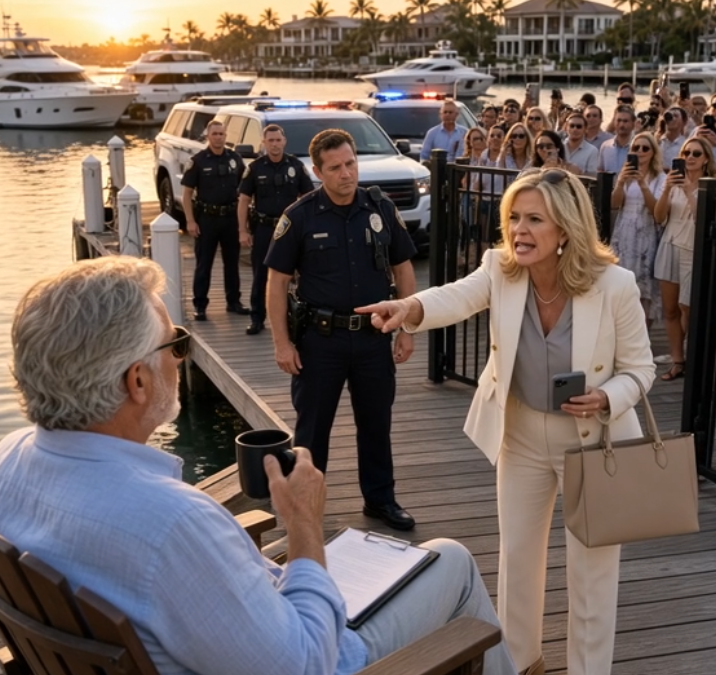
At five-thirty, Marisel arrived.
White linen suit.
Gold heels.
Sunglasses.
Phone in hand.
Behind her came residents carrying wine, cameras, and the kind of excitement people bring when they think a fight has already been won.
I was sitting at the far end of the dock.
Not hiding.
Not standing guard.
Sitting.
Coffee in hand.
Elaine’s old chair was not beside me anymore, but I still left a little space where it used to be.
Marisel reached the gate and found it locked.
Denise stood on the inside.
“Open the gate,” Marisel said.
“No.”
“We have an event.”
“No, you have a calendar entry.”
“This is HOA property.”
Denise smiled.
“No, ma’am.”
Marisel lifted her phone and started recording.
“I am documenting your refusal.”
“Please do.”
That answer irritated her.
People filming rarely enjoy consent.
Within minutes, she called the police.
I watched from the dock as residents gathered behind her.
Some looked uncomfortable.
Some whispered.
Some held phones.
One man, tall and sunburned, kept saying, “This is ridiculous,” but he did not leave.
At 6:44 p.m., the first patrol car arrived.
Then two more.
Blue lights reflected across the yachts.
The harbor glowed peach and gold.
The entire scene looked too beautiful for how stupid it was.
Officer Daniel Ruiz stepped out first.
I had hired his father twenty-eight years earlier.
Daniel was young, professional, and trying very hard not to make eye contact with me before he understood the situation.
Marisel rushed him immediately.
“Officer, thank God. This man has unlawfully locked residents out of our own yacht club facility. He is refusing to leave HOA property and disrupting a private community event.”
Ruiz listened.
Asked a few questions.
Looked at the gate.
Looked at Denise.
Looked down the dock at me.
His expression shifted.
Just slightly.
Marisel saw it.
So did I.
“Do something,” she snapped. “He’s trespassing.”
Ruiz walked through the gate after Denise opened it for him.
Two other officers followed.
They approached me at the end of the dock.
I did not stand.
Not because I was disrespectful.
Because my knees hurt and I had no reason to perform innocence.
Ruiz stopped three feet away.
“Good evening, Chief Whitaker.”
The words carried.
Marisel heard them.
Everyone heard them.
The marina went silent.
One of the other officers, Sergeant Nina Patel, nodded to me.
“Chief.”
The third, Officer Greene, looked like he wanted to disappear into the water because nobody had warned him the trespassing suspect was the retired chief whose photograph still hung in the lobby.
“Evening,” I said.
Ruiz glanced at the folder beside my chair.
“May I?”
“Of course.”
I handed it to him.
Inside were the deed, tax record, marina ownership documents, coastal permits, survey, Rachel’s letters, the trespass notices, Marisel’s emails, the fake violation notice, the event announcement, and the vendor cancellations.
I believe in ink too.
Ruiz read enough to know where the ground was.
Sergeant Patel read over his shoulder.
Marisel came down the dock without being invited.
“This is absurd. I do not care what he used to do for a living. This is HOA property.”
Ruiz looked up.
“Ma’am, please step back while we review the documents.”
“No. I called you.”
“Yes, ma’am. And we responded.”
“You need to remove him.”
Ruiz’s voice stayed calm.
“From the documents provided, it appears Chief Whitaker owns this marina.”
Her face tightened.
“That is disputed.”
I said, “No, it isn’t.”
She pointed at me.
“He has been hostile for months.”
“I have been seated for an hour.”
“He locked residents out.”
“From my gate.”
“Our governing documents reference waterfront access.”
“Not this waterfront.”
“Sterling Atlantic marketed this facility as part of Harbor Crest.”
“Sterling Atlantic also marketed homes as hurricane resistant. How did that work out last September?”
A few residents made startled noises.
Sergeant Patel lowered her eyes, perhaps to avoid smiling.
Marisel turned back to Ruiz.
“Officer, I demand you enforce our property rights.”
Ruiz looked genuinely sorry for her by then.
“Mrs. Vain, police do not enforce HOA marketing language as property rights.”
The sentence hit beautifully.
I wished Elaine had been there to hear it.
Marisel’s phone lowered another inch.
“What did you say?”
Sergeant Patel stepped in.
“Ma’am, unless you have a deed, lease, court order, or recorded access agreement showing Harbor Crest has the right to enter this marina, we cannot remove the property owner from his own dock.”
“Our attorney—”
“Do you have one of those documents?”
Marisel looked back at the residents.
That was her mistake.
She wanted support.
What she saw instead was doubt.
Some residents still looked angry.
But others were reading the room.
They saw three police officers standing respectfully near me.
They heard the word Chief.
They watched Marisel fail to produce paper.
Confidence is powerful until the room asks for proof.
Then it becomes noise.
Ruiz turned to me.
“Chief, do you want the residents removed?”
That question changed everything.
Not because I wanted mass arrests.
I did not.
But because for the first time that evening, authority was pointed in the correct direction.
Marisel understood it too.
Her eyes widened.
I stood slowly.
The dock creaked beneath my shoes.
Every phone followed me.
I looked at the residents behind the gate.
Some of them I recognized.
A few had leased slips properly.
A few had always been polite.
A few had ignored my signs.
Most had believed what Marisel told them because believing it was convenient.
“I want Mrs. Vain removed from the dock,” I said. “The residents can leave peacefully through the gate. Nobody gets cited unless they refuse.”
Ruiz nodded.
“Mrs. Vain, you need to exit the marina now.”
She stared at him.
“You cannot be serious.”
“I am.”
“This is retaliation.”
“No, ma’am. This is private property.”
Her face went red.
She looked at me.
“You will regret humiliating this community.”
I almost laughed.
But then I saw the residents watching her.
Some scared.
Some embarrassed.
Some finally understanding they had been sold something that did not exist.
So I kept my voice even.
“Marisel, I did not humiliate Harbor Crest. I protected my father’s property. You humiliated yourself when you called police without reading a deed.”
That was the clip that went everywhere.
Not because I posted it.
I did not.
A resident did.
By morning, half the town had seen it.
By noon, the headline on the local paper’s website read:
HOA PRESIDENT CALLS POLICE ON RETIRED POLICE CHIEF AT HIS OWN MARINA.
Denise printed it and taped it beside the framed violation notice.
Rachel told her that was unprofessional.
Denise said she was not a professional attorney and therefore free.
The fallout was immediate.
Harbor Crest residents demanded an emergency board meeting.
The first meeting was chaos.
I did not attend.
Rachel did.
She said she wanted to “observe governance collapse in its natural habitat.”
The residents wanted answers.
Why had the marina been advertised as an amenity?
Why had the board scheduled events there without a contract?
Why had Marisel ignored legal letters?
Why had the HOA spent money on event planning for property it did not own?
Why had the newsletter called it Harbor Crest Yacht Club?
Why had dues funded signage, wristbands, vendor deposits, and legal responses to a dispute the HOA was losing?
Marisel tried to control the room.
She spoke about misunderstandings.
Historical assumptions.
Developer representations.
Resident expectations.
The same fog.
This time, people had video.
Fog does not work well after video.
A resident named Peter Lang stood with a folder.
Peter was retired Navy, sharp-faced, and had leased slip C-14 from me properly for two years. He had warned Marisel privately that she was wrong, though I did not learn that until later.
“Madam President,” Peter said, “did Chief Whitaker’s attorney notify the board that the marina was private property?”
Marisel stiffened.
“Yes, but—”
“Did the board receive documentation?”
“We received claims.”
“Did we have documentation proving Harbor Crest ownership?”
“Our position was based on developer marketing materials and established usage.”
“That is not what I asked.”
The room shifted.
Peter continued.
“Did we have a deed?”
No answer.
“A lease?”
No answer.
“An easement?”
Marisel’s mouth tightened.
“No.”
The room erupted.
By the end of the night, two board members resigned.
Marisel refused.
That lasted four days.
Then the financials leaked.
Sterling Atlantic had, in fact, marketed “marina lifestyle access” during sales. But buried in buyer disclosures was a paragraph stating that all access to adjacent marine facilities was subject to separate private agreements and not guaranteed by the HOA.
Separate private agreements.
Not guaranteed.
Rachel underlined those words three times when she showed me.
“They knew,” she said.
“Sterling knew.”
“And anyone who read the disclosures knew.”
“Did Marisel read them?”
Rachel gave me a look.
“She read enough to ignore the parts she disliked.”
The HOA’s own files showed prior boards had tried to negotiate a group access agreement with my father years earlier.
My father declined.
There was a letter.
Short.
Firm.
Beautiful.
Dear Harbor Crest Organizing Committee,
Whitaker Marina is private property. We welcome individual members and slip holders under our ordinary terms. We will not grant blanket HOA access now or in the future.
Respectfully,
Henry Whitaker
I read that letter three times.
Then I sat in the office alone for a while.
My father had been gone twelve years, and he was still protecting the dock.
Anything worth owning is worth proving twice.
He had proven it.
Then left the proof for me.
Marisel resigned before the second emergency meeting.
Officially, to avoid becoming a distraction.
Unofficially, because the residents were moving toward removal and the HOA’s insurance carrier had started asking questions.
A temporary board formed.
Peter Lang became interim president.
His first act was to send me a letter.
Dear Chief Whitaker,
On behalf of the temporary Harbor Crest Estates board, I apologize for the misrepresentation of Whitaker Marina as HOA property or a Harbor Crest amenity. We recognize that the marina is private property and that prior communications, events, and enforcement attempts were improper. We request an opportunity to meet, correct the record, and discuss lawful future relationships with your business if you are willing.
Sincerely,
Peter Lang
It was the first honest thing the HOA had sent me.
I showed it to Denise.
She said, “Frame it next to the violation notice.”
“Absolutely not.”
She looked disappointed.
Rachel arranged the meeting.
Not at Harbor Crest.
Not at my marina.
At her office.
Neutral ground with good air-conditioning and uncomfortable chairs.
Peter came with two board members, the HOA attorney, and a woman named Alison Reed who had bought one of the first Harbor Crest homes and looked like she had not slept since the video went online.
I came with Rachel and Denise.
Rachel opened with terms.
One, Harbor Crest would issue a written correction to all residents stating clearly that Whitaker Marina was private property and not an HOA amenity.
Two, all references to Harbor Crest Yacht Club would be removed from newsletters, brochures, websites, welcome packets, signage, social media, event calendars, and sales materials.
Three, the HOA would reimburse my legal fees, staff costs, vendor disruption costs, and signage removal costs.
Four, the HOA would send a formal retraction to every vendor it had contacted.
Five, the HOA would agree not to direct residents, guests, vendors, or contractors to the marina without written permission.
Six, any resident seeking marina membership would apply as an individual, subject to the same rules as everyone else.
Seven, the HOA would not use Whitaker Marina photographs, branding, docks, slips, water views, or facilities in advertising without written licensing.
The HOA attorney tried to soften number seven.
Rachel asked whether they wanted to discuss trademark exposure.
He stopped trying.
Peter accepted most terms without drama.
Then he said, “We would still like to discuss a legitimate access arrangement.”
“No,” I said.
Everyone looked at me.
Peter nodded slowly.
“May I ask why?”
“You may.”
He waited.
I said nothing.
Denise coughed to cover a laugh.
I looked at Peter.
“Your residents can apply individually. Some already have. I will not give blanket access to an HOA that spent eight months trying to take what it could have rented honestly.”
Peter absorbed that.
Then nodded.
“That is fair.”
One of his board members, a woman named Cynthia, looked uncomfortable.
“Chief Whitaker, many residents bought homes believing marina access was included.”
“I understand.”
“They feel misled.”
“They were.”
“By Sterling Atlantic?”
“Yes.”
“And by our prior board.”
“Yes.”
“That creates hardship.”
“I believe it.”
She looked at me with tired eyes.
“Is there any path forward?”
I thought about Elaine.
About my father in the water driving pilings.
About Marisel pointing her phone at me like a weapon.
About residents behind the gate waiting to watch me get removed.
Then I thought about Peter Lang, who had leased properly.
About the couple in B-7 who always brought muffins to the office during holidays.
About the young family whose little boy called every pelican “sir.”
Not everyone in Harbor Crest was Marisel.
That mattered.
“There is a path,” I said. “But not through the HOA.”
I created a new individual membership category three weeks later.
Limited.
Seasonal.
Background and boating safety review required.
No automatic approval.
No HOA group rights.
No event rights.
No guests without registration.
No resident discount.
Denise said the no resident discount part was mean.
I said it was educational.
Peter Lang was the first Harbor Crest resident to apply under the new rules, even though he already had a slip.
He said it was symbolic.
Denise said symbolism required a processing fee.
He paid it.
The correction letter went out in July.
Dear Harbor Crest Residents,
The Board acknowledges that Whitaker Marina is privately owned and is not HOA property, not a Harbor Crest amenity, and not subject to HOA control. Prior references to “Harbor Crest Yacht Club” or community marina access were inaccurate and are withdrawn. Residents seeking access to Whitaker Marina must apply directly through Whitaker Marina under its private terms. The HOA apologizes to Chief Caleb Whitaker and Whitaker Marina for improper communications, unauthorized event announcements, signage, and enforcement attempts.
Sincerely,
Harbor Crest Estates Board of Directors
I read that letter sitting at the far end of the dock at sunset.
Denise stood beside me.
“Worth it?” she asked.
“No.”
She looked at me.
“No?”
I folded the letter.
“It should not take this much paper to make people respect a deed.”
She nodded.
“That’s true.”
“But I’m keeping it.”
“Obviously.”
Marisel tried to sell her house.
For months, no one would buy it at her asking price. Not because the house was bad. It was beautiful, in the way expensive houses can be beautiful without having any soul.
The problem was search results.
Her name, the video, the article, the HOA scandal, the phrase “called police on retired chief at his own marina”—all of it followed her listing like a smell.
Eventually, she dropped the price and found a buyer from out of state who apparently did not Google well.
Two days before she left town, she came to the marina.
Not to the dock.
To the office.
Denise called me.
“She’s here.”
“Who?”
“The linen suit.”
I sighed.
“Is she armed?”
“With entitlement, probably.”
I walked to the office.
Marisel stood near the counter wearing pale blue this time. No sunglasses. No phone in hand.
She looked smaller without an audience.
“Chief Whitaker,” she said.
“Mrs. Vain.”
“I’m leaving Harbor Crest.”
“I heard.”
“I wanted to say something before I go.”
Denise suddenly found paperwork fascinating but did not leave.
Marisel looked at her.
“Privately?”
Denise looked at me.
I shook my head.
“No. Anything about this property gets said with a witness.”
Marisel accepted that, though not happily.
“I handled things badly.”
I waited.
“I believed what Sterling Atlantic marketed.”
“That was your first mistake.”
Her lips tightened, but she continued.
“I also believed that if enough residents expected access, a legal path would have to exist.”
“That was your second.”
“I thought you were being difficult.”
“I was.”
She blinked.
I said, “I was difficult because you were wrong.”
For the first time, she almost smiled.
Not the polished one.
A tired one.
“I suppose I deserved that.”
“You deserved worse.”
Her eyes dropped.
“Yes.”
That surprised me.
She looked toward the harbor through the office window.
“It is a beautiful marina.”
“It is.”
“I wanted Harbor Crest to feel important.”
“There are easier ways than theft.”
She flinched.
“I never thought of it that way.”
“That was the problem.”
She turned back to me.
“I am sorry, Chief Whitaker.”
There it was.
Late.
Insufficient.
But real enough to stand in the room.
I nodded once.
“I accept that you said it.”
Denise glanced at me.
Marisel understood the difference.
She nodded too.
Then she left.
The door closed behind her.
Denise waited three seconds.
“That was almost mature.”
“From whom?”
“Either of you.”
I smiled despite myself.
Life quieted after that.
Not completely.
The marina was still a marina, which meant something always needed repair. Pumps failed. Lines snapped. Tourists ignored signs. A pelican stole half a sandwich from a charter captain and created a disturbance Denise described as “avian felony.”
Harbor Crest residents still applied.
Some were approved.
Some were denied.
A few complained about the fees.
Denise handed them copies of the application they had signed.
Peter Lang remained a good member.
He always checked in properly.
Always brought guests to the office first.
Always paid on time.
One afternoon, he found me at the far end of the dock.
“Chief,” he said, “I wanted to thank you.”
“For what?”
“For not punishing all of us forever.”
“I considered it.”
“I know.”
He looked out over the harbor.
“Marisel made us look foolish.”
“No. She gave you the chance to look closely. Some of you took it.”
He smiled faintly.
“That sounds like something a police chief would say.”
“I’m retired.”
“Yes, Chief.”
I gave up correcting people years ago.
That fall, my son Aaron visited from Seattle.
He had not been home in nearly two years. Work, distance, grief, and the strange way adult children avoid places that remind them of loss had kept him away.
He arrived with a backpack, tired eyes, and the guarded look of a man returning to a house where his mother’s absence still sat in the corners.
We drove to the marina at sunset.
For a while, he did not speak.
Then he walked to the far end of the dock and stopped where Elaine and I used to sit.
“You still come here every day?” he asked.
“Most days.”
“Does it help?”
I thought about lying.
Then did not.
“Sometimes. Sometimes it hurts on purpose.”
He nodded.
“I avoided it.”
“I noticed.”
“I’m sorry.”
I looked at him.
“You don’t owe me grief performed on schedule.”
His mouth tightened.
“Mom loved this place.”
“I know.”
“She would’ve hated that HOA woman.”
“She would have destroyed her politely.”
Aaron laughed.
That sound alone was worth the whole evening.
We sat on the dock with coffee.
Paper cups.
Just like the old days.
A pelican hit the water too hard near the channel marker.
Aaron shook his head.
“Mom would’ve laughed.”
“She always did.”
The wind shifted.
For a second, I felt Elaine there so strongly that I almost turned my head.
Not as a ghost.
Not as a miracle.
As memory returning to the place it belonged.
Aaron looked at me.
“You okay?”
“No.”
He nodded.
“Me neither.”
We sat there anyway.
That is something grief teaches you eventually.
You do not have to be okay to stay.
The marina’s fiftieth anniversary came the next spring.
Denise insisted on a gathering.
I told her no.
She ignored me.
Good employees are like good attorneys. They listen only when you are right.
She invited slip holders, charter captains, old friends, town officials, retired officers, and a few Harbor Crest residents who had earned trust the boring way.
By sunset, the dock was full.
Not crowded.
Full.
There is a difference.
Someone brought photographs of my father during the original construction. Henry Whitaker standing in waist-deep water, hammer raised, sun blasting down on his shoulders.
Someone else brought an old newspaper clipping from the fuel station opening.
Aaron flew in.
Rachel came.
Peter came.
Even Officer Ruiz stopped by in uniform, which made everyone call me Chief twice as much as usual just to annoy me.
Denise gave a speech.
I tried to stop her.
She threatened to tell everyone about the framed violation notice.
I let her speak.
“This marina survived storms, bad markets, worse boaters, family loss, developer pressure, and one HOA president with a fictional yacht club,” she said.
People laughed.
I did too.
Then her voice softened.
“But what kept it here was not luck. It was stewardship. Henry Whitaker built it right. Caleb Whitaker protected it. Elaine Whitaker made it warm. And all of us who use it have a duty to remember that private property and community are not opposites. Community begins when people respect what is not theirs.”
I looked down at my shoes.
Aaron put a hand on my shoulder.
Denise raised a paper cup.
“To Whitaker Marina.”
Everyone raised cups, bottles, cans, and one suspicious thermos.
“To Whitaker Marina.”
I did not speak.
Not then.
Later, after most people left and the sunset turned the water copper, I walked to the end of the dock alone.
The same place.
Always the same place.
I thought about my father.
About Elaine.
About Marisel’s phone lowering when the officer called me Chief.
About how close people can come to stealing something without ever picking a lock.
Sometimes theft starts with a word.
Our dock.
Our access.
Our community marina.
Our lifestyle amenity.
Say it enough, print it enough, put it in newsletters and brochures and event calendars, and people begin to believe the deed will eventually get tired and agree.
But ink does not get tired.
Neither does memory.
Neither does a man who knows what his father built.
People still ask whether I was embarrassed by the video.
No.
I was sad.
That surprises them.
They expect me to say vindicated, amused, satisfied.
I felt some of that.
But mostly I felt sad that it took police lights and public humiliation for people to understand what a simple document could have told them eight months earlier.
The marina was mine.
Not because I was chief.
Not because officers respected me.
Not because Marisel looked foolish.
Because my father bought the land, built the dock, recorded the papers, and left a chain of proof strong enough to hold against money, marketing, and arrogance.
That was the lesson.
Not that police officers called me Chief.
Not that Marisel lost her smile.
Not that the HOA had to apologize.
The lesson was simpler.
A title does not create ownership.
A brochure does not create rights.
An expectation is not an easement.
And calling the police does not turn another person’s dock into your property.
These days, Harbor Crest’s new welcome packet includes a paragraph in bold.
Whitaker Marina is privately owned and independently operated. Harbor Crest Estates has no ownership, control, or guaranteed access rights. Residents interested in membership must apply directly through Whitaker Marina.
Denise keeps a copy in her desk.
She calls it poetry.
I call it late.
But useful.
Every evening, when the weather is kind, I still sit at the far end of the dock with coffee in my hand.
Sometimes Aaron sits with me when he is in town.
Sometimes Peter stops by.
Sometimes Ruiz waves from the patrol boat.
Sometimes I sit alone.
Alone is different now.
Not empty.
Just honest.
The harbor still turns gold at sunset.
Pelicans still dive badly.
Ropes still knock against pilings.
Boats still creak.
The old wood still holds.
And every time I look down the dock, I see my father waist-deep in water, my wife laughing beside me, and one white linen suit standing under police lights learning that confidence without paperwork is just noise.
Marisel Vain called the cops to throw me off my own dock.
She wanted an audience.
She got one.
She wanted proof.
She got that too.
Just not the kind she expected.
Because when those officers stepped onto the teak, looked past her phone, and called me Chief, they did more than embarrass her.
They reminded everyone watching that respect is earned over years, ownership is proven in ink, and the loudest person at the gate is not always the one with the right to enter.
The dock stayed mine.
The marina stayed Whitaker.
And the next time Harbor Crest wanted to use the sunset in a brochure, they paid a licensing fee.








