HOA KAREN CALLED MY CABIN ILLEGAL—THEN SHE LEARNED HER ENTIRE SUBDIVISION ROAD WAS BUILT ON MY LAND
HOA KAREN CALLED MY CABIN ILLEGAL—THEN SHE LEARNED HER ENTIRE SUBDIVISION ROAD WAS BUILT ON MY LAND
Melissa Crane thought my grandfather’s cabin was the trespass problem.
She spent eleven months burying me under fake violation notices, blocked access signs, and legal threats before she learned the road into her entire subdivision crossed my land.
By the time the county attorney slid my survey across the table, the woman who wanted my cabin removed had to ask permission to reach her own neighborhood.
I didn’t say anything when Melissa Crane slammed her palm against the folding table inside the county zoning office and accused me of fraudulently occupying protected HOA woodland.
Not because I had nothing to say.
Not because she was right.
Because after eleven months of violation notices, fake boundary signs, blocked roads, legal threats, and neighbors photographing my grandfather’s cabin like it was evidence of a crime, I had learned that the worst thing you can do to someone like Melissa is interrupt her too early.
People like her need a room.
They need an audience.
They need to hear their own certainty echo off the walls before the first document lands in front of the person who actually understands the law.
So I let her talk.
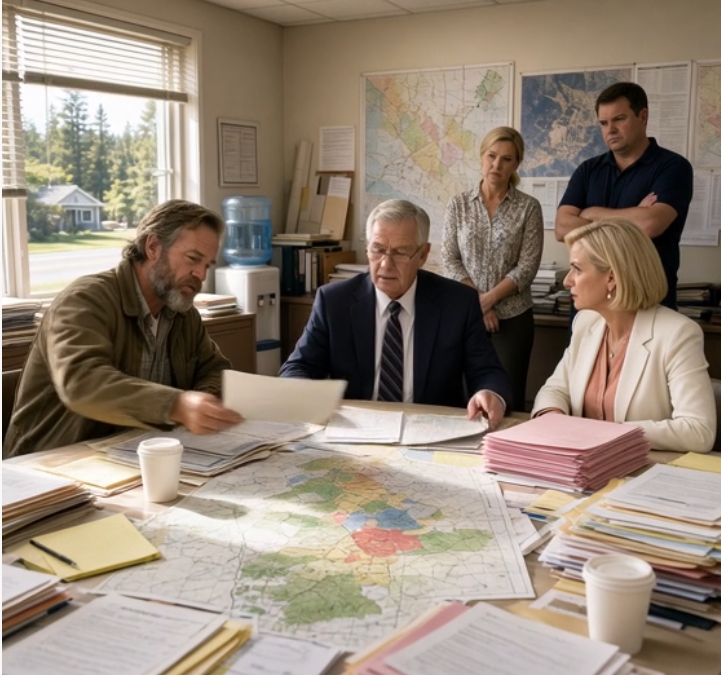
She stood at the far end of the table in a cream blazer, hair pinned back so tightly it looked painful, one hand still pressed flat against a stack of HOA violation notices she had brought as if they were court orders.
“Mr. Mercer has knowingly occupied an illegal structure inside protected Timber Creek conservation woodland,” she said, breathless with the kind of anger that comes from being used to easy victories. “His cabin violates community standards, wildfire management policy, exterior material regulations, short-term occupancy restrictions, and environmental preservation rules. Timber Creek Estates has maintained this forest corridor for years. The HOA has every right to demand removal, remediation, and penalties.”
Across from her sat the county land-use attorney, a quiet man named Howard Ellison. He adjusted his glasses and looked down at the laminated survey I had slid across the table five minutes earlier.
He had not spoken much.
That was good.
Careful attorneys read before they speak.
Melissa did not notice.
She kept going.
“My board has been more than patient,” she said. “We have sent notices. We have marked the boundary. We have attempted to resolve this peacefully. Mr. Mercer refuses to cooperate. He continues using unauthorized access roads and maintaining a nonconforming residential structure in direct conflict with Timber Creek’s conservation obligations.”
One of her board members nodded like he understood what any of that meant.
He did not.
The other board member flipped nervously through a binder, probably looking for a page that would rescue them.
There was no page.
Howard Ellison traced one highlighted line on my survey with his finger. The line began at my grandfather’s cabin parcel, followed the old forestry access corridor through a stand of pine and larch, crossed a drainage cut, and disappeared beneath a thick black mark labeled:
TIMBER CREEK ESTATES MAIN ENTRANCE ROAD.
He looked at the 1981 forestry access agreement attached behind the survey.
Then at the satellite image hanging on the county office wall.
Then back at the survey.
The room changed before he even spoke.
He turned slowly toward Melissa.
“Mrs. Crane,” he said, “were you aware that your subdivision’s entrance road crosses federally registered access land attached to Mr. Mercer’s parcel?”
PART2:
Silence hit the room so hard it almost felt staged.
Melissa’s hand lifted from the table.
The board member stopped flipping pages.
The other one leaned forward as if he had misheard.
Howard pointed to the highlighted line.
“This corridor does not simply run near Mr. Mercer’s property. It appears to run directly under Timber Creek’s landscaped entrance, the decorative stone walls, the access fencing, and nearly half a mile of your paved private roadway.”
Melissa stared at him.
For the first time in almost a year, she had no immediate answer.
That was when she understood.
Not fully.
Not legally.
But enough.
The road she used to threaten me, fine me, block me, and tell residents I was trespassing on “community woodland” was not hers to control.
The only paved entrance into Timber Creek Estates sat on land tied to my cabin.
My name is Jack Mercer.
I never wanted a fight with an HOA.
I never wanted to sit inside a county office with attorneys, federal land representatives, board members, and one red-faced HOA president learning in public that her entire neighborhood was sitting on top of a document she had never bothered to read.
I wanted quiet.
That was all.
Quiet had become important after my divorce in late 2022.
Not the peaceful kind of quiet people talk about when they imagine cabins and pine trees and coffee in the morning. I mean the other kind. The hollow quiet of a house where nobody is coming home. The kind where every room sounds too large. The kind where your phone stops ringing because people are tired of asking how you are doing and hearing you say fine.
PART3:
My daughter was grown and living in Oregon. My contracting business had turned into something I barely recognized. I had spent most of my adult life fixing other people’s problems—failed foundations, drainage mistakes, unfinished builds, bad bids, poor planning, crews that disappeared, owners who wanted mountain homes but not mountain realities.
Then my marriage ended.
My mother passed the following spring.
And suddenly the old family cabin outside Missoula became mine.
The cabin had belonged to my grandfather, Arthur Mercer.
He bought the parcel in 1979, back when that part of the valley was mostly timber, ranch fencing, old logging roads, and men who shook hands before they called lawyers. He had been a forestry contractor, the kind of man who could look at a slope and tell you where water would run in spring before snow ever touched it.
He built the cabin himself.
One room at first.
Then a sleeping loft.
Then a little porch facing west, where he could watch the sun go down behind the ridgeline and pretend he had not spent the whole day fighting chainsaws, weather, and county inspectors.
It was not fancy.
It had cedar siding darkened by time.
A green metal roof my uncle helped install in 1994.
A stone chimney that leaned just enough to look stubborn instead of dangerous.
A hand pump near the old well.
A kitchen counter made from two slabs of pine my grandfather milled himself.
When I was a kid, I thought it was the greatest place on earth.
There was no television.
No streetlights.
No neighbor close enough to hear you yell unless you really meant it.
My grandfather taught me how to split kindling there.
He taught me how to sharpen a blade.
He taught me how to patch a roof, clean a flue, and drink coffee too young because he said the world was going to be hard anyway, so I might as well get used to bitter things.
Every summer, my mother brought me there for two weeks.
Every summer, my grandfather told me the same thing.
“This place is not valuable because of the cabin,” he would say, sitting on the porch with one boot resting on the step. “It’s valuable because nobody can tell us what to do here.”
At ten years old, I did not know how wrong and right he was at the same time.
The parcel was thirty-one acres on paper, though most of it was steep, wooded, and useless to anyone who thought land only mattered if you could sell it in half-acre lots. A forestry corridor crossed the bottom edge of the property. My grandfather used it for access, timber hauling, and later just to reach the county road when snow made the upper track impossible.
In 1981, he signed a recorded access agreement with the federal forestry district and the neighboring ranch owner. The language was boring, as legal language tends to be, but the meaning was simple.
The corridor existed.
It was attached to the parcel.
It had to remain open for forestry access, emergency access, and lawful ingress and egress to the Mercer property.
My grandfather kept a copy in a metal lockbox under his bed.
My mother kept another copy in a plastic folder labeled CABIN—DO NOT LOSE.
I used to laugh at that.
After she died, I stopped laughing.
When the cabin came to me, I did not plan to live there full-time. I had a small house closer to town, too many tools, too many unpaid invoices, and too much life still tangled in the places my ex-wife had left behind.
But in June of 2023, I drove up to the cabin to check the roof after a storm.
I stayed one night.
Then two.
Then a week.
Then I realized I was sleeping better there than I had slept anywhere in years.
The quiet felt different in the cabin.
Not empty.
Old.
The walls creaked at night. Wind moved through the pines. Rain struck the metal roof with a sound that made the rest of the world feel far away. I started waking up before dawn, making coffee on the propane stove, sitting on the porch, and feeling something inside me unclench by half an inch.
That was before Melissa Crane decided I was a problem.
The first notice arrived taped to my cabin door on a Tuesday morning.
I remember that because I had just finished repairing the south window trim and had paint on my hands when I found it.
The paper was bright orange.
OFFICIAL HOA VIOLATION NOTICE.
Timber Creek Estates Homeowners Association.
Unauthorized structure.
Unauthorized occupancy.
Noncompliant exterior materials.
Failure to register property.
Improper access road usage.
Possible encroachment on conservation woodland.
Fine: $500.
I stared at it for a full minute.
Then I laughed.
Not because it was funny.
Because it was so wrong my brain refused to take it seriously.
Timber Creek Estates was the gated subdivision down the road, built sometime around 2006 on land that used to be part of the MacAuley ranch. I had watched the first houses go up from my grandfather’s porch. Back then, he had called them “rich boxes with fireplaces.”
The subdivision had manicured roads, decorative stone pillars at the entrance, black metal fencing, a little sign that said PRIVATE COMMUNITY, and houses with names instead of addresses.
Whispering Pine Lodge.
Elk Ridge Retreat.
The kind of places people from California and Texas bought so they could tell friends they had a Montana cabin while still being upset about mud.
My grandfather’s cabin had never been part of Timber Creek.
Not once.
Not on any plat.
Not on any deed.
Not in any covenant.
I took the notice down, folded it once, and stuck it inside my truck.
Then I drove to the Timber Creek gatehouse.
That was the first time I met Melissa Crane.
She was standing beside the gate kiosk, speaking to a landscaping crew about mulch color with the intensity of a woman negotiating hostage terms. She wore white jeans, leather sandals, and sunglasses large enough to hide half her face.
“Can I help you?” she asked before I even finished getting out of the truck.
“I hope so,” I said. “Somebody taped this to my cabin.”
I handed her the notice.
She glanced at it and gave me a tight smile.
“Yes. That would be from our compliance committee.”
“I’m not in your HOA.”
Her smile did not move.
“The structure is inside the Timber Creek conservation boundary.”
“No, it isn’t.”
“Mr…”
“Mercer.”
Her eyes sharpened slightly.
“Mr. Mercer, Timber Creek Estates has maintained that woodland corridor for years.”
“That does not make it yours.”
Her sunglasses lowered a fraction.
“Do you have documentation supporting your claim?”
“I have a deed.”
“All property owners claim to have deeds.”
That was the moment I should have understood what kind of person I was dealing with.
Not because she was wrong.
Wrong can be fixed.
Melissa was certain.
Certainty is harder.
“I’ll email the county plat,” I said. “You can correct your records.”
“That would be appreciated,” she replied, in a voice that made it clear she would appreciate no such thing.
I sent her the plat that afternoon.
I sent the deed.
I sent the tax map.
I sent a brief note that said my parcel was private family land, not part of Timber Creek Estates, and that no HOA authority applied to the cabin.
She replied the next morning.
Mr. Mercer,
Thank you for your email. The Timber Creek Board will review the materials. Until such review is complete, please cease all unauthorized use of Timber Creek access roads and refrain from further modifications to the structure.
Regards,
Melissa Crane
HOA President, Timber Creek Estates
Cease use of access roads.
That line sat in my chest like a stone.
I wrote back.
Mrs. Crane,
The road I use predates your subdivision. I will not cease access to my own property.
Jack Mercer
That was the last polite email for a while.
Two days later, three wooden stakes appeared near the lower road with red ribbons tied around them.
HOA CONSERVATION BOUNDARY.
PRIVATE WOODLAND.
NO TRESPASSING.
I pulled them out and stacked them neatly beside the Timber Creek entrance sign.
The next day, they were back.
This time, there were six.
I pulled them again.
A week later, a white SUV followed me from the county road to the cabin. It stopped near the drainage cut, idled for twenty seconds, then backed away.
The following morning, I found tire tracks near my shed and another orange notice taped to the door.
Fine: $1,000.
Failure to comply with prior violation.
Unauthorized removal of boundary markers.
Continued illegal occupancy.
I called the county.
The woman in the assessor’s office, Marcy, sounded tired before I finished the first sentence.
“Timber Creek again?” she asked.
“That sounds like a loaded question.”
“They call a lot.”
“About my property?”
“About many things.”
“My cabin is not in their HOA.”
“No, sir. It is not.”
“Can you put that in writing?”
“I can send you the parcel record.”
“Will that stop them?”
A pause.
“No.”
She was honest.
I liked her.
The next week, Melissa sent a certified letter.
The letter accused me of degrading conservation land, creating wildfire risk, maintaining an unapproved dwelling, using noncompliant exterior materials, and failing to submit architectural review documents.
Architectural review.
For a cabin my grandfather built before Melissa Crane probably knew Montana had counties.
I should have hired an attorney then.
I did not.
That was my mistake.
I was a contractor. I had dealt with boundary disputes before. I knew enough to read maps, understand setbacks, and recognize nonsense when someone printed it on letterhead.
But I underestimated the power of persistent nonsense.
Melissa did not need to be right to make my life smaller.
She only needed to keep showing up.
At first, it was notices.
Then emails.
Then letters from the HOA’s attorney, a man named Preston Vale, whose signature looked more expensive than his arguments.
Then came the neighbors.
A retired dentist named Lloyd Peabody walked up my road one afternoon wearing hiking shorts, a straw hat, and the offended expression of someone who had discovered weather.
“Are you Mr. Mercer?” he asked.
“I am.”
“I live in Timber Creek.”
“I’m sorry.”
He blinked.
“I beg your pardon?”
“Nothing. What do you need?”
He looked past me at the cabin.
“We were told this structure is illegal.”
“By Melissa?”
“Mrs. Crane explained that you are occupying protected community woodland.”
“Did Mrs. Crane show you a survey?”
“She showed us a map.”
“What kind of map?”
“A community planning map.”
“Did it have parcel numbers?”
He hesitated.
“I don’t recall.”
“That means no.”
His mouth tightened.
“Mr. Mercer, we moved here because Timber Creek has standards.”
“I moved here because my grandfather built this cabin.”
“That does not give you permission to violate conservation rules.”
“No,” I said. “My deed does.”
He did not like that.
People who come to scold rarely enjoy being asked to think.
After Lloyd came a woman with a camera.
Then two men in matching Timber Creek fleece jackets.
Then someone placed a laminated complaint form in my mailbox, which was illegal for them to do and also deeply irritating.
They photographed my woodpile.
My porch.
My truck.
My chimney.
One man photographed my outhouse even though it had not been used in fifteen years and existed mostly because my grandfather refused to tear down anything that still had walls.
In September, Melissa escalated.
She had a contractor install a chain across the lower access road.
Red reflective tape hung from it.
PRIVATE HOA ACCESS.
AUTHORIZED RESIDENTS ONLY.
I found it at six-thirty in the morning while driving to a job site.
For a minute, I sat behind the wheel and looked at the chain.
My coffee steamed in the cup holder.
The pines shifted in the early light.
Something in me went very still.
I got out, walked to the chain, and checked the posts.
Fresh concrete.
They had not just hung a chain.
They had installed posts into the corridor.
I called the sheriff’s office.
Deputy Caleb Frost arrived forty minutes later, young enough to still look embarrassed by other people’s stupidity.
He stood beside the chain, hands on his belt.
“You own this road?”
“I own the parcel tied to the corridor. The access agreement is recorded.”
“You have paperwork?”
“At the cabin.”
“And they have paperwork?”
“They have confidence.”
He sighed.
“That’s worse.”
Melissa arrived before I could drive back to get the documents.
Of course she did.
Her white SUV came down from the Timber Creek entrance and stopped on the other side of the chain. She stepped out wearing a navy coat and boots that had never met mud before.
“Deputy,” she called. “Thank goodness. Mr. Mercer is attempting to remove HOA safety infrastructure.”
“I haven’t touched it,” I said.
“You were clearly preparing to.”
“I was clearly drinking coffee.”
Deputy Frost raised one hand.
“Mrs. Crane, who installed this chain?”
“The HOA did.”
“On what authority?”
She smiled as if she had been waiting for the question.
“Timber Creek Estates maintains this conservation corridor under its environmental management obligations.”
“That was not what I asked.”
Her smile thinned.
“The road is part of Timber Creek’s private access network.”
“No,” I said. “It isn’t.”
She looked at me like I was a stain.
“Mr. Mercer keeps repeating that.”
“Because reality is repetitive.”
Deputy Frost coughed.
Melissa ignored me and handed him a folder.
Inside were maps.
I knew before he opened them that they would be wrong.
Not forged.
Not exactly.
Worse.
Simplified.
HOA maps are often like children’s drawings with legal ambition. They show what a board wishes was true. Common area shaded green. Roads thickened. Boundaries rounded to make brochures look clean. They are not surveys.
Deputy Frost looked at her map.
Then at the chain.
Then at me.
“I’m not settling a land dispute on the side of the road,” he said. “But I can tell you this. If Mr. Mercer has a recorded access right, blocking it may be a problem.”
Melissa’s eyes flashed.
“Deputy, this man is not a resident.”
“He says he is a property owner.”
“He is outside the community.”
“Then why are you blocking him?”
That question sat there beautifully.
Melissa did not answer it.
Deputy Frost told her to remove the chain until the county reviewed the records.
She refused.
Politely.
That was her specialty.
Polite refusal wrapped in procedural fog.
By noon, I had cut the chain.
Not with rage.
With bolt cutters.
Calmly.
Cleanly.
I left it coiled beside one post.
That afternoon, I received a letter from Preston Vale accusing me of vandalism, trespass, destruction of HOA property, and interference with community safety infrastructure.
Fine: $5,000.
I hired an attorney the next day.
Her name was Rachel Kim.
She was small, direct, and had the terrifying patience of a person who enjoyed watching arrogant people run out of rope.
Her office was above a bakery in Missoula. The entire place smelled like cinnamon rolls, which made her legal threats feel friendlier until she opened her mouth.
I spread the notices across her desk.
She read quietly.
Every now and then, she made a note.
When she finished, she looked at me.
“How much do you want to hurt them?”
I blinked.
“Legally?”
“That is the only kind I bill for.”
“I don’t want a war.”
“Then why did you let them start one?”
I had no answer.
She tapped the first violation notice.
“This is nonsense.”
“I know.”
“This is also nonsense.”
“I know.”
“This letter from their attorney is aggressive nonsense.”
“I liked that one least.”
“And this chain across the access corridor may be where they made a real mistake.”
I leaned forward.
“How real?”
“That depends on the documents.”
I pulled out my grandfather’s lockbox folder.
The deed.
The tax map.
The 1981 forestry access agreement.
Two old surveys.
A handwritten note from my grandfather that said:
Road stays open. Do not let anybody pretty it up and steal it.
Rachel read that twice.
“I like your grandfather.”
“You would have hated him in person.”
“Probably.”
She ordered a modern survey.
That cost more than I wanted to spend.
Then a title review.
Then a historical easement report.
Then she contacted the county land-use office.
For the next two months, I lived in two worlds.
By day, I worked jobs, repaired decks, inspected foundation cracks, and tried to act like I was not slowly being buried in legal fees.
By evening, I came back to the cabin and found new signs, new notices, and sometimes Timber Creek residents walking the road as if they were patrolling a border.
Melissa kept escalating because nobody had stopped her yet.
That is another thing about people like her.
They mistake delay for victory.
In October, she sent an email to all Timber Creek residents.
Dear Neighbors,
As many of you know, the Board is currently addressing an unauthorized occupation within the Timber Creek conservation corridor. This matter concerns safety, environmental protection, property values, and the integrity of our governing documents. Please avoid direct confrontation with the occupant. Continue documenting any suspicious activity.
The occupant.
Not neighbor.
Not property owner.
Not Jack.
The occupant.
For three days, I found people slowing near the cabin.
One man flew a drone over my porch while I was drinking coffee.
I shot it down with a garden hose.
He threatened to sue me for damaging his equipment.
I told him his equipment was welcome to stay off my property and dry.
Then came the worst part.
They started talking to my daughter.
My daughter, Erin, called me one Sunday evening.
“Dad,” she said carefully, “is everything okay with the cabin?”
I froze.
“Why?”
“Someone messaged me.”
“Who?”
“A woman named Melissa Crane. She said she was trying to reach family members regarding your unlawful occupancy and possible environmental violations.”
For a moment, I could not speak.
That was the first time Melissa made me truly angry.
Not annoyed.
Not tired.
Angry.
The kind of anger that makes everything in the room sharpen.
“What did you say?” I asked.
“I told her not to contact me again.”
“Good.”
“Dad, what’s going on?”
I looked around the cabin.
At the old stove.
At the table my grandfather built.
At the wall where my mother had once taped up a picture I drew of a moose that looked more like a dog.
“An HOA thinks they own what they don’t.”
“Do you need help?”
“No.”
She was quiet.
“You always say no.”
“I’m handling it.”
“You always say that too.”
I closed my eyes.
My daughter had inherited my ex-wife’s gift for finding the soft spot under the armor.
“I have an attorney,” I said.
“That is not the same as having help.”
“I know.”
“Do you?”
I almost smiled.
“Apparently not.”
That night, I forwarded Melissa’s message to Rachel.
Rachel replied eight minutes later.
Excellent. She contacted your family. Judges love that.
That was when I began to understand Rachel Kim.
She did not get angry quickly.
She collected.
By November, the survey came back.
I was sitting at the cabin table when Rachel emailed it to me.
I opened the PDF slowly, expecting confirmation of what I already knew.
I got more than that.
The survey showed my parcel exactly where it had always been.
The cabin well inside the boundary.
No encroachment into Timber Creek.
No HOA jurisdiction.
No conservation violation.
That part was expected.
What I did not expect was the access corridor.
The old forestry corridor did not just connect my parcel to the county road.
It ran beneath Timber Creek’s main entrance road.
Not beside it.
Not near it.
Under it.
The subdivision developer had paved over the old corridor, widened it, landscaped it, built decorative stone walls along it, installed private gate infrastructure near it, and then sold the road into the HOA’s private maintenance system without properly extinguishing or relocating the recorded access rights attached to my grandfather’s parcel.
I called Rachel.
She answered with, “You saw it.”
“Yes.”
“You understand what it means?”
“I think so.”
“Tell me.”
“Their entrance road crosses my access land.”
“More precisely, their entrance road occupies a recorded corridor benefiting your parcel and subject to federal access language.”
“Meaning?”
“Meaning they had no business blocking you. Meaning their claim that you are trespassing on their conservation land is not just wrong. It is inverted. Meaning their private road may be subject to rights they have ignored for seventeen years.”
I looked out the window toward the pines.
“And Melissa doesn’t know.”
“No.”
“She has no idea.”
“Based on her letters, absolutely none.”
For the first time in months, I laughed.
Rachel did not.
“Do not get cute,” she said.
“I was not planning to get cute.”
“You are a contractor. Contractors get cute with property disputes.”
“That sounds discriminatory.”
“It is experience.”
“What do we do?”
“We request a county land-use conference. We bring the survey. We bring the title report. We bring the access agreement. We bring the federal representative if available.”
“And Melissa?”
Rachel’s voice cooled.
“We let her bring her binder.”
The meeting was set for December 14.
County zoning office.
Ten in the morning.
Howard Ellison would attend for the county.
A representative from the federal forestry access office would attend by video.
Melissa would bring two board members and Preston Vale, her attorney.
I brought Rachel.
And the lockbox.
I wore jeans, boots, and a gray button-down shirt my daughter told me made me look less like a man who argued with lumber.
Melissa arrived seven minutes late.
That annoyed Howard Ellison immediately.
Attorneys notice punctuality like carpenters notice crooked walls.
She swept into the room with Preston behind her and two board members carrying binders. She did not look at me until she sat down.
Then she smiled.
“Mr. Mercer.”
“Mrs. Crane.”
“I hope we can resolve this today.”
“So do I.”
That was true.
Just not in the way she meant.
Howard began with procedural language.
Purpose of conference.
No final determination today unless parties reached agreement.
Review of parcel records.
Review of alleged HOA authority.
Melissa barely waited for him to finish before launching into the speech that began this whole story.
Illegal structure.
Protected woodland.
Community standards.
Wildfire management.
Environmental preservation.
Unauthorized access.
Penalties.
Removal.
Remediation.
She spoke for nearly eight minutes.
Rachel said nothing.
I said nothing.
Howard read.
Preston Vale tried once to interrupt Melissa gently. She talked over him.
That was when I realized even her own attorney had not fully seen the documents she was relying on.
Or maybe he had just begun to understand they were worse than useless.
Finally, Howard asked the question.
“Mrs. Crane, were you aware that your subdivision’s entrance road crosses federally registered access land attached to Mr. Mercer’s parcel?”
The room froze.
Melissa stared.
Howard continued, calm as winter.
“This corridor appears to run directly under Timber Creek’s landscaped entrance, the decorative stone walls, the access fencing, and nearly half a mile of your paved private roadway.”
Preston leaned forward.
“May I see that survey?”
Rachel slid him a copy.
He read.
His face changed by degrees.
First irritation.
Then focus.
Then concern.
Then the expression of a man realizing his client had walked him into a bear trap while waving a flag.
Melissa recovered enough to speak.
“That cannot be correct.”
Howard looked at her over his glasses.
“Surveys are not corrected by disbelief.”
Her cheeks reddened.
“Our developer conveyed those roads to the association.”
“Subject to existing recorded rights,” Rachel said.
Melissa turned toward her.
“And you are?”
“Rachel Kim. Counsel for Mr. Mercer.”
Melissa’s eyes flicked to me, as if hiring an attorney was somehow unfair.
Rachel continued.
“The Mercer parcel predates Timber Creek Estates. The cabin predates Timber Creek Estates. The access corridor predates Timber Creek Estates. Your client’s governing documents do not create jurisdiction over land they never owned.”
Preston adjusted his tie.
“We will need to review chain of title.”
“Please do,” Rachel said. “We already did.”
Howard turned to the screen where the federal representative, a woman named Ellen Price, had been listening silently.
“Ms. Price, does your office have a preliminary position?”
Ellen looked down at her own documents.
“Our records confirm the 1981 access agreement. The corridor was preserved for forestry management access, emergency access, and ingress and egress benefiting the Mercer parcel. We do not show any recorded extinguishment, relocation, or superseding agreement.”
Melissa’s board member, the nervous one, whispered, “What does that mean?”
Howard answered before anyone else could.
“It means Timber Creek Estates may have constructed and maintained improvements over an existing access corridor without properly resolving the underlying rights.”
The other board member leaned back.
“You mean our road is on his land?”
Melissa snapped, “No.”
Rachel said, “Not exactly.”
Everyone looked at her.
She folded her hands.
“The road is physically located within a corridor burdened by recorded rights benefiting Mr. Mercer’s property and involving federal access interests. Ownership and easement rights need precise legal review. But what is clear today is that Timber Creek had no authority to block Mr. Mercer’s access, fine him under HOA covenants, or claim his cabin is an illegal HOA structure.”
Preston closed his folder.
For a second, I almost felt bad for him.
Almost.
Melissa was breathing through her nose.
“This is absurd,” she said. “This man has been using Timber Creek infrastructure without contributing maintenance fees.”
I laughed once.
I did not mean to.
The whole room looked at me.
I held up a hand.
“Sorry.”
Howard said, “Mr. Mercer?”
I looked at Melissa.
“For eleven months, you told me I had no right to use that road. Now you are upset I have not paid dues for it.”
Melissa glared.
“That road is maintained by our association.”
“That road was built over my grandfather’s access corridor.”
“It serves seventy-six homes.”
“And one cabin.”
Her jaw tightened.
“The association will not be held hostage by one man living in a shack.”
Rachel’s eyes sharpened.
Howard’s face went still.
Preston actually closed his eyes.
That was the sentence Melissa should not have said.
The room heard it.
Not just the insult.
The truth beneath it.
This had never been about conservation.
It had never been about rules.
It had never been about wildfire management or exterior materials or community standards.
It was about a woman in a subdivision looking at an old family cabin and deciding it did not belong in the story she wanted to tell about her neighborhood.
Howard spoke carefully.
“Mrs. Crane, I would advise you to refrain from characterizing Mr. Mercer’s residence.”
Melissa sat back.
The meeting did not end with fireworks.
Real legal turning points rarely do.
They end with people suddenly using smaller voices.
Howard issued a preliminary county position.
My cabin was outside Timber Creek Estates.
No HOA covenant authority applied.
The county had no current enforcement action against my structure.
Timber Creek was instructed to cease issuing notices, fines, boundary markings, or access restrictions related to my parcel until the matter was resolved.
The chain across the access road could not be replaced.
Any signage implying HOA ownership over my parcel had to be removed.
The county would conduct a formal review of the road corridor and recorded access rights.
The federal office would also review.
Preston requested thirty days.
Rachel gave him fourteen.
Howard gave everyone twenty-one.
Melissa left without looking at me.
Her board members looked like men who had volunteered for a bake sale and ended up in a deposition.
Outside, snow had begun falling lightly over the county parking lot.
Rachel stood beside my truck, pulling on gloves.
“You did well,” she said.
“I barely spoke.”
“That is why.”
I looked toward the road where Melissa’s white SUV was already turning out.
“What happens now?”
“Now they panic.”
“They have a gate. Roads. Houses. Owners. Maintenance obligations.”
“Yes.”
“Could I block the road?”
Rachel looked at me.
“No.”
“I was asking legally.”
“No.”
“Could I charge tolls?”
“No.”
“You’re no fun.”
“I am excellent fun. I am also preventing you from becoming the villain in your own case.”
I looked back at the county building.
“What can I do?”
“Let them come to the table.”
“And if they don’t?”
She smiled.
“Then we bring the table to court.”
Timber Creek called an emergency board meeting that night.
I know because three residents emailed me before nine.
One apologized.
One asked whether they would still be able to access their home.
One accused me of attempting to destroy property values.
That last one came from Lloyd Peabody.
I replied to none of them.
The next morning, Melissa sent an email to residents.
Dear Timber Creek Homeowners,
The Board is aware of certain claims made by Mr. Mercer regarding historical access language affecting portions of Timber Creek’s entrance road. These claims are preliminary, disputed, and should not be cause for concern. The Board is working with counsel to protect the interests of the community.
She did not mention that her notices had been invalid.
She did not mention the county’s instruction.
She did not mention the federal representative.
She did not mention the survey.
That afternoon, someone left a note in my mailbox.
STOP TRYING TO STEAL OUR ROAD.
I stared at it for a long time.
Then I drove to the Timber Creek gatehouse and taped it to Melissa’s office door with a copy of the federal access agreement.
Maybe that was childish.
Rachel said it was “understandable but not strategically ideal.”
Which meant childish.
The next week was strange.
Timber Creek residents suddenly saw me differently.
Not better.
Differently.
Some waved nervously when I passed.
Some refused to look at me.
A man in a black Range Rover stopped near the cabin and rolled down his window.
“Are you really going to shut down the road?”
“No.”
He exhaled.
“Melissa said you might.”
“Melissa says many things.”
“My wife has cancer. We need that road for medical appointments.”
“I’m not shutting down the road.”
He studied me.
Then nodded.
“I’m sorry.”
“For what?”
“For believing her.”
That surprised me.
Most apologies arrive dressed as explanations.
His did not.
I nodded back.
After he left, I stood in the snow for a while.
Anger is easier when everyone on the other side is faceless.
It gets harder when one of them has a sick wife and fear in his voice.
More emails came.
A young couple with two kids asked whether school buses would still be allowed through.
A retired firefighter asked if emergency access was at risk.
An elderly woman named Margaret Bell left a handwritten letter on my porch.
Dear Mr. Mercer,
I am ashamed to admit that I signed the petition against your cabin. I did so because Mrs. Crane told us your woodstove threatened the conservation corridor and that your road use endangered residents. I have now learned she may not have represented the matter accurately. I am sorry.
My husband loved old cabins. He would have told me to mind my own business.
Sincerely,
Margaret Bell
I kept that letter.
It was the first decent thing anyone from Timber Creek had given me.
By January, the review was complete.
The result was exactly what Rachel expected.
The Timber Creek entrance road occupied and improved the historic forestry access corridor.
The HOA did not own my cabin parcel.
The HOA had no covenant authority over my land.
The HOA could not restrict my access.
The decorative stone walls, fencing, and gate infrastructure partially encroached into the protected corridor and required corrective agreements.
The county strongly recommended mediation before litigation.
Melissa refused mediation.
Then Timber Creek’s insurance carrier got involved.
Suddenly, mediation sounded wonderful.
We met again in February.
This time, Melissa did not lead the talking.
Preston did.
He looked like a man who had spent the previous month aging in billable increments.
The Timber Creek board had expanded the meeting to include two additional members, one of whom was Margaret Bell.
I liked her immediately because she brought her own notebook and looked at Melissa as if she had already been disappointed several times that week.
Rachel laid out our demands.
One.
Permanent written acknowledgment that the Mercer parcel was not and had never been subject to Timber Creek HOA covenants.
Two.
Removal of all fines, notices, and claims.
Three.
Written apology and correction to all Timber Creek residents.
Four.
Recorded road and access agreement recognizing my rights and preserving the subdivision’s ability to use the road without interfering with my parcel.
Five.
Shared maintenance contribution, not HOA dues, for the portion of road serving both Timber Creek and my cabin.
Six.
Removal or relocation of any gate, fencing, landscaping, or signage that impaired my access or misrepresented ownership.
Seven.
Payment of my legal and survey costs.
Melissa exploded at number three.
“I will not apologize to a man who weaponized a technicality against an entire community.”
Margaret Bell looked up from her notebook.
“You weaponized the entire community against one man.”
The room went quiet.
Melissa turned slowly.
“I beg your pardon?”
Margaret removed her glasses.
“No, Melissa. I think Mr. Mercer is owed the apology.”
Melissa’s face darkened.
“You do not understand the complexity.”
“I understand that you told us his cabin was illegal. It is not. You told us he was trespassing. He was not. You told us he was stealing access. In fact, we appear to have been using his access. You told us he refused to cooperate. From what I see, he sent documents you ignored.”
Melissa opened her mouth.
Margaret continued.
“And you contacted his daughter. That was shameful.”
For a moment, I saw the entire board shift.
Not dramatically.
But enough.
Melissa had built power by sounding certain.
Certainty only works while people believe it.
Preston cleared his throat.
“I suggest we discuss settlement language.”
That was the beginning of the end.
Not the end of the fight.
The end of Melissa’s version of it.
The settlement took six weeks.
The apology took eight drafts.
The first one said:
The Board regrets any confusion.
Rachel wrote in red:
No.
The second said:
The Board acknowledges that certain historical documents may have been misunderstood.
Rachel wrote:
Try again.
The third said:
The Board acknowledges that Mr. Mercer’s parcel is not subject to Timber Creek Estates HOA covenants and that prior notices were issued in error.
Rachel wrote:
Better. Add apology.
Melissa resisted until the board outvoted her.
The final letter went to every Timber Creek resident.
Dear Timber Creek Homeowners,
Following county review and legal consultation, the Board acknowledges that the Mercer cabin parcel is private property outside the Timber Creek Estates HOA and is not subject to Timber Creek covenants, architectural standards, fines, or enforcement authority.
Prior notices regarding Mr. Mercer’s property were issued in error and are withdrawn in full.
The Board further acknowledges that portions of Timber Creek’s entrance road occupy a recorded historical access corridor benefiting the Mercer parcel. Timber Creek Estates has entered into an agreement recognizing Mr. Mercer’s access rights while preserving continued residential access for Timber Creek homeowners.
We apologize to Mr. Mercer for the incorrect notices, access interference, and communications that mischaracterized his legal rights.
Sincerely,
Timber Creek Estates Board of Directors
Melissa’s name was not on it.
By then, she had resigned.
Officially, for personal reasons.
Unofficially, because Margaret Bell and two other board members called a special meeting and Timber Creek residents discovered that arrogance became expensive when printed on letterhead.
I did not attend.
Rachel did.
For fun, she said.
In April, the crews came to remove the false boundary signs.
I watched from my porch as two workers pulled them from the ground one by one.
PRIVATE HOA WOODLAND.
NO TRESPASSING.
CONSERVATION BOUNDARY.
They stacked them in the back of a pickup.
The decorative stone wall near the entrance was modified to create a clearly marked access lane. The gate system was adjusted so my code worked permanently, not as a guest pass. The road agreement was recorded with the county.
And Timber Creek began sending me a yearly road maintenance statement.
Not dues.
Never dues.
A maintenance contribution.
The first time I paid it, I wrote on the memo line:
For the road under your road.
Rachel told me not to do that again.
The cabin stayed.
Of course it did.
I replaced the porch rail in May.
Repaired the chimney in June.
Stacked firewood in July.
In August, my daughter Erin visited from Oregon.
She arrived in a dust-covered Subaru with a dog named Milo and the same look her mother used to give me when I pretended not to need help.
She stepped out, looked at the cabin, then at the road.
“So this is the famous illegal shack.”
“It prefers historic non-HOA structure.”
She laughed and hugged me.
That hug lasted longer than usual.
I did not pull away first.
That felt like progress.
We spent two days at the cabin. I showed her the survey. The access corridor. The place where the false chain had been. The modified entrance road. My grandfather’s old lockbox.
She read his handwritten note.
Road stays open. Do not let anybody pretty it up and steal it.
“He sounds like you,” she said.
“I sound like him.”
“That too.”
On the second evening, we sat on the porch while Milo chased moths near the steps.
The sunset turned the tops of the pines copper.
Down below, through the trees, a few Timber Creek porch lights glowed in the dusk.
“Are you still angry?” Erin asked.
I thought about it.
“At Melissa?”
“At all of it.”
The answer should have been easy.
It was not.
“Less than I was.”
“Why?”
I looked at the cabin wall, at the old cedar boards, at the knots and weathering and nail heads my grandfather had driven by hand.
“Because anger kept the cabin from being stolen. But it cannot be the reason I stay here.”
She was quiet.
Then she said, “That sounds healthy.”
“Don’t sound surprised.”
“I am extremely surprised.”
I smiled.
Across the valley, a car turned through the Timber Creek entrance. Its headlights moved slowly along the road built over my grandfather’s corridor.
For nearly a year, Melissa had tried to convince an entire subdivision that I was trespassing in the place my family had held for decades.
She had called my cabin illegal.
She had called my presence a threat.
She had put signs on land she did not own, blocked a road she did not understand, and built her authority on the assumption that nobody would dig past the first convenient map.
But land remembers.
Paper remembers.
Old agreements remember.
So do families.
The following fall, Margaret Bell walked up to my cabin with a pie.
Apple.
Slightly burned on one edge.
She stood on the porch holding it like a peace offering from a nation that had recently changed governments.
“I wasn’t sure if you liked apple,” she said.
“I do.”
“I wasn’t sure if you liked visitors.”
“I tolerate some.”
She smiled.
“I wanted to tell you something. The new board voted to preserve the lower woodland as actual conservation land. No trails without county review. No signs without survey confirmation. No enforcement letters without counsel reading them first.”
“That last one seems wise.”
“Yes. Expensive wisdom, but wisdom.”
She handed me the pie.
“I also wanted to say that many of us owe you more than one apology.”
“You already apologized.”
“I apologized for myself. I am apologizing again for the crowd.”
I looked down at the pie.
“Crowds are hard to apologize for.”
“They are easy to hide in.”
That was true.
We stood there quietly.
Then she looked at the cabin.
“It is a beautiful place.”
I followed her gaze.
The cabin was not beautiful in the way magazines use the word.
It was weathered.
Uneven.
Too plain for people who liked stone columns and gated entrances.
But it stood.
It had stood through snow, rain, neglect, grief, and Melissa Crane.
“Yes,” I said. “It is.”
After she left, I set the pie on the table and opened the old lockbox.
The documents were still there.
Deed.
Survey.
Access agreement.
My grandfather’s note.
I added the new recorded road agreement.
Then the apology letter.
Then Margaret’s handwritten note from the previous winter.
Not because they had equal legal value.
Because they told the whole story.
A cabin is not just boards and nails.
A road is not just asphalt.
A property line is not just a line.
They are memory.
They are power.
They are the difference between asking permission and knowing where you stand.
That was what Melissa never understood.
She thought authority came from a title.
President.
Board.
Committee.
She thought if she printed enough notices, repeated enough phrases, and made enough people afraid, the facts would eventually move out of her way.
But facts do not care how tight your blazer is.
A deed does not blush.
A survey does not get intimidated.
An old access agreement recorded before your subdivision existed does not vanish because you planted flowers over it.
And a man who came to the woods looking for quiet might still know how to fight when you threaten the last place his family left him.
I still live at the cabin part of the year.
Not full-time.
Not yet.
My contracting business survived. My daughter calls more often. I have learned to answer honestly sometimes, which makes both of us uncomfortable but has improved the conversations.
The Timber Creek residents mostly leave me alone now.
Some wave.
Lloyd Peabody does not.
That is fine.
His wave always looked painful anyway.
The new board sends notices about road maintenance, tree management, and fire mitigation with careful language and survey attachments. Rachel says she has never seen an HOA become so document-conscious so quickly.
I tell her fear is educational.
She says so are legal fees.
Every winter, I plow my part of the access lane and sometimes a little beyond it.
Not because I have to.
Because the woman with cancer still lives in Timber Creek, and her husband drives her to appointments before dawn.
Because Margaret Bell brings pie twice a year.
Because not everyone who was wrong stayed wrong.
That matters.
But I also keep the bolt cutters hanging in the shed.
That matters too.
One morning, nearly a year after the county meeting, I stood at the end of the porch with coffee in my hand and watched snow fall over the road.
The pines were silent.
The cabin roof held a clean white line.
Down the hill, the entrance road curved through the trees exactly where my








