HOA Karen Called 911 to Shut Down My Son’s 10th Birthday Party—Then Police Checked Her False “Violence” Report and Put Her in Handcuffs.
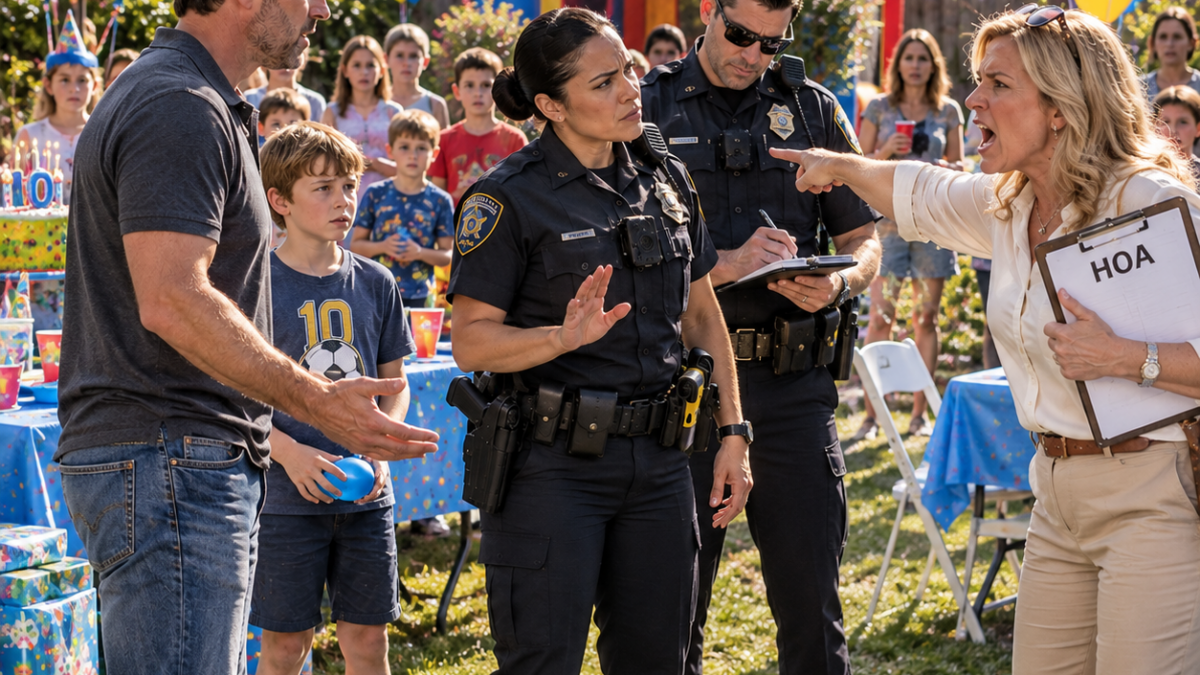
PART3:
Had strong opinions about black holes.
And defended Pluto with an emotional intensity usually reserved for family members.
So Natalie and I decided to give him a space-themed backyard party.
Nothing extravagant.
Twenty kids.
Some parents.
A rented inflatable shaped vaguely like a rocket.
A ten-by-ten canopy for shade.
Pizza.
Cake.
Water balloons.
Piñata.
Three hours.
No fireworks.
No DJ.
No alcohol.
No catering truck.
No live band.
No pyrotechnic Falcon 9 launch from the driveway.
Normal.
Unfortunately, we lived inside Cedar Ridge Estates.
And Cedar Ridge had Brenda Kensington.
Brenda had been HOA president for a little over three years.
Before that, she chaired compliance.
Before that, landscaping.
Before that, she was simply a resident who seemed born already holding a clipboard.
Every street had a Brenda story.
Mr. Henderson once left his trash bins near the curb until 4:40 p.m.
Pickup finished at 4:30.
Brenda photographed them at 4:41.
Official violation the next morning.
The Sterlings placed a twelve-inch ceramic garden gnome behind azaleas.
Certified letter.
“Unapproved permanent decorative lawn element.”
Mrs. Carter hung warm-white Christmas lights instead of the association-preferred cool-white.
Brenda called it:
“Visual inconsistency.”
My personal favorite involved Mr. Avery’s bird feeder.
His notice said the feeder caused:
“Excessive avian activity.”
Birds.
At a bird feeder.
That was Brenda.
She never considered herself difficult.
She considered herself necessary.
Whenever challenged, she repeated the same phrases.
“Property values.”
“Community standards.”
“Uniform expectations.”
“Rules exist for a reason.”
And the Brenda classic:
“If we make one exception, where does it end?”
With Brenda, everything was the first domino in civilization’s collapse.
Allow one family a slightly different mailbox and by Christmas apparently Cedar Ridge would be full of abandoned appliances, livestock, and flamingos.
So I prepared for Leo’s party as if I were submitting plans for a municipal airport.
Three weeks in advance.
Estimated attendance.
Twenty children.
Twelve adults.
Noon start.
Four p.m. finish.
Bounce-house dimensions.
Twelve-foot maximum.
Canopy dimensions.
Ten by ten.
Parking map.
Decorations.
Sound plan.
Cleanup.
I even included:
Biodegradable water balloons may be used if weather permits. All debris will be collected before event conclusion.
Why?
Because life with Brenda trained you.
Document everything.
Two days later, approval arrived.
Signed personally by:
Brenda Kensington
HOA President
I printed it.
Then printed the attachment.
Then printed the site diagram.
Natalie found me at the kitchen table placing everything inside a clear plastic sleeve.
She stared.
“You understand this is a ten-year-old’s birthday, right?”
“Yes.”
“You look like you’re preparing for litigation.”
“I’m preparing for Brenda.”
“You think she’ll actually come?”
“She showed up at the Hendersons’ house over trash bins.”
“That was different.”
“How?”
Natalie thought.
“It wasn’t a child’s birthday.”
“Exactly.”
She laughed.
“You’re paranoid.”
I held up the packet.
“Prepared.”
She rolled her eyes.
I wish I had been paranoid.
The morning of the party was perfect.
Seventy-five degrees.
Blue sky.
Almost no wind.
I woke before six because I was more excited than Leo.
Natalie had stayed up late decorating the cake with her friend Melissa, who owned a bakery.
Three levels shaped like stacked rocket sections.
Dark blue icing.
Tiny silver stars.
Little frosting planets.
At the top stood a miniature astronaut with “LEO 10” across the suit.
It was ridiculous.
And perfect.
I hung glow-in-the-dark stars beneath our pergola.
Taped cardboard planets along the fence.
Put little paper rockets around the mailbox.
At nine, the bounce-house company arrived.
The driver was a guy named Travis.
He looked at the driveway, then the houses.
“HOA?”
“Yes.”
He nodded sympathetically.
“Height limit?”
“Twelve feet.”
“You know the model is twelve.”
“I know.”
“You want me to measure it anyway.”
“Yes.”
He laughed.
“Somebody difficult?”
“Brenda Kensington.”
His smile disappeared.
“Oh.”
Even the inflatable-rental guy knew Brenda.
He took out his telescoping measurement tool.
Eleven feet, eleven inches at the highest inflated seam.
I nearly hugged him.
“Perfect.”
He stared at me.
“You okay?”
“Better than you understand.”
The canopy went beside the patio.
Ten by ten.
Exactly on the site diagram.
At eleven-thirty, families started arriving.
By noon, our backyard looked like a miniature space camp designed by people who had been drinking coffee since sunrise.
Children ran everywhere.
Parents talked.
A small Bluetooth speaker played music quietly.
Leo sprinted between the bounce house and snack table wearing his astronaut shirt and the biggest smile I had seen in months.
I stood near the grill holding lemonade and thought:
This is why you tolerate HOA paperwork.
You do the stupid process.
Then everybody leaves you alone.
At 12:28, Brenda walked up the driveway.
I saw the clipboard first.
Then blonde bob.
Then floral capri pants.
Then the expression.
Natalie noticed my face.
“No.”
I nodded.
“Yes.”
“Arthur.”
“I see her.”
“Do not let her ruin this.”
“I won’t.”
Brenda entered our side yard without greeting anyone.
No:
Happy birthday, Leo.
No:
Beautiful day.
No:
Looks fun.
She stopped and slowly scanned everything like airport security.
Parents noticed.
Every Cedar Ridge resident knew her.
Mike Douglas, whose daughter Sophie was in Leo’s class, leaned toward me.
“Is that…”
“Yes.”
“At the birthday?”
“Yes.”
“That’s bleak.”
Brenda marched over.
“I received reports of unauthorized structures.”
No hello.
Straight to enforcement.
I smiled.
“Good afternoon, Brenda.”
“This is serious.”
“It’s a bounce house.”
“It appears oversized.”
“It isn’t.”
“And that canopy was not included in your application.”
“Yes, it was.”
“No.”
“Yes.”
She looked offended by my confidence.
“I reviewed the application personally.”
“Then this should look familiar.”
I reached into my back pocket.
That was an extremely satisfying moment.
I unfolded the approval.
“Page two. Item four.”
Brenda took it.
I pointed.
“Temporary shade structure, ten feet by ten feet.”
Her eyes moved from paper to canopy.
Back.
“What is the inflatable height?”
“Twelve feet maximum.”
“It looks taller.”
“We measured it.”
“With what?”
“A measuring device.”
“What kind?”
I stared.
“A tape measure designed for things that need measuring.”
Someone behind me choked.
Mike.
Definitely Mike.
Brenda noticed people listening.
Her voice became more official.
“I need independent verification.”
“Feel free.”
“Do you have a ladder?”
“No.”
“Then how was the highest point measured?”
“The rental company used a telescoping measure.”
“That is not association-certified equipment.”
I paused.
“Association-certified measuring equipment?”
“Yes.”
“Does Cedar Ridge own an official ruler?”
Three parents laughed.
Brenda flushed.
“This is exactly the attitude that makes compliance difficult.”
“No, I think the inflatable rocket is what makes compliance difficult.”
Natalie gave me the look.
Enough.
I took the hint.
“Brenda, everything here was approved. Today is Leo’s birthday. If you see something genuinely unsafe, tell me. Otherwise, please let everyone enjoy the day.”
She looked toward the kids.
“They are extremely loud.”
“They’re ten.”
“I can hear them from three houses away.”
“It’s twelve-thirty on a Saturday.”
“Noise is noise.”
“What time do quiet hours begin?”
She knew.
“Eight p.m.”
“What time is it?”
Her mouth tightened.
“12:35.”
“Then we’re seven and a half hours early.”
She stared.
“You seem determined to push every limit.”
“No.”
I gestured toward the yard.
“I’m determined to host the party you approved.”
She straightened.
“I will be monitoring.”
“Of course you will.”
“Any violation will result in immediate enforcement.”
“Have a nice Saturday, Brenda.”
She walked away.
Mike appeared beside me.
“Does she have hobbies?”
“This is apparently the hobby.”
“Has she tried puzzles?”
“Maybe the HOA is her puzzle.”
“That is profoundly sad.”
Leo ran over.
“Dad!”
“Yes?”
“Piñata!”
And for forty minutes, I forgot Brenda existed.
The rocket piñata hung from a tree.
Children lined up.
One boy hit Mike.
Another hit the fence.
Sophie eventually connected perfectly and exploded candy across the lawn.
Then cake.
Everyone sang.
Leo stared at the astronaut decoration like we had imported it from NASA.
Ten candles.
He blew them out.
I cut cake.
Natalie handed out plates.
Then leaned close.
“Don’t look immediately.”
I knew.
“Brenda?”
“Sidewalk.”
I looked.
Brenda stood near our property line holding her phone horizontally.
Taking photographs.
Not of the inflatable height.
Not the canopy.
The party.
Children.
Parents.
Leo.
I put down the cake knife.
Natalie grabbed my wrist.
“Arthur.”
“I’m not yelling.”
“Promise?”
“Promise.”
I wiped icing from my hands and walked toward the fence.
Brenda lowered the phone slightly.
“What are you doing?”
“Documenting.”
“What?”
“Potential violations.”
“You’re photographing children.”
“I’m photographing property conditions.”
“Your camera has been pointed directly into the yard for several minutes.”
“The children happen to be present.”
“Then stop.”
Her eyes sharpened.
“You do not tell me how to perform association duties.”
“I’m telling you my guests are uncomfortable.”
“This is not about your guests.”
“Great. Come back tomorrow.”
“Violations must be documented when occurring.”
“What violation?”
She lifted her phone.
“The bounce house is visible from the street at an unauthorized angle.”
I stared.
“An unauthorized angle.”
“Yes.”
“What does that mean?”
“The approval contemplated limited visual exposure.”
“Show me.”
“What?”
“Show me that language in the approval.”
She ignored me.
“And your mailbox decorations appear noncompliant.”
I looked.
Three silver balloons and cardboard rockets.
“They’re temporary party decorations.”
“They obstruct uniform visual appearance.”
“For three hours.”
“Rules do not become optional based on duration.”
“Actually, several temporary-use rules literally do.”
Her face reddened.
“This is exactly the problem.”
“What?”
“People think temporary exceptions do not matter.”
She became more animated.
“First balloons.”
Pause.
“Then lawn ornaments.”
Pause.
“Then flamingos.”
I laughed.
Could not stop myself.
“Flamingos?”
“Yes.”
“You think Leo’s birthday balloons are a gateway to flamingos?”
Parents had begun drifting closer.
Pretending they weren’t listening.
Completely listening.
Brenda noticed.
That was the exact moment I think pride took control.
“If we selectively ignore covenants, enforcement becomes impossible.”
I lowered my voice.
“Brenda.”
“Yes?”
“Go home.”
Her eyes widened.
“Excuse me?”
“Please leave us alone for the rest of the party.”
“This is official HOA business.”
“No.”
I shook my head.
“This has become harassment.”
She gasped.
Literally.
“You are accusing the HOA president of harassment?”
“I’m saying Brenda Kensington has spent the last hour looking for reasons to interfere with an approved ten-year-old’s birthday and is now taking photos of children after every alleged violation has been answered.”
“You need to watch your tone.”
There it was.
“My tone is calm.”
“You’re becoming hostile.”
“No.”
“You’re raising your voice.”
I wasn’t.
And fifteen adults were standing close enough to know it.
That would matter.
“Go home, Brenda.”
She raised her phone again.
“I am documenting this interaction.”
“Great.”
I pointed toward the yard.
“I have witnesses.”
Her jaw tightened.
Then Leo ran over.
Frosting on his face.
“Dad!”
I turned.
“What, buddy?”
“Can we do water balloons?”
“Yeah. Give me five minutes.”
“Everyone’s ready.”
Brenda stepped forward.
“Water balloons?”
Leo looked at her.
His smile disappeared.
“That wasn’t approved.”
I closed my eyes for half a second.
“Brenda.”
“There are irrigation restrictions.”
“This isn’t irrigation.”
“Water use is still water use.”
“No.”
“Potential landscaping damage.”
“We have a tarp.”
“Balloon fragments constitute litter.”
“They’re biodegradable.”
“That does not automatically make—”
“And the application includes them.”
She stopped.
I continued.
“Section 7.3 permits biodegradable party balloons provided cleanup occurs same day.”
Brenda’s expression told me she hated that I knew the rules.
I only knew them because she had trained all of us to.
I crouched beside Leo.
“Go tell everybody five minutes.”
He looked at Brenda.
Then me.
“Is she stopping the party?”
That hurt.
More than anything Brenda had said.
My son was ten.
On his birthday.
And an adult had made him wonder whether his happiness was subject to an HOA president’s permission.
I smiled.
“No.”
“You sure?”
“Yes.”
“She isn’t stopping anything.”
Behind me, Brenda said:
“I haven’t made a determination—”
I stood.
“No.”
My voice changed.
Still not loud.
But final.
“You approved this party.”
Brenda stared.
“Every item is compliant.”
“You are not going to stand here and make my son afraid that his birthday can be canceled because you dislike water balloons.”
Her eyes narrowed.
“Are you threatening me?”
“No.”
“You’re behaving aggressively.”
“No.”
“I feel unsafe.”
I looked around.
Twenty kids.
Parents.
Cake.
Space decorations.
Mike wearing a party hat his daughter had forced onto him.
“If you feel unsafe, leave.”
Her expression hardened.
“I will be reporting this.”
“Do whatever you believe you need to do.”
Those words would later become part of Brenda’s justification.
I returned to the party.
We filled water balloons.
And for thirty minutes, everything became perfect again.
Children screamed.
Adults got soaked.
Natalie took a balloon directly to the shoulder and retaliated against a ten-year-old with frightening efficiency.
Mike gave Sophie two balloons, pointed at him, then realized too late that I had witnessed the conspiracy.
Leo laughed until he fell onto the tarp.
I was chasing three children around the bounce house when Mike touched my shoulder.
“Arthur.”
I turned.
His face had changed.
“What?”
He nodded toward the street.
Two police cruisers.
Brenda beside them.
My stomach dropped.
Natalie came over.
“She didn’t.”
“She did.”
“What did she tell them?”
“I don’t know.”
“Arthur.”
“I’ll handle it.”
“Calmly.”
“Yes.”
I wiped my hands.
Walked toward the street.
I heard Brenda before I reached the officers.
“They are violating at least seven separate covenants, and when I attempted to correct the situation, the homeowner became hostile and threatening.”
Threatening.
That word changed the entire situation.
Officer Ramirez turned.
“Sir, this your residence?”
“Yes.”
“Name?”
“Arthur Mitchell.”
“You’re hosting the gathering?”
“My son’s tenth birthday.”
I pointed behind me.
“The event was approved by the HOA three weeks ago.”
Brenda shouted:
“Not like this!”
Ramirez raised one hand.
“Ma’am.”
I continued.
“Twenty children, parents, inflatable, shade canopy, temporary decorations, water balloons. All submitted.”
“He’s lying.”
“There are copies.”
“The approval was for a smaller event.”
“It lists twenty children.”
“You exceeded the intended activity level.”
Officer Cole looked up.
“Activity level?”
Brenda straightened.
“The environment became disruptive.”
Ramirez glanced at the yard.
“Any fights?”
“No.”
“Injuries?”
“No.”
“Property damage?”
“No.”
“Alcohol involved?”
“No.”
“Weapons?”
Brenda hesitated.
“No.”
“Threats?”
She pointed at me.
“He told me to leave.”
“That by itself isn’t a threat.”
“He did it aggressively.”
Ramirez looked at me.
“What happened?”
So I told her.
Inspection.
Bounce house.
Canopy.
Noise.
Photographs.
Water balloons.
Request to leave.
No editorial.
No insult.
No Karen jokes.
Just sequence.
When I finished, Mike approached.
“Officer?”
Ramirez looked at him.
“Yes?”
“I witnessed most of the conversation.”
Brenda turned.
“This is none of your business.”
Ramirez’s expression sharpened.
“Ma’am.”
Mike continued.
“Arthur never threatened her.”
Another parent stepped forward.
“Neither did Natalie.”
A third:
“She was taking pictures of the children.”
Brenda snapped:
“I was documenting property.”
The woman replied:
“My daughter asked me why the angry lady was photographing her.”
That landed.
Not legally.
Socially.
Parents began looking at Brenda differently.
Ramirez turned to me.
“You mentioned paperwork?”
I nearly smiled.
“Yes.”
I reached into my pocket.
Brenda stared.
“You still have that?”
“Today?”
I unfolded it.
“Absolutely.”
Cole read.
“Approved noon to four.”
“Yes.”
“Twenty minors plus accompanying adults.”
“Yes.”
“Temporary inflatable structure, maximum twelve feet.”
“Yes.”
“Ten-by-ten shade canopy.”
“Yes.”
“Temporary mailbox decoration removed same day.”
I looked toward Brenda.
“Yes.”
Cole continued.
“Biodegradable water balloons approved if debris removed before end of event.”
“Yes.”
He looked at Brenda.
She folded her arms.
“This doesn’t address excessive noise.”
Ramirez asked:
“What local noise ordinance has been violated?”
“Community nuisance provisions.”
“Measured decibel level?”
Brenda paused.
“It is obviously excessive.”
“Did you measure it?”
“No.”
“Did another resident make a complaint?”
“I received reports.”
“From whom?”
“Confidential.”
I almost laughed.
Confidential complaints were Brenda’s invisible army.
Always numerous.
Never identifiable.
Ramirez looked around.
“Ma’am, at the moment, the issues you are describing appear to be HOA matters, not police emergencies.”
Brenda’s eyes widened.
“I called because I was threatened.”
Ramirez became more serious.
“Okay.”
Good.
Now the word had to survive questions.
“What exactly did Mr. Mitchell say?”
“He told me to go home.”
“Anything else?”
“He called me a harasser.”
“Anything threatening physical harm?”
Brenda hesitated.
“No.”
“Threatening property damage?”
“No.”
“Did he touch you?”
“No.”
“Block you from leaving?”
“No.”
“Follow you?”
“No.”
“Display a weapon?”
“No.”
“Raise a fist?”
“No.”
“Say he would retaliate later?”
“No.”
Ramirez paused.
“Then what made this an emergency?”
And that brought us to the question.
The one that changed everything.
Brenda stared.
“I felt threatened.”
“I understand.”
Ramirez’s voice stayed professional.
“But feeling uncomfortable and reporting a threat of violence are not the same thing.”
“I didn’t say there was active violence.”
Cole looked down.
“Dispatch notes say you described an escalating confrontation with potential violence.”
Brenda’s face changed.
“I said I was worried it could become violent.”
“Why?”
“He was angry.”
I spoke.
“I was annoyed.”
She snapped:
“You were furious.”
“You don’t get to decide what emotion existed inside my head.”
“You were glaring.”
Ramirez lifted a hand.
“Stop.”
We stopped.
Then she asked Brenda:
“Did you tell dispatch approximately thirty people were present?”
“Yes.”
“Did you explain that most were children attending a birthday party?”
Silence.
That was the crack.
“No.”
“Why?”
“It wasn’t relevant.”
Ramirez looked toward Leo and his friends.
One kid still wore the foam astronaut helmet.
“It seems relevant.”
“The number of people increased the danger.”
“What danger?”
“Uncontrolled crowd behavior.”
Twenty children were holding paper plates.
One was barefoot.
One had frosting across both cheeks.
The revolution appeared poorly organized.
Cole walked to his cruiser.
Radioed dispatch.
Requested clarification from the call.
Brenda watched him.
“What are you doing?”
He didn’t answer.
A minute later, he returned.
His expression was different.
“Dispatch has the recording.”
Brenda swallowed.
Cole said:
“You told the operator the homeowner was ‘becoming violent’ and that you feared ‘children may be caught in the situation.’”
Every parent went silent.
I stared.
“You used our kids to make it sound like I was threatening them?”
Brenda looked at me.
“I was protecting them.”
Natalie stepped forward.
“No.”
Brenda turned.
Natalie almost never engaged with HOA arguments.
That made her voice stronger.
“You stood outside photographing them.”
“You interrupted their party.”
“You made Leo think his father was in trouble.”
“Then you called 911 and described Arthur as a danger to the children.”
“I acted responsibly.”
“My son thought you were going to have his birthday shut down.”
“That isn’t my fault.”
Natalie’s eyes hardened.
“Yes.”
“It is.”
Brenda turned toward the officers.
“Can someone control these people?”
Ramirez stared.
“Ma’am, they are standing on their property.”
Another crack.
Cole asked:
“Did you identify yourself to dispatch as HOA president?”
“Yes.”
“Did you tell them you were conducting enforcement?”
“Yes.”
“Did you believe police would enforce HOA rules?”
“Of course.”
Cole blinked.
“Of course?”
“Yes.”
“That is part of community law enforcement.”
“No, ma’am.”
Brenda looked genuinely confused.
“What?”
“HOA covenants are private civil restrictions. Police do not enforce bounce-house dimensions or temporary mailbox-decoration rules.”
“So residents can violate whatever they want?”
“No.”
“The HOA has its own civil enforcement procedures.”
“That’s what I was using.”
“You called 911.”
“Because he became hostile.”
“Which we just discussed.”
“You are taking his side.”
Ramirez’s voice cooled.
“We are determining facts.”
“You came because I called.”
“Yes.”
“So address my complaint.”
“We are.”
Brenda didn’t yet understand what that meant.
The officers stepped away briefly.
Talked.
Brenda paced.
Then, unbelievably, pointed toward my mailbox.
“Those balloons are still noncompliant.”
I stared.
Police were reviewing her emergency call and she was still litigating balloons.
“Brenda.”
“What?”
“Stop.”
“You don’t tell me—”
Natalie interrupted.
“Yes.”
Brenda turned.
Natalie pointed toward Leo.
“My son is ten.”
Her voice shook now.
“Ten.”
Leo stood beside a table staring.
“He has spent the last fifteen minutes wondering whether his dad is going to be arrested because you didn’t like his birthday decorations.”
For perhaps one second, discomfort crossed Brenda’s face.
Then pride replaced it.
“I did not create this situation.”
Natalie almost laughed.
“You called 911.”
Officer Ramirez returned.
“Mrs. Kensington.”
Brenda turned.
“Yes?”
“We need to clarify your statement.”
“I already have.”
“Did Mr. Mitchell threaten you?”
“I felt threatened.”
“That is not the question.”
Brenda looked around.
Nobody was supporting her.
“Did he threaten you?”
“No.”
“Did he say he intended to hurt you?”
“No.”
“Did he physically prevent you from leaving?”
“No.”
“Did he damage property?”
“No.”
“Was violence occurring when you called?”
“No.”
“Did you know this was a child’s birthday party?”
“Yes.”
“Did you know the HOA had approved it?”
Brenda glanced at the paper in Cole’s hand.
“I knew there was an approval.”
“Did you sign it?”
Silence.
Ramirez repeated:
“Did you personally sign the approval?”
“Yes.”
There it was.
Cole spoke next.
“So you knew the event was approved.”
“Yes.”
“You knew there was no physical violence.”
“Yes.”
“You knew Mr. Mitchell had not threatened bodily harm.”
“Yes.”
“And you told emergency dispatch that he was becoming violent and children might be at risk.”
“You’re twisting the situation.”
“We have the recording.”
“I exercised judgment.”
“Emergency dispatch is not an HOA enforcement mechanism.”
“Then who am I supposed to call when residents become hostile?”
“The non-emergency line if there is an actual police concern.”
“He told me to leave.”
“That is not a crime.”
“I am the HOA president.”
Ramirez looked toward my house.
“You were standing on his property?”
Brenda stiffened.
“The association has inspection rights.”
“During an approved private gathering?”
“The covenants—”
“Did Mr. Mitchell ask you to leave?”
Ramirez looked at me.
“Yes.”
“More than once?”
“Yes.”
“Did she leave?”
“She moved to the public sidewalk and continued taking pictures.”
Ramirez nodded.
Not necessarily criminal.
But context.
Brenda realized the conversation was shifting.
“You’re investigating me?”
Cole answered:
“We investigate the information we receive.”
“I’m the complainant.”
“That doesn’t exempt you.”
“I have spent years protecting this community.”
“No one is discussing that.”
“You should.”
“Why?”
“Because it establishes credibility.”
Cole looked directly at her.
“Credibility comes from accurate information.”
That sentence hit harder than he intended.
Brenda’s face tightened.
Then she made the mistake that finished her.
She pointed toward me.
“He has been a problem resident for years.”
I laughed.
Ramirez turned.
“Any prior police incidents?”
Brenda froze.
“No.”
“Restraining orders?”
“No.”
“Documented threats?”
“No.”
“Violence?”
“No.”
“Then why did you describe him as dangerous?”
Brenda opened her mouth.
Closed it.
Then:
“Because he doesn’t respect authority.”
Silence.
Complete.
Ramirez stared.
“Your authority?”
Brenda realized instantly what she had admitted.
“I mean HOA authority.”
“And disagreement with HOA authority equals violence?”
“That isn’t what I meant.”
“You told dispatch he was becoming violent.”
“He was challenging me.”
“Challenging an HOA decision is not violence.”
There it was.
The entire problem reduced to one sentence.
Brenda looked at me with pure fury.
Not because I had done anything.
Because someone outside Cedar Ridge had finally explained the boundary she refused to recognize.
Cole stepped aside again.
Spoke over his radio.
Then:
“Mrs. Kensington, may we see your phone?”
“Why?”
“To verify portions of the call timeline.”
“You already have dispatch records.”
“Yes.”
“Then you don’t need my phone.”
“I’m asking voluntarily.”
“No.”
“That’s your right.”
She looked relieved.
Then Ramirez said:
“Please remain here.”
“I have association duties.”
“No.”
Ramirez’s tone changed.
“Remain here while we complete this.”
Brenda’s face shifted.
“Am I being detained?”
Ramirez exchanged a glance with Cole.
“For the moment, yes.”
“What?”
“We are investigating a suspected false or materially misleading emergency report.”
“You cannot be serious.”
“I am.”
“You arrived because I called you.”
“Yes.”
“This is outrageous.”
“Mrs. Kensington, stop interrupting.”
“I know the chief.”
Of course.
Or claimed to.
“I sit on the community safety committee.”
“That does not change anything.”
“I will have your badge.”
Cole sighed.
“Ma’am, threatening an officer’s employment is not helping.”
“I’m not threatening anyone.”
“You said you would have her badge.”
“I said I know people.”
“Please stop.”
Parents now had phones out.
Not to film children.
To record Brenda.
She saw them.
That was when she finally understood how the afternoon looked.
“Can we discuss this privately?”
Ramirez nodded.
“We can move farther from the children.”
Reasonable.
They walked toward the cruisers.
We stayed behind.
I could still hear pieces.
“This is a misunderstanding.”
Then:
“I was concerned.”
Then:
“I did not knowingly file anything false.”
Cole spoke.
Too quiet to hear.
Brenda answered sharply.
Then Ramirez.
Brenda’s head jerked back.
“What?”
Another exchange.
Then Officer Cole stepped behind her.
“Mrs. Kensington, turn around and place your hands behind your back.”
Every adult in my yard froze.
Brenda laughed once.
Short.
Disbelieving.
“What?”
“Hands behind your back.”
“You’re joking.”
“No.”
“You cannot arrest me.”
“Turn around.”
“I am the president of the Cedar Ridge Estates Homeowners Association.”
That sentence sounded absurd now.
Cole said:
“That has no bearing on this.”
Brenda looked toward us.
Me.
Natalie.
Parents.
Children.
Her expression went from disbelief to outrage.
“You are arresting me because of him?”
Ramirez answered:
“No, ma’am.”
“You are being arrested based on your own conduct and the information you provided to emergency services.”
“This is insane.”
“Turn around.”
She resisted verbally for another few seconds.
Then turned.
Cole took one wrist.
Click.
Even from across the yard, I heard it.
Second cuff.
Click.
Brenda’s posture changed.
The woman who had spent three years growing taller every time she issued a notice suddenly looked smaller.
Not physically.
Institutionally.
Clipboard:
Meaningless.
HOA title:
Meaningless.
Committee membership:
Meaningless.
The only thing left was evidence.
She started talking faster.
“I want an attorney.”
“You have that right.”
“I will sue this department.”
“You have that right.”
“This arrest is unlawful.”
“You may contest it.”
“The board will hear about this.”
“Okay.”
“My attorney knows the mayor.”
No response.
“This is retaliation.”
Ramirez opened the cruiser door.
“Watch your head.”
“I am not getting into that vehicle.”
“Mrs. Kensington.”
“You do not understand the consequences of humiliating me in front of my community.”
That sentence stayed with me.
Not:
The children.
Not:
The misuse of 911.
Not:
Leo.
Her humiliation.
Even in handcuffs, Brenda’s greatest injustice was somebody failing to defer to her.
Cole helped her into the rear seat.
Door closed.
For five seconds, the entire birthday party remained silent.
Then Leo tugged my wet shirt.
“Dad?”
I looked down.
“Yeah?”
“Did Brenda get arrested?”
Twenty children leaned closer.
I chose my words carefully.
“The police think she may have broken some rules about calling 911.”
Leo frowned.
“She called 911 because of my party?”
“Yes.”
“Why?”
I looked toward the cruiser.
“I think she got carried away.”
He considered.
Then:
“Can we keep playing?”
That was Leo.
Ten years old.
Priorities correct.
I smiled.
“Yes.”
The kids erupted.
Not because Brenda had been arrested.
Because their party had survived.
Ramirez returned before leaving.
“Mr. Mitchell.”
“Yes?”
“I apologize for the interruption.”
“You don’t need to.”
“We respond to the information dispatch receives.”
“I understand.”
“We may need formal statements from you and some witnesses.”
“Whatever you need.”
“Keep that HOA approval.”
“I may laminate it.”
For the first time, she smiled.
Then lowered her voice.
“Knowingly false or materially misleading emergency information is taken seriously.”
“I understand.”
“She’ll be processed. Any final charging decision may change after review.”
“Okay.”
I did not ask for jail.
Did not ask what punishment she might get.
Did not celebrate.
Mostly I was exhausted.
The cruisers drove away.
Brenda in the back.
Still talking.
Still convinced somebody, somewhere, would hear the words HOA president and recognize that a terrible error had been made.
When the police disappeared, Mike started clapping.
Slowly.
I turned.
“Don’t.”
He stopped.
“What?”
“This is still Leo’s birthday.”
His face changed.
“Right.”
Natalie looked toward the children.
“Cake round two.”
Best decision of the day.
Within five minutes:
Bounce house.
Water balloons.
Candy.
Presents.
Leo returned to being ten.
The adults took longer.
Every conversation drifted back.
“She really called 911?”
“They arrested her?”
“Is she going to jail?”
“What happens to the HOA?”
I repeated one answer.
“Not today.”
Today was Leo.
Not Brenda.
At exactly four, the party ended.
Exactly as approved.
Because after everything, I was not giving Cedar Ridge one stray minute.
We collected every water-balloon fragment.
Removed the mailbox balloons.
Deflated the rocket.
Folded the canopy.
Bagged trash.
At 4:43, I stood in the backyard surrounded by the aftermath.
Natalie handed me a beer.
“Now?”
“Now what?”
“Now we can discuss the fact that Brenda Kensington was arrested at our son’s birthday.”
I took a long drink.
“What the hell happened?”
She laughed.
Then covered her face.
“I cannot believe it.”
“I cannot believe she called them.”
“You told me she’d show up.”
“I did not predict handcuffs.”
“Fair.”
Leo came outside wearing pajamas even though it was still afternoon.
Birthday privilege.
“Dad?”
“Yeah?”
“Was I in trouble?”
That one hurt.
“No.”
“Was the party illegal?”
“No.”
“Then why did she tell police?”
I sat beside him.
“Sometimes adults become so convinced they’re right that they stop checking whether what they’re doing makes sense.”
Leo nodded slowly.
“Like when I told everybody Mars had air people could breathe?”
“Exactly.”
He smiled.
“But I was six.”
“Yes.”
“That makes Brenda worse.”
Natalie choked on her beer.
Leo looked toward the road.
“Is she bad?”
Harder question.
“No.”
He frowned.
“She got arrested.”
“People can do bad things without being completely bad people.”
“Do you like her?”
“No.”
Leo laughed.
Natalie laughed harder.
The next morning, my inbox contained fourteen messages.
Most from neighbors.
One from Thomas Reed, HOA vice president.
URGENT BOARD NOTICE.
Brenda Kensington had been suspended from presidential authority pending review.
Thomas requested my documents.
I sent everything.
Application.
Approval.
Diagram.
Email chain.
Every page.
By Monday, the story became less funny.
Thomas called.
“Arthur?”
“Yeah?”
“Did Brenda ever tell you your approval had been amended?”
“No.”
“Withdrawn?”
“No.”
“Any violation notice before Saturday?”
“No.”
“Did she say she had board authorization for an inspection?”
“No.”
Long silence.
“What are you finding?”
“I’m not ready to say yet.”
That phrase got my attention.
“Thomas.”
“Send me absolutely everything.”
“I already did.”
“I know.”
Two days later, the HOA announced an emergency meeting.
I had never seen the clubhouse that full.
Not for dues increases.
Not pool repairs.
Not even the legendary roof-color debate.
Brenda did not attend.
Her attorney advised against it while the criminal case remained unresolved.
Thomas sat in her chair.
He looked deeply uncomfortable.
“Before we begin, understand this is not a criminal proceeding.”
Someone muttered:
“Feels like one.”
Thomas ignored it.
“We are reviewing Ms. Kensington’s governance conduct.”
The property manager spoke next.
That was when the story expanded beyond my birthday.
Brenda had received no complaints about Leo’s party.
None.
No call.
No email.
No online report.
No neighbor.
Her statement:
“I received reports of unauthorized structures.”
False.
She had gone there on her own.
Why?
My home appeared on something she called an:
Enhanced Compliance Watch List.
I laughed when I heard it.
Then realized nobody else was laughing.
“What is an enhanced compliance watch list?”
The property manager looked uncomfortable.
“It is not an official association category.”
“Then what is it?”
“A list Ms. Kensington maintained personally of homes she believed required greater monitoring.”
“How many?”
“Seventeen.”
The room murmured.
Mr. Henderson raised his hand.
“Am I on it?”
The manager looked down.
“Yes.”
“Trash bins?”
“I cannot speak to motive.”
Mrs. Sterling called:
“What about us?”
“Yes.”
“The gnome?”
Laughter.
“Yes.”
My home was listed because I had appealed two incorrect violations the year before.
That was all.
My note read:
LIKELY TO CHALLENGE ENFORCEMENT. DOCUMENT CAREFULLY.
I nearly admired the accuracy.
“So appealing incorrect notices got me monitored?”
Thomas looked apologetic.
“That appears to be what happened.”
Then more.
Brenda had reopened closed violations.
Directed management to draft notices without full review.
Conducted personal inspections without complaints.
Maintained private notes.
Difficult.
Argumentative.
Anti-HOA.
Needs monitoring.
The pattern became obvious.
Agree with Brenda?
Minor issue.
Question Brenda?
Enforcement.
Challenge her publicly?
Monitoring.
Then Thomas displayed my party approval.
Signed by Brenda.
Twenty children.
Bounce house.
Canopy.
Mailbox decorations.
Water balloons.
No ambiguity.
The association attorney spoke.
“We should avoid making conclusions about criminal intent. That is for the appropriate authorities.”
Fair.
“From a governance perspective, however, the matter is serious.”
He continued.
“The president appears to have knowingly mischaracterized an approved event, used association authority in an escalating personal dispute, and exposed the association to significant liability.”
Some residents still defended Brenda.
Elaine Porter stood.
“Brenda protected property values for years.”
Mr. Henderson said:
“From birds?”
Laughter exploded.
Thomas banged the gavel.
Elaine continued.
“She overreacted. Removing her seems extreme.”
Mrs. Sterling responded:
“She called 911 on a child’s birthday.”
“She felt threatened.”
Mike stood.
“I was there.”
Everyone turned.
“She was not threatened.”
Elaine said:
“You can’t know how she felt.”
“No.”
Mike nodded.
“But I know Arthur never threatened her.”
Another parent stood.
“So do I.”
Then another.
Seven witnesses total.
Different households.
Different backgrounds.
No interest in HOA politics.
Same sequence.
Brenda arrived.
Brenda searched for violations.
Brenda photographed children.
Arthur asked her to leave.
Arthur stayed calm.
Brenda left.
Police arrived.
Consistency matters.
The board entered executive session.
Forty minutes.
When they returned, Thomas read the decision.
Brenda Kensington was removed as HOA president effective immediately.
Suspended from all enforcement and compliance functions.
Her board seat would be handled through the recall process allowed by the bylaws.
Several previous enforcement actions would be independently reviewed.
A conduct penalty would be assessed under internal ethics provisions.
The room released a sound.
Not exactly cheering.
More like people realizing they had been holding their breath for three years.
Natalie squeezed my hand.
“You okay?”
“Yeah.”
“You don’t look happy.”
“I am.”
“Then what?”
I looked around.
“This became a lot bigger than a birthday.”
“Because she made it bigger.”
True.
I had not requested her removal.
Had not called the police.
Had not organized residents.
Had not even filed the original HOA review.
All I had done was submit paperwork for my son’s birthday.
Brenda did the rest.
The criminal process was quieter.
Statements.
Interviews.
Dispatch recording.
Parent videos.
Mike accidentally captured part of my first conversation with Brenda while filming Sophie inside the bounce house.
In the background, my voice was clear:
“Please let the children enjoy the party.”
No threat.
Another parent had recorded the water-balloon argument.
Again:
Annoyed?
Yes.
Firm?
Absolutely.
Violent?
No.
Brenda’s 911 call mattered most.
Investigators confirmed she described me as “becoming violent,” said guests were frightened, and implied intervention was needed before children were caught in an escalating confrontation.
Evidence did not support it.
Her attorney negotiated.
Final outcome:
Fine.
Community service.
Probation.
No jail.
Fine by me.
I never wanted Brenda imprisoned.
I wanted her to stop.
Those are different things.
Her real consequence happened socially.
Cedar Ridge stopped being afraid of her.
That devastated the structure she had built.
Her power depended less on rules than on residents believing resisting her would cost more than compliance.
Once people watched Brenda tell police her HOA title established credibility—and watched police calmly explain that title did not transform civil rules into criminal law—the illusion broke.
Old fines were challenged.
Henderson administrative fee:
Refunded.
Sterling garden-ornament warning:
Withdrawn.
Mr. Avery requested removal of:
EXCESSIVE AVIAN ACTIVITY.
Thomas laughed before granting it.
Another family discovered Brenda had cited them for a paint color already approved.
Refund.
A woman on Ridge Court learned an “anonymous complaint” about her patio furniture had actually come from Brenda herself.
The pattern became embarrassing.
Brenda had not enforced rules consistently.
She enforced relationships.
That destroyed her more effectively than handcuffs ever could.
Her real-estate brokerage placed her on administrative leave after local coverage of the arrest.
I had nothing to do with that.
When Natalie heard, she looked less sympathetic than I did.
“She tried to get you arrested.”
“She called 911 irresponsibly.”
“Same neighborhood outcome.”
“That doesn’t mean I want her career destroyed.”
Natalie stared.
“You are irritatingly reasonable.”
“It’s one of my best qualities.”
She threw a pillow at me.
Leo became famous at school.
For two weeks:
“Was somebody arrested at your birthday?”
“Did your dad fight the HOA?”
“Were there cops?”
He hated it initially.
Then adjusted.
Eventually his version became:
“The HOA lady called cops on my dad and got arrested instead.”
Oversimplified.
But he was ten.
I allowed it.
About a month later, he asked:
“Dad, why did Brenda hate my party?”
“She didn’t hate your party.”
He looked at me.
“Yes, she did.”
Fair.
“Okay.”
“Why?”
I thought.
“Because she couldn’t control it.”
Leo frowned.
“But she approved it.”
“Exactly.”
“So she could control it.”
“No.”
I sat beside him.
“She could approve whether we followed certain HOA rules.”
“Okay.”
“She could not control whether you laughed.”
“Okay.”
“She couldn’t control whether kids made normal daytime noise.”
“Okay.”
“She couldn’t control whether I disagreed with her.”
Leo thought.
“So she wanted to be the boss.”
“Yes.”
“But she was the boss.”
“Of the HOA.”
“What’s the difference?”
Smartest question anyone asked during the entire story.
“Being in charge of something doesn’t mean being in charge of everyone.”
He considered.
“Like Coach Ramirez can tell me what to do at soccer, but not what time I go to bed?”
“Exactly.”
“Or Mrs. Nelson can make classroom rules, but she can’t tell me what movie we watch at home.”
“Exactly.”
“Or Mom can’t—”
I raised a hand.
“Dangerous territory.”
He laughed.
That became the actual lesson I wanted him to keep.
Not:
Bad people eventually get arrested.
That is not always true.
Not:
Police fix HOA disputes.
Usually they shouldn’t.
Not:
Controlling people always get humiliated.
Life does not guarantee satisfying endings.
The lesson was limits.
Authority has edges.
Teachers.
Coaches.
Managers.
Police.
Parents.
HOA presidents.
Everyone.
Healthy authority recognizes where it ends.
Brenda always needed one step more.
Rules allowed her to review a party application.
She needed to inspect the party.
Board procedures allowed violations.
She needed personal surveillance.
HOA authority allowed civil notices.
She wanted police enforcement.
Documentation rules allowed property photos.
She photographed children.
She was president of an association.
She wanted the title to behave like a badge.
It didn’t.
A month after everything, I ran into Brenda in the frozen-food aisle.
No clipboard.
No HOA polo.
No sunglasses.
She looked tired.
She saw me.
Turned her cart around.
“Brenda.”
She stopped.
I still don’t know why I called her.
Maybe curiosity.
Maybe permanent avoidance seemed childish.
She turned.
“What?”
“How are you?”
She looked genuinely offended.
“How do you think?”
“Fair.”
“You destroyed my reputation.”
There it was.
“I didn’t call police.”
“You humiliated me.”
“I asked you to leave Leo’s birthday alone.”
“You made me look unreasonable.”
“You called 911.”
“Because you became hostile.”
I stared.
Even after everything.
“You accepted a plea.”
“My attorney advised it.”
“Because there was a recording.”
“Recordings lack context.”
“And seven witnesses?”
“Your friends.”
“Some of them were parents I barely knew.”
She looked away.
I could have ended it there.
Instead:
“Why did you call?”
“I told you.”
“No.”
I shook my head.
“Why really?”
Her mouth tightened.
Then pride seemed to lose for about five seconds.
“You embarrassed me.”
“When?”
“At the party.”
“How?”
“You had an answer for everything.”
“The rules?”
“You carried the approval in your pocket.”
“Because I expected you might show up.”
“Exactly.”
I stared.
“You’re angry because I prepared for you?”
“You made me look ridiculous.”
“You said the canopy wasn’t approved.”
“It was.”
“You did not have to correct me in front of everyone.”
“You confronted me in front of everyone.”
Silence.
Then:
“When people laughed, I knew they didn’t respect me.”
There.
Not property values.
Not noise.
Not children.
Respect.
Or Brenda’s definition.
Fear.
Deference.
Never being publicly wrong.
“So you called police.”
“I wanted you to understand there were consequences.”
That sentence chilled me.
“You wanted police to scare me?”
“I wanted the situation taken seriously.”
“No.”
I shook my head.
“You wanted to win.”
She looked away.
Then:
“Maybe.”
At least honest.
“Did you actually think I was going to hurt you?”
No answer.
That was answer enough.
“You knew I wasn’t.”
“I was upset.”
“You told 911 children could be in danger.”
Her face tightened.
“I know.”
“Leo thought the police might arrest me.”
That reached her.
Her eyes dropped.
“He asked whether his birthday was illegal.”
Nothing.
“You didn’t just fight with me.”
I continued.
“You scared a ten-year-old because adults laughed when you were wrong about a tent.”
Something shifted in her face.
Anger.
Shame.
Maybe both.
Finally:
“I made a mistake.”
First time I had ever heard Brenda voluntarily combine those words.
I did not celebrate.
“Yes.”
She looked at me.
“I suppose you want an apology.”
“For Leo.”
Silence.
Then:
“I’m sorry he was upset.”
Not:
I’m sorry I scared him.
Still Brenda.
But something.
“I’ll tell him.”
We walked in opposite directions.
Six months later, Cedar Ridge held its spring picnic.
Thomas Reed was officially president.
He implemented reforms.
Written complaint tracking.
No anonymous enforcement except genuine safety circumstances.
Board review for enhanced inspection.
Recusal when board members had personal disputes.
Clear distinction between association issues and police issues.
My favorite:
No board officer could personally investigate a resident involved in an active dispute with that officer.
Everyone privately called it:
The Brenda Rule.
The picnic had a bounce house.
Twelve feet.
Ten-by-ten canopy.
Balloons.
Children screaming.
Same categories of destruction that supposedly threatened civilization at Leo’s birthday.
I stood beside Thomas.
“You measure that?”
He laughed.
“I did.”
“With association-certified equipment?”
He almost spit out his drink.
“You’re never going to let that go.”
“No.”
Then I saw Brenda.
She still owned her house.
Still a member.
Every right to attend.
She stood near the food table.
No clipboard.
Regular clothes.
Paper plate.
A group of children ran past yelling.
Brenda flinched automatically.
Then stopped herself.
A balloon came loose from a table and rolled near her shoe.
She bent.
Picked it up.
Looked toward the decorations.
Looked toward Thomas.
For one second, I saw the old machinery starting.
Then she tied the balloon back.
And walked away.
Progress.
Tiny.
But real.
Leo’s eleventh birthday was laser tag.
Indoors.
Not because of Brenda.
His choice.
I felt immense relief.
No application.
No structure measurements.
No water usage analysis.
On the way home, Leo asked:
“Dad?”
“Yeah?”
“Remember when Brenda got arrested at my birthday?”
“Yes.”
“Best birthday ever.”
I looked at him.
“Seriously?”
“Yeah.”
“What about the rocket cake?”
“That was second.”
I laughed.
Then:
“Your mother would say we should not enjoy people getting in trouble.”
“She’s right.”
“But it was kind of funny.”
“A little.”
“Are you allowed to say that?”
“Don’t tell Mom.”
From the passenger seat, Natalie said:
“I am literally sitting here.”
Leo laughed until we got home.
Years later, that is probably how he’ll remember it.
Not the fear.
The absurdity.
An HOA president tried to stop water balloons and a bounce house because a homeowner refused to act intimidated.
Then she called 911 believing police would enforce her authority.
Instead, officers asked questions.
That was all it took.
What is the emergency?
What threat occurred?
Who is in danger?
Did he touch you?
Did he threaten you?
Was violence happening?
Did you know the event was approved?
Did you sign the approval?
Why did you tell dispatch something different?
Brenda had spent years operating inside a system where people usually asked too few questions.
She mailed a notice.
People paid.
She said there had been complaints.
People believed there had been complaints.
She said a rule applied.
Few residents opened the covenant book.
She said she had authority.
Everyone assumed she knew its boundaries.
Then two officers arrived who did not care whether she was HOA president.
They cared whether an emergency existed.
That was the end of her power.
Not handcuffs.
Questions.
Handcuffs came later.
People sometimes ask whether I enjoyed watching her arrested.
I usually say no.
That isn’t completely true.
There was satisfaction.
But not joy.
Relief.
For years, Brenda used uncertainty as leverage.
What could the HOA actually do?
Fine you?
Send lawyers?
Place a lien?
Reject your improvement?
Drag you into hearings?
People did not always know.
She cultivated that uncertainty.
Watching Officer Ramirez calmly tell her:
“No, ma’am. Police do not enforce your bounce-house restrictions.”
felt like somebody opened a window.
Suddenly everyone could see the walls.
Brenda’s authority had boundaries.
Visible ones.
And once residents saw the boundary, they stopped being afraid to stand near it.
Board attendance increased.
People read covenants.
Residents challenged notices politely.
Management stopped accepting vague verbal directives.
Rules became boring again.
That is healthy.
Boring rules.
Clear.
Documented.
Consistent.
The year after Brenda lost office, Cedar Ridge issued fewer violations than any year during her presidency.
Property values did not collapse.
No flamingo armies invaded.
Mailboxes remained upright.
Children continued playing.
Trash bins occasionally stayed out fifteen minutes too long.
Civilization survived.
I sometimes think about the exact moment Brenda crossed the line.
Was it when she showed up?
No.
Annoying.
Not catastrophic.
Photographing?
Inappropriate.
Still recoverable.
Water balloons?
Ridiculous.
Still fixable.
Calling me hostile?
Wrong.
But manageable.
The real line was her phone.
She could have gone home.
Written an HOA notice.
Complained at the board.
Maybe fined me.
I would have appealed.
Documentation would have settled it.
Instead, ordinary HOA authority was no longer producing the emotional result she wanted.
So she tried to borrow police authority.
That was the step.
Brenda always wanted one step more.
And that afternoon, one step more carried her outside every limit she understood.
She expected police to arrive and question me.
They did.
Then they questioned her.
She expected me to prove I was compliant.
I did.
Then she had to prove an emergency existed.
She could not.
She expected her title to increase credibility.
Instead, the recorded words mattered more.
She expected handcuffs for the “problem resident.”
They went on the HOA president.
I never forgot her expression.
Not because I enjoyed it.
Because it was the face of somebody discovering a system did not belong to her.
Shock.
Anger.
Disbelief.
Fear.
Her identity had become fused with the idea that Cedar Ridge needed her authority.
Officer Cole had no interest in that identity.
To him, she was a caller whose description did not match the scene.
Sometimes the most powerful correction in the world is simply being treated like everyone else.
Six years after moving into Cedar Ridge, I finally understood something about HOAs.
Most rules were not inherently outrageous.
Don’t block roads.
Maintain property.
Limit loud noise late at night.
Get approval for major exterior changes.
Fine.
The trouble starts when a person stops treating rules as shared agreements and begins treating them as personal weapons.
Brenda did not protect rules.
She protected status.
That was why my compliance made her angrier.
Think about it.
If the rules truly mattered most, she should have been delighted.
Bounce house:
Correct height.
Canopy:
Approved.
Party:
Correct time.
Guests:
Disclosed.
Water balloons:
Permitted.
Decorations:
Temporary.
Cleanup:
Completed.
Perfect compliance.
But perfect compliance denied Brenda the role she wanted.
There was nothing to correct.
Nothing to command.
Nothing to win.
So she invented new interpretations.
Visual angle.
Activity level.
Water use.
Uncontrolled crowd behavior.
Hostility.
Potential violence.
Her problem was never the rule book.
It was that the rule book did not give her enough power.
Years later, I still keep the birthday approval.
Not laminated.
I was joking.
But it sits inside a folder.
Original application.
Approval.
Police reports.
Board findings.
I open it every once in a while.
The original page is so ordinary.
CEDAR RIDGE ESTATES
TEMPORARY GATHERING APPROVAL
Twenty children.
Noon–4 p.m.
Inflatable.
Canopy.
Temporary decorations.
Water balloons.
Signed:
Brenda Kensington.
A piece of paper that should have prevented everything.
Instead, the woman who signed it later stood in my street telling police the gathering she had authorized was dangerous.
That is why documentation mattered.
Without it:
He said.
She said.
Homeowner versus HOA president.
With it:
Did Brenda approve twenty kids?
Yes.
Did she approve the tent?
Yes.
Bounce house?
Yes.
Decorations?
Yes.
Water balloons?
Yes.
End time?
Four.
Did we finish by four?
Yes.
Records shrink intimidation.
They don’t become nervous.
They do not forget.
They do not worry about political consequences.
They sit there until somebody asks the right question.
The last meaningful conversation I had with Brenda came two summers later.
I was walking our dog near the clubhouse.
Leo was twelve by then.
Brenda sat alone on a bench.
She waved.
That surprised me.
I stopped.
“How are you?”
“Fine.”
“How’s Leo?”
“Tall.”
She smiled.
“They do that.”
Silence.
Then:
“I saw the birthday decorations last week.”
“My neighbor’s daughter?”
“Yes.”
“Unicorns.”
She nodded.
“Large inflatable.”
I waited.
She saw my expression.
“Don’t.”
I smiled.
“I didn’t say anything.”
“You were thinking it.”
“Maybe.”
She sighed.
“I checked.”
I laughed.
“Of course you did.”
“Twelve feet.”
We both laughed.
Strange.
Then Brenda became serious.
“I was awful that day.”
That was more direct than anything she had ever told me.
“Yes.”
“I convinced myself you were trying to humiliate me.”
“I wasn’t.”
“I know.”
She looked toward the clubhouse.
“I thought if residents stopped taking me seriously, everything would fall apart.”
“Why?”
“I don’t know.”
Then:
“Maybe because being HOA president was the one thing I felt especially good at.”
That humanized her more than I expected.
Not enough to erase what happened.
Not enough to make us friends.
Enough to understand.
“I was terrified of losing control.”
“So you lost it.”
She gave a tired smile.
“Yes.”
Then:
“Does Leo remember?”
“The arrest?”
“Yes.”
“He calls it his best birthday.”
Brenda covered her face.
“Oh, God.”
“Rocket cake came second.”
She laughed.
“I deserve that.”
Probably.
“Tell him I’m sorry.”
“I will.”
We walked separate ways.
No reconciliation scene.
No hug.
No sudden friendship.
Closure.
That suited me.
Because the actual ending had happened years earlier.
That afternoon.
Officer Ramirez standing beside my driveway.
Brenda clutching a clipboard.
Twenty children waiting.
Leo holding a water balloon.
And one question:
“Ma’am, what exactly was the emergency?”
Everything else followed from that.
Because there wasn’t one.
There was a birthday party.
A ten-year-old boy.
Twenty friends.
One inflatable rocket exactly within the height limit.
One approved canopy.
Temporary balloons.
Biodegradable water balloons.
Pizza.
Cake.
Parents drinking lemonade.
Children laughing.
And one HOA president so furious that a homeowner had publicly shown she was wrong that she converted embarrassment into danger.
She called 911 expecting authority to arrive.
Authority did arrive.
It simply wasn’t hers.
I stood holding the approval Brenda had signed while Officer Cole closed handcuffs around her wrists.
Behind me, Leo waited to learn whether his birthday was over.
I looked at him.
Then at the police.
Then at Brenda.
And for the first time all afternoon, everything became simple.
The party was approved.
The kids were safe.
I had threatened nobody.
Brenda had crossed the line.
So when the cruiser disappeared around the corner, I went back into the backyard.
Found my son.
Picked up a water balloon.
“Okay, birthday boy.”
Leo grinned.
“Where were we?”
He pointed straight at me.
“Dad.”
I looked around.
Twenty children had suddenly armed themselves.
“Oh, no.”
Leo smiled.
“You’re the target.”
I barely had time to raise my hands.
The first balloon exploded against my chest.
Then another.
Then six.
Natalie joined them.
So did Mike.
Children screamed.
Parents laughed.
The rocket bounce house bounced.
The approved balloons remained attached to the mailbox.
The twelve-foot limit survived.
Cedar Ridge survived.
Civilization survived.
And Leo turned ten.
Brenda had called 911 because she believed a child’s birthday proved the neighborhood no longer respected her authority.
By the end of that afternoon, she was right.
But not because of balloons.
Not because of a bounce house.
Not because I challenged her.
We stopped respecting the authority she had invented for herself.
And all it took to expose the difference between real authority and imagined authority was one police officer asking her to explain what the emergency actually was.








