**HOA Karen Called 911 to Shut Down My Garage Party, Claiming It Was Illegal—But She Had No Idea Who Was Sitting Among My Guests. What Happened Next Left Her Speechless. 🚔😱⚖️**
PART2:
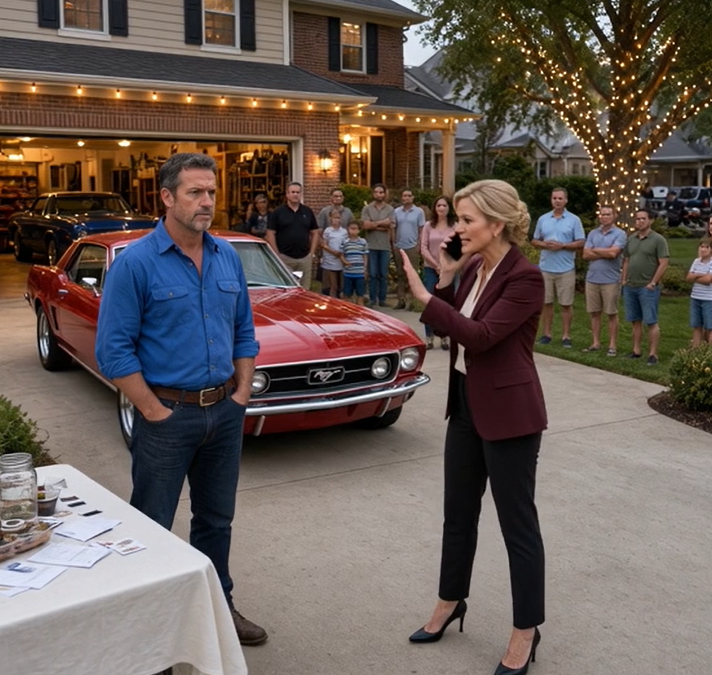
Then pointed toward my open garage like she had discovered a meth lab.
“I’m shutting down this illegal operation.”
Nobody spoke.
I stared at her.
Zoe, standing behind the donation table, slowly lowered the stack of scholarship brochures in her hands.
Delilah raised her phone.
“Yes, 911?”
The entire driveway changed.
One second earlier, people had been laughing.
Now:
Silence.
Even the music sounded too loud.
I reached toward the speaker remote and lowered it.
Delilah began performing.
“I need police immediately at 1247 Oak Street.”
She paused dramatically.
“Yes, this is an ongoing illegal commercial event.”
Another pause.
“Large crowd.”
“Alcohol.”
“Dangerous vehicles.”
“Noise.”
“Potential fire hazard.”
I looked at Chief Rafael Rodriguez.
He was standing beside my 1967 Mustang Fastback.
Jeans.
Brown work boots.
Dark gray T-shirt.
No badge visible.
No uniform.
No entourage.
Just another middle-aged guy holding a paper plate with half a rib on it.
He had been examining the headers five minutes earlier.
Now he was watching Delilah.
Very quietly.
Rafael and I had known each other three years.
We met through a veteran support program.
He had been Army military police before entering civilian law enforcement.
I had done twenty years Navy.
Two Gulf deployments.
Different branches.
Same ability to argue for an hour about which service had the worst coffee.
Every Tuesday before his shift, Rafael stopped by.
6:15.
Black coffee.
No sugar.
We talked cars.
Sometimes work.
Sometimes neither.
He knew about Delilah.
More than she realized.
Because for the last several months, her name had appeared repeatedly in calls, complaints, reports, and requests involving my address.
Rafael never interfered personally.
That mattered.
Friendship with a police chief is not a magic shield.
I did not want one.
If I violated a law, I expected the same response anybody else got.
What he did do was notice patterns.
Chiefs are supposed to notice patterns.
Delilah apparently believed police departments existed like vending machines.
Insert complaint.
Press button.
Receive enforcement.
She never considered that somebody might eventually count how often she pushed the button.
She ended the call.
Then looked at me with a smile that made several people visibly uncomfortable.
“They’re coming.”
I nodded.
“Okay.”
“You think this is funny?”
“No.”
“You’ve been warned repeatedly.”
“I’ve been accused repeatedly.”
“Same thing.”
“No.”
I looked toward the street.
“Very different.”
She folded her arms.
“You veterans always think rules don’t apply to you.”
That sentence shifted the mood.
Tommy Reyes stopped smiling.
Mrs. Patterson’s son straightened.
Three off-duty officers near the barbecue looked toward Rafael.
He gave the smallest shake of his head.
Stay out.
For now.
I asked Delilah:
“Which rule am I breaking tonight?”
“Commercial activity.”
“No sales.”
“Your garage business.”
“My licensed restoration workshop.”
“Exactly.”
“My business is closed.”
She pointed toward the cars.
“Then explain these.”
“Private vehicles belonging to invited guests.”
“The donations?”
“For a nonprofit scholarship fund.”
“Money is changing hands.”
“Donations.”
“Alcohol.”
“Adults brought their own beer.”
“Noise.”
I held up the decibel meter mounted near the garage wall.
“Sixty-one at the property line ten minutes ago.”
Her mouth tightened.
“Fire code.”
I pointed toward the inspection certificate beside the garage door.
“Cleared last month.”
Delilah stepped closer.
“You think paperwork makes you untouchable.”
I laughed.
That was rich.
“No.”
“I think paperwork proves whether something is legal.”
She looked ready to respond.
Then Chief Rodriguez walked forward.
Not dramatically.
No chest puffing.
No movie reveal.
He set his paper plate on my workbench.
“Ma’am.”
Delilah barely looked at him.
“This is an HOA enforcement matter.”
Rafael nodded.
“Okay.”
“Please don’t interfere.”
“I’m not.”
“Good.”
She turned away.
Rafael looked at me.
I looked back.
Zoe had both hands over her mouth.
She knew.
Almost everyone close to us knew.
Delilah did not.
Sometimes karma does have timing.
But to understand why that phone call mattered, you need to understand the three months before it.
My name is Miles Juliette.
I was forty-five that summer.
Twenty years Navy.
Machinist’s mate first.
Later maintenance supervisor.
Two Gulf deployments.
Enough time around engines, hydraulic systems, pumps, generators, and sailors trying to repair expensive things with cheap tools that mechanical problems became more comfortable to me than most human ones.
I retired at forty-one.
My wife, Claire, had died two years earlier from ovarian cancer.
Thirty-nine.
Too young.
Zoe was twelve then.
Grief changes a house.
Noise disappears first.
Then routines.
Then some stupid object breaks you open.
A coffee mug.
A hair tie.
The jacket still hanging behind a door.
For me, it was Claire’s grocery list stuck to the refrigerator.
Milk.
Eggs.
Dish soap.
Zoe’s cereal.
I kept it there for eleven months.
After Claire died, I needed work I could touch.
Engines helped.
Metal does not lie about damage.
If compression is low, it is low.
If timing is wrong, it is wrong.
If a bearing is destroyed, wishing harder does nothing.
You diagnose.
Repair.
Test.
That clarity kept me functional.
Eventually I bought the corner house on Oak Street because of its garage.
Three bays.
Deep lot.
Separate side drive.
The previous owner had operated a woodworking hobby shop there.
I spent almost a year converting it legally.
And I mean legally.
Zoning consultation.
Home occupation permit.
Electrical upgrade.
Fire inspection.
Ventilation.
Hazardous-material storage compliance.
Business registration.
Noise limits.
Waste-oil collection contract.
Insurance.
Every form.
Every signature.
Every boring piece of bureaucracy people complain about until their neighbor actually starts using air tools.
I did the work because I wanted to sleep at night knowing nobody could reasonably say my shop endangered the neighborhood.
I restored classic cars.
Mostly American muscle.
Not twenty cars at once.
One or two projects.
Appointment only.
No junkyard.
No parking lot full of customer vehicles.
No employees.
No midnight grinding.
By 6:00 p.m., commercial work stopped.
The garage became home again.
Zoe did homework at the workbench sometimes.
She learned to rebuild a carburetor before she learned parallel parking.
She could identify a small-block Chevy by sound at fifteen.
I considered that excellent parenting.
The charity shows started accidentally.
One Saturday, I finished a veteran’s 1965 Mustang.
His name was Harold Briggs.
Vietnam-era Army.
He had owned the Mustang as a young man, sold it when his first daughter was born, then spent thirty-five years talking about that car.
His family found another one matching the original.
They hired me to restore it for his seventieth birthday.
When we unveiled it, half the neighborhood came out.
Somebody brought burgers.
Someone else brought a speaker.
Kids sat in old cars.
Veterans talked.
Harold cried.
A week later, Zoe said:
“We should do this again.”
“With whose car?”
“No, Dad.”
She rolled her eyes.
“The whole thing.”
“What whole thing?”
“Cars.”
“Food.”
“Neighbors.”
“People actually talking to each other.”
Then she added:
“And raise money.”
“For what?”
She looked at Claire’s photograph on the garage shelf.
“School.”
That became the scholarship fund.
Military families carry weird financial gaps.
People imagine benefits solve everything.
They do not.
Some kids fall between programs.
Some parents have service records that qualify for little.
Some families spent years moving and rebuilding careers.
So once a month, in warm weather, we opened the garage.
Classic cars.
Voluntary donations.
No entry fee.
No sales.
No commercial transactions.
We partnered with a registered veterans’ nonprofit.
They handled funds and award administration.
I hosted.
It worked.
First year:
$8,400.
Second:
$17,900.
Three local students received scholarships.
One wrote me a letter from Texas A&M saying the money paid for books and lab fees his first year.
I kept that too.
Most neighbors loved the events.
Then Delilah Thornfield became HOA president.
Technically she had already been on the board.
But when the previous president moved, Delilah stepped into the role as though hereditary succession had occurred.
Fifty-two.
Former real-estate broker.
Now “community property consultant,” whatever that meant.
White BMW.
Designer clothes.
Perfectly manicured nails.
Eight years in HOA politics.
She liked rules the way some people like weapons.
Not for order.
For leverage.
Her first notice to me arrived three months after she became president.
COMMERCIAL ACTIVITY PROHIBITED.
I responded with permits.
She sent another.
EXCESSIVE VEHICULAR TRAFFIC.
I sent attendance estimates and parking plan.
Another.
UNAUTHORIZED CHARITABLE SOLICITATION.
The veterans’ nonprofit attorney responded.
Then:
NOISE.
City tested.
Within limits.
FIRE HAZARD.
Fire marshal inspected.
Passed.
Delilah did not stop.
That was the first clue this was not about compliance.
If someone wants compliance, proof solves the issue.
If proof creates a new accusation, they want submission.
Her bureaucratic carpet bombing began after our June show.
I was in the garage Tuesday morning at seven.
Rafael sat on a stool drinking coffee.
We had the Mustang’s engine open.
My doorbell rang repeatedly.
I wiped my hands.
City planner Steve Morrison stood outside holding a folder.
“Morning.”
“Steve.”
He looked embarrassed.
“We received multiple complaints.”
“How multiple?”
“Forty-seven.”
I stared.
“Forty-seven about me?”
“No.”
He corrected.
“Forty-seven from the same complainant this year.”
That was worse.
He came inside.
Two other inspectors arrived later.
Fire.
Code.
Environmental.
Every complaint Delilah could think of.
Hazardous liquids.
Illegal vehicle storage.
Commercial signage.
Improper ventilation.
Unpermitted electrical service.
Excessive noise.
Blocked sidewalk.
Traffic.
Improper waste disposal.
Even pest attraction.
Apparently carburetors caused rats now.
They inspected.
Everything passed.
One minor recommendation:
Relabel the waste-oil cabinet.
I did before lunch.
Steve pulled me aside afterward.
“I probably shouldn’t say much.”
“Then don’t.”
He lowered his voice.
“But you should request the public complaint records.”
“Why?”
“Pattern.”
He handed me a form.
I submitted the request.
That became my first look at Delilah’s broader behavior.
Eight homeowners.
Forty-seven complaints.
Veterans.
Minority families.
People who had opposed her dues increase.
A firefighter who questioned emergency-lane parking.
A widow whose cat occasionally entered Delilah’s landscaping.
The complaints came in clusters after disagreements.
I started comparing.
That was when Tommy Reyes came over.
Firefighter.
Owned the Charger.
He sat at my workbench.
“You found out?”
“About what?”
“She does this to everybody.”
He told me his story.
After he voted against a special assessment, Delilah reported his pickup three times for street-parking violations.
Perfectly legal location.
Then landscaping.
Then a storage shed.
All cleared.
Mrs. Patterson had records too.
So did the Martinez family.
A picture formed.
Selective pressure.
Not necessarily illegal by itself.
But definitely abusive.
I did something the Navy taught me well.
I stopped arguing.
Started collecting.
Every notice.
Date.
Time.
Response.
Official outcome.
Photos.
Audio where lawful.
Public records.
I photographed comparable properties where the same HOA provisions were ignored.
If my work trailer was prohibited, why was Delilah’s favored board member allowed one?
If guest cars were excessive, why did board parties fill both sides of Elm Court?
If my garage door needed closing during mechanical work, why were three other residents rebuilding motorcycles openly?
I was not building revenge.
I was building context.
Then Delilah organized her “concerned citizens” meeting.
Twenty-five people.
PowerPoint.
Title:
PRESERVING OUR COMMUNITY VALUES.
Every slide featured my property.
My truck.
My garage.
Neighbors.
Zoe.
That part made me angry.
A telephoto photo of my sixteen-year-old daughter carrying scholarship brochures.
I stood.
“Take that slide down.”
Delilah smiled.
“This is public community documentation.”
“My daughter is a minor.”
“She’s participating in the event.”
“Take it down.”
Maybe she saw something in my face.
She changed slides.
The next images showed an unmarked Ford Crown Victoria parked near my garage on multiple Tuesday mornings.
Rafael’s old department vehicle.
Delilah said:
“We have repeatedly observed suspicious vehicles associated with this property.”
Rafael, sitting near the back in civilian clothes, lowered his coffee cup.
I saw Tommy bite his lip.
Delilah continued.
“This demonstrates the kind of traffic we are dealing with.”
She zoomed in.
Plate visible.
Timestamp visible.
A perfect surveillance photograph.
I looked at Rafael.
He looked back.
One eyebrow.
That was all.
By the end of the meeting, Delilah’s plan had backfired.
Residents started telling their own stories.
Mrs. Patterson stood.
“You reported my cat.”
Delilah sighed.
“We are not discussing unrelated—”
“You reported him three times.”
“He damaged landscaping.”
“He weighs nine pounds.”
Laughter.
Tommy stood.
“You reported my truck after I voted against your fee increase.”
“That is false.”
“I have dates.”
The Martinez family spoke next.
Then Paul Henson.
Then Sarah Lee.
Fifteen homeowners signed a statement supporting my charity shows.
Three off-duty officers added names.
Delilah left furious.
One week later came Inspector Bradley Hoffman.
Tuesday morning.
Again.
Rafael drinking coffee.
Hoffman arrived in a wrinkled suit and announced an emergency structural inspection.
I asked for the complaint basis.
“Anonymous.”
Of course.
He examined my 240-volt outlets.
“These look questionable.”
“They were installed under permit.”
“We’ll see.”
Rafael stepped forward.
“Morning, Brad.”
Hoffman froze.
“Chief.”
Delilah had no idea.
Rafael sipped coffee.
“Carry on.”
Hoffman became a different inspector.
Permit verification.
Panel labels.
Grounding.
Ventilation.
Fire separation.
Everything correct.
At the end, he packed his clipboard.
Then quietly told me:
“Your HOA president contacted me directly.”
I said nothing.
“She said her real-estate office could refer inspection work if I found violations.”
Rafael heard.
Hoffman saw him hear.
His face dropped.
“I didn’t accept anything.”
Rafael answered:
“Then document the contact.”
Hoffman did.
That report went to the city.
I separately filed a professional ethics complaint with Delilah’s real-estate licensing authority based on the documented allegation.
Not bribery.
I did not use that word.
Investigators decide labels.
I submitted facts.
Delilah responded by attempting to rewrite the HOA rules.
Emergency meeting.
Retroactive ban on automotive businesses.
No notice.
No comment period.
No proper voting procedure.
Her hired attorney looked increasingly uncomfortable as I read the actual amendment provisions from the declaration.
Two-thirds board threshold.
Written notice.
Member comment period.
Prospective enforcement issues.
I finished.
Delilah said:
“You think you’re a lawyer now?”
“No.”
“I can read.”
Her own attorney cleared his throat.
“Mrs. Thornfield, Mr. Juliette is correct regarding the notice provision.”
The room turned.
Delilah stared at him.
“You work for us.”
“I advise the association.”
“Same thing.”
“No.”
Beautiful word.
No.
The proposal was tabled unanimously.
Outside, she cornered me.
“You’re going to regret this.”
I stayed quiet.
She moved closer.
“You think being some washed-up Navy mechanic makes you special?”
“No.”
“You are destroying property values.”
“No.”
“You’re going to wish you had sold.”
Twenty feet away, Rafael stood by his car.
Phone in his hand.
He did not intervene.
She was not threatening immediate violence.
But he preserved the interaction.
The digital campaign began two days later.
Concerned Citizens of Willowbrook.
Facebook group.
Delilah’s fingerprints everywhere.
Photos distorted to make my garage appear industrial.
Posts claiming hazardous chemicals.
Anonymous testimonials.
Claims that cars were “running continuously through the night.”
False.
Zoe found the group first.
“Dad.”
She turned her laptop.
“You need to see this.”
I read.
My stomach tightened.
Not because of me.
Because Delilah had posted a picture including Zoe.
Again.
My daughter looked at me.
“She’s obsessed.”
“Don’t engage.”
“I already screenshot everything.”
Of course she had.
Zoe organized evidence better than most sailors I supervised.
Folders.
Dates.
Screenshots.
Archived links.
She said:
“Some accounts were created this week.”
“Do not investigate identities.”
“I’m just observing metadata.”
“Zoe.”
“Fine.”
I did not let her become part of my fight.
We sent material to counsel.
Platform reports.
Preserved copies.
Then I created a public page for the scholarship fund.
No attack on Delilah.
Just facts.
Recipients.
Donation totals.
Event schedules.
Nonprofit partnership.
Testimonials.
Pictures with permission.
Community support.
Good information is often the best response to bad information.
Then Delilah filed a police report alleging I threatened her.
That changed things.
Officer Rivera investigated.
Professionally.
He came to my house.
Asked direct questions.
I answered.
“Did you threaten Mrs. Thornfield?”
“No.”
“Did you tell her she would regret anything?”
“No.”
“Did you approach her home?”
“No.”
“Where were you at the alleged time?”
My garage.
With Zoe.
And two customers.
Mrs. Patterson’s doorbell camera covered the street.
Delilah’s claimed timeline did not work.
Tommy had photographs placing her elsewhere.
Rivera’s report concluded no credible evidence supported the allegation.
He warned Delilah about false reporting.
I thought that would stop her.
I underestimated obsession.
Channel 7 ran a positive feature on the scholarship program.
Quiet interview.
Tuesday afternoon.
One reporter.
One camera.
Zoe.
Two scholarship recipients.
No party.
No engines.
Delilah called police about excessive noise.
Officers arrived during the interview.
The camera caught everything.
One officer looked around.
“Where’s the disturbance?”
Reporter said:
“This.”
Officer listened.
Birds.
A lawn mower three houses away.
Normal voices.
The news segment changed title before broadcast.
VETERAN’S SCHOLARSHIP GARAGE TARGETED BY REPEATED HOA COMPLAINTS.
Delilah hated that.
Which brings us to the night she called 911.
The biggest charity show of the summer.
Twenty cars.
Almost one hundred people over several hours.
Proper parking.
Fire extinguishers visible.
No blocked hydrants.
Music below ordinance limit.
No sales.
No commercial repair work.
Nonprofit representative onsite.
And Chief Rodriguez standing beside my Mustang.
Delilah had reached the end of her patience.
She wanted spectacle.
She got one.
Seven minutes after her 911 call, the first patrol car arrived.
Officer Rivera.
He stepped out.
Saw the crowd.
Saw me.
Saw Delilah.
Then saw Rafael.
His posture changed.
“Chief?”
Delilah turned.
Her smile vanished.
Rafael walked forward.
“Evening, Rivera.”
“Sir.”
Delilah looked from one to the other.
“Chief?”
Nobody answered immediately.
She stared at Rafael.
The quiet man she had told not to interfere.
The suspicious Crown Vic owner in her PowerPoint.
The guy drinking coffee in my garage every Tuesday.
Rafael extended a hand.
“Rafael Rodriguez.”
“Chief of Police.”
I watched recognition move through her face.
Not all at once.
First disbelief.
Then memory.
Photos.
Complaints.
Her surveillance slides.
The unmarked car.
Inspector Hoffman.
The charity interview.
Tonight.
“You…”
She stopped.
Rafael said:
“Yes, ma’am?”
“You’re the police chief?”
“Yes.”
“Why didn’t you tell me?”
He looked genuinely puzzled.
“You never asked.”
Tommy coughed to hide a laugh.
Zoe failed entirely.
Delilah straightened.
“This doesn’t change the violations.”
Rafael nodded.
“Then explain the emergency.”
“What?”
“You called 911.”
“Yes.”
“911 is for emergencies.”
“This is an illegal event.”
“That’s not what I asked.”
She pointed toward the crowd.
“There is alcohol.”
“Legal.”
“Noise.”
Rivera checked the meter he carried.
“Within ordinance.”
“Commercial activity.”
“That’s a zoning matter unless there is an immediate criminal violation.”
“Fire risk.”
Tommy, still wearing his fire department T-shirt, raised one hand.
“I checked.”
Delilah looked betrayed by the universe.
Rafael remained calm.
“Mrs. Thornfield, what immediate threat required emergency police response?”
She said:
“The neighborhood is being terrorized.”
Silence.
A child laughed near the Road Runner.
Somebody dropped a plastic cup.
Rafael glanced around.
“By barbecue?”
Delilah’s face reddened.
“This man has been operating illegally for months.”
Rivera said:
“City records show active permits.”
“He manipulates people.”
Rafael’s expression changed slightly.
“Ma’am.”
She stopped.
“This department has responded to repeated complaints from you regarding this address.”
“That’s my right.”
“You may report legitimate concerns.”
“Exactly.”
“But tonight you described an emergency.”
“It is one.”
“No.”
His voice remained quiet.
“It isn’t.”
That was the first time I saw Delilah unsure.
She had expected one of two things:
Police would arrive and shut me down.
Or I would argue and look unstable.
She had not planned for calm authority refusing her premise.
Then Rivera said:
“Mrs. Thornfield, I need to speak with you separately regarding the call.”
Her eyes widened.
“Me?”
“Yes.”
“I’m the complainant.”
“I understand.”
“This man is the problem.”
Rivera looked toward Rafael.
Rafael said:
“Handle it like any other call.”
That mattered.
No special treatment.
No command to arrest.
No revenge.
Rivera walked with Delilah toward the sidewalk.
People started whispering.
I raised both hands.
“Everybody relax.”
Music remained off.
Nobody celebrated.
I did not want a mob.
Rafael came beside me.
“You okay?”
“Yeah.”
“You sure?”
“No.”
He nodded.
“Better answer.”
Zoe approached.
“Dad.”
“What?”
“This is insane.”
“Yes.”
“Did she seriously not know?”
“Apparently.”
Zoe looked at Rafael.
“You were in her PowerPoint.”
“I know.”
“You never told her?”
Rafael smiled.
“Your father enjoys long games.”
“I had nothing to do with that.”
He looked at me.
“Sure.”
Rivera spoke with Delilah for almost twenty minutes.
Another supervisor arrived because of the complaint history.
Then a city code officer came voluntarily after dispatch consulted the call notes.
He inspected.
Again.
Permit posted.
Attendance not violating zoning.
Music legal.
Parking clear.
No emergency.
The party resumed quietly.
Not because Delilah was defeated.
Because people were there to raise scholarship money.
That mattered more.
By nine-thirty, donations hit $18,700.
Enough for three scholarships and part of a fourth.
Zoe cried when she saw the total.
So did I.
Rafael eventually left.
Before going, he stood beside the Mustang.
“You did good work.”
I thought he meant the event.
Then he touched the fender.
“No.”
“The car.”
“Finally.”
He smiled.
“Still running too rich.”
“Get out.”
The real consequences came later.
That is the part people always exaggerate.
Delilah was not dragged away in handcuffs that night.
No SWAT team.
No federal raid.
No dramatic instant justice.
Real accountability is slower.
Officer Rivera documented misuse of emergency services concerns.
The department cross-referenced previous calls.
City planning reviewed her complaint history.
The real-estate licensing board examined the Hoffman referral allegation.
The HOA’s insurer received notice of potential selective-enforcement claims.
Residents petitioned for a special association meeting.
I retained counsel.
So did several neighbors.
Most importantly, Delilah’s board allies started abandoning her.
People tolerate bullies while they believe the bully controls outcomes.
The moment Delilah called police in front of the police chief and accomplished nothing, her mystique broke.
The following HOA meeting had more than one hundred residents.
Standing room only.
Delilah arrived early.
No PowerPoint.
No glossy handouts.
Still composed.
Mostly.
The board secretary called the meeting.
A petition for removal had enough signatures.
Delilah challenged several.
Association counsel ruled them valid.
She demanded delay.
Denied.
Then residents spoke.
Martinez family.
Tommy.
Mrs. Patterson.
Paul Henson.
Sarah Lee.
One after another.
Not about my garage.
About years.
Selective fines.
Threatening letters.
Complaints after votes.
Favoritism.
Improper enforcement.
One elderly homeowner said:
“I stopped planting flowers because I didn’t want you looking at my house.”
That hurt the room.
Delilah said:
“I was protecting standards.”
The homeowner answered:
“You made us afraid of our own homes.”
Nothing Delilah said after that recovered control.
The recall vote passed overwhelmingly.
She was removed.
Not imprisoned.
Not ruined instantly.
Removed from office.
A week later, the real-estate licensing investigation formally opened.
Hoffman testified about referral promises.
Delilah’s attorney argued she had merely discussed future legitimate business opportunities.
Investigators reviewed communications.
The final outcome was not permanent license destruction as neighborhood rumor later claimed.
Her license was suspended for a period, she paid penalties, and she completed ethics requirements before any reinstatement consideration.
Enough.
Her Facebook group disappeared.
Fake accounts vanished.
The Concerned Citizens movement lasted twelve days without her.
Then died.
My business continued.
The city performed one final comprehensive zoning review because everybody wanted the issue settled.
I welcomed it.
Inspector Steve Morrison came.
Fire marshal.
Noise officer.
Business licensing.
They checked everything.
One violation.
A fire extinguisher inspection tag was eight days overdue.
I laughed.
“Write it.”
Steve looked surprised.
“Seriously?”
“Yes.”
“If it’s a violation, it’s a violation.”
He wrote it.
I renewed the tag that afternoon.
That became my favorite part of the entire story.
Because I did not want special treatment.
I wanted equal treatment.
There is a difference.
The HOA adopted new enforcement procedures.
Anonymous complaints required corroboration.
Board members with personal disputes had to recuse from related enforcement.
Fine schedules became transparent.
Appeals went to a three-person panel instead of the president alone.
Vendor relationships disclosed.
Emergency-services complaints were no longer described in HOA communications as an enforcement tool.
Rafael’s department also changed something.
Repeated non-emergency calls involving private civil disputes received supervisor review faster.
Not because of Delilah alone.
Because patterns waste public resources.
The neighborhood relaxed.
Garage nights became easier.
Somebody always brought too much food.
Tommy still overcooked burgers.
Mrs. Patterson became scholarship treasurer.
Zoe ran the website.
The monthly event grew.
Not into a commercial show.
Still neighborhood scale.
But organized.
By the following year, we had funded seven students.
Then eleven.
Zoe received her own scholarship.
Not because she was my daughter.
I refused to participate in selection.
Independent nonprofit committee.
She almost rejected it anyway.
“Someone else needs it more.”
I sat with her at the workbench.
“Your mother would yell at you.”
“She would not.”
“She absolutely would.”
Zoe smiled.
I continued.
“You earned it.”
She looked toward Claire’s photo.
“I wish she could see this.”
“She can’t.”
I never lied to Zoe about that.
She appreciated honesty.
“But she knew who you were becoming.”
That made her cry.
She attended Cal Poly.
Automotive engineering.
First semester, she called me because an engineering professor had assigned a teardown project.
“Dad.”
“What?”
“Our team doesn’t know carburetors.”
“Because you’re studying modern automotive engineering.”
“I know.”
“But I do.”
“That is my child.”
She graduated four years later.
Claire’s photograph sat inside my jacket during the ceremony.
Rafael came.
Tommy.
Mrs. Patterson.
Half the neighborhood watched the livestream.
The scholarship fund had supported twenty-nine students by then.
At graduation dinner, Zoe raised her glass.
“To the garage Delilah tried to shut down.”
Everyone laughed.
I said:
“We are not toasting that woman.”
Zoe smiled.
“Then to the people she accidentally brought together.”
That I accepted.
Delilah stayed in Willowbrook another year after the recall.
Our interactions became rare.
Then one morning, she walked across the street.
No binder.
No BMW behind her.
Just Delilah.
I was adjusting the Mustang’s idle.
She stopped at the edge of the driveway.
“Can we talk?”
I wiped my hands.
“Sure.”
She looked into the garage.
Scholarship photographs lined one wall.
Students.
Graduations.
Thank-you letters.
She stared longer than I expected.
“I thought you were using the charity as cover.”
“For what?”
“Your business.”
“Why?”
She looked embarrassed.
“Because I had already decided you were a problem.”
That was surprisingly honest.
She continued.
“Then every piece of information became evidence.”
I leaned against the workbench.
“That happens.”
“Yes.”
She looked toward her house.
“I’m selling.”
“I heard.”
“My daughter wants me closer.”
“Probably good.”
She nodded.
Then:
“I shouldn’t have called 911.”
“No.”
“I shouldn’t have filed half the complaints.”
“Probably more than half.”
She almost smiled.
“I still think your music gets loud.”
“Sometimes it does.”
“I knew it.”
“Then call me.”
She looked up.
“What?”
“Next time you think it’s too loud.”
“Call me.”
“Not 911.”
Her face changed.
Something between shame and amusement.
“Fair.”
Then she looked at the Mustang.
“That the famous one?”
“Sixty-seven Fastback.”
“Looks expensive.”
“It was.”
“Can I see it?”
That question surprised me.
I stepped aside.
She walked into my garage for the first time without claiming authority.
I showed her the engine.
Suspension.
Interior.
The original body panels we saved.
She asked normal questions.
Not intelligent ones.
But normal.
Eventually she said:
“Chief Rodriguez really came every Tuesday?”
“Yes.”
“For coffee?”
“Yes.”
“For years?”
“Three.”
“And I photographed his car?”
“Repeatedly.”
She covered her face.
“Oh God.”
I laughed.
“I’m sorry.”
“No, you’re not.”
“No.”
She laughed too.
Then became serious.
“I owe him an apology.”
“Probably.”
“And you.”
“Yes.”
She looked at me.
“I’m sorry, Miles.”
No excuse.
No community standards.
No property values.
Just:
“I’m sorry.”
I nodded.
“Thank you.”
She left.
We never became friends.
That would have been fake.
But the last interaction mattered.
People sometimes learn.
Not always enough.
Not before damage.
But sometimes.
Years later, my garage looks different.
Same building.
More scholarship plaques.
Fewer customer restorations.
I slowed business after sixty.
Zoe eventually designed electric drivetrain systems.
The irony was delicious.
My carburetor-loving daughter went electric.
I accused her of betrayal.
She said:
“Torque is torque, Dad.”
Hard to argue with engineering.
The ’67 Mustang remained gasoline.
Some principles deserve preservation.
Rafael retired as chief.
His retirement party happened in my driveway.
Delilah was not invited.
Not because of vengeance.
She lived three states away.
Tommy grilled.
Mrs. Patterson cried.
Rafael gave a speech.
Too long.
At the end, he looked toward me.
“I’ve been asked many times what I thought that night when a woman called my own department to shut down a charity party I was attending.”
People laughed.
Rafael smiled.
“My first thought was that Miles’s Mustang idle still sounded wrong.”
I shouted:
“It was fine.”
“It was not.”
More laughter.
Then he became serious.
“My second thought was how easy authority is to misunderstand.”
The driveway quieted.
“People assume power means getting the answer you want.”
“It doesn’t.”
“If you carry authority properly, most of your job is restraint.”
He looked around.
“Delilah expected police to be another HOA tool.”
“We were not.”
“Willowbrook learned something useful that night.”
“So did we.”
He raised his glass.
“Never confuse access to authority with ownership of it.”
I remembered that sentence.
Still do.
Because that was the whole story.
Delilah’s real mistake was not calling 911.
That was merely the moment everything became visible.
Her real mistake happened much earlier.
She believed every system around her existed to reinforce her decisions.
HOA.
City planning.
Building inspection.
Police.
Social media.
Real estate.
If one system refused, she moved to another.
Complaint.
Notice.
Call.
Post.
Report.
Again.
Again.
Again.
Until the machinery produced the outcome she wanted.
Except institutions are not supposed to work that way.
A building inspector is not your personal enforcer.
A police officer is not your argument.
A 911 dispatcher is not your HOA assistant.
Public systems belong to everyone.
That is what she missed.
And maybe, for a while, what some officials missed too.
Hoffman should never have allowed a private relationship to shape an inspection.
He admitted that.
Received discipline.
Later apologized.
Steve Morrison once told me the Delilah situation caused the city to review anonymous-complaint procedures.
Good.
A bad experience that improves a system is not wasted entirely.
The same was true for me.
At first, I loved the revenge version.
I admit it.
The look on Delilah’s face when Rivera called Rafael “Chief.”
Beautiful.
For about thirty seconds.
But years later, that is not what stays with me.
I remember Zoe behind the donation table.
Students whose tuition we helped pay.
Neighbors finally speaking to each other.
The Mustang under string lights.
Rafael eating ribs in jeans.
Kids asking what carburetors do.
Claire’s photo above my workbench.
The garage Delilah called a threat became one of the most social places in Willowbrook.
Not because I defeated her.
Because people chose community over fear.
That matters more.
A few years after retiring fully, I turned half the garage into a free weekend teaching space.
High-school students.
Veterans transitioning careers.
Single parents wanting basic car knowledge.
Saturday mornings.
Brakes.
Oil changes.
Electrical diagnosis.
Tool safety.
No charge.
Zoe designed the curriculum.
One kid named Marcus came at seventeen.
Barely spoke.
Father incarcerated.
Mother working two jobs.
He loved engines.
Three years later, he became a certified technician.
Then shop foreman.
Eventually opened his own business.
He returned one afternoon in a clean polo shirt driving a restored ’72 Nova.
“Mr. Juliette.”
“Miles.”
“You’re old now.”
“Get off my property.”
He laughed.
Then handed me an envelope.
Inside:
A $10,000 donation to the scholarship fund.
I stared.
“Marcus.”
“You helped me.”
“No.”
“You helped yourself.”
“Same thing you always say.”
“Because it’s true.”
He shook his head.
“Use it for the next kid.”
That night I sat alone in the garage.
Cars gone.
Lights low.
Claire’s photo.
Zoe’s graduation picture.
Scholarship letters.
Marcus’s check.
I thought about Delilah saying:
Illegal operation.
Threat to community character.
Sometimes people are so obsessed with preserving what they think a neighborhood should look like that they miss what makes a neighborhood worth living in.
Perfect lawns are not community.
Matching mailboxes are not community.
Property values are not community.
People are.
The widow who brings potato salad.
The firefighter who checks extinguishers.
The cop who drinks your coffee.
The teenager who learns how a wrench works.
The veteran who tells the same deployment story fourteen times.
The kid who cannot afford tuition.
The neighbor who shows up anyway.
That is community.
Messy.
Loud sometimes.
Uneven.
Human.
HOAs can help maintain shared property.
Nothing wrong with that.
But the moment appearance becomes more important than people, something has gone wrong.
Delilah learned that.
Eventually.
So did I.
I learned not every challenge deserves combat.
The Navy trained me to solve problems aggressively.
Civilian life taught me some problems improve when you document, wait, and let people reveal themselves.
Delilah did that better than anyone.
Every false complaint added weight.
Every unnecessary inspection created another witness.
Every online post produced another screenshot.
Every public accusation increased scrutiny.
Every attempt to isolate me introduced another neighbor who had been treated the same way.
By the night of the party, I barely needed to defend myself.
She had built the case against herself.
All I had to do was keep the garage lights on.
The Mustang is still with me.
Zoe has tried to buy it twice.
I told her:
“Inheritance.”
She said:
“That sounds like a yes with extra waiting.”
Smart kid.
Every once in a while, I take it out on Tuesday mornings.
Rafael meets me for coffee.
Retired now.
Slower.
More gray.
Still complains about idle quality.
One morning we drove through Willowbrook.
Passed Delilah’s old McMansion.
New family there.
Three bicycles on the lawn.
Basketball goal crooked.
One trash bin visible from the street.
Rafael pointed.
“Standards are collapsing.”
“Terrible.”
“We should call somebody.”
“911?”
He laughed so hard I had to slow the car.
Then he looked out the window.
“Remember her face?”
“When Rivera called you Chief?”
“Yeah.”
“I try not to.”
“Liar.”
“Fine.”
“I remember.”
He nodded.
“Best barbecue I had that summer.”
“That’s what you remember?”
“And the Mustang running rich.”
“It was not rich.”
He smiled.
Some arguments never need resolution.
We stopped at the old garage.
String lights still hung above the driveway.
Faded now.
I never took them down.
Too many memories.
Sometimes young families walk past and ask about the plaque beside the door.
WILLOWBROOK MILITARY FAMILY SCHOLARSHIP GARAGE
EST. 2019.
Below it:
COMMUNITY BUILT HERE.
No mention of Delilah.
That was intentional.
I did not want her name carved into the thing she failed to destroy.
She gets a story.
Not a monument.
And if people ask me what happened that night, I tell the truth.
An HOA president walked into a legal charity event convinced that her title gave her power over everybody present.
She dialed 911 to make police prove it.
She did not know the police chief was standing ten feet away admiring a Mustang.
That part is funny.
It always will be.
But the important part came after.
Chief Rodriguez did not humiliate her.
Did not scream.
Did not pull rank.
He asked one question:
“What is the emergency?”
Delilah could not answer.
That is the sentence I remember.
Because so much abuse of authority depends on never being asked to explain the emergency.
The urgency.
The harm.
The actual rule.
The actual danger.
People say:
This must stop.
Why?
Because I said so.
That is not governance.
It is theater.
That evening, Delilah walked onto my property believing the uniformed world would obey her because it always seemed to before.
Instead, the system asked for facts.
The music was legal.
The garage permitted.
The fire code satisfied.
The charity legitimate.
The donations documented.
The cars privately owned.
The crowd peaceful.
The emergency did not exist.
Once that became clear, her power disappeared.
Not because my friend was chief.
Because the facts did not need him to lie for them.
That was the best part.
If Rafael had not been there, the officers should have reached the same conclusion.
Maybe slower.
Maybe with more confusion.
But the same.
And if they had found a real violation?
I would have fixed it.
That is what Delilah never understood.
Being right does not mean never being corrected.
It means correction applies honestly.
Years later, Zoe asked me:
“Dad, do you think she hated us?”
We were replacing the Mustang’s alternator.
I thought.
“No.”
“She acted like she did.”
“I think she hated not controlling what happened around her.”
“That sounds worse.”
“Probably felt worse to her.”
Zoe tightened a bolt.
“Would you forgive her?”
“She apologized.”
“That’s not what I asked.”
I smiled.
“Engineer now?”
“Yes.”
“Annoying.”
She waited.
“Yeah.”
I finally said.
“I think I did.”
“When?”
“I don’t know.”
“That’s not very satisfying.”
“Most real things aren’t.”
She nodded.
Then:
“Still wouldn’t elect her president.”
“Absolutely not.”
We laughed.
The alternator worked.
The car started.
Deep V8 rumble filled the garage.
For a second, everything felt like those old charity nights again.
Claire gone.
But present in the things she helped shape.
Zoe grown.
Rafael retired.
Delilah somewhere else.
Neighborhood changed.
The story finished.
Or maybe stories like that never finish.
They just become something people tell differently over time.
In Willowbrook, I became:
The Navy guy who trapped Karen with the police chief.
That is not accurate.
I did not trap her.
She dialed the phone herself.
She walked into the party herself.
She stated the claims herself.
She brushed past Rafael herself.
She created the moment.
I simply happened to be standing there.
That may be the greatest lesson Delilah ever gave me.
You do not always need to defeat people who misuse power.
Sometimes you need to stop protecting them from the consequences of what they freely choose to do.
Let them talk.
Let them file.
Let them call.
Keep the records.
Know your rights.
Know your own obligations too.
Then stay calm long enough for reality to arrive.
That Saturday night, reality arrived in a patrol car seven minutes after Delilah called 911.
She thought police were coming to shut down my garage.
Instead, they found twenty classic cars under string lights.
Kids chasing fireflies.
Veterans eating barbecue.
Neighbors dropping twenties into a scholarship jar.
My daughter smiling beside a photograph of her mother.
And the chief of police standing beside my Mustang with sauce on his shirt.
Delilah looked at all of it and saw an illegal operation.
Everyone else finally saw what it actually was.
A community.
And there was nothing she could cite for that.








