HOA Karen Burned My Father’s Tractor After I Refused to Join Her HOA—Then She Led Her Entire Board Onto My Farm and Finally Noticed What Was Clipped Beneath My Jacket.
HOA Karen Burned My Father’s Tractor After I Refused to Join Her HOA—Then She Led Her Entire Board Onto My Farm and Finally Noticed What Was Clipped Beneath My Jacket.
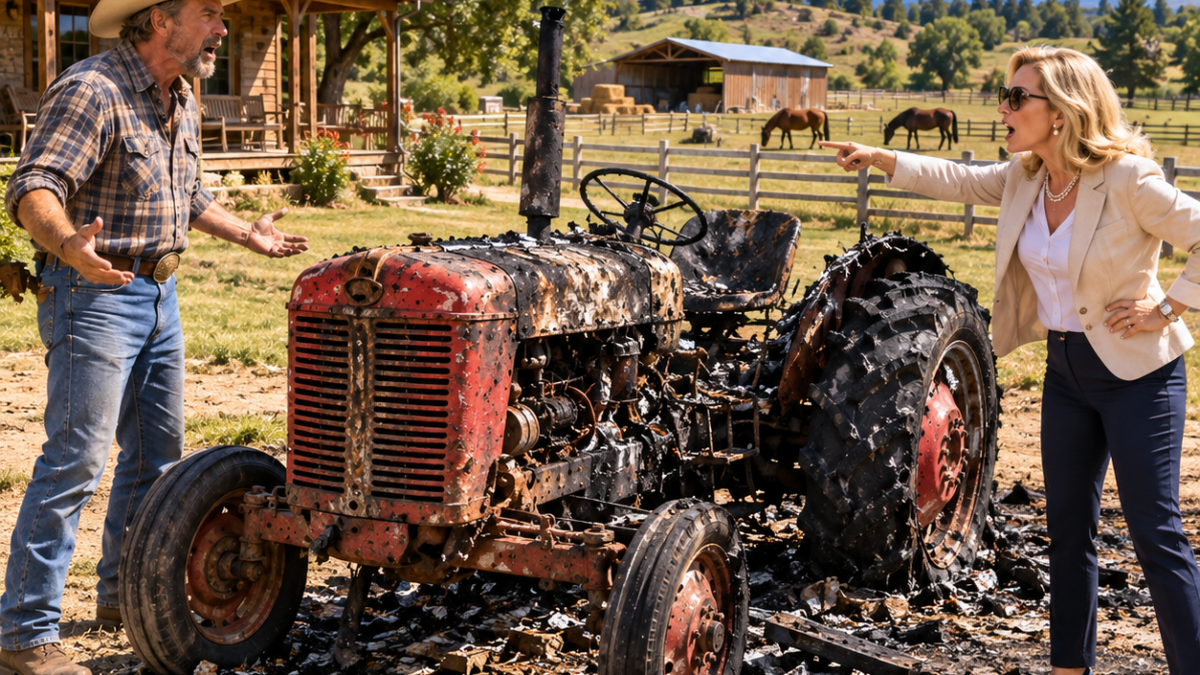
She stood across the road filming while the tractor my father taught me to drive burned down to black steel, then smiled because she thought fire would finally force me into her HOA.
For weeks, Karen Holloway had threatened me, moved boundary markers onto my land, vandalized my property, and told half the neighborhood I was the dangerous old farmer standing in the way of progress.
Then she marched onto my property with her entire HOA board to “reclaim” my land and finally noticed the sheriff badge clipped beneath my jacket.
My name is Bill Turner.
For most of my life, people around Willow Creek knew me in one of two ways.
Some knew me as the man who lived on the old Turner place.
Others knew me as Sheriff Turner.
I preferred the first one.
The badge had been part of my life for decades, but the land came before it.
My father bought the first section of our property before I was born. By the time I was old enough to remember anything, that place had become the center of my world.
The barn.
The creek.
The orchard.
The long fence line along the county road.
And an old red tractor that had probably spent more hours running than half the cars in town.
My father taught me to drive it when I was ten.
He sat beside me on the metal fender while I gripped the steering wheel with both hands.
“Easy,” he said.
“I am going easy.”
“You’re trying to wrestle it.”
“It’s pulling.”
“No. You’re pulling.”
I remember being furious because I thought he was making fun of me.
Then he put one hand over mine.
“Machines tell you what they need,” he said. “Land does too. Don’t fight either one just because you’re stronger.”
I did not appreciate the lesson then.
I did later.
That tractor plowed our garden.
Pulled fence posts.
Hauled hay.
Cleared snow during the rare hard winters.
When my father died, it became mine.
I replaced parts.
Rebuilt the carburetor twice.
Changed tires.
Repainted the hood once and regretted it because the new red never looked like the original.
It was not valuable in the way Karen Holloway understood value.
You could not put it in a luxury brochure.
Nobody would pay collector money for it.
But every dent had a history.
Every worn patch on the steering wheel came from hands I remembered.
So when I stood barefoot in the yard one night watching flames roll across its seat and black smoke rise into the dark, I was not watching an old machine burn.
I was watching someone deliberately put fire to part of my family.
And across the road, Karen Holloway was filming it.
That was the moment everything changed.
But the trouble had started weeks earlier.
Willow Creek was new.
My farm was not.
Developers had bought several large parcels surrounding the southern end of our county and built a subdivision that looked like almost every modern subdivision I had ever seen.
Wide entrance.
Decorative stone walls.
Matching streetlights.
Rows of new homes.
Fresh lawns that had not yet figured out whether they wanted to survive the summer.
The developers named it Willow Creek because an old creek crossed the area.
At least that part was honest.
Most people who moved there were fine.
Families.
Retirees.
Young couples.
A few commuters working in the city.
They waved when they drove past.
PART2:
Some stopped at my roadside stand when I had tomatoes.
A father brought his two boys over once because they wanted to see the orchard.
Normal neighbor things.
Then Willow Creek formed a homeowners association.
And the association elected Karen Holloway.
I met her on a Tuesday afternoon.
I was replacing the lower rail on the fence near the county road when I heard somebody call my name.
“Mr. Turner?”
I looked up.
A woman in a pink blazer stood beside the ditch with a clipboard tucked against her chest.
Cream slacks.
Dark sunglasses.
Blonde hair that did not appear capable of moving in wind.
“Depends,” I said.
She smiled.
“I’m Karen Holloway.”
“Okay.”
“President of the newly formed Willow Creek Homeowners Association.”
“Congratulations.”
She laughed.
A bright, artificial laugh.
“I wanted to personally welcome you.”
I leaned on the rake.
“Been here since 1981.”
Her smile paused.
“Of course.”
“The neighborhood welcomed me a while ago.”
She laughed again.
That one sounded more forced.
PART3:
“Well, what I mean is that Willow Creek is becoming a more organized community.”
“That sounds serious.”
“We’re establishing consistent standards.”
“For Willow Creek.”
“For the broader neighborhood.”
I looked around.
“My house isn’t in Willow Creek.”
“Technically, your property borders us.”
“That’s how maps work.”
She ignored that.
“We believe all nearby properties should maintain a unified appearance.”
“You do?”
“Yes. It helps preserve property values.”
“Whose?”
Her smile tightened.
“Everyone’s.”
I looked past her toward the new houses.
They sat beyond the rise, roofs still too clean, sidewalks still too bright. My pasture ran along the western edge, separated by an old fence line and a strip of county drainage ditch.
“My land isn’t part of your HOA,” I said.
“We understand that.”
“Good.”
“But we hope you’ll consider voluntarily joining.”
“No.”
She blinked.
I had seen that look many times in thirty-two years of law enforcement.
It was the look people get when they expected negotiation and received a locked door.
“You haven’t reviewed the benefits.”
“I heard the word HOA. That was enough.”
Karen’s smile did not move, but something behind it cooled.
“Mr. Turner, this community is changing.”
“Communities do that.”
“Willow Creek is attracting families who expect a certain quality of life.”
“Good for them.”
“Your property has several visible issues that may create concern.”
“My property has hay, tractors, fences, chickens, a barn, a vegetable patch, and mud when it rains.”
“Yes,” she said slowly. “That is exactly the concern.”
I stared at her.
She continued.
“Unscreened agricultural equipment. Irregular fencing. Visible livestock structures. Nonconforming roadside signage. Seasonal produce sales. These things may have been acceptable before, but they create an inconsistent impression now.”
I looked down at the fence rail in my hand.
Then back at her.
“Miss Holloway, did you move next to a farm and decide the farm was the problem?”
Her jaw tightened.
“My name is Mrs. Holloway.”
“All right.”
“And this is not about disrespecting agriculture.”
“Sounds like it.”
“It’s about progress.”
That word told me everything.
Progress, in some mouths, means making room for the future.
In others, it means erasing whatever was already standing there.
Karen Holloway meant the second one.
I picked up my hammer.
“We’re done.”
She stepped closer to the fence.
“I strongly recommend you review the membership packet.”
“I strongly recommend you don’t climb that fence.”
Her eyes flicked to the old rail.
“I’m simply trying to be neighborly.”
“No, ma’am. You’re trying to be in charge.”
For the first time, her smile disappeared completely.
“You’ll find that cooperation is easier than conflict.”
I drove the nail in with one clean strike.
“Been my experience that depends on who starts the conflict.”
She stood there another second, then turned and walked back to her SUV.
I watched her leave.
At the time, I thought she was just another neighborhood busybody with too much time and a clipboard.
I had underestimated her.
That was my first mistake.
The letters started three days later.
Official HOA letterhead.
Willow Creek Residential Association.
Violation Notice.
I laughed so hard I had to sit down at the kitchen table.
The first notice cited me for storing farm equipment visible from the road.
The second demanded removal of my roadside produce stand.
The third claimed my fence line failed to meet Willow Creek standards.
The fourth required me to paint my barn a “community-approved neutral tone.”
My barn was red.
It had been red since before Karen Holloway learned how to spell covenant.
I wrote one response.
The Turner property is not part of Willow Creek HOA. No covenant applies. Do not contact me again regarding HOA violations.
I mailed it certified.
Then I put copies of her notices in a folder.
Old habit.
A badge teaches you that paper matters long before you need it.
Karen did not stop.
She escalated.
A week later, I found three orange survey flags along my fence line.
They were not on the county side.
They were not on Willow Creek land.
They were inside my pasture.
Each had black marker writing on the ribbon.
FUTURE COMMON ACCESS BUFFER.
I pulled them up and laid them on my workbench.
Then I checked the ground near the fence.
Fresh boot prints.
Two sets.
One large.
One smaller.
I photographed everything.
The next morning, Karen called.
Her number showed up because she had included it in every letter like she was running a government agency.
“Mr. Turner,” she said, without saying hello. “I understand you removed boundary markers.”
“I removed trespass markers.”
“Those were placed by a survey contractor.”
“Then your contractor trespassed.”
“They were marking the future buffer.”
“My pasture is not your future anything.”
She sighed.
The dramatic kind.
“The county is reviewing access and beautification concerns along that corridor.”
“That corridor is my fence line.”
“For now.”
I stood very still.
“For now?”
She paused.
Then recovered.
“I mean only that land use can evolve.”
“Mrs. Holloway, listen carefully. Do not step on my land again. Do not send anybody onto my land again. Do not place markers, notices, signs, stakes, flags, cones, or paper threats on my land again.”
Her voice hardened.
“Threatening an HOA officer is not wise.”
“Good thing I’m giving instructions.”
She hung up.
The vandalism began after that.
A gate chain cut.
A tire slashed on the old hay wagon.
One of my roadside tomato signs knocked into the ditch.
Spray paint on the produce stand.
JOIN OR MOVE.
That one was new.
I photographed it.
Filed a report.
Then painted over it.
The deputy who came out was twenty-three and nervous because I had sworn him in myself the year before I retired.
Technically, I was no longer sheriff.
I had retired seven months earlier after thirty-two years wearing the badge.
But the county still called me when they needed help with search operations or old cases or people who listened better when an old sheriff stood in the room.
The badge on my belt was honorary now in one sense.
In another sense, it was still real enough.
Retired law enforcement in our county retained certain authority under state statute if they maintained certification and carried department identification. I did both, though I did not advertise it.
I was proud of the badge.
I was also tired of it being the first thing people saw.
After retiring, I wanted mornings with coffee on the porch, fence repairs on my own schedule, tomatoes in July, pears in September, and no one calling me at midnight because someone had decided whiskey and firearms belonged in the same conversation.
So I wore old jackets over the badge.
Most people in Willow Creek had no idea who I was.
Karen certainly did not.
That was her mistake.
One evening, my neighbor Tom Avery drove up in his pickup.
Tom lived half a mile down the road on the last remaining old place before Willow Creek began. He was seventy-one, widowed, and still strong enough to make men half his age feel lazy.
He got out slowly, looking toward the road.
“You got trouble.”
“I noticed.”
“No,” he said. “I mean more.”
He leaned against the truck.
“My niece lives in Willow Creek. She says Karen’s been telling people you’re a public safety hazard.”
“That so?”
“Says you refuse to follow community standards. Says your property invites crime. Says your animals carry disease. Says your farm equipment is dangerous to children.”
“My nearest tractor is eighty yards from their sidewalk.”
“Facts don’t slow people like that.”
I wiped my hands on a rag.
“What else?”
Tom hesitated.
“She’s saying the county may have to condemn part of your frontage for Willow Creek access.”
I laughed once.
No humor in it.
“Condemn.”
“Yeah.”
“For what?”
“Trail connection. Emergency route. Community buffer. Depends who she’s talking to.”
There it was again.
Access.
Buffer.
Corridor.
Future.
Words people use when they are trying to turn your land into a line on their map.
The next day, I pulled county records.
The developer had built Willow Creek with only one main road in and out.
Phase Two required a secondary access route before full occupancy approvals.
I knew because I still had friends in county administration, and because public records are not secret just because most people are too lazy to read them.
Their proposed secondary route would be expensive if built through land the developer still owned.
Too much grading.
Drainage problems.
A creek crossing.
But if they could run a short connector along my frontage and through the lower pasture, the route became cheaper, cleaner, and faster.
Karen’s HOA wanted my land.
The tractor was not the beginning.
It was the confession.
The night it burned, I woke to my dog barking.
Buster was twelve years old, mostly hound, partly something with poor judgment, and too lazy to bark unless the world had truly offended him.
At first, I thought it was coyotes.
Then I smelled smoke.
I sat up in bed.
The room had that strange orange flicker that does not belong inside a bedroom.
I got to the window and saw fire near the barn.
For one second, my mind refused to make sense of it.
Then I saw the tractor.
My father’s tractor.
Flames rolled over the hood.
The seat had already caught.
The old tires smoked black and thick.
I ran outside barefoot, grabbing the extinguisher from the mudroom as I went.
The gravel bit into my feet.
I emptied the extinguisher into the flames, but it was already too far gone. The tractor sat near the equipment shed, close enough that if the wind shifted, the shed would catch too.
I dragged the hose from the side of the barn and opened the spigot full.
Water hit the fire and flashed into steam.
Buster barked behind me.
My lungs burned.
I kept spraying until the worst of the flames died down, then moved toward the shed wall to wet the siding.
That was when headlights swept across the road.
I looked up.
Across the ditch, near the entrance to Willow Creek, Karen Holloway stood beside her SUV.
Phone raised.
Filming.
The fire lit her face orange.
She was smiling.
Not openly.
Not broadly.
But enough.
Enough that I saw it.
Enough that I would remember it later when she claimed she had rushed over because she was worried.
I lowered the hose for one second.
She did not move to help.
Did not call out.
Did not ask if I was injured.
She just filmed.
By the time the volunteer fire crew arrived, the tractor was blackened steel.
The seat was gone.
The paint had blistered and curled.
The tires were ruined.
The steering wheel had melted partly away, leaving the metal ring exposed like bone.
I stood barefoot in the wet gravel and stared at it.
Fire Chief Dale Monroe walked over.
He had known me thirty years.
“Bill.”
I did not look away from the tractor.
“Dale.”
“You hurt?”
“No.”
“You sure?”
“Feet are cut up. That’s all.”
He followed my eyes to the tractor.
“Damn.”
“Yeah.”
He crouched near the ground, careful.
Firefighters know when not to disturb a scene.
“Did you move anything?”
“Just fought it.”
“Anybody around?”
I looked across the road.
Karen was still there.
Her phone was lowered now.
She noticed us looking and began walking over with that concerned face people put on after deciding there are witnesses.
“Sheriff—”
She stopped herself.
Maybe she did not know whether to call me that.
Maybe she did not want others remembering.
“Mr. Turner,” she said. “I saw the fire and came over as quickly as I could.”
“No, you didn’t.”
Her eyebrows lifted.
“Excuse me?”
“You stood across the road filming.”
“I was documenting the emergency.”
“For who?”
“The HOA has an obligation to monitor safety concerns affecting the community.”
Dale stood slowly.
“Karen, did you call this in?”
She blinked.
“I assumed Mr. Turner had already—”
“Did you call 911?”
“I was about to.”
Dale stared at her.
Firefighters have a way of looking at people that can strip varnish.
She looked away first.
Dale turned back to me.
“We’ll have the fire marshal look.”
“Good.”
Karen stepped closer to the fence.
“This is exactly the sort of danger I’ve been warning about.”
I looked at her.
“What?”
“Old equipment. Fuel. Dry grass. Improper storage. This could have spread to Willow Creek.”
“My tractor was set on fire.”
“You don’t know that.”
“No?”
“Accidents happen when properties are not maintained to modern standards.”
The fire chief looked at her.
“Ma’am, maybe save the property lectures until after we figure out why the tractor burned.”
Her mouth tightened.
“I’m simply saying this proves the need for oversight.”
There it was.
She had not come to help.
She had come to use the fire.
The next morning, a letter was taped to my gate.
Not mailed.
Taped.
TEMPORARY SAFETY NOTICE.
Due to recent fire activity and ongoing community risk, Willow Creek HOA requires immediate compliance review of adjacent agricultural property.
That was the first time Karen made me laugh after the fire.
It was also the last.
I called my old undersheriff, Maria Delgado.
She had taken over after I retired.
Maria was forty-two, sharp as barbed wire, and had the patience of a rattlesnake in July. She had been my best investigator for eight years before voters decided she had earned the office.
She answered on the second ring.
“You all right?”
“You heard?”
“Dale called me.”
“My tractor was burned.”
“That’s what Dale thinks too.”
“Karen Holloway was across the road filming while it burned.”
There was a pause.
“The HOA woman?”
“Yes.”
“I’ll send someone.”
“No.”
“Bill.”
“I need you to handle this by the book.”
“That is what sending someone means.”
“I mean not the kid who still calls me Sheriff at the diner.”
She understood.
“You want clean distance.”
“Yes.”
“I’ll come myself.”
“Good.”
Maria arrived with a fire investigator from the state office by noon.
They photographed the tractor, the ground, the shed, the tire marks near the ditch, and the place where someone had cut the back pasture gate chain the night before.
Accelerant traces were found near the seat and engine compartment.
A small section of cloth had been caught under the left rear tire, half burned.
Not mine.
Not from the tractor.
Maria bagged it.
Then she looked across the road.
“Any cameras?”
“Two.”
“Only two?”
I almost smiled.
“On the barn.”
She stared at me.
“What does that mean?”
“It means I have four more people don’t know about.”
She shook her head.
“Retirement made you paranoid.”
“No. Being sheriff made me paranoid. Retirement gave me time to wire things.”
We reviewed footage in my workshop.
The visible cameras showed only flame after ignition.
The hidden camera near the windbreak showed the road.
At 1:17 a.m., Karen’s white SUV drove past slowly.
At 1:22, it returned and stopped near the drainage ditch.
A figure got out.
Not Karen.
A man.
Medium build.
Dark hoodie.
He crossed toward my property line where the brush was thickest.
At 1:31, he came back fast.
At 1:32, light flickered near the tractor.
At 1:34, Karen’s SUV pulled forward thirty yards and parked where she later stood filming.
At 1:36, the first visible flames appeared.
At 1:39, I came out of the house with the extinguisher.
At 1:40, Karen’s phone lifted.
Maria said nothing for a long time.
Then she said, “Who’s the man?”
“I don’t know.”
“We will.”
The cloth fragment came back with traces of gasoline and fibers matching cheap cotton gloves. The tire impressions near the ditch matched Karen’s SUV size class, though that alone did not prove much.
The break came from something Karen never considered.
Her own phone.
She had filmed the tractor burning.
Then she posted a cropped clip to the Willow Creek community page with a caption.
This is why Willow Creek must act before unsafe neighboring properties endanger our families.
She thought that video helped her.
It hurt her badly.
In the background, before the flames fully rose, a male voice could be heard faintly.
“Did it take?”
Then Karen whispered, “Move. He’s coming out.”
She deleted the post within an hour.
Too late.
Three residents saved it.
One sent it anonymously to Maria.
Another sent it to the county fire marshal.
The third sent it to me with one sentence:
I’m sorry. This is wrong.
Karen did not know the ground under her was shifting.
That was why she planned her big performance.
Three days after the fire, at nine in the morning, Karen Holloway marched onto my property with the entire Willow Creek HOA board.
There were six of them.
Karen in the lead.
Two board members behind her with folders.
One man recording with his phone.
A woman carrying a printed notice.
Derek Sands, the HOA security chair, wearing a black polo and a belt radio.
They came through my open gate like they had practiced.
I was standing near the burned tractor with my jacket on.
Maria was parked behind the barn where they could not see her.
Two deputies were in the lower drive.
Fire investigator Dale had returned for follow-up documentation and stood inside the shed doorway with a camera.
Karen saw only me.
That was her second mistake.
She stopped ten feet from the tractor and lifted her chin.
“Mr. Turner, this has gone far enough.”
“It has.”
She held out a paper.
“Willow Creek HOA is issuing formal notice of emergency community intervention.”
I did not take it.
She continued anyway.
“Given the fire hazard demonstrated by your property, the board has voted to assume temporary control of the roadside buffer and equipment storage area pending county review.”
I stared at her.
“You voted to assume control of my land?”
“In an emergency capacity.”
“That’s not a thing.”
“It is when public safety is involved.”
Derek Sands stepped forward.
“Sir, we’re asking you to cooperate peacefully.”
I looked at him.
“Are you?”
Karen’s voice sharpened.
“Your refusal to join the HOA has placed families at risk. Your neglect caused a fire that could have spread into our neighborhood.”
“My neglect?”
“An old tractor caught fire beside a wooden structure.”
“Caught fire.”
“Yes.”
“And now you want the land near the road.”
“We want safety.”
“No. You want access.”
Her eyes flashed.
“That is a reckless accusation.”
“Is it?”
She stepped closer.
“You are one man standing in the way of a community’s future.”
I had heard enough.
I unzipped my jacket.
Just enough.
The badge clipped to my belt caught the morning light.
Karen’s eyes dropped.
Then froze.
The man recording lowered his phone slightly.
One of the board members whispered, “Oh God.”
Karen looked up slowly.
“You’re…”
“Bill Turner,” I said. “Former county sheriff. Current certified reserve officer.”
Her face lost color.
Behind her, Maria stepped out from behind the barn.
“And I’m Sheriff Delgado,” she said. “Current county sheriff.”
The entire HOA board turned.
Derek Sands took one step backward.
Two deputies came up the drive.
Dale Monroe stepped from the shed holding an evidence camera.
Karen’s mouth opened.
Closed.
Opened again.
Maria walked toward her.
“Mrs. Holloway, you and your board are standing on private property after repeated written notice not to enter.”
Karen tried to recover.
“We are here in response to a safety emergency.”
“No, you are here attempting to enforce a fake emergency authority over land your HOA does not own.”
One board member immediately said, “Karen told us the county was aware.”
Maria looked at him.
“The county is aware now.”
Karen snapped, “Don’t say another word.”
That was exactly the wrong thing to say in front of a sheriff.
Maria smiled without warmth.
“Actually, I’d like everyone to say a lot of words. Separately.”
Derek Sands shifted toward the gate.
A deputy stepped into his path.
“Stay put.”
I looked at Karen.
She would not meet my eyes now.
All that polished confidence had drained out of her.
The pink blazer, the clipboard, the perfect hair, the HOA title—all of it looked suddenly small against the blackened tractor and the sheriff standing behind her.
Maria removed a folded paper from her jacket.
“Karen Holloway, we have a warrant for your phone, your vehicle, and HOA communications related to the Turner property, the roadside buffer, the fire, and any proposed access route through this land.”
Karen whispered, “You can’t do that.”
Maria held up the warrant.
“Already did.”
A deputy took Karen’s phone from her hand.
She looked at me then.
And I saw the calculation.
Not remorse.
Calculation.
People like Karen do not feel guilty first.
They look for the nearest exit.
“This is a misunderstanding,” she said.
“No,” I said. “A misunderstanding is when a child throws a baseball through a window. This was gasoline.”
Her eyes flicked toward the tractor.
Just once.
But enough.
Maria saw it too.
The investigation did what investigations do.
It moved slowly.
Carefully.
Without caring how badly Karen wanted a press release to shape the story.
Her SUV was searched.
In the cargo compartment, investigators found a partially empty gas can.
Karen claimed it had been used for lawn equipment.
Maybe it had.
But residue on the spout matched the accelerant pattern found on the tractor.
Her phone told the rest of the story.
Messages to a man named Caleb Moss.
Caleb was a contractor who had done landscape work for Willow Creek and odd jobs for Karen personally.
Three weeks before the fire, Karen texted him:
The Turner place is the obstacle. We need leverage.
A week later:
He thinks being old gives him permanent rights.
Then:
If the old equipment becomes a safety issue, county will have to review.
The night of the fire:
Tonight. Just the tractor. Enough to prove risk, not spread.
Caleb replied:
You sure?
Karen:
Do it and leave. I’ll document.
That was the message that ended her.
Caleb ran for two days.
Then his girlfriend turned him in because apparently he had not been smart enough to avoid telling her why police were looking for him.
He confessed faster than anyone expected.
Not out of conscience.
Out of fear Karen would blame him for everything.
He admitted she paid him cash.
He admitted she told him where to enter.
He admitted she wanted the tractor burned because it was close enough to the shed to “prove” the property was unsafe without destroying the whole barn.
He admitted the goal was to force a county safety review and create pressure for me to accept HOA oversight or sell the frontage.
Sell the frontage.
There it was.
The road.
The access route.
The thing behind every complaint, letter, marker, and threat.
Karen had presented herself as a guardian of community safety.
She was a woman trying to steal a strip of land with fire.
The HOA board collapsed almost instantly.
Not legally at first.
Socially.
Residents who had repeated her claims began deleting posts. People who had called my farm dangerous suddenly remembered they had always respected old properties. Board members issued statements saying they had relied on Karen’s representations.
Some meant it.
Some were saving themselves.
Both could be true.
The county suspended Willow Creek’s Phase Two access review.
The developer distanced itself from the HOA so quickly I wondered if their lawyers had teleported.
Karen was removed as president in an emergency vote.
That happened before her first court appearance.
By then, everybody knew.
The local paper ran the headline:
HOA PRESIDENT ACCUSED IN ARSON TARGETING FORMER SHERIFF’S PROPERTY.
Former sheriff.
They loved that part.
So did half the county.
For two weeks, people kept stopping by with pies, coffee, sympathy, and gossip.
I appreciated the pies.
Less so the gossip.
Tom Avery came over the morning after Karen’s arrest.
He stood beside the burned tractor and took off his hat.
“Your dad would be mad.”
“About the tractor?”
“About you letting an HOA woman get that close.”
I almost smiled.
“He’d be mad about both.”
Tom looked at the blackened machine.
“You going to restore it?”
I did not answer quickly.
“I don’t know if I can.”
“Can and will aren’t always the same.”
“No.”
We stood there awhile.
Finally, he said, “If you try, I’ll help.”
That was Tom.
No speech.
No pity.
Just the offer of hands.
The court case took months.
Karen pleaded not guilty at first.
Her attorney floated several theories.
Caleb acted alone.
Karen’s texts were taken out of context.
The fire was meant as a controlled demonstration.
She had never intended harm.
The public safety concern was legitimate.
None of it survived contact with evidence.
The video.
The messages.
The gas can.
Caleb’s testimony.
The vandalism history.
The boundary markers.
The false HOA notices.
The planned access route.
The fact that she marched onto my property three days later with paperwork prepared to “assume temporary control” of the same area she had created danger around.
A jury did not have to be brilliant to understand that sequence.
They only had to listen.
Karen eventually took a plea after the judge ruled most of the messages admissible.
Arson.
Conspiracy.
Criminal trespass.
Vandalism.
False reporting tied to her HOA safety claims.
There were civil claims too.
Restitution for the tractor.
Fence damage.
Produce stand damage.
Legal costs.
Emotional value is harder.
The law is not good at pricing the weight of your father’s hand over yours on a steering wheel.
It can price steel.
Tires.
Paint.
Parts.
Labor.
It cannot price memory.
That bothered me for a while.
Then I realized something.
The court did not need to understand everything I lost.
It only needed to stop the person who caused it.
That was enough.
Almost.
The day Karen was sentenced, she wore gray.
No pink blazer.
No sunglasses.
No clipboard.
Her hair was less perfect.
For the first time, she looked like a person instead of a campaign poster.
The judge allowed victim statements.
I had written one.
Then rewritten it.
Then thrown it away.
When my turn came, I stood with the paper folded in my pocket and did not open it.
I looked at Karen.
She looked past me.
Not at me.
Past me.
That made the choice easier.
“My father taught me to drive that tractor when I was ten,” I said. “It was old then. It was older when you burned it. You probably looked at it and saw junk. Something ugly. Something in your way.”
The courtroom was quiet.
“You were wrong.”
Karen’s jaw tightened.
“That tractor worked this land before Willow Creek existed. It pulled fence posts. Hauled hay. Cleared snow. It sat in my barn for years after my father died because sometimes objects hold more than their market value.”
I paused.
“You set it on fire because I told you no. Not because it was unsafe. Not because you were protecting families. Because you wanted my land and thought fear would make me easier to move.”
For the first time, she looked at me.
I continued.
“You called yourself a community leader. A leader protects boundaries. You tried to burn through them.”
The judge watched me carefully.
I looked at him.
“I am not asking the court to understand what that tractor meant to me. I don’t think a sentence can fix that. I am asking the court to understand what she meant to do next. The fire was not the end of her plan. It was the beginning.”
That mattered.
The judge said so later.
Karen received prison time.
Not as much as some people wanted.
More than she expected.
She was ordered to pay restitution and barred from contacting me, entering my property, or holding any fiduciary position in a homeowners association or community board during probation.
That last part made Tom Avery laugh so hard he had to sit down.
The Willow Creek HOA survived, technically.
But not in the same form.
The board resigned in pieces.
Residents rewrote rules.
The patrol committee dissolved before it ever became anything official.
Any proposed boundary action now required legal review and notice to adjacent landowners.
The access route through my property died permanently.
The developer redesigned Phase Two at great expense.
They were not happy.
I was not concerned with their happiness.
As for the tractor, I did restore it.
Not completely.
That would have been impossible.
Too much heat damage.
Too much metal compromised.
Too many parts gone beyond saving.
But Tom helped.
So did Dale Monroe.
So did Maria’s husband, who had no business being as good with old engines as he was.
We salvaged what we could.
Frame sections.
A gear housing.
The steering column.
A few parts that had survived because old steel has a stubbornness new things often lack.
We found a donor tractor three counties away.
Same model.
Worse paint.
Better bones.
For months, my barn smelled like grease, solvent, and old grief.
Every Saturday morning, men showed up with coffee and tools.
Nobody called it therapy.
That would have made everyone uncomfortable.
But it was.
Piece by piece, we built one tractor from two.
Not Dad’s tractor exactly.
Not the same.
But carrying parts of it.
The first time it started, the engine coughed twice, caught badly, spat smoke, and settled into an uneven idle.
Tom yelled like we had won a war.
Dale clapped his hands.
Maria’s husband cried and pretended it was allergies.
I stood with one hand on the hood and felt the vibration move through my palm.
Not the same.
Still alive.
That was enough.
I painted it red.
Not the bright wrong red I had used years earlier.
This time, I found a paint closer to the old shade.
Dull.
Deep.
Honest.
On the inside of the hood, where nobody would see unless they opened it, I painted my father’s initials.
Then mine beneath them.
Not for display.
For record.
The rebuilt tractor does not do heavy work anymore.
I use it lightly.
Parades sometimes.
Dragging brush.
Hauling a small wagon during harvest days when neighborhood children visit.
Funny thing about Willow Creek.
After Karen was gone, people started acting like neighbors.
Not all at once.
Not perfectly.
But enough.
A woman named Heather brought her daughter to buy tomatoes and apologized for believing what Karen had said.
A man named Joel asked if his son could see the tractor.
Two boys who had once been warned to stay away from my “dangerous farm” now help pick pears in late summer for cash and all the bruised fruit they can carry.
The new HOA president, a quiet retired teacher named Linda Price, came by one afternoon with a folder.
I nearly laughed.
She saw my face and held up both hands.
“No citations.”
“Good start.”
She wanted to create a voluntary neighbor communication list so farmers, residents, and county officials could coordinate seasonal spraying notices, road work, and school bus concerns.
Reasonable.
Respectful.
No authority claimed.
No land grabbed.
I signed up.
Linda looked relieved.
“I know Willow Creek has a lot to repair.”
“That’s one word for it.”
“She made people afraid of you.”
“She tried.”
Linda looked toward the rebuilt tractor.
“I think she was afraid of you first.”
That made me pause.
“Why?”
“Because you couldn’t be controlled.”
I thought about Karen standing across the road filming the fire.
Maybe Linda was right.
Bullies are often called fearless.
Most are not.
Most are full of fear.
Fear of being ignored.
Fear of losing power.
Fear that someone else’s independence proves their authority is smaller than they want to believe.
Karen did not burn the tractor because it was dangerous.
She burned it because it stood on land she could not command.
So did I.
Years later, the boundary between Turner land and Willow Creek is clearly marked.
Not aggressively.
Clearly.
Good fence.
Recorded survey.
County acknowledgement.
No ambiguity.
That matters.
Land disputes love ambiguity.
So do people like Karen.
She lived inside gray areas until evidence dragged her into daylight.
People still ask me about the badge.
They like that part.
The moment Karen saw it.
The sudden change in her face.
The board member whispering, “Oh God.”
The sheriff stepping out from behind the barn.
It makes a good story.
I understand why.
But the badge was not what beat her.
Not really.
The badge made her realize she had chosen the wrong target.
The evidence is what beat her.
Photographs.
Reports.
Video.
Messages.
Burn patterns.
Witnesses.
Paper.
The same boring things that build justice brick by brick while angry people are busy giving speeches.
That is the lesson I tell people now.
Do not only get mad.
Document.
Measure.
Photograph.
Write dates down.
Keep copies.
Bullies thrive in fog.
Evidence is sunlight.
Karen Holloway walked onto my land believing she could turn a lie into policy if she said it loudly enough.
She discovered too late that I had spent my life listening to liars.
Her mistake was thinking retirement meant I had forgotten how.
This morning, I drove the rebuilt tractor along the fence line.
Slowly.
It rattled more than it should.
The steering pulled slightly left.
My father would have criticized the carburetor adjustment.
I could almost hear him.
“You’re fighting it again.”
I smiled.
“Maybe.”
The Willow Creek houses sat beyond the trees, quieter now.
A child waved from the sidewalk.
I lifted one hand from the wheel.
The tractor rolled on.
Not as strong as before.
Not untouched.
Not original.
But moving.
That is the thing about what survives.
It does not always come back the same.
Sometimes it carries burn marks beneath new paint.
Sometimes the old parts and new parts learn to work together.
Sometimes what was meant to scare you off becomes the very thing that proves you are still there.
Karen Holloway burned my father’s tractor because I refused to join her HOA.
She thought fire would make me small.
She thought grief would make me weak.
She thought a fake notice, a board vote, and a pretty blazer could turn theft into progress.
Then she saw the badge on my belt.
And after that, she saw something worse.
She saw the truth recorded from every angle.
She saw neighbors stop believing her.
She saw the sheriff she had underestimated become the complainant, the witness, and the man standing between her and the land she thought she could take.
The tractor still runs now.
Not every day.
Not hard.
But enough.
Enough for children to ride behind it in a wagon.
Enough for Tom to complain that the idle is wrong.
Enough for me to feel the old steering wheel vibrate under my hands and remember my father’s voice.
Machines tell you what they need.
Land does too.
So do people.
And what my land needed was simple.
A line held.
A lie exposed.
A fire answered not with rage, but with proof.
That is what I gave it.
That is what stayed standing.








