HOA Karen Burned My Equipment Yard to Force Me Out—But My Deed Froze Her $19 Million Development Before Closing
PART2:
A developer named Garrett Hollister partnered with the HOA to plan seventy-four luxury townhomes on the parcel directly behind my equipment yard. The local business journal called it a $19 million construction and land package. The renderings showed glass balconies, decorative lighting, manicured courtyards, young trees, smooth sidewalks, and smiling people drinking coffee in clothes nobody wears before work.
From the air, the land behind me looked valuable.
On the ground, it was boxed in.
Wetlands on one side.
A ravine on the other.
A drainage problem running straight through the middle.
The only clean route to the county road ran along the edge of my six acres.
That made me inconvenient.
People with money hate inconvenience more than they hate losing money.
The first meeting happened in my site office on a Wednesday afternoon. I remember because Travis had just come in furious about a blown seal on the 320 excavator, and my coffee had gone cold on the desk.
The door opened, and Mallerie Wexler walked in like she owned the air.
She was the president of the Crest Haven Ridge HOA.
That title meant nothing on my side of the fence, but she wore it like a crown.
Mallerie had perfect silver-blond hair, a sharp smile, and the kind of voice that could make insults sound like meeting minutes. She wore a cream blazer, narrow heels that had no business being near a gravel yard, and a gold watch bright enough to look like it had its own attorney.
Garrett Hollister stood beside her, taller, quieter, expensive without needing to announce it. He had the polished look of a man who never signed anything without three people reading it first.
Mallerie folded both hands over a leather portfolio.
“Mr. Prescott,” she said. “Thank you for meeting with us.”
“You came without an appointment.”
Her smile did not move.
“And yet here we all are.”
Travis snorted from the doorway.
I gave him a look that said not now.
Mallerie pretended not to hear him.
“Crest Haven wants to be a good neighbor,” she said.
I already knew that meant they wanted something.
Garrett did the talking at first. He explained the development timeline, the economic benefits, the increased tax base, the improvements to infrastructure, the beautification of a growing community. He had a smooth way of speaking that told me he had given this pitch to banks, investors, planning commissions, and probably his own mirror.
I listened.
Not because I was interested.
Because people tell you things when they think you are too simple to understand what matters.
Then Mallerie slid a purchase offer across my desk.
Six acres.
My entire yard.
The number was not laughable.
It was insulting.
There is a difference.
Laughable offers come from people who do not know the market.
Insulting offers come from people who know exactly what something is worth and hope you are too tired, scared, or foolish to say no.
I looked at the paper, then at her.
“This is not for sale.”
Mallerie smiled.
“Everything is for sale under the right circumstances.”
“Not this.”
Garrett leaned forward slightly, trying to soften the moment.
“Mr. Prescott, relocating your operation could give you an opportunity to modernize. Larger footprint. Cleaner zoning. Better long-term value.”
“My value is fine where it is.”
Mallerie’s fingers tapped once on the leather portfolio.
“With respect, Nolan, your current yard is not exactly compatible with the direction this area is moving.”
“That area is moving around me,” I said. “I was here first.”
Her smile stayed.
Her eyes changed.
“That attitude can become expensive.”
“It already is. That loader outside cost me more than my first house.”
Travis laughed.
Mallerie did not.
They left without a deal.
I thought that would be the end of it.
That was my first mistake.
The letters started the next week.
Official HOA letterhead.
Crest Haven Ridge Residential Association.
Noise concerns.
Lighting concerns.
Dust migration.
Visual nuisance.
Improper fencing aesthetics.
Negative impact on residential desirability.
I read the first letter twice because I thought maybe I had missed the part where my property had joined their HOA.
It had not.
My six acres were private commercial land outside their covenants, outside their board authority, and outside Mallerie Wexler’s little kingdom of landscaping rules and mailbox colors.
I wrote one response.
Prescott Heavy Equipment and Site Work is not subject to Crest Haven Ridge HOA covenants. Any further claims should be directed to my attorney.
At the time, I did not have an attorney.
That was my second mistake.
Mallerie did not care whether her authority was real.
She only cared whether it sounded official enough to scare people.
Fuel vendors started getting calls.
One asked if I was still operating legally.
Another said someone from Crest Haven warned them about “pending environmental action” at my yard.
A parts delivery truck was stopped at my gate by two men in security uniforms who had no legal right to stop a bicycle, much less commercial freight. They delayed my delivery two hours, asked the driver for paperwork, filmed his license plate, and claimed they were documenting nuisance activity for community safety.
Travis chased them off before I got there.
He called me while still breathing hard.
“They had badges, Nolan.”
“What kind of badges?”
“The kind you buy online when you want idiots to think you’re law enforcement.”
Then one of my biggest clients called.
Ron Bell owned a paving outfit three counties over. He had given me work when I had more ambition than equipment. His voice sounded uncomfortable, which told me the damage had already begun.
“Nolan, I got an email about your property.”
“What email?”
“Something about zoning violations. Possible shutdown. I figured it was garbage, but I need to ask.”
“There are no violations.”
“I believe you.”
But he should not have had to.
That was the point.
Mallerie was not trying to beat me in one move.
She was trying to make doing business with me feel risky.
She wanted clients nervous, suppliers cautious, employees tired, and me wondering whether selling was cheaper than fighting.
Then Travis found the survey stake.
It was driven into the ground behind the yard near the drainage ditch, wrapped in bright orange ribbon. The ribbon had black lettering stenciled across it.
CREST HAVEN PHASE 2 ACCESS.
Travis called me over, jaw tight.
“This is inside our line.”
“How far?”
He pulled out the tape.
Forty-two feet.
Forty-two feet past the boundary.
That is not a mistake.
That is a test.
I pulled the stake out myself and carried it home that night. I set it on my kitchen table under the light and stared at it while my dinner went cold.
The next morning, Mallerie called.
No hello.
No apology.
No pretending.
“Why did you remove survey markers from the construction boundary?”
I looked at the stake on my table.
“You mean the one on my land?”
There was a pause.
“That marker was placed as part of a professional survey.”
“Then the professional crossed my line.”
“You are interfering with a development project.”
“I am removing trespassing markers from my property.”
Her voice hardened.
“You are making this much more difficult than it needs to be.”
“No,” I said. “I am making it accurate.”
She hung up.
I should have hired a land-use lawyer that day.
Instead, I kept working.
That is what men like me do when we should be protecting ourselves.
We fix machines.
We chase invoices.
We make payroll.
We assume paperwork can wait until after the next job.
Paperwork did not wait.
Three months after that first meeting, my alarm company called at 2:13 in the morning.
The voice on the phone was flat, automated, and wrong for the moment.
“Fire event detected at Prescott Heavy Equipment and Site Work.”
I was out of bed before the sentence finished.
I pulled on jeans, boots, and a jacket while calling Travis with one hand and grabbing my keys with the other. My house sat fifteen minutes from the yard if I obeyed speed limits.
I did not obey a single one that night.
Halfway down the frontage road, I saw the glow.
Orange against black sky.
Too large.
Too alive.
My stomach dropped before I reached the gate.
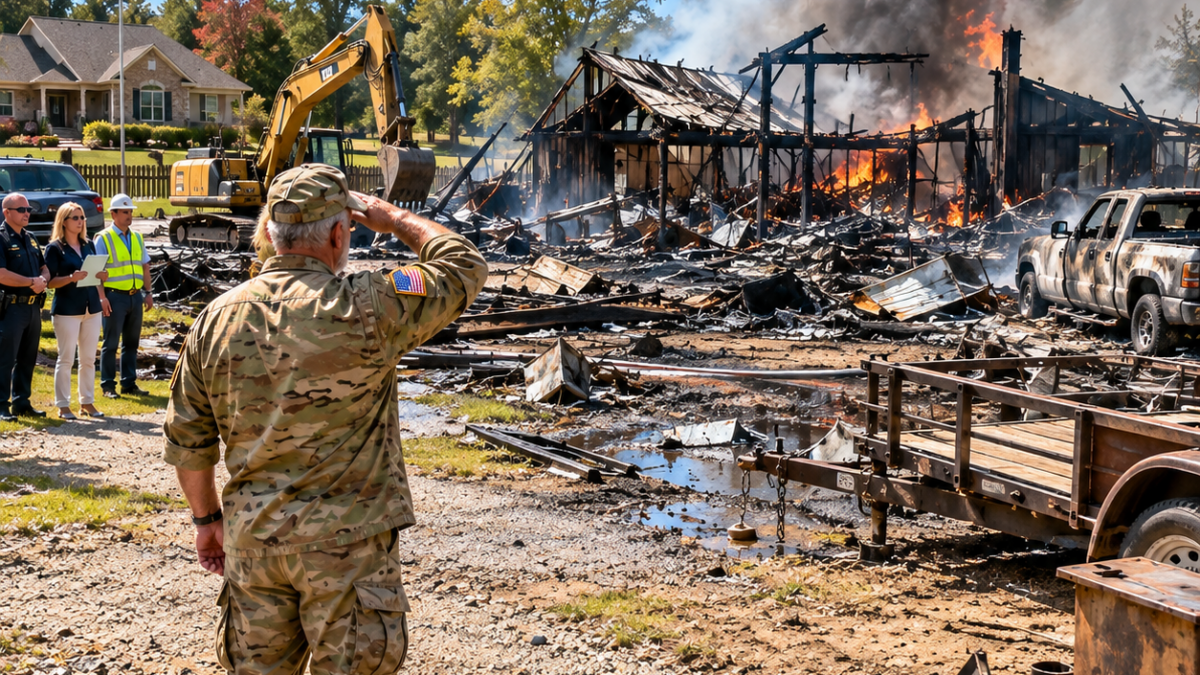
By the time I pulled in, a wheel loader was burning so hard the heat shoved me backward when I opened my truck door. Two excavators beside it had already caught from radiant heat. Hydraulic lines hissed and popped as fluid ignited in bursts of blue and orange flame. The parts shed on the east side was a skeleton of light, its metal roof sagging inward like it was bowing under shame.
Three service trucks were black frames.
Their tires had melted into the gravel, leaving long dark smears like rubber had tried to crawl away and died.
I remember the sound most.
People think fire just roars.
It does.
But equipment burns with other noises too.
Popping metal.
Bursting glass.
Hydraulic pressure screaming through failing seals.
Small explosions inside engines that had worked faithfully for years before some coward turned them into kindling.
I stood there with my phone in my hand and felt eighteen years of labor fold into heat.
Travis arrived minutes later.
He did not speak at first.
He just stopped beside me, breathing hard, face lit orange by the fire.
Finally, he said, “This was not an accident.”
I wanted to tell him not to jump ahead.
I wanted to be careful.
I wanted to be the calm businessman who waited for facts.
Then I saw the rear fence.
Cut clean.
A rectangular gap through the chain link. Low and wide enough for a person to pass without ducking. Bolt cutters, most likely. Not a vehicle impact. Not storm damage. Not random vandalism.
Then my alarm company called back.
The main camera system had lost power eleven minutes before the first flame was reported.
Eleven minutes.
I walked to the breaker box with fire department lights flashing behind me. The utility shed door was open.
The breaker had been switched off.
Not tripped.
Switched.
I looked at Travis.
He looked at me.
Neither of us said Mallerie’s name.
Not yet.
Dean Lockidge, the county fire investigator, arrived before sunrise. Dean was not dramatic. He did not make big declarations over smoke. He walked the perimeter with a flashlight, crouched near the cut fence, photographed the breaker, marked burn patterns, and studied the ground beneath each ignition point.
He taped off the property as an active investigation scene before the sun cleared the trees.
“Nobody touches anything,” he told me.
“Is it arson?”
He looked across the yard, eyes moving from the loader to the excavators to the parts shed.
“I am saying nobody touches anything.”
That was answer enough.
By first light, fire crews were packing up hoses. Steam rose from black metal. The whole yard smelled like wet ash, burned fuel, and financial ruin.
Then a black SUV rolled slowly up to my fence.
Mallerie Wexler stepped out wearing a blazer so clean it looked obscene against the smoke.
She did not ask if anyone had been hurt.
She did not ask what happened.
She did not ask whether the fire investigator had finished.
She looked past me at the wreckage like she was appraising a vacant lot.
Then she said, “Maybe this is the sign you needed.”
My hands curled.
“What?”
She gave me a sympathetic smile that did not reach her eyes.
“Nolan, no one wanted to see it come to this. But rebuilding here would be expensive. Uncertain. Frankly, unnecessary.”
She walked to my truck and placed an envelope on the hood.
“Our board authorized a revised offer. It could give you a clean exit.”
A clean exit.
My equipment was still smoking.
The ground was still hot.
The fire investigator’s tape was still fluttering in the morning wind.
And she had brought a purchase agreement.
I opened it because part of me could not believe what I already knew.
The price was almost forty percent below market value.
Then I saw the date beneath the notary block.
Prepared two days before the fire.
Not that morning.
Not in response to the disaster.
Two days before.
Something inside me went cold and clear.
I lifted the paper and looked at her.
“Why was this ready before my yard burned?”
For two full seconds, Mallerie had no answer.
That silence told me more than a confession.
Her face flickered.
Just slightly.
A crack in the marble.
Then she took one step back.
“You are emotional. We can revisit this when you are thinking rationally.”
“I am thinking just fine.”
“Nolan.”
“Get off my property.”
She stared at me, then turned, got into her SUV, and drove away without another word.
Travis watched her taillights disappear.
“Now can we say her name?”
I looked down at the purchase agreement.
“Yes.”
The next forty-eight hours were a blur of investigators, insurance adjusters, equipment lists, employee calls, client calls, and the sick practical math of disaster.
The preliminary estimate came in just over one million dollars.
That number should have flattened me.
But money was not what kept me awake.
It was the pattern.
The fence cut.
The breaker switched off.
The multiple ignition points.
The prepared purchase agreement.
The survey stake.
The security patrols.
The pressure on vendors.
The email to Ron.
The way Mallerie stood in the smoke without surprise.
I had spent months treating her like a nuisance with a title.
Now I understood she was something else.
So I hired Brena Fairchild.
Brena specialized in land use, title disputes, easement conflicts, and the kind of property fight where someone smiles while trying to steal the ground under your boots. Her office was downtown, old brick, no nonsense, lined with deed books and maps large enough to cover a conference table.
She listened while I talked.
She did not interrupt.
When I placed Mallerie’s purchase offer on her desk and pointed to the date, Brena’s expression changed.
“Who prepared this?”
“The HOA, I assume.”
“You assume?”
“I haven’t asked.”
“Do not ask. Not directly.”
She pulled a legal pad close.
“Tell me about the development.”
I did.
Seventy-four townhomes.
Nineteen million dollar package.
Land behind mine.
Wetlands.
Ravine.
Need for road access.
Need for drainage.
At the word drainage, Brena stopped writing.
“What drainage?”
“There is a ditch along the back of my property. Stormwater moves through there after heavy rain.”
“Do they have rights to use it?”
“No.”
“You are certain?”
“I have never signed anything.”
Brena leaned back.
“People do not always need your memory to claim your land. They need paper. Let us go find out what paper they think they have.”
That sentence changed everything.
For the next three days, Brena disappeared into deeds, surveys, title records, project filings, loan documents, county planning submissions, and every public record tied to Crest Haven Phase 2.
She worked like a woman excavating bones.
On the fourth morning, she called and said, “Come to my office. Now.”
When I arrived, binders covered her conference table. A laptop sat open. Maps were pinned under paperweights. Red marker circled dates, names, parcel numbers, and one phrase repeated more than once.
ACCESS AND DRAINAGE RIGHTS.
Brena did not waste time.
“They built their financing package on your land.”
I sat down slowly.
“How?”
She pulled out a document.
“This is what they gave the lender and title company. It claims Crest Haven HOA holds permanent vehicular access and stormwater drainage rights across a portion of your property.”
“I never signed that.”
“I know.”
She placed another document beside it.
“This is the original easement from 1998.”
I leaned over the map.
The original easement was a twelve-foot utility strip.
A narrow strip for a buried electric line to a neighboring parcel, filed long before the current development existed.
It was not for vehicles.
It was not for construction access.
It was not for stormwater discharge.
It was not wide enough for what they claimed even if God Himself drove the truck.
Then Brena laid down the new exhibit.
EXHIBIT B.
Someone had transformed that twelve-foot utility strip into a nearly sixty-foot access corridor with turning radii for delivery trucks and a stormwater culvert running straight through the center.
I stared at the two maps side by side.
Even without legal training, the lie was visible.
One was a narrow line.
The other was a fake highway.
Brena slid another page toward me.
“Owner acknowledgment.”
My name appeared at the bottom.
Or rather, a version of my name.
The signature was wrong.
The slant was wrong.
The loops were wrong.
The pressure was wrong.
It looked like someone had practiced from memory and still failed.
Beneath it was a notary seal from a county I had not visited in over a year.
“I did not sign this.”
“I know.”
“I never got paid anything.”
“I know.”
“I have never met that notary.”
“I know.”
My voice came out lower.
“Who submitted it?”
“The package came through the HOA side. Mallerie also signed a formal representation letter saying access rights were settled and secured.”
I sat back.
“Closing is when?”
“Friday at ten in the morning.”
My mouth went dry.
It was Monday.
Four days.
Brena watched me carefully.
“Nolan, I need you to understand something. They did not need you to eventually agree. They needed you gone quietly before anyone checked closely enough to notice their entire access corridor is fiction.”
I looked through her window toward the direction of my burned yard, though I could not see it from there.
The fire changed shape in my mind.
It was not vandalism.
It was not pressure.
It was timing.
Destroy the yard.
Make me desperate.
Show up with a low offer.
Get me to sign before closing.
Clean the title problem before the lender asked questions.
Turn six acres of someone else’s work into a road, a culvert, and a profit line.
For the first time since the fire, I laughed.
Not because it was funny.
Because the anger needed somewhere to go.
Brena said, “What?”
“They thought burning my equipment made me weak.”
She waited.
“They forgot land has paperwork too.”
That afternoon, we stopped defending and started cutting the wires holding their deal together.
Brena drafted notices to the developer, the construction lender, the title company, the escrow officer, and the county development office.
Every notice said the same thing in clean legal language.
The access and drainage rights relied upon for the $19 million Crest Haven Phase 2 transaction were under active documented dispute.
Attached was a binder thick enough to make people nervous before they opened it.
My recorded deed.
The original 1998 survey.
The true twelve-foot utility strip.
The fake Exhibit B.
The forged owner acknowledgment.
My sworn statement denying the signature.
Photographs of the illegal survey stake forty-two feet inside my property.
The cut fence from the fire scene.
The prepared purchase offer dated two days before the blaze.
Brena sent everything before close of business.
Then we waited.
Not long.
Lydia Farnsworth, the escrow and title officer, called an emergency underwriting meeting that same evening. Title people do not like surprises. They especially do not like surprises involving forged signatures, disputed access, and multi-million-dollar developments with closing four days away.
Without clean access, title insurance could not issue.
Without title insurance, the lender could not fund.
Without funding, Garrett Hollister’s beautiful $19 million machine could not move a single dollar.
The next morning, Paige Kettering from the lending institution called Garrett.
Brena got word minutes later.
Emergency review.
Closing frozen pending title resolution.
When she told me, I was standing beside the blackened shell of my loader.
For the first time since the fire, I breathed all the way in.
Mallerie came to the yard that afternoon with Garrett beside her.
She looked furious.
Not sad.
Not worried.
Furious.
Garrett looked like a man who had just realized the ground beneath his deal was not ground at all.
Mallerie did not bother with sympathy this time.
“What do you think you are doing?”
I leaned against the fence.
“Standing on my property.”
“You are attempting to extort this project.”
“No. Someone put my name on documents I did not sign. I corrected the record.”
“You are holding up tens of millions of dollars.”
“Maybe you should have checked who owned the dirt before you built a deal on top of it.”
Garrett turned and looked at her.
That was the first time I saw doubt cross his face.
Not irritation.
Doubt.
The kind that asks, silently, what did you drag me into?
Mallerie felt it too.
Her posture stiffened.
“Garrett, this is exactly the kind of obstruction I warned you about.”
Brena stepped forward.
“Mr. Hollister, did your office ever receive a recorded easement expansion from Mr. Prescott?”
Garrett did not answer.
Mallerie snapped, “All project documents were reviewed.”
“That is not what I asked,” Brena said.
Garrett looked at her.
“We relied on representations from the HOA regarding access coordination.”
Brena nodded.
“Then you relied on the wrong person.”
Mallerie’s face hardened.
“You are all going to regret this.”
I looked at the burned equipment behind me.
“I already regret plenty. Just not this.”
With forty-eight hours before closing, the title company demanded proof.
Not promises.
Not board minutes.
Not informal assurances.
Recorded, verifiable documentation proving the HOA held legal access across my land.
Mallerie produced Exhibit B.
Brena produced the original deed.
The two did not match in width, boundaries, or purpose.
The twelve-foot utility strip had never become a sixty-foot road. No county filing supported it. No parcel record contained my approval. No payment record showed I had accepted consideration. No legitimate notary could explain how my signature appeared on a document I had never seen.
Then the county engineer found the drainage problem.
The development stormwater plan discharged runoff through a culvert across Parcel 17B.
Parcel 17B belonged to me.
There was no drainage agreement.
No easement.
No permission.
No legal right.
The county suspended approval of the stormwater plan immediately.
That mattered even more than the road.
A developer can sometimes redesign access with enough time and money.
Drainage is different.
Water does not care about renderings.
It does not care about investor deadlines.
It goes where gravity sends it.
And if your legal route for that water crosses land you do not control, your project is not delayed.
It is trapped.
Garrett understood that before Mallerie did.
His project timeline could not absorb months of redesign. Financing deadlines, seller obligations, contractor mobilization, deposits, rate locks, investor commitments, all of it depended on closing by Friday.
And Friday was coming like a blade.
Mallerie tried to blame the surveying firm.
She called their office and demanded an explanation for what she called a clerical oversight.
The surveyor refused to die for her lie.
He produced an email sent seven months earlier warning the HOA that owner authorization would be required for any use of the Prescott parcel.
The recipient was Mallerie Wexler.
She had known.
From the beginning.
She knew the HOA did not have what it needed.
She knew the project depended on rights she did not control.
She knew I had refused to sell.
She knew the survey stake was inside my line.
She knew the documents were not clean.
Then my yard burned five weeks later.
Dean Lockidge finished his preliminary fire analysis around the same time the title problem exploded.
He came to my temporary office with a folder in one hand and soot still under one thumbnail.
“It was accelerant,” he said.
I nodded once.
“Three points of origin?”
“Yes. Petroleum distillate. Deliberate placement. No electrical cause. No accidental chain.”
He opened photographs across my desk.
Burn patterns.
Cut fence.
Breaker panel.
Scorched ground.
“Whoever did it knew the yard,” Dean said. “They knew where the cameras were. They knew where the breaker was. They knew which machines would burn hot and fast.”
I thought about the security men Travis had chased off three days before the fire.
“They had a tour,” I said.
Dean looked up.
“Tell me.”
Travis had already told him, but I repeated it. Two men from Stroud Protective Services had come onto the property claiming they needed to check a future construction boundary. Travis ran them off, but not before they walked the fence line and saw the utility shed near the south gate.
Then Dean showed me the image.
A pickup truck.
Stroud Protective Services logo on the door.
Captured by one of my independent cellular cameras across the drainage ditch at 1:41 in the morning.
Those cameras ran on solar-charged battery packs.
They were not tied into the main yard power.
Switching off the breaker did nothing to them.
The truck left at 2:08.
The fire was reported five minutes later.
Dean’s face stayed neutral.
But the room felt different.
“Calvin Stroud denies company involvement,” he said.
“Of course he does.”
“He claims an employee may have used the vehicle without authorization.”
“Of course he does.”
“We subpoenaed GPS data.”
“And?”
“The truck was inside your property line for more than twenty minutes.”
I looked out at the burned yard.
“That is a long patrol.”
Dean closed the folder.
“It is.”
While Dean built the arson case, the HOA began cracking from inside.
Her name was Fiona Markham.
She was a board member who had supported Mallerie’s push to acquire my land because Mallerie had sold it as safety, cleanliness, property values, and neighborhood protection. Fiona later told me she believed my equipment yard was a nuisance because she had been fed a steady diet of curated outrage, selective photos, and official-sounding lies.
The frozen closing scared her.
The fire investigation scared her more.
So she opened the HOA financial records and started reading.
Real reading.
Not glancing over summary reports at meetings while Mallerie talked about community vision.
Fiona stayed up past midnight at her kitchen table, cross-referencing invoices against board minutes.
What she found made her hands shake.
Payments the board never approved.
Site security consulting.
Boundary inspection.
Property acquisition preparation.
Overnight patrol.
Vegetation clearing.
Most of the money went to Stroud Protective Services.
One payment stood out.
Processed the morning after the fire.
Emergency completion bonus.
No invoice attached.
No description.
No vote.
Mallerie’s authorization.
Fiona copied everything to a personal drive before anyone could delete it.
Then she called Brena.
By Thursday morning, the pressure on Mallerie came from every direction.
The title company wanted proof she did not have.
The lender would not fund.
The county suspended the stormwater plan.
Garrett’s attorney began preparing claims against the HOA for misrepresentation.
Dean had the Stroud truck on camera.
Fiona had payment records.
Brena had the forged documents.
I had a burned yard and the deed they wished I had forgotten.
Friday at 10:00 arrived anyway.
Mallerie still showed up at the escrow office dressed like she expected a ribbon cutting.
That remains one of the strangest things I have ever witnessed.
Some people, when cornered by facts, panic.
Some run.
Some confess.
Mallerie walked into that conference room with perfect hair, a cream blazer, and the same leather portfolio she had carried into my office months before.
The room was full.
Lydia Farnsworth from escrow and title sat at the head of the table.
Paige Kettering represented the lender.
Garrett Hollister sat stiffly beside his attorney, leaving more space between himself and Mallerie than politeness required.
Brena sat beside me near the far wall.
I said nothing.
Mallerie demanded the closing proceed.
Not requested.
Demanded.
“Every material concern has been addressed,” she said. “The project cannot be held hostage by a disgruntled adjacent landowner.”
Lydia looked down at her file.
“The title exception remains unresolved.”
“The HOA has provided documentation.”
“The documentation is disputed and unsupported by recorded land records.”
Mallerie’s jaw tightened.
“Then insure around it.”
Lydia’s expression did not move.
“We cannot insure vehicular access across a parcel where the claimed rights are contradicted by the recorded easement and formally disputed by the owner.”
Paige spoke next, voice even.
“The lender will not release funds without title coverage for access and drainage.”
“The HOA can indemnify the lender,” Mallerie said quickly.
Paige looked at her like she had suggested paying a mortgage with coupons.
“An association facing unresolved liability related to alleged document falsification and an active fire investigation cannot provide meaningful indemnity for a multi-million-dollar title defect.”
Mallerie turned red.
Brena opened her folder.
She placed two survey documents side by side on the table.
The real twelve-foot utility strip.
The fabricated sixty-foot corridor.
Then she placed the forged owner acknowledgment in the middle.
Everyone could see it.
No speech was necessary.
But Brena gave one anyway.
“My client did not sign this document. He received no consideration. He granted no expanded easement. He authorized no vehicular access, no construction access, and no stormwater drainage across his property.”
She paused.
“Any party proceeding with closing today does so with actual notice of disputed title, alleged forgery, and unresolved access failure.”
Silence.
Every pen stopped.
Mallerie looked at Garrett.
“Say something.”
Garrett did.
He looked at Lydia.
“Can this close today?”
“No,” Lydia said.
“At all?”
“Not under the current conditions.”
Paige closed her folder.
“Funding remains on hold.”
At 10:17 Friday morning, the closing was formally suspended.
The $19 million did not move.
The seller received no purchase funds.
The developer received no financing.
Contractors scheduled to mobilize were told to stay away.
The project stopped cold.
Mallerie sat frozen for a moment, as if her mind refused to translate what had just happened into reality.
Then she stood so fast her chair hit the wall behind her.
“This is not over.”
I looked at her.
“It is for today.”
She stormed out making phone calls before she reached the lobby.
Dean Lockidge was waiting there.
Not for the easement.
For the fire.
The arson investigation moved faster after that.
Once Calvin Stroud realized Mallerie was willing to let his company take the entire fall, his loyalty developed a sudden medical condition.
It died in the interrogation room.
Investigators obtained communications between Calvin and an account tied to the HOA server. Neither he nor Mallerie had thought anyone would look there deeply enough.
One message, sent before the fire, said:
Nolan will not move unless there is nothing left to operate.
Not burn.
Not destroy.
Careful people avoid obvious words when they know they are doing obvious crimes.
The next message said it had to be finished before Friday.
Friday.
The closing deadline.
Calvin began cooperating.
He turned over records, messages, route notes, payment details, and internal Stroud documents. One younger employee gave a statement through his attorney. He said Calvin described the job as making the property unusable. He claimed he did not know who originally ordered it, but the payment authorization traced back to the HOA office.
To Mallerie.
Fiona handed over the financial records she had saved. She sat with investigators for nearly four hours, answering questions and crying once, not because she was afraid, but because she finally understood she had helped give power to someone dangerous.
An emergency board meeting was called two days later.
Mallerie tried to control it.
She failed.
The room that once nodded along to her polished updates now stared at her like she was smoke in human form.
Fiona stood first.
“I move to suspend Mallerie Wexler from all board authority pending completion of the criminal investigation.”
Another board member seconded before Mallerie could speak.
Mallerie’s face went pale.
“You cannot do this.”
Fiona’s voice shook, but she did not sit down.
“You used association funds without board approval.”
“That is false.”
“There is an emergency completion bonus paid to Stroud Protective Services the morning after Mr. Prescott’s yard burned.”
The room erupted.
Mallerie tried to shout over them.
Fiona kept going.
“There are invoices for patrols the board never authorized. There are payments for boundary inspections on land the HOA did not own. There are communications tying those payments to the development timeline.”
Mallerie pointed at her.
“You ungrateful little coward.”
That lost her the last undecided person in the room.
The vote was unanimous.
Mallerie was stripped of account access, suspended from her position, and removed from every committee tied to the development.
Garrett terminated the development agreement shortly afterward.
One signed letter delivered by courier.
Months of planning destroyed by the woman who thought she was too clever for property records.
The seller kept part of the deposit.
Garrett prepared litigation against the HOA for due diligence costs, financing fees, architectural work, deposits, carrying costs, and damages nearing five million dollars.
The HOA insurance carrier issued a reservation of rights letter, which is a polite way of saying, We may not cover you if your president committed intentional misconduct.
Homeowners who had spent months complaining about my yard suddenly understood what real property damage looked like.
It came in assessments.
Potential lawsuits.
Frozen reserves.
Legal fees.
A luxury development that had been sold to them as profit and prestige became a smoking hole in their balance sheet.
As for me, rebuilding was not cinematic.
Movies like the moment of revenge.
They do not show the paperwork afterward.
Insurance adjusters walked through ash with clipboards.
Vendors quoted replacement machines at prices that made me nauseous.
Clients needed reassurance.
Employees needed hours.
Travis needed to know whether he still had a job.
He came into the temporary office one afternoon and found me staring at a spreadsheet.
“You thinking of shutting down?”
“No.”
“You sure?”
“No.”
He sat across from me.
“That is not the same answer.”
I looked around at the folding tables, rented trailer office, extension cords, salvage lists, and ash still caught in the seams of my boots.
“I do not know how long this takes.”
“We have worked through worse.”
“No,” I said. “We have not.”
He nodded.
“Fine. Then we work through new worse.”
That was Travis.
No speech.
No drama.
Just boots on the ground when the ground was still warm.
We rented what we had to.
Borrowed what we could.
Repaired what was repairable.
Sold scrap.
Filed claims.
Took jobs that fit the limited fleet.
Turned down jobs that would have broken us.
Paid employees before paying ourselves.
Some nights, I drove home with my hands aching and wondered whether Mallerie had done what she meant to do after all.
Because burning equipment is not just destroying machines.
It attacks rhythm.
It turns confidence into calculation.
It makes every phone call heavier.
It makes every decision smell faintly like smoke.
Then I would think of her standing at the fence with that prepared offer.
And I would come back the next morning.
The criminal case continued.
Charges tied to arson, conspiracy, fraud, and falsified property records moved through the system. Calvin cooperated. Stroud Protective Services folded under legal pressure. The notary on the forged owner acknowledgment claimed she had never met me and eventually admitted her seal had been misused after she left blank stamped pages in an office where one of Mallerie’s associates had access.
That detail made Brena furious.
Not surprised.
Furious.
“People think forged signatures are dramatic,” she told me. “Most of the time, they are lazy. Lazy people count on nobody comparing the paper.”
Brena filed civil claims on my behalf.
Against the HOA.
Against Stroud.
Against parties involved in the false documents.
Against anyone who had touched the lie and left fingerprints.
I did not enjoy court.
I did not enjoy depositions.
I did not enjoy sitting across from lawyers who tried to ask whether my yard had perhaps been unsafe, perhaps poorly maintained, perhaps vulnerable to fire because of my own negligence.
Brena shut that down every time.
“Three ignition points,” she would say.
“Cut fence.”
“Breaker switched off.”
“Security truck GPS.”
“Accelerant.”
“Prepared purchase agreement.”
Piece by piece, the truth became harder to insult.
The day I saw Mallerie again in a legal setting, she looked smaller.
Not humble.
People like that do not shrink into humility.
They shrink into resentment.
She wore a dark suit, no jewelry except a watch, and she avoided my eyes until she realized avoiding them made her look afraid.
Then she stared too hard.
During a break, she passed close enough to speak under her breath.
“You ruined an entire community.”
I turned toward her slowly.
“No,” I said. “I kept you from stealing from one.”
Her mouth tightened.
“You could have sold.”
“You could have asked honestly.”
“I did.”
“No,” I said. “You offered robbery with stationery.”
For once, she had no comeback.
Maybe because lawyers were nearby.
Maybe because some part of her understood that every word from her mouth had become another shovel.
The development land sat quiet through all of it.
No crews.
No concrete.
No decorative trees.
The big sign showing glass balconies faded under sun and rain until one corner peeled loose and slapped in the wind.
That sign bothered me more than I expected.
Not because it represented what almost happened, but because it showed how close lies can come to becoming landscape.
If Brena had not found the fake Exhibit B before closing, if Dean had not found accelerant, if the cellular cameras had not caught that truck, if Fiona had not saved the records, if Travis had not remembered the security men by the breaker box, they might have pulled it off.
That thought stayed with me.
Not in a paranoid way.
In a practical way.
The law protects records, not assumptions.
So I became a man who checked everything.
Every gate got documented.
Every boundary got marked.
Every camera got independent power.
Every deed, easement, survey, and title exception tied to my property went into both digital and physical files.
I replaced the fence with steel.
Taller.
Cleaner.
Stronger.
The new cameras ran on battery backups with solar support. The main system had redundancy. The generator could keep the yard running through outages. The breaker panel moved behind a locked enclosure.
Travis joked that Fort Knox would have to apply for access.
I told him Fort Knox had better bring ID.
The rebuild took months.
When the first new excavator rolled into the yard, everyone stopped working.
It was not the biggest machine I had ever owned.
It was not even the most expensive.
But when that lowboy trailer pulled through the gate and the machine crawled down the ramps, steel tracks clanking against metal, I felt something inside me settle back into place.
Travis slapped the side of it.
“Looks mean.”
“It better work mean.”
The second excavator came two weeks later.
The service trucks took longer.
The parts shed went back up with better fire separation, better storage, and fewer of my old bad habits tolerated in the name of convenience.
The new sign came last.
PRESCOTT HEAVY EQUIPMENT AND SITE WORK.
Same name.
Same land.
Same business.
Still standing.
I stood across the road after the sign crew left and looked at it for a long time.
The paint still smelled fresh.
Behind me, the parcel meant for Crest Haven Phase 2 sat empty. Brush had started reclaiming the edges. Survey flags had faded. Mud collected where trucks once would have entered if Mallerie had gotten her way.
The county changed its planning code that year.
Any future development on that parcel would require proof of legitimate recorded access and drainage rights before approval moved forward.
Not verbal assurances.
Not HOA representations.
Not pretty exhibits.
Recorded rights.
That rule did not mention me by name.
It did not need to.
Everyone knew why it existed.
One morning several months later, I was near the front gate checking a hydraulic fitting on the new excavator when a car slowed on the road.
I knew the vehicle before I looked up.
Mallerie.
Not the black SUV from the morning after the fire.
Something smaller now.
Less impressive.
Less armored by money.
She slowed near the fence line where the HOA once planned its grand entrance boulevard.
No young trees.
No decorative lighting.
No monument sign.
No access.
Just my fence.
A new sign stood there, simple and clean.
PRIVATE PROPERTY.
NO DEVELOPMENT ACCESS PERMITTED UNDER ANY CIRCUMSTANCES.
I wiped my hands on a rag.
For a second, she looked at me through the window.
I thought about everything I could say.
I thought about asking whether she remembered the purchase agreement dated two days before the fire.
I thought about asking whether the $19 million freeze felt cold.
I thought about asking whether burning a man’s equipment yard had been worth losing her title, her project, her reputation, and possibly her freedom.
But some people want your words because words let them pretend they are still part of the story.
Mallerie no longer deserved dialogue.
So I said nothing.
I reached over, took the chain in my hand, and pulled the gate closed.
The latch fell with a quiet metallic click.
Not loud.
Not dramatic.
Final.
Then I turned back to my excavator and went to work.
That was what she never understood.
My yard was not valuable because developers wanted it.
It was not valuable because it blocked a road.
It was not valuable because it controlled drainage.
It was valuable because I had spent eighteen years proving myself on that gravel.
She thought fire could erase that.
She thought a forged signature could rewrite ownership.
She thought pressure could become permission if she applied enough of it.
She thought the closing table would reward whoever lied fastest.
Instead, she burned nearly a million dollars worth of machinery trying to clear six acres she never had a right to touch.
And in the end, she burned the one deal she could never afford to lose.
Years later, people still ask me why I did not sell after the fire.
They mean well.
Some of them look at the yard, at the machines, at the steel fence, at the lights, at the sign, and they think about market value. They think about insurance checks and legal settlements and development money. They think land is just dirt with a price attached.
Maybe for some people, it is.
Not for me.
Land can hold memory.
A yard can hold proof.
That gravel held every bad year I survived.
Every payroll I made by inches.
Every employee who trusted me to figure it out.
Every job that started before sunrise.
Every broken machine we refused to let die.
Every young man who came to me needing work and learned a trade instead.
Every winter storm we cleared.
Every road we graded.
Every foundation pad we cut for somebody else’s dream.
Mallerie looked at my yard and saw an obstacle.
I looked at it and saw my life.
That was why she lost.
Not because I was smarter.
Not because I was tougher.
Not because I wanted revenge more than she wanted profit.
She lost because she never understood the difference between owning land and belonging to it.
She had documents with lies in them.
I had a deed with truth in it.
And when fire turned my machines black and ash blew across the gravel, that truth stayed exactly where it had always been.
Recorded.
Measured.
Signed.
Mine.








