HOA Karen Buried the Only Drainage Creek to Build a Luxury Walking Path—Then Called Me an Idiot for Warning Her. Three Months Later, a Violent Storm Exposed Her Catastrophic Mistake.
PART3:
New clubhouse furniture.
Repainting curbs.
If Riley could put a plaque on something and hold a ribbon cutting, she was interested.
One Saturday morning, I was trimming shrubs along the side of my house when she walked up carrying a clipboard.
“Mr. Baker.”
I shut off the trimmer.
“Morning.”
“We’re starting an exciting new beautification initiative.”
The phrase alone made me nervous.
“What kind?”
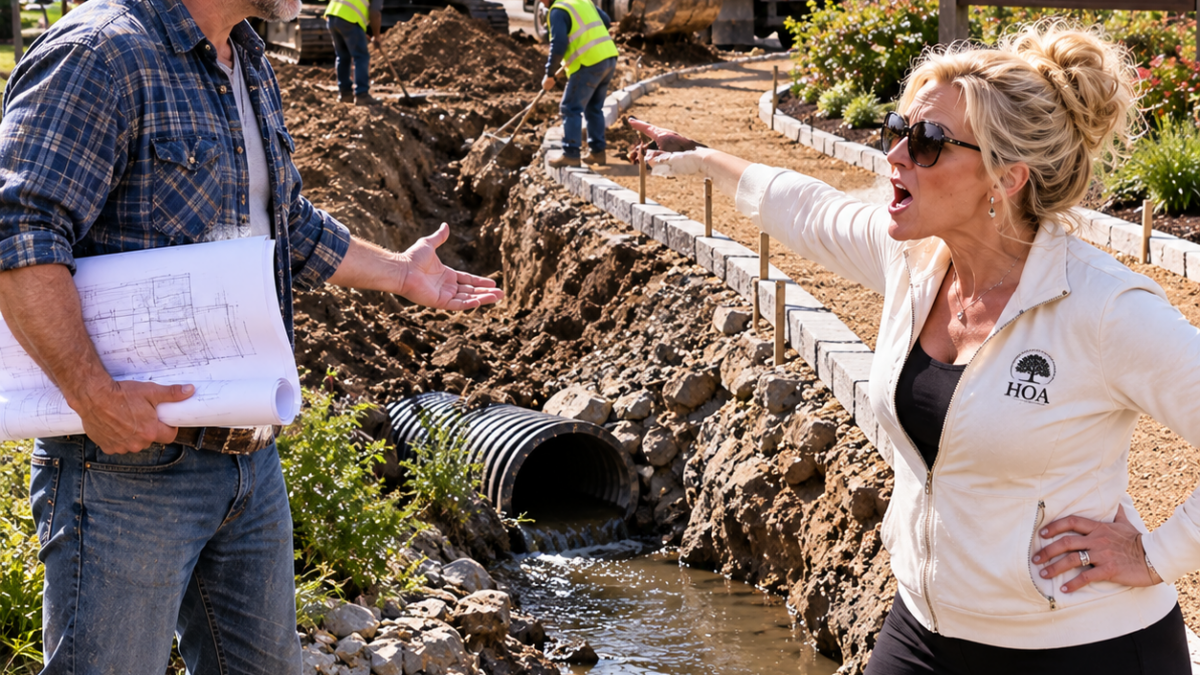
She turned and pointed behind my house.
“The drainage corridor.”
I looked at the creek.
“What about it?”
“We’re finally addressing it.”
“Addressing what?”
“The appearance.”
I looked again.
Water.
Rocks.
Grass.
A few willow saplings.
“It looks like drainage.”
“Exactly.”
She laughed as though I had helped her.
“The board has had complaints for years.”
“About water?”
“About the ditch.”
“It isn’t a ditch.”
“That’s semantics.”
“No.”
“It’s a natural drainage channel.”
She waved one hand.
“You’re an engineer, right?”
“Was.”
“That explains it.”
“What?”
“You’re looking at function.”
I stared.
“What are you looking at?”
“Potential.”
That is a dangerous word in the wrong mouth.
Riley unfolded a glossy rendering.
It showed a landscaped walking path.
Decorative pavers.
Low black fencing.
Benches.
Ornamental grasses.
Small trees.
A stone drainage feature that looked like something outside a wine-tasting room.
The natural channel was gone.
In its place, the drawing showed a mostly flat strip about fifteen feet wide.
People walking dogs.
A family pushing a stroller.
One cyclist.
I looked at the sheet.
Then at the creek.
“Where does the water go?”
Riley tapped the image.
“Underground.”
My stomach tightened.
“Through what?”
“Drainage pipe.”
“What size?”
“I’d have to ask the contractor.”
“Who designed it?”
“We have professionals.”
“Engineers?”
“Landscaping professionals.”
“That wasn’t my question.”
She smiled again.
“You’ve only been here a few months, Kenneth.”
There it was.
First-name familiarity used as a reminder of rank.
“This improvement has been discussed for years.”
“Was it designed for storm flow?”
“Yes.”
“What design storm?”
She blinked.
“What?”
“Ten-year?”
“Twenty-five-year?”
“Hundred-year?”
“I don’t know what you mean.”
“Then you don’t know whether it was designed for storm flow.”
Her smile vanished slightly.
“We’ve been assured it’s adequate.”
“By who?”
“Stonebridge Landscape Development.”
I knew the company.
Not engineers.
Hardscape.
Retaining walls.
Patios.
Commercial landscaping.
Good at making things attractive.
Not the people I would hire to redesign a neighborhood watershed.
I pointed downstream.
“This channel takes water from the ridge, the upper streets, the detention basin overflow, and at least three storm-drain outlets.”
“We know.”
“No.”
“You know water is there.”
“Do you know peak flow?”
Riley sighed.
“Kenneth.”
“What is the proposed pipe diameter?”
“I don’t carry construction details in my head.”
“Then get them before you bury that channel.”
Her expression hardened.
“This project has been approved.”
“By whom?”
“The board.”
“The county?”
She paused.
“That process is underway.”
“What process?”
“Permitting.”
“Then it isn’t approved.”
She folded the rendering.
“Residents overwhelmingly support it.”
“Water doesn’t vote.”
That line got me in trouble later.
At the time, Riley rolled her eyes.
“You engineers always think in worst-case scenarios.”
“No.”
“We think in design scenarios.”
“The worst case is what happens when the design scenario is wrong.”
She walked away.
That afternoon, I did what retired engineers tell themselves they will stop doing after retirement.
I opened maps.
The county GIS showed the drainage basin upstream of Maple Creek.
One hundred and eighty-three acres.
Mostly rooftops, roads, lawns, and compacted development.
Runoff coefficient much higher than natural land.
The creek behind my house was not decorative.
It was the neighborhood’s low point.
Water from almost half the subdivision eventually reached it.
I downloaded contour data.
Pulled old subdivision plans from county records.
And found something important.
The original engineering drawings identified the channel as:
PRIMARY OPEN STORMWATER CONVEYANCE — DO NOT OBSTRUCT WITHOUT HYDRAULIC ANALYSIS.
Capital letters.
Not ambiguous.
The original subdivision engineer had sized nearby culverts based on major-storm overflow.
There were notes about maintaining open-channel capacity.
I printed everything.
Then I emailed Riley.
Subject:
Drainage Corridor Project — Engineering Concern.
I kept it polite.
Attached original plans.
Highlighted the warning.
Asked for:
Hydraulic calculations.
Pipe size.
Inlet design.
Overflow path.
Permits.
Professional engineer stamp.
Riley replied two days later.
Kenneth, thank you for your interest. The board has retained qualified professionals and is comfortable with the current design. Please direct further concerns through normal HOA channels rather than creating unnecessary alarm among residents.
Creating unnecessary alarm.
I had emailed one person.
Her.
I replied:
Please provide the stamped drainage design.
No response.
A week later, orange stakes appeared.
Then utility marking.
Then excavation equipment.
I walked down behind my house.
The creek was dry that morning except for a thin ribbon.
Workers had begun clearing vegetation.
Stonebridge’s site supervisor, a man named Eddie Walsh, stood beside a mini excavator.
“Morning.”
“Morning.”
“You Kenneth?”
“Yep.”
“Riley said you might come by.”
That was never a good sign.
“She tell you I’m the crazy drainage guy?”
He laughed.
“Something like that.”
I didn’t blame him.
“What’s your pipe?”
“Thirty-six-inch HDPE.”
I stared at him.
“Single?”
“Single.”
“For the whole channel?”
“Mostly.”
“Inlets?”
“Two catch structures.”
“Emergency overflow?”
“Path stays graded low.”
“How low?”
He pointed at the plans.
“Six inches below adjacent lawns.”
I looked toward the row of homes.
Six inches.
That wasn’t an overflow channel.
That was a suggestion.
“Who engineered it?”
He tapped a title block.
Consultant:
Merritt Site Concepts.
I knew them by reputation.
Small design office.
Civil work sometimes.
I asked:
“PE stamp?”
He flipped pages.
No stamp.
“Preliminary set?”
“That’s what Riley gave us.”
“You’re building off preliminary plans?”
Eddie frowned.
“Permit set’s supposed to be coming.”
“Have you seen a county permit?”
“No.”
“You started anyway?”
“HOA signed authorization.”
“That doesn’t replace county stormwater review.”
His expression changed.
“I’m just the site guy.”
“I know.”
“I’m telling you because you don’t want your company holding the shovel if this goes bad.”
He studied me.
“How bad?”
I looked upstream.
“Depends how hard it rains.”
That afternoon, Stonebridge stopped work.
For one day.
Then resumed.
I later learned Riley had called their owner and told him the permit was “administratively approved.”
It wasn’t.
The next HOA meeting was packed because Riley had promoted the project like a campaign event.
Slides.
Renderings.
Before-and-after images.
Project name:
MAPLE CREEK GREENWAY ENHANCEMENT.
Greenway.
The creek itself had apparently become an obstacle to the greenway named after it.
Riley stood at the front.
“This project will transform an unattractive, underused drainage ditch into a safe, walkable amenity.”
Residents nodded.
Some applauded.
The rendering really was beautiful.
That’s the problem with bad infrastructure presented beautifully.
I raised my hand.
Riley saw me.
Her face changed.
“Yes, Kenneth.”
“Can I ask about drainage capacity?”
A few people turned.
She sighed.
“We’ve been through this.”
“No.”
“You and I exchanged emails.”
“The community hasn’t.”
Riley smiled at the room.
“Mr. Baker is a retired engineer and has concerns based on older stormwater assumptions.”
Older stormwater assumptions.
Gravity, apparently, had been updated.
I stood.
“Can I show one slide?”
She hesitated.
Then:
“Three minutes.”
I plugged in my laptop.
Showed the original subdivision plan.
Highlighted basin.
Channel.
Storm-drain outlets.
Then a simple runoff calculation.
Not advanced.
Just enough for homeowners.
“Under a heavy storm, this channel could carry several times the flow that a single thirty-six-inch pipe can handle.”
Riley interrupted.
“That is your estimate.”
“Yes.”
“Based on assumptions.”
“All drainage models use assumptions.”
“Exactly.”
She smiled at residents.
“You see the issue.”
I ignored her.
“There’s more.”
I showed photographs of storm debris.
Branches.
Leaves.
Mulch.
A plastic kiddie pool from a storm two years earlier.
“Even if the pipe were hydraulically adequate, the inlet becomes the failure point.”
A man named Don Fleming asked:
“What happens if it clogs?”
“Water rises.”
“How high?”
“Until it finds another path.”
“Which is?”
I clicked.
Contour map.
Blue arrows spread outward from the buried-channel area.
Across rear yards.
Toward three cul-de-sacs.
Into the lowest houses.
The room got quiet.
Riley stepped forward.
“Stop.”
I looked at her.
“What?”
“This is fearmongering.”
“No.”
“This is topography.”
She reached for the laptop remote.
I held it.
She turned to the room.
“Mr. Baker has no role in this project, no access to the final design, and no authority to present speculative flood scenarios as fact.”
I said:
“Then show us the final design.”
“We are not litigating project documents in a community meeting.”
“Where’s the county permit?”
Her jaw tightened.
“Administrative processing.”
“So none.”
She pointed toward my seat.
“Sit down.”
People murmured.
I stayed standing.
“Riley, burying an open drainage channel without adequate overflow can flood homes.”
She laughed.
Actually laughed.
Then said:
“You’re an idiot with a calculator who can’t accept progress.”
Room went silent.
Even people who disagreed with me looked uncomfortable.
I shut the laptop.
“Put that in the minutes.”
Secretary Mark Dalton looked down.
Riley said:
“No.”
I nodded.
“Fine.”
“I’ll put it in writing.”
I left.
The next morning, I sent an email to the entire board.
Not residents.
Just board.
Subject:
FORMAL NOTICE — STORMWATER RISK.
I attached:
Original plans.
Calculations.
Photos.
Contour map.
Meeting summary.
And this sentence:
If the proposed work proceeds without a competent hydraulic design, verified downstream capacity, debris-control strategy, and legal emergency overflow path, I believe the project creates a foreseeable risk of flooding to adjacent homes.
Foreseeable.
That word mattered later.
I also sent it to the county stormwater office.
A technician named Javier Ruiz called me.
“You live there?”
“Yes.”
“We don’t have an approved permit for channel enclosure.”
“I thought so.”
“Is construction underway?”
“Yes.”
Pause.
“How far?”
“They’ve cleared about two hundred feet.”
He swore quietly.
The county issued a stop-work notice.
Riley blamed me.
Not privately.
Newsletter.
GREENWAY PROJECT TEMPORARILY DELAYED BY RESIDENT COMPLAINT.
I printed it.
My daughter, Angela, visited that weekend.
She was thirty-one.
Emergency-room nurse.
Inherited none of my interest in drainage but all of my stubbornness.
She read the newsletter.
“Resident complaint?”
“That’s me.”
“She made you sound like someone angry about dog poop.”
“Effective politics.”
“Are you right?”
“I think so.”
“You hate saying that.”
“I could be wrong.”
“Could you?”
“Yes.”
She studied my calculations.
Understood maybe ten percent.
“Would you bet my basement on it?”
“No.”
“Then don’t let them build it.”
The county required a hydraulic study.
Good.
Merritt Site Concepts eventually submitted one.
I requested it through public records.
The engineer of record was a young PE named Aaron Blake.
His report recommended:
Forty-eight-inch primary pipe.
Secondary overflow swale.
Two grated inlets.
Debris forebay.
No structures within defined overflow width.
Not thirty-six.
And definitely not a fully landscaped flat path.
I smiled.
Finally.
Then I saw the construction set.
HOA version.
Thirty-six-inch pipe.
Overflow swale reduced.
Decorative berm added.
One inlet removed.
Why?
Value engineering.
That phrase should be tattooed on every catastrophic lawsuit.
Emails later showed Riley and treasurer Scott Harmon asked Stonebridge to reduce cost.
The original estimate was $428,000.
Board had approved $300,000.
Aaron Blake wrote:
Reducing conveyance below recommended size materially changes flood performance. I cannot approve this revision without additional analysis.
Riley responded:
We are not building a municipal dam. This is a neighborhood beautification project. Please avoid overengineering.
Aaron declined to stamp the revised plan.
So what did Riley do?
She hired another consultant.
Not to redesign.
To “review constructability.”
The reviewer, Phil Benson, was not a licensed engineer.
Construction manager.
He wrote:
Thirty-six-inch pipe appears feasible based on observed low base flow.
Observed low base flow.
During summer.
That is like looking at an empty highway at three in the morning and deciding one lane is enough forever.
The county rejected the revision.
Riley appealed.
Meanwhile, she convinced the board to split the project.
Walking path and landscaping under an HOA landscape permit.
Drainage work described as “maintenance replacement.”
That administrative trick let Stonebridge restart part of construction before the full stormwater permit was resolved.
The open channel was excavated.
Pipe placed.
Soil backfilled.
Walking-path base installed.
By the time Javier returned for inspection, almost four hundred feet of creek were underground.
He shut everything down again.
But the damage was done.
The natural channel was gone through the center section.
County ordered corrective work.
Riley negotiated.
Argued.
Delayed.
Then hired counsel.
Winter approached.
The county reluctantly allowed temporary stabilization with conditions:
Keep upstream inlet open.
Maintain emergency overflow.
No final landscaping berms.
Monitor storms.
Complete redesign before spring.
Reasonable.
Then Riley did the exact opposite.
She wanted the path finished before the holiday home tour.
So the HOA contractor installed decorative berms.
Planted ornamental grass.
Built stone edging.
And raised portions of the path six to ten inches.
The only low overflow route disappeared.
I photographed it.
Sent it to county.
Sent it to board.
Riley replied:
Your continued surveillance is becoming harassment.
I wrote back:
Water still flows downhill whether I photograph it or not.
No response.
November was dry.
December was dry.
January cold.
Everything looked fine.
Residents used the path.
Joggers.
Dog walkers.
Children on scooters.
They loved it.
I’ll admit that.
It was attractive.
Riley hosted a ribbon cutting.
Red ribbon.
Champagne.
Local realtor photographer.
A small brass plaque:
MAPLE CREEK GREENWAY
A COMMUNITY VISION REALIZED.
I watched from my porch.
Did not attend.
Angela called that night.
“Still worried?”
“Yes.”
“Nothing’s happened.”
“Nothing happens until it does.”
“Very cheerful.”
“I’m retired.”
February brought rain.
Normal rain.
Pipe handled it.
Riley posted on the neighborhood page:
Another storm successfully managed by our new drainage system.
Comments:
Beautiful project.
Great leadership.
Thank you, Riley.
Maybe the engineer can finally relax.
That last one came from someone named Beth Moore.
I did not respond.
March brought two heavier storms.
Still okay.
The inlet collected branches.
Maintenance crew cleared them.
I photographed.
The thirty-six-inch pipe ran nearly full once.
Nobody noticed.
They saw dry path.
Working.
See?
Progress.
Then April arrived.
Warm air.
Saturated ground.
Snowmelt from higher elevations.
Weather service forecast a slow-moving thunderstorm system.
Three to five inches possible.
Locally higher.
That got my attention.
I checked the inlet Wednesday morning.
Already half blocked.
Leaves.
Mulch.
Two branches.
Plastic bag.
I called property management.
No answer.
Emailed Riley.
Inlet requires immediate clearing before forecast storm.
Her reply:
Maintenance contractor is scheduled Friday. Please stop entering restricted landscape areas.
Storm began Thursday.
Friday was too late.
I called Javier at the county.
He sent a crew.
But by the time they arrived, rain was heavy.
Water rose in the upstream channel.
County workers cleared debris.
Flow dropped temporarily.
Then another branch jammed against the grate.
At 2:15 p.m., water was six inches below path elevation.
I called Angela.
“Storm?”
“Bad.”
“Are you safe?”
“My house is higher than most.”
“Leave if you’re worried.”
“Not yet.”
At 3:10, thunder rattled windows.
The power flickered.
Rain hit the back porch so hard the gutters disappeared behind sheets of water.
I pulled on a raincoat and went outside.
The greenway was already under three inches of water.
Not flowing neatly.
Ponding.
The decorative berms trapped it.
The stone edging trapped it.
The raised path acted like a low dam.
Water behind the upstream inlet had become brown and violent.
Tree branches spun in it.
The grate disappeared.
I could hear the pipe beneath the soil.
A low roar.
Pressure.
But the pipe was only taking part of the flow.
The rest had nowhere to go.
At 3:22, water overtopped the path.
The first sheet ran south.
Exactly where my contour map had shown.
Across the lawn behind Lot 18.
Then Lot 19.
Then toward Juniper Court.
I called 911.
Not because anyone was drowning yet.
Because I knew what was next.
“Stormwater emergency.”
The dispatcher asked:
“Flooding?”
“Yes.”
“How deep?”
“Growing.”
“Any structures affected?”
“Not yet.”
I looked at the water.
“Give it ten minutes.”
At 3:26, I called Riley.
No answer.
Again.
No answer.
Text:
GET PEOPLE OFF JUNIPER COURT LOW LOTS NOW. DRAINAGE IS OVERTOPPING.
She replied a minute later.
Please stop causing panic. Emergency management has not issued any flood notice.
I stared at the message.
Then looked at water flowing toward houses.
I typed:
This is the notice.
At 3:31, somebody screamed.
Not far.
I ran toward Juniper Court.
Mrs. Reynolds stood behind her glass patio doors while muddy water covered her back steps.
Her husband was dragging patio furniture uphill.
“Kenneth!”
“Get valuables upstairs.”
“What?”
“Now.”
The water hit the first sliding door at 3:34.
Maybe three inches.
Then five.
Then seven.
A lower basement window well filled completely.
Glass bowed.
I yelled:
“Stay away from the basement!”
People came outside.
Umbrellas useless.
Phones.
Confusion.
That is when infrastructure failure becomes personal.
A map turns into furniture.
Theoretical flow depth becomes someone’s family photographs.
A clogged inlet becomes a child’s bedroom.
Don Fleming ran from his house.
“What do we do?”
“Turn off power to basement circuits if panel’s safely accessible.”
“What about sandbags?”
“Too late for these houses.”
His face changed.
“Too late?”
“For stopping it at the doors.”
“Get people up.”
“Move cars to high ground.”
“Do not walk through moving water.”
The water rose.
At 3:41, a basement window on Lot 21 shattered inward.
Brown water exploded through.
The homeowner, Beth Moore—the woman who had commented that maybe the engineer could finally relax—stood in the rain watching.
She looked at me.
I did not say a word.
Didn’t need to.
At 3:45, county emergency vehicles arrived.
Javier in a stormwater pickup.
Fire department.
Police.
Public works.
Within five minutes, they realized the blocked inlet was not the only problem.
The system had nowhere safe to bypass.
Javier stood beside me in rain.
“How much overflow?”
“Everything above pipe capacity.”
“Where’s designed relief swale?”
I pointed at the landscaped berm.
His face changed.
“That wasn’t supposed to be there.”
“I know.”
“Who built that?”
“HOA.”
He swore.
Then radioed crews.
An excavator was requested.
Not to improve the neighborhood.
To tear apart the path.
At 4:02, Riley finally arrived.
White Range Rover.
Rain jacket.
No umbrella.
She stepped out and froze.
Water ran across Juniper Court.
Residents were carrying boxes out of houses.
One woman held a cat above her head.
Firefighters moved door to door.
A police officer was blocking the street.
The beautiful greenway was half submerged.
Riley stared.
“What happened?”
I honestly thought I’d misheard.
Javier turned.
“What happened?”
“Yes.”
“The drainage overtopped.”
“Why?”
He looked at her.
“Because you buried an open conveyance inside an undersized pipe and blocked the emergency overflow.”
Riley shook her head.
“No.”
Javier actually laughed once.
Not humor.
Disbelief.
“Ma’am.”
“This project was approved.”
“No.”
“Your office approved temporary stabilization.”
“With conditions.”
“We complied.”
“No.”
“You did not.”
She pointed toward the raging water.
“This must be some upstream obstruction.”
Javier said:
“The upstream obstruction is your inlet.”
“That is not what our consultant told us.”
“What engineer stamped this configuration?”
Silence.
She looked at me.
I saw the moment.
The need for another explanation.
Someone else.
Something else.
“You.”
I blinked.
“You’ve been interfering with that inlet.”
For the first time all day, anger got through fear.
“What?”
“You’ve been photographing it.”
“Yes.”
“You’ve been entering the area.”
“To document it.”
“You could have moved debris.”
“I called your maintenance contractor and the county.”
“Did you touch anything?”
“No.”
She pointed at me in front of Javier.
“You’ve wanted this project to fail since day one.”
Residents turned.
Water up to their ankles.
Mud.
Sirens.
Rain.
And Riley was accusing me of sabotaging a creek.
Before I could answer, Javier did.
“He emailed us photographs before the storm.”
Riley stopped.
“What?”
“Timestamped.”
“He reported the inlet blockage.”
“He warned your office.”
“We sent crews.”
“You delayed.”
“He gave us enough information to dispatch.”
Javier looked at me.
“Mr. Baker is the reason we already knew what we were dealing with.”
Silence.
Then an excavator arrived.
Public works tore through the decorative berm.
Granite blocks.
Ornamental grass.
Fresh landscaping.
All gone in minutes.
When the bucket opened a relief cut beside the buried pipe, water exploded through.
A new temporary channel formed.
Ugly.
Brown.
Effective.
The water level upstream dropped almost immediately.
Thirty minutes earlier, that ugly channel was exactly what Riley had spent $300,000 trying to hide.
Now everybody stood around praying the excavator could make it wider.
The storm continued until after midnight.
Rain total at the nearest gauge:
5.7 inches.
Not biblical.
Not unprecedented.
Large.
Rare.
But absolutely within the kind of event engineers are supposed to plan for.
Twenty-six houses took water.
Nine had significant first-floor flooding.
Seventeen basements.
Three HVAC systems destroyed.
Four vehicles damaged.
Clubhouse lower storage room flooded.
One person treated for a fall.
No deaths.
No serious injuries.
That’s the part that matters.
Everything else was money.
A lot of money.
At six the next morning, Maple Creek Estates smelled like wet drywall, sewage, mud, gasoline, and ruined carpet.
I walked Juniper Court.
People dragged furniture outside.
Mattresses.
Sofas.
Boxes.
Children’s toys.
A piano.
One refrigerator.
Insurance adjusters had already started arriving.
Riley was nowhere.
Beth Moore saw me.
She had mud to her knees.
For a second, neither of us knew what to say.
Then she looked down.
“I’m sorry.”
“What for?”
“The comment online.”
“You had bigger things happen yesterday.”
“I laughed.”
“So did other people.”
“You were right.”
I looked at her house.
“No.”
She frowned.
“What?”
“This isn’t about me being right.”
“I would’ve preferred to be wrong.”
Her eyes filled.
“I lost everything in my basement.”
I’m not proud of how quickly my anger disappeared.
Maybe because disasters strip arguments down.
She was a woman standing beside waterlogged boxes.
I said:
“Do you need help moving things?”
She nodded.
So I helped.
My house stayed dry.
Barely.
The original grade behind my lot sat about eighteen inches higher than Juniper Court.
Water crossed the lower corner of my yard.
Killed part of the lawn.
Filled my shed with two inches.
Nothing compared to others.
Angela drove in that morning with gloves, masks, bottled water, and the look nurses get when everyone else is overwhelmed and they finally have something useful to do.
She stared at the piles outside houses.
“You knew.”
“I suspected.”
“Dad.”
“I didn’t know when.”
“But you knew this could happen.”
“Yes.”
She hugged me.
Then whispered:
“Don’t say I told you so.”
“I wasn’t going to.”
“I know.”
“That’s why I’m saying it.”
We spent the next three days helping.
Water removal.
Drywall.
Dehumidifiers.
Documentation.
That last one became more important than anyone expected.
Insurance carriers immediately started asking:
Was this surface water?
Storm sewer backup?
Negligent construction?
Maintenance failure?
Natural flood?
Each category affected coverage.
Residents who assumed homeowners insurance would simply pay discovered insurance contracts enjoy definitions even more than engineers do.
Some claims were covered.
Some partially.
Some disputed.
HOA master policy received notice.
Stonebridge’s carrier received notice.
Merritt’s professional-liability carrier received notice.
The county sent enforcement letters.
Within a week, lawyers outnumbered landscapers.
Then came the records requests.
That was when Riley’s problem became larger than the flood.
The new temporary channel exposed what had physically happened.
Discovery exposed why.
Stonebridge’s contract specified:
Construct per HOA-provided plans. Owner responsible for design approval and permitting.
Merritt’s preliminary design specified forty-eight-inch pipe and overflow swale.
Aaron Blake’s email rejecting reduction existed.
County stop-work notice existed.
Temporary-stabilization conditions existed.
My warnings existed.
Board emails existed.
Lots of board emails.
One from Riley to Scott Harmon, treasurer:
Kenneth is making residents nervous. If we pause every time he sends another engineering essay, we will never finish before the winter tour.
Scott replied:
County wants bigger pipe. Upgrade adds 92k.
Riley:
We do not have another 92k unless we kill the clubhouse renovation.
Scott:
Then tell Stonebridge to use the current material and make the path work around it.
Another email:
Aaron refuses to stamp revision. Can Phil sign something?
Answer:
Phil is not an engineer.
Riley:
Then don’t call it engineering. Call it constructability review.
That one hurt.
Not me.
Them.
Another:
Keep county discussions separate from resident communications. No reason to create concern until path is complete.
Another:
If Greenway is visibly finished, nobody is going to force us to rip it out over theoretical overflow.
Theoretical overflow.
Residents printed that one.
Someone taped it to the clubhouse door.
Riley removed it.
Someone put up another.
Within two weeks, the board called a special meeting.
The clubhouse couldn’t hold everyone, so they used a middle-school auditorium.
I went because people asked me to.
I did not sit in front.
I wanted to disappear into the back row.
That was impossible.
Every person recognized me now.
Riley sat at a long table with Scott, vice president Linda Foster, secretary Mark Dalton, and two other board members.
HOA counsel sat beside them.
Insurance counsel sat separately.
That seating arrangement told me things were not going well.
Riley opened.
“I want to begin by acknowledging the tremendous hardship this unprecedented weather event caused.”
Someone shouted:
“Five inches isn’t unprecedented!”
Lawyer leaned toward her.
Riley continued.
“We are committed to learning exactly what occurred.”
Don Fleming stood.
“What occurred is you buried the creek.”
Applause.
Riley banged the gavel.
“Please.”
Another homeowner:
“You called him an idiot!”
More voices.
The meeting nearly dissolved.
Then Mark Dalton, secretary, did something unexpected.
He stood.
“I need to say something.”
Riley turned.
“Mark.”
“No.”
He held papers.
“I have served on this board four years.”
“Some of the minutes we approved don’t accurately reflect engineering concerns raised about the project.”
The room went quiet.
Riley said:
“That is not appropriate.”
Mark continued.
“At the meeting where Mr. Baker presented, I wrote his warning in my draft notes.”
“I was instructed to remove the wording before final minutes.”
Every head turned toward Riley.
She said:
“Executive editing of minutes is standard.”
HOA counsel closed his eyes.
Bad sign.
Mark pulled out the original draft.
He read:
Mr. Baker warned that burial of the natural channel using the proposed thirty-six-inch pipe without a maintained overflow route could redirect stormwater into Juniper Court residences.
Exactly.
Then:
“Final approved minutes say only: ‘Resident expressed general concern regarding Greenway drainage.’”
The room erupted.
Riley tried to regain control.
“You approved those minutes.”
Mark nodded.
“I did.”
“I shouldn’t have.”
That mattered.
Linda Foster spoke next.
She had supported the project but not the final construction decisions.
“I was told the county had accepted the reduced design.”
Riley said:
“They accepted temporary stabilization.”
Linda looked at her.
“You told us that meant we could complete landscaping.”
“It did.”
County representative Javier Ruiz stood from the audience.
“No.”
Riley froze.
He had not told her he was attending.
Javier walked to the microphone.
“For clarity, county authorization allowed temporary stabilization of disturbed soil while final hydraulic redesign remained pending.”
“It specifically prohibited obstruction of the emergency overflow corridor.”
Riley’s attorney whispered.
She ignored him.
“Your office never issued a removal order.”
Javier answered:
“We issued a stop-work order.”
“And then allowed work.”
“Limited work.”
“Not the decorative berm.”
“Not final path elevation.”
“Not enclosure without approved hydraulic capacity.”
He paused.
“And not removal of the overflow function.”
The room was silent.
Then somebody asked:
“Did the county know she did it?”
Javier said:
“We received photographs from Mr. Baker.”
Heads turned toward me.
I wanted to crawl under the chair.
“He repeatedly notified us.”
“He also notified the board.”
A woman in front whispered:
“Oh my God.”
The special meeting lasted four hours.
By the end, residents had enough signatures to trigger a recall vote.
Riley refused to resign.
Scott Harmon did resign.
Not from guilt, he said.
For family reasons.
Nobody believed him.
Three weeks later, membership voted.
Riley removed.
Scott removed retroactively from eligibility after his resignation.
Two directors survived because emails showed they had repeatedly asked for legal and engineering review.
Mark stayed only long enough to help transfer records.
Then resigned voluntarily.
Linda became interim president.
Her first act was almost funny.
She hired an independent civil engineering firm.
Not me.
Good.
Firm called Northline Water Resources.
They reviewed the entire system.
Their findings were worse than mine.
The thirty-six-inch pipe was undersized.
The single effective inlet had insufficient debris capacity.
The downstream manhole created additional head loss.
The decorative berm blocked major-overflow relief.
The path elevation forced water toward occupied lots.
And the buried system had been constructed with a slight sag in one section, reducing performance further.
The report used the phrase:
Predictable hydraulic failure under foreseeable storm conditions.
Foreseeable again.
The HOA’s insurer hated that word.
Stonebridge’s insurer hated it too.
Riley’s lawyer probably hated the dictionary by then.
Then came the money.
Direct property losses:
About $4.8 million.
Temporary housing.
Mold remediation.
Landscape repairs.
Infrastructure reconstruction.
Legal fees.
Engineering.
Insurance deductibles.
Loss of use.
Total exposure rose beyond $8 million.
Nobody had intended that.
That’s the terrifying part.
Riley didn’t wake up one morning planning to cause eight million dollars in damage.
She wanted a walking path.
Scott wanted to stay within budget.
Stonebridge wanted the job.
Residents wanted prettier landscaping.
Every bad decision had a reasonable sentence attached.
Save money.
Finish before winter.
Avoid ugly open drainage.
Reduce resident concern.
Keep schedule.
Maintain property values.
Then rain arrived.
Water did not care about any of those sentences.
The lawsuits consolidated.
Twenty-three households sued the HOA.
Several also sued Stonebridge.
Stonebridge sued the HOA for defective owner-provided plans and misrepresentation.
HOA filed claims against Merritt.
Merritt’s insurer defended by pointing to Aaron Blake’s written warning.
Riley was named individually in some claims based on allegations she acted outside board authority and knowingly ignored professional advice.
Scott too.
The county was initially named by one group, then largely dismissed after records showed it had issued stop-work notices and restrictions the HOA violated.
I was subpoenaed.
Of course.
My emails became exhibits.
The presentation Riley shut down became Exhibit 42.
My blue flow arrows were projected in a courtroom conference room larger than the HOA clubhouse.
Lawyers asked:
“Mr. Baker, were these arrows intended as a precise flood-depth model?”
“No.”
“What were they?”
“A topographic flow-path illustration.”
“So not exact?”
“No model is exact.”
“Then Riley Thompson was correct when she described it as speculative?”
“No.”
Counsel frowned.
“Why not?”
“Uncertainty in depth does not create uncertainty in direction.”
“Explain.”
“Water flows from higher hydraulic head to lower.”
“I didn’t know exactly whether Mrs. Reynolds would get eight inches or eighteen.”
“I knew the overflow route pointed toward her house because the path blocked the natural channel.”
The lawyer tried again.
“You used simplified calculations.”
“Yes.”
“Not a full two-dimensional hydraulic model.”
“No.”
“So your work was incomplete.”
“Yes.”
He smiled.
“Then—”
I continued.
“It was still enough to show that the proposed design needed a full analysis before construction.”
His smile disappeared.
“You don’t need a wind-tunnel model to know you shouldn’t build a brick wall across a runway.”
Mediation began before trial.
Insurance companies prefer numbers to morality.
Eventually there was a global settlement.
Multiple carriers.
HOA reserve funds.
Stonebridge.
Professional-liability coverage.
Personal contributions under disputed circumstances.
Not every resident recovered every dollar.
Some did well.
Some remained angry.
Some moved.
One family sold their house as soon as repairs finished.
Beth Moore stayed.
Mrs. Reynolds stayed.
Don stayed.
I stayed.
Riley sold.
Before moving, she sent no apology.
Not to me.
Not publicly.
At least not then.
She issued a statement through counsel:
I deeply regret the suffering caused by the April storm and wish the community healing. I continue to believe decisions regarding the Greenway were made collectively and in good faith based on information available at the time.
Nobody liked it.
Maybe lawyers did.
The phrase “information available at the time” became neighborhood dark humor.
People printed shirts.
I hated that.
Not because Riley deserved protection.
Because humiliation becomes addictive.
After disaster, people want a villain simple enough to absorb everyone’s guilt.
Riley made terrible choices.
She also had help.
The board approved budgets.
Residents applauded renderings.
Contractors kept working.
People laughed at my presentation.
A lot of them.
Turning Riley into a cartoon allowed everybody else to pretend they had nothing to learn.
I cared more about what came next.
Northline redesigned the drainage corridor.
Guess what they recommended.
Open channel.
Not identical to the old creek.
Better.
Wider floodplain bench.
Armored low-flow channel.
Native grasses.
Willows.
Strategically placed stones.
Two pedestrian bridges.
Walking path set back above design overflow elevation.
No long buried section.
In other words:
A creek.
With a path beside it.
Beautiful.
Functional.
Both.
Funny how often the best engineering compromise is less dramatic than the thing it replaces.
Construction took eight months.
Cost:
$1.3 million.
More than four times what the HOA had tried to save.
During reconstruction, crews uncovered the old creek bed under fill.
Rounded stones.
Dark soil.
Roots.
Water immediately began finding it.
One operator said:
“Like it remembers.”
Engineers don’t usually talk that way.
But I understood.
Water remembers elevation.
Not emotionally.
Physically.
You can pave over history.
You cannot negotiate with gradient.
The new channel opened the following spring.
No ribbon cutting.
Linda refused.
Thank God.
Instead, the board sent one email:
Restoration of the Maple Creek drainage corridor is complete. Please remain outside planted areas until establishment.
Perfect.
Boring.
I walked the path early the first morning.
Water moved over stones again.
Not exactly where it had before.
Close.
I sat on a bench.
Same location as the glossy rendering years earlier.
Now the bench faced the creek rather than replacing it.
Beth Moore walked up with her dog.
“Morning.”
“Morning.”
She sat.
For a while we listened.
Then she said:
“You know what’s embarrassing?”
“Many things.”
“I liked the old Greenway.”
“So did I.”
She looked at me.
“You did?”
“It was attractive.”
“I thought you hated it.”
“I hated what was under it.”
That made her laugh.
Then:
“Why didn’t you rub it in after the flood?”
“I was busy carrying your wet boxes.”
She became quiet.
“My husband said the same thing.”
“Smart man.”
“We were awful to you.”
“You laughed.”
“That was awful.”
“Yes.”
I smiled.
“Also normal.”
She looked surprised.
“People trust confidence.”
“Riley was confident.”
“I was one guy with ugly maps.”
“You had twenty years of experience.”
“Hard to fit that on a rendering.”
Beth nodded.
“I think I learned something.”
“Dangerous.”
She ignored me.
“Pretty plans feel more real than invisible risk.”
There it was.
Exactly.
“That’s why engineering fails politically sometimes.”
“People can see the park.”
“They can’t see the flood that hasn’t happened.”
She looked at the creek.
“Until it does.”
“Yes.”
My daughter Angela visited after restoration.
We walked the channel.
She stopped at the new high-flow bench.
“Dad.”
“What?”
“This is basically what you told them to leave.”
“More expensive version.”
She laughed.
“Are you going to put that on a sign?”
“No.”
“You should.”
“I have dignity.”
“You have spreadsheets.”
“Different.”
She took a photograph of me beside the channel.
I hated it.
She framed it for Christmas.
Underneath she printed:
IDIOT WITH A CALCULATOR.
I hung it in my garage.
Some insults improve with age.
The county changed policy after Maple Creek.
Any HOA or private association seeking to enclose an open drainage channel above a certain drainage area now needed explicit stormwater review before ground disturbance.
No more separating beautification permits from drainage alteration.
No more “maintenance replacement” loophole for major conveyance changes.
Javier helped draft the policy.
He called me.
“You caused paperwork.”
“My legacy.”
“Thousands of pages.”
“You’re welcome.”
He hung up.
The engineering firm where I’d once worked asked me to give a lunch presentation to younger engineers.
I declined.
They asked again.
Eventually I went.
The room was filled with people in their twenties and thirties.
Laptops.
Coffee.
The presentation title they proposed:
Maple Creek Failure: Technical and Governance Lessons.
I changed it.
THE PIPE DOESN’T CARE WHO WON THE MEETING.
That got attention.
I showed them the original channel.
Rendering.
Thirty-six-inch pipe.
Forty-eight-inch recommendation.
Blocked overflow.
Storm photographs.
Flood map.
Then I told them the part technical schools don’t always teach.
“Your calculation can be perfect and still lose.”
One engineer frowned.
“Then what do you do?”
“Document.”
“Explain simply.”
“Repeat.”
“Find the decision-maker who understands risk.”
“And if they still ignore you?”
“Document again.”
Someone laughed.
I didn’t.
“When infrastructure fails, everyone reconstructs memory.”
“People who called your concern theoretical will say nobody warned them.”
“People who cut the budget will say they relied on engineering.”
“People who rejected engineering will say they never saw it.”
“Write things down.”
A young woman asked:
“Did it feel good being right?”
“No.”
That answer surprised them.
I pointed at a photograph.
Furniture piled outside flooded homes.
“Being right is overrated when the consequence is this.”
The room went quiet.
“If your job is safety, success is when the thing you warned about never becomes proof.”
That’s the engineering lesson.
You don’t want vindication.
You want prevention.
The flood changed me too.
I had bought Maple Creek to retire from responsibility.
That didn’t work.
Maybe responsibility isn’t something careers grant.
Sometimes it simply appears behind your house.
I joined the county stormwater advisory committee.
Yes.
A committee.
Retirement lost.
Angela mocked me mercilessly.
The committee mostly reviewed capital priorities.
Boring.
Occasionally meaningful.
I served three years.
Then quit before anyone could make me chair.
At my final meeting, Javier gave me a plaque.
It read:
KENNETH BAKER
FOR SERVICE TO COMMUNITY STORMWATER RESILIENCE
I turned it over.
Someone had taped a label to the back.
IDIOT WITH A CALCULATOR.
Javier denied responsibility.
Liar.
Years passed.
Maple Creek channel matured.
Willows grew.
Children caught frogs.
Dog walkers used the path.
During storms, the channel widened exactly as intended.
Water climbed banks.
Spilled into the flood bench.
Then dropped.
Homes stayed dry.
Nobody thanked it.
Perfect.
Infrastructure had returned to invisibility.
Linda remained HOA president two years.
Then refused reelection.
The next president was Don Fleming.
He hated public speaking.
Excellent qualification.
The HOA stopped calling major construction “beautification.”
Projects had boring names.
Drainage Phase 2.
Pavement Repair.
Roof Replacement.
Residents approved them anyway.
Turns out communities can survive without branding everything.
Annual budgets included an engineering review line.
Small.
Worth every dollar.
New owners received a drainage map in the closing packet.
A note explained:
The open channel behind lower lots is critical stormwater infrastructure and may carry high flows during major rainfall events. Do not obstruct or alter.
I liked that.
One day a new resident named Tyler knocked on my door.
Young.
Early thirties.
“Are you Kenneth?”
“Depends.”
He looked confused.
“Sorry.”
“Old-person joke.”
He laughed.
“I bought the Reynolds house.”
I immediately understood.
One of the worst flooded.
“Congratulations.”
“Thanks.”
“The disclosure mentioned the flood.”
“Good.”
“Can I ask you something?”
“Sure.”
“Should I be worried?”
I appreciated that question.
Not:
Is the HOA stupid?
Not:
Will it flood again?
Should I worry?
I walked him behind the houses.
Showed channel.
Flood bench.
Bridge opening.
Overflow routes.
Explained detention basin.
Maintenance.
“No system guarantees zero flooding.”
He nodded.
“But this one makes sense now.”
“Yes.”
“How can I tell if something changes?”
“Pay attention to water.”
He smiled.
“I’m serious.”
“Storm drains don’t need constant fear.”
“Just don’t forget what they’re for.”
He looked at the creek.
“My realtor said you’re the guy who predicted everything.”
“No.”
“She said you had a map showing exactly which houses would flood.”
“Not exactly.”
“Close?”
“Close enough to annoy people.”
He laughed.
Then pointed toward my house.
“You stayed.”
“Yes.”
“Why?”
I thought.
“It’s still a good neighborhood.”
That was true.
Bad boards don’t make bad soil.
Floods don’t erase friendships.
People made mistakes.
Then people rebuilt.
I stayed.
Riley’s story had one more chapter.
Eight years after the flood, I received an envelope.
No return address I recognized.
Inside was a handwritten letter.
Kenneth,
I don’t expect a response.
I owe you an apology that I should have written years ago.
I called you an idiot because I felt embarrassed in front of the neighborhood.
I had built my identity around being the person who could get things done.
When you questioned the Greenway, I did not hear a technical warning.
I heard a challenge to my competence.
I wanted to prove I was not wrong more than I wanted to understand whether you might be right.
That distinction cost people dearly.
The night of the flood, I kept thinking about your blue arrows.
I had laughed when you put them on the screen.
Then I watched water follow them.
I am sorry.
Riley.
I read it twice.
Then once more the next morning.
Angela happened to call.
I told her.
“What are you going to do?”
“Nothing.”
“Dad.”
“What?”
“Write back.”
“Why?”
“Because she apologized.”
“That doesn’t create an invoice.”
“You are impossible.”
I wrote back eventually.
Not much.
Riley,
I received your letter.
Thank you for saying it clearly.
I hope you’re doing well.
Kenneth.
That was enough.
Forgiveness is not infrastructure.
It does not need to carry maximum load.
Sometimes a small bridge is enough.
I never saw Riley again.
I heard she moved near her sister.
No HOA leadership.
Probably healthy for everyone.
Scott Harmon eventually settled his portion of civil claims.
Stonebridge survived.
Eddie Walsh became a project manager somewhere else.
He called me once years later.
“You remember me?”
“Yes.”
“I tell crews about Maple Creek.”
“What do you tell them?”
“If an old engineer walks onto your site asking what size pipe you’re using, don’t laugh.”
“Good policy.”
Aaron Blake did well.
The young PE who refused to stamp the reduced design.
His written refusal protected his license and probably his firm.
He later became a stormwater manager for another county.
I sent him a note after the litigation ended.
You did the right thing when doing the right thing was inconvenient. Don’t lose that.
He replied:
I almost changed my mind because everyone kept telling me I was overdesigning.
That bothered me more than anything.
Competent people can be worn down.
Not only by corruption.
By confidence.
Schedule.
Budget pressure.
Group certainty.
The most dangerous phrase in design meetings is sometimes not:
Ignore the engineer.
It’s:
Everyone else is comfortable with it.
Water does not become comfortable.
Steel does not become comfortable.
Soil does not become comfortable.
Physics does not take consensus.
When I turned seventy, I finally sold my house.
Not because of the creek.
Knees.
Stairs.
Angela wanted me closer.
I resisted two years.
Then slipped on ice and spent four hours in urgent care.
Children become authoritarian when parents age.
She found me a smaller house ten minutes from her.
Before closing on Maple Creek, I sat on the back porch one last morning.
Coffee.
Creek.
Same sound that made me buy the property.
Water over stone.
The channel was wider now than when I arrived.
Better vegetation.
More deliberate.
Still natural enough to look like it belonged.
A runner passed on the path.
Dog.
Sun coming through trees.
Nobody looking at that scene would know twenty-six homes had once filled with muddy water there.
That’s good.
Places don’t need to perform their scars forever.
Tyler, the new owner, came by before I left.
“Anything I should know?”
I gave him a folder.
He laughed.
“This all drainage?”
“Mostly.”
Original plans.
Restoration plan.
Maintenance contacts.
County map.
Emergency numbers.
He looked at the thickness.
“You really are an engineer.”
“Retired.”
“Sure.”
At the bottom was one photograph.
The old Greenway ribbon cutting.
Riley holding oversized scissors.
Everyone smiling.
Behind them, ornamental grasses hiding the buried channel.
Tyler looked.
“Why keep this?”
I thought.
“Reminder.”
“Of what?”
“That something can look finished and still be wrong.”
He nodded slowly.
Then tucked it back.
I drove away that afternoon.
Didn’t look in the mirror much.
Some homes deserve to remain behind you.
Angela put the framed IDIOT WITH A CALCULATOR photo in my new office before I arrived.
I threatened to disinherit her.
She reminded me she had medical power of attorney.
I surrendered.
I still talk about Maple Creek sometimes.
People hear the story and want a clean moral.
Listen to engineers.
That’s not bad.
But too simple.
Engineers can be wrong.
I’ve been wrong.
More than once.
The real lesson is:
Respect systems you do not fully understand before changing them.
Ask what something does before deciding it is ugly.
A ditch may be flood protection.
A wetland may be storage.
A retaining wall may be holding back more than dirt.
An old tree may be stabilizing a slope.
A culvert may look oversized because somebody calculated the day you’d actually need it.
And when somebody brings you an inconvenient warning, don’t ask whether you like the messenger.
Ask whether the warning is true.
Riley looked at the creek and saw wasted space.
I looked at it and saw capacity.
Residents looked at the rendering and saw value.
The county looked at the original plans and saw infrastructure.
The storm looked at none of us.
It simply arrived.
That’s what nature does.
No presentation.
No gavel.
No vote.
No appeal.
Five-point-seven inches of rain fell.
Water moved downhill.
The thirty-six-inch pipe filled.
The inlet clogged.
The berm blocked relief.
The path held back water.
The creek found another route.
Through lawns.
Window wells.
Basements.
Living rooms.
Exactly where gravity gave it permission to go.
Years afterward, someone at a dinner asked me whether I felt sorry for Riley.
I said yes.
They looked surprised.
“After what she did?”
“Yes.”
“Why?”
“Because she had to live with knowing the flood followed a warning she chose to humiliate.”
That is a heavy thing.
Heavier than being called an idiot.
Names fade.
Water stains can be repaired.
But knowing you silenced the person who was trying to prevent the thing that happened?
I wouldn’t want to carry that.
I kept one object from the original creek.
Not a plaque.
Not a board document.
A rounded stone.
About the size of my fist.
Construction crews dug it up when they restored the channel.
I found it near my fence.
Gray.
Nothing special.
It sits on my desk.
Angela once asked why.
“Memory?”
“Sort of.”
“What does it remind you of?”
I picked it up.
Heavy for its size.
“Water wins eventually.”
She smiled.
“That sounds depressing.”
“No.”
“It means design with it.”
That’s the whole story.
The HOA spent hundreds of thousands of dollars trying to make the creek disappear because they thought hiding water underground meant controlling it.
They called the open channel ugly.
They called my warnings fearmongering.
They called me an idiot with a calculator.
Then one storm arrived.
The buried pipe filled.
The path became a dam.
And Maple Creek returned to the surface through the exact houses it had once been built to protect.
Afterward, the neighborhood spent more than a million dollars putting the creek back.
Not because nostalgia won.
Not because I won.
Because physics had already cast the only vote that mattered.








