HOA Karen Bulldozed 38.6 Acres of My Family Orchard for a Secret Road and Called Them “Just Trees”—Then the Agricultural Appraiser Opened Her Report.
HOA Karen Bulldozed 38.6 Acres of My Family Orchard for a Secret Road and Called Them “Just Trees”—Then the Agricultural Appraiser Opened Her Report.
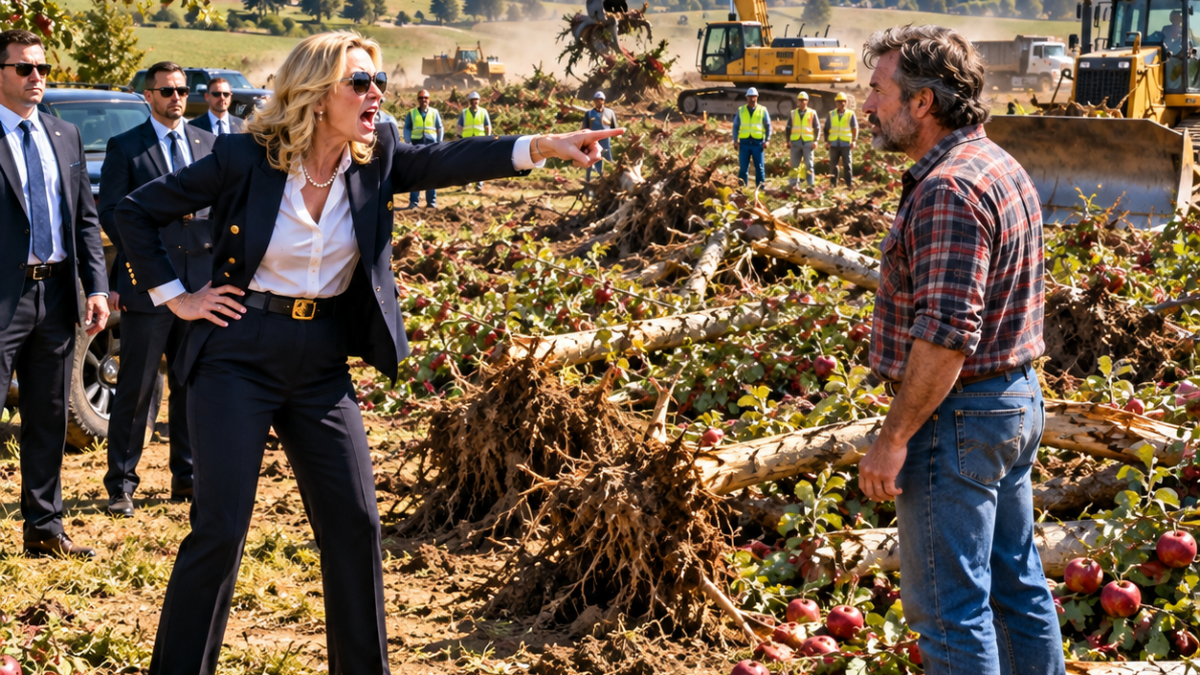
The HOA president stood beside the bulldozers while twenty years of my family’s orchard was ripped out of the ground, then looked me in the face and said, “They’re just trees.”
By the time I reached the South Orchard, thirty-eight point six acres were already gone, and she still believed the worst thing she had caused was a landscaping bill.
Then the agricultural appraiser opened her report, looked directly at Denise Whitmore, and explained that she had not destroyed trees—she had destroyed time, contracts, infrastructure, and a producing commercial asset worth approximately eleven point two million dollars.
For several seconds, Denise laughed.
Not because anything was funny.
Because her brain simply refused to believe the land she had casually ordered bulldozed could possibly be worth that much.
Then she stopped laughing.
And for the first time since I had known her, Denise Whitmore looked afraid.
But I am getting ahead of myself.
The morning my orchard disappeared started like any other harvest season morning.
My name is Jack Callaway.
I am sixty-two years old, and Callaway Orchard sits on one hundred sixteen acres along the western side of Hawthorne Ridge.
My father bought the original sixty acres in 1974.
Back then, the hills to the east were mostly timber, pasture, and open ground. There was no Hawthorne Ridge subdivision. No stone entrance monument. No decorative streetlights. No HOA president driving around in a white SUV explaining what everybody else’s property should look like.
There was my father’s farmhouse.
A barn.
A packing shed.
A rusted tractor that started only when it felt appreciated.
And trees.
Lots of trees.
Dad began with apples. Nothing fancy. Reliable commercial varieties that local grocery stores would buy without asking too many questions.
Then pears.
Then cherries.
As I got older, I started experimenting.
Different rootstocks.
Different spacing.
Specialty varieties.
Trees bred for flavor rather than simply surviving a long ride in a refrigerated truck.
Some worked.
Some did not.
That is farming.
People think orchards are planted once.
They are not.
An orchard is constantly becoming something else.
You remove varieties the market stops wanting. You graft new material onto established root systems. You adjust irrigation. You plant pollinator rows. You lose trees to disease. You replace them. You spend five years waiting for a decision you made in one afternoon to finally become profitable.
The South Orchard became the heart of our operation because I treated it like a long experiment.
Forty acres, approximately.
More accurately, thirty-eight point six acres inside the main production block.
Pears.
Apples.
Cherries.
Some trees were only five or six years old.
Others had been producing for close to twenty.
PART2:
A few contained graft material that traced back to trees my father planted decades earlier.
Those were the ones I cared about most.
Not because they made the most money.
Because when I walked those rows, part of Dad was still there.
He died twelve years before the bulldozers came.
Heart attack.
Fast.
No long hospital goodbye.
He drove his tractor one afternoon, complained about indigestion after dinner, and was gone before sunrise.
For months afterward, I found myself expecting to see him around corners.
That probably sounds strange unless you have worked beside the same person most of your life.
You do not realize how deeply somebody becomes part of a place until they are missing.
His coffee thermos stayed in the packing shed for almost a year.
His handwriting remained on irrigation notes.
I could walk through certain rows and remember exactly where we had argued about planting distance.
Dad always planted wider than I wanted.
“Trees need room,” he would say.
I would tell him land was expensive and production mattered.
He would shake his head and look down a row like he was seeing twenty years ahead.
“Young people think land is supposed to hurry.”
By the time I was fifty, I understood what he meant.
Value on a farm does not always appear quickly.
Sometimes it takes twenty years to grow.
That was the lesson Denise Whitmore was about to learn at an extremely expensive price.
Hawthorne Ridge was built about nine years before the destruction.
At first, I did not mind.
Development was inevitable. I was not one of those farmers who believed nobody should ever build a house within sight of agricultural land. People need homes. Families grow. Towns expand. I understood that.
The first houses went up along the ridge east of my property.
Big places.
Stone fronts.
Three-car garages.
Wide decks facing west toward my orchard.
PART3:
The marketing brochures called the view “protected pastoral scenery.”
I remember laughing when I saw that phrase.
Protected by whom?
Certainly not the developer.
Nobody had ever asked me whether I intended to keep farming so homeowners could enjoy their pastoral scenery.
But for several years, we coexisted.
I ran tractors.
They ran lawn mowers.
I sprayed early in the morning when weather required it.
They had backyard parties.
Occasionally somebody complained about dust.
Occasionally somebody asked whether they could buy apples directly.
Nothing serious.
Then Denise Whitmore became HOA president.
Denise was one of those people who spoke softly until she realized softness was not working.
Then the smile disappeared.
She wore expensive boots even when walking agricultural ground. She always carried a leather folder. She always said “the board” when she meant herself.
The letters began within months of her election.
The first complained about tractors operating before eight in the morning.
The second complained about orchard spraying.
The third asked whether several equipment sheds could be relocated because they interfered with homeowners’ views.
That one made me laugh.
I wrote back:
The sheds existed before the houses.
No.
I never heard a response.
Then came a letter asking me to install “more aesthetically consistent boundary screening.”
I looked out the window at thousands of trees.
Apparently actual trees were not aesthetically sufficient.
Most of Denise’s correspondence went into a drawer.
I was not in Hawthorne Ridge.
My farm was not subject to their covenants.
They could make recommendations.
I could ignore them.
That arrangement worked until about eight months before the bulldozers arrived.
Denise came to the farm personally.
I was outside the packing shed checking a refrigeration problem. One of the walk-in coolers had been cycling wrong, and I was standing with my arm halfway behind a panel when her white SUV pulled in beside the gravel drive.
I heard the tires before I saw her.
Clean tires.
Subdivision tires.
The kind that do not belong in a working farmyard unless the driver is lost or selling something.
Denise stepped out holding her leather folder.
“Jack.”
She always called me Jack once she realized Mr. Callaway did not intimidate me.
“Denise.”
“Do you have a few minutes?”
“What broke?”
She smiled.
“Nothing broke.”
“Then five.”
She followed me around the side of the packing shed.
From there, you could see most of the South Orchard descending gently toward the lower field. Steel trellis posts ran in straight lines. Irrigation control boxes sat beside the access lanes. Frost protection lines ran low along the blocks. Pollinator rows broke up the varieties where timing required them.
Denise looked across it like she was studying a problem.
“Hawthorne Ridge is developing a long-term wildfire mitigation plan.”
“Good idea.”
“We’re particularly concerned about fuel loads along the western boundary.”
“Also reasonable.”
“We may need a wider vegetation buffer.”
I looked at her.
“You already have a cleared strip on your side.”
“Not enough according to some recommendations.”
“How wide are you talking?”
She avoided the answer.
“That’s still being evaluated.”
“Then come back when you know.”
“We may need cooperation from adjacent landowners.”
“Meaning me.”
“Yes.”
“What kind of cooperation?”
“Selective vegetation removal.”
I laughed.
She did not.
“Denise, this is a commercial orchard.”
“I understand.”
“No, you don’t.”
“Jack.”
“You’re looking at trees and seeing vegetation.”
She crossed her arms.
“What should I see?”
“Revenue.”
She looked annoyed.
“That’s dramatic.”
“No. That’s farming.”
I pointed toward a pear block.
“That row goes to a specialty distributor. Those apples go to a cider producer. Those trellises are not decoration. Those pollinator rows are there because yield depends on them.”
“We are not suggesting removing the entire orchard.”
“How much?”
Again, she did not answer.
That should have been my warning.
I had dealt with enough buyers, contractors, suppliers, and county officials to know that people who avoid numbers are usually hiding the real plan inside vague language.
I shook my head.
“Nothing happens on my side of the property line without my written permission.”
“Of course.”
She said it easily.
Too easily.
Then she left.
I nearly forgot the conversation.
Eight months later, the bulldozers arrived.
That morning, I was at the northern end of the property dealing with equipment.
A mower attachment had thrown a belt, and one of the older tractors was making a noise Louise Mercer described as “financially ugly.”
Louise was my farm manager.
Despite the name, Louise was a man.
His mother had been French and apparently had strong opinions about family names.
He had worked with me for eighteen years. He knew every block, valve, frost pocket, low spot, picker complaint, and old family argument embedded in the soil. He rarely sounded panicked.
That morning, he did.
My phone rang around ten-thirty.
I wiped grease off my hand and answered.
“Jack.”
“What?”
“You need to get down here.”
“Where?”
“South block.”
“What happened?”
“Just come.”
“Louise.”
“They’re taking trees out.”
I froze.
“Who?”
“Bulldozers.”
For a second, I thought I misunderstood him.
“What bulldozers?”
“Three of them. Excavator too.”
I was already moving toward my truck.
“Whose equipment?”
“Clearing company. I don’t know. Jack, they’re already halfway through the western rows.”
My chest tightened.
“Call them off.”
“They say they’re authorized.”
“By who?”
There was a pause.
“The HOA.”
I do not remember hanging up.
I remember getting into the truck.
I remember gravel spraying behind me.
I remember driving too fast.
When I came around the bend above the South Orchard, my foot hit the brake so hard the rear end of the pickup slid sideways.
I stopped.
For several seconds, I could not process what I was seeing.
The South Orchard was gone.
Not all of it.
Not yet.
But enough.
Rows that should have been green and straight had become brown scars across the field. Mature pear trees lay on their sides, roots exposed, soil clinging to them in enormous clumps. Apple trees had been pushed into piles. Cherry branches were mixed with broken irrigation line. Black plastic pipe twisted through trunks like rope. Steel trellis posts were bent flat. Wire dragged across the ground in tangled lengths.
A bulldozer moved at the far end.
Its blade pressed against a row of trees.
The trees leaned.
Then fell.
I could hear wood snapping even from inside my truck.
Another bulldozer pushed uprooted material into a pile.
An excavator used its bucket to tear at the roots of a mature pear.
I sat behind the steering wheel staring.
Twenty years.
That is what I saw falling.
Not trees.
Years.
Pruning.
Training.
Disease control.
Irrigation.
Late freezes.
Drought.
Harvest crews.
Contracts.
My father’s graft stock.
Thousands of mornings.
Thousands of decisions.
Then I saw the white SUV.
Parked beside the equipment.
And Denise Whitmore.
She stood beside a contractor holding her folder.
Calm.
Completely calm.
That was when the shock became anger.
I drove straight across the field.
The truck bounced through ruts. A foreman noticed me coming and raised one hand.
I got out before he reached me.
“Shut everything down.”
“Sir, you need to stay clear of the equipment.”
“Shut it down!”
He looked confused.
“We have authorization.”
“From who?”
Before he answered, Denise walked toward us.
“Jack.”
“Turn them off.”
“You need to calm down.”
I looked past her.
A bulldozer was still moving.
Another mature pear tree leaned.
Then crashed.
“TURN THEM OFF.”
The foreman lifted his radio.
“Hold all equipment.”
One machine stopped.
Then another.
The excavator bucket hung in the air.
Finally, silence.
Except for diesel engines idling.
Denise sighed.
“The HOA approved this work.”
“You’re standing in my orchard.”
“This section had to be cleared.”
“For what?”
“Fire mitigation.”
“Thirty-eight acres?”
“And future access considerations.”
That phrase hit me.
Future access.
I stared at her.
“Access to what?”
She did not answer.
Instead, she opened the folder.
“We are already behind schedule.”
That was when something clicked.
She was not surprised to see me.
She was not confused about the ownership.
She knew exactly where she was.
And she had expected the work to be finished before I discovered it.
I walked toward the foreman.
“What’s your name?”
“Paul Mercer.”
He sounded nervous now.
“No relation to Louise.”
I was not in the mood.
He pulled out a site plan.
“Mr. Callaway, this is what we were provided.”
The highlighted clearing boundary covered almost the entire South Orchard.
I stared at it.
“Who gave you these limits?”
“Hawthorne Ridge HOA.”
“Did anyone show you a deed?”
Paul hesitated.
“We were told this parcel was controlled by the association.”
I laughed once.
Not because anything was funny.
“Controlled.”
Denise stepped closer.
“The association has emergency authority relating to wildfire safety.”
“Not on my farm.”
She pulled out a county fire recommendation.
I read it.
It recommended brush reduction along Hawthorne Ridge’s western boundary.
Brush.
On HOA property.
Not a producing orchard.
I held it up.
“This does not authorize any of this.”
“The board interpreted it differently.”
Paul looked at Denise.
“The work order says HOA common property.”
Denise turned sharply.
“I told you we had authority.”
“You told our office this parcel was under association control,” Paul said.
That was the first crack.
I started photographing everything.
The site map.
The work order.
The equipment.
The destroyed rows.
Denise.
Paul.
Machine numbers.
Then I called the sheriff.
Not because I expected someone to drag Denise away in handcuffs.
I wanted the work stopped.
I wanted a record.
Twenty minutes later, a deputy arrived. He looked at my county parcel map. Then Paul’s work order. Then Denise’s fire recommendation. Then the orchard.
Finally, he looked at Paul.
“If I were you, I wouldn’t touch another tree until ownership gets sorted out.”
Paul nodded immediately.
The machines shut down completely.
But by then, most of the damage was done.
Thirty-eight point six acres.
I would learn the exact figure the following morning.
That evening, after everybody left, I walked the South Orchard alone.
I wish I had not.
From the truck, destruction had looked enormous.
On foot, it became personal.
I recognized individual trees.
That surprised me.
When you manage thousands, outsiders assume they are interchangeable.
They are not.
I knew where the first Bartlett pear block began.
I knew which cherry rows always ripened three days early.
I knew the apples grafted from Dad’s old stock.
I knew which areas held frost.
I knew the irrigation valves.
I knew where Louise had once backed a tractor into a trellis and denied it for two years.
Now many of those landmarks were gone.
The ground looked wounded.
Bulldozer tracks had churned soil into deep ruts. Compaction was obvious even before testing. Several irrigation valves were snapped below grade. Buried lines had been torn out when roots came up. Steel wire wrapped around broken trunks.
Trees still standing had bark torn away.
Some leaned.
Others had cracked scaffold limbs.
Those damaged survivors were almost worse than the uprooted ones.
At least with the trees on the ground, I knew they were dead.
The standing ones made you hope.
Louise found me near the middle row.
He did not say anything.
Neither did I.
Eventually, he asked, “Can we save any?”
“Some.”
“How many?”
I looked around.
“Not enough.”
He kicked at the dirt.
“They didn’t even mark the irrigation.”
“No.”
“Idiots.”
I wanted to agree.
But idiot was not the right word.
An idiot makes a mistake.
This had a map.
A schedule.
A contractor.
A work authorization.
Somebody had planned it.
The next morning, Denise called.
“Jack, the HOA would like to resolve this without turning it into a war.”
I looked through my kitchen window toward the ruined field.
“You bulldozed forty acres.”
“It wasn’t forty.”
I checked the GPS report Louise had pulled.
“Thirty-eight point six.”
Silence.
Then Denise said, “The trees can be replanted.”
Those words stayed with me.
I still hear them.
The trees can be replanted.
Like shrubs outside a clubhouse.
Like replacing flowers after a frost.
I said, “You think I plant a tree Monday and harvest Friday?”
“That isn’t what I meant.”
“Then what did you mean?”
“Obviously there will be some replacement cost.”
“Some.”
“Yes.”
“How much do you think?”
“I don’t know. That’s why we should discuss it reasonably.”
“You first.”
“What?”
“Give me your number.”
“I don’t negotiate like that.”
“Then don’t call me talking about resolution.”
She became irritated.
“Jack, nobody is saying there wasn’t a mistake.”
“Mistake?”
“The scope may have exceeded what was intended.”
“You sent bulldozers onto land you do not own.”
“We believed we had authority.”
“No. You believed you’d be finished before I saw it.”
“That is ridiculous.”
“Then why wasn’t I notified?”
Silence.
I continued.
“Why didn’t the contractor have my name?”
“Jack.”
“Why did their paperwork call my orchard HOA common property?”
Another silence.
I said, “Do not call me again without lawyers involved.”
Then I hung up.
My insurance company sent an adjuster immediately.
Because the destruction had been caused by third parties, the process became complicated fast.
Contractor insurance.
HOA insurance.
Potential personal liability.
Business interruption.
Property damage.
Crop loss.
Nobody wanted to be the first company admitting responsibility.
My attorney recommended an agricultural appraiser named Laura Benton.
I expected someone who would count trees.
Laura did far more than that.
She arrived two days later in an old pickup with a laptop bag and boots that actually belonged in dirt.
No expensive leather folder.
No dramatic introduction.
She shook my hand.
“Jack?”
“Yes.”
“Laura Benton.”
“Thanks for coming.”
She looked toward the South Orchard.
“Before we walk it, I need records.”
“What kind?”
“Production history.”
“Okay.”
“Tree counts.”
“Have them.”
“Varieties.”
“Have most of it.”
“Planting dates.”
“Some exact, some by year.”
“Sales contracts.”
I paused.
“Why contracts?”
“Because I don’t know yet what was destroyed.”
“You’re looking at it.”
“No.”
She glanced toward the field.
“I am looking at trees. I need to know what those trees were doing economically before somebody removed them.”
That sentence changed how I understood the claim.
We spent half the morning in the office.
Production spreadsheets.
Yield histories.
Buyer invoices.
Nursery records.
Graft notes.
I showed her our supply agreement with two specialty grocers, a restaurant distributor, and two regional cider producers. One cider company bought almost everything from three specific apple blocks because the fruit created a flavor profile they used in one seasonal product line.
Laura wrote constantly.
Then we walked the orchard.
Row by row.
It took all day.
At first, she counted.
Then she asked questions.
“How old were these?”
“Seventeen years average.”
“How long until replacement trees begin commercial production?”
“Depends on rootstock. Four to six years.”
“Full production?”
“Closer to eight.”
She wrote.
“What about those pears?”
“Some nearly twenty.”
“Replaceable stock?”
“Most varieties, yes.”
“Most?”
I pointed toward a damaged section.
“Some grafts came from my father’s old trees. Nursery does not carry identical stock.”
“Can you propagate from surviving material?”
“Possibly.”
“How long?”
“Years.”
She wrote.
At the irrigation control station, pressure was down across half the southern zone.
We walked the lines.
Bulldozer damage in multiple locations.
At least eleven obvious breaks.
Probably more buried.
Trellis replacement.
Control valves.
Frost protection.
Monitoring equipment.
Then pollinator rows.
Laura stopped.
“These were dedicated pollinators?”
“Yes.”
“Separate management?”
“Yes.”
“Why?”
“Bloom timing.”
She nodded.
“Expected yield impact if not restored properly?”
“Significant.”
More writing.
By the end of the day, Laura’s notebook looked worse than my orchard.
Three days later, she returned with a perennial crop valuation specialist.
That was when Denise appeared.
I saw the white SUV first.
She walked across the dirt wearing expensive boots.
Laura was crouched near the remains of an irrigation line.
Denise said, “How long is this going to take?”
Laura looked up.
“As long as necessary.”
Denise crossed her arms.
“We are talking about agricultural trees.”
“Yes.”
“You do not need a team of experts to price trees.”
Laura stood.
She looked toward me.
Then back at Denise.
“Actually, you do.”
It was the first time I saw uncertainty in Denise’s face.
She had expected arithmetic.
Number of trees multiplied by nursery cost.
Maybe five hundred dollars each.
Maybe less.
Remove.
Replace.
Done.
Commercial orchards do not work that way.
Laura explained it gradually.
First, replacement stock.
Then labor.
Then irrigation reconstruction.
Then trellis replacement.
Then soil rehabilitation.
Heavy equipment had compacted significant areas.
Then years of lost crops.
Then reduced yield while replacement trees matured.
Then contract exposure.
That was where the numbers stopped feeling theoretical.
Laura sat in my office with the supply agreements spread across the table.
“You guaranteed annual volume?”
“Yes.”
“What happens if you miss it?”
“Depends on buyer.”
“Can they terminate?”
“Some.”
“Can you source equivalent fruit elsewhere?”
“Not at this scale.”
“Can you lease another orchard?”
“Not locally.”
“What percentage of total annual revenue came from the South Block?”
I gave her the figure.
She stopped writing.
That scared me.
“What?”
“Jack.”
“What?”
“This isn’t primarily a tree replacement claim.”
“What is it?”
“A business interruption claim with biological replacement time.”
I leaned back.
“That sounds expensive.”
“It can be.”
“How expensive?”
“I don’t give numbers until I can defend them.”
That was Laura.
No drama.
No guessing.
Meanwhile, the clearing contractor’s insurance company started asking questions.
Paul’s company had been told Hawthorne Ridge controlled the parcel.
Their insurer wanted the work authorization.
The HOA insurer wanted board minutes.
And that was where the story changed.
One evening, Tom Grayson called me.
Tom was Hawthorne Ridge’s treasurer.
We had spoken maybe twice in nine years.
His voice was quiet.
“Jack, I need to talk privately.”
“About?”
“The clearing.”
“Come over.”
He arrived after dinner.
No SUV.
No folder.
Just an old sedan.
We sat outside the packing shed.
He looked sick.
Finally, he said, “Denise told you the board approved clearing your orchard.”
“Yes.”
“We didn’t.”
I stared at him.
“What did you approve?”
“Four acres.”
“Where?”
“HOA property.”
“How did four become thirty-eight point six?”
He handed me copies of meeting minutes.
The board had approved a four-acre brush reduction project on Hawthorne Ridge land.
Nothing about Callaway Orchard.
Nothing about entering my property.
Nothing about future access.
Nothing about trees.
Tom rubbed his face.
“She used the fire recommendation to push the vote.”
“Did the board ever see the contractor map?”
“No.”
“Did you know my land was included?”
“No.”
“You expect me to believe that?”
He looked at me.
“I would not believe me either.”
That answer made me believe him more.
Then Tom pulled out another paper.
“A few months ago, Denise circulated this to part of the development committee.”
I unfolded it.
Planning sketch.
Behind my South Orchard, Hawthorne Ridge owned twenty-seven undeveloped acres.
The sketch showed eighteen future luxury lots.
And a second entrance road.
The proposed road ran directly across my property.
Across the orchard.
I looked at Tom.
“Was this approved?”
“No.”
“Board vote?”
“No.”
“County application?”
“Not that I know of.”
“Did Denise support it?”
“She pushed it hard.”
I looked back at the drawing.
Then I remembered demolition morning.
Fire mitigation and future access.
Future access.
It was not an accidental phrase.
The orchard was not merely vegetation in Denise’s way.
It was physically in the way.
If the trees disappeared, a road corridor suddenly looked possible.
I asked, “Who benefits from the expansion?”
Tom hesitated.
“Hawthorne Ridge.”
“Who else?”
“I don’t know.”
“Tom.”
“I really don’t know.”
That did not matter yet.
The motive was clear enough.
My attorney sent the minutes and development sketch to every relevant insurer the next morning.
Paul’s company responded with emails.
One of them made my hands shake.
The contractor had questioned the boundary before starting.
Satellite imagery clearly showed active orchard rows inside the proposed clearing zone.
Someone from Paul’s office emailed Denise:
Please confirm marked limits. Imagery appears to show active orchard production.
Denise replied:
Proceed with marked area. HOA authority has been confirmed.
Another email:
Has property owner been notified?
Denise’s response:
Notification is being handled separately.
I was never notified.
Not once.
She knew there was an owner.
She knew the contractor had concerns.
She told them to proceed anyway.
After those emails surfaced, Denise came to my house.
No leather folder.
No confident smile.
She stood on the porch.
“We need to find a number.”
“A number.”
“Yes.”
“For what?”
“Resolution.”
“The trees?”
“Everything.”
I looked at her.
“You still think this is about trees?”
“What else would it be?”
Before I answered, a pickup turned into the driveway.
Laura.
She climbed out holding a thick report.
I almost laughed.
“Perfect timing.”
Denise looked at the report.
“Is that the appraisal?”
Laura nodded.
“Preliminary?”
“Yes.”
“How much?”
Laura did not answer immediately.
She opened the report.
Denise’s eyes stayed on her.
Laura read, “Direct orchard replacement, damaged irrigation and trellis infrastructure, soil rehabilitation, lost crop production, contract exposure, and projected business interruption currently place total damages at approximately eleven point two million dollars.”
Denise laughed.
A short burst.
Then stopped.
“Eleven million?”
“Eleven point two preliminary.”
“For trees?”
Laura looked directly at her.
“No.”
She closed the report.
“For destroying a producing commercial asset that takes years to replace.”
Denise stared at her.
Then looked toward the orchard.
I watched her face.
For months, she had looked across those rows and seen land.
Potential road.
Potential development.
Trees in the way.
Now she was seeing time.
Twenty years converted into a number.
Eleven point two million dollars.
She said, “That is impossible.”
Laura remained calm.
“It will be reviewed.”
“You’re claiming each tree is worth thousands.”
“No.”
“But that’s what the math means.”
“No.”
Laura opened the report again.
“This includes infrastructure, rehabilitation, future production losses, contractual exposure, and biological maturation time.”
Denise turned toward me.
“You can’t seriously expect the HOA to pay eleven million dollars.”
“I did not create the number.”
“This will bankrupt people.”
I stared at her.
“You should have thought about that before sending bulldozers.”
“I didn’t send them there to destroy your business.”
“You sent them.”
“The scope got out of control.”
“You signed the work authorization.”
“The contractor misunderstood.”
“They emailed you.”
Her face changed.
“You have those?”
“Yes.”
That was when she knew.
Not suspected.
Knew.
The contractor had turned over her emails.
She sat down on one of my porch chairs without asking.
For the first time, she looked older.
Tired.
“Jack.”
“No.”
“You need to understand something.”
“I understand plenty.”
“The road concept was preliminary.”
“So there was a road.”
“That is not what I’m saying.”
“You told me future access while the machines were still running.”
She looked away.
“You were angry.”
“I remember exactly what you said.”
“We were trying to protect Hawthorne Ridge.”
“From apple trees?”
“Wildfire is serious.”
“So serious your board approved four acres on your land, and you cleared almost forty on mine.”
She did not answer.
Laura stood nearby.
Quiet.
I think Denise forgot she was there.
Then Denise said, “If this claim destroys the HOA, hundreds of homeowners get hurt.”
I leaned forward.
“Do not put that on me.”
“I’m not.”
“Yes, you are.”
I pointed toward the orchard.
“They didn’t bulldoze this.”
She looked at me.
“You did.”
Denise left ten minutes later.
The insurers spent weeks attacking Laura’s numbers.
As expected.
Nobody simply wrote an eleven-million-dollar check.
That is not how claims work.
Their experts challenged projected yields.
Replacement periods.
Contract losses.
Mortality estimates.
Soil remediation.
Discount rates.
Future revenue.
Some estimates came lower.
Some surprisingly close.
Every expert agreed on one thing.
This was not a landscaping loss.
That alone changed everything.
Then Hawthorne Ridge residents learned what had happened.
At first, the HOA’s internal message described it as a boundary issue related to wildfire mitigation.
Then Paul’s company documents leaked.
Then residents heard nearly forty acres of productive commercial orchard had been cleared without board authorization.
Then someone learned about the second entrance plan.
The emergency HOA meeting was packed.
Tom asked me to attend.
I did not want to.
My attorney suggested I should.
So I went.
The clubhouse held more people than the fire code probably allowed. Residents stood along the walls. People whispered. Denise sat at the front beside the board. She looked composed again. Almost like the woman who had stood beside the bulldozers.
She began with wildfire safety.
“Hawthorne Ridge leadership has a fiduciary obligation to protect residents from known environmental risks.”
Someone interrupted.
“Did the board approve clearing his orchard?”
Denise continued.
“All decisions were made in the context of professional recommendations.”
Tom stood.
He connected his laptop to the projector.
The board minutes appeared.
Four acres.
HOA property only.
Tom read the language.
Silence.
Then he displayed the contractor clearing map.
Nearly forty acres.
My property.
A resident near the back asked, “Who changed the map?”
No answer.
Another asked, “Who told the contractor this was HOA common property?”
Denise leaned toward the microphone.
“There were conflicting understandings about the boundary.”
I stood.
Not angrily.
Just enough for people to see me.
“County parcel records have never shown the orchard as HOA property.”
A woman turned toward Denise.
“Did Jack agree to clearing?”
“No.”
“Was he notified?”
Denise hesitated.
That hesitation told everyone.
Tom displayed the contractor email.
Has property owner been notified?
Notification is being handled separately.
The room changed.
Whispers became voices.
Then Tom displayed the development sketch.
Eighteen luxury lots.
Second entrance road.
The route crossed the cleared orchard.
Nobody spoke for several seconds.
Finally, one homeowner said, “You bulldozed his orchard for a road we never approved.”
Denise leaned forward.
“That is not what happened.”
“Then why does the clearing line match the proposed access?”
“Correlation does not establish motive.”
Someone laughed bitterly.
Another homeowner asked, “Why didn’t we know about the expansion plan?”
“It was conceptual.”
“Who authorized you to pursue it?”
“We explore multiple planning scenarios.”
Tom said, “The board never authorized negotiations involving Callaway property.”
Denise turned toward him.
“You were aware of discussions.”
“I was aware you wanted a second entrance. I was not aware you were clearing Jack’s land.”
The room erupted.
People talked over one another.
Some residents were furious about liability.
Others about insurance limits.
A man near the front shouted, “Are our dues paying for this?”
Someone else asked, “Can they assess us?”
That was the moment Hawthorne Ridge understood Denise’s decision could reach every household.
Eleven point two million dollars was bigger than Denise.
Bigger than the board.
Possibly bigger than their insurance coverage.
I felt uncomfortable watching people panic.
Most of them had nothing to do with my orchard.
They had simply bought houses.
I did not want families losing savings because Denise decided my farm was expendable.
But I could not absorb the destruction either.
My business had been damaged.
Employees depended on it.
Buyers depended on contracts.
My family had spent decades building what was gone.
There was no simple way to make everyone whole.
The board went into executive session.
Forty-five minutes later, they returned.
Denise was removed as president that night.
Eleven days later, she resigned from the board completely.
I thought that would feel satisfying.
It did not.
The orchard was still gone.
That is something people do not understand about accountability.
Punishing the person responsible does not reverse the damage.
Trees do not stand back up because someone loses a title.
The legal and insurance fight lasted months.
Meanwhile, I still had a farm to run.
Our first priority was irrigation.
Without water, surviving sections would deteriorate too.
Crews mapped broken lines.
Eleven obvious breaks became fourteen.
Then seventeen.
Some damage had occurred beneath compacted soil.
We replaced valves.
Control lines.
Pressure regulators.
We rebuilt damaged frost protection.
Then soil.
Heavy machinery had compacted portions so badly roots would struggle if we simply replanted.
We ripped those areas.
Added organic matter.
Regraded.
Restored drainage.
The first replanting day was harder than I expected.
A truck arrived loaded with young trees.
Tiny things.
Thin trunks.
Small root systems.
I stood beside thirty-eight acres that once held mature production and looked at saplings.
Louise came beside me.
“Feels wrong.”
“Yeah.”
“Too much sky.”
That was exactly it.
Too much sky.
A mature orchard fills space. Canopies connect visually. Rows create tunnels. Young trees leave emptiness between them. You can see everything that is not there yet.
We started with pears.
Then apples.
Then cherries.
For common varieties, nursery stock was available.
For Dad’s old material, we had a different problem.
Some surviving sections still contained usable graft wood.
We collected scion material.
Carefully labeled it.
Worked with a nursery.
It would take time.
But we could preserve the genetic lines.
That mattered more to me than almost any financial recovery.
One afternoon, I held a bundle of graft material cut from a surviving tree my father had started decades earlier.
Louise asked, “You okay?”
“Yeah.”
“You don’t look okay.”
“My dad planted the original.”
He nodded.
“We’ll keep it going.”
That sentence nearly broke me.
Not the eleven million.
Not the lawsuits.
That.
We’ll keep it going.
Because that was what farming had always been.
Keeping things going.
Through weather.
Markets.
Death.
Development.
Mistakes.
Even bulldozers.
The appraisal process continued in parallel.
Opposing experts came.
They measured.
Photographed.
Questioned everything.
Some treated me like I was exaggerating.
“How do we know these trees would have remained productive?”
“We don’t.”
“So future projections are speculative.”
“All agriculture is projected.”
“What if disease reduced yield?”
“What if prices increased?”
They did not like that answer.
Another expert challenged contract losses.
“Could you substitute fruit?”
“Not the same varieties at required volume.”
“Could buyers accept alternatives?”
“Ask them.”
They did.
One cider producer confirmed that three of our blocks supplied a specific flavor profile important to one product line. The restaurant distributor explained that replacement pears from commodity suppliers were not equivalent.
Suddenly, my buyers became part of the valuation.
Years of relationships had economic value.
Not just fruit.
The more everyone studied the orchard, the clearer Laura’s original point became.
The land was not the expensive part.
The system was.
Trees.
Rootstock.
Age.
Infrastructure.
Soil.
Contracts.
Knowledge.
Time.
Time was the biggest one.
You can buy another sapling tomorrow.
You cannot buy an eight-year-old production curve tomorrow.
You cannot write a check and make biology hurry.
That was where Denise had failed completely.
She thought destruction happened in one day, so replacement should too.
Bulldozer arrives Tuesday.
New trees arrive Friday.
Problem solved.
Agriculture does not work on administrative timelines.
The first growing season after replanting was psychologically brutal.
I drove the new rows every morning.
Some trees took.
Some did not.
A percentage always fails.
That is normal.
But after losing thousands at once, every dead replacement felt personal.
I found myself overreacting.
One yellow leaf and I wanted soil tests.
One weak leader and I called Louise.
Finally, he said, “Jack, you’re going to worry these trees to death.”
“I don’t think that’s biologically possible.”
“You’ll find a way.”
He was right.
I had to stop expecting the new orchard to become the old one.
It never would.
It would become something else.
We improved parts of the irrigation layout.
Adjusted spacing.
Changed certain rootstocks.
Installed better monitoring.
Used the rebuilding process to correct things Dad and I would never have torn out voluntarily.
That felt almost disrespectful at first.
Then I remembered Dad.
He never treated tradition like religion.
He loved what worked.
If you showed him a better method, he would complain for three days and adopt it on the fourth.
The insurance settlement process finally moved toward resolution.
Confidentiality around some details limited what I could discuss publicly.
What mattered was that multiple parties contributed.
Contractor insurer.
HOA carrier.
Other negotiated components.
There was no single dramatic eleven-point-two-million-dollar transfer.
The appraisal number became the benchmark everyone argued around.
Some categories were accepted.
Some reduced.
Some structured differently.
Some business losses remained uncertain until time passed.
That is reality.
People hear “eleven-million-dollar damage estimate” and imagine money appearing in a bank account.
It does not.
First come lawyers.
Then experts.
Then counter-experts.
Then spreadsheets.
Then arguments about discount rates that make you question whether civilization was a mistake.
But enough was recovered to rebuild.
Enough to stabilize the business.
Enough to protect employees.
That mattered.
Hawthorne Ridge went through its own reckoning.
The new board commissioned a review of major decisions made under Denise. Residents demanded clearer limits on executive authority. Contract approvals changed. Property verification procedures changed. Nobody wanted another contractor touching land without actual ownership documentation.
Tom became interim president for a while.
He hated it.
Every time I saw him, he looked more tired.
“You enjoying public service?” I asked once.
“No.”
“Good.”
“Why good?”
“Means you’re sane.”
He laughed.
One afternoon, Tom came to the packing shed.
“I want to show you something.”
“If it is another development sketch, burn it.”
“Not development.”
He handed me a proposed agreement.
Hawthorne Ridge wanted a formal boundary acknowledgment between the subdivision and Callaway Orchard.
Surveyed line.
Recorded.
No ambiguity.
They also proposed a standing policy requiring written consent before any HOA contractor entered my property.
I read it.
“Should have had this nine years ago.”
“Probably.”
“Would have saved everyone money.”
“Definitely.”
I signed after my attorney reviewed it.
That boundary became one of the few good things to emerge from the disaster.
No more assumptions.
No more “we thought.”
No more “the board interpreted.”
Land has lines.
Respect them.
A year after the bulldozers, the South Orchard looked green again.
Small.
But green.
The pear grafts from Dad’s stock survived.
The first time I saw new growth on one of them, I stood there longer than necessary.
A tiny shoot.
Three inches maybe.
Nothing valuable yet.
Nobody could build a lawsuit around it.
But it mattered.
I touched the new leaves.
Soft.
Flexible.
Dad used to say young trees tell you everything they need if you bother looking.
Color.
Angle.
Growth.
Leaf shape.
Most problems appear early.
People are different.
They can hide rot for years.
Denise moved away from Hawthorne Ridge eventually.
I heard she sold her house.
I never spoke to her after the insurance dispute reached its final stages.
Part of me expected one last conversation.
An apology maybe.
Not because I needed it.
Because stories train us to expect them.
The villain comes back.
Admits wrongdoing.
Everybody gets closure.
Real life is not usually that neat.
Denise never stood in my orchard and told me she finally understood.
Maybe she did.
Maybe she did not.
I stopped caring.
Closure came from other places.
The first irrigation line holding pressure.
The first successful graft.
The first blossoms.
The first small harvest from replanted sections.
The first buyer who said, “We’ll wait for you.”
That one mattered.
One of our cider partners could have replaced us permanently.
Instead, they modified sourcing and kept the relationship open.
The owner told me, “Twenty years together means something.”
I wrote that sentence down.
People talk about contracts like they are only paper.
Relationships matter too.
Two years after the destruction, Laura returned.
Not for appraisal work.
She was nearby and wanted to see the rebuild.
We walked the young rows.
The trees were taller now.
Still years from full maturity.
But starting to resemble an orchard instead of a nursery.
Laura stopped beside a pear tree and looked down the row.
“You know what’s funny?”
“What?”
“The land itself was never the expensive part.”
I smiled.
“I know.”
She touched a branch.
“People see acreage and think value is dirt times price per acre.”
“Denise did.”
“Most people would.”
We kept walking.
I said, “Eleven point two million still sounds crazy when I say it.”
“It was a valuation.”
“I know.”
“Not a lottery ticket.”
“I definitely know that.”
She laughed.
Then turned serious.
“People underestimate perennial agriculture.”
“Why?”
“Because they understand houses better.”
I looked at her.
She continued.
“Burn a house down, people understand rebuilding takes money. Destroy a factory, people understand lost production. Destroy an orchard, they think you buy new trees.”
I nodded.
That was exactly it.
The South Orchard had been a factory made of biology.
Every tree was production equipment that needed years to reach capacity.
The irrigation was infrastructure.
The trellises were infrastructure.
Pollinator rows supported output.
Soil was the floor.
Contracts were customers.
And unlike a conventional factory, you could not overnight replacement machinery.
The machinery had roots.
That became the sentence I used whenever somebody asked why the damage estimate was so high.
The machinery had roots.
By the third year, we harvested enough from parts of the rebuilt South Orchard to make the picking crew complain again.
That made me happy.
Farm workers complaining means there is work.
Louise stood beside a bin of young orchard pears.
He picked one up.
“Small.”
“Tree’s young.”
“Tastes good.”
He bit it.
Juice ran down his wrist.
“Your dad would complain about the size.”
“My dad complained recreationally.”
Louise laughed.
Then he said, “You ever think about selling?”
That caught me.
“Why?”
“After all this.”
I looked across the orchard.
For the first time since the destruction, the rows did not make me think first about bulldozers.
I saw trees.
Not absence.
Trees.
“No.”
“Never?”
“Everybody has a price.”
“What’s yours?”
“I’d have to be dead.”
He nodded.
“That’s probably not technically selling.”
“Then no.”
Hawthorne Ridge changed too.
People who once complained about tractor noise started understanding what it meant to live beside a working orchard.
The new board created an agricultural neighbor disclosure for buyers.
If you purchased a home along the western edge, you signed acknowledgment that farming involved early equipment, seasonal spraying, harvest crews, and ordinary agricultural activity.
Smart.
Very smart.
A couple years earlier, Denise had tried to pressure agriculture into behaving like landscaping.
The new board accepted the reality that the orchard came first.
Some residents became customers.
Mrs. Avery from Ridgecrest Lane bought cherries every season.
Tom bought cider.
Children from the neighborhood came for school tours.
One teacher asked me to explain how long an orchard takes to establish.
I looked at a group of third graders.
“How old are you?”
“Eight!”
Several shouted.
I pointed toward a mature apple tree outside the destroyed section.
“That tree took about as long as you have been alive to reach full production.”
Their eyes widened.
One boy asked, “What happens if somebody cuts it down?”
“You start over.”
“How long?”
“Another you.”
He looked horrified.
That was the best agricultural economics lesson I ever taught.
Years passed.
The legal files moved from my desk into storage.
At first, I kept everything close.
Denise emails.
Board minutes.
Maps.
Appraisal.
Photographs.
I could recite dates.
Eventually, I could not.
That was healthy.
Trauma has paperwork too.
You know you are healing when you stop needing it within arm’s reach.
One evening, I found the original photograph I took from the truck the day of destruction.
Uprooted trees.
Bulldozer tracks.
White SUV.
I stared at it.
Then looked through the office window toward the replanted South Orchard.
Green.
Orderly.
Alive.
The photograph no longer made me angry.
Mostly sad.
That is progress.
People still ask about the eleven million dollars.
Local reporters loved that number.
Headline damage estimate tops $11 million.
It was dramatic.
But focusing only on the number misses the point.
Eleven point two million was not punishment.
It was not revenge.
It was not a magic price tag taped to trees.
It was an attempt to quantify consequences.
Replacement stock.
Labor.
Infrastructure.
Soil.
Lost production.
Future production.
Contracts.
Time.
The number existed because Denise treated twenty years of accumulation like disposable scenery.
That was the mistake.
Not merely entering my property.
Not merely misunderstanding a boundary.
She misunderstood value.
She saw forty acres.
I saw thousands of productive organisms operating inside a system built over decades.
She saw obstacles.
I saw assets.
She saw an empty road corridor hidden behind trees.
I saw my father’s work.
That difference cost millions.
One morning, about four years after the destruction, I walked the South Orchard before sunrise.
The trees had grown enough to cast real shadows.
Not mature yet.
But close enough that the empty sky between rows had begun closing.
I stopped near one of Dad’s graft lines.
Blossoms.
The first heavy bloom.
I took a photograph.
Then another.
Sent it to Louise.
His reply came a minute later.
About damn time.
I laughed.
A few weeks later, fruit set.
Not perfect.
Good enough.
I thought about the morning the machines came.
That version of me believed the orchard I knew had ended.
He was not wrong.
The old South Orchard was gone.
You cannot recreate twenty years exactly.
But ending and destruction are not always the same thing.
Sometimes something can end and still leave material for the next version.
Graft wood.
Knowledge.
Contracts.
Soil.
People.
Memory.
That is how farms survive generations.
They are not preserved unchanged.
They adapt.
My grandfather’s era became my father’s.
Dad’s became mine.
Mine would eventually become somebody else’s.
The trees change.
The land stays.
That was another thing Denise never understood.
She believed clearing the orchard created vacant property.
It did not.
It created damaged orchard property.
Those are completely different things.
One afternoon, a Hawthorne Ridge homeowner named Kevin stopped at the farm stand.
He had bought his house after Denise left.
“You Jack?”
“Depends who’s asking.”
He laughed.
“I’ve heard that line.”
“Then yes.”
He bought apples.
Then hesitated.
“I’ve heard the story.”
“Which version?”
“She tried to bulldoze your orchard for a road.”
“Close enough.”
“Eleven million dollars?”
“Appraisal estimate.”
“Did you really get eleven million?”
“No.”
He looked disappointed.
I laughed.
“Sorry.”
“Internet made it sound like you did.”
“Internet also thinks every legal dispute ends by Thursday.”
He nodded toward the orchard.
“Looks good now.”
“Getting there.”
He looked toward Hawthorne Ridge.
“We had to sign an agricultural acknowledgment when we bought.”
“Good.”
“My wife complained about the sprayer last month.”
“What did you tell her?”
“That we signed the paper.”
I smiled.
“Better neighbor than most.”
He carried his apples back to the car.
That small interaction meant more to me than any headline.
Systems had changed.
People were learning before conflict started.
That is what good policy does.
It prevents stories like mine.
Tom eventually left the HOA board.
He came by one last time.
“I survived.”
“Barely.”
“My wife says if I volunteer for anything involving bylaws again, she’s divorcing me.”
“Smart woman.”
He looked toward the South Orchard.
“I’m sorry.”
“You already said that.”
“Still.”
“You didn’t order the clearing.”
“I didn’t stop Denise soon enough.”
I thought about the emergency meeting.
Tom putting the minutes on screen.
The development sketch.
The contractor map.
He had risked becoming the enemy of his own neighbors by telling the truth.
“You stopped her when you understood.”
“After the damage.”
“Most people never stop anything.”
He nodded.
Then said, “You know the expansion road is dead permanently.”
“I assumed.”
“The twenty-seven acres behind you are being kept as open space for now.”
“Good.”
“Residents do not want another development project.”
“Better.”
Tom laughed.
“The phrase future access is basically profanity over there now.”
That made me laugh harder than it should have.
Years later, I still thought about those two words.
Future access.
Denise revealed everything without realizing it.
Humans do that.
We practice official explanations so carefully that truth leaks out through the small phrases.
She had a wildfire document.
She had board language.
She had contractor papers.
But standing beside the bulldozers, she said what actually mattered.
Future access.
I wrote those words in my original incident notes.
They became important later.
Documentation mattered from the first hour.
Photographs.
Maps.
Work orders.
Emails.
Minutes.
Production records.
Contracts.
Not because I enjoyed paperwork.
Because memory becomes argument.
Paper becomes evidence.
If I had simply yelled at Denise and sent everyone away, we would still have had a claim.
But her version might have been simple.
We believed it was HOA land.
The contractor misunderstood.
The board authorized emergency wildfire work.
Jack exaggerated the acreage.
Nobody knew the trees were commercially valuable.
Instead, every one of those claims met a document.
County parcel map.
Contractor email.
Board minutes.
Agricultural records.
GPS acreage.
Sales contracts.
That is why the eleven-million-dollar appraisal mattered.
Laura did not invent value after the destruction.
She reconstructed value from records created before the destruction.
Years of invoices.
Yield reports.
Buyer agreements.
Planting logs.
Everything we had maintained for ordinary business suddenly became proof.
Farmers hate paperwork.
Dad especially hated it.
If he were alive, I would never let him forget that paperwork saved his orchard’s future.
I can hear him now.
“Trees saved the orchard.”
“No, Dad. Spreadsheets.”
He would walk away.
Some arguments continue even when one person is dead.
That is family.
The South Orchard finally produced a meaningful commercial crop several seasons later.
Not full production.
But enough.
The first truck leaving with fruit from the rebuilt block felt like a ceremony.
Nobody organized one.
Louise and I simply stood near the loading area.
The driver closed the doors.
“Ready?” he asked.
I nodded.
The truck pulled away.
Louise said, “There goes money.”
“Beautiful.”
“You going to cry?”
“No.”
“You look like you’re going to cry.”
“Dust.”
“Cold storage loading dock has a lot of dust.”
“Shut up.”
He laughed.
I did get emotional.
Not because the load was worth some enormous amount.
Because it meant the waiting had worked.
Trees planted after the destruction were now producing something people wanted to buy.
The biological clock had moved forward.
You cannot speed it up.
But eventually, time pays you back.
That evening, I walked the orchard alone.
Years earlier, I had walked almost the same route after the bulldozers left.
Then, the ground was destroyed.
Now, leaves moved in the evening wind.
Irrigation clicked.
Birds worked the rows.
The air smelled faintly sweet from fruit.
I stopped near the place where Denise’s SUV had been parked.
Nothing marked it.
No plaque.
No monument.
Good.
I did not want her name permanently attached to the orchard.
People sometimes preserve conflict too carefully.
They build monuments to the worst person who passed through their life.
I had no interest in giving Denise more land than she had already taken.
So there is no sign saying:
Here stood the HOA president who destroyed thirty-eight point six acres.
There are only trees.
That is better.
If you walk those rows today, you would notice some are younger than the northern blocks.
You might notice modern trellis design.
Different irrigation.
Spacing changes.
Unless someone told you, you probably would not know why.
That is how I want it.
Scars should not always be the first thing people see.
The final lesson came unexpectedly.
Laura visited again years after the appraisal.
She was working another case two counties away and stopped in.
We drank coffee on the packing shed porch.
She looked toward the orchard.
“Hard to believe.”
“Yeah.”
“Remember Denise laughing?”
“I remember.”
“What did you think?”
“That she was insane.”
Laura smiled.
“She was not laughing at you.”
“What was she laughing at?”
“The gap between what she thought she understood and what she had just heard.”
I considered that.
Laura continued.
“People do that when a number breaks their internal model.”
“Meaning?”
“She believed trees were landscaping.”
“Right.”
“So in her head, the maximum loss was whatever landscaping costs.”
“Maybe a few hundred thousand.”
“Exactly.”
“Then you said eleven point two million.”
“I did not say it. You did.”
“Fine.”
She sipped coffee.
“Her brain did not have anywhere to put the number.”
I looked across the young mature rows.
“She learned.”
Laura shook her head.
“Maybe.”
That was fair.
We do not always know whether consequences teach people anything.
Sometimes consequences merely stop them.
That is enough.
I do not know where Denise lives now.
I do not know whether she tells the story differently.
Maybe in her version, she was protecting homeowners from wildfire and an unreasonable farmer exploited an honest mistake.
People are talented at becoming innocent inside their own memories.
I am not interested in correcting her.
The documents exist.
The orchard exists.
The road does not.
That is enough.
My father once told me land keeps score differently than people.
At the time, I thought he was being poetic because he had had two beers.
Now I think he meant this:
People measure events.
Land measures time.
A bulldozer can destroy a row in minutes.
The soil remembers compaction for years.
A tree can be removed in seconds.
Replacement takes seasons.
A contract can disappear after one missed year.
A relationship might take decades to rebuild.
Denise’s decision lasted one morning.
Its consequences lasted years.
That is why the appraisal was so high.
It was not pricing what happened that Tuesday.
It was pricing everything Tuesday did to the future.
That distinction still matters to me.
Eleven point two million dollars was not the value of forty acres of dirt.
It was not the price of timber.
It was not a punishment invented to frighten an HOA.
It was an attempt to put numbers around stolen time.
Twenty years of biological growth.
Future harvests.
Commercial relationships.
Infrastructure.
Genetic material.
Soil health.
Business continuity.
The appraiser was not telling Denise what trees cost.
She was telling her what years cost.
And years are expensive because nobody can manufacture replacements.
I am sixty-two in the beginning of this story.
Older now.
I think about succession more than I used to.
My children did not choose full-time farming.
I do not blame them.
One works in logistics.
One in healthcare.
They still love the place.
My granddaughter likes the orchard.
Maybe one day she will want part of it.
Maybe not.
The farm will change again.
That is fine.
Dad’s biggest mistake was believing I would run everything exactly the way he did.
My biggest mistake would be expecting the next generation to run it exactly like me.
What matters is that they have a choice.
Denise almost took that choice away.
That is what made me angriest.
Not lost fruit.
Not the road.
Not even the money.
She looked at land my father built and decided its future belonged to her planning sketch.
She assumed because she could authorize a contractor, she could erase twenty years.
She treated ownership like an inconvenience.
That is what I could never forgive.
I could forgive a mistaken boundary.
I could forgive a contractor error.
I could probably even forgive a badly designed wildfire project.
But she knew.
The emails proved it.
The contractor asked.
She said proceed.
The contractor asked about notification.
She said it was being handled.
That was not confusion.
That was a decision.
Everything after that was consequence.
One spring morning, I stood in the rebuilt South Orchard while bees worked the pear blossoms.
Pollinator rows restored.
Irrigation running.
Steel trellises straight.
The trees were finally large enough that sunlight broke into patterns beneath them.
Louise drove by on a tractor.
He stopped.
“Remember when you could see the whole ridge through here?”
“Unfortunately.”
“Can’t anymore.”
“No.”
“Good.”
He drove on.
I looked east.
Hawthorne Ridge houses were partly hidden again.
Not because I planted a privacy screen.
Because the orchard had grown back.
That made me smile.
Denise once believed my trees interfered with future access.
Now they blocked the view of the road that never existed.
There was something satisfying in that.
Quietly satisfying.
No revenge.
No dramatic gesture.
Just growth.
Growth is slow.
That is why impatient people underestimate it.
They see no immediate result and assume nothing is happening.
But roots are working.
Wood is forming.
Branches extend.
Systems reconnect.
Eventually, what looked fragile becomes permanent enough that removing it carries consequences.
Dad understood that.
Maybe that is why he planted wider rows.
Trees need room.
Land needs time.
People need both.
When the rebuilt orchard reached its first genuinely strong production year, we held a small dinner.
Not a celebration of the lawsuit.
A harvest dinner.
Employees.
Family.
Louise.
Several buyers.
Tom and his wife.
Laura happened to be nearby and came too.
We set tables beside the packing shed.
Pears.
Apples.
Cider.
Roasted pork.
My sister Sarah brought dessert.
At sunset, light hit the South Orchard.
Someone raised a glass.
I hate speeches.
Everybody knew that.
So naturally Louise stood.
“Jack wants to say a few words.”
“I do not.”
“Too late.”
People laughed.
I stood.
Looked toward the orchard.
For a moment, I had no idea what to say.
Then I thought about Dad.
The bulldozers.
Laura’s report.
Young trees.
Years.
I said, “Some of you were here when those rows were older than a few people at this table.”
More laughter.
“Some of you helped plant what’s there now.”
I paused.
“We spent a lot of years talking about what was lost.”
I looked toward the trees.
“I think we’re done with that.”
That was all.
Best speech I ever gave.
We’re done with that.
Not forgetting.
Not pretending it did not happen.
Done letting destruction define the place.
The South Orchard was not the ruined orchard anymore.
It was the South Orchard again.
That distinction took years.
Worth every one.
Sometimes I imagine Dad walking through it.
He would criticize the tighter spacing.
Complain about one trellis design.
Ask why I spent so much on monitoring sensors.
Then he would taste a pear.
If it was good, he would say nothing.
That was Dad’s highest compliment.
Silence.
Maybe he would eventually ask about Denise.
“Woman really bulldozed thirty-eight acres?”
“Thirty-eight point six.”
“You sue her?”
“Complicated.”
“How much?”
“Appraiser said eleven point two million.”
He would whistle.
Then probably say, “Should’ve planted wider.”
I would tell him to go to hell.
And we would keep walking.
That is how I remember him.
Not sentimental.
Present.
The old graft lines survive in the new orchard now.
That may be the part I am proudest of.
Not because anyone pays extra for them.
Some do.
But because Denise’s machines failed to erase continuity.
She removed trees.
She did not remove what they came from.
We carried pieces forward.
Tiny sticks of dormant wood.
Almost nothing to look at.
Then grafted them onto new root systems.
Today, those grafts are trees again.
There is a metaphor there if you want one.
I mostly see pears.
But I understand why people see more.
Destruction can be fast.
Rebuilding is slow.
That does not make rebuilding weaker.
Sometimes slowness is strength.
Bulldozers needed hours.
We needed years.
We still won.
Not against Denise.
Against emptiness.
That is the victory I care about.
There is no second entrance road through Callaway Orchard.
There are no luxury lots behind it connected by a corridor carved through Dad’s trees.
There are rows.
Irrigation.
Pollinators.
Workers.
Fruit.
The sound of tractors before eight in the morning.
Occasionally Hawthorne Ridge residents still hear them.
Nobody sends letters anymore.
That is progress.
Every now and then, I stand at the western end of the rebuilt South Orchard and look back toward the ridge.
I can still remember exactly where each bulldozer was positioned that morning.
Memory does that.
It overlays old images on new landscapes.
But the new landscape is stronger now.
The rows interrupt the memory.
Leaves cover the scars.
I can no longer see the destroyed irrigation trenches.
The compacted soil has been rehabilitated.
The trellises stand straight.
Birds nest where broken trees once lay.
Time did not erase what happened.
It changed what happened means.
At first, the bulldozers meant loss.
Then they meant litigation.
Then reconstruction.
Now they mostly mean a lesson.
Value can take decades to grow and one morning to underestimate.
That is the entire story.
Denise thought she cleared land.
She destroyed a living business system.
The appraiser merely translated that mistake into dollars.
Eleven point two million dollars.
Preliminary.
Debated.
Adjusted.
Negotiated.
But large enough that nobody could keep pretending it was “just a few trees.”
The last time someone used that phrase around me was years ago.
A reporter asked, “So this all began because an HOA removed some trees?”
I looked at him.
“No.”
“What would you call it?”
I pointed toward the orchard.
“They removed twenty years.”
He lowered his notebook.
That answer finally made sense to him.
It makes sense to me too.
Forty acres was never the point.
Eleven million dollars was never the point.
The point was time.
My father’s time.
My time.
Louise’s time.
Employees.
Buyers.
Biology.
Seasons.
All arranged in rows.
Denise saw trees blocking a road.
Laura Benton saw a producing commercial asset with biological replacement time.
I saw my life.
Of the three perspectives, Denise’s turned out to be the most expensive.
This morning, I walked the South Orchard just after sunrise.
The pears are nearly where I want them.
The apple blocks are producing well.
Cherries still give me trouble because cherries enjoy making farmers miserable.
The creek was quiet.
Irrigation pressure looked good.
A few Hawthorne Ridge roofs were visible above the eastern rise.
I stopped beside one of the grafted pear trees descended from Dad’s stock.
Its trunk is thick now.
Not as thick as the tree bulldozed years ago.
Give it time.
I put my hand around one branch.
Strong.
Still flexible.
Fruit forming.
And I thought about Denise standing on my porch while Laura read the eleven-point-two-million-dollar figure.
Denise had looked toward the ruined field as though seeing it for the first time.
Maybe she finally understood.
Maybe not.
Either way, the orchard no longer needs her understanding.
It only needed the chance to grow back.








