HOA Karen Built Her Mansion 6 Inches Onto My Land and Told Me, “No One Cares”—Then the Surveyor Drove One Stake Into the Ground and Her Smile Disappeared.
HOA Karen Built Her Mansion 6 Inches Onto My Land and Told Me, “No One Cares”—Then the Surveyor Drove One Stake Into the Ground and Her Smile Disappeared.
Six inches of concrete cost Karen Mitchell everything.
Not all at once.
At first, those six inches looked almost harmless, which was exactly what she counted on.
A thin strip of gray foundation crossed over an old property line where my father had set an iron marker before I was old enough to swing a hammer. Six inches of dirt. Six inches of roots. Six inches of land most people would have shrugged off just to avoid an argument.
Karen counted on that.
She counted on me being tired.
Polite.
Embarrassed to make a scene.
She counted on the fact that her house was already under construction, that money was already moving, that contractors were already pouring concrete and framing walls, and that I would look at the size of the problem and convince myself it was not worth the fight.
Then she stood there in her white designer sunglasses, watching rebar get drilled into my soil, and told me, “Relax. It’s only six inches. No one cares.”
That was her first mistake.
Her second mistake was assuming I was no one.
My name is Daniel Mercer.
My land sat on a narrow five-acre strip outside Pine Hollow, Tennessee, where the road bent away from town and slipped into trees thick enough to swallow noise.
My father bought the place in 1985, back when people still shook hands over fence repairs and remembered which creek marked whose back corner. He was not a rich man. He was a mechanic who saved cash in coffee cans, worked weekends for neighbors, and believed owning land meant more than having your name printed on a deed.
“It means you stand on what’s yours,” he used to say. “And you don’t take what belongs to someone else.”
He taught me every boundary on that property.
The cedar post at the north corner.
The creek bend at the back.
The flat stone half-buried under moss.
And most important, the old iron stake near the east line, sunk in concrete and marked in the original survey.
He made me walk that line with him every spring, not because he expected trouble, but because respect starts with knowing where your rights end and another person’s begin.
After he died, I kept the habit.
Every April, I walked the line. I cleared brush. I checked markers. I made notes. Some people collect watches or cars. I collected certainty.
So when Karen Mitchell’s construction crew started edging closer to my property, I noticed.
At first, I told myself not to be paranoid.
Karen had just bought the neighboring parcel, another five acres that had sat empty for years. She came from the city with a BMW crossover, a filming drone, a husband named Bruce who looked permanently exhausted, and a vision board for what she called “modern rural luxury.”
She did not move to the country.
She imported an idea of the country, polished it, filtered it, and tried to make the rest of us fit inside it.
The first week after closing, she posted photos of herself in hiking boots that had clearly never touched mud. By the second week, she was telling local contractors that “rustic doesn’t mean sloppy.” By the third, she had started using the phrase community standards, which was funny because there was no community out there.
There were a few scattered homes, long gravel drives, and people who mostly left each other alone.
That was not enough for Karen.
Karen needed authority the way some people need oxygen.
She began calling her parcel and mine Cedar Ridge Estates, even though no such development existed. She printed little flyers announcing a “future homeowners association,” though there were only two actual owners on that stretch of road: her and me.
She once left a note in my mailbox suggesting I paint my barn “a less visually aggressive shade of red.”
My barn was not red.
It was weathered brown.
That was when I realized accuracy was not Karen’s strongest quality.
Still, I ignored her.
I had work, a garden, a roof that needed patching, and no desire to waste my life fighting a woman who thought moving next to trees made her the queen of the forest.
Then the machines came.
PART2:
Excavators tore into her hillside. Dump trucks rattled down the road. Cement mixers groaned in low gear.
She was not building a cabin.
She was building a monument to herself.
Three stories.
Glass walls.
Stone columns.
A wraparound porch.
A detached garage bigger than my first house.
A driveway curved like the entrance to a private resort.
I did not care.
If Karen wanted to spend a fortune pretending she lived in a magazine spread, that was her business.
Right up until her foundation crossed the line.
I saw it on a Tuesday morning.
The sun was barely up, and I was walking the east boundary with a mug of coffee when I noticed the crew setting forms too close to the iron stake.
Not near it.
Past it.
I stopped, set my coffee on a stump, and stared long enough for my stomach to turn cold.
The stake was exactly where it had always been.
The string line for her foundation was not.
By my eye, they were over by several inches. Maybe more.
Enough that I walked back to my house, grabbed a tape measure, pulled the old survey from my desk drawer, and came back with a kind of calm that felt heavier than anger.
The number was six inches.
Six inches of her foundation, rebar, and fresh concrete sat on my land.
I waved down one of the workers, a young guy in a hard hat who looked like he would rather be anywhere else.
“Who’s supervising the pour?” I asked.
He pointed toward the driveway.
“Mrs. Mitchell.”
Of course.
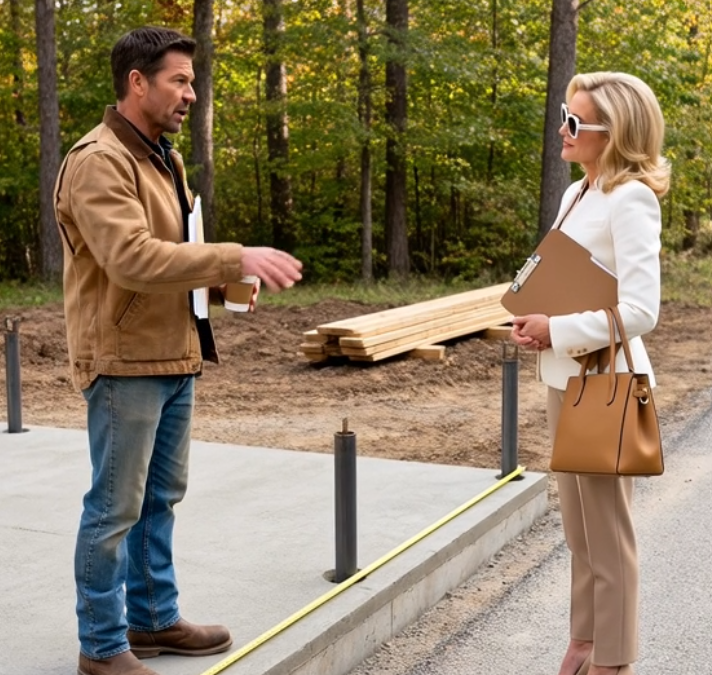
Karen arrived twenty minutes later, stepping out of her BMW like she expected applause. She wore white sunglasses, white pants, and a cream-colored jacket that probably cost more than my tractor.
I explained the issue as politely as I could.
“Your forms are over the property line,” I said. “The foundation is on my land.”
She did not walk over to look.
She did not ask the foreman to stop.
She pulled out her phone, opened one of those cheap parcel map apps, and held it up like she had just produced the Constitution.
“This says the line is here.”
“Those apps can be off by ten or fifteen feet,” I said. “This stake is part of the certified survey.”
Karen glanced at the stake like it was a dead insect.
“That thing looks ancient.”
“It’s set in concrete.”
“Well,” she said, smiling, “concrete cracks.”
I stared at her.
PART3:
She lowered the phone, sighed, and gave me the kind of patient look people give toddlers in grocery stores.
“Listen. I know change can be difficult when someone has lived somewhere a long time. But it’s only six inches. No one cares.”
“I care.”
Her smile sharpened.
“Then you’re choosing to care.”
That was the moment I understood this was not a mistake to her.
It was a calculation.
Karen saw the line. She knew what I was saying. She simply decided my property rights were less important than her construction schedule.
I told her she needed to stop the pour and get a licensed surveyor out immediately.
She laughed.
Not a nervous laugh.
Not a surprised one.
A small, dry, dismissive laugh.
“Absolutely not. We’ve already delayed framing twice. My contractor charges for schedule changes.”
“That isn’t my problem.”
“It will be if you keep harassing my crew.”
“Karen, they are building on my land.”
She pushed her sunglasses onto her head.
“Relax. If something is technically off, we’ll deal with it later.”
Technically.
That word told me everything.
She was not saying I was wrong.
She was saying being right would not matter if she moved fast enough.
So I took out my phone and photographed the forms, the stake, the string line, the rebar, the crew, and Karen standing beside it all with her arms crossed.
Then I said, “I’m giving you notice right now. Do not pour anything else over my line.”
Karen smiled again.
“Noted.”
Then she turned to the foreman.
“Keep going.”
The mixer started turning.
That sound changed the whole morning.
Wet concrete slid down the chute and into the forms while I stood on my side of the line, watching a woman gamble her house on my willingness to give up six inches.
The foreman would not look at me.
The young worker in the hard hat stared at his boots.
Karen got back into her BMW and sat there with the air conditioner running.
That was fine.
I had learned something from my father.
You do not always need to stop a wrong thing the second it happens.
Sometimes you let the wrong thing become visible enough that nobody can deny it later.
I went home, put my coffee in the sink, and called a surveyor.
His name was Marcus Bell.
He was seventy-one years old, semi-retired, and had surveyed half the county before GPS made younger men think a screen could replace judgment. He had known my father. That did not hurt.
When I explained what happened, he got quiet.
“Did they pour?”
“They’re pouring now.”
“You told them not to?”
“Yes.”
“You documented it?”
“Yes.”
“Good.”
“When can you come?”
“Tomorrow morning.”
“Tomorrow?”
“You said Karen Mitchell?”
“Yes.”
“I’ve heard enough to know tomorrow is not soon enough, but it’s what I have.”
He showed up at 6:30 the next morning with a tripod, a vest, two assistants, and the expression of a man who disliked avoidable nonsense before breakfast.
Karen’s crew was already on site.
So was Karen.
She watched Marcus set up near the iron stake.
“Can I help you?” she called.
Marcus did not look up.
“No.”
“I own that parcel.”
“You own the parcel east of this line.”
“My contractor already verified setbacks.”
“Then this should be relaxing for you.”
I almost smiled.
Karen did not.
Marcus found the old iron marker, checked it against the plat, located the rear reference pin, shot the line, measured again, and then did what serious men do when a situation turns stupid.
He measured a third time.
Finally, he stood beside me and said, “You were right.”
“How much?”
“Six point four inches at the south corner. Five point eight at the north. The footing bell extends farther underground.”
“How far?”
“Looks like fourteen inches at the widest point.”
I looked toward Karen’s foundation.
Above ground, it was six inches.
Underground, it was worse.
Marcus drove survey flags along the line and placed bright orange stakes exactly where the boundary ran.
Karen marched over.
“What are those?”
“Boundary markers,” Marcus said.
“They’re in my construction area.”
“They’re on his property line.”
She laughed once.
“This is ridiculous.”
Marcus looked at her.
“Ma’am, the concrete is on Mr. Mercer’s land.”
“My site plan was approved.”
“Then the site plan was wrong, the layout was wrong, or somebody ignored the layout.”
Karen’s face tightened.
“Do you know how much this project costs?”
Marcus removed his glasses.
“I know how much six inches costs when the wrong person thinks it doesn’t matter.”
I paid Marcus before he left.
Then I called my attorney.
Her name was Evelyn Price.
She was small, precise, and had once made a developer cry during mediation without raising her voice. She handled land disputes, title issues, easements, and all the other ways people discover that dirt can be more complicated than marriage.
I sent her the photos, the old survey, Marcus’s preliminary measurements, and a written timeline.
She called me back in twelve minutes.
“Did they pour after you objected?”
“Yes.”
“Can you prove that?”
“Yes.”
“Did she acknowledge the issue?”
“She said if something was technically off, we’d deal with it later.”
Evelyn exhaled.
“That sentence is going to age badly for her.”
“What do we do?”
“First, we send a cease-and-desist and notice of encroachment. Second, we notify the county building office that a permitted structure appears to be located across a surveyed property boundary. Third, we record a notice against your property file and send notice to her lender if we can identify it.”
“Her lender?”
“If she has construction financing, they care very much whether the collateral sits partly on someone else’s land.”
For the first time that morning, I felt something colder than anger.
A structure was one thing.
The money behind it was another.
“Will that stop her?”
“It should.”
“And if it doesn’t?”
Evelyn paused.
“Then she becomes the kind of person judges remember.”
By Friday, Karen had received the letter.
I know because she drove to my house and parked halfway in my driveway like the road belonged to her too.
I stayed on the porch.
She got out wearing a coral blouse, wide-leg pants, and rage dressed as composure.
“You contacted my lender?”
“I contacted my attorney.”
“You had no right.”
“You built on my land.”
“It is six inches.”
“Six point four above ground. Fourteen underground.”
Her eyes flashed.
“You are trying to sabotage my home.”
“No, Karen. You built your home partly on my property after I told you not to.”
“This is harassment.”
“It’s a boundary.”
“You people always do this.”
That phrase landed wrong.
“You people?”
She waved a hand toward my house, my barn, my gravel drive, the field beyond it.
“People who can’t stand improvement. People who think the whole world has to stay small because they’re small.”
I looked at her for a long moment.
“Karen, I don’t care how big your house is. I care where it sits.”
She stepped closer.
“You’re going to look very foolish when this is resolved.”
“Maybe.”
“I can buy six inches from you.”
“It’s not for sale.”
“Everyone says that until the offer is large enough.”
“That may be true where you come from.”
She smiled.
“You have no idea where I come from.”
“No,” I said. “But I’m learning where you stop.”
The smile vanished.
She left.
That same afternoon, the county building inspector posted a stop-work notice.
Not on the whole project.
Just on the foundation section near my line.
But that was enough.
Framing could not proceed on schedule.
The contractor, Bell Ridge Custom Homes, was not happy.
Karen was less happy.
Two days later, orange survey flags disappeared from the boundary.
I expected that.
I had already installed a trail camera in the pine tree facing the line.
The camera caught Karen’s husband Bruce removing the flags at 7:12 on Sunday morning. He wore running shorts, a gray sweatshirt, and the exhausted look of a man who knew he was doing something stupid but lacked the energy to refuse.
I sent the footage to Evelyn.
She filed for a temporary injunction on Monday.
Karen’s attorney responded on Tuesday.
His name was Nolan Pierce, and his letter used the phrase de minimis encroachment four times in three pages.
De minimis.
Too minor to matter.
That was their strategy.
Make six inches sound too small for a court’s attention.
Make me look petty.
Make Karen look practical.
But Evelyn had already thought three moves ahead.
At the injunction hearing, she did not lead with emotion.
She led with numbers.
The house was projected at 6,800 square feet.
Estimated completed value: $3.4 million.
Construction loan: $2.1 million.
Foundation already poured.
Framing scheduled.
Encroachment confirmed by licensed surveyor.
Owner warned before completion of pour.
Work continued after objection.
Footing extended underground farther than visible foundation.
Title cloud created by recorded encroachment notice.
Potential setback violation.
Potential loan covenant issue.
Then she held up a photograph of Karen watching the pour after I had objected.
“This is not an innocent mistake,” Evelyn said. “This is a decision.”
Judge Harold Vance leaned back.
He was a gray-haired man with a farmer’s tan and reading glasses he wore low on his nose.
He looked at Karen’s attorney.
“Mr. Pierce, was your client notified before the concrete was poured?”
Nolan stood.
“There is disagreement about the nature of that conversation.”
Judge Vance looked at me.
Then at Karen.
Then at the photograph.
“Was she present?”
Nolan hesitated.
“She was on site.”
“Did Mr. Mercer object?”
“He expressed concern.”
“And after he expressed concern, did the pour continue?”
Nolan glanced at Karen.
“Yes, Your Honor, but—”
The judge raised one hand.
That was all.
Nolan sat.
The temporary injunction was granted.
No further construction within twenty feet of the disputed boundary.
No removal of survey markers.
No grading, drainage work, foundation extension, framing, or utility installation in the affected area.
The judge also ordered an independent survey.
Karen left the courthouse without looking at me.
Bruce looked at me once.
Not angry.
Not quite apologetic.
More like a man watching a bridge collapse after ignoring every sign that said weight limit.
The independent survey came back ten days later.
Worse than mine.
Six inches at the foundation wall.
Fourteen inches in the footing.
Eighteen inches of disturbed soil.
A drainage trench planned along my side of the line.
One corner of the future wraparound porch would have crossed three feet into my land if built according to Karen’s submitted landscaping plan.
Three feet.
The six inches were only where she started.
Evelyn read the report and said, “She wasn’t stealing a strip. She was staging an expansion.”
“What does that mean?”
“It means her plans treated your land as a buffer zone. Foundation first. Drainage next. Landscaping after that. Then, five years from now, she argues everything has always been where it is.”
Manufacturing reality.
One inch at a time.
After the independent survey, the case changed.
Karen’s lender froze the next construction draw.
The title company refused to insure the property without resolution.
The county extended the stop-work order.
The contractor filed a delay claim.
Subcontractors started sending invoices.
Materials sat on site under tarps.
Rain came through the open framing area and soaked lumber already delivered for the second floor.
Karen’s modern rural luxury began to look like a half-built hotel abandoned after a financial crime.
That was when she tried kindness.
She sent Bruce.
He arrived at my porch one evening holding his baseball cap in both hands.
I had seen him around but never spoken to him alone. He was thinner than I remembered, with tired eyes and a wedding ring that looked too tight.
“Daniel,” he said. “Do you have a minute?”
I nodded.
He stood at the bottom of the steps.
“I’m not here to argue.”
“That makes one Mitchell.”
He looked down.
“Fair.”
For a few seconds, neither of us spoke.
Then he said, “She told me you were making it up.”
“The survey?”
“The line. The whole thing. She said your father moved the marker years ago.”
“My father set that marker in concrete before Karen knew Pine Hollow existed.”
“I know that now.”
He rubbed both hands over his face.
“I saw the independent survey.”
“Then you know what needs to happen.”
He nodded slowly.
“Remove the encroachment.”
“Yes.”
“That means cutting into the foundation.”
“Yes.”
“That may compromise the whole east wall.”
“That sounds like something your engineer should have considered before you poured over my line.”
Bruce flinched.
He deserved some of the blame.
But not the full weight of her arrogance.
“My name is on the loan,” he said quietly.
“I figured.”
“If this doesn’t resolve, we lose everything.”
I said nothing.
That was the thing about consequences.
They often arrived attached to innocent people.
Or people who were not innocent exactly, but weaker than the person driving the disaster.
Bruce looked toward the trees.
“She told me you’d take a check.”
“She was wrong.”
“What if it’s a large one?”
“How large?”
He swallowed.
“One hundred thousand.”
“For six inches?”
“For peace.”
I leaned against the porch post.
“Bruce, let me ask you something. If I take that money, what does Karen learn?”
He looked at me.
“That she can buy her way out.”
“No. That she can build first and negotiate later.”
He closed his eyes.
When he opened them, he looked older.
“She’s not going to agree to demolish anything.”
“Then a judge will explain it to her.”
He nodded once, like he had expected the answer.
“I’m sorry,” he said.
“I believe you.”
“I wish that helped.”
“So do I.”
After he left, I almost felt bad.
Almost.
Then I looked at the photo of Karen standing beside the pour, telling them to keep going.
Pity did not move the property line.
Mediation came next.
It lasted two hours.
Karen arrived with Nolan Pierce, Bruce, a financial consultant, and a woman from the lender who looked like she had not slept well since my notice hit her inbox.
I came with Evelyn and Marcus Bell.
The mediator was a retired judge named Leland Cross.
He opened with the usual speech about compromise, cost, uncertainty, neighborly resolution, and the benefit of avoiding trial.
Karen nodded solemnly through all of it, as if she had not created the emergency being discussed.
Then she made her offer.
Two hundred thousand dollars for a permanent easement covering the encroachment, drainage, landscaping buffer, and future maintenance access.
Evelyn looked at the document.
Then looked at me.
Then slid it back across the table.
“No.”
Karen’s composure cracked.
“You haven’t even considered it.”
“I have,” I said.
“You’re being irrational.”
“No. I’m being clear.”
Nolan jumped in.
“Mr. Mercer, courts regularly balance equities in minor encroachment matters.”
Evelyn smiled slightly.
“Courts also dislike willful encroachment after notice.”
Nolan’s jaw tightened.
Karen leaned forward.
“You’re going to destroy a multimillion-dollar project over six inches of dirt?”
“No,” I said. “You risked a multimillion-dollar project over six inches of dirt.”
That sentence ended the joint session.
The mediator separated us.
For the next hour, he walked back and forth between rooms with offers.
Three hundred thousand.
Five hundred.
Seven hundred fifty.
Each offer included an easement.
Each one required me to accept her house staying where it was.
Each one turned my boundary into her mistake’s solution.
I said no.
Finally, Judge Cross sat across from me and folded his hands.
“Mr. Mercer, may I speak frankly?”
“Please.”
“You are being offered a significant sum.”
“I know.”
“More than that strip of land is worth on paper.”
“I know.”
“If this goes to trial, there is risk.”
“I know.”
He studied me.
“Then why no?”
I looked through the conference room window at the parking lot, where Karen’s BMW sat beside Bruce’s pickup.
“Because it isn’t a strip of land anymore,” I said. “It’s the rule she thinks does not apply to her.”
The mediator was quiet for a moment.
Then he nodded once.
“I’ll convey that.”
The mediation failed.
Trial was set for March.
By then, Karen’s project had become a local legend.
The half-built mansion on Cedar Ridge sat exposed through winter rains. The contractor had wrapped sections in plastic. The lender had stopped advancing funds. Mechanics’ liens piled up. Karen’s Instagram went silent, then private. Bruce moved into a rental in town “temporarily,” though everyone understood what that meant.
Then came the email.
Not to me.
To the contractor.
But the contractor’s attorney produced it during discovery.
It was sent the morning of the pour, fifteen minutes after I first objected.
From Karen Mitchell to Bell Ridge Custom Homes.
Subject: Line issue
Daniel is being dramatic about old boundary marker. Do not stop pour. If we pause now, he’ll use it to hold up the whole build. Get the foundation finished today and I’ll deal with him later.
There it was.
In writing.
Get the foundation finished today.
I’ll deal with him later.
When Evelyn read it, she went very still.
Then she said, “That may be the most expensive email she has ever sent.”
The trial lasted three days.
Karen’s side tried everything.
They argued the encroachment was minimal.
They argued removal would be economically wasteful.
They argued I had suffered no practical loss.
They argued money damages were enough.
They argued the court should grant an equitable easement because the harm to Karen outweighed the harm to me.
Then Evelyn stood and built the case brick by brick.
My father’s deed.
The original survey.
The iron stake.
My yearly boundary notes.
Photographs of the forms.
My warning before the pour.
Marcus Bell’s survey.
The independent survey.
The stop-work order.
The removed flags.
The planned drainage and landscaping extending farther onto my land.
Karen’s email.
That email did what no speech could have done.
It stripped away every word she had tried to hide behind.
Mistake.
Technicality.
De minimis.
Misunderstanding.
Neighbor dispute.
The email said the truth plainly.
She knew I objected.
She knew stopping would give me leverage.
So she poured first.
Karen testified on the second day.
She wore a navy dress, simple jewelry, and an expression designed to suggest wounded reasonableness.
Her attorney guided her gently.
She said she relied on professionals.
She said she believed the site plan was accurate.
She said she never intended to take anything from me.
She said she was shocked by how aggressive I became.
Then Evelyn crossed her.
“Mrs. Mitchell, when Mr. Mercer told you the forms were over the line, did you stop construction?”
“No.”
“Did you ask your contractor to verify before pouring?”
“My contractor had already—”
“Did you ask him to verify after Mr. Mercer objected?”
Karen hesitated.
“No.”
“Did you call a licensed surveyor?”
“No.”
“Did you review the certified survey before telling the crew to continue?”
“I reviewed mapping information.”
“An app on your phone?”
“It is a commonly used parcel reference.”
“Is it a certified survey?”
“No.”
“Is it accurate enough to pour a multimillion-dollar foundation?”
Nolan objected.
The judge overruled.
Karen’s mouth tightened.
“It was for reference.”
Evelyn picked up the email.
“You wrote, ‘Do not stop pour,’ correct?”
Karen looked at the paper.
“Yes.”
“You wrote, ‘If we pause now, he’ll use it to hold up the whole build,’ correct?”
“Yes.”
“You wrote, ‘Get the foundation finished today and I’ll deal with him later,’ correct?”
Karen’s face flushed.
“Yes.”
“What did you mean by deal with him later?”
“I meant resolve the issue.”
“After the concrete was already poured.”
“Yes.”
“Because you believed pouring first would strengthen your position.”
“No.”
“No?”
“I believed he was wrong.”
“Then why worry he would hold up the build?”
Karen said nothing.
Evelyn waited.
Judges notice silence.
So do juries, though this was a bench trial.
Finally, Karen said, “I was under pressure.”
Evelyn nodded.
“That I believe.”
The courtroom stayed silent.
On the third day, Judge Vance issued his ruling.
Not immediately.
He took a recess.
Came back with notes.
Karen sat perfectly straight.
Bruce sat two rows behind her, staring at the floor.
I sat beside Evelyn, hands folded, feeling strangely calm.
Judge Vance began by stating the obvious.
The encroachment existed.
It was confirmed by two surveys.
It affected both above-ground and below-ground structural elements.
My title was valid.
Karen had no easement, no deeded right, no agreement, no license, no boundary adjustment, and no permission.
Then he turned to the question that mattered.
Remedy.
Karen wanted an easement.
She wanted to pay.
She wanted the court to make me accept money so her house could stay exactly where she had forced it.
Judge Vance did not give her that.
He said, “Equity does not reward a party who proceeds with construction after actual notice of a boundary dispute and then asks the court to protect the cost of that decision.”
Karen’s face went white.
The judge continued.
“Mrs. Mitchell made a calculated choice to proceed first and resolve later. That choice transferred risk onto herself, not onto Mr. Mercer.”
He ordered removal of all encroaching foundation, footing, drainage, and structural elements from my property.
He ordered restoration of the disturbed soil.
He ordered Karen to pay my attorney fees, survey costs, expert fees, and damages.
He denied her request for an easement.
Then came the part that turned six inches into millions.
The removal order triggered her construction loan default.
The lender called the note.
The contractor’s liens accelerated.
Her unfinished structure could not receive a certificate of occupancy.
The engineer concluded that removing the encroaching foundation section would require partial demolition of the east wall, redesign of the load path, repouring footings, reframing two levels, and replacing custom glass already ordered for that side of the house.
Estimated correction cost: $1.18 million.
Loan penalties, contractor claims, lien settlements, legal fees, redesign fees, weather damage, and carrying costs pushed the total beyond $2.7 million before anyone counted the drop in property value.
Karen tried to appeal.
She lost.
She tried to sell the unfinished house.
No buyer wanted a mansion under court order with liens attached and a neighbor who had already proven he read documents.
Eventually, the lender took control through foreclosure.
The structure was partially dismantled.
The encroaching foundation was cut out under court supervision.
I stood there the day the saws arrived.
Not because I enjoyed it.
Because I wanted to see the line cleared.
A concrete saw does not sound dramatic. It screams. High, harsh, mechanical. Water sprayed over the blade. Dust ran in gray streams. Workers marked the cut with chalk.
Six inches.
Six inches that had become the most expensive strip of land in Pine Hollow.
Karen was not there.
Bruce was.
He stood near the driveway with his hands in his jacket pockets, watching men undo what pride had built.
After an hour, he walked over to me.
“Daniel.”
“Bruce.”
He looked at the cut line.
“I should have stopped her.”
I said nothing.
He nodded like I had answered.
“She always thought rules were for people who didn’t know how to win.”
“That gets expensive.”
He laughed once.
No humor in it.
“We’re getting divorced.”
“I’m sorry.”
“I’m not sure I am.”
He looked at the foundation.
“She said you ruined us.”
“No,” I said. “She built over the line.”
Bruce stared at the chalk mark.
“Yeah.”
Then he left.
The county restored the property record after the encroachment was removed. Evelyn filed satisfaction notices. My title cleared. My survey line remained exactly where it had always been.
The iron stake never moved.
That part mattered to me.
Karen moved away before summer.
Not quietly.
People like Karen rarely do anything quietly.
She blamed corrupt local politics.
She blamed outdated rural attitudes.
She blamed jealous neighbors.
She blamed incompetent contractors.
She blamed her attorney.
She blamed Bruce.
She blamed me most of all.
What she never blamed was the one thing responsible.
Her own decision.
The funny thing about property lines is that they do not care how important you feel.
They do not care what your house costs.
They do not care how many followers watched your drone footage.
They do not care whether your sunglasses are designer or whether your contractor charges delay fees.
They do not care if six inches seems small to you.
A line is not measured by how much you want past it.
It is measured by where it is.
That fall, I walked the east boundary like I did every year.
The cedar post.
The creek bend.
The mossy stone.
The iron stake.
The soil near it had been repaired. Grass was coming back. If you did not know where to look, you might never guess that a multimillion-dollar house had once tried to cross that spot and failed.
I knelt beside the marker and brushed away leaves.
My father had been dead seven years by then, but I heard his voice as clearly as if he were standing behind me.
It means you stand on what’s yours.
And you don’t take what belongs to someone else.
For a while, I stayed there.
Not angry.
Not triumphant.
Just steady.
Karen had been right about one thing.
Six inches was not much land.
Not enough for a garden.
Not enough for a driveway.
Not enough to change the shape of a map.
But it was enough to reveal everything.
It revealed what Karen thought she could take.
It revealed what she thought I would tolerate.
It revealed which professionals would look away, which ones would tell the truth, and which documents mattered when confidence finally met paper.
Most of all, it revealed a lesson my father had tried to teach me before I was old enough to understand it.
Small boundaries are still boundaries.
And when someone tells you no one cares, what they usually mean is they are hoping you do not.
I cared.
That was why Karen Mitchell’s house did not stand where she wanted it.
That was why six inches of concrete cost her millions.
And that was why, every April, I still walk the line.








