HOA Karen Built a $300,000 Resort Pool 22 Feet Onto My Ranch—So I Built Something Perfectly Legal Five Feet From Her Diving Board.
PART2:
By the time Pamela Whitfield decided my land would be useful for her HOA resort pool, the Shelton family had been on those acres for more than sixty years.
I ran about sixty head of Angus.
Not a giant commercial operation.
Enough to keep me busy.
Enough to pay bills.
Enough that I knew individual cattle by behavior even when I pretended I did not.
I also ran a small composting operation.
Cattle manure.
Plant waste from two local nurseries.
Old hay.
Turned properly.
Managed properly.
Sold back to landscapers and a market garden.
Nothing glamorous.
Everything legal.
Then there was Lily.
My daughter.
Fourteen.
She was eleven when her mother died.
Carol fought ovarian cancer for fourteen months.
Hospitals change time.
Days become test results.
Weeks become treatment cycles.
PART3:
You start remembering life by numbers you never wanted to know.
White blood cell counts.
Scan dates.
Infusion schedules.
Insurance authorizations.
The day Carol died, Lily sat in a hospital waiting room with a book open in her lap.
She never turned a page.
Three years later, she still sometimes slept with a light on.
She fed cattle with me on weekends.
Never complained about mud.
Never complained about the cold.
Never complained about the smell.
She had Carol’s patience.
And, occasionally, Carol’s ability to look at somebody in a way that told them they had miscalculated without saying a word.
The ranch was the one thing that remained steady after Carol died.
Same fence lines.
Same eastern ridge.
Same cedar breaks.
Same access road my grandfather used.
Same winter wind.
Same summer heat.
Then Creekstone Estates went up along our eastern boundary.
Developer was Craig Whitfield.
Pamela’s husband.
Craig bought one hundred ten acres of old wheat ground that had belonged to the Grimes family.
Within a few years, dirt roads became cul-de-sacs.
Utilities.
Streetlights.
Stone entry monuments.
Three hundred forty homes.
Prices high enough to make me wonder whether houses now came with oil wells underneath them.
Some of those backyards stopped forty feet from my pasture.
You could hear my cattle from the subdivision on still mornings.
You could smell them sometimes too.
That is what happens when people build homes beside a ranch.
At first, most residents understood.
Some even liked it.
Parents brought kids to the fence.
Children pointed at calves.
Occasionally someone asked whether I sold beef.
Normal neighbor stuff.
Then Pamela became HOA president.
Technically, she became president before the first residents even moved in.
By the time our conflict became serious, she had run Creekstone Estates for seven years.
Long enough that people had stopped distinguishing between what Pamela wanted and what the governing documents actually said.
Pamela liked control.
I do not mean she screamed at everybody.
She didn’t.
She was more effective than that.
Early fifties.
Blonde.
Immaculate.
The kind of person who could make a threat sound like a scheduling update.
She used phrases like:
“community expectation,”
“future compatibility,”
“shared aesthetic,”
and
“property-value protection.”
Those phrases sound impressive because they rarely contain verbs you can arrest.
Our first disagreement was my north fence.
She sent a letter telling me the wire was “visually inconsistent with Creekstone’s western architectural transition area.”
I called.
“My ranch isn’t in Creekstone.”
“I know.”
“Then why are you sending me HOA letters?”
“Because your eastern frontage affects community appearance.”
“My cows affect community appearance.”
“Yes.”
“They’re staying.”
She laughed.
“You’re funny.”
“No. I’m Garrett.”
Silence.
Then:
“We are asking for cooperation.”
“No.”
That became our pattern.
Fence.
Hay bales.
A rusted stock trailer.
My barn roof.
She did not fine me because even Pamela understood eventually that an HOA cannot meaningfully fine a nonmember property owner just because his land is visible.
Instead, she complained to county.
County inspected.
No violation.
She complained to environmental health about manure.
Inspected.
No violation.
She complained about drainage.
County engineer visited after a storm.
No violation.
Then she started talking about “buffer solutions.”
At first, I thought she meant trees.
I would have considered trees.
Then Craig came by.
Not Pamela.
He drove a white F-250 nicer than any truck that had ever actually needed to cross a pasture.
He stopped at the ranch house.
“Garrett.”
“Craig.”
“We need to talk.”
“About?”
“Community expansion.”
I already disliked those words.
He had a rolled site plan.
We stood at my kitchen table.
Lily did homework at the far end.
Craig unrolled.
Creekstone Phase Four.
A larger clubhouse.
Fitness pavilion.
Pickleball courts.
A resort pool.
Not neighborhood pool.
Resort pool.
Free-form shape.
Zero-entry side.
Diving section.
Cabana.
Outdoor kitchen.
Tiki bar.
Landscaping.
He pointed.
“This gives us a stronger western amenity anchor.”
I pointed too.
“You crossed the boundary.”
“No.”
“Yes.”
“The old fence line isn’t the legal line.”
I looked at him.
“What legal line?”
“Updated development survey.”
“Updated by who?”
“Our engineering consultant.”
I pulled the county GIS map from my laptop.
Parcel line.
Right where I thought.
Craig shook his head.
“GIS isn’t survey.”
That was true.
I hated when people I disagreed with were correct.
He continued.
“The Grimes tract had a historic boundary discrepancy. The new survey resolves it farther west.”
“How far?”
“Twenty to twenty-five feet in areas.”
“Onto my land.”
“No. Onto what has always been Grimes land under the controlling calls.”
“Show me.”
He handed survey.
I am not a surveyor.
But I know enough to notice when something depends on a monument nobody in my family has ever seen.
Their line originated from a supposed iron pipe near a creek crossing.
Our older deeds referenced a limestone corner and a cedar post that no longer existed.
Competing calls.
Possible ambiguity.
Not something to solve over coffee.
“I’m getting my own survey.”
Craig smiled.
“Of course.”
Then:
“We’d still like to purchase a narrow strip regardless.”
There it was.
“Why buy it if it’s yours?”
His smile stopped.
“For certainty.”
“How much?”
“Eighty thousand.”
“For what width?”
“Roughly thirty feet along seven hundred feet.”
“No.”
“You didn’t think.”
“I did.”
“Garrett.”
“No.”
He rolled map.
“Pamela said you’d be difficult.”
“Pamela thinks grass needs permission.”
Lily coughed to hide a laugh.
Craig left.
I hired Reed Hollis.
Licensed Texas surveyor.
Sixty-two.
Sun-damaged neck.
Truck full of equipment.
He had done ranch boundary work for years.
He walked the line.
Pulled deeds.
Compared plats.
Located surviving monuments.
Spent two full days near creek.
Then three more in records.
When he returned, he laid his drawing across hood of my truck.
“Your grandfather’s deed is right.”
“Good.”
“Their survey isn’t crazy.”
“Less good.”
“They relied on a later subdivision reference that propagated a bad tie from the Grimes tract.”
“In English.”
“Someone forty years ago measured from the wrong point, and the error got copied.”
“How much?”
He traced.
“At future pool area, their planned improvements cross your line about twenty-two feet.”
I stared.
“Existing improvements?”
“Not yet.”
This was before construction.
Important.
“So we tell them.”
“Yes.”
Reed stamped survey.
I sent certified copy to Craig.
Also to Creekstone HOA because Pamela had already been involved.
Their development attorney replied.
Not admitting.
Not denying.
They requested joint survey review.
Fine.
Reed met their surveyor.
Two professionals.
No shouting.
They agreed the discrepancy needed formal resolution before construction.
Then nothing happened for two months.
I assumed project paused.
That was my mistake.
Construction fencing went up inside Creekstone.
I could see excavators.
Concrete trucks.
But from the ranch side, heavy landscaping screening hid details.
I was busy with calving.
One cow had twins.
Another rejected calf.
Pump failed.
Then Lily’s school had a three-day livestock program she insisted I attend because apparently I was qualified to explain why cows chew twice.
Life moved.
When I finally rode the east fence on an ATV, I stopped so abruptly Lily nearly hit me with hers.
Beyond the fence:
Concrete.
A lot of it.
Pool shell.
Decking.
Cabana posts.
And the edge of the diving area looked wrong.
Too close.
I called Reed.
He came next morning.
Measured.
His face hardened.
“Twenty-two feet.”
“They built it.”
“Part of it.”
“On mine.”
“Yes.”
“How much?”
He pointed.
A section of pool deck.
Diving board footing.
Landscaping wall.
Part of drainage system.
A corner of cabana overhang? The structure itself maybe just within line. Let’s keep pool and board.
The actual water basin crossed several feet at its widest.
The deck and diving-board structure extended farther.
I felt something in my chest go cold.
Not because I hated pools.
Because they had been warned.
This wasn’t mistake discovered afterward.
Craig had my stamped survey before excavation.
I called him.
Voicemail.
I emailed.
No response.
Then drove to Creekstone clubhouse.
Construction gate open.
Pamela stood near pool wearing white slacks and hard hat that looked newly purchased.
She was talking to contractor.
I walked over.
“Pamela.”
She turned.
“Garrett.”
“You built on my property.”
She smiled.
“No, we didn’t.”
“Reed surveyed this.”
“Craig says boundary is under review.”
“Then why pour concrete?”
“The project schedule cannot stop because you disagree with a line.”
“It’s not disagreement.”
She motioned toward security guy.
“Garrett, this is an active construction area.”
“I know.”
“You need to leave.”
I pointed toward ground.
“This part is mine.”
Her smile became thin.
“Get away from my pool. You’re trespassing.”
I almost laughed.
Then realized she meant it.
I stood on land my grandfather bought in 1961 while an HOA president told me I was trespassing because she had poured concrete over it.
I said:
“The deck extends twenty-two feet onto the Shelton tract.”
She looked over my shoulder toward cattle.
Then back.
“Honey, your land is cow pies and dead grass.”
I still remember exact phrase.
“Nobody cares about your little fence line.”
Lily had followed at distance.
She heard.
Her face changed.
That bothered me more than insult.
I said:
“You’re going to care.”
Pamela smiled.
“Is that a threat?”
“No.”
I looked down at concrete.
“It’s a survey result.”
Then I left.
Not dramatically.
No bulldozer.
No chains.
No confrontation with workers.
Workers build what plans tell them.
My problem was owner and developer.
I called an attorney.
Her name was Elaine Navarro.
Real-estate litigation.
Austin.
Recommended by Reed.
Elaine listened.
Asked for deed.
Survey.
Craig’s earlier survey.
Certified-mail receipts proving they received mine before construction.
Emails.
Photos.
Then she said:
“Do not touch the pool.”
“I wasn’t planning.”
“Do not block their workers.”
“Okay.”
“Do not move fence into concrete.”
“I know.”
“Do not turn cattle loose into resort.”
I looked at Lily.
She was smiling.
“I hadn’t thought of that.”
“Now forget.”
Good lawyer.
Elaine sent cease-and-desist and notice of encroachment.
Requested construction stop within disputed strip.
They refused.
Creekstone’s attorney argued competing surveys and good-faith reliance.
Elaine filed suit.
Trespass.
Declaratory judgment.
Boundary determination.
Injunction.
Potential removal or compensation depending court.
I expected Pamela to back down.
Instead, she opened pool.
They finished just before Memorial Day.
Huge event.
Balloons.
DJ.
Food trucks.
Creekstone newsletter called it:
THE OASIS AT CREEKSTONE
Lily saw online.
“That’s Grandpa’s dirt.”
“Partly.”
“They put a name on it.”
“People name everything.”
“Can we name our side?”
“What?”
She thought.
“Cow Pie Heights.”
I laughed harder than I had in months.
That same week, Pamela sent letter from HOA counsel demanding I cease “harassing pool users by photographing property boundary.”
I had photographed the survey stakes from my side.
Elaine responded.
Short:
Mr. Shelton will continue documenting his property.
Then Pamela complained about smell.
Not new smell.
Cattle.
Wind shifted east one evening.
She emailed county environmental services saying our manure management was “incompatible with newly established recreational amenity.”
Newly established.
On disputed land.
County inspector came.
His name was Jared Pool.
Yes, Pool.
Life has humor.
He had inspected my compost site twice before.
“Garrett.”
“Jared.”
“Complaint.”
“Pool?”
He sighed.
“Don’t.”
We walked.
Existing compost operation sat northwest, farther from Creekstone.
Proper drainage berm.
Runoff control.
Compost turned on schedule.
He checked.
“Everything looks okay.”
“Can I relocate part?”
He looked.
“Why?”
I smiled.
He immediately became suspicious.
“Garrett.”
“I need a nearer manure handling area for east pasture.”
That was true.
Partly.
My cattle rotated through east field in summer.
We hauled manure and spoiled hay from feeding area all the way northwest.
I had considered a closer pad before.
Never worth effort.
Now effort suddenly interested me.
“Where?”
I showed him.
A flat piece of my land near boundary.
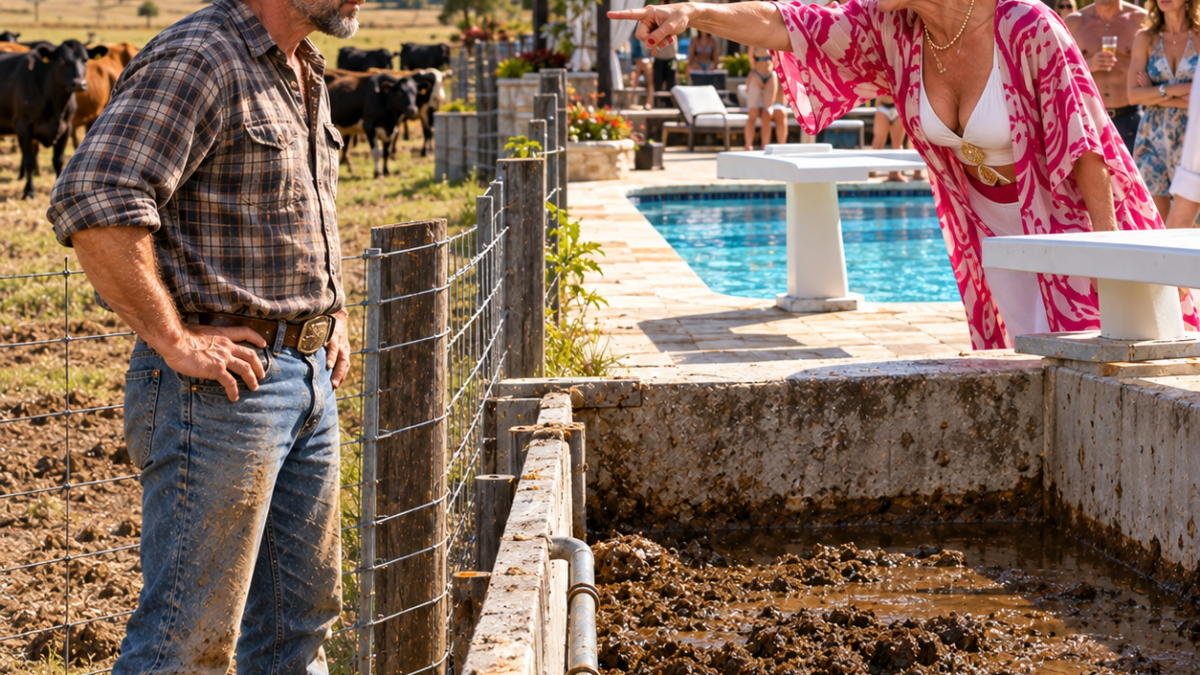
Five feet west of the edge of their diving-board structure.
Not five feet from legal property line.
Five feet from the diving board because their board itself projected into my parcel.
Jared stared.
“No.”
“Why?”
“Because I know your face.”
“What regulation?”
He rubbed his forehead.
We reviewed.
An open manure lagoon would require setbacks and design standards I could not meet there.
I was not trying to create pollution.
So no lagoon.
No liquid waste pit.
But a covered, bermed agricultural manure staging and composting pad for my own cattle operation could be placed there if designed correctly, maintained, and outside drainage easements.
Setbacks from occupied structures, wells, waterways, and property line applied depending use.
Because the area was my agricultural land and the HOA’s pool was the encroaching use, the geometry was unusual.
Jared said:
“You need engineer.”
“I know one.”
“You need stormwater plan.”
“Fine.”
“You need concrete or compacted base depending volume.”
“Fine.”
“And if I think you’re doing this only to create nuisance—”
“What?”
He stopped.
Law is messy.
Agricultural operations can have protections, but intentional nuisance/spite can still create claims.
Elaine told me same.
“Do this only if it serves legitimate ranch purpose.”
“It does.”
“Can you prove?”
“Yes.”
“Would you build it if no pool?”
I thought.
“Eventually maybe.”
“That’s not great answer.”
So we made it real.
I adjusted cattle rotation.
Moved temporary feeder closer east pasture.
Documented hauling efficiency.
Hired an agricultural engineer.
Designed a small roofed manure-transfer and composting bay.
Contained runoff.
No open pit.
No leaking waste.
No dead animals.
No dumping.
Legal.
Functional.
Smelly.
Very.
Lily called it manure pit anyway.
Everyone did.
The title stuck.
Construction started while the lawsuit was pending.
Pamela lost her mind.
She arrived at my gate.
“Stop.”
I was setting forms.
“Morning.”
“You cannot put that there.”
“Why?”
“It creates a health hazard.”
“County approved.”
“It is five feet from our diving board.”
“Your diving board is on my property.”
Her jaw tightened.
“You are doing this maliciously.”
“I’m building ranch infrastructure on ranch land.”
“You’ve never had a manure facility there.”
“You’d never had a pool there.”
“That is not comparable.”
“No.”
I looked at cattle.
“One produces something useful.”
Lily nearly fell off ATV laughing.
Pamela pointed at her.
“This is not funny.”
Lily stared with Carol’s look.
“I didn’t say anything.”
Pamela looked back at me.
“Our residents paid assessments for that pool.”
“Then you should have built it on land you owned.”
She stepped closer.
“Craig’s survey establishes the line.”
“No. Your survey makes a claim. Court establishes if we can’t agree.”
“You are harming property values.”
“I’m running cattle.”
“Five feet from recreation.”
“Again—your recreation crossed onto my ranch.”
She raised phone.
“I am documenting this.”
“Good.”
I pointed to my own cameras.
“So am I.”
The manure pad finished in June.
Roof.
Three concrete bays.
One for fresh manure and bedding.
One active compost.
One curing pile.
Drainage directed to vegetated filter strip entirely on my land.
No runoff toward pool.
No flies beyond normal ranch levels because we managed properly.
But smell?
Yes.
Fresh cattle manure smells like cattle manure.
Heat makes it stronger.
South wind carried it directly over diving board.
The first Saturday after we started using pad, I heard complaints from across fence.
Not words.
Just the universal sound of affluent disappointment.
“What is that smell?”
Lily and I were repairing water trough.
She looked up.
“Cow Pie Heights opened.”
“Work.”
We worked.
By afternoon, Creekstone’s pool had maybe half normal crowd.
On Sunday, Pamela emailed cease-and-desist accusing me of “weaponized agricultural nuisance.”
Elaine laughed.
Actually laughed.
Then wrote serious response:
The Shelton ranch predated Creekstone by decades.
Agricultural use was lawful.
Facility properly permitted and operated.
The location served documented ranch logistics.
Any conflict was intensified because Creekstone constructed pool facilities into Shelton property despite prior notice of boundary dispute.
Then Creekstone sued.
Nuisance.
Intentional interference.
Requested emergency injunction to stop manure use.
Now both lawsuits met.
At hearing, Pamela wore navy suit.
Craig looked tired.
I wore clean shirt that Lily chose because she said my usual pearl-snap made me look “too aggressively ranch.”
Judge Elena Morrow.
State district court.
No patience for theatrics.
Creekstone argued smell made pool unusable.
Residents paid for amenity.
Health concerns.
Property value.
Elaine did not deny smell.
Smart.
“Yes, Your Honor. Cattle manure has odor.”
Judge looked at her.
“Thank you for the scientific clarity.”
Elaine continued.
Facility met county requirements.
No runoff.
No contamination.
No unsafe vector conditions.
Longstanding agricultural use.
Most importantly, location was within tract supported by Shelton survey, while Creekstone improvements intruded into that same tract.
Creekstone counsel said boundary unresolved.
Judge asked:
“Did developer receive Shelton survey before pool construction?”
Pause.
“Yes.”
“Did it show this area as Shelton property?”
“Yes.”
“Did developer nevertheless proceed?”
“It relied on its own survey.”
Judge:
“Then both sides assumed litigation risk.”
Exactly.
Judge did not order manure pad removed.
Also did not declare Garrett could intentionally maximize odor.
She ordered continued compliance inspections and prohibited expansion during case.
Fair.
Then boundary trial.
Surveyors testified.
Old deeds.
Monuments.
Historical calls.
Grimes tract error.
County plat references.
It was boring.
Important.
Reed explained how later subdivision survey inherited a mislocated control point.
Creekstone’s surveyor admitted his initial work had relied partly on that record without recovering older monument later located by Reed near creek.
Not fraud.
Survey error.
Once monument verified, he agreed Shelton line was stronger.
That testimony changed case.
Judge ruled boundary substantially as Reed had surveyed.
The pool encroached.
Twenty-two feet at maximum deck extension.
Eight feet of water basin crossed line at one corner.
Diving-board foundation was entirely on Shelton parcel.
Part of landscape retaining wall too.
Creekstone had built on my land.
Then came remedy.
People online always imagine judge says:
“Bulldoze it tomorrow.”
Courts don’t like waste if money can solve fairly.
Options:
Remove encroachment.
Buy strip if I consent.
Easement.
Land exchange.
Damages.
I did not want to sell.
At first.
Elaine asked:
“What do you actually want?”
“My land.”
“All?”
“Yes.”
“Even under pool?”
“Yes.”
“Then removal.”
I pictured jackhammers.
Pool drained.
Concrete broken.
Diving board removed.
Would satisfy something angry.
Then I thought about three hundred forty homeowners.
They had paid assessments.
Most did not know.
Children used pool.
The board and developer had created problem.
Not residents.
Lily said:
“Can they move pool?”
“Part.”
“Would it cost a lot?”
“Yes.”
“Would they make everybody pay?”
“Probably.”
She frowned.
“Pamela should pay.”
“That’s not how companies work.”
“Stupid.”
Often.
Then Elaine discovered developer agreement.
Craig’s company had promised HOA clean title to common amenities and indemnified association for title defects caused by development construction.
That mattered.
If HOA paid damages due encroachment, developer likely responsible.
Insurance too.
Now solution could target responsible party more directly.
I considered selling narrow strip.
Not for revenge price.
Fair value plus damages, legal fees, permanent buffer, and conditions.
Craig offered $90,000.
I laughed.
Then $150,000.
No.
Independent appraisal considered amenity value, not raw ranch acre value.
Strip was critical to $300,000 pool and entire common-area plan.
Negotiation moved.
Then Pamela complicated it.
At HOA meeting she told residents I was “extorting community by placing manure next to children.”
A resident recorded.
She did not mention that their pool sat on my property after developer ignored survey warning.
Video spread.
Some residents came to my ranch gate angry.
I did not let them in.
One shouted:
“You’re poisoning our kids!”
I called sheriff.
No charges.
They left.
Next morning, a woman named Monica Reed—not related to surveyor—came alone.
No shouting.
She stayed outside gate.
“Mr. Shelton?”
“Yes.”
“I live on Blue Heron Circle.”
“Okay.”
“My kids use pool.”
“I figured.”
She held folder.
“I asked HOA for boundary documents.”
“Did they give?”
“Eventually.”
She looked embarrassed.
“They knew before construction?”
“The developer had my survey.”
“Did board?”
“Pamela did. Certified mail.”
Monica stared at ground.
Then:
“She told us you moved property line after pool opened.”
I laughed once.
“Land doesn’t do that often.”
She smiled despite herself.
“Can I ask something?”
“Sure.”
“Is manure thing retaliation?”
Honest question.
I answered honestly.
“Partly.”
She nodded.
I continued before she could leave.
“But it is also legal ranch infrastructure I needed and county approved. I was not going to dump sewage, create runoff, or poison anybody.”
“Still smells.”
“Yes.”
“You picked that spot because pool.”
“Yes.”
There.
Truth.
She looked at me for long time.
“Why admit that?”
“Because pretending otherwise insults both of us.”
“Could court make you move it?”
“Maybe if judge finds nuisance outweighs protected agricultural use or malicious purpose controls. That’s why lawyers exist.”
She smiled faintly.
“My husband’s a lawyer.”
“Sorry.”
She laughed.
Then serious:
“I don’t think most residents know what happened.”
“They should ask.”
“We’re starting to.”
They did.
HOA records requests.
Board emails.
Construction notices.
Certified survey.
Craig’s indemnity.
Residents learned Pamela had received warning two months before concrete.
Minutes showed she told board:
Developer counsel considers Shelton claim without merit. Construction should proceed to avoid schedule impact.
No written counsel opinion attached.
When asked later, Creekstone’s outside lawyer said he had recommended pausing improvements within disputed strip until survey conflict resolved.
Pamela had summarized differently.
Not crime.
Bad governance.
Craig had pressure too.
Pool opening tied to home sales.
Marketing promised amenity by Memorial Day.
Delay cost money.
He rolled dice.
Lost.
HOA meeting became brutal.
Not fists.
Questions.
Monica stood.
“Why did you tell us Garrett moved boundary?”
Pamela:
“I said his survey was newly asserted.”
“That’s not same.”
Another resident:
“Why did construction proceed after notice?”
Pamela:
“Because developer had competing survey.”
“Why not move diving board thirty feet east?”
Silence.
Craig wasn’t there.
Another:
“Why are we suing rancher for smell when our pool is on his ranch?”
That line ended meeting clip online.
Board voted to retain independent counsel.
Pamela opposed.
Lost.
Independent counsel reviewed.
Recommended settlement.
Also recommended Pamela recuse because her husband owned developer.
Conflict obvious.
How had no one addressed before?
Because early HOAs often developer-controlled.
Pamela had transitioned into resident control without clean separation.
She resisted.
Board voted her out as president 4-1.
She remained director pending election.
Then resigned.
Craig’s company took lead.
Settlement took months.
Final terms:
Developer purchased 0.74 acres including encroached strip and buffer.
Price: $620,000.
Not millions.
Still far above ranch-acre value because of improvements, litigation risk, title defect, and project dependence.
Developer paid my legal fees.
Paid survey costs.
Paid for new boundary fence.
Agreed permanent vegetated buffer between ranch operations and pool.
HOA recorded acknowledgement it had no authority over Shelton Ranch.
No nuisance complaints based solely on ordinary lawful agricultural odors or activities existing within protected operation, though actual environmental violations remained enforceable like anywhere.
Important.
I moved manure pad?
Yes.
Eventually.
Not because Pamela won.
Because after settlement, the strip became theirs and facility footprint was adjusted.
The developer paid relocation cost as part settlement.
I rebuilt it sixty-five feet west, still efficient for east pasture, screened by cedar berm.
Smell at pool dropped dramatically.
Lily complained.
“Cow Pie Heights lasted one summer.”
“Successful businesses relocate.”
“To worse location.”
“To our land.”
She thought.
“Fair.”
The pool stayed.
Diving board remained.
Now legally.
That mattered.
I was paid.
They got title.
Residents kept amenity.
Developer bore much of cost.
Nobody jackhammered a functioning pool just for satisfaction.
Some people online hated that ending.
They wanted me to bulldoze tiki bar.
Real life is not revenge fantasy.
Land disputes need ending people can record.
Mine did.
Craig came to ranch after papers signed.
No Pamela.
He stood at gate.
“I owe you apology.”
“You owe me money.”
“Already wired.”
“Then apology optional.”
He smiled tiredly.
“I should’ve stopped construction.”
“Yes.”
“I thought we’d win survey.”
“Okay.”
“I also thought if we poured, you’d settle easier.”
There.
Honest.
“Create facts.”
“Something like.”
“That was stupid.”
“Yes.”
He looked at pasture.
“Your grandfather would’ve sold for $620,000.”
“You never met him.”
“No.”
“He might’ve charged more.”
Craig laughed.
First genuine interaction we’d ever had.
Then:
“Pamela hates you.”
“I’ll survive.”
“She thinks you humiliated her.”
“I built compost.”
“Five feet from diving board.”
“On my land.”
“At the time.”
“Exactly.”
He nodded.
“She shouldn’t have called it dead grass.”
“No.”
He extended hand.
I considered.
Then shook.
Not friendship.
Closure.
Pamela never apologized directly.
Months later, she sent letter through attorney stating she regretted “the escalation and communication failures.”
Not apology.
Fine.
I did not need one.
She moved out of Creekstone two years later.
Craig stayed in development business.
They divorced eventually.
I did not celebrate.
Marriage is complicated enough without neighbors cheering.
Creekstone changed.
New HOA president Monica Reed.
Yes, woman from gate.
Her first letter to me:
Mr. Shelton, the board would like to establish a routine communication process regarding shared boundary issues. This is not a request for access or authority over your ranch.
Best HOA letter ever.
I responded.
We met twice a year.
Drainage.
Fence maintenance.
Prescribed burn notices.
Cattle escape plan.
Normal neighbor matters.
No one sent me aesthetic violations.
Kids still watched calves.
Lily sold lemonade near fence one spring and made forty dollars.
I told her technically unlicensed commerce.
She told me call HOA.
Very funny.
The manure story followed us.
People at feed store asked:
“You really put pile five feet from pool?”
“Facility.”
“Manure pit.”
“Contained composting pad.”
“Manure pit.”
I gave up.
One reporter called.
I declined interview.
Then he published anyway from court records.
Headline:
RANCHER ANSWERS HOA POOL ENCROACHMENT WITH MANURE
Not wrong.
Could’ve been worse.
Internet versions exaggerated.
Some said I filled pool with manure.
No.
Illegal and disgusting.
Some said I redirected cattle waste through fence.
No.
Some claimed pool had to close permanently.
No.
Some said Pamela was arrested.
Absolutely not.
No crime.
She made terrible decisions.
Conflict of interest.
Arrogance.
But not every bad act is criminal.
Some said I won $8 million.
I wish.
Some said court awarded ranch to HOA then reversed.
No.
The truth was enough.
An HOA president and developer proceeded with luxury pool after being warned about boundary.
They lost title dispute.
A rancher lawfully moved manure-management activity nearby during litigation.
The smell became leverage, but the legal victory came from deed, monuments, surveys, certified notice, and patience.
Boring things.
Important things.
Elaine told me after settlement:
“You know what saved you?”
“The manure?”
“No.”
“Reed?”
“Partly.”
“What?”
“You kept records.”
Again.
Paper.
I had kept grandfather’s deed.
Dad’s transfer.
Old surveys.
Tax maps.
Certified mail.
Photographs.
Every letter.
Every complaint.
Carol used to tease me for boxes of records.
After she died, Lily helped organize.
Maybe grief makes some people throw things away.
It made me hold onto everything.
Those files protected the ranch more than any fence.
The manure was memorable.
The documents won.
That distinction matters.
A year after settlement, Lily and I sat on eastern ridge watching sunset.
Creekstone pool lights came on below.
Blue water.
Music faint.
People laughing.
The new cedar buffer had grown enough to hide most deck.
Lily pointed.
“You okay with that?”
“What?”
“Pool.”
“It’s theirs now.”
“You sold Grandpa’s land.”
There it was.
I had wondered when she’d say.
“Less than an acre.”
“You promised Grandpa.”
“He said don’t sell it stupid.”
She looked.
“Was six hundred twenty thousand stupid?”
“No.”
“Then okay.”
I smiled.
She didn’t.
“You miss Mom?”
Question came from nowhere.
“Yes.”
“Would she have sold?”
I laughed.
“Your mother would’ve made Craig cry before signing.”
Lily smiled.
Then quiet.
“I liked manure pit.”
“Of course.”
“It was funny.”
“It smelled.”
“That’s why.”
We sat.
Then she said:
“I think Mom would’ve liked that you didn’t wreck pool.”
I looked.
“Why?”
“She hated when people got punished for somebody else’s mistake.”
Carol did.
She worked elementary school counselor before cancer.
Always said:
“Find the person who made decision. Don’t punish room.”
That influenced settlement more than I admitted.
Residents had not poured pool.
Kids hadn’t changed survey.
Destroying amenity just to hurt Pamela would punish everyone.
Selling strip with developer paying damages was better.
Not as satisfying in a movie.
More just.
Lily was right.
I said:
“Your mom would’ve also hated smell.”
“She married rancher.”
“She complained.”
“You complain.”
“That’s my right.”
We watched lights.
Ranch on one side.
Subdivision on other.
Neither disappearing.
That is development reality.
Texas grows.
Rural land becomes edge land.
People move beside farms.
Conflicts happen.
The answer cannot always be:
Farmers own everything forever.
Nor:
New money redraws old boundaries.
Law exists to keep one side from simply overpowering other.
Deed matters.
Survey matters.
Agricultural use matters.
So do health rules.
Nuisance law.
Setbacks.
Contracts.
Indemnity.
I learned more property law in one year than I wanted.
One concept stuck:
Coming to nuisance does not give rancher unlimited right to be harmful.
Being there first matters, but not absolute.
Likewise, buying a house near agriculture doesn’t grant right to sanitize neighbor’s lawful farm out of existence.
Balance.
Pamela hated balance.
She preferred control.
I preferred no one telling me what to do.
Grandfather’s sentence.
But even he would’ve had rules.
Water.
Roads.
Neighbors.
Property ownership is not sovereignty.
You own land inside system.
Rights and duties.
That is why I did not dig open manure lagoon beside pool.
Could I have made situation worse legally?
Absolutely.
Spite creates bad facts.
Elaine kept me from some.
One night after second complaint, I told her:
“I should put hog pen there.”
“Do you raise hogs?”
“No.”
“Then no.”
“Could.”
“No.”
“Goats?”
“No.”
“Chicken houses?”
“Garrett.”
“What?”
“Courts know when adults act like thirteen-year-olds.”
Lily, overhearing, said:
“I resent comparison.”
Elaine liked her.
Another time I suggested wind chimes.
“Legal.”
“Hundred wind chimes.”
“Garrett.”
Fine.
The legitimate manure pad was enough.
Irony worked because it served ranch.
Not because I manufactured pure nuisance.
People miss that.
If your only purpose is harming neighbor, legal protections get weaker fast.
Intent matters.
Operations matter.
Reasonableness matters.
I had reason.
Pamela gave me motive.
Difference.
Years later, Creekstone held a neighborhood “Ranch Day.”
Monica asked first.
They wanted kids learn about adjacent agricultural land.
I said:
“On your side.”
“Yes.”
“No petting through fence.”
“Yes.”
“No feeding cattle.”
“Yes.”
“No balloons.”
“Why?”
“Cows eat stupid things.”
“No balloons.”
We brought one gentle heifer into portable pen on my side.
Lily, now seventeen, explained cattle feed, compost, water use.
A little boy asked:
“Is this where poop pool was?”
I closed eyes.
Monica laughed so hard she had to walk away.
Lily answered professionally:
“The manure facility was a livestock-waste management area.”
Boy:
“So poop pool.”
“Basically.”
Thanks.
Pamela’s legacy immortal.
But event changed relationship.
Residents saw ranch not as smell behind fence.
Work.
History.
Food.
Water.
Land management.
I saw residents not as Pamela.
Families.
Kids.
Retirees.
People who bought houses.
Normal.
Conflict shrinks when categories become names.
Not always.
But often.
Dad lived long enough to hear about pool dispute beginning.
He was eighty-one then.
In assisted living nearby because Parkinson’s had made ranch unsafe.
I brought survey.
He studied.
“Twenty-two feet?”
“Yes.”
“That’s a lot.”
“Yes.”
“You gonna shoot somebody?”
“No.”
“Good.”
“You disappoint?”
“A little.”
I laughed.
He pointed trembling finger.
“Paper first.”
“Already lawyer.”
“Good.”
Then:
“Don’t sell stupid.”
Same blessing.
He died before settlement.
I took final agreement to grave anyway.
Ridiculous.
I stood there.
“They paid six-twenty.”
Wind.
“They covered legal.”
Nothing.
“And manure pad worked.”
A mockingbird somewhere.
“You would’ve loved that.”
I imagined him saying:
“How much did pad cost?”
Forty-one thousand including engineering and later relocation, mostly developer reimbursed.
Dad would’ve hated.
Then loved reimbursement.
I left.
Grief with fathers different than spouse.
Carol’s death broke daily life.
Dad’s death broke history behind me.
Ranch felt suddenly mine in a way I never wanted.
No older Shelton left to ask.
That makes boundaries heavier.
Not acreage.
Continuity.
People hear land dispute and assume money.
Sometimes yes.
But family land carries dead voices.
Gate where father taught you.
Tree grandfather planted.
Barn where wife painted door.
You are not negotiating bare dirt.
Developer sees square feet.
Owner sees time.
Neither necessarily evil.
But if you want fair deal, you have to recognize both values exist.
Craig eventually did.
Pamela never really did.
Maybe that’s why I remember “cow pies and dead grass” more than every legal threat.
She looked at land and saw low-value surface.
I saw grandfather’s cash purchase.
Dad’s hands.
Carol teaching Lily to bottle-feed a rejected calf.
Lily’s first horse.
Our wedding photos by oak.
So when someone pours resort pool over twenty-two feet and says nobody cares about fence line, argument isn’t concrete.
It is erasure.
That’s why manure pit felt satisfying.
It forced them to experience ranch as real.
Not background scenery.
Not empty buffer waiting for amenity.
Working land has consequences.
Smell.
Noise.
Flies.
Tractors at sunrise.
Cattle bawling.
None makes it worthless.
Quite opposite.
It means land is doing something.
The funniest aftermath came five years later.
Creekstone wanted enlarge cabana.
New board sent survey first.
Monica emailed:
Attached is boundary survey. Proposed work remains 18 feet inside Creekstone parcel. Please confirm you have no conflicting records.
I replied:
Looks fine. Appreciate notice.
She wrote:
We learned.
I responded:
So did I.
Truth.
I learned saying no is not enough.
Document.
Mark.
Record.
Follow up.
I learned a survey dispute unresolved is not same as boundary settled.
I learned even when you are right, revenge can make you look wrong if you stop being reasonable.
I learned residents inside HOA are not board president.
I learned developer schedule creates bad incentives.
I learned manure odor carries farther in Texas heat than you think.
Actually knew that.
Lily went to Texas A&M.
Agricultural engineering.
I blame compost pad.
She says no.
Her freshman essay was about land-use conflicts between rural agriculture and suburban expansion.
I read.
Too many citations.
“Who taught you to write like lawyer?”
“You.”
“I can’t write.”
“You complain in paragraphs.”
Fair.
She graduated.
Came home.
Not forever.
She works water-resource firm in Austin.
Visits ranch.
Says she may take it someday.
I do not pressure.
Dad didn’t ask if I wanted ranch because my answer obvious.
Lily’s life is hers.
If she sells someday?
I hope not.
But I changed family folklore.
I told her:
“Don’t sell it stupid.”
She laughed.
“What counts stupid?”
“That’s problem. You decide.”
More honest.
Land should not become prison because ancestors loved it.
Protecting inheritance includes letting next generation choose.
I understand that now.
Maybe Carol would’ve told me sooner.
At forty-eight, I thought ranch permanent.
At fifty-eight, I know nothing is.
Fences move only if law or people move them.
Families move.
Cities grow.
People die.
Cattle come and go.
What matters is whether changes happen by consent or someone else’s arrogance.
Pamela tried to skip consent.
That’s what failed.
Not pool.
Not suburbia.
Not HOA itself.
The idea that because her project looked expensive and my pasture looked ordinary, her use deserved priority.
Courts corrected.
Money corrected.
Smell helped.
I won’t pretend otherwise.
One afternoon last summer, I walked east fence.
Pool music faint.
A kid on diving board counted:
“One! Two! Three!”
Splash.
No manure smell.
Facility farther west now.
Cedar buffer thick.
Monica’s grandson waved.
I waved.
My cattle barely looked.
I stopped near old survey monument.
Reed had set cap after settlement.
Metal disc.
SHELTON / CREEKSTONE BOUNDARY
Simple.
I touched with boot.
That line had caused lawyers.
Concrete.
Anger.
Emails.
Forty-one-thousand-dollar manure pad.
Six-hundred-twenty-thousand-dollar settlement.
Years of tension.
Yet on ground, line is invisible except cap.
That is strange thing about property.
Ownership is mostly agreement.
Paper.
Monuments.
Memory.
Respect.
Fence helps.
But fence isn’t right itself.
Pamela saw fence and thought movable.
What she missed was system behind.
Grandfather’s deed.
Recorded calls.
Survey evidence.
Court.
No amount of teak decking changes that.
People ask whether I’d do manure pad again.
Yes.
But only legal way.
Maybe not if I knew settlement would happen quickly.
It cost time.
Stress.
Smell.
Lily loved too much.
Elaine aged six years.
But it served purpose.
It reminded everyone ranch was active use.
It improved east-pasture logistics.
And, yes, it made Pamela understand proximity in language no map could.
Would I dump raw manure five feet from somebody’s pool today just to punish?
No.
That would be stupid.
Would I build a compliant agricultural facility on my property where it made operational sense, even if new luxury amenity nearby disliked smell?
Absolutely.
Neighbors do not get veto over lawful land use because their patio cost more.
Likewise, rancher does not get right to pollute patio out of spite.
Both.
Always both.
That is adult answer.
Less viral.
More useful.
The viral version says:
HOA Karen built pool on ranch, rancher built manure pit, rich people gagged, Karen destroyed.
Real version:
Developer ignored unresolved survey warning.
HOA president overreached.
Rancher documented.
Built lawful composting facility.
Both sides litigated.
Survey evidence prevailed.
Developer paid substantial settlement.
HOA reformed.
Pool remained.
Ranch remained.
Neighbors learned boundaries.
No one destroyed.
Except maybe Pamela’s white sandals one windy afternoon.
I saw from tractor.
She was walking near pool while fresh manure unloaded.
Wind shifted.
She stopped.
Looked toward me.
I did not wave.
Lily did.
Pamela turned around.
That memory still makes me laugh.
Carol would’ve laughed too.
Maybe hardest thing after losing spouse is realizing jokes keep happening without them.
You collect moments they’d understand.
No place to put.
So I put some here.
Carol would have hated conflict.
She would have corrected my grammar in every email.
She would have told me not to call it manure pit in court.
She would have liked Monica.
She would have told Pamela once, very quietly, that rich people are not exempt from property lines.
And Pamela would’ve underestimated her.
Everybody did once.
Only once.
Sometimes I think fight kept Lily and me moving during years after Carol.
Not healthy to need conflict.
But projects help grief.
Fence repair.
Survey.
Court dates.
Compost engineering.
Something to solve.
Then when it ended, quiet returned.
For a while I didn’t know what to do with it.
Lily had school.
Dad gone.
Carol gone.
Ranch.
Cattle.
Sunrise.
I started sitting on porch evenings.
No legal files.
No phone.
Just wind.
Grandfather wanted nobody telling us what to do.
He was wrong in literal sense.
County tells me plenty.
State tells me plenty.
Bank used to tell him plenty.
Weather tells everybody.
But spirit of it wasn’t lawlessness.
It was independence.
The right to stand on land you own and not have somebody with prettier rendering decide your history is inconvenient.
That right isn’t absolute.
But real.
I protected it.
Then I sold a fraction by choice.
Some people think that contradicts.
It doesn’t.
Ownership includes right to say no.
Also right to say yes when terms become acceptable.
Consent is point.
When Craig offered eighty thousand before construction, no.
When they poured anyway, still no.
When court confirmed boundary and settlement recognized value, legal fees, buffer, indemnity, and permanent rights?
Yes.
My decision.
Not Pamela’s.
Not schedule.
Not HOA.
Mine.
That is what grandfather bought in 1961.
Not just acres.
Choice.
Lily understands.
At least I hope.
Last Christmas she gave me framed photo.
Taken from east ridge.
Foreground: Angus cows.
Middle: cedar fence.
Distance: Creekstone pool barely visible beyond trees.
She wrote on back:
Still yours where it matters.
I put in kitchen.
Sometimes I think line sentimental.
Then I remember she is Carol’s daughter.
They get away with things.
I am fifty-eight now.
Fewer cattle.
More gray.
Ranch still one hundred nineteen-point-something acres after strip sale.
People joke:
“Sold out.”
I say:
“Sold 0.74 acres at resort-pool prices.”
Different.
The compost pad west of old location still operates.
Nurseries buy product.
One of Creekstone’s landscaping vendors became customer.
First time truck came, driver handed order.
Creekstone Estates — 12 cubic yards finished compost.
I stared.
“You’re buying our cow pies?”
He looked confused.
“Good compost.”
I signed.
Later sent copy to Lily.
She replied:
Capitalism heals.
Maybe.
I considered mailing invoice to Pamela.
Didn’t.
Growth.
If I could speak to her now, I’d say this:
You were right about one thing.
My land had cow pies.
Dead grass sometimes too.
Drought does that.
Neither made it worthless.
Value is not only what photographs well beside a pool.
Ranch soil fed cattle.
Cattle fed families.
Manure fed nurseries.
Grass returned after rain.
Fence marked history.
Your resort pool was valuable too.
People enjoyed.
Kids learned to swim.
Neighbors gathered.
Neither use was morally superior.
The problem was you believed expensive use erased ordinary one.
It didn’t.
That is why we fought.
Not because I hate pools.
Not because I hate HOAs.
Not because ranchers are heroes.
Because boundaries mean something before money arrives.
Pamela wanted me to care about her concrete.
She should have cared about my line.
In the end, the line held long enough for me to choose what happened next.
And yes, for one very hot Texas summer, there was a perfectly legal manure operation close enough to her diving board that every cannonball came with a reminder of exactly what kind of land Creekstone had been built beside.
Some lessons arrive in court orders.
Some in survey monuments.
Some on certified mail.
And some ride a south wind across a luxury pool at ninety-five degrees.
Pamela got all four.








