HOA Karen Blocked My Lake Cabin Driveway With Her SUV and Called Me a Trespasser—Then the Sheriff Unfolded My Property Survey and Asked Her One Question She Couldn’t Answer.
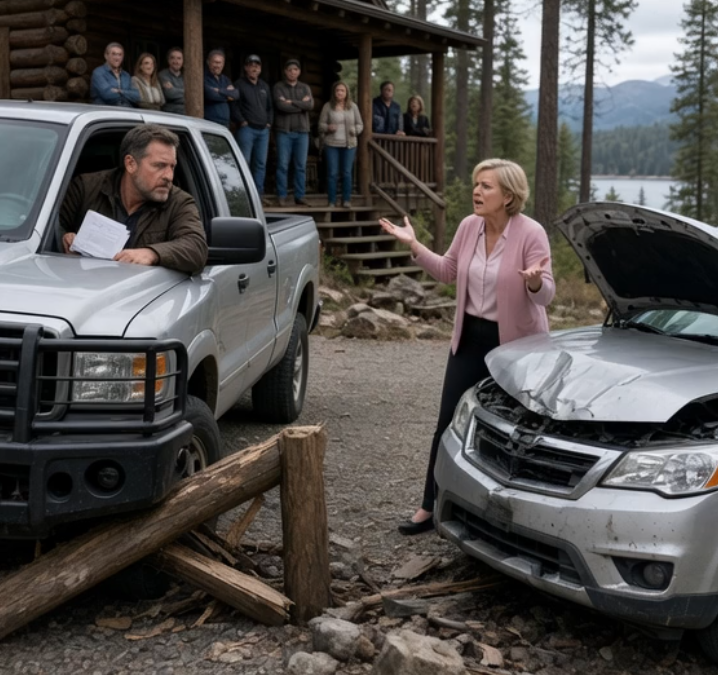
HOA Karen Blocked My Lake Cabin Driveway With Her SUV and Called Me a Trespasser—Then the Sheriff Unfolded My Property Survey and Asked Her One Question She Couldn’t Answer.
Karen Whitmore thought blocking my driveway would force me to obey her HOA.
She did not know the gravel under her tires had belonged to my family longer than her subdivision had existed.
By sundown, her SUV was on a tow truck, and every Harbor Ridge resident learned the road they treated like community property was mine to close.
Karen Whitmore learned the difference between an HOA rule and a property deed on the morning her silver SUV left my ranch on the back of a tow truck.
She stood in the gravel road with her arms folded, red blazer bright against the gray mountain sky, screaming that I had no right to enter my own land.
Behind her, half the lake community watched from the edge of the road.
Some held coffee.
Some held phones.
One man had the nerve to bring a folding chair.
And there I was, sitting in my old Ford with a snowplow mounted to the front, watching the woman who had spent six months calling me a trespasser slowly realize she was the one standing on private property.
The sheriff gave her one last chance.
“Mrs. Whitmore,” he said, voice flat with exhaustion, “move the vehicle.”
Karen lifted her chin.
“This is an HOA-controlled access point.”
The sheriff looked down at the certified survey in his hand.
“No, ma’am. This is Luke Hartman’s driveway.”
Her face twitched.
The crowd went quiet.
I could hear the lake wind moving through the pines.
Then the sheriff said the words that ended her little kingdom.
“Tow it.”
That was the first time I saw Karen Whitmore truly panic.
Not annoyed.
Not angry.
Panicked.
Because bullies can survive arguments.
They can survive complaints.
They can even survive being disliked.
What they cannot survive is public proof.
And by the time that tow truck hooked her SUV, by the time my plow cleared the gravel road she had tried to steal, by the time the HOA board found out I had just banned them all from using my ranch access road, Karen’s face had gone so pale that even her red blazer looked embarrassed to be seen with her.
But to understand how a driveway turned into a public execution of HOA arrogance, you have to understand what that road meant.
My name is Luke Hartman.
I was born on that lake.
Not in the poetic sense.
Literally.
My mother went into labor during a thunderstorm in the old cabin my grandfather built in 1961. The county road had washed out, the bridge was underwater, and the local doctor had to get there by boat. My father used to say I came into the world stubborn because the lake itself refused to let me leave.
The land had been in my family for more than sixty years.
Eighty-three acres of pine, pasture, rocky shoreline, and one narrow gravel driveway that curved down from Ridge Road through a stand of old cedar trees before opening onto the lake.
My grandfather built that driveway with a rented dozer, a hand level, and more determination than engineering.
My father maintained it.
I learned to drive on it before I was tall enough to see over the hood without sitting on a folded blanket.
That road was not decorative.
It was not shared.
It was not “community adjacent.”
It was the only legal access to my lake cabin ranch.
And every inch of it belonged to me.
PART2:
The HOA did not exist when my grandfather bought the land.
Back then, everything beyond Ridge Road was timber, cattle pasture, and cabins that smelled like woodsmoke. Then developers came in during the 1990s, bought the hillside above the lake, carved it into luxury lots, and named the subdivision Harbor Ridge Estates.
It was the sort of place where mailboxes matched, lawns looked nervous, and every welcome packet sounded like it had been written by a retired prison warden.
For years, Harbor Ridge and my ranch existed beside each other without much trouble.
They had their private lanes, clubhouse, marina dock, tennis court, and endless rules about roof colors and trash bins.
I had my cabin, my barn, my fishing dock, my dog, and the freedom to let my grass grow however high the deer preferred it.
Most residents understood the boundary.
My land was older than their HOA.
My road was not theirs.
My lake frontage was private.
Every few years someone new would wander down thinking it was a community trail. I would politely point to the signs and send them back up the hill.
Usually that was the end of it.
Then Karen Whitmore moved in.
Karen bought the largest house on the bluff, a white stone monster with black shutters, three balconies, and outdoor lights bright enough to confuse migrating birds. She arrived with a silver SUV, a tiny white dog named Duchess, and a personality that made even friendly people step back when she spoke.
Within two months, she was on the HOA board.
Within four, she was president.
By month six, she was calling herself “the voice of Harbor Ridge.”
That should have warned everyone.
Karen did not just like rules.
She needed them.
Rules were how she turned preference into authority. If she disliked your mailbox, it became a neighborhood concern. If she disliked your dog, it became a safety matter. If she disliked you personally, she could invent a violation with enough official language to make a normal person tired before they even fought back.
The first time she came after me, it was over my barn.
I was replacing a few warped boards on the south wall when her SUV rolled down the ranch road without permission. She stepped out in white pants, sunglasses, and a yellow folder tucked under one arm.
“Mr. Hartman?” she called.
I kept my hammer in my hand.
“That depends who’s asking.”
“Karen Whitmore. Harbor Ridge HOA president.”
“Then no.”
Her smile tightened.
“Excuse me?”
PART3:
“No, I’m not whoever you came to bother.”
She gave a brittle laugh and looked at the barn.
“We’ve received complaints about this structure.”
“No, you haven’t.”
Her head tilted.
“I beg your pardon?”
“Your HOA has no jurisdiction over this property. So if anybody complained, they complained to the wrong kingdom.”
The smile disappeared.
“Mr. Hartman, Harbor Ridge has architectural standards for visible lake-facing structures.”
“I’m sure it does.”
“This barn is visible from several residences.”
“So is the lake. Are you regulating that too?”
Her nostrils flared.
“The structure appears deteriorated.”
“It is a working barn.”
“It affects the visual harmony of the community.”
“That sounds like a community problem.”
“You don’t understand.”
“No, Karen. You don’t understand. My ranch is not in Harbor Ridge. My barn is not in Harbor Ridge. My road is not in Harbor Ridge. Your bylaws stop at your property line.”
She lifted the yellow folder as if paper gave her courage.
“Our legal committee disagrees.”
“Then your legal committee should learn to read deeds.”
That should have ended it.
It did not.
A week later, I got my first violation letter.
The letter accused me of maintaining an unapproved agricultural structure visible from HOA common areas, operating unpermitted equipment near a residential zone, creating “lakefront aesthetic disturbance,” and failing to comply with Harbor Ridge architectural standards.
Fine: $750.
I put the letter in a drawer with old fishing licenses and did not answer.
That was my first mistake.
Not because Karen was right.
Because people like Karen interpret silence as fear.
Two weeks later, I got a second letter.
Fine: $1,500.
Then a third.
Then one from the HOA attorney, a man named Preston Vale, informing me that continued noncompliance could result in “further legal remedies.”
I called Preston myself.
“Mr. Vale,” I said, “this is Luke Hartman.”
He sounded pleased, like he had been waiting for me to crawl toward reason.
“Mr. Hartman. Thank you for calling. I trust you’re prepared to discuss compliance.”
“No. I’m calling to tell you your client is harassing a non-member property owner.”
A pause.
“Harbor Ridge has certain rights regarding adjacent property impacts.”
“No, it doesn’t.”
“Visibility, nuisance, and access concerns may create—”
“Stop. My parcel predates your subdivision. It is not subject to your covenants. Your HOA has no authority over my barn, my driveway, my shoreline, or my dog.”
“Dog?”
“Give Karen time. She’ll get there.”
He cleared his throat.
“If you have documentation supporting your position, you may submit it to the board.”
“I don’t submit things to HOA boards I don’t belong to.”
“Then we may have to proceed formally.”
“Please do,” I said. “Put everything in writing.”
That was the second mistake Karen made.
She kept putting things in writing.
By late spring, she had decided my ranch road was the real prize.
See, Harbor Ridge had a problem nobody liked to talk about.
The subdivision had one official paved entrance from Ridge Road. It was steep, narrow, curved badly, and turned into a skating rink every winter. Their developer had promised a second access point in the 1990s, but the county records showed it had never been completed. Instead, for decades, residents had used my ranch road casually.
Not legally.
Casually.
My father had allowed certain neighbors to walk down it to fish when he liked them. He let emergency crews use it during storms. He let the old Harbor Ridge maintenance crew access the lower lake pump twice a year because he believed being neighborly was cheaper than being angry.
But he never signed an easement.
Never granted formal access.
Never gave the HOA rights.
After he died, I kept the old habit alive within reason. If a fire truck needed through, the gate opened. If a neighbor’s truck slid off the upper road in winter, I helped pull it out. If kids wandered down to the water, I sent them home before they got hurt.
But Karen saw old courtesy and mistook it for community property.
That is a dangerous thing.
The first sign appeared in May.
HARBOR RIDGE LAKE ACCESS TRAIL.
It was planted beside my driveway entrance.
I pulled it out and dropped it on the HOA office porch.
The next day, it was back.
This time with a second sign.
AUTHORIZED HOA MEMBERS ONLY.
That one made me laugh so hard my dog, Boone, started barking.
Boone was a ninety-pound black lab mix with a gray muzzle, one bad hip, and a deep suspicion of paddleboards. He had been my constant companion since my wife died seven years earlier. He did not care about mailboxes, roof colors, or neighborhood standards.
He did care about strangers walking down our road.
The week after Karen installed the signs, I caught three Harbor Ridge residents walking down toward my dock carrying fishing poles.
I stopped them at the bend.
“Private road,” I said.
One of them, a man in a blue jacket, frowned.
“The HOA opened lake access.”
“No, it didn’t.”
“There’s a sign.”
“I know. I threw it away yesterday. Apparently it grew back.”
The man looked irritated.
“We pay dues.”
“Not to me.”
A woman behind him pointed toward the water.
“The welcome packet says Harbor Ridge has lower lake access.”
“Your welcome packet lied.”
“That’s not our fault.”
“No. But walking past a private property sign becomes your fault after you read it.”
They left muttering.
By the next morning, Karen had emailed me.
Mr. Hartman,
Multiple residents have reported confrontational behavior while attempting to access community lake amenities. Please be advised that the lower ranch road has historically served Harbor Ridge residents, maintenance vendors, emergency personnel, and recreational users. Your unilateral interference with established access may expose you to liability.
Regards,
Karen Whitmore
HOA President
I read that email twice.
Then I printed it.
Then I opened the metal filing cabinet in my office, pulled out my grandfather’s deed, my father’s updated survey, the county road map, and the title report I had ordered after my father died.
I spread them across the kitchen table.
Boone lay beside me and sighed like he had been warning me about people for years.
The records were clear.
The ranch road belonged to the Hartman parcel.
There was no recorded easement for Harbor Ridge.
No recreational access.
No HOA maintenance right.
No lake path.
No community trail.
Only one narrow emergency access notation from 1998, and even that was conditional: fire, ambulance, law enforcement, and county emergency vehicles could use the road when necessary. That was not a right for Karen’s pickleball friends to walk down with fishing coolers.
I sent Karen a short reply.
Mrs. Whitmore,
Harbor Ridge has no recorded access rights over Hartman Ranch Road. The road is private. Any use by residents has been permissive only and may be revoked at any time. Effective immediately, recreational access is revoked. Emergency access remains unaffected.
Luke Hartman
She replied sixteen minutes later.
Mr. Hartman,
The HOA rejects your attempted revocation.
That was it.
No legal citation.
No document.
Just rejection, as if reality needed board approval.
The next month was a parade of stupidity.
Residents walked around my gate.
Someone moved my PRIVATE ROAD sign into the ditch.
A teenager on an ATV tore up the shoulder near the lower pasture.
Karen left a laminated notice zip-tied to my fence.
NOTICE OF COMMUNITY ACCESS REVIEW.
I cut the zip tie and mailed the notice back to her in pieces.
Then she hired a contractor to paint white arrows on the gravel near the top of my driveway.
I drove to the HOA office with a pressure washer in the bed of my truck and cleaned them off in front of her window.
She came outside red-faced.
“You are destroying HOA markings!”
“I am removing graffiti from my driveway.”
“You do not have the right to erase access indicators.”
“I have the right to remove paint from my rocks.”
“These markings were placed for resident safety.”
“Then your residents are safest when they stay off my land.”
Her little dog Duchess started barking from inside her SUV.
Boone barked once from my truck.
Duchess stopped.
That was the only sensible response anyone from Karen’s household had all year.
By July, she had moved from irritation to obsession.
She sent a drone over my cabin.
I waved at it with a shotgun in my hand.
I did not shoot it.
I wanted to.
But I am old enough to know the difference between a satisfying decision and a useful one.
She had residents photograph my barn, my dock, my plow, my woodpile, and Boone doing what dogs do behind a cedar tree.
The next letter accused me of maintaining unsightly equipment visible from Harbor Ridge and operating a “large aggressive animal” near community access.
I replied:
Boone says hello.
Then I hired an attorney.
Her name was Rachel Kim.
I have learned that the best attorneys do not look dramatic. Rachel was five foot three, wore plain black suits, and had the calm expression of a woman who enjoyed watching arrogant people place themselves in traps.
Her office was in town above a dentist. The waiting room smelled faintly of mint and printer toner.
I spread Karen’s letters across her desk.
Rachel read quietly.
Every few pages, she made a small mark with a blue pen.
When she finished, she looked at me.
“Is she always like this?”
“Worse in person.”
“This is a lot of writing for someone with no legal position.”
“That’s what I thought.”
“She claims historic access.”
“Courtesy.”
“She claims community amenity use.”
“Lie.”
“She claims enforcement authority over visible structures.”
“Fantasy.”
“She claims your dog creates a community risk.”
“Boone is retired from caring.”
Rachel almost smiled.
“Do you want peace, or do you want clarity?”
“What’s the difference?”
“Peace means she stops bothering you because she gets bored or distracted. Clarity means she stops because she understands the next step hurts.”
“I want clarity.”
“Good.”
Rachel sent a formal letter to the HOA.
It stated, in clean and brutal language, that Harbor Ridge had no jurisdiction over my ranch, no easement over my road, no recreational access, no authority to install signs, no right to mark my driveway, no right to enter my property, and no right to represent private Hartman land as an HOA amenity.
The letter revoked all non-emergency access.
It demanded removal of signs.
It demanded written correction to all residents.
It demanded that the HOA stop trespassing, stop encouraging trespass, and stop issuing fraudulent notices.
It gave them ten days.
Karen responded in three.
Not through Preston Vale.
Personally.
Dear Ms. Kim,
Your client’s position is rejected.
Harbor Ridge Estates has used the lower lake road for decades and will continue to do so. Mr. Hartman cannot unilaterally interfere with resident safety, community access, or HOA operations.
Sincerely,
Karen Whitmore
President, Harbor Ridge Estates HOA
Rachel read it and said, “Wonderful.”
I looked at her.
“That’s wonderful?”
“She ignored counsel and put the bad position in her own name.”
“That helps?”
“Immensely.”
Then came the snow.
That morning in October was not winter yet, not officially, but the mountains do not care about calendars. A wet storm moved over the lake before dawn, dropping three inches of heavy snow on top of rain. The upper Harbor Ridge entrance iced over by sunrise. Cars crawled down Ridge Road. Pines sagged under the weight. The lake turned steel gray.
I had planned to plow my ranch road, clear the cabin driveway, and haul feed to the lower barn before the temperature dropped.
I climbed into my old Ford, fired the engine, and let it idle while Boone watched from the porch with the deep concern of a dog who hated weather unless it involved ducks.
The plow blade lifted clean.
I backed out of the barn lot.
Then I saw the silver SUV.
Karen had parked it sideways across my driveway entrance at the top of Hartman Ranch Road.
Not near it.
Not beside it.
Across it.
Her hazard lights blinked uselessly in the snow.
She stood beside the SUV in boots that cost more than my first truck, wearing her red blazer under a wool coat, holding a folder against her chest like a shield.
Behind her, a small crowd of Harbor Ridge residents had gathered near the road.
Some curious.
Some smug.
Some nervous.
One man had set up a folding chair under a pine like he had bought a ticket.
I stopped the truck twenty feet from her.
Rolled down the window.
“Karen.”
“Mr. Hartman.”
“Move your vehicle.”
“This road is under HOA review.”
“It is under my plow.”
“You are not authorized to clear or alter an HOA-controlled access point.”
I stared at her.
Snow ticked against the windshield.
“You parked across my driveway during a storm because you think my snowplow is unauthorized?”
She lifted her chin.
“The board has determined that unilateral road modifications create liability for Harbor Ridge residents.”
“Karen, I am plowing my own road.”
“You have not provided proof that this is exclusively your road.”
“Yes, I have.”
“The board disputes it.”
“The board can dispute gravity. It will still fall down.”
Her mouth tightened.
“You are not entering until this matter is resolved.”
Something in me went very calm.
Not peaceful.
Calm.
There is a kind of anger that comes loud, and another kind that quietly puts on work gloves.
I put the truck in park.
Took out my phone.
Called Sheriff Boyd Mercer.
Boyd and I had known each other for thirty years. We were not friends exactly, but in a county that size, long history counts for something.
He answered on the fourth ring.
“Luke.”
“Boyd. Karen Whitmore parked her SUV across my ranch driveway and says I can’t enter my land.”
A pause.
“Tell me you’re joking.”
“No.”
“Do you have your paperwork?”
“In the truck.”
“Do not move her vehicle yourself.”
“I know.”
“I mean it.”
“I know.”
“I’ll be there in fifteen.”
It took him twenty-five because the roads were bad.
During that time, Karen performed for her audience.
She talked about community rights.
She said the HOA had an obligation to prevent unsafe road use.
She claimed my plow could damage shared infrastructure.
She said residents relied on the lower road.
She said I was creating a public hazard.
I sat in my truck and let the engine run.
Boone had appeared on the porch and was watching the entire scene with judgment.
When Sheriff Mercer arrived, he stepped out of his cruiser already looking tired.
He wore a tan jacket over his uniform and carried the expression of a man who had hoped retirement might come early by divine intervention.
Karen walked toward him first.
“Sheriff, thank you for coming. Mr. Hartman is attempting to force his way through an HOA access point.”
Boyd looked at her SUV.
Then at my truck.
Then at the road.
“Mrs. Whitmore, is that your vehicle?”
“Yes.”
“Is it parked across the road?”
“It is temporarily positioned to preserve the status quo.”
Boyd blinked once.
“Meaning it’s blocking the road.”
“It is preventing unauthorized entry.”
“To his property.”
“To disputed access.”
Boyd turned to me.
“Luke.”
I handed him the folder through the window.
Inside were the deed, the certified survey, the title report, Rachel’s letter, Karen’s response, and a map with the Hartman Ranch Road highlighted in yellow.
He stood in the snow and read.
Karen kept talking.
“Sheriff, this is a civil matter. The HOA has longstanding use rights. Mr. Hartman has become increasingly hostile. He has harassed residents, removed safety signage, and threatened to close a road our community depends on.”
Boyd held up one hand without looking at her.
She stopped.
That was when I knew he had reached the part of the survey that mattered.
He looked at the road.
Then at the map.
Then back at the SUV.
“Mrs. Whitmore,” he said, “were you told by Mr. Hartman’s attorney that this road is private?”
She stiffened.
“We dispute that characterization.”
“That’s not what I asked.”
“This is part of an ongoing access matter.”
“Did you receive the letter?”
Her lips pressed together.
“Yes.”
“Did it tell you not to enter or encourage others to enter this road?”
“It made several claims.”
“Did it tell you not to block his access?”
“The HOA has a responsibility to—”
“Mrs. Whitmore.”
His voice changed.
Not louder.
Flatter.
Better.
“Move the vehicle.”
“This is an HOA-controlled access point.”
Boyd looked down at the certified survey in his hand.
“No, ma’am. This is Luke Hartman’s driveway.”
The crowd went quiet.
Even the folding chair man sat up straighter.
Karen’s face twitched.
“Sheriff, with respect, you are not qualified to adjudicate land access.”
“I’m not adjudicating. I’m looking at a deed, a survey, and a vehicle blocking a private driveway during winter weather.”
“I am acting on behalf of Harbor Ridge Estates.”
“That does not improve your position.”
“My attorney will be contacting your office.”
“He can contact me after you move the vehicle.”
“I will not be bullied.”
Boyd sighed.
I almost felt sorry for him.
Almost.
He gave her one last chance.
“Mrs. Whitmore, move the SUV now, or I will have it towed.”
Her eyes flashed.
“You wouldn’t dare.”
The sheriff turned to his deputy.
“Call Ridge Tow.”
That was when Karen Whitmore truly panicked.
Her confidence cracked from the edges inward.
“Wait,” she said. “You can’t tow it. This is not an abandoned vehicle.”
“No,” Boyd said. “It is an illegally parked vehicle obstructing private access after lawful warning.”
“I am the HOA president.”
“Congratulations.”
A few people in the crowd made sounds they tried to hide.
Karen heard them.
That made it worse.
Public embarrassment does what legal letters sometimes cannot. It makes the fantasy impossible to maintain.
The tow truck arrived in twelve minutes.
Karen tried to get into the SUV.
Deputy Mason stopped her.
“Ma’am, step back.”
“This is my property!”
“Then you can pick it up from the tow yard.”
The driver hooked the SUV while Karen stood in the road shaking with fury.
Her little dog Duchess was not inside, thank God. Even Karen had not brought the dog into that weather.
As the tow truck pulled away, the crowd watched in complete silence.
That was the moment I lowered my plow.
The old Ford moved forward with a growl.
Snow curled off the blade.
The gravel road opened ahead of me, clean and private and mine.
I passed Karen slowly.
She stood there with snow in her hair, her red blazer visible beneath her coat, looking at me as if I had stolen something from her.
I stopped beside her and rolled down the window.
“You should go home, Karen.”
“This is not over,” she said.
“No,” I told her. “Now it starts.”
Then I plowed my road.
By noon, Rachel Kim had sent the letter.
Not a warning.
A revocation.
Effective immediately, all non-emergency permissive use of Hartman Ranch Road by Harbor Ridge Estates residents, board members, agents, contractors, guests, vendors, and invitees was revoked.
No walking.
No fishing.
No maintenance access.
No recreational passage.
No lake trail.
No community use.
No contractor use.
No HOA inspection.
No parking.
No “historic access.”
Emergency services only.
The letter went to Karen, Preston Vale, every board member, the county, the sheriff’s office, and the title company listed on the original Harbor Ridge development filings.
I also installed a new gate.
A real one.
Steel.
Set into concrete.
With a lockbox code for fire, EMS, and law enforcement.
The sign beside it was simple.
PRIVATE ROAD
HARTMAN RANCH ACCESS ONLY
NO HOA ACCESS
NO TRESPASSING
Boone sat beside me while I installed it.
He approved.
The reaction from Harbor Ridge was immediate and dramatic.
Residents who had ignored me for years suddenly discovered they had feelings about neighborly cooperation.
One email said I was endangering families by closing the lower road.
Another said I was punishing innocent homeowners for Karen’s mistake.
A third asked whether I would make an exception for dog walkers because “the upper trail is muddy.”
I deleted that one twice for satisfaction.
Then came the meeting.
Harbor Ridge called an emergency community session at the clubhouse, and for reasons I still do not fully understand, they invited me.
Maybe they thought a room full of angry residents would pressure me.
Maybe Karen thought she could reclaim control if she had a microphone.
Maybe stupid just likes an audience.
Rachel told me not to go alone.
So I brought her.
That changed the mood before anyone spoke.
Karen stood at the front of the clubhouse with Preston Vale beside her. Her SUV had been retrieved from the tow yard by then, but apparently her dignity was still missing.
The room was packed.
Residents stood along the walls.
Some looked angry.
Some frightened.
Some confused.
A few looked embarrassed, which meant they had probably read the documents.
Karen opened with a speech about community continuity, long-standing reliance, and the need for civility.
Then she turned toward me.
“Mr. Hartman’s sudden decision to block a road used by Harbor Ridge families for decades is reckless, punitive, and contrary to the cooperative spirit this community was built on.”
Rachel leaned toward me and whispered, “Cooperative spirit means they want something.”
I almost smiled.
Karen continued.
“Our residents have accessed the lake through that lower road since this community was founded.”
I raised my hand.
Karen frowned.
“This is not a question period yet.”
“I’m correcting your first sentence.”
Murmurs moved through the room.
Preston Vale stepped forward.
“Mr. Hartman, you will have a chance—”
“No,” Rachel said.
She did not raise her voice.
She did not need to.
The room quieted.
Rachel stood.
“My client has listened to six months of false claims regarding his property. He is not required to let another one pass unchallenged.”
Preston looked irritated.
Karen looked furious.
Rachel opened her folder.
“Harbor Ridge residents have not accessed the lake through Hartman Ranch Road by legal right. They have done so by revocable permission, tolerated informally by the Hartman family. That permission was abused. It has now been revoked.”
A man in the third row stood.
“My wife uses that road because the upper road is too steep in winter.”
Rachel nodded.
“I understand. The emergency gate remains available to fire, EMS, law enforcement, and county-authorized response. It is not available for private convenience.”
Another resident stood.
“We bought our house because the brochure said lower lake access.”
I looked at him.
“That brochure was wrong.”
“That’s not our fault.”
“No,” I said. “But it is not mine either.”
A woman near the back raised her hand.
“Are you saying we have no lake access now?”
“No,” Rachel said. “You have whatever lake access is legally recorded within Harbor Ridge property. If that access is insufficient, your issue is with the developer and the HOA, not Mr. Hartman.”
The woman turned toward Karen.
Karen’s posture changed.
Just slightly.
But enough.
That was the first crack.
Then Margaret Ellis stood.
She was seventy-two, retired from teaching, and lived two houses below Karen. She had once brought my father soup after he broke his wrist. I had not seen her in years.
“Karen,” Margaret said, “did the board verify the road rights before calling it community access?”
Karen’s mouth tightened.
“We relied on historical usage.”
“That is not what I asked.”
The room got quieter.
Karen glanced at Preston.
Preston did not rescue her.
Margaret continued.
“When you sent residents to walk that road, did you know there was no recorded easement?”
Karen’s jaw moved.
“We believed—”
“Did you know?”
Karen looked down.
That was answer enough.
Another board member, Phil Dawson, stood from the side row.
He was a retired accountant and one of those men who looked nervous even when sitting down.
“We asked for a title review last month,” he said.
Karen spun toward him.
“Phil.”
“No,” he said, voice shaking. “They need to know.”
The room shifted.
Phil held up a folder.
“The title review came back two weeks ago. It found no recorded recreational easement over Hartman Ranch Road. No maintenance right. No pedestrian access. No general HOA access.”
Someone said, “Two weeks ago?”
Phil looked miserable.
“Yes.”
I looked at Karen.
She stared at Phil as if betrayal had a dress code and he had violated it.
Rachel asked, “Was Mr. Hartman notified of this title review?”
Phil shook his head.
“No.”
“Were residents notified?”
“No.”
“Did Mrs. Whitmore continue representing the road as HOA-controlled after receiving that information?”
Phil looked at Karen.
Then at the floor.
“Yes.”
The room erupted.
Karen grabbed the microphone.
“This is being taken out of context.”
Margaret said, “You had his SUV towed in front of us?”
Karen’s voice rose.
“My SUV was unlawfully towed because Sheriff Mercer chose to insert himself into a civil dispute.”
A man near the aisle said, “You parked across his driveway.”
“I was preserving access!”
“To what?” someone else shouted. “A road we don’t own?”
Preston Vale stepped in quickly.
“I would advise everyone not to make statements that may create liability.”
Rachel said, “That ship has left the dock.”
I enjoyed that more than I should have.
The meeting ended badly for Karen.
Not with a vote yet.
Not with resignation.
But with the one thing every small tyrant fears most.
People started asking for records.
The following week, Harbor Ridge residents demanded copies of the title review, board emails, welcome packet language, vendor contracts, insurance communications, and every letter sent to me.
Karen tried to slow-walk the requests.
Phil leaked everything.
By the end of the month, the truth was public.
Harbor Ridge had marketed “lower lake access” in materials for years without recorded rights.
The HOA had treated Hartman Ranch Road as a community amenity based entirely on habit.
Karen had been warned by my attorney.
The title review had confirmed my position before she blocked my driveway.
She blocked it anyway.
That mattered.
Intent matters.
Ignorance can be corrected.
Defiance becomes expensive.
Homeowners were furious, and not all of them at me anymore.
Some had bought houses believing the road was part of the community. Some had paid premium prices for “easy lower lake access.” Some had mobility issues and had used my road because the HOA’s own lake path was steep and poorly maintained.
For the first time, Karen was not the loudest voice in the room.
She tried to blame the developer.
Then prior boards.
Then Preston.
Then me.
Then “ambiguous historical assumptions.”
That phrase lasted exactly one meeting before Margaret Ellis asked whether “ambiguous historical assumption” was the official term for “we used the neighbor’s road until he objected.”
Karen resigned three days later.
The announcement said she was stepping down to focus on personal matters.
In small communities, personal matters often mean everyone found the emails.
Phil became interim president because nobody else wanted to touch the mess.
His first act was to send me a letter.
Not through Preston.
Personally.
Dear Mr. Hartman,
On behalf of the interim Harbor Ridge board, I apologize for the board’s treatment of you and for the misrepresentation of Hartman Ranch Road as HOA-controlled access. We recognize that your family’s road is private property. We request an opportunity to discuss emergency access, possible limited winter use, and appropriate compensation for any future agreement, if you are willing.
Sincerely,
Phil Dawson
That was the first reasonable thing I had received from Harbor Ridge all year.
I showed it to Rachel.
She read it twice.
“This is not terrible.”
“High praise.”
“For an HOA, yes.”
We agreed to meet.
Not at the clubhouse.
Not at the HOA office.
At the county records building.
My choice.
Phil came with Margaret, Preston Vale, and two other board members. I came with Rachel and a folder thick enough to make Preston uncomfortable.
We sat in a conference room with fluorescent lights, bad coffee, and a county road map framed on the wall.
Phil began by apologizing again.
Not dramatically.
Not legally.
Plainly.
“I should have pushed harder when Karen kept escalating,” he said. “I didn’t. That is on me.”
Margaret nodded.
“Many of us believed what we were told because it was convenient.”
That sentence did more for me than six months of legal letters.
Rachel laid out the terms.
One, Harbor Ridge would issue a written acknowledgment that Hartman Ranch Road was private and not HOA-controlled.
Two, all prior notices, claims, and access statements would be withdrawn.
Three, the HOA would stop representing my road as community access in any materials.
Four, Harbor Ridge would pay my legal fees related to the access dispute and towing incident.
Five, the HOA would cover repairs for damage caused by resident traffic, ATV ruts, unauthorized signage, and painted road markings.
Six, emergency access would remain available through a locked gate with county-approved code.
Seven, any future non-emergency access would require a recorded agreement, annual maintenance contribution, indemnity, and my written consent.
Preston objected to number five.
Rachel slid photos across the table.
Ruts.
Paint.
Broken signposts.
A damaged culvert edge.
Preston stopped objecting.
Phil asked about limited winter access for older residents.
I looked at him.
“That depends.”
“On what?”
“On whether Harbor Ridge understands that permission is not ownership.”
Margaret answered before he could.
“We understand now.”
I believed her.
Not completely.
But enough to keep talking.
We worked out a narrow agreement.
Emergency access remained open.
County services had full access.
No recreational walking.
No fishing access.
No resident shortcuts.
No HOA maintenance unless preapproved.
During winter storm closures of the upper road, the HOA could request temporary limited passage for residents with documented medical or mobility needs. Requests had to come through a designated board contact, not Karen, not a committee, not a resident texting me because they wanted to avoid ice.
Harbor Ridge would contribute annually to road maintenance.
Not dues.
Not control.
Maintenance.
The agreement would state clearly that all permissions were limited, revocable under breach, and did not create an easement.
Preston hated the word revocable.
Rachel loved it.
The final document was recorded in December.
By then, Karen had put her house on the market.
She avoided me until the week before she moved.
I was repairing a gate hinge near the road when her silver SUV stopped twenty feet away.
For once, she was not wearing red.
She stepped out slowly.
Boone rose from the grass beside me and watched.
Karen looked at him.
“Is he friendly?”
“No.”
Boone wagged his tail once, because he enjoyed contradiction.
Karen clasped her hands.
“I’m leaving Harbor Ridge.”
“I heard.”
She looked toward the lake.
“I suppose you’re pleased.”
I tightened the hinge bolt.
“Karen, I have fences older than my feelings about you.”
Her mouth pressed into a line.
“I was trying to protect the community.”
“No, you were trying to control what did not belong to you.”
She looked at the gravel road.
“I believed the road was ours.”
“No,” I said. “You wanted it to be.”
That landed.
She took a breath.
“I handled things poorly.”
That was the closest thing to an apology I was ever going to get.
It was not enough.
But it was something.
“You humiliated me,” she said.
I looked at her.
“You parked across my driveway and got towed in front of your neighbors.”
Her face flushed.
“You could have moved around me.”
“No. I could have let you win.”
She had no answer.
After a moment, she said, “You know, the old board should have formalized the access years ago.”
“Maybe.”
“You benefited from it too. Residents kept watch down here. People used the road. It connected the properties.”
I set the wrench down.
“My father let neighbors use the road because he believed kindness made a place better. Your mistake was thinking kindness was a weakness you could record into ownership.”
Karen’s eyes flickered.
Maybe she understood.
Maybe she didn’t.
She got back in the SUV.
Before leaving, she lowered the window.
“Goodbye, Mr. Hartman.”
“Goodbye, Karen.”
Boone barked once as she drove away.
Not aggressive.
More like punctuation.
The winter after Karen left was the quietest I had known in years.
No strangers walked past my barn.
No HOA signs appeared on my road.
No drones buzzed over my dock.
No letters arrived accusing Boone of emotional damage to community harmony.
The new gate stayed closed.
Emergency crews had the code.
Phil used the winter access request twice. Once for Margaret, who needed transport after slipping on her porch. Once for a man on dialysis whose driveway iced over during a storm.
Both times, they called first.
Both times, I opened the gate.
Both times, they said thank you.
That was all my father had ever wanted from neighbors.
Ask.
Respect the answer.
Say thank you when someone helps.
It is amazing how many adults need lawyers to relearn things children understand.
Harbor Ridge changed too.
Not completely.
No place changes completely.
People still argued about paint colors. They still had mailbox standards. They still used phrases like “visual cohesion” when they meant “I dislike your fence.” But the new board became more careful.
Every meeting packet included deed references now.
Every access claim had to be verified.
Every committee action went through counsel before residents were threatened.
Margaret told me they had created a “Karen rule.”
No enforcement letter could be sent to a non-member property owner without board vote, legal review, and documentary proof.
They did not call it the Karen rule officially.
But everyone knew.
That spring, Harbor Ridge held a community cleanup along their own lake trail.
Their actual one.
The steep, rocky, neglected path on their side of the boundary that they had ignored for years because my road was easier.
They repaired steps.
Cleared brush.
Installed handrails.
Widened the top switchback.
Added drainage.
Margaret sent me before-and-after photos.
I replied:
Looks safer.
She replied:
Looks legal.
I laughed for the first time all day.
In June, my daughter Nora came home for a week with her two kids.
They lived three states away, and like most grown children, she existed in my life through photos, brief calls, and holiday logistics. Her mother and I had divorced when Nora was in college. Not angrily. Just sadly. Some marriages end like storms. Ours ended like a dock slowly pulling loose from shore.
Nora arrived in a minivan full of snacks, sunscreen, and children who believed my ranch was a wilderness survival challenge because the Wi-Fi only worked near the kitchen window.
My grandson Caleb was eight and obsessed with frogs.
My granddaughter June was five and believed Boone was a horse.
They ran down the ranch road toward the lake, and for one sharp second, I almost yelled for them to stop.
Not because of traffic.
Because for months, that road had been a battlefield.
Then I saw Nora watching me.
“It’s okay, Dad,” she said softly.
I nodded.
It was.
It was my road again.
Not because it had ever legally stopped being mine.
Because I had stopped bracing for someone to challenge every inch of it.
That evening, we sat on the dock while the lake turned gold.
Caleb asked why there was a new gate at the top of the road.
Before I could answer, June said, “Because Grandpa had to keep bossy people out.”
Nora nearly choked on her drink.
I looked at June.
“That is mostly accurate.”
Caleb frowned.
“Did they try to steal it?”
“They tried to use it without asking.”
“That’s stealing.”
“Sometimes adults call it something else.”
“Why?”
“Because big words make bad manners feel important.”
Nora smiled at that.
Later, after the kids were asleep, she and I sat on the porch.
The road curved through the cedars below us, pale in the moonlight.
“I read the articles,” she said.
“There were articles?”
“Local ones. HOA president towed from private road. Lake access dispute. Stuff like that.”
“Fantastic.”
“You didn’t tell me it got that bad.”
“I handled it.”
She sighed.
“You and that sentence.”
“I did handle it.”
“Eventually. With a lawyer and a sheriff.”
“That still counts.”
She looked out toward the lake.
“Mom said Grandpa would have loved it.”
“What?”
“Karen getting towed.”
I smiled.
“He would have brought the folding chair.”
“The guy with the chair in your story?”
“That man would have had competition.”
We sat quietly.
Then Nora said, “Are you lonely out here?”
I thought about the question.
The old answer would have been no.
Quick.
Automatic.
Defensive.
Instead, I looked at the dark pines and the road my grandfather cut and the lake where I had been born during a storm.
“Sometimes,” I said.
Nora nodded.
“Me too.”
That surprised me.
She had a house full of noise, work, children, obligations. It had not occurred to me that loneliness could live inside that too.
“Then come more often,” I said.
She looked at me.
“Ask more often.”
Fair.
That became our agreement.
Ask more often.
Come more often.
Another simple thing adults make too hard.
By late summer, the legal bills were paid.
The road repairs were complete.
Harbor Ridge had removed every reference to lower lake access from its materials.
The settlement check arrived in a white envelope with Preston Vale’s return address.
I used part of it to resurface the worst stretch of ranch road.
I used part to repair the dock.
I used part to build a covered bench near the bend where my father used to stop the truck and look down at the water.
On the bench, I mounted a small brass plaque.
HARTMAN RANCH ROAD
BUILT BY ELI HARTMAN, 1961
MAINTAINED BY THOSE WHO ASK FIRST
Rachel said the plaque was petty.
I told her it was historical.
She said those categories overlap.
One evening in September, Margaret walked down to the gate and called from the intercom.
“Yes?” I said.
“It’s Margaret Ellis. I brought pie.”
“What kind?”
“Apple.”
“The gate opens for pie.”
She came down slowly in her little blue car, parked near the cabin, and handed me a pie still warm enough to fog the aluminum cover.
“I wanted to thank you,” she said.
“For opening the road during the ice storm?”
“For that. And for forcing us to fix our own trail.”
“I didn’t do that.”
“Yes, you did. By saying no.”
I leaned against the porch rail.
“People don’t usually thank me for saying no.”
“They should. A good no is sometimes the only thing that makes people build what they should have built in the first place.”
I thought about that after she left.
A good no.
My father had believed in neighborliness, but he also believed a gate existed for a reason. I had spent years trying to honor both and letting other people blur the line because I did not want conflict.
Karen had taught me something the hard way.
Kindness without boundaries becomes someone else’s entitlement.
The next morning, I walked the whole length of Hartman Ranch Road with Boone.
From the cabin to the gate.
Past the cedar stand.
Past the bend where the road dropped toward the lake.
Past the ditch where the ATV tore up the shoulder.
Past the place Karen’s SUV had sat sideways in the snow like a monument to arrogance.
The gravel crunched under my boots.
Boone limped beside me, sniffing everything like he was verifying ownership.
At the gate, I stopped and looked up toward Harbor Ridge.
Their houses sat on the bluff, tidy and expensive, roofs catching morning light. Their trail curved down their side of the hill now, newly graveled and properly marked. A few residents were already walking it.
Good.
Let them use what was theirs.
I turned back toward my ranch.
The road looked ordinary.
That is what I loved about it.
No stone pillars.
No ornamental lights.
No committee-approved signage.
Just gravel, cedar needles, tire tracks, and the memory of every Hartman who had kept it passable through storms, mud, washouts, and stubborn neighbors.
Karen had thought control came from titles.
President.
Board.
Community representative.
Voice of Harbor Ridge.
She thought if she spoke with enough authority, planted enough signs, sent enough letters, and parked boldly enough across my driveway, the road would become what she said it was.
But land is not persuaded by confidence.
A deed does not care about your blazer.
A survey does not flinch because you raise your voice.
A private road does not become communal because enough people use it without asking.
And a man sitting in an old Ford with a snowplow does not have to move aside just because an HOA president mistakes habit for ownership.
People still ask whether I banned the entire HOA out of anger.
The honest answer is yes.
At first.
I was angry when that tow truck hauled Karen’s SUV away.
I was angry when I closed the gate.
I was angry when I thought about residents walking my road for years while their board quietly turned courtesy into a claimed right.
But anger was only the spark.
The reason I kept the ban was simpler.
Respect had to come before access.
Without that, every favor becomes evidence.
Every handshake becomes a loophole.
Every neighborly kindness becomes one more thing someone like Karen can print in a welcome packet and sell to strangers as an amenity.
Now, if Harbor Ridge needs emergency access, they have it.
If a resident has a medical issue during a storm, there is a process.
If the county needs through, the gate opens.
But nobody strolls down to my dock because a brochure once lied.
Nobody paints arrows on my gravel.
Nobody calls my barn a community concern.
Nobody blocks my driveway and tells me I need permission to enter land my grandfather bought before their subdivision was a blueprint.
That morning, after Boone and I finished our walk, I sat on the bench near the bend.
The lake was calm.
A heron stood in the shallows near the reeds.
Far above, someone in Harbor Ridge started a leaf blower, because peace is never perfect.
I thought about my mother giving birth during that thunderstorm.
My grandfather cutting the road.
My father teaching me to steer by letting the truck idle in low gear while he walked beside the open door.
Nora and her kids running toward the lake.
Karen standing in the snow while her SUV disappeared behind a tow truck.
The sheriff saying, “No, ma’am. This is Luke Hartman’s driveway.”
Some sentences are worth waiting for.
That one was.
By the next winter, the story had become local legend.
People exaggerated, of course.
They said Karen was dragged away screaming.
She was not.
They said I laughed while the tow truck pulled her SUV.
I did not.
They said Boone chased the HOA board off the property.
He wished.
They said I shut down the whole neighborhood and made residents hike three miles uphill in snow.
Not true.
The truth was simpler and better.
A woman who believed rules belonged only to her parked across the wrong driveway.
A sheriff read the right document.
A tow truck did its job.
And a private landowner finally stopped letting a community confuse his patience with permission.
That is not revenge.
That is a boundary.
And sometimes a boundary needs a gate, a survey, a sheriff, and one very public tow before people remember it exists.
Karen Whitmore learned the difference between an HOA rule and a property deed on the morning her silver SUV left my ranch on the back of a tow truck.
Harbor Ridge learned the difference between access and ownership when their lower lake road disappeared behind my gate.
And I learned something too.
I learned that peace is not always keeping the road open.
Sometimes peace is closing it, locking it, and letting the people who took you for granted find their own way home.








