HOA Karen Blocked My Farm Gate With Her Luxury SUV Every Day—So I Dug a Moat Around It, Leaving Her Trapped on a Dirt Island. Her Reaction Was Priceless!
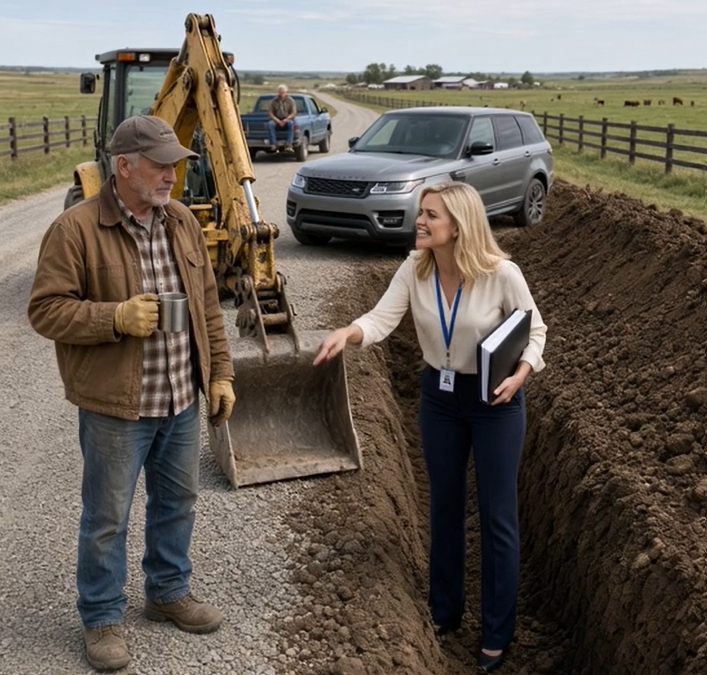
PART2:
Vanessa Cole believed phones existed primarily to summon people who would agree with her.
Lawyers.
HOA managers.
Sheriff’s deputies.
Contractors.
Board members.
Anybody with a title.
She pointed at me with the phone.
“You are going to pay for this.”
Hank whispered:
“Here we go.”
I ignored him.
Vanessa continued.
“You vandalized my vehicle.”
“Didn’t touch it.”
“You destroyed the road.”
“It’s my road.”
“You obstructed HOA access.”
“There is no HOA access.”
“You cannot trap somebody’s property.”
“You were given written notice of construction.”
Her voice rose.
“You knew I park there.”
“Yes.”
“You knew I would be there!”
“No.”
“I assumed eventually the signs might work.”
Hank lost control.
He bent forward laughing.
Vanessa turned toward him.
“This is not funny!”
Hank wiped his eyes.
“No, ma’am.”
Then looked at SUV.
“It’s pretty funny.”
That was how the morning started.
But if you want to understand why a recovery crane eventually had to lift Vanessa Cole’s SUV off my land—and why Silver Creek Estates ended up rewriting half its property-access policies afterward—you need to understand that none of this started with a ditch.
It started with a woman who believed authority expanded automatically wherever she wanted it to go.
My name is Walter Reed.
I was sixty years old.
My family had worked the same stretch of western Oklahoma land for almost a century.
My grandfather Earl Reed bought the original 160 acres in 1931.
Back then, roads were mostly dirt.
Electricity was inconsistent.
Water came from wells.
Neighbors solved disputes by walking across fields and talking until either the problem was fixed or both men got tired enough to go home.
The farm expanded slowly.
My father added eighty acres in the 1960s.
I bought another parcel in my thirties.
By the time Dad died and the main acreage came to me, Red Hollow Farm covered a little over three hundred acres.
Pasture.
Hay.
A few wheat fields.
Cattle.
Equipment sheds.
Two ponds.
An old creek bed that only remembered it was a creek after heavy spring rain.
Linda and I had never gotten rich from it.
Farming is one of the few professions where having half a million dollars’ worth of land and machinery can still mean checking the bank account before buying a transmission.
But the farm paid its bills.
Most years.
It gave us a home.
And it gave me something I valued more with age.
Space.
I grew up with two rules.
Respect property that isn’t yours.
And if somebody asks you to move your truck, move the truck.
For fifty-nine years, those rules worked.
Then Silver Creek Estates arrived.
The developers bought land immediately east of mine.
Old grazing ground.
Coyotes.
Mesquite.
Cottonwoods.
Natural runoff channels.
Then bulldozers came.
Roads.
Utilities.
Concrete.
Cul-de-sacs.
Stone entrance pillars.
The brochures called it:
SILVER CREEK ESTATES — LUXURY COUNTRY LIVING WITH MODERN CONVENIENCE.
Hank read one of those brochures once.
He stared at the phrase for several seconds.
“Luxury country living.”
“Yep.”
“They removed all the country.”
“Mostly.”
“And sold people the word.”
“Apparently.”
Hank shook his head.
“Good business.”
He was not wrong.
Silver Creek filled quickly.
Most residents were fine.
That is worth saying.
This was never farmers versus suburban people.
One resident, Dr. Nolan Pierce, grew tomatoes so badly I started leaving bags of mine on his porch out of sympathy.
Another family bought hay from me because their daughter convinced them miniature donkeys were reasonable pets.
Melissa Avery, a schoolteacher, brought Christmas cookies every December.
People waved.
Kids rode bikes.
Dogs escaped occasionally.
Life.
Then there was Vanessa Cole.
Vanessa became HOA president with startling speed.
Late forties.
Perfect blonde bob.
Designer sunglasses.
Clothing too clean for Oklahoma wind.
Silver luxury SUV.
And a black clipboard.
The clipboard became a neighborhood joke.
Trash can too visible?
Clipboard.
Fence stain off approved palette?
Clipboard.
Basketball hoop positioned wrong?
Clipboard.
Holiday lights still up after January 10?
Clipboard.
Residents joked privately.
Never in front of her.
Vanessa did morning inspections.
Usually 8:30.
Slow SUV patrol.
Window down.
Phone camera ready.
Duke, my cattle dog, hated her.
Duke liked everybody.
He once tried to climb into a propane delivery truck because the driver had beef jerky.
But the first time Vanessa walked our eastern fence, Duke stood beside me and growled.
“Easy.”
Vanessa looked over.
“Is that dog secured?”
“He’s with me.”
“He appears aggressive.”
Duke yawned.
That should have told me everything.
Along my eastern boundary ran a private farm-access road.
Important word:
private.
Not county.
Not public.
Not Silver Creek common property.
It sat entirely inside my deed.
The road reached hay ground, cattle pens, and equipment storage.
Tractors used it.
Feed trucks.
Veterinarians.
Hay trailers.
There were signs.
PRIVATE PROPERTY.
FARM ACCESS ONLY.
NO TRESPASSING.
AUTHORIZED VEHICLES ONLY.
Not subtle.
The first time Vanessa blocked my gate, I was hauling fencing posts.
I rounded the bend.
Stopped.
Her silver SUV was parked dead center.
Engine off.
Nobody inside.
I waited.
Five minutes.
Ten.
Twenty.
Finally I shut the truck off.
Duke looked at me.
“I know.”
Vanessa appeared on the neighborhood side.
Clipboard.
Another board member.
“Morning.”
She glanced.
“Mr. Reed.”
“You’re blocking my gate.”
“I’m conducting association business.”
“Fine.”
“I need through.”
“You can wait.”
That sentence stayed with me.
You can wait.
My road.
My gate.
Her vehicle.
I still stayed polite.
“This is private property.”
“We have maintenance rights.”
“No.”
She stiffened.
“Excuse me?”
“You don’t.”
“We have access along perimeter infrastructure.”
I had no idea what that meant.
“Show me the easement.”
“The association has rights.”
“Recorded where?”
She frowned.
“Move the SUV.”
Eventually she did.
Before leaving:
“You need to understand Silver Creek has responsibilities involving this boundary.”
“And you need to understand your authority stops at it.”
She looked offended.
Not confused.
Offended.
As though the concept of a property line was personally disrespectful.
Three days later, I got an HOA violation notice.
I did not live in Silver Creek.
Still:
AGRICULTURAL DUST IMPACTING COMMUNITY PROPERTY.
Required action:
Wet private road twice daily during dry conditions.
Potential fine:
$200 per occurrence.
Linda read the notice at kitchen table.
Folded it.
Placed it down.
“Can they fine us?”
“No.”
“You’re sure?”
“Yes.”
“Then why are they trying?”
“Because fancy letterhead makes people nervous.”
She drank coffee.
“Are you going to respond?”
“Yes.”
“Politely?”
I sighed.
“Yes.”
“Very politely?”
“Yes, Linda.”
I sent certified letter.
Red Hollow Farm is not subject to Silver Creek covenants.
No HOA jurisdiction.
No easement.
No assessments.
Please provide recorded instrument if association believes otherwise.
Vanessa responded.
The HOA possessed “implied authority where community welfare is affected.”
Hank loved that phrase.
“Implied authority.”
“Yep.”
“You got implied cattle?”
“No.”
“Implied mortgage?”
“No.”
“Can I impliedly borrow your tractor?”
“Absolutely not.”
Linda made us stop.
Then Vanessa began parking more.
Sometimes ten minutes.
Sometimes forty.
Sometimes near gate.
Sometimes inside the road.
Always association business.
One afternoon she brought a folding chair.
I wish I were exaggerating.
Chair.
Iced tea.
Clipboard.
She parked beside the gate and sat while landscaping contractors worked on the subdivision side.
I shut down tractor.
Walked over.
“You need to move.”
“I’m monitoring landscaping.”
“From my road.”
“We’ve discussed this.”
“Yes.”
“You don’t have rights here.”
She stood.
“I spoke with legal counsel.”
“Excellent.”
“Send me the recorded easement.”
“Our attorney has documentation.”
“Great.”
“County book and page.”
“Survey instrument.”
“Whatever you’ve got.”
Her voice cooled.
“If you insist on being adversarial, our counsel may also review zoning compliance for your agricultural operation.”
Threat.
Simple.
She couldn’t establish access.
So she would look for leverage elsewhere.
I nodded.
“Okay.”
She looked disappointed.
That afternoon I called Rachel Monroe.
Property attorney.
Woodward.
She understood farms.
Boundaries.
Water.
Access disputes.
Rachel reviewed my deed.
Survey.
HOA letters.
Maps.
“They have nothing.”
“No easement?”
“No.”
“No covenant?”
“No.”
“Can they fine me?”
“They can print fines.”
“Collection is another question.”
I smiled.
She pointed.
“Don’t get clever.”
“I’m never clever.”
“Walter.”
“Fine.”
She advised documentation.
Photographs.
Signs.
Written notice.
No touching vehicles.
Call sheriff if trespass becomes dangerous.
I added signs.
Vanessa ignored them.
I tried a tow company.
Rick Mason.
When I said silver SUV, he groaned.
“You mean Vanessa?”
“You know her?”
“I towed her from a fire lane two years ago.”
“How’d that go?”
“Poorly.”
“You’ll tow her now?”
“No.”
“Why?”
“I enjoy having a business license.”
He laughed.
Hung up.
So the SUV remained a recurring problem.
Then came drainage.
That part was real.
Long before Vanessa.
Runoff had been eroding the farm road during spring storms.
Silver Creek’s development increased flow from the eastern slope enough to make an existing problem worse.
Not malicious.
Just hydrology.
County conservation technician Eric Lawson inspected.
Recommended shallow diversion channel.
Graded swale.
Rock armoring.
Outlet into existing drainage path.
I postponed it.
Farm life is deciding which problem gets to wait.
Then after another storm washed out the road shoulder, I pulled Eric’s plan back out.
The line crossed exactly where Vanessa liked to park.
Linda saw my face.
“No.”
“I didn’t say anything.”
“You have a face.”
“What face?”
“The grain-conveyor face.”
“That conveyor was useful.”
“It sank.”
“Temporary setback.”
She pointed.
“Are you doing actual drainage work?”
“Yes.”
“Exactly to plan?”
“Yes.”
“Permits?”
“Calling.”
“Utilities?”
“Calling.”
“Attorney?”
“Calling.”
“HOA notice?”
I stared.
She stared back.
“Fine.”
I notified everyone.
Eric returned.
Confirmed route.
Utility locates done.
No lines.
Rachel reviewed.
“Do the project.”
“Do not alter route because of vehicle.”
“I won’t.”
“Do not damage SUV.”
“I won’t.”
“Photograph before.”
“Yes.”
Then I sent written notice to Silver Creek.
Road closure Thursday.
7:00 a.m.
Drainage work.
No unauthorized vehicles.
Map attached.
Management company acknowledged.
Vanessa personally responded:
YOUR CONSTRUCTION DOES NOT SUPERSEDE HOA ACCESS RIGHTS.
Rachel’s reply to me:
Do not answer.
Thursday.
Clear.
Cool.
Backhoe ready.
Cones.
Signs.
Hank arrived with coffee.
At 8:27 Vanessa came.
Read sign.
Drove around cone.
Read second sign.
Continued.
Parked exactly over drainage line.
I walked over.
“Morning.”
She opened door.
“Road’s closed.”
“I have business.”
“Move the vehicle.”
“No.”
“I start excavation here.”
“You cannot interfere with HOA access.”
“This isn’t HOA access.”
“Vanessa.”
I pointed at stakes.
“That is the drainage line.”
“You touch my car, I’ll sue.”
“I won’t touch it.”
“Good.”
She locked the SUV.
Walked away.
I called Rachel.
She repeated instructions.
Proceed.
Stay on design.
No contact.
Photograph.
So I did.
The trench approached the SUV.
I maintained safe offset.
Since SUV sat on a small high spot, drainage line curved around the original grade to preserve the designed slope.
It created an island.
Not intentionally for spectacle.
That was simply what happened when you refuse to move a vehicle from the center of an excavation corridor.
By 11:20, the SUV had open drainage on three sides and soft unfinished earth on fourth.
No safe drive-out path.
I stopped work.
Hank sat beside me.
Sunflower seeds.
At 11:36 Vanessa returned.
And screamed.
That’s where we started.
She called the sheriff.
Of course.
Deputy Raymond Cho arrived.
Late thirties.
Calm.
Looked at SUV.
Looked at trench.
Looked at signs.
Looked at me.
Then Vanessa.
“What happened?”
“He trapped my vehicle!”
I handed him folder.
Written notice.
Acknowledgment.
Photos.
Drainage plan.
Utility locate confirmation.
Time-stamped picture showing SUV before excavation.
Another showing Vanessa being warned.
Deputy read.
Then:
“Ma’am, did Mr. Reed tell you work was starting?”
“He claimed it.”
“Did he ask you to move?”
“That is irrelevant.”
“It seems relevant.”
“He has no right to obstruct association access.”
Deputy looked at me.
“Is there an easement?”
“No.”
I handed survey.
Vanessa snapped:
“Our attorney has—”
Deputy held hand up.
“If you have civil access claim, that’s for court.”
She pointed at SUV.
“I need my car.”
Deputy nodded.
“That’s understandable.”
“Make him fill it in.”
“No.”
“Why?”
“This appears to be lawful work on private property.”
“You’re taking his side.”
“No, ma’am.”
“I’m trying not to turn civil dispute into criminal one.”
Then she said:
“Fine.”
“I’ll drive it out.”
Deputy looked at trench.
“I wouldn’t.”
“I have four-wheel drive.”
Hank muttered:
“Lord.”
Deputy heard.
He almost smiled.
“No, ma’am.”
“You could roll vehicle.”
“You could collapse trench.”
“You could injure yourself.”
“Recovery company is safer.”
Vanessa stared at me.
“You pay.”
I shrugged.
“That’ll be between you and whoever you hire.”
Rick’s Towing refused.
Again.
Second company arrived.
Driver walked around.
“Can’t winch without damaging bank.”
Third company:
same.
Finally a heavy-recovery operator named Stan Mercer came.
He looked at SUV.
Then trench.
Then at Vanessa.
“How did this happen?”
Vanessa pointed at me.
“He trapped it.”
Stan looked at signs.
“What do those say?”
Hank turned away laughing.
Stan decided a small recovery crane could lift SUV vertically onto stable road if permission granted to position outriggers.
But crane would need enter my land.
Vanessa turned.
“Do it.”
Stan said:
“I need property owner authorization.”
She stared at him.
Then me.
For the first time in months, Vanessa needed to ask.
Not demand.
Ask.
She walked across temporary foot plank.
Stopped.
“I need you to allow crane access.”
I waited.
Hank became very interested in sunflower seeds.
Vanessa’s jaw tightened.
“Well?”
I said:
“Please.”
“What?”
“Ask properly.”
Her face changed.
“You’re enjoying this.”
“No.”
I wasn’t, exactly.
I was making a point.
“I have asked you politely for months to move off my property.”
“You told me to wait.”
“You ignored signs.”
“You ignored letters.”
“You parked inside marked construction zone.”
“Now you need access.”
She stared.
Then:
“Walter, may the recovery company enter your farm to remove my vehicle?”
“Yes.”
That was all.
I signed access waiver.
Crane came.
Outriggers.
Straps.
Slow lift.
The SUV rose into air like an extremely expensive Christmas ornament.
Hank took no photographs.
I know because Linda specifically threatened him not to.
Other people did.
Silver Creek residents watched from fence.
Kids loved it.
Someone later posted video online.
“HOA PRESIDENT’S CAR AIRLIFTED OFF FARM.”
It spread locally.
I hated that title.
But it got attention.
The HOA held emergency meeting three days later.
Vanessa called incident:
deliberate harassment.
unsafe excavation.
retaliatory property entrapment.
Then Eric Lawson, county conservation technician, attended because someone from Silver Creek had complained to county about drainage.
He stood.
“Channel matches recommended plan.”
Silence.
Vanessa:
“You approved digging around occupied vehicle?”
“No.”
“I approved route weeks earlier.”
“Vehicle should not have been there.”
A resident asked:
“Did HOA have access rights?”
Vanessa:
“Yes.”
HOA attorney raised hand.
“No.”
Room went quiet.
Vanessa turned.
“What?”
Counsel adjusted papers.
“To my knowledge, association has no recorded vehicular easement over Reed farm road.”
“You told me—”
“I told board there may be rights concerning shared perimeter drainage inspections from common-property side.”
“That is not the same as vehicular access over private road.”
Someone in back laughed.
Vanessa went pale.
Then Melissa Avery stood.
The teacher.
Cookies.
“Why have we been told for two years that farm road is association access?”
Counsel:
“I cannot answer that.”
Everyone looked at Vanessa.
She said:
“It has historically been used.”
I stood near back.
Could not help myself.
“By you.”
Laughter.
Gavel.
Meeting got worse.
Residents started asking about HOA letters sent to my farm.
They discovered fines had been issued against non-HOA property.
That bothered them.
Not because they loved me.
Because every dollar spent enforcing nonsense came from their dues.
Treasurer produced legal-expense figures.
Over eighteen months, Silver Creek had spent nearly $14,000 on counsel, management review, and property complaints involving Red Hollow Farm.
Fourteen thousand dollars.
For property HOA did not govern.
A man stood.
“You spent fourteen grand bothering farmer?”
Vanessa said:
“That is an inflammatory characterization.”
Hank, sitting beside me:
“Pretty accurate.”
Then came drainage question.
Silver Creek had its own runoff problem.
Remember how I said development increased flow?
Turns out original stormwater plan included maintenance responsibilities for two retention swales on common property.
One had not been cleared properly for two years.
Vegetation and sediment reduced capacity.
My new drainage channel exposed the issue because water now flowed correctly toward lower path but subdivision discharge still came too fast.
County sent Silver Creek maintenance notice.
Residents were furious.
They had paid landscaping fees.
Where money went?
The board ordered independent review.
That review found Vanessa had repeatedly prioritized aesthetic projects over drainage maintenance.
Entrance flowers.
Stone monument lighting.
Decorative fencing.
Holiday landscaping.
None criminal.
Just poor priorities.
Stormwater budget underspent.
Beautification budget overspent.
Hank summarized:
“They watered flowers while water was eating your road.”
Exactly.
Vanessa lost board presidency six weeks later.
Not because of SUV alone.
The SUV made people pay attention.
Records did rest.
Members voted.
New president:
Melissa Avery.
The teacher.
Her first call:
“Walter?”
“Yes.”
“I’m sorry.”
“For what?”
“For association acting like your farm belonged to us.”
“You didn’t do it.”
“No.”
“But I benefited from not paying attention.”
That was thoughtful.
She asked whether we could meet about drainage.
We did.
This time:
maps.
County.
Engineers.
Coffee.
No clipboard.
Silver Creek agreed to restore its retention swale.
They added rock check structures.
Improved outlet.
Shared reasonable costs for downstream protection voluntarily.
Not because HOA had authority over me.
Because runoff crossed property lines and cooperation made sense.
That’s how adults solve things.
Vanessa threatened civil action over SUV recovery cost.
Her lawyer sent letter.
Rachel responded with:
construction notices.
photos.
video.
witness statements.
county plan.
No lawsuit followed.
She paid crane company.
I paid for my drainage project.
Nobody paid anybody else.
Fair.
The SUV was not damaged.
That disappointed internet.
Reality is often less dramatic than comments.
Months passed.
Farm road stopped washing out.
Best part.
First spring storm:
water flowed down channel exactly as Eric predicted.
No rut.
No erosion.
No standing water at gate.
I stood in rain watching it.
Hank came beside me.
“Worth it?”
“Yes.”
“Even without Vanessa?”
“Especially without Vanessa.”
He nodded.
Then:
“Still funny.”
“It was.”
Linda heard.
“You two are twelve.”
We were.
Vanessa moved from Silver Creek about a year later.
Before leaving, she stopped at farm entrance.
Did not drive in.
That mattered.
She parked on public shoulder.
Walked to gate.
I came over.
No clipboard.
No sunglasses.
She looked older.
“Walter.”
“Vanessa.”
“I wanted to tell you something.”
I waited.
“You made me look ridiculous.”
I almost laughed.
Instead:
“No.”
She frowned.
“You put my car on an island.”
“No.”
“You parked in excavation zone.”
“You could have stopped.”
“I warned you.”
“You could’ve waited.”
I looked at her.
“There’s that sentence.”
She knew.
You can wait.
The first thing she had said when blocking my gate.
Her shoulders dropped slightly.
“I thought if I gave ground once, people would stop respecting me.”
That surprised me.
“Respect isn’t people giving way.”
“I know that now.”
I believed she knew some of it.
Not all.
Enough.
She left.
No apology exactly.
But no accusation either.
Maybe that was as far as she could go.
Silver Creek changed.
Not dramatically.
HOA still existed.
Rules still existed.
Trash cans.
Fence stains.
Meetings.
Budgets.
But access maps became part of board training.
No director allowed to assert offsite property rights without recorded documentation.
Any adjacent-land issue required attorney review.
Stormwater got annual inspection.
And—Melissa told me with a smile—
no HOA officer could park on private farm-access roads.
They wrote that one down.
Hank wanted plaque.
I said no.
He bought me one anyway.
Small metal sign:
NO HOA PARKING
DRAINAGE MAY OCCUR WITHOUT WARNING
Linda made me take it down.
“Too petty.”
“It’s funny.”
“Take it down.”
I put it inside barn.
Years later, Silver Creek residents became normal neighbors.
Dr. Pierce finally learned tomatoes.
Mostly.
Miniature donkeys kept escaping.
Melissa remained HOA president two terms and wisely quit.
Kids from subdivision sometimes watched cattle from fence.
They asked permission.
That mattered.
One boy named Lucas asked if moat still existed.
“What moat?”
“The one you dug around lady’s car.”
“It was drainage.”
“My dad says moat.”
“Your dad enjoys fiction.”
“Did she cry?”
“No.”
“Did crane fly car?”
“Sort of.”
His eyes widened.
I realized story had become folklore.
I explained:
“It wasn’t a trap.”
“You can’t dig ditches around people because you’re mad.”
“Why not?”
“Because that’s how adults get sued.”
He nodded solemnly.
Good lesson.
At sixty-seven, I leased part of cattle operation to younger rancher.
My knees appreciated it.
I still drove farm road.
The drainage channel had grassed in.
No longer looked dramatic.
Just shallow swale.
Functional.
That is what I liked most.
Conflict disappeared.
Infrastructure remained.
One morning I stopped near old parking spot.
Could barely see where SUV island had been.
Nature repaired spectacle.
Duke had died by then.
Good dog.
Fourteen years old.
Buried near cottonwoods.
Hank said Duke would have liked crane.
Probably.
Linda and I sat porch more.
Silver Creek lights visible after dark.
Sometimes parties.
Sometimes barking.
Sometimes HOA emails about whatever.
Normal.
One evening Melissa came by with updated drainage map.
“We’re replacing culvert on subdivision side.”
“Looks good.”
“Need temporary access?”
“No.”
“We designed from our property.”
I smiled.
“Look at you.”
“Growth.”
She laughed.
Then pointed toward swale.
“People still call it Vanessa’s Moat.”
“I know.”
“Sorry.”
“No, you’re not.”
“No.”
We drank iced tea.
That was community.
Not sameness.
Not authority.
Knowing where your line ended and still choosing to help beyond it.
People ask what I learned.
Mostly that signs are only useful if people read them.
But something bigger too.
A property line does not make you enemies.
It makes cooperation honest.
If I own this side and you own that side, we can make agreements.
We can share costs.
We can coordinate runoff.
We can solve problems.
But if you begin with:
I’m entitled to use your road because I say so—
there is nothing to negotiate.
Vanessa confused leadership with reach.
She thought authority had to keep expanding or people would stop respecting her.
So she expanded it until it hit something recorded in a deed.
Then she kept pushing.
The SUV became funny because it turned her whole philosophy into a picture.
Her expensive vehicle sat in middle of land she insisted she had a right to use.
Surrounded not by revenge.
By reality.
A drainage ditch she had been told about.
On property she had been told was private.
Beside signs she had physically driven around.
There was no better metaphor.
Hank understood immediately.
That is why he could not stop laughing.
The best part came years later.
I was seventy.
Hank was seventy-four.
Still cracking sunflower seeds.
We sat on same tailgate near east pasture.
A young HOA board member from Silver Creek approached.
New guy.
Maybe thirty-five.
Tablet.
Very polite.
“Mr. Reed?”
“Yes.”
“We’re planning fence maintenance.”
“Okay.”
“We think one contractor may need temporary access from your road.”
I looked at Hank.
Hank looked at me.
The young man immediately said:
“But only if you’re willing.”
I smiled.
“What equipment?”
“Small lift.”
“How long?”
“Two hours.”
“Insurance?”
“Here.”
He handed paperwork.
“Access agreement?”
“Drafted.”
“Date?”
“Next Wednesday.”
I read.
Everything correct.
“Fine.”
He exhaled.
“Thank you.”
As he walked away, Hank cracked a seed.
“Look at that.”
“What?”
“Civilization.”
I laughed.
The following Wednesday, contractor came.
Used road.
Finished fence.
Closed gate.
No drama.
No sheriff.
No lawyer.
No crane.
It was almost disappointing.
Almost.
People still tell the story as:
Farmer Dug Moat Around HOA Karen’s SUV.
I understand.
That’s a better title.
But the truth matters.
I didn’t wake up deciding to trap anybody.
I didn’t dig outside plan.
I didn’t touch car.
I didn’t create hidden hazard.
I posted signs.
Sent notice.
Marked utilities.
Used surveyed drainage route.
Warned Vanessa directly.
Asked her to move.
She refused because she believed backing down would weaken her authority.
That refusal cost her.
Not the ditch.
That is the part worth remembering.
People create most of their own disasters long before consequences appear.
Usually at the moment somebody gives them one last simple chance to choose differently.
Move your SUV.
Read the notice.
Respect the boundary.
Ask permission.
Say you were wrong.
Small choices.
Vanessa kept choosing no.
Eventually there was nowhere left to drive.
And that morning, while her ninety-thousand-dollar SUV sat safely on an island of dirt waiting for a crane, Hank cracked another sunflower seed and said the most accurate thing anyone said during the entire mess.
“You know, Walter…”
“What?”
“She could’ve just moved the car.”
I looked at the SUV.
Then the trench.
Then the signs.
“Yep.”
Sometimes the whole story really is that simple.








