HOA Installed a Locked Gate Across My Private Bridge and Demanded $15,420—So I Removed the Entire Bridge Overnight and Left Their Gate Opening Into Thin Air.
HOA Installed a Locked Gate Across My Private Bridge and Demanded $15,420—So I Removed the Entire Bridge Overnight and Left Their Gate Opening Into Thin Air.
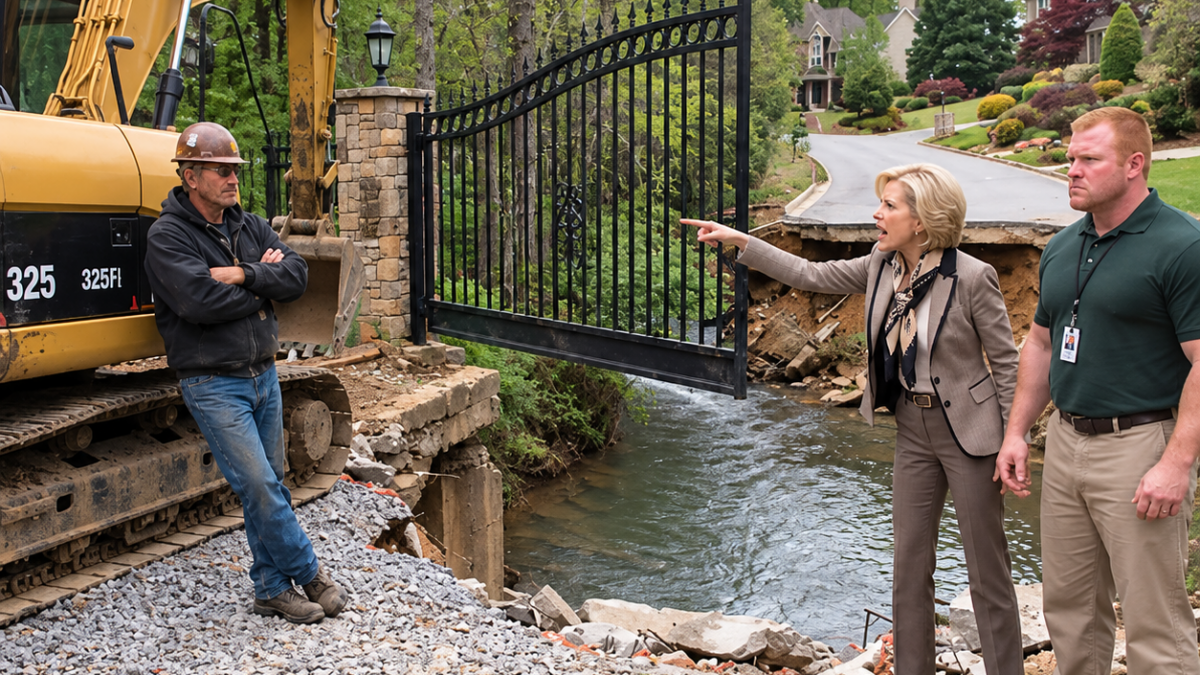
The HOA waited until I was out of state, poured concrete beside my only driveway, installed an eight-foot iron gate across the entrance to the private bridge my grandfather had built, and told me I would not receive the access code until I paid $15,420 in fines from an association I had never belonged to.
The police warned me not to damage the HOA’s gate while the boundary dispute crawled toward court, so I did exactly what they told me: I never put so much as a scratch on their expensive ironwork.
Instead, before sunrise on Friday morning, I hired a crane, unbolted forty tons of my own steel and timber, removed the entire bridge from beneath their gate, and left the HOA with a beautifully landscaped entrance that opened directly into ten feet of empty air.
My name is Noah Collins.
And at 12:17 on a rainy Friday night, I found myself sitting behind the wheel of my F-350 staring at an eight-foot wrought-iron gate that had not existed when I left home eight days earlier.
The rain hit my windshield so hard the wipers could barely keep up.
My headlights reflected off black iron bars.
Two new masonry pillars stood on either side.
A keypad blinked red.
A security camera pointed directly at my truck.
And hanging from the center of the gate was a laminated notice.
I shifted into park.
For maybe ten seconds, I just sat there.
Sometimes your brain takes longer than your anger.
I knew exactly where I was.
Sycamore Drive.
The last asphalt street in Oak Creek Estates.
Forty yards behind me were rows of expensive beige houses.
Ten feet beyond the gate was Miller’s Creek.
And across that creek was my property.
My house.
My barn.
My excavator.
My bed.
The twelve acres my family had owned since the 1970s.
Between me and all of it stood the bridge my grandfather had built in 1985.
Or at least it should have.
The bridge itself was still there.
I could see its wet timber deck disappearing behind the iron gate.
But somebody had decided I no longer had the right to cross it.
I shut off the truck.
Rain immediately sounded louder.
I put on my work jacket and stepped outside.
Cold water hit the back of my neck.
I walked toward the gate.
That was when I saw one of the pillars.
The left pillar sat on the edge of Oak Creek’s asphalt.
The right one did not.
PART2:
Its concrete footing crossed several inches beyond the recorded line and into the bank that belonged to me.
I knew because I had argued that exact line with the HOA president three months earlier.
A plastic sleeve had been zip-tied to the bars.
Inside:
NOTICE OF RESTRICTED ACCESS
This access point has been secured by the Oak Creek Estates Homeowners Association for the protection of community property and residents.
The adjacent property owner must resolve all outstanding compliance violations, assessments, security expenses, and gate-installation costs before receiving a remote or access code.
CURRENT BALANCE:
$15,420.00
CONTACT:
BRENDA CARMICHAEL
HOA PRESIDENT
I read it once.
Then again.
The number did not become less insane.
Fifteen thousand four hundred twenty dollars.
For fines issued by an HOA I did not belong to.
Plus a gate I had never requested.
Installed across access to land they did not own.
I pulled out my phone.
Called sheriff’s office.
While I waited, I stood in the rain looking through the bars.
The bridge was forty-two feet long.
Two heavy steel I-beams beneath thick pressure-treated decking.
Concrete abutments on each side.
My grandfather had built it because Miller’s Creek cut our land off from the county road.
Calling Miller’s Creek a creek was generous in summer.
In October after three days of rain, it was different.
Brown water churned over rocks ten feet below the bridge.
Fast.
Cold.
Deep enough in the channel to knock a grown man off his feet.
The bridge was not decorative.
It was not a neighborhood walking path.
It was my driveway.
My grandfather, Walter Collins, had built it to carry logging trucks.
My father had reinforced it in 1998.
I had hired a structural engineer to inspect it five years earlier when I bought a heavier excavator.
It could support far more weight than my pickup.
It had survived floods, ice, delivery trucks, concrete mixers, and one memorable afternoon when my cousin parked a loaded dump truck halfway across because he thought “bridge testing” was funny.
For almost forty years, nobody questioned who owned it.
Then Oak Creek Estates arrived.
Three years before the gate, a developer named Midland Residential bought the old Hensley farm on the opposite side of Miller’s Creek.
Two hundred acres.
Pasture.
Cornfield.
Scattered woods.
Within eighteen months it became 286 homes.
Stone entrance monuments.
Decorative ponds.
Walking paths.
Clubhouse.
Pool.
A maze of cul-de-sacs.
The development’s western edge ended at Miller’s Creek.
My property lay beyond.
Originally, the developer wanted to buy my twelve acres too.
I declined.
Then they offered to purchase an easement across my bridge so residents could extend a walking trail into my woods.
I declined again.
They offered more money.
I said no again.
Eventually they built Sycamore Drive right up to the property line.
The asphalt stopped precisely at the entrance of my bridge.
That was important.
Their survey showed it.
Mine showed it.
The county GIS map showed it.
The developer’s recorded plat showed it.
There was no shared-driveway easement.
No HOA access easement.
No pedestrian easement.
No maintenance easement.
Nothing.
My bridge connected to their road physically.
Legally, it remained private.
For the first two years, that was no problem.
Then Brenda Carmichael became HOA president.
Brenda was fifty-one.
Former regional sales director for a pharmaceutical company.
She had the posture of someone who had spent twenty years entering conference rooms expecting people to stop talking.
Blond hair always perfect.
Designer sunglasses.
White Mercedes SUV.
She owned a miniature schnauzer named Winston and somehow managed to walk him without ever looking down at him.
Her husband, Paul, seemed pleasant.
Quiet.
Rarely involved.
Brenda became president after campaigning on “protecting Oak Creek’s long-term property values.”
That sounded harmless.
Then she created the Architectural Integrity Committee.
Then the Community Appearance Patrol.
Then the Boundary Safety Initiative.
That final one brought her to me.
My first HOA letter arrived on thick cream card stock.
Dear Resident,
It has come to the attention of the Oak Creek Estates Architectural Review Committee that the bridge adjacent to Sycamore Drive does not comply with the Tuscan-inspired visual standards adopted by the Association.
Please submit renovation plans within thirty days addressing:
masonry façade treatment,
ornamental railing replacement,
lighting,
landscaping,
and community-compatible finishes.
Failure to comply may result in enforcement action.
I laughed so hard I showed it to my friend Tommy Mitchell.
Tommy owned Mitchell Crane & Rigging.
We had worked heavy-equipment jobs together for fifteen years.
He read the phrase Tuscan-inspired.
Then looked toward my steel-and-timber bridge.
“They want you to make that thing look like an Olive Garden?”
“Apparently.”
“Put fake grapes on it.”
“I hate you.”
I threw the notice away.
Two weeks later:
$500 fine.
Then:
$1,000.
Then:
$1,500 for maintaining an unauthorized structure adjacent to HOA common roadway.
I started writing:
NOT HOA PROPERTY
across the envelopes and mailing them back.
That was childish.
Satisfying.
But childish.
My attorney later told me to stop.
The confrontation happened in July.
I was changing oil beneath my truck when I heard heels clicking across the bridge.
That sound alone was wrong.
Nobody wears heels on timber decking unless they are committed to proving something.
I rolled out.
Brenda stood twenty feet away.
Beside her was Greg Tolson.
Greg chaired the HOA’s “security committee.”
Former high-school football coach.
Big chest.
Bigger voice.
He treated his yellow neighborhood-watch vest like body armor.
I stood.
“Afternoon.”
Brenda gave me her meeting smile.
“Noah.”
“Brenda.”
“We need to clear up the bridge issue.”
“There isn’t an issue.”
Greg stepped forward.
“You’ve been ignoring lawful notices.”
“No.”
“I’ve been ignoring unlawful notices.”
Brenda sighed.
“Your property is visually integrated into Oak Creek.”
“That isn’t a legal category.”
“The bridge terminates on our private road.”
“My property line begins where your pavement ends.”
“That creates an implied easement.”
“No.”
Greg puffed up.
“You a lawyer?”
“No.”
“But mine is.”
That slowed him half a second.
I went inside.
Got my deed and a certified survey prepared when Midland Residential built the subdivision.
Spread it over truck hood.
The boundary line was thick.
Clear.
Sycamore Drive ended exactly at the western subdivision boundary.
My parcel began.
The bridge, both abutments, creek segment, and approach belonged to me.
No easement crossed it.
I pointed.
“Show me your rights.”
Greg stared.
Brenda did not.
She looked at the document maybe five seconds and said:
“We’ll have counsel review.”
“Good.”
Greg said:
“You still owe fines.”
“No.”
“We can lien your property.”
That was when my tone changed.
“If you knowingly file a false lien against land that isn’t governed by your association, my attorney will have a wonderful month.”
Greg smiled.
“You threatening me?”
“No.”
“Explaining.”
Then I folded survey.
“Now get off my bridge.”
Brenda’s face hardened.
“This structure is a security vulnerability.”
“How?”
“Anyone could enter Oak Creek from your property.”
“Anyone could walk through woods anywhere along your subdivision.”
“This is direct access.”
“To my home.”
“It undermines our controlled perimeter.”
I looked behind her.
There was no gate on Sycamore Drive.
No guard booth.
No perimeter fence.
Children rode bicycles past while we argued.
“Brenda.”
“Yes?”
“You don’t have a controlled perimeter.”
She hated that.
“This is not over.”
“It should be.”
“It isn’t.”
Then she left.
For three months, silence.
I thought her lawyer had explained reality.
In late October, I left for an eight-day commercial clearing job in Kentucky.
Long days.
Motel.
Diesel fuel.
Bad food.
I returned Friday night.
And found the gate.
Officer Jenkins arrived twenty-three minutes after my call.
I knew him slightly.
His brother rented excavators from me.
Jenkins stepped from cruiser, read notice, and swore quietly.
“Who put this up?”
“HOA.”
He illuminated the concrete pillar with flashlight.
“Property line?”
“Right around here.”
I pointed.
“I have survey in truck.”
I showed him photograph on phone.
He shook head.
“Jesus.”
“I want it removed.”
“Tonight?”
“Yes.”
“Noah.”
“They’re locking me out of my house.”
“I understand.”
“I have bolt cutters.”
“Put them down.”
“They’re in truck.”
“Keep them there.”
He called dispatch.
Then supervisor.
Then someone at HOA.
Fifteen minutes later, Brenda arrived in white Mercedes.
At one in morning.
In the rain.
Fully dressed.
That told me she had been waiting for the call.
She rolled window down.
“Officer.”
Jenkins:
“Mrs. Carmichael, is this your gate?”
“Association property.”
“Why is it blocking Mr. Collins’s bridge?”
“It secures the terminus of our private roadway.”
“It also blocks his access.”
“He may receive access once outstanding obligations are resolved.”
I laughed.
Jenkins looked at her.
“Do you have easement over bridge?”
“Our counsel believes there are unresolved boundary questions.”
I said:
“No, your counsel doesn’t.”
She continued:
“For liability purposes we had no choice but to secure a dangerous uncontrolled entrance.”
Jenkins rubbed his forehead.
“Did you file permit?”
“The contractor handled.”
“Where is gate located?”
“On Oak Creek property.”
I pointed at right footing.
“No.”
“That pier crosses line.”
Brenda:
“We dispute that.”
There it was.
Boundary dispute.
Once those words appear, police get cautious.
Jenkins turned to me.
“Do not tear this down tonight.”
“You’re serious.”
“Yes.”
“I can’t get home.”
“I understand.”
“Then open it.”
“I can’t force her to give code without establishing property rights.”
“I showed survey.”
“I know.”
“But she is asserting dispute and ownership of gate.”
I stared.
He hated it too.
“You need civil order.”
“How long?”
“I don’t know.”
“Monday call lawyer.”
“So what am I supposed to do tonight?”
Jenkins looked at swollen creek.
“Hotel.”
“My dog is home.”
I had a twelve-year-old shepherd mix named Scout.
Food dispenser could handle one day.
But still.
“My medication is home.”
“Can someone bring code?”
Brenda said:
“Upon payment.”
I almost went through gate with my hands.
Jenkins stepped between.
“Noah.”
“Don’t.”
I walked away.
Rain.
Dark.
Anger.
I parked truck along Sycamore.
Put phone and wallet in dry bag.
Climbed down the embankment forty yards upstream where bank was less steep.
The water reached my thighs.
Then waist.
Current shoved.
I used a rope I kept in truck.
Crossed slowly.
Stupid.
Dangerous.
I knew.
But I was furious and cold.
By the time I reached my side, my boots were full of water.
Scout met me whining.
I stood in mud looking back across creek.
The gate’s red keypad blinked through rain.
Like an eye.
Saturday morning, Brenda stood on her rear balcony overlooking the crossing.
Coffee mug.
Robe.
I could see her from my porch through bare trees.
Maybe she was not smiling.
From that distance, impossible.
But I believed she was.
That was enough to make me angry again.
Monday at 8:00, I called David Hayes.
David was county’s best property lawyer because he disliked unnecessary drama almost as much as he disliked HOAs pretending to be municipalities.
I explained.
He pulled prior survey.
Then I texted photographs.
“Gate footing crosses your line.”
“Yes.”
“How much?”
“Maybe fourteen inches.”
“Could matter.”
“Can judge order removal?”
“Yes.”
“When?”
Pause.
“How soon, David?”
“Emergency injunction request maybe faster than standard docket.”
“That sounds encouraging.”
“Do not celebrate.”
“What does that mean?”
“If court treats access as immediate hardship, we may get hearing quickly.”
“If Brenda keeps claiming boundary dispute, she may ask court-ordered survey.”
“How long?”
“Weeks perhaps.”
“Not six months?”
“Hopefully not.”
Original story version says months. Realistically emergency access would likely get faster relief. So in our story, Brenda creates enough procedural mess to delay days/weeks, but Noah chooses legal alternative sooner.
David continued:
“You have any alternate access?”
“Old logging road touches north corner.”
“Usable?”
“Not really.”
“Recorded?”
“County maintenance ended decades ago.”
“Still public right-of-way?”
“I don’t know.”
“We’ll check.”
I said:
“I could remove my bridge.”
Silence.
Then:
“What?”
“The gate belongs to HOA.”
“Bridge belongs to me.”
“I could dismantle bridge.”
“Noah.”
“Yes?”
“Do not do anything until we talk to engineer.”
“So not no.”
“I did not say that.”
“You didn’t say no.”
“I regret answering phone.”
David came that afternoon.
Could not drive in.
He parked HOA side.
We spoke across gate until I took ATV along old logging trail to meet him outside development.
He had surveyor coming Tuesday.
We checked county records.
The old logging road did indeed touch my northern boundary.
It had once served timber parcels.
County had stopped maintaining it, but the public right-of-way had never been formally vacated.
It was overgrown.
Rutted.
Blocked by two fallen trees.
But theoretically:
secondary access.
David looked at me.
“If you improve that road within county requirements, you can move your driveway.”
“How long?”
“Permit for driveway tie-in maybe manageable.”
“I have excavator.”
“I know.”
He looked toward bridge.
“Now tell me what insane idea you’re considering.”
I did.
Remove decking.
Lift beams.
Store entirely on my property.
Do not touch HOA gate.
Do not damage their road.
Set barriers on my side.
David listened.
Then:
“Engineering?”
“Tommy.”
“That is not engineering.”
“He owns cranes.”
“Still not engineering.”
So we hired one.
Laura Nguyen.
Structural engineer I had worked with on commercial sites.
She inspected bridge Wednesday.
Checked original connections.
Concrete abutments.
Beam weights.
Anchor layout.
She said removal was feasible.
“Why are you removing perfectly serviceable bridge?”
I pointed to gate.
She stared.
“Oh.”
“HOA?”
“Yes.”
“I’m starting to understand.”
She created lift plan.
Temporary rigging plan.
Sequencing.
Safety barriers.
No one would be working suspended beneath unsupported beams.
No dramatic dangling over creek with torch.
That sounds cinematic.
It also sounds like a workers’ compensation claim.
We would remove timber decking first.
Disconnect steel stringers using existing bolted joints where possible.
Cut only my own obsolete fasteners after load transferred to crane.
Lift beams to my side.
Concrete abutments remain.
David contacted county.
Asked whether removing privately owned bridge required demolition permit.
County wanted erosion-control precautions and notification because work over water.
We complied.
No replacement planned.
No obstruction placed in creek.
No debris allowed to fall.
Roadside crane setup required temporary traffic-control authorization from HOA side because Sycamore was private roadway.
That was problem.
Tommy solved it by accessing crane from old county logging road? But crane needs one side perhaps. Let’s make crane set on Noah’s side after clearing old logging road enough for transport. This avoids HOA road and makes removal more plausible, albeit heavy crane access via rough road. Noah spends Thu clearing.
Thursday, I spent fourteen hours opening logging road enough for Tommy’s all-terrain crane.
Not secretly.
Legally.
County right-of-way.
I removed two dead trees.
Filled washouts.
Laid aggregate near my property entrance.
A county road supervisor inspected tie-in.
“Temporary construction access?”
“For now.”
He looked at me.
“You the bridge-gate guy?”
“Unfortunately.”
He smiled.
“Everybody in office knows.”
Great.
By Friday evening, all paperwork sat in a folder.
Survey.
Deed.
County acknowledgment.
Engineer’s lift plan.
Insurance certificates.
Traffic not affected.
Environmental precautions.
David said:
“If you do this, bridge is gone.”
“I know.”
“Do not leave hazardous condition.”
“Barriers.”
“Signs.”
“Lights.”
“Yes.”
“Do not create trap.”
“Yes.”
“And Noah?”
“What?”
“Do not make speeches while cameras roll.”
“I don’t own cameras.”
“The HOA does.”
Fair.
At 11:30 Friday night, Tommy arrived from north logging road with a rough-terrain crane and two flatbeds.
He climbed out.
Looked at gate across creek.
Then me.
“You actually doing this.”
“Yes.”
“You know normal people just sue.”
“I am suing.”
“This is supplemental.”
He laughed.
His foreman Chuck came.
Laura Nguyen too.
She insisted on being present because it was her lift plan.
David did not attend.
He said lawyers do better sleeping when clients are around cranes.
We installed work lights facing inward.
No theatrical fog.
No hiding from neighborhood.
No need.
The work was lawful.
What made it feel unreal was simply the hour.
We chose overnight because crane mobilization on logging road was easier when ground partially frozen and because I wanted work complete before Saturday rain.
Also, yes:
I liked idea Brenda waking up after.
I am not saint.
We started by removing deck boards.
Impact guns.
Bolts.
Each timber panel rigged.
Lifted.
Stacked beside barn.
The bridge slowly became skeleton.
Scout watched from porch.
At 1:30, half deck gone.
At 2:20, all decking removed.
Across creek, HOA gate still stood.
Beautiful.
Black.
Locked.
Behind it now:
steel framework and open water visible between beams.
Laura checked rigging.
First main beam weighed a little over eight tons.
Not ten.
Tommy’s crane barely noticed.
We transferred load.
Removed anchor connections.
Lifted.
The beam rose slowly.
Water below.
No sparks raining into creek.
No one dangling.
No movie nonsense.
Steel moved over my property.
Then settled onto cribbing.
Second beam.
Same.
By 4:48 a.m., last structural section lifted.
At 5:20, bridge no longer crossed Miller’s Creek.
Both concrete abutments remained.
The HOA gate remained untouched.
We installed steel barricade on my abutment.
Reflective signs.
DANGER — NO CROSSING.
A solar warning light.
On HOA side, their gate itself blocked entry.
But David insisted I notify HOA and sheriff immediately that the physical crossing had been removed.
At 5:43, I emailed:
Oak Creek Estates Board,
Please be advised that the privately owned Collins Bridge has been decommissioned and removed from service as of this morning.
The HOA gate remains intact.
There is no longer a crossing beyond the western terminus of Sycamore Drive.
For safety, do not open or approach the gate until county officials inspect the condition.
Noah Collins.
Copied:
Sheriff.
County engineer.
Zoning.
David.
Then I made coffee.
Sat in Adirondack chair.
And waited.
At 7:12, Greg arrived in his golf cart.
Not 7:30.
I saw yellow vest through trees.
He parked.
Walked to gate.
From my side, maybe sixty feet across.
He entered code.
The gate motor buzzed.
The iron panels began to swing.
Greg looked down.
Stopped.
His whole body jerked backward.
He did not almost fall because I had not left some invisible cliff immediately beneath his foot; the gate sat several feet before the old abutment edge.
Still, sight got him.
Road.
Gate.
Concrete landing.
Then nothing.
Creek.
He shouted:
“What the hell?”
I lifted coffee.
“Morning, Greg.”
He looked across.
“Where is bridge?”
“I moved it.”
“You can’t move bridge!”
“It’s mine.”
“You’re insane.”
“Maybe.”
He pulled phone.
Brenda arrived eight minutes later.
Not running dramatically.
Mercedes.
Yoga pants.
Jacket.
She got out.
Walked fast.
Then saw.
Even from my porch I could see her stop.
She looked from empty span to me.
Then shouted:
“Noah!”
“Morning.”
“What did you do?”
“Decommissioned private bridge.”
“You destroyed community access.”
“What community access?”
She looked at Greg.
He looked at her.
Brenda:
“You can’t remove infrastructure connected to HOA road.”
“I already did.”
“This is sabotage.”
“No.”
“It’s relocation.”
“You’re going to jail.”
“For moving my bridge?”
“For creating dangerous condition.”
“That part might involve your gate.”
She glared.
Then called sheriff.
Officer Jenkins arrived around 7:50.
He walked slowly toward gate.
Looked through bars.
Whistled.
Then found me by phone first instead of shouting across creek.
“Noah.”
“Morning.”
“You removed bridge.”
“Yes.”
“Do you have paperwork?”
“Yes.”
“Of course you do.”
I emailed.
He read.
County notice.
Engineer plan.
Survey.
He looked toward Brenda.
Then back toward empty crossing.
“I told you not to damage their gate.”
“I didn’t.”
“I noticed.”
A pause.
“I’m trying very hard to remain professional.”
“I appreciate.”
He hung up.
Then spoke with Brenda.
Later he told me gist.
She demanded arrest.
He explained bridge ownership undisputed by recorded documents.
No evidence I damaged HOA property.
Removal itself appeared civil/property matter, not theft.
Then he asked:
“Who authorized your gate?”
Brenda said contractor handled.
That question opened next chapter.
County zoning inspector arrived before ten.
Name Carl Miller.
Fifty-nine.
Mustache.
Clipboard that looked ancient.
He measured gate footing.
Reviewed plat.
Then became very quiet.
People who work code enforcement become dangerous when quiet.
“This pier is across line.”
Brenda said:
“The boundary is disputed.”
Miller:
“Survey monument is here.”
He uncovered cap.
“Your footing crosses approximately eleven inches.”
Brenda:
“That can be corrected.”
“Maybe.”
Then he walked toward creek.
Looked at proximity to bank.
“Where is permit?”
“What permit?”
“For concrete within riparian setback.”
“Our contractor handled.”
“Which contractor?”
She named.
Miller called.
Contractor apparently believed HOA had obtained required approvals.
It had not.
Then Miller looked at open gate.
“This cannot remain operable.”
Greg:
“Why?”
“Because it now opens toward an unprotected former bridge approach.”
“We can keep locked.”
“You need permanent barrier.”
“We have gate.”
“Gate swings open.”
“It has keypad.”
“That is not substitute for guardrail.”
He issued emergency safety order.
Gate motor disabled.
Temporary concrete barriers placed by afternoon.
Then environmental inspector came.
Not because removing my bridge harmed creek.
Because HOA’s new masonry footing and bank disturbance had occurred without proper review near protected watercourse.
One footing sat partly on my parcel.
One construction spoil pile had been dumped near drainage channel.
The inspector photographed.
Brenda stopped speaking much after that.
By Monday, county had ordered:
gate removed unless properly permitted and relocated entirely within HOA boundary,
bank restored,
guardrail installed at roadway terminus,
lighting and warning signs added.
The irony was exquisite.
Brenda had built decorative gate because my bridge supposedly harmed Oak Creek’s Tuscan aesthetic.
Now county required industrial galvanized guardrail.
With yellow reflectors.
And flashing warning marker.
Right at end of Sycamore Drive.
Visible from her rear balcony.
Marcus? No.
Tommy came over that afternoon.
He stood by my side looking across creek.
“That guardrail is hideous.”
“Safety first.”
“You’re terrible.”
“County code.”
“Still terrible.”
The HOA’s fines against me?
David filed suit.
Declaratory judgment.
No HOA jurisdiction.
False fines.
Interference with access.
Trespass for pillar footing.
Injunctive relief preventing future entry.
The judge did not need months to understand core issue once certified survey came back.
The court-ordered survey matched mine within ordinary tolerances.
My property began where I said.
No HOA easement.
No covenant authority.
No right to condition my access on fines.
At hearing, Brenda’s attorney did something I almost respected.
He did not repeat her strongest claims.
He conceded my parcel was not subject to HOA covenants.
Then argued gate had been installed as a security measure on HOA roadway and encroachment was contractor error.
Judge asked:
“Why was Mr. Collins denied access?”
Counsel paused.
“Association believed fees should be resolved.”
“What lawful fees?”
Another pause.
“That issue is disputed.”
Judge looked at ledger.
“Fines for architectural noncompliance?”
“Yes.”
“Against property not subject to declaration?”
Counsel:
“The association acknowledges those fines are unenforceable.”
Brenda stared straight ahead.
Judge ordered all fines void.
The $15,420 balance:
gone.
Permanent injunction:
HOA could not obstruct my access or enter my property without permission or lawful authority.
Damages reserved.
Then judge asked question nobody expected.
“Mr. Collins.”
I stood.
“Yes, Your Honor?”
“Do you intend to reinstall bridge?”
“No.”
Brenda’s head turned.
Judge:
“How will you access home?”
“The old county logging road touches north boundary.”
“I’ve begun improvements and applied for permanent driveway permit.”
Judge:
“Is that practical?”
“Yes.”
“Emergency services?”
“County fire marshal reviewed proposed route.”
He had.
I had spent the previous week widening access.
Adding gravel.
Improving culvert.
The new route was longer.
About seven-tenths of a mile through woods.
But it connected directly to County Route 14.
No HOA.
No speed bumps.
No Sycamore Drive.
No Brenda.
Judge nodded.
“Then issue is largely moot as to vehicular bridge access.”
David whispered:
“That sentence just ruined half their strategy.”
Outside courthouse, reporter waited.
Apparently bridge disappearing overnight had become local-interest story.
She asked:
“Was this revenge?”
David looked at me with murder in eyes.
I said:
“No.”
Mostly true.
“It was boundary.”
Reporter:
“You removed entire bridge because HOA installed gate?”
“I removed my bridge because I no longer wanted my only access point dependent on HOA property or HOA decisions.”
“What will happen to gate?”
“Ask county.”
“Would you do it again?”
David coughed loudly.
I said:
“I would call lawyer sooner.”
He relaxed.
The HOA meeting was worse for Brenda than court.
Residents learned total cost.
Gate:
$18,600.
Masonry:
$7,400.
Electrical/keypad/camera:
$5,900.
Legal fees already:
$14,000 and rising.
County remediation.
Guardrail.
Survey.
My claim.
All because Brenda wanted to force compliance from one man outside association.
A resident named Linda Peters stood.
“How did board approve gate?”
Treasurer looked down.
Brenda said:
“Security reserve.”
Linda:
“Was there a vote?”
Silence.
Greg said:
“The security committee had delegated authority.”
Another homeowner:
“To block someone from his house?”
Brenda:
“He owed fines.”
Resident:
“He didn’t belong to HOA!”
Applause.
Then the contractor issue surfaced.
The gate company had asked for proof of site rights.
Brenda signed a work authorization representing that HOA controlled the installation area.
She had not attached survey.
She had not told contractor one footing might cross private line.
That exposed HOA to claim.
The board turned.
Not instantly.
Not Hollywood.
But enough.
A motion to remove Brenda as president passed.
She remained director temporarily pending recall.
Greg resigned security chair the next morning.
Within a month, Brenda lost board seat in special vote.
No handcuffs.
No federal prison.
No dramatic seizure of house.
Just consequences.
Humiliating ones.
The HOA’s insurer covered portions of defense subject to policy terms.
The association paid county penalties and remediation.
The homeowners faced a special assessment.
Not $600 each from original internet version because math and actual costs did not require that much.
It came to a few hundred dollars per household after reserve transfers.
Still painful.
People were angry.
Not at me mostly.
Some were.
One man stopped me at hardware store.
“You couldn’t just wait for court?”
I looked.
“You couldn’t just ask why your HOA president locked man out of home?”
He paused.
Then:
“Fair.”
Another homeowner, Melissa Grant, brought pie.
“Why?”
“Apology.”
“You didn’t install gate.”
“No.”
“But I voted Brenda.”
“That’s democracy.”
“That is not comforting.”
I took pie.
Neighbor relationship improved.
My new driveway took three weeks.
Tommy helped.
I used excavator.
County required proper culvert, sight distance, gravel depth, drainage.
The old logging route climbed gently through north woods.
We widened.
Removed brush.
Laid geotextile.
Crushed stone.
Compacted.
By December I could drive F-350 straight from property to County Route 14.
No subdivision.
No HOA road.
The first morning I used it, snow dusted woods.
Scout rode passenger.
I reached county highway.
Stopped.
Looked back down private drive.
Trees.
Gravel.
No gate.
No beige houses.
I laughed.
For years, Oak Creek had technically been easiest route.
I had tolerated connection because convenient.
Brenda’s mistake forced me to build independence I should have built earlier.
That is why I never put bridge back.
Not because I wanted punish residents.
Because I no longer needed it.
The concrete abutments remained.
I removed them later? Actually could keep. Better: preserved them as historical remnants and installed rail barriers.
County approved safety fencing on my side.
Across creek, HOA removed illegal gate and installed required guardrail entirely on its property.
Sycamore Drive now ended.
Literally.
Pavement.
Guardrail.
Trees and creek beyond.
Residents hated appearance.
I sympathized.
A little.
Brenda hated more.
Her house sat uphill with view straight toward flashing amber marker county required.
At night:
blink.
blink.
blink.
I never asked where her bedroom was.
Sarah? Different story. Need maybe another neighbor. Let’s introduce Oak Creek resident Tom? Could keep minimal.
A resident named Mark Ellis told me at hardware store:
“Brenda says that light shines into kitchen.”
“Safety.”
He laughed.
“You’re enjoying.”
“A responsible amount.”
What about bridge steel?
I did not turn it into giant abstract art monument.
Funny.
Legally possible maybe.
But unnecessary and too cartoonish.
I reused it.
One beam became part of equipment shelter on my property.
Another remained stacked on cribbing until I sold it to a local farmer rebuilding a creek crossing.
Several original timber deck sections became flooring in my barn loft.
I kept one plank.
Eight feet long.
Weathered.
Boltholes.
Granddad’s bridge.
Mounted horizontally on barn wall.
Small metal plaque:
WALTER COLLINS BRIDGE
1985–2026
PRIVATE THEN. PRIVATE NOW.
Tommy made plaque.
I told him too dramatic.
He installed anyway.
My father was still alive? Source says grandfather only. Let’s establish parents maybe died. We can mention mother maybe not.
My dad had died six years earlier.
He would have loved entire story too much.
He was more vindictive than I am.
He once moved neighbor’s illegally placed fence three feet overnight and left survey stake decorated with Christmas ribbon.
I learned restraint from watching him almost get sued.
Granddad, though, would have been different.
He built bridge because family needed access.
If alive, he might have asked:
“Why are you sentimental about steel?”
Then helped remove.
Old working men often treat objects pragmatically.
Still, I missed bridge.
That surprised me.
For first month, every time I looked toward creek, empty air felt wrong.
There had always been horizontal line there.
Steel.
Wood.
Connection.
Now only water.
The absence looked like missing tooth.
I wondered if I had made choice from anger.
Maybe partly.
David asked too.
At settlement meeting:
“You regret?”
“Sometimes.”
“Would you reinstall?”
“No.”
“Then probably fine.”
We settled civil claims.
HOA paid for:
survey costs,
damage to bank where pillar encroached,
temporary access disruption,
attorney fees negotiated,
restoration.
In exchange, I released claims once complete.
No jackpot.
No million-dollar punitive award.
I was made reasonably whole.
More importantly, permanent recorded agreement acknowledged:
Collins parcel not subject to Oak Creek covenants.
No HOA easement across property.
No HOA right to bridge.
No future gate, barrier, sign, camera, or structure may encroach without written permission.
Simple.
Boring.
Beautiful.
Brenda put house on market about nine months later.
People say she moved because humiliation.
Maybe.
Her husband got job in another city too.
Maybe both.
I don’t pretend to know.
Before she left, she came to my new driveway.
First time she had approached from county road instead of Sycamore.
She parked outside gate.
I had a normal farm gate.
Mine.
No keypad.
She waited.
I walked over.
“Noah.”
“Brenda.”
She looked older.
Less polished maybe.
Or maybe I was no longer seeing villain costume.
“I wanted to say something.”
I waited.
She looked through trees.
“I was wrong.”
That was not sentence I expected.
“About?”
“Most of it.”
Good start.
“I believed your bridge gave you access through our community.”
“It did physically.”
“I treated physical connection like legal dependence.”
I nodded.
“That’s accurate.”
“I thought if we controlled road side, we could force compliance.”
“Yes.”
She swallowed.
“I didn’t think you would remove bridge.”
“Neither did I initially.”
“That was insane.”
“Probably.”
She almost smiled.
Then:
“I’m sorry I locked you out.”
That mattered.
“Thank you.”
“I still think bridge was ugly.”
I laughed.
There she was.
“It was.”
She looked surprised.
“You admit?”
“Granddad built for trucks, not Tuscany.”
She actually laughed.
Then:
“The guardrail is worse.”
“County code.”
“I know.”
“Sorry.”
“No, you’re not.”
“A little.”
She shook head.
“Goodbye, Noah.”
“Goodbye.”
That was last time.
No reconciliation friendship.
No forgiveness speech.
Just two adults ending bad chapter.
Oak Creek elected new president.
Priya Shah.
CPA.
First email to me:
Mr. Collins,
The association is updating its emergency-management map. Because your parcel borders Oak Creek but is not part of the association, we would like your preferred emergency contact information. Participation is voluntary.
I stared at word:
voluntary.
Almost emotional.
I replied.
We developed normal relationship.
During a wildfire smoke event, Priya asked if fire department could stage a brush truck near old crossing on HOA side.
Yes.
During spring flooding, I warned HOA creek rising near Sycamore guardrail.
They closed end.
No conflict.
That is what Brenda never understood.
Saying:
“You do not own my bridge”
does not mean:
“I refuse to cooperate.”
It means cooperation starts with permission.
Consent.
Ask.
Maybe yes.
Maybe no.
No is allowed.
That should not be revolutionary.
A year after incident, Oak Creek hosted neighborhood picnic.
Priya invited.
I nearly declined.
Then Mark Ellis said barbecue good.
I went.
Without Scout; too many kids.
People were awkward for five minutes.
Then normal.
One older resident said:
“You’re bridge guy.”
“I have name.”
“Sorry.”
“No problem.”
A child asked:
“Why did you steal bridge?”
His mother went pale.
I crouched.
“I didn’t steal it.”
“It belonged to me.”
“Where is it?”
“Pieces are on my property.”
“Why did you take?”
I thought.
“Because adults disagreed about who got to make rules.”
He nodded like that explained entire world.
Probably does.
Then:
“Can you build another?”
“Yes.”
“Will you?”
“No.”
“Why?”
“I have better road now.”
He accepted.
Children do not need revenge.
They need cause and effect.
Adults prefer villains.
The local Facebook version got worse over time.
“Man removes HOA bridge while president sleeps.”
Wrong.
Never HOA bridge.
“HOA traps homeowner six months.”
Wrong.
Days.
“Man leaves gate over cliff and nearly kills inspector.”
Absolutely wrong.
We sent notice.
Barriers.
Nobody nearly fell.
“County fines HOA $100,000.”
No.
Costs added up, but not that.
“Bridge turned into sculpture visible from Karen’s bedroom.”
No.
That was Tommy’s suggestion.
He remains disappointed.
Truth was sufficient.
Brenda installed gate to force me to pay fines.
I removed asset she assumed would always be there.
County discovered her gate was partly illegal.
Court confirmed boundaries.
I built independent road.
She lost position.
No explosions required.
The most satisfying piece was not her removal.
It was first winter storm after my new driveway opened.
Six inches overnight.
Oak Creek’s plows cleared subdivision by 8.
County Route 14 plowed by 6.
My gravel road had snow.
I started tractor.
Mounted blade.
Cleared it myself.
Took an hour.
Then parked at top.
Looked down.
Mine.
I realized independence is work.
People romanticize private property.
It means:
your gravel.
your culvert.
your snow.
your trees.
your drainage.
your repairs.
No HOA dues.
Also no HOA plow.
Fine with me.
Ownership is not freedom from responsibility.
It is responsibility without unauthorized manager.
I preferred.
The old Sycamore route had been convenient.
But convenience had hidden dependency.
Once HOA controlled the approach, Brenda imagined she controlled destination.
The new road removed that ambiguity.
Sometimes best way to win boundary dispute is redraw your own life so dispute no longer matters.
Not physically redraw survey.
Redraw dependence.
That is what bridge removal did.
The bridge itself had been connection.
Connection can become leverage if wrong person controls other end.
So I moved connection.
That sounds philosophical for man who owns excavator.
Tommy says age.
Maybe.
Three years later, county replaced a culvert near Miller’s Creek.
Engineer asked whether I would consider allowing temporary equipment staging on my side.
They sent written request.
Insurance.
Dates.
Restoration obligations.
I said yes.
Took twenty seconds.
Because they asked.
Amazing.
No battle.
No gate.
No disappearing bridge.
Sometimes people hear these stories and conclude:
Never help HOA.
Wrong.
Never let anyone control your property?
Closer.
But even that too simple.
Grant easements if beneficial.
Lease.
Share.
Cooperate.
Just understand documents.
Know consequences.
Written terms protect friendships better than assumptions.
My grandfather did not have lawyers every time neighbor crossed bridge.
Different era.
Fewer houses.
More handshake culture.
But if Granddad had 286-home HOA president at end of driveway?
He would have gotten survey.
I guarantee.
One day Tommy sat in barn looking at old bridge plank.
“Still think should have made sculpture.”
“No.”
“Could weld two I-beams into giant middle finger.”
“No.”
“County might approve.”
“No.”
“Art is subjective.”
“Leave.”
He laughed.
Then became serious.
“You know, first night I thought this was revenge.”
“Wasn’t entirely not.”
“No.”
“But now?”
“What?”
“You’re better off.”
“Yes.”
“That’s what bugs her probably.”
“She’s gone.”
“Still.”
He took coffee.
“Sometimes winning is not making other guy lose.”
“That is surprisingly mature.”
“Don’t repeat.”
I won’t.
The Chevelle from different story? Wait this Noah story doesn’t have car. Avoid mixing. Good.
My barn in Noah story maybe just equipment. Keep separate.
I do have a 1978 Ford Highboy Granddad used on logging property.
Bridge removal forced me finally restore.
Maybe not needed.
Let’s keep narrative focused.
One physical reminder remains:
the old electronic gate keypad.
Not mine.
HOA removed gate under county order.
When contractor pulled pillars, one worker found the laminated $15,420 demand sign in weeds.
He asked if I wanted.
I said yes.
It hangs in shop.
Above it:
receipt for zero dollars.
Because every fine voided.
Tommy wrote:
PAID IN FULL.
I let.
The $15,420 number fascinates people.
Where came from?
Architectural fines.
Late fees.
“security assessment.”
gate share.
administrative charges.
None enforceable.
The HOA ledger had compounded late fees on nonexistent debt.
That is another lesson.
An official invoice is not proof you owe.
A logo is not law.
A board vote is not jurisdiction.
A collection letter can be challenged.
Do not panic because paper uses bold font.
Read governing authority.
My lawyer says this every time.
He also says:
“Do not use your story as universal legal advice.”
So there.
Laws vary.
Facts vary.
Call professional.
I wish I had sooner.
Would have saved hypothermia.
Yes.
I really crossed creek that first night.
That was stupidest part.
I could have slept motel.
Scout had automatic food.
I was angry.
Men confuse anger with urgency.
That cold water could have killed me.
I admit.
If I could redo one thing:
hotel.
Call lawyer morning.
Not heroic river crossing.
Pride almost creates worse story.
I tell younger guys.
“You can be right and dead.”
Useful.
The next day I installed remote feeder backup and emergency lockbox for property access through rear route even before driveway.
Because boundaries aside, redundancy matters.
Granddad built one bridge.
For forty years enough.
Development changed context.
One access point became vulnerability.
Now I have:
main gravel drive north.
equipment trail east for emergencies.
Footpath near creek.
Better.
HOA indirectly improved resilience.
I will never thank Brenda for method.
But outcome.
Another irony.
Oak Creek eventually beautified Sycamore terminus.
After required guardrail, residents hated industrial look.
They petitioned county and insurer for approved landscaping behind safe setback.
Native shrubs.
Stone monument.
Bench.
No gate.
There is sign:
MILLER’S CREEK OVERLOOK
PRIVATE PROPERTY BEYOND THIS POINT
NO CROSSING
They asked me wording.
I suggested exactly that.
The view became amenity.
People walk there.
Look across water into my woods.
Fine.
As long as stay their side.
Sometimes I am operating excavator and kids wave.
I wave.
Brenda once wanted my bridge to look Tuscan.
Now no bridge.
Nature view.
Maybe she got aesthetics.
Not in way intended.
The woods beyond creek grew denser where old approach used to be.
Grass covered concrete.
Vines.
In spring, dogwoods bloom.
If you didn’t know bridge had existed, you might think creek always divided.
But I know.
At dusk, sometimes I still see Granddad driving timber truck across in memory.
Me ten years old beside.
He would grip wheel and say:
“Never trust a bridge until you know who built it.”
I thought he meant engineering.
Maybe broader.
Know foundation.
Know ownership.
Know load.
Know what holds you up.
My bridge held for decades.
Then social context changed.
I removed before conflict defined rest of life.
There is something powerful about choosing not to fight for old convenience.
David once said:
“You could have won order forcing gate removed and kept bridge.”
“I know.”
“Why didn’t?”
“Because then next board could find another issue.”
He nodded.
“And because you were mad.”
“And because I was mad.”
Honesty.
Anger is not always bad advisor.
It points.
Then you let law and engineering decide whether direction safe.
Mine pointed:
stop depending on these people.
That was correct.
Method checked.
So bridge came out.
I think that distinction separates satisfying revenge from stupid revenge.
Stupid revenge destroys enemy’s property, creates danger, gets arrested.
Good response changes your own position until bully’s leverage disappears.
Brenda had leverage only because access touched Oak Creek road.
I removed bridge.
Built road.
Game over.
No need destroy her gate.
County did.
No need fine her.
County did.
No need remove from board.
Residents did.
No need torment after.
Why bother?
I had road.
That is ending.
Not her embarrassment.
My freedom.
Five years later, property worth more because direct county access.
Realtor told me.
Not planning sell.
Still nice.
He said:
“Buyers prefer not crossing HOA road.”
I laughed.
“Really?”
“Yes.”
“Your weird dispute created feature.”
Excellent.
If I ever sell, listing:
12 wooded acres.
Private road.
Creek frontage.
No HOA.
No bridge.
I like last line.
Scout died two years later.
Fourteen.
Good dog.
I buried him under oak near old bridge approach.
He had crossed that bridge thousands times.
On final year when legs weak, he liked sitting where he could hear creek.
I chose spot.
Now when I walk there, story changes.
Gate drama feels small.
Time does that.
Places collect newer meanings.
A creek that was battlefield becomes resting place.
A former bridge abutment becomes bench.
I installed simple wooden bench nearby.
No Tuscan stone.
No committee approval.
Just cedar.
I sit sometimes.
Look across.
Sycamore overlook visible through trees.
People there.
Families.
Dogs.
Nobody shouting.
That is success.
The HOA president after Priya emailed when they planned replacing bench on their overlook.
Not because needed my approval.
Just courtesy.
“Work trucks will be visible Thursday.”
Fine.
We became good neighbors.
Imagine.
Boundaries did not make us enemies.
They made peace possible.
When everyone knows edge, interactions become voluntary.
Voluntary kindness means more than forced community.
Brenda used phrase:
community safety.
community standards.
community responsibility.
community access.
Community is good word.
She used it like crowbar.
That was mistake.
Community cannot mean “we vote, therefore you obey” when person never joined.
Neither can neighborliness mean surrender.
I can help because choose.
You can ask because respect.
No is survivable.
Oak Creek survived without my bridge.
My property survived without Oak Creek road.
Everybody learned.
I still get Christmas cards from Priya.
Sarah? no.
Mark sends barbecue invite.
I occasionally donate to their holiday toy drive.
Not dues.
Donation.
Difference matters.
One year they asked if they could decorate overlook with lights.
Their land.
I said:
“Why asking?”
Priya:
“Trauma.”
We laughed.
Permission culture overcorrected.
Better than alternative.
The $15,420 sign remains.
Sometimes clients in shop ask.
I tell abbreviated version.
They always ask:
“You really removed whole bridge overnight?”
“Yes.”
“How?”
“Crane.”
“How much?”
“More than lawyer letter.”
“Worth?”
I think.
“Yes.”
Not financially perhaps.
Crane mobilization.
Engineering.
Permits.
New driveway.
Aggregate.
Culvert.
Work.
Probably cost more than simply litigating gate.
But new driveway added value.
Removed future dependency.
And, yes, satisfaction has nonzero value.
I do not tell accountant that.
One contractor said:
“I would’ve hooked chain to gate.”
“That’s why you’d get arrested.”
“Probably.”
“Bridge was cleaner.”
He shook head.
“Cold.”
No.
Calculated eventually.
Started hot.
Became calculated because other people stopped me.
Officer Jenkins.
David.
Laura.
Tommy.
Important.
Stories make one clever hero.
Reality usually includes professionals keeping hero from doing stupid version.
Credit them.
Without Jenkins warning:
I rip gate.
Now I damaged HOA property.
Without David:
maybe I remove bridge illegally without notice.
Without Laura:
maybe someone gets hurt.
Without county:
maybe environmental violation.
Without Tommy:
no safe lift.
The satisfying outcome came because I listened after anger.
That is less sexy than lone-wolf revenge.
More useful.
Jenkins retired eventually.
At his retirement party, I gave him toy bridge.
Cheap model.
Label:
THANKS FOR NOT LETTING ME RIP THE GATE OUT.
He laughed.
“You were close.”
“Very.”
“I could see chain in your eyes.”
True.
He said:
“You know Brenda complained I was conspiring.”
“I’m shocked.”
“She said I gave you idea.”
“You did.”
His smile vanished.
“What?”
“You said don’t touch gate.”
He stared.
Then laughed so hard beer came out nose.
“That is not legal advice.”
“I know.”
“That better not be in story.”
Too late.
But to be clear:
Officer did not tell me to remove bridge.
He told me not damage disputed gate.
My mind did rest.
Then attorneys.
Again.
Documentation.
The final court file is thick.
Most boring.
Survey plats.
Affidavits.
Photos.
Invoices.
Emails.
No dramatic language.
Those pages matter more than coffee-chair image.
If you are ever in real property dispute, remember:
Your best weapon is often boring paper.
The deed does not care who is more charismatic.
Survey monument does not care who has neighborhood majority.
Recorded easement either exists or doesn’t.
Covenants either encumber parcel or don’t.
Brenda could say:
community
one thousand times.
It did not move boundary eleven inches.
She poured concrete anyway.
County measured.
That was end.
The residents were not villains.
Another important thing.
Some cheered her before details.
They thought my bridge was HOA-controlled access.
Some believed fines legitimate.
They trusted elected board.
After documents came, many changed mind.
I do not hold initial belief against them.
If president tells homeowners:
“Neighbor owes money and unsafe gate needed,”
why would average person research county recorder?
That is why governance matters.
Leaders receive trust.
Abuse spreads consequences to people who never asked.
Special assessment taught.
Residents became more attentive.
Meeting attendance doubled.
Budgets online.
Contracts.
Minutes.
No more neighborhood-watch enforcer acting like deputy.
Greg sold golf cart?
No, he kept.
He stopped wearing vest.
I saw him years later at grocery.
We nodded.
No conversation.
Enough.
Brenda’s former house sold to family with three kids.
One summer ball flew across old creek? Impossible. Perhaps from overlook? No.
They live on subdivision side, far enough.
The kids once left toy sailboat in creek near overlook and asked if I could retrieve downstream from my bank.
They asked.
I did.
Little plastic boat.
Kid said:
“Thanks, Mr. Collins.”
Normal.
That is the world I wanted.
Not constant enforcement.
No dramatic “mine.”
Just basic courtesy.
My new road sometimes needs grading.
Every spring.
I do myself.
The money I once might have spent making bridge “Tuscan” buys gravel.
Much better investment.
There is no ornamental railing.
No masonry façade.
No electronic gate.
Just county-approved steel culvert and farm gate.
If Brenda drove past, she’d call ugly.
Maybe.
I call functional.
Granddad would too.
I have wondered if I should rebuild pedestrian bridge someday.
A narrow private footbridge.
Just for walking to creek.
Maybe.
If I do:
entirely inside property.
No connection to Sycamore.
No ambiguity.
Perhaps suspension style.
Tommy keeps sending designs.
One says:
TUSCAN INSPIRED.
I block him periodically.
But maybe one day.
Not because HOA.
Because I miss crossing water.
That is weird part.
The bridge was problem but also memory.
Removing leverage cost me something.
Freedom sometimes costs connection.
Worth, but still cost.
That nuance gets lost.
I won.
I also lost my grandfather’s structure in original form.
I chose dismantle instead of wait.
Both.
A satisfying ending can still have ache.
The plank on wall helps.
So does creek bench.
I didn’t erase past.
I rearranged.
Maybe that is what we all do.
In the end Brenda said:
“You can’t remove infrastructure connected to our road.”
But connection did not create ownership.
That was entire story.
Things can touch without belonging.
Road touched bridge.
Subdivision touched land.
My life touched their community.
None gave them title.
Good boundaries allow contact without confusion.
I wish we learned before $15,420 fake bill and overnight crane.
Would have saved everybody money.
But then I wouldn’t have story.
And Tommy would not have spent years introducing me at job sites as:
“Noah Collins, bridge thief.”
“I did not steal bridge.”
“Where’s bridge?”
“My property.”
“Exactly what thief says.”
I gave up correcting.
At county fair, he once yelled:
“Hide your infrastructure!”
I considered homicide.
Friendship survived.
The bridge beams still useful.
One supports lean-to roof.
Every time rain hits metal above excavator, I know exactly where steel came from.
So bridge not gone.
Changed job.
Granddad built steel to carry family across creek.
Now it protects machines that maintain new road.
That feels right.
Materials continue.
Function evolves.
Maybe that is more respectful than monument.
The last time I looked at Sycamore gate location, nothing remained except guardrail and overlook.
Concrete pillars removed.
Bank replanted.
Native grass.
No scars obvious.
The conflict disappeared physically.
If stranger came, they’d never know there had been eight-foot gate demanding $15,420.
That pleases me.
Not every victory needs statue.
Sometimes land healing is better.
My side too.
Old approach grown moss.
Concrete abutment half-covered.
Scout beneath oak.
Bench.
Water.
Quiet.
The reason I bought place.
Silence returned.
Not perfect.
Far-off lawn mower.
Kids shouting across creek sometimes.
But enough.
At night, from porch, I cannot see Oak Creek houses through leaves most seasons.
I hear Miller’s Creek.
Same sound my grandfather heard.
Same water under bridge.
Then without bridge.
Land adapts.
So do people.
If somebody asks what I would tell Brenda before first letter:
“Ask.”
That’s it.
If she said:
“Noah, some residents dislike bridge appearance. Would you consider improvements?”
I would probably say no.
Maybe paint.
Maybe not.
Then done.
If concern genuine security:
we could discuss camera.
Sign.
Emergency contact.
But she did not ask.
She issued.
Fine.
Threat.
Gate.
Authority where none.
Every escalation reduced options.
People think power means avoiding no.
Real power sometimes hearing no and continuing life.
Brenda couldn’t.
I learned.
When I get subcontractor who says no, I negotiate or walk.
I don’t pour pillar across his property.
Growth.
The title everyone uses:
HOA INSTALLED A GATE ON MY PRIVATE BRIDGE — SO I REMOVED ENTIRE BRIDGE OVERNIGHT.
Accurate enough.
But if I titled my version:
HOA Tried to Control My Only Road Home, So I Built Another One.
Less viral.
More true.
The bridge removal was spectacle.
The new driveway was victory.
Because once north gate opened onto County Route 14, Oak Creek stopped mattering to how I got home.
No one could lock me out by changing keypad.
No board election determined access.
No fines.
No covenants.
Just my road.
My gravel.
My plow.
My maintenance.
Responsibility.
Freedom.
One winter night years later, I came home after job.
Snow.
Dark.
Headlights down private drive.
I passed equipment shed.
Parked by house.
Scout gone by then, so no dog greeting.
House quiet.
I carried groceries.
Then stopped porch.
Looked north at road disappearing between trees.
I remembered rainy night standing before gate.
Cold.
Furious.
Feeling trapped ten feet from home.
That man wanted to destroy something.
I am glad he waited.
Because instead of destroying their gate, he built himself a way around people who believed they could own his choices.
That is difference.
A gate says:
You may enter when we allow.
A road says:
I don’t need to ask.
And sometimes the cleanest way to end a fight over who controls the bridge is not to win the bridge.
It is to remove it from the argument entirely.
Brenda wanted Oak Creek’s border secured.
She got exactly that.
Sycamore Drive now ends at a steel guardrail, a flashing yellow light, and a sign warning that everything beyond Miller’s Creek is private property.
Nobody crosses.
Nobody argues.
Nobody sends fines.
And every time I turn onto my gravel road from County Route 14, pass beneath the oak trees, and drive straight home without seeing a single beige mailbox, I remember the night their $15,420 gate taught me something my grandfather probably already knew.
Never let someone else control the only bridge between you and your own front door.








