HOA Handcuffed Me, Seized My Truck, and Called Me a Fraud—Then Their Lawyer Opened the One Case I Warned Them Not to Touch
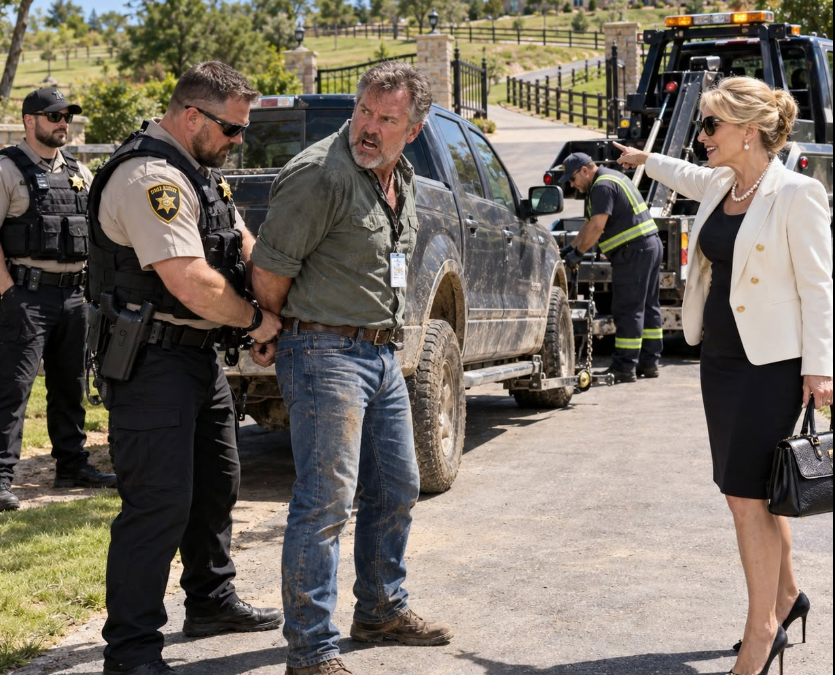
HOA Handcuffed Me, Seized My Truck, and Called Me a Fraud—Then Their Lawyer Opened the One Case I Warned Them Not to Touch.
The handcuffs snapped shut around my wrists while the HOA president laughed at my federal credentials.
She ordered her security chief to tow my truck, search everything inside it, and treat me like a criminal standing on a road she did not even own.
I warned her only once not to open the locked black case behind my seat—but by then, she had already decided whatever was inside would prove I was the fraud she desperately wanted me to be.
My name is Everett Slade.
That morning was supposed to be boring.
I had left before sunrise in my gray pickup with a thermos of coffee in the cup holder, a stack of subpoenas on the passenger seat, satellite photographs folded beneath a county plat map, and enough property records to keep an accountant miserable for a week.
Behind my seat sat a locked black case.
Nothing about the truck looked official.
That was deliberate.
No government plates.
No agency markings.
No flashing lights.
No antenna farm sticking out of the roof.
Just an older pickup with road dust along the doors and enough scratches in the bed to make it look as though I spent my weekends hauling fence posts instead of working federal land fraud cases.
For three months, I had been assigned to an interagency task force examining suspicious property transfers scattered across the county.
Most of them looked harmless when considered alone.
An assessment notice here.
A lien there.
A distressed sale.
A parcel transferred to a holding company.
A boundary adjustment.
Nothing dramatic.
Nothing that would make the evening news.
But financial fraud rarely announces itself with a flashing sign.
It hides in paperwork.
It survives because most people never place one harmless-looking document beside another and ask why the same names, addresses, signatures, and money keep appearing.
We had started placing them side by side.
That was how Silver Crest Ridge entered our investigation.
The gated community sat along the southern edge of Cedar Basin, surrounded by wooded acreage, old farms, and privately owned parcels that had existed long before anyone poured the first foundation inside the subdivision.
Silver Crest Ridge itself was polished.
Stone entrance walls.
Trimmed hedges.
Decorative lamps.
A clubhouse that looked more expensive than some county offices I had worked inside.
The problem was what had been happening outside those walls.
Property owners who had never joined the HOA were receiving assessment notices.
Some ignored them.
Then liens appeared.
Then legal notices.
PART2:
Then, in several cases, the properties changed hands.
A company called Ridgeway Holdings appeared again and again.
Seventeen parcels had caught our attention.
More than eleven million dollars in combined value.
I was not going to Silver Crest Ridge that morning to confront anybody.
I was supposed to meet a man named Clayton Rusk.
Clayton owned thirty-eight acres north of the development. Six months earlier, survey stakes had appeared along his land. When he called the HOA, someone told him an easement had already been recorded across his property for a future access road.
Clayton had one problem with that explanation.
He had never signed an easement.
My job that morning was simple.
Meet Clayton.
Look at the original deed.
Get a handwriting affidavit.
Photograph the boundary.
Leave.
I chose Cedar Basin Road because it approached Clayton’s property from the north and allowed me to avoid the Silver Crest Ridge main gate.
I did not want an audience.
I had no intention of entering HOA property.
Then I came around a curve and saw the barrier.
A metal arm had been stretched across Cedar Basin Road.
Beside it stood a hand-painted sign.
PRIVATE HOA ACCESS
RESIDENTS ONLY
I slowed the truck.
Then I stopped.
I knew the county maps well enough to know exactly where I was.
Cedar Basin Road was public.
The HOA had no authority to close it.
PART3:
At first, I wondered whether there had been temporary construction.
I checked the shoulder.
No county notice.
No work permit.
No detour sign.
Just an HOA barrier planted across a road taxpayers maintained.
I looked at the clock.
Meeting Clayton could wait five minutes.
I parked on the shoulder, stepped out, and took several photographs.
One wide shot.
One showing the road marker.
One showing the barrier relative to the property line.
Then I pulled the plat map from my truck and compared the coordinates.
That was when I heard engines.
Two black SUVs came fast down the gravel shoulder from the direction of the community.
They stopped hard enough to throw dust around my boots.
The driver’s door of the first SUV opened.
A broad-shouldered man stepped out wearing a black polo with SILVER CREST SECURITY stitched across the chest.
His name, I would later learn, was Brock Harlan.
He walked toward me with the posture of a man who had spent too much time being obeyed.
“Get back in the truck.”
I lowered my phone.
“Excuse me?”
“You heard me. Get back in your vehicle.”
“Is there a problem?”
“You’re on private property.”
I looked down at the pavement beneath my boots.
“No, I’m not.”
His expression hardened.
“Do you live here?”
“No.”
“Then you’re trespassing.”
I almost smiled.
“That isn’t how property law works.”
Brock moved closer.
“You need to leave.”
“If you believe I’m trespassing, call the sheriff.”
That slowed him for perhaps half a second.
Then his jaw tightened.
“We handle our own security.”
“On HOA property, perhaps.”
I tapped the county road marker.
“This is Cedar Basin Road.”
“I know what road it is.”
“Then you know the county owns it.”
Another guard had stepped out of the second SUV. He stayed several yards back, one hand near his belt.
Brock glanced at my truck.
“What are you doing here?”
“Taking photographs.”
“Of what?”
“The barrier.”
“For who?”
“That isn’t your concern.”
His voice changed.
People who believe they possess authority often have a particular reaction when someone calmly refuses to surrender to it.
They do not hear calmness as confidence.
They hear it as disrespect.
Brock took another step toward me.
“You need to identify yourself.”
I could have refused.
Instead, I reached slowly into my pocket and removed my credential wallet.
“Everett Slade.”
I opened it.
Brock stared at the federal lettering.
His eyes moved over the seal.
He clearly did not understand what he was looking at.
That should have been the moment he called someone.
Instead, pride took over.
He reached for the credential wallet.
I let him take it.
Behind us, another vehicle approached.
A white sedan.
It stopped near the SUVs, and a woman stepped out.
She wore a cream jacket, dark slacks, and the expression of someone arriving at a meeting she already expected to control.
Lenora Pike.
President of the Silver Crest Ridge Homeowners Association.
She looked first at Brock.
Then at me.
Then at my truck.
Her eyes stayed on the pickup longer than they stayed on my face.
I watched her make a decision about me before either of us had spoken.
That judgment would shape almost everything that followed.
“What is this?” she asked Brock.
“Caught him photographing the entrance.”
“I wasn’t photographing your entrance,” I said.
She ignored me.
“Who hired him?”
“I don’t know.”
Lenora finally looked directly at me.
“Which resident sent you?”
“No resident sent me.”
“So you’re a surveyor?”
“No.”
“A reporter?”
“No.”
Her irritation grew.
“What are you?”
I nodded toward the wallet in Brock’s hand.
“He has my identification.”
She took it from him.
She looked at it for perhaps three seconds.
Then she laughed.
Not nervous laughter.
Not uncertain laughter.
The kind of laugh someone uses when they want everyone nearby to understand that they have already decided the other person is ridiculous.
“Federal?”
“Yes.”
“You expect me to believe this?”
“I expect you to return it.”
She held the wallet between two fingers.
“You can buy badges like this online for twenty dollars.”
“Not that one.”
“Oh, please.”
“Call the number.”
“What number?”
“The verification number printed beneath the commission reference.”
She did not look.
Instead, she snapped the credential wallet shut.
“Who are you pretending to be?”
“I already told you my name.”
“I asked what you’re pretending to be.”
I looked at Brock.
“Call the sheriff.”
Lenora laughed again.
“We don’t need the sheriff.”
“Yes, you do.”
She turned toward Brock.
I remember the next two words very clearly.
“Cuff him.”
Brock hesitated.
It was tiny.
Just a fraction of a second.
But I saw it.
Then he stepped behind me.
I could have made the situation difficult.
I could have pulled away.
I could have raised my voice.
I could have told them exactly what federal authority I was operating under and what statutes they were drifting toward violating.
Instead, I placed my hands behind my back.
Metal closed around my wrists.
Click.
Click.
The sound was sharper than I expected against the quiet road.
Lenora watched as though something had just been proven.
“Now,” she said, “maybe you’ll tell us who hired you.”
I looked at her.
“You’re making a serious mistake.”
“They all say that.”
“Who is they?”
“People who think intimidation works here.”
Brock tightened his grip on my arm.
I turned my head slightly.
“Do not damage my shoulder.”
“Then cooperate.”
“I am cooperating.”
They began moving me toward the SUV.
That was when I stopped.
Not physically.
I simply turned enough to look at Lenora.
“There is a locked black case behind the driver’s seat.”
She followed my eyes toward the truck.
“Okay.”
“Whatever you do, don’t touch it.”
Something changed in her expression.
Not caution.
Interest.
She smiled.
It was the wrong response.
I knew it immediately.
Lenora heard my warning and interpreted it as fear.
To her, the black case was no longer something she should leave alone.
It was proof that she had discovered something.
“What is in it?” she asked.
“Protected material.”
“Protected from whom?”
“You.”
Her smile disappeared.
Then returned colder.
“We’ll see about that.”
I exhaled slowly.
“Call the sheriff.”
“No.”
“Then call your attorney.”
That suggestion pleased her.
“I intend to.”
Brock put me in the rear of the security SUV.
Lenora stood by my pickup and began making phone calls.
From where I sat, I could hear pieces of the conversation through the open door.
She called their towing contractor first.
She described my truck as an unauthorized trespass vehicle.
Then she started inventing numbers.
Fifteen hundred dollars in towing charges.
Seven hundred fifty for security response.
Five hundred dollars in administrative penalties.
When she finished, I called through the open door.
“Are those fees written anywhere?”
She looked at me.
“They’re association policy.”
“Where?”
“In our rules.”
“Which rule?”
“You’ll receive documentation.”
“I’m looking forward to it.”
My calm annoyed her more than anger would have.
She pointed at Brock.
“Search the vehicle.”
I leaned forward.
“Don’t.”
Lenora turned.
“Don’t what?”
“Search the vehicle without law enforcement present.”
“You were trespassing.”
“No, I wasn’t.”
“You were impersonating a federal officer.”
“You haven’t verified anything.”
“I don’t have to.”
“Yes, Lenora. You do.”
It was the first time I used her name.
She froze.
“How do you know my name?”
“It is printed on the HOA website.”
That answer was true.
It was not the entire truth.
Her name also appeared repeatedly in the task force files.
But until that morning, she had not been the center of our investigation.
Silver Crest Ridge was.
Ridgeway Holdings was.
The property transactions were.
Lenora Pike was one name among many.
That distinction would not survive the next few hours.
A tow truck arrived.
Brock opened my driver’s door.
He removed my laptop.
Then my camera.
Then folders.
One envelope had OFFICIAL USE printed across the front.
Lenora looked at it.
“Cute.”
I said nothing.
Brock pulled my radio from the console.
He reached behind the seat.
His hand landed on the black case.
I sat forward.
“Brock.”
He looked at me.
“That case contains protected federal material.”
Lenora folded her arms.
“Stop pretending.”
“Do not open it.”
“That is exactly what a fraud would say.”
“No. It is exactly what someone says when a case contains protected federal material.”
She stepped closer to the truck.
“Break the lock.”
Brock looked at her.
“You sure?”
“Yes.”
I watched the two of them for a moment.
Then I leaned back.
There comes a point in certain investigations when your role changes.
You stop trying to prevent a mistake.
You start documenting it.
“Who authorized that?” I asked.
Lenora looked at me.
“I did.”
“Good.”
“Good?”
“I wanted to be clear.”
She stared at me.
For the first time, I saw uncertainty.
It disappeared almost immediately.
“Take him inside.”
The security office was attached to the clubhouse.
They walked me through a side entrance, down a short hallway, and into a room with a steel desk, filing cabinets, monitors, and a large metal ring bolted to the edge of the furniture.
Brock unlocked one cuff.
Then he wrapped it through the ring and closed it around my wrist again.
I looked down.
“You do this often?”
“What?”
“Chain people to furniture.”
“Only when necessary.”
“Who decides necessary?”
He did not answer.
Lenora came in carrying my credential wallet.
She took out her phone.
“Look here.”
I stared at her.
She raised the phone.
Click.
She took a photograph.
“What was that for?”
“Community notice.”
“Community notice?”
“We’re warning residents that a federal impersonator was detained near the property.”
“You haven’t verified that I’m an impersonator.”
“I don’t need you telling me how to run my neighborhood.”
“This isn’t your neighborhood.”
Her eyes narrowed.
“What did you say?”
“This room may be. The houses may be. The pool probably is.”
I lifted my cuffed wrist slightly.
“But Cedar Basin Road isn’t.”
She stepped closer.
“You came here looking for trouble.”
“No.”
“Then why were you photographing our barrier?”
“Because your barrier was on a public road.”
“You keep saying that.”
“Because it remains true.”
She studied me, waiting for fear.
I gave her none.
She was not accustomed to that.
“I’m sending your photograph to every household.”
I nodded.
“Please do.”
That stopped her.
“What?”
“You heard me.”
“You think this is funny?”
“No.”
“Then why are you smiling?”
“I wasn’t.”
She stared harder.
I could almost see the questions forming.
Why wasn’t I frightened?
Why wasn’t I begging?
Why wasn’t I trying to escape?
Why had I asked repeatedly for the sheriff?
People who manufacture authority depend heavily on emotional reactions from the people they control.
Fear validates them.
Calmness does the opposite.
Lenora left the room.
Brock remained near the door.
I looked around.
Twelve camera feeds rotated across the monitor.
Main gate.
Pool.
Clubhouse parking lot.
Rear service entrance.
Sidewalk.
Then Cedar Basin Road.
The barrier.
The exact place where they had handcuffed me.
I looked away before Brock noticed.
That footage mattered.
So did every camera between the road and the security office.
If their system retained audio, even better.
Outside, my truck rolled past the clubhouse on the tow rig.
A device hidden below the dashboard had already done its job.
The moment the vehicle moved without the proper authorization sequence, it transmitted an alert.
I did not know exactly who would receive it first.
I only knew somebody would.
Brock paced.
“You really work for the government?”
I looked at him.
“You had my credentials.”
“That wasn’t what I asked.”
“What do you think?”
He looked toward the hallway.
“I think Lenora knows what she’s doing.”
“That wasn’t what I asked either.”
He stopped pacing.
“You trying to scare me?”
“No.”
“You’re awfully calm.”
“I asked you to call the sheriff.”
“Lenora said not to.”
“I noticed.”
He rubbed his jaw.
“What agency?”
“I’ll explain it to law enforcement.”
“You don’t want to tell me?”
“I already did.”
“When?”
“When you looked at the credential wallet.”
He did not respond.
Twenty minutes passed.
Then a man walked into the room carrying a leather briefcase.
Preston Vail.
Attorney for Silver Crest Ridge.
He stopped the instant he saw me cuffed to the desk.
His eyes moved from me to Brock.
Then to Lenora.
“What is this?”
Lenora entered behind him.
“We detained an impersonator.”
Preston looked at the cuff.
“Detained?”
“Yes.”
“By whom?”
“Our security.”
“Was he arrested by law enforcement?”
“No.”
“Then why is he handcuffed?”
“He was trespassing.”
“Where?”
“Cedar Basin Road.”
Preston looked at her.
“The county road?”
“Our access road.”
“Lenora, Cedar Basin is county maintained.”
“That is a technical distinction.”
“No. It’s a property distinction.”
Her mouth tightened.
“He was photographing us.”
“That isn’t a crime.”
“He impersonated a federal officer.”
Preston looked at me.
“What did he do to impersonate one?”
Lenora held up my credential wallet.
“This.”
“Who verified it was false?”
Silence.
Preston’s face changed.
Very slightly.
He turned to Brock.
“Did you call the sheriff?”
“No.”
“County dispatch?”
“No.”
“Federal verification?”
“No.”
Lenora interrupted.
“I called you.”
Preston closed his eyes for half a second.
“Where are his belongings?”
“Impound lot.”
“You towed his vehicle?”
“He was trespassing.”
“Did you search it?”
Lenora pointed toward a conference table.
My laptop sat there.
My folders.
My camera.
My radio.
And the black case.
The lock had been cut.
Preston stared at it.
“Tell me you did not force that open.”
Lenora crossed her arms.
“We needed evidence.”
“Evidence of what?”
“Fraud.”
“Based on what?”
“He told us not to open it.”
Preston looked at her as though he had not heard correctly.
“That was your reason?”
“It was suspicious.”
“People usually tell strangers not to break into locked cases.”
“He claimed it contained federal material.”
Preston went very still.
Then he walked to the table.
I watched him open the case.
The first document he removed carried an embossed seal.
My full name was printed beneath it.
Everett James Slade.
Special Deputy United States Marshal.
Task force authorization.
Commission number.
Expiration date.
Agency signatures.
Preston read it once.
Then again.
His face lost color.
Lenora watched him.
“Well?”
He did not answer.
“Preston?”
He picked up the commission.
He held it closer to the light.
Then he looked at me.
“Who put the cuffs on you?”
Brock raised his hand reluctantly.
Preston looked at Lenora.
“Who ordered the vehicle seized?”
“I did.”
“Who ordered the search?”
“I did.”
“Who ordered this case opened?”
“I did.”
Each answer came with less confidence.
Preston lowered the document.
“Lenora.”
“What?”
His voice became very quiet.
“You just detained a federally commissioned officer.”
The room changed.
I could feel it.
Brock stopped moving.
Lenora stared at Preston as though he had betrayed her.
“No.”
“Yes.”
“No. Check it again.”
“I did.”
“It could be forged.”
Preston removed the next document.
His eyes found a name near the bottom.
Mara Whitfield.
Assistant United States Attorney.
He knew it.
I saw recognition hit him.
He set the paper down.
“Remove the cuffs.”
Brock moved toward me.
“No,” I said.
Everyone looked at me.
Preston blinked.
“What?”
“Leave them.”
“Mr. Slade, I strongly recommend—”
“I know exactly what you recommend.”
I lifted my wrist.
“You wanted an official record of what happened here.”
I looked at Lenora.
“Let’s keep it exactly the way you made it.”
Nobody spoke.
Preston slowly turned another page.
Then he stopped.
Across the top was a heading.
SILVER CREST RIDGE HOMEOWNERS ASSOCIATION
TARGET PROPERTY ANALYSIS
Preston looked at me.
Then at Lenora.
Then back at the document.
“You were investigating us.”
“I was investigating property transactions.”
“How long?”
“Long enough.”
Lenora stepped forward.
“This is harassment.”
Preston raised a hand.
“Stop talking.”
She looked stunned.
He had probably never spoken to her that way before.
“What did you say?”
“I said stop talking.”
“You work for us.”
“Right now, Lenora, I am trying to determine what exactly you’ve dragged me into.”
I watched her face.
Anger.
Disbelief.
Then calculation.
That last one interested me.
Fear is often honest.
Calculation rarely is.
Preston looked at me.
“Was this investigation based on one complaint?”
“No.”
“What then?”
“A pattern.”
“What kind?”
I looked toward Lenora.
“Would you like the short version?”
She said nothing.
“Over the last eighteen months, landowners outside Silver Crest Ridge began receiving HOA assessments.”
Preston frowned.
“Outside?”
“Completely outside.”
Lenora shook her head.
“That’s not accurate.”
I continued.
“When they refused to pay, liens were filed.”
“Lawful liens,” she said.
“Then a company called Ridgeway Holdings began purchasing the debts.”
Preston looked at her.
I continued.
“In several cases, Ridgeway eventually acquired the land.”
“That proves nothing.”
“No. Not by itself.”
I leaned slightly against the chair.
“But Ridgeway Holdings uses a mailing address less than two miles from this management office.”
“That is coincidence.”
“The payment address isn’t.”
She stopped.
Preston looked at her.
I continued.
“Neither are the legal notices.”
“What legal notices?” Preston asked.
I nodded toward the documents from my case.
“Those.”
He picked up one.
I watched his eyes move down the page.
He read another.
Then another.
His breathing changed.
“This is my letterhead.”
“Yes.”
“I didn’t write this.”
Lenora spoke quickly.
“Your staff handles collections all the time.”
“My staff does not issue notices against nonmember property.”
“You don’t remember every notice.”
“I remember my own language.”
He pointed at a signature block.
“And I remember what I sign.”
Lenora looked toward me.
“You planted those.”
I almost laughed.
“You opened my locked case twenty minutes ago.”
“You could have prepared them.”
“Then I’m fortunate your cameras recorded Brock removing them from my truck.”
That landed.
Her head turned toward the monitor.
Preston noticed.
“So there is footage?”
Brock answered.
“Everything is recorded.”
“Preserve it.”
Lenora immediately said, “We don’t know whether the system is functioning properly.”
Preston looked at her.
“What does that mean?”
“Exactly what I said.”
He stepped toward her.
“Do not touch that system.”
She folded her arms.
“You’re overreacting.”
“No, Lenora. I don’t think I’ve started reacting yet.”
The first sheriff’s deputy arrived several minutes later.
Then another.
Lenora visibly relaxed when she saw the uniforms.
I remember thinking how strange that was.
I had asked her to call them from the beginning.
Now she believed they were there to rescue her from me.
One deputy walked through the door holding a small tablet.
“Who owns the gray pickup?”
“I do,” I said.
He looked at me cuffed to the desk.
Then he looked back at the tablet.
His eyebrows rose.
“Why is it in your impound lot?”
Lenora stepped forward.
“Trespassing.”
The deputy looked at her.
“On Cedar Basin?”
“Yes.”
“Cedar Basin is a county road.”
“It serves our community.”
“That doesn’t make it private.”
“He was impersonating a federal officer.”
The deputy glanced at me.
“Credentials?”
Lenora handed him my wallet.
He opened it.
The recognition on his face was immediate.
Unlike Brock, he knew enough to stop talking and verify.
He keyed information into his radio.
Dispatch answered.
The room waited.
I watched Lenora.
Her chin stayed raised.
Her arms stayed folded.
But one finger tapped against her elbow.
Once.
Twice.
Three times.
Then dispatch came back.
“Credential verified.”
The deputy looked directly at Lenora.
“Everett James Slade. Current commission.”
Nobody spoke.
He looked at Brock.
“Take those cuffs off.”
Brock moved immediately.
Metal opened.
I rubbed my wrist.
A red band circled the skin.
The deputy looked at me.
“You want medical attention?”
“No.”
“Anything taken?”
“My vehicle. Laptop. Camera. Radio. Documents. Protected case.”
“Anything accessed?”
I looked at Brock.
“The laptop?”
He swallowed.
“We opened it.”
“How many times?”
He said nothing.
I waited.
“How many access attempts?”
“I don’t know.”
That answer mattered.
The laptop contained sealed investigative information.
Every login attempt was recorded remotely.
Every failed authentication.
Every external connection.
Every attempt to copy files.
Technology has a useful quality when people lie.
It remembers.
Preston pulled Lenora toward the far side of the room.
He lowered his voice.
I could still hear him.
“You are not deleting anything.”
“I wasn’t going to.”
“No emails. No security video. No server files. No text messages. No meeting minutes. Nothing.”
“Why are you talking to me like I’m a criminal?”
“Because if you alter anything after learning there is a federal investigation, this changes.”
“Changes into what?”
“Obstruction.”
She looked at me.
“What investigation?”
I answered.
“The federal one.”
Her face hardened.
“How much are you claiming?”
“We are reviewing at least seventeen property transfers.”
Preston looked at me.
“Value?”
“More than eleven million total.”
For the first time that morning, Lenora looked genuinely pale.
Only for a second.
Then she recovered.
“Every one of those transactions was legal.”
“Excellent.”
“What?”
“If they’re legal, you’ll have no objection to providing the complete records voluntarily.”
Her answer came immediately.
“You need a warrant.”
I nodded.
“That was always the plan.”
Outside, three black SUVs turned into the clubhouse driveway.
No sirens.
No flashing lights.
They did not need them.
Residents walking dogs stopped.
A landscaping crew paused near the median.
Several people came out onto porches.
The vehicles parked in a line.
Doors opened.
Assistant United States Attorney Mara Whitfield stepped out first.
She entered the clubhouse with four investigators and a digital forensic specialist carrying two equipment cases.
Mara saw me.
Her eyes dropped to my wrist.
Then to the cut lock on the black case.
Then to Lenora.
“Who detained my officer?”
Nobody answered.
I did.
“Brock Harlan placed the cuffs on me under Ms. Pike’s direct instruction.”
Mara looked at Brock.
“Where is the vehicle?”
“Impound yard behind maintenance.”
“Who searched it?”
Brock hesitated.
Mara waited.
“I did.”
“Under whose authority?”
He looked at Lenora.
Mara turned to her.
Lenora lifted her chin.
“He entered restricted property.”
“No, he didn’t,” the deputy said.
Lenora shot him a look.
Mara opened a folder.
“Ms. Pike, this is a federal preservation order.”
She placed it on the table.
“It covers association email, financial records, server data, towing records, security video, lien documents, board minutes, communications with Ridgeway Holdings, and any documents related to property transactions under investigation.”
Lenora stared at it.
“You can’t just walk in here.”
Mara looked at the deputies.
“We can stand here while the appropriate process continues.”
“Our server is undergoing maintenance.”
The forensic specialist looked up.
“Right now?”
“Yes.”
“Who authorized it?”
Lenora hesitated.
“That is an internal matter.”
He looked at Mara.
She nodded.
We moved toward the server room.
Lenora followed.
Preston followed her.
Brock stayed near the deputies.
Inside the small server room, the forensic specialist crouched beside a rack.
Then he stopped.
“Don’t touch anything.”
Nobody moved.
An external drive was connected to the main system.
Activity light blinking.
He checked the workstation.
Files were actively transferring.
Not a scheduled backup.
Not routine maintenance.
A live copy.
“When did this start?” Mara asked.
He checked.
Then checked again.
“Seven minutes after credential verification began in the conference room.”
Lenora spoke quickly.
“Our office manager probably—”
“Your office manager isn’t here,” Brock said from the doorway.
Everyone turned.
Lenora stared at him.
He swallowed.
“She called out today.”
The specialist photographed the setup.
I crouched slightly and looked at the external drive.
Two letters had been written on a small label in permanent marker.
LP.
I said nothing.
I did not need to.
Preston saw it.
So did Mara.
The forensic specialist read the transfer timestamp aloud.
Seven minutes.
Mara looked at Lenora.
“Who owns this drive?”
“I don’t know.”
“Initials?”
“Could mean anything.”
Preston closed his eyes.
Something had shifted for him.
Until then, I think some part of him had believed this might still be explained as recklessness.
An overbearing HOA president.
A security team with too much confidence.
A terrible misunderstanding.
The drive changed that.
Because misunderstandings do not begin copying server files seven minutes after someone learns federal investigators are involved.
Preston asked to speak privately with Mara.
Lenora snapped, “You represent the association.”
He turned toward her.
“I represented the association.”
“What does that mean?”
“It means documents bearing my signature appear to have been issued without my authorization.”
“My staff used templates you approved.”
“Inside association boundaries.”
“It’s the same thing.”
“No.”
His voice sharpened.
“It is absolutely not the same thing.”
He looked at Mara.
“My firm archives every version of every legal template we create.”
That sentence changed the direction of the investigation.
Within an hour, Preston’s office began transmitting archived originals.
We placed them beside the versions recovered from the HOA server.
At first glance, the documents looked nearly identical.
Same letterhead.
Same formatting.
Same signature block.
Same legal citations.
Then one of our analysts found two words.
HOA parcel.
That was the language in Preston’s original.
HOA controlled parcel.
That was the language in Lenora’s version.
Two words.
That was all.
But those two words expanded the claimed jurisdiction of Silver Crest Ridge beyond property actually belonging to the association.
Preston stared at the documents.
“I never wrote that.”
Lenora sat silently.
He turned toward her.
“I never authorized that.”
She finally answered.
“It was a clarification.”
“A clarification?”
“The association exercised control over those parcels.”
“Control based on what?”
“Operational necessity.”
Preston looked almost offended by the phrase.
“You cannot manufacture ownership through operational necessity.”
Lenora’s eyes flashed.
“Everything I did protected property values.”
I spoke for the first time in several minutes.
“Did Ridgeway Holdings protect property values?”
She looked at me.
“I don’t know what you’re implying.”
“I haven’t implied anything.”
“You keep saying that company as though it belongs to me.”
“Does it?”
“No.”
The forensic accountant sitting across the room looked up from his screen.
“Payment address for Ridgeway’s registered agent routes to a post office box.”
Lenora shrugged.
“So?”
He continued.
“The box was paid using a Silver Crest Ridge corporate card.”
Silence.
Preston slowly sat down.
I watched Lenora.
She did not look surprised.
That was more interesting than anything she could have said.
Preston rubbed his forehead.
“There was a transfer.”
Lenora turned sharply.
“What?”
He looked at Mara.
“About two years ago. Six hundred forty thousand dollars.”
“For what?” I asked.
“Strategic land acquisition.”
“Paid to?”
“Ridgeway Holdings.”
Lenora interrupted.
“The board approved it.”
Preston looked at her.
“I objected to the amount.”
“And the board overruled you.”
“That is what you told me.”
“They voted unanimously.”
Mara said, “Then there will be minutes.”
Lenora said nothing.
We pulled the board records.
There was indeed a meeting entry for the transaction.
PROPOSAL APPROVED UNANIMOUSLY BY BOARD.
On its face, that supported Lenora.
Then the forensic technician recovered an earlier version of the same file.
Four words.
PROPOSAL DENIED BY BOARD.
Preston leaned closer to the monitor.
He stared.
Lenora did not.
Her eyes stayed fixed on the table.
Mara asked, “Who has administrative access to edit board minutes?”
Lenora answered slowly.
“Several people.”
“Names?”
“I’d need to check.”
The technician said, “Revision metadata lists LPike.”
Lenora closed her eyes.
Only briefly.
Then she opened them and said, “That account is used by multiple administrators.”
Brock laughed once from the doorway.
Not because anything was funny.
It was the involuntary sound a person makes when a lie has become too obvious to respect.
Lenora turned on him.
“You have something to say?”
He shook his head.
“No, ma’am.”
The title sounded different now.
Not respectful.
Habitual.
The forensic accountant continued tracing Ridgeway.
Wire transfers.
Trust accounts.
Acquisition payments.
The numbers stretched across three years.
Careful amounts.
Careful timing.
Enough distance between them to look unrelated unless somebody already knew where to look.
Preston stood beside me.
“How long did you suspect her?”
I answered truthfully.
“I didn’t.”
He looked surprised.
“You were investigating Silver Crest Ridge.”
“Yes.”
“And Ridgeway.”
“Yes.”
“But not Lenora?”
“Not specifically.”
He looked across the room.
Lenora was arguing quietly with Mara.
“So this morning…”
“Changed things.”
“How?”
“She put herself in the center.”
“By detaining you?”
“By what she did afterward.”
The cuffs mattered.
The truck mattered.
The forced search mattered.
But investigators learn to separate arrogance from evidence.
Lenora had done something far more damaging than handcuff a federal officer.
She had started moving records the moment she learned what I was.
That was not arrogance.
That was consciousness.
I finally explained why I had come to Cedar Basin Road.
“Clayton Rusk.”
Preston frowned.
“The farmer?”
“Thirty-eight acres behind the development.”
“I know who he is.”
“He says Silver Crest Ridge recorded an easement across his land.”
“We have an easement.”
“He says he never signed it.”
Preston looked toward Lenora.
She heard.
Her head turned.
“That is false.”
“What part?” I asked.
“He signed.”
“You saw him sign?”
“The consultant handled it.”
“Which consultant?”
She gave a name.
Preston immediately looked at Mara.
“I know him.”
“How?”
“He did work for Ridgeway Holdings.”
The room went quiet again.
There are moments in an investigation when separate lines suddenly become one line.
That was one of them.
The liens.
Ridgeway.
The legal templates.
The board records.
The easement.
Silver Crest Ridge’s planned expansion.
Everything began touching everything else.
I called Clayton.
He arrived later that afternoon wearing muddy work boots and a faded jacket.
He looked uncomfortable the moment he stepped through the clubhouse doors.
Federal agents.
Sheriff’s deputies.
Computer equipment.
Files across tables.
He saw Lenora.
His face tightened.
She looked away.
I met him near the entrance.
“Sorry your morning got more complicated.”
He looked at my wrist.
“What happened to you?”
“Long story.”
“I’ve got time.”
“Unfortunately, so do I.”
That earned a small smile.
Then he became serious.
“You found the easement?”
“We found something.”
He sat with us and explained the timeline.
Twenty years farming the same land.
No conflict with Silver Crest Ridge.
Then six months earlier, stakes appeared near his back line.
Orange ribbons.
Survey paint.
No notice.
No phone call.
He contacted the HOA.
They told him an easement had already been recorded and construction planning had begun for a secondary access road.
Clayton remembered laughing.
Not because it was funny.
Because it was impossible.
“I told them they were standing on the wrong farm,” he said.
Lenora sat several yards away with an investigator.
Clayton pointed toward her.
“She called me herself.”
Lenora looked up.
“What did she say?” Mara asked.
Clayton’s voice hardened.
“That fighting it would cost me more than cooperating.”
Lenora shook her head.
“I never said that.”
Clayton looked at her.
“You told me your lawyers would bury me.”
“I said litigation would be expensive.”
“You told me to think about whether thirty-eight acres was worth destroying my retirement.”
Lenora folded her arms.
“I was explaining risk.”
Clayton laughed bitterly.
“That’s what you call it?”
We retrieved the recorded easement.
The notary seal looked legitimate.
The signature did not.
Clayton stared at it.
“That’s not mine.”
“You’re certain?”
He looked at me.
“Everett, I have been signing my name for sixty-three years.”
He took the pen we offered.
He signed once.
Then again.
The difference was obvious.
The forged signature was stiff.
Clayton’s natural signature had a long descending stroke in the R and a sharp finish on the k.
The document did not.
Mara looked toward Lenora.
“Who submitted this?”
Lenora repeated the consultant’s name.
The same consultant tied to Ridgeway.
The loop tightened.
Then came the money.
The forensic team located a private trust.
The beneficiary was Lenora Pike.
More than one point eight million dollars had passed through it over three years.
Not association money moving into association improvements.
Not land purchased for residents.
Not reserve funds.
Private trust.
Private beneficiary.
Lenora.
When Mara placed the record in front of her, Lenora’s face changed in a way I had not seen all day.
The anger disappeared.
So did the superiority.
What remained was fear.
“That isn’t what it looks like.”
Mara sat across from her.
“What does it look like?”
“A legitimate investment vehicle.”
“Funded by Ridgeway Holdings?”
“I want an attorney.”
Preston spoke without hesitation.
“You need one.”
Lenora looked at him.
“You are my attorney.”
“No.”
“You have represented me for years.”
“I represented the association.”
“You represented me as president.”
“Not for this.”
Her voice rose.
“You cannot abandon me in the middle of an investigation.”
Preston stared at her.
“If you used my signature and bar number on unauthorized legal documents, I am potentially a witness.”
“You approved the templates.”
“I did not approve fraud.”
The word hung in the room.
Fraud.
Until then, everyone had talked around it.
Transactions.
Documents.
Questions.
Discrepancies.
Unauthorized alterations.
Preston said the word.
Lenora looked at him as if he had struck her.
That was when one of our investigators handed Mara a newly recovered file.
She read it.
Then brought it to me.
“What do you make of this?”
I looked at the parcel number.
Then the map.
For a moment, I thought I was reading it wrong.
“This is the main gate.”
Mara nodded.
Silver Crest Ridge’s primary entrance sat partly on land the association did not own.
Years earlier, the HOA had obtained a temporary construction easement.
Twenty-four months.
That easement had expired.
Instead of renegotiating with the property owner, association maps had been altered.
The temporary right had quietly become permanent on internal documents.
Forty feet of roadway beneath the gate belonged to another parcel.
I looked across the room at Lenora.
Suddenly, her behavior that morning made even more sense.
The barrier.
The panic when she saw me photographing the road.
The obsession with knowing who had sent me.
She had assumed I was there because of the gate.
She had been wrong.
I knew nothing about the gate until she detained me.
I walked toward Mara.
“She wasn’t protecting the neighborhood this morning.”
Mara looked at the map.
“She was protecting the road.”
We called the county survey office.
A surveyor arrived with GPS equipment.
By then, residents had begun gathering outside.
Word had spread.
Nobody knew the whole story.
They knew federal vehicles had arrived.
They knew deputies were inside the clubhouse.
They knew Lenora Pike had been sitting with investigators for hours.
They knew somebody had removed the Cedar Basin barrier.
That was enough.
The surveyor started at the county marker.
One measurement.
Then another.
Metal stake.
Flag.
Another stake.
Another flag.
A bright line began forming across the landscape.
Through areas residents had assumed belonged to Silver Crest Ridge.
Across landscaping.
Near the entry wall.
Toward the gate.
I watched from the shoulder.
Clayton stood beside me.
“So you were never trespassing.”
“No.”
He shook his head.
“They cuffed you on county land.”
“Yes.”
“For photographing their illegal barrier.”
“Yes.”
“And then they found out you were investigating them.”
“Yes.”
He looked at me.
“That is one hell of a bad morning.”
“For them.”
He laughed.
It was the first time all day I did too.
The survey confirmed it.
The barrier where Brock had detained me sat entirely within the public right of way.
Not partially.
Not ambiguously.
Entirely.
Silver Crest Ridge security had left association property, physically detained me on public land, removed me to a private building, seized my vehicle, searched federally protected materials, attempted to access sealed data, and ignored repeated requests to contact actual law enforcement.
Then the evidence transfer began.
Mara gathered everyone in the main conference room.
Lenora sat at one end.
Brock near the wall.
Preston beside an investigator.
I stood near the window.
Mara listed the matters now under review.
Unlawful detention.
Unauthorized seizure.
Interference with federally protected materials.
Attempted access to sealed investigative data.
Evidence tampering.
Possible obstruction.
Mail fraud.
Wire fraud.
Fraudulent property transfers.
Potentially forged legal instruments.
Lenora listened.
Then she pointed at Brock.
“He did the detention.”
Brock’s face changed.
She continued.
“He made the decision to use restraints.”
“I told you I wasn’t comfortable with it,” he said.
“You are security chief.”
“You told me to cuff him.”
“That was your interpretation.”
Brock stared at her.
“My interpretation?”
“You are responsible for operational decisions.”
He pulled out his phone.
Lenora’s eyes widened.
“What are you doing?”
“Helping investigators.”
“Put that away.”
Mara held out her hand.
Brock unlocked the phone.
Then passed it across the table.
He opened a message thread.
There it was.
From Lenora.
CUFF HIM. TAKE THE TRUCK. SEARCH EVERYTHING.
Mara scrolled.
Another message.
DO NOT CALL COUNTY YET. FIND OUT WHO SENT HIM.
Another.
MOVE SERVER FILES IMMEDIATELY.
Nobody needed to speak.
Lenora stared at Brock.
“You saved those?”
He looked genuinely confused.
“You told me to save everything.”
For one brief second, nobody moved.
Then Preston turned his face away.
Clayton covered his mouth.
One deputy stared at the floor.
It was not funny.
But the irony was brutal.
Lenora had built her authority through records.
Notices.
Minutes.
Signatures.
Assessments.
Rules.
Documentation.
Now documentation was dismantling her piece by piece.
Mara stood.
“Ms. Pike, stand up.”
Lenora remained seated.
“Am I under arrest?”
“You are being detained for questioning while the investigation proceeds.”
“I want counsel.”
“You have that right.”
“I want Preston.”
Preston shook his head.
“I cannot represent you.”
She looked around the room.
For the first time since I had met her, nobody moved when she wanted them to.
Not Brock.
Not Preston.
Not the deputies.
Not residents.
Not me.
Her authority was gone.
Not because someone shouted louder.
Because the paperwork had stopped obeying her.
When a deputy reached for restraints, I spoke.
“Don’t.”
Mara looked at me.
I clarified.
“No public spectacle.”
Lenora looked toward me.
“Why?”
I did not answer her immediately.
Earlier that morning, she had photographed me while I was chained to a desk.
She had planned to circulate my face throughout the community.
She had wanted humiliation.
She had wanted neighbors to see a man she labeled a fraud before verifying one fact.
I had no interest in returning the favor.
“Do it correctly,” I said.
Mara nodded.
No photographs.
No dramatic march through the crowd.
No community newsletter.
No performance.
Just procedure.
Brock began cooperating.
Completely.
Text messages.
Towing orders.
Security logs.
Camera footage.
Internal instructions.
Previous incidents involving neighboring landowners.
Preston turned over his firm’s archive.
The digital team recovered deleted files.
Financial analysts traced transfers.
Every hour brought another connection.
By evening, residents stood outside in small groups.
Some were angry.
Some frightened.
Some embarrassed.
A few defended Lenora because accepting the truth meant admitting they had trusted her for years.
Most simply wanted answers.
I understood that.
Ordinary residents were not the target.
They had not built Ridgeway.
They had not altered board minutes.
They had not forged easements.
They had paid assessments, attended meetings, complained about landscaping, argued over parking rules, and trusted the elected leadership of their association.
That trust had been exploited.
In the weeks that followed, the court appointed a temporary financial administrator for Silver Crest Ridge.
Questionable liens were suspended.
All seventeen disputed property transfers entered formal review.
Landowners who had sold under pressure were given opportunities to file claims.
The expansion project across Clayton Rusk’s farm stopped immediately.
Survey stakes disappeared.
Construction plans froze.
Ridgeway Holdings became the subject of a separate asset investigation.
The one point eight million dollars connected to Lenora’s trust was frozen while investigators followed the rest of the money.
The number did not shrink.
The deeper they looked, the more complicated the trail became.
Silver Crest Ridge called an emergency board meeting.
Lenora was removed as president by unanimous vote.
The illegal Cedar Basin barrier came down.
The private detention policy disappeared.
The towing arrangement was terminated.
An independent financial audit began.
Access routes that had been restricted without lawful authority reopened.
Several neighboring landowners who had spent years fighting the HOA finally received letters acknowledging that their properties did not fall under Silver Crest Ridge jurisdiction.
Clayton called me after receiving his.
“I framed it.”
“You framed an HOA letter?”
“Best thing they’ve ever sent me.”
I smiled.
“What are you doing with the land?”
“Same thing I’ve always done.”
“Farming?”
“Exactly.”
The point mattered.
Good investigations do not create dramatic endings for everybody.
Sometimes the best ending is simply returning a person’s life to normal.
Clayton wanted his land.
Not revenge.
Not publicity.
His land.
Weeks after the original confrontation, the forensic examination of my pickup was finally complete.
I went to the towing yard to collect it.
The truck looked exactly the way it had before.
Gray paint.
Dust along the lower doors.
Scratch above the rear wheel.
Nothing about it suggested federal work.
A young employee walked around it while I signed the release paperwork.
“This is the government truck?”
“No.”
He looked confused.
“I heard it was federal.”
“It was assigned to an investigation.”
“But it belongs to the government?”
“No.”
“It belongs to you?”
“Yes.”
He looked at the dented bumper.
“Huh.”
I opened the driver’s door.
My black case sat nearby.
The lock had been replaced.
I put it behind the seat in the same place it had rested that morning.
The same place I had warned Lenora not to touch.
Outside the courthouse later that day, I saw Preston.
He had just finished another interview with investigators.
He looked exhausted.
Not frightened anymore.
Just older somehow.
He watched me approach the truck.
“There is something I still don’t understand.”
“What?”
“Why didn’t you just tell them?”
“I did.”
“No. I mean really tell them.”
I turned toward him.
“Tell them what?”
“That you were legitimate.”
“I showed them my credentials.”
“You could have explained the commission.”
“I offered verification.”
“You could have said you were investigating the HOA.”
“That information was protected.”
“You could have threatened them with federal charges.”
“That would not have made the credential more authentic.”
Preston looked down.
“I suppose.”
I reached into my pocket and opened the credential wallet.
The same one Lenora had held between two fingers as though it were a cheap prop.
“They had the truth in their hands.”
Preston studied it.
“They just didn’t believe it.”
“No.”
“Why?”
I closed the wallet.
“Because they decided the truth was fake when they didn’t like who was holding it.”
Preston did not answer.
I opened the truck door.
Before climbing inside, I took out the federal commission.
There was a small crease in one corner.
Probably from the morning Brock had searched the black case.
I ran my thumb across it.
Then smoothed it against the seat.
That piece of paper had not changed.
It was genuine when Brock first looked at it.
Genuine when Lenora laughed.
Genuine when she called me a fraud.
Genuine when the cuffs closed around my wrists.
Genuine when Preston finally opened the case and understood what they had done.
Confidence had not made Lenora right.
A security uniform had not transformed a county road into HOA property.
An association sign had not created legal jurisdiction.
An edited document had not created ownership.
A forged signature had not created consent.
And disbelief had never turned a legitimate federal commission into a fake one.
That was the part I remembered most.
Not the handcuffs.
Not the tow truck.
Not even Lenora’s expression when Preston first read my commission.
I remembered how quickly a group of people had decided that authority belonged to them simply because nobody had stopped them before.
They had erected a barrier.
People obeyed it.
They sent assessments.
People paid.
They filed liens.
People panicked.
They threatened litigation.
People sold.
They changed maps.
People accepted the new boundaries.
Every successful overreach made the next one easier.
Until one morning they blocked the wrong road in front of the wrong man.
My phone rang before I started the engine.
Mara.
I answered.
“You free?”
“For what?”
“I have an address.”
“That sounds ominous.”
“Another homeowners association.”
I leaned back against the seat.
“Of course.”
“Different county. Different shell company. Property transfer caught the analyst’s attention.”
“Any illegal roadblocks?”
“Not that we know of.”
“That’s encouraging.”
“You want the file?”
I looked through the windshield.
The road leading away from Silver Crest Ridge stretched toward the county highway.
The place where the barrier had stood was empty now.
No PRIVATE HOA ACCESS sign.
No security SUV.
No one demanding proof that I belonged there.
Just pavement.
Public road.
Exactly what it had always been.
“Send me the address.”
Mara laughed quietly.
“Already did.”
My phone buzzed.
I placed the commission back into the black case.
Closed the lid.
Slid it behind my seat.
Then I started the truck.
As I pulled away, I passed Silver Crest Ridge one final time.
Workers were removing the last mounting hardware from the old barrier.
A survey flag fluttered near the shoulder, marking the true county boundary.
Several residents drove through the gate.
Nobody stopped them.
Nobody interrogated them.
Nobody claimed ownership over the road.
I thought about Lenora.
That morning, she had stood beside my truck convinced that I was the threat to everything she had built.
In a strange way, she had been right.
She simply misunderstood why.
I had not arrived to expose her.
I had not known about the main gate.
I had not known about the server drive.
I had not known about Preston’s altered templates.
I had not known about the falsified board minutes.
I had not known the Ridgeway money ended in her private trust.
I had not even gone there looking for Lenora Pike.
I had gone to meet a farmer about one suspicious easement.
Lenora did the rest herself.
She blocked the road.
She sent security.
She ignored verification.
She ordered the cuffs.
She seized the truck.
She ordered the search.
She opened the case.
She started moving files.
She blamed everyone around her.
And every decision pushed investigators toward evidence we might otherwise have needed weeks or months to uncover.
That is the problem with people who become too comfortable exercising power without challenge.
Eventually they stop asking whether they have authority.
They start believing authority is whatever they decide to do next.
Lenora had spent years treating Silver Crest Ridge like a private government.
She controlled access.
She controlled records.
She controlled meetings.
She controlled legal notices.
She controlled security.
She controlled what residents were told.
For a long time, that control protected her.
Then she used it against somebody whose job was to follow records wherever they led.
And the records led straight back to her.
I turned onto the highway.
Silver Crest Ridge disappeared in the rearview mirror.
Ahead of me was another address.
Another set of property records.
Another shell company.
Another place where paper might be saying one thing while the truth said another.
My wrist still carried the faintest mark from the handcuff.
It would disappear.
The records would not.
That was the lesson Lenora Pike learned too late.
You can intimidate a person.
You can threaten a landowner.
You can put up a barrier.
You can print a notice.
You can even convince an entire neighborhood that your version of reality is official.
But eventually somebody checks the original.
And when that happens, paper has a way of remembering exactly who changed it.








