HOA Enforcers Tore Down the Gate I Built for My Late Wife—Then I Stepped Onto the Porch With My Father’s Shotgun, and Their President Made One Fatal Mistake When Real Police Arrived.
PART2:
Enough distance from the neighboring houses that I could stand outside at night and hear nothing except insects, distant traffic, and sometimes a coyote.
The first evening we spent there, Lily and I sat on the porch while the desert turned orange.
She looked at the mountains and said, “Mom would’ve liked this.”
That was the first time I knew I had made the right decision.
The realtor had mentioned an HOA during the purchase.
I barely cared.
Monthly dues.
Community maintenance.
Architectural standards.
Normal suburban bureaucracy.
I paid every bill on time.
Kept my property clean.
Never parked where I wasn’t supposed to.
Never caused trouble.
For eighteen months, the HOA barely existed in my life.
Then I built the gate.
The idea had started while Elena was still alive.
She loved sunrises.
During the worst months of treatment, when sleep became difficult for both of us, we would sometimes sit together before dawn.
Elena would wrap herself in a blanket and watch the first light come through the kitchen window.
She told me once that sunrise was proof the world could begin again even after the worst night.
After she died, I could not stop thinking about that sentence.
So when I decided my new home needed a gate, I didn’t want something from a hardware catalog.
I drew one.
Wrought iron.
Heavy but elegant.
PART3:
A large sun at the center with rays extending outward.
Not flashy.
Not gold.
Not ornate.
Just a simple southwestern design that reminded me of Elena.
I submitted the drawings to the HOA architectural review committee exactly as required.
Dimensions.
Material.
Finish.
Placement.
Everything.
They approved it.
In writing.
No conditions.
No objections.
I hired a local blacksmith named Jorge Ramirez who had been working iron for more than twenty years.
When he saw the drawing, he asked who had designed it.
“I did.”
He looked at the sun.
“Means something?”
I nodded.
“My wife.”
He didn’t ask anything else.
Three months later, he installed it.
I stood in the driveway after his truck left and stared at that gate until my vision blurred.
Then I cried.
Not dramatically.
No collapse.
No screaming.
Just tears.
For the first time since Elena’s funeral, I had created something instead of simply surviving something.
That gate was proof I could still build.
Lily found me standing there.
She touched the sun at the center.
“Looks like her.”
I laughed through the tears.
“I don’t know how a gate looks like your mother.”
“You know what I mean.”
I did.
The trouble started eleven days later.
The first violation notice appeared taped to the gate itself.
UNAPPROVED EXTERIOR MODIFICATION.
I assumed it was a clerical mistake.
I took a picture.
Emailed management.
Attached the architectural approval.
The property manager, Cynthia Bell, replied the next morning.
Mr. Anderson,
Thank you. Our records do reflect approval dated March 14. I will close the violation.
Problem solved.
That should have been the end.
Two days later, another notice appeared.
GATE HEIGHT EXCEEDS COMMUNITY STANDARD.
Same gate.
Same dimensions the board had approved.
I emailed again.
Cynthia responded more slowly.
Mr. Anderson,
There appears to be an internal discrepancy. I am reviewing with the board.
That phrase bothered me.
Internal discrepancy.
Three days later, Gerald Gomez came to my house.
Gerald had become HOA president about four months earlier.
I had seen him once at an annual meeting.
Mid-fifties.
Close-cropped gray hair.
Expensive sunglasses.
Golf shirts tucked too neatly into khakis.
He had the posture of a man who believed every conversation was easier if everyone else understood he was in charge.
He arrived in a black Chevrolet Tahoe with a gold emblem on the door:
SONORAN HEIGHTS COMMUNITY ENFORCEMENT.
I had never seen that logo before.
Gerald stepped out with another man wearing a tan tactical-style shirt.
The shirt had a patch:
COMMUNITY OFFICER.
The man wore a brass badge.
Not police.
No city.
No county.
Just:
OFFICER.
That was my first real warning.
Gerald walked toward the gate.
“Albert Anderson?”
“Yes.”
He extended his hand.
I shook it.
“I’m Gerald Gomez, board president.”
“I know.”
He looked at the gate.
“That structure has become a problem.”
“It was approved.”
“The previous committee made an error.”
I stared.
“What error?”
“It doesn’t conform to the updated visual standards.”
“When were those updated?”
“Last month.”
“My gate was approved before that.”
“Standards apply to existing exterior elements.”
“No.”
He smiled slightly.
“What do you mean, no?”
“I mean you don’t approve something in writing and then retroactively call it illegal because the board changed taste.”
“This isn’t about taste.”
“What is it about?”
He pointed toward the center sun.
“The design is personalized.”
“Yes.”
“Visible memorial features are not consistent with community uniformity.”
I actually laughed.
“Memorial features.”
“Personal monuments.”
“It’s a sun.”
“You’ve stated publicly it represents your wife.”
“I told my daughter.”
“That information has circulated.”
I felt something cold move through me.
“So because you know what it means to me, the design becomes prohibited?”
Gerald’s smile tightened.
“You’re oversimplifying.”
“Then simplify it correctly.”
“The board wants a standardized gate.”
“I don’t.”
“This is an HOA.”
“Yes.”
“You accepted shared standards when you bought.”
“Yes.”
“I also accepted an architectural process.”
He waited.
“I followed it.”
He glanced toward his badge-wearing companion.
“Approval can be rescinded.”
“Show me the provision.”
He looked back at me.
“What?”
“The declaration section allowing you to revoke an architectural approval after construction because you changed the rule.”
“You should contact counsel if you want legal debate.”
“No.”
I pointed toward the Tahoe.
“You came to my house.”
“You debate.”
Gerald’s eyes hardened.
“We’ll send formal notice.”
“Great.”
“And until then?”
“Stay off my property unless you are using the walkway to contact me.”
The so-called community officer shifted.
Gerald said:
“Our enforcement personnel have inspection rights.”
“Where?”
“Throughout the community.”
“Show me.”
Gerald gave me that tiny official smile.
“You’re going to make this harder than it needs to be.”
“No.”
I looked at the gate.
“I think the gate is making it exactly as hard as necessary.”
They left.
Lily had watched from the front window.
When I came inside, she was angry.
“What does he mean memorial features?”
“Nothing.”
“Can he make us take it down?”
“I don’t think so.”
“You don’t think so?”
“I’m going to read.”
That was my profession showing.
Software engineering does something to your brain.
You stop trusting interfaces.
You want underlying rules.
Architecture committee approval was one interface.
Declaration was the code.
So I read.
Every covenant.
Every amendment.
Every recorded supplement.
All 184 pages.
Then I read state statutes.
Then board policies.
The approval was valid.
The gate complied with every rule in force when approved.
The new visual standard applied prospectively.
Nothing authorized retroactive removal.
Nothing allowed private “community officers” to enter fenced property merely because a violation existed.
I sent Gerald a concise email.
The gate was approved.
The approval was relied upon.
Construction completed.
No applicable provision authorizes retroactive rescission.
Please identify any provision you believe otherwise.
He replied:
The board’s position remains unchanged.
No citation.
That was Gerald’s style.
Authority by repetition.
A week later, I got a $250 fine.
Then $500.
Then $1,000.
The amounts were not terrifying.
They were absurd.
I disputed every one.
Requested hearing.
At the hearing, Gerald chaired.
Naturally.
Five board members sat at a long folding table in the clubhouse.
Cynthia the manager sat off to one side.
Three residents attended for unrelated issues.
Gerald opened:
“Mr. Anderson, this hearing concerns ongoing noncompliance.”
I placed approval letter on table.
“No.”
He frowned.
“No what?”
“This hearing concerns your attempt to punish me for something the association approved.”
Board member named Janet McRae picked up my letter.
She was maybe sixty-five.
Retired teacher, I later learned.
“Gerald, is this authentic?”
“Yes.”
“Then why are we here?”
Gerald leaned back.
“The approval was issued under incomplete information.”
“What information?”
“The design intent.”
I asked:
“You would have rejected a sun if I said it was decorative?”
He looked at me.
“The memorial nature changes it.”
Janet said:
“How?”
Gerald’s jaw tightened.
“Our standards discourage personal memorial installations visible from common areas.”
I slid copy of standard.
“Adopted five weeks after approval.”
Another board member, Howard Kim, adjusted his glasses.
“That’s true.”
Gerald said:
“We have broad authority to correct architectural mistakes.”
Howard asked:
“Where?”
Gerald looked at him.
Then at me.
“This is not a courtroom.”
“No,” I said.
“Courtrooms have rules.”
Janet hid a smile.
The fines were tabled.
Not dismissed.
Gerald was furious.
Three days later, six men in tan shirts walked my street photographing the gate.
I installed cameras.
Not because I thought they would tear it down.
Because I had started understanding Gerald.
He did not hear disagreement as disagreement.
He heard it as a challenge to his legitimacy.
People like that do not back down when evidence appears.
They escalate until evidence becomes inconvenient enough to erase.
The men worked for a company called Desert Compliance Group.
DCG.
Private contractor.
Their website called them:
Community Enforcement Specialists.
Services:
Covenant patrol.
Parking control.
Property inspections.
Violation documentation.
Abatement coordination.
Uniformed compliance presence.
Photos showed badges.
Marked SUVs.
Amber light bars.
Not law enforcement.
But designed to borrow the feeling.
I searched Arizona corporate records.
Owner:
Victor Salazar.
Then something interesting.
Gerald Gomez’s wife’s maiden name was Salazar.
I did not know yet whether related.
I saved screenshot.
Two weeks later, Gerald sent an “Order to Cure.”
It said if I did not remove gate within ten days, association could conduct self-help abatement and charge costs to my account.
I forwarded everything to an attorney.
Her name was Rebecca Sloan.
She specialized in property and HOA disputes.
She read the approval.
Then the order.
Then asked:
“Did they cite self-help provision?”
“No.”
“Does declaration have one?”
“Only for emergency maintenance and limited nuisance conditions.”
“Gate emergency?”
“No.”
“Blocking sidewalk?”
“No.”
“Fire access?”
“No.”
“Public road?”
“No.”
She smiled without humor.
“Then Gerald is trying to create a remedy out of a heading.”
She sent a letter.
Stop.
No entry.
No gate removal.
No self-help rights established.
Any attempt to enter enclosed property or damage gate will be treated as trespass and property damage.
Gerald’s response came from HOA counsel this time.
A lawyer named Martin Ellis.
Much more careful.
The association believes gate approval may have been issued in error but will refrain from physical action pending review.
Good.
I slept better.
That was my mistake.
Because Gerald apparently decided “association” and Gerald were different things.
Two weeks of quiet.
Then Friday afternoon, a new notice.
Not from law firm.
From Gerald.
EMERGENCY ABATEMENT AUTHORIZATION.
It claimed my gate constituted:
An unauthorized obstruction affecting community emergency response, visual safety, and access control.
It referenced a county order number.
AZ-EM-4471.
It said Sonoran Heights had been “authorized by county authorities” to remove the obstruction if not voluntarily corrected within forty-eight hours.
Rebecca called county.
No such order.
She emailed me:
This appears false. Do not confront. I am notifying counsel and county attorney.
That should have ended it.
Saturday evening HOA lawyer emailed Gerald, board, management, and Rebecca.
The Association is not authorized to conduct physical abatement at the Anderson property at this time. No contractor should enter or alter the gate absent owner consent or lawful order.
I printed it.
Placed by front door.
I also called sheriff non-emergency and asked for an incident note.
“Possible private property conflict tomorrow.”
Dispatcher logged.
I slept badly.
At 6:42 Sunday morning, one of my cameras pinged.
Motion.
I opened phone.
Six men.
Tan shirts.
DCG.
Two pickup trucks.
One utility trailer.
Tools.
Gerald’s black Tahoe.
They were outside my gate.
I got out of bed.
Lily was already awake.
“Dad?”
“Stay inside.”
“What is it?”
“Gerald.”
Her face changed.
I opened camera feed again.
One man was using a cutoff tool near hinge.
Another had pry bar.
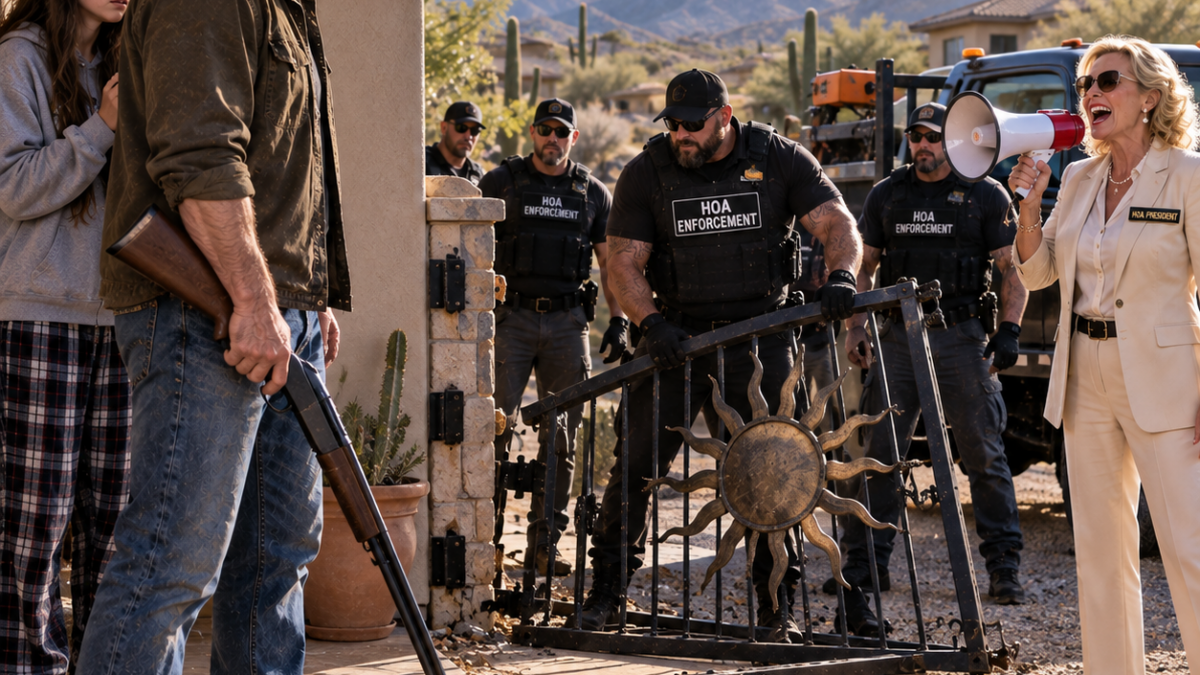
Gerald stood in street.
Megaphone in hand.
He said:
“Mr. Anderson, this is authorized community abatement. Do not interfere.”
I called 911.
“This is Albert Anderson, 1184 Sonoran Crest Drive. Six private HOA contractors are actively cutting my gate after written trespass notice. There is a disputed fraudulent-looking county order. I am inside with my daughter. I need deputies.”
Dispatcher asked:
“Any weapons?”
That question mattered.
“Yes.”
“I have a legally owned shotgun in the residence.”
“Is anyone threatening you directly?”
“They are entering fenced property and destroying the gate.”
“Stay inside if safe.”
I looked at camera.
The first hinge gave.
Metal crashed.
My father’s shotgun sat in a locked cabinet in bedroom closet.
Remington 870.
Old.
Wood stock.
He taught me to shoot when I was fifteen.
After he died, it became mine.
I had not fired it in years except once at a range.
I unlocked cabinet.
Loaded it.
Then stopped.
That moment deserves honesty.
I was angry.
Not scared enough.
Angry.
Six men were tearing apart the last thing I had built for Elena.
Lily stood in hallway.
“Dad, don’t.”
Those two words saved me from making a much worse decision.
I looked at her.
Seventeen.
Barefoot.
Elena’s eyes.
I lowered the muzzle.
“I am not going out there to threaten them.”
“Then why take it?”
“Because they’re entering the property.”
“Police are coming.”
“I know.”
“Stay inside.”
That was the safest answer.
I should have.
Then the second hinge gave.
The gate fell.
The sound was enormous.
Metal against concrete.
Lily gasped.
Something in me broke.
I stepped onto porch.
Shotgun pointed at ground.
Finger straight along receiver.
Not trigger.
I stayed behind porch column, thirty yards from gate.
“STOP.”
Everything froze.
Not because I pointed.
I didn’t.
Because they saw gun.
One man dropped pry bar.
Another stepped backward.
Gerald raised megaphone.
“Mr. Anderson, put down the weapon.”
I almost laughed.
“You are trespassing.”
“We are acting under lawful HOA authority.”
“Leave.”
“Put down the weapon.”
“Leave my property.”
One contractor said:
“Gerald, we should stop.”
Gerald snapped:
“Continue.”
Nobody moved.
Good.
I said:
“The sheriff is on the way.”
Gerald lifted paper in one hand.
“So is county authorization.”
He had a document.
“Then wait for the sheriff.”
He smiled.
That smile.
“You’ve been served.”
“No.”
“You have forty-eight hours.”
“The notice is fake.”
Now his smile disappeared.
“You’re threatening officers with a firearm.”
I looked at tan shirts.
“You are not officers.”
One man had brass badge.
He touched it unconsciously.
I said louder:
“Do not come farther into my property.”
Nobody did.
Then Gerald made his first irreversible mistake.
He turned toward one of his men and said, loud enough for my porch camera:
“Get the excavator.”
Excavator?
I had not seen it.
Then around corner came compact skid-steer with bucket on trailer.
Not full excavator.
Still heavy equipment.
They had planned not just gate removal.
Maybe posts.
Maybe landscaping.
Maybe more.
The operator hesitated when he saw me.
I raised my free hand.
“Do not unload that machine.”
Gerald shouted:
“Proceed.”
Operator stayed seated in truck.
Smart man.
Sirens arrived less than two minutes later.
Two Pima County sheriff units.
Then a third.
I immediately set shotgun down on porch floor.
Stepped away.
Hands visible.
That was deliberate.
The first deputy approached me while another went to Gerald.
“Sir, step away from weapon.”
I did.
“My daughter is inside.”
“Anyone injured?”
“No.”
“Did you point it at anyone?”
“No.”
He looked at contractors.
One said:
“No.”
Important.
Gerald shouted:
“He brandished it to obstruct lawful officers.”
The deputy looked at tan badges.
“What officers?”
“HOA enforcement officers.”
Deputy blinked.
“Private?”
“Authorized.”
Not answer.
Sheriff Daniel Ortega arrived about ten minutes later.
Not because every HOA dispute gets sheriff.
Because dispatch had flagged:
Armed homeowner.
Multiple trespassers.
Possible forged county order.
Private security.
Property damage.
Ortega was fifty-eight.
Silver mustache.
Calm.
He separated parties.
Good procedure.
I gave him the timeline.
Architectural approval.
Violation notices.
Attorney cease-and-desist.
HOA counsel email saying no physical abatement.
County order number county already said did not exist.
Camera footage.
911 call.
Shotgun use.
Everything.
I did not minimize weapon.
“I brought it onto porch.”
“Why?”
“Six men were inside my gate after cutting it down.”
“Did you point?”
“No.”
“Threaten to shoot?”
“No.”
“No.”
“Any verbal threat?”
“No.”
“Just told them stop and leave.”
“Yes.”
He nodded.
Then walked to Gerald.
From porch I could not hear everything.
Later bodycam and reports filled gaps.
Gerald told Sheriff:
HOA possessed emergency abatement authority.
Gate was hazard.
County had approved.
He handed Sheriff Ortega a laminated document.
The emergency abatement order.
County seal.
Case number.
Signature:
Hon. Theresa M. Langford
Pima County Superior Court
That was Gerald’s second irreversible mistake.
Ortega knew Judge Langford.
Everybody in county justice system did.
She did not sign “emergency abatement orders” for HOAs.
She was also not county code officer.
The document mixed court and administrative language like someone had assembled authority from Google results.
Ortega looked at seal.
Then case number.
Then Gerald.
“Where did you get this?”
“County legal liaison.”
“Name.”
Gerald hesitated.
“It’s in our records.”
“Who?”
“Our compliance counsel.”
“What counsel?”
“Association enforcement.”
Ortega held document up.
“This says superior court.”
“Yes.”
“You’re telling me a superior court judge personally authorized your HOA to destroy a residential gate?”
“Correct.”
At 7:19 on Sunday morning.
Ortega called dispatch.
“Verify case AZ-EM-4471 and contact duty clerk.”
No record.
Then he called someone else.
Within fifteen minutes, answer came back.
Judge Langford was not on any order.
Signature did not match known filings.
Seal wrong proportions.
Case format invalid.
The judge herself, reached through proper channels later that morning, confirmed she had never seen it.
Ortega walked back toward Gerald.
“Mr. Gomez, this document is not valid.”
Gerald’s confidence finally cracked.
“It came from our compliance provider.”
“Who created it?”
“I don’t know.”
“You used it to enter this property?”
“We relied on professional guidance.”
“Your own lawyer told you yesterday not to enter.”
Silence.
There it was.
Ortega already had copy from me.
Gerald had no answer.
The six enforcers were told to stop.
Tools collected as potential evidence where relevant.
Nobody was thrown on ground.
Nobody dramatic.
Gerald was not handcuffed immediately.
Investigators do not arrest simply because crowd wants ending.
Deputies photographed gate.
Cut hinges.
Vehicles.
Badges.
Document.
Megaphone.
The shotgun remained secured after deputies documented.
I voluntarily let them inspect that it was legal.
Then they asked me to stay available.
Gerald left in a deputy vehicle for interview.
Not under arrest at first.
People online later said he was arrested at gate.
He wasn’t.
That came later.
The real collapse took weeks.
First, Desert Compliance Group suspended operations in Sonoran Heights.
Their owner, Victor Salazar, hired attorney.
Then HOA counsel resigned from enforcement matter.
Martin Ellis sent board:
My office expressly advised against physical entry or abatement at Anderson property. We did not prepare, review, or authorize the document presented to law enforcement Sunday.
Board members panicked.
Janet called me.
“I’m sorry.”
“Thank you.”
“I didn’t know.”
“I believe you.”
“Gerald told us county had stepped in.”
“He lied.”
“Yes.”
She sounded sick.
“Albert…”
“What?”
“DCG is his brother-in-law.”
There it was.
Victor Salazar.
Gerald’s wife’s brother.
The board had approved contract eighteen months earlier.
Gerald had disclosed “family familiarity,” apparently.
But not ownership connection clearly enough for everyone.
DCG charged HOA:
$8,500 monthly base.
Plus per-violation fees.
Plus abatement coordination.
Plus “special response deployment.”
My gate operation alone was billed in advance:
$6,400.
Six men.
Equipment.
Sunday premium.
Private officers.
Gerald had turned HOA enforcement into revenue stream for relative.
That did not automatically make contract criminal.
Related-party contracts can be legal if disclosed and approved.
But records were ugly.
Invoices showed aggressive increase in violations after DCG hired.
Previous year:
142 notices.
Next year:
Revenue from fines quadrupled.
DCG received percentage on some “field resolution” fees.
Board members had not all understood.
Then investigators examined fake order.
Metadata traced draft to computer assigned to DCG operations manager.
But emails showed Gerald requested it.
The wording:
Need county-looking emergency authorization we can use if Anderson’s attorney tries delaying again.
DCG manager responded:
We cannot fabricate court order.
Gerald:
Not asking fabricate. Need administrative form reflecting our emergency authority.
Two days later PDF appeared.
First draft labeled:
SAMPLE ABATEMENT AUTHORIZATION.
No judge.
No seal.
Then edits.
Somebody added seal.
Somebody added judge name.
Investigators eventually determined DCG employee created a “template” based on an unrelated county nuisance case.
Gerald personally forwarded final version to board saying:
County order received.
That was bad.
Then worse.
He sent it to contractors as:
Lawful judicial authorization.
That became basis for entry.
State investigators got involved regarding private security licensing and badge presentation.
Not because badges automatically illegal.
Because DCG used:
COMMUNITY OFFICER.
ENFORCEMENT OFFICER.
Official-looking shields.
Amber lights.
Some residents reported believing they were government code officers.
One elderly couple paid $1,200 “emergency abatement fee” after DCG threatened to remove an unapproved shed.
Another man said two enforcers entered backyard through unlocked side gate to photograph patio.
A single mother said one told her:
“We can remove property if board orders it.”
The HOA actually had due-process remedies.
Notice.
Hearing.
Fines if authorized.
Court.
It did not possess universal self-help seizure powers.
Gerald had created a parallel enforcement culture built on people not asking.
The shotgun complicated my life too.
I want that clear.
I was investigated.
Rightfully.
Any firearm introduced into conflict deserves scrutiny.
Deputies reviewed camera.
Audio.
Witnesses.
Every contractor said I kept muzzle down.
No one said I threatened to shoot.
911 recording showed I disclosed weapon before taking it outside.
Lily confirmed.
My attorney still told me:
“You made the situation more dangerous.”
“I know.”
“Do you?”
“Yes.”
“If those men panicked?”
“I know.”
“If deputy arrived seeing you first?”
“I know.”
She leaned across desk.
“You were legally entitled to defend yourself if actual threat justified it. But property damage alone does not mean firearm is best tool.”
I hated hearing that.
Because she was right.
Lily had been right first.
Police are coming.
Stay inside.
For weeks I replayed it.
The gate hit ground.
My anger.
Cabinet.
Loaded shotgun.
I never pointed it.
Still.
I had brought possibility into scene.
That became my own reckoning.
Gerald’s overreach did not make every choice I made perfect.
Life is not a courtroom meme where one villain makes everyone else righteous.
I apologized to Lily.
“For what?”
“Scaring you.”
“You scared me.”
“I know.”
“Were you going to shoot them?”
“No.”
“Then why take it?”
I struggled.
“Because I was angry and afraid.”
“That’s not good.”
“No.”
She looked at me with Elena’s face.
“So don’t do that again.”
I almost smiled.
“Yes, ma’am.”
“I’m serious.”
“So am I.”
The HOA board held emergency meeting.
Clubhouse packed.
Gerald absent.
Victor absent.
Janet chaired.
Howard beside her.
Cynthia manager looked like she had not slept.
Residents shouted.
Janet stopped meeting twice.
“No accusations from floor unless tied to documented item.”
Retired teacher voice.
Effective.
They voted unanimously:
Suspend Gerald.
Terminate DCG pending investigation.
Void all fines generated solely through unauthorized DCG abatements.
Independent audit.
Preserve electronic records.
Cooperate with sheriff.
Then residents started talking.
Stories.
A man on Sagebrush Lane had been told HOA officer could enter side yard.
A woman on Ocotillo received warning that her car could be booted in driveway.
A veteran named Paul had paid “inspection fee” after refusing interior access to detached garage.
Gerald had built something bigger than gate dispute.
He had convinced people the HOA had police-like authority.
Not officially.
Culturally.
That distinction matters.
The word cops started as joke.
“HOA cops.”
Then people stopped joking.
They saw badges.
Marked vehicles.
Radios.
Uniforms.
Compliance language.
Most homeowners do not read declarations.
They assume someone wearing badge knows.
Gerald understood psychology.
Maybe too well.
The gate became symbol.
That embarrassed me.
News came.
LOCAL HOA CREW DESTROYS WIDOWER’S MEMORIAL GATE.
I hated headline.
Lily hated more.
“That’s Mom’s gate, not sad-dad content.”
Exactly.
We declined most interviews.
One local reporter, Nina Park, did careful story.
She included:
approval.
board letters.
fake order.
DCG relationship.
firearm review.
No melodrama.
She asked me:
“Do you regret bringing shotgun out?”
“Yes.”
That quote surprised viewers.
People expected:
I had right.
Maybe.
I said:
“I had a right to be furious. I had a right to call police. I had a right to demand they leave. I’m not convinced introducing a gun was smartest way to protect a piece of iron.”
“Even memorial?”
“Especially memorial.”
“Why?”
“Because my daughter is alive.”
That became quote people shared.
I was glad.
Elena would have hated being used to justify me risking myself.
The criminal case evolved.
Gerald ultimately faced charges connected to forged instrument use, criminal damage/trespass-related conduct, and fraud-related representations.
Not every allegation stuck.
DCG manager reached cooperation agreement.
Victor claimed he did not know final document had judge’s name when crews deployed.
Emails partly supported and partly hurt him.
He knew county “authorization” had not been independently verified.
But Gerald repeatedly said:
I have legal covered.
The fake signature became central.
Investigators proved no judge signed.
Who physically placed it?
A DCG administrative employee said Gerald sent a scanned signature image and asked:
Make this look complete.
Gerald’s attorney disputed context.
Forensics and emails mattered.
Eventually plea.
No dramatic life sentence.
Probation plus limited custodial time on certain counts.
Restitution.
Bar from serving fiduciary board position for period.
DCG license consequences.
Civil settlements.
Gerald sold his house.
But before that came recall.
Ninety-one percent.
Highest turnout Sonoran Heights ever had.
He released letter accusing:
Political hysteria.
Media distortion.
Anti-HOA hostility.
Weaponization of a grieving homeowner.
That last one made me laugh.
Then cry.
I hated being defined as grieving homeowner.
I was grieving.
I was also software engineer.
Father.
Neighbor.
A man who knew exactly what the approval letter said.
Grief did not make me legally correct.
The documents did.
That mattered.
My civil case settled.
HOA insurance paid gate replacement.
Not cheap.
Jorge came back.
He stood over broken sections in driveway.
Ran hand across cut hinge.
“Can fix.”
“Can you?”
“Yes.”
“Should we?”
He looked at sun center.
It had bent slightly when gate fell.
One ray twisted.
He said:
“New would be easier.”
I stared.
“No.”
He nodded.
“I thought so.”
We repaired original.
Straightened.
Rewelded.
Reinforced posts.
Preserved scars.
Jorge asked whether I wanted grinder marks polished out.
“No.”
“Why?”
“Because they happened.”
He smiled.
“That is very Arizona answer.”
Lily came outside during installation.
Touched sun.
Same as first day.
“Looks more like Mom now.”
I laughed.
“Your mother was not attacked by angle grinder.”
“You know what I mean.”
I did.
Damage does not erase meaning.
Sometimes it becomes part.
HOA adopted new enforcement rules.
No badges.
No use of word officer for ordinary covenant staff.
No physical entry onto enclosed private lot absent permission, emergency, or legal process.
No self-help property removal unless explicitly authorized by governing documents and attorney review.
Related-party contracts disclosed clearly.
Two-signature requirement for special deployments.
Legal counsel review for any claimed government order.
That last rule should not have been necessary.
Civilization keeps writing policies because somebody somewhere makes obvious insufficient.
Janet became president.
Reluctantly.
Best kind.
Her first newsletter was one page.
POOL HOURS.
LANDSCAPING SCHEDULE.
PLEASE STOP LEAVING AMAZON BOXES AT MAIL KIOSK.
I almost framed it.
Boring.
Beautiful.
My gate stayed.
No fines.
The memorial policy remained but only prospective and clarified it did not prohibit ordinary design with personal meaning.
Because how could it?
Every home contains meaning.
A blue door because grandmother loved blue.
A rose because husband planted roses.
Wind chime from dead son.
Communities cannot regulate memory without becoming monstrous.
They can regulate size.
Safety.
Placement.
Noise.
Fine.
Meaning belongs owner.
Months after settlement, I found something in Elena’s things.
Not dramatic evidence.
A note.
She had written on back of grocery receipt during hospice.
Albert—
If you ever build that sunrise gate, make the rays uneven.
Perfect symmetry is boring.
I sat on closet floor laughing and crying.
I had forgotten telling her.
Apparently I had mentioned gate idea before death.
Jorge’s original gate had uneven rays because my drawing was imperfect.
I had almost asked him to regularize.
He said no.
“Hand-drawn is better.”
Elena would have approved.
Now one ray had grinder scar too.
Uneven indeed.
Lily graduated high school.
We took pictures by gate.
Not because scandal.
Because Elena wasn’t there.
The sun stood in background.
Lily wore white dress.
She touched center before leaving for ceremony.
No words.
That was our ritual now.
Not a shrine.
Just touch.
A year later, she left for Arizona State.
House became quiet.
Different quiet than after Elena.
Not haunted.
Expanding.
Children leaving is supposed to happen.
Still hurts.
First Sunday alone, I sat porch at dawn.
Gate shadow stretched across driveway.
I thought of 6:47 a.m.
Six men.
Megaphone.
Shotgun.
Sirens.
Gerald.
Then I thought of Elena:
Sunrise proves world can begin again even after worst night.
It sounded corny when healthy.
Profound when dying.
Still true.
I started therapy after Lily left.
Not because gate.
Because gate showed how much anger I had stored.
Grief had hardened into readiness.
I had mistaken vigilance for healing.
The morning Gerald cut the gate, my reaction was not only about trespass.
It was every hospital bill.
Every doctor phrase.
Every helpless night.
Every time I had watched cancer take something and could not stop it.
Then six men came and physically took another thing connected to Elena.
My body said:
Not again.
That is understandable.
Understanding does not make every response wise.
Therapist asked:
“What did shotgun represent?”
“Control.”
There it was.
Cancer removed control.
Gerald removed gate.
Gun restored feeling temporarily.
Dangerous bargain.
I learned.
I bought better cameras.
Stronger gate opener.
Emergency lights.
But shotgun stays locked.
Not staged for property disputes.
Tools should fit problem.
That sounds obvious.
Grief had blurred.
Gerald wrote me once after sentencing.
Handwritten.
Albert,
I believed I was protecting the community from selective compliance. I allowed your refusal to become personal. I convinced myself that because I believed the gate approval was wrong, the process used to remove it mattered less than correcting the result.
The county document was indefensible.
So was entering your property after counsel told us not to.
I am sorry for what happened to your wife’s gate.
I do not expect forgiveness.
Gerald.
I read twice.
Did not respond for months.
Then:
Thank you for saying it clearly.
Albert.
That was all.
I did not need him ruined forever.
I needed boundary restored.
Law handled other.
Residents handled office.
Time handled anger.
Eventually.
Cynthia stayed property manager.
She almost quit.
Janet convinced her.
She implemented ticketing system where every enforcement action linked exact covenant.
If no section, no notice.
Good software logic.
I volunteered to help configure database.
Yes.
After everything.
Lily laughed.
“You joined HOA?”
“No.”
“You’re programming for them.”
“Different.”
“That’s how it starts.”
She was joking.
Mostly.
The system was simple.
Violation type.
Covenant citation.
Photo.
Notice date.
Appeal status.
No free-text “community concern” penalties.
No Gerald magic.
Machines cannot stop bad governance.
They can make undocumented improvisation harder.
As engineer, I approve.
Two years later Sonoran Heights argued about palm-tree trimming.
A resident accused board of tyranny because his fronds were cut too short.
I attended meeting.
Smiled entire time.
Janet noticed.
“What?”
“Nothing.”
“You enjoy this.”
“Immensely.”
Ordinary ridiculousness.
No forged orders.
No badges.
No guns.
Perfect.
Jorge died three years after repairing gate.
Heart attack.
His son Mateo sent me photograph from shop.
Original design sketch pinned over workbench.
Mine.
Sun.
Elena.
I had forgotten leaving copy.
Mateo wrote:
Dad kept jobs that mattered.
I printed.
Placed by Elena’s photo.
Gate now carried Jorge too.
Objects collect people.
That is why destruction hurts more than replacement cost.
Insurance saw wrought iron.
I saw wife.
Daughter saw mother.
Blacksmith saw craft.
Gerald saw violation.
Same object.
Different realities.
Law cannot encode all meaning.
That is why restraint matters.
When institution has power to destroy, it should ask whether destruction necessary, authorized, proportionate.
Gerald asked only whether he could make us comply.
Then when answer uncertain, he manufactured certainty.
Fake order was not his first failure.
It was final expression of earlier one:
He could not tolerate not having authority.
So he created appearance.
Badge.
Uniform.
Megaphone.
“Officer.”
“Emergency.”
“County authorized.”
Judge signature.
Each layer added theater.
Real authority arrived in ordinary brown sheriff uniform and asked:
Where did this come from?
That question destroyed everything.
Not force.
Verification.
People love explosive endings.
Sheriff cuffs villain.
Gate saved.
Homeowner wins.
Real explosion was administrative.
Phone calls.
Record search.
Metadata.
Email preservation.
Board minutes.
Invoices.
Conflict forms.
One question at time.
What authority?
Who signed?
Who benefited?
Who knew?
When?
Boring questions.
They dismantled Gerald’s kingdom faster than outrage.
I am sixty now.
Lily twenty-three.
She moved to Denver.
Works in environmental design.
Elena would be unbearable with pride.
Lily visits twice a year.
Every time, she touches sun on gate before coming inside.
Doesn’t know I notice.
I pretend not.
One Thanksgiving she brought boyfriend.
Nice guy.
Nervous.
He admired gate.
“That’s beautiful.”
Lily said:
“It’s my mom.”
He looked confused.
I laughed.
“You’ll learn.”
Later he heard story.
First question:
“You really came out with shotgun?”
“Yes.”
“Badass.”
“No.”
He blinked.
“That part isn’t badass.”
I told him.
Most young men expect older men to polish stories.
I don’t.
I said:
“I was angry. I kept muzzle down. I did not threaten. But I increased risk.”
“So what should you have done?”
“Stayed inside with Lily. Recorded. Waited for deputies unless they tried entering house or presented immediate danger.”
He nodded.
“Still, they broke gate.”
“Yes.”
“Wouldn’t that make you crazy?”
“Yes.”
“That doesn’t mean crazy gets to drive.”
He thought.
Good.
Maybe story worth telling correctly.
The repaired gate has a small mark near lower hinge.
Jorge could have removed.
I asked keep.
Silver line through black iron.
Not obvious unless close.
Sometimes at sunrise it catches light.
I like that.
The gate survived.
Different.
Like us.
The worst nights do end.
But sunrise does not return world to what it was.
It reveals what remains.
That is enough.
I used to think memorial should stay perfect.
Now I think perfection is wrong language for memory.
Elena was not perfect.
Thank God.
She snored when exhausted.
Left wet towels on bed.
Bought books faster than she read.
Could hold grudge over thermostat for days.
Made incredible enchiladas and terrible eggs.
She once backed into my car in our own driveway and tried convincing me the mailbox did it.
I miss all of it.
A flawless gate would be lousy memorial.
The scratched one is better.
One Sunday morning, years after Gerald, I woke at 6:47.
Exact time.
Habit from anniversary.
I walked outside.
No trucks.
No enforcers.
No megaphone.
Desert cool.
Sun beginning behind mountains.
Gate closed.
I opened it with remote.
Slow.
Metal moved.
Sun split as halves swung.
For first time I noticed how design worked.
Closed, sun whole.
Open, two halves move apart.
Then when gate closes, sun comes back together.
Elena would have liked metaphor too much.
I sat porch.
Coffee.
Watched day begin.
People ask me what destroyed Gerald Gomez.
The shotgun?
No.
The sheriff?
Not exactly.
The forged order?
Legally, that was huge.
But I think Gerald destroyed himself earlier.
The moment he decided being president meant he could not be wrong.
Everything after flowed.
A rule contradicted him.
He reinterpreted.
Approval contradicted him.
He called it mistake.
Lawyer contradicted.
He went around lawyer.
County authority absent.
He manufactured paper.
Contractors hesitated.
He ordered proceed.
Real deputies arrived.
He doubled down.
Strong-looking systems fail at cracks.
That was his.
Inability to stop.
Elena taught opposite.
Cancer took choices from her daily.
She could not control outcome.
So she controlled what remained.
Blanket.
Sunrise.
How she spoke to Lily.
What she wanted remembered.
She understood limitation better than Gerald ever did.
Maybe better than me.
That is why gate stayed.
Not because I won against HOA.
Because every morning when light comes through that iron sun, it reminds me authority, grief, fear, anger—all of it—has an edge.
The hardest part is knowing where to stop.
Gerald didn’t.
That morning, for a few minutes, neither did I.
But the shotgun stayed pointed at the ground.
The deputies arrived.
The contractors walked away.
The gate was repaired.
My daughter remained safe.
And years later, when I stand on that porch and watch sunrise come through the scars in Elena’s gate, that is the part I am most grateful for.
Not that everything exploded.
That, in the end, nothing else did.








