HOA “Enforcers” Cut the Chain on My Private Hunting Road and Drove Onto My Ranch—Then They Came Back Out of the Timber and Found Five Sheriff Units Waiting.
HOA “Enforcers” Cut the Chain on My Private Hunting Road and Drove Onto My Ranch—Then They Came Back Out of the Timber and Found Five Sheriff Units Waiting.
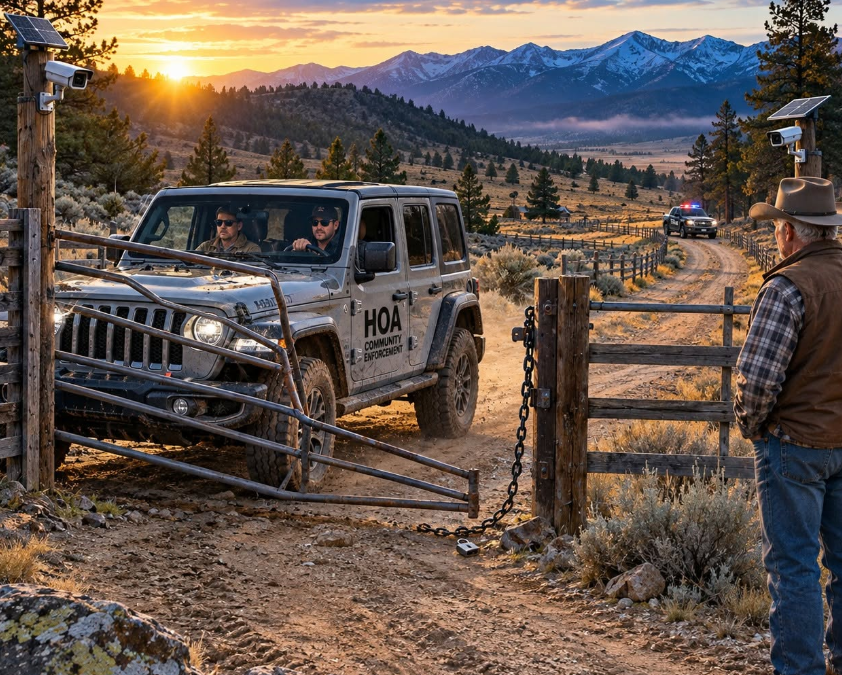
The gray Jeep marked HOA COMMUNITY ENFORCEMENT cut through my locked gate before sunrise and rolled onto my private hunting road like my family’s ranch had already become theirs.
I did not chase them, block them, or even raise my voice, because every camera on that road was recording and the county sheriff already knew exactly where they were.
What those fake officers did not know was that when they came back out of the timber, five real sheriff units would be waiting—and the road they were trying to steal was tied to a development worth millions.
I heard the diesel before I saw the Jeep.
Low.
Steady.
Unhurried.
The kind of engine noise that told you the driver did not think he needed permission.
It was still dark over Miller Creek Ranch.
Just enough gray had begun to form behind the ponderosa pines for me to make out the eastern fence line from my porch.
I had coffee in one hand and my phone in the other.
Then headlights moved between the trees.
A gray Jeep pushed through my eastern gate and turned onto the hunting road.
I stayed exactly where I was.
The first thing I noticed was the chain.
It was not hanging between the cedar posts where I had locked it the night before.
It lay in the dirt.
Cut clean through.
The second thing I noticed was the magnetic sign on the Jeep’s front door.
HOA COMMUNITY ENFORCEMENT.
Black letters.
White background.
Big enough to look official from fifty yards away.
It was not official.
I knew that.
The county knew that.
And by the end of that morning, Travis Boone was going to understand it too.
The Jeep rolled another forty yards and stopped near the old cattle crossing.
Travis was driving.
Eric Dalton sat in the passenger seat wearing the same tan shirt I had seen him in before, a laminated identification card hanging from a black lanyard around his neck.
Neither man looked embarrassed about being on my land.
That was what got me.
Not the homemade badge.
Not the magnetic door signs.
Not even the cut chain.
The certainty.
They looked like they believed I was the one who needed permission.
My name is Grant Miller.
Miller Creek Ranch covered more than a thousand acres of cattle country and hunting timber in western Montana.
My family had held that ground since 1968.
Every fence line had a history.
Every section road had a reason.
Every gate meant something.
PART2:
The gravel road beneath Travis’s tires was private.
Not shared.
Not disputed.
Not a county road.
Private.
Travis lowered his window.
“Grant.”
Not Mr. Miller.
Not good morning.
Just Grant.
The way people talk when they have already decided courtesy is unnecessary.
“You’ve been formally notified,” he said.
I did not answer.
Eric looked down at a clipboard.
Travis continued.
“This road has been designated Emergency Access Route 7. You have seventy-two hours to remove the deer stands near the east junction and clear anything restricting HOA access.”
He delivered the words smoothly.
Practiced.
I had spent years working county road maintenance.
I knew the tone.
It was the voice some men used when they wanted the sentence itself to sound like authority.
I looked past him toward the gate.
“You cut my chain?”
Eric shifted.
Travis barely glanced back.
“We needed access.”
“That wasn’t my question.”
His jaw tightened.
“We’re carrying out an authorized safety inspection.”
“Authorized by who?”
That stopped him.
Only for half a second.
Then he tapped the magnetic sign on the door with two fingers.
“Pine Ridge Estates.”
I almost smiled.
Almost.
PART3:
Pine Ridge Estates sat beyond my eastern boundary.
Expensive homes.
Stone entrance.
Trimmed roadsides.
New roofs rising every year.
The people living there had every right to manage their property.
Their authority ended where my fence began.
Travis knew I disagreed with him.
What he did not know was that disagreement no longer mattered.
I had stopped arguing weeks earlier.
A trail camera mounted above the gate had recorded him holding bolt cutters.
A second camera had already captured the Jeep crossing the posted property line.
My phone was recording the conversation now.
And Sheriff Paul Ramirez had received a call from me before sunrise.
Travis knew none of that.
To him, this was just another patrol.
Another morning when an older rancher would stand at a distance while two men in matching shirts drove around with clipboards and pretended they had more power than they did.
Eric looked toward the trees.
“Should we keep moving?”
Travis nodded.
Then he looked at me.
“Seventy-two hours, Grant. After that, we document noncompliance.”
“Go ahead.”
He frowned.
“What?”
“I said go ahead.”
For the first time, Eric looked directly at me.
Uncertainty crossed his face.
Not fear.
Not yet.
But something close to doubt.
Travis did not share it.
He rolled the window up.
The Jeep moved deeper into the ranch.
I stepped off the porch but did not follow.
No shouting.
No truck blocking the road.
No demand that they turn around.
I watched the taillights disappear into the trees.
A man twenty years younger might have followed them.
A man angrier than I was might have confronted them.
But I had spent too much of my life around contractors, easement disputes, county crews, and property maps to confuse anger with strategy.
If somebody crosses your land by mistake, you tell them.
If they cross again after being told, you document it.
If they remove signs, change markers, and invent authority, you keep documenting.
And if they cut a locked chain after their lawyer has received formal notice that they have no access rights?
Then you stop arguing.
You let them make the record themselves.
My phone buzzed.
A message from Sheriff Ramirez.
THEY IN?
I typed one word.
YES.
His reply came almost immediately.
STAY CLEAR. CALL WHEN THEY TURN BACK.
I slipped the phone into my pocket.
That was why I had not stopped Travis.
That was why I had not rushed toward the gate when I heard the chain snap.
And that was why I did not care how far down the hunting road the Jeep drove.
They were not getting lost.
They were building my case with every yard.
I poured the rest of my coffee into a thermos and walked toward my pickup.
There was only one practical route back to the county highway.
Travis thought he knew it well.
He had driven it enough times.
What he did not know was that this morning, when his gray Jeep came back out of the timber, I would not be the only person waiting.
To understand how we got there, you have to go back four months.
The first time Susan Whitaker told me a road my family had owned for decades somehow belonged to her HOA.
It started with a certified letter.
Pine Ridge Estates letterhead.
Susan’s signature at the bottom.
Three paragraphs described the gravel road running through my eastern timber as a “historic emergency access corridor serving the Pine Ridge community.”
The letter gave me ten days to acknowledge continued community access.
I knew that road better than anybody alive.
My father bought the first section of Miller Creek Ranch in 1968.
He expanded the property over the years.
The eastern hunting road had always stayed inside our recorded boundary.
I had graded part of it myself back when I worked county road maintenance.
I knew where Pine Ridge stopped.
I knew where Miller Creek began.
There was no HOA road on my deed.
No shared driveway.
No permanent easement.
No subdivision access.
I called Susan.
She answered on the third ring.
“Grant,” she said pleasantly. “This doesn’t need to become adversarial.”
“Then send me the recorded easement.”
A pause.
“The route has historical standing.”
“That isn’t an easement.”
“It has been used for emergency purposes for decades.”
“By who?”
Another pause.
“The community has relied on it for safety.”
“Then send me the document.”
Her tone cooled.
“Our records are clear.”
“Good. That should be easy.”
She hung up.
Two days later, a red-and-white stake appeared beside my eastern fence.
EMERGENCY ROUTE 7.
I pulled it out and stored it in the barn.
The next morning another one stood in the same location.
That was when I called Laura Mitchell.
Laura handled ranch boundaries, water rights, and rural easement disputes.
She had a way of making complicated people sound very simple.
She cared about signatures.
Recording dates.
Parcel descriptions.
The exact rights created by a document.
I brought Susan’s letter to her office.
She read “historic emergency access corridor” twice.
“Careful wording,” she said.
“What does that mean?”
“She never says Pine Ridge owns it.”
“No.”
“She never says there’s a recorded easement.”
“No.”
“She wants you to assume both.”
Laura ordered the complete property history.
My deed.
Recorded surveys.
Pine Ridge plats.
Subdivision amendments.
County road records.
Every easement touching the eastern boundary.
Three days later she called me back.
An old document sat on her desk.
County fire district heading.
August 1996.
My father’s signature at the bottom.
I remembered that summer.
Lightning had started a wildfire west of the ridge.
The fire moved fast.
Smoke covered the hills.
My father opened the east gate so county fire crews could cross the ranch and reach the timber without circling miles around.
I remembered tanker trucks.
Engines.
Men sleeping near the barn.
I remembered helping refill water.
I had forgotten the paper.
Laura pushed the agreement toward me.
It gave county fire and emergency personnel permission to use our ranch road during the 1996 wildfire response.
Then she tapped the final paragraph.
Permission terminated when the emergency declaration ended.
“No HOA,” Laura said.
“No.”
“No residents.”
“No.”
“No developer.”
“No.”
“No permanent easement.”
I looked at my father’s signature.
“He let firefighters through during one emergency.”
“That’s all.”
“Could Susan misunderstand this?”
Laura looked at me for a second.
“She’s a real estate broker.”
That was enough.
A mistake could be corrected.
This no longer felt like a mistake.
I went to the county records office myself.
I pulled Pine Ridge’s recorded subdivision plat.
Their streets were marked.
Common areas were marked.
Drainage areas.
Utility corridors.
Lot boundaries.
Miller Creek Ranch sat beside them exactly where it always had.
No Route 7.
No emergency corridor crossing my property.
Nothing.
Then I noticed a newer notation attached to the planning file.
PINE RIDGE PHASE 2 PRELIMINARY REVIEW.
I asked the clerk.
“What’s this?”
“Expansion proposal.”
She brought out the preliminary map.
Thirty-eight additional homes.
One existing entrance.
Steep ravine on the south side.
And to the west?
My ranch.
My hunting road ran from near the proposed lots to the county highway without needing a bridge, major excavation, or a completely new road.
I stood staring at the page.
That was the first time Susan’s sudden interest in a thirty-year-old wildfire agreement made sense.
Maybe not all of it.
But enough.
She was not trying to preserve some forgotten emergency corridor.
She was trying to make one exist.
The answer became clearer a week later when I saw the gray Jeep for the first time.
Travis Boone parked just outside my eastern fence.
Eric Dalton sat beside him.
Both wore tan shirts with shoulder patches saying COMMUNITY SAFETY.
Laminated IDs hung against their chests.
Magnetic signs on the Jeep doors read HOA ENFORCEMENT.
Travis got out holding a clipboard.
“Morning, Grant.”
I looked at the Jeep.
“New job?”
His expression tightened.
“Susan established a Community Safety Unit.”
“For what?”
“We’re documenting emergency access conditions.”
“On my ranch?”
“Along Route 7.”
“There is no Route 7.”
He lifted the clipboard.
“The HOA recognizes it.”
“The county doesn’t.”
“We’re not here to debate.”
That sentence told me more than the uniform.
People with real authority usually know where it comes from.
Travis seemed irritated that I had asked.
He handed me a notice.
OBSTRUCTION OF COMMUNITY EMERGENCY ACCESS.
It accused me of restricting a designated evacuation corridor with a cattle gate, hunting equipment, and “unapproved vegetation growth.”
I read it.
There was a case number.
There was an HOA seal.
There was no statute.
No recorded easement.
No county reference.
No legal description.
I pointed at the case number.
“Where’d this come from?”
Eric looked at Travis.
“Internal enforcement system.”
“So you made it.”
“It’s official HOA documentation.”
I folded the notice and put it in my jacket.
“Then I’ll keep it.”
Travis seemed disappointed.
He expected a fight.
He got a filing cabinet.
That afternoon, the Jeep crossed my eastern boundary for the first time.
I was repairing a feeder when I heard tires on gravel.
Travis drove slowly.
Eric took photographs through the passenger window.
Gate.
Road surface.
Cattle crossing.
Junction toward the north hunting ridge.
When they reached me, Travis stopped.
“We’re conducting a route assessment.”
“You have permission?”
“We’ve explained the HOA’s position.”
“That isn’t permission.”
“We won’t be long.”
Then they continued.
I wrote down the time.
Four days later they returned.
Then the following Tuesday.
Then Friday.
Always the same pattern.
Enter from Pine Ridge.
Drive the length of the east trail.
Stop at the same junctions.
Photograph the same features.
Exit near the county highway.
At first, I thought the point was intimidation.
Then my old road-maintenance instincts started bothering me.
When the county evaluated access, we documented conditions once.
Maybe twice if weather or construction changed something.
You did not photograph the same cattle guard every four days.
You did not repeatedly record the same route unless repeated use itself was the thing you wanted to show.
The next notice confirmed it.
CONTINUED OBSTRUCTION OF ACTIVE EMERGENCY ACCESS ROUTE.
Active.
That word mattered.
I called Laura.
“They changed the language.”
“How?”
“First it was historic. Now it’s active.”
She went quiet.
“How often are they driving it?”
“Twice a week.”
“Photographs?”
“Every time.”
“Keep a log.”
“I already am.”
“Improve it.”
That evening I bought four trail cameras.
One went above the east entrance.
One covered the cattle guard.
One covered the central junction.
One watched the western exit toward the county road.
Every image carried a timestamp.
Within six days, I had two complete Jeep runs from one end of my road to the other.
Travis driving.
Eric photographing.
Same stops.
Same pattern.
Then one camera captured something new.
6:42 a.m.
Travis walked to my PRIVATE PROPERTY sign.
He removed it from the post.
Carried it to the Jeep.
Eric stood beside him holding another red marker.
EMERGENCY ROUTE 7.
Travis hammered the marker into the ground where my sign had been.
Then Eric photographed him beside it.
I watched the footage three times.
Not because I could not believe it.
Because I wanted to understand exactly what they were doing.
They were not documenting an existing emergency route.
They were changing the appearance of my land.
Then photographing the result.
Two days later they returned.
Eric measured the gate opening.
Travis photographed the county-road exit.
I pulled up behind them.
Eric looked uncomfortable.
Travis did not.
“You’re trespassing.”
“We’re documenting existing community access.”
“You removed my sign.”
“No idea what you’re talking about.”
“I have you on camera.”
That changed his expression.
Only a little.
Then he recovered.
“If you have concerns, take them up with Susan.”
“I will.”
He smiled.
“I suggest you do.”
They drove away.
I stood there looking at the red Route 7 marker where my private-property sign had been.
That was when the whole thing changed for me.
Susan was not simply making a bad legal argument.
She was building a visual history.
Jeep tracks.
Route markers.
Photographs.
Repeated patrols.
A private ranch road slowly being made to look like something Pine Ridge had been using all along.
I called Laura.
“They’re not trying to prove it belongs to them.”
“What are they doing?”
“They’re trying to create proof they’ve been using it.”
Laura said nothing for several seconds.
Then:
“Don’t remove the route markers yet.”
“Why?”
“Because if they’re manufacturing a record, I want to know who they plan to show it to.”
A week later, Helen Cooper gave us the answer.
She arrived after dark.
Parked by the barn instead of the house.
Helen was sixty-six.
Treasurer of Pine Ridge Estates.
One of the few board members I had met who seemed to understand that an HOA was supposed to maintain common property, not act like a government.
She carried a manila envelope.
“Can we talk inside?”
I let her into the kitchen.
She did not sit until I closed the blinds.
That got my attention.
Helen placed the envelope on the table.
“I shouldn’t have this.”
“Then why bring it?”
“Because Susan shouldn’t have written it.”
Inside were printed emails from the HOA account.
One was from Susan to Travis.
Subject:
ROUTE 7 DOCUMENTATION.
The body was short.
Continue driving Route 7 twice weekly. We need documented active use before county Phase 2 review. Photograph entry, full route, exit, and markers. Keep patrol logs consistent.
I read it once.
Then again.
Then a third time.
Not because it was complicated.
Because it was not.
“This came from the HOA account?”
Helen nodded.
“I handle financial records. Susan asked me to reimburse fuel and equipment expenses for Travis’s patrols.”
“What did she tell you they were?”
“Phase 2 safety review.”
“You knew about the road?”
“I knew she was talking about an emergency route. I didn’t know it was your hunting trail until I saw the map.”
She pulled out another page.
Glossy color print.
Pine Ridge.
Proposed Phase 2 lots.
A red line crossing Miller Creek Ranch.
EMERGENCY ROUTE 7.
“What exactly is Phase 2?”
Helen hesitated.
“Thirty-eight luxury homes.”
“Who’s developing it?”
“David Monroe.”
I knew the name.
Bozeman developer.
He had been buying land near Pine Ridge.
Helen continued.
“The board has been told the expansion needs a second emergency route before county review can move forward.”
There it was.
“Does Monroe know the road is mine?”
“I don’t know what Susan told him.”
“What did Susan tell residents?”
Helen gave a tired laugh.
“That Route 7 is an existing historical access corridor and you’re trying to close it.”
“So I’m the problem.”
“That’s what people are being told.”
Then Helen said something that made my anger turn colder.
“She’s telling residents that if a wildfire comes through and families can’t evacuate, it’ll be because you blocked their second exit.”
I felt my jaw tighten.
Property arguments were one thing.
Using children and wildfire fear to turn a neighborhood against me was another.
“My father opened that road once.”
Helen nodded.
“I know now.”
“For firefighters.”
“Yes.”
“One fire.”
“Yes.”
“Thirty years ago.”
“Yes.”
“Does Susan know that?”
Helen looked down at the email.
“She knows enough to be careful about how she describes it.”
That matched Laura’s read exactly.
Susan was not confused.
She was constructing language around facts she could not change.
The next morning, I checked every camera.
Now that I knew what I was looking at, the pattern was obvious.
Entry.
Photograph.
Marker.
Photograph.
Junction.
Photograph.
Exit.
Photograph.
Twice each week.
Exactly what Susan had ordered.
In one clip, Travis repositioned a Route 7 marker so its label faced Eric’s camera.
In another, Eric photographed fresh tire tracks immediately after their own Jeep made them.
I almost laughed at that one.
They were documenting their own evidence of “historical use.”
I sent everything to Laura.
She called within twenty minutes.
“Do not contact Susan.”
“I wasn’t planning to.”
“This email changes things.”
“How much?”
“If authentic, it helps establish intent. They’re not simply entering because they believe they have a right. They appear to be deliberately creating a record before government review.”
“Can we stop them?”
“Yes.”
“Should we?”
Laura paused.
“That’s a different question.”
A few days later, a Pine Ridge resident named Mark stopped me outside the feed store.
I barely knew him.
He looked uncomfortable.
“Grant, can I ask you something?”
“Sure.”
“Why are you blocking the fire road?”
I looked at him.
“I’m not.”
“Susan says the county recognized it years ago.”
“They didn’t.”
“She showed us pictures of patrol vehicles using it.”
Of course she had.
The photographs were not only for county planners.
They were for homeowners.
Susan created a road on paper.
Then sent Travis out to create photographs making the paper believable.
Mark rubbed the back of his neck.
“I’ve got two grandkids living with us. People are worried.”
“I understand.”
“So if there’s a fire, you’d really stop people?”
“No.”
That surprised him.
“If real firefighters need through my ranch during a real emergency, they get through. Same as 1996.”
“Then what’s the issue?”
“The issue is your HOA president pretending temporary emergency permission gave Pine Ridge permanent rights.”
He stared at me.
“That isn’t what she told us.”
“I know.”
I drove home angrier than I had been since the dispute began.
Susan had found the one claim decent people would be afraid to question.
Safety.
By the end of that week, Laura had everything spread across her conference table.
1996 agreement.
Susan’s internal email.
My deed.
Recorded survey.
Camera footage.
Route 7 signs.
HOA notices.
Phase 2 map.
Laura tapped the Phase 2 reference.
“This is what we follow next.”
Three days later, she found it.
The fake Route 7 had moved beyond HOA paperwork.
Susan had put it into county planning documents.
Laura called me into her office and turned her monitor around.
Professional site plan.
Thirty-eight new homes.
Drainage.
Utilities.
Fire turnaround areas.
Two marked exits.
The first was Pine Ridge’s existing entrance.
The second ran across my ranch.
EMERGENCY ACCESS ROUTE 7.
EXISTING.
That word hit me harder than the rest.
Existing.
Laura nodded.
“The Phase 2 application describes your hunting road as an established secondary emergency corridor, currently maintained and monitored by Pine Ridge Estates.”
“Maintained?”
“Yes.”
“Monitored?”
“Yes.”
Susan had turned Travis’s repeated trespassing into official-sounding history.
“Did the county approve it?”
“Not yet.”
“So we correct the record.”
“We will.”
Laura leaned back.
“But first we preserve exactly what she filed.”
She requested certified copies and all Phase 2 correspondence.
Then she looked at me.
“She’s no longer exaggerating at HOA meetings. She is making factual representations to a government agency about property she doesn’t own.”
That afternoon, Pine Ridge held what Susan called an emergency wildfire preparedness meeting.
Laura told me to attend.
“Don’t argue.”
“Why go?”
“To listen.”
The clubhouse was packed.
Almost seventy residents.
Susan stood beneath a projection screen.
Behind her was the Route 7 map.
My ranch shaded green.
Hunting road marked red.
She pointed directly at it.
“This corridor has served emergency purposes for decades. Unfortunately, Mr. Miller has recently taken steps to restrict access.”
Heads turned toward me.
Susan had known I was there.
A man raised his hand.
“What happens if there’s a wildfire?”
Susan lowered her voice.
“Without a usable secondary route, evacuation could become extremely difficult.”
Another resident asked, “Can Grant legally block it?”
Susan answered carefully.
“Our legal position is that the community has longstanding access rights.”
Not deed.
Not easement.
Not ownership.
Legal position.
Then she added, “Unfortunately, some older landowners struggle to understand how much this area has changed.”
That one hit harder than I expected.
Since my wife died, the ranch had become quieter.
My sons had families and work in other states.
They visited.
They called.
But most days, it was me.
Cattle.
Fence.
Weather.
More than a thousand acres outsiders increasingly saw as undeveloped opportunity.
Susan had taken solitude and tried to turn it into weakness.
A woman stood.
“If Mr. Miller won’t cooperate, can the county force it open?”
Susan spread her hands.
“We’re exploring every option necessary to protect Pine Ridge families.”
That was when I spoke.
“Show them the 1996 agreement.”
The room went still.
Susan looked toward me.
“I don’t think this is appropriate.”
“Show them.”
Her expression hardened.
I continued.
“The document you keep calling historical access was temporary permission my father gave county firefighters during one wildfire. It expired when the emergency ended.”
Whispers moved through the room.
Susan recovered.
“That is your attorney’s interpretation.”
“No. It’s written on the page.”
She changed slides.
“Tonight is about safety, not Mr. Miller’s personal grievances.”
Personal grievance.
My deed had become a grievance.
My fence had become obstruction.
Her invented road had become safety.
I felt anger rising.
For one second, I wanted to walk to the front, put the deed on her podium, and make her answer every question.
Laura stood along the wall.
She gave me a small shake of the head.
So I stopped.
Susan wanted an angry rancher.
Stubborn.
Unreasonable.
Old.
Someone whose behavior could become the story instead of the boundary.
I was not giving her that.
I walked out.
Three residents followed.
Mark was one.
“Grant.”
I stopped.
“Is it true you’d let fire crews through?”
“Immediately.”
“Then why is Susan saying you’re blocking evacuation?”
I looked at him.
“That’s a question you should ask Susan.”
That answer traveled farther through Pine Ridge than any speech I could have made.
Over the next week, Laura collected everything.
Meeting recording.
Route maps.
Notices.
Camera timestamps.
Expired fire agreement.
Deed.
Survey.
Helen’s email.
Then the county produced its Phase 2 correspondence.
Laura called that evening.
Her voice was sharper.
“I found the language she used with planning.”
I drove into town.
Laura had three pages on her conference table.
County checklist.
Susan’s submission.
Email involving Susan and David Monroe.
Laura tapped the checklist.
“Phase 2 requires two compliant emergency access points before final approval.”
Then Susan’s submission.
“She is representing your hunting road as the second one.”
Thirty-eight homes.
One legitimate entrance.
One fake red line.
“So without my road?”
“Phase 2 has a serious access problem.”
Now the pressure made sense.
But it raised a worse question.
How far was Susan willing to go?
Laura pushed the county filing toward me.
“We can end this fast.”
“How?”
“One demand letter. If they don’t stop, injunction.”
I should have felt relieved.
Instead, something bothered me.
“Give me a day.”
Laura frowned.
“Grant, you’ve been patient.”
“I know.”
“So what are you waiting for?”
I found the answer at the Pine Ridge mailbox cluster that afternoon.
I had stopped to speak to Helen when an older man approached.
Walter Bennett.
Seventy-four.
Retired machinist.
An oxygen concentrator sat in the passenger seat of his pickup.
I recognized him from the wildfire meeting.
“Mr. Miller, I don’t want trouble.”
“Neither do I.”
“My wife can’t move fast anymore.”
He glanced at the hills.
“If something burns up there, I need a way to get her out.”
“You have Pine Ridge’s main entrance.”
“Susan says one fallen tree could close it.”
His fear was real.
Not politics.
Not development economics.
A husband imagining smoke and his wife trapped.
I understood why he had signed a petition.
“Did Susan tell you my father granted Pine Ridge permanent access?”
He nodded.
“She said your family recognized the route thirty years ago.”
“That isn’t what happened.”
I explained.
One wildfire.
County emergency personnel.
Temporary.
Expired.
Walter stared at me.
“You’re saying Susan knows this?”
“She has access to the same public document my lawyer found.”
A woman standing nearby stepped closer.
“Would you stop an ambulance?”
“No.”
“Fire truck?”
“No.”
“Evacuation during a real wildfire?”
“If the sheriff or fire chief needs my road during a real emergency, I open every gate they need.”
She looked confused.
“Then why are we fighting?”
That question followed me home.
We were not fighting about emergency safety.
Susan had made people believe we were.
If Laura filed an injunction and Susan backed down quietly, residents might never know why.
She could say Grant Miller hired an expensive lawyer and bullied the HOA into abandoning an emergency route.
If Phase 2 failed, I would become the reason thirty-eight houses did not get built.
Susan could lose the road and keep the lie.
That evening Helen called.
“You need to hear what she’s saying.”
Susan had sent a new community email.
Helen read it.
“Pine Ridge leadership continues working to preserve historic emergency access rights despite resistance from an adjacent property owner.”
Adjacent property owner.
She would not even use my name.
“Residents are encouraged to support all lawful measures necessary to maintain safe evacuation options.”
“Lawful measures?”
“That’s what she wrote.”
I looked across my kitchen table.
Deed.
Survey.
1996 agreement.
Video.
Email.
County filing.
All saying the same thing.
There was no Route 7.
But Susan had built something nearly as valuable as a legal right.
Belief.
I called Laura.
“Don’t file yet.”
Silence.
Then:
“Tell me why.”
“I want the notice first.”
“That’s already part of the plan.”
“No. I want everybody served separately.”
She understood.
“Susan. Travis. Eric. Board. Monroe.”
“Exactly.”
“You want to eliminate misunderstanding as a defense.”
“Yes.”
Once everyone received written notice, no one could say they thought permission existed.
No one could say they misunderstood the 1996 agreement.
No one could claim I never objected.
The line would be bright.
Private land.
No access.
Written notice.
What they chose after that would be their choice.
“This isn’t about baiting them,” Laura said.
“No.”
I meant it.
I did not want a trap.
I wanted a decision.
Laura drafted the notice that night.
NOTICE OF REVOCATION AND DENIAL OF ACCESS.
Plain language.
Miller Creek Ranch granted no HOA access.
No resident access.
No developer access.
No private patrol access.
Only legitimate police, fire, or EMS personnel responding to actual emergencies could enter without my express permission.
I read it twice.
“Send it.”
Certified copies went out.
Susan signed at the HOA office.
David Monroe’s company signed at reception.
Eric accepted his at home.
Travis received his the following morning.
Laura called when the receipts came back.
“Now nobody gets to say they didn’t know.”
I replaced the eastern gate chain that afternoon.
New steel.
Bright against old cedar posts.
Then I installed two signs.
PRIVATE PROPERTY.
NO HOA ACCESS.
Below:
POLICE FIRE EMS EXEMPT DURING ACTUAL EMERGENCIES.
No threatening language.
No ambiguity.
Laura had me photograph the gate from both directions.
I kept the chain receipt.
“Boring evidence,” she said.
“That’s what I want.”
“Good. Keep it boring.”
My next stop was Sheriff Paul Ramirez.
I had known Paul casually through county work.
I was not asking for a favor.
I laid everything on his conference table.
Deed.
Survey.
1996 agreement.
Laura’s notice.
Signed receipts.
Camera footage.
Susan’s Route 7 map.
County planning submission.
Helen’s email directing twice-weekly patrol runs.
Paul read slowly.
When he reached the email, he read it twice.
“So they’re intentionally driving the route to document use.”
“That’s what the email says.”
“And now they’ve been expressly told they have no access.”
“Yes.”
Paul leaned back.
“Grant, I want to be careful. I’m not turning a property dispute into a criminal case because an HOA president is difficult.”
“Neither am I.”
“But if somebody knowingly enters posted private property after express denial, that’s different.”
He tapped Laura’s notice.
“And if they damage a lock or gate getting in, call us.”
“That’s the plan.”
“Don’t confront them.”
“I won’t.”
Paul watched me.
“You expect them to come back.”
“I don’t know.”
That was not entirely true.
I suspected they would.
But suspicion was not evidence.
For two days, nothing happened.
No Jeep.
No notice.
No Route 7 marker.
The east trail stayed quiet.
I began wondering whether one letter had ended everything.
Then Helen called after nine on the third night.
Her voice was low.
“Grant, are you alone?”
“Yes.”
“Susan held an emergency board meeting.”
“What happened?”
“She called your notice an intimidation tactic meant to derail Phase 2.”
“Did the board vote?”
“No.”
Helen paused.
“That’s the problem.”
“What?”
“After the meeting I stayed to finish financial reports. Susan was in her office with Travis.”
I stood.
“What did you hear?”
“She said the county site inspection is Monday.”
I waited.
“She told him they need one final patrol run before then.”
“When?”
“Before sunrise.”
Helen lowered her voice further.
“Her exact words were, ‘We can’t let Miller manufacture the appearance that Route 7 is closed.’”
The irony took a second to settle.
Susan had been formally told that the road was private.
Her response was to order one more trespass so she could create photographs suggesting it was not.
“Did Travis agree?”
“Yes.”
“Anything in writing?”
“She sent him a follow-up message.”
“Save it.”
“Already printed.”
I called Laura.
She listened.
“This is why we served them.”
“Do we file now?”
“We can.”
I looked toward the eastern ridge.
“No.”
“Grant.”
“One more morning.”
Silence.
“You’re not going to interfere.”
“No.”
“You’re not blocking them inside.”
“No.”
“You call the sheriff the moment they enter.”
“Yes.”
“Then document and stay away.”
I called Paul next.
“They’re planning to come before sunrise.”
“How do you know?”
“Helen heard Susan order it.”
A pause.
“Gate still posted?”
“Yes.”
“Notice served?”
“Signed receipts.”
“If they come back, call.”
The next morning I was awake before five.
Coffee.
Phone charged.
Cameras running.
Nothing else changed.
I did not hide near the gate.
I did not stand there waiting.
At 5:38, diesel rolled through the darkness.
Then came the metallic snap of my new chain being cut.
I stayed on the porch.
The trail camera was already recording.
Headlights swept across the fence.
Paused.
Then moved.
Travis had seen the signs.
He had seen the chain.
He had received the certified notice.
He entered anyway.
I called Paul.
“They’re in.”
“You see the chain cut?”
“Camera has it.”
“Stay clear.”
The call ended.
The Jeep came far enough for me to see Travis.
Eric sat beside him.
At the cattle crossing, Travis lowered his window.
“Grant.”
Same tone.
Same confidence.
“You’ve been formally notified. Route 7 has to remain unobstructed.”
I looked toward the broken gate behind him.
“You cut a locked chain.”
“We removed an unauthorized obstruction from an emergency corridor.”
Eric stared at the dashboard.
Travis continued.
“You have seventy-two hours to move those deer stands.”
I let him finish.
Then I said, “Go ahead.”
His face changed.
“Excuse me?”
“You came to document the route. Go document it.”
Eric turned toward Travis.
Doubt passed between them.
Travis had already committed.
The window went up.
The Jeep disappeared into the pines.
I drove the outside ranch road toward the county highway.
I did not follow them.
The cameras had the route.
Paul had the location.
Twenty minutes passed.
Then thirty.
The eastern sky turned gray.
The first sheriff’s SUV arrived.
Paul drove.
Then another.
Then another.
Five county units in total.
No sirens.
No dramatic lights.
They positioned themselves near the gravel apron at the western exit.
Enough space for emergency traffic.
No realistic way for Travis to come out and pretend he had not seen them.
Paul walked toward my pickup.
“You talked to them?”
“Only when they stopped.”
“What did they say?”
“Road belongs to them.”
“And you?”
“Told them to go ahead.”
Paul nodded.
“Good.”
He was not smiling.
Neither was I.
This was not a show.
It was the moment four months of paperwork finally met people who carried actual authority.
We heard the Jeep.
Diesel through timber.
Closer.
Gray paint appeared between the trees.
The Jeep rounded the last bend.
Stopped.
Five sheriff vehicles waited in front of it.
For several seconds nobody moved.
The Jeep idled.
Then Travis opened his door.
He stepped out carrying his clipboard.
That almost impressed me.
Even then, he brought the clipboard.
Eric got out more slowly.
Paul walked forward.
“Morning.”
Travis straightened.
“Sheriff, we’re conducting an authorized HOA safety inspection.”
Paul looked at the magnetic sign.
HOA COMMUNITY ENFORCEMENT.
Then Travis’s uniform.
“You law enforcement?”
A pause.
“We’re community enforcement officers.”
“Commissioned by what agency?”
“We operate under Pine Ridge Estates.”
“That isn’t an agency.”
Travis shifted.
“We handle compliance and community safety.”
“Licensed private security?”
No answer.
“Deputized by this county?”
“No, but—”
“Court order allowing you onto Miller Creek Ranch?”
Travis lifted the clipboard.
“We have documentation establishing Route 7 as historic community access.”
“Recorded easement?”
“It’s been recognized for decades.”
“That wasn’t my question.”
Silence.
Eric stepped away from the Jeep.
Paul repeated himself.
“Do you have a recorded easement?”
Travis looked at me.
Then Paul.
“No.”
“Deed?”
“No.”
“Written permission from Grant Miller?”
Travis’s jaw tightened.
“Our position—”
“Do you have permission?”
“No.”
Paul held up Laura’s notice.
“Did you receive this?”
Travis stared.
“I received correspondence.”
“Certified?”
“Yes.”
“Did it tell you the property was closed to HOA access?”
No answer.
Paul looked toward Eric.
“You received one?”
Eric nodded.
“Yes, sir.”
“And you entered anyway?”
Eric looked at the Jeep.
Then the road.
“Travis said Susan cleared it.”
Travis snapped his head toward him.
“Eric—”
Paul raised one hand.
“Don’t coach him.”
That was the first crack.
Not in the case.
In them.
I retrieved my folder.
Deed.
Survey.
1996 agreement.
Certified notice.
Helen’s email.
Previous camera stills.
Then I opened the newest footage.
5:38 a.m.
Travis standing beside my gate.
Bolt cutters.
Chain dropping into the dirt.
Paul watched it once.
Then again.
He handed the phone to a deputy.
“Preserve that.”
Travis’s voice changed.
“This is being blown out of proportion. The HOA has legitimate safety concerns.”
Paul looked at him.
“Safety concerns don’t create property rights.”
Nobody answered.
One deputy photographed the Jeep.
Magnetic signs.
Laminated IDs.
Route materials in the rear.
Another separated Eric and began taking his statement.
Travis finally lowered the clipboard.
Then headlights appeared on the county road.
A white SUV came fast.
Gravel spit under its tires.
Susan Whitaker.
She stepped out already talking.
“Sheriff Ramirez, there has obviously been a misunderstanding.”
Of course she carried a leather portfolio.
She opened it.
Inside was the same laminated Route 7 map she had shown residents.
“This route is recognized HOA emergency access.”
Paul did not take it.
He looked at Susan.
Then the Jeep.
Then the cut-chain footage.
“Ms. Whitaker, show me the recorded document giving your HOA legal access.”
Susan stopped.
For the first time since this started, she did not have an immediate answer.
Paul waited.
Then repeated the question.
“Recorded document. Deed. Easement. Court order. License. What gives Pine Ridge Estates legal authority to enter Miller Creek Ranch?”
Susan opened the portfolio wider.
She pulled out the laminated map.
Paul still did not take it.
“That’s your map.”
“It’s part of our emergency access records.”
“I’m asking for the recorded right.”
“This corridor has been historically recognized.”
“By whom?”
“The community.”
“That isn’t a legal answer.”
Susan looked toward Travis.
That was when I knew the balance had changed.
For months, everyone had looked at Susan for answers.
Now Susan was looking at a man with a homemade badge.
Travis looked away.
Eric was already talking to a deputy.
Laura arrived fifteen minutes later.
She carried one thin file.
“Before anyone leaves,” she said, “there’s something the sheriff and Ms. Whitaker should see.”
She handed Paul a certified copy of the Phase 2 submission.
Then she looked at Susan.
“You represented Route 7 to the county as an existing and maintained secondary emergency corridor.”
Susan’s expression hardened.
“That’s a planning interpretation.”
“No. It’s a factual representation about access across my client’s land.”
Another truck pulled in.
Black pickup.
David Monroe.
He stepped out looking irritated.
“What happened?”
Susan moved toward him.
“David, this is a temporary dispute over historical access.”
Laura answered before Susan could continue.
“Then you should probably see what your project was filed with.”
David took the county document.
Read the marked section.
Then looked at Susan.
“You told us this route was secured.”
“The HOA has longstanding rights.”
David shook the paper.
“My civil engineer asked you twice whether this was recorded.”
“It has historic use.”
“That isn’t what I asked.”
The road got very quiet.
Laura opened the site plan.
Thirty-eight homes.
Existing public entrance on one side.
Steep ravine along the southern edge.
Potential alternative access across terrain requiring serious engineering.
Then the red line across my hunting road.
Laura pointed.
“Your planning materials estimate the alternative access improvements in the millions once grading, drainage, environmental review, and construction are included.”
David looked toward Susan.
Then my road.
The financial motive was suddenly visible.
My hunting road already existed.
Graded.
Stable.
Connected Pine Ridge to the county highway.
Susan had decided it would be cheaper to transform my private road into an HOA corridor than build a lawful route.
David looked at me.
“Grant, I was told your family already granted this access.”
“They didn’t.”
“Permanent emergency easement?”
“No.”
“Negotiation underway?”
“No.”
He turned toward Susan.
“You told me the title issue was resolved.”
Susan’s face changed.
“This project benefits the whole community.”
David stepped closer.
“Did you tell the county we had access that we didn’t have?”
Susan said nothing.
A voice came from behind us.
“Yes.”
Everyone turned.
Helen Cooper stood across the road.
Folder in hand.
Susan looked genuinely alarmed.
“Helen, this is board business.”
“Not anymore.”
Helen walked to Paul.
Opened the folder.
Expense reports.
Reimbursements.
Internal accounting notes.
COMMUNITY SAFETY OPERATIONS.
EMERGENCY ACCESS EVALUATION.
Fuel.
Magnetic vehicle signs.
Route markers.
Equipment.
Patrol reimbursements.
Survey costs.
Residents had been paying for the effort Susan used to make my private road look like HOA property.
Laura asked Helen, “Were homeowners told these expenses were part of an effort to establish Route 7?”
“No.”
“What were they told?”
“General community safety.”
Susan interrupted.
“Those expenditures were authorized.”
Helen looked at her.
“Some were approved under routine safety spending. The board was never told Travis was being instructed to repeatedly cross private property to create evidence for Phase 2.”
Travis spoke.
“Susan told us the road was legal.”
Susan turned on him.
“You knew the purpose of those patrols.”
“I knew what you told me.”
Eric spoke from near a sheriff vehicle.
“She told us photographs would prove continuous use.”
Another silence.
Different this time.
The versions Susan had told different people were finally in one place.
Residents:
Grant is blocking wildfire safety.
Travis:
Patrol is authorized.
David:
Access is secured.
County:
Route 7 already exists.
Board:
Routine safety expenses.
Each story worked as long as nobody compared notes.
Now everybody was comparing them in front of the sheriff.
Paul closed Helen’s folder.
“I’m not deciding civil ownership here.”
Susan jumped on that.
“Exactly. So this patrol cannot simply be treated as—”
Paul raised his hand.
“But I am documenting the cut chain, the entry after written notice, prior entries, and the statements made by everyone involved.”
Susan stopped.
Laura looked toward David.
“The county planning record needs correction today.”
David nodded.
“My attorney will contact planning.”
Susan stared at him.
“You can’t pull support now. Phase 2 is too far along.”
David looked back at her.
“I’m not putting thirty-eight homes behind an access route we don’t control.”
By noon, county planning had been notified.
Route 7 crossed disputed private property.
No recorded easement existed.
Phase 2 review was frozen pending correction.
David’s company suspended work tied to final approval.
Sheriff Ramirez opened a broader review into repeated entries and the conduct of the so-called Community Safety Unit.
And Laura filed for the injunction Susan could have avoided weeks earlier.
That evening, she called.
“Judge Rebecca Collins accepted the emergency filing.”
“When?”
“Initial hearing is set.”
I looked through my kitchen window toward the east gate.
For months Susan asked people to trust a red line.
Now she had to explain it under oath.
The next person asking whether Route 7 was real would not be me.
It would be a district judge.
Judge Collins began with the simplest question.
“Where is the recorded easement?”
Susan sat beside Pine Ridge’s attorney.
No projection screen.
No residents holding petitions.
No Travis standing in a tan shirt.
Just a courtroom.
A file.
A judge.
The attorney answered carefully.
“The association contends that historical emergency use created continuing access rights.”
Judge Collins looked toward Laura.
“Ms. Mitchell?”
Laura stood.
She introduced my deed.
Then the recorded survey.
Then the 1996 fire agreement.
“The historical use Pine Ridge relies upon was written permission for county emergency personnel to use a ranch road during one specific wildfire.”
Laura pointed to the final paragraph.
“The document states that permission terminated when the emergency declaration ended.”
Judge Collins read it herself.
“Does Pine Ridge Estates appear anywhere?”
“No, Your Honor.”
“Residents?”
“No.”
“Developer?”
“No.”
“Permanent easement?”
“No.”
Pine Ridge’s attorney tried another argument.
“The route has nevertheless been used continuously.”
Laura was ready.
“By whom?”
The trail-camera records appeared.
Dates.
Times.
Gray Jeep.
Travis.
Eric.
Two runs a week.
Route markers placed where private-property signs had been.
Then Helen’s email.
Continue driving Route 7 twice weekly. We need documented active use before the county Phase 2 review.
Judge Collins read it silently.
Laura waited.
Then she said, “The association is relying on repeated use as evidence of an established route. Its own internal communication shows the repeated use was deliberately created for the purpose of documenting repeated use.”
That sentence broke the argument.
Not emotionally.
Legally.
Susan wanted Jeep tracks to prove history.
The email explained who ordered the tracks.
And why.
Next came Laura’s certified denial of access.
Every relevant party had received it.
Then the final morning footage.
New chain.
Clear signs.
Travis.
Bolt cutters.
Chain falling.
Jeep entering.
Nobody needed an explanation.
Judge Collins looked at the HOA table.
“After receiving express written denial of access, your personnel entered anyway.”
The attorney glanced toward Susan.
“Yes, Your Honor.”
“And damaged the access control?”
“Yes.”
Then Laura introduced the county Phase 2 filing.
Thirty-eight homes.
Route 7 labeled existing.
Maintained.
Monitored.
David Monroe had already filed a sworn declaration.
His company relied on Susan’s representation that legal access existed.
The alternative route over the ravine would require major engineering and millions in additional work.
Susan’s interest in Route 7 had never really been about preserving an old wildfire road.
It was about making Phase 2 cheaper.
Then Helen’s financial documents were introduced.
HOA money had paid for fuel.
Magnetic signs.
Route markers.
Patrol reimbursements.
Other costs connected to the campaign.
Judge Collins closed the file.
“The court sees no evidence that Pine Ridge Estates possesses an ownership interest, easement, license, or continuing right of access across the Miller Creek Ranch route at issue.”
Susan did not move.
“The temporary 1996 emergency permission created no permanent HOA right.”
Then came the order.
Pine Ridge was permanently prohibited from representing my hunting road as HOA property, HOA-controlled access, or an established HOA emergency corridor.
The HOA, its officers, contractors, and agents could not enter the road without my permission.
The exception was exactly what I had always said it should be.
Legitimate police.
Fire.
EMS.
Actual emergencies.
The court also required Pine Ridge to correct the county planning representations.
Certain costs connected to the access campaign had to be addressed through the association.
Questions involving possible criminal conduct were left to the sheriff and county prosecutor.
No cinematic arrest.
No screaming courtroom breakdown.
Consequences moved through the proper channels.
That suited me fine.
Within two weeks, Pine Ridge homeowners removed Susan from the board.
The Community Safety Unit disappeared.
Magnetic signs came off the Jeep.
Travis stopped wearing his laminated badge.
Eric cooperated with investigators and turned over messages confirming Susan’s instructions.
Phase 2 remained suspended.
David Monroe could not proceed until his company found a lawful second emergency route.
Then something happened Susan probably never expected.
David asked to meet.
Laura came with me.
He spread an engineering plan across my kitchen table.
“This is different.”
The proposed lane touched another edge of Miller Creek Ranch.
Far from the hunting trail.
Far from cattle areas.
“Fire and EMS only,” he said.
“No residents?”
“No.”
“No HOA patrol?”
“No.”
“No development traffic?”
“No.”
Laura leaned forward.
“County-controlled gate?”
“Yes.”
“Permanent restrictions recorded?”
“Yes.”
“Your company pays construction and maintenance?”
“Yes.”
I studied the map.
Then looked at Laura.
She already knew what I was thinking.
“I’ll consider it.”
We eventually signed a narrow emergency access agreement.
Actual emergency vehicles.
Clear limitations.
No residential traffic.
No HOA control.
No development shortcut.
No interpretation games.
Some people thought that meant I compromised.
They were wrong.
I had never fought emergency access.
I had fought people using the word emergency to take something they did not own.
A few weeks later, my granddaughter visited.
We walked the original hunting trail beneath a cold Montana sky.
The red Route 7 markers were gone.
The HOA notices were gone.
The gray Jeep was gone.
At the eastern gate, a new chain hung between the cedar posts.
Beyond it, elk tracks crossed the dust where Travis had once driven.
My granddaughter looked toward Pine Ridge.
“Are those HOA people ever coming back?”
I rested one hand on the top rail.
“Not on this road.”
She nodded.
That was enough for her.
We kept walking toward the timber.
For months, Susan Whitaker had tried to turn my silence into surrender.
My father’s kindness into an easement.
A wildfire emergency into permanent access.
A private hunting road into a development line.
Then she tried to turn repeated trespassing into history.
She put markers on my land.
Sent fake enforcement officers through my gate.
Photographed their own tire tracks.
Called my refusal a safety threat.
Told residents I was endangering families.
Told a developer his access problem had already been solved.
Told the county Route 7 existed.
Then, after receiving written notice that none of it was true, she sent the Jeep through one more time anyway.
That final run was supposed to prove the road remained active.
Instead, it proved something very different.
Travis had a magnetic sign.
Paul Ramirez had a badge backed by the county.
Travis had an internal HOA case number.
Laura had recorded documents.
Susan had a red line on a development map.
I had a deed.
She had photographs of repeated Jeep travel.
I had the email ordering that travel.
They had a story.
We had dates.
And that turned out to be the difference.
Months later, I stood at the eastern gate at sunrise.
No Jeep.
No red Route 7 marker.
No clipboard.
Just cold air moving through the pines.
A whitetail doe crossed the trail near the cattle guard.
Farther up the ridge, two elk moved between the trees.
The hunting road looked exactly like what it had always been.
Gravel.
Ruts.
Pine needles.
Fence shadows.
Nothing about it looked worth millions of dollars.
But that had been the problem.
To me it was a ranch road.
To Susan it was an inexpensive answer to a development problem.
If Pine Ridge built a legal second route across the ravine, engineers would have to design it.
Contractors would have to grade it.
Drainage would have to be managed.
Possibly a bridge or engineered crossing.
Permits.
Review.
Time.
Money.
My road already existed.
So Susan decided history should be rewritten until my road became theirs.
That might have worked if I had argued the way she expected.
If I had yelled at Travis.
Blocked the Jeep with my truck.
Threatened them.
Ripped every marker out the moment it appeared.
Shown up at the HOA clubhouse furious.
Given her a dozen photographs of an angry rancher.
Instead, every time she added a piece to her story, I kept the paper.
Every notice.
Every map.
Every photograph.
Every timestamp.
Every email.
Every certified receipt.
Every mile the Jeep drove.
By the end, Susan’s own evidence explained the case better than I ever could.
She wanted repeated use?
She ordered it.
She wanted Route 7 signs?
Her patrol installed them.
She wanted photographs?
Her patrol took them.
She wanted active access?
Her email explained why they needed it to look active.
She wanted a county record?
Her Phase 2 submission showed exactly what she had represented.
She wanted one final patrol run?
She ordered it after everyone had received written notice.
The harder she tried to make the road look like hers, the more evidence she created showing why she needed it to look that way.
That was the part I thought about most.
People imagine property disputes are won by whoever plants the biggest sign.
Whoever has the strongest gate.
Whoever yells loudest.
Most of the time, that is not how it works.
Lines matter.
Documents matter.
Dates matter.
Intent matters.
And sometimes patience is the most aggressive thing you can do.
Because patience gives the other side time to explain themselves.
Susan explained herself for four months.
Travis explained himself every time he drove through the gate.
The Jeep explained itself every time it stopped at a marker.
The county submission explained the real purpose.
Helen’s email explained the strategy.
The cut chain explained the final choice.
By the time five sheriff vehicles were waiting at the exit, there was not much left for me to say.
The road was mine before Pine Ridge existed.
The road was mine while Susan called it Route 7.
The road was mine while Travis photographed it.
The road was mine while the county reviewed Phase 2.
And the road was still mine after a district judge finally put in writing what the deed had said all along.
The truth had never moved.
Only the story around it had.
I latched the eastern gate and started back toward the house.
The sun was breaking over the ridge.
Behind me, Miller Creek Ranch settled into another quiet morning.
Not because I had defeated a neighborhood.
I had not.
Most Pine Ridge residents had been frightened by information they trusted.
Some apologized later.
Some did not.
I did not need them to.
The road did not require anyone’s apology.
It required a boundary.
And finally, everyone could see it.








