HOA Demolished My Private Bridge to Build the Entrance for 993 Homes—Then the County Records Revealed I Owned the Only Road They Could Use to Get Out.
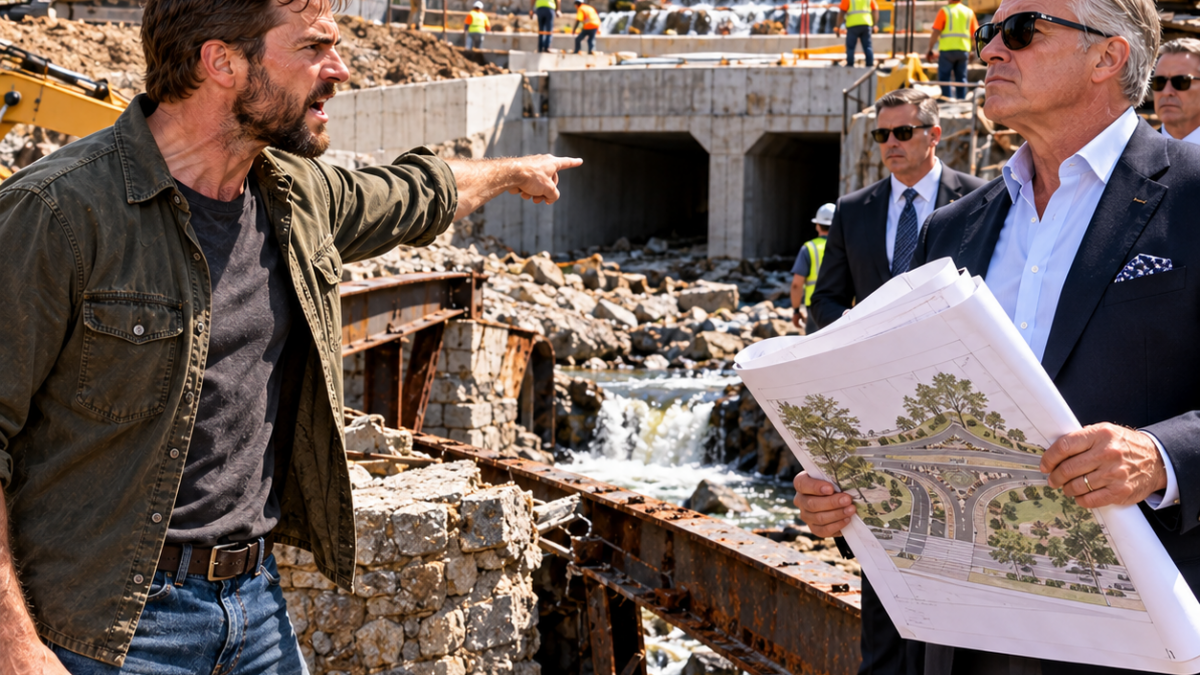
PART2:
For most of my life, the land beyond ours was timber.
Hundreds of acres.
Pine.
Juniper.
Rock.
Some grazing.
A few logging roads.
Then Bend grew.
And grew.
By 2023, four hundred acres behind and beside us belonged to Triton Land Management, a California developer with enough money to make hills disappear.
The project was called Crestview Meadows.
Nothing about it was a meadow.
They cleared forest, blasted rock, installed water, sewer, fiber, streets, retaining walls, and sales monuments.
The master plan called for 993 homes.
Not ninety-three.
Nine hundred ninety-three.
Luxury homes.
Golf course.
Clubhouse.
Tennis courts.
Walking trails.
Community lake.
A “mountain lifestyle village center,” whatever that meant.
The geography caused problems immediately.
The site sat in a broad basin bordered by steep ridges.
There were two theoretical access routes.
One required blasting and a major bridge over protected drainage.
The other ran almost perfectly along the old flat approach to my property.
Across Miller’s Creek.
Across Grandpa’s bridge.
Then into the development.
Triton had tried buying my front corridor two years earlier.
They did not offer to buy the whole twelve acres.
Just a sixty-foot strip from the highway through the bridge area and along my eastern edge.
Their first offer was $180,000.
I said no.
Not because insulting.
Because that strip divided my property.
Their road would have placed thousands of vehicles within sight of my house and barn.
Their second offer was $350,000 plus landscaping.
I said no.
Their third was $500,000.
My attorney, Thomas Langdon, told me:
“That’s real money.”
“I know.”
“You sure?”
“Yes.”
“What number changes your mind?”
“No number I’ve heard.”
I did not oppose the subdivision.
I opposed turning my grandfather’s private driveway into a boulevard.
That distinction mattered to me.
It did not matter to Ryan Caldwell.
Ryan was selected as the first HOA president before most Crestview homes were even occupied.
He had been a corporate litigator.
Late fifties.
Silver hair.
Perfect posture.
The kind of man who made every conversation sound as though a court reporter might be present.
Before the first finished home sold, I received a letter.
CRESTVIEW MEADOWS COMMUNITY STANDARDS NOTICE.
It asked me to remove “visual blight” along their western boundary.
The visual blight included:
My barn.
A stack of firewood.
An old Ford pickup that had belonged to Grandpa.
And “unmanaged native vegetation.”
I wrote across the letter:
NOT A MEMBER.
RETURN TO SENDER.
Rachel told me that was childish.
I agreed.
Then did it anyway.
Second letter:
Our barn should be repainted in an approved earth tone because it was visible from future homes.
Third:
No derelict vehicles were permitted.
The Ford ran.
Badly.
Still ran.
Fourth:
Exterior lighting needed shielding.
Our nearest light was two hundred yards from their future lots.
Thomas finally sent formal letter:
Mr. Pendleton’s parcel is not encumbered by Crestview Meadows declarations. Please cease representing otherwise.
Letters slowed.
Then access discussions resumed.
Triton project manager called.
“We need a temporary construction license.”
“No.”
“Just trucks.”
“No.”
“We’ll repair bridge.”
“No.”
“We’ll replace bridge.”
“No.”
“You understand this development will be built regardless.”
“I understand.”
“The alternate entrance adds tens of millions.”
“That sounds like your planning problem.”
He did not like that.
About three months later, Ryan visited.
He drove a white Range Rover to my gate.
No golf cart yet.
The subdivision roads were still dirt.
He carried a folder.
“Alex.”
“Ryan.”
“We need to talk as neighbors.”
“We’re not neighbors yet.”
“We will be.”
He smiled.
“Triton has reviewed historic county records.”
“Good.”
“There is a public-access basis over the Miller’s Creek corridor.”
“No.”
“There is.”
“Show me.”
He pulled modern survey.
A sixty-foot shaded band.
The title block read:
PRESUMED HISTORIC ACCESS CORRIDOR.
Presumed.
I pointed.
“That word is doing work.”
Ryan said:
“Prior use plus public maintenance history.”
“There has never been public maintenance.”
“The county has records.”
“My family paid for bridge.”
“Public roads can be privately improved.”
“It isn’t public.”
“Then litigate.”
His smile was small.
That was first time I understood strategy.
They did not necessarily need to be right immediately.
They needed enough ambiguity to keep project moving.
I called Thomas.
He ordered title research.
The modern records were strange.
County GIS showed access line.
Older plats referenced Miller Creek Road in inconsistent ways.
Some maps showed dashed corridor.
Others stopped at state highway.
There had been logging access in 1940s.
Nothing obvious enough for quick answer.
Thomas said:
“Do not assume.”
“I know my property.”
“I know.”
“Court cares what record says.”
We requested archives.
Before those arrived, Triton filed permit applications for road improvements.
County transportation staff initially treated corridor as existing rural access.
Thomas objected.
They paused final approval pending title clarification.
At least I thought they had.
Then came my fishing trip.
Mid-October.
Four days on Deschutes River with my brother.
No cell signal much of time.
It was deliberate.
Rachel had gone to Portland to visit our daughter.
I came home Sunday afternoon.
Turned off state highway.
Stopped so hard a toolbox slid across truck bed.
The bridge was gone.
Not damaged.
Gone.
Grandpa’s stone abutment on the north side had been broken apart by excavator.
Steel girders had been cut.
Deck demolished.
Chunks stacked beside creek.
In place:
Two enormous concrete box culverts.
Fresh fill.
Graded roadbed.
Yellow excavators.
Compactor.
Survey stakes.
A four-lane corridor nearly fifty feet wide.
My private drive had become a construction zone.
On my side of creek, maybe quarter acre of pines were down.
And thirty yards farther in, masonry crews had started a twenty-foot entrance monument.
STONE.
WATERFALL.
BRASS LETTERS:
CRESTVIEW MEADOWS
ELEGANCE IN NATURE
I sat behind wheel unable to process.
Then anger arrived.
Not normal anger.
The kind that makes hands cold.
I got out.
Walked toward foreman.
White hard hat.
Plans spread across hood of pickup.
“What the hell happened to my bridge?”
He looked up.
“You Pendleton?”
“Yes.”
“Talk to Triton.”
“You demolished my bridge.”
“We had work order.”
“You cut trees.”
“Right-of-way clearing.”
“There is no right-of-way.”
He sighed.
Not cruel.
Tired.
“Look, man, I’m contractor.”
“Permits were issued.”
“HOA and developer signed off.”
“County?”
“Transportation permit.”
“Show me.”
He handed copy.
TEMPORARY ACCESS IMPROVEMENTS — MILLER CREEK CORRIDOR.
Applicant: Triton Land Management.
It referenced “existing access.”
Not ownership.
Not condemnation.
I said:
“That is my bridge.”
He pointed toward culverts.
“Was.”
I nearly hit him.
Not because he deserved it.
Because one word landed wrong.
Was.
Instead I walked away.
That was the smartest thing I did that day.
I called sheriff.
Deputy arrived.
Then county inspector.
Then Thomas.
Then my lawyer.
By dark there were seven vehicles around creek.
Everyone had paper.
Nobody could instantly tell me how a seventy-year-old bridge disappeared from private land while I was gone.
The contractor stopped work voluntarily once title dispute was raised.
Good.
But bridge was still rubble.
I did not sleep.
At 7:30 next morning, Rachel returned early.
She stood at creek.
Cried.
Not because she loved steel.
Because she knew what it meant to me.
“What are you going to do?”
“I don’t know.”
“Don’t do anything stupid.”
“I’m going to talk to Ryan.”
“That sounds stupid.”
She knew me.
At eight I drove the ugly logging-road route around ridge to reach development sales office.
It took forty-five minutes.
Normally bridge to highway took three.
Ryan’s temporary office looked like permanent executive suite.
Mahogany desk.
Leather chairs.
A model of development.
Little plastic homes.
Little trees.
A perfect tiny boulevard over Miller’s Creek.
Brenda Higgins sat to side.
HOA secretary.
Ryan looked up.
“Alex.”
He had been expecting me.
“I assume you’ve seen improvements.”
“Improvements?”
“Your bridge was structurally obsolete.”
“You destroyed private property.”
“The crossing is being upgraded under historic access rights.”
“You cut my trees.”
“Within corridor.”
“You’re building monument on my land.”
“Within corridor.”
“There is no corridor.”
Brenda slid survey.
Apex Surveying.
Same shaded sixty feet.
Ryan said:
“Your grandfather’s bridge was built in what county records identify as rural access corridor.”
“No.”
“Repeated historic use can establish rights.”
“Who used it?”
“Logging operations.”
“By permission.”
“Public service vehicles.”
“By permission.”
“County graders.”
“Never crossed bridge.”
He smiled.
“These are factual disputes.”
Then sentence I will never forget:
“The bridge is gone, Alex.”
As though destruction had settled title.
He leaned forward.
“The boulevard is being built.”
“The community is moving forward.”
“You can spend five years litigating history, or you can accept reality.”
“What reality?”
“Triton will offer fair compensation.”
“For what?”
“Integrating your parcel.”
“I am not joining your HOA.”
“Eventually you’ll want services.”
“No.”
“You are standing in way of nearly a thousand families.”
“No.”
“You built nearly a thousand homes without buying access.”
His eyes narrowed.
Brenda said:
“You cannot hold a development hostage because you’re sentimental about old rocks.”
My hands tightened on chair.
I released.
Ryan continued:
“If you interfere with permitted construction, you will be exposed to enormous damages.”
“Road delay.”
“Home closings.”
“Financing.”
“Maybe enough to force sale of your property.”
There it was.
Not hidden.
Pressure.
I stood.
Ryan smiled.
“Think carefully.”
“I am.”
Then left.
Not because defeated.
Because I needed records before emotion.
Thomas and I went to Deschutes County records.
Not cinematic basement with mystical archivist necessarily, but older records were partly digitized, partly archived.
A clerk named Beatrice Owen helped.
She had worked there thirty-six years.
She knew old road books.
We requested everything:
Pendleton parcel.
Miller Creek crossing.
1950–1960 county commission minutes.
Road dedication.
Bridge permit.
Tax maps.
Logging easements.
Maintenance records.
The search took most of day.
Then Beatrice found a reference in 1952 road ledger.
PENDLETON CROSSING — PRIVATE BRIDGE APPLICATION.
She brought microfilm.
There was Grandpa’s name.
Samuel R. Pendleton.
He had initially offered to dedicate crossing to county in exchange for maintenance.
County declined.
Reason:
Unstable bedrock and insufficient public-road justification.
Then another document.
Quitclaim/deed instrument.
The county formally disclaimed and conveyed whatever roadway interest it might have asserted in the sixty-foot strip to my grandfather, subject only to state highway approach requirements and specified utility rights.
No public roadway.
No county bridge.
No general access easement.
And most important:
The corridor matched modern route.
Thomas read twice.
Then sat back.
“That’s strong.”
“How strong?”
“Very.”
“Ryan says prescriptive use.”
“Prescriptive easement requires elements they may not satisfy.”
“Especially if use was permissive.”
“We have old family records?”
I did.
Grandpa kept everything.
Fuel receipts.
Letters.
Logging agreements.
At home we found two timber-company licenses from 1960s.
Temporary permission to cross bridge.
A school district note thanking family for emergency access.
Sheriff letter requesting permission during wildfire.
Permission.
Permission.
Permission.
That undercut hostile/adverse historic use.
Then county produced maintenance records.
Nothing showing county maintained bridge.
They plowed state approach.
Not crossing.
Apex had relied on modern dashed GIS layer and historic references without locating 1952 instrument.
Mistake.
A catastrophic one.
I called Thomas.
“Can we stop road?”
“Yes.”
“How fast?”
“Emergency injunction.”
We filed.
Not secret.
Not waiting fourteen months.
That would have been madness.
By then Triton had already sold some homes under construction contracts, but hundreds remained.
The court heard emergency motion two days later.
Triton argued:
Work permitted.
Substantial reliance.
Public-safety need.
Potential easement theories.
We argued:
Recorded title.
County disclaimer.
No public dedication.
Destruction already occurred.
Continuing road construction irreparable trespass.
Judge issued temporary restraining order.
No further construction on disputed corridor.
No public vehicular use beyond emergency access by consent until preliminary hearing.
Triton could use internal construction access from alternate ridge route.
Expensive.
Slow.
But possible.
Ryan called me that afternoon.
“You just cost developer millions.”
“No.”
“You built road on wrong land.”
“This will not stand.”
“Then see you at hearing.”
“You think twelve acres outweighs 993 homes?”
“It doesn’t matter what weighs more.”
“It matters who owns it.”
He hung up.
That was beginning, not end.
The public story came later.
At first everything stayed quiet.
Triton did not want buyers hearing “access problem.”
HOA did not want residents concerned.
They referred to it as “temporary construction routing adjustment.”
Meanwhile legal teams dug.
Apex Surveying notified insurer.
Triton title insurer got involved.
County reviewed permitting.
Contractor preserved records.
I documented destroyed bridge.
Engineer assessed replacement cost.
Stonework photographs.
Original plans.
Could bridge have remained safe another seventy years?
Maybe not.
Inspection showed deterioration.
But that was irrelevant.
They had no right to destroy it without consent.
Replacement value became complicated.
Historic/sentimental value not simple damages.
We did not claim three million because Grandpa touched rocks.
We got engineers.
Masons.
Bridge consultants.
Estimate to reconstruct comparable private bridge using salvaged stone where feasible was substantial.
Far less than internet-fantasy millions, still serious.
The bigger issue was access.
Triton had already designed entire subdivision around our corridor.
Alternate western entrance required major excavation, retaining walls, environmental review, and years.
Could be done.
Not impossible.
But expensive.
Very.
At preliminary injunction hearing, Apex surveyor testified.
He admitted he had not found 1952 county instrument.
His team relied on digital index and later plats.
Triton argued dashed road and decades of use supported implied rights.
Thomas showed permission records.
Judge asked:
“Who maintained bridge?”
“My family.”
“Who paid taxes on corridor?”
“My family.”
“Who insured?”
“My family.”
“Any evidence general public used continuously as right?”
No strong evidence.
Emergency services?
Permission.
Timber?
Licenses.
Neighbors?
Invitation.
The court extended injunction.
Not final title judgment yet.
But enough.
Triton’s lenders noticed.
Home closings slowed.
Buyers demanded disclosure.
That is when things became serious.
A road is not decoration.
Subdivision needs legal ingress and egress.
Fire access.
School buses.
Utilities.
Insurance.
Mortgage underwriting.
Emergency response.
Crestview had internal roads.
But external legal connection mattered.
The alternate construction route was not approved permanent residential access.
Triton’s lawyers requested mediation.
My lawyer Thomas Langdon came with me.
He was not theatrical.
He was methodical.
“Before money,” he told me, “decide what you want.”
I knew.
“Bridge replaced.”
“Private access for us.”
“Buffer from boulevard.”
“No HOA control.”
“Compensation for trees.”
“Legal costs.”
“And road corridor?”
I hesitated.
That was difficult.
Could insist they build another route.
Then my land remains private, but development suffers years.
Could sell corridor.
Then thousands of cars.
Could grant limited easement with design protections.
Money mattered, but so did home.
Rachel said:
“If you sell them straight line past house, we’ll hate money.”
Correct.
We hired traffic engineer.
Landscape architect.
Surveyor.
Designed alternative within my property edge:
Developer could obtain sixty-foot corridor on far eastern edge, farther from house, if it built entirely new access and funded a separate private bridge/drive for us upstream.
But that required more land.
Would cut trees.
I did not love.
Another option:
Sell existing corridor but require massive vegetated berm, sound wall in sections, gates separating our private driveway, no HOA jurisdiction beyond road, no pedestrian access, strict maintenance.
Still traffic.
Rachel asked:
“Do you want stay here?”
“Yes.”
“Then don’t optimize check.”
Best advice.
We countered with a permanent access easement rather than sale.
Triton preferred ownership because lenders.
Negotiation went weeks.
Meanwhile residents moved in through temporary controlled access windows under court agreement? Need practical. Court permitted existing homeowners emergency/limited access via corridor while dispute continued, because by then some had occupied homes and blocking them would be unsafe and inequitable. Important grounding.
We agreed interim license.
No toll.
No trapping residents.
Triton paid monthly escrow.
Traffic limited.
Construction vehicles used alternate route.
Emergency services unrestricted.
Residents got temporary passes.
I hated seeing cars cross Grandpa’s demolished bridge site.
But residents had not destroyed it.
Punishing them would have made me wrong.
That became important distinction.
Ryan hated interim agreement because it admitted my ownership position.
He kept writing HOA notices about my barn.
Thomas responded once:
“Please identify covenant binding Mr. Pendleton.”
No answer.
Then residents started learning details.
One physician named Dr. Lena Morales contacted me.
She lived in Phase One.
“Are you trying to close road?”
“No.”
“HOA says you threatened to trap neighborhood.”
“I have never said that.”
“Did you put up barriers?”
“No.”
“Then what’s happening?”
I told her:
“Developer destroyed private bridge and built road without owning corridor.”
She went quiet.
“Do you have proof?”
“Yes.”
“Can residents see?”
“Court filings are public.”
She read.
Then other residents did.
Ryan’s narrative started cracking.
At town hall, he said:
“This is an opportunistic landowner exploiting a technical title defect.”
Someone asked:
“Did Triton offer to buy corridor before construction?”
Ryan hesitated.
Yes.
That answer changed everything.
If they thought it was public, why offer money?
Another resident:
“Did Mr. Pendleton reject?”
“Yes.”
“Then you demolished bridge anyway?”
“Triton relied on survey.”
“After he rejected sale?”
Silence.
The HOA board had not authorized demolition—it was developer action in coordination with access committee and Ryan.
Still, Ryan had pushed.
Emails later showed:
We should proceed under presumed access. Once roadway is established, Pendleton’s leverage decreases substantially.
From Ryan to Triton project executive.
That email became famous locally.
Once roadway is established.
In other words:
Build first.
Argue later.
Exactly what I feared.
Triton’s executives blamed Apex.
Apex blamed incomplete records.
Ryan blamed county GIS.
County blamed applicant.
Everybody had piece.
No single villain caused whole thing.
But Ryan’s email showed intent to use construction as leverage despite known ownership objection.
That made him toxic.
Triton removed him from developer liaison meetings.
HOA board voted to appoint separate counsel.
Brenda resigned as secretary.
Not criminal.
Just unwilling to stay.
Ryan refused.
He called me.
“You’re turning residents against me.”
“I haven’t attended meeting.”
“You released emails.”
“Discovery is public.”
“You know what you’re doing.”
“So did you.”
He breathed hard.
“You could end this.”
“So can Triton.”
“What do you want?”
“A legal road that doesn’t erase my home.”
“You’re being sentimental.”
“Yes.”
“My grandfather built bridge.”
“That has no economic value.”
“Then why did your development need its location?”
Silence.
He hung up.
Mediation finally reached terms after three failed sessions.
The numbers were nowhere near fifteen million cash plus three million bridge revenge.
Reality is usually less cinematic and more defensible.
But they were substantial.
Triton agreed to purchase a defined seventy-foot transportation corridor along the eastern edge of my parcel for $4.6 million.
Why so much for narrow strip?
Because value was not acreage.
It was project access.
Without it, alternative road cost far more and delayed hundreds of closings.
But I did not simply sell existing driveway through middle.
The deal required:
Triton abandon the central alignment.
Remove portions of new monument and grading that intruded toward my home.
Restore disturbed quarter acre.
Fund a new private bridge for my residence upstream, designed by engineer I selected within reasonable budget.
Construct separate private driveway from new bridge to highway.
Build landscaped earth berm and sound barrier between Crestview boulevard and remaining Pendleton land.
Replace destroyed mature trees at agreed ratio with native species.
Pay bridge reconstruction/restoration compensation.
Pay my documented legal and engineering fees.
And most importantly:
Recorded declaration stating remaining Pendleton property was permanently outside Crestview Meadows HOA and could not be annexed without written voluntary consent from future owner.
No dues.
No architectural review.
No HOA maintenance rights.
No survey access without permission except defined utility corridor.
No decorative monument on my remaining land.
Triton got what it needed.
A legal road.
I kept what I needed.
A home separated from it.
The new road curved east before reaching old bridge location.
The old location became part of my restored property.
We rebuilt private bridge upstream.
Not exact replica.
Could not be.
But salvaged some original river stone.
One old steel section mounted beside new bridge with small plaque:
SAMUEL PENDLETON CROSSING
1952
Rachel cried when installed.
So did I.
Triton also paid additional $620,000 encompassing bridge loss, timber, temporary access use, restoration, and settlement of claims.
After taxes and fees, less.
Still life-changing.
I did not become twenty-million-dollar road baron.
I became man whose refusal forced developer to buy what it should have bought before sending excavators.
That was enough.
Ryan’s end was less spectacular.
He was not forced by contract to sell his home.
I had no authority to demand that.
He was recalled by Crestview homeowners.
The vote was overwhelming.
Not because residents suddenly loved me.
Because his judgment had threatened their home values, caused legal uncertainty, and helped create millions in unplanned costs.
At recall meeting, he defended himself.
“The developer’s survey supported access.”
A resident shouted:
“You knew Alex said it was private!”
Ryan:
“We had legal theories.”
Another:
“You gambled our road!”
That was the phrase.
Gambled our road.
That is what residents cared about.
Not my bridge.
Not property philosophy.
Their ability to get mortgage, insurance, school bus.
Understandable.
Ryan lost vote.
He remained resident another six months.
Then listed.
Moved later.
I heard Arizona.
Internet versions say Florida.
Maybe neither.
I did not keep track.
Brenda sent me apology letter.
Short.
She admitted she had assumed Ryan and developer counsel had verified title.
She apologized for comments about my “ugly old rocks.”
That line stuck.
I wrote back:
“Thank you.”
Nothing more.
The county reviewed permitting process.
Not because corruption.
Because gap.
Transportation permit should not have proceeded with unresolved private-title objection.
They adopted requirement for stronger title certification on subdivision ingress when access crosses separately owned parcel.
Again:
Boring reform.
Useful.
Apex’s insurer settled professional-negligence claims with Triton.
I was not party beyond my property damages already settled.
The contractor was mostly indemnified because it relied on issued work orders and permits, although it had ignored my on-site objection the day I returned.
Foreman later came to see rebuilt bridge.
His name was Mark.
He stood quietly.
“I’m sorry.”
“You didn’t know.”
“I knew you were mad.”
“Different.”
“We should’ve shut down immediately when you said private.”
“Yes.”
He nodded.
Then:
“I’ve changed how we verify right-of-way.”
Good.
That mattered more than humiliation.
Crestview’s boulevard opened eighteen months later on new legal alignment.
Four lanes.
Trees.
Lights.
A monument.
Smaller than original.
It says:
CRESTVIEW MEADOWS
Nothing about elegance in nature.
Maybe they learned humility.
Probably marketing changed.
Nine hundred ninety-three homes eventually occupied.
Traffic heavy mornings.
But from my house, berm and trees block most.
New private driveway curves opposite direction.
Our bridge is gated.
Not because hatred.
Because private.
Fire department has access code.
Utilities as needed.
No HOA.
I occasionally meet Crestview residents at grocery store.
Most normal.
One woman once said:
“You’re the guy who shut us in.”
I corrected.
“No.”
“You blocked road.”
“No.”
“There was never a day residents couldn’t leave under court agreement.”
She frowned.
“That’s not what Facebook said.”
“Facebook lied.”
She laughed.
Fair.
Another resident thanked me.
“For what?”
“For forcing them to fix title.”
“That’s low bar.”
“You’d be surprised.”
Probably.
The viral version of story spread years later.
Someone took skeleton:
HOA destroys private bridge.
993 homes rely on landowner’s road.
Owner proves title.
Then added fantasy:
I waited fourteen months while all homes sold.
Installed Jersey barriers at four in morning.
Trapped residents.
Charged $500 per exit.
Made doctors walk suitcases to highway.
Demanded $15 million.
Forced HOA president to sell house.
Built twelve-foot wall.
Fun story.
Legally suicidal.
Morally ugly.
If I had knowingly trapped nearly a thousand households without emergency access to maximize leverage, a judge would have had several things to say.
So would I.
The residents were not responsible for Triton’s title failure.
There were nurses.
Teachers.
Children.
Elderly people.
Emergency calls.
People going to work.
Ownership rights are not license to manufacture danger.
Thomas would have tackled me before letting me erect a tollbooth.
He told me later:
“If you had tried charging five hundred dollars per car, I would have changed my phone number.”
Fair.
The real leverage was stronger anyway.
Court.
Title.
Financing.
Permits.
Closings.
Insurance.
No theatrics required.
When a developer has hundreds of millions committed to a project without secured permanent ingress, you do not need barricade.
You need a certified deed.
That is what Ryan never understood.
He believed visible control became legal control.
Bridge gone.
Road graded.
Monument built.
Therefore reality changed.
But concrete does not cure defective title.
Pavement does not create deed.
A $2 million entrance built on wrong parcel remains a $2 million problem.
I learned something too.
I had been overconfident before.
When Ryan first showed presumed corridor map, I said:
“I know my property.”
Emotionally, yes.
Legally, not enough.
My family stories were not evidence.
Grandpa saying “county never owned bridge” was not evidence.
We needed 1952 records.
Permission letters.
Tax history.
Survey.
That distinction humbled me.
Property rights are strongest when documented.
Memory helps find documents.
It does not replace them.
After settlement, I organized everything.
Deed.
Survey.
1952 county instrument.
Bridge plans.
New corridor sale.
Permanent HOA exclusion declaration.
Utility easements.
Emergency access agreement.
Digital copies.
Offsite copies.
My daughter knows where.
I told her:
“If someone arrives with pastel polo and clipboard, call lawyer before talking.”
She laughed.
Good.
Maybe she will listen.
Rachel and I used some settlement money to improve land.
Not giant wall.
We planted trees.
Built workshop.
Repaired barn.
Set aside conservation area along creek.
New bridge cost more than I ever expected, even with Triton paying.
Engineering modern standards.
Hydrology.
Permits.
Foundations.
Steel.
It is beautiful.
Not Grandpa’s.
That is okay.
Trying to recreate exact past would have made new bridge shrine.
Instead, we reused his stone.
One abutment includes hand-laid stones salvaged from rubble.
The old steel plate sits beside.
I cross and remember.
Not only destruction.
What he did right.
He documented.
That 1952 paper saved more than bridge claim.
Grandpa had insisted county put refusal and quitclaim in writing.
My father used to say he was paranoid.
Maybe.
Sometimes paranoia with filing cabinet becomes estate planning.
I wish he had been alive to see Ryan’s face when county records surfaced.
Then I remember Grandpa probably would have hated attention.
He would have asked why I ever let developer near bridge.
Fair question.
Harrison? No other story contamination.
Years later, a county planning class asked me to speak.
I said no twice.
Then agreed because topic was access and title diligence.
I opened:
“I’m not lawyer.”
Then told students:
“If your project needs one road, own the road.”
They laughed.
I did not.
“Or hold recorded easement.”
“Not a dashed GIS line.”
“Not a presumed corridor.”
“Not ‘everybody always used it.’”
“Not somebody’s recollection.”
“Recorded legal access.”
One developer in room asked:
“What if landowner refuses unreasonable offer?”
“Build somewhere else.”
Murmurs.
He said:
“That can kill project.”
“Yes.”
“That gives one owner enormous leverage.”
“Yes.”
“Is that fair?”
I thought.
“Property ownership is partly right to say no.”
“If public necessity justifies taking, government has condemnation procedures and compensation.”
“Private developer does not get to skip because schedule expensive.”
That became quote in local planning newsletter.
Ryan would have hated.
The 993 number remained symbolic.
People ask:
“Did 993 families really have no legal way out?”
At peak, not all homes occupied.
And there were emergency/construction alternatives, though impractical.
By final buildout, legal boulevard resolved.
So no, I did not literally own every human being’s only physical exit.
I owned corridor Triton had designed as sole permanent primary access to highway.
That distinction matters.
The title still works:
993 homes learned who owned their only planned way out.
But the truth is better than hostage fantasy.
Their subdivision’s access plan depended on a man they tried to bulldoze.
That is irony enough.
One winter, Dr. Morales—the physician who first called me—came by with bottle of wine.
“What for?”
“For not closing road.”
“I never planned to trap people.”
“I know now.”
“Sheepishly, I was furious at you.”
“Reasonable if you believed Ryan.”
“I did.”
“What changed?”
“Court record.”
Good answer.
We became casual friends.
Her son fishes Miller’s Creek sometimes with permission.
That is another thing internet revenge stories lose:
Life after conflict.
If you treat 993 households as enemies, you live beside 993 enemies forever.
If you separate wrongdoers from everyone else, neighborhood can recover.
Crestview eventually stabilized.
New HOA president was an engineer named Priya Shah.
First letter she sent:
Mr. Pendleton,
This is not a violation notice.
I laughed before reading rest.
She requested annual coordination meeting about emergency access, wildfire evacuation, creek maintenance, and boundary vegetation.
Voluntary.
Useful.
We met.
Fire district attended.
Wildfire was real shared risk.
Our properties bordered forest.
We coordinated secondary emergency path that could open during evacuation under county command.
Recorded license.
No daily traffic.
No HOA jurisdiction.
Just safety.
That is what good neighboring looks like.
Ironically, after fighting over access, we created better emergency access than Triton had planned.
Because everyone knew exact rights.
Clear boundaries make cooperation easier.
Ambiguity makes cooperation dangerous.
Priya once said:
“Ryan thought boundaries were obstacles.”
I answered:
“They’re instructions.”
She wrote that down.
Probably for meeting.
The old Crestview entrance monument? The first one was partially demolished because it encroached.
Some river stone? No, tacky stone. The waterfall structure on my land removed under restoration agreement. They rebuilt entirely within purchased road corridor, smaller.
I kept one brass letter.
Not deliberately.
Contractor found an “E” in debris and left near barn.
For months it leaned against wall.
Rachel asked:
“What are you doing with that?”
“Nothing.”
“Throw it away.”
“Maybe.”
She eventually did.
Good.
Not every relic deserves shrine.
The most important relic is original bridge bolt.
A black steel bolt Grandpa had stamped initials on.
Found in rubble.
S.P.
I keep on desk.
Heavy.
Rusty.
People pick up.
“What’s this?”
“Receipt.”
For what?
For remembering what concrete forgot.
I know that sounds poetic.
Age does that.
The money changed life some.
We paid off mortgage.
Funded granddaughter’s education accounts.
Bought better tractor.
Donated portion to local land trust.
Not because saint.
Tax planning partly.
Still good.
I did not build fortress.
Did not need.
A surveyed line and recorded agreement are stronger than wall.
We installed normal fence.
Trees.
Cameras at bridge.
Gate.
No twelve-foot masonry.
I wanted home, not compound.
Ryan’s old threats faded.
No more letters about barn color.
The barn remains red.
The Ford pickup still sits beside it.
I restored enough to run properly.
On nice Sundays, I drive it across new bridge.
Grandpa would laugh at power steering.
Sometimes Crestview kids wave.
I wave back.
That feels better than flipping them off.
The first anniversary of bridge demolition, Rachel found me at creek before dawn.
I had been standing over salvaged stone.
She brought coffee.
“You okay?”
“Yes.”
“You’re lying.”
“A little.”
“You miss it.”
“Yes.”
“New one is better.”
“Structurally.”
“You’re impossible.”
I smiled.
Then she said:
“You know Grandpa’s bridge did its job.”
“What?”
“It got family across for seventy years.”
“It doesn’t have to exist forever to matter.”
That hit harder than any court ruling.
I had treated demolition as if they erased him.
They did not.
You cannot bulldoze memory.
You can destroy object.
Not what object carried.
The settlement gave us money.
The new bridge gave access.
The records gave justice.
But Rachel’s sentence gave peace.
It did its job.
That is true of people too.
Grandpa built.
Dad maintained.
I inherited.
One day daughter will decide.
Maybe keep.
Maybe sell.
I used to think selling would betray family.
After everything, I changed.
Ownership includes choice.
If she voluntarily sells to Crestview someday, that is her decision.
The thing worth defending was never “Pendletons must own forever.”
It was consent.
Ryan tried to take decision.
That is why I fought.
If future owner chooses differently, fine.
I put no spite covenant forbidding sale.
I did put no automatic HOA annexation.
Future owner must sign affirmatively.
Choice preserved.
That is legacy I like.
Not wall.
Not revenge.
Choice.
The county archives clerk Beatrice retired next year.
Rachel and I sent flowers.
She called.
“Wasn’t me.”
“Yes, it was.”
“I only found file.”
“That mattered.”
She laughed.
“People never appreciate archives until something expensive is sitting on wrong land.”
Exactly.
Triton later paid county to digitize older access records? Maybe county itself initiated grant. Let’s avoid attributing. County began digitization project after several disputes. Good.
The yellowed 1952 record is now scanned online.
Anyone can see.
I sometimes open.
Grandpa’s signature.
Samuel R. Pendleton.
Strong handwriting.
County commissioner below.
One old document.
Tiny compared to boulevard.
Yet when conflict came, paper outweighed concrete.
That is one of strangest things about property law.
Humans can spend millions changing physical world.
Bulldoze.
Pave.
Build.
Light.
Landscape.
But if underlying right absent, all that investment can become leverage against builder.
The more Triton spent before checking, the worse their position.
Ryan thought construction would weaken me.
It strengthened urgency.
That is why due diligence is boring and priceless.
The preliminary title report Triton relied on had exception referencing old unlocated county instruments.
Somebody should have dug deeper.
Apex should have.
Title counsel should have.
Developer acquisition team should have.
Ryan definitely should have paused once I objected.
Instead every layer assumed previous layer checked.
That is how sophisticated organizations make stupid mistakes.
Not one idiot.
Chain of assumptions.
Then ego prevents correction.
I often wonder what would have happened if Ryan responded that Sunday:
“Stop work.”
“Alex, we may have made terrible mistake.”
“We’ll restore.”
“We’ll investigate.”
Probably settlement far cheaper.
Maybe I would grant access willingly after redesign.
Maybe $1 million instead of millions.
Maybe relationship okay.
But he told me:
“The bridge is gone.”
As if destruction settled ownership.
That line hardened me.
Words matter.
Not legally maybe.
Negotiation definitely.
If you realize you may be wrong, arrogance is expensive.
Crestview residents eventually held annual wildfire drill.
Our emergency gate included.
First year, I stood beside fire chief watching cars route.
Priya said:
“Look at us.”
“What?”
“Cooperating over road.”
“Don’t tell anyone.”
She laughed.
Ryan would not have.
He thought power meant unilateral.
Good governance is opposite.
Clear authority.
Consent.
Process.
Records.
Dull until needed.
When people hear story they always want moment gate closed.
I tell them there was no dramatic gate day.
No mile-long hostage traffic jam.
The real “gate closing” happened in courthouse when judge extended injunction and said, in effect:
You cannot keep building until you prove right.
That stopped $700 million project’s easiest access plan.
No concrete barrier needed.
A court order is quieter.
Much stronger.
Later closing documents mattered too.
Triton’s lender required recorded corridor before releasing next financing tranche.
That deadline created pressure no theatrical toll could match.
They paid because financing mathematics.
Not because I scared residents.
Those are grown-up stakes.
Less viral.
More real.
The check? Wire.
No suitcase cash.
Thomas called:
“Funds cleared.”
I was changing hydraulic hose.
“How much?”
“You know how much.”
“I wanted hear.”
He told.
I sat on tire.
Not triumph.
Relief.
Rachel came.
“We done?”
“Mostly.”
“Mostly?”
“Never say done with real estate.”
She groaned.
That night we ordered pizza.
Not champagne.
Maybe that is Midwestern? Oregon too. Fine.
The final property record shows:
Triton owns Crestview boulevard corridor.
We own remaining twelve minus conveyed strip.
Actually less now maybe around ten-plus acres after strip. Fine.
Recorded buffer easement.
Private bridge access.
No HOA annexation.
All clean.
The road works.
Development works.
Our home works.
Nobody trapped.
Nobody extorted.
Nobody needs to pretend.
That is victory I trust.
Ryan’s old sales-office model ended up in HOA storage.
Priya once showed me.
Tiny boulevard crossed my property exactly along first design.
She pointed.
“This version caused all trouble.”
“Model didn’t.”
“People did.”
“Fair.”
She removed road section.
Handed tiny plastic bridge to me.
“Souvenir?”
“No.”
“Why?”
“I have enough.”
Good.
The real bridge bolt remained.
That was enough.
There are mornings now when fog sits low over Miller’s Creek.
From new bridge, you cannot see Crestview beyond trees.
You hear traffic faintly.
Then nothing.
Water.
Birds.
Sometimes elk tracks.
The place is not as isolated as childhood.
Never will be.
Progress happened.
But home remains home because boundary negotiated rather than erased.
That difference is everything.
My grandfather built first bridge because he wanted secure access to land.
Seventy years later, that same bridge became reason I learned access is one of most valuable rights property can have.
Developers know this.
Farmers know.
Landowners sometimes forget until someone wants it.
An acre in middle of nowhere might be cheap.
A sixty-foot strip connecting 993 homes to highway can be worth millions.
Value is not size.
It is function.
Triton learned late.
I learned just in time.
If there is one thing I tell landowners now:
Know your access.
Know your easements.
Know who maintains.
Know what is recorded.
Do not rely on “everyone knows.”
Everyone knew Grandpa built private bridge.
That almost was not enough because digital records blurred.
Paper saved.
Scan now.
Back up.
Tell children.
Maps change.
People die.
Developers arrive.
A dotted line can become bulldozer remarkably fast.
Also:
Do not treat every HOA as enemy.
Crestview’s later board was reasonable.
HOA itself did not swing excavator.
Individuals and developer made decisions.
Collective can correct.
That matters.
If I had demanded HOA dissolution, I would have punished residents who needed roads, landscaping, stormwater, amenities.
Their association had purpose.
Ryan abused scope.
Remove bad governance, not necessarily institution.
Again:
Less cinematic.
More useful.
The title people use online is:
HOA Removed My Bridge—Then 993 Homes Learned Who Owned Their Only Way Out.
It is close.
The HOA president pushed.
Developer demolished.
And yes, the subdivision eventually learned its planned primary access crossed my land.
But the part I care about is not “who owned their way out.”
It is who had right to decide what happened on that land.
For a while, Ryan thought money decided.
Triton’s construction budget.
Legal teams.
993 buyers.
He thought scale converted inconvenience into entitlement.
If enough people needed my bridge, then my no became unreasonable.
Property law does not always work that way.
Public necessity can invoke government powers with due process.
Private profit cannot simply declare necessity and send excavator.
That is why 1952 document mattered.
County had considered public dedication.
Declined.
Recorded.
Grandpa retained.
It was not loophole.
It was decision.
A decision Ryan wished did not exist.
Wishing is not title.
When the original bridge was demolished, I thought family history had been stolen.
Years later I see differently.
The bridge’s final service was not carrying truck.
It exposed exactly how valuable boundaries were.
It forced every party to put assumptions on paper.
It led to new bridge.
Cleaner title.
Safer road.
Better emergency planning.
Not worth losing it.
But meaning can grow around loss without justifying loss.
I would still choose old bridge intact if given choice.
I was not.
So we built forward.
One day my granddaughter asked:
“Did bad man break Grandpa’s bridge?”
Children simplify.
I said:
“Some people made a bad decision.”
“Why?”
“They thought they had right.”
“But they didn’t?”
“No.”
“How did you know?”
“Grandpa wrote things down.”
She nodded solemnly.
Then:
“Writing is important.”
“Yes.”
That may be greatest lesson anyone extracted.
She was eight.
I gave her copy of bridge drawing later.
Maybe she will keep.
Maybe not.
The Ford truck still crosses.
Barn still not earth tone.
Brush still wild along parts boundary.
Crestview HOA has never sent another violation notice.
Priya once joked:
“We have a special rule.”
“What?”
“Anything west of berm is none of our business.”
“Excellent rule.”
I wish more organizations adopted.
As for Ryan, I heard he joined condo board somewhere.
That may be rumor.
If true, God help them.
I do not care enough to verify.
That is real ending.
Not revenge.
Indifference.
He no longer occupies my mornings.
The creek does.
When I drink coffee on porch, I can hear water beneath new bridge.
Sometimes cars from Crestview.
Sometimes nothing.
The brass-letter monument is out of sight.
My private gate stands upstream.
Samuel Pendleton’s stone embedded in abutment.
S.P. bolt on desk.
And in county record, one line remains clearer than anything Ryan ever said from mahogany desk:
The sixty-foot crossing had never become public.
My grandfather knew it.
The county knew it.
For seventy years, the paper waited.
Then a developer destroyed his bridge, paved a road, and discovered that concrete can cover land.
It cannot rewrite who owns it.








