HOA Demolished My 80-Year-Old Private Bridge Without Permission—Then Their Main Crossing Closed and 1,200 Residents Learned I Owned the Only Way Out.**
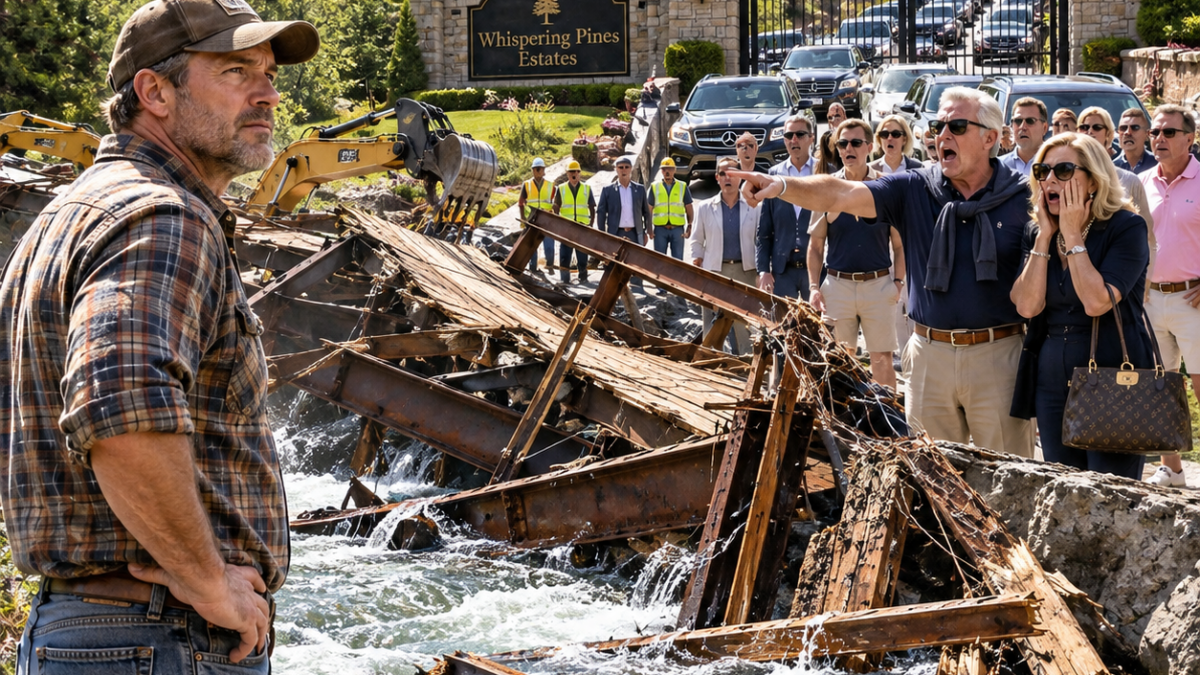
HOA Demolished My 80-Year-Old Private Bridge Without Permission—Then Their Main Crossing Closed and 1,200 Residents Learned I Owned the Only Way Out.
The HOA president hired a demolition crew while I was out of town, cut apart the 1932 steel bridge my great-grandfather had built across Cedar Creek, dumped part of it into the water, and then sent me a $28,450 bill for the privilege.
What Richard Wallace did not know was that my family’s century-old deed did not stop at the creek bank—I also owned the bridge abutment, the creek-bed rights tied to the crossing, and a fifty-foot strip of land on the subdivision side where his contractors had driven their excavators.
Then the development’s main highway bridge was closed for emergency structural repairs, and 1,200 homeowners discovered that the backup crossing their HOA president had just destroyed had never belonged to the HOA at all.
My name is Carter Walker.
For most of my life, Cedar Creek had been the kind of place people drove past without noticing.
That changed when someone figured out you could put stone entry monuments, iron gates, a clubhouse, and the word “Estates” beside almost anything and charge three times what the land had sold for ten years earlier.
My family had been there before all of that.
Long before the landscaping crews.
Before the tennis courts.
Before homeowners argued about acceptable mailbox finishes.
Before anybody named Richard Wallace owned a silver Range Rover.
My great-grandfather, Samuel Walker, bought the original property in 1898.
Back then, it was close to sixty acres of timber, creek bottom, rocky slope, and one narrow wagon road that disappeared whenever spring runoff got serious.
The land sat at the base of a heavily wooded Colorado valley cut almost in half by Cedar Creek.
Calling Cedar Creek a creek is a little misleading.
In August, you could stand in some sections and throw a rock across it.
In May, after snowmelt, it became dark, fast, and mean enough to roll logs end over end.
Samuel made a living hauling timber.
That meant he needed a crossing.
In 1932, after losing two wooden bridges to floods, he commissioned one that he believed would outlive everybody involved.
Steel trusses.
Massive stone abutments.
Heavy timber deck.
Seventy feet from bank to bank.
Wide enough for logging trucks.
Strong enough that, according to my grandfather, the engineer who designed it once said:
“If that bridge comes down, the mountain probably came with it.”
My grandfather exaggerated.
But not by much.
The bridge survived floods.
Heavy equipment.
Snow.
A 1964 ice jam that destroyed two downstream structures.
And, much later, a fully loaded concrete truck that crossed while I was pouring a new patio.
By the time I inherited the remaining family property, we no longer owned sixty acres.
Taxes and life had eaten away at it.
My grandfather sold pieces.
My father sold more.
We kept roughly five core acres surrounding the house, creek frontage, the old bridge, a workshop, and enough wooded land to make the place feel separate from everything that had grown around it.
Everything around it was the important part.
Because during the 1990s and early 2000s, almost the entire valley changed hands.
A development company came in.
The trees closest to the flats disappeared.
Roads arrived.
Water lines.
Sewer.
Model homes.
Then Whispering Pines Estates.
One thousand two hundred luxury homes behind ornamental gates.
The brochures showed smiling couples hiking beneath aspens that had actually been cut down two years earlier.
The development advertised:
PRIVATE MOUNTAIN LIVING
MINUTES FROM EVERYTHING
That second line became funny later.
At first, the developers were practical.
PART2:
They knew Cedar Creek divided the valley from the state highway.
So they built a modern concrete bridge roughly two miles downstream.
Two lanes.
Sidewalk.
Utilities beneath.
That became the subdivision’s official entrance and primary vehicle access.
The old Walker bridge remained on the northern edge.
Mine.
Private.
The developers knew it.
They had title reports.
Survey monuments.
Recorded maps.
They even negotiated a limited emergency-access arrangement with my father during the early construction years.
Not public access.
Not HOA ownership.
Not a permanent unrestricted easement.
A written agreement allowing authorized development and emergency vehicles to use the bridge under limited circumstances while the main roads were being built.
Once their concrete bridge opened, the arrangement effectively went dormant.
My father kept the bridge gated.
We used it for our property.
Occasionally the fire department coordinated access.
That was about it.
The developers built Whispering Pines around our retained parcel because they had to.
Our land predated their subdivision by nearly a century.
That meant I was not part of Whispering Pines.
No HOA membership.
No dues.
No architectural standards.
No clubhouse key.
No obligation to paint my workshop “Mountain Taupe Number Seven.”
For nearly fifteen years, nobody cared.
Then Richard Wallace became HOA president.
Richard was sixty-one when I met him.
Retired senior vice president from some logistics company.
He carried himself like retirement had not actually ended his authority, merely deprived him of employees.
Tall.
Trim.
Gray hair cut every two weeks.
Golf shirts with collars that never wrinkled.
Silver Range Rover.
He spoke in the tone of a man accustomed to PowerPoint presentations becoming reality after he said:
“Make it happen.”
Whispering Pines loved him at first.
There were reasons.
He negotiated a better snow-removal contract.
Forced the developer to repair drainage around the west tennis courts.
Got the clubhouse roof replaced under warranty.
Property owners liked seeing somebody aggressive on their behalf.
Aggression is impressive when pointed away from you.
Richard’s vice president was Susan Carmichael.
Susan was fifty-six.
Former commercial real-estate broker.
Sharp.
Organized.
And convinced the phrase “community standards” could solve almost any argument.
Together, Richard and Susan began what they called the North Greenway Enhancement Initiative.
The subdivision had a nature trail that ran along the northern boundary and ended near my property.
Residents apparently disliked the abrupt ending.
Richard wanted the trail extended.
Across the creek.
Using the location of my bridge.
His first letter was polite.
Mr. Walker,
The Whispering Pines Board of Directors is exploring a modernization of the northern recreation corridor. Your existing creek structure appears to occupy the logical alignment for a pedestrian connection.
The Board would welcome an opportunity to discuss acquisition, replacement, or cooperative improvement of the crossing.
I called him.
“It’s not available.”
“I think you should hear the proposal.”
“I read it.”
“We’re considering a highly attractive pedestrian structure.”
“I already have a bridge.”
“That structure is functionally obsolete.”
“It carried a concrete truck last month.”
“That is not really the point.”
“What is?”
He paused.
“Aesthetics.”
There it was.
The old bridge did not look like Whispering Pines.
The steel had surface rust.
The timber deck was weathered.
The stonework was dark with age.
It looked like exactly what it was.
A working bridge from 1932.
Richard wanted glass railings.
LED lighting.
Decorative stone.
A twelve-foot pedestrian span that matched the subdivision’s “architectural language.”
I told him no.
A month later, I received an HOA violation notice.
UNAPPROVED EXTERIOR STRUCTURE.
Fine:
$500.
I called the management office.
A young woman named Chelsea answered.
“I’m not in your HOA.”
Pause.
“Address?”
I gave it.
Typing.
Another pause.
“You’re right.”
“I know.”
“I’ll remove the violation.”
“Thank you.”
Three weeks later:
FAILURE TO MAINTAIN COMMUNITY AESTHETIC STANDARDS.
$300.
I mailed it back with a copy of my deed and one sentence:
PLEASE VERIFY JURISDICTION BEFORE GENERATING PAPER.
Then:
OBSTRUCTION OF PLANNED COMMUNITY IMPROVEMENT.
$1,000.
That one made me laugh.
My attorney, Harrison Cole, did not laugh.
Harrison had been my father’s lawyer.
He was sixty-eight and operated from a downtown Denver office that looked like somebody had thrown law books into a tornado and then decided not to clean up.
He hated two things.
Bad coffee.
People asserting property rights they did not possess.
He read the HOA notices.
“Do not throw these away.”
“I was using them to start fire pit.”
“Stop.”
“They burn well.”
“Carter.”
“Fine.”
“Paper trails are gifts.”
That became important.
Harrison sent the HOA a formal letter.
Carter Walker is not a member of Whispering Pines Estates Homeowners Association.
His property is not subject to the association’s declaration, covenants, architectural standards, assessments, fines, or enforcement powers.
The Walker bridge is private property.
Any entry, construction, alteration, demolition, or interference without written permission will constitute trespass and may result in civil and criminal remedies.
Richard responded through HOA counsel.
A lawyer named Evan Brooks.
Brooks was more reasonable than his client.
His letter said the HOA was investigating whether county waterway regulations gave it “maintenance or nuisance-abatement authority” over structures affecting Cedar Creek.
Harrison called.
“They’re fishing.”
“For what?”
“Something that sounds official.”
“Can they touch the bridge?”
“No.”
“Then good.”
“But document everything.”
I did.
Security cameras.
Photographs.
Survey markers.
Old maintenance records.
Engineering inspection from three years earlier confirming the bridge remained structurally serviceable for our restricted use.
I assumed that would be the end.
Then one humid August afternoon, Richard arrived at my house.
I was under the hood of my pickup changing oil.
His Range Rover stopped across the gravel drive.
Not off to the side.
Across it.
Richard stepped out.
Susan followed.
Then a younger man carrying a survey rod and clipboard.
I stood.
“Can I help you?”
Richard walked past the NO TRESPASSING sign.
“We’re done playing games.”
“Interesting greeting.”
He ignored it.
“You have thirty days to remove the bridge.”
I actually thought I had misheard.
“What?”
“The board has determined that the structure constitutes a visual and safety nuisance affecting the northern community corridor.”
“The board can determine the moon is HOA common property.”
“That doesn’t make it true.”
Susan said:
“The bridge lowers surrounding property values.”
I looked toward steel span.
“According to who?”
“Our consultant.”
“Did your consultant inspect it?”
“The issue is broader than structural capacity.”
“So no.”
Richard stepped closer.
“We found county provisions concerning structures over protected waterways.”
“Harrison already addressed that.”
“Your lawyer gave an opinion.”
“So did ours.”
That turned out to be a lie, or at least a serious exaggeration.
Richard pointed toward bridge.
“If you don’t remove it, the association will pursue abatement.”
“On my property?”
“You don’t own the waterway.”
I wiped oil from my hands.
“Richard.”
“Yes?”
“Leave.”
His expression changed.
“We’re having a legal discussion.”
“No.”
“You’re trespassing.”
Susan gasped like I had insulted royalty.
Richard leaned closer.
“This community has twelve hundred homeowners whose property values are affected by what you do.”
“No.”
“You have five acres.”
“We represent the entire valley.”
“You represent people who signed your covenants.”
“I didn’t.”
His jaw tightened.
“This bridge will come down.”
I pulled out my phone.
“What are you doing?”
“Calling sheriff.”
“You’re kidding.”
“No.”
They left before the deputy arrived.
The surveyor stayed long enough to apologize.
“I was told this was HOA property.”
“It isn’t.”
He looked embarrassed.
“I’m going.”
“Please.”
Two weeks later, I had to fly to Seattle for a business meeting.
I own a small industrial-equipment consulting company.
Most work can be done remotely.
This one could not.
I was gone five days.
Before leaving, I locked the bridge gate.
Locked driveway gate.
Checked cameras.
Asked my friend Jackson Bell to drive past once a day.
Jackson owned a fencing company and had known me since high school.
He called me Friday.
“Everything looks normal.”
Saturday too.
Sunday my flight landed at Denver around four.
By the time I reached Cedar Creek, the sun was low.
I turned onto my gravel driveway.
Saw heavy-equipment tracks.
Wide.
Deep.
Fresh.
My stomach dropped.
I parked before house.
Ran.
I was fifty-four then.
I do not run unless chased.
I ran.
Through trees.
Down slope.
Toward creek.
Then stopped.
The bridge was gone.
Not damaged.
Gone.
For a few seconds my brain refused.
The stone abutment on my side had been torn open.
The deck was splintered.
Steel trusses had been cut.
Some sections lay twisted along creek bank.
One beam sat half submerged.
Cedar planks floated against rocks.
The opposite abutment was ripped apart.
Mud tracks scarred both banks.
A cottonwood had been scraped by excavator.
I walked to the edge.
Did not understand sound coming out of me.
Not crying exactly.
Not yet.
That bridge was steel and wood.
I knew.
It was also my great-grandfather.
My grandfather.
My father.
The place where Dad taught me to drive an old Ford truck at thirteen.
Where my mother took our photograph every first day of school because the bridge was “better background than the porch.”
Where I proposed to my late wife, Ellen, twenty-nine years earlier.
Ellen had been gone four years.
Cancer.
I had never considered the bridge a memorial until it disappeared.
That is how some objects work.
They hold things quietly.
You do not know until somebody destroys them.
Then I saw the paper.
Laminated.
Nailed to an oak.
Gold HOA seal.
NOTICE OF ABATEMENT
Pursuant to the health, safety, and community-improvement authority of the Whispering Pines Estates Homeowners Association, the unauthorized hazardous crossing over Cedar Creek has been removed.
Below:
DEMOLITION COST: $28,450.
ADMINISTRATIVE FEES INCLUDED.
PAYMENT DUE WITHIN 30 DAYS.
Failure to remit may result in collection action and lien proceedings.
Signed:
Richard Wallace
President
I read it twice.
Then laughed once.
A bad sound.
Jackson arrived fifteen minutes later.
He walked down.
Stopped.
“Oh, Carter.”
I handed him notice.
He read.
“Tell me you called Harrison.”
“Not yet.”
“Call.”
I did.
Harrison answered second ring.
“Tell me you’re home.”
“I’m home.”
“Good trip?”
“They demolished bridge.”
Silence.
“Repeat.”
“HOA demolished my bridge.”
Another silence.
Then:
“Do not touch anything.”
“I wasn’t planning to.”
“Do not move wreckage.”
“Okay.”
“Do not call Richard.”
“Okay.”
“Do not post online.”
“I don’t use Facebook.”
“Today I love you.”
I explained.
Excavator tracks.
Both banks.
Stone abutments.
Debris in creek.
Notice.
When I mentioned opposite abutment, Harrison stopped.
“They removed it?”
“Yes.”
“On the subdivision side?”
“Yes.”
“Completely?”
“Pretty much.”
“Photograph everything before dark.”
“Why?”
“Because Richard may have just made this much worse than he understands.”
Next morning, I sat in Harrison’s office.
He dropped an old leather-bound title abstract on his desk.
Not magical secret deed nobody had ever seen.
A legitimate chain of title my family had kept copies of for generations.
Harrison had ordered current certified records from county too.
He opened survey map.
“Your great-grandfather’s acquisition was unusual.”
“I know he owned both banks near bridge.”
“You know generally.”
“Look at this.”
He pointed.
The Walker parcel included not only the western bank.
It crossed the water corridor at the bridge alignment.
The deed described rights to the creek bed within the parcel subject to state water law, plus a fifty-foot strip extending onto the eastern bank for bridge approach and maintenance.
That strip remained excluded from every later sale.
When development bought surrounding acreage, its title exception specifically listed:
WALKER CROSSING PARCEL — PRIVATE.
I stared.
“I own land inside Whispering Pines?”
“Fifty-foot strip.”
“Technically surrounded by their common property on east side, yes.”
“They know?”
“The developer absolutely knew.”
“HOA?”
“They should.”
“It’s on plat.”
Harrison tapped another page.
“The recorded subdivision map bends around it.”
I remembered nature trail.
It ended at my line because legally it had to.
“So Richard’s demolition crew…”
“Crossed your property.”
“Yes.”
“Destroyed your bridge.”
“Yes.”
“Removed your eastern abutment.”
“Yes.”
“Excavated your eastern parcel.”
“Yes.”
“Dumped debris into creek.”
“Yes.”
He leaned back.
“And sent you bill.”
I laughed.
Harrison did too.
Then he became serious.
“Do not mistake funny for easy.”
“They’ve caused environmental issues.”
“Potential permit violations.”
“Historic structure valuation.”
“Restoration cost.”
“Trespass.”
“Conversion.”
“Property damage.”
“Possibly personal liability depending authorization.”
“What about criminal?”
“That’s for sheriff and prosecutor.”
“We do not throw felony words around because angry.”
This was one reason I trusted Harrison.
He liked winning.
He liked reality more.
We filed police report.
County environmental office came.
State water-quality officials were notified because debris and disturbed banks could affect the creek.
The demolition contractor turned out not to be some shadow company.
They existed.
But they had relied on HOA’s written certification that it owned or controlled the site.
Their project manager looked physically sick when Harrison showed deed.
“We asked.”
He said.
“We have email.”
That email became another gift.
From contractor:
Please confirm ownership/control and permit responsibility for both abutment areas prior to mobilization.
Richard replied:
Whispering Pines HOA has authority over the crossing area under community waterway and nuisance provisions. Proceed.
No title report attached.
No landowner authorization.
No demolition permit from county.
No state stream-disturbance approval.
No written legal opinion saying they could.
HOA counsel had actually warned:
We do not recommend unilateral action until title and jurisdiction are confirmed.
Richard proceeded anyway.
Susan approved invoice under “capital landscape hazard removal.”
No full board vote.
Two board members did not know demolition had been scheduled.
One was overseas.
Another believed they were authorizing a structural assessment.
Then came the second problem.
Not mine.
Whispering Pines’.
During all of this, the county had been monitoring the subdivision’s main concrete bridge two miles downstream.
Heavy summer rains had accelerated scour around one pier.
A routine inspection found movement.
Not collapse imminent.
But enough that engineers ordered emergency closure pending stabilization.
Harrison got the notice Tuesday afternoon.
He called.
“Carter.”
“What?”
“You sitting?”
“No.”
“Sit.”
“I hate when people say that.”
“County closes Whispering Pines main bridge tomorrow at six.”
I stopped.
“For how long?”
“Preliminary estimate six to twelve weeks.”
“Maybe longer depending foundation repair.”
I understood immediately.
The main concrete bridge was their normal route to state highway.
There was an old forestry road over the east ridge.
Technically another exit.
But steep.
Unpaved.
Seasonal.
Bad for normal passenger traffic.
Emergency services could use portions with proper vehicles, but it was not a realistic replacement for daily movement of 1,200 homes.
The old Walker crossing had always been the logical backup because it connected the northern end toward county road.
Except there was no bridge anymore.
Harrison said:
“Do nothing stupid.”
“I’m not.”
“I can hear thinking.”
“I’m thinking about securing my property.”
“That can be reasonable.”
“Fence?”
“Yes.”
“Within surveyed boundary.”
“Yes.”
“No traps.”
“I’m not cartoon villain.”
“No obstruction of lawful emergency responders.”
“Obviously.”
“Coordinate sheriff if necessary.”
“Fine.”
“And Carter?”
“Yes?”
“You are not trapping anybody.”
“I know.”
“The county closed their bridge.”
“Richard destroyed yours.”
“Those facts are enough.”
That distinction became central later.
I did not imprison 1,200 residents.
I did not close their road.
I did not destroy their backup crossing.
I simply refused to allow an HOA that had just demolished my property to treat my remaining land as its emergency construction site.
At four the next morning, Jackson arrived with fencing crew.
Not secret raid.
Not military operation.
Licensed fencing contractor.
Survey stakes already verified.
We erected commercial fence across the eastern Walker parcel, tying it into existing boundary barriers.
Eight-foot chain link near former crossing approach because demolition had left unsafe drop and debris.
Locked service gate.
Orange signs.
PRIVATE PROPERTY
NO TRESPASSING
UNSAFE CREEK CROSSING
AUTHORIZED ACCESS ONLY
No barbed wire.
Jackson suggested.
Harrison said no.
“This is residential-adjacent property.”
“Make it secure, not theatrical.”
Correct.
By 5:45, fence stood.
At six, county crews closed main bridge.
Concrete barriers.
Electronic warning signs.
Sheriff units.
Detour information.
By seven, traffic backed up.
By seven-thirty, phones started.
County road department.
HOA office.
Residents.
Eventually Richard.
I did not answer.
Harrison did.
Around 8:15, I drove down near crossing.
Jackson sat on tailgate drinking coffee.
Across creek, on subdivision side, Richard’s Range Rover came down nature-trail maintenance lane.
Susan behind in a golf cart.
Two private-security vehicles.
They stopped at fence.
Richard got out.
Walked to gate.
Read sign.
Then looked across the missing bridge.
He spotted me.
“Carter!”
I did not need bullhorn.
Creek was lower.
But he shouted.
“What the hell is this?”
I walked closer, staying my side.
“A fence.”
“Open it.”
“No.”
“This is an emergency.”
“The bridge is gone.”
“We need temporary crossing.”
“Then talk to county.”
“We need access to bank.”
“That bank is mine.”
Richard actually laughed.
“No, it isn’t.”
Harrison’s black SUV pulled up behind me.
He stepped out carrying document tube.
Perfect timing.
Not theatrical planning.
He had been coming to meet county inspector.
He walked down.
“Good morning, Mr. Wallace.”
Richard pointed.
“Tell your client to open this.”
Harrison said:
“No.”
“You cannot block community emergency access.”
Harrison unfolded certified survey copy.
“I suggest you look at recorded plat.”
Susan came closer.
“This is HOA common ground.”
“No.”
Harrison held map against fence.
“This fifty-foot strip belongs to Walker parcel.”
Richard stared.
“That is impossible.”
“It has existed since before your subdivision.”
“We maintain trail.”
“Trail ends east of parcel.”
Richard looked from map to ground.
“You’re saying he owns this side?”
“Yes.”
“And creek?”
“He owns the defined crossing parcel subject to applicable public water and environmental rights.”
“Do not simplify that into ‘owns the river’ because water law is more complicated than a bumper sticker.”
I appreciated Harrison ruining best line.
Richard looked at demolished abutment debris.
His face changed.
For the first time, he understood scale.
“You tore up both sides.”
Harrison said.
“You had no ownership.”
“No recorded recreational or demolition right.”
“And your contractor entered this parcel under written representation from you that HOA controlled it.”
Susan said:
“We have emergency easements.”
Harrison shook head.
“There was historic limited emergency-use agreement with developer and Walker family.”
“Not unrestricted construction right.”
“And the physical crossing that supported any practical use is the bridge you chose to destroy.”
Richard’s voice changed.
Less authority.
More panic.
“We have twelve hundred homes.”
“I know.”
“People have medical appointments.”
“I know.”
“School buses.”
“I know.”
“Emergency services.”
“The county is coordinating emergency response.”
I said.
“This isn’t residents’ fault.”
“Then help them.”
That landed.
Because he was right about one part.
Residents had not demolished my bridge.
Most knew nothing.
Harrison saw my face.
“We can discuss a temporary licensed access arrangement with county and emergency services.”
He said.
“Not HOA self-help.”
Richard grabbed.
“Good.”
“We can put temporary bridge.”
“No.”
Harrison said.
“Not without engineering, environmental permits, owner agreement, insurance, indemnity, and compensation.”
“We do not have weeks.”
“That is unfortunate.”
Richard looked at me.
“You’re enjoying this.”
I was not as much as he thought.
I looked at wreckage.
“My bridge is in the creek.”
“Because you wanted to teach me about aesthetics.”
His jaw tightened.
“This isn’t time for blame.”
“It became time when you sent me invoice.”
By noon, local news had arrived.
The story wrote itself.
Luxury subdivision loses main access.
Backup historic bridge demolished days earlier by HOA.
Private owner dispute.
Twelve hundred households facing major detours.
News helicopters did not circle dramatically for hours, but aerial footage did show traffic congestion and the broken crossing.
Residents were furious.
Some at county.
Some at developer.
Then they learned why old bridge no longer existed.
That evening, the Whispering Pines clubhouse meeting overflowed.
I did not attend.
Harrison did as observer.
Harold Jensen, one board member who had not known about demolition, later gave me recording.
Richard stood at podium.
He opened:
“This is an unprecedented infrastructure emergency.”
A resident shouted:
“Did you tear down the backup bridge?”
Richard tried:
“The structure had been deemed a liability.”
“By who?”
“Community consultants.”
“Did you own it?”
Silence.
A woman named Dr. Renee Patel stood.
Emergency physician.
Lived north section.
“I spent ninety minutes getting to hospital today using ridge road.”
“My question is simple.”
“Did HOA have written permission from Carter Walker to remove his bridge?”
Richard said:
“We believed we had authority.”
“That was not my question.”
Applause.
Richard’s attorney was not present.
Smart man.
Susan tried:
“The bridge created long-standing safety and property-value concerns.”
Someone shouted:
“My property value is pretty bad if I can’t drive out!”
Meeting deteriorated.
Then Harold stood.
“I need disclose.”
Room quieted.
“The full board did not vote to demolish.”
Richard turned.
“Harold—”
“No.”
“We voted to obtain abatement options.”
“I did not vote to authorize physical demolition.”
Another board member said same.
Susan claimed executive authority.
Residents asked cost.
Harold:
“$28,450.”
Then somebody had copy of invoice they sent me.
Read aloud.
Including attempted lien language.
That was the moment sympathy collapsed.
Not because residents suddenly loved me.
Because they realized leadership had spent HOA money destroying privately owned infrastructure and then tried billing the victim.
A retired corporate litigator named Alan Morrow asked:
“Did counsel approve demolition?”
Richard:
“We consulted counsel.”
Alan:
“Written approval?”
Richard:
“We received guidance.”
Harold:
“I have memo.”
He read.
The memo explicitly recommended confirming title and obtaining owner agreement or court order before any physical action.
The room erupted.
Recall petition began that night.
Meanwhile county needed practical access.
That mattered more than revenge.
The forestry road could support limited traffic after grading but not full subdivision volume safely.
School district rerouted buses.
Remote work increased.
Emergency medical response staged an ambulance inside subdivision.
Fire department coordinated apparatus placement.
For certain emergency purposes, I signed a temporary no-cost access license allowing county personnel to use my eastern strip and western property for assessment of possible modular pedestrian/emergency crossing.
Not resident vehicle traffic.
Not HOA construction.
County controlled.
Within seventy-two hours, engineers installed a temporary pedestrian footbridge adjacent to demolished span using permitted anchoring outside damaged habitat as much as possible.
Residents could walk across to shuttle buses staged on county road.
Mobility assistance arranged.
Emergency golf carts handled people unable to walk.
It was inconvenient.
Very.
But nobody was “trapped.”
I refused to let story become lie.
The HOA’s actions caused a transportation disaster.
Not a prison.
That distinction mattered to me.
It also destroyed Richard’s attempt to call me heartless.
I gave county emergency access for free.
I did not give HOA unrestricted control.
Different.
At court, Harrison filed civil complaint.
Trespass.
Property damage.
Conversion.
Negligence.
Interference with property rights.
Restoration costs.
Environmental remediation allocation.
Historic-resource valuation.
Attorneys’ fees where recoverable.
He also sought injunction preventing HOA from entering Walker crossing parcel without authorization.
We did not file nonsense like “false imprisonment of residents.”
We did not claim Richard committed every felony in legal dictionary.
Sheriff and district attorney handled criminal questions separately.
The demolition contractor cooperated.
They produced emails.
Insurance certificates.
Invoices.
Photos.
Richard’s written ownership certification.
They eventually settled their portion and contributed to cleanup and reconstruction after acknowledging failure to independently confirm authority despite warning signs.
HOA insurer initially reserved rights.
Because intentional unauthorized demolition by an officer might fall outside parts of coverage.
That created panic.
Not automatic total denial.
Insurance law is messy.
Months of lawyers arguing.
Residents learned phrase:
reservation of rights.
Nobody enjoyed.
Environmental agencies required debris removal and bank stabilization.
Steel.
Timber.
Fuel residue from machinery.
Sediment disturbance.
The cleanup alone cost more than Richard’s demolition.
That was the absurdity.
They paid to destroy bridge.
Then paid to remove destruction.
Then paid to restore creek banks.
Then faced bridge replacement damages.
At preliminary injunction hearing, judge looked at subdivision plat for maybe thirty seconds.
“Mr. Wallace.”
Richard stood with counsel.
“Were you aware the Walker parcel extended to eastern bank?”
Richard said:
“I believed HOA common property reached creek.”
Judge:
“Did you review title?”
“No.”
“Survey?”
“We relied on historic maintenance practices.”
“Did your attorney advise confirming ownership?”
Pause.
“Yes.”
“Did you obtain court order declaring bridge nuisance?”
“No.”
“County demolition permit?”
“No.”
“Owner consent?”
“No.”
Judge looked at attorney.
Then me.
Injunction issued.
HOA prohibited from entering Walker parcel beyond emergency access separately agreed with county.
Richard resigned three days later.
He said it was to “reduce distraction.”
Residents called it resignation before recall.
Susan resigned too.
Harold became interim president because nobody else wanted to touch chair.
His first call was to me.
“Mr. Walker.”
“Carter is fine.”
“Carter.”
Long pause.
“I’m sorry.”
“You didn’t authorize.”
“I sat on board that let Richard operate like this.”
“You voted against demolition.”
“I still should have demanded paperwork.”
Fair.
He continued.
“Residents need a path forward.”
“So do I.”
“Can we meet?”
“Yes.”
That meeting changed tone.
No golf shirts talking sovereignty.
Just Harold.
Two residents.
HOA counsel.
Harrison.
County engineer.
We laid everything out.
Their needs:
Reliable emergency backup access.
Commercial-delivery contingency.
Long-term transportation resilience.
My needs:
Bridge restored.
Property respected.
Legal liability resolved.
Environmental damage repaired.
Future rights explicit.
County:
Permits.
Engineering.
Safety.
No improvisation.
We negotiated.
Not quickly.
Not cheaply.
Eventually settlement.
HOA and contractor-funded pool paid substantial portion of bridge replacement and property damages.
Insurers contributed subject to coverage allocations.
Richard and Susan faced personal claims regarding conduct outside authority and ultimately contributed through separate settlement without dramatic bankruptcy spectacle.
No one went to federal prison.
No mansion empire vanished overnight.
Reality was more satisfying.
Documents produced consequences.
Richard lost presidency.
Sold his home about eight months later.
Whether because legal costs, embarrassment, retirement plans, or all three, I never asked.
Susan moved the following year.
The HOA adopted governance reforms.
No capital action involving non-HOA property without:
title verification,
survey,
written counsel approval,
recorded board vote,
permits,
owner authorization.
Obvious rules.
Usually written after somebody proves they were not obvious enough.
The bridge itself became larger question.
Rebuild exactly 1932 design?
Preserve historic character?
Modern load standards?
I cared more than expected.
The original was gone.
You cannot replace eighty-year-old cedar and call it same.
But you can respect.
I hired structural firm experienced with historic bridges.
We found Samuel’s original engineering drawings in county archive.
Not complete blueprints.
Enough.
New bridge used weathering steel styled after original trusses.
Heavy timber deck.
Stone abutments reconstructed using salvaged original stone where possible.
Modern foundations.
Better flood clearance.
Vehicle gate.
Security camera.
Load monitoring.
From distance, it looked like old bridge grown stronger.
My mother cried first time.
She was eighty-one then.
She touched stone.
“Your dad would approve.”
“That’s high bar.”
“He’d complain about railing.”
“There it is.”
She smiled.
The biggest negotiation involved future access.
Whispering Pines wanted permanent backup rights.
I did not want repeat.
We reached limited paid emergency and commercial-access agreement.
Not public road.
Not resident daily shortcut.
Emergency vehicles could use under defined conditions.
County disaster declarations.
Main bridge closures.
Specific utility emergencies.
Commercial heavy vehicles exceeding the repaired subdivision bridge’s later reduced weight limit could request scheduled crossing under license.
The agreement included fees.
Not $500 revenge toll for every truck.
That sounded good online and terrible in court.
Actual rates covered inspection, maintenance reserve, insurance, and administration.
Heavy commercial vehicles paid more.
Emergency public-safety vehicles paid nothing.
Residents in medical emergency paid nothing because ambulances did not stop at toll booth like medieval bridge.
Harrison insisted everything be boring.
“Boring contracts keep people from becoming stories.”
He was right.
The subdivision main bridge reopened after eleven weeks.
Not three months.
County stabilized piers, repaired scour protection, imposed temporary weight restrictions pending future work.
Traffic returned.
People celebrated.
Then forgot.
Good.
Infrastructure should be forgettable.
Whispering Pines special assessment was painful but nowhere near imaginary $15,000 catastrophe.
Residents paid increased dues and a one-time assessment to replenish legal and infrastructure reserves.
They were angry.
Property values did not collapse.
Hundreds did not flee.
Some sold.
Most stayed.
Gated communities survive scandals better than internet stories suggest.
What changed was trust.
HOA meetings that once attracted twelve people suddenly drew eighty.
Residents read budgets.
Asked for invoices.
Demanded minutes.
Wanted counsel letters attached.
Richard’s greatest legacy was accidentally teaching 1,200 homeowners how their association worked.
One resident joked:
“We should name the new transparency policy after him.”
Harold declined.
Good.
The old bridge had also been part of local history, though not formally protected as registered landmark.
A county historical society asked to preserve pieces.
We salvaged one cut steel section.
One cedar plank.
The plank hangs inside my workshop.
Torch mark visible.
Under it I mounted Richard’s NOTICE OF ABATEMENT.
Not because revenge.
Okay.
Partly revenge.
Jackson saw.
“Needs frame.”
“No.”
“Gold.”
“Leave.”
He framed anyway.
Cheap gold plastic.
It is still there.
Richard and I crossed paths once after settlement.
Hardware store.
Of all places.
I was buying fence staples.
He was with no cart.
We recognized.
He looked older.
Not destroyed.
Just humbled.
He walked over.
“Carter.”
“Richard.”
Awkward.
Then:
“I owe you apology.”
I waited.
“I was convinced you were resisting because you disliked community.”
“I did dislike some of community by end.”
Fair.
He almost smiled.
“I thought bridge was ugly.”
“It was.”
That surprised.
“It was also mine.”
He nodded.
“I should have stopped at that.”
“Yes.”
He looked down aisle.
“I spent career fixing obstacles.”
“That mindset doesn’t work well with property rights.”
“No.”
“I know.”
Then:
“I didn’t expect main bridge closure.”
“Nobody did.”
“I know that doesn’t excuse.”
“No.”
“I’m sorry about history.”
That part mattered.
“Thank you.”
He left.
I did not forgive everything in hardware aisle.
Life isn’t movie.
But apology can be accepted without rewriting.
Susan never apologized.
Fine.
Not required for my peace.
The new bridge opened quietly.
No ribbon.
No news.
My mother.
Jackson.
Harrison.
County inspector.
Harold.
A few Whispering Pines residents.
We walked across.
Harrison stood middle.
“This is dramatically less satisfying than lawsuit.”
“You’re getting old.”
“I was old before.”
Mother tapped railing.
“Too smooth.”
I laughed.
Dad through her.
Then first vehicle across:
my pickup.
Slow.
No ceremony.
Tires over timber.
Creek below.
For first time since demolition, my property was whole again.
That hit harder than settlement check.
Land separated by missing crossing had felt injured.
Now connected.
I stopped halfway.
Looked at water.
Ellen and I had stood there decades earlier.
Different bridge.
Same line across creek.
I said quietly:
“Got it back.”
Nobody heard.
Good.
Whispering Pines eventually started using permitted commercial crossing occasionally.
Moving vans.
Concrete trucks.
Roofing-delivery trucks.
Large cranes when weight limits prevented main bridge.
Every request came by email.
Every vehicle scheduled.
Gate code temporary.
Insurance certificate.
Fee.
Harold called first heavy move.
“Carter.”
“Yes?”
“We have contractor needing cross.”
“Send form.”
He laughed.
“Richard would hate this.”
“Richard hated forms unless his.”
True.
The first truck belonged to kitchen remodeling company.
Jackson happened to be over.
We watched eighteen-wheeler cross.
He said:
“Sweet sound of money.”
“It’s maintenance reserve.”
“Boring.”
“Exactly.”
The bridge paid for itself partly over time.
Not because extortion.
Because private infrastructure used commercially has cost.
Inspection.
Timber wear.
Insurance.
Snow clearing.
Security.
Ownership includes responsibility too.
That is another part people forget when yelling:
MY PROPERTY.
Mine means my repairs.
My taxes.
My liability.
My maintenance.
My risk.
That was why Richard assuming authority angered me.
He wanted control without ownership’s burden.
Then handed burden to all neighbors.
One afternoon, Dr. Renee Patel—the resident who challenged him at meeting—stopped at gate.
She brought pie.
“I’m not accepting bribes.”
“It’s peach.”
“I reconsider.”
She laughed.
Then:
“I wanted thank you for letting county establish emergency crossing.”
“You didn’t owe me anything.”
“No.”
“But you could’ve made this worse.”
“So could everyone.”
“My daughter was pregnant then.”
She said.
“Due three weeks.”
“That’s why you were furious.”
“Yes.”
“Main bridge closure terrified me.”
“I thought ambulance access…”
She stopped.
“Thank you for not punishing us for Richard.”
That line stayed.
It would have been easy to see twelve hundred homes as “the HOA.”
They were not.
HOA is legal entity and elected board.
Residents were people.
Some voted Richard.
Some didn’t.
Some barely knew.
Some had children.
Jobs.
Medical needs.
It is dangerous when property disputes become tribe.
Harrison reminded me repeatedly:
“Sue wrongdoers.”
“Secure land.”
“Do not manufacture innocent suffering to improve leverage.”
That should be obvious.
Not always when angry.
My first instinct after demolition?
I wanted them to feel stranded.
I admit.
Then county closure actually happened.
Seeing traffic changed.
It was no longer fantasy.
People had lives.
So emergency license.
That decision helped my case too.
Judge later noted I had cooperated with public-safety access.
Richard’s claim I was vindictive went nowhere.
Restraint is useful morally and strategically.
My father would’ve struggled with that.
He had Irish temper and zero litigation instinct.
He would have chained gate and invited television.
Mother said:
“He’d have gotten arrested by lunch.”
Probably.
I am glad I called Harrison.
Paper wins more quietly.
Years later, cedar on replacement deck weathered silver-gray.
Steel darkened.
The bridge began looking less new.
I liked that.
A bridge should look like it belongs.
The development behind grew trees.
Nature trail remained ending at property line.
HOA eventually built an overlook there.
On their land.
Bench.
Interpretive sign about Cedar Creek history.
They asked permission to mention Walker bridge.
I said yes.
The sign reads:
PRIVATE WALKER CROSSING
ORIGINAL BRIDGE CONSTRUCTED 1932
REBUILT FOLLOWING 2026 LOSS
PLEASE RESPECT PRIVATE PROPERTY
No mention Richard.
No need.
One child once stood at overlook waving while I drove tractor across.
I waved.
That is neighbor relationship we should have had all along.
View.
Wave.
Boundary.
Simple.
People online retell story with increasingly wild details.
Richard dynamited bridge.
No.
Excavator and torches.
I trapped 1,200 millionaires behind fence.
No.
County closed main bridge; alternate ridge road and emergency arrangements existed.
Federal agents raided clubhouse.
No.
Environmental regulators investigated and required compliance.
Richard went bankrupt forever.
Not that I know.
HOA paid me millions.
No.
Settlement substantial enough to rebuild and compensate.
I charge every Amazon truck $500.
No.
That would be hilarious and impractical.
Truth does not need decorations.
An HOA president ignored title documents and legal caution.
He authorized demolition of infrastructure he did not own.
Then, by astonishing timing, the subdivision lost its primary bridge days later.
The community suddenly needed the very crossing he had destroyed.
That is enough irony for ten stories.
The deeper part is older.
Property rights are boring until someone ignores them.
Recorded deeds sit unnoticed for decades.
Survey monuments get buried in weeds.
Easement language lives on pages nobody reads.
Then somebody decides:
Surely that belongs to us.
That word—surely—causes trouble.
Surely waterway is public.
Surely HOA controls boundary.
Surely old bridge can be removed.
Surely residents can use land in emergency.
Maybe.
Maybe not.
Check.
Richard did not.
My great-grandfather did.
In 1898, Samuel Walker insisted the crossing parcel include the opposite bank.
Family legend said seller thought he was paranoid.
Samuel supposedly said:
“I’m not building half a bridge.”
Smart.
That sentence became joke.
Harrison loved.
At settlement meeting:
“Your great-grandfather knew more property law than current HOA board.”
“Apparently.”
The fifty-foot strip looked trivial on map.
It saved clarity.
Without, we still owned bridge.
But opposite-bank rights could have created uglier dispute.
Samuel paid for certainty a century before needed.
Good deeds survive people.
Literal deeds too.
My own son Caleb? We haven’t established family. Could introduce daughter instead. Let’s say I have one daughter, Rachel, 27. Need not overdo.
My daughter Rachel lives in Boulder and works as civil engineer.
When she heard bridge demolished, she drove down.
She stood at wreckage.
“Dad.”
“Yeah.”
“This is insane.”
“Correct.”
She crouched near cut beam.
“They torched primary members.”
“Yes.”
“Without shoring?”
“Apparently.”
“Idiots.”
Engineer grief.
When rebuilding, Rachel reviewed plans unofficially.
Argued with structural consultant.
At opening she touched rail.
“Grandpa would like.”
“Grandma says too smooth.”
“Grandma thinks paved roads are weakness.”
Also true.
Eventually property will likely go to Rachel.
I updated trust.
Included bridge.
Included crossing agreements.
Included copies of every settlement document.
I wrote note first page:
READ THE DEED BEFORE YOU ARGUE WITH ANYONE.
Harrison approved.
He retired two years later.
At retirement dinner, I gave him framed copy of HOA abatement invoice.
He laughed until coughed.
“You still owe twenty-eight four-fifty.”
“Add interest.”
“I’ll send to collections.”
He hung in office at home.
His wife hates me.
Worth.
Harold remained HOA president one year, then refused reelection.
He said:
“One year of this cured leadership ambitions.”
New president, Denise Harmon, was a CPA.
First meeting with me, she brought binder.
“I want everything written.”
I almost hugged.
We developed annual coordination call.
Ten minutes.
Main bridge condition.
Emergency contacts.
Gate status.
Snow.
Creek flood.
No drama.
No surprise.
Boring.
Beautiful.
Once, county temporarily closed subdivision bridge for four hours after vehicle crash.
HOA activated backup agreement.
Emails.
Gate opened.
Residents did not drive across; only emergency detour buses and authorized vehicles per plan.
Nobody argued.
When normal bridge reopened, gate closed.
That was how cooperation works.
Permission beforehand.
Limits.
Documentation.
The same land Richard tried commandeering became part of resilient emergency plan because people finally asked.
No contradiction.
Saying no to theft is not saying no forever to cooperation.
It is saying cooperation begins with consent.
That is probably lesson I value most.
People heard story and asked:
“Why help them after?”
Because “them” did not demolish bridge.
Richard did.
Susan helped.
Board failures contributed.
Contractor acted carelessly.
Insurance lawyers did insurance lawyer things.
Residents mostly lived lives.
Collective punishment feels good only from distance.
Up close, it is doctor trying reach hospital.
Child trying school.
Home aide trying reach elderly client.
You can enforce boundaries without enjoying collateral damage.
My anger had target.
Documents gave target.
That kept me sane.
I still have bourbon sometimes on patio near bridge.
Not every truck.
That would become alcoholism.
But occasionally evening.
Creek.
Steel.
Timber.
A commercial delivery rumbling across by appointment.
Electronic gate.
For a moment I remember standing at destroyed bank.
Torch-black steel.
Laminated HOA notice.
The feeling of family history being treated like landscaping debris.
Then I look at rebuilt span.
Not same.
Important.
People say:
“You rebuilt better.”
Maybe structurally.
But “better” can insult what was lost.
Original carried eighty-plus years.
New bridge carries future.
They are different.
I salvaged one cedar plank from original.
It hangs workshop.
You can see old tire marks faintly.
Maybe grandfather’s truck.
Maybe random.
Doesn’t matter.
I run hand across sometimes.
History does not return because insurance writes check.
But continuity can.
That is enough.
Richard wanted bridge gone because it clashed with community aesthetic.
Today subdivision’s historical sign includes photograph of original.
Residents walk trail to see.
Irony again.
What once embarrassed HOA became local history.
A school teacher brought class.
Asked if I would explain property and bridges.
I did.
Children care less about legal doctrine.
One asked:
“Why did bad man break it?”
I said:
“He wasn’t a bad man every minute.”
Teacher looked surprised.
I continued.
“He made a bad decision because he believed having authority in one place meant authority everywhere.”
Kid frowned.
“That’s dumb.”
“Yes.”
“Did he go jail?”
“No.”
“Why?”
“Because not every wrong thing becomes jail.”
Kid disappointed.
I explained civil court.
Money.
Repair.
Rules.
Apology.
He said:
“Jail is easier.”
I laughed.
“Sometimes stories are.”
The teacher later emailed:
Thank you for not turning conflict into cartoon.
That meant something.
Because Richard was arrogant.
Yes.
He abused office.
Yes.
He destroyed my property.
Yes.
But he was not dragon.
He was man who got used to being right.
That is common danger.
Competence in one domain produces confidence in another.
Retired executive.
HOA president.
Successful projects.
People defer.
Soon:
I manage landscaping becomes I decide boundaries.
That leap destroyed bridge.
Susan too.
They believed community benefit gave moral permission.
But good intentions do not create easements.
Neither does majority vote.
Twelve hundred homes can vote unanimously that they want your driveway.
Still your driveway.
That principle is simple and sometimes unpopular.
Majority rules inside sphere.
Not everything is sphere.
Private property sets line.
Public safety can create lawful exceptions through government authority.
Contracts can create access.
Courts can resolve necessity.
But HOA board cannot simply declare:
We need this.
Therefore ours.
That was Richard’s mistake.
When main bridge closed, his first instinct was same:
Emergency.
Therefore open gate.
Harrison forced process.
County.
License.
Engineering.
Permits.
It worked.
Slower than seizure.
Safer than chaos.
The temporary pedestrian crossing became a strange social moment.
For weeks, wealthy residents who rarely walked outside subdivision crossed on foot.
Shuttle bus.
People met neighbors they had never spoken to.
One resident wrote local column:
“Our infrastructure failure did more for community interaction than ten years of HOA mixers.”
Karen Whitmore? Different story, don’t mix.
Richard would have hated.
Maybe appreciated later.
The old forestry road was graded during closure.
County improved emergency portions.
Subdivision eventually funded second emergency egress road on land it actually acquired.
That was smartest outcome.
They no longer depended on my private bridge for backup.
Redundancy.
Real resilience.
I supported.
No objection.
They bought easement from willing landowner.
Built properly.
No drama.
Whispering Pines today has:
main bridge,
emergency ridge access,
limited Walker crossing agreement.
Three options.
Better than before.
Sometimes catastrophe improves systems if people learn correct lesson.
Not:
Destroy fewer bridges.
Though yes.
Also:
Do not build 1,200-home valley with one primary access route and assume private neighbor’s old bridge is yours when convenient.
County planning updated standards afterward.
Large developments need more robust secondary access.
Richard’s mistake became policy without his name.
Probably best.
My mother died two years after rebuilding.
Ninety? Earlier 81, maybe 83. She had good years.
We carried her ashes? Could be too much. Better one personal scene.
Her last trip outside house before hospice was across new bridge.
Rachel drove slowly.
Mom looked out.
“Still too smooth.”
I laughed.
Then she touched dashboard.
“Your grandfather would be proud.”
She meant my father? She called my dad. Let’s make: “Your dad would be proud.”
That was last thing she said about property.
Months later, after funeral, I walked bridge alone.
Families attach memory to places not because places are people.
Because places witness.
The old bridge witnessed four generations.
The new one has begun fifth.
That is why demolition hurt beyond replacement cost.
Harrison fought for “loss of historical character” in valuation.
Insurer hated.
We compromised.
Money cannot measure.
But law needs number.
Life does not.
I kept notice nailed? Original laminated sheet now behind clear cover workshop.
Sometimes contractors see.
“What’s this?”
I tell.
They laugh.
Especially line:
ADMINISTRATIVE FEE.
You have to admire.
They charged me administrative fee for demolishing my own bridge.
Peak bureaucracy.
Jackson wanted a plaque on rebuilt bridge:
ABATEMENT UNSUCCESSFUL.
I vetoed.
Rachel secretly had small brass plate made on underside where public cannot see.
It says:
1932–2026
CROSSED AGAIN
I discovered a year later during inspection.
I left.
Some sentiment deserves hiding.
The bridge is inspected annually now.
Engineer walks bolts.
Timber.
Abutments.
Scour.
I receive report.
Good.
That is ownership.
Not just yelling “mine.”
Maintaining.
Paying.
Monitoring.
Replacing.
Richard wanted aesthetic control without those decades of cost.
Once he was gone, HOA wanted emergency access.
Now they contribute maintenance reserve under contract.
That feels fair.
They use sometimes.
They pay share.
I maintain.
Everybody knows line.
One winter a moving truck arrived at gate without approval.
Driver showed address in Whispering Pines.
“I was told this is shortcut.”
“No.”
“GPS routed.”
“GPS wrong.”
“Can you open?”
“Do you have authorization number?”
“No.”
“Then use main entrance.”
He complained.
I did not care.
Ten minutes later HOA called apologizing.
They had updated vendor instructions but old database persisted.
No fight.
That is what systems do when mature.
Mistake.
Correction.
No president in golf shirt threatening lien.
Peace.
If someone asks whether I hate HOAs, answer no.
I hate organizations that forget limits.
HOA can keep common pool clean.
Enforce agreed rules.
Maintain roads if private.
Manage reserves.
Useful.
My property was never part.
That is boundary.
Same with towns.
Companies.
Families.
Clubs.
Authority must know edge.
Richard forgot.
Cedar Creek reminded.
The river itself has no opinion.
It ran before Samuel.
Under 1932 steel.
Through demolition debris.
Under temporary footbridge.
Under new span.
Still runs.
That humbles legal drama.
Humans fight over maps.
Creek goes downhill.
Every spring, water rises.
I inspect abutments.
Think about original.
Once, Rachel asked:
“If you could go back, would you sell them bridge before all this?”
“No.”
“Even knowing?”
“No.”
“Why?”
“Because not for sale.”
She nodded.
People sometimes think refusal must be financially rational.
Maybe HOA would pay.
Maybe modern walkway nice.
Does not matter.
Ownership includes right to value something beyond highest bid.
My family bridge was not unused.
Not abandoned.
Not nuisance.
It had maintenance.
Inspection.
Function.
History.
Saying no was complete sentence.
Richard could dislike.
Not demolish.
That is whole case.
At one point media called me “holdout homeowner.”
I corrected reporter.
“Holdout from what?”
“Development.”
“I was here first.”
She laughed.
Then changed to:
“private landowner.”
Language matters.
I was not resisting subdivision expansion.
Subdivision had expanded around retained property.
History gets inverted when newest thing becomes assumed default.
The bridge looked out of place only if you forgot it was there first.
Whispering Pines was new object.
Not bridge.
That perspective made residents rethink.
The historical society later produced exhibit:
CEDAR CREEK BEFORE THE GATES.
Photographs of valley.
Timber camps.
Walker bridge.
Old ranches.
Floods.
People attended.
Some Whispering Pines homeowners told me they had never known history of place.
Not their fault entirely.
Developer marketed “mountain heritage” without teaching actual.
Now school kids know.
One destructive act accidentally increased preservation.
Irony again.
I do not thank Richard.
But I acknowledge consequences.
The bridge story follows me.
Hardware store.
County fair.
Business clients.
“You the bridge guy?”
Unfortunately.
One man once asked:
“Did you really trap twelve hundred millionaires?”
“No.”
He looked disappointed.
I explained.
He said:
“Internet version better.”
“No.”
“Truth better.”
“Why?”
“Because truth teaches something usable.”
Anybody can fantasize revenge.
Useful lesson is documentation.
Before conflict:
Know deed.
Know easements.
Keep surveys.
Respond in writing.
Do not ignore official-looking claims forever.
Notify authorities.
Do not retaliate physically.
Preserve evidence.
Use counsel.
Distinguish organization from residents.
Cooperate with genuine safety needs without giving up rights.
That is how I kept property and sleep.
Punching Richard at driveway would have felt satisfying seven seconds.
Would also create police report with my name as problem.
Instead I called sheriff.
Photographed.
Saved emails.
Let him write:
Proceed.
Those words cost him more than my fist ever could.
My father would reluctantly admit.
Maybe.
Harrison definitely.
After retirement Harrison still calls once a year.
“Bridge standing?”
“Yes.”
“HOA behaving?”
“Yes.”
“Boring.”
“Your fault.”
“Best work always becomes boring.”
Correct.
The last time Richard and I spoke was not hardware store.
I remembered later.
There was one more.
He mailed me a letter after moving.
No return needed.
Carter,
I have replayed the bridge decision more times than I care to admit.
I convinced myself I was protecting community and that your refusal was personal hostility.
That allowed me to stop asking whether I had authority.
I did not.
I ignored counsel because it did not give me answer I wanted.
I am sorry for destroying something that had meaning to your family.
I cannot undo it.
I hope replacement lasts as long as first.
Richard
I did not respond immediately.
Two weeks.
Then:
Richard,
Thank you for writing.
The new bridge is standing.
Carter
That was enough.
Forgiveness does not need friendship.
His letter sits file with settlement, not workshop wall.
Private.
I hope he found something useful after leadership.
People should be allowed to become more than worst decision.
Even when worst decision involves excavator.
The residents of Whispering Pines learned too.
At annual meeting after crisis, attendance 412 households.
Following year 289.
Then 176.
Then 90.
People drift back.
Normal.
But governance stayed more careful.
Minutes public.
Budgets.
Legal review.
No single officer spending above threshold without vote.
Contractors require proof of site control.
Risk committee.
Emergency egress plan.
The community survived.
Good.
Stories love total ruin.
Reality should allow repair.
Their property values recovered.
Mine too.
Creek healed.
Banks replanted.
Fish habitat improved after restoration.
Environmental consultant said disturbed area now more stable than before.
Again:
Better does not erase wrong.
But good.
One thing did become more valuable.
The bridge.
Not because toll income.
Because everybody now knew what infrastructure meant.
Richard had called it eyesore.
After closure residents called lifeline.
Same steel concept.
Context changes value.
That is why his final irony works.
He wanted to protect property values by eliminating old structure.
Instead he exposed how much value structure carried.
Not aesthetic value.
Functional.
Historical.
Emergency.
Legal.
Sometimes old things look inefficient because you have not needed them yet.
Redundancy looks wasteful until primary fails.
Backup generator.
Spare tire.
Second exit.
Old bridge.
Samuel understood without modern resilience terminology.
He built across both banks.
Owned approach.
Maintained.
Maybe he was paranoid.
Paranoia occasionally survives flood.
On summer evenings I sit on patio above creek.
Bourbon, sometimes.
Coffee more often.
Gate light green.
Water below.
If heavy authorized truck crosses, bridge hums softly.
Timber takes load.
Steel carries.
Then quiet.
I do not hear revenge.
I hear engineering.
Ownership.
Continuity.
A crossing doing what crossing exists to do.
Connect two sides.
That is perhaps the final thing Richard did not understand.
He saw bridge as object occupying view.
My family saw function.
Community eventually saw function too.
You can dislike rust.
You cannot argue with necessity after road closes.
The original bridge is gone.
I still miss.
But new bridge carries:
my truck,
Rachel’s car,
county fire engine during drill,
occasional commercial trucks,
memories not yet created.
Maybe one day grandchild will learn driving there.
Maybe someone will propose there.
Maybe not.
Places gain history by use.
We have time.
When people ask story, I start:
“The HOA sent me a bill after demolishing my bridge.”
That gets attention.
Then:
“They also demolished their own backup access without knowing.”
That gets laughter.
But I end different.
I tell them:
“The real lesson wasn’t revenge.”
“It was boundary.”
Richard Wallace believed representing 1,200 homeowners made his judgment larger than one man’s deed.
It did not.
Twelve hundred votes cannot manufacture ownership.
Good intentions cannot erase survey line.
Emergency planning cannot be retroactively invented after destroying what you might need.
And a private bridge does not become community property merely because community suddenly wishes it were.
Whispering Pines eventually got three safe routes.
I got rebuilt crossing.
County got better emergency plan.
HOA got governance reforms.
Richard lost office.
Nobody ended homeless.
Nobody was trapped for months.
Nobody needed cartoon ending.
The truth was enough.
He wanted my old bridge gone.
He got exactly what he demanded.
Then, almost immediately, his entire community discovered how much they needed it.
And when they looked north for the crossing they thought would save them, all they found was Cedar Creek running through empty space—and a recorded property line that had been waiting more than a century for someone to finally read it.








