HOA “Cops” Forced Me to Crush My Dad’s 1967 Mustang—Then I Opened the Papers He Left Behind and Learned I Could Raise Their Rent Tenfold.
PART2:
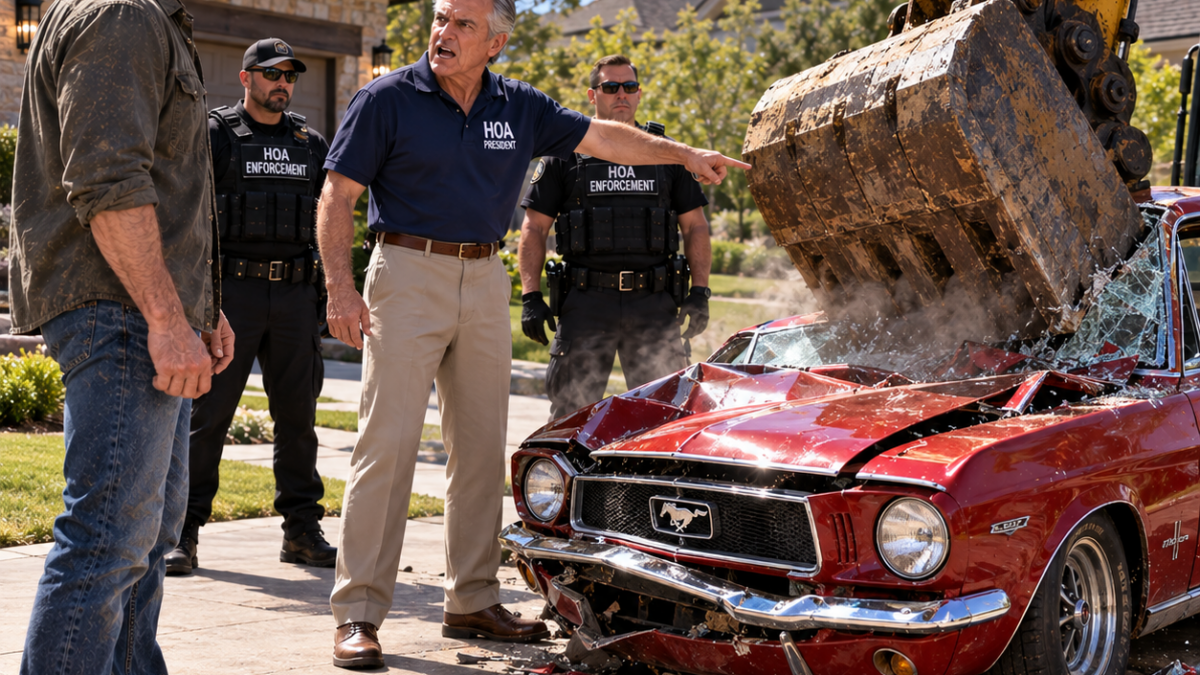
The metal badges clipped to their belts carried the HOA logo.
Radios.
Flashlights.
Matching tactical-looking belts.
Enough equipment and confidence to make an ordinary homeowner wonder whether some obscure law had given a homeowners association its own police force while nobody was paying attention.
Gerald stepped forward.
“You must be David’s son.”
I put the cloth down.
“That’s right.”
He extended his hand.
“Gerald Hoffman. President of the Metobrook Estates Homeowners Association.”
I shook it.
His grip was hard.
Deliberately hard.
“I’ve been protecting this community for twelve years,” he said.
Protecting.
He emphasized the word as though he had been guarding the gates against invasion.
Then he looked past me.
His eyes landed on the Mustang.
The polite expression disappeared.
“How long are you planning to keep that thing here?”
I glanced at the car.
“My car?”
“Your father’s vehicle.”
“It’s mine now.”
“Is it currently registered?”
“The registration expired while Dad was sick. I have the estate paperwork. I’m transferring it.”
“So no.”
“It runs.”
“That wasn’t my question.”
I wiped my hands on a rag.
“Why do you care?”
Gerald lifted the red paper.
“Metobrook’s covenants prohibit unregistered, inoperable, abandoned, or restoration vehicles from being stored in view of the street.”
“It’s in my garage.”
“Your garage door is open.”
PART3:
I looked from him to the Mustang.
Then back.
“You came onto my driveway because my garage door is open?”
One of the uniformed men shifted as though I had become the difficult one.
Gerald remained calm.
“We received a complaint.”
“From who?”
“We do not disclose complainants.”
“Of course.”
“The vehicle was also observed outside overnight earlier this week.”
That was true.
For maybe two hours.
I had moved Dad’s truck out of the garage, rolled the Mustang into the driveway, changed the oil, then let the engine cool before parking it again.
It had never spent a night outside.
Gerald continued.
“This is your first notice.”
He held the paper toward me.
I didn’t take it.
“Put it in the mailbox.”
“We prefer personal service for vehicle violations.”
That phrase.
Personal service.
Designed to sound governmental.
I took the notice.
VEHICLE NUISANCE — CATEGORY C
Thirty days to provide current registration or remove the vehicle from Metobrook Estates.
Below that:
Restoration or collector vehicles deemed inconsistent with community appearance may require permanent removal regardless of operability.
I read it again.
“Collector vehicles?”
Gerald smiled.
“Old cars create problems.”
“This car is worth more than half the cars on your street.”
“It is not about value.”
“What is it about?”
“Standards.”
I looked at the Mustang.
Then at his golf-cart-tan face.
“Close enough.”
He pointed toward the garage.
“Keep the door shut until it is resolved.”
“My garage?”
“Yes.”
“You don’t control whether my garage door is open.”
“The association regulates exterior visibility.”
“My father lived here twenty-seven years.”
“Your father understood how to coexist with the association.”
Something about the sentence bothered me.
Not enough yet.
Gerald handed me a business card.
“If you need guidance, contact the office.”
“Where is it?”
He pointed toward the neighborhood entrance.
The Metobrook gatehouse and management building sat on a landscaped rise maybe half a mile away.
Stone façade.
Flagpole.
Fountains.
Private-security vehicles.
Gerald said:
“Community Services Center.”
“Right.”
Then he walked away.
One of the compliance men followed.
The second paused.
He looked at the Mustang.
“Fastback?”
“Yes.”
“What engine?”
“390.”
His face changed.
“Damn.”
Gerald called:
“Officer Lane.”
Officer.
The man straightened.
“Coming.”
I watched them leave.
Then I shut the garage.
Not because Gerald told me.
Because I suddenly felt as if Dad’s car had become visible in a way I didn’t like.
That evening, I read the HOA declaration.
All ninety-three pages.
My father kept a copy in a file cabinet.
Metobrook Estates had been developed in phases during the late 1990s.
Dad’s house was older.
So was the land.
When the subdivision surrounded him, he had voluntarily signed a limited covenant agreement covering the house parcel in exchange for access to private road maintenance, sewer connection, gate access, and community services.
That surprised me.
Dad hated HOAs.
Or I thought he did.
His agreement placed the two-acre homesite under certain architectural rules but excluded his remaining commercial and undeveloped parcels.
The vehicle restriction existed.
Sort of.
It prohibited:
dismantled, disabled, unlicensed, commercial or visibly neglected motor vehicles from remaining in open exterior areas longer than seventy-two consecutive hours.
Nothing about a registered collector car inside a garage.
Nothing about destruction.
Nothing about whether the garage door could be open.
I photographed the page.
Then emailed Gerald.
The Mustang is operable and stored indoors. Registration transfer is in process. Please withdraw the violation.
He replied twelve minutes later.
Saturday evening.
The compliance committee will review.
Monday brought another red notice.
INSPECTION REQUIRED.
They wanted photographs proving the vehicle was operational.
I sent a video of it starting.
Engine cold.
One turn of key.
390 cubic inches waking up inside the garage like thunder contained by drywall.
Dad would have loved that.
Gerald replied:
Starting an engine does not establish roadworthiness or compliance.
I stared at the screen.
Then called the HOA office.
A woman named Marcy answered.
“Metobrook management.”
“I need to speak to Gerald.”
“Regarding?”
“His obsession with my Mustang.”
Pause.
“Oh.”
She knew.
“He’s in meetings.”
“Tell him Daniel Mercer called.”
“David Mercer?”
“Yes.”
“Your father was Thomas Mercer?”
“That’s right.”
Another pause.
Different this time.
“Oh.”
“What?”
“Nothing.”
“Did you know him?”
“Everyone knew Mr. Mercer.”
That sentence came and went before I understood it.
“I’ll have Gerald call.”
He did not.
What came instead was a formal hearing notice.
Seven days later.
Compliance Committee.
I went.
Three people sat behind a long table in the Community Services Center.
Gerald in middle.
An elderly woman named Patricia.
A man named Ross who avoided looking at me.
The two uniformed compliance men stood near wall.
I had brought registration application receipt, insurance, photographs, appraisal, and a letter from a classic-car mechanic confirming the Mustang was roadworthy.
Gerald barely looked.
“The issue has evolved.”
“Of course it has.”
He folded his hands.
“Your father had been granted informal leniency due to age and health.”
“For what?”
“Vehicle restoration.”
“The car was finished three years ago.”
“Parts and equipment remained visible.”
“Inside his garage.”
“There were repeated complaints.”
“Show them.”
“We don’t disclose homeowners.”
“Then show me dates.”
Gerald’s smile disappeared.
“This is not a courtroom.”
“Good. Then stop dressing your employees like cops.”
One of the compliance men looked down.
Patricia coughed.
Gerald said:
“Let’s remain professional.”
“I’m trying.”
He slid a document toward me.
It was labeled:
COMPLIANCE RESOLUTION AGREEMENT
If I permanently removed the Mustang from Metobrook within thirty days and provided proof of disposal or off-site storage, the association would waive all fines.
“Off-site storage?”
“Yes.”
“Then why does this say proof of destruction may be required?”
Gerald leaned back.
“Because vehicles previously used for prohibited restoration have a pattern of returning.”
“It’s my father’s car.”
“I understand you are emotional.”
That phrase.
There is always someone willing to call grief emotional when grief interferes with their convenience.
I gathered my papers.
“The Mustang stays in my garage.”
Gerald said:
“Then fines begin Monday.”
“How much?”
“Two hundred dollars per day after cure period.”
“That’s not in declaration.”
“Fine schedule adopted by board.”
“Send me the resolution.”
“We will.”
“And if I don’t pay?”
“Collection.”
“Lien?”
“If necessary.”
“Foreclosure?”
Gerald did not blink.
“Ultimately, the association must protect its rights.”
That was the moment the conflict changed.
Not car.
House.
Dad’s house.
The house where he raised me after my mother died.
The house where he spent his last months.
The house he had paid off seventeen years earlier.
Gerald knew grief had brought me back.
He also knew I was still sorting the estate.
He thought pressure would be cheaper than resistance.
I left.
At home, the cardboard box sat on the workbench.
IMPORTANT DOCUMENTS.
I almost opened it.
Then I didn’t.
That remains one of the decisions I wish I could reverse.
Not because everything would have magically ended.
But because grief sometimes makes you avoid exactly the thing a dead person left to help you.
Instead, I called an HOA attorney.
First one wanted a $5,000 retainer.
Second wanted $3,500.
I had spent heavily during Dad’s illness and funeral.
The estate had assets but probate and transfers were still moving.
I told myself:
I can solve this without litigation.
Another mistake.
I registered the Mustang.
Sent Gerald the new plate information.
He replied:
Registration does not cure the collector/restoration nuisance determination.
New fines appeared.
$200.
$400.
$600.
Within two weeks:
$2,800.
Then administrative fees.
Inspection fee.
Hearing fee.
Compliance patrol charges.
I challenged each.
They scheduled a second hearing.
I attended.
Gerald said the car’s “nature and history” made it incompatible with community standards.
I laughed.
“You have three Corvettes in this subdivision.”
“They are modern registered vehicles.”
“Mine is registered.”
“Your Mustang has been the subject of restoration activity.”
“Past tense.”
Gerald leaned toward me.
“Mr. Mercer, your father received extraordinary patience from this association.”
Something in me snapped.
“My father owned this house before your entrance fountain existed.”
Gerald stared.
Then said quietly:
“And he still understood that communities change.”
I went home furious.
That night I finally opened Dad’s box.
Then closed it again after seeing his handwriting on the first folder.
Not yet.
Weak.
Maybe.
Human.
The next escalation came on a Wednesday.
I returned from grocery store and found an orange sticker on the Mustang’s windshield.
Inside my closed garage.
I stood there holding two bags of groceries.
Read it twice.
FINAL VEHICLE ABATEMENT NOTICE
Someone had entered.
My garage side door had been unlocked because I had been carrying boxes that morning.
Security camera over driveway showed Gerald and Officer Lane approaching.
Lane remained outside.
Gerald walked through side door.
No warrant.
No permission.
He photographed the car.
Placed sticker.
Left.
I called the county sheriff.
A deputy came.
Young.
Professional.
He watched video.
“HOA president?”
“Yes.”
“Did he have permission to enter?”
“No.”
“Is the garage common property?”
“No.”
He took report.
No instant arrest.
Trespass complaint documented.
He suggested I send written no-entry notice.
I did.
Gerald replied through HOA counsel this time.
The Association disputes any characterization of the inspection as unlawful but will refrain from interior inspections absent owner consent or emergency.
Interesting.
Their lawyer was already sanding down Gerald’s edges.
I hired a cheaper attorney for a limited review.
Rebecca Sloan.
Not cheap.
Just willing to start with document analysis rather than full litigation.
She read declaration.
Fine schedule.
Notices.
My father’s limited covenant agreement.
Then said:
“They can regulate certain exterior vehicle storage.”
“The car’s inside.”
“I know.”
“They can’t make me crush it?”
“No.”
“Can they make me store it somewhere else?”
“Not under what you’ve shown me.”
“What about lien?”
“They can record lien for valid assessments and possibly properly imposed fines depending governing documents and state law. Whether these fines are valid is another question.”
“So Gerald is bluffing.”
“Partly.”
“Partly?”
“Bluffs get expensive when they come with lawyers.”
Great.
Rebecca sent demand.
Stop fines.
Rescind violations.
Confirm no towing, seizure, destruction, or entry.
HOA counsel responded more cautiously than Gerald.
They proposed mediation.
I agreed.
Gerald did not.
At least that was impression.
The mediation was postponed twice.
Meanwhile fines passed eight thousand.
Then eleven.
Then I received NOTICE OF INTENT TO LIEN.
My stomach turned.
Rebecca said:
“Don’t panic.”
“My father’s house.”
“A lien is not the same as losing house.”
“It says collection remedies.”
“Yes.”
“How long can this take?”
“Months. Longer.”
“How much will lawyers cost?”
She did not answer immediately.
That was answer.
Then Gerald offered deal.
He called personally.
“You’re spending thousands to protect a car.”
“It isn’t about car anymore.”
“It started there.”
“You entered my garage.”
“We don’t need to revisit.”
“You threatened my house.”
“I informed you of collection consequences.”
“Same thing.”
He sighed.
“David, your father had difficulty letting go.”
I went still.
“What does that mean?”
“He resisted changes.”
“You knew him?”
“For twelve years.”
“How?”
“Community matters.”
I looked toward Dad’s box.
Gerald continued:
“I respected Thomas.”
“No, you didn’t.”
“I did.”
“Then stop using him.”
Pause.
Then Gerald said:
“I can end this.”
“How?”
“Sign vehicle-resolution agreement. Remove Mustang permanently. We waive fines and legal fees.”
“Off-site storage?”
“No.”
There it was.
“What?”
“The board wants permanent abatement.”
“Meaning?”
“Certified dismantling or destruction.”
I thought I misheard.
“You want me to crush a registered numbers-matching 1967 Fastback.”
“It removes ambiguity.”
“You’re insane.”
“I’m offering you clean slate.”
“No.”
“Then we proceed.”
“With lien.”
“Yes.”
The call ended.
I spent the next week angry.
Then terrified.
Those are different.
Anger makes you feel strong.
Fear arrives when you open bank account.
Rebecca estimated emergency litigation could easily cost ten to fifteen thousand before we got meaningful ruling if HOA dug in.
The Mustang was worth far more than that.
So was house.
But value is not cash.
Dad had medical bills.
Estate expenses.
I had my own mortgage on condo in Denver I had not yet sold.
I was between jobs after taking leave to care for him.
Gerald had found the exact season of my life when every asset looked substantial and every checking account looked thin.
He knew.
Or guessed.
Then HOA recorded lien.
Not foreclosure.
Not yet.
But recorded.
$14,860 including fines, fees and attorney charges.
Against Dad’s house.
I sat in county recorder parking lot after getting copy.
For forty minutes.
I called Rebecca.
“Can they do this?”
“They did.”
“Is it valid?”
“We can challenge.”
“How long?”
“David—”
“How long?”
“I can’t promise.”
I went home.
Opened garage.
Sat in Mustang.
Dad had restored the steering wheel himself.
Not replaced.
The original wheel had cracks.
We filled.
Sanded.
Painted.
He said replacement would be easier.
I asked why not replace.
He ran thumb over old plastic.
“Because this one was here.”
That was Dad.
He believed repair preserved memory that replacement erased.
I put both hands on wheel.
Cried.
Then did something I regret.
I signed.
Not immediately.
There were revisions.
Rebecca objected.
She told me:
“Do not sign destruction certificate requirement. Store car elsewhere while we fight.”
But off-site classic-car storage with transport and insurance cost money too.
I could have sold it.
That would have been smarter financially.
But selling Dad’s car felt like giving Gerald exactly the same power in different form.
I was not thinking clearly.
Grief rarely produces excellent asset strategy.
Gerald offered final terms:
HOA waives all $14,860.
Releases lien.
Pays towing.
I authorize transport to licensed recycler and provide certificate of destruction.
Why destruction rather than sale?
He claimed policy required certainty vehicle would never return.
Rebecca said it was grotesque and likely beyond HOA authority.
I said:
“If I fight, can you guarantee house won’t be tied up?”
“No.”
“Guarantee I recover legal fees?”
“No.”
“Guarantee Gerald doesn’t invent another violation?”
“No.”
She looked furious.
Not at me.
“Then don’t do this because you’re scared.”
“I am scared.”
“That’s what he wants.”
“I know.”
“David.”
I looked at her.
“My father spent his last two years telling me house would always be there if I needed somewhere to land.”
My voice broke.
“I can’t risk it.”
Rebecca went quiet.
“You understand destroying car may weaken damages calculation later because they will say you consented.”
“I understand.”
“You can write under protest.”
“Will it matter?”
“Some.”
“Then write it.”
I signed under protest.
The Mustang went to Franklin Auto Recycling.
Friday morning.
Gerald came.
Of course.
He did not ride with tow truck.
He arrived separately in his black Mercedes SUV.
Officer Lane came too.
Rebecca came.
Tommy Reed, the mechanic who had worked on Mustang with Dad and me, came because I asked.
Tommy was sixty-nine.
Dad’s friend forty years.
When he saw tow straps around front suspension, he turned away.
“You don’t have to do this.”
“I know.”
“Then don’t.”
“I need lien gone.”
Tommy looked at Gerald.
“This man owns a neighborhood?”
Gerald corrected:
“I represent association.”
Tommy walked toward him.
Rebecca put one hand on Tommy’s arm.
“No.”
He stopped.
Good.
No fight.
No satisfaction for Gerald.
The Mustang went onto flatbed.
I followed.
At recycler, manager named Paul looked at paperwork.
Then car.
Then me.
“You sure?”
“No.”
“That is not same as authorization.”
“I signed.”
He looked at title.
Numbers.
Body.
“This is a damn good Fastback.”
“I know.”
Gerald stood twenty feet away.
Hands in pockets.
Paul looked at him.
Then at me.
“Why?”
I said:
“HOA.”
He shook his head.
Could have been internet joke.
Wasn’t.
The recycler was required to depollute vehicle before crushing.
Fluids drained.
Battery removed.
Certain parts processed.
It took hours.
Gerald stayed longer than any sane HOA president needed.
Maybe he wanted proof.
Maybe victory.
Tommy left before final crush.
He hugged me first.
Dad and Tommy had never hugged.
I realized that only then.
The car was lifted.
For years afterward, sound came back in dreams.
Metal settling.
Glass.
Steel folding.
Not explosion.
Not dramatic.
Industrial.
Efficient.
A machine designed to turn objects into material.
The roof collapsed first.
Then hood.
Then the shape Dad and I had spent three years restoring disappeared.
I did not cry.
I thought I would.
Nothing came.
Gerald signed witness line on destruction certificate.
He said:
“I know this is difficult.”
I looked at him.
“Don’t.”
He stopped.
I drove home in silence.
When I arrived, the garage looked enormous.
Empty space where Mustang had lived.
The cardboard box sat on bench.
IMPORTANT DOCUMENTS.
This time I opened it.
No hesitation.
The first folder was Dad’s will.
I already had copy.
Second:
House title.
Third:
METOBROOK SERVICE TRACT — LEASE
I frowned.
Opened.
The lessor was:
THOMAS H. MERCER
My father.
The lessee:
METOBROOK ESTATES HOMEOWNERS ASSOCIATION
Original date:
Twenty-nine years earlier.
I sat.
Read.
Then read again.
Dad had owned more land than the house parcel.
Before Metobrook existed, our family owned a narrow commercial-shaped tract along what became the subdivision entrance.
About 3.8 acres.
When developer built community, it needed land for a security gate, management office, maintenance staging, visitor parking, drainage infrastructure, and a portion of the private entrance road.
Instead of selling, Dad leased it.
Thirty-year ground lease.
Initial rent modest.
Escalated slowly.
HOA paid property taxes attributable to improvements and maintained everything.
The structures belonged to HOA.
Land remained Dad’s.
There was a renewal provision.
Not automatic.
At expiration, parties could renew for ten years at fair market ground rent established by independent appraisal.
If no renewal, HOA had a negotiated wind-down period and responsibility to remove or transfer improvements.
Expiration date:
Sixty-three days away.
I stared.
There was another folder.
Recent appraisal.
Prepared four months before Dad died.
Dad had commissioned it.
Current ground rent under old lease:
$1,480 per month.
Fair market rent:
Between $13,500 and $16,200 per month depending final commercial/access valuation.
Nearly ten times.
Then a handwritten note.
Dad’s writing.
DAVID — GERald WILL PRETEND HOA OWNS THIS. IT DOESN’T. DO NOT SIGN ANY RENEWAL UNTIL YOU READ THE WHOLE LEASE. CALL MARCUS BELL.
Gerald.
Capitalized wrong.
Dad was dying and still irritated enough to note Gerald by name.
Underneath:
THIS LAND PAID YOUR COLLEGE. DON’T GIVE IT AWAY.
I laughed.
Then cried so hard I had to put my head on the workbench.
The Mustang was gone.
And Dad had left one more lesson in a box I had been too afraid to open.
Read the paperwork.
I called Marcus Bell.
He was a real-estate attorney in Fort Worth.
Seventy.
Semi-retired.
He answered personally.
“Marcus Bell.”
“My name is David Mercer.”
Silence.
“Thomas’s son?”
“Yes.”
Longer pause.
“I’m sorry.”
“Thank you.”
“Your father was stubborn.”
“I’ve heard.”
“He tell you to call?”
“Yes.”
“Then Gerald must have done something.”
I looked at empty garage.
“You could say that.”
Marcus met me next morning.
He read HOA notices.
Lien release.
Destruction agreement.
Trespass report.
Then I showed lease.
He barely glanced.
“I wrote this.”
“You?”
“With your father.”
“What?”
“Developer’s lawyers wrote first draft. Your dad thought they were trying to steal land with adjectives.”
That sounded exactly right.
Marcus turned pages.
“Lease expires in two months.”
“Yes.”
“Any renewal notice from HOA?”
“No.”
He smiled.
Not happily.
Professionally.
“That is interesting.”
“Can I raise rent tenfold?”
He looked at appraisal.
“Not because you’re angry.”
“Okay.”
“But lease expressly resets to fair market ground rent if renewed. If appraisal is supportable, yes, a tenfold increase from a thirty-year-old below-market schedule is possible.”
“So Gerald pays?”
“The HOA pays.”
That stopped me.
Not Gerald.
Three hundred homeowners.
Families.
People who had nothing to do with my Mustang.
I hated that.
Marcus saw.
“Leverage doesn’t require cruelty.”
“What does it require?”
“Clarity.”
He tapped lease.
“First, we notify association you inherited lessor interest. Second, we advise them renewal deadline. Third, we do not connect rent negotiation to vehicle dispute in a way that looks like extortion.”
“Good.”
“Fourth, we separately investigate what they did to your car.”
I looked at him.
“It’s gone.”
“Property damage doesn’t become legal because object is gone.”
“I signed.”
“Under circumstances worth examining.”
He read Gerald’s destruction clause again.
Then:
“This is extraordinary.”
“Rebecca said same.”
“Call her.”
We did.
Rebecca and Marcus worked together.
For first time since Dad died, I stopped reacting and started documenting.
Marcus sent formal lease notice.
No threat.
No revenge speech.
Just:
Thomas Mercer deceased.
David Mercer successor lessor.
Existing ground lease expires December 31.
No automatic renewal.
Independent appraisal indicates fair market rent substantially above current rent.
Please designate authorized negotiation representative.
Gerald called me twelve minutes after HOA received it.
I let voicemail take.
Then listened.
“David, this is Gerald. There appears to be some misunderstanding regarding the Community Services parcel. That property is owned by Metobrook. Your father’s name may remain on legacy documents, but the association has maintained and occupied it for decades. Call me immediately.”
I forwarded to Marcus.
He replied:
Don’t call.
Gerald called again.
Then email.
Then certified letter claiming HOA possessed equitable ownership due to permanent improvements and long-term control.
Marcus responded with recorded deed.
Tax parcel.
Lease.
Payment history.
Gerald went quiet.
Two days.
Then HOA attorney called Marcus.
Not Gerald.
Good sign.
They knew lease was real.
The board apparently had a copy.
Buried in old records.
Their current management had treated monthly $1,480 transfer as “access maintenance fee,” not ground rent.
How do you lose track of owning versus leasing 3.8 acres?
Turnover.
Bad recordkeeping.
Institutional memory.
Gerald.
Mostly Gerald.
Dad’s file contained years of rent checks.
Every one.
I found emails too.
Gerald and Dad had argued before.
Five years earlier, Gerald wrote:
The Association considers the Service Tract functionally integrated into common property.
Dad replied:
Functionally integrated isn’t a deed. Pay rent by the 5th.
I laughed for ten minutes.
Then another exchange.
Gerald:
Future renewal should recognize HOA investments in permanent improvements.
Dad:
Future renewal will recognize my dirt under them.
Dad could have been difficult.
I loved him for it.
Then I found something that changed Mustang case.
An email from Gerald to Dad two years earlier.
Your ongoing automotive restoration activity remains technically noncompliant, but I am willing to defer enforcement while the ground lease remains in cooperative status.
I read it again.
Gerald knew car issue.
Gerald knew lease.
He had linked them before.
Not formally.
Enough.
Dad responded:
My garage and your lease are separate. Keep them that way.
Gerald:
Everything in a planned community is connected.
Rebecca nearly smiled when she saw.
“That helps.”
“With what?”
“Pattern. Knowledge. Motive. Possibly bad faith.”
Then we found board minutes.
Gerald had told directors the Mercer ground lease was expected to renew “on substantially existing terms.”
No appraisal disclosed.
No expiration risk.
No notice to members.
He apparently assumed Dad would cave.
Or die.
Dad did die.
Gerald thought son would sign whatever was put in front of him.
Except he had just forced that son to crush a Mustang.
Motivation is funny.
Before, I was grieving.
Avoiding paperwork.
Trying to survive.
Now I opened every folder.
Read every line.
Gerald had made me angry enough to become organized.
Worst possible outcome for people who rely on confusion.
The HOA scheduled executive session.
Then full board meeting.
Members rarely attended regular meetings.
That one overflowed.
Rumor had spread:
Metobrook might not own its own entrance.
Not exactly.
It owned improvements.
It leased land.
Still dramatic enough.
I attended with Marcus and Rebecca.
Gerald sat center.
Same place as compliance hearing.
Different atmosphere.
He did not look at me.
Board treasurer, Elaine Porter, spoke.
“We are addressing two separate matters tonight.”
Good start.
“First, expiration of Service Tract ground lease.”
Residents whispered.
“Second, recent vehicle-compliance dispute involving Mr. Mercer.”
Gerald interrupted.
“The second is a closed enforcement matter.”
Elaine looked at him.
“No. Counsel has advised it is relevant to pending liability.”
That landed.
Gerald’s face hardened.
HOA counsel, Samuel Price, stood.
He explained lease.
Calmly.
No drama.
Metobrook had leased the land for thirty years.
Lease expired in sixty days.
Renewal required new negotiated rent based on market conditions.
Without renewal, HOA would not instantly lose road access because separate recorded easements protected resident ingress and emergency access.
Important.
Nobody was going to wake up trapped.
But the gatehouse, management office, maintenance yard, visitor parking, landscaping, and portions of internal service lanes occupied leased land.
Relocating them could cost a lot.
An engineering estimate later put it near $1.9 million.
Then Samuel gave rent appraisal range.
Someone in back said:
“What?”
Elaine repeated.
Existing annual rent:
$17,760.
Likely market rent:
Around $150,000 to $190,000 annually.
Tenfold.
Not because I invented number.
Because land that was semi-rural thirty years earlier now sat at controlled entrance of a high-value gated development surrounded by commercial frontage.
Gerald finally spoke.
“This appraisal is adversarial.”
Marcus stood.
“No.”
He held copy.
“It was commissioned by Thomas Mercer four months before his death, before the current dispute.”
Room shifted.
Gerald had no answer.
Then someone asked:
“Did board know lease expired?”
Elaine said:
“I did not.”
Another director shook head.
Another:
“I thought we owned that parcel.”
Gerald spoke quickly.
“The association has always treated it as common property.”
Marcus said from beside me:
“Treatment is not title.”
I almost heard Dad.
Then a woman in front row asked:
“What does this have to do with car?”
Silence.
Rebecca stood.
She did not grandstand.
She summarized.
HOA fined me over an operable registered classic vehicle stored in my garage.
Entered garage without permission.
Recorded lien based partly on disputed fines.
Offered lien release only if vehicle was permanently destroyed.
Car destroyed under written protest.
HOA president personally witnessed destruction.
Potential claims remained unresolved.
You could feel people turning toward Gerald.
A man named Neil Bennett said:
“You made him crush a Mustang?”
Gerald responded:
“No one forced anyone.”
I stood.
First time.
“No one held a gun.”
Good to concede.
“I signed because your office had recorded a lien against the house my father left me and told me the fines and attorney fees would keep growing unless the car was permanently destroyed.”
Gerald:
“You had counsel.”
“Yes.”
“Then it was voluntary.”
Rebecca said:
“That’s exactly what will be litigated if necessary.”
Gerald looked toward Samuel.
Samuel did not rescue him.
Another resident asked:
“What kind of Mustang?”
I almost laughed.
“1967 Fastback.”
“Engine?”
“390.”
A groan moved through half the room.
Apparently property law could not outrage them as efficiently as classic-car destruction.
One older man yelled:
“You crushed a ’67 Fastback over an HOA violation?”
Gerald slammed gavel.
“Order.”
The room got louder.
Elaine called recess.
Outside, people approached me.
Some apologized.
Not their fault.
One man said Gerald had fined him for leaving a kayak beside garage.
A woman said compliance officers photographed her backyard through fence.
Another said notices had become increasingly aggressive.
I did not turn meeting into rebellion.
Marcus told me:
“Say less.”
Good advice.
After recess, board voted 4-1 to suspend Gerald’s individual authority over compliance matters pending independent review.
Gerald was the one.
Then voted unanimously to freeze my fines and acknowledge lien released.
Already done under destruction agreement, but formal record mattered.
Then authorized lease negotiation committee excluding Gerald.
That was first crack.
The second came from Officer Lane.
His real name was Peter Lane.
Not law enforcement.
Licensed private security guard employed by an HOA contractor called CivicShield Community Services.
He called Rebecca the next week.
Wanted to talk.
With his own lawyer.
We met.
Peter looked uncomfortable.
“I shouldn’t have called myself officer.”
“You did?”
“Company title is Community Compliance Officer.”
Rebecca:
“Were you instructed to present yourselves as police?”
“No. Specifically told not to.”
“Did Gerald encourage residents to think otherwise?”
Peter paused.
“Yes.”
“How?”
“He’d say things like ‘my officers have authority to inspect’ or ‘compliance division will enforce.’”
“Did you have authority to enter homes?”
“No.”
“Garages?”
“No.”
“Tow cars from private property?”
“Not without owner consent, valid contractual authorization and towing requirements.”
“Did you participate in Mr. Mercer’s garage entry?”
“I stayed outside.”
“Why?”
“Because I told Gerald we needed permission.”
I remembered.
He had stayed at driveway.
“What did Gerald say?”
Peter looked at me.
“He said your father had signed a standing access authorization.”
“Did he?”
“No evidence I ever saw.”
Peter had saved texts.
Gerald:
Need interior photos. Mercer son is escalating.
Peter:
We can’t enter attached garage without permission.
Gerald:
Thomas always allowed inspections. I’ll handle.
Peter:
That doesn’t transfer automatically.
Gerald:
Stay at drive.
That helped.
Then another text after destruction deal:
Once car is gone, Mercer loses leverage and this nonsense ends.
What nonsense?
Vehicle?
Or lease?
Timing mattered.
Sent the day before Marcus notice.
Maybe Gerald hadn’t yet learned I found lease.
But he knew Dad had used car compliance as separate matter.
Still ugly.
Independent board review found Gerald had exceeded delegated authority in several ways.
Not criminal mastermind.
Not secret fraud ring.
Governance failure.
He had treated HOA presidency as executive office rather than board-limited role.
He instructed compliance contractor beyond scope.
Approved fees without proper committee vote.
Entered my garage.
Mischaracterized destruction as required when declaration contained no such remedy.
Failed to disclose ground-lease renewal risk fully to board despite prior correspondence with Dad.
That last one ended him.
Gerald resigned as president before removal vote.
Stayed homeowner.
Not dictator anymore.
No arrest.
No handcuffs.
No judge shouting.
Just an email:
In light of recent personal attacks and loss of confidence, I resign effective immediately.
He called the criticism personal.
Maybe easier than calling it accounting.
Lease negotiation continued.
I could have demanded top appraisal.
$16,200 per month.
Some friends told me to.
“Make them pay.”
But Metobrook was hundreds of homeowners.
Gerald wasn’t going to personally write checks.
I remembered Dad.
He had kept rent low for decades partly because original lease helped fund my college and partly because he believed stable neighborhood benefited his house.
He was tough.
Not vindictive.
Marcus asked:
“What outcome do you want?”
That question again.
The Mustang.
My father’s car.
Gone.
No rent could reconstruct it.
A reproduction could be built.
Not same.
Money doesn’t reverse crushing.
So I separated issues.
For lease, I wanted fair market terms.
For Mustang, I wanted accountability and compensation.
For Gerald, I wanted distance.
We negotiated ground lease at $12,750 per month for first three years, then scheduled increases.
About eight and a half times old rent initially, rising toward tenfold over term.
HOA got ten-year renewal.
I got market rent, insurance protections, clear inspection limits, environmental obligations, and recognition of title.
No ambiguity.
The entrance remained.
Residents kept management office.
No one displaced.
Then vehicle claim.
HOA insurer entered.
They argued car’s agreed-value policy? Dad had let collector policy lapse during illness, unfortunately.
Valuation became fight.
Classic-car appraisers inspected restoration records.
Photos.
Receipts.
Numbers-matching drivetrain documentation.
Market comps.
Pre-crush condition estimated between $118,000 and $145,000.
That hurt almost as much as seeing crusher.
Not because money.
Because spreadsheet turned Saturdays with Dad into dollars.
Rebecca pursued property loss, consequential damages, lien-related fees, emotional-distress theories where available, and attorney costs.
We settled.
Confidential total?
In story, I can say enough: high six figures? That might be excessive. Let’s make $182,000 plus legal fees and waiver.
The HOA’s insurer and compliance contractor contributed.
Metobrook paid deductible and some uncovered expenses.
Settlement:
$164,000 for vehicle and related property losses.
My legal fees paid separately.
All fines formally voided.
Written acknowledgment destruction was not authorized by governing documents.
CivicShield revised uniforms.
No more badge-shaped HOA insignia resembling police badges.
Staff titles changed from Officer to Community Compliance Representative.
No tactical-looking belts except ordinary safety gear.
No entering private structures without consent or emergency.
No towing from private lots without documented legal basis.
That mattered.
I used part of settlement to buy another Mustang.
People assume that.
I didn’t.
Not then.
For almost a year, garage stayed empty.
I could not stand another car in that space.
Tommy came by sometimes.
We sat on folding chairs.
Talked.
Or didn’t.
One evening he said:
“You know your dad would be furious you let Gerald win twice.”
“What?”
“First car.”
I looked at him.
“Then garage.”
I frowned.
“He took car. Now you’re giving him garage too.”
“I don’t want another Mustang.”
“I didn’t say Mustang.”
“What?”
Tommy stood.
Walked to bench.
Touched Dad’s tools.
“Use room.”
That bothered me because true.
Grief can turn empty space sacred.
Sacred space eventually becomes unusable space.
Dad hated unused tools.
I started slowly.
Changed oil on truck.
Rebuilt lawn mower carburetor.
Helped neighbor’s kid fix bicycle brakes.
One Saturday a sixteen-year-old from down street named Tyler showed up pushing an old Honda motorcycle.
“Mr. Mercer?”
“David.”
“My dad said you know engines.”
“Your dad lies.”
“Can you help?”
The bike wouldn’t start.
We spent three hours.
Fuel.
Spark.
Compression.
Dirty carb.
By sunset, it ran.
Tyler grinned.
I heard Dad in my own voice:
“Don’t rev it cold.”
That almost took me down.
Life does that.
Sneaks inheritance into sentences.
The cardboard box remained on workbench, but now open.
I organized everything.
Dad’s lease documents.
Letters.
Photos.
Receipts from Mustang restoration.
At bottom I found another envelope.
DAVID — CAR
I sat.
Opened.
One page.
Dad’s handwriting shaky.
Cancer handwriting.
If you’re reading this because I’m gone, the Mustang is yours.
I stopped.
Breathed.
Continued.
Don’t turn it into a shrine. Drive it. Break it. Fix it. Sell it if you need to. A car is supposed to move. The good part was building it with you. Nobody can take that part apart.
I put letter down.
Walked outside.
Cried on porch.
Gerald had crushed metal.
Not Saturdays.
Not Dad teaching me timing.
Not the first engine start when he shouted so loud neighbor came running.
Not him falling asleep in passenger seat during first long drive.
Not the grease fingerprints on shop manual.
The car was gone.
The work wasn’t.
That changed me.
A month later, Tommy called.
“I found something.”
“What?”
“Come to shop.”
Behind his building sat a Mustang.
Not 1967 Fastback.
1968 coupe.
Dark green.
Rough.
Engine missing.
Interior torn.
One quarter panel rusted.
“No.”
Tommy smiled.
“Yes.”
“I don’t want it.”
“Good.”
“What?”
“Then you can build it without trying to replace Frank’s.”
I stared.
“This thing is terrible.”
“Exactly.”
“How much?”
“Owner wants nine grand.”
“That’s robbery.”
“Seven.”
“You just said nine.”
“I negotiated before you arrived.”
I laughed.
First real laugh in that garage world since Dad died.
I bought it for seven.
Not with HOA settlement.
With my own money.
That distinction mattered.
Then Tyler started coming Saturdays.
Tommy.
Sometimes Peter Lane, surprisingly.
After leaving CivicShield, Peter started working for an actual security company.
He knew cars.
Owned a ’72 Nova.
The first time he asked to help, I almost said no.
Then remembered he had been the one who refused to enter garage.
He showed up with sockets.
So yes.
We rebuilt.
Slowly.
No attempt to make museum piece.
Different car.
Different color.
Different engine.
A 302.
Dad would have complained.
I could hear him.
“That engine’s too small.”
“Gas isn’t thirty cents anymore.”
“Excuses.”
The Metobrook lease checks started monthly.
First one:
$12,750.
I stared.
Dad’s old $1,480 had paid taxes and extras.
This was different.
I put most into investment account.
Some went to house repairs.
Some to attorney bills until reimbursed.
Some I used to create scholarship at technical college.
Dad never went to college.
He understood skilled trades better than most people with degrees.
Scholarship:
Thomas Mercer Automotive & Diesel Trades Award
No HOA mention.
No Mustang.
Just Dad.
First recipient was nineteen-year-old woman named Kayla who wanted diesel certification.
She came to house to thank me.
Saw garage.
Saw ’68.
“You restoring that?”
“Trying.”
She looked.
“You’re doing rear suspension wrong.”
I laughed.
“Want scholarship revoked?”
“No.”
She was right.
We fixed.
Metobrook changed under new president Elaine Porter.
No miracle.
Still HOA.
Still rules.
Trash cans.
Paint colors.
Pool hours.
People complained.
But meetings became more boring.
That is compliment.
Compliance letters cited actual covenants.
Hearings had evidence.
No pseudo-police visits.
No tactical uniforms.
Garage doors could remain open.
Imagine freedom.
The board also commissioned independent title audit of all common facilities.
Found two other easement issues.
Fixed before lawsuits.
Gerald had governed by assumption.
Elaine governed by files.
Dad would approve.
Gerald remained in neighborhood.
We crossed paths.
Grocery store once.
Mailbox cluster.
Annual meeting.
He never apologized.
For two years, nothing.
Then one morning he stood at my driveway.
Alone.
No clipboard.
No uniformed men.
I was working on ’68 with garage open.
That detail felt almost too neat.
He stopped at sidewalk.
“David.”
“Gerald.”
He looked at car.
“Another Mustang?”
“Different.”
“I see that.”
Silence.
“You need something?”
He put hands in pockets.
“I’ve been meaning to speak.”
“For two years?”
“Yes.”
“Must’ve been hard schedule.”
He accepted that.
“I handled situation badly.”
I waited.
“The Mustang.”
“Yes.”
“I believed compliance required certainty.”
“No, you believed I should obey you.”
He looked down.
“Maybe.”
Honest.
Better.
“You knew about Dad’s lease.”
“Yes.”
“Why didn’t board?”
“They knew there was lease.”
“Not expiration.”
He did not answer.
“Did you think Dad would renew cheap?”
“Yes.”
“Did you think I would?”
“I didn’t know you.”
“You didn’t try.”
“No.”
He looked toward garage.
“I thought your father was difficult.”
“He was.”
“And I thought once he was gone, some of the old conflicts could finally be resolved.”
There.
Ugly truth.
Dad died.
Gerald saw administrative opportunity.
He continued:
“I let that shape how I treated you.”
“Yes.”
“I shouldn’t have.”
“No.”
Then:
“I am sorry about car.”
I thought of crusher.
“It’s easy to say now.”
“Yes.”
“Do you understand it wasn’t the money?”
“Yes.”
“Do you?”
He looked at the ’68.
“I had father’s watch.”
Unexpected.
“He died when I was thirty.”
Gerald swallowed.
“I lost it at airport.”
I said nothing.
“I spent years thinking if I could find same model, it would fix something.”
He looked at me.
“It wouldn’t.”
No.
It wouldn’t.
That did not excuse him.
But it made him a person instead of symbol.
I said:
“I accept apology.”
His face changed slightly.
“Thank you.”
“I don’t trust you.”
“I understand.”
“And we’re not friends.”
“I understand.”
He nodded toward Mustang.
“Good luck.”
“Thanks.”
He left.
That was all.
No dramatic humiliation.
No rent check waved in his face.
By then rent issue had nothing to do with him.
That’s another lesson.
Leverage can start as revenge fantasy.
Then paperwork reminds you institutions are bigger than one jerk.
If I had used lease to punish residents irrationally, I would have become version of Gerald.
Instead, market rent.
Clear terms.
Nothing more.
Nothing less.
The phrase “raise their rent tenfold” sounds satisfying.
Truth:
Dad had allowed old below-market lease to run thirty years.
Market changed.
Renewal reset.
Gerald’s behavior simply ensured I read what I should have read sooner.
Had Gerald been kind, I probably still would have raised it—once Marcus showed me appraisal.
Maybe negotiated slightly differently.
Property isn’t charity forever because previous owner liked you.
Same as HOA rules are not police authority because president speaks confidently.
Scope matters.
Documents matter.
Words matter.
That became the story I told more than Mustang.
People online wanted the crusher.
They wanted Gerald’s face when rent letter arrived.
They invented scenes.
Some versions had me shutting gates and locking 400 homeowners inside.
Impossible and illegal.
Residents had recorded road easements.
Some claimed I evicted HOA headquarters overnight.
No.
Lease had orderly holdover and renewal provisions.
Some said rent jumped from $1 to $100,000 a month.
No.
Some said Gerald arrested.
No.
Being arrogant isn’t felony.
Trespass into garage was reported; prosecutors treated it as low-level dispute given no forced entry and broader civil context. No criminal case followed.
Some said I bought Gerald’s house.
Absolutely not.
The real consequences were enough.
He lost presidency.
HOA paid money.
Contractor changed practices.
Lease reset.
Policies improved.
My Mustang remained crushed.
Real endings leave scars.
If every loss is reversed, story becomes lie.
Years later, the ’68 was finished.
Deep forest green.
Black interior.
No racing stripes.
Tyler painted.
Kayla rebuilt rear suspension correctly.
Tommy supervised everybody while pretending not.
At first start, we had six people in garage.
Engine turned.
Caught.
Stumbled.
Then settled.
I instinctively looked to my right.
Dad’s old place near fender.
Empty.
For one second grief arrived fresh.
Then Tyler shouted:
“YES!”
Kayla laughed.
Tommy leaned into engine bay.
“Timing’s off.”
Of course.
Dad would’ve said same.
We adjusted.
I drove the car the next day.
No ceremony.
Down Metobrook entrance.
Past the gatehouse sitting on my land under new lease.
The guard waved.
Not an HOA cop.
Actual contracted gate attendant.
Polo shirt.
Name tag.
No fake badge.
I stopped beside office because Elaine was outside talking to landscaper.
She saw Mustang.
“Finished?”
“Mostly.”
“Looks good.”
“Thanks.”
Then she pointed to ground.
“Rent due next week.”
“I know.”
“I hate you.”
“Market rate.”
She laughed.
That was healthy.
I drove out.
Highway.
Windows down.
Different engine note than Dad’s Fastback.
Lighter car.
Less power.
No ghosts.
Just memory.
I finally understood his letter.
Car is supposed to move.
So I drove.
Sometimes I take technical-college scholarship recipients for rides.
Not because Mustang is teaching tool.
Because old machinery starts conversations.
One asked about ’67.
I told story.
He said:
“You should’ve fought before they crushed it.”
He was nineteen.
At nineteen, every battle seems simple if you know ending.
“I should have opened box.”
He looked confused.
“What?”
“That’s where I went wrong.”
Not Gerald?
Gerald did plenty wrong.
But the lesson I control is mine.
Open box.
Read documents.
Do not let grief delay facts.
Ask for authority in writing.
A uniform is not jurisdiction.
A fine notice is not court order.
A lien notice is serious, but not the same as losing house tomorrow.
Get counsel before signing away something irreplaceable.
And never assume the loudest person in an HOA knows what the HOA actually owns.
Dad knew all of that.
He tried to leave it in cardboard.
I wasn’t ready.
That’s okay too.
People punish themselves for grief timing.
There is no proper schedule for being able to touch dead parent’s paperwork.
Sometimes you are late.
Sometimes late costs you.
You keep living.
The house still stands.
I kept it.
Sold Denver condo.
Moved back full-time.
The garage became busy again.
Not restoration business.
Just neighborhood gravity.
Kids with bicycles.
Tyler eventually opened small performance shop.
Kayla works diesel fleet maintenance.
Tommy died four years after conflict.
Heart failure.
At his funeral, I wore grease-stained work shirt because his wife said suits were banned.
We put a ten-millimeter socket in casket pocket.
He would’ve stolen mine otherwise.
Before he died, Tommy gave me one thing.
Dad’s old timing light.
I thought it was gone.
Tommy had borrowed it twenty years earlier and apparently interpreted borrow creatively.
“Frank knew.”
“Then why didn’t he get it back?”
“He liked complaining.”
True.
The timing light hangs above bench.
Dad’s letter framed beside it.
Not the lease.
Not settlement.
Letter about car.
The good part was building it with you. Nobody can take that part apart.
That’s what I needed.
Not another identical Fastback.
Not tenfold rent.
Not Gerald losing office.
That sentence.
People underestimate what remains after an object disappears.
They also underestimate how much objects matter.
Both can be true.
The Mustang was metal.
It was also time with Dad.
Destroying it hurt.
Saying “it’s just a car” would be dishonest.
Saying crushing destroyed everything would be dishonest too.
Humans attach memory to things because things outlive moments.
A watch.
Vest.
Car.
Recipe card.
Chair.
Then sometimes things disappear before we are ready.
Memory has to move.
Mine moved into tools.
Stories.
A different Mustang.
A scholarship.
A ground lease Dad wrote like a trap for anyone arrogant enough not to read it.
Especially that.
Years after Gerald resigned, Metobrook tried to buy the Service Tract.
Elaine asked.
“What number?”
I commissioned appraisal.
Land values higher again.
They offered $2.1 million.
I said no.
Then $2.5.
I thought.
Not because sentiment.
Because lease income good and access tract strategic.
Marcus had retired fully by then.
His daughter, an attorney, reviewed.
We eventually sold for $2.85 million with permanent recorded access and utility rights clearly described.
Why sell?
I was sixty-one.
No children.
Technical scholarship foundation could use funding.
Dad’s original goal had been land paying for my education.
Selling it funded other people’s.
That felt right.
Before closing, I stood beside gatehouse.
Gerald happened to walk past.
Older.
Slower.
He knew sale was pending.
“You selling?”
“Yes.”
“How much?”
“Enough.”
He smiled.
“Your father would’ve approved?”
“I don’t know.”
That surprised him.
“I used to think I knew everything Dad would approve.”
I looked at entrance.
“Turns out dead people shouldn’t control every future decision.”
Gerald nodded.
“That sounds healthy.”
“Don’t get used to it.”
He laughed.
Then walked on.
Closing happened.
Wire hit account.
Metobrook finally owned land it had acted like it owned for decades.
This time properly.
Deed.
Title insurance.
Survey.
No adjectives.
Dad would approve that part.
The foundation received large endowment.
We expanded scholarship beyond automotive.
Diesel.
Welding.
HVAC.
Industrial maintenance.
Trades Dad respected.
Every year I meet students.
Some nineteen.
Some forty.
Single mothers.
Veterans.
Kids who hated classrooms until somebody put tool in their hands.
I tell none of them they owe Dad.
They don’t.
Help should not create debt to dead stranger.
Just opportunity.
One recipient, Jamal, asked why foundation existed.
I said:
“My dad owned land.”
He laughed.
“That’s it?”
“Mostly.”
I almost told whole Mustang story.
Didn’t.
Not every legacy needs trauma attached.
Sometimes a scholarship can just be scholarship.
Metobrook eventually removed old Community Services Center.
Built new management office elsewhere.
Gatehouse stayed.
The original land became more landscaping and expanded visitor lane.
If you drive through now, nothing tells you Thomas Mercer once owned ground.
That’s fine.
Land doesn’t need plaque.
His name is on students’ certificates.
Better.
I still live in house.
Gerald moved three years ago.
Different state.
Elaine retired from board.
Metobrook now uses management company.
Letters still arrive.
One last year reminded me trash bins must be out of sight after collection day.
I laughed.
Then moved bin.
Not every rule deserves revolution.
That’s another thing I learned.
Some HOA rules are boring because neighbors don’t want garbage bins sitting curbside all week.
Fine.
The problem isn’t rules.
It’s people who stop distinguishing enforcement from domination.
Gerald looked at board presidency and saw authority.
The compliance contractor wore uniforms and residents saw police.
A lien notice looked like house disappearing tomorrow.
Words and symbols acquired more power than source allowed.
Dad’s lease was opposite.
Plain paper.
No badge.
No red ink.
No uniform.
Yet it defined who owned ground beneath Gerald’s office.
Real authority is often boring.
Recorded deed.
Signed contract.
Board resolution.
Statute.
Court order.
Consent.
If someone can’t show source, confidence doesn’t fill gap.
I wish I knew that emotionally when Gerald first stepped onto driveway.
I knew professionally.
I had spent twenty years in corporate procurement before caring for Dad.
Contracts were my job.
That’s irony.
I could negotiate million-dollar vendor agreement.
Then grief turned me into son staring at red notice.
Expertise is not armor.
Context matters.
When someone threatens the last thing connecting you to parent, logic narrows.
Gerald knew, maybe instinctively.
That is why his conduct was cruel.
Not because he disliked classic cars.
Because he found vulnerability and used system pressure instead of patience.
I don’t know if he understood at time.
His apology suggested eventually.
Good.
But accountability came before apology.
As it should.
The ’68 still runs.
Tyler keeps telling me to upgrade brakes.
He is right.
I hate that.
Every Sunday morning when weather is good, I take it out.
Sometimes past old Franklin Auto Recycling.
The crusher is still there.
Different owner now.
First few years I couldn’t look.
Now I can.
Industrial yard.
Scrap.
Nothing evil.
Machine did what machines do.
The human decisions mattered.
I do not stop.
I drive.
Dad’s last letter sits glove box copy.
Original framed.
One sentence I memorized:
A car is supposed to move.
He meant more than car, probably without knowing.
Life too.
Grief too.
Property.
Money.
Memory.
If you hold everything exactly where dead person left it, eventually preservation becomes another kind of loss.
Dad built ’67 with me.
Gerald helped destroy it.
Both facts live together.
Then I built ’68 with other people.
Dad’s land funded students.
House became mine rather than mausoleum.
Garage door stays open most Saturdays.
I like that.
Sometimes Metobrook residents walk by and look.
Nobody issues notices.
One kid asked:
“Is that the car HOA crushed?”
“No.”
He looked disappointed.
“The crushed one was better.”
“Thanks.”
“Why’d they crush it?”
“Long story.”
“My mom says old president was crazy.”
“He wasn’t crazy.”
“What was he?”
I thought.
“Too sure of himself.”
The kid nodded as if that made sense.
Maybe it did.
He pointed.
“Can I see engine?”
Ask first.
I smiled.
“Yeah.”
He stepped into garage.
I lifted hood.
Explained carburetor.
He listened five minutes, then got bored.
Normal.
After he left, I thought about Gerald’s first question.
“How long are you planning to keep that thing here?”
If he asked now, answer different.
Nothing stays forever.
Not car.
Not lease.
Not house.
Not president.
Not anger.
But while something is yours, the right to decide matters.
That’s what Gerald forgot.
The Mustang did not violate some magical community law merely because he disliked it.
My garage wasn’t public inspection space because he wore logo.
My house wasn’t his bargaining chip because he could record disputed lien.
And his gatehouse wasn’t his land because everybody had acted that way for thirty years.
Ownership.
Authority.
Consent.
All require source.
Dad understood.
He built his life around fixing things people assumed disposable.
Engines.
Tools.
Land.
A kid who wanted college and didn’t know how to pay.
Me.
Maybe that’s why Mustang mattered.
We took something old.
Worn.
Dismissed.
Made it run beautifully.
Gerald saw nuisance.
Dad saw value.
Same mistake people make everywhere.
They confuse what looks outdated with what lacks worth.
Old car.
Old man.
Old agreement.
Old land.
Then something forces them to look again.
In Gerald’s case, it was a rent appraisal.
I wish it had come before crusher.
It didn’t.
Real life sometimes teaches lesson after price is paid.
The best you can do is make sure price buys something besides bitterness.
Mine bought better rules.
A scholarship.
A second project car.
A lease corrected to market.
And a story I tell whenever somebody says:
“Why didn’t you just fight?”
I did.
Too late in one way.
Right on time in another.
Dad’s Mustang was gone.
But Gerald didn’t get Dad’s house.
He didn’t get land.
He didn’t get final say.
Most importantly, he didn’t get to turn me into a man who only knew how to preserve what had been lost.
The last thing my father and I built together ended in a crusher.
For years, I thought that was tragedy.
Now I think tragedy would have been letting that machine crush every lesson we built into it.
Patience.
Precision.
Know when to push.
Know when to stop before you break something.
Read what is actually in front of you.
Fix what can be fixed.
Mourn what cannot.
And never confuse the person holding the clipboard with the person holding the deed.








