HOA BURNED MY FAMILY ORCHARD DURING A FIRE BAN—THEN THE WIND TURNED AND BURNED THEIR PERFECT NEIGHBORHOOD TO THE GROUND
PART3″
“We have documented your obstruction.”
I laughed once.
I should not have.
It made them feel powerful.
“Document this too,” I said. “If you light anything along that slope, the first call I make is to the fire marshal. The second is to my attorney. The third is to my insurance carrier. And after that, Kevin, I hope your beautification initiative has a defense fund.”
Kevin looked past me toward the orchard.
Rows of trees stood behind the fence, leaves gray-green in the heat, fruit still small and hard on the branches.
“You know,” he said quietly, “Harmony Hills would have far better property values if this land were properly developed.”
There it was.
The truth, finally.
Not safety.
Not brush.
Not standards.
Development.
For years, Harmony Hills residents had complained about my orchard because it interrupted their fantasy. They wanted Tuscan roofs, smooth stucco walls, trimmed hedges, white gravel paths, and sunset views without the inconvenience of remembering that their perfect subdivision had been built beside working land.
I looked at Kevin.
“This land fed my family before your neighborhood existed.”
“Things change.”
“Not everything should.”
He smiled then.
Not warmly.
Not even smugly.
Just thinly.
“We’ll see.”
The fire marshal’s order came out the next evening.
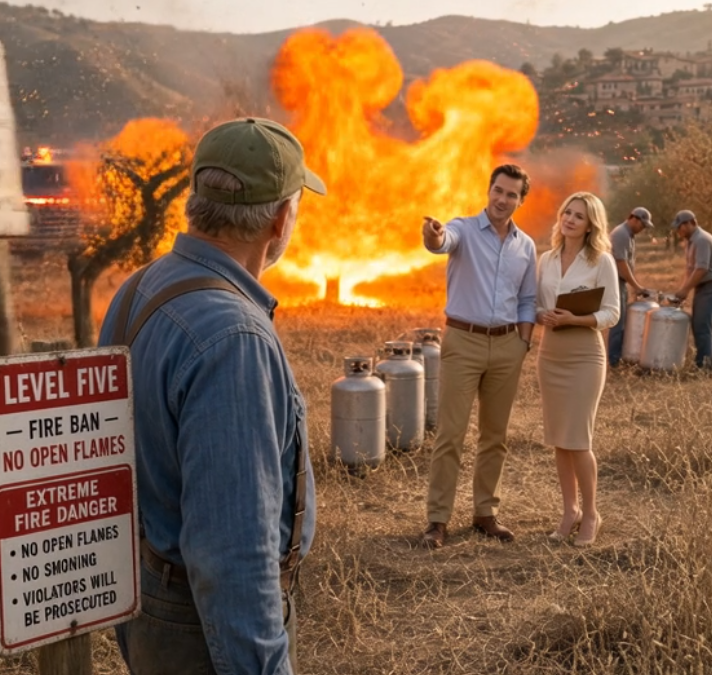
Level Five Fire Ban.
No open flames.
No burn barrels.
No brush clearing by fire.
No grills.
No fire pits.
No exceptions for landscaping, neighborhood cleanup, private maintenance, or “community beautification.”
I printed the notice at dawn.
I stapled one copy to the gate beside my orchard.
I emailed another to the Harmony Hills HOA board.
I hand-delivered a third to their office before nine in the morning.
Kevin was not there.
Karen was.
She sat behind the desk in the HOA office wearing a red blazer even though it was already ninety degrees outside.
“I wanted to make sure you had a printed copy,” I said, placing the notice on her desk.
She looked at it.
Then at me.
“We received your email.”
“Good.”
“Was the hand delivery necessary?”
“Yes.”
“Why?”
“So later you cannot say you didn’t know.”
Her face changed.
Only slightly.
But I saw it.
“Mr. Baxter,” she said, “the board has no intention of violating county rules.”
“That’s good to hear.”
“Your hostility is unnecessary.”
“So are propane tanks beside dry brush.”
She folded her hands.
“The board is managing a complicated slope area that your orchard contributes to.”
“My orchard is on my land.”
“Your trees shed debris.”
“So do your eucalyptus.”
“Your irrigation runoff encourages weeds.”
“My irrigation is permitted and metered.”
“Your fencing prevents safe maintenance access.”
“My fencing prevents trespassing.”
She smiled.
“You seem determined to view the HOA as an enemy.”
“No, Karen. The HOA keeps showing up dressed like one.”
I left before she could answer.
By noon, their maintenance crew was dragging propane tanks, burn barrels, and gas cans toward the dry brush along my fence line.
That was the first thing people needed to understand later.
I warned them before anything burned.
Before the smoke.
Before the sirens.
Before the wind changed.
Before the first tree in my family’s orchard cracked open in the heat like a bone.
I warned them while there was still time to stop.
And they laughed.
I saw them from the irrigation shed.
Three men in HOA maintenance shirts were unloading equipment near the slope. One of them had a weed burner attachment connected to a propane tank. Another was moving metal barrels into a dirt clearing they had scraped badly but not safely. A third was pouring something from a red can onto a pile of cut brush.
I took out my phone and started recording.
The time stamp was 12:17 p.m.
The county order had been active for twelve hours and seventeen minutes.
I called Kevin.
He did not answer.
I called Karen.
She did.
“Mr. Baxter,” she said, already irritated.
“Your crew is setting up burn barrels behind my orchard.”
“That is not accurate.”
“I am looking at them.”
“They are conducting controlled debris reduction.”
“With propane tanks and gas cans.”
A pause.
“Fuel containers are standard equipment.”
“Not under a Level Five ban.”
“We are not having this conversation again.”
“Yes, we are. I am telling you clearly, on a recorded call, your crew is violating the fire ban.”
Another pause.
“You are recording this call?”
“California is a two-party consent state, Karen. I just told you I’m recording. Do you consent?”
She hung up.
I called the fire marshal’s office.
No answer at first.
That happens during high-risk periods. Everyone is already moving.
So I called dispatch and reported an active fire ban violation with open-flame equipment near dry brush behind Harmony Hills.
Then I walked to the fence.
The maintenance supervisor was a man named Dale Porter. I knew him a little. He was not a bad man. He was one of those workers who had learned to survive bad bosses by keeping his head down and saying less than he knew.
“Dale,” I called.
He looked over.
His face had sweat running down both sides.
“You can’t do this.”
He glanced toward the upper slope.
Kevin’s white electric SUV was parked beneath an oak.
Karen stood beside it with her clipboard.
Dale lowered his voice.
“Sam, I’m just doing what they told me.”
“That won’t matter when the citation comes.”
“We’re not lighting barrels.”
I looked at the propane wand in his hand.
“Then what is that for?”
“Spot clearing.”
“There is no spot clearing by flame today.”
Dale rubbed his forehead.
“I told them.”
“I believe you.”
That made him look worse.
Because being believed meant he still had a choice.
“Walk away,” I said.
“I can’t lose this job.”
“You can get another job. You can’t unburn a hillside.”
Behind him, Kevin shouted, “Dale, we’re on a schedule.”
I looked up the slope.
“Kevin!”
He turned slowly.
“Shut it down.”
He waved one hand like dismissing a fly.
“Go home, Sam.”
“This is my home.”
“This is HOA maintenance.”
“This is illegal.”
Karen walked closer.
“Mr. Baxter, you need to leave the work area.”
“I am on my side of the fence.”
“You are interfering.”
“I am documenting.”
“Documentation does not make you right.”
“No. The fire ban does.”
Kevin came down the slope, face red from heat and temper.
“We are not burning the orchard.”
“You light that slope, you won’t control where it goes.”
“We have water tanks.”
I looked at the two small plastic tanks in the pickup bed.
“That is not suppression. That is wishful thinking with a hose.”
Karen’s mouth tightened.
“Enough. Dale, proceed.”
Dale did not move.
For a moment, I thought maybe he would refuse.
Then Kevin said quietly, “This is your job.”
Dale looked down.
That was all it took.
He turned the propane valve.
The hiss reached me before the flame did.
I remember that sound more than anything.
Not the sirens later.
Not the cracking branches.
Not the screaming.
The hiss.
That thin, stupid, preventable hiss.
The torch sparked.
A blue-orange tongue of fire opened in the dry grass.
For three seconds, nothing happened.
Then the world answered.
The grass flashed.
Not burned.
Flashed.
The flame ran low and fast, slipping through the dead thatch beneath the brush line like it had been waiting all summer for permission.
Dale jerked the torch back.
“Shut it down!” I shouted.
He stepped on the first patch.
Another caught ten feet away.
Then twenty.
Then the brush pile whooshed with a sound like breath being sucked from a room.
Kevin yelled something.
Karen screamed at Dale.
One of the workers grabbed the little hose from the water tank.
It sputtered.
The flame hit the eucalyptus litter at the base of the slope.
Everything changed.
Eucalyptus does not burn like ordinary brush.
It goes up oily and mean.
Leaves curled black.
Bark strips lit and lifted.
Sparks jumped the dirt scrape as if it were a painted line on paper.
I was already calling 911.
“This is Sam Baxter,” I said, voice level because training does not ask permission before returning. “Active vegetation fire behind Harmony Hills, east boundary, adjacent to Baxter Orchard. Fire ban violation. Dry brush, eucalyptus involvement, wind out of the northeast, structures threatened within minutes. Dispatch full wildland response.”
The dispatcher asked for confirmation.
I gave coordinates.
Gate access.
Nearest hydrants.
Best approach.
I had spent thirty-two years doing this from the other side of a radio.
Now I stood beside my own fence and watched the fire turn toward my trees.
The first ember landed in the orchard at 12:26 p.m.
A peach tree in row twelve smoked at the base.
I grabbed the shovel I kept by the gate and ran.
People think fire arrives as a wall.
Sometimes it does.
More often, it arrives as messages.
One ember.
One leaf.
One patch of dry grass under a fence.
One place you miss because your eyes are on the flames while the future starts behind you.
I knocked down the ember, then another.
I opened the irrigation valve for rows ten through eighteen. Water shuddered through the old pipes. Sprinklers coughed, spun, and began throwing thin arcs over the trees.
Not enough.
Never enough.
But something.
The wind shoved heat against my face.
The brush line roared now.
Dale and the workers had retreated toward the HOA road. Kevin stood frozen beside his SUV, phone at his ear, looking like a man trying to negotiate with consequences.
Karen was screaming that someone had to move the propane tanks.
I yelled at her to leave them.
She did not hear me.
One worker tried to grab a tank.
A flare-up sent him stumbling backward.
“Get out!” I shouted. “Leave the equipment and get out!”
Dale heard me.
He grabbed the worker by the shirt and pulled him down the slope.
For that, I will give him credit.
Panic makes fools of people.
Dale still managed to save a man who had almost died trying to save a tank.
Sirens started in the distance.
Too far.
I moved down row twelve with the shovel.
Then row thirteen.
A fig tree caught at the edge.
I beat the flames down until my shoulders burned.
Smoke flattened low through the orchard.
My eyes watered.
The air tasted like metal and sap.
A branch above me snapped with a loud, wet crack.
I looked up.
Crimson Heart was burning.
That was one of Ellie’s trees.
She had been ten when I grafted it. She named it because the peaches blushed red near the stone. Every summer, she would cut one open and say it looked dramatic.
The fire climbed through the dry leaves at the crown.
I stood under it with a shovel and understood there was nothing I could do.
That is a terrible thing for an old firefighter.
Knowing exactly when a thing is already gone.
I backed away.
The crown lit fully.
Heat pushed me hard enough that I raised one arm to shield my face.
Behind me, another tree caught.
Then another.
By the time Engine 14 came through my service gate, seven rows were involved.
Captain Luis Ortega stepped out in yellow brush gear, saw me, and shouted, “Sam!”
“I’ve got ignition from HOA slope, eucalyptus, propane equipment left near origin, wind northeast, orchard extension, structures threatened on Sycamore!”
He stared at me for half a second.
Not because he doubted me.
Because firefighters hate seeing one of their own standing on the wrong side of the disaster.
Then training took over.
“Copy. Get back.”
“I can help.”
“Sam.”
“I can help.”
He looked at my face.
Then my hands.
Then the burning rows behind me.
“You can help by not becoming my rescue.”
That sentence worked.
Only because I had said it to other men before.
I stepped back.
More engines arrived.
Then the water tender.
Then a dozer.
Then the sheriff’s department.
Then the first evacuation alert hit every phone in Harmony Hills.
Mandatory evacuation: Sycamore Court, Laurel Bend, East Ridge Drive.
The wind shifted at 1:04 p.m.
Not gradually.
Not politely.
It came hard out of the east, hot and sudden, as if some giant hand had slapped the fire sideways.
The flames that had been chewing through my orchard turned and ran uphill toward Harmony Hills.
The same slope Kevin called a beautification project became a chimney.
Fire loves uphill.
It loves dry brush.
It loves fences, decks, mulch beds, ornamental grasses, cedar shake accents, and the stupid decorative bark people pile around luxury homes because it looks clean in real estate photos.
Harmony Hills had all of it.
I stood beside my service road and watched the fire reach the first backyard on Sycamore Court.
The house had a pool.
A pergola.
A row of Italian cypress trees planted like green candles along the fence.
They went up one by one.
Whoosh.
Whoosh.
Whoosh.
People were running now.
Residents who had spent years complaining about my orchard’s “visual inconsistency” were throwing photo albums, dogs, laptops, medicine bottles, and crying children into SUVs.
A woman in yoga clothes stood in her driveway screaming that her cat was inside.
A teenage boy dragged two trash bags full of clothes down the sidewalk.
An elderly man stood frozen with a walker halfway down his front path while smoke rolled over his roofline.
I moved before thinking.
Old training again.
I crossed the road, grabbed the walker, and looked him in the eye.
“What’s your name?”
“Arthur.”
“Arthur, we are walking to my truck.”
“My wife—”
“Where is she?”
“Gone. She died last year.”
“I’m sorry. We are still walking.”
“I need my pills.”
“Where?”
“Kitchen counter.”
I looked at the smoke.
Too much.
Too fast.
“You need your lungs more.”
He started to argue.
I lifted the walker over the curb and guided him forward.
“You can be mad at me when you’re breathing clean air.”
I got him to my truck and helped him in.
By then, Deputy Frost was directing evacuation traffic near the entrance road. Two sheriff’s units tried to keep the single exit from locking up.
The single exit.
That was the irony no one appreciated in the moment.
Harmony Hills had insisted on gates, stone walls, decorative medians, and controlled access because exclusivity made people feel safe.
Now all that control had become a bottleneck.
Cars jammed at the entrance.
Smoke pushed across the road.
A delivery van stalled near the gatehouse.
People honked as if noise could move fire.
I ran to the gate controls.
Karen was there.
Her red blazer was gone now. Her hair had fallen loose. Her face was streaked with soot.
“The gate won’t stay open!” she shouted.
“Manual override.”
“I don’t know where it is.”
“You’re the treasurer.”
“I don’t know where it is!”
I looked at her.
For one second, rage tried to rise.
This woman had carried a clipboard like authority was a divine right. She had fined people for paint colors. She had signed letters threatening liens. She had stood beside Kevin while a torch lit dry brush under a county fire ban.
Now she did not know how to open her own gate.
I wanted to say all of that.
Instead, I shoved past her, yanked the panel cover open, and pulled the manual release.
The gate rolled free.
“Keep it open,” I said.
“How?”
I pointed to a broken piece of concrete near the curb.
“Jam it.”
She stared.
“Now, Karen.”
She moved.
That may have been the first useful thing I ever saw her do.
I ran toward the stalled delivery van. The driver was trying to restart it. Behind him, thirty cars were trapped.
“Neutral!” I shouted.
“What?”
“Put it in neutral!”
Three residents and I pushed the van clear while smoke thickened around us.
Someone coughed hard.
Someone cried.
A child in a back seat pressed a stuffed dinosaur against the glass.
I kept moving.
That was the only way.
Move.
Clear.
Direct.
Do not think about the orchard.
Do not think about Crimson Heart.
Do not think about Starlight Lemon.
Do not think about the fact that every minute spent helping Harmony Hills was a minute I was not watching my family’s land burn.
Captain Ortega’s crew made a stand at the bottom of East Ridge Drive.
For twenty-three minutes, they held the line.
Then embers crossed behind them and three roofs ignited almost simultaneously.
Modern houses do not always burn slower than old ones.
People like to think new means safe.
But foam furniture burns hot.
Vinyl windows fail fast.
Composite decking melts.
Attic vents invite embers like open mouths.
The first house was gone in twelve minutes.
The second followed.
Then a third.
By 2:30 p.m., Harmony Hills was no longer evacuating.
It was losing.
News helicopters arrived before the second strike team did.
That always happens now.
Cameras get there while hoses are still being unrolled.
By late afternoon, the fire had taken fourteen homes, damaged nine more, destroyed the HOA office, burned three maintenance trucks, and blackened the entire slope Kevin had wanted beautified.
My orchard lost twenty-two rows.
Thirty-seven rows had stood that morning.
Fifteen survived in patches.
Not whole.
Not untouched.
But alive.
My house survived because my grandfather had planted dirt lanes between the orchard and the old farmhouse, because I had cleared the defensible space myself every winter, and because Engine 14 made one hell of a stand at the irrigation pump when the fire tried to jump the service road.
At sunset, the wind died.
That felt cruel.
All day, it had pushed fire like it had somewhere to be.
Then, once everything that could break had broken, it went still.
Smoke hung over the valley.
Ash fell into swimming pools, onto lawns, across the burnt frames of houses that had once been staged for open houses and holiday newsletters.
I stood at the edge of row seven with a blanket around my shoulders and watched firefighters overhaul hot spots between blackened trees.
My hands shook.
Not from fear.
From what comes after.
Kevin found me there.
I heard his shoes on the dirt before he spoke.
He looked smaller.
Soot on his face.
Polo torn near the collar.
Hair flattened with sweat.
His perfect HOA president mask had burned away hours earlier.
“Sam,” he said.
I did not turn.
He stopped a few feet behind me.
“I didn’t know it would happen like this.”
That was the wrong sentence.
I turned slowly.
“You didn’t know fire burns?”
His mouth opened.
Closed.
“I mean—we had done brush clearing before.”
“During a Level Five ban?”
“No.”
“With propane?”
He looked down.
“Karen said—”
I took one step toward him.
“Do not do that.”
He looked up.
“Do not stand in my orchard and put this on Karen. She is responsible for what she did. Dale is responsible for what he did. You are responsible for what you ordered.”
His face twisted.
“We were trying to protect the neighborhood.”
“No. You were trying to make the slope look better before a property tour.”
His silence told me I had hit bone.
I knew about the property tour because a real estate broker had called me two weeks earlier asking whether I would consider selling “for the sake of neighborhood continuity.”
I told him no.
Apparently, Harmony Hills had been preparing for a push to attract higher-end buyers.
A clean slope.
A prettier boundary.
No orchard “irregularities” visible from the walking trail.
Kevin whispered, “This is going to ruin us.”
I looked behind him.
At the smoke column.
At the residents standing near the road with pets in carriers, children wrapped in towels, and faces emptied by shock.
“Us?” I said.
He swallowed.
“I didn’t mean—”
“You never do.”
Sheriff’s deputies took statements that night.
The fire marshal arrived before dark.
His name was Victor Salas. We had worked together years earlier, though not closely. He was younger than me by fifteen years and had the careful eyes of a man who believed burn patterns more than people.
He hugged me once.
Hard.
Then stepped back and became official.
“I’m sorry, Sam.”
“Do your job.”
His face tightened.
“I will.”
“I have video.”
“I figured you might.”
“I have phone logs, emails, delivery confirmation of the fire ban notice, photos from last week, and footage of ignition.”
Victor exhaled slowly.
“That will help.”
“It won’t bring the trees back.”
“No.”
I handed him the memory card from my gate camera.
Then the copy from my phone.
Then printouts from the folder I had kept because old firefighters and old farmers both know documentation matters.
Karen gave her statement near the HOA office ruins.
From where I stood, I could not hear all of it.
But I saw enough.
At first, she pointed often.
Toward the slope.
Toward the orchard.
Toward Dale.
Toward the barrels.
Then Victor showed her something on his tablet.
Probably my video.
Her hand lowered.
Kevin refused to answer questions without counsel.
That was his right.
It was also the first smart decision he made all day.
Dale Porter told the truth.
I learned that later.
He told Victor he had warned Kevin and Karen.
He said he felt pressured to proceed.
He admitted he lit the torch.
He cried during the statement.
That did not absolve him.
But truth matters.
Especially when everything else has turned to smoke.
I slept in my truck that night because the farmhouse smelled like ash and wet insulation.
Not really slept.
Sat.
Drifted.
Woke every time an engine moved.
At 3:12 a.m., my daughter Ellie called.
I had texted her earlier.
I’m safe. Orchard burned. Call when you wake.
She did not wait for morning.
“Dad?”
“I’m here.”
Her breath caught.
“I saw it on the news.”
“I know.”
“Are you hurt?”
“No.”
“The orchard?”
I looked through the windshield.
In the dark, I could see small orange spots where crews still worked hot roots.
“Bad.”
“How bad?”
I closed my eyes.
“Most of it.”
She was quiet.
Then I heard her crying.
That hurt worse than my own.
Ellie lived in Sacramento with her husband and two boys. She had her own life. A job. School schedules. Soccer practices. Bills. Allergies. A dishwasher that had been threatening to quit since March.
But the orchard was part of her too.
She had learned to walk between those rows.
She had buried a goldfish under the almond tree in row three.
She had kissed her first boyfriend behind the irrigation shed, badly if her later embarrassment was any measure.
She had named Rose Seven after her mother because my wife Rose died the same year that graft took.
“I’m coming,” Ellie said.
“You don’t have to.”
“Dad.”
“I know.”
“I’m coming.”
She arrived the next afternoon.
By then, the fire was mostly contained, though crews still patrolled. Harmony Hills looked like a war had passed through wearing expensive shoes.
Fourteen houses were gone completely.
Nine damaged.
The clubhouse burned to the foundation.
The HOA office was a shell.
The entrance sign had cracked in half.
The words HARMONY HILLS still stood on one side, while the other half lay blackened in the gravel.
Ellie parked by the farmhouse and got out without closing the driver’s door.
She was thirty-eight, but for one second I saw the little girl with peach juice on her shirt running through the orchard rows yelling that Crimson Heart was ready.
Then she saw the trees.
Her hands went to her mouth.
The orchard after fire is not quiet.
People think burned places are silent.
They are not.
They tick.
Drip.
Pop.
Settle.
Branches fall without warning.
The ground smokes in strange places.
I walked beside her because I knew where it was safe.
She stopped at row twelve.
Crimson Heart was black.
The trunk had split.
The bark peeled away in curls.
Ellie reached toward it, then stopped before touching.
“Don’t,” I said softly. “Still hot inside.”
She lowered her hand.
For a while, neither of us spoke.
Then she said, “I named this one.”
“I know.”
“You told me it was too dramatic.”
“It was.”
“It was perfect.”
I nodded.
“Yes.”
She looked across the burned rows.
“What happens now?”
That question had already been asked by insurance adjusters, sheriff’s deputies, residents, reporters, and Victor Salas.
From Ellie, it meant something else.
Not liability.
Not cleanup.
Not prosecution.
What happens to us now that one more piece of family is gone?
“I don’t know,” I said.
She took my hand.
My daughter had not held my hand in public since she was twelve.
We stood there like that until the smoke made our eyes water too badly to pretend it was only smoke.
The investigation took six weeks.
The civil fallout began before that.
Insurance companies arrived like vultures wearing branded polo shirts.
Harmony Hills’ carrier sent adjusters.
My carrier sent adjusters.
Homeowners’ carriers sent adjusters.
The county sent inspectors.
The state fire agency sent a review team.
Reporters kept calling the fire the Harmony Hills Disaster.
I hated that name.
Not because Harmony Hills had not suffered.
It had.
But disasters do not light themselves.
This was not lightning.
Not a freak accident.
Not an unavoidable act of God.
It was people with authority ignoring a lawful fire ban because they thought rules bent around their needs.
Victor Salas issued his preliminary report in September.
Origin: HOA-maintained slope behind Sycamore Court.
Cause: open-flame vegetation clearing in violation of county Level Five Fire Ban.
Contributing factors: dry fuels, eucalyptus litter, inadequate clearance, wind shift, delayed suppression, unauthorized ignition source.
Responsible parties listed: Harmony Hills HOA maintenance operation under direction of board representatives.
Kevin resigned the same day.
Karen resigned two days later.
Dale was fired by the HOA before the full report came out, which was a cowardly attempt to make him the whole story.
It did not work.
Dale hired his own attorney and provided emails showing he had objected to burning under ban conditions.
That made things worse for Kevin and Karen.
Much worse.
The district attorney filed charges in October.
Not the dramatic kind people online demanded.
Nobody was charged with arson in the way strangers wanted.
The law is more precise than outrage.
Kevin and Karen were charged with reckless burning, violation of emergency fire restrictions, public nuisance, and endangerment-related counts tied to the evacuation and property loss.
Dale faced a lesser charge because he lit the torch, but his cooperation and documented objections mattered.
The HOA itself faced civil enforcement, fines, and lawsuits from nearly every direction.
Including mine.
Rachel Kim became my attorney because Ellie insisted I needed someone more aggressive than “a retired fire captain with a folder and righteous anger.”
Rachel was short, sharp, and had the courtroom patience of a woman who enjoyed watching arrogant people learn consequences in complete sentences.
She visited the orchard in black boots and stood with me near the burned rows.
“I’m sorry,” she said.
“Most people say that while looking at me. You’re looking at the trees.”
“Because you already know I’m sorry for you.”
I liked her immediately.
She reviewed my documentation.
Emails.
Printed notices.
Delivery confirmations.
Phone logs.
Videos.
Photos.
Prior complaints about the brush line.
Kevin’s beautification email.
Karen’s claim of a maintenance exemption.
The footage of Dale lighting the torch.
The flame spread.
The time stamps.
Rachel looked through all of it in my kitchen while Ellie made coffee with the fury of a daughter who wanted to sue the entire world.
When Rachel finished, she leaned back.
“They are in serious trouble.”
“They burned fourteen homes.”
“Yes.”
“And my orchard.”
“Yes.”
“They’ll try to say the wind changed.”
Rachel looked at me.
“The wind did change. But wind is not a defense when you create unlawful ignition during a fire ban.”
I nodded.
I had known that.
It still helped hearing someone else say it.
“What do you want?” she asked.
I looked out the window.
Black rows stretched beyond the farmhouse.
“I want my trees back.”
She did not insult me with optimism.
Instead, she said, “What else?”
“I want them to admit they were warned.”
“That we can pursue.”
“I want the residents to know Kevin and Karen did this. Not bad luck. Not my orchard. Not the weather.”
“That too.”
“I want enough money to rebuild what can be rebuilt.”
“Yes.”
“And I want Harmony Hills to stop treating working land like a disease.”
Rachel smiled faintly.
“That may be the hardest demand.”
The lawsuits came in waves.
Homeowners sued the HOA.
The HOA tried to sue the maintenance contractor.
The maintenance contractor sued the HOA.
Insurance carriers sued everyone.
Residents formed factions.
Some blamed Kevin and Karen.
Some blamed Dale.
Some blamed the county for not arriving sooner.
A few blamed me.
Of course they did.
One man named Christopher Vail told a reporter that my orchard had “contributed organic fuel load” to the disaster.
Ellie saw that interview before I did.
She called him a name I will not repeat.
Then she drove to Harmony Hills and taped copies of my three years of brush complaints to the temporary community bulletin board.
Under them, she wrote:
MY FATHER WARNED YOU.
I told her that was not helpful.
She said it helped her.
Fair enough.
The strangest part of loss is how busy it makes you.
I had imagined grief as stillness.
But after the fire, grief came with appointments.
Adjusters.
Lawyers.
Tree specialists.
Soil tests.
Debris removal.
Hazard assessments.
Bank calls.
County hearings.
Reporters.
Neighbors.
My orchard was gone, but my calendar had never been fuller.
In November, an arborist named Miguel Aranda walked the rows with me.
He was an old friend from the agricultural extension office. He had hands like bark and spoke to damaged trees with more respect than most people speak to the living.
He scraped bark.
Checked cambium.
Measured trunk damage.
Marked some trees with orange tape.
Others with blue.
“What does blue mean?” I asked.
“Maybe.”
“What does orange mean?”
He did not answer immediately.
That was answer enough.
We walked row after row.
Orange.
Orange.
Blue.
Orange.
Blackened trunks.
Split bark.
Burned crowns.
Some roots still alive.
Some cooked underground.
When we reached Starlight Lemon, Miguel stopped.
The top was dead.
The trunk looked terrible.
But near the base, one small green shoot had pushed through blackened bark.
Miguel crouched.
“Well,” he said.
I stood over him.
“Well what?”
“This one is rude.”
I almost laughed.
It came out wrong.
Half laugh.
Half sob.
Miguel looked up.
“She wants to live.”
I crouched beside him.
The shoot was smaller than my thumb.
Ridiculous.
Bright.
Impossible.
I touched the soil near it.
Not the shoot.
Just the soil.
“Ellie named this one,” I said.
Miguel nodded.
“Then Ellie was right to name it.”
That night, I slept inside the farmhouse for the first time since the fire.
It still smelled faintly of smoke.
Maybe it always would.
In December, Harmony Hills held its first open community meeting after the fire.
They held it in the high school gym because the clubhouse was gone.
I almost did not go.
Rachel told me not to speak unless necessary.
Ellie told me to wear a clean shirt.
Miguel told me to bring water because gyms make everyone stupid.
I sat in the third row.
Residents filled the bleachers and folding chairs. Some had lost everything. Some were living in rentals. Some were fighting insurance. Some looked angry enough to chew nails. Some looked hollow.
Kevin was not there.
Karen was not there.
Dale was.
He sat in the back with his attorney, head down, hands clasped.
The temporary board chair was Margaret Leland, a retired school principal whose house had survived with smoke damage. She stood at a microphone and looked like she had slept six hours total in the last month.
“We are here,” she said, “because Harmony Hills failed itself.”
That quieted the room.
Not because people agreed.
Because they expected softer words.
Margaret continued.
“We can discuss insurance, rebuilding guidelines, road repairs, slope stabilization, and legal strategy. We will. But first we need to say plainly what happened. Our board authorized prohibited fire activity during a county fire ban after receiving direct warning from Mr. Baxter, from county notices, and from our own maintenance staff.”
A man stood.
“My house burned because of them.”
Margaret nodded.
“Yes.”
Another woman shouted, “And because of that orchard.”
I felt Ellie stiffen beside me.
Margaret turned toward the woman.
“No, Diane. The orchard did not light itself. Mr. Baxter’s orchard burned first.”
Diane sat down slowly.
Margaret looked at me.
“Mr. Baxter, I know this does not repair anything. But on behalf of the temporary Harmony Hills board, I apologize.”
Every head turned.
I hated it.
I stood because sitting felt worse.
“I accept the apology from you,” I said.
Not from Kevin.
Not from Karen.
Not yet.
Maybe not ever.
Margaret understood.
She nodded.
Then an elderly man rose from the front row.
Arthur.
The man with the walker.
His house had survived with smoke damage because firefighters stopped the fire two doors away. He gripped the microphone after his daughter helped him stand.
“Sam Baxter carried me to his truck while my own neighbors were trying to get out,” he said. “I want that in the minutes.”
The gym went quiet.
Arthur turned his head toward me.
“I did not thank you properly.”
“You were busy breathing,” I said.
A few people laughed softly.
Arthur did not.
“Thank you.”
I nodded.
Then sat down before I embarrassed myself.
That meeting changed something.
Not everything.
But something.
It became harder after that for residents to turn me into the villain. Not impossible. People can do impressive mental gymnastics when property values are involved. But harder.
The criminal case ended in February.
Kevin took a plea.
Karen did too.
Reckless burning.
Violation of emergency fire restrictions.
Community service.
Fines.
Restitution hearings.
Probation.
No jail.
Some people were furious.
Ellie was furious enough for three people.
I was not satisfied.
But I was not surprised.
Courts do not weigh trees like families do.
They do not know what thirty-seven rows mean.
They do not know that Crimson Heart was not just peach wood.
They do not know that my daughter named Rose Seven after her mother.
The civil settlement took longer.
By spring, Harmony Hills’ insurance carrier had agreed to a large settlement fund for homeowners and impacted neighboring properties. My claim was separate because my orchard was agricultural land with documented lineage, production value, specialty grafts, and extensive negligence evidence.
Rachel fought like a woman personally offended by bad paperwork.
We settled in late May.
The amount was more money than I had ever seen attached to my name.
Not enough.
No amount would have been enough.
But enough to clear debris properly.
Enough to restore irrigation.
Enough to replant.
Enough to compensate lost production.
Enough to build a permanent firebreak between the orchard and Harmony Hills.
Enough to fund annual vegetation management on the slope under county supervision.
Enough to create a community emergency response fund in my daughter’s name, because Ellie insisted that if money was coming from stupidity, some of it should be forced into usefulness.
The agreement required Harmony Hills to issue a public acknowledgment.
Not “regret.”
Not “incident.”
Not “unforeseen weather event.”
Rachel murdered those words on sight.
The final statement said:
Harmony Hills HOA acknowledges that prohibited open-flame brush clearing was conducted under board authority during a county Level Five Fire Ban despite prior warnings. This action caused ignition that resulted in the Baxter Orchard Fire, destruction of private orchard land, damage and destruction of Harmony Hills homes, and significant community harm. Harmony Hills accepts responsibility and commits to permanent changes in governance, fire safety compliance, and land stewardship.
I read that sentence twenty times.
Accepted responsibility.
It did not bring back a single tree.
But it put the truth in ink.
That mattered.
Replanting began in March.
People came expecting a ceremony.
I did not want one.
I wanted shovels.
Miguel came with rootstock.
Ellie came with my grandsons.
Rachel came wearing boots that cost too much but got muddy anyway.
Arthur’s daughter brought sandwiches.
Margaret Leland brought coffee.
Dale Porter came too.
I had not invited him.
He stood near the service gate holding a shovel like a man expecting to be told to leave.
Ellie saw him first.
Her face hardened.
I walked over.
Dale looked at me.
“I know I don’t deserve to be here.”
“That’s not a question.”
“No.”
His hands tightened around the shovel.
“I lit it.”
“Yes.”
“I told them it was wrong, but I still lit it.”
“Yes.”
“I think about that every day.”
“So do I.”
He swallowed.
“I’m not asking forgiveness.”
“Good.”
“I’m asking if I can dig.”
I looked at him for a long time.
Forgiveness is not a switch.
People talk about it like it is clean. Like you either give it or withhold it and that says something about the size of your soul.
I think forgiveness is often less useful than accountability.
Dale had told the truth.
He had testified.
He had lost his job.
He had not tried to turn himself into the victim.
And now he stood at the edge of what he helped destroy asking to do the only useful thing available.
I pointed toward row twelve.
“Start there.”
He nodded once.
Then walked into the orchard.
Ellie came up beside me.
“You sure?”
“No.”
She watched Dale push the shovel into the ground.
“You’re letting him help.”
“I’m letting him work.”
“Is there a difference?”
“Yes.”
She nodded slowly.
“Okay.”
We planted forty-two trees that day.
Not thirty-seven rows.
Not yet.
But forty-two trees.
Peaches.
Figs.
Lemons.
Almonds.
Two experimental grafts Miguel said were probably foolish.
Ellie named them anyway.
Ash Bell.
Second Grace.
That one broke me.
I had to walk away for ten minutes.
My grandsons followed at a distance but did not crowd me.
Good boys.
When I came back, Ellie handed me a small tree tag.
ROSE EIGHT.
I tied it myself.
The new firebreak went in over the summer.
Not a decorative strip.
A real one.
Cleared mineral soil.
Irrigation access.
Emergency turnaround.
No eucalyptus.
No ornamental bark.
No nonsense.
Harmony Hills paid for it.
County fire inspected it.
I signed off only after walking every foot.
The new HOA board invited me to consult on their fire safety committee.
I told them no at first.
Then Margaret said, “We would rather be corrected before the flames.”
That was a good line.
I joined.
Not because I wanted to be part of Harmony Hills.
I did not.
But because fire does not respect property lines, and stubbornness that helps nobody is just vanity wearing work boots.
Our first meeting lasted three hours.
I explained defensible space.
Fuel ladders.
Ember intrusion.
Gate access.
Evacuation chokepoints.
Maintenance without ignition.
The difference between a pretty landscape and a survivable one.
One resident asked whether removing ornamental bark would hurt curb appeal.
I said, “Not as much as burning down.”
Nobody argued.
That felt like progress.
Kevin moved out of state.
Arizona, I heard.
Karen tried to stay in Harmony Hills for six months. No one spoke to her at meetings. Her own street refused to elect her to the landscape committee. Eventually, she sold her house at a loss and left.
I did not celebrate.
Not because I felt sorry for her.
Because by then I understood something that took me too long to learn.
Consequences are not the same as repair.
Kevin and Karen lost reputations, positions, money, and standing.
Fine.
But my trees were still dead.
Fourteen families still had to rebuild.
Arthur still woke coughing from smoke irritation.
Dale still stared at his hands too long before digging.
Ellie still cried when she found an old jar of peach preserves labeled Crimson Heart 2019.
The neighborhood burning did not undo the orchard burning.
It only proved the fire had never cared who thought they were in charge.
The first new blossom came almost two years later.
Starlight Lemon.
Of course.
The rude one.
Miguel had grafted from the surviving shoot, protected it, babied it, cursed at it, and declared it dead twice. The tree ignored him.
One March morning, I walked row twelve and saw three white blossoms near the lower branch.
Small.
Fragile.
Defiant.
I called Ellie.
She answered on the third ring.
“What’s wrong?”
“Nothing.”
“You never call before eight unless something is wrong.”
“Starlight bloomed.”
Silence.
Then she said, “Send a picture.”
“I thought you’d want to come see.”
“I’m already getting dressed.”
She drove two hours.
Brought the boys.
They were taller now, old enough to remember the fire but young enough that the new orchard would be more real to them than the old one someday.
That hurt.
Then it comforted me.
Maybe that is what rebuilding means.
Not replacing what burned.
Creating something that can belong to those who come after.
Ellie stood in front of Starlight Lemon and touched the air near the blossoms without touching them.
“She made it,” she whispered.
I nodded.
“She did.”
My oldest grandson, Caleb, looked around the orchard.
“Grandpa?”
“Yeah?”
“Will it all grow back?”
I looked at the rows.
Young trees.
New irrigation.
Mulch that would not burn like stupidity.
Firebreak shining pale between us and Harmony Hills.
Some old trunks left standing as habitat because Miguel said dead trees could still serve if they were stable.
“No,” I said.
Caleb frowned.
I put a hand on his shoulder.
“It won’t all grow back the same.”
“Is that bad?”
I thought about Crimson Heart.
Rose Seven.
My father’s almonds.
My grandfather’s citrus.
Kevin’s face when the wind turned.
Karen wedging the gate open with broken concrete.
Arthur breathing in my truck.
Dale asking to dig.
Ellie tying Rose Eight.
The apology letter.
The settlement.
The new blossoms.
“No,” I said finally. “Not always.”
Harmony Hills looks different now.
Less perfect.
Better.
The rebuild rules changed after the fire. No shake accents. No flammable mulch within five feet of structures. Screened vents. Wider turnarounds. Clear evacuation signage. Annual drills. Actual slope maintenance.
Some residents complained.
They always do.
But most had learned that perfect neighborhoods burn like any other when pride does the planning.
The HOA office was rebuilt smaller.
The new sign at the entrance is stone, simple, and far less ridiculous than the old one.
Every July, the fire safety committee sends out notices in plain language.
No open flames means no open flames.
No exceptions.
No beautification fires.
No Kevin clauses.
That last part is not official.
But everyone knows.
I still own the orchard.
Not the same orchard.
A new one grown from ash, insurance money, stubbornness, guilt, apology, and labor.
Some mornings, I walk the rows before sunrise and talk to the trees like an old fool.
I tell Rose Eight about her namesake.
I tell Second Grace to behave.
I tell Ash Bell she has an ugly name but a strong trunk.
I tell Starlight Lemon she is rude and I admire her for it.
Sometimes I talk to the dead trees too.
Not out loud if workers are nearby.
Usually.
I tell Crimson Heart that Ellie still remembers.
I tell my father the almonds are coming back.
I tell my grandfather that dry California soil did love him back, just not gently.
And sometimes, when the wind moves right, I swear I can still smell the old orchard beneath the new one.
Smoke changed the land.
But it did not erase it.
That is what Kevin never understood.
Land is not scenery.
It is not negative space around houses.
It is not a problem to be managed for market alignment.
It remembers every hand that worked it.
Every root that held.
Every warning ignored.
Every fool who thought fire would respect a board decision.
The day the HOA burned my orchard, they thought they were improving a view.
They thought my rows of old fruit trees were ugly.
They thought rules were tools for controlling other people, not limits that applied to them.
They thought a printed fire ban was less important than a schedule.
Then the wind turned.
And for one terrible afternoon, Harmony Hills learned what firefighters, farmers, and old landowners already know.
Fire does not care about your property values.
It does not care about your bylaws.
It does not care about your red blazer, your committee vote, your maintenance exemption that never existed, or your perfect neighborhood sign.
It goes where fuel, wind, and arrogance send it.
By the time it was over, my orchard was black, fourteen houses were gone, and the people who called my land an eyesore were standing in ash asking how it happened.
I could have told them.
I did tell them.
Before anything burned.
That is the part I still carry.
Not because I wanted to be right.
I would give anything to have been wrong.
I would give anything for Kevin to have listened, for Karen to have folded that fire ban notice and said, “We wait,” for Dale to have set the torch down and walked away, for Crimson Heart to still shade row twelve.
But life does not let us edit the spark after the slope is burning.
It only asks what we do with the ash.
So I replanted.
I testified.
I helped rewrite the rules.
I pulled Arthur out through smoke.
I let Dale dig.
I let Harmony Hills pay.
I let my daughter name the first new grafts because grief needs somewhere to put its hands.
And every summer now, when the county sends out fire warnings, I print them.
One copy goes on my gate.
One copy goes in my records.
One copy goes to Harmony Hills.
They never laugh anymore.
That does not bring back the old orchard.
But it keeps the new one alive.
And some days, when Starlight Lemon throws white blossoms into the morning air and my grandsons run between rows that did not exist before the fire, I can almost believe survival is not the same as losing.
The orchard burned.
The perfect neighborhood burned.
The truth survived.
And from the ground they all thought was ugly, something stubborn is growing again.








