HOA Bulldozed My Family Fence While I Was at Work—So I Shut Off the Well Feeding Their Luxury Pool
PART3:
President of the Willow Creek Estates Homeowners Association.
Caroline and I had been circling each other for almost a year.
When Willow Creek Estates first appeared beside my property, I honestly did not think much about it.
My family had been on this land long before their developers arrived.
Eighty acres gave me enough room that I did not have to worry too much about what somebody was building a quarter mile away.
I had horses.
A barn.
Pasture.
An old pump house.
A farmhouse that had survived more storms than most of the residents next door had probably seen.
My mornings were quiet.
Most days started with coffee on the porch while fog moved across the pasture.
Ranger and the other horses would graze near the lower field.
Sometimes I could hear birds in the cottonwoods.
Sometimes I heard absolutely nothing.
That was the point.
My father used to say land gave you exactly as much peace as you were willing to protect.
I did not understand that sentence when I was younger.
I understood it now.
The fence Caroline hated had been built by him.
I had been a kid when he installed part of it.
I remembered carrying nails in an old coffee can while he set posts into the ground.
I remembered complaining that my arms hurt.
He laughed and told me that one day I would appreciate anything that clearly told the world where our responsibility ended and somebody else’s began.
The fence aged.
The cedar faded.
Some rails were not perfectly straight anymore.
A few posts leaned slightly after decades of weather.
But it remained strong.
It kept the horses where they belonged.
It marked our property.
It did everything a fence was supposed to do.
Then Willow Creek Estates arrived.
At first, most of the residents were fine.
Some jogged along the paved trail beside my property.
A few waved.
Occasionally somebody stopped to look at the horses.
Kids loved them.
I did not mind.
Then I started hearing comments.
“That fence is really old.”
“It ruins the view.”
“Why doesn’t he replace it?”
One morning, I heard a woman wearing sunglasses the size of dinner plates say loudly to her friend, “That thing makes the whole side of the neighborhood look rundown.”
I almost laughed.
My fence had existed before her house.
Before her trail.
Before her HOA.
But apparently it was now interfering with her experience.
Then Caroline sent me a letter.
I still remembered the wording.
She informed me that my fence created an “unappealing aesthetic contrast” with Willow Creek Estates.
I read that sentence twice.
Then I showed the letter to Ranger.
He sniffed it.
“Exactly,” I told him.
I threw it away.
A few weeks later, another one arrived.
That letter claimed the fence represented a potential safety concern for residents using the walking trail.
I stared at the fence.
Then I stared at the walking trail.
They were separated.
Nobody had to climb the fence.
Nobody had to touch it.
Apparently looking at weathered cedar was now dangerous.
I threw that letter away too.
Caroline eventually appeared herself.
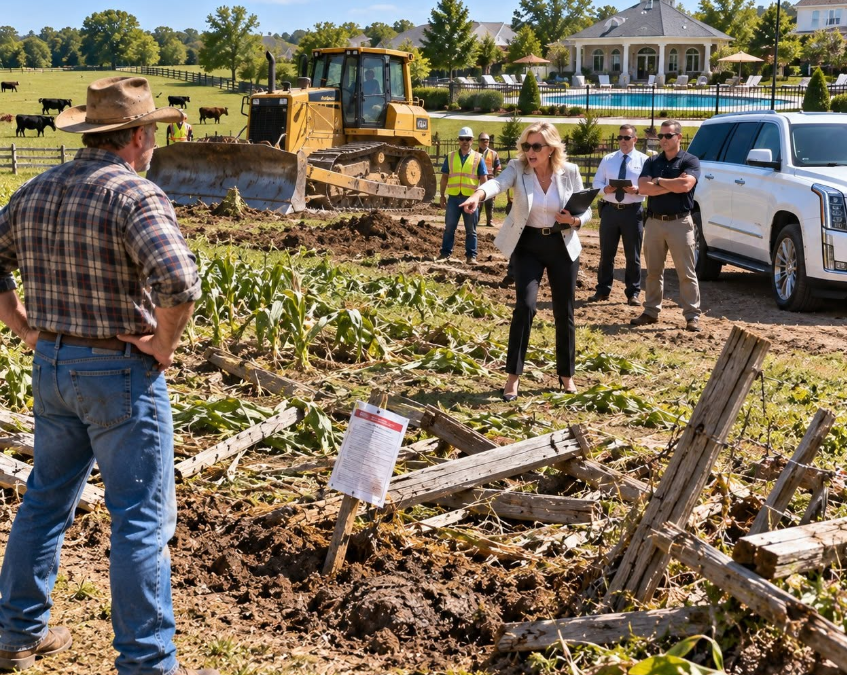
She walked along the property line holding a clipboard, dressed in a pastel blazer that probably cost more than one of my saddles.
She did not introduce herself like a neighbor.
She introduced herself like an inspector.
“We really need to address the fence situation,” she said.
“There is no fence situation.”
“It doesn’t meet the standards of the surrounding community.”
“I’m not in your community.”
She smiled tightly.
“Our residents still have to see it.”
“Then tell them to look the other direction.”
Her smile disappeared.
She started explaining visual harmony, community standards, property values, and safety.
I stopped her.
“Caroline, this is my property. Your rules stop on your side.”
She looked at me for several seconds.
Then she said, “We’ll see.”
At the time, I thought it was just attitude.
Now, standing in front of an empty property line, I realized it had been a warning.
I spent that night going over every interaction in my head.
I barely slept.
Not because I was planning something reckless.
The opposite.
I wanted to understand exactly what had happened before I decided what to do.
At sunrise, I went back outside.
The damage somehow looked worse in the morning light.
Without the long shadows of evening, I could see every scar in the earth.
The bulldozer had churned up sections of grass.
There were wide ruts near the pasture.
Broken pieces of cedar were scattered everywhere.
I crouched beside one of the post holes and ran my fingers across the torn earth.
Still soft.
Still fresh.
A week earlier, I had noticed heavy tire tracks near that same property line.
At the time, I had assumed some landscaping crew had taken a wrong turn.
Now I knew better.
They had probably been surveying the job.
That meant this was not some spontaneous mistake.
Somebody had planned it.
I fed the horses, checked the temporary corral, then followed the machinery tracks as far as I could.
They led toward an industrial staging area about a mile down the road.
The yard was filled with construction equipment.
Dump trailers.
Skid steers.
Work trucks.
Men in reflective vests.
I parked near the entrance.
A large man with a red neck and mirrored sunglasses was filling out paperwork on the hood of a pickup.
“Morning,” I said.
He looked up.
“Can I help you?”
“I’m the owner of the eighty acres next to Willow Creek Estates.”
His expression changed slightly.
Not much.
Just enough.
“You guys remove a fence yesterday?”
He lowered his pen.
“Depends.”
“Depends on what?”
“Which fence.”
“The long cedar fence beside the walking trail.”
He hesitated.
“Yeah. We did a cleanup job there.”
Cleanup.
That word hit me harder than I expected.
“You call destroying somebody’s fence cleanup?”
He frowned.
“We were hired by the HOA.”
“To go onto private property?”
“The lady in charge told us it was noncompliant.”
“Noncompliant with what?”
“Their neighborhood rules.”
“I’m not in their neighborhood.”
The man shifted his weight.
It was the first moment he looked uncomfortable.
“Look, man, we get work orders. We do the work.”
“Did anybody check who owned the fence?”
“We had a map.”
“Did the map show my property line?”
He did not answer immediately.
That was answer enough.
Finally he said, “You’re going to have to take that up with the HOA.”
“I plan to.”
“We were just following the job order.”
I looked past him toward the equipment.
A yellow bulldozer sat near the back of the yard.
Dried dark soil clung to its tracks.
The color looked exactly like the earth beside my pasture.
“You drove that machine through my land?”
Again, hesitation.
“We followed the access route they gave us.”
“Through my pasture.”
“I’m not here to argue with you.”
“Neither am I.”
I meant it.
I was not there to punch anyone.
I was not interested in creating some scene that would eventually make me look like the problem.
I wanted confirmation.
I had it.
The HOA had hired them.
The contractor had not checked ownership.
My fence had been intentionally removed.
I nodded.
“Thanks.”
The man looked almost relieved.
I walked back to my truck.
Before leaving, I looked once more at the bulldozer.
Then something inside me became very calm.
Caroline had wanted control over what happened on my land.
Fine.
It was time for both of us to learn exactly where control really lived.
But before I did anything, I wanted to hear it from her.
I drove toward Willow Creek Estates.
I did not go through the main gate.
I parked near the outer walking trail.
Several residents were jogging.
A woman slowed when she saw me.
“Is everything okay?” she asked.
“Did you hear about the fence removal?”
Her eyes moved away from mine.
“I heard there was a cleanup.”
Again.
Cleanup.
“That fence was on my property.”
“Oh.”
“Did the HOA tell residents that?”
She looked uncomfortable.
“I just saw a post saying it had been declared a safety hazard.”
“What was dangerous about it?”
“I don’t know.”
“Did anybody ever get hurt?”
“I don’t know.”
“Did anybody ever complain about an injury?”
She swallowed.
“I really don’t know.”
Then she gave me an apologetic smile and hurried away.
I kept walking.
Near the back entrance, I saw Caroline.
She stood beside the trail wearing another bright blazer and sunglasses, arms folded across her chest.
For a second, I wondered whether she had come there specifically to admire the missing fence.
She noticed me approaching.
Instead of looking guilty, she looked annoyed.
“Well,” she said. “I was wondering when you’d come over.”
That told me everything.
“You authorized it.”
She did not bother pretending she did not know what I meant.
“The fence needed to be removed.”
“It was on my land.”
“It created a serious visual problem for our community.”
I stared at her.
“A visual problem.”
“And a potential safety issue.”
“How?”
“It was deteriorated.”
“It was solid.”
“It was old.”
“Old isn’t dangerous.”
She sighed.
Actually sighed.
Like I was wasting her time.
“Your property borders our walking trail. We have an obligation to preserve the environment our residents pay for.”
“My land isn’t part of that environment.”
“It affects it.”
“So if your residents can see something, you think you control it?”
“If it negatively impacts the community, the board has an obligation to act.”
There it was.
Not confusion.
Not miscommunication.
Not an honest mistake.
She genuinely believed it.
I stepped closer, stopping well short of her side of the trail.
“You sent heavy equipment onto my property without permission.”
“We corrected a long-standing problem.”
“You destroyed private property.”
“The fence was an eyesore.”
“You trespassed.”
“Property boundaries in developments like this can be complicated.”
“No, Caroline. They aren’t.”
Her jaw tightened.
I continued.
“My deed is clear. My survey is clear. That fence stood entirely on my side.”
She waved one hand.
“If you’d like to dispute the action, you can submit a formal request to the board.”
I almost laughed.
“You want me to ask your board for permission to complain that your board destroyed my property?”
“That’s the process.”
“No.”
She blinked.
“No?”
“I’m not one of your residents. I don’t answer to your process.”
For the first time, she looked genuinely irritated.
“Then I don’t know what you expect me to do.”
I looked back toward the open stretch where the fence used to be.
“Nothing.”
She raised an eyebrow.
“Nothing?”
“That’s right.”
I turned away.
Behind me she said, “The fence isn’t coming back.”
I stopped.
For one second, I almost turned around.
Instead, I kept walking.
Because she had just made the decision much easier.
On the drive home, I did not think about shouting.
I did not think about revenge fantasies.
I thought about a small metal building at the southern edge of my land.
The pump house.
Most people in Willow Creek Estates probably did not even know it existed.
Their developers certainly did.
Years earlier, when construction on the neighborhood first began, the municipal water expansion they expected had not reached the area on schedule.
The developers needed another source of water for the clubhouse and pool.
They approached my father.
My father was old school.
If he shook your hand, he believed that was supposed to mean something.
The developer asked for temporary access to our well.
In return, my family would be allowed to use a newly paved access road they were building.
My father agreed.
No twenty-page contract.
No legal department.
Just neighbors helping neighbors.
The temporary arrangement lasted.
The city expansion never reached the property the way everyone expected.
The HOA changed leadership.
Developers left.
Years passed.
The pool kept filling.
The clubhouse kept using water.
And the line running beneath my pasture continued supplying them from our well.
I had asked Dad about it once.
“Shouldn’t you get something in writing?”
He smiled.
“Good neighbors don’t need paper to remember how to treat each other.”
That sentence had aged badly.
I parked beside the pump house.
The little building looked exactly as it had for years.
Metal siding.
Rust in the corners.
Cottonwood shade across the roof.
Inside, the air smelled faintly of damp metal and old machinery.
The pump hummed.
Pipes ran along the walls.
My father had taught me every part of the system.
Which line supplied the barn.
Which one fed irrigation.
Which valve controlled the secondary line.
And which large valve fed Willow Creek Estates.
I stood in front of it.
My hand rested on the metal.
I thought about my father.
I thought about the fence.
For half a second, I hesitated.
Then I asked myself a very simple question.
If the water line crossed my property and came from my well under a voluntary arrangement, why was I continuing to provide it to people who had just sent a bulldozer across that same land?
I was not going onto their property.
I was not damaging their equipment.
I was not touching their pool.
I was not tearing down anything that belonged to them.
I was simply ending a favor.
I turned the valve.
It resisted for a moment.
Then it moved.
Metal groaned.
Water pressure shifted inside the pipe.
The hum changed.
Finally, the valve stopped.
Closed.
That was it.
No explosion.
No dramatic alarm.
No flashing light.
Just silence in one line.
I locked the pump house and went back to my chores.
For the next couple of hours, almost nothing happened.
That was expected.
Their system still had water in the lines.
The pool was not going to transform instantly.
But without continued supply and normal system operation, problems would build.
And they did.
By late afternoon, I noticed activity near the clubhouse.
A maintenance cart moved back and forth.
Then another.
A man disappeared into the pool equipment room.
Around sunset, three people were standing together pointing toward the water.
I watched from my porch.
The distance between my property and their pool was enough that I could not hear every word.
I did not need to.
I knew exactly what they were discovering.
Their system had stopped getting water.
The following morning, I woke before sunrise.
I made coffee.
Fed the horses.
Then I walked back to the destroyed fence line.
I wanted to look at it while I was calm.
One of the broken rails still had a nail bent sideways through the cedar.
I remembered handing nails to my father from that old coffee can.
That memory hit harder than the destruction itself.
People like Caroline looked at land and saw scenery.
My father looked at land and saw work.
He saw responsibility.
Every fence post represented an afternoon somebody spent digging.
Every repaired gate represented an hour somebody could have spent somewhere else.
Nothing on a working property simply appeared.
Somebody built it.
Somebody maintained it.
Somebody paid for it.
And Caroline had erased decades of that effort because she did not like how it looked from her jogging trail.
I picked up the broken rail and carried it toward a growing stack.
By noon, several Willow Creek residents had gathered on their side of the old boundary.
They watched me work.
One man finally spoke.
“Hey.”
I kept stacking wood.
“Hey.”
I looked up.
“We heard about the fence.”
“I’m sure you did.”
He shifted awkwardly.
“They said it was unsafe.”
I leaned on my shovel.
“Did you ever see it fall?”
“No.”
“Did you ever see a horse escape through it?”
“No.”
“Did it ever hurt you?”
“No.”
“Then what made it unsafe?”
He looked embarrassed.
“I’m not taking sides.”
“That’s fine.”
“I just don’t want this getting worse.”
I almost smiled.
“Neither did I.”
He nodded slowly.
Then he walked away.
That afternoon, somebody from the HOA came to my house.
Not Caroline.
A man in khaki pants and a golf shirt carrying a red binder.
He marched up my driveway like he had been sent to deliver a court order.
“Are you the property owner?”
I looked around.
“Last time I checked.”
He did not appreciate the answer.
“We are investigating a serious water failure at the Willow Creek clubhouse.”
“That sounds inconvenient.”
“The pool’s filtration system is experiencing problems. Our supply pressure dropped unexpectedly.”
I took a sip of coffee.
“Okay.”
He stared at me.
“Are you aware of any issue affecting the water?”
“You might want to ask Caroline.”
“Why?”
“She seems very interested in what happens on my property.”
His expression shifted.
“Are you saying you interfered with our system?”
“I haven’t touched anything on your property.”
“The pool has lost water.”
“I still haven’t touched anything on your property.”
He opened the binder.
“I need a direct answer.”
“You just got one.”
He looked down the driveway toward the missing fence.
Then back at me.
“Did you shut off a water line?”
“I shut off a valve connected to my well on my property.”
His face changed instantly.
“What?”
“There it is.”
“What do you mean, your well?”
“You should probably ask your board where your clubhouse water has been coming from.”
He opened his mouth.
Closed it.
Then he left much faster than he had arrived.
By that evening, things were getting ugly on their side.
The pool had gone cloudy.
The next morning, it had a faint green tint.
People gathered outside the clubhouse.
Parents complained.
Maintenance crews moved equipment around.
Events were canceled.
A birthday party scheduled near the pool was apparently postponed.
I learned most of that because Willow Creek had a public social media page.
Residents were furious.
Why is the pool closed?
Where are our dues going?
How can a community this expensive have no backup water source?
Why isn’t the board explaining anything?
Then Caroline’s name started appearing.
Caroline needs to fix this.
The board knew about the water system.
Somebody needs to take responsibility.
It was amazing how quickly community unity disappeared when people could not use the pool.
By the second day, the green tint was no longer subtle.
Maintenance workers attempted to stabilize the system.
Without normal supply, they were fighting a losing battle.
I watched trucks enter.
Then leave.
A foul smell gradually developed around the pool area.
The walking trail that had once been the center of Caroline’s aesthetic crusade now ran beside water that looked more like a farm pond than a luxury amenity.
Then her white SUV appeared at the end of my driveway.
I was unloading feed when she stepped out.
No greeting.
No clipboard.
No fake smile.
“What have you done?”
I set down the bag.
“Good afternoon to you too.”
“This isn’t funny.”
“I didn’t say it was.”
“Our pool is unusable.”
“That’s unfortunate.”
“The clubhouse is losing reservations.”
I waited.
She took a step toward me.
“This is sabotage.”
That word almost made me laugh.
“Says the woman who sent a bulldozer onto my land.”
“That fence violated community standards.”
“My community?”
“Our shared environment.”
“No, Caroline. My land.”
She threw her hands up.
“The pool has nothing to do with your fence.”
“Exactly.”
She froze.
I continued.
“And my well has nothing to do with your HOA.”
Her face went still.
For several seconds, neither of us spoke.
Then I saw it happen.
Recognition.
“The well,” she said.
“Yes.”
“You shut off our water?”
“I stopped supplying water from my private well.”
“You can’t do that.”
“I already did.”
“We have used that connection for years.”
“Correct.”
“So you can’t simply turn it off.”
“Show me the contract.”
Her mouth tightened.
“There was an agreement.”
“Between the original developer and my father.”
“Exactly.”
“Temporary access.”
She stared at me.
“Temporary?”
“Until municipal service expanded.”
“That’s not what we were told.”
“Then maybe your board should have spent less time studying my fence and more time studying its own utilities.”
She took another step.
“We demand that you restore service immediately.”
“No.”
Her expression almost made the entire week worth it.
Caroline was not used to hearing that word.
Not from residents.
Not from vendors.
Certainly not from someone she believed she could control.
“You are deliberately damaging this community.”
“No. I am declining to continue providing free access to something I own.”
“You are doing this because of the fence.”
“I’m reconsidering our relationship because your board deliberately entered my property and destroyed something that belonged to me.”
“We believed we had the authority.”
“You didn’t.”
“We acted in the best interest of our residents.”
“Then your residents should ask why their best interests required bulldozing my father’s fence.”
Her face turned red.
“This will have legal consequences.”
“Good.”
That stopped her.
“Good?”
“Yes. Have your attorney call mine. Then everybody can review the property survey, the fence removal, the trespass, the well history, and whatever contract you believe gives you permanent water rights.”
She said nothing.
For the first time since I had known her, Caroline looked unsure.
I picked up the feed bag.
“Anything else?”
“This isn’t over.”
“No,” I said. “It isn’t.”
She left.
That evening, five vehicles came up my driveway.
The HOA board.
Caroline was with them.
So was the clubhouse manager.
A balding man carried a folder.
Another board member looked as if he had been dragged out of dinner.
The tone was completely different.
No speeches about aesthetics.
No lectures about standards.
One of them got straight to the point.
“We need the water restored.”
I folded my arms.
“Why?”
The clubhouse manager looked confused by the question.
“Because the pool system is failing.”
“I understand what’s happening. I’m asking why that’s my responsibility.”
The board members exchanged looks.
Caroline interrupted.
“You have supplied water for years.”
“Free.”
“There was an agreement.”
“Show it to me.”
Silence.
One board member cleared his throat.
“We may need time to locate the original documentation.”
“There isn’t any.”
“How can you know that?”
“Because my father made the agreement.”
The man’s expression fell.
I continued.
“It was a handshake arrangement. Temporary water access in exchange for use of your access road.”
Caroline shook her head.
“You can’t suddenly attach fees to something that’s always been free.”
“I can stop giving it away.”
“This is extortion.”
That word irritated me.
I stepped closer.
“No. Extortion would be threatening to damage your property unless you paid me. I haven’t touched your property. I stopped providing my resource after you trespassed and destroyed mine.”
Nobody answered.
I went inside.
When I returned, I had a sheet of paper.
I handed it to the nearest board member.
He looked at the top.
Then down the page.
His eyes widened.
“What is this?”
“An invoice.”
“For what?”
“Fence replacement. Ground restoration. Property damage. Labor.”
His eyes moved to the bottom.
“And this?”
“Estimated historical well usage.”
Caroline snatched the paper from him.
Her face changed as she read the total.
“This is absurd.”
“Then don’t pay it.”
“You expect us to pay years of water fees?”
“I expect you to decide whether you want a real business relationship or no relationship.”
One board member spoke carefully.
“If we pay the damages, will you turn the water back on?”
“We can discuss terms.”
“Discuss?”
“Yes.”
Caroline laughed sharply.
“This is unbelievable.”
I looked at her.
“You know what I found unbelievable? Coming home and discovering the fence my father built lying in pieces because you decided your view mattered more than my property rights.”
Nobody moved.
“My horses were exposed to an open boundary. Heavy equipment crossed my pasture. Your contractor tore up my ground. Then you told me I could file a complaint with the same board that authorized it.”
The silver-haired woman on the board looked down.
I continued.
“So no, you’re not getting a handshake this time.”
The group eventually left.
The pool kept getting worse.
By day three, it was no longer just green.
Brown patches appeared.
The water looked thick.
Insects collected near the edges.
Residents avoided the walking path because the smell was becoming impossible to ignore.
Water trucks arrived.
They tried adding fresh water.
It did not solve the underlying problem.
Without a functional, stable supply and proper circulation, they were dumping clean water into a growing mess.
From my porch, I watched workers drag hoses across the clubhouse grounds.
Caroline stood nearby giving instructions.
Even from a distance, I could see the frustration in her movements.
One truck backed dangerously close to a flower bed.
A worker shouted.
A resident shouted back.
Someone else pointed toward the pool.
The whole thing looked like a disaster drill nobody had rehearsed for.
Then somebody called the county.
A health inspector arrived.
He walked around the pool carrying a clipboard.
He tested the water.
He spoke to the clubhouse manager.
Then he spoke to Caroline.
I could not hear their conversation.
I did not need to.
The following morning, orange closure signs appeared across the pool entrance.
Officially closed.
Willow Creek Estates had spent years presenting itself as a picture of controlled suburban perfection.
Now its centerpiece looked like a swamp.
The irony was not lost on me.
They had destroyed my weathered fence because it supposedly ruined their visual environment.
Now residents were walking past a foul green pool surrounded by warning signs.
A day later, I saw birds circling above it.
Then came the turtle.
I did not see him arrive.
Apparently, he found the pool before anyone realized what was happening.
By that afternoon, residents were posting pictures of a turtle swimming through the murky water.
Somebody called it an intruder.
A teenager called it the new pool manager.
For the first time since this started, I laughed.
Not because the residents were suffering.
Most of them had nothing to do with the fence.
I laughed because the situation had reached a level of absurdity no person could have planned.
The board had wanted absolute control over its environment.
Nature had responded by putting a turtle in the swimming pool.
Still, I did not feel completely comfortable.
Watching the HOA panic was one thing.
Watching innocent residents deal with the consequences was another.
Kids lost access to the pool.
Events were canceled.
People who had never complained about my fence were getting dragged into a fight Caroline had started.
That mattered.
I was not interested in punishing an entire neighborhood forever.
I wanted the violation corrected.
I wanted the board to understand that my property was not theirs to manage.
And I wanted any future relationship built on something stronger than assumption.
That was when Bill Harmon came to see me.
Bill had been on the HOA board for years, but he was not like Caroline.
I had seen him around.
Quiet guy.
Usually drove an older white pickup instead of one of the polished SUVs most board members favored.
He walked up my driveway carrying a plain manila folder.
“Afternoon,” he said.
“Afternoon.”
He looked toward the missing fence.
“Looks strange without it.”
“Sure does.”
He shoved his hands into his pockets.
“I’m not here to threaten you.”
“Good start.”
He smiled slightly.
“Board’s falling apart.”
“Also a good start.”
That got a short laugh.
Then his face became serious.
“The residents are furious. Clubhouse cancellations are costing us money. The pool may need major repairs. Half the board wants Caroline removed.”
I waited.
“And?”
“And I read your invoice.”
“Okay.”
“I also looked into the well.”
Now he had my attention.
“What did you find?”
“Exactly what you told us.”
“No permanent easement?”
“None that our attorney can find.”
“No recorded water rights?”
He shook his head.
“No.”
“Any contract?”
“Nothing.”
I nodded.
Bill looked toward the pasture.
“The developer relied on a handshake with your father.”
“That’s right.”
“And the HOA kept using the connection.”
“That’s right.”
“For years.”
“Also right.”
He exhaled slowly.
“We screwed up.”
It was the first time anyone from the board had said it plainly.
Not miscommunication.
Not complicated boundaries.
Not community interests.
We screwed up.
Those three words mattered.
Bill continued.
“I don’t think shutting the water off permanently helps either of us.”
“I never said it had to be permanent.”
He nodded.
“I want to propose something.”
“I’m listening.”
“A formal lease.”
“For the well.”
“Yes. Long term.”
“How long?”
“Twenty years.”
I raised an eyebrow.
“Paid access?”
“Paid access.”
“Up front?”
He hesitated.
“That would be difficult.”
“Then keep talking.”
He opened the folder.
He had rough numbers.
The HOA would compensate me for past usage.
They would pay for the fence.
They would restore all damaged land.
Then they would enter a formal twenty-year agreement for continued access to the well.
No more handshake.
No more assumptions.
No more pretending they had rights nobody had ever granted them.
“What does Caroline think?”
Bill gave a tired laugh.
“She hates it.”
“Then how are we talking?”
“Because Caroline doesn’t have the votes anymore.”
That was interesting.
“The pool situation changed things,” he continued. “Residents want answers. Board members want distance from the fence decision.”
“The fence decision she claimed all of you supported.”
Bill looked embarrassed.
“Some people signed off on a maintenance action without understanding she planned to cross the property line.”
“So nobody checked.”
“No.”
“Nobody looked at the survey.”
“No.”
“Nobody called me.”
“No.”
“Nobody asked the contractor to verify ownership.”
“No.”
I stared at him.
“That’s a lot of people not doing their jobs.”
“I know.”
We stood in silence.
Finally, I asked, “What happens to the fence?”
“We rebuild it.”
“Exactly?”
“Same boundary.”
“Same dimensions?”
“Or better.”
“I approve the design.”
Bill nodded immediately.
“Fine.”
“All restoration work happens under my approval.”
“Fine.”
“No HOA notices get posted on my property.”
“Agreed.”
“And nobody from your board enters my land without permission again.”
“Agreed.”
I studied him.
“What happens if Caroline refuses?”
“Then the board votes without her.”
That was the moment I realized things had shifted.
This was no longer me against an HOA.
It was the HOA trying to survive Caroline’s decision.
“Bring me a real contract,” I said. “Something my attorney can review.”
Bill smiled for the first time.
“I can do that.”
“And Bill?”
He turned.
“The water stays off until the paperwork is finished.”
His smile vanished.
“I figured you’d say that.”
The next few days were brutal for Willow Creek.
The board tried draining the pool.
When the water finally disappeared, the bottom looked worse than anyone expected.
Dark stains covered the plaster.
Slime clung to sections of the floor.
Workers stood around staring down into it.
One inspector visibly recoiled.
The HOA announced that the pool would undergo an “accelerated renovation.”
Nobody believed that wording.
Residents knew exactly why the renovation was happening.
The social media comments became vicious.
Why was the fence removed?
Who authorized it?
Why didn’t the HOA have a water contract?
How did nobody know the pool depended on private property?
Why are we paying dues to people who don’t understand the utilities?
Caroline’s control began collapsing.
A week earlier, she had stood beside the trail telling me the fence would never come back.
Now residents were demanding her resignation.
Then, one evening, the board returned.
Three SUVs and Bill’s pickup rolled up my gravel drive.
I was coming out of the barn.
Caroline stepped from the second SUV.
She looked different.
No coral blazer.
No perfect presentation.
Jeans.
T-shirt.
Hair pulled back badly.
Dark circles beneath her eyes.
Stress had finally made her look like everyone else.
Bill approached first.
“We had an emergency meeting.”
“I assumed.”
“We voted.”
“And?”
“We’re accepting the settlement framework.”
I looked toward Caroline.
She said nothing.
Bill handed me a folder.
Inside was a formal agreement.
The HOA would pay all documented costs for fence reconstruction and land restoration.
They would compensate me for historical water usage.
They would enter a twenty-year lease for continued well access.
Payments were defined.
Maintenance responsibilities were defined.
Property boundaries were explicitly recognized.
No HOA authority extended onto my land.
The fence design would require my approval alone.
Then I saw the cashier’s check.
For a moment, even I was surprised.
It was substantial.
Not lottery money.
Not some fantasy fortune.
But enough to make one thing very clear.
The HOA finally understood that free access had ended.
I looked up.
“You’re agreeing to all of this?”
Bill nodded.
“Subject to your attorney confirming final language.”
“And the fence?”
“Rebuilt.”
“When?”
“Contractor can start within days.”
“Ground damage?”
“Restored.”
I turned toward Caroline.
“And no more violation notices?”
Her mouth tightened.
“No more notices.”
“On my land.”
“On your land.”
I waited.
There was one thing I still needed.
Not humiliation.
Not revenge.
Accountability.
“Do you understand why this happened?”
Caroline’s eyes flashed.
For a second, I saw the old version of her.
Then she looked toward the ruined fence line.
Her shoulders dropped.
“I overstepped.”
Bill looked at her.
She corrected herself.
“We overstepped.”
It was not exactly an apology.
But for Caroline, it was probably the closest thing I was ever going to get.
“You sent heavy equipment onto property you didn’t own.”
“Yes.”
“You destroyed a fence after I explicitly told you the HOA had no authority here.”
“Yes.”
“And you did it because residents didn’t like looking at it.”
She inhaled slowly.
“Yes.”
I nodded.
“Then we’re finally talking about the same thing.”
I shook Bill’s hand.
The water still stayed off.
Not because I wanted another week of chaos.
Because my attorney had not finished reviewing the documents.
Trust had created the problem.
Paper was going to end it.
The following morning, contractors arrived at my property.
Different company.
Different attitude.
The foreman walked straight up to me before anyone touched the ground.
“You’re the owner?”
“Yes.”
He unfolded a survey.
“We have the boundary here. I want you to confirm it before we start.”
I almost laughed.
“You’re already doing better than the last crew.”
He smiled.
“I heard there’s a story.”
“Long one.”
He walked the fence line with me.
We marked every post location.
I told him I wanted cedar.
Four rails.
Same general design my father had built.
Strong enough for the horses.
Nothing fancy.
Nothing designed to match Willow Creek.
It was my fence.
That was the entire point.
Over the next several days, the property began healing.
Workers filled damaged ruts.
They leveled torn soil.
New posts went into the ground.
The sound of the post driver echoed across the pasture.
Every heavy thud felt like something being restored.
Ranger watched the crew constantly.
At one point, he walked up behind me and rested his head against my shoulder.
“Looks familiar, doesn’t it?”
His ears flicked.
By the third day, long cedar rails stretched across the open boundary again.
Residents stopped along the walking trail to look.
Most did not say anything.
One woman approached with a golden retriever.
“Can I say something?”
“Sure.”
“What the HOA did was wrong.”
I was not expecting that.
“Thank you.”
“A lot of us didn’t know what really happened until after the pool situation.”
“I figured.”
“Caroline told people the fence was partly on HOA property.”
That irritated me.
“It wasn’t.”
“I know that now.”
Her dog pulled toward Ranger.
She tightened the leash.
“Most of us just want things calm again.”
“So do I.”
She smiled.
“Fence looks good.”
“Thanks.”
That conversation mattered more than I expected.
It reminded me that Willow Creek was not a single personality.
The HOA board had made the decision.
Caroline had driven it.
But most people living there were simply residents trying to enjoy their homes.
Some probably hated the fence.
Some did not care.
Some liked it.
The problem had never been taste.
The problem was believing taste created authority.
A few days later, a younger man appeared at the property line carrying a binder.
He did not cross.
That alone impressed me.
“Mr. Thompson?”
“Yeah?”
“I’m the acting president of Willow Creek Estates.”
I stared at him.
“Acting president?”
“Caroline stepped down.”
That happened faster than I expected.
“When?”
“Last night.”
“Her decision?”
He paused.
“The board and residents held a vote.”
I almost smiled.
He cleared his throat.
“I wanted to introduce myself and assure you we’re changing several procedures.”
“Such as?”
“No board member will authorize work on neighboring property without verified ownership documentation.”
“Seems sensible.”
“Any issue involving a nonmember property owner requires direct communication first.”
“Also sensible.”
“And we’re reviewing the circumstances around the fence removal.”
“Good.”
He shifted the binder.
“I know the last few weeks have been difficult.”
“For everybody.”
“Yes.”
That answer surprised him.
I continued.
“I didn’t enjoy watching families lose access to the pool.”
He looked skeptical.
“I’m serious.”
“Then why shut off the water?”
“Because your board had to understand something.”
“What?”
“You don’t get to use my property while pretending my ownership doesn’t matter.”
He absorbed that.
Finally, he nodded.
“Fair.”
That one word told me the new board might survive.
By the end of the week, the fence was finished.
It looked better than the old one.
Not because it was prettier.
Because it was strong.
Straight cedar posts.
Four solid rails.
A heavy gate.
Freshly restored soil beneath it.
The contractor even reseeded sections where the bulldozer had torn up the pasture.
The foreman walked beside me after the crew finished.
“What do you think?”
I grabbed one rail and shook it.
Nothing moved.
“Better than new.”
“That’s what we were aiming for.”
I watched their trucks disappear down the road.
Then I stood beside the fence alone.
I ran my hand across the cedar.
The wood was smooth.
It did not have decades of sun in it.
It did not have my father’s hammer marks.
Nothing could replace that.
But the line was back.
My horses were safe.
My land felt contained again.
That night, I sat on the porch longer than usual.
Across the pasture, construction lights glowed around the HOA pool.
They were tearing out damaged sections.
Workers had already removed stained plaster and tile.
The pool looked like a crater.
For a neighborhood obsessed with appearance, it was a spectacularly ugly sight.
And yet something about it felt necessary.
Not the damage itself.
The lesson beneath it.
You could polish everything until it looked perfect.
You could regulate mailbox colors.
Measure grass height.
Approve paint samples.
Send letters about shrubs.
But none of that gave you the right to control something simply because you could see it.
A few days later, Bill stopped by.
He leaned against his pickup.
“We’re drafting new board rules.”
“What kind?”
“No unilateral property decisions.”
“Good.”
“No contractor enters neighboring land without written authorization.”
“Better.”
“Property boundaries have to be verified before any exterior work.”
“Should have been obvious.”
Bill laughed.
“You’d be surprised how much common sense only becomes policy after somebody creates a disaster.”
“How’s the pool?”
“Expensive.”
“That bad?”
He looked toward the clubhouse.
“New plaster. New tile in sections. Filtration repairs. Cleanup. Inspections. Lost events.”
He shook his head.
“Probably one of the most expensive fences nobody ever bought.”
That made me laugh.
“What about Caroline?”
“She’s gone.”
“From the board?”
“From the neighborhood.”
I raised an eyebrow.
“Really?”
“House listed.”
I did not ask why.
Maybe she was embarrassed.
Maybe residents made life uncomfortable.
Maybe she simply wanted a fresh start somewhere nobody knew about the fence.
Whatever the reason, I did not celebrate.
Caroline had done something reckless and arrogant.
But I did not need her ruined forever.
I needed her away from my property.
I had that.
The final piece came on a Thursday morning.
My attorney called.
“The lease is clean.”
“Everything?”
“Everything. Payment provisions are clear. Easement boundaries are limited. Maintenance responsibilities are defined. The HOA has no claim to the well itself.”
“And the damage settlement?”
“Cleared.”
“What about the payment?”
“Funds received.”
I leaned back in my chair.
For several seconds, I said nothing.
The entire ordeal had started with me coming home to an empty fence line.
Now I had a rebuilt fence, restored land, compensation, and twenty years of guaranteed income under a legal agreement.
More importantly, there would never again be confusion about whose water they were using.
I closed my laptop.
Then I walked toward the pump house.
The path curved through the lower pasture.
Dust rose around my boots.
Cottonwood leaves shifted overhead.
Ranger followed me halfway before deciding grass was more interesting.
When I reached the little metal building, I stopped.
My father had built it decades earlier.
He believed in handshakes.
He believed neighbors should help each other.
Part of me hated that the lesson from all of this seemed to be that he had been naive.
But that was not really true.
My father was not wrong to trust people.
The mistake was continuing to extend trust after people proved they did not respect it.
Trust was not weakness.
Trust without boundaries was.
I opened the pump house.
The familiar smell hit me.
Metal.
Moisture.
Old wood.
The system hummed.
I walked to the supply valve.
For weeks, it had remained closed.
I put my hand on it.
I thought about the afternoon I first shut it.
The anger.
The broken fence.
The laminated notice.
Caroline telling me the fence would never come back.
Then I thought about the new cedar rails standing outside.
The signed lease.
The restored soil.
The board rules.
The neighbors who had apologized.
I turned the valve.
Metal moved slowly.
Then came the familiar rush inside the pipe.
Water surged through the line.
Pressure returned.
The sound filled the pump house.
For some reason, it felt heavier than when I shut it off.
Turning it off had been an act of boundary.
Turning it back on was an act of agreement.
There was a difference.
The next morning, Willow Creek announced that repairs were moving ahead and the clubhouse pool would reopen after inspection.
No mention of me.
No mention of the well.
No mention of Caroline.
No mention of the fence.
That was fine.
Everybody who needed to know already knew.
Weeks passed.
The pool eventually returned to blue.
Fresh tile.
Clean water.
New equipment.
Kids came back.
Families returned to the clubhouse.
The infamous turtle disappeared.
The smell vanished.
Landscapers replanted flower beds.
Workers pressure-washed sidewalks.
Willow Creek slowly rebuilt its polished image.
My life returned to normal too.
Coffee on the porch.
Horses in the pasture.
Repairs around the barn.
Quiet mornings.
One afternoon, a mother and her young daughter walked along the trail.
The girl stopped.
“Hey!”
I looked over.
She pointed toward the fence.
“It looks pretty!”
Her mother looked embarrassed.
I smiled.
“Thank you.”
The girl waved.
They kept walking.
I stared at the cedar rails.
Pretty.
That word made me laugh.
For almost a year, adults had fought over whether the fence was ugly.
An HOA president had treated its appearance like a threat to civilization.
Contractors had destroyed it.
A pool had become a swamp.
A board had nearly collapsed.
Thousands of dollars had been spent.
And a little girl looked at the replacement and reduced the entire argument to three words.
It looks pretty.
Maybe that was the funniest part of all.
I never cared whether Willow Creek loved the fence.
They were free to hate it.
They were free to think it was ugly.
They were free to complain among themselves every single day.
What they were not free to do was destroy it.
That was the line Caroline never understood.
Freedom to dislike something is not authority to remove it.
Weeks became months.
Willow Creek remained quieter.
Joggers passed my property without staring.
Residents waved more often.
Nobody left notices.
Nobody mentioned visual harmony.
Nobody suggested that my barn needed a different color.
The new board kept its distance.
Bill occasionally stopped by to discuss maintenance on the water line, but now every conversation began with a phone call.
Permission.
Coordination.
Respect.
Amazing how complicated things become when people refuse to practice those three things.
The new lease changed my relationship with the HOA too.
Before, I had barely thought about the water arrangement.
It was simply something my father had allowed years earlier.
Now everything was documented.
They paid for access.
I maintained my portion.
They maintained theirs.
If a problem occurred, procedures existed.
No assumptions.
No entitlement.
No confusion.
Some people might hear the story and think the important part was that I shut off the water.
It was not.
The important part was why I eventually turned it back on.
I could have remained angry.
I could have refused every offer.
I could have taken the case to court and dragged the fight out for years.
Maybe I would have won more money.
Maybe I would have lost some.
Either way, I would have spent months talking to lawyers while staring at a broken boundary.
That was not what I wanted.
I wanted my fence back.
I wanted my property repaired.
I wanted acknowledgment that the HOA had no authority over my land.
And I wanted any future use of my well handled legally and fairly.
I got all four.
One evening, months after everything ended, I sat on the porch watching the sun drop behind Willow Creek.
The pool was open again.
From far away, I could hear kids shouting and splashing.
Ranger grazed near the fence.
The new cedar had already begun losing that bright fresh color new wood carries.
Eventually, it would weather.
Years from now it would probably look a lot like the old fence.
Maybe some future resident would call it ugly.
That thought made me smile.
Let them.
I looked toward the pump house.
A faint mechanical hum blended with the evening insects.
Water flowed beneath the pasture toward Willow Creek.
Only now every gallon moved under an agreement both sides understood.
My father’s original deal had been based on trust.
The new one was based on respect backed by paper.
I still preferred trust.
But if somebody gave me a choice between a friendly handshake with people who ignored my boundaries and a signed contract with people who respected them, I knew which one I would choose.
I took another drink and looked along the fence.
There was one section where the setting sun hit the cedar and turned it almost gold.
For a second, I thought about Dad.
I imagined him standing beside me.
He probably would have stared at the new fence and asked how much they charged.
Then he would complain about the price.
Then he would test every post himself.
Eventually, he would have asked what happened to the old one.
I could almost hear his reaction when I told him an HOA bulldozed it because it was not visually compatible with their neighborhood.
He would have laughed until he could not breathe.
Then he would look toward the pump house.
And I think he would understand.
Because what happened had never really been about whether a fence was attractive.
It was not even about the pool.
It was about the moment somebody decides your boundaries only matter when they approve of them.
That was what Caroline believed.
She thought authority came from position.
President.
Board.
Rules.
Notices.
Committees.
She thought if enough people inside Willow Creek agreed that my fence bothered them, their collective irritation somehow became power over me.
It did not.
Property lines do not move because somebody dislikes the view.
Rights do not disappear because a committee votes.
And respect does not become optional because one side has a nicer clubhouse.
The fence taught them that.
The pool simply made the lesson impossible to ignore.
Months later, I occasionally heard people joking about the summer Willow Creek’s luxury pool became a swamp.
The turtle became something of a neighborhood legend.
Teenagers apparently printed stickers of him.
Some residents jokingly suggested putting a turtle on the next HOA board election ballot.
Bill told me the clubhouse manager hated every one of those jokes.
I could not blame him.
Still, there was something fitting about it.
Caroline had wanted everything controlled.
The lawns.
The trail.
The views.
The fences.
Even property she did not own.
Then one broken relationship with a neighboring landowner was enough to send that illusion crashing down.
Water stopped.
The pool clouded.
Algae spread.
Birds appeared.
A turtle moved in.
Nature did not read the HOA handbook.
Neither did I.
Eventually, Willow Creek returned to normal.
But it was not exactly the same normal.
People questioned the board more.
Meetings became better attended.
Financial reports were reviewed more carefully.
Residents started asking where utilities came from and what agreements existed.
The board created procedures for dealing with neighboring properties.
No contractor could cross a boundary based solely on a board member’s instruction.
Property ownership had to be verified.
Written permission was required.
In other words, they discovered rules that protected people outside the HOA too.
Funny how that worked.
For my part, I stopped treating Willow Creek like one giant enemy.
That would have been easy after what happened.
But it would not have been fair.
The woman with the golden retriever had not bulldozed my fence.
The little girl who called the new one pretty had not done anything wrong.
Most residents probably had not known Caroline was planning the removal.
Some had believed the fence was on HOA property because that was what they were told.
The board failed.
Caroline abused authority.
The contractor failed to verify the job.
Those were specific failures by specific people.
Blaming every resident would have made me no better at respecting boundaries than the people who crossed mine.
So we moved on.
Their world stayed on their side of the cedar.
Mine stayed on my side.
The trail remained busy.
My horses stopped reacting to the joggers.
Occasionally someone waved.
I waved back.
Nobody became best friends.
Nobody needed to.
Peace does not always require friendship.
Sometimes peace is just two sides understanding exactly where the line is and deciding not to cross it.
That was enough for me.
The strange thing was how ordinary life became afterward.
For weeks, everything had felt like war.
Every approaching SUV made me wonder which board member was coming next.
Every sound near the property line made me check whether another contractor had arrived.
Every conversation carried tension.
Then one morning, I realized I had not thought about the HOA in several days.
That was when I knew it was actually over.
I was fixing a gate latch.
Ranger was trying to steal a rag from my back pocket.
The sun was hot.
Somebody was mowing grass in the distance.
Kids were laughing near the reopened pool.
Nothing dramatic happened.
And that felt better than any moment of revenge ever could.
The land was quiet again.
My fence was standing.
My animals were safe.
The well was protected.
The agreement was clear.
Nobody was pretending they owned something that was not theirs.
That was the ending I wanted.
Not Caroline humiliated.
Not Willow Creek destroyed.
Not families miserable.
Just balance.
Sometimes people ask what I would have done differently.
I think about that.
Maybe I should have taken Caroline’s early letters more seriously.
Maybe I should have sent a lawyer’s response after the first threat instead of throwing the letters away.
Maybe I should have formalized the well arrangement years earlier.
Maybe I should have installed cameras along that boundary after noticing the machinery tracks.
There were plenty of warning signs.
I ignored them because the idea of an HOA actually sending a bulldozer onto somebody else’s land seemed too ridiculous to be real.
That assumption cost me my father’s fence.
So yes, I learned something too.
Boundaries do not protect themselves.
A deed sitting in a drawer does not physically stop a bulldozer.
A survey does not matter to somebody who never looks at it.
Trust does not matter to somebody who thinks your silence means permission.
Sometimes protecting what belongs to you requires speaking earlier.
Documenting more.
Checking the paperwork.
Making sure everybody understands the line before somebody decides to test it.
But I also learned something about anger.
When I first saw the destruction, I wanted to explode.
I wanted to drive straight into Willow Creek and confront whoever had done it.
If I had, maybe I would have shouted.
Maybe Caroline would have shouted back.
Maybe police would have been called.
Maybe the story would have become about an angry rancher causing a scene instead of an HOA destroying private property.
Instead, I waited.
I asked questions.
I found the contractor.
I confronted Caroline directly.
I verified what happened.
Then I acted on something I legally controlled.
That calm made all the difference.
Caroline wanted to make me react inside her system.
File a complaint.
Attend a meeting.
Ask the board.
Follow her process.
But I was not one of her residents.
I did not need permission from the people who created the problem to protect myself from it.
I only needed to understand my own rights and responsibilities.
The moment I did, the balance changed.
Years later, that is probably the part I remember most clearly.
Not the green pool.
Not the angry board members.
Not even Caroline’s face when she realized where the water came from.
I remember standing inside that pump house with my hand on the valve.
The fence was gone.
I felt violated.
I felt furious.
But suddenly I also understood something.
They had spent so much time thinking about what they could control that they never considered what they depended on.
They depended on a neighbor.
A neighbor whose property they had just decided did not deserve respect.
That contradiction destroyed them faster than anything I could have done out of pure anger.
Eventually, the sun went down that final quiet evening.
Lights came on inside Willow Creek.
The pool glowed blue again.
My fence cast long shadows across the pasture.
Ranger moved slowly through the grass.
The pump house hummed in the distance.
Nothing looked dramatic anymore.
There were no contractors.
No board members.
No health inspectors.
No angry social media posts.
No laminated notices fluttering in the dirt.
Just land.
Water.
Wood.
And one very clear boundary.
I sat there until the sky turned dark.
Before going inside, I walked down from the porch and followed the fence for a while.
My hand ran across the top rail.
The wood was cool now.
I stopped near the place where I had first found the violation notice.
Months earlier, there had been a broken post there.
A laminated piece of paper declaring that my property failed someone else’s aesthetic standards.
Now there was a solid cedar post set deep into restored earth.
I pushed against it.
It did not move.
That felt right.
Across the fence, a jogger passed on the Willow Creek trail.
He looked toward me.
For a second, I wondered if he was going to say something.
Instead, he raised one hand.
I raised mine.
He kept running.
No argument.
No complaint.
No discussion about appearances.
Just two people on opposite sides of a fence acknowledging each other and continuing with their lives.
That was all it ever needed to be.
I looked once more toward the clubhouse.
The pool lights reflected across perfectly clean water.
For weeks, that place had represented everything I hated about Willow Creek.
Entitlement.
Control.
Arrogance.
Now it was simply a pool again.
Children would swim there.
Families would gather there.
And every gallon flowing into that system would come through an agreement based on something the HOA should have understood from the beginning.
You can ask.
You can negotiate.
You can disagree.
You can even dislike what somebody else does on their own property.
But the moment you decide that your preference gives you ownership over another person’s boundary, you create a problem much bigger than whatever offended you in the first place.
Caroline learned that when her perfect blue pool turned green.
The board learned it when they discovered their most important amenity depended on a well they did not own.
The contractor learned it when he realized a work order is not a substitute for checking property rights.
And I learned it when I stood in front of the empty space where my father’s fence used to be.
A boundary only works when you are willing to defend what it represents.
My new fence eventually weathered.
The cedar darkened.
Rain marked it.
Sun faded it.
One rail developed a small crack after a hard winter.
I repaired it myself.
No committee approval.
No architectural review.
No notice.
Just me, a hammer, a replacement board, and Ranger watching like a supervisor.
When I finished, I stood back and looked at it.
The fence was not perfect.
I did not want it to be.
It was working land.
Working fences age.
Wood changes.
Paint fades.
Grass grows unevenly.
Horses lean where they are not supposed to.
That is life.
Willow Creek could keep its perfect lawns.
I was happy with something real.
And every once in a while, when evening light hit the clubhouse pool and made it shine through the trees, I remembered what it looked like when everything fell apart.
Brown water.
Green algae.
Workers running hoses.
Residents shouting.
A turtle calmly swimming through the middle of their disaster.
I would smile.
Not because I wanted to see it happen again.
I did not.
Once was enough.
I smiled because the sight reminded me how quickly arrogance can collapse when it finally meets a boundary it cannot vote away.
They destroyed my fence because they thought it was ugly.
In the end, they rebuilt it stronger.
They used my water for years without thinking about where it came from.
In the end, they signed a twenty-year agreement recognizing exactly who owned it.
They told me I had no say in what happened to my own boundary.
In the end, I became the only person with approval authority over the fence design.
And Caroline told me the fence would never come back.
She was gone before the cedar finished drying.
I never needed a victory speech.
The fence was enough.
Every post standing straight along the pasture said everything that needed to be said.
This side is mine.
That side is yours.
Respect the line, and we will never have another problem.








