HOA Built an $11.4 Million Road Across My Ranch—Then Its President Tore Up the Court Order and Ordered Concrete Anyway
PART2:
A low spot where cattle always bog down after spring rain.
A creek crossing you know not to trust in April.
That sort of knowledge never appears on a county GIS map.
Stonebridge Crest began southeast of us as a small gated community.
Seventy-two homes.
One entrance.
One clubhouse.
One pond.
For years, we barely interacted.
They had their neighborhood.
I had cattle.
Then a development company announced Stonebridge Crest Phase Two.
One hundred eighty luxury lots.
Expanded clubhouse.
Walking trails.
New landscaping.
A second security gate connecting directly to County Highway 9.
That second gate was the problem.
The shortest route to Highway 9 crossed the southeast corner of my property.
I found out on a Thursday afternoon in April.
I had driven down to inspect a sagging section of fence near the creek.
There were orange survey stakes in my pasture.
Seventeen of them.
At first I assumed they belonged to the county.
Drainage study.
Utility work.
Something like that.
Then I read the flagging.
STONEBRIDGE EAST ACCESS.
The deepest stake sat nearly two hundred feet inside my boundary.
Pink ribbon connected the stakes toward the highway.
The corridor was wide.
Two lanes.
Drainage.
Retaining wall.
Future guardhouse.
I stood there staring.
Then I did what twenty-six years of construction work had trained me to do.
I photographed everything before touching anything.
Wide shots.
Close-ups.
Stake labels.
Fence.
Known corners.
Timestamp enabled.
Location data preserved.
I did not pull a single stake.
The next morning, I learned why that mattered.
Two excavators arrived.
By noon, almost three hundred feet of my fence had been removed.
The topsoil had been scraped into piles.
A raw brown corridor cut through the pasture.
At the temporary opening stood a large project sign.
STONEBRIDGE CREST EXPANSION.
$11.4 MILLION.
The rendering showed a landscaped boulevard with stone columns, decorative lighting, drainage swales, a guardhouse, and enough pavement to make it look as though the road had existed for years.
The guardhouse was drawn almost exactly where my cattle normally moved toward the creek.
I drove my truck down and parked across the disturbed ground.
Not close enough to trap machinery.
Just close enough that somebody had to acknowledge I existed.
A tall man in a white hard hat walked over.
He introduced himself as Travis Bellamy.
Site manager for Bellamy Civil Construction.
“Morning.”
“Morning.”
I pointed to the nearest stake.
“Who gave you permission to remove my fence?”
Travis looked toward the corridor.
“Stonebridge Crest.”
“Stonebridge doesn’t own this.”
He unrolled a plan set on the hood of his truck.
“Our plans show a recorded access corridor.”
“Show me.”
He pointed.
The road alignment was clear.
The supposed property line was not.
“This isn’t a certified survey.”
“It’s what we were issued.”
“Where’s the easement?”
“Owner furnished.”
“That isn’t an easement.”
Travis studied me.
“You have a survey?”
“I have a deed, three recorded plats, original monuments, and forty-four years of fence maintenance.”
“Okay.”
“Shut the machines down until we compare them.”
A lot of contractors would have argued.
Travis didn’t.
He looked at the stakes.
Then at me.
Then radioed the operators.
Both excavators went quiet.
That decision probably saved his company later.
Five minutes afterward, a black SUV rolled through the opening.
Veronica Ashford stepped out.
Red blazer.
Cream blouse.
Expensive boots completely unsuited to mud.
She was president of the Stonebridge Crest HOA and chair of the expansion committee.
Mid-fifties.
Controlled voice.
Perfect posture.
The kind of person who never seems to arrive anywhere surprised.
She carried a folder.
“Mr. Hollister.”
“Ms. Ashford.”
“I understand you’ve stopped our contractor.”
“I stopped machines on my ranch.”
“That’s exactly the dispute.”
“No.”
I pointed toward the fence line.
“The dispute is why your stakes are on my ranch.”
She opened a colored site plan across her hood.
“Your fence has historically sat east of the true property line.”
“Show me the survey.”
“This is the current development plan.”
“Not what I asked.”
“The association has a recorded easement.”
“Show me the easement.”
“Our attorneys reviewed it.”
“Then this should take thirty seconds.”
Her smile tightened.
“The county approved the project.”
“The county doesn’t grant you my land.”
“Every day this is delayed costs future homeowners money.”
“And every foot you build on my property costs me land.”
She closed the folder.
“You are welcome to have your attorney contact ours.”
“Fine.”
“Work resumes Monday.”
I looked at Travis.
“If your machines cross that line again, you’re doing it after written notice that title is disputed.”
Travis gave me a slight nod.
Veronica did not.
She got back into the SUV and drove away.
Looking back, that was the cheapest moment available to everybody.
Pause.
Survey.
Title review.
Move the road if necessary.
Maybe lose two weeks.
Maybe redesign.
Maybe negotiate legitimately.
That’s what competent people do when evidence appears.
Mistakes slow down.
Entitlement accelerates.
I drove to the county records office.
Russell Fenwick was the county surveyor.
He had known my father.
He remembered the southeastern boundary because a flood in 2006 had damaged two monuments and he’d helped document replacements.
He pulled everything.
Original Hollister plat.
Legal descriptions.
Stonebridge subdivision plat.
Historic easements.
Then overlaid the records on current aerial imagery.
He leaned back.
“Well.”
“What?”
“They’re not close.”
“How far?”
He measured.
Road corridor entered my ranch for roughly six hundred eighty feet.
At the widest point, construction extended sixty-three feet beyond the recorded line.
The planned guardhouse sat fully inside my parcel.
I asked:
“Where are they getting an easement?”
Russell pointed to a dashed line on an old subdivision document.
“This maybe.”
“What is it?”
“Drainage easement from 1989.”
“Across me?”
“No.”
“Where?”
“Parcel Fourteen.”
“Where’s that?”
“Half a mile south.”
He looked at me.
“It never touched your property.”
“Can you certify the boundary?”
“Three days.”
“Do it.”
That afternoon, I paid for a full boundary retracement.
Before sunset, I emailed Veronica.
Travis.
The HOA management company.
County planning.
Subject line:
FORMAL NOTICE OF DISPUTED OWNERSHIP — EAST ACCESS ROAD.
I attached recorded plats.
Asked that construction stop until a licensed retracement was complete.
Travis answered in twenty minutes.
Bellamy Civil will hold work within the disputed corridor pending direction from project owner.
Veronica answered eleven minutes later.
The association rejects your interpretation. Any interference with approved community infrastructure will be documented.
No easement attached.
Monday morning, equipment returned.
They did not dig as deep as Friday.
But workers removed more fence.
Unloaded drainage pipe inside my property.
Widened the entrance.
I filmed from a distance.
Did not touch anyone.
Did not park in front of machinery.
Did not yell.
Then sent another written notice.
Two days later, the HOA mailed me something called:
NOTICE OF INTERFERENCE WITH COMMUNITY INFRASTRUCTURE.
It accused me of obstructing an authorized project and threatened delay damages.
But it included something useful.
An easement recording number.
Finally.
I drove straight to Russell.
He entered the number.
Document appeared.
Recorded 1989.
Real easement.
Real signatures.
Real recording stamp.
Wrong property.
It granted drainage access across Parcel Fourteen to a timber company called Red Basin Forestry.
My land was not described anywhere.
Russell zoomed in on the PDF.
Then pointed.
“Look at the first page.”
A white label covered the original street reference.
Printed over it was my ranch address.
My stomach tightened.
“The legal description?”
“Untouched.”
“So anyone who reads page two—”
“Knows it’s different land.”
That changed everything.
Until then, somebody could still argue sloppy mapping.
Bad GIS.
Old records.
Developer confusion.
Now a genuine recorded instrument for unrelated land had been made to look like it belonged to me.
I called Reed Vaughn.
Property attorney in Helena.
Almost twenty years doing boundary, access, utility, and easement litigation.
I explained everything.
He mostly listened.
Then said:
“Send originals.”
“I can email screenshots.”
“No.”
“Why?”
“I want native files where you have them.”
“Metadata?”
“Exactly.”
I sent the full package.
That evening Reed called.
“What do you want?”
“Meaning?”
“Money or possession?”
“They leave.”
“Permanently?”
“Yes.”
“Good.”
“Why good?”
“Because that gives us a clean target.”
He paused.
“Do not start talking about twenty-million-dollar emotional damages.”
“I wasn’t planning to.”
“Good.”
“We stop the trespass.”
“We restore what was damaged.”
“We preserve evidence.”
“If compensation becomes appropriate, we deal with it honestly.”
That was Reed.
No revenge fantasies.
No courtroom speeches before filing.
Specific harm.
Specific proof.
Specific remedy.
Russell finished the certified survey Thursday.
Three original monuments recovered.
A fourth had been disturbed.
That part got worse.
Near one corner, Russell found a fresh steel pin.
Painted orange.
Three feet west of the historic monument.
The actual capped iron rod from 2006 had been bent almost flat and covered with loose soil.
I stared.
“Could grading equipment bend it?”
“Yes.”
“Could grading equipment install a new pin three feet away?”
“No.”
“Could somebody mistake that for normal?”
Russell shook his head.
“Somebody established a false point.”
He photographed both.
Recorded coordinates.
Called county planning from the field.
The planning director confirmed the county permit had been issued based on representations that private access rights already existed.
County did not independently verify easement ownership.
The permit did not authorize construction on my property.
That afternoon, Reed sent a cease-and-desist package.
Certified survey.
Deed.
Photos.
Wrong easement.
Disturbed monument.
Demand to stop all work.
Recipients:
Veronica.
Every HOA board member.
Management company.
Developer.
Bellamy Civil.
Title insurer.
County planning.
Travis stopped his crew again.
Veronica called me personally that evening.
I put her on speaker.
Reed was listening on another line.
“You’re holding an entire community hostage over unused grass.”
“Pasture.”
“Excuse me?”
“It’s pasture.”
“Fine.”
“Still mine.”
“Every property has a price.”
“Not this strip.”
“Give me a number.”
“No.”
“That’s not rational.”
“It isn’t for sale.”
“You’re willing to jeopardize eleven million dollars over sixty feet.”
“You’re willing to jeopardize eleven million dollars without proving you own sixty feet.”
She inhaled.
“The board will proceed under the easement.”
“The easement is Parcel Fourteen.”
Silence.
Four seconds.
Maybe five.
Then:
“Our professionals disagree.”
“Name one.”
She hung up.
I saved the recording.
Wrote down time.
Reed did not immediately file suit.
He wanted permit records.
Title records.
Board minutes.
Emails.
Draft surveys.
Insurance.
Change orders.
Text messages.
He sent preservation notices.
Then contacted the title company.
That was where Veronica’s “mistake” became difficult to defend.
The title insurer responded with a letter issued sixty-two days before I discovered the stakes.
It said clearly:
ACCESS EASEMENT ACROSS HOLLISTER PROPERTY CANNOT BE VERIFIED.
It recommended obtaining a new easement from the Hollister owner or rerouting the proposed east access road before construction.
Delivery list included:
Developer.
HOA management company.
Veronica Ashford.
She had the answer two months before she told me her attorneys had already confirmed the right.
Reed filed in Pine Ridge County District Court.
Temporary restraining relief.
Preliminary injunction.
Boundary determination.
Restoration.
Preservation.
Judge Lenora Whitam handled the case.
She did not immediately issue a secret order because Bellamy Civil had already paused most disputed work.
Instead, she set an expedited hearing.
Formal notice to all sides.
Eleven days.
Those eleven days were quiet at the construction corridor.
Not peaceful.
Quiet.
My cattle lane was cut.
Lower pasture access disrupted.
Fence gone.
I ran nine hundred feet of temporary hose because cattle couldn’t reach the creek safely.
Installed temporary electric fencing around disturbed soil.
Moved a mineral feeder.
Cancelled other work.
These weren’t million-dollar inconveniences.
But they were mine.
Stonebridge talked in project milestones.
I thought in gates.
Water.
Grass.
Cattle.
Storms.
Veronica kept calling the strip “unused.”
I hated that word more than I expected.
People use “unused” when they mean “not used the way I value.”
Pasture is used.
Timber is used.
Drainage is used.
Open land is used.
It does not become available merely because no building sits on it.
During those eleven days, Stonebridge held a closed board meeting.
I didn’t know what was said until later.
Veronica told directors I had discovered a minor mapping discrepancy and was now demanding an unreasonable payout.
I had demanded no payout.
Brooke Danner, the HOA treasurer, asked whether the easement was verified.
Veronica said:
“Counsel is comfortable with it.”
That was not what counsel had said.
Paige Wexler, the association’s attorney, had reviewed Russell’s survey and emailed Veronica that the 1989 easement probably did not match the corridor.
She advised no further work without a title opinion.
Veronica translated that into “counsel is comfortable.”
Brooke wrote the phrase in her notes.
That mattered later.
The injunction hearing was Friday morning.
I arrived with Reed.
Two document boxes.
Russell.
Veronica arrived with Paige Wexler and three board members.
Travis sat behind them under subpoena.
Judge Whitam asked a question so simple it cut through a month of noise.
“What recorded instrument gives Stonebridge Crest the right to construct this road across Mr. Hollister’s parcel?”
Paige offered the 1989 easement.
Reed placed a certified copy beside the original plat.
Russell testified.
He walked the legal description from its point of beginning.
Bearings.
Distances.
Parcel markers.
Half a mile south.
Reed asked:
“Does this easement touch Mr. Hollister’s property?”
“No.”
“Can a competent surveyor place it where Stonebridge placed the east road?”
“No.”
Paige moved to the developer’s site plan.
Russell explained:
“A site plan can depict proposed improvements.”
“It cannot create a property right.”
Then Reed introduced the title insurer’s letter.
Paige asked for time.
She had never seen it.
That moment changed the room.
Judge Whitam looked toward Veronica.
“Ms. Ashford, did the association receive this title warning sixty-two days before construction?”
Paige stood quickly.
“Your Honor, may I confer with my client?”
Granted.
Whispering.
Then Paige said:
“For purposes of today’s hearing, the association does not dispute receipt.”
Very careful wording.
She was protecting her client from denying something supported by delivery confirmation.
Then Travis testified.
He brought Bellamy Civil’s plan set.
Sheet C7.
Handwritten note beside the corridor:
EASEMENT CONFIRMATION PENDING.
PROCEED PER V.A.
V.A.
Veronica Ashford.
Veronica said that meant paperwork remained routine.
Travis said he had asked twice for confirmation.
He was told the board had accepted the risk.
Brooke turned her head toward Veronica.
Small movement.
Important movement.
Because Brooke had believed there was information she simply had not seen.
Now she was learning Veronica had invoked the board’s authority to contractors without board approval.
Judge Whitam granted a preliminary injunction.
Limited.
Specific.
No grading in disputed corridor.
No deliveries.
No concrete.
No fence alteration.
No survey-marker disturbance.
No destruction or alteration of project records.
Stonebridge had to maintain erosion controls.
I could continue ranch access outside the restricted zone.
I had to post a bond.
Then Judge Whitam looked directly at Veronica.
“This order is not a suggestion.”
Veronica sat straight.
“If the association believes this ruling is legally incorrect, your remedy is a motion or appeal.”
“Yes, Your Honor.”
“Your remedy is not self-help.”
“I understand.”
“Completely?”
“Yes.”
Deputy Everett Sloan from the sheriff’s civil division formally served the order.
A protected copy was posted at my gate.
Yellow boundary tape marked the restricted corridor.
Everett told me:
“Keep cameras on.”
“I will.”
“Do not touch their equipment.”
“I won’t.”
“Do not argue with crews.”
“Fine.”
“If somebody violates this, call.”
“Understood.”
As we left the courthouse, I heard Veronica say to Travis in the parking lot:
“We only need forty-eight hours.”
Travis didn’t answer.
That night, one trail camera recorded a Stonebridge security SUV passing my gate.
11:47.
Back at 12:09.
Again 12:31.
Each time, the driver slowed near the posted injunction.
I sent clips to Reed.
His reply:
SAVE ORIGINAL FILES.
DO NOT CONFRONT.
Saturday passed.
Sunday passed.
No work.
I began thinking Veronica might finally listen.
What I didn’t know was that the road was tied to Stonebridge’s financing.
The $11.4 million expansion used a construction loan.
Three milestones controlled draw releases.
The east access road had to reach concrete-base stage by Friday.
Miss it?
Lender could freeze the next draw.
Order new risk review.
Increase interest reserve.
Delay the entire luxury-lot phase.
The board knew financing had milestones.
It did not know Veronica had signed an amendment promising completion of the east corridor despite unresolved private-title exceptions.
It also did not know about a $420,000 acceleration payment.
Sunday afternoon, Brooke saw the proposed transfer in the HOA banking portal.
Description:
EMERGENCY INFRASTRUCTURE PROTECTION.
$420,000.
Above Veronica’s normal spending limit unless a safety emergency existed.
Brooke called.
“What emergency is this?”
“East gate.”
“The east gate is under injunction.”
“Temporarily.”
“The board did not approve four hundred twenty thousand dollars.”
“I have emergency authority.”
“Not for a construction bonus.”
“Brooke.”
Veronica’s voice reportedly went cold.
“I need a treasurer who understands the difference between governance and obstruction.”
“Send the invoice.”
“Release the payment.”
“Send the legal opinion.”
Veronica hung up.
At 9:18 Sunday night, the management company used a secondary authorization normally reserved for urgent repairs and released the money without Brooke’s approval.
Brooke downloaded everything.
Transaction.
Permissions.
Signed board minutes.
Then she saw something worse.
The official signed minutes contained no vote authorizing the acceleration payment.
The HOA portal version now contained an extra sentence saying the board unanimously approved emergency east-access expenditures.
File metadata showed that version created at 8:52 p.m.
Sunday.
From Veronica’s account.
Brooke printed both.
At 5:54 Monday morning, my phone vibrated.
Gate camera.
Headlights in fog.
Two concrete trucks stopped along the county road.
Then an excavator.
Bulldozer.
Pump truck.
Three pickups.
Twenty-plus workers.
I got out of bed.
Boots.
Jeans.
Jacket.
Called Reed.
“They’re here.”
“Inside the restricted corridor?”
“Not yet.”
“Veronica?”
“At the gate.”
“Do not go to her.”
“Understood.”
“Record everything.”
“I am.”
“I’m calling the sheriff’s civil desk and preparing an emergency motion.”
At 6:07, Travis Bellamy arrived.
He walked directly to Veronica.
The gate camera picked up most of their conversation.
He pointed toward the court notice.
“My crew isn’t crossing that.”
Veronica said:
“The association accepts responsibility.”
“You can’t accept contempt for my company.”
“The order is based on the wrong map.”
“Then show me the order dissolving it.”
“Paige is getting it handled.”
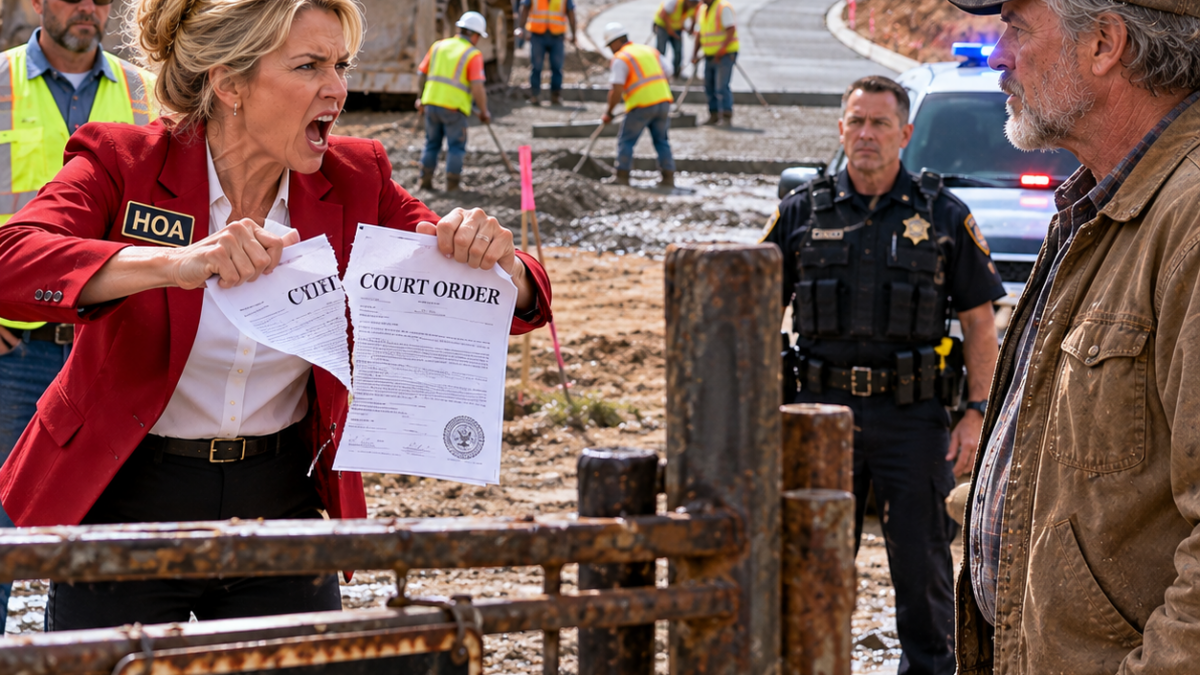
“That isn’t a dissolution.”
Veronica turned.
Looked at the posted notice.
Opened the clear weather cover.
Pulled it out.
Read the first page.
At 6:12 and eighteen seconds, she tore it in half.
Then again.
Dropped the pieces into the mud.
Pulled down the yellow boundary tape.
“There.”
She pointed toward the road.
“Now move.”
Travis stepped backward.
“Bellamy Civil is standing down.”
Veronica stared.
“Travis.”
“No.”
“We have a contract.”
“We also have a court order.”
She turned toward a smaller subcontractor.
Miguel Cruz.
Earthwork company.
“Start the dozer.”
Miguel looked at the torn paper.
“You told me this was cleared.”
“It will be cleared today.”
“Is it cleared now?”
“The association assumes responsibility.”
He hesitated.
Veronica said:
“Start the machine.”
At 6:18, the bulldozer crossed the marked line.
I watched from about seventy yards away.
Every instinct in my body told me to drive my truck down there.
Block it.
Stand in front.
Protect the land physically.
Instead, I put my phone on a tripod.
Hit record.
Reed later told me that restraint may have saved my case from becoming much messier.
Veronica needed me angry.
She needed an aggressive rancher confronting workers.
I gave her video.
At 6:26, Reed filed an emergency motion.
Still images from the camera.
My electronic declaration.
Copy of the injunction.
He served Paige through the court system.
At 6:41, Paige called Veronica.
Later, that call became part of the record because Paige’s advice was eventually put in issue.
“Stop work immediately.”
Veronica said Reed was bluffing.
Paige said:
“I have the filing in front of me.”
“The injunction remains active.”
“Did you remove the posted notice?”
“No.”
“It fell.”
At 6:48, Paige followed by email:
ALL CONSTRUCTION MUST CEASE IMMEDIATELY.
DO NOT ALTER OR REMOVE ANY COURT POSTING.
PRESERVE ALL COMMUNICATIONS AND SITE RECORDS.
Veronica replied:
NOTED.
Then kept going.
At 7:03, the first concrete entered forms inside the disputed corridor.
Travis meanwhile had sent Reed photographs of Bellamy Civil leaving.
He preserved screenshots.
One from Sunday night.
Veronica offering Bellamy Civil an additional $100,000 if concrete-base work was completed before noon.
Reed forwarded it to the judge.
At 7:32, Judge Whitam convened a telephone status conference.
Reed.
Paige.
Court clerk.
Paige confirmed her client had actual notice of the injunction.
Confirmed she had advised compliance.
Judge Whitam issued a supplemental enforcement order.
All work stop.
Sheriff authorized to enforce restricted corridor.
Neutral construction inspector appointed.
Project records preserved.
The order did not decide punishment.
It secured the scene and evidence pending a show-cause hearing.
At 8:14, Paige served Veronica by email and text.
A process server arrived at the gate and handed her a physical copy.
Veronica signed acknowledgement.
Then construction continued.
That detail mattered more than tearing the first copy.
People later asked why she would keep going after personal service.
The answer was simple.
She believed concrete changed the balance.
Every cubic yard poured made removal more expensive.
Every hour made settlement more practical.
She believed the violation could become too costly to undo.
At 8:37, Miguel Cruz shut down his bulldozer.
He had called his business attorney.
His attorney explained that Veronica’s promise to “assume responsibility” did not protect Miguel’s license.
Insurance.
Contract exposure.
Contempt risk.
Miguel walked to Veronica.
“We’re done.”
“You leave now, I will hold you responsible for delay.”
“Put it in writing.”
Then he moved his equipment out.
At 9:02, another grading contractor arrived.
Different county.
Veronica had told dispatch the first subcontractor suffered mechanical problems.
The new operator unloaded without seeing the torn injunction in the mud.
I photographed company name.
Sent it to Reed.
Reed called the dispatcher.
Gave case number.
Sixteen minutes later, operator climbed down.
Wouldn’t proceed.
Veronica was running out of people willing to believe her.
Concrete pump still operated.
Meanwhile, Brooke opened Paige’s compliance email sent to the board.
She saw my emergency filing.
Photos.
And Veronica’s reply.
NOTED.
Brooke called Paige.
“The board didn’t approve any of this.”
“Can you prove that?”
“I have signed minutes.”
“And the altered portal file.”
“Preserve both.”
Brooke hesitated.
“Are you representing Veronica?”
Paige answered:
“I represent Stonebridge Crest.”
Pause.
“Those interests may no longer be identical.”
That sentence told Brooke everything.
At 10:36, five vehicles from the Pine Ridge County Sheriff’s Office turned onto the access road.
No sirens.
No dramatic rush.
Civil enforcement does not usually look like television.
Deputy Everett Sloan stepped out holding a certified copy of Judge Whitam’s supplemental order.
Two other civil deputies.
Neutral construction inspector.
County evidence technician.
Everett walked to the concrete pump operator.
Handed him the order.
“Shut down safely.”
Operator looked at Veronica.
Everett said:
“The instruction comes from the court, not Ms. Ashford.”
Pump stopped.
Veronica walked toward him.
“This is private HOA construction.”
“Yes.”
“The sheriff has no authority to take over our project.”
“We are not taking over your project.”
Everett pointed toward my pasture.
“We are enforcing a district court order on Mr. Hollister’s property.”
“My attorney said this injunction was being dissolved.”
At that exact moment, Paige’s car pulled in.
She stepped out.
Phone in hand.
“I said no such thing.”
Everyone heard.
“I told you to stop.”
“Repeatedly.”
Veronica’s face changed.
Not because deputies threatened her.
They didn’t.
Because the last explanation disappeared in public.
Everett served the show-cause notice.
Court next morning.
Nine.
Veronica could retain separate counsel for contempt.
By 11:18, every machine was silent.
Inspector documented wet concrete.
Base material.
Disturbed ground.
Drainage trench.
Equipment positions.
The torn notice was collected.
Video files preserved.
I stayed outside the restricted corridor until the inspector released a safe path to my lower pasture.
Then I walked to Reed.
Looked at the concrete.
“Can they make me keep it?”
He watched the pump truck leave.
“No one can promise what a judge will ultimately order.”
“But?”
“Every yard they poured after notice made their argument worse.”
“Not better.”
“No.”
“They believed permanence helped them.”
“Yes.”
“Courts generally don’t reward a party for increasing the cost of correcting its own violation.”
That night I barely slept.
Not from fear.
Adrenaline.
Anger.
The image kept replaying.
Veronica tearing paper.
“There. Now move.”
As if removing the physical notice removed the judge.
At nine Tuesday morning, show-cause hearing began.
Veronica now had separate contempt counsel.
Paige appeared for the HOA.
That distinction alone changed the room.
Judge Whitam began with timeline.
Order issued.
Service.
Posting.
Actual knowledge.
Monday work.
She did not ask whether Veronica believed the injunction fair.
She asked:
“Did Ms. Ashford know it was active?”
Veronica’s attorney argued confusion.
Multiple contractors.
Expected emergency relief.
Ongoing legal challenge.
Judge turned to Paige.
“Did you tell Ms. Ashford the injunction was dissolved?”
“No.”
“Suspended?”
“No.”
“Likely to be suspended that morning?”
“No.”
“Did you advise continued work?”
“Absolutely not.”
Because that advice had become central, the HOA waived privilege narrowly as to compliance communications.
Paige submitted the 6:48 email.
Delivery confirmation.
Veronica’s reply.
NOTED.
One word.
Defense gone.
Travis testified.
Identified the video.
Confirmed Veronica read the posted injunction.
Confirmed she tore it.
Confirmed he refused to proceed.
Produced the $100,000 acceleration message.
Reed asked:
“Why did Bellamy Civil refuse?”
Travis answered:
“The restricted corridor was identified by survey coordinates.”
“There was no honest way for my company to say we didn’t understand where the order applied.”
Miguel Cruz testified next.
Said Veronica told him the order had been cleared.
He asked for documentation.
None provided.
His attorney told him to stop.
I testified for less than fifteen minutes.
Camera locations.
Timestamps.
Distance.
No edits.
Where I stood.
What I touched.
Nothing.
I did not call Veronica a liar.
Reed had warned me.
“The evidence gets stronger when you don’t decorate it.”
So I didn’t.
Then Brooke Danner came in.
Financial records.
She displayed signed minutes.
Then altered portal minutes.
Side by side.
Original:
No authorization.
Portal version:
Added line claiming unanimous approval for emergency infrastructure expenditures.
Created from Veronica’s account at 8:52 Sunday night.
Veronica’s attorney suggested assistant access.
Brooke produced login-security logs.
The edit was approved using a verification code sent to Veronica’s personal phone.
Then Brooke showed the $420,000 payment.
Invoice description:
ACCELERATED COMPLETION BONUS — EAST ACCESS CONCRETE BASE MILESTONE PRIOR TO 12:00 MONDAY.
Not emergency safety.
Not road stabilization.
Not storm protection.
Noon.
Judge Whitam looked toward Veronica.
“Why noon?”
Her attorney objected to forcing her to testify.
Judge didn’t compel it.
Reed called the lender’s representative by video.
Construction loan amendment.
If photographic proof showed east access concrete-base milestone by noon Monday, next draw proceeded.
If not:
Draw suspension possible.
Full risk review.
Interest reserve reconsideration.
Millions in financing suddenly uncertain.
There was the motive.
Veronica was not pouring concrete because children needed emergency access.
She needed one photograph before noon.
Then Reed introduced a memorandum from the county fire marshal.
Stonebridge had repeatedly described East Access as critical public-safety infrastructure.
But six weeks before construction, the fire marshal had concluded the existing west entrance met current emergency-access requirements during the next development phase.
Second gate:
Helpful.
Desirable.
Not county-mandated emergency infrastructure.
Then Paige supplied the last chain of documents.
After the title company said no Hollister easement could be verified, Paige had drafted a proposed offer to purchase access from me.
Veronica rejected sending it.
Email to developer:
DO NOT INVITE HIM TO PRICE LAND.
WE CAN ESTABLISH THROUGH USE.
ONCE ROAD IS OPERATING, REMOVAL WILL BE COMMERCIALLY IMPOSSIBLE.
Fifty-eight days before I found the stakes.
That sentence changed everything for me.
Until then, part of me still wondered whether Veronica simply kept making worse decisions after an initial mistake.
No.
Build first.
Create cost.
Use cost as pressure.
Then came the mislabeled easement.
The management company archive contained instructions from Veronica’s office to place my ranch address over the cover-page property reference so the contractor’s indexing system would associate the easement with East Access.
The legal description remained Parcel Fourteen.
Half a mile south.
Anyone competent who read it would know.
Judge Whitam listened.
No theatrical outrage.
That was more intimidating than yelling.
At the end, she found clear and convincing evidence of knowing violation of the preliminary injunction.
The immediate order was civil.
Purpose:
Stop.
Preserve.
Compensate for enforcement costs.
Stonebridge had to fund an independent engineering assessment.
Deposit estimated restoration costs into a court-controlled account.
Pay reasonable attorney and expert fees caused by the contempt violation, subject to review.
No construction in corridor.
No record alteration.
Veronica removed from compliance authority over the disputed site.
Future instructions had to go through counsel and the court monitor.
Then Stonebridge argued that removing partially completed roadwork would waste millions.
Judge Whitam answered with the sentence everybody later repeated:
“The association cannot manufacture hardship by violating an order and then offer that hardship as the reason the violation must remain.”
I did not ask the judge to bankrupt Stonebridge.
Reed asked what temporary relief I wanted.
“Safe access to my lower pasture.”
“Protection for the creek.”
“No further work until title is resolved.”
That was it.
Stonebridge had 252 homes planned after expansion.
Most residents had nothing to do with Veronica’s decisions.
I had no interest in punishing families because their HOA president lost perspective.
That afternoon, Stonebridge called an emergency board meeting.
Packed clubhouse.
People angry.
Confused.
Some still believed I was extorting the neighborhood.
Brooke presented documents.
Title warning.
Certified survey.
Altered minutes.
$420,000 acceleration payment.
Contempt findings.
One homeowner asked:
“Did Grant ask for money?”
Brooke answered:
“No.”
Another:
“Did we have an easement?”
“Independent review says no.”
Veronica stood.
“This is exactly what he wanted.”
Carol Jensen, a board member who had served beside her four years, interrupted.
“No.”
Veronica turned.
Carol continued.
“He didn’t alter our minutes.”
“He didn’t ignore our lawyer.”
“He didn’t spend four hundred twenty thousand dollars without a vote.”
“He didn’t pour concrete onto somebody else’s deed.”
Then:
“We did that.”
She paused.
“Or you did it in our name.”
Silence.
The board voted to remove Veronica as president.
Her project authority suspended pending audit.
Brooke became interim president.
She accepted on one condition.
Any emergency expenditure above a specified amount required two officer approvals and disclosure to homeowners within seventy-two hours.
Paige advised the association to stop defending a corridor its own title insurer would not insure.
New independent title review.
New independent survey.
Same answer Russell gave on day one.
No Stonebridge easement.
No right across my ranch.
The association stipulated to the boundary.
Released access claims.
Agreed to permanent injunction.
That avoided months of trial.
The contempt consequences remained.
Independent engineer measured what had entered my land.
One hundred forty-six cubic yards of concrete and compacted base.
Drainage pipe.
Trench.
Imported aggregate.
Soil compaction.
Runoff redirected toward my creek.
Slope stabilization needed before summer storms.
Restoration plan was detailed.
Saw-cut concrete.
Remove every section.
Excavate imported base.
Pull drainage pipe.
Restore grade.
Replace native topsoil.
Reseed pasture.
Stabilize creek buffer.
Inspect after first two major rain events.
Bellamy Civil received part of the restoration contract.
I agreed.
Travis had stopped when warned.
Preserved records.
Refused the injunction violation.
Miguel Cruz’s company helped remove equipment.
Same reason.
Six weeks after Veronica said the road would become permanent by noon, excavators returned.
This time to take it apart.
I stood behind the temporary fence.
Steel bucket hooked under a concrete section.
Lifted.
Cracked.
Loaded into truck.
Another section.
Another.
There was some satisfaction.
I’m not going to lie.
Watching something “commercially impossible” to remove leave my land in dump trucks was satisfying.
But mostly I felt tired.
That road had occupied months of my life.
My pasture.
My sleep.
My attorney bills.
My attention.
Every conversation had become evidence.
Every truck made me look toward the gate.
I wanted normal back.
Restoration took weeks.
Concrete gone.
Base gone.
Drainage corrected.
Topsoil replaced.
Seeded.
Fence rebuilt.
Not on the legal boundary.
Several feet inside, where I wanted it.
A ranch fence does not have to sit exactly on a deed line to define ownership.
It just needs people not to confuse livestock control with title.
Russell reset the disturbed monument.
Recorded updated certificate.
Installed a visible witness marker.
No ambiguity.
Final contempt order came later.
Stonebridge responsible for property restoration.
Reasonable enforcement-related attorney and expert costs.
Veronica received separate monetary sanctions tied to conduct personally attributed to her.
I’m not going to invent numbers beyond what the final orders said.
She did not go to prison.
No dramatic handcuffs.
This remained largely civil enforcement.
The HOA faced a special assessment.
That was painful.
Brooke published every figure.
Held open meetings.
Explained exactly why.
People were angry.
Some at Veronica.
Some at the developer.
Some at the board.
A few at me.
That happens.
One man told me at a gas station:
“You could’ve just sold them the strip.”
“I could’ve.”
“Saved us all money.”
“Maybe.”
“You didn’t even use it.”
“There are cattle on it.”
“You know what I mean.”
“Yes.”
I looked at him.
“If it had been your backyard, would you sell because they paved first?”
He didn’t answer.
Later, several Stonebridge homeowners came to my gate.
Not as a group.
One by one.
Apologies.
I told most of them they didn’t owe me one.
They hadn’t moved the pin.
Hadn’t relabeled the easement.
Hadn’t ignored the injunction.
A few residents volunteered when we replanted several windbreak trees damaged near the construction entrance.
I accepted.
That mattered to me.
Because Stonebridge Crest was never one villainous neighborhood.
It was a lot of ordinary people trusting leadership.
That distinction is important.
Power gets dangerous when oversight becomes social trust without verification.
Brooke told me something months later.
“Veronica was always the person who knew everything.”
“What do you mean?”
“Contract status.”
“Permits.”
“Budgets.”
“Deadlines.”
“Lawyer calls.”
“She centralized everything.”
“Why?”
“Because she was good at it.”
“And?”
“And eventually nobody checked.”
That was the real governance failure.
Veronica could add a sentence to board minutes because everyone assumed she handled minutes correctly.
She could tell Travis the board accepted title risk because nobody expected a president to invent board approval.
She could characterize legal counsel as comfortable because directors did not ask to see Paige’s actual email.
People thought checking her work would be insulting.
Trust without audit feels polite.
Until it becomes expensive.
Three months after the first stake appeared, Deputy Everett Sloan came back to my gate.
No court emergency.
No construction crew.
He handed me a filed notice closing the immediate enforcement phase.
I looked across the reseeded corridor.
“That’s really it?”
He smiled.
“That’s what enforcement usually looks like after people start obeying the order.”
“Less exciting.”
“Usually good.”
Russell installed final survey cap.
I put in a cedar gate several feet inside my line.
Small metal sign:
PRIVATE PROPERTY
ACCESS BY WRITTEN PERMISSION ONLY
No threats.
No cameras drawn on it.
Just plain language.
I kept a copy of Judge Whitam’s original injunction in my office.
Not framed.
Not displayed.
In a file cabinet.
Reed asked why.
“Reminder.”
“Of what?”
“That not losing your temper is expensive too.”
He laughed.
But I meant it.
There were moments I wanted to drag equipment off my land.
Block trucks.
Cut fuel lines.
Stand in front of a bulldozer.
Any of that would have felt satisfying for five minutes.
Then Veronica’s lawyer would have had photographs of an angry rancher interfering with an $11.4 million community project.
Instead, my cameras showed machinery crossing my land.
My emails showed notice.
My survey showed line.
Their records showed decisions.
My restraint kept the story clean.
That was harder than being angry.
People tell me the most shocking part is Veronica tearing down the court notice.
It is dramatic.
Red blazer.
Fog.
Concrete trucks.
Paper in mud.
“There. Now move.”
But honestly, that wasn’t the worst decision.
By Monday morning, Veronica had already built a structure in her head that made tearing that notice feel logical.
She believed:
The road was necessary.
The financing deadline mattered.
The project was too large to reverse.
I was unreasonable.
The land was underused.
The easement could be “established.”
The board would support completion if enough money was already spent.
The lender would keep funding if the milestone was hit.
The court order was temporary.
Her lawyer could fix it later.
Each statement made the next one easier.
By the time she ripped the page, she was not thinking:
I am defying a judge.
She was thinking:
I am protecting the project from delay.
That is how people cross lines they once would have recognized.
Not usually in one leap.
One justification at a time.
I saw Veronica once after everything ended.
Almost a year later.
Hardware store in Mill Haven.
I was buying fencing staples.
She was near the paint section.
We saw each other.
For a moment, I considered walking the other way.
She came over.
“Grant.”
“Veronica.”
She looked different.
No red blazer.
Jeans.
Sweater.
Tired.
“I owe you an apology.”
I said nothing.
Not to punish her.
I simply didn’t know what I was supposed to do with that yet.
She continued.
“I convinced myself you would eventually sell.”
“I told you no.”
“I know.”
“You knew before construction.”
“Yes.”
“Title company told you.”
“Yes.”
“You knew the easement didn’t match.”
She looked down.
“Eventually.”
“You changed the cover page.”
Her face tightened.
“I told management to index the document to the project address.”
“The legal description was still Parcel Fourteen.”
“Yes.”
“Why?”
She breathed out.
“Because if we stopped to resolve ownership, we missed financing.”
“That’s not an answer.”
“It is.”
“No.”
I looked at her.
“Why did missing financing mean my deed stopped mattering?”
She didn’t respond immediately.
Finally:
“It didn’t.”
“No.”
“It just felt like every option was closing.”
“Buying an easement was an option.”
“You said you wouldn’t sell.”
“You never asked.”
That hit her.
Paige had drafted an offer.
Veronica had refused to send it.
“Why didn’t you?”
She looked toward the shelves.
“Because I thought asking gave you leverage.”
I almost laughed.
“I owned the land.”
“You already had leverage.”
“I know that now.”
“What did you think then?”
“That once the road was functioning, everyone would see removing it made no sense.”
“So build first.”
“Yes.”
“Make correction expensive.”
She nodded.
That honesty surprised me.
“And the court order?”
Her face changed.
“I panicked.”
“You tore it in half.”
“I know.”
“You kept pouring after Paige told you to stop.”
“I know.”
“After the second order.”
“I know.”
“Why?”
“The lender deadline.”
“No.”
She looked up.
“No?”
“That explains noon.”
“It doesn’t explain why you thought your financing problem mattered more than a judge.”
Silence.
Then she said:
“Because by then the project felt like me.”
I understood that more than I wanted to.
“If it failed, I failed.”
“Yes.”
“So every obstacle became personal.”
“Yes.”
“And you thought I was trying to defeat you.”
“Yes.”
“I was trying to keep my ranch.”
She closed her eyes briefly.
“I know.”
The hardware store speaker announced something about lawn fertilizer.
Ridiculous ordinary moment.
Then Veronica said:
“I am sorry.”
I believed her.
That didn’t undo anything.
But I believed her.
“Okay.”
“That’s all?”
“What do you want?”
“I don’t know.”
“Neither do I.”
She smiled weakly.
Then:
“Did the grass come back?”
That surprised me.
“Mostly.”
“The creek?”
“Fine.”
“I’m glad.”
“Me too.”
We nodded.
Walked away.
No reconciliation.
No friendship.
No reason for one.
But I was glad she eventually understood the dispute had never been about humiliating her.
Stonebridge eventually completed the expansion.
Different east-access plan.
More expensive.
Longer route.
Entirely on land they actually controlled.
Imagine that.
The west entrance remained primary during part of construction.
No emergency occurred.
Fire trucks still reached the neighborhood.
Luxury lots sold.
Maybe slower than planned.
Maybe financing cost more.
Life continued.
The development company survived.
HOA survived.
Residents survived.
My cattle were especially unimpressed.
The pasture where the road had been became green again.
First spring, seed came in patchy.
Second, better.
The restored soil settled differently.
You can still see the corridor if you know what to look for.
Grass color shifts.
A subtle line.
Scars do that.
They become less obvious.
Not nonexistent.
One morning, I walked down after rain.
Creek running clear.
No redirected drainage.
Fence solid.
New survey cap visible.
I thought about my father.
He used to tell me fences were mostly agreements between people who might forget why they were built.
“Never trust a fence more than a deed,” he said.
At the time I thought that was overly cautious.
He had watched neighbors move gates.
Ranches split.
Old handshakes die with the men who made them.
He understood.
A visible line can feel more real than a legal one.
That’s why the false pin bothered me so much.
Somebody had tried to make appearance replace record.
Three feet.
That’s all.
New pin.
Orange paint.
Old monument flattened.
If Russell had been lazy, maybe that three feet would have been accepted.
Then another map.
Then another project.
Then ten years later somebody would say:
“But this has always been the boundary.”
That is how property history gets rewritten.
Not always through forged deeds.
Sometimes through people being too tired to challenge the new marker.
I was fortunate.
I knew what to check.
I could afford Reed.
I had cameras.
Russell knew the land.
Travis had professional standards.
Brooke kept records.
Paige eventually protected the association instead of one officer.
Everett enforced exactly what the judge ordered and nothing more.
The system worked because enough individuals refused to bend their role.
That matters.
People like telling these stories as if one powerful hero beats a corrupt machine.
That isn’t what happened.
I had a deed.
Russell had a survey license.
Reed had legal knowledge.
Travis had a contractor’s obligation.
Brooke had fiduciary responsibilities.
Paige had ethics.
Judge Whitam had authority.
Everett had an order.
Each person did one part.
Veronica’s biggest mistake was assuming all those separate responsibilities would bend toward the largest amount of money already spent.
They didn’t.
Money has influence.
It does not alter coordinates.
$11.4 million sounds enormous.
It was.
But no number on a project sign moved my boundary sixty-three feet east.
The road could cost eleven million.
Or a hundred million.
Same deed.
Same monument.
Same answer.
One of Stonebridge’s residents eventually asked me something I still think about.
“If Veronica had offered you a million dollars before construction, would you have sold?”
I told him:
“I don’t know.”
He seemed surprised.
“Seriously?”
“Seriously.”
“Why not?”
“Because that would’ve been a real choice.”
That was the difference.
A legitimate offer lets an owner decide.
Maybe price matters.
Maybe sentimental attachment matters.
Maybe ranch operations matter.
Maybe the answer is still no.
But the owner gets to decide before the bulldozer.
Veronica wanted to eliminate my ability to decide by changing the economics first.
Build.
Pour.
Finance.
Create expectations.
Then come to me and say:
Look how expensive your no is.
That was the heart of it.
Not an easement.
Not a road.
Consent.
She wanted cost to substitute for consent.
Judge Whitam’s contempt ruling rejected exactly that.
You cannot manufacture hardship through violation and then use the hardship as your defense.
I wish more people understood how broadly that principle applies.
Build the fence first.
Move the boundary later.
Spend the money first.
Ask approval later.
Publish the promise first.
Pressure the other person afterward.
The strategy works often enough that people keep trying it.
It works when the other person gets tired.
Or intimidated.
Or thinks opposing something already underway will make them look unreasonable.
I almost felt unreasonable myself.
Standing in front of an $11.4 million rendering saying:
No.
A road versus grass.
One hundred eighty future homeowners versus cattle.
Security gate versus old fence.
That framing makes you question yourself.
Then I would open the deed.
Look at the coordinates.
And remember:
Scale does not create entitlement.
One hundred eighty homeowners do not collectively gain rights one homeowner would not have individually.
A large project is still required to fit on land the project controls.
That is not hostility.
That is planning.
Stonebridge’s new leadership became almost obsessive about documentation.
Brooke once joked that every board meeting now needed seventeen signatures to order paper towels.
I told her:
“Good.”
She rolled her eyes.
They adopted policies.
No capital construction before title review.
Independent survey required for boundary-adjacent work.
Two-officer approval for emergency expenditures above threshold.
Portal minutes locked after secretary certification.
Revisions require visible amendment history.
Outside counsel receives board communications directly.
Management accounts use unique credentials.
No more shared project logins.
Again, obvious afterward.
Expensive lessons often produce obvious policies.
Travis Bellamy and I stayed in occasional contact.
A year later, Bellamy Civil worked on a county bridge project near the ranch.
He stopped by.
We stood at the gate.
He pointed toward the restored pasture.
“Looks better.”
“Getting there.”
“I’ve thought about that Monday a lot.”
“Which part?”
“When she tore the order.”
“So have I.”
“I almost stayed.”
That surprised me.
“What?”
“My contract was eleven figures in headaches.”
“You mean millions.”
“You know what I mean.”
He laughed.
“I thought maybe the association really had emergency relief coming.”
“What stopped you?”
He looked at me.
“The paper had a judge’s signature.”
Simple.
“That’s it?”
“Pretty much.”
Then:
“I build roads.”
“I don’t get to decide court orders are inconvenient.”
That’s professionalism.
Not dramatic.
Just knowing where your authority ends.
Miguel Cruz sent me a Christmas card once.
No idea why.
Inside he wrote:
THANKS FOR NOT PARKING YOUR TRUCK IN FRONT OF MY DOZER.
I laughed.
That morning I had wanted to.
Badly.
Restraint does not feel noble while you’re doing it.
It feels like swallowing anger.
You rarely know in the moment whether patience will help or simply let someone damage more.
I trusted Reed.
Trusted cameras.
Trusted court.
That was not easy at 6:18 when steel tracks crossed my pasture.
But if I had driven down and blocked Miguel, Veronica might have gotten exactly the confrontation she wanted.
Instead, she supplied the confrontation herself.
With paper.
Camera.
Email.
Her own account.
Her own phone.
Her own words.
Centralized control made her powerful.
Then it made the evidence simple.
One login.
One initials set.
One phone verification.
One approval trail.
Every shortcut pointed back the same direction.
There is an irony there.
People who crave control often create excellent records of control.
They want authority traceable when things succeed.
Then suddenly find that traceability inconvenient when things fail.
Brooke once showed me the audit summary.
Veronica had approved hundreds of legitimate decisions over her tenure.
Landscaping.
Security contracts.
Clubhouse repairs.
Snow removal.
Insurance.
Most were perfectly proper.
That matters too.
She was not a cartoon villain plotting trespass from the day she took office.
She was a capable person whose confidence outgrew accountability.
That is more common.
And more dangerous.
Because capable people get trusted longer.
A fool who makes one obvious mistake gets stopped.
A successful leader who has been right twenty times may get twenty-first mistake waved through because everybody assumes she still knows something they don’t.
Stonebridge’s board did that.
Brooke told me:
“When I asked about the easement, she answered so quickly I felt stupid asking.”
That sentence stuck with me.
Authority can make other people embarrassed to verify.
Good leaders should make verification easier, not socially expensive.
Years after this, if someone asks what I learned, I don’t say “never trust an HOA.”
That would be lazy.
Stonebridge residents eventually fixed their governance.
Most acted decently when they saw the records.
I don’t say “always sue.”
Court was expensive.
Slow.
Stressful.
We used it because construction continued after evidence.
I don’t even say “never compromise.”
Compromise is useful when both sides still respect each other’s right to choose.
What I learned was narrower.
If somebody is rushing you because making something permanent will weaken your ability to object, slow down.
If they say:
We already spent the money.
Ask why they spent it before permission.
If they say:
Everyone expects this.
Ask who promised it.
If they say:
The project is too far along.
Ask who chose to keep going after the dispute started.
If they say:
The paperwork is just technical.
Read the paperwork.
And if somebody tells you a road is permanent because the concrete is wet, remember that concrete can be cut.
Loaded.
Removed.
A deed is harder to move.
Last summer, I took my grandson down to the southeast pasture.
He was nine.
We checked fence.
He saw the survey marker.
“What’s that?”
“Property corner.”
“Why is it metal?”
“So it stays.”
“Forever?”
“Nothing stays forever.”
I pointed.
“But long enough.”
Then he saw the slight grass line where the road had been.
“What happened there?”
I told him people built something where they shouldn’t have.
He asked:
“Why?”
I considered giving him the whole story.
Fake easement.
Title insurance.
Financing.
Injunction.
Concrete.
Too much.
So I said:
“They thought if they did it fast enough, nobody could make them undo it.”
He looked at the pasture.
“But they undid it.”
“Yes.”
“Because you told them?”
“No.”
“Because the judge did?”
“Partly.”
He thought.
“Because it wasn’t theirs?”
I smiled.
“That’s the important part.”
We walked toward the creek.
Cattle followed at a distance.
The windbreak my father planted was still along the ridge.
Gate where I wanted it.
Survey marker visible.
No road.
If you didn’t know the story, you would never guess that one Monday morning concrete trucks lined up there while an HOA president tore a court order in half and announced that by noon everything would be permanent.
Nothing about that morning became permanent.
Not the concrete.
Not the false boundary.
Not Veronica’s presidency.
Not the altered minutes.
Not the claimed easement.
The only things that remained were the records.
The restored land.
And one lesson I keep closer than the injunction in my filing cabinet.
Authority is not the same thing as ownership.
Money is not the same thing as permission.
And permanent is a dangerous word to use when the land beneath your project belongs to somebody else.








