HOA Built 109 Luxury Cabins Worth $12 Million Around My Private Lake While I Was Away—Then Their President Threatened to Bury Me in Court. He Had No Idea I Controlled the Dam.
PART2:
“You were warned about the continuing commercial use of your residence.”
“My appeal is still pending.”
“The board has broad authority to preserve community standards.”
“The board voted last week that you don’t have enforcement authority while your eligibility is under review.”
Her voice sharpened instantly.
“Don’t lecture me about HOA procedure.”
“I’m not lecturing you. I’m reminding you.”
“Marcus, this neighborhood existed long before you arrived.”
“And?”
“And some people move into communities like Willowbrook and think they can do whatever they want because they paid for a house.”
I almost smiled.
That sentence was remarkable coming from a woman who had spent months behaving as though buying the biggest house in the subdivision had made her mayor, judge, police chief, and queen.
She continued.
“You’ve turned your property into a business depot. Trucks coming and going. Strangers parking outside. Equipment being loaded. You’ve ignored repeated instructions.”
“They aren’t instructions. They’re threats.”
“You can call them whatever you want. Those barriers remain until you agree to comply.”
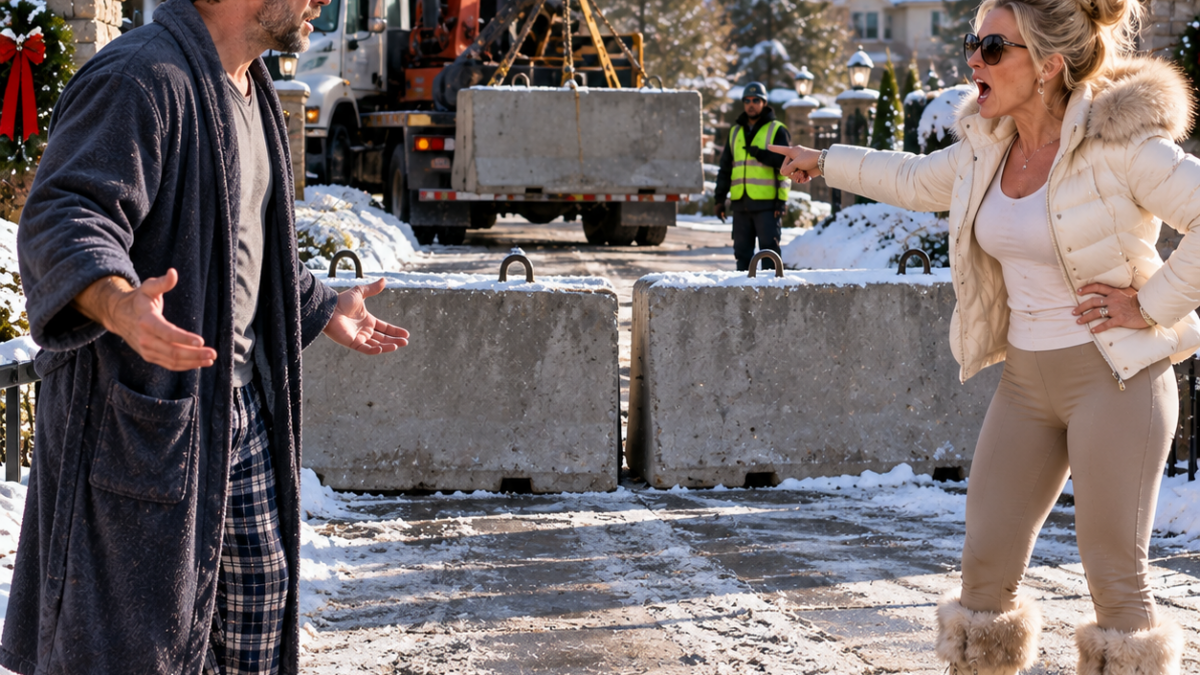
I looked again at the concrete blocks.
“Did you authorize this?”
PART3:
“The association authorized corrective action.”
“That’s not what I asked.”
Another pause.
“You should focus less on technicalities and more on fitting into the neighborhood.”
There it was.
That tone.
The same one she’d used the first day I met her.
The tone people use when they think they’re talking to someone beneath them.
“Let me make sure I understand,” I said. “You’re telling me those blocks stay there until I shut down my legal home-based consulting business.”
“I’m telling you that actions have consequences.”
“Good.”
She hesitated.
“What does that mean?”
“It means we finally agree on something.”
I ended the call.
Then I called a man I hadn’t spoken to in almost eight months.
He answered on the fourth ring.
“Rivera, if this is another invitation to help you move furniture, I’m hanging up.”
“Morning, Hawk.”
Caleb Mercer had spent fourteen years as a combat engineer before retiring and starting a commercial concrete and structural-landscaping company south of Denver.
We had served together in Afghanistan.
People called him Hawk because his last name wasn’t remotely bird-related and Army nicknames rarely make sense to anyone who wasn’t present when they happened.
He was forty-seven now.
Six foot three.
Bald.
Built like somebody had stacked landscaping blocks inside a flannel shirt.
“What’d you break?” he asked.
“Nothing.”
“Then why are you calling before sunrise?”
“My HOA blocked my driveway.”
“With what?”
“Concrete.”
Pause.
“What kind?”
“Jersey barriers.”
“How many?”
“Three.”
Another pause.
“Marcus.”
“Yeah?”
“Did you finally annoy suburban people enough that they fortified your house?”
“Apparently.”
He laughed.
I waited.
“Send a picture.”
I did.
His laughter stopped.
“Those aren’t decorative barriers.”
“I know.”
“Each one is probably nineteen hundred pounds.”
“Close.”
“Who set them?”
“Contractor.”
“Authorized?”
“HOA president claims she did.”
“Your driveway private?”
“Yes.”
“Street?”
“HOA-maintained private road.”
“Property line?”
“Starts seven feet back from curb.”
“And barriers?”
“Inside my property line.”
That changed his voice.
“Survey?”
“Have one.”
“Good.”
“Why good?”
“Because people who weaponize concrete should respect surveying.”
I smiled for the first time that morning.
“Hawk.”
“Yeah?”
“Remember the drainage strip behind my lot?”
“The ugly ditch?”
“Seasonal drainage easement.”
“County?”
“County stormwater.”
“Beyond it?”
“Old county service road.”
He went quiet.
When Caleb Mercer went quiet, something was being engineered.
“Marcus.”
“Yes?”
“You still have frontage on that service road?”
“Technically the back property line touches it for about eighty feet.”
“Fence?”
“My fence.”
“HOA land between?”
“No.”
“Utility corridor?”
“No.”
“Elevation difference?”
“Maybe four feet.”
“How wide’s the ditch?”
“Eleven feet at top.”
He breathed out slowly.
“You have plans today?”
“Had.”
“Cancel them.”
“For what?”
“We’re going to the county.”
That sentence was the beginning.
But to understand why Delilah was willing to park six thousand pounds of concrete across my driveway, you have to understand what she thought I had done wrong.
I moved into Willowbrook Heights thirteen months earlier.
I was forty-five.
Divorced.
No children at home.
No dramatic fresh-start story.
My marriage had ended six years earlier with less hostility than exhaustion.
My ex-wife, Rachel, lived in Colorado Springs and taught middle school.
We still exchanged birthday texts.
Occasionally complained to each other about insurance.
Two people can fail at marriage without becoming enemies.
After leaving the Army, I worked seven years for a national logistics company before starting my own consulting firm.
Rivera Resilience Group.
The name sounded larger than it was.
Most days, “group” meant me, a laptop, and a German shepherd named Max sleeping beneath my desk.
I advised utility companies, warehouses, construction firms, and municipalities on emergency logistics.
Supply-chain continuity.
Fleet routing.
Disaster response.
Fuel planning.
The exact sort of work people forget exists until a hurricane closes three highways and someone needs twenty generators moved overnight.
I chose Willowbrook because the house had two things I wanted.
A detached three-car garage.
And an unfinished basement.
The basement became my office.
The garage held my pickup, a utility trailer, emergency demonstration equipment, and more shelving than any single man had a reasonable excuse to own.
My business license allowed a home occupation.
County zoning allowed consulting services.
HOA covenants allowed home offices as long as they didn’t generate “substantial customer traffic, nuisance activity, exterior commercial storage, or material disruption to residential character.”
I had one employee who worked remotely from Fort Collins.
Clients almost never came to my home.
Maybe twice a month.
My truck had a discreet company logo.
My enclosed trailer had none.
I received packages.
So did everybody else.
It was boring.
Delilah disagreed.
She introduced herself three days after I moved in.
I was replacing a garage shelf when a shadow appeared in the open door.
“Marcus Rivera?”
I turned.
Woman in her mid-fifties.
Perfect blond bob.
White winter coat despite there being no snow.
Large sunglasses.
Clipboard.
“Yes.”
“Delilah Thornberry.”
“Nice to meet you.”
“President of the Willowbrook Heights Homeowners Association.”
“Ah.”
She looked at the shelving.
“Moving in?”
“Trying.”
Her eyes went to a stack of hard cases near the wall.
“What are those?”
“Training equipment.”
“For?”
“Work.”
She smiled.
“What kind of work?”
“Emergency logistics consulting.”
The smile changed.
“From the house?”
“Mostly.”
She looked toward my truck.
“Commercial business?”
“Home office.”
“Our covenants have restrictions.”
“I read them.”
That answer bothered her.
People like Delilah prefer newcomers who haven’t read things.
She stepped closer to the garage threshold but did not enter.
“Will clients be coming here?”
“Rarely.”
“Employees?”
“No.”
“Deliveries?”
“UPS likes me.”
She didn’t laugh.
“If there are complaints, the board will review.”
“Sure.”
“Willowbrook is residential.”
“So is my house.”
I thought that was the conversation.
It became the first entry in a seven-month campaign.
The first violation notice accused me of “commercial vehicle storage.”
The vehicle was my Ford F-250.
One truck.
Registered personally.
Parked inside my garage most nights.
The commercial offense was apparently the twelve-inch Rivera Resilience Group logo on the rear quarter panel.
I appealed.
Board dismissed it.
Then came “excessive delivery activity.”
Evidence:
Three FedEx deliveries in one week.
One was dog food.
One was printer toner.
One was a Christmas gift from my sister.
I appealed.
Dismissed.
Then:
“Client parking creating roadway congestion.”
Photograph showed two pickups in my driveway.
One belonged to Hawk.
The other belonged to my brother Luis.
We were watching football.
Dismissed.
That should have embarrassed Delilah.
Instead it made her more determined.
She started photographing my house.
Not secretly.
Standing on the sidewalk.
Phone raised.
Sometimes at seven in the morning.
Sometimes after dark.
I installed cameras.
Not because I feared her.
Because I had spent twenty-one years around logistics and learned that memory is a terrible evidence-management system.
Then the first driveway blockade happened.
That one used orange cones.
Twelve of them.
Placed across my driveway before a Saturday HOA inspection.
I moved them.
Delilah emailed:
Unauthorized removal of association traffic-control devices will result in enforcement.
I responded:
Do not place association property on my lot without permission.
She replied:
Your refusal to cooperate is noted.
I saved it.
Second blockade came five weeks later.
Plastic water-filled barriers.
Bright orange.
She had them placed partly across my driveway during what she called “commercial-traffic observation.”
I came home from Costco and found the entrance narrowed to six feet.
I moved them with my tractor.
That earned me a $500 fine for “interference with safety equipment.”
The board overturned it 3-2.
The vote mattered.
Until then, Delilah controlled the board easily.
Vice president Samuel Cho rarely argued.
Treasurer Helen Davenport liked Delilah personally.
Secretary Curtis Bell attended meetings mostly through Zoom.
But the repeated cases against me made them uncomfortable.
Then another homeowner, Priya Shah, discovered Delilah had fined her for operating a “commercial catering business” because Priya occasionally baked wedding cakes for friends.
Then Tom Kelley got a violation because his plumbing van was parked in his driveway overnight.
He owned the plumbing company.
He also owned the house.
Then retired accountant Ed Kowalski was cited because he did tax returns from a desk in his spare bedroom.
The pattern became obvious.
Delilah had decided “residential character” meant nobody could earn money within sight of her.
At the November board meeting, forty-two homeowners attended.
Normal attendance was nine.
Priya spoke first.
Then Tom.
Then Ed.
Then me.
I kept my remarks simple.
“I am asking the board to stop enforcing rules that don’t exist.”
Delilah interrupted.
“The rules exist.”
“Show me where a home consulting office is prohibited.”
“The nuisance provision.”
“What nuisance?”
“Commercial traffic.”
“How many client visits did I have last month?”
She didn’t know.
“Four.”
I continued.
“How many Amazon deliveries came to your house last month?”
People laughed.
Delilah’s face changed.
“This isn’t about me.”
“It becomes about you when you define three packages as industrial activity.”
Samuel Cho asked the HOA attorney for an opinion.
That was the beginning of the end of Delilah’s certainty.
The attorney, a tired man named Paul Reddick, read the covenants.
Then said:
“Home occupations are not categorically prohibited.”
Delilah stared at him.
Paul continued.
“To impose penalties, the association would need evidence that Mr. Rivera’s use materially violates the nuisance or commercial-activity provisions.”
“Which it does.”
Paul looked at her.
“What evidence?”
Silence.
That was the first board meeting where Delilah lost a vote.
All pending fines against me were suspended.
Then Samuel raised something nobody expected.
“There’s also an eligibility issue.”
Delilah’s head snapped around.
“What eligibility issue?”
Samuel had been reviewing corporate records.
Willowbrook bylaws required each director to be an individual member of the association who was also the record owner of a lot or the spouse of the record owner.
Delilah’s house had been transferred two years earlier into Thornberry Residential Holdings LLC.
Not a trust.
Not a personal title.
An LLC.
Delilah wasn’t individually listed.
Neither was her husband.
Depending on interpretation, she might no longer qualify as a director.
Paul Reddick did not make an immediate ruling.
He said it required review.
The board voted 3-2 that Delilah should not initiate new enforcement actions until counsel confirmed eligibility.
Delilah voted against.
So did Helen.
She lost.
That meeting ended at 9:48 p.m.
At 5:52 the next morning, the concrete barriers arrived.
That is why I called Hawk.
By seven-thirty, I had called the sheriff too.
Deputy Alicia Benton arrived.
She took photographs.
Viewed my survey.
Confirmed the barriers sat approximately three feet inside my parcel.
Then called Delilah.
I heard only Alicia’s half.
“Ma’am, did you authorize placement?”
Pause.
“No, I’m asking specifically whether you ordered the contractor.”
Longer pause.
“I understand your position.”
Then:
“No, an HOA enforcement dispute does not automatically create authority to obstruct ingress and egress to privately owned property.”
That sentence made my morning.
Alicia ended the call.
“This is probably partly civil.”
“Of course.”
“But blocking vehicle access could create other issues depending on emergency access and intent.”
“Can I move them?”
“You own the land.”
“How?”
She looked at six thousand pounds of concrete.
“That part is above my pay grade.”
Hawk arrived at eight-fifteen in a muddy Ram truck.
He stepped out holding coffee.
Looked at the barriers.
Then at me.
“Impressive.”
“Thank you.”
“Your neighborhood has upgraded from passive aggression to fortification.”
“I called you for emotional support.”
“You called the wrong veteran.”
He walked the driveway.
Measured.
Photographed.
Found tire impressions from the delivery truck.
Then stood beside the barrier closest to the curb.
“Know the contractor?”
“No.”
He scraped mud from a small sticker.
Front Range Barrier & Traffic LLC.
Hawk took a picture.
“I know them.”
“Good?”
“Legitimate.”
“That’s good.”
“Also expensive.”
“How expensive?”
“To mobilize a loader, three barriers, early-morning placement?”
“Maybe fifteen hundred.”
“For this?”
“Somebody paid extra.”
We drove to county planning.
By ten-thirty, Hawk had sketched what he wanted.
My property was unusual.
The house faced Willowbrook Boulevard.
Behind it, the lot dropped gently toward a stormwater drainage channel running along my rear line.
Beyond that sat an old county maintenance road.
Technically public right-of-way.
Rarely used.
Originally built when the area was farmland.
As Willowbrook developed, most homeowners fenced their rear yards and ignored it.
My parcel retained direct frontage because its original legal description predated the subdivision.
Hawk’s idea was simple.
Bridge the drainage swale with a permitted culvert and reinforced concrete apron.
Build a twelve-foot-wide all-weather access lane from my rear garage pad to the county service road.
Essentially a second driveway.
County land-use technician studied the plat.
“You want a residential secondary access?”
“Yes.”
“Why?”
I put photographs of the barriers on her desk.
She stared.
“That’ll do it.”
Her name was Monica Fields.
She called stormwater.
Then transportation.
Then fire prevention.
That last one changed everything.
Because my house sat more than one hundred fifty feet from Willowbrook Boulevard.
Under current fire-code standards, if the property were being newly developed, apparatus access would likely require a turnaround or secondary configuration.
The house was grandfathered.
But a new permitted rear access could be designed to fire-apparatus standards.
Hawk leaned toward me.
I knew that expression.
“Marcus.”
“No.”
“You don’t even know what I’m going to say.”
“Yes, I do.”
Monica looked between us.
Hawk smiled.
“If we’re pouring it anyway, build it to emergency-load rating.”
Monica nodded.
“Would simplify fire review.”
“How thick?”
“Engineer decides.”
Hawk looked delighted.
Combat engineers are happiest when civilians accidentally authorize overbuilding.
By three that afternoon, I had filed applications for:
Secondary residential access.
Stormwater crossing.
Culvert installation.
Concrete apron.
Fire-apparatus-rated turnaround.
Hawk’s engineer, Denise Yamaguchi, began drawings that evening.
I asked:
“How fast can this happen legally?”
Monica said:
“Legally?”
“Yes.”
She smiled.
“I like that qualification.”
“People in my neighborhood are creative.”
She reviewed the barrier photographs again.
“We can prioritize emergency-access review.”
By Wednesday morning, the sheriff had encouraged Delilah’s contractor to retrieve the barriers while the property dispute was reviewed.
The contractor arrived.
Delilah arrived too.
She stood on the sidewalk while a loader lifted each block.
I stood on my porch drinking coffee.
She saw me.
“Enjoy it.”
“Enjoy what?”
“This little performance.”
“I’m drinking coffee.”
“You think police involvement gives you permission to ignore the covenants.”
“No.”
“I think the covenants give me permission to follow the covenants.”
She stepped closer to my property line.
“You are not going to turn this neighborhood into an industrial park.”
I looked behind me at my house.
No forklifts.
No loading docks.
Max was peeing on a shrub.
“Delilah.”
“What?”
“You know the board told you to stop enforcement.”
“The board cannot strip the president of her statutory responsibility.”
“Which statute?”
She didn’t answer.
“You also know your director eligibility is under review.”
Her face hardened.
“I own my home.”
“Your LLC owns your home.”
“I own the LLC.”
“Then let the attorney sort it out.”
“Don’t tell me how to govern.”
“I wasn’t.”
The last barrier lifted.
The contractor truck drove away.
Delilah watched.
“You’ll regret making this public.”
I said:
“Delilah, you put three concrete barriers across my driveway before sunrise.”
She left.
Thursday, the county approved the culvert concept.
Friday, fire prevention approved the access geometry pending engineering stamp.
Monday, stormwater permit.
Tuesday, engineering.
Wednesday, final transportation signoff.
Eight days after Delilah blocked my driveway, Hawk arrived with equipment.
Mini excavator.
Skid steer.
Dump truck.
Concrete forms.
Pipe.
Aggregate.
Four crew members.
Delilah noticed before eight.
Of course she did.
Her Escalade stopped at the front curb.
She got out.
Walked around the side of my property until she could see the rear construction.
“What are you doing?”
I was wearing work gloves.
“Hawk, Delilah.”
Hawk waved from the excavator.
“Morning.”
She ignored him.
“Marcus.”
“Building a driveway.”
Her face actually went blank.
“Where?”
“Back.”
“You already have a driveway.”
“I did yesterday.”
“You cannot add another access point without HOA approval.”
“It’s not onto an HOA road.”
She looked beyond my fence toward the county maintenance road.
Then at the excavated drainage channel.
“No.”
It was the quietest I had ever heard her.
I almost felt bad.
Almost.
“You’re crossing common drainage property.”
“County easement.”
“The HOA maintains it.”
“Land’s mine.”
“Drainage easement allows the county access.”
“Correct.”
“It doesn’t allow you to build.”
“Correct.”
“That’s what permits are for.”
I handed her copies.
Stormwater permit.
Transportation approval.
Stamped engineering plan.
Fire-prevention review.
She read the first page.
Then the second.
“This is absurd.”
“Why?”
“You don’t need emergency access.”
I pointed toward the front of my house.
“You’ve blocked my primary access three times.”
Her lips tightened.
“That was enforcement.”
“The county called it sufficient reason.”
“That driveway will bring commercial traffic through the rear.”
“The county road doesn’t connect to Willowbrook except half a mile south.”
“Exactly.”
“Exactly what?”
“You’re bypassing association control.”
That sentence came out before she could catch it.
Hawk stopped his machine.
Even he had heard.
I looked at her.
“That’s the point, Delilah.”
Her face reddened.
“You are weaponizing county regulations against your own community.”
I laughed.
“It’s a driveway.”
“It’s retaliation.”
“No.”
Hawk climbed out of the excavator.
He walked over.
“Ma’am, we’re working around open excavation.”
“I need you outside the work zone.”
“Who are you?”
“Caleb Mercer.”
“Contractor.”
“Owner.”
She looked at his truck.
MERCER STRUCTURAL & CONCRETE.
“Do you know this violates HOA architectural standards?”
He nodded thoughtfully.
“Does the HOA regulate county right-of-way improvements?”
“It regulates Mr. Rivera’s lot.”
“County permit says otherwise on access.”
“You’re not an attorney.”
“No.”
He smiled.
“I make things difficult to move.”
I had to turn away.
Delilah left.
The culvert went in that afternoon.
Thirty-six-inch reinforced concrete pipe.
Compacted base.
Wing walls.
Drainage stone.
Hawk overbuilt everything.
When I complained about cost, he said:
“You called a combat engineer because somebody weaponized concrete.”
“What did you expect?”
By Friday morning, formwork for the apron and turnaround covered most of the rear pad.
Hawk’s engineer inspected rebar.
Fire inspector reviewed dimensions.
Everything documented.
At 11:30, concrete trucks arrived.
By four, the first pour was complete.
Forty yards of reinforced concrete.
Six-inch residential lane.
Eight-inch apparatus apron and turnaround.
Fiber reinforcement.
Rebar where required.
The thing looked less like a driveway and more like an aircraft might land on it if sufficiently motivated.
I stood beside Hawk.
“You’re insane.”
“You’ll thank me during the apocalypse.”
“I hired you for a driveway.”
“You got infrastructure.”
Then my phone rang.
Board vice president Samuel Cho.
“Marcus.”
“Hey.”
“You home?”
“Yes.”
“We have a problem.”
I looked at Hawk.
“Another one?”
“Delilah scheduled an emergency contractor for tomorrow.”
My stomach tightened.
“For what?”
“Removal.”
“Of?”
“Your rear driveway.”
I stopped breathing for a second.
“She can’t.”
“I know.”
“Who approved it?”
“That’s the problem.”
“Did the board vote?”
“No.”
“Did you authorize?”
“No.”
“Helen?”
“No.”
“Curtis?”
“No.”
“Delilah claims president’s emergency authority.”
“Again.”
“Yeah.”
“Contractor?”
“I don’t know.”
“Time?”
“Seven a.m.”
I looked at fresh concrete.
Green.
Not yet full strength.
A machine could destroy it easily.
Hawk saw my expression.
“What?”
I told him.
He smiled.
That worried me more than anger would have.
“Good.”
“Good?”
“Call fire prevention.”
I did.
Fire Marshal Daniel Keane answered personally because he’d inspected the plans.
I explained.
Long silence.
“Somebody intends to excavate a permitted apparatus-access crossing?”
“Yes.”
“Tomorrow?”
“Yes.”
“Final inspection isn’t until Monday.”
“I know.”
“Do they own the property?”
“No.”
“County right-of-way?”
“They’d have to cross it.”
“Stormwater facility?”
“Yes.”
Another pause.
“I’ll be there at six-forty-five.”
I liked him immediately.
Saturday morning was colder than the first blockade.
Nineteen degrees.
I wore actual clothes this time.
Hawk arrived at six-twenty.
Samuel at six-thirty.
So did Carlos Alvarez from three houses down.
Then Priya.
Then Tom Kelley.
Apparently Samuel had told one person.
Neighborhood information networks require no formal infrastructure.
At 6:43, Fire Marshal Keane pulled up in a county SUV.
Transportation inspector Monica Fields arrived five minutes later.
Deputy Alicia Benton came at 6:52 after I requested a civil standby.
At 7:06, the contractor arrived.
Large tracked skid steer.
Mini excavator.
Dump trailer.
Company name:
THORNBERRY PROPERTY SERVICES.
I stared.
Then looked at Samuel.
“Related?”
He looked sick.
“Delilah’s brother.”
There it was.
A black pickup stopped behind them.
Delilah got out.
Fur-lined coat.
Sunglasses.
Folder.
Always the folder.
Her brother Brent Thornberry climbed from the contractor truck.
Mid-fifties.
Heavyset.
Red beard.
He looked at the county vehicles.
Then at Delilah.
“What is this?”
She walked toward the backyard.
“Administrative interference.”
Fire Marshal Keane stepped forward.
“Mrs. Thornberry?”
“Yes.”
“Daniel Keane, county fire prevention.”
“I know who you are.”
“Good.”
“That access lane is currently under county fire review.”
“No.”
“It is.”
She opened her folder.
“This association has not approved the structure.”
Keane looked at the plans.
“Association approval isn’t part of our permit.”
“The driveway sits inside a deed-restricted community.”
“Partly.”
He pointed toward the rear.
“The drainage crossing intersects county-regulated stormwater infrastructure and terminates into public right-of-way.”
“I understand that.”
“Then why are you here with excavation equipment?”
“To remove an unauthorized structure on the owner’s lot.”
I said:
“I did not authorize removal.”
Delilah ignored me.
“The HOA has architectural enforcement rights.”
Keane’s voice changed.
Not louder.
Official.
“Mrs. Thornberry, once this lane is accepted as approved emergency apparatus access, obstruction or removal may violate fire code.”
“It hasn’t been accepted.”
“Correct.”
“And if your contractor destroys it before final inspection, I’ll document intentional interference with pending life-safety infrastructure.”
Brent looked at Delilah.
“You didn’t tell me this was fire access.”
“It isn’t.”
Keane said:
“It is designed and permitted as fire access.”
Brent removed his gloves.
“I’m not touching that.”
Delilah stared.
“You have a contract.”
“Contract says unauthorized residential slab.”
She turned.
“What difference does terminology make?”
Hawk laughed once.
“Lady.”
Everyone looked at him.
He pointed toward the apron.
“That slab can carry seventy-five thousand pounds.”
“What did you think he was building, a patio?”
Brent walked toward the plans.
Monica Fields showed him the county permit.
His face tightened.
“I’m out.”
Delilah stepped closer.
“Brent.”
“No.”
“You already mobilized.”
“Then bill me mobilization.”
“You cannot—”
“I’m not risking my license because you forgot to mention county permits.”
He turned toward his crew.
“Load up.”
Delilah snapped:
“Nobody leaves.”
Nobody obeyed.
That might have been the first moment in her adult life when an entire group of working men simultaneously treated her command as background noise.
It did not suit her.
Then Alicia Benton approached.
“Mrs. Thornberry.”
Delilah turned sharply.
“Yes?”
“I need to ask about the concrete barriers placed at Mr. Rivera’s front driveway last week.”
“What about them?”
“Who paid the contractor?”
“The association.”
Samuel spoke from behind me.
“No, it didn’t.”
Delilah looked at him.
Samuel held a folder.
“I checked the bank account.”
Silence.
Helen Davenport had given him access after becoming uncomfortable with the repeated enforcement actions.
The barrier invoice had been submitted to the HOA but not yet paid.
However, a deposit had been charged to the association debit card.
Authorized by Delilah.
Contractor?
Thornberry Property Services.
Her brother’s company.
Amount:
$2,850.
For one early-morning barrier placement and removal.
Hawk whistled.
“That is robbery without the efficient part.”
Brent stared at Delilah.
“You used my invoice?”
She looked furious.
“I paid your quoted rate.”
“No.”
“I quoted fifteen fifty.”
Samuel opened another page.
“Invoice says twenty-eight fifty.”
Brent’s face changed completely.
“What?”
Now Delilah looked trapped.
Alicia said quietly:
“Mrs. Thornberry, I’m going to suggest you stop discussing financial details in front of everyone until you speak with counsel.”
For once, Delilah listened.
She left.
No tow truck.
No demolition.
No final speech.
Just the Escalade reversing faster than necessary.
Monday, the county performed final inspection.
The driveway passed.
Keane signed the fire-access approval.
Transportation accepted the culvert crossing.
A small metal sign was required near the rear entrance:
FIRE ACCESS — KEEP CLEAR
Hawk installed it personally.
Then stood beside me.
“There.”
“What?”
“She can’t block that one.”
He was right.
Not because the sign was magical.
Because obstruction of a designated fire-access lane brought consequences far beyond HOA fines.
Delilah knew it.
And suddenly, my business wasn’t her biggest problem.
Samuel called a special board meeting.
Every homeowner came.
Literally every lot was represented.
Sixty-eight homes.
Some spouses stood along walls.
People crowded the clubhouse lobby.
Delilah arrived with an attorney.
Not Paul Reddick.
Private counsel.
That told everybody something.
Samuel opened the meeting.
First item:
Director eligibility.
Paul Reddick had completed his review.
Because Thornberry Residential Holdings LLC—not Delilah or her husband—was record owner, and because the bylaws specifically required an individual record owner or spouse of an individual record owner, Delilah had ceased to satisfy director qualifications when title transferred two years earlier.
There was debate.
Her attorney argued beneficial ownership.
Paul disagreed.
But it almost didn’t matter anymore.
Samuel had more.
Second item:
Unauthorized enforcement expenditures.
Barrier placement.
$2,850 invoice.
No board approval.
No emergency basis.
Related-party contractor.
Potential invoice alteration.
Delilah objected.
Brent Thornberry was in the room.
That surprised her.
Samuel called him forward.
Brent looked uncomfortable.
“My company quoted fifteen hundred and fifty dollars.”
Samuel held the submitted invoice.
“This says twenty-eight hundred fifty.”
“That isn’t the invoice I sent.”
The room changed.
Paul Reddick asked:
“Do you have your original?”
Brent did.
Email.
PDF.
Metadata.
$1,550.
The HOA copy:
$2,850.
Same job description.
Different amount.
Different invoice number.
Delilah’s attorney whispered to her.
She went pale.
Then Samuel produced three more Thornberry Property Services invoices from the previous eighteen months.
Tree removal.
Snow emergency.
Drainage repair.
All approved solely by Delilah.
All higher than Brent’s company records.
Total discrepancy:
$17,400.
Brent looked more horrified than anybody.
“I never received that money.”
Samuel said:
“We don’t yet know where all of it went.”
Treasurer Helen Davenport began crying.
She had signed checks based on Delilah’s approval packets.
“I trusted her.”
Nobody knew whether Delilah had personally taken the difference.
Not yet.
But we knew somebody had altered invoices.
The board voted unanimously to refer the records to police and the HOA’s insurer.
Delilah’s private attorney immediately advised her not to speak.
For the first time in seven months, she said nothing.
Then came the removal vote.
Technically, if she was already ineligible, removal was redundant.
The homeowners wanted it anyway.
Sixty-three votes for removal.
Three against.
Two abstentions.
Delilah was no longer HOA president.
People expected me to feel triumphant.
I mostly felt tired.
I drove home through the front entrance.
Then, just because I could, continued around to the county service road.
Turned onto my new rear access.
Drove across Hawk’s concrete bridge.
Parked behind my garage.
Max met me at the door.
No applause.
Dogs understand victories properly.
Food?
Walk?
You’re home?
Good.
Everything else is human paperwork.
The audit took four months.
It found more than invoice discrepancies.
Delilah had used HOA funds for landscaping work near her personal residence.
Her fountain pump had been repaired once under “community entrance water feature maintenance.”
Her fountain was not the community entrance fountain.
Different fountain.
Her brother’s company had received nearly $92,000 in association work over three years without competitive bids.
Not automatically illegal under the bylaws.
But undisclosed.
Some invoices were duplicated.
Some contained unexplained markups.
A forensic accountant identified $31,600 in expenditures requiring further explanation.
The district attorney eventually charged Delilah with felony theft and forgery-related counts connected to altered invoices.
The criminal case took over a year.
She ultimately accepted a plea to reduced charges.
Restitution.
Probation.
Community service.
No prison.
People online would probably have demanded more.
Real life rarely ends with everybody handcuffed while neighbors cheer.
Brent was not charged.
Investigators concluded his company had submitted legitimate invoices and Delilah had altered several after receiving them.
He cooperated.
The irony was brutal.
She had been overcharging the HOA using her own brother’s company name without his knowledge.
His business nearly collapsed from the reputational damage.
He sued her separately.
Families are complicated.
The barrier company incident also created an insurance claim.
Blocking my driveway without legal authority had exposed the HOA to liability.
My attorney, Laura Chen, handled that.
I hadn’t called her until after the second blockade.
By the third, she had a file thick enough to stun livestock.
Laura was thirty-nine, former Air Force JAG, and possessed no visible sense of humor when opposing counsel was present.
Privately, she was hilarious.
She watched the phone video of Delilah telling me “actions have consequences.”
Then looked at me.
“Please tell me you didn’t answer with anything threatening.”
“I said we agreed.”
“Good.”
She replayed it.
“That’s annoyingly perfect.”
My civil claim settled.
The HOA reimbursed my legal fees.
Paid for damage to the front driveway.
Covered part of the rear-access engineering because the association’s obstruction had created the circumstances requiring alternate access.
That surprised me.
I didn’t request the last part initially.
The insurer offered it.
Apparently insurers also understand consequences.
The new board adopted rules preventing physical enforcement actions without counsel review and full board vote.
No director could hire a relative’s company without disclosure and competitive bids.
Any expenditure over $2,500 required two signatures.
Financial statements became available through an owner portal.
Appeals were heard by people who didn’t issue the original violation.
Simple things.
Obvious things.
Things nobody creates until obvious things fail.
Samuel Cho became president.
He hated it.
That was one reason he was good.
At his first meeting, he said:
“If I ever refer to myself as community leadership, somebody please remove me.”
People laughed.
Priya Shah became treasurer.
Her first act was buying a commercial scanner.
“Why?”
I asked.
“Because apparently civilization depends on PDFs.”
Hard to argue.
My business continued.
Nothing dramatic happened.
Clients occasionally visited.
FedEx continued terrorizing residential character with toner deliveries.
Tom Kelley parked his plumbing van outside.
Ed did tax returns.
Priya baked cakes.
Willowbrook survived capitalism.
The strangest change involved my new driveway.
At first, it was mine.
Technically still was.
But its fire-access designation made it useful.
The county asked whether I would sign a limited emergency-use agreement allowing fire apparatus to use the rear lane during neighborhood emergencies.
I read it.
Laura read it.
Hawk read it despite having no legal qualifications and strong opinions.
I signed.
The agreement granted no everyday HOA traffic.
No resident shortcut.
No commercial access.
Emergency services only.
Recorded.
Specific.
That distinction mattered to me.
A year later, it mattered to everyone else.
March.
Dry winter.
High winds.
A transformer failed near Willowbrook’s main entrance.
The resulting grass fire spread into ornamental shrubs beside the boulevard.
Nothing like a forest fire.
But enough flames and smoke to close the main entrance while firefighters worked.
One engine entered from the county service road.
Across my culvert.
Up my rear lane.
Through the temporary emergency opening the fire department had coordinated with the board.
They attacked the fire from both sides.
Contained in twenty-seven minutes.
No homes lost.
Minimal damage.
Samuel called me afterward.
“Your revenge driveway saved us.”
“Don’t call it that.”
“Why?”
“Fire marshal will get emotional.”
He laughed.
But the story spread.
People started calling it Rivera Road.
I hated that.
Hawk loved it.
He had a small metal sign made:
RIVERA EXPRESSWAY
I removed it.
He installed another.
I removed that one too.
Third time he used tamper-resistant bolts.
Combat engineers are exhausting friends.
There was one person who never saw the fire-access lane in action.
Delilah.
By then, she had sold her Willowbrook house.
The two stone lions stayed.
The new owners removed the fountain.
Water bill.
They also removed the personalized THORNBERRY plaque from the driveway gate.
For six months, the house sat almost unrecognizable without HOA correspondence radiating from it.
I saw Delilah one final time at the courthouse during restitution proceedings.
She looked different.
No designer coat.
No clipboard.
Hair shorter.
She stood with her attorney near an elevator.
I planned to walk past.
She said:
“Marcus.”
I stopped.
“Delilah.”
Her attorney stepped away politely.
We stood there in a hallway neither of us wanted to occupy.
She looked down.
“I heard about the fire.”
I nodded.
“And the rear road.”
“Driveway.”
“Fine.”
A tiny smile.
Then gone.
“It helped.”
“Yes.”
She looked toward the elevator doors.
“I suppose that’s funny.”
“Not really.”
“I blocked your driveway.”
“So you built another one.”
“Yes.”
“One that ended up protecting the neighborhood.”
“Apparently.”
She gave a tired laugh.
“I hated that road.”
“I know.”
“Why?”
I actually wanted to hear.
Delilah thought.
“Because once it existed, you didn’t need anything from me.”
That answer was so honest I didn’t know what to do with it.
She continued.
“I told myself it was about rules.”
“Traffic.”
“Businesses.”
“Standards.”
“But every time the board overturned me, I felt like people were taking something away.”
“What?”
“Authority.”
She shook her head.
“No.”
“Control.”
There it was.
The word beneath everything.
“My husband left three years before you moved in.”
I hadn’t known.
“I’m sorry.”
“We didn’t divorce immediately.”
“We just…”
She paused.
“Stopped being a marriage.”
She looked embarrassed.
“I took over everything else.”
“HOA.”
“House.”
“Committees.”
“Neighborhood.”
“If people followed my rules, I didn’t have to think about what I couldn’t control.”
I understood more than I wanted to.
Army life teaches control too.
Checklists.
Plans.
Schedules.
Contingencies.
Then combat teaches the opposite.
You control almost nothing.
You just control what you do next.
Delilah had learned only the first half.
“That doesn’t excuse it,” she said.
“No.”
“I know.”
She looked at me.
“I am sorry I blocked your driveway.”
“Which time?”
She laughed.
Actually laughed.
“All three.”
“And the forged invoices?”
Her face closed slightly.
“I’m not asking you to forgive everything.”
“Good.”
“I’m not ready.”
“Fair.”
Elevator dinged.
She stepped inside.
Then turned.
“Why didn’t you try to destroy me?”
That question surprised me.
“What?”
“You had everything.”
“Videos.”
“Emails.”
“Records.”
“You could’ve gone to every station.”
“Every newspaper.”
“I was busy building a driveway.”
She stared.
The elevator doors began closing.
I said:
“You weren’t the project.”
The doors shut.
I never spoke to her again.
That sentence stayed with me too.
You weren’t the project.
For months, I had thought my dispute was about defeating Delilah.
It wasn’t.
My project was access.
My house.
My business.
My right to use property I paid for.
Once I had another route, much of her leverage disappeared.
People who depend on controlling you often become furious when you stop requiring their cooperation.
That was what the concrete lane represented.
Not revenge.
Independence.
The driveway cost me almost thirty-four thousand dollars before reimbursements.
Hawk discounted his labor so heavily that I accused him of violating basic economics.
He said:
“You once drove eighty miles through Afghanistan because I left my rucksack in another convoy.”
“It had your radio batteries.”
“It also had my underwear.”
“Strategic underwear.”
He refused full payment.
So I did what veterans do when another veteran refuses money.
I bought his crew an unreasonable amount of meat.
Then helped him pour a pad at his own shop in July.
He made me work.
Fair.
The access lane aged well.
Small cracks after three winters.
Nothing serious.
Every spring Hawk inspected it like he’d built Hoover Dam.
At year four, he stood beside the culvert.
“Still perfect.”
“There are cracks.”
“Concrete cracks.”
“That’s what concrete does.”
“Then why are you proud?”
“Because these are excellent cracks.”
Contractors are poets in strange languages.
Willowbrook changed.
Not because Delilah left.
Because residents paid attention.
For the first time, board elections had competition.
People read budgets.
They asked questions.
Not hostile questions.
Normal ones.
Why are we spending this?
Who approved that?
Is this bid competitive?
Where is the authority?
Those questions sounded tedious.
Good governance is tedious.
Corruption loves boredom because boredom makes people stop watching.
The new board made meetings shorter.
Budgets clearer.
Violations rarer.
No one photographed lawns unless there was a real complaint.
Children started leaving basketball hoops near curbs again.
Tom’s plumbing van continued existing without civilization collapsing.
Priya’s cakes became so popular she eventually rented a small commercial kitchen downtown.
At her opening, Samuel gave a speech.
He said:
“I’m pleased to announce Priya is finally conducting dangerous commercial activity somewhere else.”
Everybody laughed.
My company grew too.
Eventually Rivera Resilience Group became an actual group.
Five employees.
Then nine.
At that point I rented office space in Centennial.
Not because Delilah had been right.
Because the basement became too small.
I still worked from home two days a week.
Some principles deserve unnecessary defense.
My rear garage became less equipment storage and more workshop.
Max grew old.
German shepherds do that unfairly fast.
By eleven, his hips hurt.
Hawk built him a ramp from the porch.
Concrete, obviously.
“You know they make wooden ramps.”
“Wood rots.”
“You know the dog weighs seventy pounds.”
“Design margin.”
Max used that ramp until his final week.
When he died at twelve, Hawk came over.
No call.
Just showed up with beer.
We sat on the rear apron after sunset.
Fire-access sign reflecting moonlight.
“You okay?”
“No.”
“Good.”
I looked at him.
“What?”
“Would’ve worried me if you were.”
We sat.
The driveway became more than infrastructure over the years.
Neighborhood kids learned to ride bikes on the wide turnaround because it was flat.
I pretended to complain.
Never stopped them.
During snowstorms, the county sometimes staged a plow near the rear road.
A paramedic unit used the access once when a tree fell across Willowbrook Boulevard.
The patient was Mrs. Jacobs, eighty-two, possible stroke.
Ambulance reached her four minutes faster through my property.
She survived.
Three months later she brought me banana bread.
“I heard they came through your road.”
“Driveway.”
“Same thing.”
Apparently I had lost that battle.
At a summer barbecue, somebody asked me why I built it.
Before I could answer, Samuel said:
“Spite.”
Hawk, standing beside the grill, nodded.
“Structural spite.”
I said:
“It was access.”
Priya laughed.
“Spite with permits.”
Fine.
Maybe there was some spite.
Humans are rarely pure.
The important part is what you build with it.
Anger can become a lawsuit.
A fist.
A threat.
Or a drainage permit.
I recommend the drainage permit.
It lasts longer.
One afternoon, years later, a young couple moved into Delilah’s old house.
Nathan and Olivia Brooks.
Early thirties.
Baby.
Golden retriever.
No stone-lion energy whatsoever.
Nathan knocked on my door.
“Are you Marcus?”
“Depends.”
He looked confused.
“Sorry.”
“Old habit.”
He laughed.
“We bought the Thornberry place.”
“I know.”
“Our closing packet had a disclosure about previous HOA litigation.”
“I’m sorry.”
“No, it’s fine.”
He pointed toward the rear.
“I was told you’re the guy with the emergency driveway.”
“I have a driveway.”
He smiled.
“Can I ask something?”
“Sure.”
“Our backyard fence has a gate that connects near the county service road.”
“I noticed.”
“Could we use your lane to move a shed in?”
“Truck?”
“Yes.”
“How big?”
“Pickup and trailer.”
“Once?”
“Once.”
I almost laughed.
The entire history of Willowbrook had apparently led to one normal request.
“Sure.”
Nathan blinked.
“Really?”
“Yes.”
“Do we need HOA approval?”
“No.”
“Anything you want in writing?”
“No.”
“You sure?”
I thought about it.
“Text me the date.”
“That’s it?”
“Yes.”
He thanked me.
Two weeks later, he moved his shed.
No crisis.
No board vote.
No concrete barriers.
He brought beer afterward.
My father used to say civilization is mostly people asking before borrowing tools.
He wasn’t entirely wrong.
When I turned fifty-five, Hawk gave me a framed photograph.
I opened it at dinner.
There I was.
Bathrobe.
Army socks.
Standing in front of three concrete barriers.
He had somehow gotten the picture from Carlos.
Below it, engraved:
ACTIONS HAVE CONSEQUENCES.
I laughed until my eyes watered.
“You’re an idiot.”
“Turn it over.”
On the back:
SO BUILD BETTER ONES.
That one got me.
I hung it in my office.
People who saw it asked.
Sometimes I told the full story.
Usually not.
The short version was enough.
HOA president tried to shut down my home business.
Blocked my driveway three times.
Third time with concrete.
I built a second legal driveway through my own rear property.
County approved it.
Fire department designated it emergency apparatus access.
She tried to remove it.
Couldn’t.
Then her unauthorized contractor spending exposed altered invoices.
She lost the presidency.
Then her house.
Then the criminal case.
The driveway stayed.
Simple.
Satisfying.
But short versions always lie a little.
They turn people into characters.
Karen.
Hero.
Villain.
Revenge.
Justice.
Real life was messier.
Delilah had done real harm.
She had abused authority.
Altered documents.
Spent money she had no right to spend.
She deserved consequences.
But she was also a lonely woman who had slowly confused control with safety until everybody else’s independence felt like rebellion.
Understanding that did not excuse her.
It only made the lesson more useful.
Bad behavior rarely introduces itself as bad behavior.
It says:
I’m protecting standards.
I’m maintaining order.
I’m just enforcing rules.
I’m doing what nobody else has the courage to do.
That’s why written limits matter.
Votes.
Appeals.
Budgets.
Property lines.
Permits.
Conflict rules.
The boring stuff.
Because eventually somebody says:
Trust me.
And sometimes the right answer is:
Show me where it says you can do that.
That question saved me more than once.
Show me the rule.
Show me the vote.
Show me the authority.
Show me the survey.
Show me the invoice.
Show me the permit.
People with legitimate power usually can.
People inventing power become angry that you asked.
Delilah became very angry.
That should have told us everything sooner.
My military career ended before smartphones became as embedded in life as they are now.
Still, one lesson transferred perfectly.
Document.
Not obsessively.
Accurately.
Dates.
Times.
Names.
Orders.
Changes.
When the barrier contractor came at dawn, Delilah expected a confrontation.
Maybe yelling.
Maybe me dragging a chain around the blocks.
Maybe damaging HOA property so she could claim I was dangerous.
I took pictures.
Called the sheriff.
Called Hawk.
Then went to the county.
That is much less dramatic than backing a pickup into a Jersey barrier.
It is also much more effective.
Years later, Deputy Benton told me something.
We ran into each other at a coffee shop.
“You know what I thought when I first saw those blocks?”
“What?”
“That you were going to ram them.”
“Why?”
“You had an F-250.”
“Excellent police reasoning.”
She laughed.
“Most people would’ve tried.”
“And then?”
“Property damage.”
“Insurance dispute.”
“Possibly injury.”
“Delilah would’ve loved it.”
Exactly.
Some people build traps by counting on your temper.
The best way out is refusing to behave according to their script.
I didn’t smash the barriers.
I built around them.
That’s probably the whole story in one sentence.
I built around them.
The Army taught me obstacles come in categories.
Some you breach.
Some you remove.
Some you bypass.
Young soldiers usually love breaching.
Noise.
Force.
Immediate satisfaction.
Older engineers understand bypass.
If the objective is beyond the obstacle, why spend resources fighting the obstacle when a clean route exists around it?
Delilah was an obstacle.
I spent too long arguing with her.
Appeals.
Emails.
Meetings.
Explanations.
Every time I won one argument, she invented another.
The rear access changed the problem.
I no longer needed her road to reach mine.
Her power over my movement disappeared.
That was why she hated it.
And that was why she could not remove it.
Not simply because the county had stamped papers.
Because the structure solved a real problem.
It served a legitimate function.
It protected access.
Later, it protected neighbors.
Things built only out of revenge usually become embarrassing after anger fades.
Things built from a real need can outlive the fight.
The concrete still sits there today.
The original rear access sign has been replaced twice.
Hawk insists the second replacement used inferior galvanized hardware.
Nobody else can tell.
Samuel moved to Arizona.
Priya sold her bakery company and retired early.
Tom’s son runs the plumbing business.
Mrs. Jacobs died at ninety-one.
Nathan and Olivia had a second child.
Their golden retriever discovered my koi pond and was politely banned from unsupervised visits.
My business eventually merged with a larger emergency-management firm.
I retired from full-time consulting at fifty-nine.
Hawk claims contractors never retire.
They just become people who show up at job sites and criticize things.
Accurate.
One December morning, almost fourteen years after the barrier incident, I woke before sunrise.
Snow.
Three inches.
Maybe four.
I made coffee.
Walked outside.
No bathrobe this time.
I had learned.
The front driveway was clear.
The rear access needed plowing.
I started my old tractor.
Drove down the concrete lane.
Past the fire-access sign.
Across the culvert.
Snow curled from the blade.
At the county road, I stopped.
Looked back.
House lights glowing.
Two routes now.
Front.
Rear.
Neither blocked.
For some reason, I thought of Delilah.
Not angrily.
Just remembered her first words that morning.
Temporary traffic-control measures.
I laughed alone on the tractor.
Then noticed a county ambulance approaching slowly on the service road.
Driver waved.
I moved aside.
They weren’t responding to anything.
Probably training.
The ambulance rolled across the rear access.
Past my garage.
Out toward Willowbrook Boulevard.
The lane had become part of their familiar emergency map by then.
Something normal.
That was the best ending.
Not that Delilah couldn’t remove it.
Not that she lost power.
Not even that the thing she hated eventually helped save people.
The best ending was that years later, almost nobody remembered why it existed.
It was just a road.
Useful.
Legal.
Boring.
The fight faded.
The concrete remained.
And maybe that is the most satisfying kind of victory.
When somebody tries to trap you, you don’t always need to destroy what they put in your way.
Sometimes you call an old combat engineer.
Pull the property records.
Get the permits.
Pour forty yards of reinforced concrete.
And build a way out they never had the authority to close.








