Her Father Cast Her Out for Refusing a “Good Man,” and Seven Neighbors Shut Their Doors—Months Later, He Offered Her Family Back for One Lie That Would Destroy an Innocent Man
PART2:
When Mrs. Harrow’s roof burned the previous winter, August organized the men who rebuilt it.
Everyone liked him.
Including me.
That fact would become evidence against me.
My father, Gideon Bellweather, considered the match nearly perfect.
The Bellweathers owned one of the largest apple orchards outside Juniper Crossing.
Not wealthy enough to be powerful.
Respectable enough to be concerned with appearance.
My father had spent his whole life believing survival depended on people knowing exactly where you stood.
Men worked.
Women married.
Families protected their names.
Children repaid what parents sacrificed.
He had loved me.
I believe that.
But my father’s love came with blueprints.
When I was little, those blueprints felt like safety.
At twenty-four, they had begun to feel like walls.
August stood in front of me that afternoon.
His hands trembled slightly.
“Marin.”
I knew before he spoke.
Everyone knew.
My mother had already begun crying.
Nell was trying not to smile.
My father looked as proud as if he had personally arranged the sunrise.
August said, “I have admired you for years.”
He had.
Quietly.
Respectfully.
“You are the most capable woman I know.”
That was generous.
“I would be honored if you would build a home with me.”
Then he asked.
No grand speech.
No pressure.
“Will you marry me?”
The room disappeared around me.
I looked at August.
I tried.
God knows I tried.
I imagined his house.
His feed store.
Children.
Sunday services.
Preserves in summer.
A good husband coming home for supper.
No cruelty.
No violence.
No obvious reason to be afraid.
Only a life already formed before I entered it.
August wanted a wife.
My father wanted a suitable daughter.
My mother wanted peace.
And I realized with terrifying clarity that if I said yes, I might never again be asked what I wanted.
I heard my own voice.
“No.”
Nobody moved.
August blinked.
My mother whispered, “Marin.”
My father’s face changed.
August swallowed.
“I’m sorry?”
My hands had gone cold.
“I can’t marry you.”
His expression was not anger.
That made it harder.
“Have I offended you?”
“No.”
“Have I done something?”
“No.”
“Then…”
He looked genuinely confused.
So was everyone else.
I forced myself to hold his gaze.
“You’ve done nothing wrong.”
My father stood.
“Marin.”
I ignored him.
August asked, “Is there someone else?”
“No.”
That answer hurt his pride.
I saw it.
“Then what is it?”
The true answer sounded pitifully small.
“I don’t want to.”
Silence.
My father said, “That is not an answer.”
“It is mine.”
Gideon’s face flushed.
“August, forgive us.”
August looked at him.
Then at me.
To his credit, he did not beg.
He put on his hat.
“I think Marin has answered.”
My mother cried.
“Nonsense. She’s upset.”
August’s eyes remained on mine.
“Are you certain?”
I wanted to say no.
Not because I wanted him.
Because saying yes to certainty meant accepting what came next.
I said, “Yes.”
He nodded once.
“Then I wish you well.”
And left.
The front door had barely shut when my father turned on me.
“You will reconsider.”
“No.”
“Do you understand what you’ve done?”
“Yes.”
“No, you do not.”
He began pacing.
“August Witcom is respectable. Secure. He has property. He has no vice worth naming. He chose you despite your age.”
“My age?”
“You are twenty-four.”
“I’m aware.”
“Nell will be eighteen next spring. People already ask why the elder Bellweather daughter remains unmarried.”
“Then let them ask.”
My father slammed one palm onto the dining table.
“You think family reputation is amusement?”
“No.”
“Then explain.”
I looked at my mother.
Eliza sat with both hands pressed together.
Pleading without words.
Nell stood near the window.
Confused.
“You need a reason,” I said.
“Yes.”
“There isn’t one.”
My father laughed.
“Then marry him.”
That was the whole trap.
If August had struck me, I could refuse.
If he drank, I could refuse.
If he had another woman, debt, scandal, cruelty, disease, anything society considered a defect, people would understand.
But a woman refusing a good man because she did not want his life?
That sounded like ingratitude.
Pride.
Rebellion.
My father said, “You will apologize tomorrow.”
“No.”
His face went still.
“What?”
“No.”
“Marin.”
“I won’t marry August.”
“Then why?”
Because I wanted to know whether I could build anything that belonged to me before becoming part of someone else’s story.
Because I loved accounts.
Livestock.
Trade.
Because I had managed my father’s orchard books for four years and watched him sign his own name beneath figures I had calculated.
Because I was tired of every skill I possessed being described as something that would “make me useful to a husband.”
Because sometimes I woke at night imagining myself forty years old, standing in August’s kitchen, and feeling guilty that a perfectly decent life had made me miserable.
I could not say all that.
So I said the shortest truth.
“I don’t want to marry him.”
My father stared.
Then pointed toward the stairs.
“Go pack.”
My mother gasped.
“Gideon.”
He did not look at her.
“You want independence?”
My heart started pounding.
“Then learn its cost.”
“Papa—”
“No.”
He looked directly at me.
“If you refuse this family’s judgment, you will not live under this family’s protection.”
Nell whispered, “Father.”
I waited for him to soften.
He did not.
So I packed.
Pride can look very much like courage while you are still indoors.
By the second night outside, I knew the difference.
I stayed the first night in the church vestry because Reverend Lyle happened to be there late.
By morning, his wife had heard.
So had everyone else.
The reverend gave me bread and apologized.
“I cannot make this permanent, Marin.”
“I understand.”
“I have a congregation.”
I understood that too.
I went to relatives.
Friends.
Women whose children I had watched.
Families who owed my father favors.
Every door came with an explanation.
“My husband doesn’t want trouble with Gideon.”
“You know how people talk.”
“Just apologize.”
“August is a good man.”
“Your mother must be heartbroken.”
“You can’t expect the whole town to approve rebellion.”
Seven doors.
By late afternoon on the third day, I left Juniper Crossing walking north.
Not because I had a destination.
Because I could not bear door eight.
My boots rubbed blisters against both heels.
My satchel cut into my shoulder.
I ate one apple and half a biscuit all day.
Then, near sunset, I smelled cattle.
Not beef cattle.
Dairy.
Warm hay.
Manure.
Milk.
Work.
I followed the smell.
Blue Lantern Dairy sat three miles north of town, though I had never visited.
Thirty-one cows grazed behind fencing that leaned as though one strong wind might finish it.
The barn roof sagged on the west side.
One wagon wheel had been propped against the wall, broken.
The milk house needed whitewashing.
A man stood on a ladder hammering a board beneath the eaves.
He glanced down as I approached.
Early thirties.
Broad enough through the shoulders to suggest hard labor.
Brown hair in need of cutting.
Mud dried along one sleeve.
Tired eyes.
“Looking for somebody?”
“Work.”
He continued hammering.
“Not hiring.”
“How many cows in milk?”
The hammer stopped.
He looked down.
“What?”
“How many?”
“Thirty-one.”
“You milk thirty-one alone?”
“Mostly.”
“What time do you begin?”
“Two-thirty.”
“When do you finish?”
He almost smiled.
“Depends which day.”
“When do you sleep?”
That did make the corner of his mouth move.
“Who are you?”
I put down my satchel.
“I know dairy.”
“That wasn’t the question.”
“I can skim cream, churn butter, set soft cheese, treat mastitis, assist difficult calving, balance feed, keep production records, and repair a basic separator if the gears aren’t stripped.”
Now he climbed down.
“What’s your name?”
There it was.
“Marin Bellweather.”
Recognition came immediately.
“Bellweather.”
“Yes.”
“Gideon Bellweather’s daughter.”
“One of them.”
His expression changed.
Not hostile.
Interested.
“I heard you ran away.”
“They say it easier than what happened.”
“What happened?”
I picked up my satchel.
“If the answer matters more than whether I can work, I’ll go.”
He stared.
Then extended his hand.
“Rowan Vale.”
I looked at it.
His palm was calloused.
I shook.
“Here’s what I can offer,” he said. “Meals. No proper room.”
“I can sleep in a barn.”
“Not this one. Roof leaks.”
“That cellar?”
He glanced toward a low stone door beneath the milk house.
“It hasn’t been used in years.”
“Dry?”
“Mostly.”
“Mostly is better than a ditch.”
He frowned.
“You shouldn’t agree before seeing it.”
“You said work?”
“For a month.”
“Food and shelter?”
“Yes.”
“No wages.”
His eyebrows rose.
“You negotiating against yourself?”
“I need you to know I’m not asking for charity.”
“I didn’t offer charity.”
“Good.”
I held out my hand again.
“One month.”
He shook it.
That first night, I slept in an abandoned milk cellar on a mattress stuffed with straw.
The walls sweated.
Mice scratched behind old crates.
My window was level with the ground, so all I could see were boots when anyone crossed the yard.
It was better than seven closed doors.
At two-twenty the next morning, I climbed out beneath a black sky.
Rowan was already in the barn.
He looked at me.
“You’re early.”
“You said two-thirty.”
“Most people think that means two-thirty-five.”
“Most people waste daylight.”
That time he smiled fully.
“Left row kicks more.”
“Then I’ll start there.”
Work saved me before I understood I needed saving.
Not Rowan.
Work.
That distinction mattered.
Rowan never treated me like a wounded bird.
He did not ask about my father.
Did not offer advice about August.
Did not tell me I was brave.
He gave me a pail.
A stool.
A schedule.
A problem.
The first week nearly destroyed me.
I had milked since childhood, but not thirty-one cows twice every day.
My fingers swelled.
My shoulders burned.
My back screamed every time I lay down.
A red cow named Bess kicked over half a pail and nearly caught my knee.
Rowan said only, “She leans before she kicks.”
“I noticed afterward.”
“Useful timing.”
The roof leaked directly over my mattress during the second rain.
The next day, Rowan brought tar paper and repaired it.
I said, “I could have managed.”
“I know.”
“Then why?”
“I needed that roof fixed anyway.”
He never made kindness sound like debt.
I began noticing Blue Lantern’s problems.
Too much hay wasted in feeders.
Three cows being milked too quickly.
One young heifer needing more grain.
Pasture rotation badly timed.
Cream yields inconsistent.
Accounts barely kept.
Rowan wrote income and expenses on scraps of paper shoved into a cigar box.
The first time I saw it, I nearly fainted.
“How do you know what the dairy earns?”
He pointed at the box.
“That.”
“That is not accounting.”
“It contains numbers.”
“So does a calendar.”
He looked offended.
I bought a notebook in town.
Cheap paper.
Blue cover.
Every cow got a line.
Morning yield.
Evening yield.
Feed.
Condition.
Cream content where measurable.
Illness.
Breeding dates.
Expenses.
Within two weeks, patterns appeared.
Within thirty days, average production had risen enough that even Rowan stopped teasing my notebook.
Eighteen percent.
He found me washing pails after evening milking.
“You start wages tomorrow.”
“No.”
He frowned.
“You worked a month.”
“That was our agreement.”
“Exactly. Month’s over.”
“I won’t live out of another man’s pocket.”
His expression changed.
“Do you think wages are charity?”
“No.”
“Then what are you arguing?”
I dried my hands.
“Proof.”
“Of what?”
“That this place can actually pay me.”
“It can.”
“Show me the books.”
He laughed.
“You made the books.”
“Then you understand my concern.”
Blue Lantern was failing.
Not dramatically.
Quietly.
The way farms often fail.
Debt.
Equipment.
Bad weather.
Feed costs.
An old loan.
Margins narrowing until every broken hinge became a financial event.
Rowan did not own the dairy.
Mrs. Mercy Mercer did.
A widow in her sixties who had inherited the property from her husband.
She had leased it to Rowan for three years.
Rowan was behind.
Not by much.
Enough.
Mrs. Mercer came two days later.
Small woman.
Gray braid.
Pencil tucked behind one ear.
She ignored me at first.
Walked the barn.
Inspected the cream cans.
Checked the feed shed.
Then Rowan handed her my notebook.
She stood there for nearly an hour reading.
Finally she looked up.
“Which numbers are yours?”
“All.”
“You changed feed ratios?”
“With Rowan’s consent.”
Rowan coughed.
“Eventually.”
Mrs. Mercer looked at him.
Then me.
“What do you want, Miss Bellweather?”
Nobody had asked me that plainly.
Not what I should do.
Not what was sensible.
Not what would repair my reputation.
What did I want?
My throat tightened.
“Work that counts.”
She waited.
“My own wages.”
Another pause.
“And if I’m going to risk myself helping save this place, I want my name on whatever agreement decides whether I get to stay.”
Rowan looked at me.
Mrs. Mercer’s eyes narrowed.
“You want a lease.”
“I want protection from becoming useful until someone decides I’m inconvenient.”
That sentence came from somewhere deeper than I expected.
Mrs. Mercer studied me.
Then said, “Come tomorrow.”
“Where?”
“My lawyer.”
Rowan said, “Mercy—”
She lifted one hand.
“Bring your accounts.”
The next afternoon, I signed the first legal document in my life that placed my name beside property without attaching it to a father or a husband.
One-year working lease.
Blue Lantern Dairy.
Co-lessees:
Rowan Vale.
Marin Bellweather.
The first payment was larger than either of us could comfortably manage.
I sold my mother’s small pearl earrings.
The only jewelry I had taken.
Rowan sold his father’s silver pocket watch.
I discovered afterward.
I was furious.
“You said that was all you had left of him.”
“It was.”
“Then why sell it?”
“Because memory doesn’t wind a watch.”
“That’s a terrible answer.”
“It paid the deposit.”
I hated him for being practical.
I also understood.
We signed.
Blue Lantern became ours to lose.
That changed everything.
I moved out of the cellar.
Not into Rowan’s house.
That would have destroyed my reputation even further and, more importantly, blurred boundaries I needed clear.
We converted a small storage room beside the milk house.
I paid rent from my wages.
Mrs. Mercer insisted the amount appear in writing.
I loved her immediately for that.
Winter approached.
Blue Lantern survived.
Not prospered.
Survived.
That mattered.
We sold cream directly to a hotel kitchen in Juniper Crossing.
I persuaded a baker to take weekly butter.
Rowan repaired the cheese press.
We cut feed waste.
I learned more about cows than I thought possible.
Rowan learned that numbers were not supernatural.
Slowly.
Very slowly.
We became friends.
Then something more dangerous.
Not romance.
Not yet.
Trust.
He never reached for my future.
Never joked about marriage.
Never treated my refusal of August as proof I disliked men.
One evening, while repairing a fence, Rowan asked, “Was he bad?”
“August?”
“Yes.”
“No.”
Rowan tightened wire around a post.
“Worse that way.”
I looked at him.
He shrugged.
“Would’ve been easier if he was a bastard.”
I laughed unexpectedly.
“Yes.”
“Everyone would understand.”
“Yes.”
“But he was good.”
“Yes.”
“And still wrong for you.”
I stared across the pasture.
“Yes.”
Rowan nodded.
“That makes sense.”
I turned.
“You’re the first person who’s said that.”
“Seems obvious.”
It was not.
That was the moment something in me shifted.
Not because Rowan offered love.
Because he offered comprehension without demanding gratitude.
By January, Blue Lantern had paid Mrs. Mercer on time three months straight.
By February, we replaced part of the barn roof.
By March, I had eighty-six dollars saved under my own name at the Juniper County Bank.
Tiny amount.
I visited the teller sometimes just to see the account book.
MARIN BELLWEATHER.
Mine.
Nobody else’s.
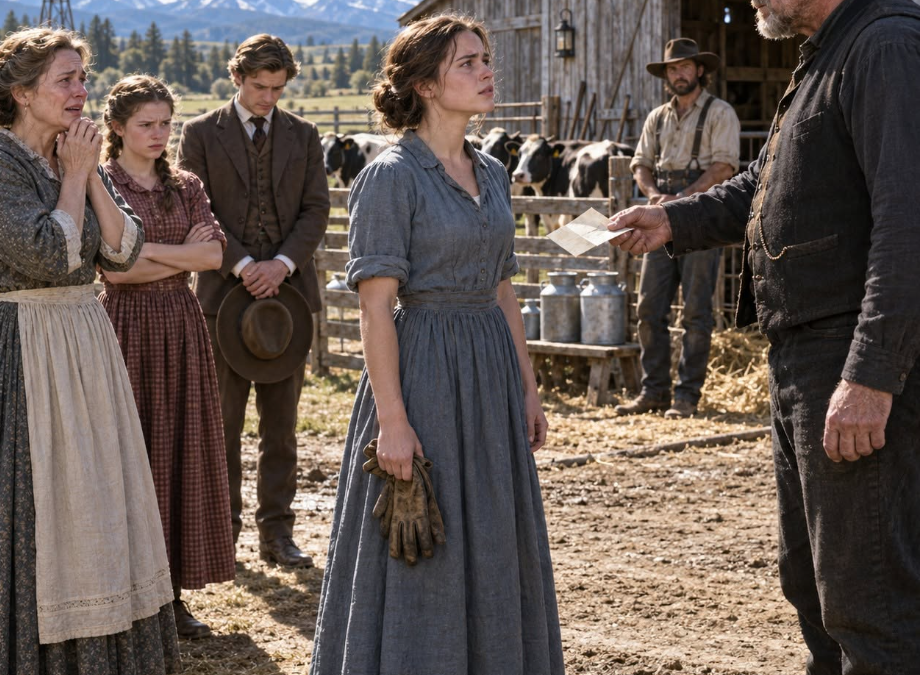
Then, one cold afternoon, a wagon entered the yard.
I was separating cream.
Rowan was repairing a gate hinge.
The wagon stopped.
My father climbed down.
My body knew him before my mind did.
I could not breathe.
Then my mother.
Eliza looked thinner.
Then Nell.
Beautiful.
Angry.
Then August Witcom.
He climbed down last.
Hat in hand.
Same way he had stood during his proposal.
Rowan took one step toward me.
I shook my head.
Don’t.
He stopped.
Close enough.
That was Rowan.
Always close enough.
Never taking the ground beneath my feet unless I asked.
My father surveyed the dairy.
The repaired roof.
Fresh paint.
Healthy animals.
Clean yard.
His expression revealed almost nothing.
“So.”
I wiped my hands on my apron.
“So.”
“This is where you’ve been.”
“This is where I work.”
He glanced at Rowan.
“Work.”
“Yes.”
Nell stepped forward.
“I lost Mr. Halpern.”
I looked at her.
“What?”
“His family ended the courtship.”
“Why?”
Her eyes filled with anger.
“Because of you.”
That hit me.
“How?”
“Because now everyone talks about the Bellweather girls.”
Father said, “Nell.”
She ignored him.
“They say our father cannot control his own daughters.”
I swallowed.
“Nell—”
“They say if you could refuse August and leave home, what guarantee is there I won’t shame them too?”
“I’m sorry.”
“Are you?”
“Yes.”
“You got what you wanted.”
Her voice cracked.
“Freedom.”
She gestured around.
“And I got your consequences.”
That was unfair.
It was also real.
Choices spread outward.
Even rightful choices.
That was one lesson nobody had prepared me for.
Mother stepped toward me.
“Marin.”
I nearly broke.
“Ma.”
Her arms lifted.
Then stopped.
My father said, “We did not come for sentiment.”
Eliza lowered them.
I hated him in that moment.
He reached into his coat.
Pulled out folded paper.
“I have spoken with August.”
August stared at the ground.
My stomach turned.
“About what?”
“Repairing this.”
Father unfolded the sheet.
“Your refusal created speculation.”
“My refusal created gossip.”
“Same thing in a town.”
“No.”
He continued.
“People need explanations.”
“Then give them the truth.”
“That you simply did not want a respectable marriage?”
“Yes.”
His jaw tightened.
“That is precisely the problem.”
I looked at August.
He looked miserable.
Father held out the paper.
“One sentence.”
I did not take it.
“What sentence?”
“An explanation people can understand.”
He read aloud.
I declined Mr. August Witcom’s proposal because prior to our intended engagement he behaved toward me in a manner I considered dishonorable and inappropriate for a future husband.
I stared.
“No.”
My mother closed her eyes.
Father said, “Listen first.”
“No.”
“August has agreed not to contest it publicly.”
My eyes snapped toward August.
“You agreed?”
His face went red.
“I agreed to hear your father.”
“That is not the same thing.”
“No.”
Father interrupted.
“August is willing to bear some embarrassment if it restores order.”
I looked at him.
“Some embarrassment?”
My voice rose.
“You want me to accuse him of misconduct.”
“Nothing criminal.”
“That distinction will vanish by supper.”
August said quietly, “He’s right.”
My father looked irritated.
August continued.
“If she signs it, people will assume things.”
“Yes.”
“Things I did not do.”
My father said, “Your business will recover.”
August laughed once.
“Will it?”
Nell snapped, “My future matters too!”
We all turned.
She was crying now.
“Marin gets to protect August?”
Her voice shook.
“What about me?”
I stared at my sister.
“Nell.”
“Do you know what people say?”
“No.”
“That we are defective.”
My mother whispered, “Please.”
Nell continued.
“That Father could not raise obedient daughters. That maybe I’m like you.”
“Would that be terrible?”
“Yes!”
The answer came instantly.
It hurt.
Nell covered her mouth.
Then whispered, “I don’t want your life.”
I looked at the barn.
The mud.
Cracked hands.
Worn apron.
I understood why.
She saw struggle.
She did not see what it had given me.
My father stepped closer.
“Sign.”
“No.”
“You haven’t heard what I offer.”
“I know what you offer.”
“Your home.”
My chest tightened.
“Your room remains.”
That nearly destroyed me.
He knew exactly where to strike.
“Your mother wants you back.”
I looked at her.
Tears spilled down Eliza’s cheeks.
“Nell’s future can be repaired.”
I looked at my sister.
“Your place in church.”
Another wound.
“Your family name.”
He lowered his voice.
“My forgiveness.”
Something in me hardened.
“Your forgiveness.”
“Yes.”
“For refusing marriage.”
“For humiliating us.”
August shifted.
My father held out the paper.
“Come home.”
For months I had imagined those words.
At night in the cellar.
During storms.
While washing milk pails until my hands split.
When I missed my mother’s voice.
When I wondered whether Nell hated me.
When Christmas passed without a letter.
Come home.
There it was.
I could have my mother.
My sister.
My bedroom.
Sunday supper.
My old place.
I had only to sign a lie.
I looked at August.
He held his hat.
His face was pale.
“What happens to you?”
My father answered for him.
“Nothing permanent.”
I ignored him.
“August.”
He looked at me.
“I don’t know.”
That honesty decided more than he realized.
“Would you lose customers?”
“Probably some.”
“Credit?”
“Possibly.”
“Marriage prospects?”
His mouth tightened.
“Yes.”
“Would people believe you pressured me?”
“Yes.”
My father snapped, “Marin, enough.”
I looked at him.
“No.”
His face darkened.
I took the paper.
Everyone went still.
I read every word.
Then tore it once.
Down the middle.
My mother gasped.
I tore it again.
And again.
The pieces fell into mud.
My father stared.
“You selfish girl.”
I started shaking.
Maybe from fear.
Maybe anger.
“I will not purchase my family with another person’s reputation.”
“You chose him over us.”
“No.”
I pointed at the paper.
“You made that choice necessary.”
Nell said, “So I’m supposed to suffer?”
I turned to her.
“No.”
“But I am.”
“Yes.”
That surprised her.
“I know.”
Tears blurred my vision.
“And I am sorry.”
“Sorry doesn’t fix it.”
“No.”
I swallowed.
“But lying about August would teach every man in this town that a woman’s refusal is only legitimate if the man can be blamed.”
Silence.
August looked at me.
I continued.
“I said no because I did not want to marry him.”
My father scoffed.
“That is childish.”
“No.”
My voice strengthened.
“That is enough.”
Gideon’s face went red.
“You have learned arrogance.”
“No.”
I glanced toward Rowan.
He remained where he had been.
Silent.
“This place taught me something else.”
“What?”
“That agreements require two names when two people bear risk.”
My father stared.
“That wages belong to the person who earns them.”
I stepped forward.
“That a roof over a woman’s head does not purchase obedience.”
My mother began crying harder.
“And that if love requires me to hurt an innocent person before I’m allowed back inside, it is not love I can safely return to.”
My father raised his hand.
Not to strike.
A furious gesture.
“You will regret this.”
Maybe.
That possibility still frightened me.
“You will grow old alone.”
Maybe.
“You will lose your mother.”
That one almost broke my resolve.
I looked at her.
“Ma.”
She moved toward me.
Father said, “Eliza.”
For the first time in my life, my mother did not stop when he spoke.
She came across the yard.
Took my face in both hands.
“You’ve gotten thin.”
I laughed through tears.
“So have you.”
She pulled me into her arms.
I became a child.
For several seconds, everything else disappeared.
Then she whispered against my hair:
“I wanted to come sooner.”
I held her tighter.
“Why didn’t you?”
Her body trembled.
“I was afraid.”
Of Father.
Of town.
Of choosing one daughter over another.
Of the same things I had been afraid of.
When she stepped back, she touched my cheek.
“I do not understand all of this.”
“I know.”
“But I know you should not lie.”
My father looked stunned.
“Eliza.”
She turned.
“No, Gideon.”
Two words.
Quiet.
Earth-changing.
“You asked too much.”
My father stared at his wife.
Then Nell.
“You too?”
Nell shook her head quickly.
“No.”
She looked at me.
Anger still there.
Pain.
“I still think you ruined things.”
“I know.”
“I still wish you had married August.”
August muttered, “Encouraging.”
For the first time, Nell almost smiled.
Then she looked at him.
“I’m sorry.”
He nodded.
Nell turned back to me.
“But Father’s paper was wrong.”
I exhaled.
That was enough for one day.
My father looked suddenly older.
Not defeated.
Disoriented.
His authority had always depended on everyone accepting the same structure.
One daughter left.
Then his wife said no.
Then Nell refused to support a lie.
Even August, the man supposedly being “protected,” would not cooperate.
Gideon looked at Rowan.
“You.”
Rowan finally moved.
One step.
“Yes?”
“You filled her head.”
“No.”
“She was not like this.”
Rowan glanced at me.
Then back at Father.
“She arrived like this.”
I almost laughed.
My father did not.
“What do you want with my daughter?”
There it was.
Rowan’s expression stayed calm.
“Nothing she doesn’t choose.”
My father looked offended by the concept.
“You expect me to believe a man houses a young woman for months without expectation?”
“She pays rent.”
“What?”
I said, “Twelve dollars monthly.”
My father stared.
“Written agreement,” Rowan added.
Mrs. Mercer would have been proud.
My father said, “You put my daughter’s name on a farm lease.”
“Mrs. Mercer did.”
“Why?”
Rowan looked at me.
“Because she earned it.”
My father had no answer.
He returned to the wagon.
Nell followed slowly.
Then August.
My mother remained.
Gideon turned.
“Eliza.”
She looked at him.
“I’ll come later.”
I had never seen my father look so shocked.
He left without her.
My mother stayed until dark.
We sat at the kitchen table in the little room I rented.
She asked about everything.
The cellar.
Cows.
Mrs. Mercer.
The lease.
My bank account.
She touched the account book like it was something fragile.
“Your name.”
“Yes.”
“Just yours.”
“Yes.”
She smiled.
Small.
Then cried.
“I should have taught you this.”
“Taught me what?”
“That your name could stand alone.”
That sentence healed something I had not known was bleeding.
Mother returned home that evening.
I feared Father would punish her.
He did not.
Not exactly.
He became silent.
For Gideon Bellweather, silence was often the only place he could put thoughts that threatened his rules.
August came back the next morning.
Alone.
I found him near the gate.
“I thought you’d be angry.”
“At you?”
“Yes.”
He looked almost amused.
“Marin, I was humiliated when you refused me.”
“I know.”
“I was angry.”
“I know.”
“I spent two months trying to discover what defect in me made you say no.”
My chest tightened.
“I’m sorry.”
“Don’t be.”
He looked toward the cows.
“Eventually I realized that was pride.”
I waited.
“You did not say I was defective.”
“No.”
“You said you didn’t want the life.”
“Yes.”
He nodded.
“I wish you had explained better.”
“So do I.”
“Would I have understood?”
“No.”
He laughed.
“Probably not.”
Then his expression became serious.
“Thank you.”
“For what?”
“Not signing.”
I looked at him.
“My father asked something unforgivable.”
“He was desperate.”
“That doesn’t make it less wrong.”
“No.”
August rubbed his hat brim.
“I’m leaving Juniper Crossing.”
“What?”
“Opening a second feed store in Lowell.”
“Because of this?”
“Partly.”
He smiled.
“Mostly because I realized I was waiting for the town to tell me what my life should look like too.”
I had never considered that.
We shook hands.
No bitterness.
No romance.
Just two people who could finally admit a good match on paper was not a commandment.
Winter ended.
Blue Lantern entered spring still standing.
Then summer.
We added four cows.
Mrs. Mercer renewed the lease.
Two years this time.
My share.
Rowan’s share.
Both names.
My mother began visiting every Tuesday.
At first, secretly.
Then not.
Nell took longer.
Nearly six months.
She arrived one afternoon in a blue dress.
Stood near the barn.
“I’m teaching permanently now.”
“Congratulations.”
She shrugged.
“I may not marry.”
I stared.
“What happened?”
“Nothing.”
Then she smiled faintly.
“Apparently that can be a reason.”
I laughed so hard a cow turned toward us.
Nell cried.
Then I cried.
She apologized.
So did I.
She had been right about one thing.
My choices had affected her.
But eventually, they gave her language she had not possessed before.
Our father visited only once during that first year.
He came alone.
No paper.
No speech.
He stood at the fence while I worked.
“You look well.”
“So do you.”
Lie.
He looked older.
“Your mother talks about this place constantly.”
“She likes the calves.”
“She likes you.”
My throat tightened.
“I know.”
He stared toward the barn.
“Vale?”
“Inside.”
“You marrying him?”
I almost smiled.
“Why?”
He frowned.
“Are you?”
“No.”
The answer surprised him.
“Do you love him?”
That surprised me.
My father had never asked me that about August.
I looked toward the workshop.
Rowan emerged carrying a broken harness.
He saw Father.
Nodded.
Went back inside.
“Yes.”
Gideon’s eyes shifted.
“And he loves you.”
“Yes.”
“Then why not marry?”
I wiped my hands.
“Because we’re not ready.”
My father stared as though I had begun speaking French.
“You can decide that?”
“Yes.”
He was silent.
Then said, “I was wrong about one thing.”
Only one?
I kept that thought to myself.
“What?”
“I thought if I let you refuse August, every rule would disappear.”
I waited.
“Did it?”
He looked toward the dairy.
“No.”
That was as close to apology as Gideon Bellweather knew how to come.
I accepted it for what it was.
Not enough.
Something.
Rowan and I married two years later.
Not because Blue Lantern required it.
Not because the town expected it.
Not because my father finally approved.
We married after Rowan asked me one evening while we were fixing the west fence.
No ring.
No audience.
He said, “I like the life we’re building.”
“So do I.”
“I’d like to keep building it with you.”
I looked at him.
“Is that a proposal?”
“If you want it to be.”
“And if I say no?”
He pulled the wire tighter.
“Then you still own half the lease.”
I laughed.
That was when I knew my answer.
“Yes.”
He stopped working.
“Yes?”
“Yes.”
Rowan kissed me.
Then we finished the fence because cows do not respect romance.
At our wedding, August sent a wooden feed scoop as a gift.
Nell stood beside me.
Mother cried.
Mrs. Mercer complained that the cake was too sweet.
My father came.
He sat in the second row.
When the minister asked who gave me away, nobody stood.
That was my choice.
I walked forward alone.
Not because I had no family.
Because I was not being transferred.
After the ceremony, Father approached Rowan.
I prepared for something uncomfortable.
Instead Gideon held out his hand.
“You take care of her.”
Rowan looked at him.
Then at me.
“She takes care of herself.”
Father stiffened.
Then, slowly, nodded.
“Right.”
It took him years.
But he learned.
Blue Lantern eventually became ours.
Mrs. Mercer sold us the property through a long-term payment agreement because, as she said, “I’m too old to keep watching you two improve something I still technically own.”
The deed contained both names.
Marin Vale.
Rowan Vale.
I stared at mine for a long time.
Then asked the lawyer to add language recognizing my original capital contribution separately.
Rowan grinned.
“Romantic.”
“Practical.”
“Even better.”
We expanded the dairy.
Added cheese.
Butter.
A small storefront.
Nell handled school accounts during summer.
Mother kept trying to reorganize my kitchen.
Father never approved of everything.
But when illness finally weakened him years later, he chose to spend his last winter in the small cottage beside Blue Lantern instead of the Bellweather house.
One evening, he watched me calculate feed contracts at the table.
“You always did like numbers.”
“Yes.”
“I should have noticed.”
“You noticed.”
He looked at me.
“I should have valued it differently.”
That was the apology.
The real one.
Not perfect.
Late.
Still real.
He died the following spring.
Afterward, while sorting his belongings, I found the torn-paper incident had not vanished from his mind.
Inside his Bible was a folded blank sheet.
At the top, in my father’s handwriting:
One acceptable reason.
Nothing beneath it.
I sat there for a long time.
Then turned the page over.
On the back, he had written:
She said no.
And underneath:
That should have been enough.
I cried harder over those six words than I had at his funeral.
Years later, when young women from Juniper Crossing came to Blue Lantern asking for work, I never asked whether they had scandal behind them.
Some did.
Some did not.
Widows.
Unmarried mothers.
Girls who refused matches.
Wives who left bad homes.
Daughters who simply wanted wages before marriage.
I asked what they knew.
What they wanted to learn.
And one question Mrs. Mercer had once asked me.
“What do you want?”
The answer always mattered.
Sometimes more than the work.
People later made my story simpler than it was.
They said I was brave for refusing August.
I was terrified.
They said my father was cruel.
He was.
He also loved me badly and eventually learned better.
They said Rowan rescued me.
He did not.
He gave me work.
That difference changed my life.
They said love won in the end.
Maybe.
But love was not the most important thing I found at Blue Lantern.
Choice was.
The right to choose work.
To choose where I lived.
To choose who could enter my life.
To choose whom I married.
To choose forgiveness without returning to obedience.
To choose family without surrendering myself to earn it.
And most importantly, the right to say no without inventing a villain to justify it.
August Witcom was a good man.
I still said no.
Rowan Vale was a good man.
Years later, I said yes.
The difference was not their goodness.
It was mine to choose.
That was what my father could not understand when I was twenty-four.
That was what the town punished me for.
That was what seven closed doors tried to teach me to regret.
But the eighth place did not open a door and promise rescue.
It handed me a milk pail.
And asked me to work.
From that work came wages.
From wages came a bank account.
From a bank account came a lease.
From a lease came a life.
And when my father finally returned with a door open behind him, I understood something I had been too frightened to see before.
A door is not freedom simply because it is open.
Not if the price of walking through it is becoming someone you can no longer respect.
So I let that door close.
And built my own.








