He Slapped His Wife in a Diner While Secretly Plotting With His Mistress to Steal Her Inheritance—Then Her 3 Hells Angels Brothers Arrived With Proof of a $400,000 Life Insurance Scheme
PART3:
The new cologne.
Late-night jobs.
Phone turned face down.
Passwords changed.
Receipts from towns where no construction job existed.
The slight smile whenever the phone vibrated.
Nora had learned not to ask.
Questions cost too much.
That afternoon she had seen only four words on the screen before Dale snatched it away.
**Tonight. Same room. Miss you.**
And a name.
Crystal.
That was enough.
Nora stared at her untouched grilled cheese.
Dale kept scrolling.
Across the room, Earl Mercer set down his spatula.
Earl had worked the Iron Kettle grill for twenty years.
Sixty-three.
Heavyset.
Gray hair.
Permanent burn mark across one forearm from an oil accident sometime during the Clinton administration.
He did not talk much.
The diner ran partly on coffee and partly on Earl’s ability to know when customers wanted conversation and when they did not.
He knew Nora.
Not well.
Enough.
She came most weekdays around noon.
Grilled cheese.
Decaf.
Biscuit.
Small booth.
Never sent food back.
Always stacked her dishes when she finished.
Always apologized if Biscuit’s leash stretched into the aisle.
Earl had noticed things.
Bruises below cardigan sleeves.
A swollen lip once.
Another time, the faint green-yellow mark near her jaw.
Each time he had asked some careful version of:
“You all right?”
Each time Nora had smiled.
“Yes.”
That word had bothered him for years.
Two summers earlier, on a slow afternoon, Nora had sat at the counter because the window booth was being repaired.
Biscuit lay at her feet.
Earl poured coffee.
A motorcycle group passed outside.
Nora watched.
Something changed in her face.
Earl noticed.
“You ride?”
She smiled faintly.
“Used to.”
“Family?”
Her fingers tightened around the coffee cup.
“My brothers.”
Earl had once ridden too.
Not the same club.
Different years.
Different life.
But he recognized what silence meant around family.
“You close?”
Nora stared through the window.
“Once.”
Earl waited.
Eventually she told him.
Three brothers.
Cole.
Wyatt.
Sam.
After their parents died, the four siblings had grown up like a small country defending its border.
Cole was oldest.
Responsible before he was old enough to know what responsibility meant.
Wyatt fought anybody who frightened Nora.
Sam wrote letters from everywhere because Nora loved receiving mail.
Then she met Dale.
At first her brothers disliked him.
Nora thought that was ordinary older-brother suspicion.
Then Dale started complaining about them.
Cole asked too many questions.
Wyatt was disrespectful.
Sam “filled her head with nonsense.”
Visits caused arguments.
Phone calls caused arguments.
Dale accused Nora of telling family their private business.
So Nora stopped telling them anything.
Then Dale convinced her that every disagreement between him and the brothers was her fault.
Nora started canceling visits.
Changed phone numbers twice.
Stopped attending birthdays.
Eventually the calls stopped.
Not because her brothers stopped caring.
Because Nora begged them to leave her alone.
“Please,” she had told Cole during their last conversation. “Every time you call, he gets worse afterward.”
Cole’s voice changed.
“Nora, if he’s hurting you—”
“I’m fine.”
“You don’t sound fine.”
“If you love me, stay away.”
Cole had stayed away.
He hated himself for it every day afterward.
Earl had listened to that story two years earlier.
Then Nora did something strange.
She wrote a phone number on the back of an order ticket.
Pushed it toward him.
“If it ever gets real bad…”
Earl looked at the number.
“You want me calling your brothers?”
“If I can’t.”
He studied her.
“What counts as real bad?”
Nora’s eyes dropped.
“If you have to ask, it probably isn’t.”
Earl had folded the ticket.
Put it in his wallet.
For two years he carried it.
Twice the ink nearly wore off.
He rewrote the number.
Never called.
He told himself Nora was an adult.
She had choices.
He told himself interfering could make things worse.
He told himself people needed to decide when they were ready.
All of those statements contained truth.
Earl still felt like a coward every time she walked in wearing long sleeves in July.
Now he looked through the pass.
Nora’s cheek was red.
Dale sat across from her smiling at his phone.
Earl reached into his wallet.
The paper was still there.
He walked to the kitchen phone.
Dialed.
Two rings.
A man answered.
“Yeah?”
“My name’s Earl Mercer.”
Silence.
“I cook at a diner off Route 9.”
Still silence.
“You don’t know me.”
“Then why are you calling?”
Earl looked toward Nora.
“Your sister gave me this number.”
The voice changed immediately.
“Nora?”
“Yes.”
“What happened?”
Earl took a breath.
“She’s alive.”
“Tell me what happened.”
“Her husband just hit her.”
Silence.
“In front of about forty people.”
Another silence.
This one colder.
Earl continued.
“I’ve watched things I should’ve spoken about sooner.”
“Address.”
Earl gave it.
“How long ago?”
“Two minutes.”
“Is Dale still there?”
“Yes.”
“Is Nora leaving?”
“No.”
“Why not?”
Earl looked through the window.
“She looks like she thinks nothing can change.”
The voice on the phone exhaled.
“Keep him there if you can.”
“I’m sixty-three and I fry hamburgers.”
“I’m not asking you to fight him.”
“Good.”
“Just don’t let her leave alone.”
Earl said:
“I can do that.”
The caller paused.
Then:
“We’re coming.”
“How far?”
“Eighteen minutes.”
The line disconnected.
Earl stood there.
Then returned to the grill.
His coworker looked at him.
“Everything okay?”
Earl picked up the spatula.
“Nope.”
He glanced toward Dale.
“Somebody should pour that man another coffee.”
“Why?”
“He’s going to want to be sitting down.”
Outside the kitchen, the diner tried to restart itself.
Forks scraped plates.
People whispered.
Someone fed quarters into the jukebox.
Nobody selected a song.
Nora pressed a napkin against her cheek.
Dale looked at her.
“You embarrassed me.”
She almost laughed.
Not because it was funny.
Because the sentence was so completely backward.
“I’m sorry.”
Her mouth said it automatically.
Dale relaxed.
That was all he wanted.
Not remorse.
Submission.
“Good.”
His phone buzzed.
He answered the message.
Nora looked out the window.
For a moment she imagined opening the door.
Walking.
Not home.
Anywhere.
Then fear supplied the usual questions.
Where would she sleep?
What about Biscuit?
What about money?
Dale handled most of the accounts.
The house was in both names, she thought.
Unless that had changed.
Could he find her?
Of course.
Could the police protect her forever?
No.
Would he behave worse if she tried and failed?
Yes.
Eleven years had turned uncertainty into a cage stronger than locks.
Nora had inherited money after her parents died.
Not a fortune.
Enough.
Her father owned a small equipment rental company.
Her mother inherited land.
When both died within two years of each other, the estate settled into investment accounts.
Dale had been fascinated by the money before Nora understood he was fascinated.
He asked sensible questions.
Told her he wanted to protect her.
Warned that investments were complicated.
Offered to “handle the boring things.”
At first Nora appreciated it.
Then access expanded.
Her independence shrank.
Dale convinced her she was terrible with money.
Then terrible at decisions.
Then unstable.
Then selfish.
Then lucky he stayed.
By the time Nora understood the pattern, she no longer trusted her own understanding.
Dale ordered pie.
Nora watched him eat.
Biscuit rested his chin on her shoe.
Eighteen minutes passed.
Then the windows began vibrating.
A low rumble approached from Route 9.
Conversations stopped again.
Three motorcycles turned into the gravel lot.
Large.
Black.
Chrome flashing.
They stopped almost perfectly aligned.
Engines died.
Three kickstands dropped.
Nora froze.
She knew before the men removed their helmets.
Cole.
Wyatt.
Sam.
Her brothers.
For eleven years Nora had imagined seeing them again.
Sometimes she imagined running toward them.
Sometimes hiding.
Sometimes apologizing.
Never like this.
Cole swung off the first motorcycle.
Fifty-one now.
Gray threaded through his dark beard.
Leaner than Nora remembered.
Leather vest over black denim.
His face had aged hard.
Eyes had not.
Wyatt came off the second.
Forty-seven.
Built like somebody had designed him to carry refrigerators upstairs.
Shaved head.
Close beard.
Arms covered in tattoos.
Sam dismounted last.
Forty-four.
Quieter than the others.
Dark hair.
Glasses.
Leather vest.
Manila folder under one arm.
That folder frightened Dale more than Wyatt did.
He simply did not know it yet.
The bell rang.
Cole entered first.
Every conversation died.
Nora looked up.
Cole found her instantly.
Saw the cheek.
Saw Biscuit.
Saw Dale.
Something violent crossed his face.
He stopped it.
That was important.
Old Cole might have crossed the room and broken Dale’s jaw.
Nora knew that.
So did Wyatt.
Cole had learned over the years that rage could feel loyal while making everything worse for the person you were trying to protect.
He walked slowly.
“Nora.”
Her throat closed.
“Hey.”
His voice was gentle.
“Sorry we’re late.”
Nora’s eyes filled.
Dale looked from her to them.
“Who the hell are you?”
Cole stopped beside the booth.
“My name’s Cole Rook.”
Dale frowned.
“These are Wyatt and Sam.”
Wyatt nodded.
Sam lifted the folder slightly.
Cole continued:
“And Nora…”
He looked at his sister.
“…is ours.”
Dale laughed.
Wrong sound.
Too high.
“What?”
“Our sister.”
The diner reacted like someone had thrown a switch.
People looked at Nora differently.
Quiet Nora.
Library Nora.
Cardigan Nora.
Small Nora.
Three bikers standing behind her.
Dale turned.
“You told me your family was dead.”
Nora flinched.
Cole answered.
“Parents are.”
“Brothers aren’t.”
Dale’s face reddened.
“She never said—”
“No.”
Cole pulled a chair from the next table.
Turned it around.
Sat.
“She didn’t.”
He looked at Nora.
“Because she was protecting you.”
Dale laughed again.
“From what?”
“Us.”
Cole’s eyes hardened.
“She begged us not to come.”
“She said if we confronted you, you’d take it out on her.”
Nora looked down.
Cole’s voice softened.
“We listened.”
He swallowed.
“That was a mistake.”
Dale tried to stand.
Wyatt moved one step closer.
Did not touch him.
“Sit.”
Dale stared.
“You threatening me?”
“No.”
Wyatt’s voice was calm.
“I’m suggesting you hear the rest.”
“I can leave whenever I want.”
Sam finally spoke.
“I’d recommend staying.”
Dale looked at the folder.
“Why?”
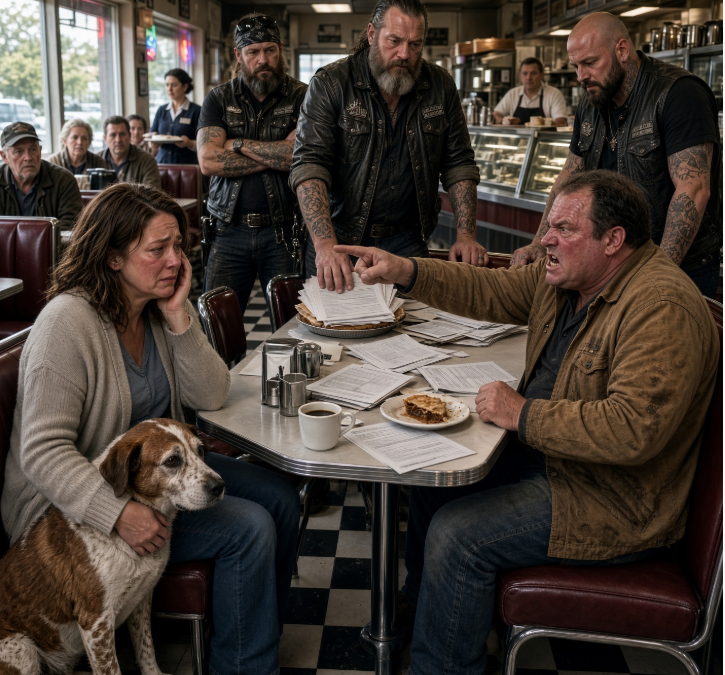
Sam set it on the table.
“Because the sheriff’s office is already coming.”
Everything in Dale’s face changed.
Nora noticed.
So did Cole.
There.
Fear.
Not because he had hit Nora.
Dale had never feared consequences for that.
Something else.
Cole nodded toward Sam.
“Show him.”
Sam opened the folder.
The first item was a photograph.
Dale.
Outside the Riverbend Motor Lodge.
One county over.
His arm around a blonde woman.
Nora stared.
Dale’s mouth opened.
Cole asked:
“You know her, Nor?”
Nora shook her head.
“Her name’s Crystal Avery.”
Cole looked at Dale.
“Loan officer.”
Merchants Trust.”
Nora’s stomach tightened.
Her bank.
Dale jumped in.
“This is insane.”
Cole ignored him.
“Thirty-one hotel stays in the last year.”
Sam laid down receipts.
Credit-card records.
Dates.
Nora saw Thursdays.
Saturdays.
One Tuesday Dale told her he was visiting his mother.
His mother lived two states away.
Nora closed her eyes.
Dale said:
“You’ve got no right digging into—”
Cole raised one hand.
“You’re still on the smallest part.”
Sam placed another document on the table.
Bank form.
Account number partially redacted.
Nora recognized the final digits.
Her inheritance account.
The account her parents had built.
Her emergency security.
The one Dale always told her was “untouched.”
Sam pointed.
“Two months ago, somebody submitted an ownership amendment.”
Nora leaned closer.
Dale’s name.
Added as joint owner.
Her breath stopped.
“No.”
Sam showed the signature.
**Nora Rook.**
She shook her head.
“That’s not mine.”
Dale said:
“You signed it.”
Nora looked at him.
“What?”
“You forget everything.”
The old tactic.
Confuse.
Reframe.
Make her doubt.
“You signed it.”
“I didn’t.”
“You did.”
Cole leaned forward.
“No, she didn’t.”
Dale’s eyes moved to him.
Cole tapped the page.
“We compared it.”
“With what?”
“Documents Nora signed before she met you.”
Dale became still.
“How did you get those?”
Sam answered.
“Public records.”
“Estate filings.”
“Old title documents.”
“A friend of ours does handwriting examination for court cases.”
Sam lifted another sheet.
“He gave a preliminary opinion.”
“Different formations.”
“Different pressure.”
“Different letter connections.”
He looked at Nora.
“This signature was traced badly.”
Nora covered her mouth.
The diner was silent.
Dale pushed back from the table.
“You people are crazy.”
Cole said:
“You know what forgery is?”
“Go to hell.”
“It’s a crime.”
“Prove I did it.”
Cole nodded.
“Good distinction.”
Dale blinked.
“We didn’t say you forged it personally.”
Dale’s breathing changed.
Cole glanced at the motel photograph.
“We think your girlfriend did.”
Nora felt cold.
Sam placed another page down.
Internal access record from Merchants Trust.
Crystal Avery’s employee ID had opened Nora’s account profile repeatedly.
Late.
Outside normal customer-service patterns.
Then another.
Draft wire instructions.
A transfer that had not yet been finalized.
Dale said nothing.
Sam explained:
“Bank security froze everything twenty minutes ago.”
Dale’s face drained.
Nora looked at Sam.
“What transfer?”
He hesitated.
Cole answered carefully.
“Most of the account.”
“How much?”
“Nora—”
“How much?”
Sam gave the number.
Nora stopped hearing the diner.
It was almost everything.
Her parents’ money.
Her father selling equipment in freezing rain.
Her mother saving receipts in envelopes.
Their house.
Their land.
Everything distilled into numbers that Dale and Crystal had planned to take.
Nora looked at her husband.
“Why?”
Dale’s face hardened.
“Don’t start acting like some rich victim.”
Cole stood halfway.
Wyatt touched his shoulder.
Not Dale.
Cole.
One look.
Not here.
Not like this.
Cole sat again.
Dale saw it.
Mistook restraint for weakness.
“That money has sat there for years.”
He looked at Nora.
“You don’t even know what to do with it.”
Nora stared.
Dale continued.
“I built our life.”
“You worked part-time shelving books.”
“I paid bills.”
“I handled everything.”
Nora whispered:
“Because you wouldn’t let me.”
Dale laughed.
“Because you can’t handle anything.”
Biscuit crawled farther from under the table.
Placed himself beside Nora.
Cole looked at the dog.
Then at Dale.
His voice dropped.
“She handled you for eleven years.”
Dale looked confused.
“Every bad mood.”
“Every insult.”
“Every bruise she hid.”
“Every phone call she stopped making because you made her afraid.”
Cole leaned forward.
“You mistook endurance for incompetence.”
Sam reached into the folder.
Placed down a life-insurance policy.
Nora stared.
Her name.
Four hundred thousand dollars.
Beneficiary:
Dale Rook.
Effective fourteen months earlier.
Nora looked up.
“I never…”
Sam nodded.
“We know.”
Dale spoke fast.
“That’s normal.”
“Spouses have insurance.”
Cole asked:
“Do they normally not know?”
“You don’t know what she knows.”
Nora said:
“I didn’t.”
Dale turned toward her.
“Shut up.”
The words came automatically.
Then he remembered where he was.
Wyatt stepped closer.
Dale looked away.
Sam took out another document.
Not dramatic.
A printed list.
Search records connected to a device registered to Dale’s contracting office.
Cole had obtained them legally through an investigator they had hired months earlier after Nora’s brothers quietly began checking on her.
Not everything in the list was criminal.
Some of it was disturbing.
Life-insurance contestability periods.
Accidental-death exclusions.
How jointly owned accounts transfer after spouse death.
Medication interactions.
Carbon monoxide symptoms.
Dale’s face became gray.
Nora saw only the heading.
Cole turned the sheet facedown before she could read more.
“You don’t need that.”
She looked at him.
“What is it?”
“Nora.”
“What is it?”
Cole’s jaw worked.
Sam answered.
“Questions Dale shouldn’t have been asking.”
Nora looked at Dale.
Her husband began talking.
Fast.
“You can search anything.”
“Everybody searches weird stuff.”
“This proves nothing.”
“You’re twisting it.”
“This is some biker intimidation garbage.”
Cole said:
“Maybe.”
Dale stopped.
Cole leaned back.
“Which is why we called people who carry badges instead of patches.”
Sirens became audible outside.
Dale looked toward the window.
Two cruisers.
Then an unmarked county vehicle.
His entire posture changed.
Nora saw it.
The man who had dominated rooms by being the loudest suddenly searched for exits.
Sam said:
“Crystal’s already talking.”
Dale looked at him.
“That’s a lie.”
“She was escorted out of the bank.”
“You don’t know Crystal.”
Cole smiled without humor.
“Apparently Nora isn’t the only person you underestimate.”
Dale stood.
Wyatt did not stop him.
That surprised Dale.
He moved fast.
Toward the kitchen.
Rear door.
Biscuit came out from beneath the booth.
Three-legged.
Scarred.
Old.
He ran.
Not fast compared with a healthy dog.
Fast enough.
He planted himself in the narrow doorway.
Dale stopped.
Biscuit’s body shook.
His lips pulled back.
A low growl rose from somewhere deep.
Nora stared.
Biscuit had never confronted Dale.
He usually hid.
Just like her.
Dale lifted one foot as if to kick him aside.
Nora stood.
“Don’t.”
One word.
Dale looked back.
Nora’s hands trembled.
Her cheek hurt.
Her heart pounded.
But she was standing.
“You touch him…”
Her voice almost disappeared.
She forced it back.
“…and I swear you’ll regret the last thing you do in this building.”
Dale stared.
This was not the Nora he knew.
Or maybe it was the Nora he had spent eleven years making sure never got enough air to appear.
Wyatt walked over.
Stopped behind Dale.
“Sit down.”
Dale turned.
“You think I’m afraid of you?”
Wyatt shrugged.
“No.”
He nodded toward Biscuit.
“Seems like you’re afraid of him.”
A few people laughed nervously.
Dale’s humiliation flashed into rage.
Then the front door opened.
Deputies entered.
A plainclothes detective followed.
Detective Mara Ellis.
Forty-six.
County financial crimes.
Sam knew her through a retired investigator in his riding club.
Mara looked at Sam.
Then Cole.
Then Nora.
Then Dale.
“Mr. Rook.”
Dale immediately changed personalities.
“Thank God.”
He stepped toward her.
“These men came in here threatening me.”
Mara raised a hand.
“Stay where you are.”
Dale stopped.
“They’re harassing me.”
Mara looked toward the security camera above the register.
“We’ll review everything.”
Dale continued.
“My wife is confused.”
Nora closed her eyes.
There it was.
The version Dale would sell.
Unstable Nora.
Forgetful Nora.
Manipulated Nora.
Mara looked at her.
“Mrs. Rook?”
Nora opened her eyes.
“Did your husband strike you?”
The diner froze.
For eleven years Nora had answered versions of that question incorrectly.
Doctor.
Neighbor.
Earl.
Brother.
She looked at Dale.
He gave her the face.
Not angry.
Not yet.
The warning face.
The face that said:
You know what happens later.
Except later had changed.
Cole stood behind her.
Wyatt.
Sam.
Earl near the grill.
Biscuit against her leg.
And forty witnesses who had finally stopped pretending they had seen nothing.
Nora looked at Mara.
“Yes.”
Dale’s face cracked.
“She—”
Mara said:
“Did he strike you today?”
“Yes.”
“Open hand?”
“Yes.”
“Once?”
Nora swallowed.
“Today?”
Mara understood.
“How many other times?”
Nora’s eyes filled.
“I don’t know.”
The words changed the room.
Not one isolated slap.
A history.
Dale began shouting.
“She’s lying!”
A deputy moved closer.
Mara remained calm.
“Mr. Rook, put your hands behind your back.”
“You’re arresting me because my wife is emotional?”
“Right now I’m arresting you based on probable cause for domestic assault witnessed by multiple people.”
“This is ridiculous.”
“Hands.”
Dale looked toward Nora.
The old tactic again.
Soft voice.
“Nora.”
She said nothing.
“Honey.”
Nothing.
“You know this got out of hand.”
Her stomach turned.
“Tell them.”
Dale’s eyes filled with manufactured hurt.
“Tell them this is a misunderstanding.”
Nora stood straighter.
For the first time in eleven years, she looked directly at him without calculating what her face might cost her later.
“I have nothing to tell them.”
Dale’s expression hardened.
“Nora.”
She continued:
“I have nothing left to say to you.”
Mara cuffed him.
Dale twisted around.
“You think these freaks care about you?”
Cole smiled faintly.
Dale shouted:
“They disappeared for eleven years!”
Cole’s smile vanished.
Nora flinched.
Because that one hurt.
Cole stepped forward.
Mara watched carefully.
Cole did not touch Dale.
He answered:
“You’re right about one thing.”
The diner became quiet.
“We should’ve come sooner.”
Nora looked at him.
Cole’s eyes filled.
“We believed her when she said staying away kept her safer.”
He swallowed.
“That was the wrong choice.”
Dale laughed.
“See?”
Cole looked at Nora, not Dale.
“But we’re here now.”
Mara escorted Dale outside.
One of the retirees near the door watched him pass.
This was Clarence Webb.
Seventy-eight.
Same booth every weekday.
He had watched Dale slap Nora.
Had done nothing.
Now as Dale passed, Clarence said quietly:
“Nobody in town, huh?”
Dale looked at him.
Clarence did not look away.
The cruiser door closed.
Inside, silence remained.
Then Biscuit returned to Nora.
His entire body relaxed the moment Dale disappeared.
That broke her.
Nora dropped to her knees.
Not because someone knocked her down.
Because she no longer had to stand.
She buried her face in Biscuit’s neck.
Cried.
Deep.
Ugly.
Eleven years.
Cole crouched beside her.
His hand hovered.
He did not assume touch.
“Nora?”
She leaned toward him.
That was permission.
Cole put one arm around his sister.
Wyatt knelt on the other side.
Sam stood behind them.
Nora reached blindly.
Caught Sam’s wrist.
He joined them.
Four siblings.
Together for the first time in eleven years.
Earl watched from the counter.
Then quietly returned to the grill.
Nora cried until breathing hurt.
Eventually she looked up.
“How did you know?”
Cole nodded toward Earl.
“Cook called.”
Nora looked.
Earl was flipping a burger.
Pretending not to watch.
“You kept the number?”
He shrugged.
“You told me to.”
“For two years?”
“I’ve kept worse things longer.”
Nora began crying again.
Earl frowned.
“Don’t do that.”
She laughed through tears.
“Thank you.”
He nodded.
“Coffee?”
Nora laughed harder.
“Yes.”
“Decaf?”
“Please.”
Earl poured it.
That was Earl’s way.
Do the necessary thing.
Then return the world to manageable tasks.
Coffee.
Grill.
Toast.
The next hours moved slowly.
Nora gave a statement.
The diner’s security footage was copied.
Witnesses spoke.
Clarence apologized.
So did the waitress.
Then another person.
Nora did not know what to do with the apologies.
Part of her wanted to say:
It’s okay.
That habit rose immediately.
Make other people comfortable.
Instead she said:
“Thank you for saying that.”
Nothing more.
That night Nora did not go home.
Neither did Biscuit.
Cole rented adjoining motel rooms.
Wyatt checked both doors twice.
Sam bought dog food.
None of the brothers asked Nora why she stayed.
That mattered.
People often asked abused women that question as if the answer would explain something wrong with them instead of something powerful and frightening about coercion.
Her brothers did not ask.
Cole said:
“What do you need tonight?”
Nora stared.
Nobody had asked her that in years.
“I don’t know.”
“Fine.”
He nodded.
“Then tonight you don’t have to.”
Biscuit slept beside her bed.
Nora did not.
Every sound in the hallway became Dale.
Footsteps.
Ice machine.
Door shutting.
Voices.
At 2:11 a.m., she called Cole.
He answered immediately.
“I’m sorry.”
“Don’t.”
“I woke you.”
“I wasn’t sleeping.”
That was probably true.
“I keep thinking he’s coming.”
“He’s not.”
“You don’t know.”
“He was denied immediate release pending initial hearing.”
Sam had checked.
Cole continued.
“And Wyatt is sitting outside your door.”
Nora sat up.
“What?”
“You know Wyatt.”
She opened the motel door.
Wyatt sat in a plastic chair in the hallway.
Arms folded.
Eyes closed.
He opened one.
“You need something?”
Nora stared.
“You’ve been there all night?”
“Chair’s comfortable.”
“It is absolutely not.”
“Subjective.”
Nora started crying.
Wyatt stood.
“Hey.”
She hugged him.
He froze.
Then wrapped both arms around her.
“I’m sorry.”
He whispered.
Nora pulled back.
“For what?”
“Believing staying away was helping.”
“You listened to me.”
“Shouldn’t have.”
“You didn’t know.”
Wyatt looked down.
“I knew enough.”
The following morning, Sam explained the financial evidence.
He was careful.
Not all of it had been gathered in eighteen minutes.
That would have been impossible.
The truth was more complicated.
Cole had never fully stopped checking.
None of them had.
They respected Nora’s demand for no contact but remained worried.
Four months earlier, Sam saw Dale leaving a hotel with Crystal while visiting a supplier nearby.
He did not confront him.
Instead he photographed it.
Then called Cole.
They hired a licensed investigator.
Not to invade Nora’s private life.
To determine whether Dale posed a financial threat.
The investigator discovered suspicious liens on the house.
Private debt.
The hotel stays.
Then unusual public-record changes around Nora’s accounts.
The forged bank paperwork only became visible after Earl’s call gave them reason to escalate.
Sam contacted the bank’s fraud department with documents Nora’s brothers possessed from their parents’ estate.
That triggered the freeze.
Police investigation uncovered the rest legally.
Nora listened.
“You were investigating him?”
Cole nodded.
“Were you going to tell me?”
“Yes.”
“When?”
“When we had enough that you could make a decision without him convincing you we were lying.”
Nora looked away.
Part of her felt angry.
They had watched from a distance.
Decided things.
Investigated her husband.
Made plans.
Too close to what Dale had done.
Sam saw it.
“We should’ve told you sooner.”
Nora looked at him.
“We were scared if we showed up without proof, you’d disappear from us again.”
Nora whispered:
“I might have.”
Cole nodded.
“I know.”
That honesty helped.
No one pretended they had handled everything perfectly.
Over the next three weeks, the case widened.
Crystal Avery cooperated.
At first she denied everything.
Then investigators confronted her with access logs.
Forged forms.
Messages.
Hotel receipts.
Draft transfers.
She broke.
Crystal had believed Dale’s version of Nora.
Dale told her Nora was mentally unstable.
That the marriage was effectively over.
That Nora’s inheritance was “family money” tied up because Nora refused to sign reasonable paperwork.
Crystal helped prepare account documents.
At first, she told investigators she thought Nora had agreed.
Then the messages proved otherwise.
One from Dale:
**Just copy it close enough. She never checks anything.**
Another:
**Once my name is on, we move it in pieces.**
Another:
**She’ll sign whatever insurance stuff I put in front of her.**
Crystal wrote:
**What if she notices?**
Dale:
**She won’t. She’s scared of her own shadow.**
Nora read that message during a meeting with Detective Ellis.
It hurt more than she expected.
Not because Dale had described her as frightened.
Because he was right about something.
She had been frightened.
He had created the fear and then treated it as proof of her weakness.
Mara slid the page away.
“You don’t have to keep reading.”
Nora stared.
“I want to.”
“You sure?”
“No.”
Mara waited.
Nora took the page back.
“But I’m reading it anyway.”
That became the first of many small acts Nora chose while unsure.
She hired an attorney.
Filed for divorce.
Requested a protection order.
Changed financial access.
Opened an account only she controlled.
Changed passwords.
Changed her phone number.
Then did something that frightened her more than all of those.
She returned to the house.
Not alone.
Police had cleared it.
Dale remained detained due to the combination of domestic violence charges, financial-fraud allegations, and evidence connected to insurance concerns.
Cole offered to enter first.
Nora said no.
“This is my house too.”
Cole nodded.
She opened the door herself.
Biscuit stopped on the threshold.
His body shook.
Nora felt it through the leash.
She crouched.
“Me too.”
He looked at her.
“Come on.”
They entered together.
The house felt smaller.
Dale’s boots by the door.
His jacket.
Coffee mug.
Everything familiar.
Everything poisoned.
Nora went room by room.
Her brothers followed only when asked.
In the bedroom, she opened the closet.
Half her clothes were hidden behind Dale’s.
That felt symbolic enough to make her angry.
She pulled his clothes down.
Not dramatically.
One hanger at a time.
Put them into bags.
Wyatt appeared at the doorway.
“You want help?”
Nora considered.
“Yes.”
They worked.
In the home office, Sam found three locked drawers.
Police had already documented contents.
Copies of insurance documents.
Financial papers.
Nora’s old identification.
A file marked **N.R. MEDICAL**.
Nora opened it.
Doctor records.
Prescription lists.
Copies she had never given Dale permission to keep.
Search notes.
She closed the folder.
“I want this out.”
Sam took it.
“Done.”
In the kitchen, Nora stood near the cabinet she once closed silently because Dale hated the sound.
She opened it.
Then shut it.
Hard.
BANG.
Everyone stopped.
Nora opened another.
BANG.
Another.
BANG.
Wyatt started smiling.
Cole leaned against the counter.
Sam said:
“I feel like there’s symbolism happening.”
Nora laughed.
Then slammed every cabinet in the kitchen.
Biscuit barked once.
Not fearfully.
Almost approving.
For the first time in eleven years, Nora made noise in her own house on purpose.
Then she cried again.
Healing did not arrive in a straight line.
Some mornings Nora woke feeling free.
By lunch she felt terrified.
Sometimes she missed Dale.
That embarrassed her.
She told no one at first.
Then one evening, Cole found her staring at an old wedding photograph.
“I miss him.”
She expected anger.
Cole sat.
“Okay.”
Nora looked at him.
“You don’t think that’s insane?”
“No.”
“He hurt me.”
“I know.”
“He was trying to steal from me.”
“I know.”
“He might’ve…”
She could not say the rest.
Cole nodded.
“I know.”
Nora stared at the photograph.
“So why do I miss him?”
“Because not every minute was bad.”
Nora began crying.
Cole continued.
“And because your brain spent eleven years building survival around that man.”
“Missing a routine doesn’t mean you want the cage back.”
Nora looked at him.
“Who taught you that?”
“Therapist.”
“You see a therapist?”
Cole looked offended.
“I contain layers.”
She laughed.
That conversation helped more than all the revenge fantasies people casually offered her.
Nora did not need Dale destroyed.
She needed herself restored.
Those were different goals.
The legal case took months.
Crystal pleaded guilty to fraud-related charges and cooperated.
Dale fought everything.
He claimed Nora’s brothers intimidated witnesses.
Video disproved it.
He claimed Nora authorized the bank changes.
Handwriting evidence contradicted him.
He claimed the insurance policy was ordinary marital planning.
On its own, maybe.
Combined with other evidence and messages, investigators treated it differently.
The most serious allegations required careful proof.
Nora learned that suspicion and conviction were not the same thing.
She hated that legal precision sometimes felt emotionally unsatisfying.
Mara explained:
“We only charge what we can prove.”
Nora asked:
“What if we know there was more?”
“Then we keep looking.”
“And if you can’t prove it?”
Mara held her gaze.
“Then we don’t pretend.”
Nora respected that.
Eventually Dale accepted a plea covering domestic assault, conspiracy to commit financial fraud, forgery-related offenses, identity misuse, and other charges supported by the evidence.
The investigation into more serious intent remained complicated and did not become the neat dramatic outcome everybody expected.
Nora was surprised by her own response.
She was relieved.
Not because every dark suspicion had been answered.
Because she no longer needed the criminal case to validate what happened to her.
For years Dale had defined reality.
Now judges, detectives, bankers, brothers, and witnesses could confirm pieces.
But Nora herself had become capable of saying:
I know what happened to me.
That was enough to begin rebuilding.
The inheritance remained hers.
The fraudulent ownership change had been stopped before final completion.
The account was secured.
The house was harder.
Dale had borrowed heavily against it.
Hidden debt surfaced.
Contractor liens.
Loans.
Taxes.
Nora’s attorney explained the numbers.
Nora listened.
For once, she did not automatically assume she was too stupid to understand.
She asked questions.
Requested copies.
Took notes.
Then sold the property.
After debts and legal adjustments, less remained than Dale had always claimed the house was worth.
Nora did not care.
She wanted walls without memory.
She bought a small one-story house twenty minutes from Cole.
Two bedrooms.
Wide kitchen windows.
Fenced backyard.
A ramp from the back porch for Biscuit.
The first night, Nora sat on the floor surrounded by boxes.
No television.
No curtains yet.
Biscuit asleep beside her.
The silence felt different.
Not dangerous.
Empty.
She almost called Cole.
Then stopped.
Not because she should not need help.
Because she wanted to test something.
Could she spend one night alone and safe?
She made tea.
Locked the door.
Checked it.
Checked it again.
Turned off the kitchen light.
Biscuit followed her into the bedroom.
At 1:00 a.m., a branch scraped the window.
Nora’s entire body locked.
She waited for Dale’s footsteps.
None came.
At 1:07, she got up.
Looked outside.
Tree.
Only tree.
She returned to bed.
At 1:34, she slept.
Morning sunlight woke her.
Nora stared at the ceiling.
Then realized.
She had done it.
One night.
Nothing dramatic.
One night became another.
Then a week.
Cole visited Sunday.
Wyatt brought burgers.
Sam arrived with a box of books.
Nora looked at it.
“What’s this?”
“Stuff Mom kept.”
Inside were childhood photographs.
School papers.
Letters.
One envelope had Nora’s name in Sam’s handwriting.
She opened it.
A letter he wrote fifteen years earlier while working in Arizona.
He described heat.
Bad motel coffee.
A motorcycle that kept overheating.
Then:
**You better not marry that contractor before I get home. Cole doesn’t trust him, Wyatt hates him, which doesn’t mean much because Wyatt hates everybody, but I’m trying to be reasonable. Just remember you don’t owe anyone your whole life because they made you feel less lonely for a little while.**
Nora sat down.
Sam looked horrified.
“I forgot I wrote that.”
Nora laughed and cried simultaneously.
“You were annoying.”
“Still am.”
She kept the letter.
Earl became part of her life too.
Nora returned to the Iron Kettle six weeks after the assault.
She sat in the same booth.
That surprised everyone.
Earl came out from the kitchen.
“You sure?”
Nora nodded.
“I don’t want him owning this booth too.”
Earl set down coffee.
“Decaf.”
“Thank you.”
Biscuit settled under the table.
The diner regulars behaved awkwardly.
Clarence eventually approached.
Cap in hand.
“Nora.”
She looked up.
“I need to say something.”
She waited.
“I should’ve stood up.”
Nora’s stomach tightened.
Clarence continued.
“I saw him hit you.”
“I sat there.”
“I’ve spent my whole life thinking I’d be the kind of man who moved when something like that happened.”
He shook his head.
“Turns out I froze.”
Nora looked at him.
Clarence’s eyes were wet.
“I’m sorry.”
Nora thought carefully.
“You know what I wish?”
“What?”
“That somebody had called 911 immediately.”
Clarence nodded.
“I should have.”
“You didn’t need to fight Dale.”
He looked surprised.
Nora continued.
“I don’t want anybody thinking being brave means physically taking on a bigger man in a diner.”
“Call police.”
“Get staff.”
“Move children.”
“Ask me if I’m safe.”
“Be a witness.”
She looked around.
“Do something.”
Clarence nodded.
“I understand.”
“Good.”
Nora smiled faintly.
“Then next time, do that.”
Word spread.
Not gossip this time.
The Iron Kettle worked with a local domestic-violence organization to train staff.
What to do.
What not to do.
When to call 911.
How not to confront a victim in front of an abuser.
How to discreetly offer help.
Earl attended every minute.
One instructor said:
“You cannot force someone to leave.”
Earl looked down.
He had spent years feeling guilty for not calling Nora’s brothers sooner.
The instructor continued:
“But you can keep doors open.”
Earl thought about the order ticket in his wallet.
Maybe that was what Nora had done.
She had left one door open.
He was simply grateful he finally used it.
Nora returned to work full time at the library.
The first morning, she stood outside for five minutes.
Her supervisor, Diane, came out.
“You don’t have to come back yet.”
“I know.”
“You can take more leave.”
“I know.”
Diane waited.
Nora said:
“I want to.”
“Okay.”
They walked in together.
People knew the story.
Nora hated that.
Whispers followed her for weeks.
Some patrons wanted details.
One woman said:
“I always knew something was wrong with him.”
Nora wanted to ask why she never said anything.
She did not.
Another said:
“You’re so brave.”
Nora disliked that too.
Sometimes being called brave felt like people turning pain into something beautiful so they did not have to look directly at how ugly it had been.
Eventually Nora learned to answer:
“I’m recovering.”
That word fit better.
She was not brave every day.
She was recovering every day.
Biscuit became something of a local celebrity.
Nora hated that even more.
Children recognized him.
“That’s the dog who stopped the bad man.”
Technically, Biscuit had blocked a doorway for about six seconds.
But legends expanded.
Soon people claimed he attacked Dale.
He had not.
Nora corrected the story every time.
“He stood there.”
“That’s all.”
“He was scared.”
“That’s what made it matter.”
One afternoon, a little girl asked:
“Can dogs be brave if they’re scared?”
Nora smiled.
“Yes.”
“Can people?”
Nora looked toward Biscuit.
“Yes.”
The three brothers became regular Sunday visitors.
Neighbors initially watched the motorcycles arrive with concern.
Then curiosity.
Then acceptance.
Cole always brought iced tea.
Wyatt grilled badly but confidently.
Sam repaired things that did not need repair.
Nora slowly rebuilt each relationship.
Not where it had been.
Somewhere new.
One Sunday she finally addressed the guilt.
“You should’ve come.”
Cole stopped.
Wyatt looked down.
Sam said nothing.
Nora continued.
“I told you not to.”
“Yes,” Cole said.
“And part of me meant it.”
He nodded.
“Part of me didn’t.”
Cole’s eyes filled.
“I know that now.”
“I kept waiting for somebody to ignore me.”
Nora stared at her hands.
“Isn’t that awful?”
“No.”
Cole’s voice was quiet.
“I kept saying stay away because I thought I had to say it.”
“And every time you stayed away…”
She swallowed.
“…it proved Dale was right when he said nobody was coming.”
Wyatt looked devastated.
Nora reached across.
Touched his arm.
“I’m not saying that to punish you.”
“Feels like I deserve it.”
“That isn’t why.”
She looked at all three.
“I need us to stop pretending we handled everything perfectly.”
Cole nodded slowly.
“We didn’t.”
“No.”
“We won’t make that mistake again.”
Nora looked at him.
“Don’t promise never to make mistakes.”
Cole almost smiled.
“Okay.”
“Promise we’ll talk.”
Cole raised his iced tea.
“That I can do.”
Months became a year.
Nora changed.
Not dramatically.
People expected dramatic transformations after leaving abuse.
New haircut.
New clothes.
Big speech.
Nora’s changes were smaller.
She stopped wearing cardigans in July.
Not because cardigans were bad.
Because she had used them to hide bruises.
She bought a yellow blouse.
Dale always said yellow made her look sick.
Nora wore it constantly.
She took a pottery class.
Made a bowl so ugly Wyatt called it a felony.
Nora gave it to him for Christmas.
He displayed it in his living room.
She learned online banking.
Not because she had to.
Because Dale had told her she could not.
She learned every account.
Every investment.
Every password.
Every tax document.
Sam helped only when asked.
One evening she called him.
“I moved part of the portfolio.”
Sam paused.
“On your own?”
“Yes.”
“Do you want me to review it?”
“No.”
Another pause.
“Then why are you calling?”
“To tell you.”
Sam smiled through the phone.
“Nice.”
Nora smiled too.
She adopted another dog.
That took longer.
Biscuit was older.
Nora worried change would stress him.
At the shelter she found a small elderly beagle named June.
Cloudy eyes.
Overweight.
Terrible breath.
Nobody wanted her.
Nora sat beside the kennel.
June stared.
Biscuit sniffed politely.
Then lay down.
Nora said:
“You want a sister?”
Biscuit sighed.
That was interpreted as yes.
The house became noisier.
Nora liked it.
Two years after the Iron Kettle incident, Dale’s case concluded fully.
He received prison time and financial restitution obligations.
The exact sentence mattered less to Nora than everyone expected.
Cole called after the hearing.
“How do you feel?”
Nora sat on her back porch.
Biscuit in the grass.
June snoring.
“I don’t know.”
“Good answer.”
“I thought I’d feel…”
“What?”
“Like a door slammed shut.”
Cole waited.
“I don’t.”
“That bad?”
“No.”
Nora thought.
“It feels like I stopped standing in front of the door a long time ago.”
Cole smiled.
“Then maybe the sentence isn’t your ending.”
“No.”
Nora looked toward the fenced yard.
“It’s his.”
That distinction gave her peace.
Nora did not want the story of her life to remain:
**Woman abused by husband.**
She wanted more sentences.
So she added them.
Library program coordinator.
Volunteer reader at the animal shelter.
Homeowner.
Sister.
Dog mom.
Terrible potter.
Beginner gardener.
Woman who occasionally still panicked when a man raised his voice in a grocery store.
Woman who went anyway.
Three years later, Earl retired.
The Iron Kettle organized a dinner.
Nora attended with her brothers.
Earl hated the attention.
“This is why I didn’t retire sooner.”
Cole handed him a small envelope.
Inside was the old order ticket.
The original one.
Earl had returned it to Nora after Dale’s arrest.
Nora had kept it.
Now she had it framed.
On the back:
**If it ever gets real bad and I can’t call, you call.**
Earl stared.
“You framed garbage.”
Nora smiled.
“You kept garbage in your wallet two years.”
“Different.”
“How?”
“I’m old.”
Everyone laughed.
Then Nora became serious.
“You saved my life.”
Earl immediately shook his head.
“No.”
“You did.”
“No.”
“I made a phone call.”
“You made it when nobody else did.”
Earl looked uncomfortable.
Nora continued.
“And you gave me a way to ask for help before I knew how to actually leave.”
Earl looked at the framed ticket.
“I should’ve called sooner.”
Nora nodded.
“Maybe.”
He looked up, surprised.
She smiled gently.
“But I also wasn’t ready.”
“That doesn’t mean you were responsible for what he did.”
“I know.”
Earl’s eyes filled.
“Good.”
Nora hugged him.
Earl protested.
Then hugged back.
Biscuit lived to twelve.
His final months were slower.
More ramps.
More medication.
More naps.
One autumn morning, Nora found him lying in his favorite patch of sunlight.
He did not stand.
She knew.
At the veterinary clinic, Cole came.
Wyatt.
Sam.
All three.
Nora sat on the floor.
Biscuit’s head in her lap.
She remembered the diner.
Three legs slipping on tile.
The dog trying to put his damaged body between her and Dale.
“You never forgot.”
She whispered.
Cole looked away.
Nora stroked Biscuit’s scarred ear.
“When I forgot I mattered, you didn’t.”
Biscuit breathed out.
Slow.
Nora cried.
He died with her hand on his chest.
The grief was enormous.
But different from grief inside abuse.
This grief had room.
People came.
Food arrived.
Her brothers sat.
Nobody told her to stop crying.
Nobody called her dramatic.
June searched the house for Biscuit for weeks.
Nora did too in her own way.
Months later, she volunteered to foster a three-legged shepherd mix.
Cole stared when he saw the dog.
“No.”
Nora smiled.
“What?”
“You did that on purpose.”
“The shelter asked.”
“You picked another three-legged dog.”
“He picked me.”
Cole shook his head.
The dog stayed permanently.
His name became Earl.
The real Earl complained.
Nora ignored him.
Five years after Dale’s arrest, Nora was invited to speak at a local domestic-violence awareness event.
She almost declined.
Public speaking terrified her.
Then she thought about the diner.
Forty people.
Silence.
She agreed.
Cole offered to sit front row.
Nora said:
“Back row.”
“Why?”
“I need to know I can stand up there without hiding behind you.”
Cole nodded.
“Back row.”
The room held around one hundred people.
Nora stood at the podium.
Hands shaking.
She did not tell the dramatic version.
Did not turn her brothers into avenging heroes.
Did not turn herself into a saint.
She spoke about inches.
“How does a person stay eleven years?”
The room became quiet.
“It usually doesn’t begin with the worst thing.”
“It begins smaller.”
“A joke that hurts.”
“An apology you make even though you weren’t wrong.”
“A friend you stop seeing because the argument afterward isn’t worth it.”
“A bank password you hand over.”
“A job you reduce.”
“A family member you stop calling.”
“A question you stop asking.”
“A cabinet you learn to close quietly.”
She looked at the audience.
“And eventually your life becomes so small you can’t remember when you started shrinking.”
A woman in the second row cried.
Nora continued.
“People ask why victims don’t leave.”
“I think a better question is what happened to make leaving feel more dangerous than staying.”
She breathed.
“My brothers loved me the whole time.”
“My friend Earl noticed.”
“My coworkers cared.”
“My dog never left me.”
“And I still believed I was alone.”
She looked down briefly.
“Isolation doesn’t require nobody to love you.”
“It only requires the person hurting you to convince you that love cannot reach you.”
Cole lowered his head in the back row.
Nora continued.
“The day my husband hit me in public, I thought the worst thing was that forty people saw.”
“I was wrong.”
“The worst thing was that for a few seconds nobody knew what to do.”
She paused.
“I don’t say that to blame them.”
“I say it because people can learn.”
“If you witness abuse, you do not need to become a superhero.”
“You do not need to fight anybody.”
“Call for help.”
“Get staff.”
“Document safely.”
“Become a witness.”
“Ask privately if the person needs support.”
“Do not make them prove they deserve dignity first.”
Nora’s voice strengthened.
“And if someone tells you they’re not ready to leave, don’t disappear.”
“Stay reachable.”
“Stay safe.”
“Keep the door open.”
At the end, the audience stood.
Nora disliked applause.
But this time she accepted it.
She looked toward the back.
Cole.
Wyatt.
Sam.
Three leather vests.
All three crying.
Nora smiled.
Cole pointed at Wyatt as if blaming him.
Wyatt punched his shoulder.
Sam wiped his glasses.
Later outside, Nora teased them.
“Very intimidating.”
Wyatt said:
“Allergies.”
“In November?”
“Seasonal.”
Cole hugged her.
No apology this time.
They had apologized enough.
Instead he said:
“Proud of you.”
Nora answered:
“I’m proud of me too.”
That was new.
Ten years after the Iron Kettle, Nora still lived in the little house with the ramp.
June was gone by then.
Earl the dog had gray in his muzzle.
Nora worked at the library.
Her brothers visited.
Earl Mercer, the retired cook, still drank coffee every Wednesday morning.
The original Iron Kettle changed owners but kept the same cracked booth by the window.
Nora sometimes sat there.
Not every day.
Enough.
One Tuesday, almost exactly ten years after the slap, a young woman entered.
Maybe twenty-six.
Long sleeves despite warm weather.
Eyes on the floor.
She sat alone.
A man entered ten minutes later.
Sat across from her.
Nora noticed the woman’s shoulders tighten.
The man’s voice remained low.
Nora could not hear everything.
She did not assume.
That mattered.
Experience did not grant mind reading.
But when the woman went to the restroom, Nora followed after a moment.
Not too close.
In the hallway she said:
“Excuse me.”
The woman looked startled.
Nora smiled gently.
“I might be completely wrong.”
The woman waited.
“But if you need somebody to make a phone call, wait with you, or help you leave through another door…”
Nora handed her a small card.
Domestic-violence hotline.
Local advocate.
Police non-emergency.
“…you can ask.”
The woman stared at the card.
Her hand shook.
Nora’s chest tightened.
“What’s your name?”
The woman whispered:
“Emily.”
“I’m Nora.”
Emily looked at her.
“Why are you doing this?”
Nora considered telling her everything.
Three brothers.
Manila folder.
Diner floor.
Three-legged dog.
Instead she said:
“Someone once kept a phone number for me until I was ready to need it.”
Emily began crying.
Nora did not tell her to stop.
She waited.
The story did not end dramatically that day.
No motorcycles arrived.
No police sirens.
No villain arrested in front of a crowd.
Emily returned to the table.
Nora worried.
Then three weeks later, the library phone rang.
“Is Nora Rook there?”
Nora answered.
Emily.
“I left.”
Nora sat down.
“Are you safe?”
“Yes.”
“Do you have somewhere to stay?”
“Yes.”
Nora closed her eyes.
“Good.”
Emily whispered:
“I kept the card.”
Nora smiled.
“Good.”
After the call, Nora walked outside.
Cole happened to be pulling into the parking lot on his motorcycle.
Older now.
More gray.
Still riding.
He removed his helmet.
“You okay?”
Nora nodded.
Then laughed.
“What?”
“Nothing.”
She looked toward the sky.
“I think I finally understand Earl.”
Cole leaned against the bike.
“What part?”
Nora smiled.
“The call.”
Cole’s expression softened.
They stood there.
No grand speech.
No revenge.
No secrets.
Just brother and sister.
Alive.
Free.
Years earlier, Dale Rook had leaned over Nora in a diner and told her:
**Nobody is coming for you.**
He had been wrong in more ways than he understood.
Cole came.
Wyatt came.
Sam came.
Earl called.
Detectives came.
Bank investigators came.
Attorneys came.
Friends came.
But in the end, the person Nora had been waiting for longest was someone none of them could deliver.
Herself.
She came back slowly.
One bank statement.
One slammed cabinet.
One night alone.
One yellow blouse.
One honest answer.
One decision at a time.
That was the part nobody put in the dramatic version.
The brothers did not rescue Nora and return her life fully assembled.
They interrupted the danger.
They opened a door.
They stood beside her.
Nora still had to walk through.
And she did.
Years later, she would sometimes think about that terrible Tuesday at the Iron Kettle.
Coffee cups rattling.
Fork on the floor.
Biscuit shaking beneath her hands.
Forty people staring.
Dale believing he was the biggest person in the room.
Then three motorcycles.
Three brothers.
One folder.
One cook.
One old dog.
The moment Dale’s certainty collapsed.
But Nora no longer remembered that day as the day her brothers came for her.
She remembered it as the day the lie finally broke.
The lie that she was nobody.
The lie that nobody cared.
The lie that fear was the same as weakness.
The lie that silence meant consent.
The lie that eleven stolen years meant the rest belonged to him too.
Dale had spent more than a decade teaching Nora to make herself small.
He failed.
Because people can become small to survive without becoming small forever.
And once Nora remembered that, nobody—not Dale, not fear, not shame, not the years behind her—could make her disappear again.








