He Knelt on the Shelter Floor and Set Down a Pair of Old Gloves—Then the Dog He Had Lost Years Ago Took One Trembling Step Forward and Faced the Hardest Choice of All
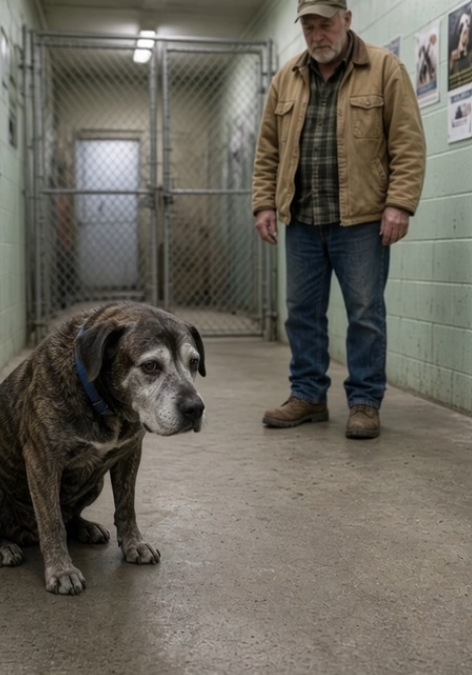
He Knelt on the Shelter Floor and Set Down a Pair of Old Gloves—Then the Dog He Had Lost Years Ago Took One Trembling Step Forward and Faced the Hardest Choice of All.
The old man had searched for his dog for seven years, but when he finally knelt on the shelter floor, the dog looked at him like love itself might be a trap.
Everyone expected the reunion to be instant, beautiful, and easy—until the trembling dog backed away from the only human who had never stopped looking.
Then the man slid a pair of old leather gloves across the floor, and one familiar scent exposed a story of loss, guilt, betrayal, and the kind of loyalty that survives even when trust does not.
The man knelt on the shelter floor and slid the gloves forward.
Then he turned his face away.
That was the part that made everyone stop breathing.
Not the gloves.
Not the dog.
Not even the fact that the old man had driven through the night after seeing one blurry photo on a rescue page that said SENIOR SHEPHERD MIX, POSSIBLE STRAY, EIGHT YEARS OLD, FEARFUL, NEEDS EXPERIENCED HOME.
It was the way he turned his face away.
As if looking too directly at the dog might break something.
As if he knew that love, when it returned after too much pain, had to come in sideways.
The room felt frozen in time.
Old fluorescent lights buzzed overhead. Posters about hope and adoption peeled from the cinderblock walls. A metal water bowl sat untouched in the corner. Somewhere down the hall, a terrier barked twice, then stopped, as if even he understood that something in Room Three had become too delicate for noise.
The dog stood rigid near the kennel door.
Eight years old.
Golden-brown coat dulled by years on the road.
Scars hidden under fur but not hidden from anyone who knew how to look.
One ear pulled back tight.
Front paws trembling so badly his nails clicked once against the floor.
He had come into the shelter three weeks earlier under the name County Intake 47. Found near a truck stop outside Billings, Montana, ribs showing, coat matted, old collar burn under the neck, and a healed injury along the left hind leg that made him sit crooked when he forgot to guard himself.
The shelter staff had called him Hank because shelters always needed names to replace the numbers.
But when the man saw the photo, he called the shelter before sunrise and said one word.
“Ranger.”
Now he knelt six feet away from the dog he believed he had lost seven years before.
He was white, early sixties, with weathered hands and a military cap placed carefully beside him on the floor. His hair was mostly gray. His shoulders were still broad, though the years had pulled them downward. He wore an old canvas jacket, jeans, and boots that had seen real work, not fashion.
His name was Thomas Hale.
Retired Army sergeant.
Widower.
Former search-and-rescue handler.
And for seven years, the first thing he did every morning was check missing dog listings before making coffee.
“I lost you,” Thomas said.
His voice came out rough and low, as if the words had rust on them.
“And I never stopped looking.”
The dog took one cautious step forward.
Then stopped.
His breathing turned shallow. His muscles locked. His eyes went to the door. Then the window. Then the corner behind him.
This was the moment he had learned to run.
Everyone in the room knew it.
Leah, the volunteer near the wall, wiped her face with the cuff of her sweatshirt. She had been at the shelter for eleven years and had seen dogs reunite with owners, dogs refuse owners, dogs recognize voices, dogs forget names, dogs forgive more than any human deserved.
But she had never seen this.
The dog wanted to go forward.
His whole body said so.
But his fear was older than the room.
Thomas did not look at him.
“I’m not here to take you,” he said softly. “Only if you choose me.”
Silence.
The dog leaned forward and sniffed the gloves.
Oil.
Leather.
Rain.
Cedar shavings.
Something old and impossible.
His body shook harder now.
A woman behind the observation glass covered her mouth. Dr. Elise Morgan, the shelter veterinarian, stood with both arms folded tightly, though tears had already escaped her control. Beside her, shelter director Paul Danner watched with the tense stillness of a man who had approved the meeting but did not yet believe in miracles.
The dog lowered his head to the gloves again.
He breathed in once.
Twice.
Something moved through him.
Not recognition all at once.
Not joy.
Memory.
That was more dangerous.
The dog lifted his head.
PART2:
For one heartbeat, it looked like he might bolt.
Instead, he crossed the distance.
Slowly.
One paw.
Then another.
The entire room seemed to lean with him.
He stopped beside Thomas’s knee.
Thomas did not reach.
Did not say his name again.
Did not cry out.
Did not grab.
The dog stood there shaking.
Then he lowered his head and rested it briefly against the man’s knee.
Just one second.
Enough to break everyone watching.
Thomas closed his eyes.
His hand lifted a fraction, then stopped in the air, asking permission without words.
The dog pulled back before he could answer.
Confused.
Torn.
Afraid of what choosing might cost him.
And that was where everything stopped.
Because the hardest part was not finding each other again.
It was deciding whether love was still safe.
Seven years earlier, Ranger had been the kind of dog people remembered.
Not because he was beautiful, though he was.
Not because he was obedient, though he had been trained better than most men Thomas knew.
People remembered him because Ranger had a way of looking at trouble like it had personally offended him.
He was not a purebred, though everybody guessed at him. Shepherd. Golden. Maybe some Belgian Malinois somewhere far back. He had a thick golden-brown coat, black shading over the muzzle, amber eyes, and one ear that never stood quite as proudly as the other.
Thomas used to joke that Ranger’s crooked ear was the only proof he had a sense of humor.
They had met when Ranger was fourteen months old and already on his second failed placement.
Too intense for a family.
Too smart for a backyard.
Too stubborn for the first handler who thought shouting louder counted as training.
Thomas was fifty-three then, recently retired from the Army, newly alone in a house that still held his wife’s books, her mug, her gardening gloves, and the silence left by a woman who had filled forty years without trying.
Mary Hale died in October.
Cancer.
The word was too small for what it did.
It entered their house quietly at first, then took every room.
After the funeral, people told Thomas he needed something to do. A hobby. Church group. Veterans’ coffee hour. Golf.
He lasted exactly one veterans’ coffee hour before leaving halfway through a story about cholesterol medication.
Then a friend from county search and rescue called.
“We’ve got a dog nobody can place.”
Thomas said, “I’m not looking for a dog.”
“Good. He’s not looking for a person.”
That dog was Ranger.
He stood in the training yard with a leash in his mouth, refusing to hand it over to anyone because Ranger had already decided humans mishandled equipment.
Thomas watched him for five minutes and said, “That dog is judging all of us.”
The trainer said, “Constantly.”
Thomas took the leash.
Ranger did not let go.
Thomas looked down.
“Son, if we’re going to argue, at least let me win the first one.”
Ranger stared at him.
Thomas stared back.
After seventeen seconds, Ranger released the leash.
The trainer laughed.
Thomas did not.
He knew a negotiation when he saw one.
Within a year, they were certified in wilderness search and recovery.
Ranger could track a scent over rock, through rain, across muddy creek beds, and once, infamously, into a church picnic where he located a missing toddler asleep beneath the dessert table with icing on both hands.
He found a lost hiker with a broken ankle during a snow squall.
He found a dementia patient in a drainage ditch two miles from home.
He found a boy who had run away after fighting with his father and hidden in an abandoned hunting blind, crying too hard to answer when searchers called.
Ranger did not care about praise.
He cared about the find.
After each successful search, he would press his head against Thomas’s knee once, hard and brief, then turn away as if embarrassed by affection.
Thomas understood.
Some love did not need display.
Then came the night Ranger disappeared.
It was supposed to be a routine assist near the border of Wyoming and Montana.
A storm had rolled over the Beartooth foothills faster than forecast. A college student named Daniel Ross had gone missing after leaving a campground alone. Search teams deployed before midnight. Rain turned trails to black ribbons. Wind knocked loose branches across the service road.
Thomas and Ranger were called at 2:13 a.m.
By 4:40, Ranger had the scent.
By 5:15, they found the student alive, hypothermic, wedged between rocks near a creek bed.
The rescue should have ended there.
It did not.
On the way back down, a mudslide broke above the trail.
Thomas remembered the sound first.
Earth moving like thunder.
Someone shouting.
Ranger lunging.
A tree coming down.
The leash ripping from Thomas’s hand.
Then pain.
When Thomas woke in the hospital, his left shoulder was dislocated, two ribs cracked, and Ranger was gone.
Searchers found Ranger’s torn vest caught on brush half a mile below the slide.
No body.
No tracks after the rain.
No collar.
No dog.
For five days, Thomas refused to leave the search area.
For twelve days, volunteers helped.
For three weeks, people called with possible sightings.
A golden dog near a logging road.
A shepherd mix outside Cody.
A limping stray behind a gas station.
Every time, Thomas went.
Every time, not Ranger.
Then the calls slowed.
Then stopped.
But Thomas did not.
He printed flyers until the ink bled.
Drove hundreds of miles.
Called shelters every week.
Checked rescue pages.
Joined missing dog groups.
Learned how to use social media even though he still believed “the cloud” sounded like something a person should not trust.
People were kind at first.
Then careful.
Then worried.
His daughter, Emily, tried to help.
“Dad,” she said one evening, five months after Ranger vanished, “you need to sleep.”
“I sleep.”
“In the truck?”
“That counts.”
“It doesn’t.”
“He’s out there.”
Her face crumpled.
“Maybe.”
Thomas heard the maybe.
He hated it.
Not because Emily was cruel.
Because she loved him enough to say the word everyone else swallowed.
Maybe Ranger was dead.
Maybe Ranger had been taken.
Maybe Ranger had crawled somewhere to die.
Maybe love did not guarantee a return.
Thomas looked at his daughter and said, “Your mother told me once that if I ever lost something living, I’d search until my own bones quit. She was right.”
Emily cried then.
He pretended not to see because fathers are cowards in specific ways.
Years passed.
The world continued insulting him by moving forward.
Seasons changed.
Grandchildren grew taller.
Neighbors repainted fences.
Emily divorced, remarried, and gave birth to another child.
Thomas fixed the porch, replaced the truck, and attended birthdays with a folded smile.
Every morning, he checked listings.
Every night, he left the porch light on.
Not because Ranger would find the house from Montana.
Because some rituals are not about logic.
They are about refusing to let love be declared over by people who stopped looking.
What Thomas did not know was that Ranger had survived the mudslide.
Barely.
He woke tangled in brush near a wash, bruised, bleeding, and too disoriented to follow his own scent back. The storm scattered everything. The search grid moved above him while he dragged himself toward lower ground.
Two days later, a man in a rusted pickup found him near a culvert.
Ranger, injured and exhausted, let himself be lifted.
That was the last kind human hand he trusted for a long time.
The man said his name was Wade.
Later, shelter records would identify him as Wade Kessler, though by then he had used three last names and owed fines in two states. Wade saw not a lost search dog but a useful animal. Strong, trained, responsive to commands, no collar, no witnesses.
He did not take Ranger to a shelter.
He took him to work.
For months, Ranger rode in the back of the pickup from ranch to ranch, construction site to construction site, wherever Wade found temporary labor. He was fed irregularly. Hit when he refused. Locked in sheds. Loaned to men who thought a working dog was just another tool.
The first time Ranger ran, he made it six miles before hunger and injury slowed him.
Wade found him.
After that came chains.
Then came shock collars.
Then came the lesson Ranger learned too well.
Coming when called could hurt.
Trusting hands could hurt.
Being recognized could hurt most of all.
Years blurred.
Ranger escaped again sometime during a spring flood outside Sheridan.
For a while, he lived as a ghost dog near highways and grain bins. He learned dumpsters, culverts, ditches, deer carcasses, the kindness of one old woman who left biscuits behind her laundromat, the cruelty of teenagers with rocks, and the exact distance a human could come before he needed to run.
He carried Thomas inside him as scent and sound.
Leather gloves.
Gun oil from cleaning old hunting rifles.
Cedar shavings from the porch box.
Coffee.
The low whistle Thomas used before releasing him on a trail.
But memory became dangerous.
A dog on the road cannot afford longing.
Longing makes you step toward hands.
Hands are how leashes appear.
So Ranger buried the memory as far as an animal can.
Until a shelter volunteer named Leah posted his photo.
She almost did not.
County Intake 47 was not the kind of dog people shared because he made them smile. He stood stiff in every picture. Eyes hard. Head low. Body angled toward escape. He refused toys. Refused most food if anyone watched. Refused touch unless sedated.
Paul, the director, said, “We need a foster with behavior experience, not a social media campaign.”
Leah said, “Maybe somebody knows him.”
“Leah.”
“Somebody might.”
“He’s been on the road for years.”
“Then somebody has missed him for years.”
Paul sighed.
Leah wrote the post anyway.
Senior shepherd mix found near I-90 truck stop. Golden-brown coat, estimated eight years old. Fearful but not aggressive. Possible old working dog. Distinct scar on left hind leg. Please share.
Thomas saw it at 5:06 a.m.
He had opened the page with coffee in one hand and his reading glasses in the other. At first, he scrolled past because seven years teaches a man not to let his heart jump at every brown dog.
Then something stopped him.
The ear.
One ear slightly softer than the other.
He enlarged the photo until the image blurred.
The dog’s face was older.
Harder.
Thinner.
But the ear was the same.
Thomas’s coffee went cold.
He called the shelter.
Leah answered.
“Yellowstone County Animal Shelter, this is Leah.”
Thomas tried to speak.
Nothing came.
“Hello?”
He cleared his throat.
“The dog you posted. Intake 47.”
“Yes?”
“Does he have a scar inside his right front leg? Thin line. About three inches. From old barbed wire.”
There was a pause.
“I’d have to check the medical notes.”
“And when he’s nervous, does he press his tongue once against the left side of his mouth?”
Another pause.
“Sir, who is this?”
“My name is Thomas Hale,” he said. “And I think that dog is mine.”
Eight hours later, Thomas reached the shelter with a folder of proof on the passenger seat and a pair of old leather gloves on the dashboard.
Leah met him at the front desk.
She had expected desperate owners before.
They came with photos, tears, sometimes guilt, sometimes hope too large for the room.
Thomas came with the stillness of a man afraid that if he moved too quickly, the universe would change its mind.
He placed the folder on the counter.
Inside were photographs.
Ranger at two, muddy after a search.
Ranger at four, head on Thomas’s boot.
Ranger wearing an orange search vest.
Ranger with Mary, who had been alive long enough to love him for one summer.
Certificates.
Microchip paperwork.
Old veterinary records.
Search-and-rescue ID.
Leah looked through them with tears gathering before she reached the last page.
Paul stood beside her.
“The microchip scanner didn’t pick anything up,” he said carefully.
Thomas nodded.
“It was between his shoulders. Could have migrated. Could have been removed.”
Paul glanced up.
Removed was not a word anyone liked.
Dr. Morgan examined the records.
“The hind-leg scar matches. Age matches. Dental wear is close. Markings are close, though coat condition—”
“It’s him,” Thomas said.
No anger.
No drama.
Just certainty.
Dr. Morgan softened.
“We need to do this carefully. He does not trust people approaching. He has shown flight panic. No direct grabbing. No crowding. No sudden movements.”
Thomas looked at her.
“I know.”
Paul said, “If he doesn’t recognize you—”
“He doesn’t owe me recognition.”
Leah blinked.
Thomas looked toward the kennel hall.
“If he’s Ranger, he survived something I wasn’t there to stop. He doesn’t owe me anything.”
That was when Leah decided she trusted him.
Room Three was chosen because it was the quietest.
No windows to the kennel yard.
No loose objects.
Two exits.
Rubber matting.
A blanket in the corner.
They brought the dog in first.
He stood near the kennel door, body tense, eyes scanning.
Then Thomas entered.
The dog froze.
For one second, something in him seemed to break the surface.
Then fear slammed over it.
Thomas lowered himself to the floor with visible effort. His knees did not appreciate it. Neither did his back. He removed his military cap and placed it beside him.
Then he took the old gloves from his jacket pocket.
The gloves had belonged to him during the search years. Ranger had carried them around the house when Thomas did not put them away. Mary used to complain that the dog treated leather better than toys.
Thomas slid them forward.
Then turned his face away.
And the room held its breath.
Now, after the dog touched his head to Thomas’s knee and pulled back again, everyone waited for what Thomas would do.
He did nothing.
That was harder than reaching.
His hands rested open on his thighs.
His eyes stayed lowered.
The dog stood two feet away, trembling so violently that Leah nearly stepped forward.
Dr. Morgan whispered, “Wait.”
The dog looked at the gloves again.
Then at Thomas.
Thomas said, “You used to steal those.”
The dog’s ears twitched.
“Mary said you were the only creature she knew who could make theft look solemn.”
At the name Mary, the dog’s head shifted.
Thomas swallowed.
“She would have fussed over you something terrible. You remember her?”
The dog took one step back.
Too much.
Thomas stopped speaking.
Silence returned.
After nearly a minute, Thomas slid one hand slowly toward the glove but did not take it.
“I brought your whistle too,” he said.
Paul stiffened behind the glass.
Leah looked at him.
Thomas reached into his jacket pocket and drew out a small metal whistle on a cord.
The dog’s eyes locked onto it.
Fear?
Recognition?
Both.
Thomas did not blow it.
He set it on the floor beside the gloves.
“I won’t use it,” he said. “Not unless you ask.”
That sentence broke Leah.
She turned her face toward the wall.
Because who asks a dog for permission?
Someone who knows obedience is not the same as trust.
The dog stared at the whistle.
His breathing grew fast.
A memory moved through him.
A mountain trail.
Rain.
Thomas’s whistle before release.
Run, Ranger.
Find.
Another memory.
A different man.
A metal click.
Pain.
Come here, dog.
Pain again.
His body could not decide which past was real.
Thomas lowered his head.
“I should’ve held the leash tighter.”
The words were barely above a whisper.
“I know people told me it wasn’t my fault. They were wrong.”
Dr. Morgan’s face tightened.
The dog’s eyes lifted.
“I had you,” Thomas said. “And then I didn’t.”
His voice cracked.
“I’m sorry.”
The room changed.
People often apologized to animals in a bright voice, hoping tone could cover guilt.
Thomas did not.
He apologized like a man placing something heavy on the floor because he could not carry it one more step.
The dog moved before anyone expected it.
Not forward.
Back.
He retreated to the corner, pressed his body against the wall, and lowered his head.
Leah’s heart dropped.
Paul whispered, “That’s enough.”
But Thomas shook his head once.
“No,” Dr. Morgan said softly. “Look.”
The dog had not shut down.
He had not turned away.
He was watching Thomas.
His body needed distance.
His eyes did not.
Thomas sat on the floor for forty-seven minutes.
No one spoke.
At minute twelve, the dog sat.
At minute nineteen, he lowered himself to the mat.
At minute twenty-eight, Thomas’s left leg began cramping, but he did not move.
At minute thirty-one, the dog rested his chin on his paws.
At minute forty, Thomas picked up one glove and held it against his own chest for a moment before setting it back down.
At minute forty-seven, the dog rose, walked to the gloves, picked one up gently in his mouth, and carried it to the corner.
Thomas bowed his head.
“Good boy,” he whispered.
The dog flinched at the praise.
Thomas corrected himself.
“Good choice.”
That was the first meeting.
They did not leave together.
People later argued about that.
Online, once the story spread, thousands of strangers with no knowledge of trauma insisted Thomas should have taken Ranger home immediately.
They wrote things like true love heals all wounds and the dog knows his person and why leave him in a shelter another night?
Leah wanted to answer every one of them with the same sentence.
Love is not a leash.
Instead, she posted nothing.
Thomas returned the next morning.
And the next.
And the next.
Every day, he drove to the shelter and sat in Room Three.
Sometimes Ranger came close.
Sometimes he did not.
Sometimes he took the glove.
Sometimes he growled at the hallway.
Once, a kennel door slammed nearby and Ranger panicked so badly he threw himself into the corner hard enough to bruise his shoulder.
Thomas did not touch him.
He sat on the floor and said, “You’re here. I’m here. That’s all.”
On the fifth day, Emily came.
Thomas did not ask her to. Leah had called, worried about the strain on him. Emily drove three hours with a casserole in the back seat because that was what her mother would have done.
She stopped outside Room Three and covered her mouth.
Ranger was lying six feet from Thomas, head up, eyes watchful.
Older.
Scarred.
Alive.
Emily cried before entering.
Ranger lifted his head.
Thomas looked over.
“Em.”
She stepped in slowly.
“Hi, Ranger.”
The dog stared.
Emily crouched near the door.
“You probably don’t remember me.”
Thomas smiled faintly.
“He remembers who gave him turkey under the table.”
Emily laughed through tears.
“That was Mom.”
“That was both of you. Your mother just didn’t get caught.”
At the word Mom, Emily broke fully.
She sat on the floor and wept into both hands.
Ranger watched.
Then, quietly, he rose.
He did not go to Thomas.
He went to Emily.
Stopped two feet away.
Sniffed.
She held still.
He leaned forward and touched his nose to her sleeve.
Emily whispered, “I missed you too.”
That afternoon, Paul approved a slow foster transfer plan.
Not adoption.
Not yet.
The language mattered.
Ranger would visit Thomas’s home for two hours, then return. Then half a day. Then overnight if he chose stability. Dr. Morgan warned Thomas that reunion did not erase trauma. Ranger might never be the same dog. He might bolt. He might fear doorways, collars, men, vehicles, whistles, praise, hands.
Thomas listened to every word.
At the end, he said, “I don’t need him to be who he was.”
Dr. Morgan looked at him.
“Who do you need him to be?”
Thomas looked through the glass at Ranger asleep with one paw resting on the glove.
“Here.”
The first home visit nearly failed at the truck.
Ranger reached the parking lot, saw Thomas’s pickup, and locked.
No pulling.
No coaxing.
No cheerful nonsense.
Thomas simply opened the truck door and sat on the curb ten feet away.
Ranger stared at the vehicle.
His body shook.
Leah stood nearby holding the loose long lead.
“He doesn’t have to,” Thomas said.
After nine minutes, Ranger approached the truck.
Sniffed the tire.
Backed away.
Approached again.
Sniffed the running board.
Thomas looked at the sky, pretending not to watch.
Finally, Ranger put his front paws inside.
Then jumped back like the truck had bitten him.
Thomas nodded.
“That’s one.”
Leah smiled.
It took thirty-one minutes before Ranger climbed into the back seat on his own.
Thomas did not celebrate.
He started the truck only after Ranger lay down.
On the drive, Ranger panted hard for the first ten miles, then went quiet.
Thomas drove the long way to avoid the interstate.
When they reached the house, Ranger lifted his head.
The Hale house sat at the end of a gravel drive bordered by pines and cottonwoods. A porch ran along the front. The wood had been stained last summer. A wind chime Mary bought in Santa Fe hung near the steps. Beside the door sat the cedar box where Thomas had always kept search gear.
Ranger stared at the porch.
His nose moved.
Cedar.
Old dust.
Coffee from inside.
A faint ghost of lavender from the dried wreath Emily had hung after Mary died.
Thomas opened the truck door.
Ranger did not move.
“That’s all right,” Thomas said.
He sat on the porch steps with the front door open.
It took Ranger twelve minutes to leave the truck.
He walked around the yard in widening circles, mapping scent against memory. He paused at the cedar box. Sniffed once. Twice. Then pressed his nose hard to the lid.
Thomas opened it.
Inside were old search vests, lead lines, a faded tennis ball, and a folded orange bandana Mary had tied around Ranger’s neck every Fourth of July because she said he deserved to look festive even if he judged fireworks as poor public policy.
Ranger took the bandana in his mouth.
Then dropped it.
Then picked it up again.
His legs folded.
He lay down beside the box and made a sound Thomas had never heard from him before.
Not a whine.
Not a bark.
Something lower.
Older.
Thomas sat on the steps and cried without covering his face.
The visit lasted two hours.
When it was time to return to the shelter, Ranger surprised everyone by climbing into the truck without hesitation.
But at the shelter entrance, he refused to get out.
Leah’s eyes filled.
Thomas stood beside the open door.
“Your choice,” he said.
Ranger looked at the shelter.
Then at Thomas.
Then he climbed out.
Not because he wanted to return.
Because trust, once broken, sometimes needs proof that leaving is not abandonment.
Thomas came back the next day.
And the next.
On the tenth day, Ranger stayed overnight.
He slept in the hallway outside Thomas’s bedroom, not inside. At 2:17 a.m., Thomas woke to the sound of nails pacing.
He found Ranger standing by the front door, trembling.
“You need out?”
Ranger looked at him.
Thomas opened the door.
Cold air entered.
Ranger stepped onto the porch.
Then into the yard.
Thomas’s heart stopped.
Every instinct screamed to call him back.
To grab the leash.
To shut the gate.
To prevent loss with control.
Instead, he stood in the doorway.
Ranger walked to the edge of the porch light.
Stopped.
Looked into the dark pines.
For a terrible second, Thomas saw the future split.
The dog could run.
He had every right.
Thomas gripped the doorframe hard enough that his knuckles hurt.
“I’m here,” he said.
Not come.
Not stay.
Not Ranger.
Just truth.
“I’m here.”
Ranger stood in the dark.
Then turned around and came back inside.
Thomas did not sleep the rest of the night.
But Ranger did.
Three weeks later, the adoption became official.
The shelter staff gathered quietly in the lobby. Leah brought the paperwork. Paul pretended he had dust in his eye. Dr. Morgan checked Ranger one more time though there was no medical reason except love.
Name: Ranger Hale.
Age: Estimated eight.
Breed: Shepherd mix.
Status: Returned to original owner.
Thomas signed slowly.
His hand shook.
Leah clipped Ranger’s new tag to a simple leather collar, loose enough not to press the scar tissue under his fur. Ranger tolerated it because Thomas had spent two weeks letting him sniff the collar, step away from it, return to it, and decide.
When the tag settled against his chest, Leah read it aloud.
RANGER HALE
I AM HOME
Thomas looked away.
Paul cleared his throat.
“I said no sentimental tags.”
Leah wiped her face.
“You also said you weren’t crying.”
“I’m not.”
“Your eyes are leaking professionally.”
Ranger pressed his head once against Thomas’s knee.
Brief.
Firm.
Embarrassed.
Thomas laughed and cried at the same time.
The story should have ended there.
People wanted it to.
Lost dog found.
Veteran reunited.
Shelter celebrates.
Everyone goes home believing love conquers all.
But real healing is rarely polite enough to end where people clap.
Two months after Ranger came home, Thomas received a call from Detective Alvarez in Sheridan.
“We found the man who had your dog.”
Thomas sat at the kitchen table.
Ranger lay under it, chin on Thomas’s boot.
The detective explained that Wade Kessler had been arrested after a traffic stop uncovered stolen equipment, forged work documents, and two dogs in poor condition in the back of a trailer. One had an old search-and-rescue vest cut into pieces beneath a tarp.
Ranger lifted his head as if the past had scent.
Thomas’s hand lowered to his neck.
“Is he being charged?”
“Yes. Animal cruelty. Theft. Fraud. We’re building more.”
“There are more dogs?”
“Yes.”
Thomas closed his eyes.
After the call, Emily came over.
She found her father on the porch, Ranger pressed against his side.
“What happens now?”
Thomas looked toward the trees.
“I testify if they need me.”
“And Ranger?”
“He doesn’t go near that man.”
Emily sat beside him.
For a while, neither spoke.
Then Thomas said, “I keep thinking about all the years.”
“I know.”
“He was alive.”
“Yes.”
“He was being hurt.”
Emily’s eyes filled.
“And you didn’t know.”
“I should have.”
“No.”
Thomas looked at her.
“Dad, no. You searched. You did more than anyone else would have done.”
“Not enough.”
“Enough to find him.”
The trial was small.
No cameras.
No dramatic confrontation.
Wade Kessler looked older than Thomas expected. Smaller too. Men who become monsters in memory often disappoint in person. He wore a county-issued shirt and the bored expression of someone offended by consequences.
Thomas testified.
He described Ranger.
The work they had done.
The night of the mudslide.
The years searching.
He did not describe what he wanted to do to Wade when shown photos of the collar wounds. Some truths were not useful in court.
The prosecutor asked, “Mr. Hale, what did you lose when Ranger disappeared?”
Thomas looked at the wooden rail in front of him.
“My partner.”
His voice roughened.
“And then I lost the version of myself who believed if you loved something hard enough, you could protect it.”
The courtroom went silent.
Wade took a plea after two other witnesses came forward.
He served time.
Not enough, in Thomas’s opinion.
But justice, like healing, often arrived smaller than hunger demanded.
The two dogs found in Wade’s trailer were transferred to rescues.
Thomas paid their medical bills anonymously.
Leah knew anyway.
She said nothing.
A year after Ranger came home, Yellowstone County Animal Shelter held a small ceremony for volunteers and adopters. Thomas did not want to attend. Emily made him because she had inherited her mother’s way of turning care into orders disguised as suggestions.
Ranger walked beside him through the shelter doors.
The lobby fell quiet.
Not because Ranger looked perfect.
He did not.
He was older now. Slower. His left hind leg stiffened in cold weather. He still disliked sudden noises. He did not enjoy strangers touching him, and Thomas did not allow it.
But he walked with his head level.
That was enough.
Leah knelt when she saw him.
“Hi, handsome.”
Ranger sniffed her hair, then leaned briefly against her shoulder.
Leah cried immediately.
“You could at least make me work for it,” she whispered.
Thomas spoke during the ceremony because Paul tricked him by listing it as “brief remarks” and Emily blocked the exit.
He stood with Ranger at his side and looked at the shelter staff, volunteers, adopters, and a few local reporters.
“I used to think reunion meant getting back what was lost,” he said.
Ranger leaned against his leg.
“I was wrong. Sometimes what comes back is not the same. Sometimes neither of you are. You don’t get to demand the past because you missed it.”
He looked down at Ranger.
“You get to offer safety today. Then tomorrow. Then the day after that. And if you’re lucky, the one you love decides to believe you.”
The room went quiet.
Thomas cleared his throat.
“This shelter gave him that choice. Not forced. Not rushed. Given. That saved him as much as anything.”
Afterward, donations poured in for fearful senior dogs.
Leah started a program called Choice First.
No forced meet-and-greets.
No dragging dogs into adopters’ arms for cute photos.
No insisting fear meant aggression or love meant instant trust.
Thomas came every Thursday with Ranger.
At first, Ranger waited in the truck.
Then the lobby.
Then the quiet room.
Eventually, he began lying outside Room Three while frightened dogs met patient people on the floor.
He did not greet every dog.
Did not perform.
But sometimes, when a dog trembled too hard to approach, Ranger would sigh, stand with the weariness of an old professional, walk into the room, and lie down between the dog and the human.
Calm.
Unbothered.
Proof that survival could grow old and still choose softness.
Thomas called him assistant director.
Paul said absolutely not.
Leah made a name tag.
Years later, when Ranger’s muzzle had gone almost white and his walks shortened to the mailbox and back, Thomas still kept the leather gloves by the door.
Not in a drawer.
Not sealed away.
By the door.
Some objects deserve to remain in the open because they carried too much to be hidden.
One winter evening, snow began falling early.
Thomas sat in his chair near the window with Ranger asleep on the rug. The dog’s breathing was deep and uneven, the way old dogs breathe when dreams chase them more gently than memories once did.
Emily sat on the couch with a quilt over her lap.
Her youngest son, now ten, was on the floor building something complicated with wooden blocks.
“Grandpa?” the boy asked.
“Yes?”
“Was Ranger brave?”
Thomas looked at the dog.
Ranger’s paw twitched.
“Yes.”
“Because he found people?”
“That was one kind.”
“What’s the other kind?”
Thomas thought about Room Three.
The gloves.
The trembling.
The first step forward.
The step back.
The night at the open door.
The choice to return.
“Trusting again,” Thomas said. “After he had good reason not to.”
The boy considered that.
Then nodded as if it made sense in the private way children understand more than adults expect.
When Ranger died, he did it in spring.
Thomas would later be grateful for that.
Winter would have felt too cruel.
It was a warm April morning with light coming through the kitchen window and robins arguing in the yard. Ranger had eaten half his breakfast, refused his medicine with the dignity of an old king, and rested his head on Thomas’s boot.
Then he looked up.
Thomas knew.
Old handlers know when a partner is done searching.
Emily came.
Leah came.
Dr. Morgan came to the house because some debts of love cannot be paid at a clinic counter.
Thomas sat on the floor beside Ranger with the leather gloves near his paw.
“You can choose this too,” he whispered.
Ranger’s eyes were cloudy but calm.
Thomas placed one hand on his shoulder.
This time, after years of asking, Ranger did not pull away.
He leaned in.
Just slightly.
Enough.
Afterward, Thomas buried him beneath the cedar tree near the porch, beside Mary’s garden where lavender grew wild if ignored and better if loved. He placed the old search whistle in the small wooden box with Ranger’s collar but kept the gloves.
Not because he could not let go.
Because letting go does not mean erasing everything that helped you hold on.
A month later, Thomas returned to the shelter alone.
Leah met him at the door.
For a moment, neither spoke.
Then she hugged him.
He allowed it for three seconds longer than he would have years before.
“I’m not adopting,” he said gruffly.
“I didn’t ask.”
“I’m too old.”
“I didn’t say anything.”
“I’m serious.”
“Of course.”
She led him past the kennels.
At Room Three, a new dog stood in the corner.
Black-and-white.
Female.
Maybe six.
Fearful eyes.
Body pressed against the wall.
“She was found outside Livingston,” Leah said. “Won’t let anyone near.”
Thomas looked through the glass.
His throat tightened.
“No.”
“Okay.”
“I said no.”
“I heard you.”
He stood there another minute.
The dog stared at him.
Thomas looked down at his empty hands.
Then at Leah.
“Do we have gloves?”
Leah smiled through tears.
“In the supply room.”
He nodded.
“Don’t make that face.”
“What face?”
“The face that says you planned this.”
“I would never.”
“You absolutely would.”
Thomas took the gloves and entered Room Three.
His knees hurt more now, so lowering himself to the floor took time.
The frightened dog watched every movement.
Thomas slid the gloves forward.
Then turned his face away.
“I’m not here to take you,” he said softly. “Only if you choose me.”
Outside the room, Leah covered her mouth.
Not because the moment repeated.
Because love had.
And this time, Thomas understood something he had not known when Ranger first came back.
The hardest part is not finding what was lost.
The hardest part is becoming safe enough that love can choose to stay.
Ranger had taught him that.
Not all at once.
Not through obedience.
Not through the pretty reunion people wanted.
Through fear.
Distance.
Patience.
Return.
A dog once lost on a mountain had come home older, scarred, and unsure. An old man once broken by guilt had learned not to confuse love with holding tight. Together, they had built a life neither could reclaim from the past, only make new.
And somewhere outside Room Three, in the bright shelter hallway where hope posters still peeled from the walls and fluorescent lights still buzzed overhead, an old pair of gloves waited on the floor between a frightened dog and a patient man.
Oil.
Leather.
Time.
Not a command.
Not a promise.
An invitation.
Choose when you’re ready.
I’ll be here.








