He came across a dying mother cat by the roadside with her kitten wailing beside her—and a small decision exposed a cruel secret that everyone else had ignored.
PART3:
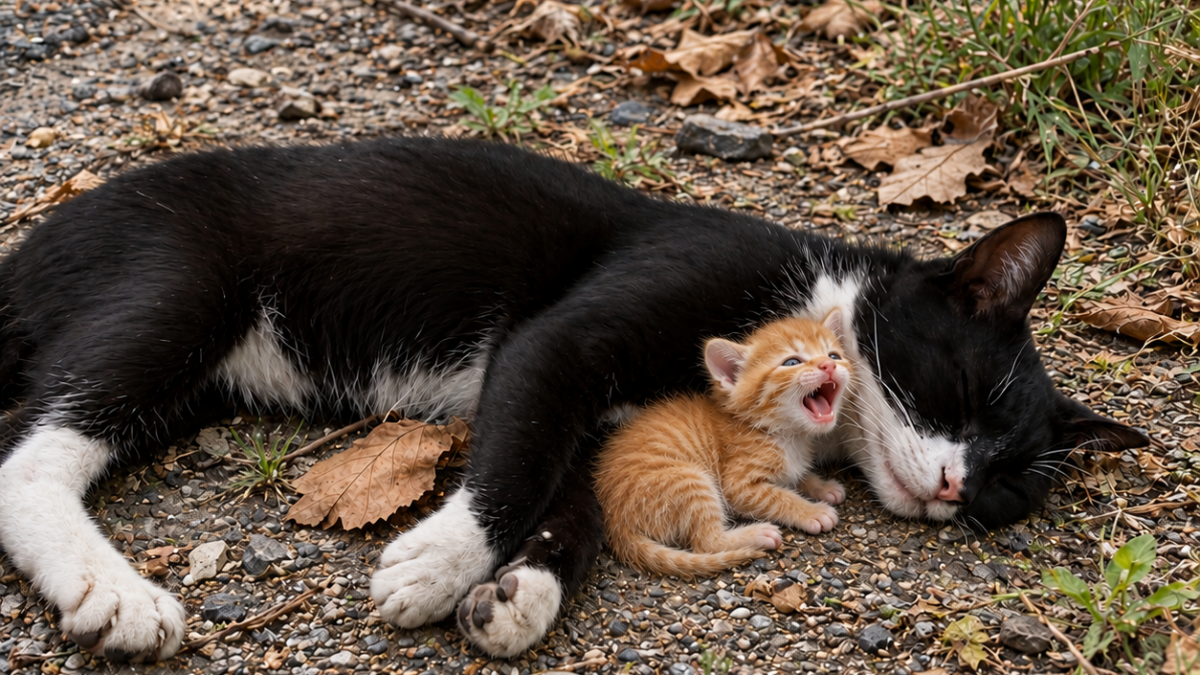
She dragged one front paw forward, then collapsed. Not aggressive. Not trying to run. Trying to cover them.
That was what broke me.
Her body had almost nothing left, but whatever she had, she was still using it to protect them.
“It’s okay,” I said, though it was not okay at all. “Easy. I’m not going to hurt you.”
I took one step closer.
She hissed.
A thin, broken sound.
Then she coughed, and her head dropped back into the wet grass.
The orange kitten crawled over her shoulder and tucked itself beneath her chin. The black-and-white one pawed blindly at her belly, searching for milk. The tiny tabby pressed against her ribs. The white one with the smudged eye had stopped crying and was shivering so violently I thought, with a sudden sick certainty, that it might die right there before I could do anything useful.
I had no carrier. No gloves. No plan.
In my truck, behind the seat, I kept an old moving blanket, jumper cables, a flashlight, two bungee cords, and a toolbox. Things practical men keep so they can solve practical problems.
This did not feel practical.
This felt like I had pulled over at the edge of someone else’s tragedy and had no right tools for the job.
I ran back to the truck, grabbed the blanket, and called the first veterinarian that came up on my phone.
Briar Glen Animal Clinic.
Closed at five.
It was 5:48.
I cursed and called the emergency number listed in the voicemail.
A woman answered on the fourth ring, breathless, like she had been moving quickly.
“Briar Glen emergency line, this is Dr. Elena Ruiz.”
“I’m on County Road 18,” I said, the words tumbling out. “There’s a cat. Mother cat. She’s down by the road. Four kittens. She’s alive but barely moving. I don’t know if she got hit.”
“Are you safe from traffic?”
The question snapped me into focus.
“Mostly.”
“Get farther off the road if you can. Do not put yourself in traffic. Is she bleeding heavily?”
I looked back.
“I don’t see blood. She’s soaked. Weak. The kittens are cold.”
“Can you transport them?”
“I don’t have a carrier.”
“Use a blanket, box, tote, anything. Keep the kittens with her if possible. Bring them in. I’m ten minutes from the clinic. I’ll meet you there.”
I swallowed. “She hissed at me.”
“She’s scared and protecting her babies. Move slowly. Cover her with the blanket first if you can. Keep your face and hands away from her mouth. If she fights hard, call animal control, but from what you’re describing, she may be too weak.”
Too weak.
The words made my chest tighten.
“I’ll bring them,” I said.
I hung up and stood in the rain with the blanket in my hands.
The mother cat watched me.
The kittens screamed.
Another car passed.
No one stopped.
“Okay,” I whispered. “Okay, mama. I know. I know you don’t trust me. I wouldn’t trust me either.”
I moved slowly, crouching low, trying to make myself smaller. Rain ran down the back of my neck. Gravel bit through the knee of my jeans as I knelt. The mother cat’s ears flattened. Her mouth opened, but this time no hiss came out.
She was spent.
That frightened me more than the hiss had.
I spread the blanket near her first, then eased one edge over her back. She flinched. The kittens wriggled and cried beneath her neck. I paused, breathing hard.
“Easy,” I said. “Easy.”
There are moments when the world narrows until everything depends on your hands being gentle enough.
I slid my arms under the blanket, scooping as much of the little family together as I could. The mother cat tensed, one paw pushing weakly against my sleeve. A tiny claw caught the skin near my wrist, sharp as a needle. I barely felt it.
She was lighter than she looked.
That is another thing I remember.
How little she weighed.
All that love, all that terror, all that effort to keep four babies alive, and she weighed almost nothing.
The kittens rolled against her belly as I lifted them. One slipped toward the edge of the blanket, and I panicked, trapping it gently with my forearm.
“I’ve got you,” I said. “I’ve got you.”
The mother cat’s head lolled toward my wrist.
For one second, I thought she had died.
“No,” I said sharply. “No, no, no. Stay with me.”
Her eye opened halfway.
Angry.
Exhausted.
Alive.
I carried them to the truck and set them on the passenger seat, blanket bunched into a nest. The groceries had spilled everywhere. Chicken slid against the door. Apples rolled under the pedals. None of it mattered.
I turned the heat up high, angled the vents toward them, and drove.
I have never driven so carefully in my life.
Every bump felt like a betrayal. Every red light felt personal. The kittens cried in waves, then fell quiet, then cried again. The mother cat lay curled around them as much as she could, but her body trembled. Once, she lifted her head and looked at me.
I know people say animals cannot understand.
Maybe not words.
But they understand danger. They understand pain. They understand hands that hurt and hands that do not. They understand when everything familiar has collapsed and a stranger is the only thing between them and the dark.
“It’s all right,” I told her. “We’re almost there.”
The clinic parking lot was empty except for one blue sedan crookedly parked by the entrance. The lights inside were on.
Dr. Ruiz opened the door before I knocked.
She was small, maybe in her early forties, with dark hair twisted into a messy bun and a sweatshirt under her white coat. Her face was calm in that deliberate way emergency people learn when panic would waste time.
“Bring them in,” she said.
I carried the blanket bundle through the door.
The clinic smelled like disinfectant, clean towels, and fear.
A vet tech in purple scrubs appeared from the back. Her name tag said Maddy. She looked about twenty-five and had the wide, worried eyes of someone still new enough to feel everything but trained enough to keep moving.
“Exam room two,” Dr. Ruiz said. “Warm towels. Scale. Fluids ready.”
The words moved around me.
I placed the blanket on the metal exam table, and the mother cat tried, impossibly, to pull the kittens beneath her again.
Dr. Ruiz’s face softened.
“Oh, mama,” she murmured. “You did enough. Let us help now.”
The mother cat looked at her.
Then at me.
Then her head dropped.
Everything happened quickly after that.
Maddy gathered the kittens one by one, checking warmth, weight, gums, breathing. The orange one screamed with surprising force. The black-and-white one rooted at Maddy’s finger. The gray tabby sneezed. The white kitten with the eye smudge barely made a sound, and Maddy’s expression tightened.
“This one’s coldest,” she said.
“Get the warmer,” Dr. Ruiz replied.
She examined the mother cat with efficient gentleness. Temperature. Heart. Lungs. Abdomen. Legs. Spine. Mouth. Eyes. She moved one limb, then another. The cat flinched but did not fight.
“No obvious fractures,” Dr. Ruiz said, partly to Maddy, partly to herself. “Shock. Dehydration. Possible soft tissue trauma. Road rash on the hip, not severe. She may have been clipped or thrown. Or she collapsed from exhaustion near the road and narrowly avoided worse.”
“She’ll live?” I asked.
Dr. Ruiz glanced at me.
That glance held too much experience to offer cheap comfort.
“She has a chance,” she said. “A real one. But she’s weak, and the kittens are vulnerable. We need to warm them slowly, get fluids into her, check for internal injuries, and see if she can nurse.”
“What do you need me to do?”
The question came out before I had time to think about it.
Dr. Ruiz looked almost surprised.
“Right now? Wash your hands. Then sit. You’re bleeding.”
I looked down.
The scratch on my wrist had opened, a red line across my skin.
It seemed ridiculous that my body had anything to say about pain in that room.
Maddy took the smallest kitten to a warming pad. The orange and black-and-white kittens were placed near their mother once she had a towel beneath her. The gray tabby kept trying to crawl toward her face. The mother cat’s eyes were half-shut, but when the kitten bumped her chin, she opened them and gave one faint lick across its head.
Maddy made a sound that was almost a sob.
Dr. Ruiz did not look up, but her voice softened. “That’s good. Grooming is good.”
I washed my hands in the sink, wrapped a paper towel around my wrist, and sat in the corner chair like a man waiting for a verdict.
The mother cat was mostly gray with a white chest and white front paws. Her fur, once cleaned of some mud, showed faint tabby striping along her sides. She had a narrow face and enormous eyes. One ear had a torn edge. Not fresh. An old injury. She could not have been more than two or three years old, but exhaustion made her look ancient.
The kittens were maybe four weeks, Dr. Ruiz guessed. Old enough to crawl, young enough to still need their mother desperately.
“Do they have names?” Maddy asked.
I laughed once, startled. “I found them in a ditch twenty minutes ago.”
“Fair.”
She glanced at the mother cat. “She looks like a Mercy.”
Dr. Ruiz smiled faintly. “Maddy names everything.”
“I do not.”
“You named the possum Kevin.”
“He looked like a Kevin.”
The absurdity of that conversation in the middle of crisis loosened something in my chest.
“Mercy,” I repeated.
The mother cat’s ear flicked.
Maddy pointed. “See? She knows.”
“She’s probably annoyed.”
“Still counts.”
Dr. Ruiz inserted fluids beneath Mercy’s skin while Maddy warmed the kittens. Mercy did not have broken bones. That was the first good news. No obvious internal bleeding. That was the second. She was underweight, dehydrated, flea-bitten, and bruised, with scrapes along one hip, but nothing that said she could not recover if given safety and care.
If.
Such a small word.
Such a heavy door.
After an hour, the kittens were warmer. The white one with the smudged eye began to squeak again. Mercy lifted her head when they were placed against her belly. Weakly, awkwardly, she shifted herself around them.
Then the orange kitten latched.
Maddy whispered, “Yes.”
The black-and-white followed. Then the tabby. The white kitten struggled until Maddy helped guide it.
Mercy’s eyes closed.
Not in defeat this time.
In relief.
I looked away because my own eyes had betrayed me.
Dr. Ruiz pretended not to notice.
“You did the right thing stopping,” she said.
I cleared my throat. “Anybody would’ve.”
She looked at me then, not unkindly.
“No,” she said. “They wouldn’t.”
I did not know what to do with that.
I had always thought of goodness as something dramatic. Firefighters running into buildings. Soldiers carrying wounded friends. People donating kidneys. Something big enough that ordinary failures did not have to measure themselves against it.
But maybe goodness was sometimes a truck easing onto a shoulder while everyone else kept driving.
Maybe that was worse.
Because it meant the chances to be decent were everywhere, and most of us were pretending not to see them.
“What happens now?” I asked.
Dr. Ruiz removed her gloves. “Normally, if they’re strays and stable, we would contact animal control or a rescue foster. The clinic can keep them overnight if medically necessary, but we’re not a shelter. With a nursing mother, a foster home would be best once she’s stable.”
“A foster home.”
“Yes.”
I looked at Mercy.
She had one paw curled over the orange kitten.
A fierce, useless little guardrail.
“She can’t go back outside.”
“No.”
“And if animal control takes them?”
Dr. Ruiz hesitated.
That hesitation told me enough.
“Depends on space,” she said carefully. “Some shelters are excellent. Some are overwhelmed. Nursing families need quiet, warmth, monitoring. If she’s fearful, she may shut down in a kennel.”
Mercy opened her eyes.
They found me.
I wish I could say I made the decision bravely.
I did not.
I made it with a tired sigh, a sinking stomach, and the full awareness that my life was about to become more complicated than I wanted.
“I have a spare room,” I said.
Dr. Ruiz paused. “Mr. Mercer—”
“Dan.”
“Dan. Taking in a nursing cat and four kittens is not simple.”
“I know.”
“You will need supplies. Food. Litter. A nesting area. Follow-up care. Flea treatment when safe. Monitoring. The kittens may need supplementing if she can’t produce enough milk.”
“I run a hardware store. I can follow instructions.”
“This is not shelving.”
“I figured.”
Maddy smiled.
Dr. Ruiz studied me for a moment. “Do you have other pets?”
“No.”
“Children?”
“No.”
“Anyone at home who would object?”
“No.”
That last no landed harder than expected.
No wife. No kids. No one waiting. No one to object.
A house full of empty rooms and a spare bedroom I had not used except to store old tax boxes and the folding table from my failed attempt at hosting Thanksgiving after the divorce.
Dr. Ruiz’s face softened again, but she did not pity me. I appreciated that.
“We can send them with you tonight if Mercy remains stable for another hour,” she said. “But I want to be clear. She needs quiet. No visitors crowding her. Minimal stress. You call if she stops eating, stops nursing, pants, bleeds, collapses, or rejects the kittens.”
“I’ll call.”
“And if you change your mind, you call before you get overwhelmed.”
I nodded.
“I mean it,” she said.
“I hear you.”
Maddy began gathering supplies with the energy of someone thrilled by my life-altering mistake. She loaded me with kitten-safe blankets, a shallow litter pan, canned food for nursing mothers, dry kitten food for later, pee pads, a syringe, emergency formula, and instructions written in block letters.
At the counter, when Dr. Ruiz handed me the bill, I stared at the total.
It was not small.
Not ruinous, but not small.
I thought about the contractor who still had not paid his last invoice. My mother’s gutter. The truck needing brakes. The way money after divorce always felt like water cupped in two hands, leaking no matter how tightly you squeezed.
Then Mercy made a low sound from the exam room.
One of the kittens squeaked.
I handed over my card.
The machine took a long time approving it, long enough for me to reconsider my entire personality.
Approved.
Of course.
Mercy and her babies went home with me in a borrowed carrier lined with warm towels. She was too weak to protest much, though her eyes never left me. The kittens, fed and warm, slept in a pile against her belly.
My house sat at the end of a narrow gravel lane five miles outside Briar Glen. It was an old white farmhouse that my father had bought cheap in 1988 and spent twenty years repairing with more stubbornness than money. After he died, my mother moved into a smaller place closer to town, saying the stairs bothered her knees. I bought my sister’s share, mostly because I could not stand the thought of strangers painting over the pencil marks on the pantry door where Dad had measured our height every birthday.
The house was too big for one man.
I knew that every time I came home and the porch light glowed over no one.
That night, I carried Mercy and the kittens upstairs to the spare room.
The room still had boxes stacked against one wall, a single bed, an old dresser, and curtains Hannah had chosen back when we thought the room might someday become a nursery.
Neither of us had said it out loud much.
But the room knew.
For years after the divorce, I had kept the door shut.
Not because I was grieving children that never existed exactly. More because the room represented a version of life that had quietly failed without ever getting a fair trial.
I pushed the boxes aside, spread blankets in the corner farthest from the door, set up food and water, and placed the shallow litter pan near the opposite wall like Dr. Ruiz instructed. Mercy watched from the carrier, eyes huge.
When I opened the door, she did not come out.
I sat on the floor several feet away.
“I know,” I said. “It’s not much.”
The orange kitten crawled over her paw and mewed.
Mercy looked down, then back at me.
“You’re safe here,” I said.
The words felt strange in that room.
Like speaking a language I used to know.
I waited twenty minutes.
At last, Mercy stood. Her legs shook. She stepped out of the carrier and immediately turned to check the kittens. One by one, she nudged them, counted them in her own way, and then guided them toward the blanket nest. The gray tabby fell over twice. The orange kitten yelled about everything. The black-and-white one seemed determined to climb Mercy’s face. The white one with the smudged eye remained quiet but stronger than before.
Mercy sniffed the food.
Turned away.
My stomach sank.
“Come on,” I whispered. “You need to eat.”
She lay down around her kittens and stared at me.
Not trusting.
Not resting.
Guarding.
I backed toward the door.
“No closed doors?” I asked, as if she could answer.
Her eyes followed me.
I left the door open a crack and sat in the hallway for another twenty minutes, listening.
Eventually, I heard the tiny wet sounds of kittens nursing.
Then, faintly, the clink of a dish.
Mercy was eating.
I leaned my head back against the wall and exhaled.
Downstairs, the groceries still sat in my truck.
The chicken was probably ruined.
I did not care.
At 10:17 that night, my mother called.
“Daniel, did you forget you were coming over?”
I closed my eyes.
The gutter.
“Mom, I’m sorry. Something happened.”
“What happened? Are you hurt?”
“No. I found a cat.”
A pause.
“You found a cat.”
“And kittens.”
Another pause.
“Daniel.”
“I know.”
“You do not have a cat.”
“I have five at the moment.”
“Five?”
“One mother. Four babies.”
“Good Lord.”
“She was beside the road.”
My mother was quiet.
Her name was Ruth Mercer, and she had the sort of silence that meant she was rearranging her opinion before speaking. My father used to say Mom could judge a man, forgive a man, and assign him chores in the same breath.
Finally, she said, “Are they warm?”
I smiled despite myself.
“Upstairs. Spare room.”
“Did a vet see them?”
“Yes.”
“Mother eating?”
“A little.”
“Kittens nursing?”
“Yes.”
“Then the gutter can wait until morning.”
I opened my eyes.
“I thought you’d tell me I was crazy.”
“Oh, you are,” she said. “But your father once brought home a half-dead barn owl in a laundry basket and kept it in our bathtub for three days. I lost the right to criticize this family’s rescue habits years ago.”
I laughed.
It surprised me.
“Dad never told me that.”
“Your father omitted many things that made him look soft.”
Something in her voice changed.
“Daniel?”
“Yeah?”
“I’m glad you stopped.”
I swallowed.
“Me too.”
That first night, I did not really sleep.
Every sound from upstairs pulled me awake. Tiny cries. A scratch in the litter. Mercy moving. Once, nothing at all, which was worse. I got up at midnight, two, and four to check on them.
Each time, Mercy lifted her head when I entered.
Each time, she looked less terrified and more exhausted.
By morning, she had eaten half the canned food.
I took that as victory.
I named the kittens accidentally.
That is how it happens, I think. People say they are not naming animals because names mean attachment, and then an orange kitten screams through breakfast like a tiny alarm system and suddenly he is Rusty. The black-and-white one had a perfect white chin that made him look formally dressed, so he became Tux. The gray tabby kept crawling under Mercy’s front leg and falling asleep there, so I called her Button because she was small enough to lose. The white kitten with the dark smudge over one eye had a habit of staring at me like I owed him money, so he became Patch.
Mercy remained Mercy because Maddy was right.
It fit.
By Sunday, word had spread.
Not because I posted anything online.
Because in a town like Briar Glen, secrecy has a shelf life shorter than milk.
Dr. Ruiz had called a rescue contact, the rescue contact had called my sister, my sister had called my mother, and my mother had almost certainly told Linda Ray at church under the sacred cover of “please pray for them.”
By afternoon, Claire showed up with kitten food, paper towels, and the expression she used when she wanted to be supportive but also remind me she had been right about something unrelated.
My sister was forty-two, a high school guidance counselor, mother of three, and a woman capable of making casseroles appear during crises like a magician producing doves. She had Dad’s eyes and Mom’s spine.
“You look terrible,” she said when I opened the door.
“Nice to see you too.”
“Where are they?”
“Upstairs. Quietly.”
She stepped inside and lowered her voice. “How’s the mother?”
“Eating. Nursing. Still scared.”
“And you?”
“I’m not nursing.”
“Dan.”
“I’m fine.”
She gave me a look.
The same look she used on teenagers who said they had no idea how a vape got into their backpack.
“Don’t start,” I said.
“I haven’t said anything.”
“You’re saying it with your eyebrows.”
“I’m just surprised.”
“That I stopped?”
“That you brought them home.”
I looked toward the stairs.
“Me too.”
Claire followed me up, carrying the bag of supplies. At the spare room door, I held up a hand.
“Slow. She’s nervous.”
Claire nodded.
We entered quietly.
Mercy’s head came up. Her eyes fixed on Claire, then on me. The kittens were piled against her belly, sleeping in twitchy little bursts. Rusty’s mouth opened in a silent dream-meow. Button’s paw rested on Patch’s face. Tux slept upside down like a drunk.
Claire’s face changed.
All the teasing left it.
“Oh, Dan,” she whispered.
“Yeah.”
Mercy gave a warning rumble.
Claire crouched where she was, making herself smaller.
“Hi, mama,” she said gently. “You did good.”
Mercy watched her.
Then, very slowly, lowered her head.
Claire blinked hard.
On the way downstairs, she said, “You know you’re keeping them until they’re weaned, right?”
“That’s what the vet said.”
“That’s weeks.”
“I can count.”
“And after?”
“They’ll go to homes.”
“All of them?”
I did not answer fast enough.
Claire stopped halfway down the stairs. “Daniel.”
“What?”
“You cannot keep five cats.”
“I’m not planning to.”
“Good.”
“I might keep one.”
“You said that too quickly.”
“I didn’t say which one.”
“You’re hopeless.”
“I found them yesterday.”
“You named them.”
I opened my mouth.
Closed it.
Claire smiled, but softly. “That’s how they get you.”
The first sign that something was wrong beyond the accident came three days later.
I was changing the pee pads in the spare room when I noticed Mercy react to a sound outside.
Not a normal reaction.
My neighbor Earl’s old pickup rattled down the lane sometimes. Crows landed on the roof. Wind hit the windows. Mercy noticed things, but she did not panic.
This sound was different.
A truck slowed on the road beyond my property.
Mercy froze.
Her body flattened against the kittens. Her ears went back. Her pupils widened until her eyes were mostly black. A growl moved through her thin body, so low I felt it before I fully heard it.
I stood still.
Outside, tires crunched faintly on gravel.
Not my driveway.
The road.
Then the engine idled.
Mercy’s growl deepened.
The kittens stirred.
“Hey,” I whispered. “It’s okay.”
She did not look at me.
Her eyes were fixed on the window.
I went downstairs and looked through the front curtain.
A dark SUV sat near my mailbox.
I did not recognize it.
The windows were tinted. The engine ran for maybe thirty seconds.
Then it pulled away.
I watched until the taillights disappeared.
Something uneasy settled in my stomach.
Briar Glen had crime, sure. Petty theft. Drunk fights. Teenage vandalism. The occasional meth bust that everyone pretended not to know about until it showed up in the paper. But a strange vehicle idling near my house after I brought home a dumped cat and kittens?
Maybe coincidence.
Maybe.
Upstairs, Mercy did not relax for almost an hour.
That night, I mentioned it to Dr. Ruiz during a follow-up call.
“She reacted to a vehicle?” she asked.
“Badly.”
“Could be trauma from the road.”
“Maybe.”
“Or she recognized something.”
The way she said it made me sit straighter.
“You think somebody dumped them.”
Dr. Ruiz was quiet.
“Dan, a nursing mother with four kittens does not usually choose to lie beside a busy road unless something forced her there. She could have been moving them. She could have been hit. Or someone could have left them.”
“Left them where?”
“In a box, maybe. A ditch. The shoulder.”
I thought of the way she had been lying half in gravel, half in weeds.
“How often does that happen?”
“More often than people want to know.”
Anger rose so quickly it startled me.
“They were babies.”
“Yes.”
“Someone just left them there?”
“Possibly.”
“Why?”
Another pause.
“Because people make their problems someone else’s tragedy.”
I looked toward the stairs.
Mercy and the kittens were quiet.
Too quiet, maybe.
“What do I do?”
“If you see the vehicle again, get the plate. Don’t confront anyone. And keep the cats inside.”
“They’re not going anywhere.”
“Good.”
The SUV returned two days later.
This time, I was in the driveway unloading lumber from my truck.
It came from the east, slowed near the mailbox, and rolled past at maybe ten miles an hour. Dark blue. Clean. Newer model. Driver wearing a baseball cap pulled low.
I stared.
The driver stared back.
Only for a second.
Then the SUV sped up.
I dropped the board I was carrying and ran to the end of the driveway, but the plate was smeared with mud.
Not unreadable by accident.
Covered.
My jaw clenched.
I stood in the road long after it disappeared.
When I turned back, my mother was standing on my porch with a grocery bag in one hand.
“Who was that?” she asked.
“I don’t know.”
She looked down the road, then at me.
“You think it has something to do with the cats.”
“I don’t know.”
“You said that already.”
I picked up the board. “Come inside.”
Mom had brought chicken, rice, and three old towels she claimed were too worn for people but good enough for “emergencies with fur.”
She climbed the stairs slowly, one hand on the railing.
Mercy allowed my mother into the room with less suspicion than she had allowed Claire, which offended Claire deeply when I told her later.
Mom sat in the old chair by the window and looked at the little family for a long time.
Mercy watched her.
My mother did not reach. Did not coo. Did not make herself important.
She simply sat.
After a while, Mercy rested her head back down.
“That cat has been handled roughly,” Mom said.
I leaned against the wall. “How can you tell?”
“She expects the worst from hands.” Mom’s eyes remained on Mercy. “But she wants to believe otherwise.”
I looked at my mother then.
Something in her voice had gone far away.
“Dad brought home a lot of animals?”
“More than you knew.”
“Why didn’t I know?”
“Because he often released them before you got attached. Or because they died.”
“Oh.”
She folded her hands in her lap.
“When we were first married, your father stopped for everything. Dogs. Birds. Once a snapping turtle in the middle of Route 6. Nearly lost a finger and called it an honest disagreement.”
I smiled faintly.
“After you kids were born, he stopped less.”
“Why?”
“Fear,” she said simply. “The older you get, the more you understand everything you cannot save. Some people turn that into wisdom. Some turn it into hardness. Your father fought hardness his whole life.”
I looked at Mercy curled around her kittens.
“Did he win?”
Mom smiled sadly. “Some days.”
That evening, I installed a motion camera facing the driveway.
Hardware store advantage.
If the SUV came back, I wanted more than a bad feeling.
Three more days passed.
Mercy improved.
She began eating with real hunger, not just survival. Her eyes cleared. Her body still looked thin, but life returned to her movements. She started grooming the kittens properly, licking each one with stern devotion while they complained. Rusty remained loud. Tux became adventurous. Button stayed gentle and sleepy. Patch, the smallest, turned out to be a fighter disguised as a smudge.
Every morning before opening the store, I checked them.
Every lunch break, I drove home.
Every night, I sat on the floor while Mercy watched me from the blanket nest.
On the eighth night, she let me touch her head.
It happened so quietly I almost missed the importance of it.
I had brought dinner upstairs and sat beside the door, reading emails on my phone while she ate. The kittens were wobbling around the blanket, beginning to discover their legs with disastrous confidence. Tux attempted to climb my boot. Rusty yelled at the wall. Button fell asleep halfway over the edge of a towel. Patch bit his own foot and seemed offended that it hurt.
Mercy finished eating, stepped over her children, and came toward me.
I put the phone down.
She stopped inches from my knee.
Her body was cautious, ready to retreat.
I held out one hand, palm down, low.
She sniffed my fingers.
Once.
Twice.
Then she pressed her forehead against my knuckle.
A small, deliberate bump.
Trust, measured in ounces.
I did not move.
Mercy leaned harder.
I touched the top of her head with one finger.
She closed her eyes.
The sound that came from her chest was not quite a purr at first. More like a rusty machine remembering what it was built to do.
Then it strengthened.
I sat there on the floor of the room that used to hurt too much to enter, with a mother cat purring against my hand and four kittens stumbling over my boots, and I felt something in me crack open in a way that did not feel like breaking.
It felt like thawing.
That was the first night I posted about them.
I had avoided it because I did not want attention. I did not want opinions. I did not want strangers turning Mercy into entertainment.
But Dr. Ruiz had asked if I knew anyone who might adopt kittens when they were old enough, and Niamh at the rescue said clear photos and early interest could help.
So I took one picture.
Mercy curled in the blanket nest, her eyes half-closed, Rusty tucked under her chin, Tux sprawled across her belly, Button and Patch asleep against her paws.
I wrote:
Found this little family beside County Road 18 last Friday. Mama was barely moving. Four kittens were crying against her. A vet checked them, and she has no broken bones, just exhaustion, shock, and a lot of healing ahead. They are safe in my spare room now. Mama’s name is Mercy. The kittens are Rusty, Tux, Button, and Patch. When they are ready, they will need good homes. For now, they need quiet, food, warmth, and time.
I posted it on my personal page.
I expected maybe thirty reactions.
By morning, the post had been shared more than two hundred times.
By afternoon, it was everywhere in Briar Glen.
Most comments were kind.
Some made me cry in the back room of my store where no one could see.
A woman wrote that she had passed that road twenty minutes before I stopped and thought the cat was already dead. She apologized three times in one comment, as if I were the person who could forgive her.
A trucker wrote that he had seen them too but had a load behind him and nowhere safe to pull over. “Been thinking about them ever since. Thank you for doing what I didn’t.”
A teenage girl asked if Button was spoken for.
A retired nurse offered blankets.
A farmer offered barn cat placements, which I politely declined with more restraint than I felt.
But mixed among the kindness were other comments.
People always reveal themselves when mercy asks for witnesses.
Why would you spend money on stray cats?
Nature is nature.
Probably diseased.
This is why people dump animals—no affordable options.
Should’ve called animal control and stayed out of it.
Everyone wants to be a hero online.
The last one stung more than it should have.
Maybe because part of me feared it.
Maybe because I had built a life around not being seen, and now strangers were assigning motives to a moment that had felt less like heroism and more like panic with a blanket.
Then one comment appeared beneath a local news share.
It came from an account named Ricky Vance.
Looks staged. Nobody finds a whole cat family just lying by the road unless they put them there.
I stared at it.
A few people pushed back.
Ricky replied with a laughing emoji.
By itself, it meant nothing.
But the name turned a key in my memory.
Vance.
There was a Vance family out near the old quarry. Brothers. Trouble, according to town gossip. One had been arrested years ago for dogfighting, though the charge had vanished somehow before trial. Another ran a landscaping business with more cash jobs than receipts. I knew of them the way hardware store owners know of everyone: through purchases, rumors, and who pays on time.
The next morning, the SUV returned.
At 6:13 a.m., my motion camera caught it rolling slowly past my driveway. Same dark blue. Mud over the plate. It stopped for twelve seconds.
Then moved on.
This time, the camera caught something else.
A sticker on the back window.
Vance Outdoor Services.
I watched the footage three times.
Then I called Sheriff Tom Avery.
Tom and I had gone to high school together, though he had been two years ahead and already looked like a grown man by sixteen. He had the weary voice of someone constantly asked to turn neighbor grudges into legal clarity.
“Dan,” he said when he answered. “Please tell me this is about plywood theft and not Facebook cats.”
“It might be both if someone tries to steal my plywood to build a cat shelter.”
He sighed. “What’s going on?”
I told him about the SUV, the covered plate, Mercy’s reaction, the Vance sticker, the dumped-cat possibility, and Ricky’s comment.
Tom was quiet for a moment.
“Send me the footage.”
“I’m not saying they did it.”
“No, you’re saying a suspicious vehicle with an obscured plate is repeatedly slowing by your property after you took in possibly dumped animals and posted about them. That’s enough for me to ask a question.”
“You know them?”
“I know of them.”
“That sounds official.”
“That sounds like me not saying things on the phone.”
I sent the video.
Two hours later, Tom called back.
“The SUV belongs to Blake Vance.”
“Ricky’s brother?”
“Cousin.”
“And?”
“And I’m going to talk to him.”
“About the cats?”
“About the plate obstruction first. People lie worse when you start with the thing they think is small.”
That afternoon, Blake Vance walked into my store.
I knew it was him before he said a word.
He was in his early thirties, broad shoulders, trimmed beard, baseball cap low, work boots too clean for the weather. He moved with the loose confidence of a man used to deciding whether rooms belonged to him.
I was behind the counter checking invoices.
The store was empty except for Earl Stinson browsing pipe fittings in aisle three.
Blake placed a pack of zip ties on the counter.
“Dan Mercer,” he said.
“Blake Vance.”
His eyes flicked, just slightly.
He had not expected me to know him.
“That cat story’s yours, right?”
I scanned the zip ties. “Seems to be.”
“Pretty popular.”
“Cats are like that.”
He smiled.
Not friendly.
“I hear you’ve got folks all worked up. Saying somebody dumped them.”
“I said I found them.”
“People are talking.”
“People do.”
He leaned one hand on the counter. “Thing is, accusations can cause problems.”
I looked at him.
“I haven’t accused anyone.”
“Maybe keep it that way.”
The store felt suddenly very quiet.
From aisle three, a pipe fitting clinked.
I knew Earl had stopped pretending to shop.
Blake’s smile remained.
“Wouldn’t want some misunderstanding getting out of hand.”
I set the receipt on the counter.
“For the zip ties?”
His eyes hardened.
“You think you’re funny?”
“No. Usually people tell me I’m dependable but emotionally unavailable.”
He blinked.
Earl made a strangled sound that might have been a cough.
Blake stepped closer to the counter.
“You don’t know anything about those animals.”
“I know they were dying beside the road.”
“You don’t know where they came from.”
“No,” I said. “But you seem worried I might find out.”
His jaw tightened.
For one second, the mask slipped.
There it was.
Not proof.
But fear.
Anger.
Recognition.
Then he snatched the zip ties off the counter and tossed down a five-dollar bill.
“Watch yourself, Mercer.”
I picked up the bill. “You forgot your change.”
He walked out.
Earl emerged from aisle three holding a copper elbow joint he clearly did not need.
“Well,” he said. “That boy’s guilty of something.”
“You heard?”
“Every word.”
I rubbed a hand over my jaw.
“You willing to tell Sheriff Avery that?”
Earl looked offended. “Son, I have waited seventy-one years for someone to ask me to be officially nosy.”
Things moved faster after that.
Sheriff Avery took Earl’s statement. He took mine. He asked for the clinic intake notes showing Mercy’s condition. He asked Dr. Ruiz for a professional opinion about whether the cats may have been abandoned. He pulled traffic camera footage from the intersection near County Road 18.
And there, grainy but clear enough, was the dark blue SUV at 4:52 p.m. on the day I found Mercy.
It slowed near the shoulder.
Stopped.
Hazards on.
A man got out.
He carried something to the ditch.
A box.
He left it there.
Then he drove away.
Twenty-three minutes later, another camera captured my truck passing the same intersection heading toward the clinic.
Tom showed me the footage in his office.
He did not look triumphant.
He looked tired.
I watched the little black-and-white image of the man leaving the box beside the road, and my hands curled into fists.
“Is that Blake?” I asked.
“Looks like him,” Tom said. “We’re working on confirming.”
“He left them in a box?”
“Yes.”
“But Mercy wasn’t in a box when I found her.”
Tom’s mouth tightened. “She must have gotten out. Or tried to move the kittens.”
I pictured it so clearly it hurt.
Mercy trapped in cardboard beside a roaring road. Kittens crying. Rain soaking through. Her clawing, pushing, tearing her way out not to save herself but to reach her babies. Dragging them or nudging them or simply collapsing near them after spending the last of her strength.
My throat burned.
“He was going to let them die.”
Tom did not soften it.
“Yes.”
“Why?”
“We searched the Vance property this morning.”
I looked at him.
“And?”
“We found multiple animals. Some in poor condition. Mostly cats. A few dogs. Looks like backyard breeding, maybe hoarding, maybe both. Animal control is involved. State humane officer too.”
The room tilted.
“How many?”
“Thirty-one alive.”
I gripped the edge of the chair.
“Alive?”
Tom’s silence answered the rest.
I thought of Mercy’s fear when the SUV idled outside my house.
She had recognized the sound.
The person.
The life she escaped.
No, not escaped.
Was thrown away from.
“And the kittens?”
Tom’s face changed. “Mercy’s? They’re evidence now, in a sense. But they’re safe with you. No one is taking them.”
The relief hit so hard I almost missed the next part.
“Blake claims he found the box abandoned and moved it.”
“Moved it to a ditch?”
“He’s not a good liar.”
“Charge him.”
“We’re working on it. Animal cruelty, abandonment, obstruction for the plate. Possibly more depending on what they find at the property.”
I stood up because sitting still had become impossible.
“Dan.”
I turned.
Tom leaned back, studying me.
“Do not go near the Vance place.”
“I wasn’t planning to.”
“Good.”
“I’m serious.”
“So am I.”
He nodded toward the window. “You stopped for one cat family. That was enough. Let us do our part now.”
I wanted that to comfort me.
It did not.
That night, I sat on the spare room floor while Mercy nursed her kittens and tried not to let rage poison the air.
Animals feel us more than we think.
Mercy watched me.
I watched her.
“I’m sorry,” I said.
The words came out rough.
“I’m sorry someone made you fight that hard. I’m sorry everybody drove past before I stopped. I’m sorry I almost did too.”
Mercy blinked slowly.
Then she stood, leaving the kittens briefly in a wriggling pile, and walked toward me.
She was stronger now. Still thin, but steady.
She stepped into my lap.
I went completely still.
Mercy circled once, awkwardly, then sat with her side pressed against my stomach. Her purr started almost immediately.
I put one hand on her back.
She did not flinch.
Downstairs, my phone kept buzzing with messages. The story had changed. Word of the Vance property search had leaked. People were angry now. Outraged. The same town that had driven past a dying cat was suddenly full of fury on her behalf.
I understood the fury.
But I also distrusted it.
Anger after rescue is easier than compassion before it.
The next few weeks were a blur of care, updates, and consequences.
The Vance case became county news. Animal control seized the surviving animals. Rescues from three towns took them in. Volunteers worked around the clock. Dr. Ruiz treated several. Maddy bottle-fed kittens until she looked like she had forgotten how sleep worked.
Blake Vance was charged.
Ricky Vance deleted his comment.
Then his whole account.
People who had defended him quietly pretended they had not.
That is another thing people do when cruelty becomes undeniable. They edit themselves in silence.
Mercy kept healing.
Her hip healed. Her fur cleaned. Her eyes changed most of all. At first they were always wide, always scanning, always expecting the next bad thing. Slowly, the fear did not disappear, but it stopped leading every moment. She began to sleep deeply. She stretched in sunlight. She groomed the kittens with fussy irritation. She chirped when I brought food, then seemed embarrassed by her own hope.
The kittens became chaos.
Rusty learned to climb the laundry basket and scream from the summit.
Tux discovered shoelaces and became a menace.
Button, sweet Button, fell asleep in the food dish twice.
Patch, the smallest, turned into a fearless little tyrant who attacked my socks every morning like they owed him rent.
By week six, the spare room no longer looked like a sad storage space.
It looked alive.
Blankets everywhere. Tiny toys. A cardboard tunnel Claire’s kids decorated with marker. Food bowls. A kitten scale. A little heating pad. Scratches on the baseboard I pretended not to notice.
My mother visited every other day.
At first, she claimed she was only checking whether I needed help.
Then she began bringing Mercy bits of plain chicken.
Then she began calling Patch “my boy.”
I let her pretend.
One afternoon, I found her sitting in the spare room with Button asleep in her lap and tears running silently down her face.
“Mom?”
She wiped her cheek quickly. “I’m fine.”
The family disease.
Fine.
I sat on the floor beside her.
She stroked Button with one finger.
“Your father would have loved this,” she said.
“Yeah.”
“He would have said we should build them a proper enclosure. Then he would have spent three weeks overengineering it.”
“With cedar.”
“And hinges strong enough for a bear.”
We both laughed.
Then she looked at me.
“I worried about you after Hannah left.”
I looked down.
“I know.”
“No, you don’t. Not really.” Her voice softened. “You became so careful. Like if you didn’t need anything, nothing could be taken from you.”
Button yawned in her lap, tiny pink mouth opening wide.
“I was doing okay,” I said.
“You were functioning.”
“That counts.”
“It does,” she said. “For a while.”
Mercy watched us from the blanket nest, one paw over Rusty’s back.
Mom continued, “Your father did that after his brother died. Fixed everything. Helped everyone. Never talked about himself. People praised him for being strong, and he believed them, so he kept disappearing behind usefulness.”
I swallowed.
“What changed?”
“You were born.”
I looked at her.
She smiled through tears. “Nothing makes a man less able to hide from love than something small depending on him.”
I looked at Mercy.
At the kittens.
At the room I had once avoided because it reminded me of everything I never had.
“I don’t know what I’m doing,” I said.
Mom’s hand covered mine.
“No one good ever does at first.”
When the kittens were eight weeks old, adoption applications began.
Niamh from the rescue helped screen them because I trusted myself with drywall, not human judgment where kittens were concerned. Dr. Ruiz insisted on indoor-only homes unless there were safe enclosed spaces. Maddy threatened to personally haunt anyone who declawed them.
The first approved adopter was a woman named Sandra Pike, a second-grade teacher who had recently lost a fifteen-year-old orange cat and cried when Rusty climbed into her purse. Rusty screamed the entire time she held him, which she interpreted correctly as charisma.
Tux went to a young couple who sent a video of him falling asleep inside a slipper less than two hours after leaving my house.
Button went to Claire.
That was not the plan.
Claire insisted she was only bringing her kids to say goodbye. Button climbed into her daughter Emma’s hoodie pocket and refused to leave. Emma, who was eleven and usually too cool to show big feelings in front of adults, looked at her mother with tears standing in her eyes and whispered, “Please.”
Claire looked at me like I had orchestrated a crime.
I raised both hands.
Button went home with them the next day.
Patch was supposed to go to a retired man in town.
He did not.
The retired man was kind, prepared, and perfectly suitable.
Patch bit his shoelace, climbed his pant leg, and then ran back to Mercy.
Twice.
The man laughed and said, “I think that one already voted.”
I told myself Patch needed more time.
Niamh looked at me over her clipboard.
“Dan.”
“What?”
“Say it.”
“Say what?”
She pointed at Patch, who was hanging from my jeans by three claws and spite.
“I’m not keeping him.”
“Of course not.”
“I’m serious.”
“Very convincing.”
Mercy watched from the windowsill.
By then, she had become something beautiful.
Not polished. Not perfect. Beautiful the way old barns are beautiful when sunlight comes through the gaps. Her fur had filled in. Her white chest shone. The torn ear remained. So did the scar near her hip. But she moved with dignity now. She greeted me at the door of the spare room. She allowed chin scratches. She slept on the old single bed in the afternoon with sunlight across her back.
She trusted me.
That trust felt heavier than any burden I had carried.
When the last official adoption day came, I sat in the spare room with Mercy and Patch.
The room was too quiet without the others.
Patch attacked a toy mouse with the confidence of a creature who had never been almost left to die in a ditch.
Mercy groomed one paw, then looked at me.
I had told myself Mercy would be adopted too.
She was young. Gentle now. Healthy. Someone would love her. Someone should. Maybe a family with a sunny window and children old enough to respect her. Maybe an older woman who needed quiet company. Maybe someone better than a divorced hardware store owner who worked too much and still had boxes in the corner of his grief room.
But whenever I imagined placing her in a carrier and handing her to someone else, my chest closed.
Mercy had fought the world and ended up in my spare room.
She had trusted me when she had every reason not to.
She had turned a room of old sorrow into a nursery.
She had shown me that love does not always arrive asking permission. Sometimes it arrives soaked, starving, and surrounded by crying babies, and your only choice is whether to stop.
Patch pounced on my boot.
I looked at him.
Then at Mercy.
“Well,” I said. “This is stupid.”
Mercy blinked.
“I can’t keep both of you.”
Patch bit my lace.
Mercy yawned.
“You’re not helping.”
She stretched, walked over, and pressed her forehead against my knee.
That was that.
I adopted them both.
Niamh cried when I signed the papers.
Maddy cheered at the clinic when Dr. Ruiz told her.
My mother said, “Of course you did,” like she had known since the first phone call.
Claire sent me a photo of Button asleep on Emma’s homework with the caption: Your bad influence continues.
The hardware store customers found out within forty-eight hours, because Earl Stinson had the discretion of a church bell.
Someone taped a hand-drawn sign behind the counter that said ASK DAN ABOUT HIS CATS.
I took it down.
It reappeared the next day laminated.
I let it stay.
The Vance case went to court in March.
I was called to testify.
The courtroom was smaller than I expected and smelled faintly of old wood, paper, and coffee. Blake Vance sat at the defense table in a collared shirt, looking smaller without his SUV and swagger. He did not look at me when I walked in.
His lawyer argued that Blake had panicked, that he was overwhelmed, that the animals on the property had multiplied beyond control, that he had made a bad decision but was not a cruel man.
Maybe some of that was true.
People love clean villains because clean villains let everyone else feel innocent.
The truth is usually uglier.
Cruelty often grows from neglect, cowardice, inconvenience, money trouble, pride, and the repeated choice not to care until not caring becomes a habit.
When it was my turn, I told the court what I saw.
Mercy beside the road.
Her kittens pressed against her.
The way she tried to cover them even when she could barely move.
The vet visit.
The fear when she heard the SUV.
The camera footage.
I kept my voice steady until the prosecutor asked one last question.
“Mr. Mercer, what do you believe would have happened if you had not stopped?”
I looked at Blake then.
He looked down.
I thought of rain.
Headlights.
Tiny cries.
Mercy’s eyes lifting from the gravel.
“They would have died,” I said.
The courtroom was silent.
Blake pleaded guilty to multiple animal cruelty charges as part of an agreement that included probation, fines, mandatory counseling, community service with restrictions, and a ban on owning animals for several years. Some people thought the sentence was too light. Maybe it was. I do not know.
What I do know is that the surviving animals were safe.
The property was monitored.
The town had been forced to look.
And Blake Vance had to sit in a courtroom while a judge described what he had done not as a mistake, not as an inconvenience, but as cruelty.
That mattered.
Not enough.
But it mattered.
After court, I walked outside into cold sunlight and found Dr. Ruiz waiting near the steps.
“You did well,” she said.
“I hated every second.”
“That’s usually how doing the right thing feels.”
Maddy was there too, holding a cardboard carrier.
“No,” I said immediately.
She grinned. “Relax. Empty. For once.”
Dr. Ruiz smiled. “How are Mercy and Patch?”
“Mercy owns the house. Patch owns my left boot. We’re negotiating.”
“And you?”
I looked across the parking lot.
For once, I did not say fine.
“I’m better,” I said.
Dr. Ruiz nodded like that was the only answer she had wanted.
Spring came slowly to Briar Glen.
The ditch along County Road 18 turned green again. Wildflowers appeared near the shoulder where I had stopped. For a long time, I hated driving that road. Every time I passed the spot, my hands tightened on the wheel. I saw Mercy there in memory, soaked and broken, babies crying against her.
Then one Sunday morning, I pulled over.
Not because anything was wrong.
Because something needed to be right.
I parked safely off the shoulder, hazards blinking. The air smelled like thawed earth and new grass. Birds moved in the brush. Cars passed, slower in daylight.
I walked to the place where I had found them.
The gravel looked ordinary.
That offended me somehow.
Tragedy should leave marks.
But roads forget. Ditches grow over. Rain washes away evidence. The world moves on unless someone decides to remember on purpose.
I stood there with my hands in my jacket pockets.
Then I crouched and placed a small flat stone near the edge of the grass.
Not a memorial exactly.
No names.
No drama.
Just a marker.
A private reminder.
Someone noticed here.
Someone stopped.
When I got home, Mercy was waiting in the front window.
She sat upright, sunlight catching her torn ear, eyes calm and bright. Patch bounced along the sill beside her, attacking the curtain cord like a fool. The house behind them looked nothing like the careful, empty place I had protected for years.
There were toys under the table.
A scratching post near the couch.
A cat bed Mercy ignored.
Patch’s tiny paw prints on the windowsill.
Fur on my black coat.
Life everywhere.
I opened the door, and Patch came skidding across the floor.
Mercy followed at her own dignified pace.
She stopped in front of me, looked up, and gave one soft chirp.
Not desperate.
Not afraid.
A greeting.
I bent down and touched my forehead gently to hers.
“Hey, mama,” I whispered.
She closed her eyes.
That evening, I sat on the porch with Mercy in my lap and Patch asleep inside my jacket because he had no respect for boundaries. The sun dropped behind the trees, turning the fields gold. My mother’s repaired gutter gleamed faintly across town in my imagination. The hardware store would open at seven the next morning. Bills still existed. Loneliness still came sometimes. Grief did not vanish because a cat chose your lap.
But the house was no longer empty.
Neither was I.
I used to think mercy was a feeling.
Something warm that passed through you when suffering came close enough to touch.
I know better now.
Mercy is not a feeling.
Mercy is a choice made at the worst possible time.
It is braking when you are tired.
It is stepping into rain.
It is wrapping the weak in an old blanket even when you have no idea what comes next.
It is paying the bill.
It is staying up all night.
It is letting your quiet life be interrupted by something that needs you.
It is refusing to look away just because everyone else does.
That mother cat beside the road had nothing left when I found her.
No strength. No shelter. No reason to believe a human hand would bring anything but more harm.
But she still curled herself around her babies.
She still tried.
And because she tried, I stopped.
Or maybe because I stopped, she got to keep trying.
I will never know which part mattered most.
All I know is that four kittens lived.
A hidden cruelty was exposed.
A town learned that passing by is a choice too.
And a man who thought his heart was safest locked away discovered that sometimes the broken things we rescue are the ones that lead us home.
Mercy lifted her head from my lap and looked toward the road.
Patch twitched in his sleep.
The porch light flickered on above us.
For a long while, we sat like that in the soft Pennsylvania dusk, one man, one mother cat, one impossible kitten, and a silence that no longer felt empty.
It felt peaceful.
It felt earned.
It felt like a second chance.
All because one person noticed.
All because, one rainy evening, I stopped.








