For Five Years, Moka Gave His Only Blue Toy to Every Terrified Kitten—Then One Morning His Cage Was Empty, and What I Found Beside Popper Changed Everything.
PART3:
They demand that the world explain itself.
Moka did none of those things.
He ate.
He used his litter box.
He accepted medication.
He let us pet him if we moved slowly.
Then he curled around that blue mouse and waited.
The first week, I told myself he was adjusting.
The first month, I told myself the right adopter would come.
By the third month, I stopped making predictions.
Senior cats disappear inside rescues in a strange way.
Not literally.
They are right there.
Visible.
Clean.
Photographed.
Listed online.
Their adoption cards say words like gentle and sweet and quiet.
People stop.
They smile.
Sometimes they stick a finger between the bars and let an older cat sniff.
Then a kitten squeaks two cages down.
And that is usually where the conversation ends.
“Oh my God, look at that face.”
“Can we hold the baby?”
“How old is this one?”
People are not cruel for wanting kittens.
I learned that early.
They imagine years.
First Christmas.
First birthday.
Growing up with children.
A whole life unfolding.
When they look at an older cat, they sometimes see the ending before they have even allowed themselves to imagine the middle.
Moka stayed in cage 14.
Weeks became months.
Months became a year.
A year became two.
He had foster attempts.
One family returned him after three days because he hid under the guest bed.
Another woman loved him but discovered her resident cat absolutely did not.
An elderly gentleman came close to adopting him and then had a stroke before the paperwork was complete.
Each time, Moka returned to cage 14.
Each time, the blue mouse returned too.
I started thinking of it as part of him.
His last possession.
Maybe his last map home.
He slept with one paw on it.
If we washed his blanket, the mouse had to remain in sight.
If it disappeared beneath bedding, he searched.
Not frantically.
Moka never did anything frantically.
But he would nose through folds until he found it.
Then came the orange kitten.
She arrived late one rainy evening in a carrier that smelled like wet cardboard and fear.
Someone had found her under the hood of a parked car.
She was maybe nine weeks old.
Thin.
Dirty.
One whisker singed.
No serious injuries.
But terrified.
She hissed at every hand.
Not the bold, ridiculous hiss kittens sometimes make when they are trying to convince you they are mountain lions.
This was different.
Her whole body flattened.
Her pupils swallowed her eyes.
When anyone approached, she pressed herself into the farthest corner of the cage as though she believed enough pressure might make the wall open and let her disappear.
We named her Clementine.
The first night she did not eat.
The next morning I walked into the cat room and saw Moka’s blue mouse sitting outside Clementine’s cage.
I stopped.
The cages were maybe twelve feet apart.
Moka’s door was closed.
Clementine’s was closed.
The mouse sat exactly between the bars and her food bowl.
I looked at cage 14.
Moka sat with empty paws.
Watching.
I assumed another volunteer had moved it.
“Who stole Moka’s mouse?” I asked during morning meeting.
Blank faces.
Marla, our rescue director, looked up from medication chart.
“What?”
“His blue mouse is outside the new kitten’s cage.”
“Did you move it?”
“No.”
“Maybe Rachel did.”
Rachel had not.
Neither had James.
Neither had the overnight cleaner.
Nobody admitted touching it.
Marla shrugged.
“Maybe it fell during cleaning.”
“Twelve feet?”
“Talented mouse.”
We laughed.
I returned it to Moka.
He sniffed it once.
Put one paw over it.
End of mystery.
Except three weeks later a gray kitten named Orbit arrived.
Orbit had come from a hoarding house.
Too many cats.
Too little space.
He had learned the safest thing was to freeze.
He didn’t hiss.
Didn’t scratch.
He simply became still.
So still the towel beneath him trembled from the shaking he could not stop.
That first night, I warmed his food.
No interest.
Tried chicken.
No.
Sat quietly beside cage without looking at him.
Nothing.
The next morning Moka’s blue mouse sat outside Orbit’s door.
Again.
This time I did not put it back immediately.
I looked across the room.
Moka was awake.
He looked at me.
Then at Orbit.
Then back at me.
I know how this sounds.
People who work around animals can become sentimental.
We give meaning to glances.
We imagine motives.
We tell ourselves they understand more than we can prove.
So I did not decide anything that morning.
I simply moved the mouse back to Moka.
But after that, I started watching.
The next frightened kitten arrived two months later.
Her name was June.
She had been dumped near a convenience store and trapped by a volunteer after three days.
I stayed late that evening.
Pretended I had paperwork.
At 8:10, the cat room lights went to their dim overnight setting.
At 8:23, Moka stood up.
Slowly.
His hips were already stiff by then.
He stretched one rear leg.
Then the other.
He bent his head.
Picked up the blue mouse.
And walked to the front of his cage.
I forgot to breathe.
The older cages on that side were built differently from the newer kennels.
Their lower doors had a gap near one corner where bedding could occasionally be pulled through if a cat worked hard enough.
Moka pushed the mouse toward it.
Once.
Twice.
The toy squeezed through and dropped onto the floor.
Then Moka reached one paw through the bars.
Hooked the mouse.
Pulled.
Released.
Hooked again.
He moved it maybe six inches at a time.
It took forever.
I sat behind the supply shelf where he couldn’t see me clearly.
He dragged that mouse across the floor like an old fisherman pulling a stubborn net.
When he reached the aisle, he stopped.
The mouse was still three feet from June’s cage.
Moka stretched as far as he could.
Could not reach farther.
He sat down.
I thought that was it.
Then a small tabby in cage 12 reached through her own bars.
Touched the mouse.
Batted it.
The mouse slid.
Another paw from cage 11.
Another tap.
It moved again.
I almost laughed.
A ridiculous little relay.
Whether those other cats were helping deliberately, I cannot say.
Probably not.
A toy appeared.
They played.
But the result was the same.
The blue mouse ended up outside June’s cage.
Moka watched until she noticed it.
Then he turned.
Walked slowly back to his blanket.
And lay down.
The next morning the mouse was back.
I never discovered how.
Maybe a cleaner moved it without thinking.
Maybe another cat pushed it.
Maybe Moka had some second route through the blind spot in our camera.
But the pattern continued.
A frightened kitten arrived.
The mouse left cage 14.
The kitten settled.
The mouse came home.
That became Moka’s ritual.
We never advertised it.
I wouldn’t let Marla make a social-media post.
She wanted to.
“Oh, come on,” she said. “People would love him.”
“I know.”
“That could get him adopted.”
“Or turn him into content.”
“He’s a cat.”
“He’s an old cat who deserves a life that isn’t just strangers showing up because they saw cute video.”
She looked at me.
“You’re weirdly protective.”
“Yes.”
She let it go.
Moka didn’t perform when visitors watched anyway.
He waited for quiet.
Always.
A small calico named Fern.
The blue mouse.
A terrified black kitten called Ink.
The blue mouse.
A skinny white kitten whose tail had been injured and amputated.
The blue mouse.
Each time, Moka gave away the object he guarded most carefully.
Each time, eventually, it returned.
I started talking to him about it.
Not because I thought he needed my commentary.
Because volunteer work gets lonely.
“You know you can keep something for yourself,” I’d tell him while changing his water.
Slow blink.
“You don’t have to fix everybody.”
Slow blink.
“You’re making the rest of us look bad.”
No response.
He gave comfort quietly.
And never asked for anything back.
Five years passed.
That number still bothers me when I say it.
Five years.
Not five weeks.
Not five months.
Moka watched hundreds of cats come and go.
He watched kittens grow old enough to be adopted.
He watched shy cats become brave.
He watched bonded pairs leave together.
He watched animals who arrived after him go home within days.
He watched the front door close behind families carrying carriers.
And every evening, someone turned off the bright lights and Moka stayed in cage 14.
He aged in front of us.
The gray spread farther over his face.
His hips became arthritic.
We started pain medication.
He stopped using the high shelf.
Then the middle shelf.
We moved everything to floor level.
His kidneys began showing early senior changes.
Nothing catastrophic.
Just age accumulating.
Some mornings he walked to his food and changed his mind halfway.
So I moved the dish closer.
He hated cold canned food.
Loved it slightly warmed.
He disliked being held.
Loved having a hand placed on the blanket beside his shoulder.
He purred so quietly you had to touch his chest to feel it.
And still, whenever a frightened kitten arrived, he got up.
Slower.
But he got up.
Then Popper arrived.
He came in on a Thursday afternoon.
A woman had found him beneath stacked pallets behind a feed store.
His mother was nowhere nearby.
No littermates.
No obvious injury.
He was black and white, with a narrow white stripe down his nose and paws that looked too large for the rest of him.
He was so small I could have held him in one hand.
I never tried.
There was something about the way Popper looked at us that made handling feel like a question we had not earned the right to ask.
He didn’t hiss.
He didn’t swat.
He didn’t hide in the frantic way frightened kittens often do.
He gave up.
That scared me more.
He curled beside his litter box and stared toward the wall.
Food untouched.
Water untouched.
When I opened the cage, his ears barely moved.
I touched one finger to the towel.
Nothing.
“Hey, little man.”
Nothing.
Marla checked him.
Temperature normal.
No obvious dehydration yet.
Vet evaluation showed parasites, mild anemia, malnutrition.
All treatable.
But behavior worried us.
“He has to eat,” Marla said.
“I know.”
“Try overnight appetite support.”
We did.
That evening, just before I left, I walked past cage 14.
Moka was awake.
The blue mouse sat beneath his front paw.
He was looking straight toward Popper.
“I know,” I whispered.
Moka blinked.
“He needs it.”
I locked up at 8:42.
The overnight caretaker arrived at ten.
Nothing unusual was reported.
At 6:06 the next morning, I walked into the cat room and stopped so fast coffee spilled over my hand.
Cage 14 was empty.
The door was closed.
The blanket was there.
Food bowl.
Water.
No Moka.
For one horrible second, I thought he had died and someone had removed him before I arrived.
Then I saw the blue mouse.
It was sitting outside Popper’s cage.
And beside it—
Moka.
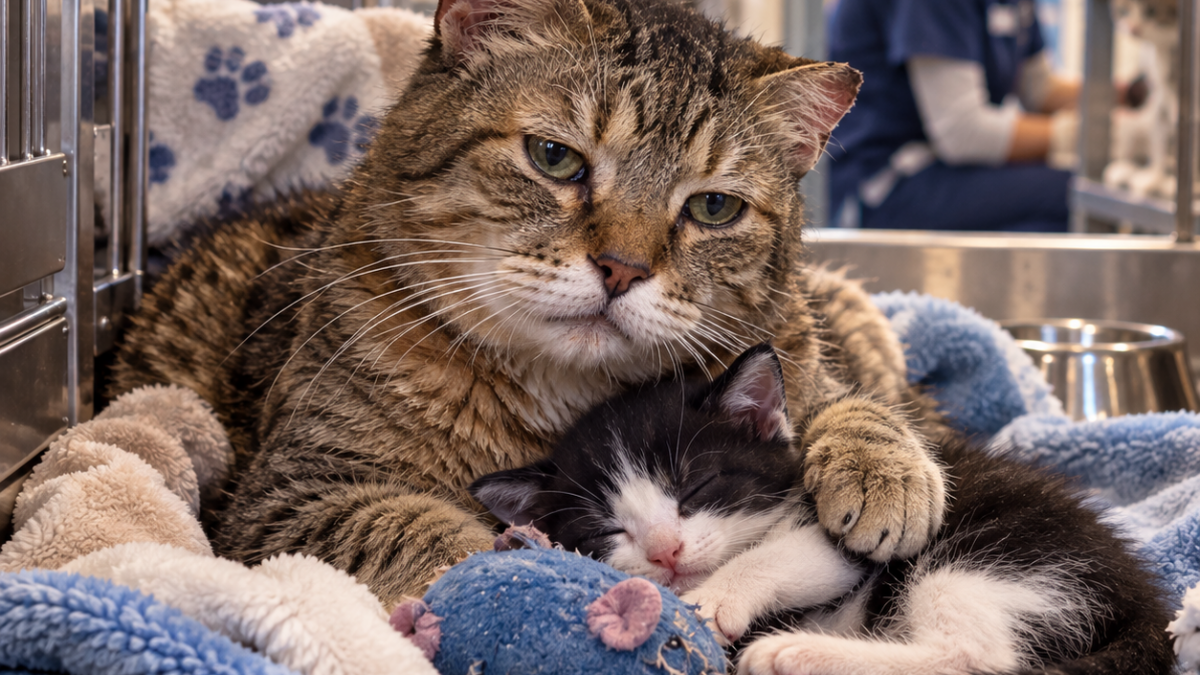
He was lying on the floor with his old body pressed against the bars of Popper’s kennel.
His nose was inches from the kitten’s face.
I put my coffee down.
“Moka?”
His ear moved.
Alive.
Inside the cage, Popper was asleep.
Not curled beside the litter box.
Not staring at the wall.
He was stretched on his towel with his face against the bars.
Against Moka.
I covered my mouth.
There was no graceful response.
I started crying.
“How did you get out?”
Moka looked at me like it was not my business.
Later we discovered the lower latch on cage 14 had not fully seated after the overnight medication check.
Moka must have pushed until it opened.
The extraordinary part was not escape.
Cats escape.
The extraordinary part was where he went.
He did not wander.
He did not raid food.
He did not hide.
He walked directly across the room, carrying his blue mouse, and lay beside Popper.
For five years, Moka always gave the mouse away and returned to his cage.
That night he didn’t take it back.
He had decided the kitten needed more than a toy.
He needed someone to stay.
Marla found me sitting on the floor.
“What happened?”
I pointed.
She stopped.
“Oh.”
That was all she said.
Then she sat beside me.
Popper woke.
His eyes opened.
He looked at Moka.
Then, for the first time since arriving, he moved toward something instead of away from it.
He pushed one paw through the bars.
Moka touched it with his nose.
Marla whispered:
“We can’t leave him on the floor.”
“I know.”
“He needs his medication.”
“I know.”
Neither of us moved for another minute.
Finally we relocated Moka into the small socialization room next to Popper.
The two enclosures there shared mesh panels.
That way they could see and smell one another safely.
Within an hour, Popper ate.
One bite.
Then stopped.
Later he ate three more.
By evening, he drank.
The next day he walked voluntarily to the mesh.
Moka was already there.
That became their routine.
Popper woke.
Found Moka.
Then ate.
If Moka was sleeping farther away, Popper waited.
If Moka looked at him, he moved.
During monitored play sessions, Popper went straight to the old cat.
He crawled beneath Moka’s chest.
Climbed over his front paws.
Slept against his belly.
Moka tolerated everything.
More than tolerated.
He groomed Popper.
Slow strokes over the top of his head.
Popper would close his eyes like somebody had finally turned off the alarm inside him.
Something changed in Moka too.
He started eating more.
Not dramatically.
But enough that I noticed.
His coat looked better.
He began waiting at the enclosure door when I arrived.
He purred louder.
For years, Moka had looked like a cat patiently waiting for the world to finish forgetting him.
With Popper, he looked necessary.
There is a difference.
Marla put them online as a bonded pair.
I argued.
“They’ve known each other two weeks.”
“They’re bonded.”
“He’s fifteen.”
“Probably.”
“Popper’s a kitten.”
“Yes.”
“Who adopts a kitten with a fifteen-year-old cat?”
“Someone good.”
I had no answer.
Most people applied for Popper alone.
Of course.
We declined.
One woman became angry.
“You’re making a kitten harder to place because of an old cat?”
Marla said:
“We’re placing them based on welfare.”
“The old one could die next month.”
“Yes.”
“And then the kitten would be alone anyway.”
“Eventually everyone loses someone.”
The woman left.
I worried.
I worried Popper would grow while we waited.
I worried Moka would decline.
I worried we were asking too much from adopters.
Then on a Saturday afternoon a couple named Diane and Cal walked in.
They were in their late fifties.
Maybe early sixties.
Diane had silver streaks in her hair and wore a sweatshirt with flour on one sleeve.
Cal looked like the kind of man who fixed his own appliances and kept every screw afterward because it might be useful.
They did not go to kitten room.
Diane asked Marla:
“Which cat has been here longest?”
Marla looked at me.
I looked at her.
Then we took them to Moka and Popper.
Moka lay on his green blanket.
Popper was sleeping partly across his back.
The blue mouse rested between their paws.
Diane put one hand against her chest.
“Oh.”
I began the speech.
“Moka is senior. Very senior. He has arthritis and early kidney changes. He needs medication. Popper is shy and likely needs a patient home. We believe—”
Diane raised one hand gently.
“They can’t be separated.”
I stopped.
Cal crouched near enclosure.
“Which one is Moka?”
“The old tabby.”
He smiled.
“I figured.”
Popper woke.
Saw strangers.
Immediately tucked himself against Moka.
Cal nodded.
“Yeah.”
They visited three times.
Then four.
They did not rush.
That mattered.
Diane sat on floor and read aloud.
Cal brought a little stool and ignored them until Popper approached.
On the fourth visit Moka leaned against Diane’s leg.
Popper climbed into Cal’s lap because Moka had gone first.
A week later, they went home together.
I cried in the parking lot after their car left.
I told myself it was because I would miss Moka.
That was only partly true.
For five years, I had imagined the moment someone chose him.
When it happened, I discovered happiness and grief can occupy exactly the same space.
Cage 14 was empty.
The blanket gone.
The food bowl gone.
No blue mouse.
I stood there the next morning staring at an enclosure I had complained about for years because Moka had been trapped inside it.
Now I wanted him back.
That embarrassed me.
Marla knew.
“He’s home,” she said.
“I know.”
“You can be sad anyway.”
“I know.”
One month later, an envelope arrived.
Actual mail.
Not email.
Diane liked photographs.
Inside was a printed picture.
Moka sleeping in an old armchair inside a patch of sunlight.
Popper curled along his side.
The blue mouse between them.
On the back Diane had written:
For five years, Moka taught scared kittens they were safe.
Now we just want him to know he is, too.
I taped the photograph above cage 14.
Not because it was sad.
Because it was proof.
Some hearts get passed over for years and still don’t turn hard.
Some animals lose nearly everything and still share what remains.
Sometimes love doesn’t arrive dramatically.
Sometimes it is an armchair.
A patch of sun.
A kitten pressed against your ribs.
A worn toy.
And a place where no one is packing your things again.
I thought that was the end of Moka’s story.
It should have been.
Two weeks later, a woman walked into the rescue and pointed at his photograph.
“That cat,” she said.
My stomach tightened before I knew why.
She looked maybe fifty-eight.
Neatly styled brown hair.
Pressed blouse.
A structured leather purse beneath one arm.
Beside her stood a young man in his twenties with both hands buried in his jacket pockets.
He stared at the floor.
Marla approached.
“Can I help you?”
The woman pointed again.
“That’s my mother’s cat.”
I looked at the photograph.
Moka.
Popper.
Blue mouse.
“Yes,” I said carefully. “That’s Moka.”
Her expression changed.
“No.”
The room seemed to shrink.
“His name is Benjamin.”
Nobody spoke.
She opened her purse.
Pulled out an envelope.
Old photographs.
Moka younger.
Much younger.
Brown face instead of gray.
Sitting on a floral couch.
Curled beside a small Christmas tree.
Sleeping in the lap of an elderly woman with thin hands and white hair.
And in every picture—
the blue mouse.
My throat closed.
The woman touched one photo.
“My mother was Evelyn Carter.”
There it was.
The name from the intake record.
“She went into assisted living.”
“Yes.”
“She sent him here.”
“Yes.”
The woman’s jaw tightened.
“She died two months later.”
I looked at Marla.
We had never known.
The young man shifted.
“Mom.”
She ignored him.
“She thought he was being held temporarily.”
Marla’s voice softened.
“We were told she surrendered him because the facility couldn’t take pets.”
“She did because she had no choice.”
“I understand.”
“No, I don’t think you do.”
Her voice remained controlled.
That was somehow harder than yelling.
“My mother asked that our family be contacted before he was adopted.”
Marla frowned.
“I don’t have that note.”
“I do.”
She pulled out folded paper.
Old.
Creased.
Written in shaky handwriting.
My cat Benjamin is to stay safe. If he cannot stay with me, please let my family decide.
I stared at the word safe.
Safe.
The word that had followed Moka through everything.
The woman said:
“Her name was on it. Her social worker knew.”
Marla read the paper twice.
“I need to review our intake records.”
“You had five years.”
“I understand you’re upset.”
“My mother died believing he was still waiting for her.”
That sentence landed like a physical thing.
There are some griefs you cannot answer.
Some mistakes, even if nobody intended them, cannot be made small through explanation.
The woman looked at me.
“You cared for him?”
“Yes.”
“For how long?”
“Almost five years.”
“Then you should’ve known.”
I wanted to defend us.
I wanted to say we knew him.
We knew he liked warmed food.
We knew he hated being lifted.
We knew he loved a hand near his shoulder.
We knew he carried his blue mouse to frightened kittens.
We knew he slept facing the room.
We knew the exact days his hips hurt worse because he placed less weight on his left rear leg.
We knew the way he blinked when he was content.
We knew more about the last five years of his life than anyone.
But none of that erased her mother’s request.
I said nothing.
Marla asked:
“What are you asking us to do?”
The woman raised her chin.
“I want him back.”
The room went still.
“He’s adopted,” Marla said.
“Then reverse it.”
Her son looked up.
“Mom.”
“That was Grandma’s cat.”
“I know.”
“He belongs with family.”
“He’s fifteen.”
“That makes it more important.”
“He’s settled.”
“He would settle with us.”
Marla said:
“We can’t simply remove an adopted animal from a home where he’s safe.”
“You placed him without contacting us.”
“We need to establish what happened.”
“I have established it.”
“Not legally.”
The woman looked at Marla.
“This isn’t about legal.”
And that was the problem.
Because she was right.
And so was Marla.
The adoption was valid.
The rescue had received a signed surrender.
There was no family hold entered in the system.
No contact information attached to Moka’s digital file.
Diane and Cal had adopted him through the proper process.
They were good adopters.
They had done nothing wrong.
But the woman standing in front of us had found one last living connection to her dead mother.
And somewhere, years earlier, somebody had failed to preserve a promise.
The young man looked at the photograph.
“Is that little cat his?”
“Popper?”
“Yes.”
“Not biologically.”
He stared.
“Looks like he thinks he is.”
Then he followed his mother outside.
That afternoon Marla called Diane.
She closed the office door.
I sat outside pretending not to listen.
I heard fragments.
“Yes, I’m sorry.”
“No, you did nothing wrong.”
“Yes.”
“She says he belonged to her mother.”
Long pause.
“No, we’re not asking you to return him today.”
Today.
That word terrified me.
When Marla came out, her face looked exhausted.
“Diane is crying.”
“Are they giving him back?”
“I don’t know.”
“What does adoption agreement say?”
“That placement is final unless welfare issue or misrepresentation.”
“So Moka stays.”
Marla sat.
“Legally, probably.”
“Good.”
She looked at me.
“That doesn’t mean good.”
I hated her for a second.
Because she was right.
The rescue staff divided immediately.
Not officially.
Emotionally.
One volunteer said the family had five years to find him.
Another reminded her they may not have known where he was.
Someone said Moka was old and moving him would be cruel.
Someone said a dead woman’s final request mattered.
Someone else said Popper would collapse without him.
Then someone asked the question none of us wanted.
“What happens when doing the kind thing for one heart breaks another?”
No one answered.
That night I dreamed about cage 14.
In the dream, Moka kept carrying the mouse back and forth between two doors.
Every time he reached one, somebody called from the other.
He never got to lie down.
I woke angry.
Not at the daughter.
Not at rescue.
At the fact that Moka had spent so much of his life waiting for humans to decide where he belonged.
The next morning Diane came in.
Alone.
Her eyes were swollen.
She carried a clear plastic bag.
Inside was the blue mouse.
My chest stopped.
“He’s alive,” she said quickly.
I breathed again.
“They’re both home.”
She put the bag on counter.
“I thought you should see this.”
A tiny note was tied around the bag.
Marla opened carefully.
Diane had written:
Moka carried this to Popper again last night.
Diane started crying.
“They sleep together,” she said. “They eat together. Popper won’t leave a room unless Moka moves first.”
She wiped her face.
“I keep thinking about that woman.”
“So do I.”
“Her mother loved him first.”
“Yes.”
“She lost her mother.”
“Yes.”
“She didn’t get to say goodbye to the cat either.”
“Yes.”
Diane looked at me.
“You knew Moka longest.”
I shook my head.
“No.”
She frowned.
“I knew him in a cage.”
That stopped her.
I continued.
“You know him at home.”
She started crying harder.
“Cal said almost exactly that.”
“What?”
“He said maybe we don’t own his happy ending just because we got to be there when it finally happened.”
I looked away.
I wanted someone in this story to be selfish.
It would have made everything easier.
I wanted the daughter to be cruel.
She wasn’t.
I wanted Diane and Cal to say absolutely not.
They didn’t.
I wanted paperwork to answer.
It couldn’t.
A few days later, Marla arranged a meeting.
Neutral.
No promises.
No legal negotiation.
Just people.
Diane and Cal would bring Moka and Popper.
The daughter—her name was Karen Whitfield, though everyone began calling her Evelyn’s daughter in my mind—would come with her son, Noah.
I was invited because I had cared for Moka longest.
I almost refused.
Then I realized I was afraid.
That made me go.
The visiting room was small.
Faded rug.
Two upholstered chairs.
A low table.
One window facing parking lot.
We placed Moka’s old green blanket on floor.
Diane entered carrying one soft carrier.
Cal carried another.
Karen sat rigid in chair.
Noah stood behind her.
Diane knelt.
Opened Moka’s carrier.
For several seconds, nothing happened.
Then an old gray face appeared.
Moka stepped out.
Slowly.
His hips were stiffer than they had been a month earlier.
But his coat looked better.
His eyes moved around room.
Then they found me.
One slow blink.
My eyes filled.
“Hi, old man.”
His ear moved.
Cal opened Popper’s carrier.
Popper came out fast.
Not frantic.
Direct.
He ran to Moka.
Tucked himself underneath the old cat’s chest.
Everyone saw.
No interpretation required.
Moka lowered his head.
Touched Popper’s forehead with his nose.
Karen pressed her lips together.
Noah looked away.
Diane covered her mouth.
Cal stared toward ceiling.
Moka slowly lay on blanket.
Popper pressed against him.
The blue mouse went between them.
Karen whispered:
“That’s not Benjamin.”
I thought she meant the name.
Then she continued.
“My mother’s Benjamin didn’t like other cats.”
Noah looked at her.
“He hid from everybody after Grandpa died.”
Karen nodded.
“He only came out for Mom.”
Her voice changed.
“He never took care of anyone.”
She watched Moka groom Popper’s ear.
“He was the one who was scared.”
Nobody spoke.
For the first time since Karen arrived at rescue, anger left her face.
What replaced it was worse.
Regret.
Moka wasn’t frozen in the version she had lost.
He had lived.
He had changed.
Five years had happened while she was not looking.
Karen whispered:
“I didn’t visit her enough.”
Noah placed a hand on her shoulder.
She shook her head.
“I told myself she had nurses.”
No one moved.
“She had activities.”
Her voice broke.
“She had friends.”
She looked at Moka.
“She had him.”
Then he was gone too.
There it was.
The real wound.
Moka had become a door.
Karen thought if she could bring him back, maybe she could open it and find her mother on the other side.
Diane stood.
Walked toward her.
I braced for defense.
Instead Diane sat in chair beside Karen.
“Tell me about your mother.”
Karen stared.
Diane nodded toward Moka.
“Tell me what she called him.”
Karen laughed once through tears.
“Benjamin.”
“No, I mean when nobody was around.”
Karen’s face folded.
“Benny Boy.”
Moka’s ear twitched.
Everyone froze.
Diane whispered:
“Benny Boy.”
Moka lifted his head.
Karen made a sound I will never forget.
Not a sob exactly.
More like something inside her had cracked open.
She slid from chair to floor.
Not approaching him.
Just sitting.
“Hi, Benny.”
Moka watched.
Popper watched too.
Karen held out her hand.
She did not reach.
Did not grab.
Did not call again.
For several minutes, nothing happened.
Then Popper stood.
He stepped over the blue mouse.
Sniffed it.
And pushed it forward with one paw.
Barely an inch.
Karen stared.
“Is he giving it to me?”
I looked at Moka.
The old cat had lowered his chin.
Eyes half closed.
I said:
“No.”
Karen looked at me.
“I think he’s sharing.”
That changed the room.
Not solved.
Changed.
Because some problems cannot be solved by deciding who wins.
Sometimes the only way through grief is to stop treating love like a possession that can only belong to one person at a time.
Marla suggested a plan.
Moka and Popper would remain with Diane and Cal.
No forced move.
No separation.
Karen could receive updates.
She could visit occasionally if Moka tolerated it.
No pressure.
No promise beyond his comfort.
Karen listened.
Then asked:
“Can I send something from Mom?”
Diane answered before anyone else.
“Please.”
A week later, a package arrived at their house.
Inside was a small square of floral fabric.
From the couch in those old photographs.
And a note.
His name was Benjamin when he was hers.
Thank you for letting him be Moka when he became yours.
Diane sent me a photograph that night.
Moka asleep in his chair.
Popper curled against him.
The floral fabric beneath Moka’s paw.
The blue mouse resting on top.
I printed it.
Placed it beneath the first photograph above cage 14.
Visitors began noticing.
They would stop.
Ask.
Sometimes I told the whole story.
Sometimes just enough.
Something strange began happening.
People started asking about older cats.
Not everyone.
Not enough to call it miracle.
But more.
A couple came for kitten and adopted a twelve-year-old calico called Pearl who had been returned twice for “not playing enough.”
A widower adopted an eleven-year-old gray male with bad teeth because, as he said, “Neither of us needs anybody bouncing off walls.”
A mother and her teenage son spent three weekends sitting with a black senior who had not allowed anyone to touch him.
Cage 14 stayed empty.
Marla claimed it was because we needed it as quiet transition space.
None of us believed her.
We called it Moka’s room when she wasn’t listening.
Months passed.
Popper grew.
Not much.
He remained small.
But his fur became glossy.
His ribs disappeared.
His eyes no longer looked too large for his head.
According to Diane, he had one rule.
Where Moka went, Popper went.
If Moka moved to armchair, Popper followed.
If Moka drank, Popper waited beside bowl.
If Moka went to screened porch, Popper followed like a bodyguard weighing eight pounds.
Moka declined gradually.
That part was harder.
Some days his hind legs wobbled.
Sometimes he would stand and forget why.
He ate only if food was warmed.
Then only if Cal sat on floor.
Sometimes Popper tapped his face when he slept too deeply.
But Moka was comfortable.
Loved.
Known.
There is a difference between being kept alive and being allowed to live.
Moka was living.
Softly.
Quietly.
In sunbeams.
Warm blankets.
The sound of Popper following him from room to room.
Karen visited twice that winter.
The first time, Moka remained on Diane’s lap.
Karen sat across room and told stories about Evelyn.
The second time, he let her place the floral cloth beside him.
She did not ask to hold him.
She did not mention taking him.
She talked about her mother humming while folding laundry.
About how she burned toast.
About how she always put too much sugar in tea.
Moka listened or didn’t.
Popper sat between them like a tiny judge.
Diane sent me picture afterward.
Karen on floor.
Moka asleep.
Popper staring directly at camera.
I laughed.
Then February came.
Marla called me on Sunday.
I knew from her voice.
“Moka stopped eating.”
I sat on edge of bed.
“For how long?”
“Since yesterday.”
“Vet?”
“Kidneys. Age. They’re talking comfort.”
I closed my eyes.
For five years, I had prepared for Moka dying in cage 14.
Then he got a home.
And somewhere in me I began believing love could bargain with time.
Love can change quality.
Not arithmetic.
Diane asked if I wanted to visit.
I almost said no.
I was afraid the final image would replace all others.
Then I thought about all the nights Moka had gotten up even when his hips hurt because somebody else needed comfort.
So I went.
Diane and Cal’s house was exactly how photographs made it look.
Small.
Warm.
Blankets thrown over furniture.
Cat bowls in kitchen.
Scratches on one chair.
A broad rectangle of afternoon sunlight lying across floor.
Moka was in the armchair.
The blue mouse beside him.
Floral cloth under his paws.
Popper pressed against him so tightly that from doorway they looked like one strange animal.
Moka lifted his head when I entered.
Barely.
But he did.
“Hi, old man.”
His cloudy eyes found me.
I sat on floor.
Placed my hand beside him.
Not on him.
The way he liked.
“You did good.”
My voice broke.
Popper opened his eyes.
Looked at me.
Then pushed harder against Moka.
As if love could hold a door shut.
Karen came later.
No papers.
No old claim.
She carried one framed photograph.
Evelyn holding a younger Benjamin.
She placed it on side table.
Then sat with us.
Moka slept.
Nobody needed to say much.
Finally Karen whispered:
“I’m sorry I tried to take you away.”
She wasn’t speaking to Diane.
She was talking to Moka.
“I thought bringing you back would bring her back.”
Noah sat beside her.
She touched the floral fabric.
“But you already found what she wanted for you.”
Diane reached across.
Karen took her hand.
It was one of the bravest things I have ever seen.
Two women who had every reason to turn pain into competition deciding the room would not belong to anger.
Not because either grief disappeared.
Because Moka deserved peace.
That evening, the vet came to the house.
I won’t make that part dramatic.
It was not.
It was gentle.
Moka was not afraid.
Diane held him.
Cal kept one hand on Popper.
Karen held the floral cloth.
I held the blue mouse until the last moment.
Then placed it against Moka’s paw.
Popper remained pressed against him.
Right until the end.
Afterward, Popper did not move.
Not for a long time.
His nose stayed buried in Moka’s fur.
Diane sobbed.
Cal cried too.
Karen cried beside them.
I sat on floor thinking about cage 14.
A cat nobody wanted.
A cat who waited five years.
A cat who had every reason to turn inward.
Instead he kept giving away the only piece of home he had left.
I thought about how unfair it was that he spent five years waiting and such a short time truly home.
Then I looked around.
Armchair.
Sunbeam.
People gathered because of him.
Popper.
Blue mouse.
And something changed in the way I measured his ending.
Maybe happiness is not counted only in years.
Maybe sometimes it is counted in finally being seen.
A week later Diane came back to rescue with Popper.
Before anyone panicked, she said:
“I’m not returning him.”
Good.
He was eating.
Sleeping.
Searching sometimes.
Calling at night.
But improving when she put the blue mouse beside him.
She brought a small shadow box.
Inside was a photograph of Moka and one tiny piece of fabric from the blue mouse.
The rest remained with Popper.
Under the photo Diane had written:
He gave away comfort until comfort finally found him.
We hung it above cage 14.
Then Marla put a new blanket inside.
Not as permanent housing.
As quiet transition space.
For frightened cats.
Beside it, she placed a basket of small stuffed mice.
Some blue.
Some gray.
Some orange.
All soft.
No plastic eyes.
No loose ribbons.
Nothing dangerous.
The first kitten placed there was a tortoiseshell called Button.
She shook whenever anyone opened door.
She had been found behind a grocery store storage building.
Marla placed a tiny blue mouse near her carrier.
For almost an hour Button stared.
Then one paw reached out.
Hooked it.
Pulled it closer.
I cried again.
I cry too much in rescue work.
I stopped apologizing.
Button was adopted a few days later by a retired school-bus driver.
He chose her because she was scared.
“I know what that’s like,” he said.
That was when I understood what Moka had left behind.
Not a legend.
Not a viral story.
A practice.
A way of looking at animals everybody else looked past.
We started spending more intentional time with seniors.
Not because they were Moka.
Because Moka taught us what we had been missing.
When adopters said:
“I want a kitten because older cats are too sad,”
we didn’t guilt them.
Guilt creates bad homes.
We told them the truth.
Older cats are not broken leftovers.
They are entire lives.
They have routines.
Preferences.
Memories.
Grief.
Humor.
Rules.
They might not give you twenty years.
They may give you something time alone cannot measure.
Some people listened.
Some didn’t.
That was okay.
Not every home is right for every animal.
But once in a while, someone would stand in front of senior enclosure longer.
They would stop saying:
“Poor thing.”
And start asking:
“What does he like?”
That question changes everything.
What does he like?
Not:
How old?
What’s wrong?
How long do we have?
What does he like?
Moka liked warm food.
Low voices.
A hand nearby.
A faded blanket.
A blue mouse.
And eventually, one terrified kitten who needed somebody to stay.
In spring, Diane brought Popper to visit.
Karen came too.
Somehow the three households had become something none of us had a proper name for.
Not family in the conventional sense.
Not strangers.
Something chosen after pain.
Popper entered cat room carefully.
He sniffed.
The floor.
Cages.
Chair legs.
Then stopped in front of cage 14.
Inside sat the basket of stuffed mice.
Popper looked.
Diane whispered:
“It’s okay.”
He stepped inside.
Picked up one small blue mouse.
Carried it out.
And placed it in front of a new kitten’s cage.
A tiny gray kitten.
Terrified.
Pressed against the rear wall.
My hand flew to my mouth.
Marla suddenly became very interested in paperwork.
Cal looked down.
Karen cried openly.
Popper did not look at any of us.
He simply walked back to Diane.
Jumped into her arms.
Pressed his face under her chin.
The gray kitten watched the mouse.
By morning, she had pulled it inside.
After that, everyone called cage 14 Moka’s Room.
Officially, it remained Intake Resting Space B.
Nobody used that name.
People started donating stuffed mice.
We inspected every one.
Kept safe toys.
Put extras away.
Every frightened kitten received one.
Every senior received more time.
Every adopter asking about older cats got Moka’s story if they wanted it.
The wall above cage 14 grew.
Pearl the calico.
A one-eyed black cat called Hector.
A bonded pair of fourteen-year-old sisters.
A shy tabby who needed six weeks before sitting on anyone’s lap.
A huge white cat named Marshmallow who refused to drink from anything except ceramic coffee mugs.
Each photograph told the same thing differently.
Passed over does not mean unworthy.
Quiet does not mean empty.
Old does not mean finished.
One afternoon a little boy stood beneath the pictures.
“Why didn’t anybody want them?”
His father looked uncomfortable.
I waited for the usual answer.
People want kittens.
Older animals need more care.
Life is complicated.
Instead, the father knelt.
“Sometimes people look too fast.”
I have never heard it said better.
Sometimes people look too fast.
At animals.
At old people.
At neighbors.
At tired mothers.
At quiet men eating alone.
At anyone who doesn’t sparkle loudly enough to be chosen.
We decide:
Too old.
Too sad.
Too difficult.
Too much work.
Not enough time.
And sometimes we’re wrong.
Sometimes we simply never stopped long enough to see what they were carrying under one paw.
A year after Moka died, Diane invited us to Popper’s adoption anniversary.
She called it Moka Day.
Nothing elaborate.
Coffee.
Cake for people.
Cat-safe treats for Popper.
Diane.
Cal.
Karen.
Noah.
Marla.
Me.
Popper wore no costume because Diane said he had dignity.
Cal said he had attitude.
Both were true.
On the coffee table sat photographs.
The floral fabric.
And the blue mouse.
The real one.
Worn almost flat now.
Patched.
Clean.
Popper walked over.
Sniffed it.
Sat beside it.
Not on it.
Beside it.
Like a guard.
Diane lifted coffee mug.
“To Moka.”
We raised whatever we had.
Coffee.
Tea.
Water.
Noah’s half-finished soda.
“To Moka.”
Then Karen spoke.
“I used to think the rescue took something from my mother.”
Nobody moved.
She looked at Diane.
“I don’t anymore.”
Diane’s eyes filled.
Karen touched the blue mouse with one finger.
“I think he carried her love as far as he could.”
Her voice shook.
“Then he handed it to all of you.”
Nothing needed adding.
Popper saved us by knocking a treat off the table.
That helped.
Cats are useful when humans become too serious about our own feelings.
Before I left, Diane gave me another photograph.
Popper sitting in Moka’s old sunbeam.
The blue mouse beside him.
On the back:
He still shares it.
But now he always brings it home.
I put that photograph below all the others above cage 14.
The next morning I stood there before the rescue got busy.
Before food bowls.
Litter boxes.
Phone calls.
Frightened arrivals.
Happy departures.
Hard goodbyes.
I looked at Moka’s first photograph.
Old.
Gray.
Tired.
Finally peaceful.
Then Popper.
Small.
Serious.
Alive.
And I thought about how close all of us came to ruining the best part of their story because everyone was trying to defend their own version of love.
Karen wanted the past back.
Diane and Cal wanted to protect the present.
The rescue wanted to correct an old mistake.
I wanted nobody to hurt Moka again.
And Moka?
He had shown us answer years before.
You can share what matters without losing it.
You can honor the past without stealing the present.
You can love someone enough to ask what they need instead of only asking what you miss.
That is harder than it sounds.
Maybe that’s why stories like Moka’s divide people.
Some will say Karen should have gotten him back because of Evelyn’s request.
Some will say Diane and Cal became his real family.
Some will say paperwork matters.
Some will say stability matters.
I understand every side.
I do.
But I was there.
I watched Popper push the blue mouse forward.
I watched Moka raise his head when Karen called him Benny Boy.
I watched two women stop fighting over who loved him correctly.
And I believe Moka belonged where he could rest.
Not where guilt pulled.
Not where paperwork pointed alone.
Where he felt safe.
Where Popper could breathe.
Where the blue mouse stopped meaning goodbye.
The last time I saw Popper, he wasn’t a terrified kitten anymore.
Still shy.
Still serious.
Still smaller than most cats his age.
But brave in the quiet way Moka had been brave.
Diane set him down in Moka’s Room.
A frightened kitten had arrived the night before.
Popper walked to the basket.
Selected a blue mouse.
Carried it to the cage.
Placed it down.
Then turned and looked at me.
For one second, I saw Moka.
Not because they looked alike.
They didn’t.
Because kindness had moved from one small body into another.
Quietly.
No applause.
No understanding required.
That is how love survives sometimes.
Not by staying exactly where it began.
By being carried forward.
Paw by paw.
Room by room.
Heart by heart.
I still volunteer at the rescue.
Cage 14 is rarely empty now.
There is usually some frightened little animal inside learning the world may not be finished with them.
The toy basket empties fast.
The blanket is almost always covered in fur.
Above it, the photographs have started curling at the corners.
Moka in the sun.
Popper beside him.
Karen’s note.
Diane’s shadow box.
Pearl.
Hector.
Marshmallow.
The wall of animals people almost missed.
Visitors stop there every day.
Some read quickly.
Some move on.
Some stay.
Some cry.
And occasionally somebody points toward the oldest cat in the room and says the words every rescue volunteer hopes to hear.
“Tell me about that one.”
Whenever they do, I start the same way.
I tell them about an old brown tabby with a gray face, a torn ear, and cloudy green eyes.
I tell them about cage 14.
I tell them about a woman named Evelyn and the one toy she sent with him when she had to say goodbye.
I tell them how that blue mouse became the only thing Moka seemed unwilling to lose.
Then I tell them how, for five years, he gave it away anyway.
A frightened orange kitten.
A trembling gray kitten.
A shy calico.
One scared little life after another.
I tell them how the mouse always came home.
Until Popper.
Until one tiny black-and-white kitten arrived so frightened he stopped eating, stopped drinking, and seemed to have decided there was nothing left in the world worth trusting.
Then I tell them about the morning I walked in and found Moka lying outside Popper’s cage.
The blue mouse between them.
The old cat refusing to go back.
And if they’re still listening, I tell them the part that matters most.
Moka was not rescued only on the day Diane and Cal carried him out.
He was rescued every time somebody finally saw him.
Every time somebody slowed down.
Every time someone chose patience instead of convenience.
Every time someone understood that love is not always loud, young, easy, playful, or beautiful in the way people expect.
Sometimes love is old.
Tired.
A little gray around the face.
Passed over.
Sitting quietly in cage 14 with one torn ear and a worn blue mouse beneath one paw.
Still willing to give away the only thing it has left.
And still hoping—somewhere beneath all that patience—that one day somebody might finally sit down beside it and say the same words Moka spent years saying to every frightened kitten who came through our doors:
“You’re safe now.”
Only this time, the words would be for him.








