For 3 Years, a Starving Stray Cat Raised 17 Kittens That Weren’t Hers—Then Rescuers Found Her With Number 18
PART3:
She watched other cats enter.
She watched the doors close.
And apparently concluded that metal rectangles containing free fish should never be trusted.
Weeks passed.
Other cats were caught.
Fixed.
Vaccinated.
Returned.
T-7 remained.
Megan began calling her Marbles because of the chaotic swirls of black, copper, cream, and orange across her coat.
The name never appeared in official records.
Just in Megan’s head.
“Come on, Marbles.”
She would whisper.
“Give me one stupid mistake.”
Marbles did not make mistakes.
Then, in June, Megan noticed something strange.
A kitten was crying behind one of the dumpsters.
The sound was thin.
Young.
Maybe ten days old.
Megan followed it and found a tiny gray tabby wedged between broken concrete and the dumpster base.
No mother nearby.
Eyes barely open.
Cold despite summer heat because evening temperatures had dropped after rain.
Megan put on gloves.
She was about to reach in when Marbles appeared.
Not from the sedan.
From beneath a loading dock.
The tortoiseshell froze when she saw Megan.
Megan froze too.
For a moment neither moved.
Then Marbles did something Megan had never seen from her.
She walked toward the kitten.
Not cautiously.
Directly.
The kitten cried.
Marbles answered with a low chirp.
She lowered her head.
Gripped the kitten gently by the scruff.
And carried him away.
Megan followed at a distance.
Marbles crossed nearly the entire gravel lot.
Past pallets.
Past weeds.
Past the dead refrigerator.
Straight to the silver sedan.
She jumped onto the rear bumper.
Squeezed beneath the partially open trunk lid.
Disappeared.
Megan stood there.
“Okay.”
She waited.
Twenty minutes later, Marbles came out.
Megan approached the car only after the cat vanished.
She used her phone flashlight to look through the trunk opening.
The inside was filthy.
Rotting carpet.
Leaves.
A shredded seat cushion.
Old insulation.
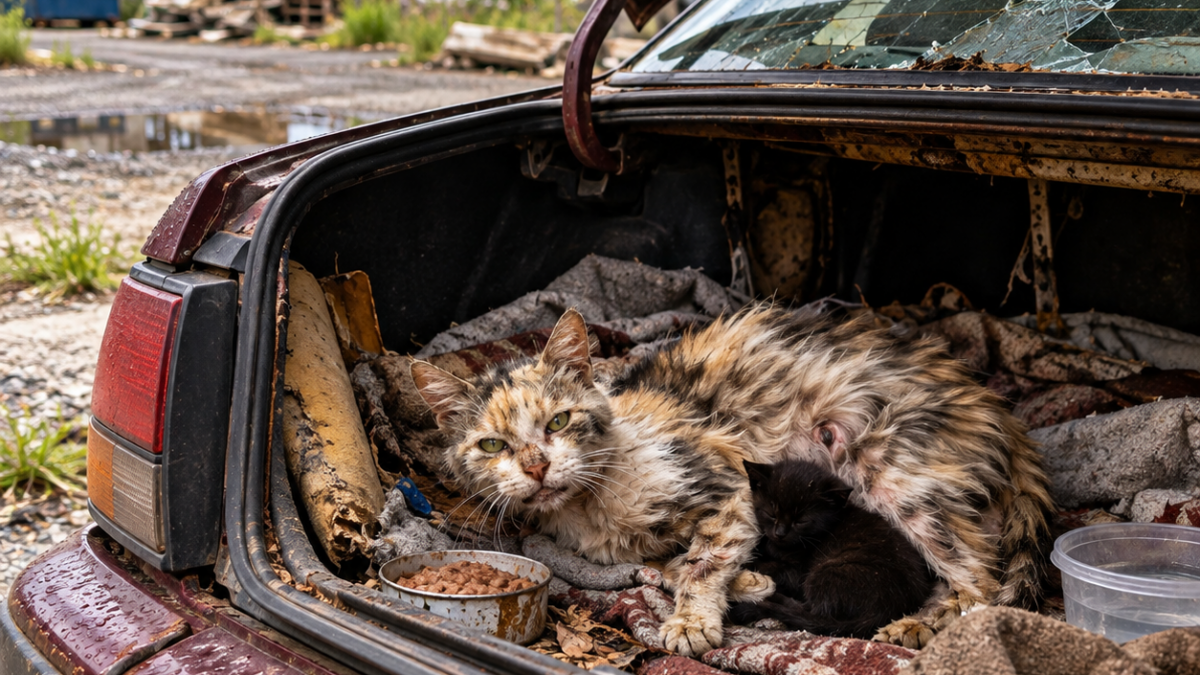
But in the far right corner, someone had made a nest.
Newspaper scraps.
Dry grass.
Pieces of cloth.
And curled in the center:
the gray kitten.
Next to him lay another kitten Megan had never seen.
Black.
About the same age.
Megan stepped back.
“Where did you come from?”
She assumed they were Marbles’s kittens.
That would have been ordinary.
Stray mother.
Hidden litter.
But three days later one of the colony’s gray females appeared with swollen mammary glands and no kittens.
Megan searched.
No litter.
A security guard from the neighboring warehouse said he had seen two tiny kittens behind the dumpsters after a storm.
One had disappeared.
The other too.
Megan looked toward the sedan.
That was the first time she wondered.
Maybe the kittens were not Marbles’s.
She started documenting.
Photos from a distance.
Dates.
Descriptions.
Weights when kittens eventually became catchable.
The gray tabby emerged from the trunk at about five weeks.
The black kitten followed.
Both healthy.
Both energetic.
Both remained near Marbles.
Then at around eight weeks, they began integrating into the colony.
Marbles stopped nursing them.
They ate solid food.
Slept elsewhere.
And eventually one was trapped and adopted.
The other was neutered and returned.
Megan wrote:
Possible foster behavior by T-7/“Marbles.” Monitor.
Then autumn came.
And another kitten appeared.
This one was orange.
Maybe three weeks old.
Megan first saw him near a concrete barrier.
His mother, a young calico, had been hit by a delivery truck the day before.
Megan had searched for kittens.
Found nothing.
Then two nights later:
Marbles crossed the gravel carrying an orange baby.
She took him straight to the trunk.
Megan followed.
There were two more inside.
Three orphaned kittens.
Marbles began nursing them.
That changed everything.
Megan sat in her car with binoculars for almost two hours the next evening.
Marbles entered the trunk.
A few seconds later, tiny tails moved.
Three kittens crawled against her belly.
Marbles stretched on her side.
They latched.
Megan stared.
“You’re not their mother.”
The kittens did not care.
Neither did Marbles.
By winter, Megan had started a separate notebook.
MARBLES — FOSTER LITTERS.
Litter One:
June 2022.
Two kittens.
Probable abandoned litter from G-3.
Litter Two:
October 2022.
Three kittens.
Dam deceased.
Marbles lactating.
All survived.
Five.
Five babies she likely had not given birth to.
The rescue’s veterinarian, Dr. Sanjay Patel, was skeptical when Megan told him.
“It happens.”
“Cats sometimes nurse unrelated kittens.”
“I know.”
“Especially if hormonally primed.”
“I know.”
“You’re saying she’s doing it repeatedly.”
“Yes.”
“How do you know she didn’t have her own litter mixed in?”
“I don’t.”
“Then document.”
Megan smiled.
“You’re encouraging me.”
“I’m encouraging you not to make me diagnose a cat through binoculars.”
Fair.
The winter of 2022 was bitter.
The bottling plant offered some shelter, but property owners would not allow volunteers inside.
The cats lived beneath pallets, inside drainage culverts, beneath loading docks.
Megan built insulated shelters from storage bins.
Marbles refused every one.
She remained in the car.
Megan worried about the broken windows and rusted trunk.
She lined a small plastic tote with straw and slid it into the trunk while Marbles was gone.
The next morning, the tote sat outside the car.
Marbles had dragged bedding back into her original nest.
“Fine.”
Megan shook her head.
“Interior design is apparently nonnegotiable.”
During a February cold snap, temperatures dropped into the teens.
A volunteer named Rosa found a tiny black-and-white kitten under a vending-machine shell near the building.
Maybe four weeks old.
No mother.
He was barely conscious.
Rosa wrapped him in a towel.
Megan prepared to take him to emergency foster care.
Then Marbles appeared.
She came closer than ever before.
Five feet.
Three.
She smelled the towel.
The kitten made a sound.
Marbles started pacing.
Megan looked at Rosa.
Rosa whispered:
“No.”
Megan understood.
“You want to give him to her?”
“I want to see what she does.”
“It’s freezing.”
“Her trunk is insulated with straw now.”
“Barely.”
“We can monitor.”
They set the kitten inside a carrier with the door open near the sedan.
Then walked away.
Marbles waited.
Ten minutes.
Fifteen.
Then approached.
Sniffed.
Climbed halfway inside.
The kitten moved.
Marbles immediately began licking his head.
Within a minute she gripped his scruff and carried him into the trunk.
Megan’s eyes filled.
Rosa whispered:
“She knew.”
Marbles fed him.
The kitten survived.
Six.
By spring 2023, Megan stopped thinking it was coincidence.
Another female abandoned a litter after developing mastitis.
Two surviving kittens wandered near a drainage culvert.
Marbles found them.
Seven.
Eight.
A young cat gave birth beneath a loading dock and vanished after two days.
Predator?
Vehicle?
No one knew.
Megan heard crying.
Before she could locate them, Marbles did.
Three kittens.
Nine.
Ten.
Eleven.
Each time the ritual was nearly the same.
Marbles found a kitten.
Carried it to the sedan.
Licked.
Fed.
Guarded.
When kittens became mobile, she taught them the geography of survival.
Where food appeared.
Which dogs were dangerous.
Which gaps in fences led away from roads.
Which humans could be approached.
Megan began realizing that Marbles was doing more than nursing.
She was raising them.
The kittens followed her.
If a truck entered the lot, Marbles chirped sharply and they vanished beneath the sedan.
At feeding time she let kittens eat first.
Megan watched from her car one evening as Marbles stood beside a plate without touching it while three six-week-old kittens ate.
Her sides looked hollow.
“Eat.”
Megan whispered.
“Come on, sweetheart.”
Marbles waited.
Only after the kittens wandered away did she lower her head.
Even then, an adult tom approached.
Marbles stepped aside.
That worried Megan.
By then Marbles looked smaller.
Not simply small-framed.
Thin.
Her coat had lost shine.
The orange and black patches looked dusty even after rain.
Her hips showed.
Megan increased high-calorie food.
Marbles ate some.
Never enough.
“She’s producing milk constantly.”
Megan told Dr. Patel.
“Can a cat even do that?”
“Not indefinitely without consequences.”
“What kind?”
“Weight loss.”
“Nutrient depletion.”
“Calcium problems.”
“Mammary inflammation.”
“Immune suppression.”
“Bone loss if severe enough.”
Megan stared.
“Bone loss?”
“The body prioritizes milk.”
“If dietary calcium isn’t enough, calcium comes from somewhere.”
“Bones.”
“Yes.”
“That sounds insane.”
“It’s biology.”
Megan looked toward exam-room door as if Marbles might somehow be standing there.
“She’s feeding kittens that aren’t hers.”
“Her body doesn’t know their genetics.”
“It only knows stimulation.”
“Repeated nursing can maintain lactation.”
“Especially if intervals are short.”
“So every new litter…”
“Could be extending it.”
Megan went quiet.
“You need to catch her.”
“I know.”
She tried.
Drop traps.
Modified box traps.
Manual remote closures.
Camouflaged traps.
A transfer cage placed near the car for six weeks.
Marbles learned every mechanism.
The rescue posted online:
Experienced trapper needed for extremely trap-shy nursing tortie.
Three people tried.
Failed.
One man muttered:
“That cat has a law degree.”
Megan agreed.
Summer 2023 brought litter after litter across the colony.
Not all survived.
That is the part sentimental rescue stories sometimes leave out.
Community-cat colonies are hard places.
Kittens die.
Respiratory infections.
Parasites.
Heat.
Vehicles.
Coyotes.
Dogs.
Poison.
Starvation.
A healthy adult can survive conditions that kill a three-week-old kitten overnight.
Megan found bodies sometimes.
She carried them out in towels.
Marked notebook.
Cried in car.
Then came back next day.
Marbles could not save all of them.
But when she found them alive, she tried.
One kitten was discovered behind a concrete Jersey barrier during a thunderstorm.
Marbles dragged him almost eighty yards.
Megan witnessed the entire journey.
The kitten was big enough that Marbles had to stop twice.
She put him down.
Panted.
Then picked him up again.
At the sedan she could barely jump onto the bumper.
Megan took one step forward.
Marbles growled.
Even exhausted.
Protective.
Megan stopped.
“Okay.”
“I won’t take him.”
The kitten became number twelve.
Another came from beneath a dumpster.
Number thirteen.
Two siblings whose mother disappeared after animal-control activity across the railroad tracks became fourteen and fifteen.
Marbles nursed them all.
The notebook became something Megan almost feared opening.
Every new number meant another life.
It also meant another demand on Marbles.
By early 2024, she was visibly deteriorating.
A healthy adult tortoiseshell of her build should have weighed around eight to nine pounds.
Megan guessed Marbles was under six.
Maybe five.
Her coat grew thin along flanks.
Her nipples looked enlarged and irritated even through binoculars.
She occasionally moved stiffly.
Once she jumped from trunk and landed awkwardly.
Megan heard a soft cry.
“Please.”
She whispered.
“Please just go into the trap.”
Marbles stared at her from ten feet away.
Then disappeared.
Megan began feeding inside progressively more confined spaces.
A wooden box.
Then crate.
Then disabled trap with door wired open.
Weeks.
Marbles slowly entered farther.
The day Megan finally thought she had her, another cat triggered the mechanism first.
Marbles watched the door slam.
She never entered that trap again.
Megan sat on curb and cried from frustration.
Rosa sat beside her.
“You’re going to get her.”
“When?”
“I don’t know.”
“That’s the problem.”
“She’s getting worse.”
“I know.”
“What if the next kitten kills her?”
Rosa said nothing.
Neither needed answer.
Then something happened that deepened the mystery.
During a routine colony survey, Megan caught Marbles on camera licking a heavily pregnant young female named Poppy.
Poppy followed Marbles toward the sedan.
For two days they stayed close.
Poppy eventually gave birth beneath an overturned pallet, not in trunk.
Three kittens.
For about a week, Poppy cared for them.
Then she stopped.
Not entirely.
She wandered.
Stayed away longer.
Marbles began visiting.
By day ten, one kitten was in trunk.
Then second.
Then third.
Poppy still existed.
She simply allowed Marbles to take over.
Megan could not decide whether to laugh or cry.
“She’s running daycare.”
Rosa said.
“No.”
Megan watched Marbles nursing.
“She’s running hospice, maternity ward, orphanage, everything.”
Poppy returned occasionally.
Groomed kittens.
Then left.
Marbles remained.
Sixteen.
Seventeen.
By the end of 2024, Megan’s notebook listed seventeen kittens across eight litters over roughly thirty months.
Seventeen.
Not one confirmed biological offspring.
The possibility that Marbles had once given birth remained.
Her anatomy suggested prior pregnancy.
But none of the seventeen could be linked to her.
They belonged to females that died, disappeared, rejected them, or stopped nursing.
Some kittens were adopted through the rescue.
Several remained in colony.
Megan knew them as adults.
A gray male slept on bottling plant roof.
The first black kitten had become a sleek adult female and often ate near the gate.
The orange orphan lived with a retired couple in Illinois.
The February freeze kitten, named Milo, slept every night on the pillow of a fourteen-year-old girl.
Marbles would never know.
Or maybe cats do not need to.
She had done the work.
The world carried it elsewhere.
In January 2025, a cold front moved through Missouri.
Megan arrived before sunrise with food.
Marbles did not appear.
That was unusual.
She always watched.
Megan waited twenty minutes.
Nothing.
She walked toward the sedan.
“Marbles?”
No movement.
Her stomach tightened.
She looked through the trunk gap.
Two eyes reflected.
Marbles.
She did not run.
That was worse.
Megan shined light.
The tortoiseshell was curled around something black.
A kitten.
Tiny.
Two weeks, maybe.
His head lifted.
He looked healthy.
Marbles did not.
Megan’s chest constricted.
The cat’s face looked narrow.
Cheeks gone.
Her shoulder bones stood sharply beneath skin.
Her fur appeared brittle and thin.
She tried standing.
Stumbled.
Then laid back around the kitten.
Megan whispered:
“Oh, sweetheart.”
For the first time in three years, Marbles did not flee when a human came within six feet.
Not because she trusted.
Because she could not.
Megan called Rosa.
Then Dr. Patel.
Then returned with a trap configuration they had never tried.
Not really a trap.
A transfer crate attached directly to the trunk opening with blankets blocking escape routes.
They placed warmed food inside.
Marbles stared.
The kitten cried.
Marbles licked him.
Megan sat twenty feet away in freezing gravel for nearly two hours.
Hands numb.
No movement.
Then the kitten crawled toward the food smell.
Marbles followed.
One step.
Another.
Into transfer crate.
Megan waited until both were fully inside.
She pulled the cord.
The door closed.
Marbles exploded.
For five seconds, she became the old cat.
Throwing herself against mesh.
Hissing.
Clawing.
Megan cried while covering crate with blanket.
“I’m sorry.”
“I’m sorry.”
“I’m sorry.”
Rosa put hand on her shoulder.
“You got her.”
Megan did not feel victorious.
The trunk was empty behind them.
Three years.
Seventeen kittens.
Now eighteen.
Megan reached through another opening and picked up the little black kitten separately.
Warm.
Round belly.
Clean ears.
Bright eyes.
He weighed 260 grams.
About nine ounces.
For a kitten his age, excellent.
Then they weighed Marbles.
1.9 kilograms.
Four pounds three ounces.
Megan thought scale malfunctioned.
“Again.”
Same.
Dr. Patel frowned.
“She’s tiny.”
“She used to be bigger.”
“Yes.”
He palpated carefully.
Marbles hissed weakly.
“Severely underweight.”
He checked gums.
Eyes.
Teeth.
Hydration.
Coat.
Mammary tissue.
Blood.
X-rays.
Megan sat with the kitten in a towel.
They named him Coal because he was black and because everyone was too tired to be creative.
Coal slept.
When Dr. Patel returned, he sat rather than standing.
Megan knew.
“What?”
“She’s in bad shape.”
“How bad?”
“Calcium dangerously low.”
“Anemic.”
“Protein depleted.”
“Significant muscle wasting.”
“Mammary tissue chronically inflamed.”
“Possible recurrent mastitis.”
“Kidney values stressed but not catastrophic.”
“And?”
He hesitated.
“What?”
“Two healed rib fractures.”
Megan stared.
“Hit by something?”
“Maybe.”
“But fracture pattern is odd for major trauma.”
“What does that mean?”
“Her bones are demineralized.”
He turned X-ray toward.
“See here.”
Megan pretended she understood.
“She likely sustained minor impacts that a healthy cat could tolerate.”
“Her ribs couldn’t.”
“Because calcium.”
“Yes.”
“From nursing.”
“Very likely contributed.”
Megan looked through glass door into treatment area.
Marbles lay in heated cage.
Coal beside her.
He was nursing.
Megan almost shouted:
“Stop him.”
Dr. Patel nodded.
“We’re going to wean.”
“But he’s only two weeks.”
“Bottle-fed.”
“Foster queen if available.”
“She cannot continue.”
“Her body needs to stop lactating.”
Megan pressed fingers to mouth.
“You’re telling me she broke bones feeding kittens.”
“I’m telling you chronic nutritional depletion and prolonged lactation have severely compromised her body.”
“That includes bones.”
“Yes.”
The scientific language was safer.
Megan still heard:
She used her bones to make milk.
Dr. Patel estimated Marbles was only about four years old.
Megan laughed once in disbelief.
“She looks ten.”
“She’s young.”
“Four.”
“Probably.”
“What about her own kittens?”
“Can you tell?”
He nodded slowly.
“Her reproductive tract and mammary history suggest she had at least one pregnancy.”
“When?”
“Hard to know.”
“Probably before your observations or early.”
“Any evidence she had many?”
“No.”
“Likely one litter.”
Megan thought of 2021.
Before monitoring began.
No young tortoiseshell-related kittens had survived as far as anyone knew.
“Maybe she lost them.”
Dr. Patel did not answer.
No one could prove.
But something in Megan’s heart accepted.
A young mother lost her first babies.
Then spent three years taking every abandoned baby she found.
People love assigning human motives to animals.
Megan knew better.
Cats do not write grief narratives.
They respond to hormones, scent, sound, behavior, instinct.
But knowing biology did not make the sight less profound.
Whatever mechanism drove Marbles, the result was the same.
Seventeen kittens lived.
Then Coal.
Eighteen.
At cost nearly everything.
Coal screamed when separated.
Marbles screamed louder.
That was the hardest part.
The veterinary team placed him in adjacent incubator where she could see and smell him.
He received kitten formula.
At first refused nipple.
He searched for Marbles.
She pressed face against cage bars.
Megan sat between.
“This is awful.”
Dr. Patel:
“It’s necessary.”
“He thinks we stole him.”
“Yes.”
“She thinks we stole him.”
“Probably.”
Megan cried.
“But if we let her keep nursing…”
“She could seize from hypocalcemia.”
“Collapse.”
“Develop more fractures.”
“Die.”
That ended debate.
Coal learned bottle by evening.
Marbles received calcium slowly.
High-calorie recovery food.
Fluids.
Pain management.
Antibiotics after culture suggested infection.
Parasite treatment carefully staged because her system was fragile.
The first forty-eight hours were uncertain.
She barely ate.
Megan drove home only to shower.
Returned.
Sat beside cage.
Marbles hid face.
“It’s me.”
Megan whispered.
“The idiot with binoculars.”
No response.
“You’ve been avoiding me three years.”
“Congratulations.”
“You lost.”
Marbles opened one eye.
Megan smiled through tears.
Coal gained weight.
Marbles did not initially.
Her metabolism had been running on emergency for so long that recovery was not simple.
Her body needed protein.
Fat.
Minerals.
Rest.
Most importantly:
no babies nursing.
After five days, milk production began decreasing.
Mammary swelling eased.
Calcium stabilized.
She stood more steadily.
After nine days, she accepted food while Megan sat nearby.
After twelve, she ate from spoon.
That felt enormous.
Megan called Rosa.
“She ate from me.”
Rosa laughed.
“You realize normal people won’t understand why that matters.”
“Normal people are exhausting.”
At two weeks, Marbles weighed 2.2 kilograms.
Still far too thin.
But moving upward.
Coal went to an experienced bottle foster named Evelyn Ross.
Megan worried separation would destroy Marbles emotionally.
Instead, something unexpected happened.
Within three days, Marbles slept deeply.
Not curled defensively.
Not alert.
On her side.
Legs stretched.
Dr. Patel pointed through glass.
“Look.”
Megan did.
“What?”
“She’s sleeping like an animal that is not responsible for anybody.”
That sentence stayed.
For three years, every observation Megan had made involved vigilance.
Listening.
Nursing.
Carrying.
Watching kittens.
Now Marbles slept.
Just slept.
Hours.
The kind of rest most people never notice because healthy animals receive it automatically.
At three weeks, she began grooming herself properly.
At four, her coat looked less broken.
At six, tufts of new fur appeared.
At eight weeks, Marbles weighed almost six pounds.
Still below ideal.
But her eyes shone.
Her spine no longer looked like a row of knobs.
Her ribs were covered.
She jumped onto a chair.
Megan nearly cried again.
She had apparently become incapable of not crying around this cat.
Coal, meanwhile, thrived.
He grew into a ridiculous, fearless black kitten who attacked shoelaces and slept upside down.
At ten weeks he was adopted by a family with two teenagers.
Before he left, Megan asked to bring him to clinic.
Not because Marbles needed reunion.
Because Megan did.
She placed Coal in playpen.
Marbles entered room.
Stopped.
Coal looked.
Ran toward her.
Megan held breath.
Marbles sniffed him.
Licked his forehead once.
Coal tried to crawl beneath her belly.
Marbles stepped away.
No milk.
He tried again.
She swatted him gently.
Not cruel.
Finished.
Coal immediately attacked toy mouse.
Marbles sat nearby.
Watching.
That was enough.
Megan laughed.
“Eighteen.”
Dr. Patel, behind:
“Eighteen is enough.”
“More than enough.”
Now came question.
Return her?
Community-cat programs often return healthy feral adults to territory after sterilization.
Marbles had survived outdoors.
She distrusted people.
The bottling plant was home.
But her medical condition changed calculation.
So did her behavior.
During recovery, she had begun tolerating touch.
Then seeking it.
Only from Megan initially.
A chin scratch.
Then head rub.
One afternoon Megan stopped petting.
Marbles nudged her hand.
Megan stared.
“Oh.”
Again.
Head into palm.
Three years of binoculars.
Three years of traps.
Now this.
Megan called Rosa.
“You’re taking her home.”
“No.”
“You already know.”
“I have two cats.”
“They’ll adjust.”
“I foster.”
“She likes kittens.”
“That is exactly problem.”
“She can’t nurse.”
“She’ll supervise.”
Megan tried resisting.
Failed.
The adoption paperwork listed:
Name: Marbles Harper.
Approximate age: 4.
Sex: Female.
Spayed.
Special medical considerations: history of severe nutritional depletion, prolonged lactation, osteopenia, healed rib fractures.
Temperament:
Cautious.
Gentle.
Maternal behavior toward kittens.
Megan stared at last line.
“Maternal behavior.”
Three years reduced to two words.
Marbles moved into Megan’s house in March.
The first night she hid beneath guest bed.
Second night behind washing machine.
Third night in closet.
Megan did not push.
Food.
Water.
Litter.
Time.
On day six, Marbles climbed onto couch after midnight.
Megan pretended not notice.
The cat sat at opposite end.
Ten minutes.
Then closer.
Then thigh.
Megan held still.
Marbles curled beside her.
Not on.
Beside.
Megan whispered:
“You’re allowed.”
Marbles purred.
Soft.
Almost rusty.
Like she had forgotten.
The sound made Megan cry again.
Indoor life confused Marbles.
Mirrors.
Television.
Vacuum cleaner, mortal enemy.
Ceiling fan suspicious.
Beds wonderful.
Heating vent life-changing.
For two weeks she slept against furnace register.
Megan bought cat bed.
Marbles ignored it.
Of course.
She preferred folded laundry.
Also of course.
Her food consumption astonished.
Not greed.
Recovery.
Four small meals.
Then five.
Supplements.
Calcium monitored.
Protein.
Her body rebuilt slowly.
At four months, she weighed 7.4 pounds.
At six, 8.1.
Dr. Patel smiled.
“There she is.”
Megan looked at Marbles on exam table.
Coat thick.
Colors vivid.
Eyes bright.
“You look like different cat.”
Marbles hissed at stethoscope.
“Same personality.”
Good.
The rescue continued fostering kittens.
Megan had always used spare bedroom.
When first foster litter arrived after Marbles moved in, she worried.
Three bottle babies.
Two weeks old.
She closed door.
Fed.
Left.
Within minutes:
Mrrrow.
Megan looked down hallway.
Marbles sat outside foster-room door.
Mrrrow.
“No.”
Mrrrow.
“You’re retired.”
Marbles scratched lightly.
“No babies.”
Mrrrow.
“Megan.”
She said to herself.
“Do not negotiate with cat.”
Mrrrow.
She lasted twenty minutes.
Then opened door.
Marbles walked in.
Straight toward kitten pen.
Three babies squeaked.
Her entire body changed.
She lowered.
Chirped.
One kitten crawled toward her.
Megan’s heart jumped.
“No nursing.”
But Marbles lay beside the pen.
Not inside.
Close enough to smell.
The kittens settled.
She stayed.
No milk.
No frantic grooming.
No carrying.
Just presence.
Later, with supervision, Megan let her into playpen.
Marbles curled around the babies.
They climbed across her.
One tried nursing.
Nothing.
Marbles licked his ear.
Then rested chin.
Megan sat on floor.
“You really can’t help yourself.”
Marbles closed eyes.
This time, caring cost her nothing.
That was the part Megan loved most.
For three years, affection and survival had been tied to sacrifice.
Every kitten she protected drained her.
Every baby made her thinner.
Every week of milk pulled calcium.
Now she could do what she seemed born to do:
stay near vulnerable things.
Without disappearing herself.
The first foster litter left.
Marbles searched room one evening.
Then moved on.
No crisis.
Next litter came.
She sat outside door.
Same.
Soon the rescue volunteers joked that Megan’s foster program had a supervisor.
Marbles inspected every newcomer.
Sick kittens got extra proximity.
Frightened kittens crawled against her.
Older socialization kittens learned calm from her.
She did not mother them in the destructive way her body once had to.
She simply stayed.
That behavior fascinated Dr. Patel.
“So she still seeks kittens?”
“Yes.”
“Even without lactation.”
“Yes.”
“Could be social reinforcement.”
“I know.”
“Could be learned behavior.”
“I know.”
“Could—”
“Sanjay.”
“What?”
“You are allowed to say she likes babies.”
He sighed.
“She appears to like kittens.”
“Thank you.”
“Scientific enough?”
“Barely.”
The rescue finally completed the bottling-plant TNR project in late 2025.
Funding came after Marbles’s story spread locally.
Someone posted before-and-after photos.
The emaciated tortie beside healthy Coal.
Then later:
same cat indoors, full coat, sitting beside foster kittens.
Donations arrived.
Not millions.
Enough.
Every remaining colony cat was trapped, fixed, vaccinated.
Several were adopted.
The site population gradually decreased through normal attrition and placement.
Insulated shelters replaced dangerous hiding spots.
Feeding became structured.
Megan hated that it took a dramatic story to fund ordinary prevention.
“If we’d had money three years earlier…”
She said to Rosa.
“I know.”
“Maybe half those kittens never would’ve been born.”
“I know.”
“Maybe Marbles wouldn’t have done this.”
Rosa looked at her.
“Then use story.”
“I don’t want turn her into content.”
“Use it for spay-neuter.”
Megan did.
Whenever she spoke publicly, she refused romanticizing everything.
People wanted:
Hero Mama Cat Saves 18 Orphans.
True.
But incomplete.
Megan said:
“What she did was extraordinary.”
“But it also should never have been necessary.”
A managed colony with adequate sterilization would not have produced repeated abandoned litters.
A funded rescue network would have intercepted kittens earlier.
A four-year-old cat should not become skeletal from raising eighteen babies.
People nodded.
Some donated.
Some signed up to volunteer.
Some brought food.
One local business funded thirty spay-neuter surgeries.
Good.
Marbles became ambassador without knowing.
She spent afternoons sleeping in sun.
The old sedan remained at bottling plant until the property was finally cleared for redevelopment.
Before the tow company removed it, Megan asked permission to visit.
She brought Marbles?
No.
She considered.
Then decided against.
Cats do not need sentimental pilgrimages because humans do.
Instead she went alone.
Opened trunk.
The nest was still partly there.
Flattened straw.
Shredded cloth.
Old newspapers.
A few tiny tufts of fur.
She stood a long time.
Three years of life in rusted compartment.
She photographed.
Then removed one piece of faded cloth.
Not because shrine.
Because history.
At home she placed cloth in sealed memory box beside notebook.
Seventeen entries.
Then eighteen.
She looked through.
June 2022.
Gray tabby.
Black kitten.
October.
Three orphans.
February freeze.
And on.
Each line a life.
Some names known.
Milo.
Pumpkin.
Sasha.
Coal.
Others only:
Tabby female.
Black-and-white male.
Orange juvenile.
But alive.
Mostly alive because one cat kept saying yes in the only language her body knew.
Megan sometimes wondered about Marbles’s original litter.
Had she lost them under car?
Had she searched?
Had that somehow changed subsequent behavior?
Nobody knew.
Dr. Patel remained cautious.
“Do not build psychological certainty from unknown.”
Megan agreed.
Still, when she saw Marbles with fosters, she thought:
Maybe loss left a door open.
Not scientific.
Human.
Allowed privately.
One evening, a foster kitten arrived in terrible condition.
Three weeks old.
Found alone in parking lot.
Cold.
Respiratory infection.
Too weak to eat.
Megan set up incubator.
Tube-fed under veterinary guidance.
Marbles sat outside enclosure.
For hours.
Not touching.
Watching.
The kitten survived first night.
Then second.
On third, he lifted head.
Marbles chirped.
Megan watched.
Her eyes filled.
“You don’t have to save him.”
She whispered.
“That’s my job now.”
Marbles looked.
Then curled beside incubator and slept.
That sentence became Megan’s promise.
That’s my job now.
For three years Marbles had carried everything.
Now humans would.
Food.
Heat.
Medicine.
Bottles.
Bills.
Transport.
She could simply be a cat.
That may have been the most radical gift.
Rest.
People often praise self-sacrifice until there is nothing left of the one sacrificing.
Animals do not choose philosophical martyrdom.
They act through instinct, attachment, hormones, learned behavior.
But humans watching can still learn.
Care should not require self-destruction.
Love is not more pure because giver disappears.
Marbles’s recovery was beautiful precisely because somebody finally interrupted sacrifice.
Coal did not need her to die for him.
He needed milk.
Humans could provide.
Marbles needed calcium.
Rest.
Safety.
A bed.
And permission not to be needed every second.
At her first anniversary indoors, Megan posted one photograph.
No fundraiser.
No dramatic caption.
Marbles asleep on a quilt.
Belly exposed.
Paws curled.
No kittens.
Just her.
Caption:
“Today she is responsible for nobody.”
That post received more comments than rescue expected.
People said:
I needed this.
Let her rest.
Good girl.
Finally.
Megan understood.
Everyone saw something familiar.
Mothers.
Caregivers.
Nurses.
Older siblings.
People who had spent years feeding others while running empty.
Marbles was still only a cat.
But sometimes a cat makes a truth easier to look at.
Another year passed.
Her bones strengthened but remained somewhat fragile.
Dr. Patel recommended maintaining healthy weight and avoiding unnecessary high jumps.
Marbles ignored the second recommendation.
She discovered top of refrigerator.
Megan bought steps.
Marbles ignored.
Cats.
Her teeth remained worn.
Her ears carried tiny scars.
Her coat never became completely luxurious.
But it became hers again.
Not something falling out because every nutrient went elsewhere.
She developed one funny habit.
At night, after Megan turned lights off, Marbles made rounds.
Kitchen.
Living room.
Foster door.
Then bedroom.
She jumped onto bed.
Walked to Megan’s face.
Touched nose.
Then curled by feet.
Megan called it inspection.
“You counted everyone?”
Marbles purred.
“All accounted?”
Purr.
“Then sleep.”
She did.
Sometimes Megan dreamed about the trunk.
Not nightmare.
Image.
A tiny tortoiseshell curled around babies beneath broken lid while snow blew through shattered windows.
She would wake and hear Marbles breathing on bed.
Safe.
The contrast never stopped mattering.
Visitors sometimes asked:
“Is this the cat?”
Megan always hated that phrasing slightly.
As if Marbles were artifact.
But yes.
This was her.
The cat who raised eighteen kittens.
The cat who outsmarted traps for three years.
The cat who weighed 1.9 kilograms.
The cat with healed ribs.
The cat whose body had been dismantling itself to continue producing milk.
Now she had preferences.
Chicken over fish.
Sun over shade.
Blue blanket over gray.
Hates closed doors.
Loves kittens.
Hates carriers.
Loves Megan when nobody watches.
A full life beyond headline.
That mattered.
Coal’s family sent yearly photos.
At one year:
huge black cat.
Twelve pounds.
Glossy.
Sprawled across teenage boy’s chest.
Megan showed Marbles.
“This is number eighteen.”
Marbles sniffed phone.
Walked away.
No sentiment.
Perfect.
Coal was fine.
That was point.
The first seventeen?
Megan tracked many.
Some adopted.
Some colony adults.
A few disappeared.
Outdoor cats do.
But when she counted known outcomes, more had survived than statistics predicted.
Not because Marbles was magic.
Because she gave vulnerable kittens time.
Warmth.
Milk.
Cleaning.
Protection.
A bridge between abandonment and independence.
That was what she had built inside rusted sedan.
A bridge.
Every time a mother vanished, Marbles stood between kitten and death long enough for the world to continue.
She did it without funding.
Without blankets at first.
Without medicine.
Without enough food.
With her own body.
Megan once described it at fundraiser:
“She opened an orphanage and paid every bill herself.”
People laughed softly.
Then she added:
“She paid with muscle, fat, calcium, and bone.”
Nobody laughed.
That was reality.
It made rescue’s mission clear.
No animal should have to fund care that way.
The abandoned sedan is gone now.
The bottling plant property became warehouse complex.
Fresh asphalt covers most gravel.
Nobody driving through would know.
No plaque.
No monument.
Probably better.
History does not always need marker.
But Megan keeps notebook.
And one rust-colored photograph of Marbles looking out trunk.
She looks suspicious.
Thin but not yet skeletal.
Behind her, two kitten ears.
That picture sits beside newer photograph.
Marbles on couch.
Three foster kittens sleeping against side.
Difference?
In first, she is feeding them.
In second, she is not.
Megan considers second more beautiful.
Because Marbles remains whole.
There is a temptation to say she never stopped being a mother.
Maybe.
But Megan chooses different language.
“She finally learned she could stay without giving everything.”
Of course Marbles did not learn philosophically.
Her body simply stopped producing milk.
Humans made boundaries.
Still, outcome.
Stay.
Care.
Rest.
All at once.
One winter evening, Megan fostered a litter of four.
No mother.
Bottle babies.
She fed every three hours.
Exhausted.
At 3:00 a.m., she sat on floor holding tiny orange kitten.
Marbles beside.
Megan laughed.
“So this is what you did?”
Marbles blinked.
“Every night?”
Blink.
“For three years?”
Marbles began grooming paw.
Megan shook head.
“Show-off.”
The orange kitten finished bottle.
Megan burped him.
Set down.
Marbles curled around him.
Not nursing.
Just warm.
Megan leaned against wall.
Closed eyes.
For a few minutes, human and cat shared the shift.
But when kitten cried again, Megan got up.
That mattered.
Marbles did not have to.
Today, she is around six years old.
Still small.
Still tortoiseshell.
Still suspicious of strangers.
Still runs from vacuum.
Still sits outside foster room every time new kittens arrive.
Megan usually gives in.
The door opens.
Marbles walks inside.
She sniffs.
She chirps.
Then chooses a spot beside them.
Sometimes a kitten buries face against her belly and searches for milk.
There is none.
Marbles does not seem bothered.
She licks top of tiny head.
Then closes eyes.
Her body no longer empties itself.
Her bones no longer feed somebody else.
Her ribs are healed.
Her coat is thick.
Her stomach stays full.
And for first time since anyone knew her, she can care without paying for it with her life.
Eighteen kittens were enough.
More than enough.
But watching over the small ones?
That seems to be one thing Marbles never learned how to stop doing.
Now, thankfully, she doesn’t have to stop.
She just doesn’t have to do it alone.








