For 13 Years, This German Shepherd Searched for Missing People—Then He Ended Up Alone in a Shelter Until We Found the One Person He Never Forgot
PART2:
His body curved inward as much as a seventy-five-pound German Shepherd could curve inward, as though he had decided that occupying less space would make the world leave him alone.
“Give him time,” one of my coworkers said.
So we did.
Soft orthopedic bedding.
Quiet hours.
Senior food.
Short walks.
Joint supplements.
Warm blankets at night.
I sat outside his kennel several times each day.
Not touching him.
Not demanding anything.
Just there.
“Hey, old man.”
Usually one ear moved.
That was all.
I tried chicken.
He ate it if I placed it close enough.
Rarely from my hand.
Peanut butter.
Same thing.
Cheese.
Slightly more interest.
I tried a squeaky toy.
Nothing.
PART3:
A tennis ball rolled accidentally toward him one morning and stopped against his front paw.
Ranger looked down.
Then turned his head away.
That bothered me more than if he had growled.
Working German Shepherds usually have opinions.
They notice movement.
They inspect things.
They watch doors.
Even elderly dogs tend to retain some fragment of whatever once drove them.
Ranger appeared to have misplaced his.
The days became a week.
Then two.
Physically, he wasn’t in catastrophic condition for thirteen.
Arthritis.
Some hip degeneration.
Cloudiness beginning in both eyes.
A few worn teeth.
Reduced hearing at higher frequencies.
The normal collection of age.
Our veterinarian, Dr. Alvarez, examined him twice.
Bloodwork was surprisingly decent.
No major organ failure.
No acute pain crisis.
Nothing that explained what I saw in his face.
“He’s tired,” she told me.
“Physically?”
She watched him through the kennel door.
“Maybe.”
Then:
“Maybe not only physically.”
That sentence followed me.
Shelter workers become familiar with fear.
Fear has movement.
Panting.
Shaking.
Avoidance.
Defensive barking.
You learn grief too.
Dogs search doors.
Stop eating.
Listen for cars.
Sleep with blankets that smell like people who are gone.
Ranger felt different.
He did not seem afraid we would hurt him.
He didn’t appear hopeful we would save him either.
He looked finished.
That word made me uncomfortable.
But it was the word.
Finished.
One morning, almost three weeks after he arrived, I took his paper folder into the office.
I told myself I wanted more medical history.
That was partly true.
Mostly I wanted to know who Ranger had been before kennel twelve.
The first pages offered very little.
Dates.
Vaccinations.
Transfer numbers.
Certification codes.
Working-dog status.
Then, tucked into the back, I found an old envelope.
Yellowed edges.
Someone had folded it twice.
Inside were photocopies.
Newspaper clippings.
A few reports.
Photographs.
The first photograph stopped me.
Ranger was young.
Maybe three.
Completely different dog.
Black saddle across a deep tan coat.
Strong rear legs.
Broad chest.
Ears high.
Mouth open.
Eyes bright.
He stood beside a man in uniform at the edge of a forest.
One hand rested on Ranger’s shoulder.
Ranger wasn’t looking at the camera.
He was looking ahead.
Waiting.
Ready.
The caption described a search for a missing eight-year-old boy.
Three days missing.
Cold nights.
Miles of forest.
Volunteer teams.
Police.
Search crews.
Helicopters.
Ranger had caught scent near a creek bed.
He found the child alive.
Dehydrated.
Frightened.
Wedged beneath fallen branches.
I looked through the office window.
Kennel twelve sat at the far end of the corridor.
The old German Shepherd inside barely resembled the dog in my hand.
I kept reading.
Missing hiker.
Located.
Teenage girl who had left home during winter.
Found alive.
Older man with dementia.
Located six miles from his assisted-living facility.
A hunter injured after a fall.
Found.
A child who wandered from a campsite.
Found.
Then searches that ended differently.
Recovery operations.
Cold cases.
Disasters.
The language became shorter there.
Search dogs do not understand the difference between rescue and recovery in the way humans do.
They only understand the work.
Find.
Alert.
Wait.
Every clipping mentioned Ranger.
And almost every photograph showed the same man beside him.
Same face.
Same hand.
Same partnership.
His name appeared repeatedly.
Daniel Mercer.
Search-and-rescue officer.
Handler.
Team leader.
Ranger and Mercer.
Mercer and Ranger.
Again.
Again.
Again.
This was not an occasional pairing.
They had worked together for years.
One interview described Ranger as Daniel’s “shadow with ears.”
Another quoted Daniel saying:
“He’s the most loyal partner I’ve ever had. Human coworkers go home at the end of the shift. Ranger acts offended when I do.”
Another photograph showed Daniel asleep against the side of a rescue truck.
Ranger lay against his boots.
Another showed them waist-deep in snow.
Another showed Ranger beside a family hugging a teenage boy he’d found.
Then I reached the end.
Daniel Mercer retired four years earlier.
After that, Ranger’s history became thin.
Transfer.
Unit reassignment.
Another transfer.
Retirement from active field work.
Temporary placement.
Then eventually:
Shelter intake.
Four years.
I looked through the glass.
Ranger sat exactly where he’d been that morning.
Suddenly his silence looked different.
For weeks, I’d assumed he’d stopped caring.
What if that was wrong?
What if he had spent most of his life waking beside one person?
Riding in the same vehicle.
Following the same voice.
Searching when that voice said search.
Stopping when it said stop.
Resting against the same boots.
Then one day Daniel disappeared.
People changed.
Vehicles changed.
Units changed.
Places changed.
Routines disappeared.
And eventually Ranger became an old German Shepherd surrounded by strangers who kept asking him to begin again.
Maybe he wasn’t waiting for life.
Maybe he was waiting for Daniel.
The next morning, I started calling.
At first, I assumed it would be easy.
Daniel had worked in public service for years.
His name appeared in archived articles.
Somebody would know him.
I was wrong.
First office no longer existed.
Second number transferred me three times.
Privacy restrictions.
A former coworker hadn’t spoken to him in years.
Someone believed he’d moved.
Another said Daniel had health problems.
Someone else thought his wife had died.
Nobody knew exactly where he was.
By lunchtime, my legal pad looked like a graveyard for phone numbers.
I went to kennel twelve.
Ranger was curled against the wall.
“Your partner is difficult to find.”
Ear movement.
I sat.
“Did you know that?”
Nothing.
“You spent your whole life finding people.”
I looked at him.
“Now I’m trying to find one for you.”
No reaction.
I kept trying.
Old articles.
Public records.
Retired unit members.
Former dispatchers.
One man remembered immediately.
“Oh, those two.”
His voice changed when I said Ranger.
“They were attached at the hip.”
“Do you know where Daniel is?”
Pause.
“I might know somebody who does.”
Another call.
Then another.
Finally, on the fourth afternoon, a retired officer gave me a number.
“Don’t know if it still works.”
I wrote it down.
“You said Ranger is in a shelter?”
“Yes.”
“What happened?”
“I don’t know the full story.”
He went silent.
“That dog saved people.”
“I know.”
“A lot of people.”
“I know.”
He sighed.
“Call Daniel.”
After hanging up, I stared at the number.
Ten digits.
Suddenly the entire idea felt enormous.
What if Daniel didn’t want him?
What if they’d separated for a reason?
What if Ranger remembered Daniel more kindly than Daniel remembered Ranger?
People love reunion stories because they imagine the past is automatically safe.
Shelter work teaches you not to assume that.
Sometimes the person an animal remembers should stay in the past.
Sometimes circumstances are complicated.
Sometimes love existed and still wasn’t enough.
I knew photographs.
Newspaper stories.
Reports.
That was all.
Still, I picked up the phone.
Three rings.
“Hello?”
Older male voice.
“Hi. My name is Rachel.”
Pause.
“I work at an animal shelter.”
Silence.
“Okay.”
“You don’t know me.”
“No.”
“I’m calling because I believe we have a German Shepherd you used to work with.”
Longer silence.
“What dog?”
I looked at the file.
“Ranger.”
The line became completely quiet.
“Sir?”
“That isn’t possible.”
His voice had changed.
“You’re sure?”
“Yes.”
“Say his name again.”
“Ranger.”
I heard something.
Half laugh.
Half gasp.
“Where is he?”
“At our shelter.”
“How?”
“I don’t know the complete chain yet.”
“Is he okay?”
I looked through the office glass.
Ranger lay against the back wall.
“He’s safe.”
Daniel answered immediately.
“That isn’t what I asked.”
I liked him then.
“No.”
Quiet.
“He isn’t really okay.”
Daniel breathed out.
“What happened?”
“I wish I knew.”
I described him.
No interest.
Minimal engagement.
Eating mechanically.
Barely lifting his head.
Always sitting in the same corner.
“He’s old.”
“I know exactly how old he is.”
Quick answer.
“He turned thirteen in February.”
I checked the paperwork.
Correct.
“You remember his birthday?”
Silence.
Then:
“I remember everything.”
My throat tightened.
“Does he still hate thunderstorms?”
“I haven’t seen one since he arrived.”
“Does he spin once before he lies down?”
I looked toward kennel twelve.
I’d seen that.
One slow circle.
Sometimes two when his hips hurt.
“Yes.”
Broken breath.
“What happened when you retired?”
I asked gently.
“I left him with the unit.”
“You couldn’t take him?”
“I couldn’t.”
Not defensive.
Angry at the memory.
“He was still operational.”
“They said he’d continue working.”
“And you believed them.”
“I had no reason not to.”
Daniel went quiet.
“He wasn’t mine legally.”
“I was his handler.”
“The agency owned him.”
“I asked about him after I left.”
“They said he was doing fine.”
“Then people transferred.”
“Leadership changed.”
“I moved.”
“My wife got sick.”
His voice stopped.
Then:
“Life happened.”
“I lost track.”
I didn’t judge him.
It would have been easy.
But regret was already doing enough.
“I never thought he’d end up in a shelter.”
“I know.”
“Do you…”
Long pause.
“Do you think he remembers me?”
There it was.
I looked at Ranger.
“I honestly don’t know.”
Truth mattered.
“But I think we should find out.”
“Can you send a picture?”
“Yes.”
I walked down the corridor while still talking.
Ranger barely reacted.
I took a photograph.
Not pretty.
Not staged.
Old German Shepherd.
Gray face.
Curled against concrete wall.
Dull eyes.
I sent it.
“Got it?”
“One second.”
Then silence.
Sharp inhale.
“That’s him.”
Two words.
My eyes burned.
“That’s my boy.”
Daniel stopped.
Corrected himself.
“My partner.”
Somehow that correction hurt more.
“When can you come?”
“Tomorrow.”
“Are you sure?”
“Yes.”
“How far?”
“About six hours.”
“You don’t need more time?”
“No.”
His voice became firm.
“I already lost four years.”
Pause.
“I’m not losing another day.”
After we hung up, I sat beside Ranger.
“Someone’s coming.”
Nothing.
“Daniel.”
One ear moved.
“Your old partner.”
No response.
“He remembered your birthday.”
His ear shifted again.
Coincidence, probably.
I smiled anyway.
“He called you his boy.”
Ranger lowered his muzzle.
I stayed.
Next morning, I arrived before sunrise.
Kennel twelve first.
Same corner.
Same silence.
Breakfast.
Medication.
Water.
At eight, I sat outside.
“Today’s different.”
Blink.
“You don’t know that, do you?”
I was terrified.
I didn’t tell anybody.
What if Ranger didn’t recognize him?
Four years was enormous when thirteen was nearly an entire lifetime.
Dogs age.
Memory changes.
Scent changes.
People change.
At 9:30, Daniel called.
“About an hour away.”
My heart accelerated.
“Okay.”
“Is he…”
Pause.
“Still there?”
“Yes.”
“That was a stupid question.”
“No.”
“I keep thinking something will happen before I arrive.”
“I understand.”
“Can you stay with him?”
I looked at Ranger.
“I’m already here.”
Daniel became quiet.
“Thank you.”
After the call ended:
“He’s almost here.”
Nothing.
10:28.
Front desk called.
“Rachel, there’s a man asking for you.”
I stood.
My legs felt weak.
Daniel Mercer looked older than the photographs.
Of course.
Gray hair.
Slight stoop.
Jeans.
Old jacket.
Work boots.
No uniform.
No badge.
But the eyes were identical.
“Rachel?”
“Yes.”
He shook my hand.
“Daniel Mercer.”
I’d read the name thirty times.
Seeing the person felt strange.
“Thank you for coming.”
“Where is he?”
Straight to it.
“This way.”
Kennel corridor.
Barking grew louder.
Dogs jumping against doors.
Daniel barely noticed.
Then we turned.
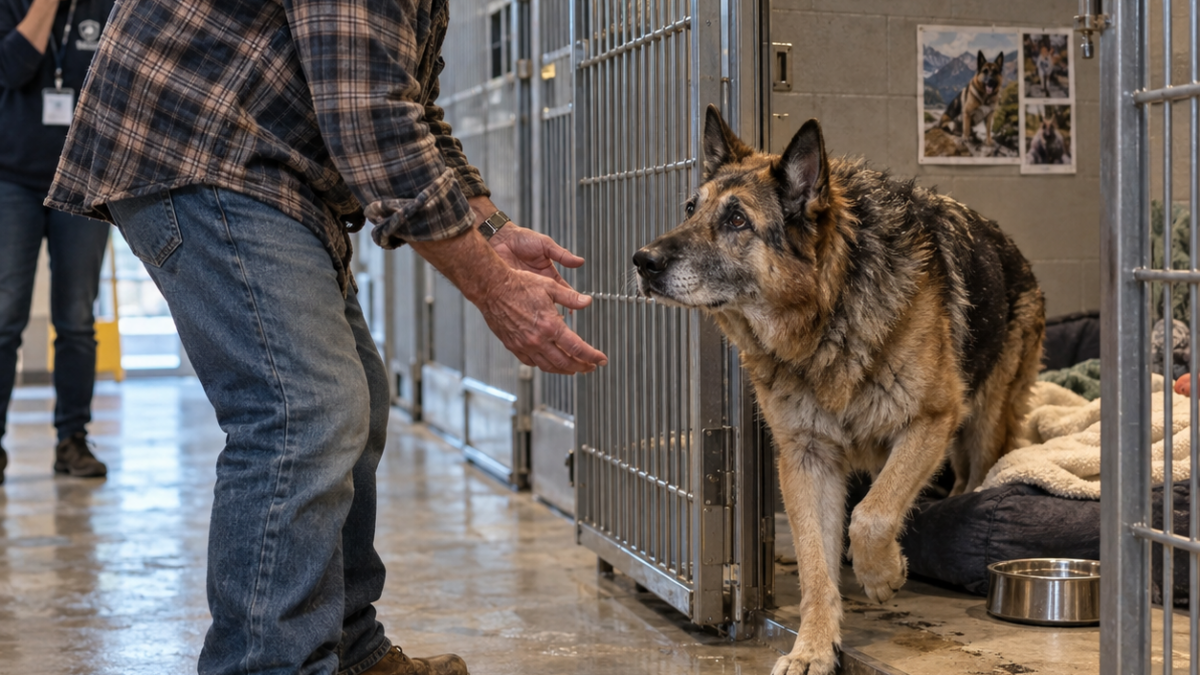
Kennel twelve.
Daniel stopped.
Ranger was facing away.
Curled in back.
Daniel didn’t move for perhaps thirty seconds.
His jaw tightened.
Eyes filled.
“Oh, buddy.”
Almost inaudible.
I stepped away.
“Go ahead.”
He shook his head.
“I don’t want to scare him.”
“You knew him better than I do.”
Sad smile.
“I used to.”
He moved closer.
One step.
Then another.
Stopped several feet from the kennel.
Put one hand against the wall.
Then said:
“Ranger.”
Quietly.
Not command.
Not excitement.
Memory.
Ranger’s eyes opened.
I stopped breathing.
“Ranger.”
The German Shepherd lifted his head.
Slowly.
First the gray muzzle.
Then the ears.
Halfway.
Then fully upright.
His eyes found the doorway.
Daniel covered his mouth.
“Hey, partner.”
Ranger stared.
Daniel said it again.
“Ranger.”
The old dog stood.
I had watched him stand every day.
Never like that.
His hips were stiff.
Rear legs trembled.
But purpose had entered the movement.
One step.
Pause.
Another.
Daniel lowered himself to one knee.
“I’m here.”
Ranger walked toward the kennel door.
Never looked away.
I was crying.
I didn’t care.
Daniel placed his hand against the bars.
Ranger stopped.
Sniffed.
Once.
Again.
Moved closer.
Daniel’s fingers curled around the metal.
“Come on, old man.”
Ranger pushed his nose against Daniel’s palm.
Then his tail moved.
One small motion.
I had never seen him wag before.
Daniel’s face broke.
“There you are.”
Another wag.
Then another.
Faster.
Not puppy-fast.
His old body couldn’t do that.
But unmistakable.
Daniel laughed while crying.
“I knew you.”
Ranger pressed harder into his hand.
I unlocked the kennel.
Neither moved at first.
Daniel remained kneeling.
Ranger stood at the threshold.
For weeks, we’d struggled to convince him to come forward.
Now the door was open.
Daniel was outside.
Ranger stared.
Daniel whispered:
“You know me.”
One front paw crossed.
Then another.
Ranger stepped out.
Stopped directly in front of Daniel.
For several seconds they simply looked at each other.
I’d read their reports.
Forest searches.
Missing children.
Winter rescues.
Night callouts.
But those reports recorded missions.
Not the thousands of ordinary moments that create partnership.
Water breaks.
Vehicle rides.
Quiet after searches.
Daniel’s hand on Ranger’s neck.
Same command.
Same voice.
Same boots beside a dog bed.
Thirteen years of familiarity.
Daniel lifted his hands.
Put them carefully around Ranger’s face.
“You got old.”
Ranger leaned forward.
Rested his gray muzzle against Daniel’s shoulder.
Daniel broke.
He wrapped both arms around him.
“I’m sorry.”
Into Ranger’s fur:
“I’m so sorry.”
Ranger pressed closer.
“I should’ve found you.”
Tail moving.
“I thought you were okay.”
Eyes closed.
“I thought they were looking after you.”
Ranger didn’t move away.
“Did you wait for me?”
I turned.
Not because I wanted to leave.
Because suddenly I felt like I’d walked into something private.
I moved down the hallway.
When I looked back, Daniel sat on the floor.
Ranger had lowered himself beside him.
His head stretched across Daniel’s thighs.
Daniel scratched behind his left ear.
The motion looked automatic.
Practiced.
Ranger’s eyes were closed.
For the first time since I’d met him, his face looked peaceful.
Daniel stayed on the floor nearly an hour.
Sometimes talking.
Sometimes silent.
“You hated that old rescue van.”
Ear movement.
“Remember?”
“You wouldn’t get in until I fixed your blanket.”
Tail tap.
Daniel laughed.
“He remembers.”
I smiled.
“I think he remembers more than either of us expected.”
We moved them to a quiet visiting room.
Ranger immediately lay beside Daniel.
No hesitation.
Daniel opened the folder.
Old photograph.
He touched it.
“That was Mason County.”
“The missing boy?”
“Three days.”
“You found him?”
Daniel corrected me.
“Ranger found him.”
“Alive?”
“Yes.”
His eyes filled.
“Dehydrated.”
“Terrified.”
“Could barely speak.”
Daniel rubbed Ranger’s chest.
“This guy caught scent near the creek.”
“Dragged me through half the forest.”
Ranger’s tail tapped the floor.
Daniel laughed.
“You remember.”
I asked:
“How many people did he find?”
Daniel thought.
“I stopped counting.”
“Really?”
“I counted at first.”
“Then it felt wrong.”
“Why?”
“Because every search wasn’t a number.”
He looked down.
“Some ended well.”
“Some didn’t.”
“But every time, he worked until I made him stop.”
He smiled.
“Sometimes I literally had to drag him away to rest.”
Ranger sighed.
Daniel froze.
Then smiled wider.
“That.”
“What?”
“That exact sigh.”
He shook his head.
“He always did that when he thought I was wasting time.”
I laughed.
“What was your first search?”
“Missing hiker.”
“How old was Ranger?”
“Almost two.”
Daniel looked at him.
“Way too much energy.”
“He wanted to search the entire planet.”
“Was he good?”
“He was terrible.”
Ranger opened one eye.
Daniel smiled.
“He was brilliant.”
Tail movement.
“But terrible.”
The room became lighter.
And I realized recognition wasn’t happening only inside Ranger.
Daniel was finding himself too.
The younger man from those photographs.
The routines.
The responsibilities.
The jokes.
Some relationships become mirrors.
Lose them and part of yourself disappears from view.
Eventually I asked:
“What happens now?”
Daniel looked confused.
“What do you mean?”
“Long-term.”
He looked at Ranger.
Answer obvious.
“He’s coming home.”
I expected that.
Shelter work still requires caution.
“I need to ask questions.”
“Ask.”
“House?”
“Yes.”
“Fenced yard?”
“Yes.”
“Other animals?”
“One elderly cat.”
“Cat okay with dogs?”
Daniel smiled.
“She tolerated Ranger once.”
“You had her when you worked together?”
“My wife did.”
“You’re married?”
His smile disappeared.
“Widowed.”
“I’m sorry.”
“Three years.”
Ranger lifted his head.
Daniel touched his ear.
“She loved you too, didn’t she?”
That revealed another loss.
Daniel had lost more than his working partner.
“Your health?”
“Mine or his?”
“Both.”
“I’m seventy.”
“You don’t look seventy.”
“Tell my knees.”
He continued.
“I can handle medication.”
“Short walks.”
“Vet appointments.”
“And if his mobility gets worse?”
Daniel’s expression became serious.
“Then mine gets better for him.”
I remembered that.
“You understand he’s thirteen.”
“I know.”
“Could be years.”
“Could be months.”
“I know.”
“Senior Shepherds can get expensive.”
“I know.”
Daniel looked directly at me.
“I missed four years.”
His voice didn’t shake.
“I’m not asking for another ten.”
“I want whatever he still has.”
“All right.”
We began the adoption process that afternoon.
Records.
Identification.
Medical transfer.
Senior examination.
Daniel contacted his veterinarian immediately.
Then arranged transportation backup.
Then bought supplies.
He didn’t walk in fueled only by emotion.
He made a plan.
That mattered.
I found him outside later.
Ranger asleep across his boots.
“You okay?”
“No.”
Then Daniel smiled.
“Yes.”
“What are you feeling?”
“Angry.”
“At who?”
“Myself.”
“You couldn’t have known.”
“I could’ve checked harder.”
“Maybe.”
He looked at me.
“You don’t need to protect me.”
“I’m not.”
I sat beside him.
“Guilt is useful only if it changes what you do next.”
Daniel considered that.
“Shelter philosophy?”
“My therapist.”
He laughed.
“Good therapist.”
Ranger opened one eye.
Daniel rubbed his neck.
“I’m not losing you again.”
We couldn’t finalize everything that day.
Records needed confirmation.
So Daniel stayed in town.
He refused to leave Ranger.
Technically we had rules.
We bent them.
A cot went into a quiet staff room beside Ranger’s kennel.
Daniel slept there.
Or tried.
I arrived at six the next morning.
Ranger was standing.
At the door.
Tail moving.
“Morning.”
Daniel looked exhausted.
“He woke me at four.”
“Why?”
“Apparently four-thirty is still an acceptable working-dog schedule.”
I stared.
“He woke you?”
“Pawed the cot.”
“Then stood by the door.”
Daniel smiled.
“I think he wanted a mission.”
For weeks, getting Ranger outside had required encouragement.
Now he was requesting activity before sunrise.
They walked around the shelter property.
Slowly.
No harness.
No official work.
Just an old man and an old German Shepherd.
But Ranger’s head stayed up.
Nose moving.
Inspecting grass.
Stopping at fences.
Looking back at Daniel.
Daniel gave commands unconsciously.
“Easy.”
“This way.”
“Wait.”
Ranger responded instantly.
Then Daniel said:
“Sit.”
Ranger sat before the word fully left him.
Daniel stopped.
Tears filled his eyes.
“Thirteen years.”
Ranger looked up.
“He still knows.”
Dr. Alvarez examined him later.
Arthritis.
Hip changes common in elderly German Shepherds.
Mild cardiac changes.
Muscle loss in the rear legs.
Nothing immediately terminal.
“With management, he can still have good quality time.”
Daniel took out a notebook.
“What do I need?”
Medication.
Joint support.
Weight management.
Non-slip flooring.
Ramps.
Short walks.
Monitoring.
Regular bloodwork.
Daniel wrote everything.
Then:
“Can he still do scent work?”
Dr. Alvarez looked surprised.
“Not professional search work.”
“I know.”
“Simple scent games?”
“Yes.”
“For enrichment?”
“Yes.”
She smiled.
“Absolutely.”
Daniel looked down.
“You hear that, partner?”
Ranger’s ears rose.
“You’re not retired.”
I laughed.
“Please don’t tell him that.”
Paperwork cleared the next afternoon.
Medication packed.
Food.
Blanket.
Records.
Daniel’s SUV sat outside.
In the cargo area:
Large orthopedic bed.
I stared.
“You bought that yesterday?”
“And ramps.”
“Ramps?”
“For my porch.”
“You bought ramps before we approved adoption?”
Daniel looked slightly embarrassed.
“I was optimistic.”
“For once, I approve.”
Ranger stood near the shelter entrance.
Daniel walked outside.
Ranger hesitated.
That surprised me.
He looked at Daniel.
Then at me.
For weeks I had wanted Ranger to care enough to look toward anybody.
Now he was looking at me.
I crouched.
Touched his chest.
“You’re okay.”
Ears forward.
“Go home.”
He looked at Daniel again.
Daniel stood beside the open SUV.
“Come on, partner.”
Ranger walked.
Slowly.
At the car, Daniel unfolded a ramp.
“I told you.”
Ranger sniffed it.
Daniel tapped once.
“Up.”
Instant response.
Ranger climbed.
Halfway up, he stopped.
Looked back at me.
I raised my hand.
“All good.”
His tail moved.
Then he continued.
Daniel hugged me.
“Thank you.”
“You already said that.”
“Not enough.”
He looked toward Ranger.
“You called.”
“You could’ve read the records and put them back.”
I didn’t know what to say.
So:
“He looked like he was waiting.”
Daniel’s face tightened.
“Maybe he was.”
The SUV started.
Ranger was lying on the orthopedic bed.
Then the engine turned over.
The old Shepherd stood.
Moved toward the front seats as far as his body allowed.
Daniel reached backward.
His hand found Ranger’s head.
Same hand from the photographs.
Same place.
I watched them leave.
I stayed outside until the SUV disappeared.
Then walked inside.
Kennel twelve was empty.
Water bowl.
Blanket.
One untouched rubber toy.
I collected them.
The corner where Ranger had spent weeks looked strangely small.
That was when I realized:
He hadn’t gone quiet because nothing remained inside him.
He had lost the context that made him make sense.
A working German Shepherd without work.
A partner without his person.
A thirteen-year life built on purpose and connection reduced to a concrete kennel and strangers.
Three days later, Daniel called.
I answered immediately.
“What happened?”
“He stole my sock.”
I laughed.
“What?”
“He stole my sock.”
“Are you complaining?”
“Rachel, I’m thrilled.”
He sounded ten years younger.
“How’s he eating?”
“Everything.”
“Sleeping?”
“Next to my bed.”
“Walking?”
“Twice every day.”
“Too much?”
“No.”
Then Daniel became quieter.
“He waited at the front door this morning.”
“Anxious?”
“No.”
I heard him smile.
“I picked up the leash.”
“He stood.”
“I asked, ‘Ready?’”
“And?”
“You should’ve seen his face.”
“What did you do?”
“Took him outside.”
“For a walk?”
Pause.
“A search.”
I smiled.
Daniel had hidden pieces of cloth around his yard.
Easy places.
Nothing physically difficult.
Then gave Ranger the old search cue.
Daniel said the change was immediate.
Nose down.
Ears working.
Tail level.
Focused.
Not fast anymore.
But working.
“He found all four.”
“Obviously.”
“I cried like an idiot.”
“Reasonable.”
“He slept three hours afterward.”
“Also reasonable.”
Daniel laughed.
Then:
“He’s home.”
I closed my eyes.
“Yes.”
“He’s home.”
A week later, photograph.
Daniel in his living room.
Ranger lying beside him.
Gray head against Daniel’s leg.
It looked almost identical to an old service photograph.
Except both were older.
Daniel’s hair gray.
Ranger’s muzzle white.
But his eyes were different from the shelter photo.
Open.
Alert.
Present.
Daniel wrote:
He’s doing well.
Then:
Every morning he waits by the door. I think he believes we’re going back on duty.
I printed both photographs.
First shelter photo.
New photo.
Pinned side by side in our staff room.
Same thirteen-year-old German Shepherd.
Taken weeks apart.
People thought the second was an old working picture.
It wasn’t.
Connection hadn’t made Ranger younger.
He still had arthritis.
Still gray.
Still tired.
But age and emptiness are not the same thing.
We had confused them.
A month later, Daniel brought him to visit.
Ranger walked through the shelter doors beside him.
I barely recognized the posture.
Head up.
Shoulders relaxed.
Tail neutral.
He saw me.
Stopped.
Then walked straight over.
“You remember me?”
Tail wag.
I knelt.
He sniffed.
Licked my chin once.
Daniel laughed.
“Special treatment.”
“I’ll take it.”
Then Ranger returned immediately to Daniel.
Of course.
“How’s retirement?”
Daniel looked down.
“He rejects the premise.”
We both laughed.
“Scent games.”
“Short walks.”
“Supervises mail delivery.”
“Important.”
“Critical.”
Daniel rested a hand on Ranger’s back.
“You know what I’ve been thinking?”
“What?”
“For years I trusted him to find people.”
Daniel looked at me.
“Then when he disappeared from my life, I trusted somebody else to know where he was.”
He shook his head.
“I’ll regret that forever.”
“You found each other.”
“You found us.”
I didn’t argue.
Maybe accepting gratitude also means admitting small actions sometimes matter.
Opening the envelope.
Noticing the same handler in every photograph.
Making one more call.
Sometimes there isn’t a dramatic rescue.
Sometimes the difference between an old dog dying forgotten and getting home is one person becoming curious.
After Ranger, I started looking more carefully at every senior dog.
Not because they all had retired handlers waiting.
They didn’t.
But because animals do not enter shelters as blank pages.
They arrive carrying years.
Rooms.
Voices.
Cars.
People.
Other animals.
Routines.
Losses.
Habits.
Sometimes stubbornness is memory.
Sometimes indifference is grief.
Sometimes an animal that appears to want nothing has simply stopped believing the thing it wants can return.
Daniel kept sending updates.
First snow.
Ranger in a ridiculous winter coat.
Ranger sleeping in front of the fireplace.
A wooden box marked SEARCH filled with scent toys.
Daniel wrote:
He checks it every morning.
Another message:
He found my keys today.
I asked:
Were they hidden?
Daniel replied:
No.
Then:
Still counts.
Six months after the reunion, Daniel called.
“He had a rough night.”
My stomach tightened.
“Pain?”
“Yes.”
“Vet?”
“This morning.”
“And?”
“Arthritis is worse.”
“Heart hasn’t changed much.”
“They adjusted his medication.”
“How is he?”
“Asleep.”
Daniel sounded tired.
“You okay?”
“No.”
Pause.
“But I knew this part was coming.”
Then:
“I wish I’d had the four years.”
“I know.”
“I keep doing the math.”
“Don’t.”
“Can’t help it.”
“If I had checked earlier—”
“Daniel.”
He stopped.
“You didn’t know.”
“I should’ve.”
“Maybe.”
I wasn’t going to give him a dishonest absolution.
“But you’re there now.”
Silence.
“So is Ranger.”
Another silence.
“Yes.”
“That’s the part he knows.”
Daniel whispered:
“That’s the part I’m trying to remember.”
Medication helped.
Not miraculously.
Enough.
Ranger kept walking.
Searching his yard.
Waiting beside the door.
Daniel sent a video.
Ranger stood near the entrance.
Daniel’s voice:
“Ready?”
The German Shepherd’s ears rose instantly.
Expression transformed.
Leash appeared.
Tail wag.
Video ended.
I watched five times.
One word from the right voice made him look young.
Ready.
Maybe that was always Ranger’s favorite word.
Ready to search.
Ready to go.
Ready to work.
Ready to follow.
Ready to trust.
A year after adoption, Daniel invited me out.
His house sat on several quiet acres.
Ramp from porch to yard.
Daniel opened the door.
“Rachel.”
Then Ranger appeared.
Much slower.
But when he recognized me, tail movement.
“Hey, old man.”
I crouched.
He pressed his forehead briefly against my hand.
Then returned to Daniel.
Always Daniel.
Photographs covered the walls.
Search teams.
Rescue vehicles.
Forests.
Snow.
Missing-child case.
One picture showed Daniel asleep in an armchair with Ranger’s head across his lap.
“That’s his position.”
Daniel laughed.
“Always was.”
Ranger lay across Daniel’s feet.
Daniel got up.
“You want to see something?”
He brought out Ranger’s old working harness.
The second Ranger saw it, his head came up.
I gasped.
“No way.”
Daniel smiled.
“I don’t put it on him.”
“Too heavy now.”
“But sometimes…”
Ranger stared at the harness.
Daniel said:
“Ready?”
Tail movement.
I covered my mouth.
“That is unbelievable.”
Daniel put the harness away.
Ranger relaxed again.
“You know what I used to think?”
“What?”
“That the work was what bonded us.”
“Wasn’t it?”
“Partly.”
He rubbed Ranger’s neck.
“But when the work stopped, the bond stayed.”
Ranger’s head rested on his boot.
“I think I had it backward.”
“How?”
“I thought we were close because we did important things together.”
He looked down.
“Now I think those things felt important because we were doing them together.”
That sentence stayed.
Daniel told stories not in reports.
Ranger once refused to leave a search area because he smelled something everyone else missed.
He stole a sandwich from a team commander.
Hated helicopters.
Loved children.
Became subdued for days after searches that ended badly.
Slept through thunderstorms only when Daniel was nearby.
“He always slept touching my boot.”
I looked down.
Ranger’s paw rested against Daniel’s shoe.
Some habits survive everything.
Time passed.
Updates became less frequent.
That was good.
Reunions become ordinary life.
Morning walks.
Medication.
Food.
Naps.
Scent games.
The extraordinary settles into routine.
Then, almost two years after Ranger went home, Daniel called.
I knew.
Before I answered.
Sometimes you know.
“Rachel.”
His voice was quiet.
I sat.
“How is he?”
Daniel breathed.
“He’s tired.”
I closed my eyes.
“Today?”
“Probably.”
I could hear faint breathing.
“Vet coming?”
“Yes.”
“To the house.”
“Good.”
Silence.
“I wanted you to know.”
“Thank you.”
“He’s on his bed.”
“By the door?”
Daniel laughed quietly.
“Of course.”
My eyes filled.
“Can I talk to him?”
The question surprised me.
Then Daniel said:
“Yeah.”
Movement.
Phone shifting.
Daniel’s voice became softer.
“Hey, partner.”
“Rachel wants to say hi.”
I felt ridiculous.
I spoke anyway.
“Hey, old man.”
Nothing.
Maybe breathing.
Fabric.
“You did good.”
My voice broke.
“You did really good.”
I stopped.
I didn’t want my final words to be sad.
So I used Daniel’s word.
“Ready?”
Silence.
Then Daniel inhaled.
“His ears moved.”
I cried.
“So he heard.”
“Yeah.”
Daniel’s voice cracked.
“He heard.”
The veterinarian arrived about an hour later.
Daniel sent one message afterward.
He went with his head on my lap.
Then another:
Same place he came back to.
I stared at that sentence for a very long time.
Kennel twelve.
The corner.
Gray muzzle lowered.
Dog who seemed to have stopped caring.
Then Daniel kneeling.
First tail movement.
Ranger’s face against his shoulder.
Head across Daniel’s lap.
Same place at the beginning of their second chance.
Same place at the end.
I cried in our staff room.
Nobody asked me to stop.
Several days later, a package arrived.
Inside:
Framed photograph.
Daniel and Ranger after the reunion.
On the back:
For Rachel.
He spent his life finding people.
Thank you for finding me.
The photograph still hangs near our office.
New employees ask.
I tell them the short version.
Retired search-and-rescue German Shepherd.
Thirteen.
Separated from handler.
Ended up in shelter.
Reunited.
Adopted.
Home for the final chapter of his life.
People ask:
“Did he really wait four years?”
I answer carefully.
“I don’t know.”
Because I don’t.
I cannot tell you what a German Shepherd consciously thinks over four years.
I cannot prove that every day Ranger sat inside our shelter he was actively waiting for Daniel Mercer.
That would be human storytelling.
But I know what I saw.
A dog who barely reacted to anyone lifted his head at one voice.
Recognition before contact.
An arthritic body standing with purpose.
Ears rising.
Eyes changing.
A tail moving for the first time.
A dog returning instantly to a position beside one man as though his body remembered where it belonged.
I saw an animal who had been surviving become interested in living again.
Call it scent.
Memory.
Conditioning.
Attachment.
Love.
We use different words depending on how comfortable we are believing animals possess inner lives we cannot fully measure.
The word matters less to me.
The response was real.
For thirteen years, Ranger searched for people.
Through forests.
Fields.
Snow.
Darkness.
Rain.
He found people who were lost.
Injured.
Frightened.
Confused.
Waiting.
Then at the end of his working life, Ranger became lost himself.
Not in wilderness.
In systems.
Transfers.
Records.
Administrative changes.
Time.
He became an elderly German Shepherd in kennel twelve whose thirteen-year history barely fit into a few lines.
Finding him didn’t require scent.
It required someone opening a folder.
Seeing the same man in every photograph.
Asking another question.
Making another call.
I used to believe rescue began when an animal entered the shelter.
Food.
Veterinary care.
Behavior.
Adoption.
Ranger changed that.
Sometimes rescue requires looking backward.
Who did this dog know?
What routines mattered?
What disappeared?
Who did he trust?
Where did he belong before he came to us?
We are not always the beginning of an animal’s story.
Usually we enter somewhere in the middle.
Sometimes the best thing we can do is return them to a chapter they never wanted to leave.
Daniel once said:
“I thought Ranger was my working dog.”
“Then he got old and I realized he had been part of who I was.”
But Daniel had been part of Ranger too.
We talk about working dogs through achievements.
Searches.
Detections.
Rescues.
Years in service.
Certifications.
Headlines.
Those things matter.
But eventually the harness comes off.
The radio stops.
Assignments end.
Uniforms get folded away.
And underneath all of that work remains an animal who learned one voice.
One smell.
One hand resting behind his ears.
One vehicle.
One set of footsteps.
One person.
That matters too.
Sometimes when I pass kennel twelve, I still picture Ranger.
Curled in the back.
Silent.
Maybe waiting.
Maybe simply existing without the thing that had once given his days meaning.
Then I remember Daniel standing outside the kennel.
“Ranger.”
The ears rising.
“Ranger.”
The gray head lifting.
One slow step.
Then another.
The first tail wag.
There are moments in shelter work that remind you why you stay.
That was one of mine.
Not because I created their bond.
I didn’t.
Their relationship existed years before I knew either name.
I simply found evidence that it existed.
Then I called.
That was enough.
Now, when new staff start, I tell them:
“Read the file.”
They laugh.
I don’t.
“Seriously.”
“Read the file.”
Because sometimes the answer is there.
An old photograph.
A phone number.
A name.
A note.
Something everybody else dismissed as history.
For Ranger, history became the road home.
I still think about Daniel’s inscription.
He spent his life finding people.
Thank you for finding me.
But maybe that isn’t quite what happened.
Maybe Ranger and Daniel found each other twice.
The first time, Ranger was young.
Powerful.
Restless.
A German Shepherd desperate to search the entire world at once.
Daniel became his handler.
Together, they learned trust.
The second time, both were old.
Slower.
Lonelier.
Carrying years neither of them could get back.
That reunion mattered differently.
No mission.
No missing child.
No grid to clear.
No rescue truck.
No uniform.
No need to prove anything.
Just time.
Morning walks.
Scent games hidden around the yard.
An orthopedic bed beside the door.
Medication with breakfast.
A ramp from the porch.
A hand resting on a silver head.
And perhaps that became the most important assignment either of them ever received.
Stay together while there is still time.
For most of Ranger’s life, people gave him commands.
Search.
Find.
Wait.
Return.
But when Daniel Mercer finally stood outside kennel twelve after four years apart, the old German Shepherd needed none of them.
Daniel only said his name.
Ranger lifted his head.
He stood.
And he walked toward the voice he had never forgotten.








