For 13 Freezing Days, a German Shepherd Guarded an Abandoned Shopping Cart—Then We Found the Woman He Was Waiting For
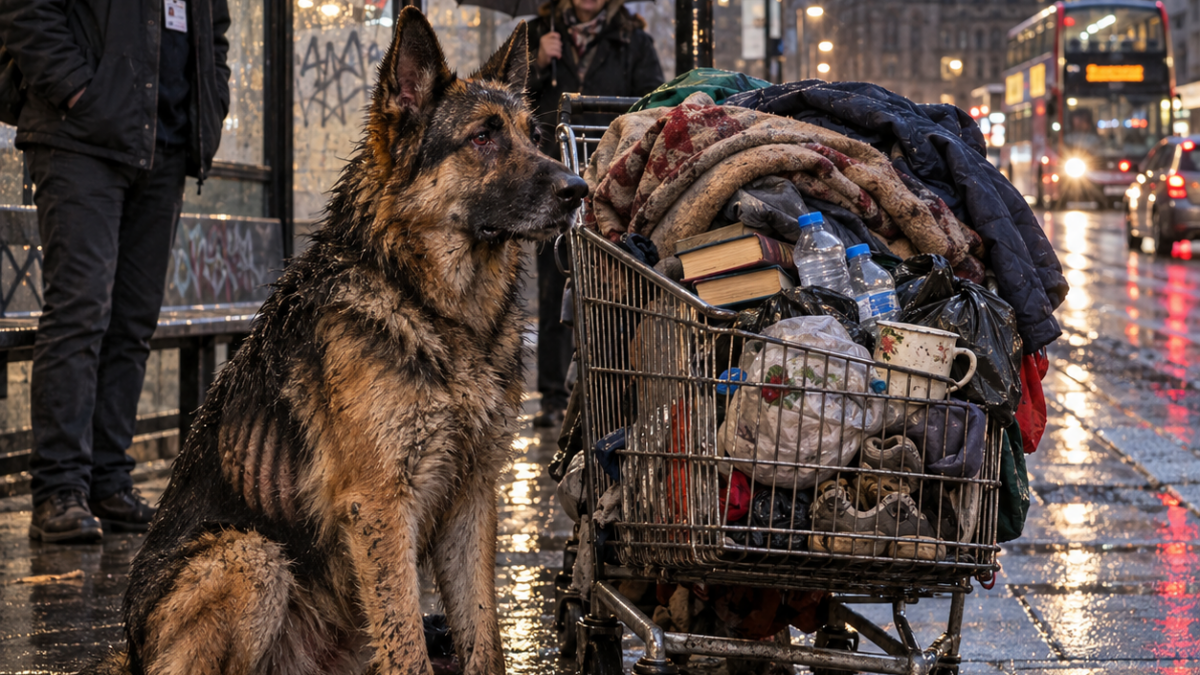
PART3:
A chipped mug.
A pair of shoes.
Several bottles of water.
And what appeared to be somebody’s entire life.
Beside the cart sat the German Shepherd.
He was large.
Black-and-tan.
Maybe eighty pounds when healthy, though he was thinner now.
The black saddle across his back was dark with rain.
Tan fur along his chest and legs clung to his body.
His paws were muddy and cracked.
His ribs showed slightly beneath his wet coat.
His ears stood upright despite the weather.
And his eyes—
That was what I noticed.
Dark brown.
Red around the edges from wind and exhaustion.
He was not curled into the blankets people had left.
He wasn’t trying to hide beneath the shelter.
He wasn’t pacing.
He sat upright beside the cart like a sentry.
Facing the road.
Watching.
Amanda stood beneath an umbrella nearby.
“How long?”
“People officially reported him four days ago.”
An elderly woman standing beside the bakery across the pavement shook her head.
“Longer.”
She stepped closer.
Gray scarf.
Heavy coat.
Small umbrella decorated with yellow flowers.
“I’ve seen him every day.”
She introduced herself as Mrs. Chatterjee.
“How long?” I asked.
“That dog has been here since the ambulance came.”
I looked at her.
“What ambulance?”
Her expression changed.
“There was a woman.”
She pointed toward the cart.
“Evelyn Cartwright.”
“That was hers?”
Mrs. Chatterjee nodded.
“Her and Bruno.”
At the name, the German Shepherd reacted.
One ear rotated toward us.
His head shifted perhaps an inch.
But his eyes remained fixed on the road.
“Bruno?”
The shepherd’s ears moved again.
I looked at the cart.
“What happened to Evelyn?”
“She collapsed.”
“When?”
Mrs. Chatterjee thought.
“Ten days ago.”
“Ten?”
Amanda folded her arms against the cold.
“That’s what we think.”
Mrs. Chatterjee corrected her.
“Eleven if you count that evening.”
I stared at Bruno.
“You mean he has been here for almost two weeks?”
“He leaves for water.”
Mrs. Chatterjee pointed toward a bowl somebody had placed beneath the shelter.
“Sometimes food.”
“Where does he sleep?”
“Near the cart.”
“In this weather?”
She nodded.
“We tried moving him.”
“Who?”
“Everybody.”
Across the street, the bakery door opened.
A heavyset man in a flour-dusted apron stepped outside.
Patrick O’Malley.
He pointed at Bruno.
“I put a lead on him two days ago.”
“What happened?”
“He didn’t bite.”
Patrick shook his head.
“Never even growled.”
“What did he do?”
“Lay down.”
“Lay down?”
“Flattened himself on the pavement and wouldn’t move.”
Mrs. Chatterjee added:
“Four people tried.”
Patrick smiled without humor.
“He is a German Shepherd. When a German Shepherd decides seventy-five pounds of dog has become part of the pavement, apparently you require construction equipment.”
Bruno’s ears shifted.
I crouched several feet away.
“Bruno?”
His eyes finally moved toward me.
German Shepherds have a particular way of looking at people.
Direct.
Evaluating.
As if some part of them is always measuring the space between you and whatever they consider important.
There was no aggression in his eyes.
No panic.
Just exhaustion.
And certainty.
Behind me, a bus arrived.
Doors opened.
Passengers stepped off.
Bruno stood.
Immediately.
His entire body changed.
Ears forward.
Neck extended.
He scanned every person.
An older man.
Two teenagers.
A woman pushing a stroller.
Someone in a fluorescent work jacket.
One by one, they walked away.
Bruno watched each face.
Then the bus doors closed.
The bus pulled away.
The shepherd remained standing for several seconds.
Finally his ears lowered.
He sat beside the cart again.
I felt something tighten in my chest.
Amanda whispered:
“He does that every time.”
Every bus.
Every arrival.
Every person walking down Maple Road.
Waiting.
“He thinks she’s coming back,” I said.
Nobody answered.
I looked at Mrs. Chatterjee.
“Where was Evelyn taken?”
“Hospital.”
“Which?”
“St. Margaret’s.”
Amanda nodded.
“That much we confirmed.”
“Then where is she now?”
Silence.
I looked between them.
“Amanda?”
“She isn’t there anymore.”
“Transferred?”
“Probably.”
“To where?”
“We don’t know.”
That answer bothered me more than it should have.
Because I knew exactly what it meant.
One ward.
Another ward.
Respiratory care.
Discharge team.
Temporary facility.
Referral.
Transport.
Maybe a misspelled surname.
Maybe someone typed Margaret as the surname instead of middle name.
Maybe a computer system that did not speak to another computer system.
People imagine disappearing as something dramatic.
A person walking into fog.
A crime.
A mystery.
Often it is much more ordinary.
You disappear administratively.
I looked at Bruno again.
Rain collected along the black fur above his eyes.
He turned toward the road.
Waiting.
I had appointments the next morning.
Cases stacked on my desk.
Supervisors who could correctly remind me that locating somebody’s dog was not technically part of my assigned workload.
But standing there, none of that mattered.
I took out my phone.
“What is Evelyn’s full legal name?”
Amanda watched me.
“Daniel.”
“Full name.”
“Evelyn Margaret Cartwright.”
“Age?”
“Approximately sixty-five.”
“Date of birth?”
She gave it to me.
I typed everything.
Then looked toward Bruno.
“I’ll find her.”
At the sound of my voice, his head turned.
I don’t know whether dogs understand promises.
Probably not as words.
But I do think German Shepherds understand intention better than we give them credit for.
Bruno looked at me for several seconds.
Then turned back toward the road.
The next morning, St. Margaret’s confirmed Evelyn Cartwright had been admitted eleven days earlier.
That was the good news.
Everything after that was difficult.
“She’s no longer a patient,” the woman on the phone said.
“Where was she transferred?”
“I can’t disclose medical information.”
“I’m her assigned social worker.”
“Do you have documentation?”
“Yes.”
“Send it.”
I sent it.
Forty-three minutes later:
Different employee.
Same explanation.
Eight minutes of hold music.
Then:
“She was transferred to a respiratory unit.”
“Which one?”
“I don’t have that information.”
“How can you not have that information?”
“I only see that she left our system.”
“She wasn’t discharged onto a pavement in her condition.”
“I’m sorry. That’s all I can see.”
I hung up.
Stared at the wall.
This is the part of social work people rarely understand.
Compassion is often not the missing ingredient.
Compassion can be everywhere.
Nurses care.
Doctors care.
Outreach workers care.
Receptionists care.
Volunteers care.
The problem is connecting all those caring people through systems divided by privacy rules, departments, software, shift changes, eligibility categories, referral codes, funding limits, and employees allowed to see only one small piece of a human life.
I called three respiratory wards.
Nothing.
Two rehabilitation centers.
Nothing.
Another hospital had an Evelyn Cartwright.
Wrong birth date.
By noon, I had achieved nearly nothing.
So I went back to Maple Road.
Bruno remained there.
He had moved approximately three feet to catch a small strip of pale winter sunlight between buildings.
Mrs. Chatterjee had brought him broth.
Patrick had left cooked chicken.
Most remained untouched.
I crouched nearby.
“No luck yet.”
One ear moved.
“I’m trying.”
Bruno watched me.
“I know you don’t trust me.”
Nothing.
“I wouldn’t trust us either.”
Mrs. Chatterjee smiled.
“He is listening.”
“You think?”
“He listens to everyone.”
She looked at Bruno.
“He obeys nobody.”
“That does sound like a shepherd.”
I stood.
“Did Evelyn always stay here?”
“Nearly a year.”
“Family?”
Mrs. Chatterjee’s face closed slightly.
“She never spoke about one.”
“Friends?”
She looked at Bruno.
“Bruno.”
That answer stayed with me.
Bruno.
One word.
An entire support network.
That afternoon I started asking questions around Maple Road.
Patrick told me Evelyn came to his bakery most evenings before closing.
Never begged.
Never walked inside demanding food.
She stood near the window until Patrick brought out bread or sandwiches that could not be sold the next morning.
“She always tried paying.”
“With what?”
“Coins.”
He cupped his palm.
“Little handfuls.”
“You took them?”
“At first.”
“Then?”
“I stopped.”
“How did she feel?”
“Furious.”
He smiled.
“She had pride.”
Most people passing Evelyn probably saw an older homeless woman with a cart.
Patrick knew she divided everything she received.
One half for herself.
One half for Bruno.
“Even if I gave her two sandwiches.”
He looked through the bakery window.
“She broke both in half.”
The previous winter somebody had offered Evelyn a place in temporary accommodation.
She refused.
“Because of Bruno?”
Patrick nodded.
“No dogs.”
I had heard variations of that story hundreds of times.
People ask:
Why would someone sleep outside instead of taking shelter?
Sometimes the answer has four legs.
That evening Amanda appeared beside my desk carrying coffee.
“You haven’t gone home.”
“Neither have you.”
“My excuse is pity.”
“What is mine?”
She handed me the cup.
“A German Shepherd judging your professional competence.”
“That is surprisingly motivating.”
“Any progress?”
I explained.
Amanda sat.
“Could she have been sent outside Manchester?”
“Yes.”
“Discharged?”
“Unlikely.”
She watched me.
“You’re taking this personally.”
Maybe.
When I entered social work twelve years earlier, I believed effort could fix nearly anything.
Experience cures that quickly.
Too many people.
Too few beds.
Funding.
Waiting lists.
Boundaries become survival.
Without boundaries, every case follows you home.
Bruno didn’t understand boundaries.
Every morning he woke beside that cart and resumed waiting.
I couldn’t stop thinking about it.
The next day brought sleet.
Bruno stood beneath the bus shelter.
Someone had constructed a bed from wooden pallets, cardboard, and blankets.
He wasn’t using it.
He sat beside Evelyn’s cart.
Again.
Like moving six feet away might somehow violate the only assignment he had left.
“You stubborn old fool,” I whispered.
Mrs. Chatterjee approached.
“He’s not old.”
I looked more closely.
She was right.
Under the exhaustion, he might have been five.
Six at most.
Strong shoulders.
Long shepherd muzzle.
Large paws.
The gray I thought I saw around his face was mostly salt from road spray and dried rain.
“Did Evelyn mention a clinic?”
“No.”
“Doctor?”
“No.”
“Anything?”
“She hated hospitals.”
“Most people do.”
“No.”
Mrs. Chatterjee shook her head.
“She feared them.”
That gave me a new direction.
Old outreach notes.
Eventually:
Evelyn Margaret Cartwright.
Sixty-five.
No fixed address.
Previous admission eighteen months earlier.
One line mentioned a community health nurse.
I called.
She remembered immediately.
“Evelyn?”
“Yes.”
“The lady with the German Shepherd?”
“Exactly.”
“Is she okay?”
“I’m trying to locate her after hospital transfer.”
The nurse paused.
“Have you checked Clayton Vale?”
I had not.
Convalescence facility north of Manchester.
Respiratory recovery.
Patients medically stable but not ready for independent discharge.
I called.
Reception.
Documentation.
Hold.
Then:
“Mr. Foster?”
“Yes.”
“We have an Evelyn Cartwright.”
I closed my eyes.
“Is she conscious?”
“Yes.”
“Stable?”
“Improving.”
For the first time in days, I breathed properly.
“Can I visit?”
The following afternoon, I stood outside Clayton Vale.
Red brick.
Two floors.
Trimmed winter shrubs.
Inside:
Disinfectant.
Boiled vegetables.
Overheated corridors.
A nurse led me toward room twelve.
“How is she?”
“Much better.”
“Does she ask about a dog?”
The nurse stopped.
“Constantly.”
My throat tightened.
“Why didn’t anyone—”
“We tried.”
Her tone was tired, not defensive.
“No contact number. No relatives. No permanent address. She kept saying Bruno was at Maple Road.”
She hesitated.
“By the time that information reached someone who could act…”
She didn’t finish.
She didn’t need to.
Another department.
Another day.
Another handoff.
I knocked.
A weak voice answered.
“Come in.”
Evelyn Cartwright sat beside the window.
Smaller than I expected.
Thin gray hair.
Weathered face.
Hands beneath a blanket.
Oxygen line under her nose.
She looked at me suspiciously.
“Who are you?”
“Daniel Foster.”
“Police?”
“No.”
“Benefits?”
“Social services.”
Her mouth tightened.
“I don’t need trouble.”
“I’m not bringing any.”
“Then what?”
I pulled the chair closer.
“Bruno.”
Everything changed.
Her shoulders jerked.
Hands emerged.
“Bruno?”
“Yes.”
Her eyes filled immediately.
“He’s alive?”
“He’s alive.”
She covered her mouth.
“He’s at Maple Road.”
“Where exactly?”
“Beside your cart.”
Her breathing changed.
“How long?”
“Thirteen days now.”
“No.”
She shook her head.
“No.”
“Evelyn—”
“Somebody would’ve taken him.”
“People tried.”
“Then where is he?”
“Still beside the cart.”
Tears ran down her face.
“He waited?”
“Every day.”
She turned toward the window.
For almost a minute, neither of us spoke.
Then:
“I left him.”
“You collapsed.”
“He doesn’t know that.”
“No.”
“I didn’t tell him.”
“You couldn’t.”
She looked angry suddenly.
“You don’t understand.”
“Tell me.”
“That dog has never left me.”
Then she told me.
Four years earlier, Evelyn had found Bruno behind an industrial estate.
He was perhaps ten weeks old.
Inside a taped cardboard box beside rubbish bins.
She heard crying.
At that point Evelyn had already been homeless almost eighteen months.
She had less than twelve pounds.
Still, she opened the box.
Inside:
A tiny German Shepherd puppy.
Black ears still too large for his head.
Tan paws.
Thin.
Shivering.
She intended to find him a proper home.
“Someone with a garden.”
“How long did you look?”
“One day.”
She smiled.
“Then two.”
“Then?”
“A week.”
By the end of that week, Bruno slept inside her coat.
“He chewed through my shoelace.”
“Expensive.”
“My best shoe.”
She laughed.
Then coughed.
Bruno grew.
He learned which shopkeepers had food.
Which streets were safer.
Which doorways stayed dry.
When temperature dropped, he slept with his back against Evelyn’s.
One winter, snow blew into a cardboard shelter.
She woke with Bruno lying across her legs to keep them warm.
Another night, a drunk man tried taking her bag.
Bruno did not attack.
He stood between them.
Hackles raised.
One low shepherd growl.
The man left.
“He always knew when I was scared.”
German Shepherds are famous for loyalty.
People romanticize it.
But loyalty is not magic.
It is attention.
Bruno had spent four years watching Evelyn so closely that her breathing probably told him more than our paperwork ever could.
“Family?” I asked.
Her expression closed.
“None.”
“Nobody?”
“Nobody who wants finding.”
I let it go.
For now.
Then:
“He needs your voice.”
“What?”
“I can’t take you out today.”
She stiffened.
“And getting a dog inside may require permission.”
“Then what?”
“Record something.”
I placed my phone on the table.
She stared.
“You think he’d understand?”
“I think he’ll understand you.”
Her hands shook.
I pressed record.
Evelyn leaned closer.
“Bruno.”
Her voice broke on his name.
She swallowed.
“Bruno, my boy.”
Tears again.
“I’m here.”
Breath.
“I’m alive.”
Then stronger:
“I didn’t leave you.”
Her face crumpled.
“I promise I didn’t leave you.”
I almost stopped recording.
Then she whispered:
“Come find me, sweetheart.”
That evening rain had returned.
A dozen people stood near Maple Road.
Bruno had become neighborhood news.
Nobody treated him as entertainment anymore.
They simply came.
Mrs. Chatterjee.
Patrick.
Three schoolchildren.
Amanda.
I approached slowly.
“Got something.”
Bruno watched.
I crouched.
Pressed play.
“Bruno.”
His ears snapped forward.
Every person fell silent.
“Bruno, my boy.”
He stood.
“I’m here.”
Head tilted.
“I’m alive.”
His tail moved.
Barely.
Then again.
“I didn’t leave you. I promise I didn’t leave you.”
Bruno stepped toward my hand.
His nose touched the phone.
“Come find me, sweetheart.”
The sound that came from him—
I still don’t know how to describe it.
Half bark.
Half cry.
A German Shepherd’s deep voice collapsing into something painfully small.
His tail struck the cart.
Again.
Again.
The children gasped.
Mrs. Chatterjee covered her mouth.
Patrick removed his glasses.
Bruno circled me once, whining.
Looked down Maple Road.
Then at the phone.
And after thirteen days, he willingly stepped away from Evelyn’s shopping cart.
Fifteen feet.
Twenty.
At thirty, he stopped.
Turned.
Looked back.
Of course.
That cart was the last piece of Evelyn he’d possessed.
Her coat.
Blankets.
Smell.
World.
“You want that too?”
Patrick heard.
“We’ll store it.”
Mrs. Chatterjee shook her head.
“No.”
“What?”
“Take everything.”
“The cart?”
“All of it.”
So we did.
A baker.
A seventy-two-year-old widow.
A social worker.
Two teenagers.
Amanda.
And one exhausted German Shepherd loaded a homeless woman’s possessions into an estate car.
Nobody called it rubbish anymore.
It looked like luggage belonging to someone returning home.
A veterinarian examined Bruno the following morning.
Dehydrated.
Weight loss.
Cracked pads.
Beginning respiratory infection.
Otherwise remarkably strong.
“He needs rest.”
“Explain that to him.”
She looked at Bruno.
“German Shepherd?”
“Yes.”
She laughed.
“Good luck.”
At ten-thirty, I led Bruno through Clayton Vale’s side entrance.
Borrowed red lead.
I expected him to pull.
He didn’t.
The moment he entered, his nose lifted.
Whole body changed.
Scent.
He knew.
A nurse opened room twelve.
Evelyn sat upright.
Hair brushed.
She had asked three nurses whether she looked presentable.
Bruno stopped in the doorway.
Evelyn stopped breathing.
“Hello, my boy.”
He didn’t run.
That surprised everyone.
He walked.
Slowly.
One step.
Another.
Ears slightly lowered.
Tail trembling.
Almost as if after thirteen days of certainty, he was suddenly afraid moving too quickly might break reality.
Evelyn held out her hand.
Bruno reached the bed.
Sniffed fingers.
Wrist.
Then pushed his muzzle into her palm.
Evelyn folded over him.
“Oh, Bruno.”
Her voice disappeared into his thick neck fur.
“I’m sorry.”
Bruno lifted his front paws carefully onto the mattress.
A nurse started forward.
The doctor stopped her.
“Leave them.”
Evelyn wrapped both arms around him.
Bruno rested his head against her chest.
And the German Shepherd who had slept lightly for thirteen freezing nights finally closed his eyes.
I stepped into the hallway.
Some moments belong only to the people—or animals—who survived enough to reach them.
Twenty minutes later, they were still holding each other.
Evelyn looked at me.
“What happens now?”
That was the question.
Finding her was not the end.
She was recovering.
Then discharge.
Back where?
Bus shelter?
Shopping cart?
December pavement?
“I don’t know yet.”
Her face tightened.
“I won’t go into a hostel without Bruno.”
“I know.”
“I mean it.”
“I believe you.”
“I won’t leave him.”
“I’m not asking you to.”
“Then what are you asking?”
“For a chance.”
“At what?”
“To find somewhere both of you can live.”
She almost smiled.
“People have been finding me somewhere to live for three years.”
“I’m not promising.”
That surprised her.
“No?”
“No.”
“What are you saying?”
“I’m saying I’m going to try.”
She looked at Bruno.
“He’s better at waiting than I am.”
The next week reminded me why.
Housing applications.
Emergency lists.
Medical priority forms.
Pet policies.
References.
Eligibility.
One property allowed dogs.
No vacancies.
Another had vacancies.
No dogs.
One required local tenancy history.
Another required references from previous landlords.
“Previous landlords?”
Evelyn stared.
“My last tenancy ended with a bailiff putting everything into black bags.”
“Yes.”
“Perhaps I should ask him for a reference.”
I laughed.
She did too.
That was the first time I really saw Evelyn instead of the case.
Dry humor.
Sharp mind.
Proud.
Stubborn.
Deeply uncomfortable accepting kindness.
Mrs. Chatterjee visited with lentil soup.
“I can’t pay you.”
“Good.”
“What?”
“If I wanted money I’d open a restaurant.”
“You own enough food to run one.”
“Eat.”
Then she pointed at Bruno.
“And you. Stop encouraging your mother.”
Bruno wagged.
“Traitor,” Evelyn muttered.
Patrick sent bread.
Schoolchildren made cards.
One drew Evelyn in a purple house with seventeen windows.
“Why seventeen?”
The child answered:
“Houses need windows.”
Fair.
Then a newspaper called.
Somebody had told them about Bruno.
Evelyn’s conditions:
“No pictures of me.”
“Fine.”
“No pity.”
“Fine.”
“Don’t call me a poor old homeless woman.”
“Fine.”
“They can photograph Bruno.”
Naturally.
The article appeared:
THE DOG WHO WAITED THIRTEEN DAYS.
Photo:
Bruno beside the shopping cart.
Large ears.
Black-and-tan coat.
Eyes fixed beyond camera.
The story stayed simple.
A woman became seriously ill.
Her dog waited.
Neighbors fed him.
A social worker located her.
They reunited.
The reaction was overwhelming.
Donations.
Food.
Dog beds.
Blankets.
Money.
Veterinary care.
Then a landlord called.
George Wilkinson.
Owned several small flats around north Manchester.
“I read about the shepherd.”
“Yes.”
“I’ve got a ground-floor flat available.”
My pen stopped.
“Pets?”
“Normally no.”
Heart sank.
“But.”
I waited.
“My German Shepherd lived fourteen years.”
His voice changed.
“Her name was Molly.”
Silence.
“If that dog waited thirteen days, I reckon he’s earned tenancy rights.”
The rent fell barely inside housing allowance.
The flat was small.
One bedroom.
Narrow kitchen.
Old carpet.
Radiator that clicked constantly.
But it was warm.
Dry.
Secure.
Back door opened into a brick courtyard.
Enough room for a German Shepherd to stretch beneath sunlight.
George asked:
“Will she take it?”
“Depends.”
“On?”
“Whether she believes it’s real.”
When I told Evelyn:
“A flat.”
“Yes.”
“Mine?”
“If the paperwork goes through.”
“For how long?”
“Normal tenancy.”
“And Bruno?”
“Explicitly approved.”
She stared.
“What does the landlord want?”
“Rent.”
“No.”
“What?”
“What does he really want?”
That question explained more than she intended.
People disappointed often enough begin assuming kindness always contains an invoice.
“Nothing else.”
“Nobody gives something for nothing.”
“He isn’t giving it to you. You’ll rent it.”
“Why me?”
I told her the truth.
“Because Bruno made people notice.”
Her face hardened.
“So I’m charity.”
“No.”
“What am I?”
“A tenant.”
I leaned forward.
“People noticed because a German Shepherd sat at a bus stop for thirteen days.”
She looked away.
“But after that they noticed a woman who should never have been invisible.”
Silence.
“You sign a lease.”
“Pay rent.”
“Take responsibility.”
I nodded toward Bruno.
“And he handles security.”
One corner of her mouth moved.
“The flat has a courtyard.”
Eyes back.
“Fenced?”
“Brick.”
She looked down.
Bruno slept beside her bed.
“For him?”
“For both of you.”
Two days later, she visited.
She entered slowly with a walking stick.
Bruno stayed beside her knee.
The first thing Evelyn inspected wasn’t bedroom.
Bathroom.
Kitchen.
She went directly into the courtyard.
Bruno followed.
Sniffed every corner like a professional inspection team.
Then sat near one wall.
Evelyn looked down.
“You approve?”
His tail hit brick twice.
George smiled.
“Apparently.”
“You really allow him?”
“This one.”
“Why?”
George rubbed his chin.
“My wife died six years ago.”
Nobody expected that.
“Molly got me through the first year.”
He looked at Bruno.
“Dogs don’t fix grief.”
Then:
“They just refuse to let you face it alone.”
Evelyn stared.
“I understand that.”
She signed the tenancy at the kitchen counter.
At the signature line, she stopped.
“Problem?”
“I haven’t signed one of these in seven years.”
“You remember how?”
She gave me a look.
“I wasn’t born homeless, Daniel.”
“No, ma’am.”
She signed.
Evelyn Margaret Cartwright.
A simple line of ink.
But she stared at it for a long time.
Donations paid deposit.
Basic furniture.
Warm clothing.
Bruno’s veterinary treatment.
Kitchen things.
Curtains.
Kettle.
Mrs. Chatterjee chose bedsheets.
“No brown.”
“I like brown.”
“You have lived outdoors in Manchester.”
“So?”
“Everything outdoors here is brown by January.”
Blue sheets.
Children selected Bruno’s bed.
Bright red.
Far too large.
Far too expensive.
Bruno refused it completely.
He slept on Evelyn’s old blanket.
“Ungrateful animal.”
She kept the bed anyway.
The move happened in February.
Cold sunlight.
Four donated boxes.
And the old shopping cart.
Sixty-five years of life inside that little amount.
Her coat.
Books.
Tin mug.
Blankets.
Then a photograph.
Young Evelyn.
Another younger woman.
Seaside promenade.
Evelyn saw me holding it.
“That’s my daughter.”
I froze.
She had told me there was no family.
“Name?”
“Claire.”
“Does she know where you are?”
“No.”
“Would you like her to?”
“No.”
Too quick.
I waited.
Eventually:
“My husband died when Claire was twenty-three.”
Debt followed.
Depression.
Rent arrears.
Temporary jobs.
Claire lived in Bristol.
Arguments.
“The last thing I told her…”
Evelyn looked down.
“That I’d rather sleep on the street than let her control me.”
Bitter laugh.
“I suppose I proved the point.”
“Did she try to find you?”
“Yes.”
“Then?”
“I stopped answering.”
“Why?”
One word:
“Shame.”
Barely audible.
She looked around her new flat.
“When you’ve fallen far enough, Daniel, sometimes being found feels worse than being lost.”
I thought about Bruno.
Thirteen days.
Not embarrassed.
Not ashamed.
Simply waiting.
“Maybe.”
I lifted the photograph.
“But sometimes being found is how you get home.”
“Don’t.”
“I’m not doing anything.”
“Do not contact her.”
“I won’t without permission.”
“Promise.”
“I promise.”
We placed Claire’s photograph on the shelf.
That night I stayed for tea.
Bruno slept beside the radiator.
His old blanket beneath him.
The new red bed untouched.
Evelyn looked around.
Lamp.
Curtains.
Television.
Steam from mugs.
Then whispered:
“It’s too quiet.”
“You miss traffic?”
“I suppose.”
“You’ll adapt.”
She looked at Bruno.
“He already has.”
He slept deeply.
At Maple Road he’d slept like a guard.
Head lifting at footsteps.
Buses.
Sirens.
Now paws twitched in dreams.
His breathing was slow.
“He doesn’t have to watch the road anymore.”
Evelyn nodded.
“Neither do I.”
I left.
Returned five minutes later for forgotten gloves.
No answer.
Used spare key she’d temporarily given me.
“Evelyn?”
She sat on the floor beside the radiator.
For one second I thought she’d fallen.
Then saw Bruno.
Half across her lap.
Both her arms around him.
“I’m fine.”
“I can see that.”
“He refused the bed.”
“The expensive one?”
“Of course.”
I found my gloves.
At the door, I heard her whisper into his fur:
“We made it, boy.”
Three words.
Outside, I stood beneath the streetlamp longer than necessary.
Social-work victories can be court orders.
Housing placements.
Medical treatment.
Benefits approvals.
Sometimes they are simply an older woman sitting on her own carpet with a German Shepherd who refused to stop waiting.
Housing wasn’t a magical ending.
It was the beginning of new work.
Documents.
Bank account.
GP registration.
Phone.
Medical appointments.
Years outdoors had trained Evelyn to expect danger.
First week, she slept near the front door.
“Why?”
“Doors make me nervous.”
“You have a locking one now.”
“Exactly.”
Outside, she had heard danger approaching.
Footsteps.
Cars.
Voices.
Inside, walls made the world quiet.
Safety felt like blindness.
So we added a chain lock.
Hallway light.
Chair near entrance.
And Bruno slept between Evelyn and the door.
A week later she used the bedroom.
A month later she stopped checking locks six times.
Progress is sometimes just sleeping in a bed.
Bruno had his own adjustment.
At first he followed Evelyn everywhere.
Kitchen.
Bathroom.
Courtyard.
Bedroom.
Closed door?
Whine.
Ambulance outside?
Instantly upright.
The first time one stopped nearby, Bruno paced and barked.
Evelyn sat on the floor.
“I’m here.”
He paced.
She held his face.
“I’m not going anywhere.”
Eventually he stopped.
Months later Evelyn called me.
“Danny.”
“What happened?”
“Nothing.”
“Social workers rarely receive calls about nothing.”
“An ambulance went past.”
“Okay.”
“Bruno stayed asleep.”
I smiled.
“That’s good.”
“No.”
Her voice cracked.
“That’s wonderful.”
Spring arrived.
Evelyn began walking farther.
Eventually Maple Road.
Bruno stopped twenty feet from the bus shelter.
So did Evelyn.
They stared.
Glass repaired partly.
Graffiti still there.
Cart gone.
Patrick had stored it behind his bakery.
Bruno approached.
Sniffed the pavement where he waited.
One circle.
Then came back to Evelyn.
He did not sit.
Did not face the road.
He leaned his shoulder into her leg.
Evelyn placed a hand between his ears.
“Nothing here for us anymore, is there?”
Tail moved.
“Come on, then.”
They walked away.
It would make a neat ending.
Life rarely cares about neat endings.
In May, Evelyn called.
“Can you come?”
“Bruno?”
“He’s fine.”
“You?”
Pause.
“Please.”
The photograph of Claire sat on the table.
“I want to find her.”
“Your daughter.”
“Yes.”
“Sure?”
“No.”
Most truthful answer.
“What changed?”
Evelyn looked into courtyard.
Bruno lay in sunlight.
“I keep thinking about those thirteen days.”
“What about them?”
“He could’ve decided I wasn’t coming back.”
“He didn’t.”
“He had reasons.”
“Yes.”
She swallowed.
“And I keep wondering whether Claire waited too.”
I understood.
“Or whether I made her stop.”
With Evelyn’s permission, we searched.
Claire Cartwright had married.
Claire Bennett.
Forty-one.
Teacher.
Bristol.
We wrote a letter.
First draft:
Six pages.
Second:
Two.
Final:
Eleven lines.
Claire,
I don’t know whether you want to hear from me.
I’m alive.
I’m sorry I disappeared.
You tried to help me, and I made your love feel like something I had to defend myself against.
I was ashamed of what my life had become.
I told myself staying away would make things easier for you.
That was cowardice dressed up as sacrifice.
I’m not asking for anything.
I have a home now.
I have Bruno.
And if you ever want to speak to me, I would be grateful.
Mum.
Evelyn stared at envelope.
“I can’t send it.”
“Okay.”
“You think I should.”
“Not my decision.”
“What would you do?”
“I’m not you.”
“You social workers are useless.”
“Professionally trained.”
She almost smiled.
“What if she hates me?”
“Then you’ll know.”
“What if she doesn’t answer?”
“Then you’ll know that too.”
“That isn’t comforting.”
“No.”
I looked at envelope.
“But not knowing has cost years already.”
She handed it over.
“Post it before I change my mind.”
One week.
Nothing.
Two.
Nothing.
Three.
Nothing.
By week four, I assumed Claire had chosen silence.
That was her right.
Reconciliation is not owed merely because somebody finally becomes ready to apologize.
Then Thursday afternoon:
My phone rang.
Evelyn.
No words.
Only breathing.
“Evelyn?”
Nothing.
“Are you hurt?”
“No.”
“Bruno?”
“He’s fine.”
“What happened?”
“She’s here.”
I knew.
“Claire?”
“Yes.”
Silver car outside Evelyn’s flat.
Through front window:
Two women at table.
I almost left.
Evelyn waved.
Inside, Claire stood.
Older version of photograph.
Eyes swollen.
“This is Daniel.”
Claire nodded.
“I know.”
“You know?”
“Mum wrote about you.”
Evelyn protested.
“I mentioned him.”
“Three paragraphs.”
“That isn’t writing about him.”
Bruno walked over.
Pressed his large shepherd head beneath Claire’s hand.
She laughed through tears.
“So you’re the stubborn idiot who waited for her.”
Evelyn folded arms.
“He gets that from me.”
Claire looked up.
“Yes.”
Silence.
Old history entered room.
Then Claire smiled.
“So I’ve heard.”
I stayed ten minutes.
Their reconciliation took much longer.
As it should.
Claire was angry.
Evelyn ashamed.
Years remained gone.
Christmases.
Birthdays.
Claire’s wedding.
Then Evelyn learned she had a granddaughter.
Sophie.
Eight.
That nearly broke her.
“A granddaughter?”
Claire nodded.
Evelyn cried for twenty minutes.
Claire stayed.
Bruno rested his head across both their feet.
Two weeks later, Sophie visited.
Evelyn cleaned an already spotless flat all night.
At nine:
“Do eight-year-olds like biscuits?”
“Usually.”
“What kind?”
“Ask Claire.”
“I can’t. She’ll know I’m nervous.”
“She already knows.”
“You are useless.”
When Sophie entered, she saw Bruno.
“Is that him?”
Evelyn laughed.
“Apparently I am secondary entertainment.”
Sophie knelt.
“Grandma says you waited thirteen days.”
The room froze.
Grandma.
Evelyn turned toward kettle.
Shoulders shaking.
Nobody commented.
That afternoon Sophie drew a picture.
One house.
Three women.
One very large German Shepherd.
Crooked yellow sun.
Evelyn framed it.
By summer, she volunteered at the community center.
Accidentally.
A man named Lewis arrived seeking emergency accommodation.
He had a terrier.
Pip.
Available shelter did not allow dogs.
Evelyn heard.
“Don’t make him choose.”
Everyone looked.
She pointed at Bruno.
“I know what happens when you make somebody choose.”
She spent forty minutes with Lewis.
Called me.
“Danny. Problem.”
“You adopted another dog.”
“No.”
“A person?”
“Don’t be stupid.”
Two hours later, pet-friendly accommodation found.
Community center asked Evelyn to volunteer.
She said no.
Started Monday.
One morning weekly.
Then two.
Then three.
She understood what training cannot teach.
Why somebody might refuse a hostel.
Why bags other people call rubbish matter.
Why paperwork feels threatening when you haven’t had an address.
Why kindness can make someone suspicious.
And most importantly:
How to help without taking over.
“People kept trying to fix me,” she told me.
“What did you need?”
“Someone to stand beside me while I fixed things myself.”
Bruno became unofficial staff.
He slept beneath reception desk.
People who refused to speak to social workers spoke while rubbing his ears.
A teenage boy sat beside him ten minutes before saying:
“My mum kicked me out.”
That sentence opened everything else.
A woman fleeing domestic abuse trusted Bruno before trusting any human.
“He’s safe.”
Evelyn understood.
One year after Maple Road, we organized winter outreach.
Meals.
Coats.
Sleeping bags.
Housing advice.
Medical checks.
Pet supplies.
More than two hundred people came.
Evelyn stood near entrance.
Dark blue coat.
Her own.
Bought partly with money from paid community-center hours.
Bruno sat beside her wearing a ridiculous green bandanna Sophie selected.
A man entered carrying two bags.
Stopped.
Overwhelmed.
Ready to leave.
Evelyn approached.
“Tea?”
No.
“Coffee?”
No.
She pointed down.
“Dog?”
The man looked.
Bruno approached slowly.
Ten minutes later, man sat inside.
Sometimes that’s all it takes.
Years passed.
Evelyn’s health improved.
Claire visited.
Sophie grew.
Bruno’s muzzle became gray.
Maple Road changed.
Bakery sign replaced.
Bus shelter glass repaired.
But every December 17, Evelyn walked there with Bruno.
No ceremony.
No flowers.
Just a few minutes.
First year I asked:
“Why?”
“So I remember.”
“What?”
“That being lost isn’t the same thing as being gone.”
When Bruno was eleven, hips started hurting.
At twelve, slower.
At thirteen, Evelyn covered the flat with rugs because he slipped on flooring.
He still followed her everywhere.
Just slower.
Claire suggested a ramp into courtyard.
George built it himself.
“I said one dog.”
He drilled another bracket.
“I didn’t agree to construct a motorway.”
Evelyn handed tea.
“Stop complaining. You love him.”
“Absolutely not.”
Bruno wagged.
“Liar.”
The final winter, snow came early.
Manchester rarely gets storybook snow.
That year, courtyard turned white overnight.
Evelyn opened door.
Bruno stared outside.
Then at her.
“No.”
He stepped forward.
“Bruno.”
Another step.
“You are thirteen.”
Ignored.
“Your hips hurt.”
Walked directly into snow.
Evelyn called me laughing.
“You remember how impossible this dog is?”
“Vividly.”
“He hasn’t improved.”
Bruno stood in courtyard.
Snow collecting along gray muzzle.
For several minutes he looked young.
Then came inside and slept beside radiator.
A few months later:
Age caught him.
No accident.
No dramatic emergency.
Appetite faded.
Walking became hard.
Advanced disease.
Treatment could keep him comfortable.
Could not make him young.
Claire came.
Sophie, now fourteen.
I came.
Bruno lay on his old blanket.
The same one from Maple Road.
Evelyn had kept it all those years.
She sat beside him.
“I don’t know how to do this.”
No professional training prepares you for that.
“Nobody does.”
“He waited for me.”
“I know.”
“Thirteen days.”
“I know.”
“What am I supposed to do for him?”
I looked at the German Shepherd who had carried her through the worst years of her life.
“Stay.”
Evelyn’s face collapsed.
So she did.
Bruno died two days later at home.
Evelyn on one side.
Claire on the other.
Sophie near his head.
Veterinarian beside them.
Me nearby.
Just before the end, Evelyn leaned close.
“You don’t have to wait anymore, my boy.”
Bruno breathed slowly.
She rubbed one ear.
“I’m here.”
Nearly the same words from years earlier.
I’m here.
I’m alive.
Come find me.
Now different.
“You found me.”
Her voice shook.
“And I found you.”
Bruno’s eyes closed.
Breathing stopped.
No one moved.
Then Sophie reached across Bruno and took Evelyn’s hand.
We buried his ashes beneath a tree in the community garden.
Evelyn rejected every sentimental plaque suggestion.
Finally accepted one stone.
It read:
BRUNO
HE WAITED.
Nothing else.
Nothing else was necessary.
People continued telling Evelyn:
“He saved your life.”
She always corrected them.
“No.”
Then she’d smile slightly.
“He reminded other people I still had one.”
That is probably more accurate.
Bruno could not fill housing forms.
Locate hospital transfer.
Raise funds.
Repair a relationship between mother and daughter.
Change accommodation policy.
What he could do was refuse to leave.
And sometimes one visible act of loyalty forces everybody around it to notice something they trained themselves not to see.
A woman.
A shopping cart.
A bus shelter.
A German Shepherd.
An entire human life thousands of commuters passed each week.
After Bruno died, Evelyn said she would never have another dog.
“It would feel like replacing him.”
“It wouldn’t.”
“I know.”
She waited almost two years.
Then community center needed temporary foster care for a client’s small dog.
Daisy.
Brown.
Terrified of men.
Evelyn agreed to three nights.
Three became five.
Owner eventually entered long-term care.
Couldn’t take Daisy.
I visited one Sunday.
Daisy slept on Evelyn’s lap.
I raised an eyebrow.
“No.”
“I didn’t speak.”
“You are thinking.”
“Thinking what?”
“That she’s staying.”
I looked at dog bed.
“There is a bed.”
“Already here.”
“Toys.”
“Donations.”
“Her name is written on the food bowl.”
Evelyn frowned.
“Do you want tea or not?”
Daisy stayed.
Years later, Evelyn told me something I had never known.
Before Bruno, during her first period on the street, she had occasionally stopped imagining a future.
Not suicide exactly.
Something quieter.
Life reduced to:
Meal.
Night.
Morning.
Find warmth.
Repeat.
Then she found a puppy inside a cardboard box.
“He needed breakfast.”
“So?”
“So I had to wake up.”
Next morning:
Breakfast again.
Then water.
Walking.
Warmth.
Protection.
“Before I knew it, I’d accidentally planned a week.”
She smiled.
“Then a month.”
Bruno did not save Evelyn with one heroic moment.
He gave tomorrow a responsibility.
Sometimes that is enough.
I am older now.
So is Evelyn.
I have spent more than two decades in social work.
There are still systems that make me furious.
Referrals disappear.
Phones unanswered.
People reduced to numbers.
But when cynicism starts winning, I remember Maple Road.
A freezing German Shepherd beside a shopping cart.
Soaked black-and-tan fur.
Cracked paws.
Ears forward.
Eyes fixed down the road.
At first, I believed Bruno was waiting for Evelyn to return and save him.
I had it backward.
He was preserving her place in the world.
Guarding belongings when she couldn’t.
Remaining visible while she disappeared into a medical system.
Waiting long enough for strangers to start asking:
Who owns that dog?
Where is she?
Is she alive?
Does anybody know her?
Does anybody care?
Those questions became phone calls.
Phone calls became visits.
Visits became donations.
Donations became housing.
Housing became stability.
Stability created room for reconciliation.
And years later, the woman commuters once walked past became the person others found when they were frightened, homeless, ashamed, and uncertain whom to trust.
One winter morning I passed Maple Road.
Someone sat in the shelter.
For half a second, memory tricked me.
I expected Bruno.
It was a young man with a backpack.
Bus arrived.
He boarded.
Shelter emptied.
No plaque marks where Bruno waited.
Most people passing have no idea.
Perhaps that’s right.
Extraordinary things often leave ordinary places behind.
I continued to Evelyn’s flat.
She opened the door before my second knock.
Daisy barked behind her.
“You’re late.”
“Four minutes.”
“Still late.”
Tea ready.
On the shelf behind her:
Photographs.
Claire.
Sophie at university.
Mrs. Chatterjee.
Patrick.
And Bruno.
Not the newspaper photograph.
Not Bruno in rain.
Not Bruno waiting.
This one showed him lying in the courtyard in summer.
Black-and-tan coat shining.
Gray muzzle resting on his paws.
Mouth slightly open.
Eyes half closed.
Safe.
That was how Evelyn chose to remember him.
Not waiting.
Home.
“I still talk to him,” she said.
“I’d be surprised if you didn’t.”
“You think I’m strange?”
“I work in social services. My threshold is exceptionally high.”
She laughed.
Then looked at Bruno’s photograph.
“You know what I used to believe?”
“What?”
“That people remembered you only while you were useful.”
I said nothing.
“He never cared whether I had money.”
Her voice softened.
“House.”
“Clean clothes.”
“Anything.”
As far as that German Shepherd was concerned, Evelyn Cartwright was not homeless.
She was not a case.
Not an address.
Not a failure.
She was his person.
“Once somebody believes you’re worth waiting for…”
Her voice trembled.
I finished:
“It’s harder to believe you’re worth nothing.”
Evelyn nodded.
Rain began tapping against windows.
Manchester rain.
Fine.
Persistent.
Like the rain on Maple Road years earlier.
Daisy raised her head.
Evelyn scratched her ears.
Then stood.
Keys hung beside the door.
Her keys.
She took them because she was due at the community center.
Before leaving, she checked Daisy’s water.
Opened her front door.
Daisy waited beside her.
“You coming?”
The little dog stepped outside.
Evelyn followed.
Locked the door behind them.
A completely ordinary thing.
A woman locking her own home.
But ordinary things can become miracles when you know what came before.
At the end of the path, Daisy stopped to smell a hedge.
Evelyn waited patiently.
I stood by my car.
Years earlier, Bruno had waited thirteen days beside a shopping cart because he believed Evelyn would come back.
Now Evelyn had somewhere to come back to.
A key.
A daughter.
A granddaughter who called her Grandma.
Friends.
Work.
A small dog pulling impatiently at a lead.
And a photograph of the German Shepherd who once refused to let the world forget her.
People tell this story as if the remarkable thing was that Bruno waited thirteen days.
I understand why.
Thirteen days in December is a long time.
Rain.
Cold.
Hunger.
Uncertainty.
But after everything I witnessed, I no longer think the length of his wait was the extraordinary part.
The extraordinary thing was that Bruno never decided Evelyn wasn’t coming back.
Not night one.
Not night five.
Not when buses arrived without her.
Not when strangers tried moving him.
Not when rain soaked through his double coat.
He preserved one certainty when Evelyn herself had lost nearly every certainty in her life.
She belonged somewhere.
She belonged with him.
As long as Bruno remained beside that cart, her place in the world stayed occupied.
Reserved.
Guarded.
Waiting.
I used to believe my job was solving problems.
Housing.
Benefits.
Health care.
Documentation.
Safety.
All important.
But Bruno taught me something professional training never had.
Before somebody can rebuild a life, sometimes they need proof that their absence would matter.
Evelyn had that proof sitting beside an old shopping cart.
Four paws on frozen pavement.
Two German Shepherd ears pointed toward every arriving bus.
Dark eyes fixed on the road.
Refusing to leave.
Bruno is gone now.
The cart is gone.
The blankets are gone.
Even some neighbors from those thirteen days have moved away.
But what he started continued.
At the community center, Evelyn eventually helped create a small program for homeless people with animals.
No one facing emergency accommodation is asked to abandon a pet without someone first trying to find another option.
The program has helped dozens of people.
Evelyn hated its name.
Everybody ignored her.
A small sign hangs beside the office door:
BRUNO’S PROMISE
Underneath:
NO ONE SHOULD HAVE TO WAIT ALONE.
The first time Evelyn saw it, she cried.
Then complained the lettering was crooked.
Patrick said that was how everyone knew she approved.
At the program’s fifth anniversary, the room was packed.
Volunteers.
Former clients.
Families.
Dogs.
Far too many dogs.
Evelyn stood near the back pretending she wanted no attention.
Sophie, now an adult, gave a short speech.
She didn’t talk about charity.
She talked about her grandmother.
“My grandma once thought losing her home meant she’d lost her place in the world.”
Evelyn stared at the floor.
Sophie continued.
“A German Shepherd proved her wrong.”
People laughed softly.
“And because Bruno waited for Grandma, she learned how to wait beside other people until they could find their way home too.”
That broke Evelyn.
Claire put one arm around her.
Daisy barked because everybody was making noise.
And I remembered room twelve at Clayton Vale.
The frightened woman asking whether Bruno was alive.
Her trembling hands.
The phone recording.
Come find me, sweetheart.
He did.
But perhaps the truest version is that Evelyn and Bruno found each other twice.
Once behind an industrial estate when a homeless woman opened a taped cardboard box and rescued an abandoned German Shepherd puppy.
And once years later when that puppy, now a full-grown shepherd who understood loyalty but not abandonment, sat beside her shopping cart and refused to let her disappear.
Sometimes rescue isn’t one person saving another.
Sometimes it passes back and forth.
You carry someone while you can.
Then one day they carry you.
Evelyn fed Bruno when she barely had enough.
Bruno kept her warm when winter came.
She protected him when he was helpless.
He protected her when she was sick.
She gave him a family.
And years later, he reminded the world that she still belonged to one.
That is the story I remember.
Not a homeless woman.
Not a social worker.
Not even a famous dog.
Just two lives discarded at different times.
Two lives that found each other.
And one stubborn German Shepherd who refused to believe losing sight of somebody meant losing them forever.
On the final Sunday before Christmas, Evelyn still walks past Maple Road.
She no longer stops long.
Just enough to glance at the shelter.
Then continues toward home.
The last time I walked with her, I asked:
“Do you ever wish you could erase those years?”
She thought.
“No.”
That surprised me.
“Even the worst parts?”
“If I erase them, I erase Bruno.”
“You wouldn’t have to.”
“In my head I would.”
She looked ahead.
“He came from the worst part of my life.”
Daisy trotted beside her.
“And became the best part.”
We reached the bus shelter.
A woman stood there carrying grocery bags.
Cars moved along wet streets.
Nobody knew why Evelyn slowed.
She glanced toward the pavement.
Then smiled.
“Come on.”
Daisy followed.
At the corner, Evelyn looked back.
“You coming for tea?”
“Invitation or order?”
“At my age, they’re the same.”
I followed her.
Five minutes later, Evelyn unlocked her front door.
Daisy rushed inside.
Warm light spilled across the path.
For just a second, I saw the woman I had met years earlier.
Cold.
Suspicious.
Afraid to hope.
Then she smiled.
“Close the door, Danny. You’re letting the heat out.”
So I did.
Inside, Daisy curled beside the radiator.
The kettle began boiling.
Rain tapped gently against the glass.
And on the shelf above the table, Bruno looked out from a photograph taken beneath summer sunlight.
His black-and-tan coat was clean.
His old German Shepherd ears were relaxed.
His eyes were almost closed.
There was no bus coming.
No road to watch.
No abandoned cart to guard.
No person left to wait for.
He had waited long enough.
Evelyn was home.
Finally.








