Firefighters Found a Burned Mother Cat Shielding Two Kittens in a Bathtub—Then the Vet Realized Why Only One Side of Her Face Was Scarred
PART3:
Nobody entered deeply that night because portions of the roof and ceiling were unstable.
The next morning, after daylight and another safety assessment, firefighters went inside.
One of them was a volunteer named Luke Harper.
Thirty-two.
Worked weekdays installing commercial HVAC systems.
Fought fires because his father had done it and because in towns like that, somebody has to answer when the pager goes off.
Luke entered through what remained of the back door with another firefighter.
Everything smelled wet and burned.
The kitchen was barely recognizable.
Cabinet doors had collapsed.
Plastic appliances were warped.
Insulation hung from ceiling.
The living room looked like somebody had emptied a fireplace across everything people had once owned.
They checked rooms systematically.
No people.
No dog.
No obvious animals.
Then Luke reached the bathroom.
The doorway was black.
Paint bubbled from the frame.
The hall outside had burned heavily.
Inside, however, tile remained.
Sink cracked.
Shower curtain gone.
The white bathtub was gray with soot.
Luke almost walked past.
Then something moved.
At first he thought insulation had fallen into the tub.
A pale shape.
Curled low.
He stepped closer.
Two eyes did not look back at him.
Only one.
The left eye opened.
A cat.
Luke stopped.
“Hey.”
No response.
He crouched.
The animal was lying in the far end of the bathtub.
Her body pressed against the porcelain.
She looked terrible.
One side of her face appeared blackened.
Ear misshapen.
Fur burned away.
Her breathing was shallow.
Luke reached toward her.
Then heard something underneath.
A tiny sound.
Not a meow exactly.
A squeak.
He froze.
“Hold up.”
His partner came closer.
“What?”
“There’s something under her.”
Luke moved carefully.
The mother cat tried to lift her head.
Could barely do it.
But when his gloved hand came near her belly, she made a weak warning sound.
Even then.
Burned.
Dehydrated.
Barely conscious.
She tried to protect what was beneath her.
Luke pulled his hand back.
“Easy.”
Another tiny squeak.
Then a second.
He looked at his partner.
“Kittens.”
They called outside for a carrier and towel.
The firefighters did not know how many babies there were.
They did not know whether the mother would attack.
They did not know whether the kittens had burns hidden under her.
They only knew they had found three living animals in a structure nobody expected anything living to survive.
Luke later said the most shocking part was the temperature.
The bathroom itself felt cold.
The fire had been out for hours.
October air had come through broken walls overnight.
Water used by crews had soaked everything.
But when he slid one hand carefully beneath the mother cat, the tiny bodies tucked against her underside were warm.
Two kittens.
Eyes still closed.
Barely ten days old.
One cream.
One orange-and-white.
Both breathing.
Neither visibly burned.
Luke wrapped them together.
The mother cat struggled when he moved them.
Not because she could stand.
She could not.
Because she wanted them back.
He placed the babies against her chest inside the carrier.
Immediately, she stopped fighting.
That was how Maya left the burned house.
Not carried alone.
Not saved first.
With her babies pressed into the only part of her body that still seemed to matter to her.
The nearest veterinary clinic was twenty-five minutes away.
They called ahead.
Dr. Samuel Reeves was working that morning.
He had been a veterinarian for twenty-three years and had seen animals hit by cars, poisoned, abandoned, attacked, frozen, starved, and neglected.
Burn cases were different.
Burn injuries are deceptive.
Sometimes the damage continues to develop after the animal is removed from heat.
Smoke affects lungs.
Fluid loss becomes severe.
Pain is difficult to measure.
Hypothermia can follow even after intense heat exposure because damaged skin cannot regulate body temperature normally.
The clinic staff brought the carrier straight into treatment.
The mother cat barely reacted when the door opened.
One technician said:
“Oh my God.”
Dr. Reeves did not.
He worked.
Temperature first.
34.1°C.
Dangerously low.
Normal feline body temperature is far higher.
Heart rate weak.
Dehydrated.
Shock.
Possible smoke inhalation.
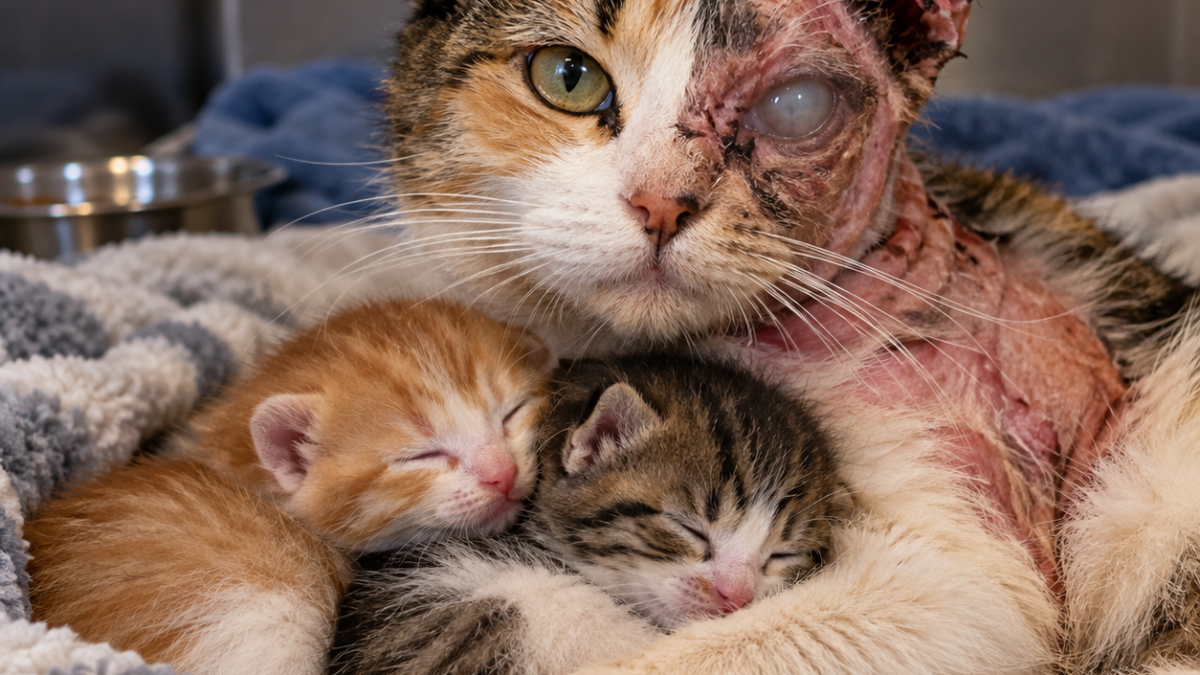
Burns concentrated along right side of face and neck.
The right eye severely damaged.
The ear partially burned away.
Her paws showed minor heat damage.
Whiskers gone on the right.
But then a technician checked kittens.
37.7°C.
Warm.
Hydrated enough to have a chance.
No burns.
No obvious smoke injury.
One kitten squirmed.
The other cried.
Dr. Reeves looked from kittens to mother.
Then back again.
“How?”
Nobody answered.
They placed mother on warming support.
Started fluids.
Oxygen.
Pain control.
Cleaned soot carefully.
The kittens were examined separately.
Both survived first assessment.
Then the staff put them back.
The mother cat immediately curved what remained of her strength around them.
Dr. Reeves stood quietly.
He began looking more closely at the burns.
They did not cover her evenly.
That was strange.
House-fire animals often have injuries on paws, nose, ears, face, lungs—whatever was exposed while they moved through smoke and heat.
Maya’s injuries formed something closer to a map.
Right side devastated.
Left side comparatively protected.
The dividing line was not perfect.
Fire never draws perfect lines.
But the pattern was obvious.
Dr. Reeves asked Luke:
“Where exactly was she?”
“In the tub.”
“Position?”
Luke demonstrated with his arms.
“Curled toward the back. Kittens underneath, against the far wall.”
“Which side faced the door?”
Luke stopped.
Then looked at the cat.
“The burned side.”
The room became quiet.
Dr. Reeves asked for photographs of bathroom.
Fire department had taken them.
A few were sent to clinic.
The bathroom door opened toward the hall.
Fire damage was heaviest on that side.
Soot pattern.
Charred doorway.
Heat entered from hall.
The tub sat lengthwise against opposite wall.
If the cat had been curled at rear of tub with kittens behind and beneath her—
Her right side would have faced the doorway.
Exactly where burns were worst.
Dr. Reeves looked at Luke.
“She stayed between them and the fire.”
Luke did not answer.
There was nothing to say.
It was not proof in the scientific sense.
No camera recorded the night.
No one watched her make a decision.
But the physical pattern told a powerful story.
The kittens were unburned.
Her left side—pressed toward them—was largely spared.
Her right side—facing hall—had absorbed the heat.
She had been found covering them.
And there was another detail.
The bathtub was the safest place available.
Porcelain and tile did not burn.
Fire crews had poured thousands of gallons of water.
Some water likely ran through the bathroom.
The tub may have collected moisture.
But ten-day-old kittens cannot regulate body temperature well.
A cold, wet bathtub after a fire should have been dangerous too.
Yet the kittens remained warm.
Because Maya had stayed over them.
Her body did two jobs at once.
A shield from heat.
A source of heat afterward.
She took what the fire gave.
Then gave them what her body still had.
Nobody at the clinic called her Maya yet.
For the first hours, the chart simply said:
FOUND CAT — HOUSE FIRE.
She was not expected to die immediately.
That did not mean she was safe.
The first twenty-four hours were fragile.
Her blood pressure remained low.
She would not eat.
Would not drink.
She barely responded.
But every time a technician moved a kitten for feeding or weighing, her good eye opened.
That became the detail everyone remembered.
Not her wounds.
Her eye.
One working amber eye following the babies around the room.
If a kitten squeaked, her head moved.
If a technician returned one, Maya sniffed it.
Licked it.
Then rested.
The kittens needed supplemental feeding because Maya was too weak to produce enough milk.
A technician named Rosa learned quickly that removing both at once upset her.
So they took one.
Fed.
Returned.
Then the other.
One at a time.
Maya tolerated that.
The fire department posted a brief update online.
Two kittens and mother cat rescued from residence fire.
Local rescue volunteers saw it.
One offered to cover treatment costs.
Another organized donations.
Someone brought kitten formula.
Someone brought tiny blankets.
A woman from a nearby town dropped off fifty dollars and refused a receipt.
Stories move differently in small communities.
By evening, everybody seemed to know about the burned mother cat.
Nobody knew her name.
The homeowners did.
They returned after being contacted.
The cat had been an outdoor stray who began appearing months earlier.
They had fed her.
She sometimes slept under porch.
When she became pregnant, they let her into mudroom.
After kittens were born, she had moved them somewhere.
The family had assumed she carried them beneath the house.
They did not know the nest was apparently inside.
During fire, they had been away visiting relatives.
The mother cat had no microchip.
No official name.
One of the children called her “Mama Cat.”
The family had lost almost everything.
They were staying with relatives and had no ability to manage months of medical care.
With their permission, a rescue organization took responsibility.
That was when Rosa wrote MAYA on the treatment board.
“Why Maya?”
Another tech asked.
Rosa shrugged.
“She looks like Maya.”
Not everything needs mythology.
Sometimes names happen because somebody says them at right moment.
Maya survived the first night.
Then second.
By day three, the damaged side of her face looked worse.
That happens with serious burns.
Some tissue had to declare what it would survive.
Part of the ear could not be saved.
The right eye was badly injured.
For several days, Dr. Reeves hoped some vision might remain.
Eventually it became clear.
The cornea had been permanently damaged.
She would be blind on that side.
There were discussions about whether the eye might eventually need removal.
For now, it remained stable enough to preserve.
The skin along her cheek and neck required repeated treatment.
Cleaning.
Medication.
Bandaging where possible.
Pain management.
Maya hated procedures.
Not loudly.
She would flatten herself.
Turn her good side away.
Try to disappear.
Then the kitten carrier would be placed nearby.
She would settle.
Her babies became part of her treatment.
And Maya became part of theirs.
The kittens were named Ash and Ember.
Someone objected.
“Too obvious.”
Everyone ignored them.
Ash was the cream kitten.
Ember the orange-and-white.
At ten days, they did little besides sleep, eat, squeak, and crawl blindly across one another.
They had no idea the world had almost ended before their eyes even opened.
At two weeks, Ash opened one eye first.
Ember took another day.
Maya’s good eye watched.
At three weeks, they began stumbling.
Tiny legs.
Poor judgment.
Maximum confidence.
Ash climbed onto Maya’s back while she was resting.
Rosa panicked.
“Maya, don’t move.”
Maya did not.
The kitten crossed her like a mountain.
Ember attacked a folded towel.
That was when the clinic started believing all three might actually make it.
Clara first heard about Maya from a Facebook post.
She was fifty-three.
Worked remotely doing medical billing.
Lived alone outside town.
Had owned cats most of her adult life.
Her last cat, Sophie, had died two years earlier at seventeen.
Clara had said she would not adopt again.
Too hard.
Too much grief.
Too quiet after.
People say that after loss.
Then sometimes life ignores them.
The post showed Maya from the left.
Beautiful.
Then second photograph from right.
Raw burns.
Bandage.
Clouded eye.
Clara stared for long time.
The caption asked for donations, not adopters.
So Clara donated.
Twenty-five dollars.
Then another fifty a week later.
Then she drove forty minutes to drop off a blanket because someone said rescue needed washable fleece.
She did not meet Maya that day.
Rosa thanked her at front desk.
Clara asked:
“How is the mother?”
“Hanging in.”
“Babies?”
“Doing great.”
“Can she see?”
“One side.”
“Will fur grow back?”
Rosa’s expression answered before words.
“Probably not much on burned areas.”
Clara looked down at blanket.
“Does she let people touch her?”
“Sometimes.”
Then:
“Why?”
“No reason.”
There was a reason.
Clara came back the following Tuesday.
She brought kitten food this time.
Then asked:
“Can I sit with her?”
Rosa hesitated.
Maya was not social.
Not aggressive.
Withdrawn.
Burn recovery made handling uncomfortable.
Visitors could stress her.
But Clara did not ask to hold her.
She said:
“I’ll sit in room. I don’t need to touch.”
So they let her.
Maya stayed in large recovery enclosure with kittens.
Clara sat on floor six feet away.
For forty minutes.
Said almost nothing.
She looked at phone.
Read a book.
Occasionally glanced up.
Maya watched with her left eye.
Clara returned three days later.
Then next week.
Forty minutes each way.
Twice a week.
No one asked her to.
Sometimes she brought supplies.
Mostly she brought herself.
At first Maya ignored her.
Then she began eating while Clara was present.
That was progress.
Then one day Ash crawled toward edge of enclosure.
Clara extended one finger.
Ash sniffed.
Maya lifted her head.
Clara froze.
“I’m not taking him.”
Maya watched.
Ash rubbed tiny face against finger.
Maya lowered her head again.
“Thank you.”
Clara whispered it.
As though the cat had given permission intentionally.
Maybe she had.
At six weeks, kittens became chaos.
Ash discovered climbing.
Ember discovered ambush.
They attacked each other.
Attacked shoelaces.
Attacked their mother’s tail.
Maya’s injuries were still healing, but she had started grooming them more.
One day Ember pounced toward her damaged side.
Maya flinched hard.
Kitten stopped.
For a moment, Clara thought Maya might swat.
Instead Maya repositioned so kitten approached from left.
That became a habit.
She learned the world through one eye.
People approached left.
Food dishes left.
Carrier doors left.
But when kittens were involved, she still placed damaged side outward sometimes.
It was instinctive.
At least that is how it looked.
One afternoon Clara watched both kittens sleep against Maya’s belly.
Maya’s burned side faced room.
Good side faced babies.
Clara’s throat tightened.
“You’re still doing it.”
Rosa, standing behind her, knew what she meant.
Maya had survived fire.
But some pattern in her had not changed.
Protect.
Watch.
Take outside position.
Let babies have soft side.
Weeks passed.
Ash and Ember grew strong.
By eight weeks, the kittens were medically healthy enough for adoption.
That day was harder than staff expected.
Everyone had spent two months talking about the miracle that babies survived.
But miracles grow.
Then leave.
Ash went to a retired couple.
Ember to a young family with two children.
The rescue arranged adoptions carefully.
Indoor homes.
Veterinary references.
Everything.
Clara was present when Ember left.
She did not plan to be.
It was simply her Tuesday visit.
A little girl held carrier.
Ember reached paw through bars.
Maya watched from enclosure.
Did she understand?
No one could know.
After carrier disappeared, Maya walked to front edge.
Sniffed air.
Then returned to blanket.
Ash left two days later.
After that, Maya stopped searching.
If that is what she had been doing.
The room felt enormous without kittens.
Clara sat on floor.
Maya lay facing away.
“You did it.”
Clara said quietly.
“Both babies are safe.”
Maya did not move.
“They don’t even know what you did.”
Clara smiled sadly.
“Probably better.”
Then something happened that Rosa would talk about for years.
Maya stood.
Slowly.
Walked out of her bed.
Across enclosure.
Clara was sitting close enough that her knee touched bars.
Maya pressed the left side of her face against them.
Right where Clara’s hand rested outside.
Clara stopped breathing.
She did not reach in.
She only left her hand there.
Maya rubbed once.
Then walked away.
Rosa pretended she had not started crying.
Recovery lasted fourteen weeks.
Not because every day was dramatic.
Most healing is repetitive.
Medication.
Cleaning.
Eating.
Sleeping.
Weight checks.
More medication.
Scabs.
New tissue.
Setbacks.
A small infection.
Another antibiotic.
A week when her appetite dipped.
Then improved.
Dr. Reeves eventually confirmed the right eye would remain blind but did not require immediate removal.
The ear healed into folded, irregular shape.
Scar tissue matured.
Fur returned around some edges.
Not across main burn area.
The right side of Maya’s face would never look symmetrical again.
When strangers met her from that side, some visibly recoiled.
Clara saw it once in clinic waiting room.
A man said:
“What happened to that poor thing?”
Before Rosa could answer, Clara said:
“She saved her babies.”
The man looked again.
Longer this time.
His expression changed.
That happened often.
Scars can look like damage when context is missing.
Give them a story, and damage becomes evidence.
Around week twelve, rescue began discussing placement.
Maya had become adoptable medically.
But everyone knew she would be harder to place than kittens.
Adult.
Scarred.
One blind eye.
Potential future medical needs.
Sensitive around face.
Not the kind of cat people usually choose from a photograph.
The rescue coordinator said:
“We may need special foster.”
Clara was sitting nearby.
She looked up.
“What does special mean?”
“Patient. Quiet home.”
“I have quiet home.”
Rosa smiled immediately.
Clara frowned.
“What?”
“Nothing.”
“You’re doing a face.”
“I’m not.”
“You are.”
The coordinator laughed.
“Clara, you drive eighty minutes round trip twice a week to sit on floor with her.”
“That doesn’t mean—”
“It kind of does.”
Clara looked toward Maya.
“I told myself I wasn’t adopting another cat.”
“When?”
“Two years ago.”
“Seems binding.”
Clara laughed.
Then became serious.
“What if she doesn’t want me?”
That question changed tone.
People often ask whether they want an animal.
Clara asked reverse.
Rosa opened enclosure.
“Sit down.”
Clara sat.
Maya stayed in bed.
Five minutes.
Nothing.
Ten.
Clara started laughing quietly.
“This is humiliating.”
Then Maya stood.
Walked out.
Not toward food.
Not toward Rosa.
Toward Clara.
She approached from left.
Sniffed Clara’s hand.
Then stepped onto her lap.
Clara covered her mouth.
Maya circled once.
Lay down.
Damaged side facing upward.
Good eye watching room.
Clara began crying without making sound.
Rosa whispered:
“I think you got your answer.”
Adoption was not immediate.
Paperwork.
Home visit.
Discussion about burn care.
Potential eye complications.
Sun exposure to scarred skin.
Indoor-only requirement.
Clara agreed to everything.
Seven months after fire, Maya entered Clara’s house.
Not as foster.
Not as project.
Home.
Clara had prepared too much.
Two beds.
Three scratching surfaces.
Water fountain.
Regular bowl in case fountain offended her.
Cat tree near window.
Low stool to help her reach bed.
A soft blanket.
Maya ignored almost all of it.
She spent first four hours under dining table.
Then emerged.
Walked through every room.
Slowly.
Always turning left side toward unfamiliar spaces first.
At bedroom, she jumped onto mattress.
No stool required.
Walked to left side.
Curled.
That became her place.
Every night.
Left side of Clara’s bed.
Often with injured side facing ceiling and her good eye toward bedroom door.
Clara noticed within first week.
“Still on duty?”
Maya blinked.
She was protective in strange ways.
If doorbell rang, Maya did not hide immediately.
She sat at hallway entrance and watched.
If Clara coughed at night, Maya woke.
If Clara got up, Maya sometimes followed.
Not obsessively.
Enough to notice.
One evening Clara fell asleep on couch with television on.
Around two in morning she woke because something touched her face.
Maya’s paw.
Soft.
Repeated.
Clara sat up.
“What?”
Maya walked toward bedroom.
Looked back.
Clara laughed.
“You putting me to bed?”
Maya continued.
Clara followed.
Animals become stories because humans are meaning-making creatures.
Maybe Maya simply wanted bedroom.
Maybe couch offended her.
Maybe she wanted blanket.
But Clara liked believing the cat who once stayed awake through fire now disapproved of humans sleeping somewhere unsafe.
Maya never became cuddly in the way some cats are.
She did not want to be held.
Did not like anyone touching burned side unexpectedly.
She tolerated gentle contact from Clara.
Sometimes.
She loved chin scratches on left.
Hated nail trimming.
Despised carrier.
Had an irrational war with vacuum cleaner.
She stole chicken.
She slept in sun.
She became ordinary.
That was perhaps best thing.
Survivors deserve ordinary life.
Not every day should be about what happened to them.
Clara did not wake every morning thinking:
This cat survived a fire.
Most mornings she thought:
Why are you sitting on my chest at 5:18?
Or:
You ate forty minutes ago.
Or:
Get off the clean laundry.
Maya was not a symbol to herself.
She was a cat.
Still, the past stayed visible.
At veterinary visits, new employees sometimes stared.
Clara explained.
When guests came, they asked.
Children especially.
One little boy visiting Clara saw Maya walk into living room.
He gasped.
“What’s wrong with her face?”
His mother looked mortified.
“I’m sorry—”
Clara smiled.
“Nothing is wrong with it.”
The boy stared.
“Then why?”
“She was in a fire.”
“Did she get hurt?”
“Yes.”
“Why didn’t she run?”
Clara looked at Maya.
“Her babies were there.”
Boy’s eyes widened.
“She stayed?”
“Yes.”
“Even when it burned?”
“Yes.”
He crouched several feet away.
Maya watched with good eye.
“That’s brave.”
Clara nodded.
“Yes.”
The boy did not ask whether she was ugly.
Children often learn what a scar means before they decide what it looks like.
Maya eventually allowed him to touch her left shoulder.
One finger.
He smiled like he had been knighted.
Clara sent photographs of Maya to families who adopted Ash and Ember.
The kittens were growing.
Ash became a large cream cat with ridiculous tail.
Ember remained smaller and fearless.
Both healthy.
No scars.
In one photograph, Ember slept on a child’s pillow.
In another, Ash sprawled upside down on sofa.
Clara printed both.
Put them near Maya’s bed.
Maya never showed interest.
“Your children are thriving.”
Clara told her.
Maya washed a paw.
“Rude.”
Clara smiled.
Maybe mothers do their job so children can become unaware of price.
The kittens never knew fire.
Never knew heat.
Never knew the smell of smoke.
Never knew the bathtub as anything.
They grew up thinking life was food bowls, toys, hands, sunlight.
That was Maya’s success.
The evidence of danger remained on her body instead of theirs.
A year after fire, Luke Harper visited Clara.
He had asked rescue for update.
Clara invited him.
When Maya saw him, she froze.
Luke stayed near doorway.
No helmet.
No turnout gear.
Just jeans and fire department sweatshirt.
“I don’t expect her to remember me.”
Clara said:
“She remembers what she wants.”
Luke laughed.
Then sat on floor.
Same way Clara had at clinic.
Maya watched.
He did not reach.
After several minutes, she came closer.
Sniffed.
Then stopped.
Luke’s eyes filled.
“This is first time I’ve seen her since that morning.”
Clara stayed quiet.
Luke looked at scars.
“We thought she might die in truck.”
“She almost did.”
“I remember touching kittens.”
He shook head.
“They were warm.”
“That still gets me.”
“Me too.”
Maya sat three feet away.
Luke said:
“You know what I keep thinking?”
“What?”
“That tub.”
Clara waited.
“The whole house was black.”
He rubbed hands.
“And there she was.”
He looked toward Maya.
“Like she picked one square of world and refused to surrender it.”
Clara swallowed.
Luke had carried animals from fires before.
Dogs hiding under beds.
Cats found in basements.
Once a rabbit beneath overturned cage.
But Maya stayed with him.
Not because she was only survivor.
Because of geometry.
Door.
Fire.
Burned side.
Unburned kittens.
He said:
“I’ve wondered if we’re putting too much human intention on it.”
Clara nodded.
“I wonder that too.”
“Animals operate on instinct.”
“Yes.”
“But then…”
He looked at her.
“She could’ve moved.”
Clara did not answer.
Maya lay down.
Good eye still watching them.
Nobody knows exactly what she understood that night.
That mattered less with time.
Whether you call it instinct, maternal behavior, protection, or sacrifice, the action was same.
She stayed.
For some people, word sacrifice requires conscious moral reasoning.
For others, protection itself is enough.
Maya did not need human vocabulary to put her body between danger and offspring.
Her body recorded outcome.
Two kittens behind.
One mother in front.
That is fact story keeps returning to.
Clara eventually volunteered with rescue herself.
Not because Maya turned her into saint.
Mostly she handled paperwork and transport.
She was good at spreadsheets.
Less good at bottle feeding.
But every so often rescue got animal people overlooked.
Old.
Scarred.
Missing limb.
Cloudy eye.
Clara would post adoption photographs with same rule.
Never hide injury.
Never lead with pity.
Show whole animal.
One post read:
This is Benny.
He has three legs.
He also steals socks, screams at ceiling fans, and believes every sandwich belongs to him.
Adopt the dog, not the missing leg.
That became her philosophy about Maya too.
People first saw scars.
Clara saw preferences.
Maya liked tuna more than chicken.
Preferred windows open one inch.
Hated thunderstorms.
Loved paper bags.
Slept left side.
Would knock pens off desk one by one.
Became offended if breakfast arrived after 6:10.
Was obsessed with moths.
Those things mattered because trauma should not consume identity.
Maya’s face told story.
It was not whole story.
Still, some days scars demanded attention.
Winter air dried skin.
Clara applied ointment.
Maya hated it.
Once the damaged eye became irritated and required treatment.
Clara panicked.
Dr. Reeves reassured.
No major change.
On drive home Clara cried.
Not because Maya was dying.
Because old fear returns quickly when you love something already marked by survival.
Maya sat in carrier and yowled entire way.
Clara laughed through tears.
“You survived a house fire but thirty-minute car ride is unacceptable?”
Maya yelled again.
“Understood.”
At home, Maya emerged.
Ate.
Jumped onto bed.
Life continued.
Two years after fire, local animal shelter invited Clara and Maya to fundraiser.
Clara almost declined.
Maya did not enjoy crowds.
They agreed only to have photographs and written story displayed.
One volunteer created poster with two images.
Left profile.
Right profile.
Underneath:
BOTH SIDES ARE MAYA.
Clara liked that.
Not before and after.
Not beautiful and damaged.
Both Maya.
A little girl stood in front of poster for long time.
Her father read story aloud.
At end girl said:
“So the burned side is the brave side.”
Her father stopped.
Then nodded.
“I guess it is.”
Clara heard from across room.
She went outside and cried privately.
Because adults had spent months calling Maya’s left side beautiful.
The child understood something better.
The scars were not absence of beauty.
They were evidence of action.
That night Clara came home.
Maya was waiting near bedroom.
Clara sat beside her.
“You know what a kid said about you?”
Maya began grooming.
“She said this is your brave side.”
Clara touched air near scar without making contact.
“I think she’s right.”
Maya moved onto pillow.
No interest in praise.
That is another advantage animals have.
They do not need narrative.
Humans need narrative because scars unsettle us.
We want damage explained.
We want suffering converted into meaning.
Sometimes there is no meaning.
Accidents happen.
Illness happens.
Cruelty happens.
Scars can simply be scars.
Maya’s story did not make every scar noble.
But hers had context.
Her babies lived.
That does not mean fire was good.
Does not make pain necessary.
Does not mean suffering improved her.
She did not need damage to become worthy.
Maya was worthy before flames.
The scars only revealed what she had done when something vulnerable depended on her.
That distinction mattered to Clara.
People sometimes said:
“The fire made her special.”
Clara always corrected gently.
“No. The fire showed us something.”
Maya did not need tragedy to become valuable.
She already had value.
What tragedy revealed was devotion.
One spring morning, Clara received message from Ember’s family.
A photograph.
Ember, now adult, curled around three foster kittens.
Not her babies.
The family had begun fostering.
Ember climbed into kitten pen on her own and started grooming them.
Clara laughed.
Then cried.
She showed Maya.
“Apparently motherhood is contagious.”
Maya sniffed photograph.
Walked away.
Later that evening she slept beside Clara’s legs.
Right side upward.
Good eye half open.
Still watching.
The left side of Maya’s face is beautiful.
Yes.
Soft fur.
Bright eye.
Long whiskers.
But Clara no longer thinks in halves.
She sees one face.
One cat.
A face with history.
Some visitors ask whether Clara wishes veterinary reconstruction could make Maya symmetrical again.
She says no.
Not because she romanticizes injury.
If surgery could restore sight, she would do it.
If fur could regrow without pain, wonderful.
If that ear could have been saved, she would choose that.
Scars are not trophies when they hurt.
But now that healing is complete, she does not wish Maya looked different for anyone else’s comfort.
The face is hers.
Clara once caught herself looking at old photographs from first veterinary week.
Maya looked small.
Bandaged.
Eyes dull.
Kittens pressed beneath her.
Clara barely recognized that frightened animal compared with the demanding cat sleeping on keyboard beside her.
Recovery is visible too.
Not only damage.
Weight returned.
Fur glossy.
Left eye bright.
Muscles stronger.
Posture confident.
One day Clara realized Maya no longer ducked when she raised a hand too quickly.
Trust had grown quietly.
That felt bigger than any photograph.
There is a moment every evening when sun reaches bed.
Maya finds it.
She always does.
Lies with left side toward window.
Scarred side warm too.
Her damaged eye closed.
Good eye watching Clara move around room.
Sometimes Clara thinks of the bathtub.
Not often anymore.
She tries not to trap Maya forever in worst night of her life.
But occasionally.
Especially when Maya curls close.
She imagines:
Smoke.
Heat.
Two tiny kittens.
Open doorway.
Some route out.
And Maya staying.
Maybe cats do not think:
I will sacrifice myself.
Maybe there was only:
Babies.
Danger.
Stay.
Protect.
Maybe those simple instincts are enough.
Humans dress love in language.
Promise.
Duty.
Courage.
Sacrifice.
Animals sometimes strip it down to action.
Stay.
That was Maya’s action.
Stay while flames entered hall.
Stay while fur burned.
Stay while smoke filled air.
Stay while kittens pushed against her.
Stay after fire went out.
Stay while bathroom became cold.
Stay until strangers came.
Then, even barely conscious, warn them when they reached for babies.
Maya never had to explain.
Her body explained.
Ash and Ember grew up without scars.
That was her explanation.
There are photos now of both kittens at two years old.
Ash weighs fourteen pounds and steals bread.
Ember sleeps under blankets and terrorizes a robotic vacuum.
Their families know story.
Sometimes they post birthday updates.
Clara saves them.
On anniversary of fire, she does not throw party.
No costume.
No dramatic tribute.
She cooks a little plain chicken.
Maya receives some.
Clara sends message to Luke and Rosa.
Maya is good.
That is enough.
The first anniversary, Luke replied:
Tell her she still owes me one glove.
Apparently Maya had bitten his firefighting glove weakly in bathtub.
Clara laughed for ten minutes.
Even hero stories need ridiculous details.
Maya is not heroic every second.
She is occasionally unpleasant.
That makes Clara love her more.
Once, during a storm, power went out.
House dark.
Thunder.
Maya disappeared.
Clara found her under bed.
“You faced literal fire.”
Maya would not move.
“But thunder is where you draw line?”
No response.
Clara crawled down with flashlight.
Maya eventually pressed against her hand.
Bravery is specific.
Trauma is specific.
You can survive one unimaginable thing and still fear ordinary ones.
Humans know that too.
Clara sat on floor until storm passed.
No one rescued anyone dramatically.
They just waited together.
Maybe that is why Maya came into Clara’s life after Sophie died.
Not to replace Sophie.
Nothing does.
But to teach Clara another shape of love.
Sophie had been easy.
Healthy until old age.
Affectionate.
Predictable.
Maya came with medical records, ointments, blind side, and boundaries.
Clara had to learn:
Approach left.
Speak before touching.
Do not surprise.
Let her decide.
Love was not less because it required more attention.
It became more precise.
Maya taught Clara that care is often precision.
Knowing where pain is.
Knowing when to stop.
Knowing what not to touch.
Knowing which side someone sees you from.
That lesson traveled beyond cats.
Clara became more patient with people too.
Her sister once said:
“You ask better questions now.”
“Such as?”
“You don’t immediately tell me what to do.”
Clara laughed.
“Maya trained me.”
Probably partly true.
Caring for scarred animal made her aware how easily help can become intrusion.
Maya needed care.
Also agency.
That balance matters in every relationship.
Years passed.
The scars softened in color.
Never disappeared.
The cloudy eye remained.
Ear remained folded.
New people still asked.
Clara kept answering.
“She was a mother.”
Sometimes enough.
Sometimes she tells full story.
At the end, people often say:
“Poor thing.”
Clara understands.
But she has started preferring another sentence.
“Lucky babies.”
Because Maya is no longer poor thing.
She has bed.
Food.
Home.
Clara.
Windows.
Paper bags.
Veterinarian who knows her.
A life.
The kittens were the ones whose entire futures depended on those few hours.
One decision.
One instinct.
One body positioned in one direction.
Lucky babies.
Lucky Clara too.
She thought she adopted Maya.
Some days she suspects Maya adopted a woman who had spent two years keeping the house too quiet because loving another animal felt dangerous.
The first night Maya slept beside her, Clara barely moved.
Did not want to disturb.
At three morning, Maya stretched one paw onto Clara’s wrist.
Exactly like a small anchor.
Clara cried.
Not because sad.
Because something in house had returned.
Presence.
Breathing.
Another life.
The same thing animals give people every day without ever knowing how large it can become.
The left side of Maya’s face is beautiful.
The right side is scarred.
That is how strangers describe her.
Clara does not.
To Clara, one side shows what Maya looked like.
The other shows what Maya did.
The good eye lets her see the room.
The cloudy one reminds everyone else to see her differently.
Part of her ear is gone.
Her whiskers are uneven.
Fur never covered every burn.
None of that changed the important thing.
She stayed.
No one ordered her.
No one trained her.
No one promised reward.
There was no firefighter yet.
No veterinarian.
No Clara.
No rescue organization.
No donations.
No adoption post.
Only a mother cat.
Two newborns.
A bathtub.
A burning house.
An open doorway.
And whatever happened inside Maya in that moment.
Run.
Or stay.
She stayed.
That choice is written across her face.
But it is written elsewhere too.
In Ash, asleep safely on a retired couple’s couch.
In Ember, grooming foster kittens.
In Luke, who still remembers finding warmth beneath a burned cat.
In Rosa, who learned to feed kittens one at a time because their mother panicked when both disappeared.
In Clara, who drove eighty minutes round trip twice a week for months to sit quietly near a cat that did not yet trust her.
Love keeps traveling outward like that.
Not always dramatically.
Sometimes through scar.
Sometimes through visit.
Sometimes through a blanket.
Sometimes through someone simply sitting on floor and asking nothing.
Maya paid for her babies’ survival with things she never got back.
Sight in one eye.
Part of an ear.
Fur.
Unscarred skin.
We cannot know whether a cat understands sacrifice as humans do.
We do know result.
When rescuers arrived, the kittens were alive.
Warm.
Unburned.
Their mother was not.
Her injured side faced the danger.
Her protected side faced them.
That is enough.
Some scars are accidents.
Some are evidence of violence.
Some are evidence of survival.
And sometimes, very rarely, the pattern of a scar tells you exactly where somebody chose to stand when something smaller needed protection.
That is Maya’s face.
Not ruined.
Not half beautiful.
Not something to hide.
A map.
One side says:
This is what the fire reached.
The other says:
This is what it did not.
And between those two sides lived two kittens who got to grow up because their mother refused to move.
When Clara turns off the bedroom lamp now, Maya is usually already there.
Left side of bed.
Scarred side upward.
Good eye toward room.
Watching.
Clara sometimes reaches toward her.
Stops before the damaged cheek.
Maya leans left.
Clara scratches beneath her chin.
“Everybody’s safe.”
She says it almost every night.
“Go to sleep.”
Sometimes Maya closes her eye.
Sometimes she keeps watching.
Old habits.
Or instinct.
Or nothing more than the way she likes to lie.
Clara no longer needs to know.
She only knows that years after the flames went out, the cat who once kept watch over two helpless kittens finally has a home where someone keeps watch over her.
And maybe that is the ending Maya deserved all along.
Not applause.
Not pity.
Not a face restored to what strangers call beautiful.
Just safety.
A soft bed.
A human who knows which side hurts.
And the freedom, finally, to turn away from the fire.








