Fake HOA Cops Kept Storming Through My Ranch After I Refused to Sell—Then They Charged Through My Gate Again and Found Six Steel Bollards Waiting.
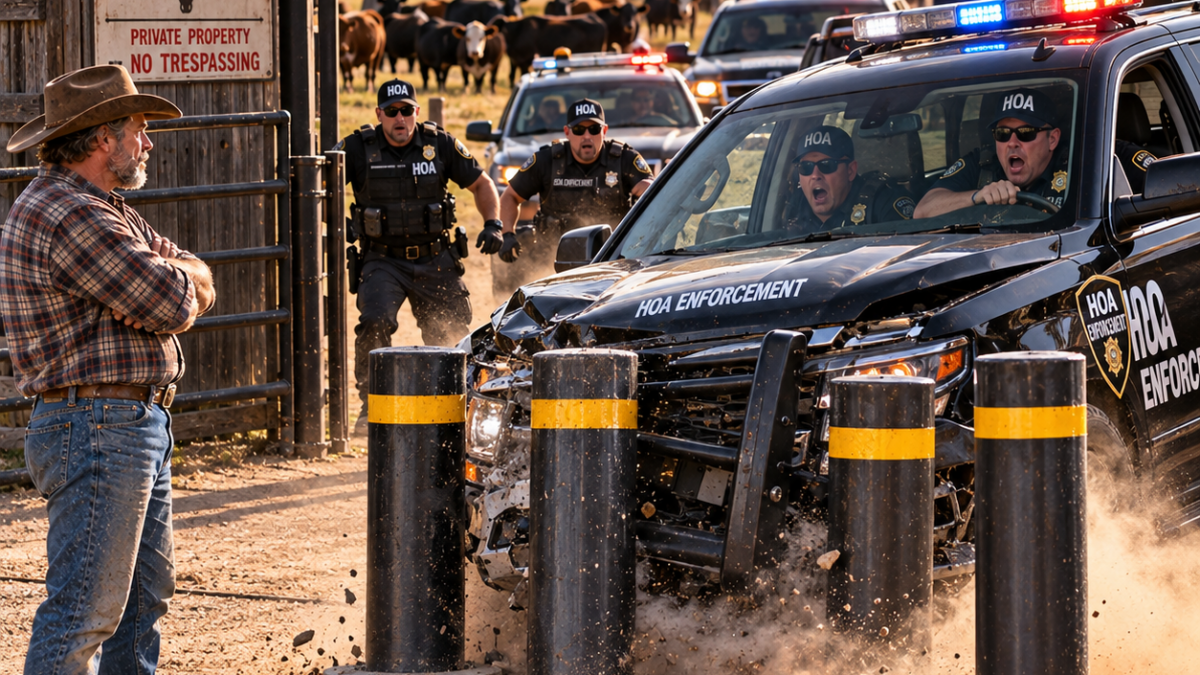
Fake HOA Cops Kept Storming Through My Ranch After I Refused to Sell—Then They Charged Through My Gate Again and Found Six Steel Bollards Waiting.
The fake HOA cops had driven through my ranch more than a dozen times, mocked my NO TRESPASSING signs, waved directly into my cameras, and told me their “community authority” mattered more than my deed—all because I refused to sell eighty acres Victor Harmon needed for his next subdivision.
By the time their red-and-blue lights appeared at my gate again, they still thought I was the same sixty-two-year-old widower who would step aside when a uniform told him to move, but this time there were six bright, reflective steel bollards standing across the private ranch track they had been using as a shortcut.
What none of them understood was that the cameras rolling that morning were no longer just mine, the sheriff already had twelve prior trespass reports, and the man sitting beside me in the truck was the surveyor whose stakes proved Victor’s proposed “community road” ran straight through the hill where I had buried my wife.
My name is Ray Calder.
I was sixty-two years old when Victor Harmon decided my ranch had become inconvenient.
Not worthless.
That would have been easier.
He knew exactly what it was worth.
Eighty acres of Texas Hill Country with county-road frontage on two sides, gentle elevation through the southern pasture, a natural drainage corridor, and one long ridge overlooking land that developers had been buying faster than cedar could grow back after a bulldozer.
To Victor, my place was not a ranch.
It was a missing piece.
His company, Harmon Residential Development, already controlled almost four hundred acres east of me.
He had options on another hundred and sixty south.
The problem was access.
The county road along his eastern boundary was narrow and expensive to improve.
The road on my western side connected almost directly to a state highway.
If Victor could get a strip through the middle of my property, he could shorten his subdivision entrance by nearly a mile, avoid a bridge project over a seasonal creek, and open another phase years earlier than his existing infrastructure plan allowed.
He first approached me politely.
That matters.
People like Victor are easier to understand if you don’t turn them into monsters before they earn it.
He came to my kitchen six months before the first patrol car crossed the ranch.
Gray suit.
No tie.
Expensive boots clean enough that they had probably never touched a cow pasture.
He carried rolled maps.
“Ray.”
“Victor.”
We had met before.
Everyone in that part of the county knew Victor Harmon.
He sponsored youth baseball.
Donated to the volunteer fire department.
Bought tables at charity dinners.
PART2:
Had his photograph taken shaking hands with people who seemed to own more flags than walls.
He was not universally hated.
Quite the opposite.
He was good at being useful.
That made him powerful.
He opened the site map.
“I’m going to make you an offer.”
“You already did.”
Two years earlier he had offered me $1.1 million for all eighty acres.
I said no.
“I’ve improved it.”
“Then we’re already negotiating with ourselves.”
He smiled.
“Two-point-four.”
“No.”
“You didn’t let me finish.”
“You said eighty acres?”
“Yes.”
“No.”
“Ray.”
“No.”
He leaned back.
“You have children?”
PART3:
“One daughter.”
“Does she want to ranch?”
“Not your concern.”
“She lives in Austin.”
That got my attention.
“You’ve researched.”
“It’s my business to understand landowners.”
“My daughter is not land.”
“I didn’t say she was.”
He softened.
“What happens here in twenty years?”
“I’ll be dead.”
“Probably.”
“Nice.”
“You know what I mean.”
I did.
My daughter, Hannah, was thirty-five.
Architect.
Austin.
Married.
Two boys.
She loved the ranch.
She did not want to run cattle.
Those are different things.
Victor pointed to a line across the southern pasture.
“I don’t actually need all eighty.”
“Good.”
“I need fifty feet.”
I looked closer.
A proposed private boulevard came in from County Road 12, cut across my southern field, curved east through a cedar break, then connected to his development.
Two lanes.
Median.
Bike path.
Utilities.
Drainage.
“What are you offering?”
“For a permanent access and utility easement, eight hundred thousand.”
That was not insulting money.
I will give him that.
“For fifty feet?”
“Average width closer to seventy once drainage is included.”
“No.”
His expression barely changed.
“Why?”
I looked toward the eastern ridge through kitchen window.
He followed my eyes.
“My wife is buried up there.”
“The road doesn’t touch the grave.”
“It cuts below it.”
“More than two hundred yards.”
“No.”
“Ray, I’m offering nearly ten thousand an acre equivalent for a strip you currently use to move cattle.”
“Then you’ll save money when I say no.”
He rolled the map.
“Think.”
“I have.”
“Talk to Hannah.”
“No.”
“Talk to your accountant.”
“No.”
Then he said the sentence that explained everything that followed.
“This is going to happen around you eventually.”
I looked at him.
“What is?”
“Growth.”
“Probably.”
“You can profit from it or fight it.”
“That sounds like three options if I count doing nothing.”
He smiled.
“You’re funny.”
“Helen used to say no.”
He stood.
“Offer stays open thirty days.”
“It won’t take that long.”
He left.
I thought that was it.
It was not.
Helen had been dead four years by then.
Pancreatic cancer.
Ten months from diagnosis to funeral.
She chose the ridge herself.
We had spent thirty-eight years together.
Twenty-nine on that ranch.
We raised Hannah there.
We lost two pregnancies there before her.
We fought there.
Made up there.
Paid off the mortgage there.
Buried dogs.
Raised calves.
Watched storms.
Made plans.
Broke plans.
Changed plans.
When Helen knew she was dying, she became strangely practical.
She wrote passwords.
Sorted clothes.
Labeled keys.
Told me which dishes Hannah wanted.
Then one evening she asked me to drive her up the eastern ridge.
We took my old Ford.
She was too weak to walk far.
I helped her out.
She leaned against hood.
Sun was coming up.
She said:
“I want this.”
I knew.
“You sure?”
“Yes.”
“Could do cemetery.”
“I spent thirty years looking at this pasture.”
She smiled.
“I don’t see why death should improve my taste.”
So we did the legal work.
Family burial on private property was allowed under the circumstances after county requirements, filings, and setbacks were handled.
Nothing secret.
Nothing dramatic.
A small fenced family plot.
Granite marker.
Helen Marie Calder.
1959–2021.
Every morning after she died, I took coffee up there.
Sometimes five minutes.
Sometimes an hour.
I talked more the first year.
Less later.
Grief changes shape.
At first you think silence means absence.
Eventually silence becomes company.
Victor knew about the grave.
Everybody did.
He just didn’t think it mattered to his road.
Three weeks after I rejected his offer, a white sedan drove through my ranch.
I thought it was lost.
The car came through my western entrance without slowing.
Light bar on roof.
Dark uniform behind wheel.
White lettering on door.
From a distance, official enough.
It crossed southern pasture on my gravel track, passed behind barn, then exited through an old utility opening near eastern fence.
I was near tractor.
Watched.
Didn’t chase.
My ranch has county roads on two sides.
Old tracks.
Multiple gates.
People get confused.
Three days later, same car did it again.
This time I walked into track and waved.
The driver looked directly at me.
Did not stop.
He accelerated just enough to throw dust.
I tried reading plate.
Brown smear covered two characters.
We had not had rain in weeks.
That was when it became interesting.
Third time: 6:20 a.m.
Fourth: mid-afternoon.
Fifth: dawn.
Sixth: 11:48 at night.
That one changed my patience.
Red and blue light flashed across bedroom ceiling.
For one second, I thought sheriff.
Accident.
Fire.
Then engine swept behind house.
Lights spinning.
Blue.
Red.
Blue.
Red.
I pulled boots on and went outside.
The sedan was already across east pasture.
No emergency.
No siren.
No stopped vehicle.
Nothing.
Two men driving through my land with emergency-style lights as if they had jurisdiction.
Next morning I drove to east opening.
There was a new sign on other side.
CEDAR CREST COMMUNITY PATROL
AUTHORIZED ACCESS ONLY
Cedar Crest was Victor’s existing HOA.
One of his subdivisions.
Almost three miles east.
I laughed.
Then stopped laughing.
I called Cedar Crest management.
A woman answered.
“Cedar Crest Association.”
“Who operates your patrol?”
“Community Shield Services.”
“They have authority outside subdivision?”
“I’m not sure what you mean.”
“One of their cars has been crossing my ranch.”
“Are you Mr. Calder?”
That answer told me my name had already been discussed.
“Yes.”
Pause.
“I’ll have Mr. Harmon’s office contact you.”
“Why Victor?”
“The developer still owns portions of common infrastructure.”
“Do you employ Community Shield?”
“Yes.”
“Tell them my ranch is private.”
Another pause.
“I’ll note.”
Same afternoon, Victor called.
“Ray.”
“Your fake cops are crossing my place.”
“They’re not fake cops.”
“What department?”
“They’re licensed private security.”
“Then why red and blue lights?”
“You’d have to ask contractor.”
“Why my ranch?”
“Legacy service route.”
“No.”
“Ray—”
“There is no service route.”
“Your east track connects to Cedar Crest maintenance corridor.”
“My east track connects to my east fence.”
“It has historically been used.”
“By me.”
“By utilities too.”
“Under utility easement.”
“Exactly.”
“No. Not exactly.”
I could hear him breathing.
“Why make this difficult?”
“Because it’s my land.”
“Patrol is keeping area safe.”
“My cows feel safer already.”
“Don’t be sarcastic.”
“Then stop trespassing.”
He said:
“I’m going to have legal look at it.”
“Good.”
I hung up.
Then installed two trail cameras at gates.
Not hidden traps.
Normal cameras.
Visible.
One had a bright sign:
VIDEO RECORDING — PRIVATE PROPERTY
I added:
NO TRESPASSING
NO HOA OR PRIVATE SECURITY ACCESS
UTILITY EASEMENTS DO NOT CREATE VEHICLE THROUGH-ROUTE
Two days later the white sedan came through.
Driver slowed.
Looked at camera.
Raised two fingers in a little salute.
Passenger laughed.
Then drove through.
Camera caught plate clearly.
Except one digit still covered.
The seventh time.
I called sheriff.
Deputy Elena Ruiz came.
Mid-thirties.
Calm.
She viewed footage.
“Private security?”
“Apparently.”
“Any easement?”
“Utility.”
“Do they service utility?”
“No.”
“Any written permission?”
“No.”
She took report.
Advised certified no-trespass notice to company, HOA, developer.
Good.
I sent three.
Certified.
Signature required.
Community Shield signed.
Cedar Crest HOA signed.
Harmon Residential signed.
Four days later, patrol came again.
This time two sedans.
They stopped at camera.
A man got out.
Dark uniform.
Metal badge shape.
Not police badge, but close from distance.
Patch:
COMMUNITY SHIELD PUBLIC SAFETY
Public Safety.
On private-company uniform.
He walked toward camera.
Read sign.
Then looked directly into lens.
“Private patrol access.”
He pointed toward east.
“Authorized.”
Then got back in.
Both cars crossed.
I watched footage three times.
Called Deputy Ruiz.
She said:
“File another.”
I did.
Eighth.
Ninth.
Tenth.
They varied times.
One came at 2:10 a.m.
Another in rain.
One parked near barn for four minutes.
My camera caught passenger photographing south field.
That was new.
I called Victor.
No answer.
Sent letter through attorney.
By then I had hired one.
Her name was Laura Medina.
Land-use and real-estate litigation.
She looked at deed.
Utility easements.
Old survey.
Victor’s offer map.
Then footage.
“These routes line up.”
“What?”
She overlaid the patrol tracks on Victor’s proposed boulevard.
Not exact.
Close enough.
Every patrol vehicle used same southern approach and eastern exit where Victor wanted development corridor.
Laura tapped screen.
“They may be trying to establish pattern of access.”
“Prescriptive easement?”
“Possibly. Though private trespass after explicit notice isn’t magic path to rights, and the facts wouldn’t satisfy the legal requirements quickly anyway.”
“Then why?”
“Pressure.”
That felt right.
Victor wanted me to see his people on my land over and over.
To normalize.
To make resistance exhausting.
Uniform helps.
Lights help.
Confidence helps.
“You think he told them?”
“I don’t know.”
“Could subpoena.”
“Eventually.”
She sent cease-and-desist.
Community Shield’s lawyer responded.
They claimed:
historical permissive access associated with Cedar Crest security and utility maintenance.
Laura replied:
Show instrument.
They sent none.
Instead, crossings continued.
Twelfth report.
Sheriff began taking it more seriously.
Not because twelfth trespass is legally mystical.
Pattern.
Deputy Ruiz spoke with patrol supervisor.
He claimed drivers believed they had permission from “development ownership.”
I did not.
Then I received a letter from Victor.
Not offer.
Demand.
It said my placement of “obstructive signage” interfered with established access and created public-safety concerns.
Laura laughed.
“What public?”
“His subdivision.”
“What safety?”
“His people might have to drive around.”
“Tragic.”
Then Victor offered again.
This time $950,000 for easement.
I said no.
He called.
“I’m giving you more.”
“Still no.”
“You’re sixty-two.”
“So?”
“This land is maintenance.”
“Yes.”
“Taxes.”
“Yes.”
“Your daughter doesn’t want it.”
“Did she tell you?”
“She told one of our planners she isn’t relocating.”
I went quiet.
“You contacted Hannah?”
“It came up at public planning session.”
Possible.
Hannah had attended one online after hearing subdivision rumors.
Still irritated me.
Victor continued:
“You are protecting dirt nobody in your family intends to ranch.”
I looked out toward Helen’s ridge.
“No.”
“What?”
“I’m protecting my right to decide.”
“Your decision affects an entire development.”
“That’s what no means.”
He hung up first.
Then Community Shield stopped for nine days.
I thought Laura’s letter worked.
During those nine days, I did something I should have done earlier.
Survey.
Full boundary and easement survey.
Surveyor named Edwin Shaw.
Sixty-eight.
Spent his career in Hill Country property fights.
He marked legitimate utility corridor.
It ran along north quarter.
Not where patrol drove.
He marked my private ranch track.
No recorded roadway easement.
No public access.
No HOA rights.
No development rights.
No ambiguity.
Then he noticed proposed Victor road if built would pass within one hundred forty-five feet of Helen’s burial enclosure at nearest drainage widening, depending final alignment.
Not two hundred yards like Victor claimed.
Old map had shifted.
“Is that legal?”
Edwin shrugged.
“Depends on approvals, setbacks, environmental review, cemetery protections, road design.”
“Can they condemn?”
“Private subdivision developer doesn’t just condemn because convenient.”
Laura later confirmed.
Public entities have specific eminent-domain powers under law.
Victor’s private company did not gain condemnation authority because it wanted a boulevard.
He needed purchase, easement, public project, or another lawful mechanism.
No shortcut.
Edwin set stakes.
Bright.
Then we planned bollards.
Not hidden.
Not booby traps.
I want that clear.
People later told story as though I dug a hole, painted a concrete wall black, and waited for fake cops to crash.
No.
That would be psychotic.
And likely illegal.
I hired a licensed fencing contractor.
We met sheriff’s office.
County road department.
Checked setback.
Sight distance.
Emergency access.
Utility easement.
My western private entrance had two parts.
Main ranch driveway.
And an older gravel cut to southern track that patrol had been using.
I kept the main driveway open with normal ranch gate for me, emergency services, deliveries, and authorized visitors.
Across the unauthorized gravel shortcut, I installed six fixed steel bollards.
Heavy.
Concrete-set.
Spaced to block vehicles but allow drainage.
Painted bright yellow.
Reflective bands.
In front of them, I placed:
ROAD CLOSED — PRIVATE PROPERTY
Then fifty feet before:
STOP
NO THROUGH ACCESS
AUTHORIZED RANCH VEHICLES ONLY
Another at one hundred feet:
DEAD END — STEEL BARRIER AHEAD
Solar amber flashers.
Visible day and night.
No excuses.
Sheriff received diagram.
Fire department got gate code for main driveway.
Utility company confirmed their access unaffected.
Laura documented installation.
Camera faced barrier.
Another faced entrance.
Edwin’s survey stakes stayed.
I told Helen that morning:
“This is ridiculous.”
Wind moved grass.
“I married you so you’d handle difficult people.”
Nothing.
“You’re slacking.”
Still nothing.
I drank coffee.
By afternoon, bollards were in.
For eleven days, Community Shield did not come.
Then a patrol supervisor drove up slowly.
Stopped outside.
Photographed bollards.
Left.
Good.
I thought message had landed.
Next morning, email from Community Shield attorney:
Your unilateral obstruction of a historic safety route creates substantial liability in event emergency response is delayed.
Laura replied with survey, title, fire-department confirmation, sheriff reports, and written offer that emergency responders could use main gate.
Then one sentence:
Your client is not an emergency-response agency.
Perfect.
Victor called.
“You need to remove bollards.”
“No.”
“You’re escalating.”
“No.”
“Our patrol needs circulation.”
“Use your roads.”
“This is bigger than you.”
“Then buy another route.”
“I’ve tried.”
“Exactly.”
“You’re going to regret this.”
I wrote down exact words.
Not because I thought he was threatening violence.
Because attorneys love accurate quotes.
The incident happened three days later.
A Saturday.
7:17 a.m.
I was already outside.
Edwin happened to be with me because he was resetting one survey cap someone had pulled up near east line.
Laura had advised I stop confronting patrol directly.
So when we heard engines, we stayed near my truck.
Two white Community Shield SUVs this time.
Not sedans.
Newer Ford Explorers.
Red-and-blue light bars.
I later learned the contractor had recently changed vehicles.
They entered southern gravel approach.
First camera caught them.
Both crossed my outer no-trespassing sign.
The lead vehicle slowed at first warning.
Then continued.
Amber flasher.
DEAD END — STEEL BARRIER AHEAD
Continued.
Second sign.
STOP — NO THROUGH ACCESS
The SUV slowed.
Passenger got out.
Walked to sign.
Camera audio caught:
“Same crap.”
Driver:
“Supervisor said route stays open.”
Passenger:
“Bollards.”
Driver:
“We’ll go around.”
They could not.
Ditch west.
Fence east.
That was point.
Not trap.
Physical access control.
The passenger got back in.
Then both SUVs backed roughly twenty yards.
For a moment I thought they’d leave.
Instead lead vehicle accelerated forward.
Not racing speed.
Maybe twenty-five.
Fast enough.
Its emergency lights came on.
Red-blue-red-blue.
The driver aimed toward the widest apparent gap between the bollards.
There wasn’t enough space for Explorer.
Anyone looking could see.
Edwin said:
“Is he seriously—”
The SUV braked late.
Front bumper struck two bollards.
Not head-on full speed.
The driver got on brakes.
Nose dipped.
Impact bent bumper, cracked grille, deployed? Let’s not overdo; airbags may not deploy at low impact. No airbag.
The bollards barely moved.
SUV stopped.
Second vehicle slammed brakes behind.
Dust rolled.
Silence.
Then driver got out furious.
“REMOVE THESE NOW!”
I stayed near truck.
“You okay?”
“YOU CAN’T BLOCK AN EMERGENCY ROUTE!”
“Are you hurt?”
“No!”
Passenger looked at front bumper.
“You damaged patrol vehicle!”
Edwin muttered:
“He damaged patrol vehicle.”
I called sheriff.
The patrol supervisor—name plate HASKINS—started walking toward me.
He stopped when he saw my camera pole.
Then looked toward ridge.
“Mr. Calder, you’ve been warned.”
“So have you.”
“You are obstructing authorized security access.”
“Show me authority.”
“This route is recognized.”
“Show me document.”
“You need to remove barriers.”
“No.”
He pulled phone.
“I’m calling Victor.”
That sentence was better than anything I could have asked.
Not police.
Not Cedar Crest board.
Victor.
The developer.
The man who supposedly had nothing to do with patrol route.
I said nothing.
Haskins called.
Camera microphones didn’t catch other side.
Caught his.
“Victor, it’s Mike.”
Pause.
“He put posts in route.”
Pause.
“No, we can’t get through.”
Pause.
“One unit hit them.”
Pause.
“No injuries.”
Then:
“Yes, sir. I know you said keep using it.”
Edwin slowly turned toward me.
I did not move.
Haskins realized.
Maybe not exact implication.
Enough.
He turned away.
Deputy Ruiz arrived with another unit.
No lights.
No drama.
She looked at damaged SUV.
Then six yellow bollards.
Then three warning signs.
Then me.
“Ray.”
“Morning.”
She sighed.
“Please tell me nobody’s hurt.”
“No.”
Haskins stepped forward.
“This man created an intentional roadway hazard.”
Ruiz walked to first sign.
Photographed.
Second.
Photographed.
Bollards.
Reflectors.
Solar flashers.
Survey stakes.
Then asked:
“Were you aware barrier existed?”
Haskins:
“We were aware he was interfering with our established access.”
“That’s not my question.”
Pause.
“Yes.”
“Did you see warning signs?”
“Yes.”
“Why did driver proceed?”
“We believed passage was possible.”
Ruiz looked at vehicle width.
Then gap.
“What emergency were you responding to?”
“Patrol.”
“Emergency?”
“No.”
“Why are your red-and-blue lights activated?”
Haskins stiffened.
“For visibility.”
Deputy Ruiz looked at light bar.
“Turn them off.”
He did.
Then she asked for driver’s license, security credentials, insurance.
Second deputy inspected equipment.
Within twenty minutes, another supervisor from sheriff’s office arrived.
Not because bollard crash was huge.
Because twelve prior reports and private-security vehicle displaying red/blue emergency-style lighting had already raised questions.
Texas law around lighting can be specific, and sheriff wasn’t going to guess roadside.
They documented.
Vehicles were not police cars.
Security officers did not have law-enforcement commissions.
Their uniforms said PUBLIC SAFETY prominently and PRIVATE SECURITY in much smaller lettering on shoulder patch.
Badge-shaped chest emblems.
The sheriff’s investigator later described overall presentation as potentially confusing to public, especially combined with emergency-style lights.
No one was handcuffed that morning.
No guns drawn.
No cinematic raid.
The lead SUV got towed because bumper was pushed into tire.
Irony.
Community Shield’s own vehicle left on a tow truck from ranch it had no right to cross.
I did enjoy that.
Just a little.
Victor arrived forty minutes later.
Black Ram pickup.
He got out fast.
No suit.
Jeans.
Polo.
Angry.
Deputy Ruiz met him before me.
“What happened?”
Haskins pointed.
“He barricaded access.”
Victor looked at bollards.
Then me.
“You did this?”
“Yes.”
“You could’ve killed somebody.”
I almost lost temper.
Instead I pointed to warning signs.
“Three signs.”
“Those weren’t there before.”
Camera.
“They’ve been there three days.”
“You can’t put steel posts in roadway.”
“My private ranch track.”
“It is not exclusively yours.”
“Show deed.”
He looked toward Edwin.
“What are you doing here?”
Edwin said:
“Surveying.”
Victor’s face changed.
Edwin had worked for developers too.
Known.
“Ed.”
“Victor.”
Victor pointed.
“You know there’s access.”
Edwin shook head.
“I know recorded utility easement north. No recorded roadway here.”
“Historic use.”
“By who?”
“Cedar Crest patrol and maintenance.”
“For how long?”
Victor didn’t answer.
Edwin looked at me.
Then:
“Not enough to change title because somebody drives where told.”
Victor said:
“This is a civil matter.”
Deputy Ruiz:
“Which is why your patrol should stop crossing until it’s resolved.”
Victor:
“They need access.”
Ruiz:
“Not through a place property owner has repeatedly reported as trespass.”
“Deputy, you don’t understand development agreement.”
“Show it.”
He had nothing with him.
That word again.
Show.
Victor left after nearly an hour.
Not arrested.
But angry enough to make mistakes.
The biggest came the next week.
Laura filed for injunction against Community Shield, Cedar Crest HOA, and Harmon Residential.
Trespass.
Interference with property.
Declaratory relief.
No roadway easement.
Stop entering.
Preserve records.
Then discovery.
Community Shield emails.
Dispatch logs.
Victor texts.
Cedar Crest minutes.
What looked like harassment gradually became strategy.
Six months earlier—two weeks after I rejected Victor’s road-easement offer—he emailed Community Shield regional manager:
Continue south patrol circulation through Calder route. Do not allow him to create impression route is abandoned.
There.
Not “emergency.”
Not mistake.
He wanted repeated use.
Regional manager replied:
Calder has posted private/no trespass. Need documentation of access rights.
Victor:
Developer rights are being reviewed. Maintain existing pattern for now.
Existing pattern.
There had been no pattern before his offer.
Dispatch data showed first patrol crossing occurred nineteen days after I said no.
Before that?
Zero logged patrol entries through my parcel during previous eighteen months of Community Shield contract.
None.
Historic route wasn’t historic.
It had been manufactured after refusal.
Then another email.
Community Shield supervisor:
Drivers are uncomfortable using Calder property after owner confrontation.
Victor:
They are paid to patrol development perimeter. Keep route. Uniform presence is important.
Uniform presence.
Important.
Laura underlined.
Then:
Do not engage Calder unless necessary. If challenged, state community access authority and continue.
I read that twice.
“He told them to bluff.”
Laura said:
“Let’s let court choose word.”
Cedar Crest HOA was almost as angry as I was.
Because its board had not authorized any campaign.
Victor still controlled some undeveloped lots and had contractual influence over security services, but homeowner board believed patrol route was merely developer-maintenance access.
When president saw emails, she hired independent counsel.
Her name was Janice Ford.
Retired teacher.
She came to my ranch.
Stayed outside gate.
“I owe you an apology.”
“You personally?”
“No.”
“Then don’t carry Victor’s.”
“Association vehicles used your land.”
“Contractor vehicles.”
“Under our contract.”
Fair.
She looked at signs.
“We have voted to direct Community Shield never to enter your property.”
“Thank you.”
“And suspend red-blue light use pending legal review.”
“Also good.”
She sighed.
“I thought Victor owned an easement.”
“So did everybody.”
“He kept saying ‘development access.’”
“Words are cheap.”
“I am learning.”
Community Shield settled first.
Not huge money.
They agreed no-entry.
Removed my parcel from patrol mapping.
Changed route.
Revised training requiring documented access authorization before private-property patrol.
They also changed light bars after state/private-security regulators reviewed.
I don’t know every technical violation ultimately alleged; what mattered was they stopped using a configuration that could confuse motorists about whether vehicle was actual law enforcement.
Their insurer paid fence-track repairs where vehicles had damaged soil.
Attorney fees contribution.
No company bankruptcy.
No fake cops hauled away.
The individual drivers had been following bad instructions.
Some were arrogant.
Still employees.
Haskins called me months later.
“Mr. Calder?”
“Yes.”
“I want to apologize.”
“For hitting bollard?”
“For everything.”
Pause.
“I shouldn’t have told guys to keep crossing once we knew you objected.”
“Why did you?”
“Victor was our biggest client.”
Honest.
“He kept saying lawyers had it handled.”
“Did you believe?”
“At first.”
“And later?”
“No.”
“Then why?”
“Job.”
I looked toward Helen’s ridge.
“That’s still choice.”
“I know.”
Good enough.
Victor did not settle.
He fought.
Claimed implied license.
Historical permissive access.
Utility-related access.
Emergency necessity.
Development agreement.
Every theory weakened under records.
The only valid easement crossed north edge and served utilities.
Not HOA patrol.
Not developer shortcut.
No document authorized east-west vehicle transit.
Then the land-sale pressure became relevant.
Laura subpoenaed internal development projections.
Victor’s subdivision Phase Seven depended on western connection to avoid costly bridge and intersection improvements.
Without my easement, estimated infrastructure increase:
$6.8 million.
Delay:
Fourteen to twenty months.
My $950,000 refusal was not personal inconvenience to Victor.
It was millions.
Then we found revised planning map dated after my refusal.
Across my land, dashed line:
FUTURE COMMUNITY CONNECTOR — ACCESS STATUS PENDING
Someone had marked existing ranch track as potential interim emergency/security route.
Not public record.
Internal.
Laura asked in deposition:
“Did you instruct Community Shield to use Mr. Calder’s ranch after he rejected your offer?”
Victor:
“I instructed them to maintain circulation they had already been using.”
“Show any log before rejection.”
His attorney objected.
He eventually admitted he could not identify one.
“Did you believe repeated patrol use would create legal rights?”
“I believed existing access should not be abandoned.”
“Existing from when?”
“I don’t recall.”
“Did your attorneys tell you Community Shield had legal road easement?”
“No.”
“Did a surveyor?”
“No.”
“Did title company?”
“No.”
“Then what was basis?”
“Operational history.”
“Beginning after Mr. Calder refused to sell?”
He did not answer directly.
Depositions are less dramatic than movies.
They are deadly through repetition.
Question.
Evasion.
Document.
Question again.
Then Helen’s grave.
Victor’s attorney tried to keep emotional issues limited.
Fair.
This was property case.
But road alignment, cemetery protections, land-use plans mattered.
County records showed family burial plot.
Victor’s early offer map said road remained “approx. 600 ft” from cemetery.
Edwin measured nearest construction disturbance in later plan around 145 feet.
Why difference?
Engineering moved road north after drainage study.
No one told me because I had rejected entire project.
Victor in deposition admitted he knew alignment had changed before increasing offer.
That made me angrier than patrol.
“You knew road moved toward Helen.”
Laura touched my arm.
Not in deposition.
Later.
Victor had not desecrated grave.
Had not crossed cemetery.
But he had talked to me as though old map remained.
Again:
Convenience over consent.
Court issued permanent injunction before full damages trial after summary judgment on access issue.
No road easement.
No patrol right.
No implied development authority.
Community Shield, Harmon Residential, their agents prohibited from entering except true emergency under general law or separate lawful utility/access rights.
Bollards could remain.
My main ranch access remained available to emergency services.
That should have ended.
But Victor had another problem.
County planning commission learned how “future connector” was being represented in internal development submissions.
One preliminary traffic memo apparently treated western connection as “anticipated negotiated access.”
Not guaranteed.
But sales and investor presentations were more optimistic.
One slide:
WESTERN CONNECTOR SECURED THROUGH EXISTING CALDER CORRIDOR
Secured.
It wasn’t.
Investors asked.
Lenders asked.
County asked.
Victor’s project did not collapse.
Let’s be clear.
Developers survive problems.
They redesign.
But Phase Seven delayed.
The expensive bridge returned.
Intersection upgrades.
More money.
No path through Helen’s ridge.
Victor tried one final offer.
$3.2 million for all eighty acres.
Not easement.
All.
Laura delivered.
I stared.
Three-point-two million.
At sixty-two.
No debt.
Daughter not ranching.
Helen dead.
That kind of offer forces honesty.
I took it to ridge.
Sat.
“That’s a lot of money.”
Wind.
“Hannah says I’m stubborn.”
Nothing.
“You would say worse.”
I looked down.
Could sell.
Buy smaller property.
Travel.
Spend time with grandsons.
Stop repairing fences.
Stop checking water.
No shame in that.
Then I realized answer was still no.
Not because Helen.
Or Dad.
Or grandfather.
Because I didn’t want to sell.
That was enough.
I wrote:
DECLINED. NO FURTHER SOLICITATION.
Victor respected that one.
Maybe injunction helped.
The strangest result came from Cedar Crest.
Their residents had watched this unfold and started asking their own questions about “community patrol.”
Why were private-security cars using red-and-blue-style lights?
Why PUBLIC SAFETY on uniforms?
Why patrol routes outside HOA land?
Why was developer instructing contractor rather than elected board?
Cedar Crest board rewrote contract.
Vehicles marked clearly:
PRIVATE SECURITY
Amber/white lights only unless lawfully otherwise allowed under specific circumstances.
No badge designs resembling police.
No traffic stops on public roads.
No entry onto third-party land absent written authority or emergency.
Complaints reviewed by board, not Victor.
Some residents thought overreaction.
Maybe.
Clarity is rarely harmful.
My ranch got quieter.
That was what I wanted.
For months after injunction, every engine near gate made me look up.
Conditioning.
Then gradually I stopped.
The bollards remained.
Bright yellow.
Ugly.
Helen would have hated them.
She cared about views.
One morning at grave I said:
“Sorry about industrial décor.”
A hawk went over.
I chose to interpret as criticism.
A year later I replaced bright yellow with dark green sleeves while retaining reflective bands and warning signs required for visibility.
Safer.
Less ugly.
Compromise.
Hannah visited with boys.
My oldest grandson, Mason, nine, asked:
“Are those the posts bad guys hit?”
“No bad guys.”
He looked disappointed.
“Mom said fake police.”
“Private security.”
“Did they chase you?”
“No.”
“Did they crash?”
“One bumped bollards.”
“Were there explosions?”
“No.”
“This story sucks.”
Hannah laughed so hard she had to sit.
Internet had ruined expectations.
I told Mason:
“The interesting part is they kept going through after being told not to.”
“Why?”
“Because their boss wanted something.”
“Why didn’t they ask?”
“They did.”
“And you said no?”
“Yes.”
“So that’s done.”
Nine years old.
Exactly.
“So that’s done.”
He understood what grown men with lawyers did not.
No means negotiation ends unless owner chooses reopen.
You can offer more.
You can ask later respectfully.
You cannot manufacture authority.
You cannot send uniforms.
You cannot create “historic access” with repetition after explicit objection.
You cannot turn private convenience into public right by installing a light bar.
Boundaries are boring until somebody ignores them.
Then everything costs money.
Victor’s final cost?
I never knew exact.
Public planning documents showed new bridge and road package around $7.4 million after redesign.
Some of that would have existed anyway.
Delay cost unknown.
Legal fees substantial.
My settlement with Harmon Residential eventually covered:
Survey.
Track repair.
Security-camera replacement after one had been tampered with? Let’s not introduce unsupported tampering. Attorney fees negotiated.
Damages for trespass and soil repair.
Total around $186,000 including fees and settlement payments.
Not mansion money.
Enough.
The bigger cost was losing shortcut.
No judge awarded me Victor’s company.
No $50 million punitive award.
No federal agents stormed HOA.
Reality was better.
They stopped.
That was victory.
Helen’s sunrise remained.
The ranch remained quiet.
The first morning after permanent injunction, I took coffee up ridge.
No patrol cars.
No lights.
No dust.
Just cattle below.
I sat.
“I won.”
Then laughed.
“What does that even mean?”
I had spent nearly a year angry.
Paper.
Calls.
Depositions.
Cameras.
Signs.
Lawyers.
All to return to condition before Victor decided my no was temporary.
Silence.
That is what property owners usually want.
Not domination.
Peace.
A few months later Victor came personally.
No map.
No offer.
He stopped outside main gate.
Called.
“I’m here. May I come in?”
I almost said no just for poetry.
Instead:
“Walk.”
He parked outside.
Walked.
That mattered.
We stood by barn.
He looked older.
Stress does that.
“I owe you apology.”
“For?”
He glanced east.
“Sending patrol through.”
“You told them?”
“Yes.”
Not lawyer language.
Good.
“Why?”
“I thought if access became routine, you’d stop treating route like sacred ground.”
There it was.
“You thought wearing me down would work.”
“Yes.”
“I told you no.”
“I thought you were negotiating.”
“No.”
“I know now.”
I looked toward ridge.
“You lied about road distance to Helen.”
His face tightened.
“I used original plan.”
“You knew it moved.”
“Yes.”
“Why?”
“I thought whole-sale conversation would make alignment irrelevant.”
“That’s not answer.”
He nodded.
“I didn’t want to make sale harder.”
At least honest.
Then:
“I was wrong.”
“Yes.”
He gave a small laugh.
“You enjoy saying that.”
“A little.”
We stood.
Finally Victor said:
“The development will go around.”
“Good.”
“It’ll cost a fortune.”
“Also good.”
He smiled.
Then became serious.
“I’m sorry, Ray.”
I believed him enough.
Not enough for friendship.
Enough to end.
“Thank you.”
He held hand.
I shook.
He walked back.
No dramatic humiliation.
That irritated Wade Palmer, my neighbor.
Wade wanted me to make Victor crawl.
“Why shake his hand?”
“Because conversation over.”
“He cost you a year.”
“I got paid.”
“He tried to steal land.”
“He tried to pressure me into selling access.”
“Same spirit.”
“Different crime.”
Wade hated nuance.
Most people do when angry.
Years passed.
Victor eventually built subdivision.
You can see rooftops from ridge now.
I don’t love.
Don’t hate.
People live there.
Children.
Families.
Dog barking.
Someone plays drums badly on weekends.
Growth happened around me just like Victor predicted.
But prediction did not grant ownership.
County widened road.
Property taxes rose.
Hannah still doesn’t want ranch full-time.
I leased grazing to younger couple while keeping cattle smaller herd.
At seventy, maybe I will sell part.
Maybe all.
The possibility no longer feels betrayal.
Helen never asked me to freeze life.
She asked for sunrise.
Family plot still protected.
If land sells someday, any deed will preserve access and buffer around cemetery.
I updated estate planning.
Hannah has documents.
Not rumors.
Maps.
Title.
Burial records.
Utility easements.
Court injunction.
Settlement.
Everything.
One binder.
Digital copies.
Label:
RANCH — READ BEFORE SIGNING ANYTHING
She laughed.
“Dad.”
“Do it.”
“I will.”
“Victor—or whoever comes after—will bring map.”
“I know.”
“Maps are not rights.”
“I know.”
“Uniforms—”
“Dad.”
“Fine.”
She hugged me.
That’s inheritance I want.
Not fear.
Preparation.
Community Shield no longer exists under that name.
Company merged.
Haskins retired.
Ruiz became sergeant.
Edwin died at seventy-three.
His daughter mailed me his field sketch because he’d written:
Calder — no road easement no matter how many fake cops drive it.
I framed that too.
Helen would’ve accused me of turning house into legal museum.
Probably right.
The bollards still stand.
Sometimes someone stops to photograph because story circulated locally.
Most versions wrong.
They say I installed retractable spikes.
No.
They say patrol cars hit at eighty miles an hour.
No.
They say three SUVs exploded.
Definitely no.
One Explorer bumped steel at maybe low twenties after ignoring obvious warnings.
Nobody hurt.
That’s important.
I did not want injury.
A boundary should stop trespass, not punish trespasser physically.
That’s why signs.
Reflectors.
Lighting.
Distance.
Documentation.
If they had turned around, story would have ended quietly.
They didn’t.
Their decision created crash.
Not my desire.
I say that because revenge fantasies blur lines.
They make dangerous behavior sound clever.
It isn’t.
You want protect land?
Survey.
Signs.
Locks where lawful.
Visible barriers.
Cameras.
Written notice.
Law enforcement reports.
Lawyer.
Paper.
Boring tools.
Boring tools win.
Victor used spectacle.
Uniforms.
Lights.
Repeated presence.
I used deed.
The deed outlasted lights.
That is the story.
The first time they came through, I thought it was mistake.
The last time, I knew exactly what it was.
A test.
Would I move because they looked official?
Would a red-blue light bar turn private asphalt into authority?
Would fear of confrontation make six steel posts disappear?
No.
But the bollards weren’t what stopped them permanently.
They stopped one SUV.
The court order stopped route.
Survey stopped argument.
Discovery stopped Victor’s story.
The homeowner board stopped contractor.
Records stopped future people from pretending.
System matters.
One physical barrier without legal clarity is just next fight.
That’s why I recorded everything.
One afternoon, years later, a new maintenance contractor arrived at east fence.
He called first.
“Mr. Calder?”
“Yes.”
“We service Cedar Crest irrigation.”
“Okay.”
“We have utility access along north line.”
“Yes.”
“Map says gate code needed.”
I gave temporary code.
He used correct gate.
Did work.
Called when leaving.
Twenty minutes.
No conflict.
That simple.
Permission and scope.
You can cross here for this purpose.
Not there.
Not whenever.
Not because uniform.
Rights are specific.
People who dislike boundaries call that difficult.
People who respect boundaries call it normal.
Helen understood.
When we first bought ranch, neighbor had well line across corner.
She made me sit at kitchen table with old easement before closing.
“Read.”
“I read title report.”
“Read actual.”
I groaned.
She poked page.
“This tells us where they can dig.”
“Lawyer checked.”
“I want us to know.”
Thirty years later, Victor arrived with map.
I wish Helen had been there.
She would have ended meeting in ten minutes.
Maybe:
“Your road isn’t on our deed.”
Then refill coffee.
She had a gift.
I made everything more complicated.
Eventually got same answer.
No.
Some mornings on ridge, I can hear construction equipment from Victor’s development.
Beeping trucks.
Concrete pumps.
Distance softens.
The sunrise remains.
Helen’s headstone warm when sun hits.
I sit.
Coffee.
No patrol.
One day Mason, now fourteen, came with me.
He read headstone.
“Grandma picked this?”
“Yes.”
“Why?”
“View.”
He looked.
“It’s good.”
“Yes.”
Then he pointed toward distant subdivision.
“Did road almost come here?”
“Closer than I wanted.”
“Because fake cops?”
“No.”
“That part was pressure.”
“Did it work?”
I thought.
“It made me angrier.”
“So bad strategy.”
“Very.”
He nodded.
“Mom says you’re stubborn.”
“She is disrespectful.”
He laughed.
Then:
“Would you sell now?”
Maybe.
I surprised myself.
“Maybe someday.”
He stared.
“But you fought.”
“To keep choice.”
That’s it.
If I sell because I choose, different.
If I grant road because terms work, different.
If county lawfully needs something under public process, different.
What I refused was somebody trying to make consent irrelevant.
That is what uniforms were about.
Authority theater.
Drive through often enough.
Flash lights.
Call yourself Public Safety.
Tell old rancher you have community authority.
Maybe he stops asking.
Maybe neighbors believe.
Maybe future map says road exists because everyone saw cars.
Maybe pressure lowers resistance.
It did not.
And the irony is Victor probably could have made a deal if he’d approached differently.
Maybe not road under Helen.
But south edge?
Another alignment?
More buffer?
Limited utility?
We could have talked.
His first offer was serious.
Then he treated no as obstacle to defeat.
After that, trust gone.
Money couldn’t repair.
Developers think landowners oppose development because nostalgia.
Sometimes.
Often they oppose being managed.
You cannot negotiate with person while demonstrating you think their answer provisional.
Ask.
Listen.
Accept.
Return later only if circumstances change.
That’s business.
The fake cops were not business.
They were coercion dressed as procedure.
That is why the bollards mattered symbolically.
For months, Victor’s people crossed an invisible legal line.
The steel made line physical.
Bright yellow.
Reflective.
Impossible to misunderstand.
They still tried.
Then physics provided feedback paperwork hadn’t.
But physics was not justice.
Justice came later.
No one injured.
No revenge.
Just line.
That is how I like ending.
A line respected.
Last fall I repainted bollards.
Mason helped.
Green sleeves.
Reflective white strips.
He said:
“Should paint ‘FAKE COPS STOP HERE.’”
“No.”
“Why?”
“Petty.”
“Funny.”
“Also petty.”
“Grandma would’ve laughed.”
Probably.
We left them plain.
At gate I replaced old sign.
New one says:
CALDER RANCH
PRIVATE PROPERTY
NO THROUGH ACCESS
AUTHORIZED ENTRY BY PERMISSION ONLY
Below smaller:
EMERGENCY SERVICES USE MAIN GATE
That’s enough.
No threats.
No skulls.
No warning shots.
No “trespassers will be prosecuted” even.
Just fact.
People know.
The best boundary is one nobody needs test.
Sometimes I think of first patrol driver saluting camera.
So confident.
He probably believed what supervisor told.
Maybe thought I was crank.
Then months later their own documents showed no right.
Authority can be contagious inside organizations.
Boss says legal.
Supervisor says authorized.
Driver says sir.
Nobody asks for deed.
Until someone does.
That’s where bad systems break.
Ask:
Who owns?
What grants access?
Where recorded?
What scope?
What duration?
Who signed?
Those questions saved my ranch more than bollards.
I tell Hannah.
She rolls eyes.
I tell Mason.
He pretends not listen.
Good.
Some lessons should annoy next generation.
It means you’re still there to repeat them.
I am seventy-one now.
Ranch eighty acres.
Still mine.
Helen still east ridge.
Victor’s subdivision glows at night beyond cedars.
Not beautiful.
Not terrible.
Just there.
Every morning I take coffee.
Sometimes traffic noise.
Sometimes nothing.
I sit beside stone.
If sun right, steel bollards far below catch a flash of light.
Six little points.
People who know story think they represent victory.
Maybe.
To me they represent something simpler.
There was a road somebody wanted.
I said no.
They kept driving anyway.
So eventually I made the no impossible to pretend they hadn’t seen.
And when those flashing lights came charging toward the ranch one final time, the uniforms did not matter.
The words PUBLIC SAFETY did not matter.
Victor Harmon’s money did not matter.
The bluff ended exactly where my deed said it did.
At the boundary.








