Fake HOA Cops Beat Me on My Own Lawn and Put Me Under “HOA Arrest”—They Had No Idea Why I Never Fought Back.
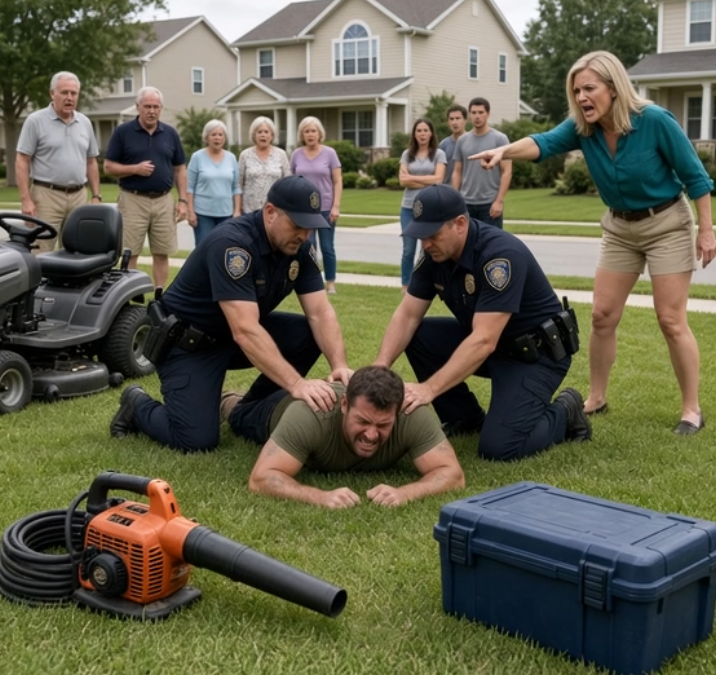
Fake HOA Cops Beat Me on My Own Lawn and Put Me Under “HOA Arrest”—They Had No Idea Why I Never Fought Back.
The first baton hit me on my own lawn.
The man who swung it thought I was just another old homeowner who would bleed quietly, sign the papers, and thank him for stopping.
What he did not know was that every camera, every microphone, every federal agent hidden inside that quiet Florida cul-de-sac had been waiting for exactly that moment.
The first baton hit the back of my shoulder before I could even reach the side gate.
Not my fence.
Not the clubhouse.
Not the street.
My own lawn.
My own St. Augustine grass.
My own front yard, where my granddaughter May had practiced her tennis serve the evening before while my wife, Estelle, sat on the porch shelling peas and pretending not to keep score.
The man who hit me wore a navy uniform with a fake badge over his heart.
His shoulder patch looked close enough to a Manatee County sheriff’s patch that an elderly neighbor might have obeyed before he could read the difference. His golf cart had a strobe light. His belt carried handcuffs, a baton, pepper spray, and a taser. His voice carried the certainty of a man who had been terrifying retirees long enough to mistake fear for law.
“Mr. Talmadge,” he said, standing over me while my left arm burned numb from the impact, “you are under HOA arrest.”
I was on one knee in the grass.
I tasted blood where I had bitten the inside of my cheek.
Behind him, three more fake officers were coming up my driveway.
Their badges said Sentinel Estate Protection.
Their paperwork said Bayou Pines Estates Enforcement Order 17.
Their authority said nothing, because no such authority existed anywhere in Florida law.
Inside the house, my wife, Estelle, had one hand on the kitchen counter and the other inches from the hidden switch behind the spice rack.
My granddaughter was not home.
May was safe in Bradenton with Estelle’s cousin, exactly where the FBI had insisted she be.
Two houses down, a white panel van sat in a retired federal magistrate’s driveway with four surveillance specialists inside and twelve cameras locked on my property.
Three blocks away, a delivery-style Sprinter van held eight federal tactical agents waiting for the one moment we all knew had to happen.
The moment they touched me.
The second baton came down toward my shoulder.
I did not draw my weapon.
I did not reach for the man’s wrist.
I did not give him the fight he wanted.
I let the cameras have him.
Ninety-two seconds later, the cul-de-sac filled with federal badges.
My name is Hayes Talmadge.
I am sixty-two years old.
For twenty-eight years, I served as a special agent of the Federal Bureau of Investigation.
I retired in 2022 as Special Agent in Charge of the Tampa Field Office.
Most of my career was in civil rights investigations.
Police impersonation.
Color-of-law abuse.
PART2:
Private security officers pretending to be sworn law enforcement.
Sheriff’s deputies shaking down truckers.
Jail guards striking cuffed inmates.
Small-town officers treating badges like permission instead of restraint.
I spent most of my adult life studying the exact moment when authority becomes a weapon.
Then I retired into a gated community where a private security company had turned that weapon on the old, the widowed, the frightened, and the quiet.
Bayou Pines Estates sits off State Road 70 in eastern Manatee County, Florida.
Palms in the medians.
Stucco houses.
Tile roofs.
Crushed-shell borders.
A heated lap pool at the clubhouse.
A gatehouse with tinted windows.
The kind of Florida subdivision where the landscaping crews arrive before sunrise and the community newsletter uses the word harmony too often.
Estelle and I bought our house there in late 2021.
We did not buy it for the HOA.
We bought it for the creek behind the property.
We bought it for the live oak in the front yard.
We bought it because the house had enough room for our granddaughter, May.
We bought it because grief had made our old home in St. Petersburg feel too full of echoes.
Our daughter, Annalee, died in June of 2021.
Pancreatic cancer.
Thirty-six years old.
Art teacher.
Seventh-grade ceramics.
PART3:
She could make a room full of middle-schoolers sit in silence by placing a lump of clay on a table and saying, “This is going to become something if you stop fighting it.”
She fought harder than anyone I have ever known.
Cancer did not care.
May was eleven when her mother died.
Her father had been out of the picture so long that his absence had become furniture. Legally complicated furniture, but furniture all the same. So Estelle and I became the people who signed the school forms, packed the lunches, memorized the tennis schedule, and learned how to answer questions no child should have to ask.
“Does missing someone get smaller?”
“No, baby,” Estelle told her. “You get bigger around it.”
That became our family’s way of surviving.
We did not move to Bayou Pines for peace exactly.
Peace felt like too large a thing to ask.
We moved for space.
For sunlight.
For a house where May could have her own room and not feel like every hallway remembered her mother laughing.
At first, Bayou Pines seemed harmless.
A little too clean.
A little too performative.
But harmless.
The clubhouse hosted pancake breakfasts. The board sent welcome baskets. The gate attendant waved. Neighbors brought key lime pie and opinions about irrigation schedules. Estelle joined a garden group. May found a friend named Sophie two streets over who liked tennis and old horror movies, which I found concerning but manageable.
Then the first letter arrived.
Not a fine.
A “courtesy notice.”
Dear Mr. and Mrs. Talmadge,
It has come to the attention of the Bayou Pines Estates Architectural and Lifestyle Harmony Committee that a nonstandard garden flag has been displayed near your entry walkway. Please remove or submit for approval within five business days.
The flag was blue.
It had a small white heron on it.
Estelle bought it because Annalee loved birds.
I read the letter twice, sighed, and put it in the kitchen drawer.
Estelle saw me do it.
“Hayes.”
“What?”
“You have that face.”
“I don’t have a face.”
“You have several. This one says you’re preparing a deposition in your head.”
“It’s a flag.”
“Then let it be a flag.”
So I did.
Or tried to.
Then came the second notice.
Trash bin visible from street for eleven minutes past approved retrieval window.
Then the third.
Driveway vehicle position inconsistent with community symmetry standards.
That one annoyed me because the vehicle was May’s tennis coach’s car, parked at an angle because the landscaping crew had blocked the curb.
Still, I stayed quiet.
I had spent decades enforcing federal law. I understood rules. I also understood that not every petty rule deserved the dignity of war.
But I began noticing things.
That is the curse of old investigators.
Retirement does not shut off pattern recognition.
It only gives you more time to resent what you see.
The first real sign came from Mrs. Claudia Bell.
She lived across the cul-de-sac.
Seventy-nine.
Widowed.
Retired school librarian.
Wore sun hats large enough to qualify as shade structures.
She owned a small white poodle named Biscuit, who hated me personally and without cause.
One morning, I found Claudia standing by her mailbox, holding a pink slip in both hands.
Her face was pale.
“Morning, Claudia,” I said.
She folded the paper quickly.
Too quickly.
“Good morning, Hayes.”
“You all right?”
“Yes. Just HOA business.”
There is a tone people use when they are trying to make fear sound boring.
I had heard it from witnesses, victims, informants, junior agents after bad interviews, and men who swore their bruises came from falling.
I looked at the pink paper.
“Anything I can help with?”
“No, no.” She smiled. “It’s just a fine.”
“For what?”
She hesitated.
“Biscuit barked.”
I glanced down.
Biscuit stared at me from behind Claudia’s ankles like a tiny war criminal.
“He’s a dog,” I said.
“Yes, well. They said three complaints.”
“Who said?”
“Sentinel.”
That was the first time I heard the name.
Sentinel Estate Protection.
Private security contractor for Bayou Pines.
They operated the gatehouse, patrolled in golf carts, issued parking stickers, and apparently now investigated poodle speech.
“How much?” I asked.
Claudia folded the paper tighter.
“It doesn’t matter.”
“It matters.”
Her eyes filled, and she looked away.
“Four hundred dollars.”
For a barking dog.
Three days later, I saw a Sentinel golf cart parked outside the home of Murray and Irene Feldman.
Murray was eighty-four and used a walker. Irene had oxygen tubing under her nose and a laugh louder than the leaf blowers. Their crime, I later learned, was placing a medical supply delivery box on the porch for six hours.
Fine: $750.
“Health equipment clutter.”
Two weeks after that, a retired postal worker named Leonard Shaw had his visitor pass revoked because his son’s truck had a small business logo on the door.
Fine: $1,200.
“Commercial activity.”
A widow on Egret Lane paid $2,000 after Sentinel accused her of “hostile noncompliance” because she asked whether a patrol officer was legally allowed to photograph inside her garage.
He was not.
By Christmas, I had a notebook.
I told myself it was just personal documentation.
Old habit.
Dates.
Times.
Names.
Fine amounts.
Officer descriptions.
Golf cart numbers.
Every investigator knows the lie of casual notes.
If you are writing patterns down, part of you already knows you may need them.
Sentinel’s uniforms bothered me.
Navy shirts.
Gold badges.
Shoulder patches shaped like shields.
Black tactical pants.
Duty belts heavy with tools designed for people who have no business wearing them.
Their carts had amber strobes and sirens short enough to avoid one statute but loud enough to scare anyone pulling out of a driveway.
Their paperwork used phrases like:
Community detention authority.
Administrative probable cause.
Compliance custody.
HOA arrest.
Those phrases were nonsense.
But nonsense wrapped in official-looking paper can frighten people who grew up believing uniforms mean law.
I brought it up at my first HOA meeting.
Bayou Pines board meetings took place in the clubhouse ballroom under chandeliers shaped like seashells. The room smelled faintly of lemon polish and pool chlorine. About eighty residents attended that night, mostly because the agenda included discussion of pickleball court noise, which in Florida can mobilize more outrage than tax fraud.
The HOA president, Marjorie Voss, sat at the center of the board table.
Late fifties.
Pearls.
White blazer.
Hair the color of expensive winter.
She had a smooth voice and the gift of making cruelty sound like homeowner stewardship.
To her right sat Trevor Gage, Sentinel’s regional director.
He was forty-something, tan, compact, with a shaved head and a smile that never reached his eyes. He wore a fitted navy uniform shirt with a badge-shaped emblem over his chest.
Not a real badge.
Close enough to matter.
During open comments, I stood.
“I’m Hayes Talmadge, 442 Magnolia Bend. I have concerns about Sentinel’s enforcement language and tactics.”
Marjorie smiled.
“Mr. Talmadge, welcome. We appreciate engaged residents.”
That meant she did not.
I continued.
“Private security does not have arrest authority. It does not have detention authority except in extremely narrow circumstances any citizen might have. It cannot issue legal summons. It cannot imply sheriff’s authority. Terms like HOA arrest and compliance custody are deceptive and dangerous.”
The room went quiet.
Trevor Gage leaned back in his chair.
Marjorie’s smile cooled.
“Mr. Talmadge, Sentinel operates under board-approved community safety protocols.”
“I’m sure they do. My concern is that those protocols appear to misstate the law.”
A murmur moved through the room.
Marjorie folded her hands.
“Are you an attorney?”
“No.”
“Then perhaps we should allow our counsel to evaluate legal terminology.”
“I spent twenty-eight years with the FBI.”
That landed.
Some people turned around.
Trevor stopped smiling.
Marjorie recovered quickly.
“Then I’m sure you understand the importance of orderly communities.”
“I understand the importance of not letting private actors impersonate public authority.”
Her eyes hardened.
“Strong words.”
“Accurate ones.”
A board member whispered something to Marjorie.
She tapped her microphone.
“We will take your concern under advisement.”
Translation: sit down.
I did.
But Trevor Gage watched me the rest of the meeting.
Two days later, I received a violation notice.
Unapproved surveillance equipment visible from street.
They meant the small camera above my garage.
The same model half the neighborhood used.
Fine: $500.
Estelle read it at the kitchen table.
“Well,” she said.
I poured coffee.
“Well what?”
“You poked the bear.”
“No. I identified the bear.”
“Hayes.”
“I’m retired, not dead.”
She leaned back.
“That sentence has started many of your worst decisions.”
She was right.
Again.
Then Sentinel escalated.
They stopped Mrs. Bell’s caregiver at the gate and made her cry because her pass had expired by one day.
They followed Leonard Shaw’s teenage grandson in a golf cart until he pulled over shaking.
They entered the Feldmans’ backyard while Irene was in the pool for doctor-recommended therapy and told her she needed to “vacate the amenity zone” because Murray’s walker had left scuff marks near the clubhouse.
That night, Murray came to my door.
He stood on my porch with his walker, breathing hard, his face red with humiliation.
“Hayes,” he said, “you were FBI.”
“Long time ago.”
“You still know people?”
That was how the federal investigation began.
Not with me calling old friends because I was angry.
With an eighty-four-year-old man asking if anyone still cared that his wife had been bullied out of a therapy pool by a man with a fake badge.
I made three calls.
The first was to Special Agent Priya Menon, now leading a civil rights squad out of Tampa.
I had recruited her twelve years earlier.
She was smarter than me then and absolutely terrifying now.
The second was to Assistant U.S. Attorney Caroline Sutter.
The third was to retired federal magistrate Judge Alan Whitcomb, who lived two houses down from me and had once written a suppression opinion so sharp that prosecutors in three counties still spoke of it with religious fear.
Alan invited me over that night.
He served cheap bourbon in expensive glasses and listened while I laid out what I had.
He did not interrupt.
That was Alan’s gift.
When I finished, he asked one question.
“Do you have evidence of force?”
“Threats. Coercion. False authority. Financial penalties.”
“But physical force?”
“Not yet.”
He swirled his bourbon.
“That may be what they’re building toward.”
He was right.
Federal interest increased when Priya’s team discovered Sentinel was not operating only in Bayou Pines.
They had contracts with seven gated communities across three counties.
Same uniforms.
Same fake legal language.
Same pattern.
Target the elderly.
Target widows.
Target residents with visible medical vulnerabilities.
Issue inflated fines.
Threaten administrative arrest.
Offer immediate settlement if residents paid through a portal controlled by Sentinel’s compliance division.
Half the payments never appeared in HOA accounting records.
Sentinel called them “field resolution fees.”
The FBI called them what they were.
Extortion.
Wire fraud.
Potential civil rights conspiracy where local off-duty officers had assisted.
That last part changed everything.
Because Sentinel had at least two former deputies on payroll and one current reserve officer advising them on “lawful escalation posture.” Their paperwork borrowed language from real law enforcement forms. Their patches resembled county insignia just enough to confuse residents. Some patrol officers told homeowners they could be “transported” if they resisted.
Transported where?
Nobody asked until I did.
The answer, according to one whistleblower, was nowhere.
It was theater.
But theater with handcuffs still leaves bruises.
For six weeks, I lived two lives.
To Bayou Pines, I was the difficult retiree at 442 Magnolia Bend who refused to pay fines and kept quoting statutes at board meetings.
To the FBI, I was a cooperating witness with enough experience to document without contaminating evidence.
I wore recording devices during meetings.
Estelle documented calls.
Judge Whitcomb allowed his driveway to serve as a surveillance position because he said retirement had become “intellectually underwhelming.”
May knew only that Sentinel were “bad rule people” and that she should not argue with them.
I hated involving her in any of it.
But Sentinel had already started using children.
Not directly.
Worse.
They used fear around them.
They sent a notice accusing May of “unauthorized sports activity” because she practiced tennis serves in our front yard.
Fine: $300.
Estelle held that notice in both hands and said nothing for so long I became afraid.
Then she looked up.
Her voice was calm.
Too calm.
“Hayes.”
“Yes.”
“End this.”
From that moment on, I stopped thinking like a retired man and started thinking like the agent I used to be.
The FBI wanted a clean overt act.
Not just paper.
Not just threats.
They needed Sentinel to cross the line in a way jurors could see without needing a lecture on HOA law.
They got their chance after I refused to pay Enforcement Order 17.
The order accused me of:
Unapproved front-yard athletic activity.
Unauthorized monitoring equipment.
Failure to cooperate with Sentinel community patrol.
Disrespectful conduct toward HOA representatives.
And obstruction of harmony operations.
That last phrase sounded like a yoga studio had declared martial law.
The fine total was $4,850.
I sent a written refusal.
Not emotional.
Not long.
I deny the allegations, reject Sentinel’s claimed authority, and request all further communications be made in writing through HOA counsel.
The next day, Marjorie Voss sent me a personal email.
Mr. Talmadge,
Your background in federal service does not exempt you from community standards. Sentinel officers will enforce the board’s order if voluntary compliance is not received by Friday at 9:00 a.m. You are advised not to interfere.
Regards,
Marjorie Voss
President, Bayou Pines Estates HOA
Priya read that email three times.
Then she said, “She just gave us a timetable.”
Friday morning arrived hot, bright, and still.
Florida stillness is different from silence.
It presses on you.
The sky was a pale blue sheet. The palms barely moved. Humidity clung to the windows before sunrise. Sprinklers ticked across lawns. Somewhere a mower started and stopped. The whole neighborhood looked peaceful in the deceptive way crime scenes often do before the tape goes up.
May left Thursday night with Estelle’s cousin.
She protested.
“I’m not a baby.”
“No,” Estelle said. “You’re the only grandchild I’ve got, and I’m not negotiating with you or the FBI.”
That ended the discussion.
By 8:15 Friday morning, the surveillance team was in place.
By 8:30, Estelle had coffee made, curtains open, and the spice-rack switch armed. The switch connected to a silent alert and interior recording trigger. It was overkill, according to one technician.
Estelle told him, “My husband worked for the Bureau. I married overkill.”
At 8:52, Judge Whitcomb texted me.
White van in position. Try not to be heroic. It complicates testimony.
I replied:
No promises.
He sent back:
That is why prosecutors age poorly.
At 8:58, the Sentinel golf cart turned onto Magnolia Bend.
I watched from the front window.
Trevor Gage was not driving.
He was in the passenger seat.
The driver was Nolan Price, the same patrol supervisor who had fined Mrs. Bell for Biscuit barking. He wore navy uniform, fake badge, shoulder patch, baton, taser, cuffs, pepper spray. He had a jaw built for clenching and the moral imagination of a parking cone.
Behind the cart came another.
Three more officers.
All dressed alike.
All performing authority for the cameras they did not know existed.
I stepped outside before they reached the driveway.
That mattered.
My front door closed behind me.
I walked down the path slowly.
Hands visible.
No weapon.
No sudden movement.
A retired FBI man offering them every opportunity to remain only stupid instead of criminal.
Nolan stopped the cart at the edge of my driveway.
Trevor remained seated, holding a clipboard.
“Mr. Talmadge,” Nolan said. “You have been ordered to comply.”
“I received your paperwork.”
“Then you know why we’re here.”
“I know why you think you’re here.”
His eyes narrowed.
“Do not obstruct Sentinel enforcement.”
“Private security has no enforcement authority over me.”
Trevor stepped out of the cart.
He smiled.
It was the same smile from the HOA meeting.
The one that never touched his eyes.
“Hayes,” he said, as if we were colleagues. “This doesn’t need to become unpleasant.”
“It already is.”
“You’ve created a great deal of tension in this community.”
“No. You have.”
He glanced toward my garage camera.
“You were ordered to remove unapproved surveillance equipment.”
“It’s my house.”
“It is inside a governed community.”
“It is inside the United States.”
Nolan stepped closer.
“Sir, turn around and place your hands behind your back.”
I looked at him.
“No.”
“You are under HOA arrest.”
There it was.
The phrase.
Clear.
Recorded.
Useless legally, priceless evidentially.
“Say that again,” I said.
Trevor’s eyes flickered.
He knew.
Maybe not that cameras were everywhere.
But he knew enough to understand repeated words can become chains.
Nolan did not.
“I said you are under HOA arrest.”
“For what crime?”
“Noncompliance.”
“That is not a crime.”
“It is under Bayou Pines authority.”
“No,” I said. “It isn’t.”
Then I turned slightly toward the side gate.
Not running.
Not resisting.
Simply moving away from them and toward my own backyard.
That was when Nolan hit me.
The first baton strike landed across the back of my left shoulder.
Pain flashed white down my arm.
My knee hit the grass.
The second strike came toward the same shoulder.
I let myself fold.
Not collapse.
Fold.
Protect the head. Turn the body. Let the camera see the weapon. Let the microphone catch the words.
Trevor said, “Get him cuffed.”
Nolan stood over me.
“Mr. Talmadge, you are under HOA arrest.”
Inside, Estelle pressed the switch.
Two houses down, the surveillance van transmitted live.
Three blocks away, the Sprinter van moved.
The third strike never landed.
Because the cul-de-sac exploded.
Not with gunfire.
With brakes.
Engines.
Doors sliding open.
Voices that knew exactly what authority sounded like because it did not need to pretend.
“FBI! Drop the baton!”
“Hands! Hands now!”
“Federal agents! Step away from him!”
Nolan froze.
Men like him understand fake authority.
They do not understand real authority until it is aimed at them.
The first agent reached him before his brain caught up.
Nolan turned halfway, baton still in hand.
An agent drove him into the grass hard enough to knock the air out of him.
Trevor backed toward the golf cart, one hand still clutching the clipboard.
Priya Menon came out of the Sprinter van wearing a ballistic vest, hair pulled back, face calm and lethal.
“Trevor Gage,” she said, “do not move.”
He looked at me.
On one knee.
Bleeding from the mouth.
Shoulder burning.
Then at Priya.
Then at the agents spreading across the lawn, securing the other three Sentinel officers, cuffing wrists, kicking weapons away, calling clear.
His face performed a dozen calculations in one second.
None saved him.
“Am I being detained?” he asked.
Priya almost smiled.
“Yes.”
“On what grounds?”
“Start with assault on a cooperating federal witness and work your way outward.”
His mouth opened.
Closed.
That was the moment he understood.
Not all of it.
Enough.
The street filled with residents.
Some came to windows.
Some opened doors.
Some stood frozen on driveways, watching the men who had terrified them get pushed to the ground by people with real badges.
Mrs. Bell stood in her doorway, one hand over her mouth.
Biscuit barked his tiny, furious approval.
Estelle came out only after Priya signaled the scene was secure.
She did not run.
Estelle has never been a runner.
She walked straight to me, knelt in the grass, and took my face in both hands.
“You stubborn old fool,” she whispered.
“I followed the plan.”
“You got hit with a baton.”
“That was the plan.”
“I hated the plan.”
“Noted.”
Her eyes filled, but she refused to let tears fall in front of Nolan Price.
I loved her for that.
A medic checked my shoulder.
Deep bruise.
Nerve shock.
No fracture.
I had been hit worse in training, though I wisely did not say that to Estelle.
Nolan lay cuffed three feet away, breathing hard, face pressed into my lawn.
He turned his head enough to look at me.
“You set us up,” he spat.
I looked down at him.
“No. You finally showed everyone what you were.”
The FBI arrests did not stop at my lawn.
By noon, agents executed warrants at the Bayou Pines clubhouse, Sentinel’s regional office, Trevor Gage’s home, and Marjorie Voss’s lakefront villa at the back of the community.
That last one drew a crowd.
Marjorie came out in a white linen outfit, sunglasses on, chin high, wrists cuffed in front of her because she complained about shoulder pain.
She tried to address residents from the driveway.
“This is a political attack on community governance!”
Nobody applauded.
Mrs. Bell stood across the street holding Biscuit.
Murray Feldman sat in his mobility scooter near the curb.
Irene stood beside him with her oxygen tank.
Leonard Shaw recorded quietly from the sidewalk.
People who had been afraid for months watched Marjorie learn the difference between control and power.
Control is what she had when everyone believed resistance was too costly.
Power is what arrived with a federal warrant.
The indictment came six weeks later.
United States v. Trevor Gage, Marjorie Voss, Sentinel Estate Protection LLC, and others.
Wire fraud.
Extortion.
Conspiracy.
Impersonation-related offenses.
Obstruction.
Assault.
False statements.
Financial crimes tied to hidden fee accounts.
And, for certain incidents involving coordination with an off-duty deputy who had misused a real badge during Sentinel operations, civil rights charges.
The indictment was ninety-four pages.
Priya sent me a courtesy copy.
I read every page.
Estelle told me this was unhealthy.
She was not wrong.
But I needed to see the architecture of it.
How fear became money.
How money became policy.
How policy became violence.
They had collected more than $1.8 million in improper fees across seven communities.
Many victims were over seventy.
Some had paid from fixed incomes.
One widow had skipped medication for two months to cover a “compliance custody avoidance fee.”
That phrase made me set the document down and walk outside before I broke something.
Compliance custody avoidance fee.
A fancy way to say: pay us or we will pretend we can arrest you.
When the story broke, reporters wanted the dramatic part.
The baton.
The FBI takedown.
The retired agent.
The hidden cameras.
They wanted to stand on my lawn and ask how it felt to be beaten by fake cops after spending a career chasing real abuses of authority.
I gave one interview.
Only one.
The reporter asked, “Were you afraid?”
I thought about that.
Then answered honestly.
“Yes.”
She looked surprised.
“You were afraid even with the FBI watching?”
“Of course.”
“Why?”
“Because a baton doesn’t care who’s watching when it lands. And a nervous man with fake authority can still do real damage.”
That quote ran everywhere.
People praised it.
But they missed the part that mattered.
I was afraid.
Claudia Bell had been afraid.
Murray had been afraid.
Irene had been afraid.
The widow who skipped medication had been afraid.
Fear was the business model.
My case only became news because I had credentials, contacts, and federal surveillance.
Most people facing bullies with badges—real or fake—do not.
The first HOA meeting after the arrests took place in the clubhouse with folding chairs because the ballroom tables had been seized as evidence. That detail pleased me more than it should have.
A temporary board sat at the front.
Residents packed the room.
No Marjorie.
No Trevor.
No Sentinel uniforms at the door.
Just neighbors.
Some angry.
Some ashamed.
Some relieved.
Some still defensive because admitting they had supported cruelty was harder than blaming the people who exposed it.
I sat in the back beside Estelle.
My shoulder still hurt.
May sat between us, arms crossed, furious at me for getting hit and furious at Sentinel for existing and furious at cancer again because grief finds its way into every new fear.
Mrs. Bell spoke first.
She brought the pink slip she had folded at her mailbox months earlier.
“My dog barked,” she said into the microphone. “They fined me four hundred dollars. I paid because my husband used to handle these things, and he is dead, and I was embarrassed that I didn’t know what to do.”
Her voice shook.
“But I am not embarrassed anymore.”
The room went quiet.
She lifted her chin.
“I want my money back.”
Applause started slowly.
Then grew.
Murray spoke next.
Then Irene.
Then Leonard.
Then a woman from Egret Lane.
Then a man I did not know who confessed he had reported his neighbor’s mobility ramp because Marjorie told him it violated harmony standards.
He cried.
Not everyone forgave him.
They did not owe him that.
But he stood there and said it out loud.
That mattered.
The temporary board voted that night to terminate Sentinel permanently, refund improper HOA-collected fines where records supported it, cooperate with federal investigators, and hire independent counsel to review all enforcement policies.
Then they voted to remove the word harmony from every governing document.
That got the loudest applause.
The trial never fully happened.
Trevor Gage pleaded first.
Men like Trevor often do when documents are strong and friends become witnesses.
Nolan Price pleaded after him.
The baton strike on video left little room for poetry.
Marjorie held out longest.
She gave interviews calling herself a victim of “federal overreach into private community management.” She said retirees needed strong governance. She said Bayou Pines had been safer under Sentinel. She said people like me were anarchists hiding behind technicalities.
Then prosecutors played the financial records for her attorney.
Marjorie pleaded two days later.
At sentencing, victims spoke.
Claudia Bell wore a blue hat and brought Biscuit in a carrier despite courthouse objections, because she said Biscuit had been listed in the original fine and therefore had standing.
The judge disagreed on the law but allowed the dog to remain because even federal courts have limits on how much absurdity they can resist.
Murray spoke from his wheelchair.
Irene held his hand.
The widow who skipped medication spoke by video.
May asked if she could speak.
I said no at first.
Estelle said, “Let the girl speak.”
May stood at the podium in a navy dress, hair pulled back, looking too much like Annalee for my heart to behave.
She looked at Marjorie.
“My grandma says people can make houses pretty and still make a community ugly,” May said. “You made people scared to live where they were supposed to feel safe. And you hit my grandpa because you thought nobody important was watching.”
She paused.
Then added, “Everybody is important when they’re standing on their own lawn.”
The courtroom went still.
I looked down because my eyes had betrayed me.
Marjorie did not look at May.
That told me everything.
Sentences came down.
Not as long as some wanted.
Longer than others expected.
Prison for Trevor.
Prison for Marjorie.
Less time for Nolan because he cooperated, though the judge made clear cooperation did not erase violence.
Restitution orders.
Forfeiture.
Sentinel dissolved.
Related investigations continued.
When it was over, reporters gathered outside again.
I walked past them.
May held my hand.
One reporter called, “Mr. Talmadge, do you feel justice was served?”
I stopped.
I should have kept walking.
But May squeezed my hand.
So I turned.
“Justice isn’t a sentence,” I said. “It’s what changes after.”
Then we went home.
Bayou Pines changed slowly.
Not magically.
The gatehouse remained, but the uniforms disappeared.
The new security contractor wore polo shirts with the word STAFF printed plainly across the chest. No badges. No belts. No strobe lights. No nonsense.
The HOA rewrote its fine process.
Notices had to cite actual covenant sections.
Residents had appeal rights.
No private contractor could issue fines independently.
No one could use law enforcement language unless actual law enforcement was involved.
The clubhouse bulletin board displayed a new document in bold letters:
PRIVATE SECURITY IS NOT POLICE.
May took a picture of it and said, “Finally, a decoration I approve.”
Estelle replanted the front bed Sentinel had once claimed was “visually disruptive.”
She chose marigolds, blue salvia, and one small heron flag near the walkway.
I said nothing about the flag.
I am not stupid.
Mrs. Bell got her four hundred dollars back.
She donated half to the county animal shelter and spent the other half on a ridiculous jeweled collar for Biscuit, who still hated me.
Murray and Irene got their pool access restored, but Irene said she preferred doing therapy in our backyard pool because Estelle made better iced tea.
We did not own a backyard pool.
Estelle bought an inflatable one as a joke.
Irene used it twice.
The neighborhood began having Friday evening potlucks on the clubhouse lawn.
No committees.
No speeches.
No harmony branding.
Just folding tables, food, mosquitoes, and people trying to learn how to be neighbors after being trained to be informants.
That was the hardest part.
Rules are easy compared to trust.
Trust returns slowly.
In paper plates.
In borrowed tools.
In someone knocking on a door not to accuse, but to ask if you need anything from Publix.
One evening, months after sentencing, I sat on the porch watching May hit tennis balls against a rebound net in the driveway. Estelle shelled peas beside me, just like she had the night before the baton strike.
May’s serve had improved.
So had her temper, though not as much.
She stopped suddenly and looked toward the spot on the lawn where Nolan had hit me.
“Does it still hurt?” she asked.
“My shoulder?”
She nodded.
“Sometimes.”
“Good.”
Estelle looked up.
“May.”
May shrugged, eyes fixed on the grass.
“Not because I want Grandpa hurt. Because if it didn’t hurt, everyone would pretend it was over.”
I had no answer.
Annalee would have known what to say.
Maybe that is not true.
Maybe parents always imagine the dead would be wiser than the living because the dead cannot disappoint us with uncertainty.
I stood and walked down the steps.
May looked at me warily, as if expecting a lecture.
Instead, I picked up a tennis ball.
“You know,” I said, “your grip is wrong.”
Her mouth fell open.
“It is not.”
“It is.”
“You’re changing the subject.”
“Also true.”
She narrowed her eyes.
“You can’t even serve.”
“I was FBI.”
“That doesn’t mean you can play tennis.”
“It means I can investigate tennis.”
Estelle laughed from the porch.
For a moment, the lawn was just a lawn again.
Not evidence.
Not a scene.
Not the place where federal agents poured into my street.
Just grass.
A granddaughter.
A wife.
A ball bouncing once, twice, then rolling toward the curb.
Peace does not return all at once.
It comes back disguised as ordinary things.
A week later, Priya visited.
Not officially.
She brought a folder because agents never visit empty-handed, even when retired agents tell them not to.
We sat in the kitchen.
Estelle made coffee.
May hovered until Estelle told her to stop interrogating the federal agent and finish homework.
Priya slid the folder across the table.
“What’s this?” I asked.
“Final closure memo excerpts. Thought you’d want the parts we can share.”
I opened it.
Photos.
Charts.
Restitution totals.
List of affected communities.
Victim compensation progress.
At the back was a still image from the surveillance footage.
Nolan standing over me with the baton raised.
Trevor behind him.
My own body half-turned, one knee in the grass.
I closed the folder.
Priya watched me.
“You okay?”
“No.”
She nodded.
“Good answer.”
“I hate that picture.”
“I know.”
“I also know it helped.”
“It did.”
I tapped the folder.
“What happens next time somewhere else?”
Priya’s expression tightened.
“We keep working.”
“That answer gets old.”
“So do we.”
I laughed despite myself.
She smiled.
Then grew serious.
“Hayes, you gave people a clean case. That matters. But more than that, you gave scared people proof that these guys weren’t untouchable.”
I looked toward the window.
Mrs. Bell was walking Biscuit along the sidewalk. Biscuit paused near my mailbox and stared at the house with suspicion.
“People shouldn’t need a retired SAC as bait to prove that,” I said.
“No,” Priya agreed. “They shouldn’t.”
We sat with that.
After she left, I put the folder in my office drawer.
Not with awards.
Not with retirement papers.
With Annalee’s old clay mug, the one she made in college and insisted was functional despite the handle being shaped like a question mark.
Some things belong together not because they are alike, but because they remind you what you owe.
A year after the arrests, Bayou Pines held a memorial dedication of sorts.
Not to me.
I refused that immediately.
Not to the FBI.
Priya refused that with better language.
The residents dedicated a bench near the clubhouse walking path to “Community Without Fear.”
It sounded like something a committee wrote because it was.
But the bench was beautiful.
Simple wood.
Facing the creek.
No gates in sight.
At the dedication, Claudia Bell read a short statement.
“Rules should help people live together,” she said. “They should not be used to make people afraid to open their doors.”
Then May stepped forward without asking permission.
That child.
She held a small ceramic bird she had made in school.
Blue glaze.
White wing.
A little uneven.
She placed it on the bench.
“My mom used to say clay becomes something if you stop fighting it,” she said. “I think neighborhoods are like that too.”
Estelle covered her mouth.
I looked away.
No one spoke for a moment.
Then Mrs. Bell’s terrible dog barked.
Everyone laughed.
The sound moved across the lawn, light and human.
For the first time since we moved there, Bayou Pines felt less like a gated community and more like a place where people might learn to leave the gate open inside themselves.
I still live in the same house.
The camera above the garage remains.
Approved or not.
The heron flag still stands near the walkway.
May is thirteen now and can hit a serve hard enough to make me step back, though she claims I flinch because I lack athletic courage.
Estelle still shells peas on the porch when she wants to think.
The lawn recovered.
You cannot see where my knee hit the grass.
You cannot see where Nolan stood.
You cannot see the path federal agents took when they flooded the cul-de-sac.
That is how lawns are.
They grow over things.
People are different.
We carry impressions longer.
Sometimes that is pain.
Sometimes it is memory.
Sometimes it is warning.
When new residents move into Bayou Pines, the welcome packet includes a page explaining resident rights, HOA limits, and how to report misconduct. At the bottom, in bold, it says:
No private security employee may claim arrest authority.
I keep a copy on my refrigerator.
Not because I need it.
Because I like looking at it.
Every so often, someone asks why I let Nolan hit me.
Usually they ask with admiration, which annoys me.
It was not bravery.
Not the movie kind.
It was calculation.
Evidence.
Discipline.
And yes, anger held on a leash.
I let the cameras have him because for too long he had operated in places without cameras, without witnesses, without consequences. He had stood over people who could not fight back and called it enforcement. He had mistaken quiet for consent.
So did Trevor.
So did Marjorie.
So did every resident who looked away because the rules benefited them until the baton landed on someone else.
That morning, it landed on me.
And because it did, the people watching finally saw what had been happening all along.
I spent twenty-eight years in the FBI learning one truth over and over:
Abuse of power rarely begins with a punch.
It begins with language.
A fake title.
A misleading badge.
A made-up process.
A fee that sounds official.
A warning that makes resistance feel dangerous.
A community that rewards obedience and calls fear harmony.
The punch comes later.
By then, everyone has been trained to lower their eyes.
That is why the first no matters.
The first question.
The first notebook.
The first neighbor who says, “That happened to me too.”
The first hidden camera.
The first time someone refuses to let a bully define authority.
On my lawn, under the Florida sun, with blood in my mouth and my shoulder on fire, I understood something I should have known long before retirement.
You do not defeat fake authority by becoming more violent than it is.
You defeat it by revealing it.
Clearly.
Patiently.
So everyone can see the costume seams.
The crooked badge.
The hollow words.
The baton raised against a man on his own grass.
And then, when the truth is visible, real authority must act.
Ninety-two seconds after Nolan Price hit me, it did.
Federal badges filled the cul-de-sac.
Fake officers dropped their weapons.
A private empire built on fear began collapsing in the middle of Magnolia Bend.
And all the people who had been told to obey finally saw what I saw from the beginning.
Sentinel Estate Protection was never law.
Marjorie Voss was never justice.
Bayou Pines was never safer because its residents were afraid.
And a man standing on his own lawn should never have to prove he is free.
But if he does, he should make sure the cameras are rolling.








