Everyone Thought the Old Shelter Cat Was Mean—Then I Saw What He Was Hiding Under One Paw and Learned Why He Watched the Door Every Day at 5:30.
PART3:
“We washed his bedding once.”
“Not that piece.”
“He panicked.”
“How?”
“Wouldn’t stop pacing until we put it back.”
Brindle still had not looked at me.
I leaned slightly closer.
Nora touched my arm.
“That’s what I meant.”
“What?”
“Don’t reach.”
“Okay.”
“He’s not ready.”
I straightened.
Something about that sentence landed deeper than she intended.
He’s not ready.
I had spent the previous year hearing versions of that sentence about myself.
Not ready to go through my husband’s clothes.
Not ready to sleep on his side of the bed.
Not ready to take off my wedding ring.
Not ready to go to dinner alone.
Not ready to “move forward.”
People loved measuring grief from outside.
My husband, David, had been dead fourteen months.
Pancreatic cancer.
Seven months from diagnosis to funeral.
Thirty-eight years of marriage reduced to seven months of medication schedules, hospital parking garages, whispered conversations, and pretending not to be terrified every time another doctor entered with a folder.
After he died, our house became too quiet.
Not peaceful.
Quiet.
There is a difference.
Peace lets you rest.
Quiet reminds you what should be making noise.
David whistled while making coffee.
Badly.
He coughed every morning before the first sip.
He left cabinet doors open.
He talked to television news anchors as though they might respond.
For thirty-eight years I complained about half those things.
Then I would have traded anything to hear one cabinet door slam.
My name is Margaret Sloan.
I was sixty-two when I met Brindle.
I had driven to the shelter that afternoon because I had three bags of towels in my trunk.
That was all.
Towels.
David had accumulated ridiculous numbers of old towels because he believed no towel was ever truly useless.
Car towels.
Garage towels.
Dog towels, though our dog had been gone six years.
Emergency towels.
Painting towels.
Towels that should have become rags during the Clinton administration.
After David died, I began clearing the basement.
Slowly.
The shelter had posted online that they needed towels.
Perfect.
I could donate something without attaching emotional significance to it.
That was the plan.
Drop off towels.
Leave.
No pets.
No new responsibility.
No fresh grief waiting somewhere ahead.
I had even told my sister over the phone:
“I am absolutely not adopting anything.”
She laughed.
“I didn’t ask.”
“I’m just saying.”
“That makes me think you’re adopting something.”
“I’m dropping off towels.”
“Sure.”
I should have hung up on her.
Instead, I walked through the cat room after handing over the bags.
Just looking.
That was how shelters get you.
There were kittens tumbling over each other.
A black cat reaching through the cage bars.
A beautiful long-haired orange cat rubbing his cheeks against everything that moved.
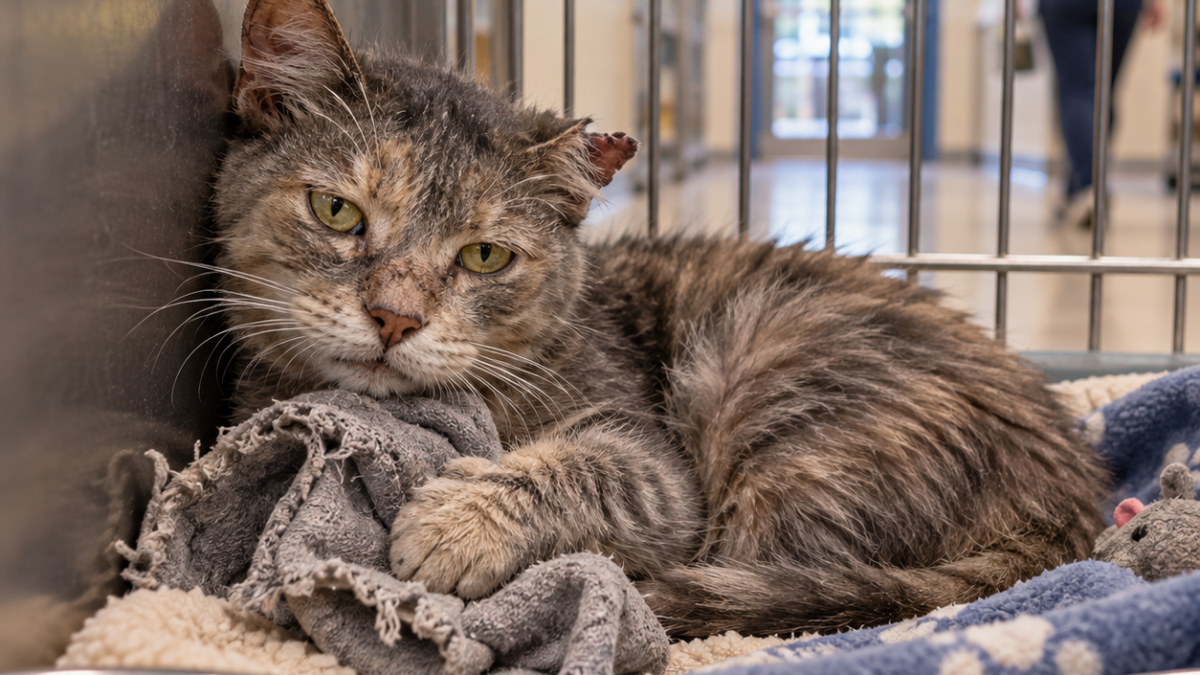
Then Brindle.
Back corner.
Still.
Holding gray cloth.
Nora told me his owner’s name had been Elise Warren.
Brindle had lived with her nearly eight years.
Elise died at seventy-nine.
Apparently sudden.
Some kind of cardiac event.
Brindle had been found beneath her bed after paramedics left.
He stayed there while relatives came.
Stayed while the apartment was emptied.
Would not come out for anyone.
Eventually somebody from animal control had to coax him into a carrier.
He arrived at the shelter with that scrap of robe inside.
“Did someone cut it for him?”
“I think it tore off when they tried to move him.”
Nora said.
“The granddaughter asked us to keep it with him.”
I looked again.
Something bothered me.
Not just sadness.
Recognition.
I had slept in David’s old sweatshirt three nights the week before.
It still smelled faintly like his aftershave if I pressed my face into the collar and wanted badly enough to believe.
I kept his reading glasses in the bedside drawer even though no one would ever wear them again.
There was still an unopened jar of the terrible marmalade he liked in my pantry because throwing it out felt strangely disloyal.
Yet this cat was expected to move into a steel cage under fluorescent lights and adjust because animals supposedly “live in the moment.”
People say that constantly.
Animals live in the moment.
As though memory is a uniquely human privilege.
Brindle lifted his head.
For the first time, his eyes met mine.
Only briefly.
Then the hallway.
“What’s he looking at?”
I asked.
Nora followed his gaze.
“The door.”
“Why?”
She hesitated.
“He does this every day.”
“What?”
“Watch.”
She checked clock on wall.
5:26.
Brindle’s body changed.
Not much.
But he sat taller.
Ears forward.
His paw stayed on the cloth.
5:27.
A cart rolled through the hallway.
He stared.
5:28.
A kennel worker opened the far door.
Brindle rose.
My chest tightened.
A young employee entered carrying cat food.
Brindle remained standing for several seconds.
Then slowly sat.
5:29.
Nothing.
5:30.
He stared harder at the door.
Nora whispered:
“His owner worked part-time at a library.”
“She usually got home around five-thirty.”
I swallowed.
“How do you know?”
“The granddaughter told us.”
“Same schedule every day?”
“Pretty much.”
Nora’s voice grew softer.
“Keys.”
“Coat.”
“Food.”
“She’d talk to him.”
“Every day.”
Brindle continued watching.
5:31.
5:32.
5:35.
No Elise.
Eventually he folded himself back into the corner.
His paw returned over the cloth.
I looked away because suddenly I could not breathe normally.
People imagine grief as crying.
Sometimes it is.
Sometimes grief is simply repeating a routine that no longer works.
I left the shelter without adopting him.
Technically.
I made it as far as my car.
Put both hands on steering wheel.
Then cried for fifteen minutes.
Not only for Brindle.
Not only for Elise.
For David.
For myself.
For every stupid drawer I had opened expecting something familiar.
For every morning I had turned toward his side of the bed before remembering.
For a small cat waiting at 5:30 because no one had explained death in a language he understood.
I drove home.
My sister called.
“How were towels?”
“Fine.”
“You sound weird.”
“I’m fine.”
There was silence.
“You met something.”
“No.”
“Margaret.”
“I met a cat.”
She laughed once.
Then stopped when I did not.
“Oh.”
“He’s old.”
“How old?”
“Twelve, maybe.”
“Healthy?”
“Not really.”
“Friendly?”
“No.”
Another silence.
“So naturally you’re obsessed.”
“I’m not adopting him.”
“Of course not.”
“Stop saying it like that.”
“Like what?”
“Like you already know.”
“I know you.”
I hung up.
That night, I set out two coffee mugs the next morning.
I had not done that in months.
I stared at David’s mug.
Blue ceramic.
Chip near handle.
Then thought about Brindle staring at a shelter door.
At 2:00 p.m., I drove back.
Nora looked up from front desk.
“You forgot a towel?”
“No.”
Her mouth twitched.
“Cat room is through there.”
Brindle was in the same corner.
Same fabric.
Same tired eyes.
I did not approach cage.
I sat on floor outside it.
Cross-legged.
My knees hated me immediately.
Brindle ignored me.
Good.
I talked anyway.
Not baby talk.
I have always hated baby talk.
Especially with animals.
“I have no idea why I’m here.”
No reaction.
“My house is too quiet.”
He blinked once.
“That’s probably not your problem.”
Nothing.
“My husband died.”
His ears moved.
“His name was David.”
I leaned against wall.
“He left cabinet doors open.”
“Constantly.”
“I complained for thirty-eight years.”
“Now I leave one open sometimes.”
“Which is pathetic.”
Brindle looked at me.
Only a second.
I continued.
“I still make too much coffee.”
“I still buy his cereal sometimes.”
“I have six shirts in a closet I know I should donate.”
“I don’t.”
Brindle lowered his chin.
“People keep telling me grief is weird.”
“I think people say that when they don’t know what else to say.”
I stayed thirty minutes.
He never moved.
Next afternoon, I returned.
Same.
Day three.
Same.
Nora eventually stopped asking why.
On day four, I brought an old sweater.
Mine.
Not David’s.
I could not give that yet.
Blue wool.
Soft.
I asked Nora to place it outside Brindle’s corner.
Not near the robe scrap.
Just nearby.
He stared at it like it contained explosives.
For forty-five minutes.
I sat.
I read a mystery novel out loud because Nora had told me Elise loved mysteries.
Badly.
I gave every character same voice.
Brindle suffered.
At 4:50, I closed book.
“I’m going home.”
He remained still.
I stood.
My knees cracked loud enough that a kitten two cages down jumped.
Then Brindle rose.
Slowly.
Stiffly.
He walked toward my sweater.
One step.
Two.
He sniffed sleeve.
Stopped.
Looked at me.
Then lowered his chin onto it.
Nora was standing ten feet away.
Her hand went to her mouth.
“What?”
I whispered.
“That’s first time he’s left that corner while someone was in room.”
My eyes filled.
I looked at Brindle.
He had not chosen me.
Not yet.
He had chosen a sweater.
But it was movement.
Sometimes hope is embarrassingly small.
I filled out adoption papers that afternoon.
Nora warned me.
“He may hide for weeks.”
“Okay.”
“He might never be affectionate.”
“Okay.”
“He might always prefer distance.”
“Okay.”
“He has arthritis.”
“Okay.”
“Dental issues.”
“Okay.”
“Possible early kidney disease.”
“Okay.”
“He may never be the kind of cat people post cute pictures of.”
I looked at her.
“I’m not asking him to perform.”
Nora smiled.
“That’s probably best thing you’ve said.”
Brindle hated the carrier.
He hated the car more.
For forty-two minutes he made no sound.
That frightened me more than screaming would have.
At home, I opened carrier in bedroom.
He shot under bed.
That was it.
Day one:
I saw one yellow eye.
Day two:
Food disappeared overnight.
Day three:
I found him in closet at 4:00 a.m.
He froze.
I backed out.
No chasing.
No pulling.
No “you need to learn.”
Trust is not rent an animal owes because you pay mortgage.
I left food near bed.
Water wide bowl because Nora said he disliked narrow.
Litter box low entry.
At night, I read aloud.
Mysteries.
Sometimes newspapers.
Once grocery coupons because book was across room and moving would have scared him.
On fourth evening, at exactly 5:30, I heard a sound.
Not meow.
A tiny scrape.
I turned.
Brindle stood in hallway.
The gray robe scrap was beside him.
I did not know he had carried it out.
He looked at front door.
My heart broke in such a familiar place I almost resented him for finding it.
He sat.
Waited.
I knew what he wanted.
I wanted to tell him.
She’s not coming back.
I wanted to save him from tomorrow’s waiting.
But who was I to force that sentence on a creature who had no way to understand it?
So I sat on floor.
Not close.
“I’m here, Brindle.”
His ear twitched.
“That’s all I’ve got.”
He looked at door.
Then at me.
Then, slowly, lowered himself beside my chair.
Not touching.
Almost.
His tail stretched across the floor.
The last inch touched my slipper.
I did not move for half an hour.
By week two, 5:30 became our ritual.
At 5:25 I made tea.
Turned kitchen light low.
Placed his food halfway down hall.
Sat on floor.
Brindle came.
Watched door.
At first, he ignored everything else.
Then one evening he looked at his bowl.
Door.
Bowl.
Door.
He took one step toward food.
Stopped.
Another.
He ate three bites.
While I sat there.
I almost cried into tea.
He looked at me.
I looked away immediately.
That became our language.
Pretending not to notice.
Pretending not to notice when he entered room.
When he slept closer to doorway.
When he began grooming himself again.
When he sat two feet from my chair instead of six.
When his tail touched my slipper twice.
Some love arrives only when it does not feel watched.
My neighbor Maureen did not understand.
Maureen was sixty-eight and possessed an opinion about every living thing within three zip codes.
She came over with banana bread.
Saw Brindle half hidden behind laundry basket.
“Oh.”
“That’s him?”
“That’s him.”
She squinted.
“He looks rough.”
“He’s old.”
“He looks angry.”
“He’s scared.”
“He looks like he doesn’t like you.”
“He doesn’t have to like me yet.”
Maureen gave me the expression people had given me since David died.
The one that said grief had made me eccentric.
“Well.”
She set banana bread on counter.
“I just don’t understand why you didn’t get a kitten.”
I knew where sentence was headed.
“Something cheerful.”
There it was.
“Something that would help you.”
Help me.
Not someone I could help.
Not something complicated.
Something cheerful.
Easy.
A little animal to make widowhood prettier for everybody watching.
I looked at Brindle.
He had turned his head away.
“I didn’t need cheerful.”
Maureen blinked.
“What did you need?”
I thought.
“Honest.”
She had no response.
Brindle won first argument without moving.
Weeks became months.
He gained a little weight.
Not much.
The veterinarian said age was uncertain but probably twelve or thirteen.
He had arthritis.
A heart murmur.
Kidney values “worth monitoring.”
That phrase became permanent source of anxiety.
I bought expensive senior food.
He preferred cheaper one.
Of course.
I bought orthopedic cat bed.
He slept in cardboard delivery box.
I bought heated pad.
He slept on David’s old sweatshirt after I finally brought it downstairs.
That almost stopped me.
I had placed sweatshirt over chair without thinking.
Brindle sniffed.
Turned twice.
Curled.
I sat across room staring.
Two griefs sharing one object.
David never knew Brindle.
Elise never knew me.
Yet there we were.
An old cat sleeping on dead man’s sweatshirt while dead woman’s robe scrap remained in his bed.
Love makes strange households.
One month after adoption, Nora called.
“Nothing’s wrong.”
Every person with an anxious heart knows those words are useless.
“What happened?”
“Someone came asking about Brindle.”
My hand tightened around phone.
“Who?”
“A young woman.”
“Name’s Holly Warren.”
Warren.
Elise.
“She says Brindle belonged to her grandmother.”
I looked across living room.
Brindle asleep in sun patch.
Robe scrap beneath chin.
My first emotion was not generous.
Where were you?
I hated myself as soon as thought it.
But it was there.
I had sat outside cage.
Watched him wait.
Watched him shrink.
Now family appeared?
Nora must have heard silence.
“She isn’t asking to take him.”
That softened something.
“What does she want?”
“She wanted to know if he was safe.”
I looked at Brindle.
His ribs were less visible now.
My sweater beside robe scrap.
“He’s safe.”
“I told her.”
“What else?”
“She has something that belonged to Elise.”
“What?”
“A pillowcase.”
My throat tightened.
“And photo.”
I closed eyes.
“Does she want to visit?”
“She asked whether it would hurt him.”
That answer destroyed most remaining anger.
People who do not care do not ask whether their presence will hurt.
“What did you tell her?”
“That it’s your decision now.”
I hated that wording.
My decision.
Brindle belonged legally to me.
Emotionally, things were more complicated.
I asked Nora for Holly’s number.
She called next evening.
Her voice was younger than I expected.
Late twenties, maybe.
Before hello:
“Thank you for taking him.”
No defense.
No explanation.
Just that.
Thank you.
My anger lost its balance.
“You knew him long?”
“Since I was sixteen.”
Her voice broke on his name.
“Brin.”
Nobody had called him that around me.
“He was Grandma’s shadow.”
I sat.
“Tell me.”
So she did.
Elise had found Brindle behind a laundromat in February.
He was already adult.
Thin.
Torn ear.
Would not let anyone near.
She fed him outside eleven days.
On twelfth, she left apartment door open and sat on kitchen floor reading murder mysteries out loud.
Brindle eventually walked in because cold beat fear.
“Grandma always said curiosity got him before trust did.”
Holly laughed through tears.
“He hated men in work boots.”
“Loved tuna water.”
“Would only drink from wide bowls.”
My pen moved across envelope.
“He slept on sofa back whenever she watched game shows.”
“He could hear treat drawer from three rooms.”
“He ate middle of soft treats and left edges.”
I laughed.
“That explains a lot.”
“You’ve seen that?”
“Every time.”
Holly cried harder.
I waited.
She told me Elise got sick fast.
One week complaining about grocery prices.
Next week emergency room.
Then gone.
Holly lived in another state.
Her mother was handling funeral.
Uncle handled apartment.
Everybody assumed somebody else had cat plan.
Holly’s lease prohibited pets.
Her mother’s asthma worsened around cats.
She called friends.
Rescues.
Nobody had room.
Finally shelter.
“I know how it sounds.”
“No.”
“It sounds terrible.”
“It sounds like people drowning.”
She went silent.
“I thought everyone would hate us.”
“Some probably would.”
“I did for about thirty seconds.”
She gave surprised laugh.
“I’m sorry.”
“No.”
“I deserved that.”
“Maybe not.”
I thought about warm-couch judgment.
People online saying:
I would never.
Easy phrase when nobody has died, landlord isn’t threatening eviction, allergies not severe, bank account stable, life orderly.
“I believe you.”
I said.
Holly cried.
Three words.
Not absolution.
Maybe permission to stop flogging herself.
She mailed pillowcase.
White.
Faded.
Lavender soap.
Old cotton.
Photo of Elise in armchair, hand resting on Brindle.
He looked younger.
Fur fuller.
Torn ear still.
Eyes half closed.
Safe.
That was word.
Safe.
A note:
He slept beside this pillow every afternoon. Please give it to him only if you think it is right.
I stood hallway with pillowcase.
Brindle watched.
He went still before I moved.
He smelled it.
I swear.
I placed fabric halfway between us.
Stepped back.
Nothing.
Thirty seconds.
Minute.
Then he rose.
Slow.
He walked.
Stopped two feet away.
Whiskers trembled.
Then a sound.
Tiny.
Broken little sound.
Not meow.
Not cry.
Something between.
He put left paw onto pillowcase.
Same paw that guarded robe.
Then lowered face.
Pressed whole body onto cloth.
His shoulders trembled.
I sat across room.
Every part of me wanted touch.
I didn’t.
That grief belonged to him.
For almost an hour he stayed.
When he lifted head, eyes looked wet.
I know cats do not cry emotional tears like humans.
I know.
That is not what I mean.
I mean his face looked changed.
Spent.
The way people look after crying even when no tears visible.
He ate half dinner.
At 5:30 he went to door.
Sat.
Then looked toward pillowcase.
And walked back.
That night, he slept between robe scrap and pillowcase.
My sweater beneath both.
Three lives in one bed.
A week later, I posted photo.
Brindle curled around:
Elise’s robe.
Elise’s pillowcase.
My sweater.
Caption:
Some animals do not need a fresh start that erases everything. Some need a soft place where the old love and new love can sit together.
I expected twenty likes.
Instead the post spread.
People shared stories.
“My dad’s dog still sleeps beside his boots.”
“My mother’s cat waited at bedroom door for months.”
“My senior rescue carries blanket from first home.”
Then arguments.
Of course.
“You’re anthropomorphizing.”
“Take old cloth away so he can move on.”
“Family should be ashamed.”
“Animals don’t understand death.”
“Old pets are too much work.”
“It’s just a cat.”
That last one got hundreds of replies.
I almost deleted everything.
I didn’t want Elise judged.
Holly shamed.
Brindle reduced to emotional internet argument.
Then I saw comment from Denise:
My neighbor died last month. His old cat is still in apartment with relatives checking once a day. I was afraid to offer because she is old and scared. I’m calling tomorrow.
I left post.
Sometimes kindness has to walk through noise to reach right person.
Next morning Nora called.
“You caused a situation.”
My stomach dropped.
“What kind?”
“The good kind.”
Three people came asking specifically about senior cats.
Not kittens.
Seniors.
One older man asked:
“Which one has been here longest?”
A young couple asked whether any animals arrived with belongings from old homes.
A widow asked for “one nobody looks at.”
Nora’s voice broke.
“We have a twelve-year-old tabby named Milton.”
“He came with stuffed rabbit.”
“Nobody asked about him until today.”
I sat.
Across table, Brindle jumped onto chair.
Badly.
Back paws slipped.
He made it.
Then glared at me as though chair design was my fault.
I laughed.
Nora heard.
“Was that him?”
“He’s judging my furniture.”
“That means he owns you now.”
She was not wrong.
Then came Holly’s visit.
I nearly canceled twice.
Not because I feared Holly.
Because I feared Brindle.
More specifically:
what if he loved her more?
It is embarrassing.
A sixty-two-year-old widow jealous of a dead woman’s granddaughter.
But grief makes children of us.
I had waited months for tail against slipper.
What if Holly walked in and he ran into her arms?
What would that mean about me?
Nothing rational.
Emotion does not ask rational permission.
Holly arrived at 4:45.
Empty hands.
No treats.
I liked that.
Brindle was under side table.
He saw her.
Did not run.
Holly sat on floor sideways, hands folded.
She knew how.
“Hi, Brin.”
His ears moved.
“It’s Holly.”
No movement.
She waited.
Then:
“Grandma used to call you Mr. Business.”
Brindle lifted head.
Tiny.
But definite.
Holly laughed through tears.
“I know.”
“You hated it.”
He stepped out.
One paw.
Another.
Halfway across rug.
Stopped.
Holly covered mouth.
I stayed frozen.
He sniffed.
Then turned away from her.
My selfish heart lifted and immediately hated itself.
Brindle walked to bed.
Took robe scrap in mouth.
Carried it back.
Dropped it in front of Holly.
She broke.
Bent over.
Sobbing.
“I’m sorry, Brin.”
“I’m so sorry.”
He sat beside cloth.
Not touching her.
Not running.
Showing.
That was what it looked like.
Look.
I kept it.
I carried her.
I remembered.
Holly whispered:
“I should’ve found a way.”
Brindle blinked.
Then turned.
Looked at me.
Longer than usual.
Walked back.
Climbed badly onto chair beside mine.
Curled with tail touching my sleeve.
Holly stared.
Pain crossed her face first.
Then relief.
“He chose you.”
I shook head.
“No.”
She looked.
“He chose both.”
That sentence traveled online later and people fought about it.
I still believe.
Love is not a rental property with one occupant.
Brindle did not need Elise evicted to make room for me.
He did not need me erased to remember Holly.
He chose both.
After Holly left, he ate full dinner.
At 5:30, he walked to door.
Sat one minute.
Then returned.
For first time, laid his head directly on my foot.
My foot went numb after ten minutes.
He stayed forty-two.
I would have sacrificed leg.
Something loosened after that.
Not healed.
I distrust that word.
Loosened.
Brindle started yelling for breakfast.
Ugly little rusty sound.
He slept in sun.
Attacked blue dish towel with personal vengeance.
Followed me to bathroom.
Pretended he had not.
Swatted my hand once when I reached too fast.
No claws.
I apologized.
He accepted nothing because cats do not accept apologies formally.
He simply remained.
That was enough.
He was not an empty room waiting for my furniture.
He came furnished.
History.
Rules.
Habits.
Old grief.
He preferred ugly pillowcase over expensive bed.
Drank from one specific bowl.
Hated vacuum.
Loved chicken.
Despised fish despite shelter notes.
Needed 5:30.
Then slowly needed it less.
That is what adopting an old animal means.
You do not adopt them to make them new.
You adopt them so they can be old somewhere safe.
That phrase upset people when I wrote it.
Good.
We are obsessed with new.
Puppies.
Kittens.
New homes.
Fresh starts.
Before-and-after photos where everything sad disappears by second image.
Real life doesn’t always cooperate.
Old animals remain old.
Scars remain.
Cloudy eyes remain.
Medications.
Bad teeth.
Past homes.
Past names.
Old blankets.
You are not rescuing blank slate.
You are joining a story already underway.
Senior-pet adoption event happened a few months later.
Nora asked me to speak.
I refused.
Then she said:
“Just ten people.”
There were thirty-seven chairs.
I almost killed her.
Animals lined walls.
Gray-muzzled dog with one cloudy eye.
Bonded older cats.
A missing-fang calico.
Milton, twelve-year-old tabby with stuffed rabbit.
I stood.
Forgot notes.
So told truth.
Robe scrap.
5:30.
Pillowcase.
Tail touching slipper.
Holly.
“He chose both.”
Real silence.
Then man in second row raised hand.
Sixty-five maybe.
Work jacket.
Big hands.
“My wife wanted cat.”
Everyone turned.
“I said no because I didn’t want hair on furniture.”
He looked down.
“She died in March.”
Long pause.
“Furniture’s still clean.”
His voice cracked.
Nobody moved.
He stood.
Walked to Milton.
Old tabby opened one eye.
Man pointed to stuffed rabbit.
“Does that go with him?”
Nora nodded.
“Good.”
“I got room for both.”
Half room cried.
Including me.
Milton went home.
Bonded pair too.
Gray dog too.
Not everybody.
But three.
Three old lives left with their medicines, blankets, smells, habits, and history.
Three people chose complicated love.
When I returned home, Brindle was asleep in my chair.
My good chair.
David’s favorite joke chair.
Brindle opened one eye.
“Excuse me.”
Closed it.
That was when I knew he felt safe.
Nothing demonstrates cat confidence like disrespect.
Winter came.
Brindle slowed.
The veterinarian said:
“He’s old.”
I hated that sentence.
He is old.
Explanation and apology.
We lowered litter box.
Bought steps.
Warmed food.
Added blankets.
He rejected soft expensive blanket.
Loved one with faded plaid.
Of course.
He coughed sometimes.
Skipped meals.
Each skipped bite became disaster in my head.
That is what scares people from seniors.
“I couldn’t adopt old one.”
“I’d lose them too soon.”
I understand.
After David, I said same.
No new heartbreak.
Just towels.
But love offers no warranty.
Young animals die.
Young people die.
Husbands die at sixty-four.
Nothing protects.
There is only love given while possible and love withheld because fear demanded insurance life does not sell.
Brindle did not make life easier.
He made it fuller.
Difference.
Holly visited again.
Brought photo Elise laughing in kitchen, Brindle on counter looking annoyed.
Back:
HE PRETENDS NOT TO LOVE ME.
I laughed until cried.
We placed photo on shelf.
Brindle tried knocking over twice.
Memorial arrangement offended him.
Good.
Spring.
He gained some weight.
Fur softened.
One April evening, I was watching cooking show and eating crackers like raccoon.
Brindle walked in.
Stared.
Stepped onto foot.
Climbed leg.
Struggled.
Then settled in my lap.
I froze.
Cracker fell.
He turned twice.
Pressed paws into robe.
Lay down.
Warm.
Heavy.
Real.
I placed one hand on back.
No flinch.
Scratched torn ear.
He closed eyes.
Months after adoption, he finally gave me picture-perfect ending everyone expected.
Lap cat.
But by then I knew better.
That was not proof adoption worked.
It worked when three bites.
When sweater.
When tail touched slipper.
When robe went to Holly.
When he came back.
Love is not only valid when photogenic.
I did not take picture.
People got mad.
“You should’ve captured.”
No.
I lived it.
Not everything tender needs audience.
He slept twenty-three minutes.
Then woke.
Bit my sleeve gently for no reason.
Left.
Again:
cat.
Denise—the woman who commented about neighbor cat—sent photo months later.
Black-and-white cat with cloudy eye by old slippers.
“Her name is Penny.”
“She still sleeps beside his slippers.”
“I let her.”
I showed Brindle.
“You helped her.”
He sniffed phone.
Disappointed no food.
Heroes rarely care about ceremony.
Maureen changed too.
Eventually Brindle accepted treat from her hand.
Dropped it.
Walked away.
Maureen smiled.
“He likes me.”
“That was unusually warm.”
She believed me.
Later she admitted her sister moved into assisted living and had to leave dog with son.
“I told her she should be relieved not to have burden.”
Her eyes dropped.
“She cried.”
“I thought dramatic.”
Maybe not.
Maureen visited sister next day with photos of dog.
Sister slept with one beneath pillow.
People say:
Move on.
Often what they mean is:
Stop making me look at your pain.
Brindle never rushed mine.
Never told me throw David’s glasses.
Never mocked sweatshirt.
He put grief beside mine.
Two creatures missing someone.
Still eating breakfast.
That is survival.
Holly’s Thanksgiving visit was different.
No grief objects.
Just herself.
I liked that.
At 5:30 Brindle still walked door.
Sat.
Holly’s face tightened.
Guilt.
Then Brindle turned.
Picked robe scrap up.
Carried halfway.
Dropped.
Returned to living room.
Sat beside me.
Holly whispered:
“What does that mean?”
I looked at cloth.
“I think he remembers.”
“But he doesn’t live there all the time anymore.”
She cried.
Brindle yawned.
Cats keep human breakthroughs humble.
I wrote online:
Stop telling people and animals to forget what loved them first. A heart is not a rental unit. New love does not need old love evicted before it can move in.
That spread faster.
People posted dogs with boots.
Cats with blankets.
Parrot with sweater.
Rabbit with stuffed bear.
Stories poured.
Brindle became less about cat.
More permission.
Permission to grieve without schedule.
Permission to love difficult.
Permission to accept animals are witnesses.
They know our cars.
Footsteps.
Arguments.
Beds.
Medication routines.
When someone disappears, they feel shape even if no language.
Call it attachment.
Conditioning.
Instinct.
I call love.
Not human love.
Different.
Still love.
Then spring came again.
Brindle slowed.
Gently.
Like tide leaving.
Food less.
Sleep more.
He stopped jumping into chair and looked at me.
I lifted.
“Oh, now you need me?”
Blink.
Service expected.
I moved bed to window.
Holly visited.
Nora visited.
Brought donated blanket.
Brindle rejected immediately.
Nora laughed and cried.
“That tracks.”
His last good evening came at 5:30.
I was kitchen.
He walked hall.
Slow steps.
Uneven.
Sat at front door.
Beside him:
robe scrap.
I had not seen him carry.
For moment, he looked exactly like shelter.
Small.
Gray.
Tired.
Holding final piece of first world.
But now there were others.
Pillowcase in bed.
My sweater on chair.
Elise photo.
My voice.
My house.
His ridiculous plaid blanket.
He had not replaced Elise.
He had not replaced anyone.
He had made room.
I lowered to floor.
Knees hurt.
“I’m here, Brindle.”
Same sentence from fourth evening.
He leaned into my leg.
Just enough.
5:31.
Door did not open.
5:32.
Still leaning.
5:33.
Eyes closed.
Maybe he had stopped waiting for Elise to walk through.
Maybe 5:30 had become somewhere he visited.
Place love first left.
This time he did not visit alone.
Brindle died three days later.
Quietly.
My hand on back.
Robe scrap near paw.
I won’t describe more.
Some things deserve gentleness.
Holly came that evening.
Maureen too.
Nora cried by phone.
It astonished me how many people one “difficult” old cat gathered.
A cat nobody wanted because he did not rub bars.
Did not perform sweetness.
Looked angry.
Looked old.
Looked too sad.
That night, I put robe scrap, pillowcase, my sweater in chair.
Not shrine exactly.
I couldn’t put away.
House became too quiet again.
Dangerous quiet.
For weeks, I did nothing noble.
No adoption speeches.
No inspiring posts.
No turning pain into purpose.
People rush that too.
They want your grief to become lesson before it becomes real.
I let it hurt.
Then one afternoon, I loaded three bags of old towels into car.
Yes.
Towels.
Again.
Nora saw me enter shelter.
Smiled carefully.
Said nothing.
I walked past kittens.
Past young cats reaching through bars.
Past cheerful easy ones.
Back corner.
An old black cat sat facing wall.
Cloudy eyes.
White whiskers.
One paw on a worn pink blanket.
I stopped.
Nora came beside.
“She came in with that.”
The cat did not hiss.
Did not growl.
Did not swat.
Just kept paw on blanket.
My heart cracked open in same old place.
I sat on floor.
The black cat did not move.
That was okay.
I knew language now.
I did not reach.
Did not ask for eye contact.
Did not demand new beginning.
I just sat.
After a while I said:
“You can miss them here.”
Her ear moved.
Tiny.
Almost nothing.
Enough.
Because maybe she wasn’t difficult.
Maybe loyal.
Maybe not angry.
Maybe waiting.
Maybe she did not need hero.
Maybe witness.
Someone willing to sit on floor.
Someone willing to keep ugly blanket.
Someone willing to understand that a life existed before this cage.
That is what Brindle deserved.
That is what he got.
Not for as long as I wanted.
Long enough to matter.
And perhaps that is all any of us are trying to do.
Make the time left softer.
Hold what was loved.
Make room for what can still be.
And when the door does not open the way it used to, sit beside the one still waiting.
Stay there.
Let the world change hands gently.








