Everyone Dismissed the Shy Nurse With Shaking Hands—Then a Navy SEAL’s K9 Heard Her Whisper One Word and Obeyed Like He’d Known Her for Years.
PART3:
He tapped his clipboard.
“Trauma nurses handle trauma. You handle stock.”
The humiliation was surgical.
Clean.
Deliberate.
Nobody spoke.
Nell nodded.
“Yes, sir.”
Strand turned away.
Conversation resumed around him as though nothing had happened.
Nell lifted the tray.
Walked out.
Only after she turned into the supply corridor did she let herself breathe.
Rosa found her there.
Yellow mop bucket.
Paper coffee cup.
Kind eyes that missed almost nothing.
“I heard.”
Nell opened a cabinet.
“Everybody heard.”
“Want me to trip him?”
Despite herself, Nell smiled.
“You’d lose your job.”
“I’m old. I’m thinking about retirement.”
“You said that three years ago.”
“I’m easing into it.”
Nell counted saline bags.
One.
Two.
Three.
Four.
Rosa leaned against doorway.
“He’s wrong.”
“No.”
Nell moved to gauze.
“He isn’t.”
“Honey.”
“My hands shook.”
“A door slammed.”
“I shouldn’t care.”
Rosa studied her.
“You think brave people don’t jump at loud noises?”
Nell kept counting.
“Seventeen.”
“Prescott.”
“Eighteen.”
“Nell.”
She stopped.
Rosa lowered her voice.
“I clean this place six nights a week.”
“I know.”
“I know who comes in early.”
Nell said nothing.
“I know who stays late with patients after clock-out.”
Nothing.
“I know who checks four exits before sitting down.”
Nell’s left thumb found the green paracord bracelet wrapped around her wrist.
Old.
Faded.
Knotted by hand.
She turned it once.
Twice.
Three times.
Rosa watched.
“You’re not afraid of medicine.”
“What am I afraid of?”
Rosa’s face softened.
“Remembering.”
Nell looked away.
Outside the supply room, somebody dropped a metal basin.
The crash echoed.
Her shoulders jerked.
For half a second the hallway disappeared.
Not Virginia.
Not fluorescent lights.
Dust.
Diesel.
Burning insulation.
Rotor blades beating hot air against sand.
A man screaming for Bishop.
Another voice on radio:
Juniper, we need you now.
Nell shut eyes.
Counted exits.
Two behind.
One stairwell.
One loading bay.
One service corridor.
Four.
Heart slowed.
Rosa said nothing.
That was why Nell liked her.
Some people respond to pain by demanding its story.
Rosa understood that silence could be kindness.
Nell opened her eyes.
“I’m fine.”
Rosa sipped coffee.
“That lie needs work.”
Before Nell could answer, the overhead speaker cracked.
“Trauma activation. Trauma activation.”
Every sound in corridor changed.
Shoes moved faster.
Voices sharpened.
The radio channel opened overhead.
“Medic Four inbound from Little Creek training range.”
Nell froze.
“Two Navy casualties. Both critical.”
Rosa saw the change.
The voice continued.
“First patient: Commander Caleb Hargrove, thirty-six, penetrating right chest trauma, probable hemothorax, severe blood loss.”
A second name followed.
“Lieutenant Commander Cole Hargrove, thirty-six, blast injury, open femur fracture, abdominal trauma.”
Nell’s fingers tightened around supply shelf.
Hargrove.
No.
Impossible.
The dispatcher continued.
“Both patients are Naval Special Warfare.”
Then:
“Be advised, military working dog Bishop is accompanying first patient and will not separate.”
Nell stopped breathing.
Rosa whispered:
“What?”
Nell stared toward ambulance bay.
“Nothing.”
But something had already begun opening inside her.
Dr. Strand’s voice carried down hallway.
“Prescott! Supply room.”
She stayed where she was.
“Prescott.”
Nell stepped into trauma bay carrying inventory clipboard.
Strand pointed back.
“I gave you an assignment.”
“The incoming report says penetrating chest.”
“We heard it.”
“You need a thoracostomy tray open.”
“I have residents.”
“Two rapid infusers.”
He stared.
“And second massive transfusion setup.”
“Nurse Boyd is coordinating.”
Nell moved anyway.
Chest tray.
Two units O-negative on standby.
TXA.
Tourniquets.
Chest seals.
Airway cart.
She did not search.
Her hands knew.
Dr. Reed noticed.
He was forty-five, calm, respected, and one of few attending physicians who had never treated Nell’s quietness as incompetence.
“Nell.”
She looked.
“You’ve done this before.”
It was not a question.
“Emergency nursing.”
“No.”
His eyes narrowed.
“Not what I meant.”
The ambulance doors exploded open before she could answer.
The first gurney came fast.
Commander Caleb Hargrove.
Combat shirt cut open.
Face gray.
Blood across right chest.
He was fighting the straps because lying flat worsened breathing.
Behind him another gurney carried his identical twin.
Cole.
Same face.
Different wounds.
Cole was barely conscious.
One leg stabilized.
Abdomen packed.
Blood pressure collapsing.
Strand moved to Cole.
Reed took Caleb.
Then everything broke.
Caleb tried to sit.
A medic pushed him gently back.
He panicked.
“Bishop.”
“We have him.”
“Bishop!”
His strength gave out.
He slid sideways off the gurney.
Two medics reached.
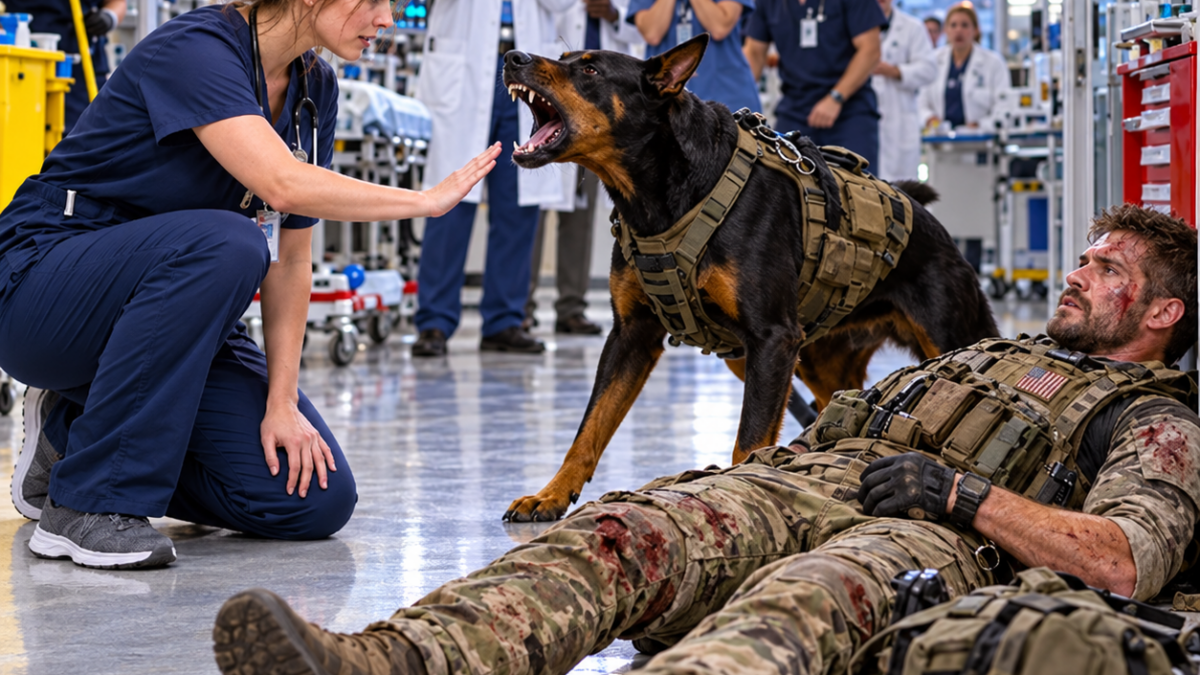
Before they touched him, ninety pounds of black-and-tan Doberman launched through ambulance doors.
Desert harness.
Blood on chest.
BISHOP stitched across side.
The dog landed over Caleb.
Turned.
Growled.
Every person stopped.
It was not a pet’s warning.
It was trained violence held one inch behind restraint.
One medic reached.
Bishop snapped.
Teeth closed on air.
“Back!”
Security Chief Roy Dillard rushed in with two officers.
“What the hell?”
“Working dog!”
“Get it away.”
“He won’t leave handler.”
Caleb made a wet choking sound.
Monitor screamed.
Oxygen saturation: 82.
Heart rate: 140.
Blood pressure: 76 over 42.
Reed raised both palms.
“Easy, Bishop.”
Dog lunged.
Reed stepped back.
Dillard drew Taser.
Nell’s voice came from twenty feet away.
“Don’t.”
No one heard.
Strand shouted:
“Dillard, remove that animal.”
“How?”
“Sedate him.”
“With what?”
“If necessary, put him down.”
Nell looked at dog’s left shoulder.
There.
Under black fur.
Curved white scar.
Three inches.
Fishhook.
Her stomach dropped.
Three years disappeared.
Northeastern Syria.
Gravel road.
Convoy burning.
Staff Sergeant Michael Torres motionless twenty feet away.
Bishop howling over him.
Nell on one knee with blood on both hands.
Gunfire somewhere beyond berm.
The dog’s shoulder split open by shrapnel.
No veterinary kit.
No time.
Fishing line.
Red lens flashlight.
One repeated word.
Not command.
Identity.
Juniper.
Her call sign.
The name that meant:
I am not the enemy.
Nell’s clipboard hit floor.
Dr. Strand turned.
“Prescott!”
She walked toward Bishop.
Dillard blocked her.
“Ma’am, back up.”
She passed him.
“Prescott, that is an order.”
Her shoulders straightened.
Hands stopped trembling.
Eight feet from dog, she turned body slightly sideways.
Lowered to one knee.
No eye contact.
Palm open.
Bishop’s growl deepened.
“Easy.”
Nobody breathed.
Nell whispered:
“Juniper.”
The dog’s head snapped.
The growl broke.
She swallowed.
“Bishop.”
His ears shifted.
“It’s Juniper.”
A thin whine escaped.
Nell’s eyes filled.
“I’ve got him.”
Bishop stared.
Three seconds.
Four.
Then stepped backward from Caleb.
One step.
Another.
He did not leave.
Moved to handler’s head.
Sat.
Watching Nell.
Trauma bay went silent.
Someone whispered:
“What did she say?”
Caleb opened eyes.
Barely.
His lips moved.
“Juniper?”
Nell leaned over him.
“Don’t talk.”
His pupils found her.
Shock spread across his face.
“No…”
“Save air.”
“You…”
“Later.”
She turned.
“Marcus, fourteen-gauge three-and-a-quarter catheter.”
Reed already moving.
Strand stepped forward.
“Prescott, absolutely not.”
Nell tore open Caleb’s shirt.
Right chest barely rising.
Neck veins distended.
Trachea subtly shifted.
She pressed ear.
Silence.
“Tension pneumothorax.”
Strand snapped:
“Get away from him.”
“He has less than ninety seconds.”
“You are not credentialed to perform—”
“You can fire me after.”
Her voice never rose.
Reed put catheter into palm.
She inserted.
Hiss of trapped air.
Caleb convulsed with sudden breath.
Monitor changed.
Heart rate began falling.
Reed stared.
Nell moved.
“Vented seal.”
Medic handed it.
She covered wound.
“Tourniquet on left thigh is too low.”
Second tourniquet.
High.
Tight.
Bleeding slowed.
“Two large-bore IVs. TXA one gram. Warmed blood. Call OR.”
Reed followed.
Nobody questioned her.
Strand looked between her and patient.
“CT first.”
Nell’s eyes cut to him.
“He will die in scanner.”
“Protocol—”
“Pressure seventy over thirty-eight.”
A beat.
“Right chest is filling.”
Reed said:
“She’s right.”
Strand looked betrayed.
Reed continued:
“Chest tube now.”
He inserted.
Dark blood rushed.
Four hundred milliliters.
Seven hundred.
One thousand.
Eleven hundred.
Nell watched chamber.
“Massive hemothorax.”
“OR.”
Reed yelled.
“Now.”
Meanwhile second trauma team worked on Cole.
Cole’s pressure crashed.
Nell heard numbers.
Turned.
One glance.
“His belly’s rigid.”
Resident said:
“FAST pending.”
“Do it now.”
Strand snapped:
“You are not running both bays.”
Nell ignored him.
Ultrasound touched Cole’s abdomen.
Black fluid.
Free blood.
Nell:
“Positive Morrison’s pouch.”
Resident looked at Reed.
Reed nodded.
“Call surgery.”
Cole’s eyes fluttered.
Then opened.
He saw Nell across bay.
His expression changed.
“Juniper?”
Second twin.
Same word.
This time everyone heard.
Nell stopped.
Cole’s hand reached weakly.
“Is that you?”
Strand looked from one brother to other.
“What is happening?”
Nobody answered.
The trauma doors opened again.
Two naval officers entered.
Then another man.
Tall.
Late sixties.
White hair.
Dress-blue trousers under weather coat.
Four silver stars on collar insignia visible when he pulled coat open.
Admiral Nathaniel Hargrove.
Commander of Atlantic Fleet Special Operations.
Father of Caleb and Cole.
Hospital command staff followed.
Nobody needed introduction.
Strand straightened instinctively.
Admiral Hargrove did not look at him.
He saw twins.
Then Bishop.
Then Nell.
And stopped.
All color left his face.
“Nell?”
She closed eyes.
Not captain.
Not Juniper.
Nell.
The admiral crossed room slowly.
Three years of rumor, classified reports, and unanswered questions seemed to arrive with him.
“Captain Eleanor Prescott.”
Rosa stood in doorway with mop.
Kendra Boyd covered her mouth.
Strand whispered:
“Captain?”
Nell looked at Admiral.
“It’s Nurse Prescott now, sir.”
Hargrove stared.
“Juniper.”
The word moved through room differently from dog command.
A title.
A history.
A ghost.
He looked at his sons.
Both being rushed toward surgery.
Then back to Nell.
“My boys know you.”
Nell said nothing.
“Bishop knows you.”
Silence.
“Mike Torres died saying your call sign.”
Her face broke for first time.
Hargrove lowered voice.
“We searched for you.”
“I know.”
“For three years.”
“I know.”
“Why did you disappear?”
Nell looked at blood on scrubs.
“My job was over.”
Hargrove shook head.
“No.”
“It needed to be.”
Strand finally spoke.
“What exactly was her job?”
Admiral turned.
His eyes landed on Strand with enough weight to change room temperature.
“You’re the trauma chief?”
“Yes, Admiral.”
“You don’t know who works in your own emergency department?”
Strand flushed.
“She was hired as a registered nurse.”
“She is a registered nurse.”
“That’s not what I meant.”
Hargrove looked at Nell.
“You want me to answer?”
“No.”
Nell’s voice calm.
Then she reconsidered.
“Actually…”
She looked around room.
People who had watched Strand humiliate her.
People who had looked away.
People who assumed trembling meant weakness.
“Tell them enough.”
Hargrove nodded.
“Captain Eleanor Prescott served with a joint special operations medical-intelligence unit.”
Silence.
“She was Air Force Office of Special Investigations attached to Special Operations Task Force.”
Strand stared.
“She wasn’t just an investigator.”
Hargrove continued.
“She was a trauma-trained critical care nurse before commissioning, completed advanced tactical medicine training, and spent multiple deployments supporting teams where standard evacuation didn’t exist.”
Reed exhaled slowly.
Hargrove:
“Her call sign was Juniper.”
Nell’s thumb rubbed paracord bracelet.
“Three years ago, a team under my command was hit in Syria.”
His voice tightened.
“Staff Sergeant Michael Torres was killed.”
Bishop whined softly.
“Caleb and Cole were there.”
Now everyone understood twins’ recognition.
Hargrove looked at Nell.
“She crossed open ground under fire to reach them.”
Nell said:
“Sir.”
“You said enough.”
“I decide enough.”
There was no arrogance in his voice.
Only grief.
“My sons were pinned behind disabled vehicle.”
He pointed at Bishop.
“That dog refused to leave Torres.”
Nell stared at floor.
“Harlan—”
Wrong story. No, maintain.
Admiral continued:
“Nell treated Cole’s shrapnel wound, decompressed Caleb’s chest, stabilized three other men, and carried Bishop nearly four hundred meters after his shoulder was torn open.”
Strand’s face emptied.
“Four hundred?”
“She weighed maybe one-forty.”
Nell muttered:
“Dog helped.”
Rosa nearly smiled.
Admiral:
“Torres died on that road.”
His voice dropped.
“Before he did, his last radio transmission said, ‘Juniper has Bishop. Juniper has the boys.’”
Silence.
“Nell got both my sons onto evacuation bird.”
The admiral looked at her.
“Then disappeared from our world.”
“I resigned.”
“You vanished.”
“I needed to.”
“Why?”
Nell looked at hands.
They had begun trembling again.
Everyone saw.
This time nobody smirked.
“Because I could still hear it.”
Nobody asked what.
She told them anyway.
“Rotor blades.”
“Doors slamming.”
“Dogs barking.”
“Metal trays hitting floors.”
“People shouting my call sign.”
She looked at Strand.
“That’s why my hands shake.”
He could not meet her eyes.
“They shake because sometimes my body remembers before I do.”
Her voice remained steady.
“But when somebody is dying…”
She looked toward operating-room doors.
“…they stop.”
Admiral Hargrove’s eyes filled.
“You saved them twice.”
Nell shook head.
“Doctors are saving them now.”
“You kept them alive long enough to get there.”
“That’s nursing.”
“No.”
Hargrove stepped closer.
“That’s you.”
Dr. Strand’s clipboard slipped from his hand.
It struck tile.
The sound was sharp.
Nell flinched.
The entire room noticed.
Nobody laughed.
Strand looked at her.
Really looked.
Perhaps for first time.
Eight months.
Quiet nurse.
Soft scrubs.
Messy auburn bun.
Hazel eyes always tracking exits.
Shaking hands.
He had built entire judgment from visible fragments and never once asked what they meant.
“Nurse Prescott.”
His voice had changed.
“I…”
He stopped.
No polished phrase arrived.
Good.
Some apologies should hurt to construct.
“I owe you an apology.”
Nell glanced toward OR.
“Not now.”
“I told you that you were unfit for trauma.”
“Not now.”
“I humiliated you.”
“Doctor.”
Her voice sharpened.
“Your patients are in surgery.”
That silenced him.
She walked to scrub sink.
Washed blood from arms.
Only after water turned clear did her hands shake badly enough she had to brace them against basin.
Rosa appeared beside her.
No words.
Nell laughed once.
Broken.
“I knew this would happen.”
Rosa put coffee cup down.
“What?”
“After.”
Her shoulders began trembling too.
“When it’s over.”
Rosa wrapped towel around her hands.
“Then let it.”
Nell stared at sink.
“I thought I buried her.”
“Who?”
“Juniper.”
Rosa shook head.
“Sounds like she was still paying rent.”
That made Nell laugh and cry at same time.
Kendra Boyd entered.
Eyes red.
“I’m sorry.”
Nell turned.
“For what?”
“Eight months.”
Kendra swallowed.
“Every time Strand embarrassed you, I watched.”
“You didn’t do it.”
“I didn’t stop it.”
“You were afraid of him.”
“That’s not excuse.”
“No.”
Nell handed towel back.
“But it can be start.”
Kendra nodded.
“I thought you were weak.”
“Sometimes I am.”
“No.”
“Yes.”
Nell looked directly at her.
“Don’t turn me into opposite myth now.”
Kendra frowned.
“What?”
“I’m not secretly fearless.”
She held up trembling hands.
“I’m scared all time.”
“That doesn’t make you weak.”
“No.”
Small smile.
“Now you’re getting it.”
They waited eleven hours.
Not for one Hargrove brother.
For both.
Caleb first.
Metal fragment had torn intercostal artery and damaged right lung.
Chest tube output worsened.
Surgery controlled bleeding.
Cole had splenic injury, open femur fracture, abdominal hemorrhage.
Multiple teams worked.
Admiral Hargrove sat in waiting room.
Four stars did not help there.
Rank becomes useless outside operating rooms.
Nell sat across from him.
Still in changed scrubs.
Bishop lay between them.
Security had wanted dog removed.
Captain Ellis, medical-center commander, overruled.
Bishop stayed.
Hargrove watched dog’s head on Nell’s boot.
“He remembers you.”
“So do I.”
“I thought he’d forgotten.”
“Dogs don’t forget smell.”
Hargrove looked.
“I wasn’t talking about Bishop.”
Nell looked away.
“You knew I was here?”
“Not until today.”
“Why?”
“Your records were sealed enough that ordinary credentialing showed what you wanted it to.”
“You could have found me.”
“Yes.”
“Why didn’t you?”
He considered.
“Because three years ago, after you resigned, you sent me one email.”
Nell remembered.
“Do you remember?”
“Yes.”
“What did it say?”
She whispered:
“Please let me become someone else.”
Hargrove nodded.
“So I did.”
That surprised her.
“We looked long enough to know you were alive.”
His eyes went to OR doors.
“Then I stopped.”
“Thank you.”
“Caleb and Cole didn’t.”
She smiled sadly.
“They asked?”
“Every year.”
“Why?”
Hargrove laughed softly.
“You saved their lives.”
“So did six other people.”
“They remember your voice.”
“So does dog apparently.”
“Torres did too.”
That name closed her face.
Admiral saw.
“Nell.”
“Don’t.”
“Mike’s death was not yours.”
“I know.”
“You say that like textbook.”
“I was there.”
“So were my sons.”
“I made decision to cross.”
“And because you did, they came home.”
“Mike didn’t.”
“You could not carry everyone.”
Her eyes filled.
“That’s exactly what people say when they were not choosing who gets carried first.”
Hargrove fell silent.
There it was.
The secret beneath tremor.
Not only trauma.
Guilt.
On Syrian road, Nell had found Torres dead or nearly beyond saving.
Caleb alive with collapsed lung.
Cole bleeding.
Bishop wounded.
Three other casualties.
She triaged.
She chose living.
Correct medically.
Unforgivable emotionally.
She had spent three years trying to become woman who stocked shelves and held hands at bedsides because battlefield decisions had hollowed her.
“I left Mike.”
Hargrove said:
“Mike was gone.”
“I left him anyway.”
“You saved his dog.”
“That doesn’t fix it.”
“No.”
Admiral leaned forward.
“Nothing fixes death.”
She looked at him.
“You carry it.”
He touched his chest.
“Then you decide whether weight crushes you or teaches you where to stand next time.”
Nell stared.
“Did you rehearse that?”
“For about three years.”
She laughed.
Quiet.
Needed.
At hour seven, Dr. Strand entered waiting room.
No coat.
No clipboard.
Sat several seats away.
Nobody invited him.
Nobody removed him.
After five minutes:
“Prescott.”
Nell looked.
“I reviewed your personnel file.”
“Why?”
“I wanted to understand.”
“You won’t find classified part.”
“I found enough.”
He rubbed hands.
“I also found every patient commendation you’ve received here.”
She said nothing.
“Seventeen.”
“I don’t count.”
“I didn’t know.”
“You never asked.”
He winced.
“I thought confidence was competence.”
Nell looked at him.
“You’re competent.”
“That isn’t what you meant.”
“No.”
He nodded.
“I thought trembling meant unreliability.”
“You told me repeatedly.”
“I know.”
“Why?”
Strand took long time.
Finally:
“My wife died twelve years ago.”
Nell did not expect that.
“She had a surgeon whose hands shook before operation.”
He stared at floor.
“Essential tremor.”
“Procedure went badly.”
“I spent years connecting those things.”
“Were they connected?”
“No.”
He shook head.
“Complication wasn’t tremor.”
Silence.
“But somewhere in me, shaking became danger.”
Nell considered.
“That explains.”
“It does not excuse.”
“No.”
He nodded.
“I judged you through someone else’s death.”
Nell’s expression softened slightly.
“People do that.”
“I should know better.”
“Yes.”
That answer surprised him.
No easy absolution.
Good.
At hour eleven, surgeon came out.
“Both alive.”
Admiral stood.
Bishop stood.
Nell stood.
Caleb stable but critical.
Cole more complex recovery.
But alive.
The admiral closed eyes.
Then exhaled.
He did not salute.
Did not give speech.
He took Nell’s hand.
Held it.
That was enough.
Caleb woke properly on day six.
First request:
“Bishop.”
Hospital had policy.
Admiral had influence.
Captain Ellis had common sense.
Bishop entered ICU.
Dog walked directly to Caleb.
Placed head on mattress.
Caleb cried.
Nell watched from doorway.
She almost left.
Caleb saw.
“Juniper.”
She stopped.
“Nell.”
He smiled weakly.
“Not sure I can call you that.”
“You can.”
“You saved my ass twice.”
“Language.”
“You stabbed my chest with needle.”
“You’re welcome.”
Bishop turned toward her.
Tail tapped floor.
Caleb said:
“He waited for you.”
“What?”
“After Syria.”
Nell’s smile disappeared.
“Every time a woman with red hair came near kennel, he checked.”
“That’s ridiculous.”
“Dog’s ridiculous.”
Bishop huffed.
Caleb winced laughing.
Then:
“Mike trained him six years.”
“I know.”
“When Mike died, I thought Bishop was done.”
Nell crouched.
Dog pushed head against hands.
“He trusted you.”
“He trusted voice.”
“No.”
Caleb watched.
“He trusted person.”
Nell closed eyes.
For first time in three years, the memory of Bishop was not bleeding animal on gravel.
It was warm head beneath palms in quiet ICU.
A new image.
Healing does not erase old pictures.
Sometimes it adds enough new ones that old one stops owning whole wall.
Cole woke two days later.
More sarcastic.
“Juniper.”
“Nell.”
“You always hated titles.”
“You always talked too much.”
He smiled.
“Still do.”
Admiral sat beside bed.
Cole looked father.
“You found her.”
“She found you.”
“No.”
His eyes went to Nell.
“She always finds us.”
Nell had to leave room after that.
Too much.
Outside she found Rosa pushing mop.
“You hiding?”
“Yes.”
“Good.”
“Good?”
“Means you know limits.”
Nell laughed.
Two weeks later Admiral Hargrove returned with offer.
Not ceremonial.
Folder.
“Joint task force.”
Nell stared.
“No.”
“You didn’t open.”
“No.”
“Promotion.”
“No.”
“Clearance.”
“No.”
“Training command.”
“No.”
He closed folder.
“Can I finish?”
“You can.”
“We need people like you.”
Nell looked down busy ER corridor.
A child crying behind curtain.
An old sailor arguing about IV.
Nurse Kendra laughing at station.
Rosa complaining about somebody leaving coffee on floor.
Dr. Reed dictating notes.
Strand teaching resident.
“I needed to know who I was without Juniper.”
Hargrove waited.
“I thought if I wasn’t captain, agent, tactical medic…”
She shrugged.
“…maybe there was nothing underneath.”
“And?”
“Turns out there is.”
“What?”
“A nurse.”
He smiled.
“You say that like small thing.”
“It isn’t.”
“No.”
She looked through glass toward trauma bay.
“Last month I thought I had nothing left to give.”
Then:
“Caleb needed somebody who knew why his chest couldn’t breathe.”
“Cole needed somebody to notice blood before scan.”
“Bishop needed one familiar voice.”
She smiled.
“That was enough.”
Hargrove nodded.
“So answer is no.”
“Yes.”
“Bishop visitation rights?”
“Non-negotiable.”
“Agreed.”
The following Monday, Strand called all-hands meeting.
Nurses.
Doctors.
Residents.
Techs.
Security.
Environmental services.
Rosa stood front because she claimed mop gave seniority.
Strand stood without clipboard.
That mattered.
“Eight months ago,” he began, “I decided Nurse Prescott did not belong in trauma.”
Nobody moved.
“I based that judgment on tremor, quietness, and behavior I interpreted as fear.”
He looked at Nell.
“I was wrong.”
Silence.
“I embarrassed her publicly.”
His voice caught.
“So apology should be public.”
Nell stood back wall.
“I treated trauma response like character flaw.”
He continued.
“I never asked what it cost her to stand here.”
People listened.
“Last week, Nurse Prescott saved Commander Caleb Hargrove’s life before I understood what was happening.”
Then:
“She also prevented me from making a catastrophic decision regarding military working dog Bishop.”
Dillard looked down.
Strand:
“I was ready to remove what I saw as obstacle.”
He swallowed.
“She recognized what I had failed to see.”
Strand looked directly at Nell.
“I am sorry.”
Not:
If I offended you.
Not:
Miscommunication.
Not:
We all made mistakes.
“I was wrong.”
Nell let silence remain.
Then nodded once.
“Apology accepted.”
Strand exhaled.
“But.”
Everyone looked.
Nell stepped forward.
“Don’t make this about me being secretly exceptional.”
Strand frowned.
She continued.
“If I had never served overseas, the way you treated me would still have been wrong.”
That hit harder than reveal.
“You don’t need classified history to deserve dignity.”
Kendra’s eyes filled.
“A new nurse.”
Nell said.
“A custodian.”
Rosa raised brow.
“A resident.”
“Security.”
“Patient.”
“Anybody.”
She looked around.
“Respect cannot depend on discovering somebody used to be important.”
Admiral was not there to hear.
Good.
This was hospital’s lesson.
Not military legend.
Strand nodded slowly.
“You’re right.”
Then he changed things.
Not overnight.
Real change is boring.
Protocols.
Training.
Leadership reviews.
Anonymous reporting.
New trauma simulations.
Security coordination for military working animals.
Peer-support referrals.
A rule allowing any team member to say:
“Pause. I see something.”
And room had to pause.
No punishment for good-faith stop.
Strand called it Prescott Rule.
Nell hated name.
Staff kept it.
Six months later, a first-year nurse stopped central-line procedure because she noticed allergy bracelet.
Doctor annoyed.
Pause happened.
She was right.
That mattered more than speeches.
Dillard completed military working-dog emergency-response training.
First day Bishop returned, Dillard crouched five feet away and waited for handler permission.
Nell noticed.
“Good.”
He smiled.
“Trying.”
“Counts.”
Kendra became charge nurse a year later.
Her first orientation speech included:
“Quiet doesn’t mean confused.”
Everyone knew where that came from.
Rosa finally retired.
For real.
Party lasted four hours.
Nell cried more than Rosa.
“You’re abandoning me.”
“Honey, I am sixty-two.”
“You said sixty last year.”
“I lie about age.”
Rosa hugged her.
“Keep door seat.”
“What?”
“The chair facing exit.”
Nell looked embarrassed.
Rosa squeezed shoulder.
“You don’t have to stop being who survived.”
That sentence stayed.
Nell stopped trying to cure every habit.
Still sat facing doors.
Still flinched sometimes.
Still counted exits.
Still wore green paracord.
Healing became less about becoming prewar person.
More about allowing postwar person to live without apology.
Caleb returned to limited duty.
Cole’s recovery longer.
Femur surgery.
Abdominal repair.
Rehab.
Both visited hospital together months later.
Identical twins in civilian clothes.
Walking differently now.
Caleb with slight stiffness.
Cole cane.
They found Nell at nurses’ station.
She groaned.
“Oh no.”
Caleb spread arms.
“Your favorite patients.”
“You were terrible.”
Cole said:
“She means me.”
“I mean both.”
Bishop came behind them.
No harness except service lead.
He saw Nell.
Trotted.
Sat at her feet.
ER noticed.
Always did.
Nell crouched.
Palm open.
Soft word:
“Juniper.”
Not because dog needed command anymore.
Because both remembered.
Bishop closed eyes.
Leaned in.
Caleb said:
“Dad wants you at dinner.”
“No.”
Cole:
“He said you’d say that.”
“Smart man.”
“He threatened to send official invitation.”
“I’ll report him.”
“To whom?”
Nell thought.
“His wife.”
Twins laughed.
Admiral’s wife, Catherine Hargrove, turned out to be far scarier than admiral.
Nell went to dinner.
First time she entered their home, Catherine hugged her so hard Nell froze.
Then whispered:
“You brought my boys home twice.”
Nell almost left.
Catherine felt it.
Let go.
Changed subject.
“Do you drink red or white?”
That kindness nearly made Nell cry.
No ceremony.
No salute.
No speeches.
Dinner.
Burned potatoes because admiral forgot timer.
Cole insulting Caleb.
Bishop beneath table.
Family.
At one point Hargrove twins argued about which one Nell saved first in Syria.
Nell finally said:
“You were both equally annoying.”
Catherine laughed.
Admiral said:
“That’s the first classified detail I’ve gotten in three years.”
For first time, memory of Hargroves was not blood.
It was burned potatoes.
More new pictures.
Years pass differently after trauma.
Not in straight line.
There were bad nights.
An ambulance backfire once sent Nell crouching behind car before she knew she had moved.
She cried in parking garage afterward.
Strand found her.
Old version of him might have said:
Get yourself together.
New version sat six feet away.
No touching.
Waited.
After ten minutes:
“Need anything?”
Nell wiped face.
“Coffee.”
He stood.
“Terrible choice medically.”
“Go.”
He did.
They never became close friends.
Did not need to.
Respect was enough.
One evening Strand told her:
“I almost retired after Hargrove case.”
“Why?”
“Shame.”
“Bad reason.”
“I thought staying would be selfish.”
“Leaving can be selfish too.”
He nodded.
“So I stayed.”
“You got better.”
He smiled.
“High praise.”
“It’s all you’re getting.”
He did get better.
Not softer exactly.
Still demanding.
Still sharp.
But humiliation disappeared from teaching.
When resident erred, he corrected error, not person.
When nurse hesitated, he asked why.
Those are small changes until you work in room where seconds matter.
Then culture becomes patient safety.
Admiral Hargrove retired eventually.
At ceremony, he mentioned no classified details.
But invited Nell.
She sat back row.
He saw her.
After speeches, he found her.
“You always sit near exits.”
“Yep.”
“You okay?”
“No.”
He smiled.
“Good answer.”
She had started answering honestly.
Progress.
Bishop retired same year.
Caleb took him home.
A year later Bishop developed cancer.
Caleb called Nell.
“You don’t have to come.”
She drove six hours.
Dog old now.
Muzzle gray.
Shoulder scar still there.
He lay on blanket in Caleb’s living room.
When Nell entered, his head lifted.
Tail moved once.
She knelt.
“Hey, Bishop.”
He breathed.
“Juniper.”
His eyes closed.
She stayed until end.
That death did not break her the way she feared.
It hurt.
Deeply.
But this time no gunfire.
No impossible triage.
No one left behind.
Caleb held dog.
Nell held Caleb.
Cole sat floor.
Admiral and Catherine nearby.
They all stayed.
Afterward Caleb gave Nell Bishop’s old harness patch.
BISHOP.
She kept it in locker beside green bracelet.
Not shrine.
Memory.
There is a difference.
Tidewater changed too.
New nurses heard story in pieces.
Usually exaggerated.
“Prescott was CIA.”
“No, Air Force.”
“She commanded SEALs.”
“No.”
“She stabbed a guy in chest with pen.”
Absolutely not.
“She made war dog sit by saying magic word.”
Closer.
Nell corrected almost none.
Except pen thing.
One new resident asked:
“Is it true you were special operations?”
Nell said:
“It’s true I need you to finish charting Bed Seven.”
Legend became joke.
Good.
She wanted ordinary.
She earned ordinary.
Years after day the ER froze, Nell became trauma charge nurse.
Not chief.
She did not want administrator.
Charge.
On floor.
Where needed.
Dr. Reed eventually became trauma chief after Strand stepped down.
Strand retired at sixty-six.
At retirement party, he handed Nell original clipboard he dropped during Hargrove case.
Frame attached.
Plaque:
SOMETIMES THE PERSON YOU UNDERESTIMATE IS THE ONE YOU SHOULD HAVE BEEN LISTENING TO.
Nell read.
“This is unbearably dramatic.”
Strand said:
“I’m old.”
“You were always dramatic.”
“True.”
Then quietly:
“Thank you for letting me become better than man who met you.”
That moved her.
She hugged him.
Brief.
Awkward.
Real.
There are people who harm us who deserve no second chance.
There are others who face harm they caused and change.
Wisdom is learning difference.
Strand changed.
Nell allowed apology without pretending past had not happened.
Both were difficult.
One winter morning, a helicopter landed hard.
Sound slammed through building.
Nell’s hand trembled.
A new nurse noticed.
“You okay?”
Nell looked down.
For years she would have said fine.
Instead:
“Not yet.”
The nurse waited.
Nell counted exits.
Four.
Breathed.
Her hand steadied.
“Now I am.”
Then went back to work.
That was healing.
Not never shaking.
Knowing shaking ends.
Not hiding tremor.
Not letting someone weaponize it.
Not needing call sign to justify competence.
Just:
Not yet.
Now I am.
The Hargrove twins still visited.
Every year near anniversary.
They called it Second Birthday.
Nell hated name.
They ignored her.
Cole brought cake.
Caleb brought coffee.
Admiral sometimes came.
At one visit, young corpsman stared at twins.
Then at Nell.
“Wait.”
Nell said:
“No.”
“Are you—”
“No.”
“Juniper?”
She closed eyes.
Caleb laughed.
“Yep.”
Nell pointed at him.
“You’re banned.”
Cole:
“You say that every year.”
“Someday I’ll mean it.”
The corpsman looked stunned.
“You saved Admiral Hargrove’s sons?”
Nell sighed.
“No.”
Both twins together:
“Yes.”
She glared.
Caleb said:
“She hates hero version.”
“Because it’s wrong.”
Cole:
“You saved us.”
“I helped.”
“You helped aggressively.”
“Go eat cake.”
They did.
Later, after everyone left, Nell stood in empty trauma bay.
Same fluorescent lights.
Different staff.
She remembered first morning.
Strand telling her hands shook.
The shame.
The tray.
The slammed door.
Bishop’s growl.
Two identical faces recognizing someone she had tried to bury.
She had thought reveal would destroy quiet life.
Instead it gave her permission to stop hiding from herself.
Not because admiral knew name.
Not because twins recognized her.
Not because dog obeyed.
Those moments forced door open.
Healing came after.
When she realized she could be Nell and Juniper without choosing one.
Nurse and captain.
Afraid and capable.
Trembling and steady.
Broken in places and still useful.
Human beings love simple categories because they save time.
Strong.
Weak.
Brave.
Coward.
Expert.
Beginner.
Hero.
Failure.
But bodies remember things minds want forgotten.
Trauma can make a skilled person look uncertain.
Silence can hide experience.
Gentleness can coexist with violence survived.
A shaking hand can still know exactly where to place a needle when somebody cannot breathe.
That was lesson Tidewater never forgot.
Not:
The shy nurse was secretly powerful.
Too simple.
The real lesson was harsher.
She should not have needed a classified résumé, two wounded SEALs, a military dog, and a four-star admiral to earn basic respect.
She deserved it before anyone knew.
When she was quiet.
When she flinched.
When she stocked shelves.
When her hands shook.
The reveal did not make her worthy.
It only exposed how badly everyone had underestimated worth already standing in front of them.
Years later, someone taped a handwritten note behind nurses’ station.
Nobody admitted who.
Nell suspected Rosa.
The handwriting looked suspiciously like hers.
It said:
RESPECT IS NOT GIVEN BY A TITLE.
IT IS EARNED BY WHAT YOU DO WHEN SOMEONE NEEDS YOU.
Nell tried taking it down.
Kendra put it back.
They argued.
Eventually Nell surrendered.
On difficult nights, new nurses read it.
Some knew story.
Some did not.
Did not matter.
And every now and then, when a helicopter came in and doors slammed and somebody noticed Nurse Prescott’s fingers trembling for a second, nobody smirked anymore.
Nobody told her she did not belong.
They simply gave her room.
Because they had learned something Dr. Strand once learned too late:
A trembling hand does not tell you what that hand has survived.
A quiet voice does not tell you how many people once obeyed it.
And the person standing unnoticed at edge of room may already know exactly what to do when everyone else freezes.








