Everyone Called the Scarred Pit Bull a Monster for Attacking a Parked SUV—Then the Security Guard Heard a Faint Sound Coming From Inside the Locked Car.
Everyone Called the Scarred Pit Bull a Monster for Attacking a Parked SUV—Then the Security Guard Heard a Faint Sound Coming From Inside the Locked Car.
Everyone in the parking lot thought the scarred pit bull was attacking a silver SUV, and one man was already shouting for someone to shoot her when the security guard finally realized she was not trying to get into the car—she was trying to get somebody to look inside it.
The dog had been pulled from a fighting ring, rejected by adopters, labeled a public-safety risk, and scheduled to be euthanized at five that afternoon, but the baby trapped behind the tinted glass was still alive only because she refused to stop clawing.
Then the security camera showed who had locked that child inside a 106-degree car for more than two hours, and the woman fighting to save the dog learned that the dying little boy Ruby had rescued was her own son.
At eleven forty-eight on a Tuesday morning in July, Raymond Ortiz heard people screaming in the north parking lot of Desert Sky Plaza.
At first he assumed somebody had backed into another car.
That happened at least twice a week.
Usually the people involved behaved as though the end of civilization had arrived because a shopping cart had touched a Lexus.
Raymond had been Desert Sky’s daytime security guard for six years.
He was fifty-eight.
Five foot eleven.
Broad through the shoulders even after retirement had softened him around the middle.
Twenty-two years in the Marine Corps had left him with a short gray haircut, a thick mustache, bad hearing in his right ear, and a lifelong inability to sit with his back toward a door.
Most days his work involved lost phones.
Teenagers skateboarding beneath NO SKATEBOARDING signs.
Seniors forgetting where they parked.
Shop owners complaining that somebody had left shopping carts near their windows.
Nothing heroic.
Nothing dangerous.
By eleven forty-five, the Arizona heat had climbed into the kind of temperature where people stopped walking naturally.
They moved quickly from air-conditioned buildings to air-conditioned cars as if the sunlight itself were trying to kill them.
The digital bank sign across East Baseline Road flashed:
106°.
Then:
11:48.
Then:
106°.
Raymond was halfway through a bottle of lukewarm water when the first scream came.
“GET IT OFF THE CAR!”
Then another voice.
“Somebody call animal control!”
Then barking.
Not one or two barks.
Continuous.
Violent.
Raymond stood so fast his plastic chair rolled backward into the security booth wall.
He grabbed his radio.
Then his baton.
Old habit.
He did not think about why.
He ran.
The asphalt shimmered.
By the time Raymond reached the third row, maybe forty people had gathered.
Store employees.
Customers.
A delivery driver.
Teenagers.
Three people had phones held vertically.
Two held them sideways.
Everyone recorded.
Nobody moved closer.
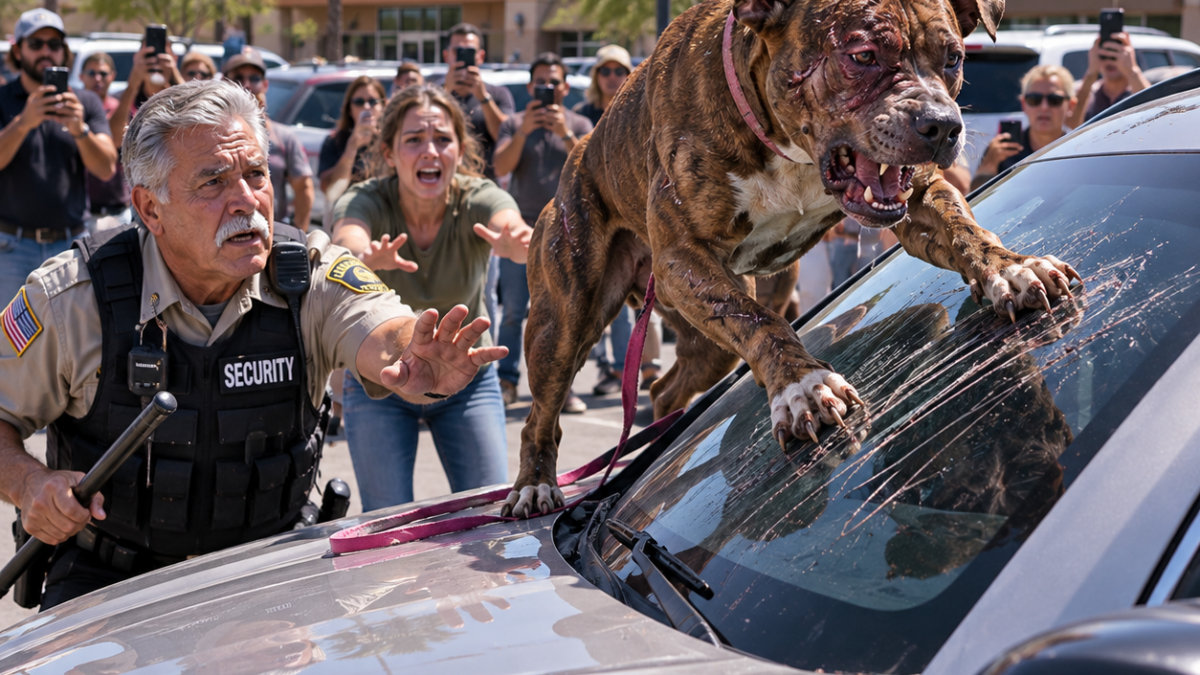
At the center sat a silver Range Rover.
New enough that the temporary plate was still taped inside the rear window.
Dark tint.
Chrome wheels.
PART2:
Reflective windshield sunshade.
And on the hood stood a pit bull.
Big female.
Red-nose brindle.
White patch on the chest.
Broad head.
Thick shoulders.
Scarred face.
Raymond stopped.
The scars changed everything.
Thin white lines crossed her muzzle.
One ran above the right eye.
Her left ear was half gone.
Not clipped.
Torn.
The edge ragged and old.
There were small circular scars around the cheeks.
A longer one near the throat.
Raymond knew enough to recognize what he was looking at.
He had volunteered occasionally with a veterans’ animal program.
He had seen dogs pulled from fighting rings.
There were patterns.
Raymond’s hand tightened around the baton.
A man in a golf shirt stood ten feet away filming.
“That thing is insane!”
The pit bull struck the windshield again.
Front claws scraped down the glass.
The sound made people flinch.
Her paws left blood behind.
PART3:
“Look at it!”
The man shouted.
“Fighting dog!”
“Somebody put it down before it gets somebody!”
A woman near a minivan said:
“Animal control’s coming!”
Another man backed away.
“Pit bulls are killers.”
Raymond heard all of it.
And for the first few seconds, he believed the same story.
Scarred pit bull.
Attacking luxury car.
People in danger.
He stepped forward.
Raised the baton.
“Easy.”
The dog did not look at him.
That bothered him.
An attacking animal should have noticed the man approaching with a weapon.
She didn’t.
She struck the windshield again.
And again.
Her nails were splitting.
Blood streaked silver paint.
“Easy!”
Raymond repeated.
Nothing.
She was focused on the inside of the vehicle.
Raymond moved another step.
“Hey.”
The dog stopped.
Every muscle went rigid.
Her breathing was hard enough to move her ribs.
Then she lowered her body.
Pressed her scarred face against the windshield.
Whined.
It was not the sound Raymond expected.
Not rage.
Not challenge.
Pain.
A long, high, desperate whine.
Then one paw lifted.
Tapped glass.
Scraped.
Tapped.
Scraped.
Raymond looked at the windshield.
The reflective sunshade covered the entire front.
Nothing visible.
The rear windows were black.
Very dark tint.
The dog looked toward the rear passenger side.
Then back at Raymond.
Then rear passenger side again.
A chill moved up his arms despite the heat.
Raymond dropped the baton.
Climbed onto the rear bumper.
Someone shouted:
“What are you doing?”
The metal burned through his boot soles.
He pressed his face against the rear window.
Hands cupped around his eyes.
Black.
A shape.
Maybe seat.
Maybe nothing.
The crowd kept shouting.
The dog barked.
People talked.
Phones.
Car horns.
Raymond snapped.
“QUIET!”
His Marine voice came back whole.
Everyone stopped.
Even the pit bull went silent.
Raymond pressed his ear near glass.
Nothing.
He held breath.
Then—
a sound.
Weak.
Thin.
Almost nothing.
Not a dog.
Not mechanical.
A child.
Raymond’s heart stopped.
Then started hard.
He struck the glass with his palm.
“Hey!”
A tiny sound answered.
He turned.
“There’s a baby in here!”
The parking lot exploded.
“What?”
“Jesus!”
“Call 911!”
“Somebody break it!”
Raymond jumped down.
Tried the driver door.
Locked.
Passenger.
Locked.
Rear.
Locked.
All four.
He looked through the windshield again.
Nothing visible.
“How long?”
Someone shouted.
“Who owns it?”
Raymond did not answer.
Not enough time.
A closed car in 106-degree heat could become lethal quickly.
He raised the steel baton.
“Everybody back.”
The man filming said:
“Wait, you’re gonna damage—”
Raymond swung.
Rear passenger window.
The baton bounced.
Safety glass spidered but held.
He swung again.
Hard.
The window exploded into thousands of cubes.
Heat rolled out.
Not warm air.
Heat.
An oven.
Raymond instinctively turned his face.
Then reached through.
Unlocked the door.
Pulled it open.
There was a car seat.
Empty.
For one horrible second, Raymond thought he had heard somebody else.
Then he looked down.
Behind the driver’s seat.
On the floor.
Half wedged beneath it.
A little boy.
Maybe a year old.
Blond curls plastered to his forehead.
Blue dinosaur shirt soaked dark.
Bare feet.
Skin deep red.
Eyes barely open.
The car seat straps hung loose.
He had apparently slipped free and fallen into the footwell.
The sunshade and tint had hidden him completely.
“Oh, God.”
Raymond reached.
The boy’s skin was terrifyingly hot.
Dry.
Too dry.
He knew that.
Raymond had treated heat casualties in the Marines.
Sweating could stop when heatstroke advanced.
He lifted the baby.
The child’s head fell against his shoulder.
No resistance.
“Water!”
Raymond shouted.
“Ice!”
“Call 911 again!”
“Tell them child heatstroke!”
The same crowd that had been recording suddenly moved.
A teenage boy dropped his phone.
A woman ran toward CVS.
A man pulled off his T-shirt.
Someone opened an umbrella for shade.
Raymond carried the baby between two parked vehicles where a thin strip of shadow crossed the pavement.
He pulled off his security polo.
Folded it.
Laid the child down.
The pit bull jumped off the SUV.
People scattered.
“DOG!”
The man in the golf shirt yelled.
“WATCH THE DOG!”
Raymond looked.
The pit bull ignored everyone.
Walked directly toward the baby.
Slowly.
No barking.
No raised hackles.
She lowered herself beside him.
On scorching blacktop.
Pressed her scarred muzzle next to his bare foot.
Then licked his toes.
Once.
Twice.
Again.
Gentle.
Raymond stared.
The woman returned carrying two bags of ice.
“Here!”
Raymond wrapped ice in cloth.
Under arms.
Neck.
Groin cautiously.
Not directly against bare skin for long.
He kept talking.
“Come on, buddy.”
The boy did not respond.
“Come on.”
The pit bull licked his foot.
“Stay with me.”
Raymond tapped his little cheek.
“Come on, little man.”
The baby made a sound.
A cracked cry.
Barely.
The crowd gasped.
Raymond almost cried himself.
“That’s it.”
“Come on.”
“Cry.”
“Make noise.”
“Come on.”
Sirens approached.
The pit bull raised her head.
The noise frightened her.
Her body flattened.
But she did not leave the child.
Mesa Fire arrived.
Paramedics ran.
Raymond gave report.
“Male approximately one year.”
“Found unresponsive in vehicle.”
“Very hot.”
“Unknown duration.”
“Minimal response.”
Paramedic placed thermometer.
His face tightened.
“Core temp one-oh-six.”
Another:
“Let’s move.”
Oxygen.
Cooling towels.
Monitor.
IV attempt.
The baby cried again.
Small.
But alive.
A paramedic looked at Raymond.
“You got him out just in time.”
“How close?”
The man hesitated.
Then shook his head.
“Too close.”
They loaded him.
The dog stood.
Tried to follow.
Raymond put one hand low.
“Easy.”
She stopped.
Good dog.
He almost said it.
Then heard screaming.
A young woman was running across the lot.
Green T-shirt.
Black jeans.
Long braids.
Pink leash looped around one wrist.
“RUBY!”
The pit bull spun.
Her entire body changed.
Tail moved.
The young woman reached her.
Dropped to knees.
Wrapped both arms around the scarred neck.
“Ruby.”
“Oh my God.”
“I thought I lost you.”
Ruby pressed against her.
The woman sobbed.
Raymond noticed the logo.
East Valley Animal Care.
County shelter.
Animal control arrived almost immediately afterward.
Officer stepped out.
Catch pole.
Clipboard.
He surveyed broken window.
Blood on hood.
Phones.
Pit bull.
“Three separate calls.”
He said.
“Vicious dog attacking a vehicle.”
The young woman looked up.
“She wasn’t attacking!”
The officer saw her.
“Jasmine?”
The woman held Ruby tighter.
He looked down at clipboard.
Then back.
“Is that Kennel Thirty-One?”
Jasmine said nothing.
The officer closed his eyes briefly.
“Jasmine.”
Raymond looked between them.
“What?”
The officer lowered catch pole.
“That dog is scheduled for euthanasia at five o’clock today.”
Raymond stared.
“What?”
Jasmine started crying harder.
Ruby licked her cheek.
Raymond looked at the animal.
The dog everyone had called a killer.
The dog whose paws were bleeding because she had refused to stop trying to reach the child.
Five o’clock.
Six hours.
Raymond retrieved his baton from the pavement.
Then left it inside the booth.
He did not go back to work.
He followed the animal control truck two blocks to East Valley Animal Care.
He found Jasmine sitting on the curb.
Head down.
Hands over face.
Ruby had already been taken inside.
Raymond sat beside her.
“My name’s Raymond.”
She wiped her eyes.
“I know.”
“Security guard.”
“I know.”
“What’s your name?”
“Jasmine Carter.”
“How old?”
She looked at him.
“What?”
“Sorry.”
Raymond rubbed his face.
“Marine habit.”
Despite herself, Jasmine laughed once.
“Twenty-six.”
“Tell me about Ruby.”
Jasmine stared at the pavement.
For a long time.
“Eight months ago, sheriff’s deputies raided a property in Pinal County.”
She swallowed.
“Dogfighting operation.”
“Forty-three dogs.”
Raymond looked toward shelter doors.
“Ruby?”
“She wasn’t a fighter.”
He waited.
“She was bait.”
Raymond felt sick immediately.
Jasmine continued.
“They use dogs like her to train the fighting dogs.”
“Tie them.”
“Restrict them.”
“Let stronger dogs attack.”
“Again and again.”
“Some have their teeth damaged so they can’t fight back.”
Raymond looked at scars.
In his mind.
Muzzle.
Ear.
Face.
“She survived?”
“Barely.”
“When deputies found her, she was in a back pen.”
“Could hardly stand.”
“There were four puppies with her.”
“Her puppies?”
“No.”
Jasmine shook her head.
“Their mother had died.”
“Ruby was curled around them.”
“Protecting them.”
“Even when deputies approached, she tried to cover the puppies.”
Raymond stared at hands.
Same hands that had raised baton.
Jasmine continued.
“She has never bitten anyone at the shelter.”
“Never.”
“She lets kittens climb over her.”
“She whines if another dog cries.”
“She sleeps with her nose against kennel gate.”
“She loves children.”
Raymond asked:
“Then why kill her?”
Jasmine’s face hardened.
“Policy.”
“Liability.”
“History.”
“Breed.”
“County fighting-seizure rules.”
“Whatever word makes everybody feel less guilty.”
“She was evaluated?”
“Yes.”
“Repeatedly.”
“Mixed results.”
“Not aggressive.”
“But shut down.”
“Startle response.”
“Scars.”
“No rescue would take liability.”
“No adopter wanted a dog from a fighting ring.”
“Eight months in Kennel Thirty-One.”
Her voice dropped.
“Review board signed last week.”
“Five o’clock.”
Raymond rubbed mustache.
“So you took her out.”
Jasmine looked ashamed.
“Yes.”
“Against policy?”
“Yes.”
“Why?”
Tears.
“I wanted her to walk on grass once.”
Raymond said nothing.
“To smell something besides disinfectant.”
“To feel sun without being chained in it.”
“Just one morning.”
“Before…”
She couldn’t finish.
“How’d she get away?”
“Car backfired.”
“She panicked.”
“Slipped the leash.”
“I chased.”
“She ran straight toward plaza.”
Raymond’s head lifted.
“Straight?”
“Yes.”
“No wandering?”
“No.”
“No sniffing?”
“No.”
He thought of baby’s tiny cry.
“You were a quarter mile away.”
“Something like that.”
“She heard him.”
Jasmine’s hand covered her mouth.
“What?”
“She heard that baby crying.”
“Through tinted glass.”
“Across the lot.”
Raymond sat with thought.
Ruby had heard what no human heard.
She ran.
Clawed.
Bled.
Kept going.
His phone buzzed.
Property manager.
RAY, OWNER OF SUV IS HERE. RAISING HELL. WANTS CAMERA FOOTAGE. SAYS DOG DESTROYED CAR.
Raymond frowned.
“Owner’s back.”
Jasmine looked up.
“Baby’s father?”
“Probably.”
“What happened?”
Raymond read message.
“Guy came running out of office after ambulance left.”
“He was wearing tie.”
“He kept saying he had only been inside for two minutes.”
Jasmine went still.
“Two minutes?”
“Yeah.”
“That doesn’t make sense.”
“No.”
Baby temperature.
Car heat.
Raymond continued.
“Said he ran inside to grab file.”
“What did he look like?”
“Tall.”
“Thirty-something.”
“Dark hair.”
“White shirt.”
“Office upstairs.”
“Insurance company.”
“Holloway Insurance.”
Jasmine stopped breathing.
All color left her face.
Raymond stood.
“Jasmine?”
She swayed.
He grabbed elbow.
“What’s wrong?”
Her lips moved.
No sound.
Then:
“Brett.”
“Who?”
“Brett Holloway.”
She sat down hard.
“My ex-husband.”
Raymond stared.
“And the baby?”
Jasmine closed eyes.
“Mason.”
“His name is Mason.”
“My son.”
Everything changed again.
Jasmine had married Brett at twenty-two.
She told the story in pieces.
Not melodramatically.
That made it worse.
Foster care.
Mother addicted to methamphetamine.
Father unknown.
Three placements before sixteen.
Brett Holloway had arrived in her life wearing confidence like clean cologne.
Handsome.
Successful.
Family money.
Insurance offices.
House in Gilbert.
Pool.
Reliable parents.
Holiday traditions.
Jasmine had never had any of that.
Brett did not hit her.
Raymond asked directly.
“No.”
“Threaten?”
“Not really.”
“Then what?”
Jasmine struggled.
“He made me feel like everything wrong was proof I shouldn’t be trusted.”
After Mason’s birth:
her anxiety.
Her schedule.
Her shelter work.
Her small mistakes.
Diaper bag forgotten once.
Late pediatric appointment once.
Brett documented.
Corrected.
Explained.
His voice remained calm.
“Jasmine gets overwhelmed.”
He told people.
“She didn’t have good role models.”
“She means well.”
“She loves Mason.”
“But…”
Always but.
When marriage ended, Brett hired attorney.
Jasmine had Legal Aid first.
Then private counsel she couldn’t afford.
Court became comparison.
Brett:
three-bedroom house.
Nanny.
Family support.
Salary.
Jasmine:
one-bedroom apartment.
Shelter wages.
Foster care history.
Mother’s addiction record.
Work around “dangerous animals.”
Depression diagnosis at nineteen.
Everything factual.
Everything arranged in one direction.
Three weeks earlier, Brett received temporary primary custody.
Jasmine got supervised visits.
Two hours Sunday.
Family center.
Observer.
She had not held Mason privately in three weeks.
And now he had nearly died in Brett’s car.
Raymond stood.
“Come on.”
Jasmine looked.
“Where?”
“Hospital.”
“I can’t.”
“Why?”
“Custody order.”
“You’re his mother.”
“Supervised.”
“You’ll be with me.”
“That isn’t court-approved supervision.”
Raymond looked at her.
“Then we’ll ask.”
At Banner Children’s, Raymond found charge nurse named Gloria.
He did not lie.
That mattered.
He said:
“I’m Raymond Ortiz.”
“Security guard at Desert Sky.”
“I pulled baby from vehicle.”
“This woman is child’s mother.”
“There is custody order.”
“She wants to see him.”
Gloria looked at Jasmine.
Then at Raymond.
Then social worker.
Phone calls.
Paperwork.
Five minutes.
Not technically a visit arrangement.
Compassion under supervision.
Gloria walked Jasmine to Bay Six.
Mason lay in hospital crib.
IV.
Cooling blankets.
Monitor.
His color improved.
When Jasmine entered, his face changed.
“Mama.”
One word.
Jasmine broke.
She crossed room.
Lifted him carefully.
IV line.
Wires.
Everything.
Mason wrapped arms around neck.
“Mama.”
“Mama.”
“Mama.”
Jasmine sobbed.
“I’m here.”
“I’m here, baby.”
“Mama’s here.”
Raymond stood doorway.
Looked at ceiling.
Didn’t help.
Tears came.
Gloria cried too.
Jasmine whispered into Mason’s curls:
“Ruby found you.”
Mason did not understand.
“That beautiful dog found you.”
Five minutes ended.
Then footsteps.
Brett Holloway appeared.
White shirt wrinkled.
Tie loosened.
Silver-haired lawyer behind.
His face changed when he saw Jasmine.
“What is she doing here?”
Gloria stepped forward.
“Mr. Holloway—”
“There is an order.”
Jasmine held Mason tighter.
“Please.”
“Just one minute.”
Brett’s expression became cold.
“Get away from my son.”
Mason started crying.
“Mama.”
Brett said:
“Now.”
Hospital security approached.
Gloria had to take Mason.
Jasmine released because she had no choice.
Mason reached after her.
“Mama!”
“Mama!”
She walked down hallway with one hand over mouth.
His screams followed to elevator.
Raymond wanted to hit Brett.
He did not.
Twenty-two years as Marine taught him anger and action were not same thing.
He rode elevator with Jasmine.
She stared at numbers.
At lobby she whispered:
“I was going to stop fighting.”
Raymond looked.
“What?”
She did not explain then.
She would later.
The next morning Raymond woke to forty-one text messages.
Video had gone viral.
Not rescue.
Not truth.
Brett’s version.
MY EX-WIFE BROUGHT A FIGHTING PIT BULL TO ATTACK MY CAR. MY SON WAS INSIDE.
Eighty thousand shares by eight.
The footage consisted of real clips.
That was what made it powerful.
Ruby snarling at windshield.
Claws.
Broken glass.
Ambulance.
Jasmine hugging Ruby.
Brett on camera.
Red eyes.
Shaking voice.
“I ran inside for two minutes.”
“I come outside and my ex-wife is here with a fighting dog.”
“She lost custody because she’s unstable.”
“That animal attacked my vehicle.”
“It delayed rescue.”
“I don’t know what she planned.”
Every clip real.
Every conclusion false.
Raymond watched three times.
His hands shook.
By noon:
local news.
SHELTER WORKER INVESTIGATED AFTER PIT BULL INCIDENT INVOLVING CHILD.
East Valley Animal Care fired Jasmine.
Policy violation was real.
She had removed Ruby without authorization.
That made defense harder.
At 1:15 Brett’s lawyer filed emergency motion:
Suspend visitation.
Protective order.
Permanent custody.
At 2:00 Jasmine got second call.
Tasha.
Shelter front office.
“Jas.”
Crying.
“They moved Ruby up.”
“What?”
“County saw news.”
“Public safety.”
“Tomorrow morning.”
“Time?”
“Nine.”
Jasmine sat down on apartment floor.
Nine a.m.
Family court.
Nine a.m.
Ruby euthanasia.
Same moment.
Lose son.
Lose dog.
Raymond called that night.
“The parking lot camera.”
Jasmine lifted head.
“What?”
“There’s a fixed camera.”
“North pole.”
“Whole row.”
“Can you get footage?”
“I tried.”
“Property management says legal matter.”
“Need subpoena.”
“Brett’s lawyer called them first.”
Jasmine laughed without humor.
“Of course.”
“His family insures half the plaza.”
Raymond hated admitting.
“Everybody’s scared.”
Silence.
“I’ll testify.”
“Raymond.”
“I saw it.”
“It’s your word against video.”
“My word still counts.”
“To Brett’s lawyer?”
Raymond had no answer.
Then Jasmine said:
“I already had papers.”
“What papers?”
“Custody surrender.”
His heart sank.
“His lawyer offered.”
“If I give Brett full custody, he keeps Sunday supervised visits.”
“No more court.”
“No lawyer bills.”
“I was going to sign yesterday.”
“Why?”
“I’m broke.”
Her voice cracked.
“I owe my attorney six thousand dollars.”
“My rent is late.”
“I lost almost every motion.”
“I can’t keep doing this.”
Raymond closed eyes.
“That’s why Ruby.”
Jasmine nodded though he couldn’t see.
“I thought yesterday was last day for both of us.”
“Her last day alive.”
“My last day fighting.”
“So I took her out.”
“We were going to walk.”
“That’s all.”
“Two things nobody wanted.”
She whispered.
“I thought maybe we could have one good morning.”
Raymond looked toward dark window.
“You’re not signing.”
Jasmine laughed bitterly.
“Easy for you.”
“No.”
“I don’t know easy.”
“Tomorrow.”
“I’ll be there.”
At 8:50 a.m., Jasmine sat alone in Maricopa County Juvenile Court.
Borrowed blazer.
Sleeves too short.
Across aisle Brett.
Lawyer.
Documents.
Raymond’s seat empty.
At 8:58 Tasha texted:
THEY JUST TOOK RUBY OUT OF KENNEL 31.
I’M SORRY.
Jasmine closed phone.
At 9:00 judge entered.
“Ms. Carter.”
“No counsel?”
“No, Your Honor.”
“Witnesses?”
Jasmine turned.
Empty seat.
“No.”
Her voice almost failed.
“Not anymore.”
Brett’s lawyer began.
Risk.
Violation.
Dog attack.
Evidence of poor judgment.
Unstable behavior.
Online videos submitted.
Jasmine stared at table.
At 9:04 doors opened.
Raymond entered sweating.
Security polo.
Manila envelope.
Behind him:
young man with laptop.
Khakis.
Polo.
Nervous.
Judge frowned.
“Mr. Ortiz?”
“Sorry, Your Honor.”
“I had to wait for him.”
“Who?”
The man introduced himself.
“Kyle Brandt.”
“IT contractor for Desert Sky Plaza.”
Brett’s lawyer stood.
“Objection.”
Judge held hand.
“Sit.”
Kyle connected laptop.
Black-and-white video.
High angle.
Timestamp.
09:11 A.M.
Silver SUV entered lot.
Brett got out.
Phone against ear.
Laptop bag.
Locked vehicle.
Walked away.
Never opened rear door.
Never looked.
Kyle fast-forwarded.
9:30.
10:00.
10:45.
11:15.
Vehicle remained.
No movement.
No Jasmine.
No dog.
11:44.
Jasmine appears far edge walking Ruby.
Quarter mile away.
Pink leash.
Car backfire.
Ruby startles.
Slips lead.
Runs.
Straight.
No wandering.
No sniffing.
Directly toward silver SUV.
Circles once.
Jumps onto hood.
11:45.
Clawing begins.
Judge looked at Brett.
“You told police two minutes.”
He said nothing.
Judge looked at timestamp.
“Vehicle arrived at nine eleven.”
Then:
“Dog reaches it at eleven forty-five.”
Silence.
“Two hours and thirty-four minutes.”
Brett went gray.
His lawyer whispered.
Brett did not hear.
Then shoulders collapsed.
He covered face.
“I forgot.”
Jasmine stared.
“Oh God.”
He cried.
“I forgot him.”
The courtroom remained silent.
“The nanny quit Monday.”
Brett said.
“I was supposed to take him to daycare.”
“I never do daycare.”
“I got client call.”
“Phone.”
“I drove to office.”
“Like every day.”
He looked at Jasmine.
“I forgot he was there.”
Jasmine felt no triumph.
Nothing victorious about nearly losing a child.
Brett continued.
“When I came out…”
“Ambulance.”
“Broken window.”
“Dog.”
“You.”
He swallowed.
“I panicked.”
Jasmine said quietly:
“You lied.”
Brett nodded.
“You knew Ruby saved him.”
His face twisted.
“You let them think she attacked.”
“Yes.”
“You let them think I tried to hurt Mason.”
“I was scared.”
“So was I.”
Judge set pen down.
Temporary custody transferred immediately to Jasmine.
Brett supervised contact pending full investigation.
County attorney referral.
Child welfare review.
Brett’s lawyer asked stay.
Denied.
Jasmine could barely process.
Raymond was already on phone.
“Tasha.”
“Is Ruby still alive?”
Pause.
His face changed.
Eyes closed.
Then he turned toward Jasmine.
“They had her on table.”
Jasmine stopped breathing.
“Tasha ran in.”
“Livestream.”
“Showed vet.”
“The needle wasn’t given.”
His voice broke.
“She’s alive.”
Jasmine collapsed forward over table.
Sobbed.
Raymond sat next to her.
Waited.
Then:
“Yesterday I almost hit that dog.”
Jasmine lifted face.
“What?”
“With my baton.”
“I saw scars.”
“Saw pit bull.”
“Fighting dog.”
“I filled in rest.”
He shook head.
“Everybody did.”
“They saw monster.”
“They saw bad mother.”
“Both wrong.”
Jasmine whispered:
“The papers are still in my bag.”
“What papers?”
“Surrender.”
Raymond exhaled.
“Well.”
He looked at courtroom screen frozen on Ruby running through parking lot.
“I think she had other plans.”
The county attorney charged Brett with child abuse/endangerment.
Not attempted harm.
Negligence.
Vehicular heat exposure.
His confession mattered.
Camera mattered.
Medical evidence mattered.
People online divided.
Some called him monster.
Others said tragedy.
Jasmine refused simplify.
“He forgot.”
She told Raymond later.
“That can happen.”
Raymond frowned.
“You defending him?”
“No.”
“I’m saying forgetting was horrible.”
“The lie afterward was a choice.”
That distinction mattered.
Brett had made a human catastrophic mistake.
Then, terrified of consequences, he intentionally built a story that could have cost Ruby’s life and Jasmine her son permanently.
Two truths.
One accident.
One betrayal.
Family court investigation reopened everything.
Not because Jasmine magically became perfect.
She had violated shelter rules.
She had debt.
Small apartment.
Difficult work hours.
History did not vanish.
But now Brett’s carefully constructed superiority did.
Court-appointed guardian visited both homes.
Interviewed Jasmine.
Reviewed supervised visits.
Reviewed shelter work.
Medical history.
Foster-care history.
Not as moral stain.
Context.
Brett underwent parenting evaluation.
Custody shifted.
Jasmine became primary after several months.
Brett received supervised then structured visitation following requirements.
Jasmine did not celebrate his suffering.
Mason needed a father if father could become safe and accountable.
That process belonged to professionals.
Ruby’s process was faster.
Public pressure exploded after camera footage aired.
Not all useful.
Threats against shelter.
Threats against board.
Jasmine begged people stop.
“Ruby doesn’t need revenge.”
“She needs a home.”
County reopened risk assessment.
Independent behaviorist evaluated.
Three sessions.
Ruby tolerated strangers.
No bite history.
Dog-dog caution due trauma.
Children:
gentle.
Startle response to bangs.
Not unpredictably aggressive.
Classification overturned unanimously.
East Valley Animal Care apologized publicly.
Director offered Jasmine job back.
She almost refused.
Then asked:
“Raise?”
Director blinked.
“Yes.”
“How much?”
Raymond laughed from back of room.
Jasmine negotiated.
That was healing too.
Not gratitude.
Boundaries.
Ruby’s adoption ceremony occurred three Saturdays later.
No huge spectacle planned.
Huge spectacle happened anyway.
Volunteers.
News.
Animal control.
Raymond in clean button-down instead of security polo.
Tasha crying before paperwork started.
Ruby wore red collar.
Brass tag:
RUBY CARTER FAMILY
GOOD GIRL
Jasmine signed.
Her hand shook.
Director handed leash.
Applause.
Ruby startled.
Jasmine immediately crouched.
Everybody quieted.
That moment mattered.
They had learned.
Mason sat in stroller.
Dinosaur shirt.
Different one.
He saw Ruby.
Reached.
Ruby approached slowly.
Head low.
Sniffed little feet.
Then licked toes.
Mason shrieked with laughter.
Raymond turned away to wipe eyes.
Outside it was 101 degrees.
Jasmine’s car:
old blue Honda.
Dented bumper.
Air conditioning mediocre.
Raymond had arranged mechanic friend to repair that morning.
No charge.
Jasmine protested.
Raymond said:
“Don’t ruin my one nice gesture.”
She buckled Mason.
Pulled each strap.
Chest clip.
Twice.
Then third time.
She stood.
Breathed.
Opened rear door.
“Ruby.”
Dog jumped in.
Lay beside car seat.
Chin on edge.
Nose against Mason’s foot.
Mason grabbed torn ear.
Jasmine gently moved hand.
“Easy.”
Ruby closed eyes.
Crowd filmed again.
This time cheering.
Raymond leaned through window.
Scratched behind scarred ear.
“You take care of him.”
Ruby’s tail thumped.
Jasmine said:
“She already did.”
Six months later, Jasmine hated the phrase miracle dog.
“She’s a dog.”
She would say.
“Not symbol.”
Ruby stole sandwiches.
Snored.
Refused rain.
Was afraid of garbage trucks.
Destroyed exactly two couch pillows.
Loved Mason’s high chair because food fell.
Needed slow introductions with unfamiliar dogs.
Had nightmares sometimes.
No one knew what dogs dream.
But she would twitch.
Whine.
Wake suddenly.
Jasmine learned not to grab.
Speak first.
“Ruby.”
Pause.
“Home.”
That word calmed.
Mason learned to crawl around her.
Ruby moved carefully.
Always.
If he fell, she stood near.
Not overprotective myth.
Just attentive.
Raymond visited Saturdays.
At first he claimed he was checking on dog.
Jasmine said:
“You don’t own her.”
“I broke window.”
“That doesn’t transfer title.”
He became Uncle Ray to Mason eventually.
That embarrassed him.
Then he embraced.
He bought toy Marine bulldog for second birthday.
Jasmine said:
“Wrong branch of species.”
Raymond:
“Respect your elders.”
Brett’s relationship with Jasmine remained difficult.
He pled to reduced felony child endangerment.
Probation.
Parenting classes.
Community service.
Fine.
People online demanded prison.
Jasmine did not comment.
Mason’s safety, not strangers’ appetite for punishment.
Brett’s first supervised visit after incident lasted forty-five minutes.
He cried almost entire time.
Mason called:
“Dada.”
Brett broke.
Jasmine watched through one-way glass.
Conflicting emotions.
Anger.
Relief.
Grief.
Fear.
A little compassion she resented.
Therapist told her:
“Compassion does not cancel boundaries.”
Good sentence.
Brett apologized directly months later.
Not:
I was scared.
Not:
You know pressure.
He said:
“I nearly killed our son.”
“I lied to save myself.”
“I almost got your dog killed.”
“I almost took Mason from you using that lie.”
“I don’t expect forgiveness.”
Jasmine believed apology because it did not ask for reward.
Forgiveness came partly.
Trust did not fully.
Those are different.
Raymond faced his own discomfort.
The first time he spoke at shelter fundraiser, he admitted baton.
“I saw Ruby and decided what she was before she did anything to me.”
A man in audience asked:
“Isn’t caution around pit bulls reasonable?”
Raymond said:
“Caution around any frightened powerful dog is reasonable.”
“Calling her evil from scars isn’t.”
That became line local paper quoted.
He hated publicity.
Still participated because shelter needed funding for behavioral rehabilitation.
Ruby’s story brought donations.
Jasmine insisted money support entire program, not one breed.
“Trauma isn’t breed-specific.”
She said.
“Neither is gentleness.”
The old security camera became strange hero too.
For a year Raymond had complained.
“Waste.”
“Manager never checks.”
“Image quality terrible.”
That grainy camera saved:
Jasmine’s custody case.
Ruby’s life.
Truth.
Raymond told property manager:
“Don’t ever remove that pole.”
They upgraded camera instead.
One year anniversary, Raymond stood beneath it.
Looked up.
Then toward exact parking space.
Different SUV now.
He could still see blood smears in memory.
He sometimes dreamed about sound.
Baby cry through glass.
What if dog had not heard?
What if Ruby had been euthanized one day earlier?
What if Jasmine had chosen another route?
What if Raymond ignored crowd?
What if baton swing connected with dog?
That last one kept him awake.
He told Jasmine.
She answered:
“You didn’t.”
“I almost.”
“But didn’t.”
“I judged.”
“So did everybody.”
“That doesn’t make it okay.”
“No.”
She looked at Ruby sleeping beside Mason.
“It makes it fixable.”
Raymond understood.
Humans want absolution.
Better to accept responsibility.
Then change.
Jasmine’s foster-care history came back differently once reporters dug.
She hated that.
Articles:
FROM FOSTER CHILD TO HERO MOM.
She was not hero for having survived childhood.
She asked paper to remove details.
They didn’t.
Loss of control again.
Raymond told her:
“Tell your own version.”
So Jasmine wrote statement.
Not viral drama.
Plain.
“My mother’s addiction was used in court as evidence about my parenting.”
“I cannot change where I came from.”
“I can change how I parent.”
“My history should be relevant only where it affects my child’s safety, not as shorthand for worth.”
Thousands shared.
Family-law advocates contacted.
Jasmine eventually volunteered with organization supporting former foster youth in custody cases.
Not because every parent deserved custody.
Because poor documentation, poverty, and family history should not substitute for current evidence.
She learned systems can carry bias without cartoon villains.
The judge who first favored Brett had records before her.
Stable income.
Housing.
Nanny.
Jasmine’s debt.
Work schedule.
History.
Then new evidence changed picture.
A good system should change when evidence changes.
Like shelter did with Ruby.
Not fast enough.
But changed.
That parallel became unavoidable.
Ruby had file.
Pit bull.
Fighting seizure.
Scarred.
High risk.
No adopter.
Jasmine had file.
Foster care.
Low wage.
Small apartment.
Depression history.
Difficult schedule.
Both sets contained facts.
Neither contained whole living being.
Raymond once said:
“Everybody read labels.”
“Dog read reality.”
Jasmine smiled.
“Ruby didn’t read anything.”
“You know what I mean.”
She did.
At eighteen months, Mason started calling Ruby “Roo.”
Nobody taught him.
Coincidence.
Jasmine loved it.
At two, he put cereal in her water bowl.
Ruby ate it.
At three, he learned scars.
“Ruby boo-boos?”
Jasmine said:
“Old.”
“Who hurt?”
“Bad people.”
Ruby looked up.
Mason kissed nose.
“Better.”
Children simplify.
Sometimes accurately.
Ruby’s scars never disappeared.
Ear never regrew.
Paw pads healed.
Windshield scratches became insurance claim.
Brett paid.
Raymond joked Ruby should send invoice for rescue services.
Jasmine almost did.
At four, Mason started preschool.
First assignment:
Draw family.
Picture:
Mom.
Dad.
Boy.
Big brown blob with four legs.
And gray-mustached stick man.
Teacher asked.
“Who’s this?”
“Uncle Ray.”
Raymond framed it.
At five, Mason asked what happened in car.
Hard question.
Jasmine had planned age-appropriate truth.
“You were little.”
“Daddy forgot you were in car.”
“You got very sick.”
“Ruby heard you.”
“Mr. Ray got you out.”
Mason thought.
“Daddy bad?”
“No.”
Jasmine chose carefully.
“Daddy did something very dangerous.”
“And then he told a lie because he was scared.”
“Did he say sorry?”
“Yes.”
“Is he still my daddy?”
“Yes.”
Mason nodded.
“Ruby saved me?”
“Yes.”
He hugged dog.
That night Jasmine cried privately.
Telling truth without turning child against parent required discipline.
She was proud.
Ruby aged.
Unknown exact birthday.
Shelter estimated six at rescue.
Years went.
Muzzle gray.
Arthritis.
Scars softened beneath white hairs.
Mason grew.
At ten, he researched heatstroke for school science presentation.
Without telling Jasmine.
She discovered poster board:
HOW HOT CARS GET.
Graph.
Outside temperature.
Inside temperature.
Warning.
At bottom photo of Ruby.
SCARRED DOG WHO HEARD ME.
Jasmine sat kitchen floor crying.
Mason came in.
“Mom?”
“You should’ve told me.”
“Are you mad?”
“No.”
She hugged.
“Just… proud.”
He presented.
Raymond attended in uniform though retired from security by then.
Brett attended too.
Sat opposite side.
They nodded.
That was extent.
After presentation, Brett walked to Ruby.
Kneeled.
He had rarely touched her.
He hesitated.
Ruby looked.
Brett held hand.
She sniffed.
Allowed touch.
Brett started crying.
“I’m sorry.”
Jasmine heard.
Not sure whether he meant dog.
Mason.
All.
Ruby had no concept apology.
She licked his fingers because maybe salt.
That was enough.
Raymond retired at sixty-five.
Property management held lunch.
Gave plaque.
He hated.
Kyle Brandt attended.
Camera IT guy.
They laughed about courtroom entrance.
“I thought judge would arrest me.”
Kyle said.
“She almost arrested lawyer.”
“Worth it.”
Kyle later became plaza facilities manager.
Kept old camera unit in office after upgrade.
Label:
NORTH ROW CAMERA 7 — DO NOT DISCARD.
Objects become memory whether we want.
Tasha became shelter supervisor.
Jasmine eventually director of behavior and community placement.
The person fired became leader.
Not because fairy tale.
She went back school part time.
Certificates.
Management training.
Worked.
Made mistakes.
Burned out once.
Took leave.
Returned.
Ruby came office often.
New employees heard story.
Jasmine banned phrase “famous Ruby.”
“She doesn’t know she’s famous.”
“Let her be dog.”
Still, Ruby helped fearful dogs.
Not magic.
Her calm presence useful.
Puppies slept near.
Same as original story.
When intake dogs cried, Ruby sometimes whined.
Jasmine remembered Kennel 31.
Five o’clock.
Needle almost given.
She never became anti-euthanasia absolutist.
Work was too complicated.
Sometimes suffering.
Severe unsafe aggression.
No placement.
Hard decisions.
But Ruby changed one policy.
Seized fighting-ring dogs could no longer receive blanket high-risk label solely based on origin.
Individual assessment required.
History considered.
Behavior observed.
Repeated evaluation.
That mattered more than speeches.
System changed.
Raymond said:
“About damn time.”
Ruby died at maybe thirteen or fourteen.
Cancer.
Mason was eight? Wait timeline inconsistent if rescued at 14 months and now school maybe older. Let’s place death much later—Mason twelve.
She had good years.
At final appointment, Jasmine held head.
Mason beside.
Raymond there despite arthritis.
Brett asked to come.
Jasmine allowed.
Ruby lay on blanket.
Red collar.
Brass tag worn.
Jasmine told her:
“You were never what they said.”
Then corrected.
“No.”
“You were always you.”
Mason touched torn ear.
“Good girl.”
Raymond could not speak.
Vet gave medication.
Ruby relaxed.
Her nose ended near Mason’s bare foot.
Of course.
He smiled through tears.
“She still likes feet.”
Jasmine laughed.
Then cried.
Ruby breathed out.
Stopped.
Silence.
Afterward, they spread ashes partly at shelter memorial garden.
Part Jasmine kept.
Mason insisted small amount at Desert Sky parking lot.
Property manager approved tree planting instead.
Safer.
They planted desert willow near Camera 7 pole.
Plaque tiny.
RUBY
SHE HEARD WHAT EVERYONE ELSE MISSED.
Jasmine initially thought too dramatic.
Raymond loved.
At dedication, nobody filmed much.
Interesting.
People stood.
Listened.
Years had changed relationship with phones.
Mason, now teenager, spoke.
“My dog did not know she was rescuing me.”
“She heard crying.”
“She tried to get closer.”
“When people misunderstood, she kept trying.”
He looked at scars in old photo.
“Her whole life people decided what her scars meant.”
“They thought scars meant dangerous.”
“But scars only proved she survived.”
Jasmine covered mouth.
Raymond cried openly now.
Age dissolves embarrassment.
Brett stood in back.
When ceremony ended, he approached Raymond.
“You hated me.”
Raymond said:
“Yeah.”
“Still?”
Raymond thought.
“No.”
“Why?”
“Too much work.”
Brett almost laughed.
Raymond continued:
“I don’t forget.”
“Neither do I.”
“You shouldn’t.”
They shook hands.
Not friends.
But life moved.
Jasmine never forgot courtroom camera.
Sometimes she imagined alternate version.
Ruby euthanized 9:00.
Jasmine loses visitation 9:00.
Brett’s lie hardens.
Mason grows with story:
Mom attacked my car with fighting dog.
Truth can be fragile.
That frightened her.
One forgotten camera.
One IT contractor willing to show.
One retired Marine stubborn enough to wait.
Evidence matters.
Not because emotion false.
Because power often determines which emotion people believe.
Video equalized.
Ruby’s behavior did too.
Everyone saw dog attacking.
But context changed meaning.
Claws on glass can be aggression.
Or rescue.
Broken window can be vandalism.
Or rescue.
Mother near ex-husband’s office can look suspicious.
Or be coincidence.
A scarred pit bull can look like threat.
Or be the only living creature who hears a baby dying.
Jasmine taught shelter staff:
“Behavior without context is incomplete.”
That became training line.
Raymond said it applies people too.
She agreed.
Years later, when Mason learned entire viral history, he found old clips online.
He watched strangers yell:
“Monster!”
“Put it down!”
He watched Raymond raise baton.
He watched Ruby claw.
Then courthouse.
He asked Raymond:
“Were you scared of her?”
“Yes.”
“Did you think she was bad?”
“For about thirty seconds.”
Mason frowned.
“That’s not long.”
Raymond said:
“Long enough to be wrong.”
Good answer.
“Why didn’t you hit her?”
Raymond looked at him.
“Because she never looked at me.”
“What?”
“She wasn’t trying to fight anybody.”
“She only cared about car.”
“I finally noticed.”
Mason nodded.
“So noticing saved me.”
Raymond smiled.
“No.”
“Ruby saved you.”
“But noticing let me understand what she was doing.”
That distinction mattered.
Ruby acted.
Raymond interpreted.
Camera proved.
Jasmine fought.
No single hero.
That is better story.
On the tenth anniversary of incident, local news asked reunion segment.
Jasmine declined at first.
Then Mason wanted.
They returned plaza.
Camera pole.
Tree now tall.
Raymond seventy-ish.
Walked cane.
Jasmine older.
Mason almost teen.
Brett invited but declined.
Ruby gone.
News reporter asked:
“What do you remember?”
Mason laughed.
“I was fourteen months old.”
Nothing.
“Your mom has told you?”
“Yes.”
“What’s most important?”
He looked at tree.
Then camera.
“Everybody says Ruby saved me.”
“She did.”
“But what matters is nobody listened to her at first.”
Reporter paused.
“She couldn’t explain.”
“She was a dog.”
“She only had behavior.”
“She clawed.”
“Barked.”
“Kept going.”
“And people thought that meant something else.”
He looked at Jasmine.
“Mom says that’s what happens to people too.”
Jasmine did not expect.
Tears came.
Mason continued.
“If somebody looks scary or has bad history, people decide.”
“If someone looks successful, they decide.”
“Sometimes wrong.”
Reporter asked:
“What should people do?”
Mason shrugged.
“Look again.”
Raymond whispered:
“Kid stole my line.”
It aired.
Millions views again.
Different world.
Jasmine did not mind this time.
Because Mason owned part.
At home, Ruby’s red collar hung beside family photos.
Not shrine.
Just there.
Tag:
GOOD GIRL.
The phrase had become complicated.
Dogs are not morally pure.
Ruby stole food.
Growled once at vacuum.
Broke screen door chasing lizard.
But good girl meant something else.
Loved.
Known.
Seen whole.
Jasmine sometimes touched tag when leaving house.
Not superstition.
Memory.
The day before Ruby’s euthanasia, Jasmine thought both of them were unwanted.
Dog no adopter wanted.
Mother court distrusted.
Both carrying histories other people used as evidence.
Then Ruby ran toward sound.
Not away.
That changed everything.
Jasmine later said:
“I thought I was taking her for last walk.”
“Really, she was taking me back to my son.”
Sentimental.
True enough.
But deeper truth less neat.
Ruby had no plan.
She heard child.
Responded.
Humans attached meaning after.
That does not reduce it.
Maybe makes it stronger.
She did not know Mason was Jasmine’s.
Did not know court.
Didn’t know euthanasia time.
Didn’t know camera.
She heard distress.
Acted.
Pure behavior.
No motive to impress.
No audience.
Although audience came.
Phones.
Hundreds.
At first crowd filming condemnation.
Later cheering adoption.
Same phones.
Different story.
Raymond never forgot.
“Crowds don’t see truth.”
He told young guards later.
“They see angles.”
“Your job is move.”
Not recklessly.
Assess.
Approach.
Look.
Listen.
He trained them.
Animal call?
Don’t assume.
Vehicle emergency?
Check interior.
Heat?
Act.
Camera?
Preserve footage immediately.
Desert Sky policy changed too.
Security staff authorized emergency window break when reasonable belief child or animal at imminent risk.
Training.
Documentation.
No waiting manager.
Again:
system.
That is how stories matter beyond emotion.
Baby saved once.
Policy saves next.
Dog spared once.
Assessment policy saves next.
Mother believed once.
Family court uses new evidence.
No magic.
Work.
If Ruby’s life had ended at five o’clock that Tuesday, people would have remembered maybe headline.
Scarred pit bull attacked SUV.
Public risk euthanized.
Maybe no one would know she had heard Mason.
Maybe camera still revealed Brett’s neglect.
Maybe Jasmine won custody.
But dog would be dead under false story.
That possibility haunted Jasmine enough that she became obsessive about documenting animals.
Not to manipulate.
Context.
Before labeling aggressive:
What happened before?
Pain?
Fear?
Barrier?
Trigger?
Recovery?
Pattern?
One incident?
Repeated?
She taught staff:
“Write what dog did.”
“Not what you think dog is.”
Dog lunged at kennel door.
Not:
Vicious dog.
Dog stiffened when broom raised.
Not:
Unpredictable.
Words shape outcomes.
Raymond heard and thought people.
Jasmine.
Brett.
Himself.
He had seen scars and thought monster.
The crowd saw green shelter shirt and ex-wife, thought conspirator after Brett’s edit.
Court saw foster care and low wage, thought instability before context.
Brett saw his mistake and thought exposure, then chose lie.
We all narrate.
Danger begins when narrative replaces evidence.
That became story’s long shadow.
Mason grew up with healthy fear of hot cars.
Obsessive, according Jasmine.
At grocery, he would peer into parked cars.
At fifteen, he called 911 over dog trapped in vehicle.
Owner returned angry.
Police handled.
Dog okay.
Jasmine asked:
“Were you sure?”
“No.”
“Then?”
“Ruby wasn’t sure either.”
Fair.
Raymond died before Mason graduated college.
Heart attack at home.
Peaceful.
Mason spoke at funeral.
He said:
“Ray broke a window before he knew who I was.”
“He didn’t know my mom.”
“He didn’t know cameras.”
“He just heard me.”
Then:
“Ruby heard me first.”
“But Ray listened to Ruby.”
That line.
Jasmine kept.
After service, Marines folded flag.
Mason stood.
Old baton displayed? No, Raymond had thrown original away.
Actually Raymond had kept steel baton in garage years, hated it because reminder.
He eventually donated to security training? Let’s keep symbolic.
Jasmine once asked why he kept it.
“So I remember.”
“What?”
“How close I came.”
He had raised it over Ruby.
Never struck.
He wanted reminder that restraint mattered.
After Raymond’s death, family gave baton to Mason.
Mason refused.
“Keep plaque.”
“Not weapon.”
They buried? No.
Jasmine took baton to shelter.
Mounted in training room beside quote:
LOOK AGAIN BEFORE YOU DECIDE WHAT YOU’RE SEEING.
That would have embarrassed Raymond.
Perfect.
Brett eventually rebuilt relationship with Mason.
Not central.
But real.
At seventeen, Mason asked:
“Why did you lie about Mom?”
Brett answered:
“Because I cared more about what would happen to me than what was true.”
Hard.
Correct.
“Did you hate her?”
“No.”
“Then why?”
“Fear can make selfish people worse.”
“Were you selfish?”
“Yes.”
Mason accepted answer.
Not forgiveness immediately.
People become more than worst choice only if they stop denying it.
Brett had.
Jasmine remained wary.
But co-parenting became possible.
Ruby indirectly saved that too, perhaps.
Truth forced everyone onto real ground.
No reunion.
No romantic reconciliation.
Different lives.
Jasmine eventually married someone else.
A veterinary technician named Andre.
Ruby initially ignored him.
Best possible sign.
Andre understood he was entering family with dog legend.
He refused compete.
Mason liked.
Brett met.
Awkward.
Adult.
Life.
At wedding, red collar wrapped around bouquet handle.
Not because Ruby replaced people.
Because she belonged.
Jasmine stood beside shelter friends.
Tasha.
Mason.
Raymond had died by then? Let’s adjust maybe before wedding; his photo on chair. She kept reserved chair for him with Marine cap.
She looked.
Thought about first curb conversation.
“Tell me about dog.”
That question had redirected her.
If Raymond had said:
Your dog destroyed property.
If he went back booth.
If he didn’t ask.
Again, questions.
Sometimes rescue begins after emergency by asking right story.
The final lesson did not arrive in parking lot.
It arrived years later when Jasmine trained new shelter employee.
Young man stood outside kennel.
Scarred pit mix.
Dog barking hard.
He said:
“Looks mean.”
Jasmine stopped.
She had heard exact sentence thousand variations.
Instead of lecturing:
“What is she looking at?”
Employee watched.
Not at him.
At hallway behind.
Another dog passing.
“What is body doing?”
“Forward?”
“Look again.”
He looked.
Weight backward.
Tail tucked.
“Scared.”
“Maybe.”
“Need more data.”
He nodded.
Then looked at framed photo of Ruby and Mason.
“That’s her?”
“Ruby.”
“The famous one?”
Jasmine sighed.
“Yes.”
“Did she really claw through windshield?”
“No.”
“Glass didn’t break until Raymond.”
“She tried.”
“Why didn’t she bite anyone?”
“Because she wasn’t trying to attack anyone.”
Employee studied photograph.
Ruby’s torn ear.
Scarred nose.
Baby foot.
“What happened to people who hurt her?”
“We don’t know.”
“Don’t you wish—”
Jasmine shook head.
“Her story isn’t about them.”
That became important.
Abuse stories often orbit abuser.
Ruby’s life had enough beyond fighting ring.
Puppies.
Kennel kittens.
Mason.
Back seat.
Couch pillows.
Toast stolen.
Grass walks.
A dog is not only thing done to her.
Neither is person.
Jasmine was not only foster kid.
Not only ex-wife.
Not only mother who lost custody temporarily.
Not only fired shelter worker.
Brett not only man who forgot child—though accountability permanent.
Raymond not only Marine.
Mason not only baby in hot car.
Lives expand after headline.
That is why endings matter.
Not clean justice.
Continuation.
Years after Ruby died, Desert Sky still stood.
Businesses changed.
Holloway Insurance sign disappeared.
CVS remodeled.
Bank clock replaced.
Camera upgraded twice.
Desert willow near north row grew.
People parked beneath.
Most had no idea.
Sometimes dogs walked by.
Sometimes children.
One July afternoon, temperature hit 106 again.
Mason was college student then.
He drove past.
Stopped.
Walked to tree.
Touched plaque.
The lot shimmered exactly like day he almost died.
He remembered nothing.
That always felt strange.
Most important minutes of life belong entirely to stories other people told him.
He trusted records.
Camera.
Medical notes.
Mom.
Raymond.
Ruby couldn’t tell.
But scars and footage did.
He sat curb.
Called Jasmine.
“Mom.”
“Everything okay?”
“Yeah.”
“I’m at plaza.”
Silence.
“Oh.”
“Tree’s bigger.”
“I know.”
“Did you really think you were gonna sign custody papers that day?”
Jasmine closed eyes at other end.
“Yes.”
“Why?”
“I was tired.”
“You’d stop fighting for me because tired?”
Pain entered his voice.
“No.”
She corrected.
“I thought continuing fight would hurt you more.”
“Brett had more money.”
“Better lawyer.”
“I thought maybe if I stopped, at least I’d keep some access.”
Mason quiet.
“You didn’t stop.”
“No.”
“Because Ruby?”
“Partly.”
“Because truth changed.”
“And because Raymond showed up.”
“And because I realized surrendering out of exhaustion wasn’t same as choosing what was best.”
Mason looked at tree.
“I’m glad.”
“Me too.”
Then he laughed.
“What?”
“Imagine if Ruby had just been lazy.”
Jasmine laughed so hard she cried.
“She loved naps.”
“Apparently not that day.”
“No.”
Not that day.
Some days ask more than others.
Ruby had spent life used by humans.
Then abandoned by systems.
Caged.
Scheduled.
Given one forbidden walk.
And on that walk, she heard a child.
She could have kept running.
Fear after backfire.
Instead sound pulled.
Maybe maternal instinct from those puppies.
Maybe simple curiosity.
Maybe distress recognition.
We cannot know dog’s inner reason.
But action we know.
Straight line.
Car.
Hood.
Glass.
Claws until bleeding.
Whine.
Stay near baby.
That is enough.
The crowd was not evil either.
Important.
They saw powerful scarred dog snarling on expensive car.
Caution understandable.
Calling animal control reasonable.
The danger was certainty.
“Monster.”
“Killer.”
“Every one of them.”
Certainty shut curiosity.
Raymond almost joined.
Then dog ignored him.
That contradiction cracked story.
Good observers follow contradictions.
If dog attacks car, why ignore approaching man?
Why focus one window?
Why bleed paws to continue?
Why whine?
Why look inside?
Question opened child.
Later:
if Brett says two minutes, why heatstroke severe?
Question opened camera.
If Jasmine intended attack, why was she quarter mile away walking dog?
Question opened truth.
If Ruby is dangerous, why history of gentle shelter behavior?
Question opened reassessment.
Question after question.
That may be real theme.
People are harmed when others stop asking because first answer fits prejudice.
Raymond once said:
“Marine Corps taught me trust first contact.”
Then laughed.
“Life taught me verify second.”
His first contact:
scarred pit bull attacking SUV.
Second look:
rescue.
The final time Jasmine visited Ruby’s memorial tree with Mason, she brought no flowers.
Arizona heat kills flowers quickly.
She brought small red collar tag replica.
Hung briefly.
Then removed because litter.
Mason asked:
“You still miss her?”
“Every day.”
“Would you adopt another pit bull?”
Jasmine smiled.
“Maybe.”
“That’s not yes.”
“Dogs are individuals.”
“Look at you using training lines.”
She laughed.
“I’d adopt right dog.”
“Ruby?”
“There won’t be another Ruby.”
No sadness in answer.
Truth.
Replacement unnecessary.
They walked back car.
Jasmine opened rear door instinctively.
Empty.
For years after incident she checked back seat compulsively.
Even when Mason old enough not there.
Every single drive.
Hand on rear door.
Visual.
Brett did too.
He told Mason.
Trauma turned into ritual.
There are devices now reminding parents.
Sensors.
Apps.
Signs:
LOOK BEFORE YOU LOCK.
Jasmine supported all.
Because memory failures happen.
Good people can forget.
The moral cannot be:
Only monsters leave children in cars.
That is dangerous.
If we believe only monsters, ordinary exhausted distracted parents think it could never happen to them.
Brett’s original forgetting was human error with catastrophic consequence.
He became morally culpable in different way when he lied and weaponized that lie.
Both need naming accurately.
Accuracy protects.
Shame alone hides mistakes.
Systems prevent.
Back-seat checks.
Daycare alert calls.
Vehicle sensors.
Habits.
Jasmine spoke at heat-safety campaign once.
People surprised she refused to demonize Brett.
She said:
“If you think this only happens to bad parents, you will not build safeguards.”
Then:
“He did something terrible afterward.”
“That’s separate.”
Nuance made headlines less exciting.
She preferred.
Ruby’s story already had enough drama.
Mason became an EMT.
Of course.
Maybe not of course.
But fitting.
First pediatric heat emergency shook him.
After shift, called Jasmine.
“Kid okay.”
“Good.”
“I thought of…”
“I know.”
He cried.
Then went back work next day.
One night he responded to dog bite call.
Pit bull.
He paused seeing scarred dog.
Not Ruby.
Just dog.
Patient treated.
Animal handled professionally.
He told partner:
“Don’t call it monster.”
Partner:
“It bit somebody.”
“Write what happened.”
Same words.
Stories travel through people.
Raymond to Jasmine.
Jasmine to Mason.
Ruby unable to speak.
Still central.
If someone asks Jasmine today what Ruby did, she does not start with fighting ring.
She starts:
“She heard my son.”
Because that was the moment Ruby became more than file to strangers.
But to Jasmine she had been more before.
Kennel Thirty-One.
Kittens sleeping against her.
Puppies protected.
Grass walk.
Pink leash.
That matters.
Worth should not require dramatic rescue.
Ruby deserved life before Mason.
Saving him did not create value.
It merely made people notice.
That distinction is important.
A dog should not need to rescue baby to prove she shouldn’t be killed.
A person should not need heroism to overcome stigma.
Ruby’s heroism changed outcome.
But Jasmine spent career afterward making sure next dog could be assessed on behavior before headline.
That may be Ruby’s larger legacy.
Not one impossible afternoon.
Policy.
Training.
Questions.
Mason alive.
Family changed.
Raymond changed.
Jasmine changed.
Shelter changed.
A camera nobody valued became evidence.
A dog nobody wanted became beloved.
But not because universe rewards good.
Many dogs never get viral second chance.
That is why systems matter.
Jasmine knew.
Every time someone said:
“Ruby was meant to be there.”
She answered:
“Maybe.”
Then:
“But we shouldn’t make animals depend on miracles.”
That is the line I would end on if this were only about shelter policy.
But it is also about a parking lot.
Hot.
Loud.
Phones.
A scarred dog on hood.
People shouting.
A security guard with baton.
A father absent.
A baby hidden.
And one sound.
So weak it barely passed through glass.
Ruby heard it.
No one else did.
Then she did the only thing available.
Clawed.
Barked.
Whined.
Kept going.
Her paws split.
Blood marked paint.
People called her vicious.
She kept going.
A man raised weapon.
She kept going.
Crowd filmed.
She kept going.
Because somewhere behind tinted glass, a fourteen-month-old boy was running out of time.
And when Raymond finally told everyone to be quiet, Ruby stopped long enough for truth to make its own sound.
A baby.
That whisper changed every story in that parking lot.
The monster became rescuer.
The unstable mother became the parent fighting hardest for her son.
The respectable father’s two-minute errand became two hours and thirty-four minutes.
The worthless security camera became witness.
The condemned dog became family.
Not because truth had changed.
Because people finally heard it.
Years later, when Mason asked Jasmine what Ruby’s scars meant, she did not tell him they proved Ruby had been dangerous.
She said:
“They mean bad things happened to her.”
“Did they make her mean?”
“No.”
“What made her good?”
Jasmine thought.
“Nothing made her good.”
“She just was herself.”
Mason nodded.
Children understand identity better than adults sometimes.
The world had spent Ruby’s whole life reading scars like confession.
But scars do not tell you what a survivor did.
Only what survived.
Ruby survived.
Then, on the day people had decided her life would end at five o’clock, she heard another living thing struggling to survive too.
And she refused to walk away.
That was all.
It was enough.








