Every Morning at 9:10, a Stray Cat Left Tiny “Gifts” at a Retirement Home—Then a Worker Discovered They All Belonged to the Man She Was Still Waiting For.
PART3:
“Yes.”
Marcus looked outside.
“No cat.”
“She left.”
“So a feral cat is delivering trash to the kitchen.”
“She’s not feral.”
“You tried touching her?”
“No.”
“Then how do you know?”
June thought.
“I don’t.”
The third morning brought a strip of blue cloth.
Fourth morning:
A dry maple leaf.
Fifth:
A piece of yellow yarn.
Sixth:
A bottle cap.
By then everybody knew about the cat.
The residents did too.
Someone called her Dusty.
Someone else called her Smokey.
But an eighty-seven-year-old resident named Evelyn shook her head when she heard those suggestions.
“She looks like morning mist.”
That stuck.
Misty.
Staff began leaving food beside the door.
At first she would not eat while anyone watched.
They put down kibble.
She waited.
They stepped away.
Only then did she approach.
Eventually she ate with June standing behind the glass.
A week later, June could open the door six inches without Misty leaving.
Progress.
“Morning, Misty.”
The cat chewed.
“You know, you could just come inside.”
Misty ignored her.
“We have heat.”
Nothing.
“Beds.”
Nothing.
“Chicken.”
Misty looked up.
June laughed.
“Oh, so we understand chicken.”
But Misty never crossed the threshold.
She came.
Delivered.
Watched.
Left.
Every morning.
And gradually June noticed something else.
The time.
At first she assumed coincidence.
Kitchen shifts at Willow Brook followed a strict schedule.
Breakfast cleanup around eight-thirty.
Coffee refreshed at nine.
Medication rounds upstairs.
Deliveries around ten.
June saw the clock constantly.
One Tuesday Misty appeared at 9:10.
Wednesday:
9:10.
Thursday:
9:11.
Friday:
9:09.
Close enough.
The following week June started writing it down.
MON — 9:10
TUE — 9:10
WED — 9:09
THU — 9:11
FRI — 9:10
She showed Marcus.
He shrugged.
“Cats like routines.”
“I know.”
“So?”
“This is extremely specific.”
“Maybe she owns a watch.”
June stared at him.
“You’re very helpful.”
“I cook eggs for eighty people every morning. My useful hours end at nine.”
Misty kept coming.
One morning with a crumpled candy wrapper.
Another with what looked like a shoelace.
Then another gardening glove.
Not the same one.
Different color.
June began storing everything in a cardboard box beneath the counter.
Marcus found it.
“You’re actually keeping these?”
“I don’t know why.”
“That is never a good sentence.”
June did not know why either.
Something about throwing the objects away felt wrong.
Misty had carried them somewhere.
Chosen them.
Or at least found them.
Then brought them to one specific door at one specific time.
Maybe it meant nothing.
Cats do strange things.
Everybody who has ever lived with one knows that.
But there was intention in the repetition.
That was what bothered June.
Not the gifts.
The schedule.
Every morning at approximately 9:10.
Then disappear.
Where?
One Thursday in early March, June decided to find out.
She told Marcus:
“Cover me for ten minutes.”
“No.”
“Please.”
“You’re following the cat.”
“Yes.”
“You’re fifty-three.”
“Thank you.”
“Just establishing facts.”
Misty arrived at 9:10.
Today’s object:
A small piece of red ribbon.
She placed it beside the door.
Looked through the glass.
June stayed farther back than usual.
Misty waited.
Then turned.
June slipped through another exit.
She followed from a distance.
Misty crossed the service parking lot.
Walked beside a line of snow-damaged shrubs.
Passed the maintenance building.
Then slipped through a small opening beneath the perimeter fence.
June had never noticed the gap.
She walked around through the main pedestrian gate.
Beyond the fence was a narrow public road.
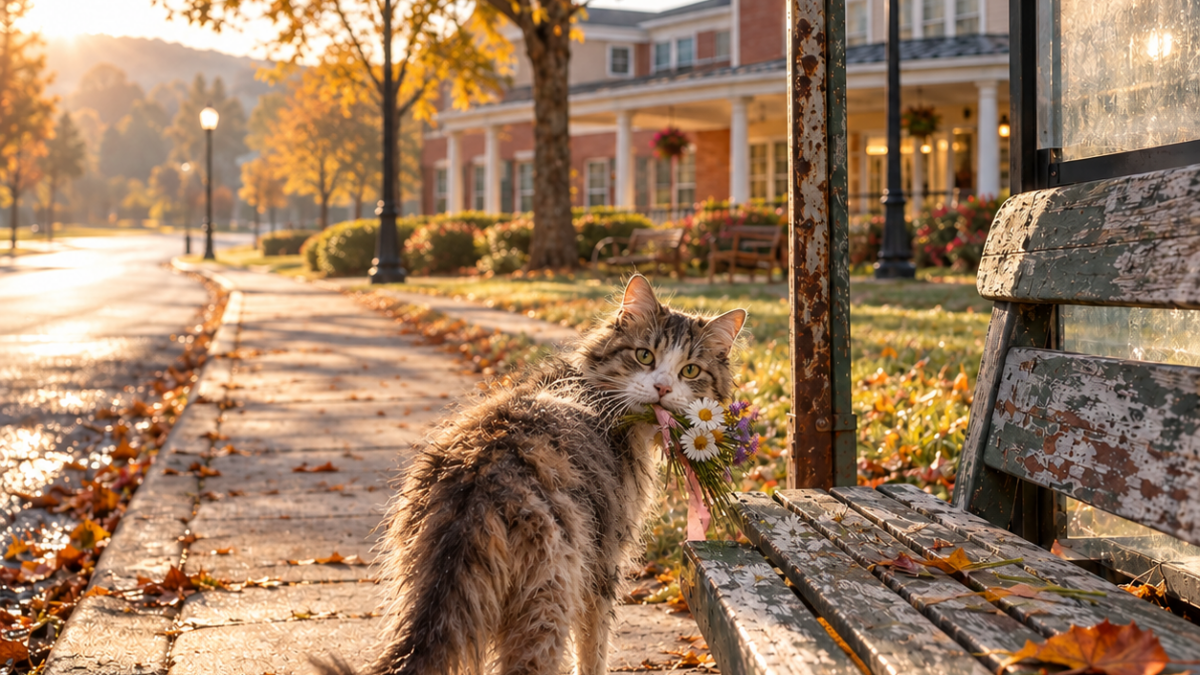
Across it stood a small bus shelter.
Wooden bench.
Plexiglass sides.
Roof stained dark from years of rain and snow.
Misty crossed.
June stopped.
The cat jumped onto the bench.
Turned twice.
Then curled up.
Facing Willow Brook.
That was all.
No hidden kittens.
No secret feeding station.
No second home.
Just a bus shelter.
June stood maybe thirty yards away.
Misty remained on the bench.
Looking toward the retirement home.
Waiting.
June crossed carefully.
She did not approach the cat directly.
Instead she moved near the old community noticeboard beside the shelter.
Most papers inside were sun-bleached.
Bus schedule.
A missing-dog notice so faded the phone number was barely readable.
Advertisement for firewood.
Then June saw the photograph.
Small.
About four by six.
Wedged behind the cracked plastic cover.
She pulled it free.
An elderly man sat on the exact bench.
Late seventies.
Maybe early eighties.
Thin.
Warm smile.
Flat cap.
Canvas bag beside him.
And sitting near his hip was a small gray cat.
Green eyes.
Not muddy.
Not thin.
But unmistakable.
June looked at Misty.
Then photograph.
“Misty?”
The cat’s ears moved.
June turned the picture over.
Faded handwriting:
ARTHUR + HIS LITTLE SHADOW
SPRING 2021
June’s skin prickled.
She returned to Willow Brook carrying the photograph.
Marcus was waiting.
“You disappear on a cat investigation and come back with evidence?”
She put the photograph on the counter.
His joke disappeared.
“That’s her.”
“Yes.”
“Who’s the man?”
“I don’t know.”
But somebody did.
June started asking longtime staff.
Most newer employees had never seen him.
Then a nurse named Carolyn looked at the photo.
“Arthur.”
“You know him?”
“Arthur Bell.”
“He lived here?”
“No.”
Carolyn paused.
“His wife did.”
That changed everything.
Arthur Bell had visited Willow Brook nearly every day for almost three years.
His wife, Margaret, developed dementia after a series of strokes.
Eventually she needed full-time care.
Arthur refused to move her far from their home.
Willow Brook was only a bus ride away.
He no longer drove.
So every morning he walked to that shelter.
Bus arrived around 9:15.
Arthur usually reached the stop a few minutes early.
Around 9:10.
June felt something tighten in her chest.
“Was there a cat?”
Carolyn smiled sadly.
“Oh, yes.”
“Misty?”
“We didn’t know her name.”
“What did Arthur call her?”
Carolyn thought.
“Pretty girl.”
June laughed despite herself.
“That sounds like Arthur.”
“You knew him?”
“No.”
“Everybody knew Arthur.”
Carolyn sat down.
“He started feeding her near his apartment building. She followed him to the bus stop. After a while she started waiting with him.”
“Did she ride the bus?”
“No.”
“But she came here?”
“Sometimes.”
“How?”
“Followed the bus route partway, we think. Mostly she waited at the stop.”
Arthur would sit on the bench before visiting Margaret.
Misty would sit beside him.
Sometimes he brought a little canvas shoulder bag.
Inside were sandwiches.
Newspaper.
Margaret’s things.
And random objects he used to play with Misty while waiting.
A glove dragged along the bench.
Fabric strip.
Bottle cap.
Plastic flower.
Anything light enough to bat with a paw.
June looked toward the cardboard box beneath the counter.
“Plastic flower?”
Carolyn nodded.
“He had one she loved.”
“What color?”
“Red.”
June stopped breathing for a second.
She retrieved the box.
Set it on the table.
One by one:
Red plastic flower.
Glove.
Blue cloth.
Yellow yarn.
Bottle cap.
Carolyn stared.
“Oh, my God.”
“What?”
“I’ve seen some of these.”
“You’re sure?”
“The flower.”
She picked it up.
“Arthur kept this in his bag for months.”
“How would Misty have it?”
“I don’t know.”
“What happened to Arthur?”
Carolyn’s face changed.
Margaret died first.
Late autumn.
Arthur continued returning to the bus stop afterward.
At first staff thought he was simply stuck in routine.
Then they realized he liked being close to the place where he had spent those years visiting his wife.
Sometimes he came into Willow Brook.
Sometimes he stayed outside.
Talked to staff.
Brought cookies.
Asked about residents he had known.
And Misty still met him at the bus shelter.
Then, the following winter, Arthur suffered a heart attack.
He died at home.
After his funeral, his daughter tried to find Misty.
The cat had disappeared.
They searched the apartment complex.
The bus stop.
Nearby yards.
Posted photographs.
Nothing.
Until now.
June looked through the kitchen window.
The bus shelter was barely visible beyond the fence.
“She comes at 9:10.”
Carolyn sat very still.
“That’s when Arthur used to wait.”
The next morning Misty arrived carrying another piece of fabric.
June did not follow.
She simply watched.
The cat set it down.
Looked through the glass.
And suddenly the entire ritual appeared different.
Not random.
Not necessarily deliberate in the human sense either.
June resisted that temptation.
Misty was a cat.
Nobody knew exactly what she understood.
But patterns mattered.
Places mattered.
Smells mattered.
Objects associated with familiar people mattered.
Routine mattered.
And every morning she returned at Arthur’s time.
With Arthur’s things.
Then went to Arthur’s bench.
June contacted Willow Brook’s administrator.
They found Arthur Bell’s old emergency contact information in Margaret’s archived file.
His daughter was named Rebecca.
June called.
“Hello?”
“Is this Rebecca Bell?”
“Yes.”
“My name is June Ellis. I work at Willow Brook Retirement Residence.”
Silence.
“My mother died there.”
“Yes. I’m sorry.”
“What is this about?”
June suddenly worried about how absurd she sounded.
“I think we found your father’s cat.”
Silence again.
Then:
“What?”
“A little gray cat.”
Rebecca’s voice changed instantly.
“Green eyes?”
“Yes.”
“Small?”
“Yes.”
“White patch under her chin?”
June had not noticed.
The next morning she checked.
There it was.
Tiny.
Barely visible.
“Yes.”
Rebecca inhaled sharply.
“Misty.”
That was the first time June learned the cat’s actual name.
“You called her Misty?”
“My dad did.”
June looked at the name somebody at Willow Brook had independently chosen.
Coincidence.
But a strange one.
Rebecca asked:
“Where is she?”
“She’s been coming here.”
“To Willow Brook?”
“Every morning.”
“Why?”
“I think she’s looking for your father.”
Rebecca said nothing.
June explained.
9:10.
Bus shelter.
Photograph.
Objects.
When she mentioned the plastic red flower, Rebecca began crying.
“My God.”
“You recognize it?”
“I have another one.”
“What?”
“My father bought a pack of those things at a dollar store.”
Rebecca laughed through tears.
“He tied one to a string because Misty chased it.”
June looked toward the cardboard box.
“We have one.”
“She used to steal them.”
That afternoon Rebecca drove to Willow Brook.
She brought something with her.
A small faded canvas bag.
Arthur’s.
She had found it while clearing his apartment.
Inside were little things he had collected.
One gardening glove.
A piece of fabric.
A plastic flower.
String.
A worn tennis ball too large for Misty to carry.
Two bottle caps.
An old handkerchief.
Rebecca set the bag on the kitchen table.
June placed Misty’s recovered objects beside it.
Some matched exactly.
Others were similar.
Rebecca touched the muddy red flower.
“Dad kept these everywhere.”
“In the bag?”
“Mostly.”
“Where was the bag after he died?”
“His apartment.”
“How would Misty have gotten them?”
Rebecca shook her head.
“She used to get in through a basement window.”
That answered one mystery.
After Arthur died, Misty may have continued entering.
Finding objects that smelled like him.
Playing with them.
Carrying them.
Nobody could know exactly.
But it was possible.
Rebecca looked toward the back door.
“When does she come?”
“Tomorrow morning.”
“Exactly 9:10.”
Rebecca smiled through tears.
“Of course.”
She returned before nine the next morning.
No crowd.
June insisted.
No residents gathered at windows.
No cameras.
No social-media spectacle.
Just June.
Rebecca.
Arthur’s canvas bag.
At 9:09, Rebecca began looking nervous.
“What if she doesn’t come?”
“She will.”
“You don’t know that.”
“No.”
9:10.
A gray shape appeared beyond the shrubs.
Misty crossed the pavement.
She carried nothing that morning.
She stopped when she saw Rebecca through the glass.
Everything in her body changed.
Not recognition.
Not yet.
Alertness.
Rebecca whispered:
“That’s her.”
June opened the door.
Misty backed up.
Rebecca crouched several feet away.
Did not reach.
“Hey, Misty.”
The cat froze.
One ear rotated.
Rebecca’s voice broke.
“Hey, pretty girl.”
Misty stared.
That was what Arthur used to call her.
Rebecca slowly placed the canvas bag on the ground.
Unzipped it.
Removed the red plastic flower.
Set it on the concrete.
Misty watched.
No movement.
Rebecca pushed the flower slightly forward.
“You remember this?”
Misty approached one step.
Stopped.
Another.
Sniffed the stem.
Touched it with one paw.
Then lowered her nose.
For several seconds, she remained perfectly still.
Rebecca covered her mouth.
“Oh, Misty.”
The cat looked up.
Rebecca did not reach.
That mattered.
She waited.
Misty walked around the flower.
Then toward the bag.
Sniffed.
Her head went partly inside.
She backed out.
Sniffed Rebecca’s shoe.
Rebecca’s hand rested open on her knee.
No movement.
Misty came closer.
Her whiskers touched Rebecca’s fingers.
Then her nose.
Rebecca held her breath.
Misty rubbed the side of her face against her hand.
Once.
Rebecca began crying.
Quietly.
No gasp.
No sudden grab.
Just tears.
Misty rubbed again.
Then sat beside her.
June turned away for a moment.
Not because she did not want to see.
Because it felt private.
Rebecca whispered:
“I’m sorry we couldn’t find you.”
Misty began washing one paw.
Very catlike.
Rebecca laughed.
“You’re exactly the same.”
She spent almost an hour sitting outside.
No attempt to pick Misty up.
Eventually the cat walked away.
Rebecca looked devastated.
“She’s leaving.”
June shook her head.
“Watch.”
Misty crossed the parking lot.
Through fence.
Toward the bus shelter.
Rebecca stood.
“Can we follow?”
“Yes.”
They stayed back.
Misty jumped onto Arthur’s bench.
Turned twice.
Curled up.
Rebecca stopped in the road.
For a second she looked as if the sight physically hurt.
“That’s where Dad sat.”
“I know.”
Rebecca approached slowly.
Misty watched.
She sat on the far end of bench.
Did not touch the cat.
Just sat.
Same place.
Same time.
For ten minutes neither moved.
Cars passed.
Wind moved through bare branches.
The bus came.
Stopped.
Doors opened.
Nobody boarded.
Then left.
Misty watched it disappear.
Rebecca whispered:
“He used to take that one.”
June felt goosebumps.
Not because she believed the cat understood bus schedules like a human.
But because routines can outlive the people who created them.
Misty stood.
Walked along bench.
Sniffed Rebecca’s coat.
Then climbed briefly onto her lap.
Rebecca closed her eyes.
That afternoon she asked:
“Can I take her?”
June answered carefully.
“She’s not technically ours.”
They contacted local animal control and checked microchip records.
No chip.
Rebecca had photographs.
Veterinary receipts from years earlier.
Old records showing Arthur had cared for Misty.
It was enough to establish the history.
The harder question was whether Misty would agree.
Because she remained skittish.
Nobody wanted to force her into a carrier and make the reunion traumatic.
So Rebecca came back the next morning.
And the next.
She brought food.
Sat near the door.
Visited the bus shelter.
By the fourth morning, Misty walked into the retirement home for the first time.
Just two steps.
Then out.
The following day:
Six steps.
She sniffed June’s shoes.
Inspected the kitchen doorway.
Retreated.
A week later, Rebecca brought an open carrier.
Blanket inside.
Arthur’s canvas bag beside it.
Misty sniffed.
Ignored it.
Two hours later she walked inside voluntarily for food.
Nobody closed the door.
Next day:
Again.
Only when she was clearly comfortable did Rebecca gently latch it.
Misty complained.
One loud meow.
Rebecca whispered:
“I know.”
They drove to the veterinarian first.
Thin, but healthier than she looked.
No major illness.
A few scars.
Parasites.
Minor dental work needed.
Otherwise surprisingly strong.
Estimated age:
Six or seven.
Rebecca sat beside the carrier.
“You survived out there all this time.”
Misty stared.
Rebecca smiled.
“Dad would be furious.”
The first night at Rebecca’s house, Misty hid under a guest-room bed.
Rebecca did not force her out.
Food.
Water.
Litter.
Arthur’s bag near the wall.
The red flower beside it.
Around midnight, Rebecca woke to a small sound.
Plastic scraping hardwood.
She checked the hallway.
Misty was walking toward the bedroom.
Red flower in her mouth.
Rebecca sat up.
The cat stopped.
Then placed it beside the bed.
Rebecca cried again.
“Okay.”
She patted the blanket.
“You can stay.”
Misty did not jump up.
Not that night.
She slept beneath the chair.
But she stayed.
The next morning at 9:10, June automatically looked toward Willow Brook’s back door.
Nothing.
No gray cat.
No flower.
No glove.
No cloth.
The concrete step was empty.
June knew this was good.
Still hurt.
Marcus found her staring.
“She’s not coming.”
“No.”
“Good.”
“Yes.”
“You don’t look good.”
June smiled.
“I’m allowed to miss her.”
On the muddy edge of the step was one paw print.
Small.
Clear.
Probably from the day before.
June noticed it when she bent to pick up the food bowl.
She almost wiped it away.
Then stopped.
Left it.
Staff walked around it all day.
A few residents came to look.
Evelyn smiled.
“Our morning mist finally blew somewhere else.”
June laughed.
“That’s terrible.”
“I’m ninety.”
“Still terrible.”
That night rain began.
Soft at first.
Then steady.
By morning the paw print was gone.
June stood at the doorway.
She felt sad.
But not the kind of sadness that wants something returned.
The kind that recognizes an ending.
Misty was no longer waiting at Arthur’s bus stop.
At Rebecca’s house, the adjustment was gradual.
The first week she hid whenever the doorbell rang.
Second week she began sleeping on sofa.
Third week she discovered the bedroom window.
Rebecca sent June photographs.
Misty in sunlight.
Misty beside Arthur’s canvas bag.
Misty asleep inside a cardboard box despite three purchased beds.
Then one photograph made June cry.
Rebecca had framed an old picture.
Arthur on the bus-stop bench.
Misty beside him.
The frame sat on a low shelf.
Misty was sleeping underneath.
June sent back:
She found him.
Rebecca replied:
Maybe.
Then another message.
Or maybe she found us.
Months passed.
Misty stopped carrying objects to doors.
Mostly.
She still stole things.
Socks.
Hair ties.
Once Rebecca’s reading glasses.
A wooden spoon.
She placed them randomly around house.
For a while Rebecca wondered whether every object was connected to Arthur.
Then she realized she was doing the human thing.
Trying to turn every cat behavior into a message.
Sometimes a stolen sock was just a stolen sock.
That mattered too.
Misty deserved to be more than a grief story.
She chased toys.
Yelled for breakfast.
Knocked over water cups.
Refused expensive cat beds.
Loved cardboard.
Hated the vacuum cleaner.
Learned to sleep beside Rebecca’s knees.
She became an ordinary house cat.
A strange one.
But ordinary.
Still, 9:10 remained special.
For several months, Misty would often become restless around that time.
She walked toward front window.
Sat.
Watched road.
Rebecca noticed.
She did not interrupt.
Eventually it happened less.
Not because Misty forgot.
Nobody knew what cats remember or how memories feel to them.
But perhaps the routine no longer needed to be repeated every day.
She had a new routine.
Breakfast at eight.
Window after.
Nap around ten.
Rebecca at home.
Warmth.
Safety.
No bus stop necessary.
One spring morning, nearly a year after the reunion, Rebecca brought Misty back to Willow Brook.
Not because the cat needed closure.
That is a very human idea.
Rebecca needed it.
June met them outside.
Misty came in a secure harness now.
Clean coat.
Healthy weight.
Tail still somehow managed to collect dirt.
June crouched.
“Hi, trouble.”
Misty sniffed her fingers.
Then rubbed once.
June nearly cried.
“You remember me?”
Rebecca smiled.
“Or you smell like chicken.”
“Let me have this.”
They walked to the bus shelter.
The old noticeboard had been repaired.
The photograph was gone because June had given it to Rebecca.
A small laminated copy had been placed discreetly inside instead.
Arthur.
Misty.
Spring 2021.
Rebecca sat on the bench.
Misty jumped up.
Sniffed.
Looked toward road.
A bus approached.
Stopped.
Doors opened.
Closed.
Moved on.
Misty watched.
Then turned.
Jumped down.
Walked toward Rebecca’s car.
June laughed softly.
“Well.”
Rebecca wiped her eyes.
“What?”
“I guess she knows where she’s going.”
Rebecca nodded.
At the car, Misty jumped onto the back seat.
No hesitation.
Home.
Years later, June would still tell new employees about the cat who arrived every morning at 9:10.
The story became part of Willow Brook.
Some versions grew dramatic.
People said Misty had brought one of Arthur’s belongings every day for months.
Not exactly.
Some objects probably were his.
Others may simply have resembled the things he used with her.
People said she knew Arthur was dead and was leaving memorial offerings.
Nobody could know that.
June always corrected that part.
“We don’t know what she thought.”
Then she would add:
“But we know what she did.”
She returned.
Same time.
Same door.
Same bus shelter.
Over and over.
That was enough.
Grief does not need to look exactly like human grief to matter.
Animals build routines around people.
Sounds.
Smells.
Places.
Touch.
Expectations.
Remove one important presence and the pattern remains for a while.
Sometimes a long while.
Misty’s life had included Arthur.
Arthur sitting on the bench.
Arthur opening the canvas bag.
Arthur dragging the little red flower across the wood.
Arthur calling:
“Pretty girl.”
Arthur getting onto the bus.
Arthur returning.
Until one day he did not.
Maybe Misty waited.
Maybe she searched.
Maybe the objects smelled like him.
Maybe carrying them toward Willow Brook was simply a behavior connected to an old routine she could not understand had ended.
Nobody knew.
But perhaps explanations are overrated.
What mattered was that a small gray cat kept returning to a place associated with somebody she trusted.
And eventually, somebody connected the pattern.
One person noticed the time.
One person followed.
One photograph survived behind cracked plastic.
One daughter answered the phone.
One canvas bag remained.
Tiny things.
If June had thrown away the first plastic flower?
Probably nothing would have changed.
If she had never noticed 9:10?
Maybe someone else eventually would.
Maybe not.
That is what stays with her.
Lives sometimes turn on attention.
Not heroism.
Attention.
Notice the same cat.
Notice the same time.
Notice the strange object.
Ask why.
Follow carefully.
Look at the faded photograph.
Call the number.
Most of the world is full of things we walk past because they seem too small to matter.
A muddy cat.
An old glove.
A plastic flower.
A paw print.
But small things become meaningful when they repeat.
Rebecca kept Arthur’s canvas bag.
It sits in a drawer now.
The red flower is inside.
Not on display.
Not treated like a relic.
Sometimes she takes it out.
Misty occasionally bats it across the floor.
That makes Rebecca laugh.
Because the object can be two things at once.
A memory.
And a toy.
Just as Misty can have loved Arthur deeply and still move forward.
That may be the gentlest part of the story.
Misty did not have to spend the rest of her life waiting at that bus shelter to prove the bond mattered.
She was allowed to leave.
She was allowed to find another warm home.
Another hand.
Another lap.
Another routine.
Love does not become less real because life continues after loss.
One evening Rebecca sat on the couch with Misty asleep beside her.
She was sorting old family photographs.
She found one taken shortly before Margaret entered Willow Brook.
Arthur and Margaret in their kitchen.
Then another.
Arthur alone at the bus shelter.
Canvas bag.
Then:
Misty.
Rebecca placed the photos side by side.
Three lives intersecting through one little routine.
Her mother.
Her father.
A stray cat.
She stroked Misty’s back.
“Dad really loved you.”
Misty slept.
Rebecca smiled.
“He would be happy you’re here.”
The cat stretched.
Placed one paw over Rebecca’s wrist.
And stayed there.
Nothing mystical.
Nothing supernatural.
Just warmth.
Weight.
Presence.
The things Arthur could no longer give.
The things Rebecca could.
Every once in a while, somebody asks June what happened to the paw print.
She tells them the rain washed it away.
People usually find that sad.
June does not anymore.
At first she did.
She wished she had photographed it.
Covered it.
Preserved it somehow.
Then she realized something.
That print was never supposed to last.
It was mud.
Rain came.
It disappeared.
Misty did not.
She simply went home.
And perhaps that was the point of all those mornings.
Not that a cat should wait forever for someone who was never coming back.
Not that grief should be preserved exactly where it began.
But that sometimes, when someone has lost the center of their world, the kindest thing another person can do is notice where they keep returning.
Follow gently.
Understand what you can.
And when they are ready—
give them somewhere new to go.
Misty spent months returning to Arthur’s time.
Arthur’s bench.
Arthur’s little objects.
Then one morning his daughter opened an old canvas bag.
Placed a red plastic flower on the ground.
And waited.
She did not grab Misty.
Did not force recognition.
Did not demand that the cat understand anything.
She simply offered something familiar.
A smell.
An object.
A voice connected to the man Misty once trusted.
Misty made the next move.
One step.
Then another.
A nose against the flower.
A cheek against Rebecca’s hand.
Then she sat beside her.
That was all.
No miracle.
No dramatic revelation.
Just a frightened little gray cat deciding, after months of returning to where someone used to be, that perhaps there was still somebody left to walk home with.
The next morning at 9:10, Willow Brook’s back step was empty.
And for the first time, that emptiness was good.
Because Misty was not waiting anymore.








