Corrupt Cops Seized a Quiet Man’s K9—They Had No Idea He Was an Elite Navy SEAL
PART3:
Havoc stepped around me, lowered himself to the mud, and placed his nose near the opening.
The puppy crawled out slowly, one paw at a time, until she was pressed against his front legs.
Havoc did not move.
He had once held armed men to the ground with one command.
He had once crossed a burning hallway because I was on the other side of it.
But he stood perfectly still for a trembling puppy that weighed less than one of his paws.
That was how Echo came home with us.
I named her Echo because she followed Havoc everywhere.
If Havoc sat, she sat.
If Havoc drank, she drank.
If Havoc watched the driveway, she watched the driveway with the seriousness of a recruit on her first day.
She slept curled against his ribs.
She stole his bed.
She chewed the corner off one of my boots and then hid behind him like he was her attorney.
Havoc tolerated all of it.
No.
That is not true.
He loved her.
Quietly, the way old soldiers love things.
Without making a show of it.
He became softer with her.
Still disciplined.
Still watchful.
But softer.
He taught her the property lines, the difference between my truck and a stranger’s engine, the command for stay, the command for come, and the sacred law that no one touched the coffee table sandwich unless I said so.
Echo broke that law often.
Havoc pretended not to notice.
For the first time in years, my cabin sounded like more than memory.
Puppy paws.
Old dog sighs.
Water bowls clinking.
Echo barking at her reflection in the stove door.
Havoc correcting her with one look.
I did not realize how much life had left the cabin until she brought some back.
That was why, on the morning Deputy Boyd Miller and Officer Ray Jenkins pulled me over, I was carrying a bag of puppy food, two chew toys, and a small blue collar from the feed store.
Echo was in a travel crate secured in the back of my Ford F-150.
Havoc sat in the passenger seat.
Seat belt harness clipped.
Head high.
Eyes forward.
The sky over Red Creek was pale and hot, washed out by dust and late-summer sun. The road shimmered ahead of us. Nothing moved but heat, sagebrush, and the thin shadow of a hawk circling over the valley.
Then red and blue lights filled my mirror.
Havoc’s ears shifted.
Echo whined from the crate.
“Easy,” I said.
Havoc relaxed by a fraction.
I pulled onto the gravel shoulder, put the truck in park, turned off the engine, and placed both hands where they could be seen.
Old habits.
Good habits.
The cruiser stopped behind me.
Two doors opened.
I knew both men by reputation.
Everybody in Red Creek did.
Boyd Miller was large, red-faced, and proud of making people nervous. His uniform always looked a little too tight, his belt a little too heavy. He had the swagger of a man who had confused authority with personal size.
Ray Jenkins was leaner, sharper, and meaner in a quieter way. He smiled before he did ugly things. That bothered me more than Miller’s shouting.
They approached on both sides of the truck.
Miller came to my window.
Jenkins went straight to Havoc’s side.
“License and registration,” Miller said.
No greeting.
No reason for the stop.
I handed over both documents slowly.
“Was I speeding?”
“Tail light’s cracked.”
My tail light was not cracked.
I had checked it the day before.
But I said nothing.
Havoc sat still beside me.
Jenkins leaned toward the passenger window, eyes locked on him.
“That’s a hell of a dog.”
“He’s friendly,” I said.
Havoc’s gaze moved to me, then back to Jenkins.
“He doesn’t look friendly.”
“He’s trained.”
“That supposed to mean something?”
“It means he won’t be a problem unless you create one.”
Miller’s eyes narrowed.
“Step out of the vehicle.”
I looked at Havoc.
He did not move.
Echo whined again from the back.
Jenkins heard it.
“What’s in the crate?”
“Puppy.”
His face changed.
Not softened.
Interested.
“Open the back.”
“No.”
Miller placed a hand on his holster.
“You refusing a lawful order?”
“I’m asking what law applies.”
That was when Miller’s expression hardened into the kind of pleasure small men get when they finally have an excuse.
“Out of the truck.”
I could have ended it there.
Not legally.
Physically.
That truth lives in my body the way old wounds do.
I knew the distance between Miller’s hand and his weapon. I knew Jenkins’s angle. I knew the blind spot near the cruiser’s dash camera. I knew how long it would take to break Miller’s wrist, put the door between Jenkins and me, and release Havoc with one word.
Less than three seconds.
Maybe two.
But Echo was behind me.
Havoc was beside me.
A gun drawn in fear does not care where loyalty is standing.
So I stepped out.
Slowly.
Hands visible.
“Face the truck,” Miller snapped.
I did.
He shoved me against the side hard enough to dent my ribs into the metal.
Havoc growled.
Not loud.
One warning.
“Havoc,” I said. “Stand down.”
The growl stopped instantly.
Jenkins laughed.
“Look at that. Big bad dog listens.”
He opened the passenger door.
I turned my head.
“Do not touch him.”
Miller shoved me harder.
“You don’t give orders here.”
Jenkins grabbed Havoc’s leash.
Havoc bared his teeth.
Every muscle in him went tight.
He was not afraid.
He was waiting.
One word.
One word from me, and Red Creek would have learned the difference between a police dog and a combat K9.
But I gave him the hand signal for submit.
Havoc looked at me.
Confused.
Betrayed, almost.
Then he obeyed.
That look cut deeper than Miller’s shove.
Jenkins dragged him out of the truck.
Havoc stepped down with perfect control, shaking from restraint.
Echo began barking from the back.
High.
Panicked.
Puppy fear.
Jenkins looked over.
“Well, look at that. Two for one.”
“Leave the puppy,” I said.
Miller leaned close to my ear.
“You in a position to negotiate, Cole?”
Jenkins opened the rear door and pulled Echo’s crate from the back seat.
She slid across the plastic floor, barking and scrambling, too young to understand why Havoc was not stopping this.
Havoc turned toward her.
Jenkins yanked his leash.
Hard.
Havoc stumbled.
A sound left him that I had never heard before.
Not pain.
Not fear.
Confusion.
That was the first crack in me.
“You are making a mistake,” I said.
Miller laughed.
“You hear that, Ray? Quiet man thinks we’re making a mistake.”
Jenkins clipped a catch pole around Havoc’s neck.
Not because he needed one.
Because he liked the look of it.
“We’ve had reports of an aggressive dog harassing livestock near the county line,” Miller said. “This animal matches the description.”
“He has not left my property without me.”
“Tell it to the sheriff.”
“And the puppy?”
Jenkins lifted Echo’s crate.
“Evidence.”
“That puppy is not evidence of anything.”
“She’s with the aggressive dog. We’ll assess her too.”
I looked at Havoc.
He looked back.
Waiting.
Still waiting for me to make the world make sense again.
I gave him the hand signal.
Wait.
His ears lowered.
But he obeyed.
They put him in the back of the cruiser.
Then they put Echo’s crate behind the metal divider in the rear compartment.
The image burned itself into me.
Havoc sitting rigid in the cage.
Echo pressed against the bars behind him, crying.
Two animals who trusted me being taken by men who wanted them to feel helpless.
Miller shoved my wallet against my chest.
“Have a nice walk home.”
The cruiser pulled away in a spray of gravel and dust.
I stood on the shoulder long after the taillights disappeared.
I did not yell.
I did not chase.
I did not collapse.
The quiet man who bought puppy food on Tuesdays was gone.
In his place stood a man I had worked hard not to be anymore.
But even then, even with the old part of me waking like a blade pulled from its sheath, one thought kept me from becoming what those deputies deserved.
Havoc had obeyed.
He had trusted me.
So I would do this the right way until the right way ran out of road.
I walked home.
Seven miles.
Hot dust.
Gravel.
Sun on the back of my neck.
No dog beside me.
No puppy barking from the truck.
By the time I reached the cabin, my shirt was soaked through.
The silence inside hit me harder than the heat.
No nails clicking on wood.
No Echo scrambling from the kitchen with something stolen in her mouth.
No Havoc taking his place beside the door.
Just silence.
I walked to the sink and drank a glass of water in one steady pull.
Then I went to the bedroom.
Not the closet.
The floor.
I rolled back the braided rug and opened the hidden compartment beneath the boards.
Inside was a black case I had not touched in years.
Most people would expect weapons.
There were some.
Locked away.
Cleaned.
Unused.
But that was not what I reached for.
I reached for the folder.
Old service documents.
Adoption papers.
K9 retirement records.
Medical charts.
Certification logs.
Photographs.
Letters.
Proof that Havoc was not a stray, not livestock danger, not contraband, not county property, not something two deputies could steal and sell.
He was a retired military working dog.
Microchipped.
Documented.
Legally adopted.
Protected.
Mine.
And Echo was registered too, her adoption receipt still folded into the pocket of the truck console.
I powered up an encrypted laptop that had spent three years gathering dust.
Not to plan an assault.
Not to go hunting.
That was the old way, and old ways have a gravity to them.
I opened a secure contact file and called the one man I still trusted inside the machinery of government.
Logan Hayes answered on the fourth ring.
He had been CIA once.
Then something else.
Then nothing he would admit to.
“You haven’t used this number in three years,” he said.
“They took Havoc.”
Silence.
When Logan spoke again, the casual edge was gone.
“Who?”
“Red Creek deputies. Boyd Miller. Ray Jenkins. Sheriff Dale Lawson likely behind it.”
“What do they want with him?”
“I don’t know yet.”
“You sound calm.”
“I’m not.”
“What do you need?”
“Everything on the department. Complaints. Seizures. Asset forfeiture records. Off-book sales. Connections to private security, dog brokers, anyone moving working dogs.”
Another silence.
“Wyatt.”
“What?”
“Do not do what you used to do.”
I looked at the empty place beside the door where Havoc should have been.
“I’m trying not to.”
“Then give me twenty minutes.”
While Logan worked, I drove back to where they had stopped me.
My truck was still there on the shoulder.
They had left it unlocked.
The passenger door hung slightly open.
Havoc’s old blanket was half on the floorboard.
Echo’s chew toy lay beneath the seat.
I picked it up.
Blue rubber.
Tiny tooth marks.
For a moment, the heat vanished, and all I could see was Echo’s crate being lifted away.
I took photos of everything.
The undamaged tail lights.
The tire marks.
The disturbed gravel.
The location.
The absence of any citation.
Then I found what I needed.
Across the highway was Hank’s Auto Salvage, a fenced lot with two security cameras mounted on poles.
Hank owed me for rebuilding a generator during an ice storm the year before.
He did not ask questions when I requested footage.
He just looked at my face and said, “Bad?”
“Very.”
The camera had caught enough.
The cruiser behind my truck.
Me stepping out.
Jenkins taking Havoc.
Echo’s crate.
No aggressive behavior.
No livestock.
No legal process.
No reason that would survive daylight.
Logan called as I was leaving Hank’s office.
“It’s worse than you think.”
“It usually is.”
“Lawson’s department has a pattern. Civil forfeiture without charges. Vehicles. Cash. Firearms. A horse trailer once. Complaints buried. Two lawsuits settled quietly. And Wyatt—there are rumors about dogs.”
My hand tightened on the phone.
“What kind of rumors?”
“Protection dogs disappearing from impound. Sold through a broker across the state line. Private security outfits. Some worse people too.”
“Names.”
“I’m sending a file. But listen to me. The Bureau has been sniffing around Lawson for months. They don’t have enough yet. You might.”
“I want Havoc and Echo back.”
“I know.”
“No. You don’t.”
Logan exhaled.
“I do, brother. But this is bigger than one dog now.”
“That dog carried my blood in his fur through three countries.”
“I know.”
“That puppy thinks he hung the moon.”
“I know.”
“If they hurt either one—”
“Then we make sure the law sees every inch of it.”
I hated that answer.
Not because it was wrong.
Because patience tastes like poison when someone you love is in a cage.
That night, I did not sleep.
I called an attorney in Boise I had used once for land paperwork.
I emailed documents.
Service records.
Adoption papers.
Microchip information.
Hank’s footage.
A written statement.
Then I called the emergency number for the regional FBI field office and left enough information that no reasonable agent could ignore it.
I did not mention every contact I had.
I did not need to.
By dawn, I had two plans.
The lawful one.
And the other one.
I prayed the lawful one moved fast enough.
It nearly did not.
At 9:14 the next morning, a photo appeared on a local community page.
A police SUV outside the Red Creek station.
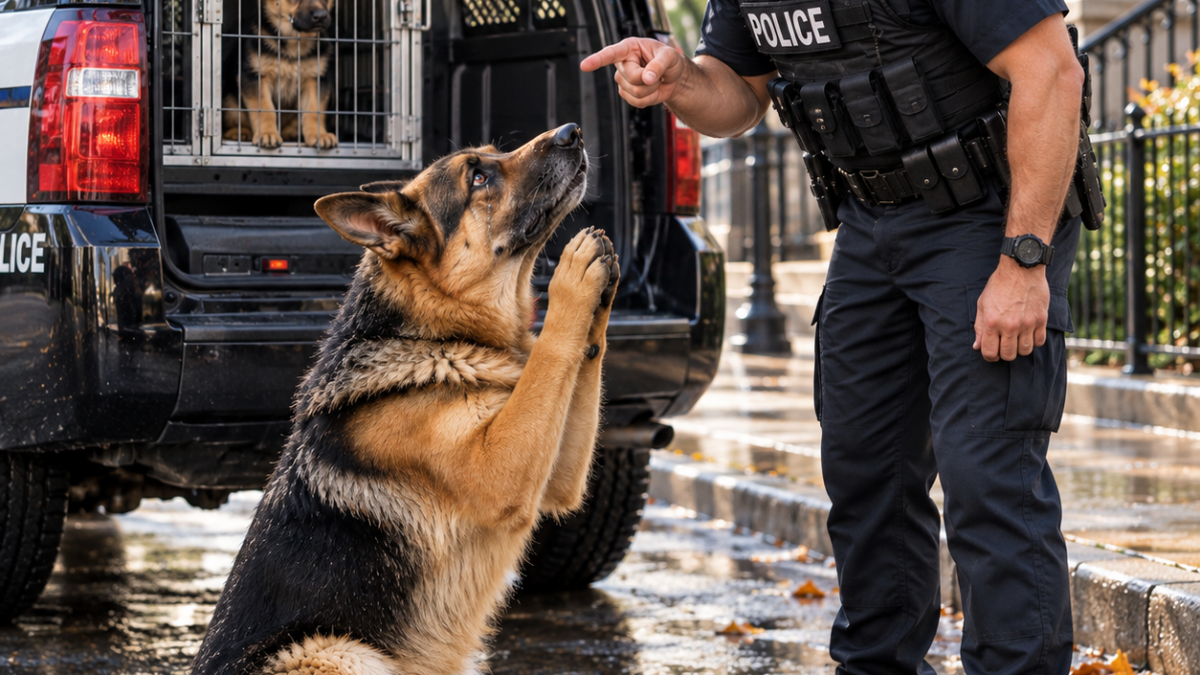
A uniformed officer standing over an old German Shepherd on the wet pavement.
His finger pointed inches from the dog’s face.
His mouth open, caught mid-yell.
Havoc sitting upright, front paws lifted in the submission position I had taught him years ago for medical checks and de-escalation.
And behind him, inside the open rear compartment of the vehicle, Echo trapped in a metal cage, staring out with frightened puppy eyes.
The caption read:
Red Creek PD dealing with vicious dog seizure. Animal appears trained but dangerous. Possible euthanasia pending.
I stared at the photo until the screen blurred.
Havoc was not begging for himself.
I knew the posture.
He had used it once when a child in Afghanistan approached him with both hands full of bread, terrified but curious. Havoc had sat like that so the boy would not be afraid.
Paws lifted.
Body still.
No threat.
He was making himself smaller for a man who deserved no such mercy.
And Echo was watching.
Learning.
The rage that moved through me was not loud.
It was cold.
Total.
Clean.
I saved the photo.
Then another appeared.
A shorter video.
Jenkins pointing at Havoc.
“See? This is what a dangerous animal looks like. One wrong move and this thing takes someone’s face off.”
Havoc sat still.
Echo cried behind him.
A woman’s voice off camera said, “He doesn’t look dangerous. He looks scared.”
Jenkins snapped, “Ma’am, step back unless you want to get bit.”
Havoc did not move.
Not even when Jenkins jabbed a finger toward his eye.
My hands shook so badly I set the phone down.
That was new.
I had been shot at without shaking.
I had walked into buildings full of explosives without shaking.
But watching a coward use my dog’s discipline as theater did something to me that combat never had.
It made me feel helpless.
That is the part people do not understand about trained restraint.
Everyone talks about what elite dogs can do.
Bite force.
Tracking ability.
Fearlessness.
Commands.
Nobody talks about the pain of watching them choose not to fight because they trust you more than instinct.
Havoc could have ended that moment.
He could have taken Jenkins down before the man finished laughing.
But I had told him to wait.
So he waited.
That obedience was not weakness.
It was love under command.
And those men mistook it for ownership.
By 10:30, the story had split the town.
Some called Havoc a monster.
Some called the photo heartbreaking.
Some defended the deputies because men with badges are often believed before animals with scars.
One woman wrote:
If that dog is so dangerous, why is the officer standing that close to his face?
That comment got deleted.
Then reposted.
Then shared.
By noon, my attorney had filed an emergency motion for return of unlawfully seized animals and preservation of evidence.
By 12:30, Logan called.
“The Bureau is moving, but not fast enough for my liking.”
“What does that mean?”
“It means Lawson has scheduled a transfer tonight.”
My blood went still.
“Where?”
“Official paperwork says veterinary evaluation. Unofficial chatter says a private buyer.”
“Havoc?”
“And the puppy.”
I closed my eyes.
Echo in a crate.
Havoc sitting still because I told him to wait.
No more cages.
I had promised him.
“Wyatt,” Logan said, “listen to me carefully. Federal agents are coordinating with state police. They need probable cause at the transfer point. They want the handoff documented.”
“They’re using my dogs as bait.”
“They’re already bait because Lawson made them bait. The difference is whether we catch the men holding the line.”
I said nothing.
“I know what you’re thinking.”
“No, you know what you would think if it were your dog.”
“That too.”
The transfer was supposed to happen at the old county maintenance yard outside town.
Not a dramatic abandoned mill.
Not some cinematic villain location.
Just a fenced lot full of rusted snowplows, broken road signs, and government equipment nobody had budget to repair.
Ordinary places hold extraordinary ugliness all the time.
That evening, I drove into town.
Not in tactical gear.
Not armed for war.
Jeans.
Jacket.
Boots.
A folder of documents on the passenger seat.
A phone recording in my chest pocket.
A copy of the court filing in my hand.
If they wanted me to become a monster, they were going to have to watch me refuse.
The station parking lot was wet from afternoon rain.
The photo online had been taken there; I recognized the puddle near the curb, the American flag in the background, the dark SUV with the cage insert.
Havoc’s scent still seemed to hang in the air, though I knew that was grief inventing evidence.
I walked inside.
The dispatcher looked up and froze.
“I’m here for my dogs.”
She reached for the phone.
A door opened behind her.
Sheriff Dale Lawson stepped out, smiling like a man who had practiced looking reasonable in mirrors.
“Mr. Cole.”
“Sheriff.”
“I understand you’re upset.”
“You stole a retired military working dog and a puppy from my truck.”
His smile thinned.
“We impounded a dangerous animal under county ordinance.”
“You also took an eight-week-old puppy.”
“Associated animal.”
“That is not a legal category.”
His eyes flicked to the folder.
“You should leave before this becomes obstruction.”
I placed the documents on the counter.
“Emergency motion. Preservation notice. Service records. Microchip registry. Video of the seizure from Hank’s Auto Salvage. Proof my tail lights were intact. Veterinary and training records.”
Lawson’s face changed by a fraction.
“There’s also a federal complaint filed,” I said. “And if either dog is moved, harmed, sold, altered, or ‘lost,’ everyone involved becomes part of a conspiracy case you will not be able to bury in county court.”
The dispatcher had stopped pretending not to listen.
Lawson stepped closer.
“You threatening me?”
“No.”
I held his gaze.
“I’m informing you of consequences.”
For one second, I saw him recognize something in me.
Not all of it.
Enough.
Men like Lawson survive by reading weakness.
He looked for it and found none.
His smile returned, weaker this time.
“Your animals are being evaluated.”
“Where?”
“Not your concern.”
“They are my property under the law and my family under every standard that matters.”
He leaned in.
“Careful, Mr. Cole. Around here, family can disappear too.”
There it was.
The mistake.
Not because he threatened me.
I had been threatened by better men in worse places.
Because he said it while my phone was recording.
I left without another word.
In the parking lot, the dispatcher came out after me.
She was maybe twenty-five.
Pale.
Scared.
Her name tag said Nora.
“Mr. Cole,” she whispered.
I stopped.
She looked back toward the building.
“I can’t be involved.”
“You already are.”
Her eyes filled.
“I didn’t know about the sales. Not at first. I swear. I thought they were transfers. Rescues. Then one of the dogs came back dead, and the paperwork changed.”
I kept my voice low.
“Where are they taking mine?”
She swallowed.
“Maintenance yard. Ten tonight. A man named Keller. Private security. He buys dogs.”
“And the puppy?”
Her mouth trembled.
“Training prospect.”
The world narrowed.
“Are they hurt?”
“No. Havoc wouldn’t eat at first, but the puppy cried, and he took food after she did. He keeps putting himself between her and everybody.”
Of course he did.
Nora wiped her face quickly.
“They joked about euthanizing him if he wouldn’t perform.”
My hands closed into fists.
I opened them slowly.
Control is not the absence of rage.
Control is choosing where it goes.
“Thank you,” I said.
She shook her head.
“I didn’t do anything.”
“You did now.”
At 9:47 that night, I parked half a mile from the maintenance yard and waited in the dark.
Not alone.
Three state police units were staged without lights along the access road. Two federal vehicles sat beyond the ridge. My attorney had become very awake and very angry. Logan was on the phone, listening through an open line.
“You stay back,” he said.
“I’m here for my dogs.”
“You stay back until they move.”
“I’m not watching another man put a hand on Havoc.”
“Wyatt.”
“What?”
“The whole point is proving they’re criminals, not proving you’re dangerous.”
I hated him for being right.
At 10:06, the sheriff’s SUV arrived.
Then the cruiser.
Then a white van with no markings.
Headlights cut through the yard.
Rain misted under the lamps.
I could see Havoc through the back of the SUV.
Sitting.
Still.
Echo in the crate behind him.
She was awake, nose pressed to the bars.
The man from the van stepped out wearing a dark jacket and carrying a scanner.
Keller, I assumed.
Jenkins opened the SUV and dragged Havoc out by the leash.
Havoc moved stiffly.
Not injured badly, I could tell from a distance.
Tired.
Restrained.
Echo began barking.
Havoc turned back toward her.
Jenkins yanked the leash.
“Move, mutt.”
Havoc stumbled.
My hand went to the door handle.
Logan’s voice came through the phone.
“Do not.”
Keller scanned Havoc’s microchip.
The device beeped.
He frowned.
“This chip flags federal.”
Lawson snapped, “It’s paperwork. Keep moving.”
Keller looked less confident.
“I don’t buy federal-marked dogs.”
“He’s not federal anymore.”
“You said clean.”
“He is clean.”
“Then why is there a court alert?”
Silence.
That was when the lights came on.
Not headlights.
Floodlights.
White and sudden.
“State police! Hands where we can see them!”
The yard erupted in shouting.
Doors opened.
Agents moved in.
Lawson reached for his weapon.
Stopped halfway when three rifles found him.
Miller dropped something metallic into the mud.
Jenkins froze with Havoc’s leash in his hand.
Havoc stood still.
Even then.
Even surrounded by yelling men and lights and fear.
He did not act without command.
Echo barked herself hoarse from the cage.
I stepped from the shadows before anyone could stop me.
“Wyatt,” Logan said in my ear.
I ended the call.
Jenkins saw me.
His face twisted.
“You.”
I walked toward him slowly.
An agent shouted, “Sir, stay back.”
I stopped.
Havoc saw me.
For the first time since they took him, his posture broke.
Not discipline.
Not training.
The wall behind it.
His ears dropped.
His mouth opened.
A sound came out of him that I had only heard once before, in a field hospital when I woke after surgery and he realized I was alive.
A whine.
Small.
Broken.
Echo went wild in the crate.
The lead state trooper looked between me and the dog.
“You the owner?”
“Yes.”
“Can you safely control him?”
“With one word.”
He studied my face.
Then nodded.
“Sergeant, release the leash.”
Jenkins did not move.
“Release it,” the trooper repeated.
Jenkins let go.
For one second, Havoc remained exactly where he was.
Waiting.
Still waiting for permission.
I raised my right hand.
Then gave the signal.
Come.
Havoc ran.
Not like a young dog.
Not like he used to.
His hips were older now, and the wet ground slipped beneath him, but he ran with everything he had left.
He hit me in the chest hard enough to stagger me.
I dropped to one knee and wrapped both arms around his neck.
His body shook.
Mine did too.
I buried my face in his fur, and for a moment I was not a SEAL or a witness or a man trying to hold his rage together.
I was just someone getting back the part of his heart that had been locked in a cage.
“I’m sorry,” I whispered.
Havoc pressed harder into me.
“I told you no more cages.”
He licked my jaw once.
Forgiveness, maybe.
Or impatience.
Echo was still crying.
I stood.
“Her too.”
An agent opened the rear compartment.
Echo’s crate door stuck.
For a terrible second, I heard her claws scraping plastic and thought I would tear the vehicle apart with my hands.
Then the latch gave.
Echo burst out like a tan-and-black comet, ran straight past three armed officers, and slammed into Havoc’s legs.
She yelped.
Licked his muzzle.
Checked his ears.
Crawled under his chest.
Then jumped at me as if remembering I existed too.
I caught her awkwardly with one arm while Havoc leaned against my knee.
Someone behind me laughed softly.
Someone else cursed.
The floodlights turned the wet pavement silver.
Lawson was being cuffed.
Miller was on his knees in the mud.
Jenkins stared at Havoc as if he had expected violence and was frightened by obedience instead.
The photo someone took that night never went as viral as the first one.
That tells you something about people.
A cruel image travels fast.
A corrected story walks uphill.
But it did spread eventually.
Not the tactical version.
Not the fantasy people wanted about a SEAL destroying everyone in sight.
The true version.
The one with court filings.
Body-camera preservation.
A dispatcher brave enough to speak.
A state police operation.
A federal case.
A retired K9 sitting with both paws lifted because his handler told him to wait.
A puppy crying behind bars.
A corrupt sheriff discovering that the quiet man he threatened had built his life around restraint, not weakness.
The investigation that followed tore Red Creek open.
Lawson’s department had been stealing more than dogs.
Cash from traffic stops.
Vehicles from poor families who could not afford attorneys.
Firearms that vanished from evidence.
Impounded animals “transferred” to buyers.
Complaints buried.
Reports rewritten.
People intimidated into silence because fighting back cost more than surrender.
Nora testified.
So did Hank.
So did I.
Havoc and Echo became evidence too, though I hated that word.
Veterinary exams documented stress, dehydration, rope abrasions on Havoc’s neck, and raw spots on Echo’s paws from trying to dig out of the crate.
Nothing life-threatening.
That was what the vet said.
Nothing life-threatening.
I nodded when she said it.
Then went outside behind the clinic and put one fist against the brick wall until my breathing steadied.
Not every wound threatens life.
Some threaten trust.
For two weeks after we got home, Havoc slept in front of the cabin door.
Not beside my bed.
Not on his old blanket.
At the door.
Guarding.
Echo slept pressed against his stomach.
If I moved during the night, Havoc’s head lifted immediately.
If a truck passed on the road, he stood.
If a branch scraped the window, he placed himself between Echo and the sound.
I knew that pattern.
Hypervigilance.
The body staying at war after the war is over.
I had lived with it long enough to recognize it in another soldier.
So I did what nobody had known how to do for me when I came home.
I kept the routine.
Same meals.
Same commands.
Same walks.
Same tone.
No pity.
No rushing.
No pretending nothing had happened.
Every morning, I sat on the porch with coffee while Havoc lay at my feet and Echo chewed something she was not supposed to have.
Every evening, I checked the fence line, not because I thought Lawson’s men were coming, but because Havoc needed to see me check it.
Proof matters when fear has entered the body.
At night, I left the bedroom door open.
Havoc eventually came back to his bed.
First for ten minutes.
Then an hour.
Then all night.
Echo recovered faster, the way puppies sometimes do, not because trauma cannot touch them, but because life still keeps calling louder.
She chased moths.
Barked at leaves.
Stole socks.
Grew into her paws.
But she never liked police sirens after that.
Not even distant ones.
The first time she heard one on television, she ran to Havoc and crawled under his neck.
Havoc stood over her until the sound passed.
Then looked at me.
I turned the television off.
“We don’t need that,” I said.
He sighed and lowered himself beside Echo.
Months later, I was asked to speak at a county hearing.
The new interim sheriff wanted public trust restored.
The words made me tired.
Public trust is not restored by press conferences. It is restored by what people do when cameras leave.
I almost refused.
Then Nora called.
“People need to hear about the dogs,” she said.
“No, they need policy.”
“They need both.”
So I went.
The room was full.
Residents.
Reporters.
State officials.
People whose vehicles had been seized.
People whose complaints had vanished.
People who had always known something was wrong and people who were just now comfortable admitting it.
Havoc came with me.
Not for drama.
Because I asked, and because he had earned the right to stand in any room where his name had been used as an excuse.
Echo stayed home with a neighbor because she would have stolen the meeting.
Havoc wore no tactical harness.
Just a plain leather collar.
He sat beside my chair, gray muzzle high, calm as stone.
When it was my turn, I walked to the microphone.
I had faced rooms full of armed men with less discomfort.
“My name is Wyatt Cole,” I said. “Most of you know that now.”
A few people shifted.
“I am a retired Navy SEAL. Havoc is a retired military working dog. That is not why what happened was wrong.”
The room went very still.
“It was wrong when you thought I was nobody. It was wrong when you thought he was just a dog. It was wrong before you knew about service records, federal chips, or military credentials.”
I looked at the county officials.
“If a person must be elite to be protected from corruption, then the system is not justice. It is a lottery.”
No one spoke.
“Havoc obeyed my command when two officers took him. He did not attack. He did not resist. He did not prove himself dangerous. He proved himself trained. They used his restraint to humiliate him.”
My voice tightened.
I looked down at him.
Havoc looked back.
“And they put a puppy in a cage behind him and made him watch.”
Someone in the room whispered, “Jesus.”
“I have done violent things in my life,” I continued. “Some necessary. Some that still visit me at night. But I am proudest of what I did not do that day.”
I took a breath.
“I did not release him. I did not start a war on the highway. I trusted the law long enough to give it a chance to work.”
Then I looked at the interim sheriff.
“Do not waste that chance.”
The reforms passed.
Not perfectly.
No reform is perfect.
Independent review for animal seizures.
Body-camera release requirements.
External audit of civil forfeiture cases.
Mandatory veterinary evaluation before any dangerous designation.
Whistleblower protection.
A database for impounded animals.
Small words on paper, maybe.
But small words on paper had nearly killed my dog too.
So I had learned to respect what paper could do when written correctly.
Lawson went to prison.
Miller took a plea.
Jenkins tried to claim he had only followed orders until three videos proved how much he had enjoyed giving them.
Keller gave up names.
The dog broker network cracked open wider than Red Creek.
Several animals were recovered.
Not all.
That is the part stories often leave out.
Not every stolen dog came home.
Not every owner could be found.
Not every wrong became repairable.
But some did.
And some matters.
One of the recovered dogs, a thin Belgian Malinois named Sable, came to my cabin for rehabilitation because the county had no idea what else to do with a high-drive working dog who trusted almost no one.
I said no at first.
Havoc was old.
Echo was young.
I was tired.
Then Sable looked at Havoc through the kennel fence at the temporary shelter and lowered her head.
Not submission.
Recognition.
Havoc stepped forward and touched his nose to the wire.
Echo watched from behind my leg, jealous and curious.
“Damn it,” I said.
That was how Sable came home for what was supposed to be two weeks.
She stayed six months.
Then went to a veteran in Montana who needed exactly the kind of difficult, loyal, suspicious, brilliant dog nobody else understood.
Havoc approved.
Echo sulked for three days.
Life kept widening after that.
I had wanted quiet.
I got purpose instead.
I started helping with working-dog assessments for the county under the new administration. Not officially at first. Then officially enough that they made me sign forms.
I trained handlers on restraint, reading stress signals, and the difference between a dangerous animal and a frightened one with no options.
I made deputies practice approaching dogs without turning fear into theater.
Some hated me.
That was fine.
I was not there to be liked.
I was there because my dog had sat on wet pavement with his paws raised while a bad cop yelled in his face, and I never wanted another handler to see that photo and think, I should have been there sooner.
The photo still exists.
Of course it does.
Nothing online dies when you want it to.
The first version had been shared with cruel captions.
Vicious dog subdued by Red Creek officer.
Aggressive K9 begs after seizure.
Look at this monster pretending to be scared.
Later, people shared it differently.
This retired military dog stayed calm while being abused.
This K9 protected a puppy without moving.
This is what restraint looks like.
I do not like any version.
Not because they are all wrong.
Because Havoc was not a symbol to me.
He was the old dog who snored in front of my fireplace.
The dog who nudged my hand when nightmares pinned me to the dark.
The dog who let Echo chew his ear because she was small and he was patient.
The dog who had every ability to destroy the man in front of him and chose obedience instead.
The public saw one image.
I lived with the cost.
Havoc aged quickly after that year.
Maybe he would have anyway.
Nine became ten.
Ten became older than I wanted to admit.
His hips stiffened.
His hearing softened.
He still worked the property line every morning, but slower.
Echo grew into a strong young shepherd with Havoc’s seriousness and none of his restraint unless reminded.
She learned from him.
Sit.
Stay.
Heel.
Leave it.
Watch me.
Find.
Home.
That last one mattered most.
Home meant come to the porch and stay there until released.
Havoc taught it better than I ever could.
One autumn morning, I found Echo sitting beside the old training field, staring at Havoc.
He had lain down halfway through a walk.
Not collapsed.
Just stopped.
I went to him.
He looked embarrassed.
Dogs can look embarrassed.
Anyone who says they cannot has not known the right dog.
I sat beside him in the grass.
“You tired, buddy?”
He sighed.
Echo pressed against his side.
For a while, we stayed that way.
The sun came through the pines.
Wind moved dust across the field.
Havoc’s breathing was steady.
Old.
But steady.
I remembered him young and black-masked and unstoppable, launching over walls, clearing rooms, finding danger before men knew to fear it.
I remembered him in the police SUV, sitting still while Echo cried.
I remembered his body hitting mine when he ran back to me.
I placed one hand on his neck.
“You did enough,” I said.
His eyes moved to mine.
“I mean it.”
That was when Echo licked his muzzle.
Havoc gave her a look, weary and tolerant.
The same look he had given her the day she chewed my boot.
He made it through that winter.
Barely.
By spring, he no longer climbed into the truck without help.
I built a ramp.
He hated it.
Refused it twice.
Then Echo ran up and down it like an idiot until he used it just to end the embarrassment.
The vet came to the cabin in June.
Dr. Elaine Porter.
She had treated Havoc after the seizure and never charged me for the follow-up visits, though she claimed the invoices had been “lost in administrative fog.”
Havoc had cancer.
We had known for six weeks.
The kind you do not win against.
Pain managed.
Comfort prioritized.
Time counted carefully.
On his last morning, he ate steak from my hand.
Echo lay beside him, silent for once.
I thought I would know what to say.
After everything we had survived, I thought the words would come.
They did not.
How do you thank a creature for saving your life without making the sentence too small?
How do you apologize for the cages you could not prevent?
How do you release a partner who never once released you?
I put my forehead against his.
“I kept the promise as long as I could,” I whispered.
His tail moved once.
Barely.
Enough.
Dr. Porter helped him go in the front room, on his blanket, with Echo pressed against his side and my hand in his fur.
No cages.
No fear.
No strangers yelling.
Just home.
Afterward, Echo would not leave the blanket.
For two days, she barely ate.
I understood then what Havoc had done for her from the beginning.
He had been her world’s wall.
Without him, the room felt too large.
So I slept on the floor beside her.
The first night, she cried in her sleep.
The second, she crawled against my chest the way she had once crawled under Havoc’s.
On the third morning, she picked up the blue chew toy from the day of the seizure and brought it to the door.
I clipped on her leash.
We walked the property line together.
Slowly.
Not the same.
Never the same.
But forward.
That is what dogs teach better than people.
Forward does not mean unbroken.
It means moving with the break carried honestly.
A year after Havoc died, the county unveiled a small plaque outside the new animal intake facility.
I did not want a ceremony.
They had one anyway.
People like ceremonies because they make pain look organized.
The plaque read:
IN HONOR OF HAVOC
RETIRED MILITARY WORKING DOG
WHO TAUGHT THIS COUNTY THAT RESTRAINT IS NOT WEAKNESS
AND THAT NO LIVING CREATURE SHOULD BE TAKEN WITHOUT DUE PROCESS
Echo sat beside me during the ceremony wearing Havoc’s old collar tag on her harness.
She behaved for almost nine minutes, which was generous by her standards.
Nora was there.
So was Hank.
So was Dr. Porter.
So were three families reunited with dogs recovered during the investigation.
One little boy asked if Havoc had been a hero.
I looked at the plaque.
Then at Echo.
Then at the boy.
“Yes,” I said. “But not because he could bite.”
The boy frowned.
“Why then?”
“Because he knew when not to.”
That answer satisfied him less than it should have.
He was young.
He would learn.
Sometimes I still drive past the place where they stopped me.
Highway 89.
Gravel shoulder.
Heat shimmer.
Nothing special to anyone else.
Echo always lifts her head near that stretch, though I do not know whether she remembers the place or only feels the change in me.
I slow down.
Not because I need to.
Because memory deserves witnesses.
There is no marker there.
No sign.
No official acknowledgment of where two corrupt deputies thought a quiet man’s love made him weak.
But I remember.
I remember Jenkins dragging Havoc from the truck.
I remember Echo’s puppy cries.
I remember Havoc looking back, waiting for the word.
I remember giving him the hardest command I have ever given.
Wait.
He did.
God help me, he did.
People love the simple version of the story.
Corrupt cops seized a Navy SEAL’s K9.
They had no idea who they were messing with.
That version gets clicks.
It makes men cheer.
It makes revenge sound clean.
But the real story is not about revenge.
It is about restraint.
It is about a dog who could have fought and did not.
A man who could have become violence and chose evidence.
A dispatcher who could have stayed silent and did not.
A town that could have looked away forever and finally looked closer.
A puppy who learned that the world can be cruel, then learned it can be repaired.
And an old K9 who kept his promise until the very end.
Havoc’s ashes sit in a wooden box above the fireplace.
His collar hangs beside them.
Not the tactical harness.
That is locked away.
The plain leather collar.
The one he wore at home.
Echo sleeps beneath it most nights.
Sometimes she dreams.
Her paws twitch.
A soft sound comes from her throat.
When that happens, I reach down and touch the top of her head.
“Home,” I say.
She settles.
The cabin is not as quiet as it used to be.
Echo makes sure of that.
She barks at delivery trucks.
Steals socks.
Tries to herd crows.
Knocks over water bowls.
Sleeps with her head on my boot.
She is not Havoc.
She was never supposed to be.
But sometimes, when she sits at the edge of the porch at sunset, ears forward, eyes scanning the tree line with a seriousness too old for her years, I see what he left behind.
Not just training.
Not just habits.
A way of standing between harm and what you love.
A way of waiting until the right command.
A way of being strong enough not to prove strength every time a coward points in your face.
That is Havoc’s legacy.
Not the arrest records.
Not the headlines.
Not the plaque.
Her.
Echo.
Alive.
Safe.
Free.
No cages.
I still keep the photo.
The one from the station parking lot.
The one where Jenkins is pointing and yelling.
Where Havoc is sitting with both paws raised.
Where Echo is behind bars.
For a long time, I could not look at it.
Now I keep it in a drawer with the court papers.
Not because I want to remember their cruelty.
Because I need to remember his discipline.
The world saw that image and thought Havoc was pleading.
Maybe part of him was.
Not with Jenkins.
With me.
Keep your promise.
Come back.
Do this right.
I did, buddy.
Not perfectly.
Not calmly.
Not without wanting to burn the whole county down.
But I came back.
And when the cage opened, you still waited for my word.
Even then.
Especially then.
That is why I tell the story now, when people ask.
Not to make myself look dangerous.
I have spent enough of my life being dangerous.
I tell it because somewhere there is another quiet person being underestimated by someone with power.
Somewhere there is another animal being mislabeled because fear looks inconvenient.
Somewhere there is another official form turning a living creature into property.
Somewhere there is another photograph missing the beginning and the end.
Look closer.
That is what Havoc taught Red Creek.
Look closer at the dog sitting still.
Look closer at the badge pointing in his face.
Look closer at the puppy behind the bars.
Look closer at the quiet man with empty hands.
Power is not always where the uniform says it is.
Danger is not always where the teeth are.
And obedience is not the same as surrender.
Sometimes the strongest thing in the picture is the one refusing to move.
Sometimes the bravest command is wait.
And sometimes a corrupt man points at an old dog on wet pavement, thinking he has won, never realizing the dog has already done the one thing he was trained to do best.
He has held the line.
Long enough for the truth to arrive.








