Colonel Marched a Black Woman Off His Base—He Collapsed as 40 Black Hawks Landed for Her
Colonel Marched a Black Woman Off His Base—He Collapsed as 40 Black Hawks Landed for Her
Colonel Grant Stanton never asked my rank.
He never checked the full list, never called the operations office, and never looked long enough at my name to understand who was standing at his gate.
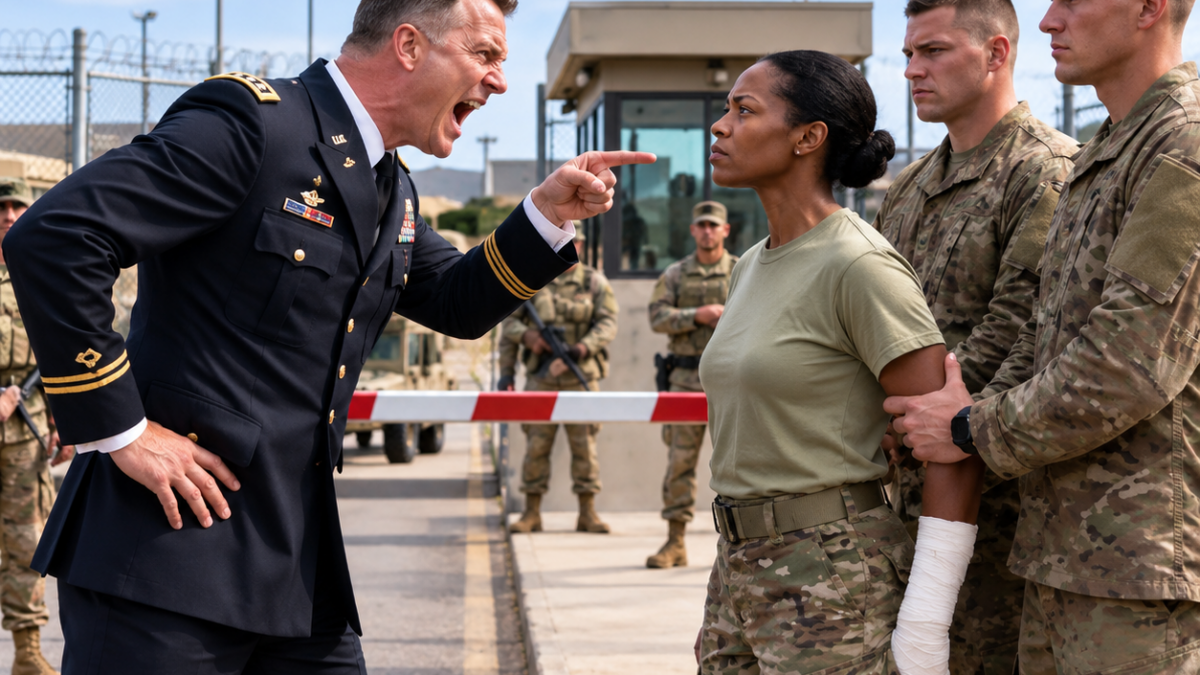
He saw a Black woman in wrinkled clothes, a cheap rental car behind her, and a field bandage around her arm—and decided I did not belong on the base I was arriving to command.
My name is Olivia Barnes.
Brigadier General, United States Army.
First Black woman appointed Deputy Commander of FORSCOM.
Daughter of Staff Sergeant William Barnes, a man who taught me to polish shoes before church, fold corners on a blanket tight enough to bounce a quarter, and arrive early enough that no one could accuse me of wasting their time.
“Early is on time,” my father used to say.
“On time is late.”
That rule followed me across every post, every deployment, every staff meeting, every airfield, and every command I ever earned.
It followed me into Georgia on the morning Colonel Stanton ruined his own life because he refused to read my name.
Fort Mercer sat on three thousand acres of flat Georgia clay.
From the air, it looked like a machine built into the earth. Long runways. Wide tarmac. Hangars big enough to swallow aircraft. Maintenance bays lined in exact rows. Fuel trucks moving in patterns. Black Hawks and Chinooks parked along the taxiways like steel birds waiting for weather to change.
On the ground, the base smelled like jet fuel, red dust, hot rubber, and coffee.
Everything had a place.
Every vehicle had a route.
Every uniform carried meaning.
Every rank mattered.
At least, that was what the Army told itself.
Colonel Grant Stanton had commanded Fort Mercer for eleven months.
He ran it like a man who believed every gate, every barracks, every hangar, every square foot of asphalt belonged personally to him. He walked the grounds every morning at 0600 with a clipboard in one hand and coffee in the other. His boots were always polished. His voice always carried farther than necessary. His opinion of who belonged on his base had never been flexible.
Stanton was fifty-four, square-jawed, silver at the temples, broad in the shoulders, and hungry for a star.
That was what people whispered.
That everything he did was measured against the promotion board he imagined watching.
Would this help his star?
Would this hurt his star?
Would this make him look decisive?
Would this make him look weak?
For eighteen months, he had been waiting for brigadier general.
Waiting can sour certain men.
Instead of humility, it breeds entitlement.
Instead of self-examination, it breeds resentment.
Stanton had four discrimination complaints locked in a drawer inside his office.
Four Black service members had filed them over three years.
Four officers and senior leaders whose records were cleaner than his conscience.
Four complaints that should have traveled up the chain.
Four complaints that disappeared before daylight touched them.
Stanton told himself it was about standards.
Not race.
He told himself that over and over until the lie wore grooves in his mind.
On that Tuesday morning, he was in a foul mood.
Six weeks earlier, the Pentagon informed him that Fort Mercer had been selected to host a change of command ceremony for the new Deputy Commander of FORSCOM.
The guest of honor and incoming deputy commander would arrive under escort at 1000 hours.
Forty Black Hawks from the 160th.
One three-star general.
Senior officers.
Public affairs cameras.
Formal remarks.
PART2:
A photograph that would land in Stanton’s file.
A ceremony like that could help a man get noticed.
It could also expose him.
So Stanton obsessed over everything.
The podium.
The flags.
The spacing of the chairs.
The order of salutes.
The aircraft parking plan.
The angle of the official photograph.
What he did not obsess over was the actual person coming to take command.
He had never met me.
Never seen my photograph.
Never cared to ask much beyond the words one-star general and Pentagon.
He assumed I would arrive in the manner he thought generals arrived.
Staff car.
Aide.
Uniform.
Stars visible.
Protocol announcing itself before the person stepped out.
He did not know I had already arrived.
At 0750, I pulled up to Fort Mercer’s main gate in a silver rental sedan that had been the cheapest available car at the counter in Atlanta.
I had landed at Hartsfield-Jackson at 0500 after a military transport out of Djibouti. The last seventy-two hours had been spent overseeing the final phase of a civilian evacuation out of Sudan.
Two hundred American citizens came home alive.
That was the part that mattered.
A piece of shrapnel had caught my left shoulder during the extraction.
That was the part I intended to deal with after the ceremony.
The wound had been cleaned in the field and wrapped tight enough to get me on the plane. I had not slept properly. I had not showered. I had not changed into my dress uniform. My blouse was gray and wrinkled. My slacks were dark. My shoes were flat. No insignia. No rank. No stars.
My left arm hung heavier than it should have.
Every heartbeat sent a pulse of heat through the bandage.
PART3:
I looked like a civilian woman who had taken the wrong exit, not a brigadier general about to assume one of the most consequential posts in the Army.
That was unfortunate.
It should not have mattered.
My plan was simple.
Check in at the gate.
Proceed to VIP quarters.
Shower.
Change.
Have the wound examined if time allowed.
Be ready when Lieutenant General Marcus Webb and the aviation escort arrived at 1000.
I was two hours early.
My father would have approved.
The private at the gatehouse was young.
Nineteen, maybe twenty.
He looked at my rental, then at me, then at the visitor list on his screen.
“Ma’am, do you have military ID?”
“My CAC was damaged during travel,” I said. “I have civilian ID and my name should be on the VIP entry list.”
He stiffened when he heard VIP.
“What name?”
“Barnes. Olivia Barnes.”
His fingers moved across the keyboard.
I watched his expression change.
Not recognition.
Confusion.
He scrolled twice, looked up, then down again.
“I have a Barnes on the ceremony list at 1000, ma’am, but it’s tied to rank designation. I don’t have civilian entry authorization under that name.”
“That is me.”
He hesitated.
That was the moment when a simple phone call should have solved everything.
Operations.
Protocol.
Administrative office.
Any one of them could have confirmed my identity in less than sixty seconds.
But the private touched the phone, then stopped.
His eyes shifted toward the road inside the base.
A man was walking toward us.
Even before I knew his name, I recognized his posture.
Not command.
Possession.
Colonel Grant Stanton arrived with his coffee in one hand, his clipboard under his arm, and irritation already arranged across his face.
He saw the rental first.
Then the bandage.
Then me.
Something cold settled behind his eyes.
He did not see a general.
He did not see a combat veteran.
He did not see a woman who had crossed continents to arrive early despite blood under her bandage.
He saw a Black woman in wrinkled civilian clothes at his gate.
And in less than ten seconds, he decided what I was.
He stopped three feet from the barrier.
“ID.”
No greeting.
No question.
No “How can we help you, ma’am?”
Just one word, flat and sharp enough to reduce a person before she spoke.
I reached into my bag with my right hand and pulled out my driver’s license.
He took it between two fingers like it was dirty.
His eyes flicked over it.
Half a second.
“Olivia Barnes,” he read aloud.
The private straightened.
“Sir, I have a Barnes on the VIP ceremony list, but—”
“Civilian authorization?” Stanton cut in.
“No, sir.”
Stanton turned back to me.
“No military ID. No authorization. No entry.”
“Sir, if you contact operations, they can confirm—”
“I’m not calling anyone for you.”
His voice did not rise.
It did not need to.
“You show up at my gate with no credentials, no uniform, looking like you slept in your car, and expect me to make phone calls on your behalf?”
“I arrived from overseas this morning,” I said. “There was no time to—”
“I don’t care where you arrived from.”
He held my license up between his fingers.
“This is the only thing you have shown me. And this tells me you are a civilian with no business on a military installation.”
Then he let it fall.
My driver’s license fluttered down and landed face up on the hot asphalt between us.
The private’s eyes dropped to it.
His jaw tightened.
He did nothing.
I looked at the license.
Then at Stanton.
For a moment, I heard my father’s voice.
Do not give a small man a large reaction.
I bent down slowly, the wound in my shoulder flaring as I reached. My fingers tightened around the warm plastic. I picked it up and slid it back into my bag.
Stanton watched with a small satisfied expression.
“Now leave.”
“Sir, I have legitimate business here today. I am asking you to verify with one phone call.”
He stepped closer.
Close enough for me to smell the coffee on his breath.
“Let me make something clear to you,” he said. “I am the commanding officer of this installation. I decide who walks through that gate. And I have decided you do not.”
He turned to the private.
“Close the barrier.”
The steel arm lowered with a mechanical hum.
I stood on the outside of Fort Mercer while the man who was supposed to support my arrival walked away as if I had ceased to exist.
He was already looking down at his phone before he reached the sidewalk.
I took out my own phone and dialed my advance officer.
No answer.
I called again.
Voicemail.
A third time.
Still nothing.
I turned slightly away from the gatehouse and made one final call to a number connected with the ceremony team.
This time a voice answered.
“I’m at Fort Mercer,” I said. “I cannot get through the gate. The commanding officer refused entry.”
A pause.
Then, “General, where exactly are you?”
“Main gate.”
“We’re trying to reach—”
The line cut.
Weak signal.
Or bad timing.
Maybe both.
I stood at the gate alone in Georgia heat.
The sun was climbing. The bandage on my arm itched beneath dried antiseptic. Sweat formed along my hairline. A Humvee rolled past inside the base and kicked up a thin cloud of dust. The driver glanced through the fence.
He looked away.
Ten minutes passed.
Then fifteen.
The private kept glancing at me, then at the phone, then toward the operations building.
I did not sit.
Did not lean against anything.
I stood the way I had been trained to stand.
Weight even.
Chin level.
Eyes forward.
That was when I heard boots.
Stanton was coming back.
This time, he was not alone.
Two military police officers walked behind him.
Both armed.
Both young enough to believe orders were solid things until the wrong one was placed in their hands.
Stanton stopped at the barrier.
His face had changed.
The dismissive amusement was gone.
Something harder had taken its place.
“I told you to leave.”
“Sir, someone is confirming my authorization.”
“You made a call?”
He laughed once.
Short.
Ugly.
“To whom? Who exactly is going to confirm that a woman with no credentials and no uniform has business on my base?”
“If you wait, this can be corrected.”
“I am done waiting.”
He turned to the MPs.
“Take her ID. Confiscate her phone. She may be attempting to impersonate military personnel.”
My stomach tightened.
“Sir, that is not what is happening.”
“Phone,” he said.
The younger MP stepped forward.
He was maybe twenty-three, brown-haired, pale-faced, jaw locked so hard I could see the muscle working.
“Ma’am,” he said quietly, “your phone, please.”
I looked at him for a long moment.
His eyes did not meet mine.
“What is your name?”
He swallowed.
“Specialist Reeves, ma’am.”
“Specialist Reeves, you understand this will be reviewed.”
His hand trembled slightly.
“I have my orders, ma’am.”
That sentence has ruined better men than him.
I placed the phone in his palm.
The second MP took my bag, searched quickly, and found exactly what he should have found.
A change of clothes.
Toiletry bag.
Leather folder.
No weapons.
No fake identification.
No threat to anyone except Grant Stanton’s assumptions.
A small crowd gathered beyond the barrier.
Three soldiers from a maintenance crew.
A lieutenant from the operations building.
Two civilian contractors near the motor pool, one already holding a phone.
Stanton turned toward them.
He did not lower his voice.
“This woman arrived at my gate with no military identification, no authorization, and a story about having an appointment. She is not welcome here. Anyone with concerns may file them through my office.”
No one spoke.
Fear makes crowds quiet.
Rank makes fear polite.
Stanton faced me.
“You have five minutes to get to the main road. After that, you will be arrested for trespassing on a federal installation.”
I looked at him.
“You are making a mistake, Colonel.”
His mouth tightened.
“The only mistake here is you thinking you could walk onto my base.”
My base.
There it was.
Not the Army’s.
Not the nation’s.
His.
He leaned forward.
“I know exactly who belongs here.”
“No,” I said quietly. “You do not.”
His face flushed.
“Get her out of here.”
The two MPs stepped to either side of me.
Reeves gestured toward the road.
“Ma’am, please come with us.”
I looked at Stanton once more.
He had already turned his back.
I started walking.
The walk from the main gate to the edge of the installation took four minutes.
The asphalt radiated heat through my shoes. My bandaged arm throbbed with each step. Reeves walked on one side. The older MP walked on the other. Their boots struck the ground in unison.
I could feel eyes on my back.
The maintenance crew still watching.
The lieutenant still outside.
A contractor still recording.
I did not turn around.
I did not speed up.
I walked the way I had walked across tarmacs in Djibouti, across airfields in the Gulf, across landing zones where the ground was still warm from ordnance.
Steady.
Measured.
One foot in front of the other.
Reeves cleared his throat.
“Ma’am.”
“Yes, Specialist?”
“I’m sorry about this.”
He kept looking straight ahead.
“How long have you been stationed here?”
“Eight months, ma’am.”
“Has he done this before?”
Reeves did not answer.
His silence was answer enough.
When we reached the main road, the older MP stopped.
“This is as far as we go, ma’am. Colonel’s orders are that you do not return to the gate.”
I nodded.
The two MPs hesitated, then turned back toward the base.
I stood alone on the shoulder.
No phone.
No vehicle.
No shade.
No water.
Left arm swelling beneath the bandage.
Ceremony less than ninety minutes away.
Behind me, Fort Mercer shimmered in the heat.
Ahead of me stretched Georgia asphalt in both directions.
Flat.
Bright.
Empty.
I did not know the ceremony fleet had already lifted off from Fort Campbell.
I did not know Lieutenant General Marcus Webb was sitting in the lead Black Hawk reviewing change-of-command paperwork with my name on every page.
I did not know that in less than an hour, the sky above Fort Mercer would darken with helicopters.
All I knew was that I was standing on the side of a road outside the base I had arrived to command because a colonel had looked at me and decided I was nothing.
So I waited.
Twenty minutes passed.
The sun climbed higher.
My blouse stuck to my back.
The bandage dulled from white to brown where dust and sweat mixed with antiseptic. The heat in my shoulder spread toward my elbow. Every heartbeat pulsed through the wound.
A truck passed.
The driver slowed.
Looked at me.
A Black woman standing alone on the shoulder, bandaged and sweating.
Then he kept driving.
A second car passed two minutes later.
Same thing.
Eyes forward.
No stop.
People tell themselves they would stop.
Sometimes they do.
Often, they calculate risk from behind glass and keep moving.
I thought about my father.
Staff Sergeant William Barnes.
Twenty-four years in uniform.
Never made officer.
Never given the chance.
He had taught me that the Army did not owe me respect.
“You earn it,” he used to say. “And once you earn it, nobody can take it from you.”
I looked down at the asphalt, heat rippling around my shadow.
Nobody can take it from you, I thought.
But they can make you stand in the sun while they pretend not to see it.
Inside the base, Stanton had already forgotten me.
He stood in the operations building reviewing ceremony logistics with Captain Reynolds, his executive officer.
Reynolds was thirty-four, careful, observant, and far better at writing down what mattered than Stanton realized.
“The fleet’s ETA?” Stanton asked.
“1000, sir. Forty Black Hawks from the 160th. Lead aircraft carries Lieutenant General Webb and the new deputy commander.”
“She’s supposed to arrive separately?”
“Yes, sir. Advance team confirmed she would be on base by 0800.”
Stanton checked his watch.
0840.
“Has anyone seen her?”
“No, sir. No check-in at the gate. No contact from staff.”
Stanton shrugged.
“She’s late. Not my problem.”
Reynolds hesitated.
“Should we try to reach her team?”
“If a general cannot find her way to a military base on time,” Stanton said, “that tells me everything I need to know about her.”
Reynolds said nothing.
But he wrote the sentence in his notebook.
He had been writing them down for months.
Outside, the tarmac filled with activity.
Chairs were placed in precise rows near Hangar Four. The podium was draped in FORSCOM colors. The band warmed up under a patch of shade. Soldiers in dress uniforms assembled and adjusted covers, ribbons, cuffs, collars.
Flags were unfurled.
Microphones tested.
Photographers positioned.
Everything moved toward 1000 hours like a machine.
Half a mile away, I stood in the sun with no way to tell anyone where I was.
Back at the gate, the young private who had watched Stanton drop my ID onto the asphalt stared at his phone.
A clip had been circulating among junior enlisted for three weeks.
Pentagon press briefing.
Announcement of the new Deputy Commander of FORSCOM.
Historic appointment.
First Black woman selected for the role.
The clip included a photograph.
The private looked at the photograph.
Then through the gatehouse window toward the road.
His hands began shaking.
He picked up the gatehouse phone and called operations.
No answer.
He called again.
No answer.
He set the phone down.
He told himself he was a private.
Stanton was a colonel.
There was nothing he could do.
Then he looked at the photograph again.
Some moments divide a life.
Before I knew.
After I knew.
The private picked up the phone a third time.
This time he called Captain Reynolds directly.
At 0915, the air changed.
Faint at first.
A low vibration more felt than heard.
The kind of sound that arrives in the bones before the ears understand it.
Soldiers near the hangar felt it first.
Conversation stopped.
Band members lowered instruments.
Flags began to flutter though there was no wind.
The vibration grew into a deep rhythmic thudding rolling from the north like thunder that refused to fade.
On the road, I heard it too.
I closed my eyes.
I knew that sound like I knew my own heartbeat.
I had commanded formations like that.
I had stood beneath rotor wash in deserts, mountains, flood zones, evacuation corridors, and combat landing zones. I knew the sound of a full flight approaching the way a conductor knows the first note of a symphony.
They were early.
I opened my eyes and looked north.
The horizon was still empty.
But the sound was everywhere.
Pressing against my chest.
Inside the base, the first call came into the tower at 0918.
“Fort Mercer Tower, Viper Lead. Flight of forty inbound from the northwest. ETA eight minutes. Request landing clearance for Tarmac Alpha.”
The tower cleared them.
Then called operations.
“Sir, ceremony fleet inbound. Forty aircraft. Eight minutes out.”
Captain Reynolds grabbed his cover.
“Colonel, they’re early.”
Stanton straightened his tie.
“Good.”
He walked toward the tarmac thinking about his star.
Not the woman at the gate.
Not the road.
Not the name he had failed to read.
On the horizon, black dots appeared.
They grew larger.
Four columns of ten, perfectly spaced, cutting across the sky.
Eighty rotors thundered overhead.
The ground trembled.
Coffee cups rattled on desks.
Windows buzzed in their frames.
The flags whipped hard against their poles.
The entire base looked north.
Stanton stood at the front of the ceremony area, hands behind his back, chin high, chest out.
This was the moment he wanted.
The photograph.
The handshake.
The three-star general stepping onto his tarmac.
The first Black Hawk touched down on the far end of Tarmac Alpha.
Rotor wash hit like a wall.
Dust exploded across concrete.
Soldiers shielded their faces.
The second helicopter landed.
Then the third.
Then the fourth.
They came down in sequence, one every few seconds, precise as a clock counting backward to something inevitable.
Forty Black Hawks settled onto the tarmac.
The turbines began winding down.
Dust cleared slowly.
For a moment, Fort Mercer stood silent inside the echo.
Then the side door of the lead aircraft slid open.
Lieutenant General Marcus Webb stepped out.
Three silver stars on each shoulder.
Broad-shouldered.
Tall.
Jaw set like granite.
Uniform immaculate.
He did not smile.
He did not wave.
He did not look at the podium or the band or the chairs Stanton had arranged so carefully.
He walked directly toward Stanton.
Stanton stepped forward, extending his hand.
Best handshake.
Firm.
Two pumps.
Eye contact.
Webb did not take it.
“Where is she?”
Stanton’s hand hung in the air.
“Sir?”
“Brigadier General Barnes. Where is she?”
Stanton blinked.
“Sir, no general has arrived on this base. We have been waiting.”
“I am not asking whether you have been waiting.”
Webb’s voice dropped to a register that made the nearest soldiers take a half step back.
“I am asking where she is.”
Stanton’s mouth tightened.
“Sir, we received no authorized arrival—”
“Olivia Barnes,” Webb said. “One star. Five-foot-eight. Left arm in a field bandage. Driving a rental sedan from Atlanta. Her advance team confirmed she arrived at this installation over an hour ago.”
Each detail struck Stanton separately.
One star.
Bandage.
Rental sedan.
Atlanta.
The color began to leave his face.
The soldier closest to him saw it happen.
First his cheeks.
Then forehead.
Then neck.
“Sir,” Stanton said, voice cracking slightly, “there was a woman at the gate this morning. Civilian clothes. No military ID. I had her escorted off the installation.”
Webb went still.
Not angry in the loud way.
Worse.
Still in the way a detonator is still before pressure meets fire.
“You had her escorted off.”
“She had no credentials, sir. No uniform. Standard protocol for unauthorized—”
“Where is she right now, Colonel?”
Stanton’s mouth opened.
Closed.
“I had the MPs take her to the main road.”
Webb turned.
He looked past the gate.
Past the perimeter fence.
Down the long straight road beyond the installation.
And there I stood.
Half a mile away.
Gray blouse dark with sweat.
Left arm hanging heavy.
No phone.
No vehicle.
No shade.
Standing on the shoulder of the road, watching forty Black Hawks sitting on the tarmac I was supposed to command from.
Webb stared for three seconds.
His jaw tightened so hard the muscles in his neck stood out.
Then he turned back to Stanton.
“You marched a brigadier general off your own base.”
His voice was quiet now.
“You took her identification. You confiscated her phone. You sent military police to escort her to the road like a criminal. And she is the officer appointed by the Secretary of the Army to be your superior.”
It was not a question.
None of it was.
Stanton’s right knee gave first.
Then his left.
He went down on the tarmac like a building collapsing from inside.
His hands hit concrete.
His forehead followed.
He knelt there on all fours in the center of Fort Mercer, surrounded by forty Black Hawks and three hundred soldiers who had just watched their commanding officer understand exactly what he had done.
His mouth moved.
No sound came out.
Webb had already turned away.
He walked toward the gate.
Three stars caught sunlight with every step.
Behind him, the base remained silent.
No one spoke.
No one moved.
Only cooling engines ticked and boots struck pavement as a three-star general went to collect the woman who should have been at the podium.
The private at the gatehouse stood so fast he knocked his coffee off the desk.
Webb did not pause.
He passed the barrier and walked down the road toward me.
I saw him coming.
At first, I recognized the rank before the face.
My body responded automatically.
Back straight.
Chin level.
Shoulders square despite the pain.
He stopped three feet in front of me.
Looked at my arm.
My sweat-soaked blouse.
My dusty shoes.
My face.
I did not salute.
No cover.
He understood.
“General Barnes,” he said quietly, “are you injured?”
“I’m fine, sir.”
“Your arm.”
“Shrapnel. Sudan. It can wait.”
Webb studied me for a moment.
Then reached into his pocket and handed me his phone.
“Call your team. Tell them you’re here.”
I took it.
My hand was steady.
I dialed.
When my aide answered, I said four words.
“I’m at the gate.”
Then I handed the phone back.
Webb turned and walked beside me toward Fort Mercer.
We did not speak.
Some silences are more respectful than any speech.
When we reached the gate, the private was still at attention. His face was white. His eyes were wet.
“Ma’am,” he said, voice tight. “I’m sorry, ma’am.”
I looked at him.
He was nineteen.
He had recognized me.
He had been afraid.
Both facts could be true.
I nodded once.
Then kept walking.
The tarmac was exactly as it had been described in the ceremony plan.
Chairs.
Podium.
Band.
Flags.
Soldiers.
Aircraft.
Except now forty Black Hawks surrounded it, and at the center of everything Colonel Grant Stanton was still on his knees.
Two MPs stood near him.
Not the ones who had walked me down the road.
Different MPs.
Stanton was not restrained.
He did not need to be.
He had no strength left.
Webb stepped to the podium and picked up the microphone.
The speakers cracked across the tarmac.
“This ceremony will proceed,” he said, his voice carrying across the entire installation. “But before it does, there is a matter that will be addressed.”
He turned toward Stanton.
The MPs lifted him to his feet.
His uniform was stained with dust.
His tie crooked.
His eyes unfocused.
“Colonel Grant Stanton,” Webb said into the microphone, “effective immediately, you are relieved of command of Fort Mercer. You are suspended from all duties pending a formal investigation into your conduct this morning and into multiple prior complaints of racial discrimination that appear to have been suppressed during your tenure.”
The words moved across the tarmac like weather.
Every soldier heard them.
Every pilot still sitting in a cockpit heard them.
Every person who had watched me get walked off the base heard them.
“Your security clearance is suspended. Your access to classified systems is revoked. You will be escorted to your quarters to collect essential personal items. You will depart this installation by 1800 hours pending further orders.”
Stanton swayed.
One MP steadied him by the elbow.
“Do you understand these orders, Colonel?”
Stanton’s lips moved.
A whisper came out.
“Yes, sir.”
“Remove him from the tarmac.”
The MPs turned him around.
He walked toward the operations building without looking back.
His boots dragged.
The soldiers parted to let him through, then closed behind him as if his space in formation had never existed.
Webb set down the microphone.
He turned to me.
“General Barnes, your uniform is waiting in VIP quarters. Take whatever time you need.”
I nodded.
My aide appeared at my side with a garment bag.
I walked toward the quarters building without hurrying.
Back straight.
Chin level.
I did not look at the place where Stanton had knelt.
Thirty minutes later, I returned in dress uniform.
The stars on my shoulders caught the light.
My bandaged arm was hidden beneath the sleeve.
My shoes were polished.
My posture was not performance.
It was history.
It was my father ironing uniforms on a Sunday night.
It was every instructor who underestimated me until scores came back.
It was every deployment.
Every after-action review.
Every door opened late.
Every door shut early.
Every time someone looked past me and then later realized I was the person they had come to see.
The band played.
Soldiers saluted.
The ceremony proceeded exactly as planned, with one exception.
The commanding officer’s chair was empty.
I accepted the flag.
I took the podium.
For six minutes, I spoke.
Not about Stanton.
Not about the gate.
Not about the road.
Not about standing in Georgia heat with shrapnel still in my shoulder and no phone in my hand.
I spoke about service.
About what it means to wear a uniform that is bigger than one person’s opinion of who deserves to wear it.
About soldiers.
Families.
Sacrifice.
Standards.
Trust.
I looked at the rows of service members before me.
Some looked ashamed.
Some angry.
Some relieved.
Some afraid.
All of them listening.
“Rank,” I said, “is not ownership. Command is not possession. Authority is not permission to stop seeing people clearly.”
Webb stood behind me, hands clasped, jaw set.
I continued.
“We are judged not only by how we treat those above us, but by how carefully we see those we believe have nothing to give us.”
No one moved.
“A uniform can identify a soldier. It cannot create integrity. That part is tested when nobody thinks they are being watched.”
I did not mention the gatehouse private.
But I saw him standing near the back.
His shoulders shook once.
When I finished, the applause lasted longer than any formal applause I had heard in years.
It was not polite ceremony applause.
It was the sound of three hundred people who had watched something ugly happen that morning and were now watching the record correct itself.
The investigation began before Stanton left the tarmac.
Webb made one call.
That call reached the Inspector General’s office.
Within thirty minutes, investigators arrived with laptops, encrypted drives, and authority to open every drawer in Stanton’s office.
The locked drawer came first.
Inside were four manila folders.
Four formal complaints.
Captain Denise Walters had filed hers fourteen months earlier.
She had earned a promotion Stanton denied. In front of witnesses, he told her certain positions required “a certain look.” She had names. Dates. A phone recording. Her complaint disappeared within forty-eight hours.
Major Kevin Pratt filed eleven months earlier.
He had requested transfer to a special operations unit. Stanton blocked it, claiming Pratt was “not the right fit.” Pratt had the highest qualification scores in his battalion. Two Bronze Stars. Letters from generals. None of it mattered.
Lieutenant Alicia Dempsey filed seven months earlier.
Stanton pulled her from a training exercise in front of her unit and told her she was making other officers uncomfortable.
When she asked how, he said, “You know how.”
She was the only Black officer in the exercise.
First Sergeant Raymond Cole filed three months before my arrival.
Twenty-two years of service.
Four deployments.
Purple Heart.
Respected by every enlisted soldier who knew his name.
Stanton passed him over for a command position despite Cole being the only qualified candidate.
When Cole confronted him, Stanton said, “I pick people I trust.”
Four complaints.
Four Black service members.
Four times the evidence was documented.
Four times Stanton made it disappear.
Then investigators pulled main-gate footage.
The cameras had captured everything.
My rental sedan.
Stanton walking to the barrier.
The license falling to the asphalt.
The phone taken from my hand.
The bag search.
The crowd.
The MPs walking me down the road.
Me standing alone in the sun half a mile from the base I was supposed to command.
Every second was timestamped.
There was no ambiguity.
No room for Stanton to claim misunderstanding.
No procedural fog.
No honest mistake.
The footage showed a colonel looking at a Black woman and deciding before he knew anything else that she did not belong.
By noon, soldiers who had recorded the confrontation on personal phones gave statements.
Fourteen separate recordings.
Different angles.
One caught Stanton calling me an impersonator.
Another captured the young MP’s apology.
A third filmed the entire walk from the gate to the highway shoulder.
Every witness said the same thing.
They wanted to intervene.
They were afraid.
Afraid of Stanton.
Afraid of what he could do to careers.
Afraid because they had seen what happened to Walters, Pratt, Dempsey, and Cole.
The two MPs who escorted me off base were suspended pending review.
Both said they followed a direct order.
One of them, Reeves, broke down during his interview.
He said he knew something was wrong.
He said I did not resist.
Did not argue.
Did not raise my voice.
He said my arm was clearly injured.
He said he wanted to stop.
Then he said the sentence that mattered most.
“I didn’t think I had enough rank to do the right thing.”
That sentence traveled.
It became the question Fort Mercer had to answer.
How had one man built a command climate where soldiers believed rank mattered more than right?
The board of inquiry convened that afternoon.
Evidence overwhelmed the room.
Four buried complaints.
Fourteen phone recordings.
Two hours of security footage.
Twenty-six witness statements.
Financial records.
Email chains.
Promotion boards.
Transfer denials.
A pattern stretching back three years.
Stanton’s relief became permanent.
His promotion packet was withdrawn.
His command record collapsed.
His name came down from the wall outside the operations building before sundown.
Captain Walters received her overdue promotion.
Major Pratt’s special operations transfer was approved.
Lieutenant Dempsey was reinstated to the training program Stanton had removed her from.
First Sergeant Cole got the command position he had earned.
Three years late.
Still necessary.
Four wrongs corrected in public because one colonel finally made his prejudice visible in front of the wrong sky.
A forty-three-second video reached the internet that evening.
A soldier had recorded Stanton pointing at me through the gate.
The caption read:
Colonel kicks woman off base. She’s his new boss.
By morning, millions had seen it.
News networks called.
The Pentagon issued a statement.
Fort Mercer’s public affairs office nearly collapsed under the volume.
My father’s neighbors saw the clip before I could call him properly.
His barber saw it.
The woman at his grocery store saw it.
Everyone saw what I had not told him the night before.
That evening, after surgery removed the piece of shrapnel from my shoulder, I called my father from the base phone.
He was seventy-eight, living alone near Fort Bragg in the small house where he still kept his shoes lined up by the door.
He answered on the third ring.
“Liv?”
“Hi, Daddy.”
“How was the ceremony?”
I looked at the bandage on my arm.
At the empty plate my aide had brought.
At the window facing the tarmac.
“It went well.”
“Band play right?”
“Yes, sir.”
“Soldiers sharp?”
“Yes, sir.”
“You get there early?”
A laugh caught in my throat.
“Yes,” I said. “Just like you taught me.”
“That’s my girl.”
He sounded proud.
I let him have that version for one night.
He would see the rest tomorrow.
The base was quiet after dark.
The Black Hawks had been towed into hangars.
Chairs stacked.
Podium removed.
Flags folded.
In Stanton’s quarters, his name was being taken off the door.
I sat on the edge of the bed and thought about the soldiers who watched me get walked to the road.
The ones who recorded.
The ones who froze.
The private who recognized me from a Pentagon video and still did not know how to speak across rank.
The MPs who followed orders.
The officers who had already learned that Stanton punished truth.
I did not think of Stanton with satisfaction.
Not exactly.
I thought of him as a wall that had stood in a hallway too long.
A wall that mistook itself for structure.
A wall that was finally removed.
In the morning, I put on my uniform carefully.
My left shoulder hurt.
I pinned the star to my collar.
Then I walked to my new office.
The hallway was long.
The floors polished.
Every soldier I passed saluted.
I returned each one.
At the end of the hall, my office window faced the tarmac.
The same tarmac where I had been told I did not belong.
The same tarmac where forty Black Hawks landed to prove that the world does not become true because one man refuses to read a name.
I sat behind the desk.
Opened the first file.
Started working.
No speech.
No declaration.
No dramatic announcement.
Just the job.
That was what I had always done.
Show up early.
Do the work.
Let the world catch up.
The private from the gatehouse stood outside my office at 0900.
His uniform was immaculate.
His eyes were red.
My aide asked if I wanted him sent away.
“No,” I said. “Send him in.”
He entered, stopped three paces from my desk, and stood rigid.
“General Barnes, Private First Class Aaron Miller reporting.”
“Stand at ease, Miller.”
He tried.
Failed.
I let him fail for a moment.
Then said, “You recognized me.”
His throat moved.
“Yes, ma’am.”
“You tried to call operations.”
“Yes, ma’am.”
“You did not stop Colonel Stanton.”
“No, ma’am.”
“Why?”
His eyes dropped.
“I was afraid.”
I appreciated the honesty.
“What are you afraid of now?”
He looked up, startled.
“I don’t know, ma’am.”
“That is better than pretending.”
He said nothing.
I leaned back carefully to avoid pulling the stitches in my shoulder.
“Private Miller, I am not interested in destroying a nineteen-year-old soldier for learning too late what fear feels like. But you will learn the right lesson from yesterday.”
“Yes, ma’am.”
“The lesson is not that you should have shouted at a colonel alone at the gate. The lesson is that systems must exist so the truth does not depend on the courage of the lowest-ranking person in the room.”
His eyes filled.
“Yes, ma’am.”
“You will provide a full statement to investigators. You will tell the truth, including your fear. Then you will report to Captain Reynolds. He is building a recommendation packet for gate protocol reforms.”
He blinked.
“Ma’am?”
“You recognized a failure before anyone else did. You will help ensure the next private has a process stronger than fear.”
His posture changed.
Not relaxed.
Strengthened.
“Yes, ma’am.”
“Dismissed.”
He saluted.
I returned it.
After he left, I looked out at the tarmac.
Fort Mercer had a new commander.
Not because helicopters landed.
Not because a colonel collapsed.
Not because cameras captured what Stanton had done.
Those things revealed reality.
They did not create it.
I belonged there before the first Black Hawk touched down.
I belonged there when I stood at the gate.
I belonged there when my ID hit the asphalt.
I belonged there when I walked to the road under armed escort.
I belonged there when passing cars did not stop.
I belonged there when I stood in the heat, wounded and waiting, while a man in polished boots congratulated himself for keeping me out.
Stanton had mistaken delay for power.
That is a mistake men like him often make.
They believe if they can hold a gate long enough, they can decide who belongs beyond it.
But gates are not truth.
Rank is not truth.
Prejudice wearing a uniform is still prejudice.
A clipboard is not command.
A loud voice is not leadership.
And a man who refuses to read your name does not get to decide where you belong.
Years later, people would tell the story in a simpler way.
A colonel marched a Black woman off his base.
Then forty Black Hawks landed for her.
That version has drama.
It has a clean reversal.
It makes people cheer.
But the truth is heavier.
The truth is that four officers had been waiting years for someone to open a locked drawer.
The truth is that soldiers had learned to survive by staying quiet.
The truth is that two MPs followed an order that should have sounded wrong in their bones.
The truth is that one private recognized me and still felt too small to act.
The truth is that I stood on a road with shrapnel in my shoulder, not because I lacked proof, but because proof does not matter to a man determined not to see it.
And the truth is that when the helicopters came, they did not make me worthy.
They made Stanton’s blindness impossible to hide.
That was the real landing.
Not aircraft on tarmac.
Truth arriving with enough force to shake the windows.
By the end of my first week, new gate protocols were drafted.
VIP verification required redundant confirmation before denial.
Confiscation of civilian property required documented legal authority.
Military police could request direct supervisory review when orders appeared improper.
Discrimination complaints moved into an external tracking system Stanton could never have locked in a drawer.
Officers attended mandatory command climate review.
Not the performative kind.
The uncomfortable kind.
Names.
Dates.
Files.
Failures.
We held listening sessions with junior enlisted.
At first, they spoke carefully.
Then honestly.
A sergeant said Stanton had once inspected a Black lieutenant’s hair in front of her platoon.
A civilian contractor said he had been called “help” by officers who knew his name.
A maintenance chief admitted he saw me at the gate and looked away because Stanton had ruined careers for less.
Nobody enjoyed those sessions.
Good.
Comfort is often where rot hides.
Captain Reynolds became acting installation commander under my oversight until a permanent replacement arrived.
He gave investigators his notebook.
Months of quotes.
Dates.
Orders.
Offhand remarks.
The kind of details people dismiss as small until they form a pattern too clear to deny.
When I asked why he had kept them, he said, “I thought someday someone would ask.”
“Why didn’t you report earlier?”
He looked at the floor.
“Because I thought no one would.”
There were many versions of that sentence at Fort Mercer.
I thought no one would listen.
I thought he would bury it.
I thought I would lose my assignment.
I thought it would hurt my promotion.
I thought I did not have enough rank.
I thought someone else would speak first.
The work after Stanton was not just punishing one man.
It was dismantling the climate that had allowed him to become inevitable.
One afternoon, First Sergeant Raymond Cole came to see me.
He was fifty, broad, tired-eyed, and carried himself with the contained dignity of a man who had survived both war and bureaucracy.
He stood in my office and saluted.
“At ease, First Sergeant.”
He relaxed slightly.
“Congratulations on the command position,” I said.
“Thank you, ma’am.”
“Long overdue.”
“Yes, ma’am.”
No bitterness in the words.
That made them worse.
I gestured to the chair.
He sat.
For a moment, neither of us spoke.
Then he said, “When I saw you on that road, I knew.”
“Knew what?”
“That if he’d do it to you, none of us were imagining anything.”
I nodded.
“People spend years wondering whether they are overreacting.”
“Yes, ma’am.”
“You were not.”
His jaw tightened.
“I know that now.”
“Do you?”
He looked at me.
“You knew it then too, First Sergeant. The system just refused to confirm it.”
He swallowed.
“Yes, ma’am.”
That is another kind of harm.
Making people doubt what they know happened to them.
After he left, I wrote a memo requiring every command climate complaint filed in the previous five years at Fort Mercer to be externally reviewed.
Not because every complaint would prove misconduct.
Because every one deserved daylight.
Stanton’s defenders appeared, as they always do.
Not many.
But enough.
A retired colonel on television said standards had collapsed if officers could be punished for gate security decisions.
A pundit asked whether the Army was overreacting to a “protocol misunderstanding.”
An anonymous source claimed Stanton was “old school” but not discriminatory.
I did not respond publicly.
The evidence did.
Footage.
Complaints.
Witnesses.
Recordings.
My ID on asphalt.
My phone taken.
Me walking half a mile beside armed MPs.
The locked drawer.
Sometimes restraint is not silence.
Sometimes restraint is refusing to wrestle with people who are arguing against a record already clear enough to convict them in history.
My father finally called after seeing the video.
I let it ring twice before answering.
“Liv.”
“Yes, Daddy.”
Silence.
Then his breath shook.
“I saw it.”
“I know.”
“That man threw your ID on the ground.”
“Yes.”
“He made you walk?”
“Yes.”
“With your arm like that?”
“Yes.”
I heard him move, maybe sit down.
For a long time, he said nothing.
Then:
“I should’ve been there.”
That nearly broke me.
“Daddy, no.”
“I should’ve been standing at that gate.”
“No,” I said, firmer. “You already were.”
He went quiet.
“Everything I did yesterday, I learned from you.”
His voice changed.
“Don’t you make me cry on my own phone.”
I laughed once.
So did he.
Then he said, “You get there early?”
I smiled.
“Yes, sir.”
“That’s my girl.”
A month later, he visited Fort Mercer.
I met him at the gate in uniform.
Staff Sergeant William Barnes, retired, stepped from a government sedan wearing a brown suit and polished shoes. Seventy-eight years old. Slower than before. Still straight-backed.
He looked at the gatehouse.
Then at me.
“Here?”
“Yes.”
He stared at the asphalt where my license had fallen.
Nothing marked the spot.
He seemed to see it anyway.
The private on duty saluted.
My father returned it instinctively, then remembered he was retired and frowned at himself.
I nearly laughed.
He walked through the gate beside me.
No one stopped him.
On the tarmac, he saw the line of Black Hawks parked in the distance.
“Heard they brought forty of them.”
“Yes.”
He nodded.
“Seems about right.”
“Daddy.”
“What?”
“That’s excessive.”
He looked at me.
“For you? No.”
He was impossible.
I showed him my office.
The window.
The desk.
The flag.
He walked around the room slowly, touching nothing. Then he stopped behind the chair and looked at my nameplate.
BRIGADIER GENERAL OLIVIA BARNES
DEPUTY COMMANDER
His hand hovered over it.
Did not touch.
“Sit,” I said.
He blinked.
“What?”
“Sit in the chair.”
“No.”
“Daddy.”
“That’s your chair.”
“I know.”
He frowned.
“You ordering me, General?”
“Yes.”
He sat.
Carefully.
As if the chair might reject him.
It did not.
He looked out at the tarmac.
The same tarmac where Stanton collapsed.
The same tarmac I now commanded from.
My father’s eyes shone.
“They never let me sit in rooms like this,” he said.
“I know.”
He ran one hand across his knee.
“Good thing they let you.”
I looked at him.
“They did not let me. I got here.”
He smiled.
“That’s my girl.”
After Stanton, Fort Mercer did not become perfect.
No place does.
The point was not perfection.
The point was accountability strong enough that people no longer had to wait for forty helicopters to prove what should have been verified with one phone call.
That became my first standard.
Not appearance.
Not comfort.
Not whether someone fit a commander’s personal idea of belonging.
Procedure.
Evidence.
Respect.
Records.
Names.
You read the name.
You verify the claim.
You treat the person in front of you with dignity until facts require otherwise.
That is not softness.
That is discipline.
Stanton had thought cruelty made him strong.
It made him sloppy.
His prejudice made him careless.
Carelessness ended him.
Six months after I took command, Fort Mercer hosted another ceremony.
Smaller.
No national attention.
Captain Denise Walters received her promotion in front of her unit.
Major Kevin Pratt departed for the special operations assignment Stanton had blocked.
Lieutenant Alicia Dempsey completed the training program from which she had been removed.
First Sergeant Cole took command before a formation that cheered louder than regulations preferred.
The gatehouse private, Miller, stood in the back.
Still young.
Still learning.
But no longer invisible.
Afterward, he approached me.
“Ma’am.”
“Yes, Private?”
“I read the new protocol manual.”
“That is not usually a sentence people volunteer.”
He almost smiled.
“There’s a part about escalation when rank pressure conflicts with verification.”
“I know.”
“Did you write that?”
“Yes.”
He nodded.
“Good.”
Then he looked embarrassed.
“Sorry, ma’am.”
“No,” I said. “Good is acceptable.”
He left standing taller.
That mattered.
Not because one private had become brave overnight.
Because he now had a process behind him.
Courage is important.
Systems are what protect people when courage alone is not enough.
Years later, I would still be asked about that day.
Reporters wanted the dramatic answer.
What did it feel like when forty Black Hawks landed?
What did Stanton’s face look like?
Did you feel vindicated?
Did you enjoy watching him fall?
The honest answers were not what they wanted.
The helicopters were loud.
Stanton looked like a man realizing the world had recorded him clearly.
Vindication felt less satisfying than people imagine.
And no, I did not enjoy watching him fall.
I enjoyed the drawer opening.
I enjoyed Walters getting her promotion.
I enjoyed Pratt getting his transfer.
I enjoyed Dempsey returning to training.
I enjoyed Cole receiving the command he earned.
I enjoyed watching Miller help rewrite the process that had failed him.
I enjoyed my father sitting in my office chair.
Stanton falling was not the victory.
The people he had buried rising was.
That is what I remember most now.
Not the heat.
Not the road.
Not the insult hidden in his voice when he said I did not belong.
I remember the sound after the Black Hawks shut down.
Three hundred soldiers holding their breath.
A base forced into honesty.
A man who loved authority discovering it was never the same as power.
And then, finally, work.
Because once the spectacle passed, the real task began.
Files needed review.
Careers needed repair.
Policies needed rewriting.
Trust needed rebuilding.
The Army does not heal because one bad officer is removed.
It heals when the next one finds fewer hiding places.
That was my job.
So when people ask me what I did after Colonel Stanton marched me off his base, I tell them the truth.
I stood in the sun.
I waited.
The helicopters came.
The truth landed.
And then I sat down at the desk I had earned and got to work.








