Cars Kept Driving Past a Stray Cat Lying Motionless in the Road—Until My Son and I Finally Stopped. What My Little Boy Said Broke My Heart. Every Forgotten Animal Deserves Someone Who Cares.
PART3:
Maybe children move differently when they believe something can still be saved.
He got out and hurried toward the cat while I stepped into the road and lifted one hand at an approaching car.
The driver slowed.
Not stopped.
Slowed.
Passed.
My son crouched.
I watched his shoulders.
For one second, I let myself believe.
Maybe it was stunned.
Maybe injured.
Maybe breathing so lightly we couldn’t see.
Maybe if we got it into the car fast enough—
My son reached out.
Stopped before touching it.
Looked back at me.
His face changed.
Children have expressions adults cannot fake.
There is a moment when hope leaves them before they know how to hide it.
“Daddy.”
I walked closer.
He swallowed.
“The cat is already dead.”
I wish I could explain why those words hurt as much as they did.
It was not our cat.
We had never seen it before.
We did not know its name.
It probably did not have one.
We did not know where it slept.
What it ate.
Whether it had kittens somewhere.
Whether it had ever belonged to someone.
Whether anyone was looking for it.
Whether anybody had ever held it.
Maybe it had been born behind a restaurant.
Maybe under a building.
Maybe in a drainage pipe.
Maybe its mother had been another stray who disappeared one day.
We knew nothing.
And yet when my son said those words, I felt grief.
Real grief.
Small compared with losing someone you love.
Of course.
But grief still.
The kind that rises before your mind has time to decide whether you are entitled to it.
I stood over that little body and saw what traffic does to a small animal.
I will not describe it.
There are details I do not want to carry more clearly than I already do.
There was no blood everywhere.
Nothing dramatic like people imagine.
That almost made it harder.
The cat looked as if it might simply stand up if the world became quiet enough.
But it would not.
I bent down.
My son asked:
“Can we take it to the vet?”
I looked at him.
He still wanted another answer.
Even after telling me the cat was dead, some part of him wanted me to be the father who could correct reality.
I touched the cat gently near the chest.
No movement.
No breath.
Body already beginning to lose warmth.
I shook my head.
“No, buddy.”
He looked down.
“What if it just looks dead?”
I checked again.
Because he needed me to.
Because I needed me to.
Nothing.
“I’m sorry.”
He did not say anything.
Cars continued passing behind us.
That was the sound I remember most.
Not engines exactly.
Tires.
That continuous rush across pavement.
One after another.
People went around us.
Some stared.
One woman slowed enough that I thought she might stop.
She didn’t.
I wondered how many had already done the same before we arrived.
How long had the cat been there?
Five minutes?
Ten?
Twenty?
Had the driver who hit it known?
Surely.
Maybe not.
People tell themselves many things in one second.
I didn’t see it.
I can’t stop here.
Someone else will help.
It might already be dead.
I have kids in the car.
I am late.
It’s dangerous.
I don’t know what to do.
Some of those reasons might even have been true.
That is what makes judgment complicated.
I did not know those drivers.
I did not know what they had seen.
But standing there with my son beside me, I could not stop thinking one thing.
Someone should have stopped.
Maybe it would not have changed anything.
Maybe the impact had killed the cat immediately.
Maybe no veterinarian in the world could have saved it.
But if there had been even thirty seconds of life left inside that body, thirty seconds mattered.
A hand mattered.
A car ride mattered.
Trying mattered.
My son asked:
“Are we just going to leave it here?”
The question hit harder than the first.
“No.”
I looked at the road.
Then at the shoulder.
There was a strip of dirt and grass beyond the pavement.
Not beautiful.
But safer.
“Help me watch traffic.”
I waited for a gap.
Then carefully lifted the cat.
It weighed almost nothing.
That surprised me.
You imagine animals as heavier when they are alive because they resist.
They shift.
Tense.
Cling.
This one simply rested in my arms.
Thin.
Too thin.
Its fur was dusty.
One ear had a small tear.
Not from the accident.
Old.
A scar.
Proof of some other day it had survived.
My son walked beside me.
We carried it to the grass.
I laid it down beneath the shadow of a low shrub.
Not a grave.
Not even a proper resting place.
Just out of traffic.
I adjusted its body so it did not look abandoned.
That sounds foolish.
It was dead.
It could not care.
But I cared.
My son cared.
Sometimes dignity is something the living give the dead because helplessness needs an action.
I brushed dirt from its face with two fingers.
My son crouched beside me.
“Was it a boy or girl?”
“I don’t know.”
“Can we check?”
“We don’t need to.”
He nodded.
A truck passed.
Wind pushed grass around us.
He asked:
“Do stray cats have families?”
I almost answered too quickly.
Then stopped.
“Sometimes.”
“What happens to them?”
“The families?”
“The cats.”
I looked at him.
“I don’t know.”
That was the honest answer.
He picked up a small leaf.
Turned it between his fingers.
“Where do they sleep?”
“Wherever they can.”
“Do people feed them?”
“Sometimes.”
“Does anybody own this one?”
“I don’t know.”
He thought.
Then asked:
“So nobody is going to know it died?”
There it was.
That was the sentence that stayed with me.
Not Daddy, the cat is already dead.
This one.
So nobody is going to know it died?
I looked at the little cat.
And suddenly I understood what had been hurting me.
It wasn’t only death.
It was anonymity.
A life had ended.
No one might mark it.
No family waiting.
No collar.
No veterinarian calling an owner.
No photograph on somebody’s phone.
No child crying because their pet had not come home.
No name spoken one last time.
Just an animal struck on a road while humans drove past.
If we had not stopped, maybe its entire ending would have consisted of tires avoiding it until someone eventually removed the body.
I said:
“We know.”
My son looked at me.
“What?”
“We know it died.”
He looked down again.
“So it wasn’t alone?”
I had no idea whether it had been alone at the moment it died.
Probably.
I would not lie.
“I think it was alone when it happened.”
His face fell.
“But we’re here now.”
He nodded slowly.
That was all I could give him.
We had to leave.
I hated that too.
We had somewhere we needed to be.
A responsibility we could not simply abandon unless there was an emergency.
If the cat had been alive, there would have been no debate.
I would have put it in the car.
Driven to the nearest veterinary clinic.
Called wherever we were supposed to go and said:
We are not coming.
But death creates a different kind of helplessness.
There was nothing medically urgent anymore.
Only respect.
And I did not have a shovel.
No box.
No safe place to bury it.
The ground beside the road was not ours.
Digging there might damage utilities or violate somebody’s property.
Taking the body in the car without anything to wrap it in felt impossible at that moment.
So I stood beside that shrub longer than our schedule allowed.
Feeling guilty about leaving a dead animal.
Feeling guilty about being late.
Feeling guilty that those two things had somehow entered the same calculation.
My son asked:
“Can we come back?”
“Yes.”
The answer left my mouth before I knew how we would manage it.
“After?”
“Yes.”
“Promise?”
I looked at him.
“Promise.”
We got into the car.
I wiped my hands.
Turned off the hazards.
Pulled back onto the road.
Neither of us spoke for several minutes.
The empty passenger-side silence between us felt different.
My son usually talks constantly in the car.
Questions.
Stories.
Things he saw online.
Facts about animals that are probably half wrong.
That morning, nothing.
I glanced over.
He was staring out the window.
Finally:
“Daddy?”
“Yeah?”
“What if someone had stopped sooner?”
There are questions parents hate because every honest answer causes pain.
“I don’t know.”
“Could it have lived?”
“Maybe.”
He turned.
“So they should have stopped.”
I took a breath.
“Yes.”
“Why didn’t they?”
“I don’t know.”
“Because it was a stray?”
I looked ahead.
That thought had already occurred to me.
Maybe.
I did not want to teach him that strangers were cruel.
The world is more complicated than that.
But I also did not want to teach him to invent excuses for people simply because the truth was uncomfortable.
“Maybe some people thought somebody else would stop.”
“But nobody did.”
“We did.”
“Too late.”
“Yes.”
The word hurt.
He looked outside again.
Then:
“If we see another one, we stop faster.”
I swallowed.
“Yes.”
“We always stop?”
“If it’s safe.”
“Even if we’re late?”
“Yes.”
“Even if it’s important?”
I thought about appointments.
Jobs.
Promises.
All the adult structures we build.
“Some things are more important.”
He nodded.
Conversation ended.
But mine did not.
Inside my head, I kept seeing the cat.
The torn ear.
Thin body.
Dust in the fur.
I kept imagining alternative timelines.
A driver stops.
Puts on hazards.
Checks.
Cat is breathing.
Towel from trunk.
Veterinary clinic.
Oxygen.
Pain medication.
Maybe surgery.
Maybe survival.
Maybe not.
There was no evidence that version was possible.
Grief does that.
It invents roads not taken and then punishes you for arriving too late to use them.
We reached the place we had needed to go.
I went through what I was supposed to do.
People spoke to me.
I answered.
I don’t remember much.
My son stayed quieter than usual.
At one point, someone asked him if he was okay.
He said:
“We found a dead cat.”
The adult made the face people make when they want to acknowledge something sad without allowing it to become too sad.
“Oh.”
Then:
“That’s unfortunate.”
Unfortunate.
Such a small word.
My son looked at me afterward.
I knew he had noticed too.
To him, the cat was not an unfortunate object in the road.
It had become a life.
I wondered when adults learn to compress things that way.
Maybe we have to.
If every dead animal, every stranger’s pain, every bad thing we passed entered us at full size, none of us could function.
Compassion needs boundaries.
But sometimes those boundaries become walls.
By afternoon, clouds moved in.
The temperature dropped.
My son reminded me twice:
“We have to go back.”
“I know.”
I did not forget.
I was afraid.
Not of the cat.
Of returning and finding it gone.
Road maintenance might have removed it.
An animal might have dragged it away.
Someone else might have done what we had promised.
Then I would never know.
On the way back, I stopped at a small hardware store.
Bought a folding shovel.
Work gloves.
A cardboard storage box.
A dark towel.
My son watched.
“We’re burying it?”
“If it’s still there.”
“Where?”
That was the problem.
I had spent part of the afternoon thinking.
I knew a small area near an old family property outside town.
Private land.
A friend of mine maintained it.
There was a patch beyond the fence where trees grew beside a dry creek.
I called him.
This was one of the strangest phone calls I have ever made.
“Can I bury a cat on your land?”
Pause.
“What?”
“A stray.”
Another pause.
“Did you hit it?”
“No.”
“Then why do you have it?”
“We found it.”
He stopped asking questions.
“Back near the cottonwoods?”
“Yes.”
“Sure.”
“Thank you.”
“You okay?”
That surprised me.
“Yeah.”
I wasn’t.
My son listened.
When I hung up:
“He said yes?”
“Yes.”
He looked relieved.
As if we had been granted something important.
Maybe we had.
We reached the spot.
The cat was still beneath the shrub.
Exactly where we left it.
I pulled over.
This time we were prepared.
I wrapped it in the towel.
My son helped hold the box open.
When I laid the cat inside, he whispered:
“Sorry.”
I don’t know whether he meant sorry you’re dead or sorry we left you or sorry nobody helped.
Maybe all three.
We closed the box.
There was a small pet store nearby.
My son asked:
“Can we buy it something?”
“For the cat?”
“Yes.”
“What?”
“I don’t know.”
We went in.
The employee probably thought we had just adopted a pet.
My son walked through aisles slowly.
Toys.
Bowls.
Collars.
Food.
He picked up a small red collar with a tiny silver bell.
“Can we get this?”
I looked at the collar.
“He can’t wear it.”
“I know.”
“Then why?”
“So he has something.”
Again.
Children understand rituals before they understand why we need them.
I bought the collar.
We drove to the property.
The sun was dropping when we arrived.
Dry grass.
Cottonwoods.
Birds settling.
No traffic.
No horns.
No rushing tires.
The place felt quiet enough.
We walked through the gate carrying the box.
My son held the collar.
I carried the shovel.
We chose a spot beneath a tree.
Not directly against the trunk.
Soft soil.
I started digging.
It took longer than I expected.
Roots.
Dry earth.
My back hurt.
My son tried helping.
The shovel was too big.
So he moved loose dirt with a smaller garden spade we found in the shed.
Neither of us talked much.
There was something ancient about digging a grave.
Even a small one.
Especially when the person—or animal—being buried had no connection to you until that morning.
You stop thinking about schedules.
Phones.
Emails.
Cars.
The earth becomes the entire job.
Deep enough.
Wide enough.
Safe from animals.
Respectful.
At one point my son asked:
“How deep does it need to be?”
“Deep enough.”
“How do you know?”
“I don’t.”
I looked at the hole.
“We’ll make sure.”
He nodded.
When it was ready, we lowered the box.
My son stopped me.
“Wait.”
He opened the lid.
I thought he wanted to look one more time.
Instead, he placed the red collar beside the cat.
Bell silent.
He touched the edge of the towel.
“Can we give him a name?”
The question caught me.
“You think it’s a boy?”
“I think so.”
“Okay.”
“What name?”
“You found him.”
He thought for a long time.
Then:
“Lucky.”
I almost said that was a terrible name.
A dead stray cat hit by a car was not lucky.
Then I understood.
“Why Lucky?”
“Because someone cared at the end.”
My throat closed.
Children will break your heart without trying.
“Lucky,” I said.
He nodded.
“Bye, Lucky.”
We closed the box.
Lowered it.
Filled the grave.
My son packed soil with the back of his spade.
I placed two flat stones on top.
Then another.
My son found a white wildflower.
Placed it between them.
We stood.
No prayer prepared.
No ceremony.
I am not especially religious.
But death makes even uncertain people want to speak toward somewhere.
I said:
“I’m sorry we found you too late.”
My son looked at me.
I continued.
“I hope somebody was kind to you before today.”
Wind moved through the cottonwoods.
“I hope you knew a warm place at least once.”
My voice almost broke.
“And if you didn’t…”
I stopped.
My son finished.
“You do now.”
I put my hand on his shoulder.
We left.
That night, I could not sleep.
I kept seeing cars.
That was what stayed.
The cat hurt.
The cars haunted me.
Vehicle after vehicle.
People moving around death because stopping was inconvenient.
Again, I know nothing about them.
Maybe someone called animal control.
Maybe someone genuinely didn’t see.
Maybe someone was transporting a sick child.
Maybe the driver who hit the cat stopped somewhere farther away because panic took over.
I will never know.
But I started thinking about the way society treats lives nobody claims.
Stray animals.
They belong to no household, so responsibility becomes invisible.
Not mine.
Not yours.
Not anybody’s.
And when responsibility belongs to everybody, it often belongs to nobody.
I searched online.
I had not meant to.
One question became ten.
How many stray cats live outside?
What happens when they are injured?
Who picks up dead animals?
What should you do if you find one hit by a car?
How do rescue groups work?
What is trap-neuter-return?
Which clinics help strays?
Which shelters accept injured animals?
At one in the morning, I found a local rescue page.
Photographs.
Cats with missing ears.
Cats recovering from infections.
Kittens in incubators.
Old tomcats sleeping under blankets after years outdoors.
I saw one orange cat who had been struck by a vehicle and survived.
Broken pelvis.
Jaw injury.
Someone had stopped.
That line in the caption destroyed me.
A passerby stopped.
I stared at it.
Someone stopped.
That cat lived because somebody turned a steering wheel, hit the brakes, and decided five minutes mattered.
Maybe Lucky could not have survived.
I know.
But maybe another one could.
The next morning my son came into the kitchen.
“Are you looking at cats?”
“Yes.”
“Can we get one?”
“No.”
Immediate.
He laughed.
Then looked at the screen.
“What happened to that one?”
“Hit by a car.”
“Did it die?”
“No.”
He moved closer.
“Why?”
“Someone found it alive and took it to a vet.”
He became quiet.
Then:
“See?”
I knew what he meant.
Someone stopped.
A week passed.
Lucky stayed with us in small ways.
My son asked whether rain would get into the grave.
I told him probably not much.
He worried the red collar would rust.
I said maybe eventually.
He asked whether dead animals could hear.
I gave the most honest answer I could.
“I don’t know.”
Then he said:
“If they can, maybe Lucky heard us.”
“Maybe.”
We drove past the spot where we found him several times.
Each time my son looked.
So did I.
The road looked completely normal.
That bothered me.
Places where something terrible happens rarely keep a visible mark.
Traffic flowed.
Nobody knew.
One Saturday we went back to the grave.
The flower was gone.
Stones still there.
My son brought another.
Then we began carrying supplies in the car.
Not because I planned to become some heroic animal rescuer.
I am not.
But I wanted to be less useless if there was a next time.
Old towel.
Gloves.
Cardboard carrier.
Bottle of water.
Phone numbers for two local veterinary clinics and a rescue.
My son called it our cat emergency kit.
“Animal emergency kit,” I corrected.
“What if it’s a dog?”
“Exactly.”
“What if it’s a snake?”
“We are not putting an injured snake in the car.”
“That’s unfair.”
“We have limits.”
He laughed.
Life continued.
Then about three weeks later, we saw another cat.
Alive.
Gray tabby.
Thin.
Near a gas station.
Not injured.
Just sitting beside a dumpster.
My son saw it first.
“Daddy.”
“I see.”
“Stop.”
“We can’t stop for every cat.”
He looked at me.
I heard myself.
The sentence sounded reasonable.
It also sounded too familiar.
Not mine.
Not my problem.
I pulled in.
We parked.
The cat disappeared under the dumpster when we approached.
My son crouched.
“Hey.”
Nothing.
We bought a small can of food.
Placed it near the edge.
Waited.
Eventually two green eyes appeared.
Then a nose.
The cat came out slowly.
One ear tipped.
I had learned enough by then to recognize that.
Probably neutered through a community program.
Maybe somebody was caring for the colony.
My son whispered:
“It’s scared.”
“Yes.”
“Can we take it?”
“No.”
“Why?”
“Because it may live here. Someone may be feeding it.”
“How do we know?”
Good question.
We asked the cashier.
She said:
“Oh, that’s Smokey.”
A name.
My son smiled.
“Someone knows him?”
“Yeah. A lady feeds three of them every night.”
Relief crossed his face.
Smokey ate.
We left.
In the car, my son said:
“He’s not invisible.”
“No.”
That became our word.
Invisible.
Over the next months, we noticed things I swear had always been there.
Water bowls behind stores.
Food dishes near alleys.
People leaving kibble beside warehouses.
Rescue volunteers carrying traps.
Missing-pet posters.
Animals sleeping beneath parked cars.
A whole parallel world living around us.
Once you see it, you cannot completely unsee it.
I met a woman named Carla through the rescue page.
She had been feeding a stray colony for seven years.
Seven.
Rain.
Heat.
Holidays.
Sick days.
I asked why.
She shrugged.
“Because they’re hungry.”
That simple.
She knew every cat.
Milo.
Tess.
Orange Boy.
Mama Gray.
Button.
Not technically hers.
All hers in the only way that mattered.
She taught my son how to sit quietly and let fearful cats decide whether to approach.
She taught me never to put myself in traffic for an animal without watching vehicles first.
“Two tragedies don’t help.”
I remembered that.
She explained injured animals can bite from pain.
Use a towel.
Keep a carrier.
Call ahead.
Do not assume every motionless animal is dead.
Check safely.
Small practical things.
Knowledge turns compassion into something more useful.
I told Carla about Lucky.
She listened without interrupting.
Then said:
“You gave him a name?”
“My son did.”
“That matters.”
I wasn’t sure.
She nodded.
“People think rescue is only saving the ones that live.”
She looked toward the colony.
“Sometimes all you can give is dignity.”
There was the word.
Dignity.
What we had tried to give beside the road without knowing what to call it.
My son started putting part of his allowance into an envelope.
CAT MONEY.
I did not ask him to.
One day I found twelve dollars and thirty-five cents inside.
“What is this for?”
“Vet.”
“For our pets?”
“For cats that don’t have people.”
I sat down.
I wish I could tell you I matched it once and that was the end.
I didn’t.
We started giving a little each month.
Not enough to change the world.
Enough to help with one vaccine.
A bag of food.
Part of an antibiotic bill.
That was another lesson Lucky taught me.
People get overwhelmed by suffering because they imagine compassion must solve everything.
It cannot.
You cannot rescue every animal.
You cannot feed every stray.
You cannot stop every car.
You cannot undo every cruel thing.
Then your brain offers a dangerous conclusion:
If I cannot do everything, why do anything?
But everything is not the requirement.
Something is.
One meal.
One stop.
One phone call.
One towel.
One life.
Or sometimes one burial.
Months later, my son asked:
“Do you think Lucky had a mom?”
“Yes.”
“All cats do.”
“I know. I mean do you think she loved him?”
I looked at him.
“Probably.”
“Do cat moms remember their babies?”
“I don’t know.”
He thought.
“What if she looked for him?”
I did not know what to say.
So I told him the truth.
“Maybe.”
That night I thought about another possibility I had avoided.
Lucky might not have been alone.
A cat’s world isn’t human.
They form relationships differently.
Maybe another cat noticed he stopped coming back.
Maybe someone put food outside every night and wondered why one plate stayed full.
Maybe a store worker had seen him for months.
Maybe a child somewhere had secretly named him too.
We often say stray as if it means disconnected.
It only means we don’t know the connections.
About six months after the accident, we visited Lucky’s grave again.
The stones had settled.
Grass grew unevenly.
The cottonwood leaves were changing.
My son had grown too.
Children do that unfairly fast.
He brought a small flat stone he had painted at home.
A paw print.
Under it:
LUCKY.
I smiled.
“You’re making a grave marker?”
“Yes.”
He placed it carefully.
Then sat on the ground.
“Daddy?”
“Yeah?”
“I’m glad we came back.”
“Me too.”
“What if we didn’t?”
I knew what he meant.
Not the burial.
The first stop.
“If we didn’t stop, someone else might have.”
“But what if nobody did?”
I looked toward the road beyond the trees.
“Then nobody would know him.”
He shook his head.
“No.”
“What?”
“He’d still matter.”
That stopped me.
He pointed at the grave.
“Even if nobody knew.”
I stared.
There it was.
The lesson I had almost gotten wrong.
We did not give Lucky value by noticing him.
We did not make his life matter because we buried him.
He mattered before us.
When he was hungry.
When he was cold.
When he crossed that road.
When no one knew his name.
When cars drove around him.
Our attention did not create his worth.
It only acknowledged it.
“You’re right.”
My son smiled.
I put my arm around him.
“I’m glad you know that.”
He leaned against me.
We sat until the light changed.
Years from now, I don’t know what he will remember.
Maybe not the appointment we were going to.
I barely remember it myself.
Maybe not the store where we bought the collar.
Maybe not Carla’s name.
Maybe not the exact road.
But I think he will remember stopping.
So will I.
I still feel angry sometimes.
At the driver.
At the cars.
At myself for not being there sooner.
But anger cannot tell me what happened before we arrived.
So I try not to build villains from people I never met.
What I can control is the next time.
That is enough.
There has been a next time.
More than one.
A dog wandering beside a road.
We stopped.
Found a phone number on the collar.
Owner arrived crying.
A kitten beneath a parked vehicle.
Alive.
We helped a store employee get it into a carrier.
A bird with an injured wing.
That one ended badly too.
We stopped anyway.
Not every act of compassion receives a happy ending.
That’s important.
Sometimes you do everything right and the animal still dies.
Sometimes the veterinarian cannot fix it.
Sometimes rescue means ending suffering.
Sometimes you arrive after the final breath.
The value of stopping cannot depend entirely on whether you win.
Lucky taught us that.
A life should not need a success story before it deserves kindness.
Today, when I think about that morning, I still see my son crouched in the road.
I still hear:
“Daddy, the cat is already dead.”
I still remember lifting that weightless little body.
I still remember the cars.
But the memory changed.
For a while, the story was about cruelty.
A stray cat struck by a vehicle.
A driver gone.
Cars passing.
Nobody stopping.
Then it became about guilt.
What if.
What if.
What if.
Then grief.
Then burial.
Then something else.
Responsibility.
Not responsibility for Lucky’s death.
We did not cause it.
Responsibility for what we become after witnessing something.
Pain can make you harder.
You can say:
The world is cruel.
Nothing matters.
People don’t care.
Or pain can make you more attentive.
My son chose attentive.
I am trying to follow him.
He notices animals near roads before I do now.
He notices empty water bowls.
He asks whether stray cats look too thin.
Sometimes I have to tell him:
“We cannot save that one.”
Or:
“That animal belongs there.”
Or:
“We need trained people.”
Compassion needs judgment.
But I would rather teach him how to care safely than teach him to stop seeing.
One evening, months after Lucky, we were driving home near sunset.
A cat crossed far ahead.
Made it safely.
My son watched until it reached the grass.
Then quietly said:
“Good.”
One word.
I knew exactly what he meant.
Good.
You made it.
Keep going.
For a second, I imagined Lucky as he might have been before the road.
Walking under parked cars.
Sleeping somewhere warm enough.
Cleaning one paw in sunlight.
Maybe stealing food.
Maybe surviving fights.
Maybe somebody once scratched behind his ear.
I hope so.
I desperately hope so.
But even if nobody did, his life was not empty simply because humans failed to witness it.
Animals do not exist only inside our relationships with them.
They have their own fear.
Comfort.
Hunger.
Curiosity.
Pleasure.
Pain.
Their own small experience of the world.
That is why the phrase only a stray bothers me now.
Only.
As if homelessness changes the size of suffering.
As if belonging to no person means belonging to no moral concern.
It doesn’t.
A stray animal does not have less pain because nobody bought it.
It does not become less thirsty without a collar.
It does not become less afraid because no owner will post about it.
And when its life ends, the absence of a human family does not make that ending meaningless.
Lucky deserved better.
Maybe that is the simplest truth.
He deserved a driver who stopped.
A safer road.
Food.
Shelter.
Veterinary care.
A warm place.
He deserved years instead of a roadside grave.
We could not give those things.
We arrived too late.
I will probably always hate that.
But we gave what remained possible.
A stop.
Hands that were gentle.
A place away from tires.
A return.
A box.
A red collar.
A grave beneath trees.
A name.
Two people remembering.
It was not enough to save him.
It was enough to refuse indifference.
Sometimes that is all left.
My son doesn’t say Run free, Lucky very often anymore.
The grief has softened.
Children understand how to release things better than adults.
But once, on Lucky’s birthday—
Not a real birthday.
The anniversary of the day we found him—
he asked to visit.
We went.
He was carrying one small red bell.
Not the original.
That was buried.
A new one.
He tied it to a branch above the grave.
Wind moved it.
Tiny sound.
He smiled.
“So he gets a bell up here too.”
I sat beside him.
“He can’t hear it.”
“I know.”
Then:
“We can.”
Again, children.
We can.
Maybe memorials are not for the dead.
Maybe they are for the living to remember what kind of people we want to be.
The bell moved again.
Soft.
Almost nothing.
I listened.
Then thought about the first morning.
Traffic.
Noise.
Urgency.
Everybody going somewhere important.
And now:
Trees.
Wind.
One bell.
Nothing demanding our attention.
Just a small place where a cat nobody owned became part of our family story.
I am still an emotional person.
I no longer apologize for that.
There are worse things than having your day ruined because a suffering creature mattered to you.
There are worse things than carrying sadness home.
The danger is not feeling too much.
The danger is seeing pain so often that you train yourself to feel nothing.
I do not want that for my son.
I don’t want it for myself.
So if someday he is late for work and sees an animal lying beside the road, I hope he remembers.
Not to run blindly into traffic.
Not to risk his life.
But to slow down.
Look.
Call.
Help if he can.
Because someone else may assume another person will do it.
And sometimes that other person is you.
Lucky never knew our names.
Never knew we gave him one.
Never knew there was a boy who worried whether rain would reach him.
Never knew a red collar was buried beside him.
Never knew his death changed what we carried in our car.
Never knew a small envelope labeled CAT MONEY appeared in our house.
Never knew another injured animal might receive help because he taught us to stop.
But his life still reached beyond that road.
That matters to me.
Maybe that is the closest thing to meaning I can give the loss.
Not that he died for a reason.
I don’t believe that.
Some suffering is simply suffering.
Some deaths are just unfair.
We do not need to romanticize them.
Lucky should have lived.
Period.
But after something unfair happens, the living still get choices.
We chose not to forget.
I think about the driver sometimes.
I hope they did not mean to leave.
I hope maybe panic took over.
I hope maybe they looked back.
I hope the image bothered them enough to make them stop next time.
Not because I want them punished.
Because I want another animal to live.
That is what grief eventually became.
Not punishment.
A wish for the next life.
The next cat.
The next dog.
The next wounded creature sitting near traffic while everyone assumes they are too busy.
Please let somebody stop.
That is all.
Sometimes life is changed by enormous things.
Births.
Deaths.
Marriage.
Illness.
War.
Disaster.
And sometimes it changes because your child sees a nameless animal in the road and says:
“Daddy, stop.”
I stopped.
Too late to save Lucky.
Not too late to become someone who would stop again.
That is the part I hold now.
So when I think of that little cat, I try not to picture the road.
I picture the cottonwoods.
The stones.
The painted paw print.
The red bell moving in the wind.
And a boy sitting beside me, old enough to understand death but still young enough to believe every life deserves somebody to notice.
He was right.
Lucky deserved better.
Every stray does.
Every injured animal does.
Every creature frightened and alone deserves at least the possibility that someone passing by will decide:
You matter enough for me to stop.
We could not save Lucky.
But we stopped.
We moved him from the traffic.
We came back.
We carried him somewhere peaceful.
We buried him beneath trees.
We gave him a name.
And for the rest of my life, whenever I hear someone say it was only a stray, I will remember a thin little cat with a torn ear, a red collar beside him, and my son’s voice beside a quiet grave.
There is no such thing as only a stray.
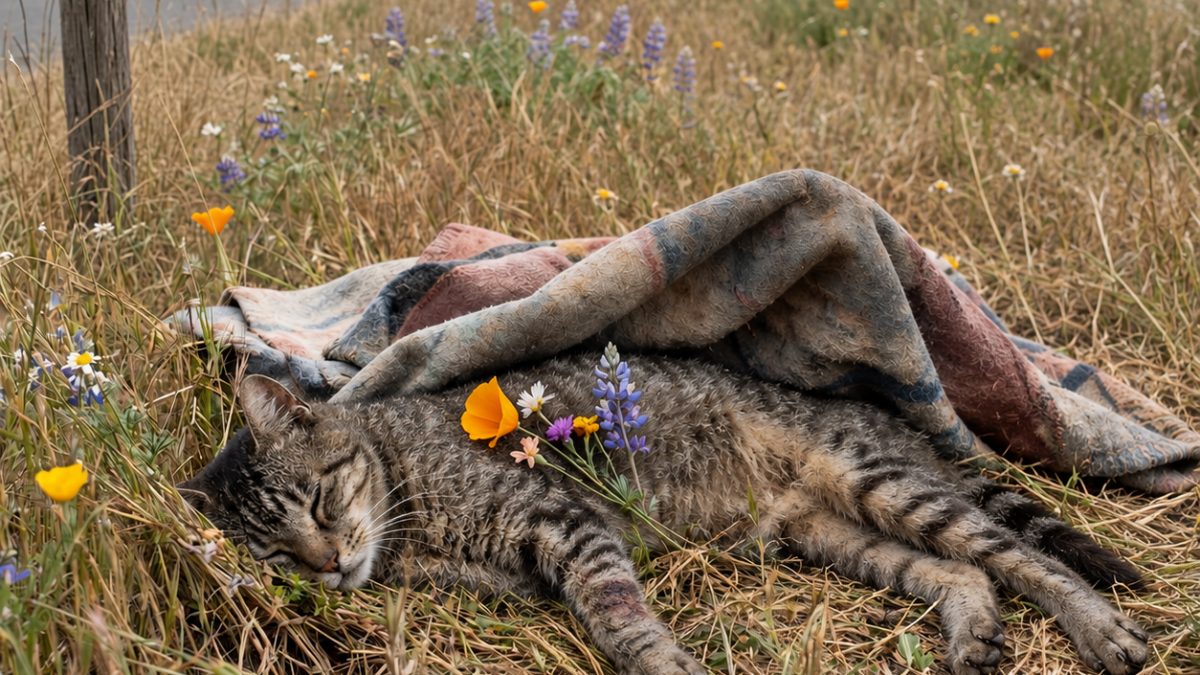
There is only a life that did not have a home.
And on his final day, Lucky finally had two people who cared enough to make sure he did not disappear without being loved at all.








