Boss Karen Fired Me to Save $50,000 a Year—Then His Shop Learned the Certification They Needed Belonged to Me, Not the Company.
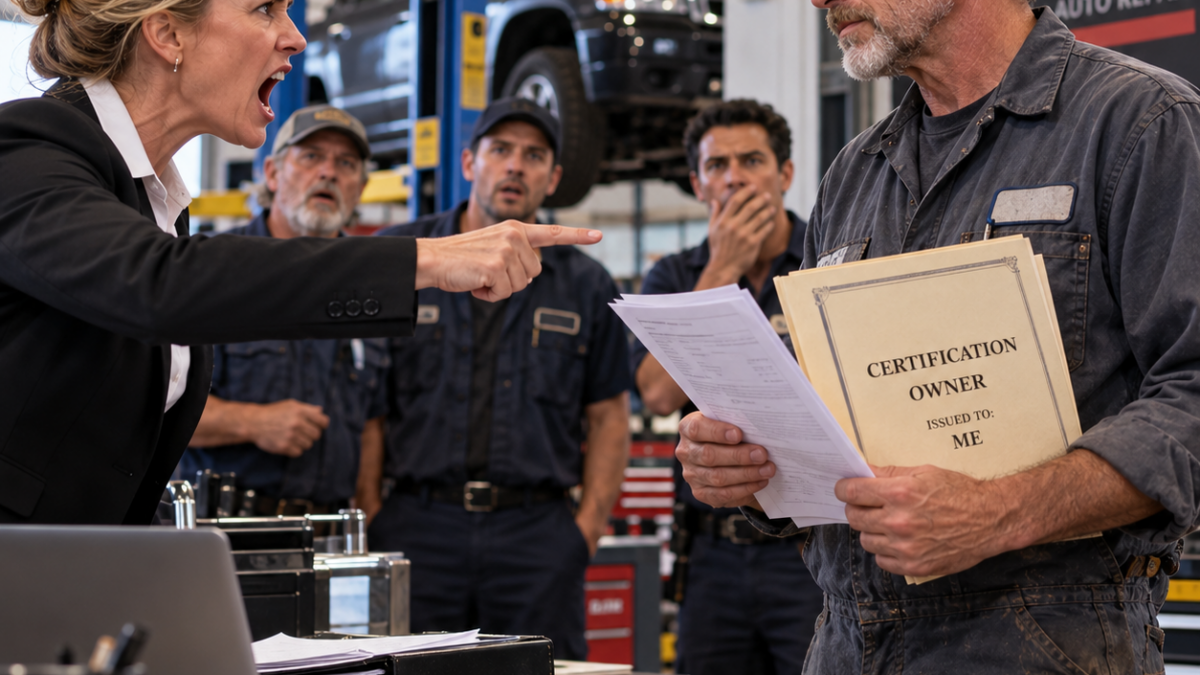
PART2:
A control cable is routed correctly or someone did something creative thirty years ago and left you to discover it upside down with a flashlight in your mouth.
I also held an Inspection Authorization.
IA.
I am going to explain this once because the entire story depends on it.
I already had my A&P certificate.
Airframe and Powerplant.
That let me perform maintenance and approve certain work for return to service.
The IA was additional authorization based on experience and eligibility.
It allowed me to perform and sign off annual inspections and certain other inspection work that an ordinary A&P mechanic could not simply take over because somebody in management changed an org chart.
The authorization was mine.
Personally.
Not Heritage Aviation’s.
Not Karen’s.
Not HR’s.
Not transferable.
You could not fire me Friday, hand my badge to another mechanic Monday, and say:
Congratulations, you’re Clint now.
Aviation doesn’t work like replacing somebody’s login credentials.
Karen did not understand that.
Or maybe she understood the words but not their meaning.
Those are different problems.
Before Karen arrived, Heritage had been run by a man named Frank Delaney.
Frank was sixty-three, smoked cigars he wasn’t supposed to smoke near the hangars, and thought Excel was a disease.
He wasn’t a modern manager.
He was sometimes disorganized.
He hated meetings.
His retirement planning consisted mainly of saying, “One more year.”
But Frank knew aviation.
He knew that a mechanic standing still for five minutes looking at something was sometimes doing more useful work than a person typing for an hour.
He knew training somebody didn’t duplicate experience.
And he knew which certifications belonged to the individual rather than the shop.
Frank retired.
Corporate ownership had changed a few years earlier, and the people above us decided Heritage needed a more “professional operational structure.”
That phrase brought Karen Holloway.
Karen was forty-two.
MBA.
Operations background.
Worked previously for a distribution business and then a regional equipment rental company.
Smart woman.
Organized.
Confident.
Carried a laptop everywhere.
Wore the same style company polo every day in five different colors.
Blue Monday.
Gray Tuesday.
Black Wednesday.
She liked metrics.
Labor utilization.
Turnaround time.
Work-order closure rates.
Parts inventory accuracy.
For her first few months, some of what she did genuinely helped.
Our parts room had been chaos.
She fixed it.
We had three different systems for tracking customer approvals.
She standardized them.
One customer had owed us money for nine months because nobody sent the final invoice correctly.
Karen collected it in two weeks.
I wasn’t against her.
That matters.
I didn’t decide she was a villain the moment she walked in.
In fact, I defended her more than once.
Old mechanics are suspicious of anybody carrying a laptop into a hangar.
I told the guys:
“Give her a chance.”
Then she discovered payroll.
At the time, I made $46 an hour.
Good money.
I earned it.
I had decades of experience.
IA.
Customer relationships.
And I was the person Frank called when somebody said:
“That engine does something weird only after twenty minutes.”
Our youngest mechanic was Tom Ellis.
Twenty-six.
A&P a little over a year.
Smart kid.
Good attitude.
Good grades.
Bad hands.
I don’t mean he was incompetent.
Young mechanics often know procedures better than they know touch.
They tighten something because the manual says torque to X.
Experience eventually teaches you what the threads feel like before you ever reach the wrench.
Tom would get there.
He asked questions.
Important ones.
He also knew how to say:
“I don’t know.”
That quality alone put him ahead of many people twice his age.
I liked him.
Which surprised everyone because I was not famous for immediate affection.
Karen announced the six-week training plan on a Tuesday.
She came into Hangar Two while Tom and I were working on a Piper Archer with an intermittent magneto problem.
“Clint.”
I slid out from under the cowling.
“What?”
“I want Tom shadowing you.”
Tom looked up.
“For what?”
“Cross-training.”
Karen smiled.
“We’re too dependent on single points of knowledge.”
That phrase.
Single points of knowledge.
I had been around long enough to hear the translation.
Expensive older employee.
Younger employee nearby.
Teach younger employee.
Eliminate expensive older employee.
But I didn’t know for sure.
Not yet.
“How long?”
I asked.
“Six weeks.”
“Everything?”
“As much as possible.”
I wiped my hands.
“Okay.”
That was it.
Tom asked me later:
“You think something’s up?”
“Yes.”
“What?”
“No idea.”
I lied.
I had an idea.
But Tom had done nothing wrong.
That was important from the beginning.
I could have protected myself by teaching badly.
A lot of people would.
Give him easy jobs.
Hold back customer knowledge.
Answer questions vaguely.
Make management think training was harder than expected.
I didn’t.
Because if Karen was planning to fire me, that was between Karen and me.
Tom was a kid trying to build a career around machines where mistakes mattered.
I was not going to make him worse at that job to save myself.
So I taught him properly.
For six weeks, we worked side by side.
The first thing I taught Tom was that logbooks lie without technically lying.
He looked confused.
“Meaning?”
I pulled a maintenance log from a Cessna 172.
“Read that.”
He read.
Cylinder replaced.
Compression values.
Return-to-service entry.
“Anything wrong?”
“No.”
“Why was cylinder replaced?”
He looked again.
“It doesn’t say.”
“Exactly.”
“So?”
“So somebody removed a cylinder. Why?”
“Low compression?”
“Maybe.”
“Crack?”
“Maybe.”
“Burned valve?”
“Maybe.”
“Then how do I know?”
“You look.”
I tapped the book.
“The book tells you what somebody wrote down.”
Then the airplane.
“The airplane tells you what happened.”
We inspected.
Eventually found evidence of overheating history.
Not catastrophic.
But relevant.
I taught Tom not to treat paperwork like truth delivered from heaven.
I taught him to treat it as evidence.
Then verify.
Another airplane came in after a previous shop had replaced a control cable.
Everything looked fine until you traced routing.
Somebody had taken a shortcut around a bracket.
Not immediately dangerous.
But wrong.
I gave Tom a flashlight.
“Find it.”
“What am I looking for?”
“If I tell you, you don’t find it.”
He spent forty minutes.
Then called:
“Clint.”
I walked over.
“This?”
“Yes.”
He looked annoyed.
“You knew?”
“Yes.”
“How?”
“Looked wrong.”
“That isn’t an explanation.”
“It will be someday.”
I taught him owners.
That may have mattered almost as much as mechanical work.
A customer named Mr. Franklin owned an old Bonanza.
He loved that airplane.
Loved it in the irrational way grown men sometimes love machines that constantly demand money.
We found corrosion.
Not little surface discoloration.
Real work.
Tom looked at estimate.
“Four thousand three hundred dollars.”
“Probably.”
“He’s going to lose it.”
“Maybe.”
“Want me to call?”
“No.”
“Why?”
“You need to learn.”
I made Tom call.
He started badly.
“Mr. Franklin, unfortunately we discovered a significant corrosion issue.”
I stopped him.
Put finger across throat.
Mute.
“What?”
“Don’t say significant before you explain significant.”
“It is significant.”
“To you. He hears airplane falling apart.”
Tom tried again.
Explained location.
Condition.
What needed removal.
What did not.
What could wait.
What couldn’t.
Estimate.
Silence on phone.
Then Mr. Franklin asked:
“Is airplane unsafe?”
Tom looked at me.
I shook my head.
He answered honestly.
“We aren’t releasing it until this is corrected, but we found it before it became something worse.”
Better.
Customer approved.
After call Tom said:
“That was awful.”
“You’ll get used to ruining people’s mornings.”
“Thanks.”
“Anytime.”
Karen watched us.
She loved what she thought she was seeing.
Knowledge transfer.
Week two.
Week three.
Week four.
One afternoon she pulled me aside by parts room.
“He’s doing great.”
“Yes.”
“I’m impressed.”
“He’s good.”
“Do you think he could do your job?”
That question was so direct I almost admired it.
I considered my answer.
“As a mechanic, he’s getting good.”
Karen smiled.
“Great.”
Then walked away.
I stood there thinking:
That is not what I said.
Two days later, the printer confirmed everything.
Heritage had one decent office printer sitting in hallway between break room and admin desks.
Everybody used it.
People left things in output tray constantly.
Purchase orders.
Invoices.
Training documents.
Nothing secret should have been printed there.
Someone printed three pages and forgot them.
I went for a parts invoice.
Top page:
STAFFING OPTIMIZATION — MAINTENANCE.
I wasn’t snooping.
My own job title was visible.
CLINT MERCER — SENIOR MECHANIC / IA
CURRENT HOURLY RATE: $46
PROPOSED:
POSITION ELIMINATED FOLLOWING TRAINING COMPLETION
DUTIES TRANSFERRED TO T. ELLIS
PROPOSED LEAD DIFFERENTIAL: +$2/HR
PROJECTED ANNUAL LABOR SAVINGS: APPROX. $50,000
I read it twice.
Then put it back exactly where it was.
Grabbed my parts invoice.
Returned to hangar.
Tom looked at me.
“You okay?”
“Fine.”
“You look mad.”
“Do I?”
“Yes.”
“Then stop looking.”
He grinned.
I taught him the rest of the afternoon.
That evening I called my friend Mike.
Known him since trade school.
He worked heavy equipment maintenance.
“What?”
he answered.
“They’re replacing me.”
“With kid?”
“Looks like.”
“You know?”
“Found staffing plan.”
“What did you do?”
“Put it back.”
“You confront manager?”
“No.”
“Why the hell not?”
“What do I say? Please don’t execute plan you already wrote down?”
Mike swore.
Then asked:
“You going to keep training?”
“Yes.”
“Why?”
“Tom didn’t write plan.”
Mike went quiet.
Then:
“You’re better man than me.”
“No.”
“What are you?”
“Tired.”
The crucial email came two weeks later.
Karen sent it Thursday morning.
Subject:
TRAINING COMPLETION / CAPABILITY CONFIRMATION
Clint,
As we finalize the maintenance staffing structure, please confirm whether Tom is now capable of assuming your current responsibilities independently.
Thanks,
Karen
There it was.
In writing.
I stared at screen.
Could have replied:
No.
Could have replied:
Ask someone who understands our certifications.
Could have been angry.
Instead I wrote it like discrepancy report.
Tom had progressed well.
He could perform routine maintenance, troubleshooting, inspections within his authority, documentation, customer communication, and most day-to-day mechanical responsibilities with normal oversight.
I said he had good judgment.
Careful work habits.
Would continue improving.
Then paragraph that mattered.
I explained that a meaningful portion of my workload required my Inspection Authorization.
Tom held an A&P but did not hold IA.
IA was held by individual mechanic.
Not Heritage Aviation.
Not transferrable.
Tom did not yet meet experience pathway required to simply obtain equivalent authorization immediately.
I listed scheduled annual inspections during next ninety days.
Flight school aircraft.
Several private owners.
Another aircraft expected to require inspection approval after substantial repair.
I ended:
Please make sure credential and authorization coverage has been reviewed before any staffing changes are finalized.
Karen answered nine minutes later.
Thanks, Clint. Understood. We’ll deal with credential side separately.
I saved email.
Printed copy.
Took it home.
Not because I was plotting revenge.
Because when someone says:
We’ll deal with it separately,
about the thing you just explained cannot be separated, keep the email.
Two weeks later, Friday morning, Sandra from HR asked me to come to conference room.
I already knew.
Karen.
Sandra.
Folder.
Broken blind.
One bottle of water.
Karen did most talking.
“As part of our ongoing restructuring, we’ve made decision to eliminate senior mechanic position effective today.”
I nodded.
“This isn’t performance-related.”
“Okay.”
“We’re consolidating responsibilities.”
“Okay.”
“Tom will be stepping into expanded lead role.”
“Okay.”
Karen looked almost disappointed.
People expect anger because anger lets them defend the decision.
I gave her nothing.
Sandra slid documents.
Severance.
Final paycheck.
Benefits.
I read.
Asked:
“Final check through today or end of pay period?”
Sandra answered.
“Today.”
“Accrued PTO?”
“Included.”
“Tool removal today?”
“Yes.”
I signed acknowledgment of receipt.
Not agreement with decision.
Karen said:
“I know transitions like this are difficult.”
“Sure.”
“If you need a reference—”
“I’m good.”
That was meeting.
No speech.
No dramatic warning.
I had already warned her.
In writing.
Tom found me in hangar.
He looked sick.
“Clint.”
I was unlocking toolbox.
“I didn’t know.”
“I know.”
“Seriously.”
“I know.”
“She told me Monday I was getting lead role.”
“Good.”
“No.”
He looked like he might cry.
“I wouldn’t have taken it if I knew.”
“Stop.”
He did.
“Kid.”
He hated when I called him that.
“You didn’t fire me.”
“No.”
“You didn’t make plan.”
“No.”
“Then don’t carry it.”
“But I’m replacing you.”
“You’re taking job. Different.”
He stared.
“What am I supposed to do?”
“Work.”
“That’s it?”
“Learn.”
I held out hand.
“You’re good mechanic.”
He shook.
Then pulled me into an awkward hug.
I tolerated it for approximately two seconds.
Then pushed him away.
“Don’t make this weird.”
I started loading tools.
Twenty years’ worth.
Rollaway box.
Socket sets.
Torque wrenches.
Specialty tools.
Flashlights.
Mirrors.
Pick sets.
Pliers.
Some tools older than Tom.
Karen came into hangar.
“Wait.”
“What?”
“Some of that’s company property, correct?”
“No.”
“There are specialty tools.”
“Yes.”
“Purchased by Heritage?”
“Some shop tools are.”
She pointed at my box.
“I need to make sure.”
Fair request.
So I gave her folder.
Receipts.
Personal tool inventory.
Separate company tool list Frank had maintained.
Karen compared.
Sandra helped.
Twenty minutes.
Then Karen nodded.
“Okay.”
“Good?”
“Yes.”
She helped push toolbox toward truck.
That remains one of strangest moments of my career.
Woman who had just fired me helping move several thousand dollars of my personal tools out of company she assumed no longer needed me.
Tom stood nearby.
Didn’t speak.
I loaded box.
Closed tailgate.
Karen said:
“Take care, Clint.”
“You too.”
I drove home.
For about one week, Karen looked brilliant.
Tom handled routine work.
Oil changes.
100-hour items.
Troubleshooting.
Magneto complaint on Cherokee.
He found fouled plug and timing issue correctly.
Customer happy.
Jobs moved.
Labor cost dropped.
Karen walked hangar with energy of someone expecting promotion.
Then calendar arrived.
Calendars are cruel to plans built on forgetting obligations.
Monday:
Annual inspection scheduled on Cessna 182.
Wednesday:
Beechcraft Bonanza annual.
Following week:
Flight school Archer annual.
Fourth aircraft coming off repair requiring approval work.
Tom could remove panels.
Service.
Inspect components within his role.
Make repairs.
Prepare documentation.
But annual inspection needed appropriately authorized person.
Tom did not have IA.
Tuesday morning, he went to Karen.
“Need talk.”
“What?”
“The 182 annual.”
“What about it?”
“I can’t sign it.”
She looked confused.
“Why?”
“I don’t have IA.”
“Then get whatever certification you need.”
Tom apparently stared at her.
“It doesn’t work like that.”
“How long?”
“Years.”
“What?”
“I haven’t even held A&P long enough for that path.”
Karen thought he was exaggerating.
She opened laptop.
Looked it up.
Read.
Then opened my email.
The one she had answered:
Understood. We’ll deal with credential side separately.
That was when $50,000 savings plan developed a structural crack.
Karen called another mechanic with IA at a shop thirty miles away.
Booked.
Called second.
Booked.
Called third.
Could possibly come in two weeks.
First owner expected airplane Friday.
Karen called him.
Explained scheduling delay.
Owner said:
“I booked annual six weeks ago.”
“Yes.”
“Our inspection availability changed.”
“What does that mean?”
“We had staffing change.”
“Clint?”
Pause.
“Yes.”
“Is Clint sick?”
“No longer with company.”
Another pause.
“You fired Clint before my annual?”
“I wouldn’t characterize—”
Owner moved airplane to another shop.
Revenue gone.
Second owner delayed reluctantly.
Flight school called.
Chief instructor named Mark Reyes.
Direct man.
They had used Heritage eleven years.
“Karen, I have two aircraft scheduled within four weeks.”
“Yes.”
“Can you support them?”
“We’re arranging coverage.”
“That isn’t answer.”
“We expect—”
“I need yes or no because I’m scheduling students.”
Karen bought time.
Meanwhile two airplanes occupied hangar space.
Panels open.
Work partly done.
Not generating finished invoices.
Tom worked hard.
None of this was his fault.
Karen started pressuring him.
“Can you complete everything except signature?”
“Yes.”
“Then do that.”
“I am.”
“Can outside IA just inspect paperwork?”
“No.”
“Why not?”
“Because he has to actually perform inspection.”
“Could Clint sign?”
Tom apparently laughed once before realizing she was serious.
“He didn’t inspect these.”
“You worked under him for six weeks.”
“That doesn’t matter.”
“Why?”
“Because his signature means he inspected aircraft.”
Again, not transferable knowledge problem.
Personal legal responsibility problem.
Thursday evening my phone rang.
I was watching baseball.
Karen.
I let it ring twice.
Answered.
“Hello.”
“Clint. Hey.”
“Karen.”
“How’ve you been?”
“Fine.”
Small talk lasted fifteen seconds.
Then:
“We’ve got couple aircraft that just need inspection signoff.”
“Which aircraft?”
She named them.
“Did I inspect them?”
“No, Tom handled work.”
“Then I can’t sign.”
“Well, you trained him.”
“Yes.”
“And you said he was capable.”
“As mechanic.”
“Could you review records?”
“I could inspect airplanes.”
“How long?”
“Depends what I find.”
Pause.
“We really just need signatures.”
“No.”
Silence.
“My certificate goes next to signature.”
“I understand.”
“No, I don’t think you do.”
Her voice cooled.
“Clint, customers are waiting.”
“I know.”
“The flight school is getting concerned.”
“I told you.”
“I understand that.”
“Email.”
Long pause.
“You said you’d deal with credentials separately.”
“Yes.”
“We thought we had coverage options.”
“You didn’t?”
“Not soon enough.”
“Okay.”
Then she asked:
“Would you consider coming back?”
I expected question eventually.
“Employee?”
“We could discuss.”
“No.”
“Temporary?”
“Contractor.”
She paused.
“What rate?”
I had already discussed with Mike.
Looked at local contractor rates.
Considered travel, liability, self-employment taxes, insurance, lost flexibility, and fact that they needed me more than I needed them.
“One seventy-five an hour.”
Silence.
“Minimum eight hours per visit.”
Karen laughed.
Not cruel.
Pure disbelief.
“Clint.”
“Yes?”
“You made forty-six.”
“That was when you employed me.”
Silence.
Long one.
“$175.”
“Yes.”
“That’s almost four times.”
“Then find someone cheaper.”
“We can’t justify that.”
“Okay.”
“Could you do hundred?”
“No.”
“Hundred twenty-five?”
“No.”
“Clint.”
“One seventy-five. Eight-hour minimum. Work under written independent contractor agreement. My own judgment. I inspect what I sign.”
She exhaled.
“I’ll call you.”
“Okay.”
Next morning:
Agreed.
The $50,000 annual savings plan had successfully replaced a $46-an-hour employee with same human being at $175 an hour.
I wish I could say I walked into hangar Monday wearing sunglasses while theme music played.
Real life disappoints.
I wore work pants.
Old shirt.
Carried toolbox.
Tom saw me.
Relief on his face almost hurt.
“Thank God.”
“Don’t get emotional.”
Karen handed contractor paperwork.
I reviewed.
Insurance.
Scope.
Rate.
Minimum.
Fine.
Then she said:
“We’ve already done most of work.”
“I’m sure.”
“So this shouldn’t take full day.”
I looked at her.
“You hired me to inspect.”
“Yes.”
“Then I inspect.”
Tom had done good work.
Really good.
But “Tom did good work” and “I personally inspected this airplane” are different statements.
Only one belonged above my signature.
So panels reopened.
Cowlings came off.
Access covers removed.
Logbooks reviewed from beginning relevant history.
Control systems checked.
AD compliance reviewed.
Documentation verified.
I found one discrepancy.
Not dramatic.
Not negligence.
A worn component Tom had looked at and considered serviceable.
I disagreed.
We measured.
Borderline.
I showed him why I wasn’t comfortable.
He listened.
“That’s why you’re expensive?”
he said.
“Apparently.”
He smiled.
Karen stood in hangar doorway looking at clock.
I did not rush.
My certificate did not belong to her schedule.
First aircraft took full day.
Second took most of another.
Documentation on one repair was too vague.
I made them rewrite.
Karen asked:
“Is that necessary?”
“Yes.”
“It says replaced.”
“Replaced what exact part?”
“It’s on work order.”
“Logbook needs stand alone.”
She walked away.
Invoice for my first two visits:
$2,800.
Plus agreed travel expense.
Karen stared at it for long time.
Then approved.
Over next six weeks I came back several times.
Eight-hour minimum.
Sometimes one day.
Sometimes two.
Customers noticed.
“Clint?”
“Yep.”
“Thought you retired.”
“Nope.”
“You still work here?”
“Contracting.”
“What happened?”
“My position was eliminated.”
That was all.
I never badmouthed Karen.
Didn’t need to.
Anybody in aviation could do arithmetic.
Customer who had known me fifteen years looked at contractor shirt.
Then at Heritage logo on hangar.
“Oh.”
Exactly.
Mark from flight school caught me outside one afternoon.
“Walk with me.”
We went parking lot.
“You leaving permanently?”
“I already left.”
“You know what I mean.”
“Probably.”
“You going somewhere else?”
“Don’t know.”
He looked toward hangar.
“If you open your own place, call me before anyone.”
I laughed.
“Why?”
“Because I bring airplanes here for you.”
That sentence stayed.
Not Heritage.
You.
I was fifty-six by then.
Mortgage.
Wife named Lisa.
Two grown kids mostly launched.
I wasn’t eager to become business owner.
I liked fixing airplanes.
Owning business meant invoices.
Insurance.
Rent.
Phones.
Customers calling Sunday.
The stuff Karen liked.
But I started doing numbers.
Found one unused hangar bay at another small airport twenty minutes away.
Owner would lease month-to-month first six months.
Shared compressor.
Utilities included.
Enough space for one aircraft comfortably, two if positioned carefully.
I already owned tools.
Already had authorization.
Already had relationships.
Lisa asked:
“What’s worst case?”
“I hate it.”
“Then?”
“Get job somewhere.”
“So?”
“I’m old.”
“You’re fifty-six.”
“Old.”
“You threw a transmission into Mike’s truck last winter in driveway.”
“Different muscles.”
She stared.
“Try.”
So I did.
Mercer Aircraft Maintenance.
Terrible name.
Nobody cared.
No fancy logo.
No polished website.
Just clean hangar.
Insurance.
Paperwork.
Phone number.
Toolbox.
Me.
First month:
Three jobs.
Second:
Seven.
Third:
Flight school moved two airplanes over.
Not entire fleet immediately.
Enough.
Then Mr. Franklin brought Bonanza.
Then Archer owner.
Then Cessna 182 customer who had moved annual after my firing.
They were not Heritage’s customers in their minds.
They were Clint’s.
I had never realized that fully.
Back at Heritage, Karen’s plan got worse for one person who deserved none of it.
Tom.
She gave him title.
Lead Maintenance Technician.
Two-dollar raise.
More responsibilities.
Scheduling.
Parts coordination.
Customer updates.
Troubleshooting.
Still no IA.
Still couldn’t magically become me.
Every delay became Tom’s problem.
Contractor invoices?
Why isn’t work moving faster?
Customers leaving?
What are you doing to retain them?
Outside IA unavailable?
Why didn’t you plan ahead?
Tom called me occasionally.
At first about technical questions.
Then less technical.
“She wants me to schedule three annuals same week.”
“Tell her no.”
“I did.”
“What happened?”
“She said Clint used to.”
“I didn’t.”
“I know.”
“Show schedules.”
“I did.”
“She says I need to develop leadership mindset.”
I sighed.
“Tom.”
“What?”
“Your job is airplanes.”
“I know.”
“Don’t let someone turn you into explanation for their math.”
He lasted five months.
Friday afternoon he walked into Karen’s office.
Resigned.
No backup job.
No dramatic speech.
He was done.
A week later, he called me.
“Need reference.”
“For?”
“Anything.”
“What do you want?”
“Work.”
“Aircraft?”
“Yes.”
“How much rent?”
He laughed.
“What?”
“Your rent. Can you survive if I pay you thirty?”
Silence.
“Are you offering job?”
“Yes.”
Another silence.
“Clint.”
“What?”
“I replaced you.”
“No.”
He said nothing.
“Karen used you same way she used me.”
“That’s not—”
“You didn’t ask to be line item.”
Silence.
“Want job?”
“Yes.”
“Monday.”
“Seriously?”
“Seven-thirty.”
“I’ll be there at seven.”
“Then you’ll make coffee.”
Tom joined me.
That changed everything.
With two of us, capacity grew.
He was faster than when I had trained him.
More confident.
Still asked questions.
Good.
I paid him more when business stabilized.
Didn’t call him lead anything.
Just mechanic.
One afternoon he asked:
“Why didn’t you hate me?”
I looked up.
“For what?”
“Taking your job.”
“You didn’t take it.”
“Still.”
“Tom, if someone replaces kitchen table with chair, do you blame chair?”
He stared.
“That’s terrible analogy.”
“I fix airplanes.”
He laughed.
We built business slowly.
No empire.
No twelve-bay facility.
No twenty employees.
I wanted life.
That was point.
We took work we could handle.
Said no when full.
Flight school eventually brought all four trainers.
Aerial photography operator came.
Private owners.
Some referrals.
Our reputation became simple:
Not fastest.
Not cheapest.
But if Clint signs it, Clint inspected it.
That statement brought business.
Meanwhile, Heritage continued.
It didn’t collapse.
That matters too.
Stories become less believable when every bad manager instantly destroys company.
Heritage had other services.
Other mechanics.
Corporate support.
They hired contractors.
Shifted jobs.
Raised prices.
Lost some customers.
Kept others.
Karen did not get escorted out carrying cardboard box while everyone applauded.
Life is usually less theatrical.
What happened was slower.
Her $50,000 projected savings disappeared.
First through my contractor invoices.
Then outside inspection costs.
Then lost annuals.
Then recruiting.
Experienced mechanics with IA were not waiting around unemployed hoping Heritage would call.
The candidates they found either wanted more money than I had made or had other limitations.
One lived ninety minutes away.
Another wanted part-time only.
One withdrew after learning workload.
Eight months after my firing, I got an email.
From Karen.
Professional.
No small talk.
Heritage Aviation would like to discuss a recurring subcontract arrangement for annual inspections and authorization-dependent work.
I read it twice.
Which was twice more than she had apparently read mine.
Tom was beside me.
“What?”
“Your old boss.”
“My old boss or your old boss?”
“Same woman.”
“What she want?”
I turned screen.
He read.
Then laughed.
“What are you going to say?”
I thought.
Then typed.
Happy to consider work case by case.
Subject to shop capacity.
At my facility.
At my standard commercial rate.
Aircraft must arrive with complete, current, legible maintenance records.
Tom read final line.
“That petty?”
“Little.”
“Why?”
“Because they always sent me garbage logbooks.”
“You told me never assume previous mechanic was stupid.”
“Correct.”
“You’re assuming Kevin—”
“Karen.”
“Sorry. You’re assuming Karen’s paperwork bad.”
“I have evidence.”
She agreed.
For next two years, every few months a Heritage customer aircraft would arrive at Mercer Aircraft Maintenance.
Twenty minutes down road.
Tom and I would open it.
Inspect.
Repair what needed.
Sign what was appropriate.
Invoice Heritage or owner depending arrangement.
Karen’s company was now paying my company to perform work she once believed a six-week handoff would make unnecessary.
The irony was satisfying.
But it wasn’t revenge.
Not really.
The part people tell at dinner is contractor rate.
$46 became $175.
That’s fun.
The part that matters happened later.
One winter evening, Karen herself drove over.
No appointment.
Tom had left.
I was finishing paperwork.
She stood at hangar door.
“Got minute?”
“Sure.”
She looked around.
Mercer Aircraft had grown slightly.
Another toolbox.
Small office partition.
Customer coffee maker newer than Heritage’s by about twenty years.
Two airplanes inside.
“You did well.”
“So far.”
She nodded.
“I owe you something.”
I expected invoice dispute.
“What?”
“Apology.”
That surprised me.
“You don’t have to.”
“Yes.”
She looked uncomfortable.
“I thought I understood staffing.”
I said nothing.
“I thought your cost was too high.”
“Okay.”
“I didn’t understand what cost represented.”
Better sentence than most managers ever say.
She continued.
“I saw forty-six dollars.”
“You saw twenty-seven next to it.”
“Twenty-seven then twenty-nine.”
“Yes.”
“And I thought gap was waste.”
“Wasn’t.”
“No.”
She looked toward airplane.
“I thought knowledge was transferable.”
“Some is.”
“I thought authorization was paperwork.”
“It is paperwork.”
She frowned.
“You know what I mean.”
“Yes.”
She sighed.
“I read your email.”
“Apparently not enough.”
“I read words.”
There it was.
“I didn’t understand consequences.”
I leaned against bench.
“What happened?”
“Corporate review.”
I almost smiled.
“Bad?”
“Embarrassing.”
“How bad?”
“My labor-saving project cost more than it saved first year.”
I said nothing.
“Lost revenue was bigger problem.”
“Flight school.”
“Mostly.”
She looked at floor.
“And Tom.”
“What about him?”
“I blamed him.”
“Yes.”
Her eyes came up.
“He told you?”
“Some.”
“I shouldn’t have.”
“No.”
“I was under pressure.”
“That’s explanation.”
“Not excuse.”
Good.
“Did you apologize to him?”
“No.”
“Then don’t apologize to me first.”
She nodded.
Two days later, she called Tom.
He didn’t tell me details.
Only:
“She apologized.”
“How feel?”
“Weird.”
“You forgive?”
“I don’t know.”
“Don’t have to know today.”
A year later Karen left Heritage.
Not fired.
Took operations job at another aviation-adjacent company.
Before leaving she sent me note.
Thanks for making me learn expensive lesson.
I still have it.
Tom joked we should frame it beside first contractor invoice.
We did not.
Lisa would not permit that level of pettiness in public areas.
Years passed.
I kept IA current.
Tom gained experience.
He became excellent.
Not “good for young mechanic.”
Excellent.
One day he asked:
“You think I should pursue IA when eligible?”
“Yes.”
“You worried I’ll replace you?”
“No.”
He smiled.
“Why?”
“Because I’m not an idiot.”
He did.
Studied.
Prepared.
Met requirements.
Eventually earned his own authorization.
His.
Not mine.
Not company’s.
His.
When he showed me confirmation, I shook his hand.
Then made him buy lunch.
“You realize,” he said, “now shop isn’t dependent on single point of knowledge.”
I stared.
He grinned.
I threw rag at him.
But he was right.
And difference mattered.
I had trained him.
Really trained him.
Not as six-week extraction project.
Over years.
Experience.
Judgment.
Authority.
Responsibility.
One afternoon we had young apprentice working with us.
Twenty-two.
Smart.
Too confident.
He asked Tom:
“How long did it take Clint to teach you everything?”
Tom looked at me.
Then laughed.
“He hasn’t.”
Kid frowned.
“You’ve worked together years.”
“Exactly.”
That might be best summary of entire story.
Experience isn’t a bucket you pour from one head into another.
Some knowledge transfers in minutes.
Some in months.
Some only after seeing same failure ten times.
Some comes from making mistake safely and remembering embarrassment forever.
Some comes from knowing when to stop.
Some comes from legal authority earned separately.
And some never fully transfers because each mechanic builds judgment differently.
Karen’s spreadsheet was not evil.
It was incomplete.
Numbers were correct.
$46.
$27.
$50,000 projected savings.
What spreadsheet lacked was column called:
Things Clint prevents that have never happened because Clint prevented them.
That column is hard to value.
Businesses struggle with invisible competence.
The IT person who keeps systems from failing looks expensive until systems fail.
Experienced nurse looks expensive until unit loses judgment.
Senior electrician looks expensive until troubleshooting takes three days.
Inspector looks expensive until certification isn’t there.
Maintenance worker looks expensive until machine nobody else understands stops.
Knowledge workers are often paid not only for tasks they perform.
They’re paid for disasters they recognize before everyone else.
One morning, years after everything, flight school brought in one of their oldest trainers.
Cessna.
High time.
Student airplane.
Tom and I inspected.
Young apprentice helped.
He was looking at attachment point.
Said:
“Looks fine.”
I stopped.
“What?”
He pointed.
“No crack.”
“Did I ask about crack?”
“No.”
“What looks wrong?”
He looked again.
“Nothing.”
Tom walked over.
Stared.
Then said:
“That washer.”
Exactly.
Slight witness mark.
Small shift.
Nothing dramatic.
We disassembled.
Found wear beginning where it shouldn’t.
Not emergency.
Not headline.
Just something caught early.
Apprentice said:
“How did you see that?”
Tom answered before me.
“Doesn’t look right.”
I smiled.
Thirty years compressed into three words.
Not transferable in six weeks.
But teachable over time.
At retirement dinner, years later, Mike told the Karen story.
Of course.
He had told it approximately five million times.
According to his version, Karen crawled back on hands and knees begging me to return while airplanes stacked up on runway and federal inspectors circled building.
None of that happened.
I corrected him.
Nobody cared.
Tom raised glass.
“To $175 an hour.”
Everybody laughed.
I said:
“That rate was low.”
Lisa yelled:
“Sit down.”
I sat.
Then Tom stood.
“I want to say something.”
He looked at me.
“When I was twenty-six, management told me I was good enough to replace Clint after six weeks.”
Laughter.
“I believed them for maybe one day.”
More laughter.
“Then first annual showed up.”
He smiled.
“But Clint never punished me for somebody else’s decision.”
Room got quieter.
“He taught me before they fired him.”
“Then hired me after I quit.”
“Then trained me until I could earn my own IA.”
He paused.
“People tell this like revenge story.”
He looked around.
“But best part isn’t Karen paying contractor rate.”
“It’s that Clint could’ve protected himself by making me fail.”
I looked down.
“He didn’t.”
That got me.
More than contractor story ever did.
Because Tom was right.
The easiest revenge available in beginning would have been sabotage through silence.
Teach badly.
Let him fail.
Let shop fail harder.
Make myself indispensable.
But then what?
A young mechanic learns less.
Customers suffer.
Airplanes sit.
Maybe safety gets worse.
That isn’t revenge.
That’s poison spreading.
Karen made a management mistake.
I didn’t need to become worse employee to prove it.
I just needed to do job honestly until last minute.
Then leave with what belonged to me.
My tools.
My knowledge.
My authorization.
My name.
That was enough.
A lot of people think employer owns whatever employee knows because they paid salary while employee worked there.
They don’t.
Company can own procedures.
Records.
Customer lists depending contracts.
Work product.
Equipment.
But experience lives in human beings.
Judgment lives in human beings.
Professional credentials often live with individual.
Respecting that is part of managing real organizations.
Karen eventually learned.
Expensively.
I learned something too.
For years, I thought loyalty meant staying.
Heritage had been my shop.
Twenty-one years.
Customers.
Friends.
Habits.
My coffee cup.
My corner.
My toolbox marks on floor.
Getting fired hurt more than I admitted.
Even though I suspected it.
Even though I left calmly.
That first Monday at home, I woke at 5:20 automatically.
Got dressed halfway.
Then remembered.
Sat on edge of bed.
Lisa found me.
“You okay?”
“Yes.”
“No.”
I looked at boots.
“I don’t know what I’m supposed to do.”
She sat beside me.
“That place was not your identity.”
“Twenty-one years.”
“I know.”
“What if nobody needs me?”
She laughed.
Not kindly.
“What?”
“Your phone rang four times yesterday.”
“Friends.”
“Two customers.”
“Maybe.”
“Clint.”
“What?”
“Stop being dramatic. It’s unattractive.”
She was right.
People needed work.
I needed courage to stop assuming only one company could provide it.
Karen’s decision forced me to discover customers valued me separately.
That was scary.
Then freeing.
I never became rich.
Did fine.
Paid mortgage.
Put money away.
Took vacations I had skipped before because Heritage was busy.
Closed shop between Christmas and New Year unless genuine emergency.
Told customers no when schedule full.
Worked until I didn’t want to.
Then sold small business to Tom.
That may be my favorite ending.
Tom bought it.
Not gifted.
Not handed over.
Fair valuation.
Financing.
He owned it.
Renamed slightly.
Mercer & Ellis Aircraft Maintenance.
I told him remove my name.
He refused.
“Brand equity.”
“Karen teach you that?”
He laughed.
He hired two younger mechanics.
One holds A&P.
One apprentice.
And because Tom remembered everything, he doesn’t build shop around single human authorization.
Another IA works with them.
They cross-train.
Properly.
Not six-week replacement training.
Resilience training.
There’s difference.
Karen once emailed me years later.
Holiday message.
She had seen article about Mercer & Ellis.
Wrote:
Looks like Tom really did learn your job after all.
I replied:
Took twelve years.
She answered:
Fair point.
That made me laugh.
Maybe she became better manager.
I hope so.
People should be allowed to learn.
Otherwise consequences teach nothing.
When I tell story now, people always focus on one line.
“That was when you employed me.”
They love it.
Yes, it felt good.
When someone tells you your labor is too expensive, then discovers your independent market rate is nearly four times higher, there is satisfaction.
I am human.
But line only worked because it was true.
As employee, Heritage bought more than hours.
Predictability.
Availability.
Benefits arrangement.
Institutional loyalty.
Knowledge.
They replaced that with contractor.
Contractor sets different rate because contractor has different risk.
No vacation.
No guaranteed hours.
Own taxes.
Own insurance.
Own schedule.
And, critically:
No obligation to rescue poor planning cheaply.
Karen wanted variable access to a scarce credential after voluntarily eliminating permanent access.
Variable access costs more.
That’s economics.
Not revenge.
I still have original email.
Printed.
In folder.
Clint,
As we finalize staffing structure…
Then my answer.
Tom is progressing well…
Then paragraph about IA.
Then Karen:
Understood. We’ll deal with credential side separately.
That is the whole story in three emails.
Warning.
Dismissal of warning.
Consequence.
I also still have first contractor invoice.
Eight-hour minimum.
$1,400.
Karen approved.
Sometimes I take it out.
Not because I’m angry.
Because it reminds me of something useful.
When someone ignores expertise because it complicates plan, you do not always have to argue harder.
Sometimes best thing is explain clearly.
Put it in writing.
Do your job properly.
And let reality handle appeal.
Reality is undefeated.
It does not care about management titles.
It does not care how clean spreadsheet looks.
It does not care how many times someone uses words efficiency, optimization, synergy, or restructuring.
An annual inspection still needs proper authorization.
An airplane still needs someone legally willing to put his name on work.
A mechanic still owns his own signature.
Karen thought certification was an administrative inconvenience.
It wasn’t.
It was part of business model.
She thought Tom could replace me because he learned what I did.
He could replace many tasks.
Not my accumulated authority.
Not yet.
That “yet” mattered.
Years later he did.
Properly.
Earned.
His own.
That distinction is everything.
If there’s any revenge in story, it isn’t that Karen paid me $175 an hour.
It isn’t that customers followed me.
It isn’t that Tom quit and came to work for me.
It isn’t even that Heritage later subcontracted inspection work to company founded by employee they eliminated for being too expensive.
Those parts are funny.
Real revenge was simpler.
I didn’t let Karen’s decision decide what I was worth.
Her spreadsheet said:
Cost: too high.
Market said:
Needed.
Customers said:
Trusted.
Tom said:
Teacher.
My wife said:
Stop moping and rent hangar.
She was probably most important.
So yes.
Boss fired me because salary looked expensive.
She believed six weeks of training had transferred everything she needed into younger mechanic.
She was wrong.
Not because Tom was bad.
Because Tom was good enough to know what he didn’t have.
And because one line on spreadsheet could not contain thirty-five years of work and certification attached to individual person.
Ten days after removing me, she called asking for signature.
I gave her rate.
$175.
Eight-hour minimum.
She laughed.
Then she paid.
Months later, she paid my shop.
Years later, her company sent airplanes twenty minutes down road to mechanic they decided cost too much.
I never sabotaged them.
Never threatened them.
Never begged for job back.
Never tried to ruin Tom.
Never lied to customers.
I simply refused to pretend my certification belonged to company after company decided I didn’t.
That was the entire malicious compliance.
They wanted to eliminate my position.
So I let them.
They wanted Tom to assume my responsibilities.
So I taught him everything he was legally and professionally able to assume.
They wanted to save money.
So I stopped being their employee.
And when they discovered what they had actually eliminated, I was happy to help.
At market rate.








