Boss Karen Fired Me Three Days Before a $10 Million Demo and Called My Code “Outdated”—Then Her New Server Stopped at 50 Trucks Because I Owned the Patents.
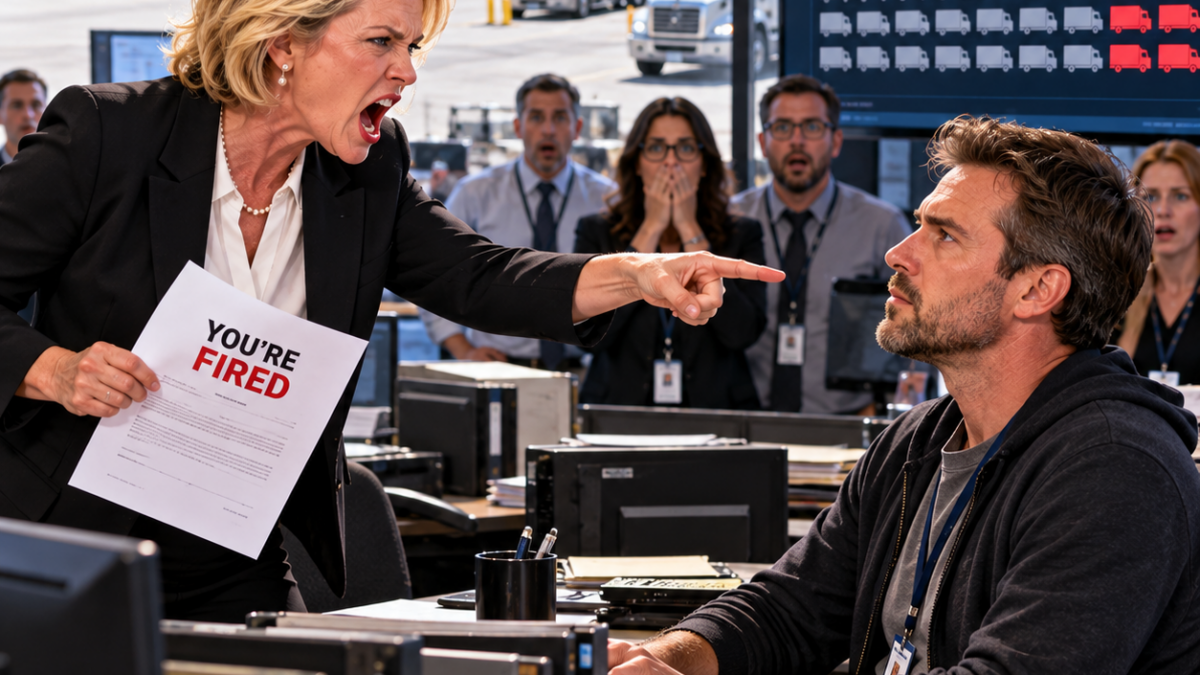
PART2:
“Knowing where the trucks are isn’t the same thing as knowing what they should do next.”
That was how he explained it to me at one of our cookouts.
I nodded while carrying potato salad.
He continued explaining anyway.
Imagine four hundred trucks.
Different trailers.
Different loads.
Delivery windows.
Driver hours.
Pickup deadlines.
Warehouse capacity.
Customer priority.
Traffic.
Then a truck blows a tire.
A customer cancels.
A rush order arrives.
Now everything changes.
Human dispatchers were good.
Some were incredible.
But a person looking at forty whiteboards and taking phone calls was still solving a huge optimization problem largely through experience and instinct.
Carl had been playing with exactly that kind of math for years.
For fun.
I know what that says about him.
Other men watched football.
Carl occasionally disappeared into our spare room because he wanted to see whether a particular heuristic could solve a vehicle-routing problem faster.
When Bob described the company idea, Carl already had the beginnings of an optimization engine on our home computer.
Bob saw it.
According to Carl, Bob stared at the screen for about thirty seconds.
Then said:
“How long have you had this?”
Carl shrugged.
“A while.”
“What does ‘a while’ mean?”
“Couple years.”
“Why?”
“I thought it was interesting.”
This is the most Carl answer possible.
Bob wanted it.
Not just code.
Carl.
He couldn’t pay much.
His startup consisted mainly of optimism and invoices that had not yet been paid.
So Carl started helping nights and weekends.
At first, the money was almost insulting.
A few hundred dollars here.
Another check there.
Enough for our cable bill.
Maybe dinner.
I would come downstairs at eleven at night and find Carl in the spare bedroom.
Two monitors.
Dot-matrix printouts.
Truck schedules.
Cereal in a coffee mug because all the bowls were downstairs and apparently stairs were unreasonable.
One night I stood in the doorway.
“Is this a hobby or a job?”
He kept typing.
“It’s a job.”
“How much did Bob pay you this month?”
He told me.
I stared.
“That is a hobby with paperwork.”
He laughed.
“He’ll pay more when they have customers.”
“If.”
“When.”
He believed Bob.
I mostly believed Carl.
And we weren’t desperate.
His main job paid the bills.
He liked the challenge.
So I let it be.
By 1998, things became formal.
Bob had a few customers.
Small trucking companies.
A regional food distributor.
One courier company.
He needed something more official than writing checks to Carl from his personal checking account.
One evening Carl sat at our kitchen table signing a stack of papers.
“What’s that?”
“Consulting agreement.”
“With Bob?”
“Yeah.”
“Did a lawyer look at it?”
“Bob’s lawyer wrote it.”
“That is not what I asked.”
Carl looked at me.
“He’s our lawyer.”
“No. He is Bob’s company’s lawyer.”
Carl smiled.
“You work claims too much.”
“I work claims exactly enough.”
I made him explain.
The routing engine remained Carl’s.
Bob’s company got a license to use it while Carl provided consulting and development support.
Why?
Because Bob could not afford to buy it outright.
Carl didn’t particularly want to sell it anyway.
He still viewed the engine as partly his private research project.
“What happens if you stop consulting?”
“There are provisions.”
“What provisions?”
“Customers don’t break.”
“That is not a legal term.”
He laughed.
“Existing deployed systems keep running.”
“And new ones?”
“We’d renegotiate.”
I remember asking:
“Do you own this?”
“Yes.”
“Like actually own it?”
“Yes.”
“Okay.”
That was my entire intellectual-property education for the evening.
A year or so later came patents.
Carl and Bob’s attorney believed some of the optimization methods were novel enough to pursue protection.
Applications were filed.
We paid a portion of legal fees ourselves.
I complained about that because patent lawyers apparently bill like they personally discovered electricity.
Eventually two patents issued.
Large official envelopes arrived.
Carl showed me.
I said:
“Neat.”
I am not proud of my enthusiasm level.
We put them in a file box in the basement.
Next to tax returns.
Home insurance policies.
Old mortgage statements.
And our daughter’s kindergarten art that neither of us could bring ourselves to throw away.
By 2002, Bob’s little company was no longer little in the garage sense.
Still small.
But real.
Customers.
Employees.
Revenue.
Investors.
The routing system worked.
The core engine took vehicle positions, loads, destinations, deadlines, restrictions, driver hours, trailer capacity, and a long list of customer-specific rules.
Then it generated optimized routes.
If conditions changed, dispatcher could rerun.
Truck breaks.
Customer cancels.
Rush pickup.
Weather delay.
The system could recalculate.
Not perfectly.
No optimization tool is magic.
But customers consistently reported meaningful mileage reductions.
Eight percent.
Sometimes ten.
On a fleet with hundreds of trucks, even a few percentage points mattered.
Fuel.
Maintenance.
Driver hours.
Asset utilization.
Suddenly Bob stopped having to convince people the product might work.
Customers were calling him.
Then investors called.
Bob took money.
Investors did what investors often do when a founder builds something successful in a messy way.
They said:
Now you need adults.
They wanted a real CTO.
Engineering process.
Release discipline.
Documentation.
Team structure.
Security.
Scalability.
That was how Maria entered the company.
I’m calling her Karen.
Because frankly, after what happened, she earned it in our household.
I want to be fair about Karen at the beginning.
She was not stupid.
That’s important.
People love stories where the villain is obviously incompetent from the first scene.
Real life is harder.
Karen was technically educated.
She had worked at a much larger software company.
She understood team processes.
She understood version control.
Testing.
Documentation.
Release procedures.
Configuration management.
A lot of the things Bob’s startup desperately needed.
Carl came home after meeting her for the first time.
“What do you think?”
I asked.
“She’s good.”
That surprised me.
“At what?”
“Process.”
“That sounded painful.”
He ignored me.
“She’s right that we’re too informal.”
“Meaning?”
“We need actual test environments.”
“You don’t have those?”
“Sort of.”
“That answer makes me nervous.”
“She wants documentation.”
“Good.”
“A release calendar.”
“Good.”
“She wants everything in source control.”
“Is it not?”
“Most is.”
“Carl.”
“It’s a startup.”
I had learned that “startup” could excuse almost anything short of arson.
Karen also wanted more full-time engineers.
Carl agreed.
He still had his day job.
His nights and weekends could not remain the company’s entire technical strategy forever.
There were two college kids helping part-time.
Bob’s nephew handled installations.
One contractor did database work.
It was not a scalable engineering organization.
Karen’s concerns were legitimate.
Then she saw the core engine.
Carl had written most of it in C.
Compiled module.
Separate from the surrounding application.
Other software called into it through defined interfaces.
Karen disliked this immediately.
She wanted a more modern architecture.
Java components.
New service layers.
Everything living under one development process.
Carl didn’t oppose modernization.
He opposed rewriting working mathematical code merely because another language was fashionable.
I heard this argument in our kitchen several times.
“It works.”
Carl said.
“That isn’t the same as maintainable.”
I said.
“I’m quoting her.”
“Oh.”
“She says C is legacy.”
“Is it?”
“No.”
“How old is it?”
“The language?”
“Yes.”
“Older than us.”
“Then maybe.”
He gave me a look.
“Airplanes use old physics too.”
“Your metaphors need work.”
He said Karen wasn’t unreasonable.
She wanted the business to stop depending on one part-time consultant.
Carl agreed.
What he didn’t notice immediately was that she had started treating him differently.
I did.
The first sign was the phone.
Karen began calling our house evenings.
Not constantly.
Once a week maybe.
Always a work question.
She wanted to understand routing constraints.
Why a particular customer rule existed.
Why certain configuration files were separated.
How licensing worked.
What happened if dispatch reran optimization during a partial outage.
Carl answered.
Calls that should have been five minutes became thirty.
Forty.
Sometimes an hour.
I would come through the spare room carrying laundry.
He’d cover receiver.
“Karen.”
“I know.”
“How?”
“You use your polite work voice.”
“She has questions.”
“She has a lot of questions.”
“She’s CTO.”
Then came coffee.
Saturday development meetings happened twice a month.
Carl came home one afternoon.
“Karen and I grabbed coffee after.”
I stopped chopping vegetables.
“You and Karen.”
“Yes.”
“Why?”
“She wanted to talk architecture.”
“For how long?”
“Maybe forty-five minutes.”
“Did Bob go?”
“No.”
“Anyone?”
“No.”
I looked at him.
He looked genuinely confused.
“What?”
“Nothing.”
“What?”
“Nothing.”
He returned to whatever technical story he had been telling.
Then emails.
Articles.
Research papers.
Conference links.
Carl liked that.
“She sent me a good paper on distributed optimization.”
“Wonderful.”
“You’re saying that strangely.”
“Am I?”
“Yes.”
“She likes you.”
He laughed.
“Professionally.”
I did not say anything.
Then one Thursday, he got home around nine.
Later than usual.
He set his keys down.
“That was weird.”
There are sentences wives learn to fear.
“What happened?”
“Karen stayed after meeting.”
“And?”
“She said she’s been under a lot of stress.”
I stopped.
“And?”
“She doesn’t know many people here.”
“And?”
“There’s a restaurant downtown with a good wine list.”
I stared.
Carl continued.
“She said we should go sometime. Just the two of us. Not talk about work.”
“What did you say?”
“I said thanks, but I’m married and you were waiting at home.”
I closed my eyes.
“What?”
“Nothing.”
“She apologized.”
“Immediately?”
“Yes.”
“Said she meant as friends?”
“Yes.”
“Did it sound like she meant as friends?”
Carl thought.
This was painful to watch.
Finally:
“It sounded like she meant the wine list.”
I laughed despite myself.
“Carl.”
“What?”
“You understand she asked you on a date.”
“I don’t know that.”
“She asked a married man she supervises to dinner alone to not discuss work.”
“She said it badly.”
“You told her no.”
“Yes.”
“Good.”
“She was embarrassed.”
“Probably.”
“It’s handled.”
Carl had closed the ticket.
In his mind, awkward interaction completed.
No pending action.
No future impact.
For almost two months, I hoped he was right.
The calls stopped.
No more coffee.
No more article links.
Karen became formal.
Professional.
Carl barely mentioned her.
Then his invitations started disappearing.
The company held a Tuesday planning meeting every week.
Carl could not attend physically because of his main job.
He always dialed in.
One Tuesday, nobody sent connection information.
He assumed mistake.
Next Tuesday, same.
He asked Karen.
She replied that they were trying to keep planning meetings focused on full-time staff.
“Fair?”
I asked.
“Maybe.”
“But you used to attend.”
“Yes.”
“Do they discuss your engine?”
“Probably.”
“Then not fair.”
He shrugged.
Then Bob’s nephew casually mentioned a meeting with a large prospective customer.
Carl had not been invited.
“Did Karen forget?”
I asked.
“No.”
“How do you know?”
“She sent technical material I wrote.”
“Without you.”
“Yes.”
“Carl.”
“She’s trying to make team independent.”
There it was.
Next came vocabulary.
Legacy.
Prototype.
Earlier architecture.
Original implementation.
The core engine that had been producing customer savings and paying salaries suddenly became “legacy technology.”
Karen said the company couldn’t scale around one part-time engineer holding critical knowledge.
That statement was true.
It was also useful.
When she asked Carl for complete documentation, he agreed.
Interfaces.
Installation steps.
Configuration.
Customer-specific constraints.
Error handling.
Performance tuning.
Licensing.
He spent three weekends writing.
Missed my nephew’s birthday party one Saturday.
I was annoyed.
Not furious.
But annoyed.
“You’re documenting yourself out of a job.”
He smiled.
“That’s dramatic.”
“Is it?”
“They need this regardless.”
“I know.”
“Then?”
“Nothing.”
He worked.
Thirty-seven pages first pass.
Then diagrams.
Examples.
Installation checklist.
Section on licensing.
That section explained something he had explained years earlier.
The engine was licensed technology.
Production activation required valid key.
Existing customer installations retained perpetual continuity rights if consulting relationship ended.
New production deployments required active license rights or replacement agreement.
It was not hidden.
Not a trap.
It was documentation Karen herself had asked him to create.
Then she hired Max.
Max Duncan.
Twenty-six.
Computer science degree.
Good programmer.
Quiet.
Nervous around executives.
Carl liked him almost immediately.
Karen assigned Max to learn the engine.
So Carl trained him.
Evenings.
Phone calls.
Saturday sessions.
Went through interfaces.
Memory management.
Input constraints.
Solver behavior.
Configuration.
Failure modes.
Max asked good questions.
One evening Carl came downstairs.
“He’s good.”
“Who?”
“Max.”
“The replacement?”
Carl sighed.
“You sound like my mother.”
“Am I wrong?”
“I don’t know.”
“When did Karen start calling your code outdated?”
He thought.
“A few months.”
“Before or after dinner invitation?”
“Rachel.”
That’s me.
“What?”
“Don’t.”
“I’m just asking chronology.”
“It isn’t about that.”
“Maybe.”
“She wants her own team.”
“Exactly.”
“That is normal.”
“It is.”
I handed him a plate.
“A month ago she wanted to discuss your architecture over wine. Now it’s obsolete.”
He laughed.
“Code can age.”
“In eight weeks?”
“Java came out.”
“Your code knows you rejected her.”
He laughed harder.
I did not.
The biggest opportunity in company history arrived that spring.
A major trucking company.
Roughly eighteen hundred trucks.
Several distribution centers.
Multiple regions.
They had heard about Bob’s system through a smaller competitor.
They wanted pilot using their own fleet data.
Not canned demonstration.
Real schedules.
Real orders.
Real geographic constraints.
If it worked, they were discussing a multi-year contract worth around ten million dollars.
For Bob’s company, this was transformation.
No more small startup trying to prove credibility.
This was the kind of customer that attracted more customers.
Investors were thrilled.
Bob barely slept.
Karen took control of pilot presentation.
She called it:
Our coming-out party.
Carl was supposed to run live optimization.
Plan:
Load eighteen hundred trucks.
Delivery obligations.
Trailer types.
Driver constraints.
Then simulate a bad morning.
Two truck breakdowns.
Several canceled deliveries.
Urgent pickup.
Run optimizer.
Show how quickly system recovers network.
Carl had done versions of this many times.
But Karen wanted demo environment built “the new way.”
Fresh server.
Fresh deployment.
Her team’s configuration.
Max would run it.
Carl would explain optimization.
That was original plan.
Carl knew his role might shrink afterward.
That did not bother him as much as you would think.
He had a full-time job.
Kids.
Life.
Bob’s startup had gone from side project to serious company.
He understood full-time engineers needed ownership.
He expected licensing arrangement would continue and he might consult less.
Maybe a few hours monthly.
He was fine with that.
Then Monday happened.
Three days before the presentation.
Karen asked him to come to office at six.
Bob wasn’t there.
That should have been warning.
Small conference room.
Karen.
No HR because company barely had HR.
She closed door.
“Carl, company has matured significantly.”
He knew.
“We need full-time commitment from technical leadership.”
“Okay.”
“Your architecture served us well during early phase.”
“Okay.”
“But we’re moving toward scalable team-owned development model.”
He waited.
“I’m terminating your consulting agreement effective immediately.”
Carl stared.
“Immediately?”
“Yes.”
“Does Bob know you’re doing this today?”
“We’ve discussed transitioning engine responsibilities to Max.”
“That wasn’t my question.”
Karen’s expression tightened.
“Bob has delegated technical staffing decisions to me.”
Carl translated that as:
Bob approved.
He later learned he was wrong.
“Who’s running Thursday’s optimization?”
“Max.”
“Is production license set up?”
“We’ll handle technical details.”
He looked at her.
She continued.
“You built a prototype, Carl.”
That sentence would live in our marriage forever.
“My team built the product.”
Carl didn’t respond.
Then she added:
“You’ve always had one foot out the door. You never left your real job.”
That hurt him.
More than he admitted.
For five years he had worked nights.
Weekends.
Vacations.
Answered support calls at dinner.
Fixed problems after midnight.
Missed birthday parties.
And now his refusal to abandon stable employment while Bob’s company was still uncertain had become proof he was insufficiently committed.
Carl asked about final invoice.
Around four thousand dollars.
Mostly documentation and training.
Karen said:
“I’ll need to review it.”
“Why?”
“Knowledge transfer is incomplete.”
“You terminated agreement before transition was complete.”
“The expectation was sufficient transfer during engagement.”
Carl stood.
“I’ll send final statement.”
She said nothing.
He left.
At our kitchen table that evening, he ate cold lasagna directly from storage container.
I was furious enough for both of us.
“She fired you three days before demo.”
“Yes.”
“For not being committed.”
“Basically.”
“After making you spend three weekends documenting everything.”
“Yes.”
“Then says she may not pay you for the documentation because transfer isn’t complete.”
“Yes.”
“How are you this calm?”
“I’m not calm.”
“You look calm.”
“I’m tired.”
“What did Bob say?”
“Haven’t talked.”
“Why?”
“He wasn’t there.”
“That makes it worse.”
Carl put fork down.
“I’m angrier at Bob.”
That surprised me.
“More than Karen?”
“Yes.”
“He hired her.”
“Yes.”
“Maybe he doesn’t know.”
“He should.”
Fair.
I continued venting.
Then remembered:
“One foot out the door.”
“Yes.”
“She really said that?”
“Yes.”
“After…”
I stopped.
Carl looked.
“After what?”
“Nothing.”
“No, say it.”
I hesitated.
“After you rejected her.”
His face changed.
Not dramatic.
Just the first moment possibility entered.
“I don’t know.”
“I do.”
“You don’t.”
“Fine.”
We sat.
Then Carl suddenly stood.
“Where’s old company file?”
“What?”
“Agreement.”
“Basement.”
He went downstairs.
Came back carrying plastic file box.
Dust on top.
Tax returns.
Patent letters.
Original consulting agreement from 1998.
He sat.
Flipped.
Found section.
Read.
Again.
“What?”
I asked.
“She terminated it.”
“I have been yelling about that for forty-five minutes.”
“No.”
He tapped paper.
“She terminated it.”
“Yes, Carl.”
“The license runs with consulting agreement.”
I stopped.
“What?”
He read clause.
Company received continuing license to use engine under agreement.
Existing deployed customer installations protected.
No interruption.
If company terminated agreement, it lost right to activate new production installations immediately.
Sixty-day period to negotiate replacement license.
I leaned closer.
“Meaning?”
“Existing customers keep working.”
“Good.”
“But no new full production install.”
“The demo?”
“Depends.”
“On what?”
“If they’re running on existing licensed environment, fine.”
“And?”
“Karen wanted fresh server.”
I stared.
“So Thursday?”
“Could run evaluation mode.”
“What is evaluation mode?”
“Fifty vehicles.”
I started laughing.
Not because funny exactly.
Because sometimes universe hands you structure too perfect for fiction.
“Client has eighteen hundred trucks.”
“Yes.”
“System will route fifty?”
“If no valid production key.”
“Does Karen know?”
“It’s in documentation.”
“The documentation she might not pay you for.”
“Yes.”
“Did Max know?”
“He emailed a few weeks ago.”
Carl found printout.
Max had asked about production installation key generation.
Carl answered:
Keys generated by licensor.
Me.
Check with Karen regarding replacement licensing if deployment model changes.
Max replied later:
Karen said old paperwork should not be concern; she expects company rights are covered.
I looked at Carl.
“Call Bob.”
He shook head.
“No.”
“Why?”
“I’ve been fired.”
“Exactly.”
“Agreement is clear.”
“Bob may not know.”
“He knows my number.”
“Carl.”
“I am not calling to say, ‘You need me.’”
I disagreed.
Still do a little.
But he was hurt.
Proud.
And legally, he had no obligation to rescue them from a decision they made without reading the contract.
Thursday morning presentation began at nine.
I was at work.
Carl at manufacturing job.
What happened came later from Bob, Max, legal records, and Carl.
Four executives from trucking company attended.
Vice president of operations.
Director of dispatch.
IT director.
Fleet analytics manager.
Two investors sat in.
Bob.
Karen.
Max.
Several employees.
Karen led.
And by all accounts, she was excellent.
Company history.
Customer success.
Mileage reductions.
Roadmap.
Scalability.
Architecture.
She described routing engine as:
“Our proprietary optimization technology.”
One slide went farther.
COMPANY-OWNED CORE INTELLECTUAL PROPERTY.
That phrase would later become important.
Then live demo.
Max loaded customer dataset.
Approximately 1,800 trucks.
Hundreds of shipments.
Time windows.
Distribution centers.
Driver restrictions.
Everything.
Map filled screen.
Karen explained disruption scenario.
Two breakdowns.
Six canceled deliveries.
Urgent pickup.
Max clicked optimize.
Progress bar moved.
Results appeared.
Fifty trucks routed.
The other 1,750 remained unassigned.
Max froze.
VP leaned forward.
“Is it supposed to do that?”
Karen smiled.
“No, this looks like configuration issue.”
Max reran.
Fifty.
Same.
Karen announced ten-minute break.
In hallway:
“Fix it.”
Max opened logs.
There it was.
LICENSE STATUS: EVALUATION
MAX VEHICLES: 50
He knew instantly.
“Production key isn’t installed.”
“Then install it.”
“I don’t have one.”
“Get it.”
“From Carl.”
Karen stared.
“What?”
“Carl is licensor.”
“No. Company owns engine.”
“No.”
Max apparently said it quietly.
But firmly.
“We license it.”
Karen’s face changed.
“Source is in repository.”
“No.”
“Then pull it from old server.”
“Compiled binary.”
“Remove limit.”
“I don’t have source.”
“How did we build it?”
“Carl builds engine.”
“Then reverse—”
“No.”
Max was twenty-six, not suicidal.
He continued:
“Section four of documentation.”
“What?”
“The license section.”
“I told you that was old paperwork.”
“It’s active.”
Karen asked:
“Who controls license keys?”
Max paused.
“Carl.”
At 10:20 a.m., Carl’s desk phone rang.
He was reviewing inventory batch process.
Picked up.
“Carl.”
Karen.
No hello.
“We have a problem with routing engine.”
He leaned back.
“What problem?”
“License issue.”
“What kind?”
“It’s running in evaluation mode.”
“Then there’s no production key.”
“I need you to issue one.”
Carl was quiet.
“To whom?”
“For demo server.”
“You terminated agreement Monday.”
“Carl, client is here.”
“I understand.”
“This is not time to make a point.”
“I’m not making a point.”
“Then send Max a key.”
“There is no active license right for new install.”
“Carl.”
“Karen.”
“You know exactly what we need.”
“Yes.”
“Then fix it.”
He later told me he almost did.
Habit.
Five years of solving emergencies.
Somebody called.
He fixed.
Then remembered Monday.
“You told me you had people who could replace me.”
Silence.
“This isn’t about that.”
“It is literally about that.”
“Carl—”
“I can’t issue a new production license under terminated agreement because you’re in a hurry.”
“Can’t or won’t?”
“Both without new agreement.”
She became angry.
“I don’t have authority to negotiate that in middle of presentation.”
“Then have Bob or Jack call me.”
“Who’s Jack?”
That question told Carl everything.
“Company attorney.”
Long silence.
“You have attorney’s number?”
“Bob does.”
“I need you to—”
“I’m at work.”
Then he added, because he is fundamentally nicer than I am:
“I’m not trying to sabotage you. Existing customers are unaffected. Evaluation mode is documented. Have Bob or Jack call.”
He hung up.
Then spent rest of morning accomplishing almost nothing because despite what he said, he felt sick.
At the client site, Bob was learning problem in real time.
Karen told him it was a licensing technicality.
Bob asked Max.
Max showed log.
Then documentation.
Then original agreement reference.
Bob called Jack.
Jack Rosen was company lawyer.
Sixties.
Careful.
Had drafted original agreement.
He had not been told Karen was firing Carl.
Bob said:
“We terminated Carl Monday.”
Jack was silent.
“How?”
“What?”
“How did you terminate?”
“Karen sent notice.”
“Who authorized?”
“She has technical staffing authority.”
“That’s not what I asked.”
“Jack.”
Another silence.
“She did what?”
That was apparently exact sentence.
Bob went outside.
Called Carl.
No answer at first because Carl was in meeting.
Called again later.
Meanwhile client waited.
What could company do?
They could run demo on old licensed environment if accessible and technically appropriate.
But Karen had specifically insisted on fresh architecture.
They could demonstrate only fifty trucks.
Ridiculous.
They could postpone.
Embarrassing.
Bob chose truth.
He returned to conference room.
“We need to clarify something.”
VP waited.
“Our core optimization engine is licensed from original engineer.”
Karen sat very still.
“License historically was tied to consulting agreement.”
Pause.
“That agreement was terminated earlier this week.”
IT director asked:
“By whom?”
Bob did not answer directly.
“We’re resolving it.”
VP asked:
“So who controls the engine?”
Bob looked at him.
“Carl does.”
“The former consultant?”
“Yes.”
“Does company own source?”
“No.”
“Patents?”
“Carl holds patents covering core methods.”
The room changed.
Large customers do not like uncertainty about intellectual property.
Especially before signing multi-year agreements worth millions.
VP said:
“I’m still interested in technology.”
Then:
“I am not signing a five-year dependency on software you don’t control.”
That sentence became the real crisis.
Not failed demo.
Control.
He asked to meet Carl.
Karen wanted to explain.
The VP stopped her politely.
“I understand organizational transition.”
Then looked at Bob.
“I need to understand ownership.”
Presentation ended.
No contract.
Not lost yet.
But not won.
That afternoon Jack called Carl.
Professional.
“Carl, do you have few minutes?”
“Yes.”
“I need confirm your understanding of section eight.”
Carl corrected subsection.
Jack laughed once.
“Still you.”
They went through agreement.
Yes.
Termination ended license for new production activations.
Existing customers safe.
Sixty-day negotiation period for replacement arrangement.
Patents owned Carl.
Source ownership Carl subject to some company-developed surrounding components.
Documentation clear.
No sabotage.
No surprise.
No breach by Carl.
Then Bob called that evening.
Long call.
I stayed in kitchen initially.
Then left because they needed privacy.
But I heard Carl repeat:
“You weren’t there, Bob.”
Not angry.
Hurt.
Bob apologized.
He had discussed reducing Carl’s operational role after pilot.
He had agreed Max should take over routine responsibilities.
He had not agreed to terminate Carl three days before the most important demo in company history.
Karen had technical staffing authority.
Bob had stopped watching details because for first time company seemed stable.
He owned that mistake.
“I hired her.”
Bob said.
“I gave her authority.”
Carl responded:
“Yes.”
No comforting.
Sometimes accountability should remain uncomfortable.
Bob asked what Carl wanted.
Carl said:
“I need lawyer.”
I cheered internally.
For once.
The next six weeks changed our life.
I insisted Carl hire independent intellectual-property attorney.
Not Jack.
Jack represented company.
We found attorney named Linda Chen.
Patent and licensing background.
Her hourly rate made me temporarily reconsider whether intellectual property was worth having.
She reviewed everything.
Original consulting agreement.
Patent assignments.
There were none to company.
License provisions.
Source ownership.
Customer continuity rights.
Company-developed integrations.
Invoices.
Documentation.
Termination notice.
Emails.
She said:
“Do not negotiate alone.”
Carl nodded.
I said:
“I’ve been saying that since 1998.”
Nobody appreciated this enough.
The trucking company asked to meet Carl separately.
Not secretly.
With Bob aware.
They wanted technical due diligence.
Carl met VP operations and IT director.
He did something Karen had apparently never expected.
He told them weaknesses.
Straight out.
Optimization was strong for regional fleet scheduling.
It performed best with high-quality input data.
Certain constraint combinations could increase solve time.
It was not magic AI.
Some customers configured rules badly and then blamed engine.
Real-time rerouting needed dispatcher judgment when driver hours became messy.
IT director later told Bob that Carl’s honesty increased confidence more than polished demo would have.
Because engineers who tell you where system breaks are usually more trustworthy than sales decks that say it never does.
Negotiation became three-way problem.
Company needed permanent rights.
Carl wanted fair compensation.
Customers needed certainty.
Bob needed company alive.
Karen was increasingly outside room.
Final arrangement:
The company received perpetual commercial license to routing engine, no longer tied to Carl’s employment or consulting status.
Carl received $250,000 upfront.
That number almost made me drop phone when he told me.
A royalty per truck on new production installations.
Not huge individually.
Meaningful at scale.
Consulting rate:
$150 per hour.
Written.
Defined.
Limited.
Carl also got two percent equity.
Bob offered equity himself.
Not required.
His acknowledgment that Carl had created core asset before investors arrived.
And the $4,000 disputed invoice?
Paid immediately.
Before final agreement.
Full.
No argument.
I deposited check.
Then stared at bank receipt for long time.
The trucking company reran pilot.
Carl personally participated.
Max beside him.
New production license valid.
All 1,800 vehicles.
Bad-morning scenario.
Two breakdowns.
Canceled loads.
Urgent pickup.
Engine recalculated.
Not instantly.
A few minutes.
But enough.
Results showed reduced empty movement and schedule recovery better than client’s manual baseline.
Five-year agreement signed roughly two months later.
A little over nine million dollars.
Not original theoretical ten.
Still enormous for company.
Bob called our house after signature.
Carl answered.
I watched his face.
He smiled.
Said:
“Congratulations.”
Bob said something.
Carl:
“No, we’re good.”
Then:
“Yes, Rachel wants roof.”
I yelled:
“Damn right.”
We replaced roof.
But Karen’s story wasn’t over.
Investors demanded internal review.
They did not fire her on presentation day.
Again, real companies rarely operate like internet revenge stories.
They gathered documents.
Jack led review.
Karen’s initial position was predictable.
Carl had built hidden limitation into software.
He had intentionally sabotaged demo after termination.
That argument collapsed quickly.
The fifty-truck evaluation cap had existed since 1999.
Bob himself had asked Carl to build it so salespeople could carry demo copies without distributing unlimited production software.
There was an old memo.
Jack found it.
Documentation described it.
Section four Karen required Carl to write described licensing and evaluation mode.
Max had emailed Karen asking about production keys.
Her response:
Don’t worry about old paperwork. We’ll address licensing after transition.
Then there was termination notice.
Karen wrote it.
Without Jack review.
Without Bob specifically approving timing.
Then slide deck.
COMPANY-OWNED CORE INTELLECTUAL PROPERTY.
False.
Maybe not intentionally fraudulent.
But materially wrong.
Then Carl’s $4,000 invoice.
Karen had said she might withhold because knowledge transfer incomplete.
Review found email three days earlier where Karen asked Max to confirm transition readiness.
Max wrote that he could manage application integration and routine configuration but noted:
Core source, production licensing, and several optimization internals remain controlled by Carl under existing agreement.
Karen responded:
Understood.
That email was brutal.
Because it showed she had been warned.
Not once.
Repeatedly.
Carl’s documentation.
Max’s email.
Original agreement available in company files.
She simply decided those things were old obstacles to her organizational plan.
Then came the interpersonal issue.
I need to be careful here.
The board reviewed whether Karen’s treatment of Carl changed after he rejected her dinner invitation.
They found the timeline concerning.
Calls and personal outreach stopped.
Meeting access reduced.
Language around Carl changed.
But no one could prove retaliation motive conclusively.
Carl himself refused to say he believed firing was romantic retaliation.
“I don’t know what she thought.”
That was his position.
I was less charitable privately.
But the board didn’t need that issue.
The business failures were enough.
She terminated agreement that company’s core technology depended on.
Days before largest prospective customer demo.
Without legal review.
Misrepresented IP ownership in sales material.
Dismissed explicit license warning.
Attempted to dispute final invoice.
Put company’s largest deal at risk.
And then accused former consultant of sabotage when software operated exactly as documented.
About one month later, Karen was terminated for cause.
Her equity situation hurt.
When she joined, she had stock options.
Most unvested.
For-cause termination canceled unvested options.
Vested portion required exercise within short window under terms.
At that stage, company valuation was still uncertain.
She reportedly exercised little or none.
Years later, when company was sold, those options could have been worth somewhere around four hundred thousand dollars.
She left with almost nothing compared with what staying could have produced.
I did not celebrate that publicly.
Privately?
I am married, not ordained.
I enjoyed irony.
Carl didn’t.
He actually felt bad.
“She helped them professionalize.”
“So?”
“She did good work too.”
“She also fired you.”
“Yes.”
“Three days before demo.”
“Yes.”
“After calling your code outdated.”
“Yes.”
“Then almost killed nine-million-dollar deal.”
“Yes.”
“And accused you of sabotage.”
Carl sighed.
“People can do good work and still make catastrophic decision.”
That is annoyingly mature.
I married him anyway.
Max stayed.
That mattered.
Karen had used him as replacement.
He could have become collateral damage.
Instead Bob promoted him.
Carl continued mentoring him under new paid consulting arrangement.
Max later became engineering manager.
They rewrote major portions of surrounding system.
Not engine core immediately.
Over time they improved everything.
Java services.
Better deployment tools.
Monitoring.
Testing.
Configuration validation.
Carl agreed with much of it.
That was another irony.
Karen had not been wrong that architecture needed modernization.
She was wrong about what “outdated” meant.
Old code is not automatically worthless.
New code is not automatically better.
A fifteen-year-old algorithm that reliably saves customers millions can be more valuable than fashionable architecture nobody has proven.
The question is not age.
The question is value, maintainability, ownership, risk, and replacement cost.
Karen focused on age because it supported conclusion she already wanted.
Then company paid to learn difference.
Carl kept his main job through all of this.
That confused everyone.
After receiving $250,000 plus royalties and equity, I assumed he would quit manufacturing company.
“No.”
“Why?”
“Insurance.”
“We can buy insurance.”
“I like job.”
“You complain about job.”
“I complain about everything.”
Fair.
“One year.”
he said.
“One year what?”
“If startup arrangement is stable, maybe.”
He stayed another year.
Exactly.
Then moved into more independent consulting.
By then royalty checks were arriving.
Not life-changing every month.
But enough to notice.
Then in 2005, Bob’s company was acquired by larger logistics software firm.
Serious money.
They wanted full ownership.
No more license dependency.
During acquisition, buyer negotiated directly with Carl for patents and engine source.
Linda represented him again.
I did not complain about her bill this time.
Final number?
I am not going to give exact amount.
Enough to pay off our house.
Fund college accounts significantly.
Increase retirement.
And make me apologize retroactively for calling those patent filing fees ridiculous.
Carl kept some consulting work afterward.
The funny thing is the code Karen called outdated lived on.
Parts rewritten.
Algorithms evolved.
Implementation changed.
Patents eventually expired, as patents do.
Technology moved.
But the fundamental routing ideas remained inside products for years.
One person’s “legacy prototype” became part of larger company’s commercial system.
That taught me something about language in business.
Legacy can mean:
Old and dangerous.
Or:
Old because it survived.
Those are not same thing.
One afternoon, years after acquisition, Carl and I cleaned basement.
We found original file box.
Tax returns.
Mortgage documents.
Patent letters.
1998 consulting agreement.
He opened it.
Yellow edges.
Staples rusting slightly.
“That thing paid for kids’ college.”
I said.
“Sort of.”
“No.”
I tapped agreement.
“This thing.”
“It helped.”
“Karen helped.”
He looked at me.
“How?”
“If she hadn’t fired you, they might have kept paying you peanuts forever.”
He laughed.
“That’s cynical.”
“Is it wrong?”
He thought.
“No.”
That is part I think about most.
Before Karen forced issue, Carl never valued his own contribution properly.
Bob knew it mattered.
Customers knew software mattered.
But arrangement had been set when company was broke.
Carl was paid modest consulting fees because that was what company could afford.
Years passed.
Value grew.
Contract stayed.
Nobody revisited what engine was worth because nothing forced them.
Then Karen tried to prove company had outgrown Carl.
Instead she forced everyone to inspect foundation.
Who owned code?
Who held patents?
What did license permit?
What depended on Carl?
What was commercial value?
Suddenly vague appreciation became a number.
$250,000 upfront.
Royalties.
$150 an hour.
Two percent equity.
Later patent sale.
It took someone trying to erase him for everyone to quantify him.
That is both satisfying and a little sad.
Companies do this often.
Not always maliciously.
Institutional knowledge becomes invisible because it is always present.
The server runs.
The expert answers.
The license works.
The old code produces results.
Nobody thinks about dependency until person leaves.
Then invisible becomes expensive.
Bob admitted this.
Years later, at our daughter’s graduation party, he was standing in backyard holding beer.
He looked at Carl.
“You know my biggest mistake?”
Carl said:
“Hiring Karen?”
Bob shook head.
“No.”
I was listening from nearby.
“My biggest mistake was thinking because things were going well, I didn’t need to know details anymore.”
That surprised me.
He continued.
“I wanted grown-up management so I could sell.”
Carl nodded.
“That was reasonable.”
“I gave authority away without keeping track of foundation.”
Carl said:
“That’s management.”
Bob laughed.
“You should’ve been CEO.”
“No.”
Immediate.
Everyone laughed.
Bob looked at me.
“He hates meetings.”
“I know.”
Then he said:
“I should have bought engine in 1998.”
Carl smiled.
“You couldn’t afford it.”
“Should’ve found money.”
“Then we wouldn’t have this story.”
Bob raised bottle.
“To bad contracts.”
Carl corrected:
“Contract was good.”
Bob thought.
“To contracts people should read.”
Better.
Max came to party too.
By then he was married.
Two kids.
He had done very well after acquisition.
At some point we talked about demo day.
I asked:
“What did you think when engine routed fifty trucks?”
He closed eyes.
“Honestly?”
“Yes.”
“I thought I had broken it.”
“Then?”
“I saw license line.”
“What did Karen say?”
He laughed.
“She asked me to remove limit.”
“You could?”
“No.”
“Did she know?”
“I thought she knew everything.”
He looked toward Carl.
“I was twenty-six.”
Carl said:
“You knew enough to ask.”
Max nodded.
“That email saved me.”
“Which?”
“The one where I told her about license.”
Right.
Documentation protects more than software.
Sometimes it protects people.
Max had flagged risk.
Karen dismissed.
When review came, he had record.
No one could blame him for failing to fix something he had explicitly warned about.
That became another family lesson.
Our son started working after college.
First real corporate job.
One evening he called complaining about manager ignoring a technical risk.
Carl’s advice:
“Put it in email.”
Our son groaned.
“Dad.”
“Not emotional.”
“I know.”
“Not accusatory.”
“I know.”
“State issue, consequence, recommendation.”
“I know.”
“Then do job.”
I interrupted:
“And save copy.”
Carl looked at me.
“Within company policy.”
“Fine.”
Our kids grew up hearing this story so often they can recite parts.
Especially:
You built a prototype. My team built the product.
Our daughter once gave Carl birthday mug printed:
PROTOTYPE.
He uses it.
Underneath in smaller letters:
$150/HR.
I bought that.
Carl pretends not to like it.
He does.
People always ask whether Karen ever contacted him again.
Once.
About two years after she was fired.
Email.
Short.
Professional.
She had taken role at another software company.
She wrote:
Carl,
I have thought about how things ended. I made decisions based on assumptions I should have verified, and I handled the termination badly. I’m sorry for putting you and the company in that position. I hope you’re doing well.
Karen
I read over his shoulder.
“What are you going to say?”
“I don’t know.”
“Nothing?”
“That seems rude.”
“She fired you.”
“She apologized.”
“What do you want?”
He thought.
Then wrote:
Karen,
Thank you. I appreciate you saying that. I hope things are going well for you too.
Carl
I stared.
“That’s it?”
“What else?”
“I could draft something.”
“No.”
“You sure?”
“Very.”
He sent.
That was Carl.
He never needed her destroyed.
He needed company to respect contract.
Needed invoice paid.
Needed ownership recognized.
Everything else became consequence.
That’s why calling this revenge story is slightly wrong.
He didn’t retaliate.
He complied.
She ended agreement.
He accepted termination.
Agreement said license changed.
So license changed.
She chose fresh server.
Fresh server lacked production key.
So engine ran evaluation mode.
She told him her team owned product.
He let her team run it.
He did not sabotage code.
Did not disable customer systems.
Did not change a line after termination.
Did not hide limits.
Did not spring secret clause.
Everything had existed for years.
The system did exactly what contract and documentation said.
That distinction matters.
Malicious compliance is funniest when there is very little malice.
Carl simply stopped rescuing people from consequences of ignoring his explanations.
People online love phrase:
I own the patents.
It sounds like dramatic weapon.
It wasn’t really.
Patents mattered.
But license agreement mattered more immediately.
Ownership mattered because company could not simply order Carl to produce unlimited keys after ending relationship.
Patents strengthened negotiating position.
Source ownership strengthened it.
Customer dependency strengthened it.
But most important thing was clear contract.
The same contract everyone had treated as old paperwork.
Karen’s technical mistake was not failing to understand C.
Her management mistake was failing to understand dependency.
She saw:
Part-time consultant.
Old code.
Single point of knowledge.
All true.
Then concluded:
Replaceable immediately.
Not true.
A dependency can be undesirable and still be real.
The correct response is controlled migration.
Acquire rights.
Rewrite system.
Parallel test.
Transition customers.
Validate licensing.
Retire old component only after replacement actually works.
Not:
Fire owner Monday.
Demo Thursday.
That is less strategy.
More wish.
Carl had actually offered path.
He had trained Max.
Documented.
Supported modernization.
He wasn’t fighting transition.
Had Karen approached Bob and Carl after pilot and said:
We need perpetual license independent of consulting. We need source escrow or purchase. We need full-time ownership. Let’s negotiate.
She probably would have gotten excellent deal.
Carl wasn’t greedy.
Maybe too not greedy.
Instead she treated licensing as administrative debris left from startup era.
And when you treat legal rights like obsolete code comments, they have a way of becoming very current.
One night years later, I asked Carl something.
“If she hadn’t fired you, would you have eventually sold patents cheap?”
He considered.
“Probably.”
I stared.
“How cheap?”
“I don’t know.”
“Carl.”
“Bob was friend.”
“That is not price.”
He laughed.
“Maybe reasonable amount.”
“Define reasonable.”
He named a number.
I nearly threw pillow at him.
“That was one tenth of what you eventually got.”
“Company was worth less then.”
“Not that much less.”
“I didn’t know.”
“Exactly.”
He smiled.
“You’re still mad?”
“I am retroactively furious at your negotiation skills.”
That may be hidden hero of story.
Linda.
The lawyer.
Carl understood algorithms.
Bob understood trucking and sales.
Karen understood process.
Linda understood leverage.
She made Carl separate friendship from asset value.
“You are not punishing Bob by asking for market terms.”
she told him.
“You are licensing valuable technology to venture-backed company entering multi-million-dollar contract.”
Carl apparently said:
“Bob helped build market.”
“Then equity can recognize that.”
She was excellent.
We paid her happily.
Mostly.
The royalties became interesting.
At first company installed system on smaller fleets.
Fifty trucks.
Hundred.
Two hundred.
Then larger.
Each new deployment generated payment.
Checks came quarterly.
Sometimes modest.
Sometimes surprising.
I kept spreadsheet.
Not Carl.
Me.
Insurance claims people also love documentation.
By acquisition, accumulated royalties had become more than original consulting income by a wide margin.
One year, I put all numbers together.
Carl looked.
“That can’t be right.”
“It is.”
“You sure?”
“I work with money.”
“No, you work with people who crash cars.”
“Same arithmetic.”
He stared.
“All from nights in spare bedroom.”
“Yes.”
“Wild.”
I thought of cereal in coffee mug.
Our kids asleep.
Him optimizing imaginary trucks for fun.
Value often looks ridiculous before market exists.
Then obvious afterward.
People ask whether patents themselves were technically strong.
I am not a patent lawyer.
Carl says they were useful but not invincible.
Like most software patents of that era, complicated.
Could competitors design around parts?
Probably.
Could company rewrite from scratch over time?
Certainly.
Was Carl immortal gatekeeper?
No.
That would make story less realistic.
Company had options.
But none were available in three days.
That is key.
Given six months, Karen could have:
Negotiated permanent license.
Rewritten engine.
Developed alternative.
Acquired source.
Changed architecture.
Tested.
Migrated.
Given seventy-two hours before biggest demo?
No.
Experience and ownership become leverage when time disappears.
Karen created time crisis herself.
That was her worst decision.
The large customer almost walked.
VP later told Carl:
“If Bob had lied, we’d have left.”
That sentence mattered.
Bob admitted the problem.
Did not pretend fifty-truck limit was random bug.
Did not blame Carl publicly.
Said:
We do not currently control this component the way we should. We are fixing it.
Customer respected honesty.
That probably saved deal.
Leadership isn’t avoiding every failure.
Sometimes it’s telling truth fast enough that trust survives.
Bob learned.
Karen learned painfully.
Max learned.
Carl learned his work had a price.
I learned never to let my husband sign intellectual property agreements without his own lawyer.
Everyone got an education.
Except maybe me.
I was right from beginning.
That’s my version.
Carl disputes it.
The company sale in 2005 closed on a rainy Friday.
Carl had to sign patent assignment documents.
This time Linda reviewed everything.
Twice.
We drove home.
He put folder on kitchen counter.
Same kitchen where years earlier he had signed cheap consulting agreement.
I made coffee.
“So?”
“So what?”
“Are we rich?”
“No.”
“Carl.”
“We’re comfortable.”
I hate engineers.
“How comfortable?”
He told me rough after-tax estimate.
I sat down.
Our house wasn’t fancy.
We still had old cabinets.
Basement occasionally leaked.
Roof new.
Cars paid.
Kids not yet college.
I looked at him.
“Remember when Bob paid you enough for cable?”
“Yes.”
“You owe cable company thank-you note.”
He laughed.
Then became quiet.
“I almost gave this away.”
“I know.”
“Not because Karen.”
“No.”
“Before.”
He stared at papers.
“I thought if company succeeded, that was enough.”
I understood.
Carl built because he liked building.
Money was proof after fact.
But organizations do not reward invisible ownership automatically.
If something matters, define it.
Write it.
Negotiate it.
That lesson cost us legal fees.
But paid well.
We paid off mortgage.
Set college funds.
Increased retirement.
Nothing outrageous.
Carl still drove same sedan until water pump finally went.
He had predicted it.
Naturally.
One day after sale, I found him at kitchen table with laptop.
“What are you doing?”
“Routing problem.”
I stared.
“You sold routing engine.”
“Different problem.”
“Is someone paying you?”
“No.”
“Of course.”
He smiled.
That’s who he is.
He likes puzzles.
Money arrived because other people found one puzzle valuable.
Not because he chased money.
Maybe that’s why Karen misunderstood him.
She measured commitment through employment status.
Full-time equals committed.
Part-time equals one foot out door.
But Carl had spent five years building something at night while holding another job to protect family.
That is commitment too.
Sometimes more.
He took risk without making us take all of it.
He paid patent fees from household budget.
Missed weekends.
Answered calls.
Stayed because Bob needed him.
Then got labeled insufficiently invested because he kept health insurance.
That still irritates me more than patent issue.
Our daughter was nine when this happened.
Years later she asked:
“Was Karen mean?”
I thought.
“No.”
She looked disappointed.
“Bad?”
“No.”
“What was she?”
“Confident.”
“That’s bad?”
“Not by itself.”
I explained.
Karen was right about many things.
Company needed processes.
Documentation.
Team.
Modernization.
Single-person dependency was dangerous.
Being right repeatedly made her trust her own conclusion too much.
When Carl pushed back, she interpreted it as resistance from legacy person.
Then personal awkwardness may have complicated things.
Maybe.
But ultimately she stopped verifying.
Confidence became certainty.
Certainty became shortcut.
That is more dangerous than stupidity.
Stupid people are often ignored.
Smart people with incomplete model can move entire organizations quickly in wrong direction.
She had enough authority to act.
Not enough humility to stop.
The final irony is she wanted to eliminate single point of failure.
Instead, by terminating Carl before securing rights, she turned single point of failure into immediate outage.
Her diagnosis was right.
Treatment nearly killed patient.
A decade later, Carl spoke at logistics software conference.
Not keynote.
Technical panel.
Someone asked about transitioning legacy optimization systems.
Carl said:
“First figure out whether you own them.”
Room laughed.
He was serious.
Then:
“Second, figure out whether person you call legacy is actually contractual dependency.”
I almost applauded.
Afterward man approached.
“You’re that fifty-truck demo guy.”
Carl looked confused.
Story had apparently spread in industry.
Version mutated.
In one telling, Karen personally deleted code.
In another, Carl remotely shut engine off mid-demo.
In another, patents covered GPS.
None true.
Carl corrected.
“Nothing shut off.”
“Then what happened?”
“License expired.”
“That’s less dramatic.”
“Usually.”
Then man said:
“Still a hell of lesson.”
Yes.
The boring version usually is.
Contracts do not explode.
They just stop granting rights.
Servers do not know there is boardroom drama.
They read keys.
Software did not care Carl was hurt.
It saw no production license.
Evaluation mode.
Fifty vehicles.
That mechanical indifference made story perfect.
Karen believed company had moved beyond Carl.
System answered:
License not found.
Eventually everyone moves beyond everyone.
Technology changes.
People leave.
Contracts end.
The goal should be to manage transition.
Not pretend dependency vanished because organization chart says so.
Max eventually led rewrite of engine.
Not identical.
New methods.
New architecture.
Carl consulted.
They tested against old engine for months.
Compared route quality.
Performance.
Corner cases.
When replacement became better, they migrated.
That is how Karen should have done it.
Ironically, her vision happened.
Just later.
Properly.
The old C engine finally retired from new deployments.
Carl didn’t mind.
“Software should die eventually.”
I said:
“Very emotional.”
“It’s code.”
“You spent half your life on it.”
“Parts.”
“Still.”
He shrugged.
“It did job.”
That’s another thing I admire.
He didn’t need his creation preserved forever to validate him.
He needed credit.
Fair compensation.
And orderly handoff.
Once those happened, he was happy to see new people improve it.
This story gets called malicious compliance because people enjoy idea:
Boss fires engineer.
Engineer owns patents.
Company crashes.
Boss comes begging.
But Carl wasn’t malicious.
He did exactly what termination required.
Stopped consulting.
Stopped issuing license keys under agreement that no longer existed.
Waited for authorized people to contact him.
Negotiated properly.
Helped restore deal.
Trained replacement.
Sold technology later.
If anything, he was annoyingly cooperative.
Had I been in charge, first phone call might have gone differently.
Karen:
Client is here.
Me:
How unfortunate.
Carl:
Have Bob or counsel call.
That difference is why he got outcome he did.
He never gave anyone evidence he was acting vindictively.
Records stayed clean.
Agreement stayed central.
Documentation supported him.
When Karen alleged sabotage, there was nothing.
No changed code.
No deleted files.
No revoked existing customers.
No hostile emails.
No threats.
Just contract termination and software behaving as designed.
Clean hands matter when money gets big.
Linda said that repeatedly.
“Do not be clever.”
That was her favorite phrase.
“Let documents be clever for you.”
I have used that in claims ever since.
Not exact legal doctrine.
Useful life doctrine.
Do not improvise revenge when paper already proves point.
People sabotage themselves by sending angry emails after they’re right.
Carl didn’t.
His termination email response was two paragraphs.
Acknowledged receipt.
Requested payment of outstanding invoice.
Confirmed no further services would be provided absent new agreement.
That was it.
I wanted him to write:
Best of luck with your 1,800 trucks.
Linda would later be grateful he did not.
We still have Max’s first email about license.
We still have Karen’s:
Don’t worry about old paperwork.
That line became family joke.
Whenever appliance manual says warning:
Don’t worry about old paperwork.
Whenever insurance renewal arrives:
Don’t worry about old paperwork.
When son got marriage license:
Definitely don’t worry about old paperwork.
Paperwork matters.
Especially when somebody thinks they have outgrown it.
Bob’s company eventually became successful beyond anything those first nights suggested.
After acquisition, Bob stayed a few years.
Then left.
Bought lake house.
Did some investing.
Still sends Christmas cards.
Every few years we see him.
He always brings too much food.
One year he brought potato salad.
I said:
“This looks familiar.”
He laughed.
“From beginning.”
“Exactly.”
He looked at Carl.
“You ever regret not joining full-time earlier?”
Carl thought.
“No.”
“Would’ve had more equity.”
“Maybe.”
“Would’ve changed things.”
“Definitely.”
Bob nodded.
Then to me:
“He always like this?”
“Yes.”
“Drives me crazy.”
“You started it.”
Fair.
Karen disappeared from our lives after apology email.
I later heard she had solid career elsewhere.
Good.
I mean that.
People deserve to be more than worst professional decision.
She made catastrophic mistake.
Paid for it.
Hopefully learned.
If she spent rest of life punished, lesson becomes cruelty.
Carl believes that strongly.
I agree intellectually.
Emotionally, I still enjoy that her stock options evaporated.
I contain multitudes.
Years after retirement, Carl finally cleared home office.
He found first handwritten routing notes.
Graph paper.
Truck nodes.
Distance matrices.
Little arrows.
I framed one.
Not patent.
Not check.
Not sale agreement.
The paper where he was experimenting before Bob called.
Because value began before anybody recognized it.
That is true for people too.
Their value exists before management assigns salary.
Before customer pays.
Before title.
Before patent.
The market may later discover it.
But discovery is not creation.
Karen did not make Carl valuable by firing him.
She made everyone notice.
That’s the part I want people to understand.
He didn’t become patent owner after termination.
He already was.
He didn’t suddenly gain leverage because demo failed.
The leverage existed in agreement.
He didn’t secretly sabotage.
The fifty-truck limitation was years old.
He didn’t steal company IP on way out.
The company never owned it.
He didn’t extort Bob for rescue.
They negotiated after rights changed exactly as contract contemplated.
Every dramatic consequence was built into facts long before confrontation.
That is why reading matters.
Karen’s whole strategy depended on assumptions:
Part-time means replaceable.
Documented means transferred.
Old means obsolete.
Team uses code means team owns code.
Investor slide says proprietary means company owns patents.
Termination ends cost but not license.
None were safe assumptions.
She treated them like facts.
Then demo forced audit.
Large customer’s most important question wasn’t:
Why are only fifty trucks routed?
It was:
Who controls engine?
That is sophisticated customer.
Operational bug can be fixed.
Ownership uncertainty can sink procurement.
If vendor doesn’t control core technology, what happens if relationship collapses?
What happens to support?
Future deployments?
Escrow?
Acquisition?
Bankruptcy?
Licensing fees?
Competitor?
The VP understood risk instantly.
Karen did not until room went quiet.
That moment probably cost her job more than anything.
Not technical failure.
Credibility failure.
She stood before potential $10 million customer saying:
We own this.
Minutes later founder had to say:
Actually, we license it.
Trust disappears faster than code compiles.
Bob rebuilt trust by being honest.
Carl rebuilt trust by meeting client.
Jack rebuilt legal certainty.
Max rebuilt technical roadmap.
Karen had made herself the obstacle.
Board removed her.
Not because she disliked Carl.
Because investors could no longer trust judgment.
There is no revenge more complete than someone losing authority through the exact overconfidence they used against you.
And Carl didn’t have to do a thing beyond keep old contract.
Our roof lasted twenty years, by the way.
The roof purchased partly with first licensing payment.
Whenever it rained, I occasionally said:
“Thank you, Karen.”
Carl hated that joke.
“Bob paid us.”
“Because Karen fired you.”
“Rachel.”
“What?”
“That’s not how causation works.”
“Roof disagrees.”
He would walk away.
Marriage survived.
Carl eventually retired.
Sort of.
Engineers do not retire correctly.
They stop having employer and continue taking phone calls.
He teaches sometimes.
Advises.
Still writes code.
Still eats cereal from coffee mugs when distracted.
Still bad at people.
Better than before.
I once asked him:
“If someone invited you to wine now?”
He said:
“You?”
“No.”
“Who?”
“That answers it.”
He laughed.
Some things don’t improve.
But he learned something from Karen.
Read what you own.
Know what you are giving away.
Do not assume friendship substitutes contract.
Do not let someone else’s description of your work become its value.
And never, ever let company tell a customer it owns your patents unless company actually bought them.
Seems obvious.
Apparently not.
If there is one line from all this I remember, surprisingly it isn’t:
You built prototype. My team built product.
Not:
Who controls engine?
Not:
She did what?
It’s something Linda said during negotiations.
Carl was uncomfortable asking for money.
He worried Bob would think he was taking advantage.
Linda put down pen.
“Carl, they are about to sell a nine-million-dollar contract using technology they do not own.”
He nodded.
She continued.
“You are not creating the value in this room by asking to be paid.”
Pause.
“You brought the value with you.”
That changed him.
Quietly.
He stopped apologizing for number.
The company got perpetual license.
They got certainty.
Customer got product.
Carl got compensated.
Good deal.
Everyone benefited.
That’s what negotiation should have been from beginning.
Karen tried to skip it.
Reality brought it back.
Years later, when buyer purchased patents, Carl called Linda.
“You were right.”
“About?”
“Value.”
She laughed.
“I usually am. That’s why hourly rate.”
Everyone has their gifts.
So yes.
Boss Karen called his code outdated.
She fired him.
She told him her team had built product.
She implied his years of nights and weekends were insufficient commitment because he kept his day job.
She questioned his final invoice.
Then three days later, her live demo routed fifty trucks out of eighteen hundred.
The client asked why.
Log said:
No valid license.
Karen asked who controlled license.
Max answered:
Carl.
Then Bob’s attorney opened old agreement.
And suddenly “legacy consultant” was patent owner whose permission company needed before it could deploy its core product to largest customer it had ever seen.
Six weeks later, Carl had:
$250,000 upfront.
Royalty stream.
$150-an-hour consulting agreement.
Two percent equity.
His final $4,000 invoice.
And recognition of ownership everyone should have understood before they fired him.
Karen had:
An internal investigation.
A failed demo.
A damaged relationship with investors.
A termination for cause.
And stock options she never got to enjoy.
Carl didn’t destroy her career.
She made decisions.
Documents recorded them.
Software enforced them.
The board judged them.
That distinction matters.
People like to believe revenge requires aggression.
Sometimes it requires patience.
Sometimes it requires saying:
Okay.
You’re terminating agreement?
Understood.
Then allowing contract to mean what it says.
Karen wanted Carl gone.
He left.
She wanted Max to run demo.
He did.
She wanted company to stand without him.
For ten minutes in front of a nine-million-dollar customer, it tried.
Then the engine stopped at fifty trucks.
Not because Carl touched it.
Because someone finally asked system to operate on assumptions management had never bothered to verify.
Computers are unforgiving about assumptions.
Contracts can be too.
That morning, Karen discovered both at once.
And all because she believed “outdated” meant “worthless.”
It didn’t.
It meant she had stopped looking closely enough to understand what was holding the business together.








