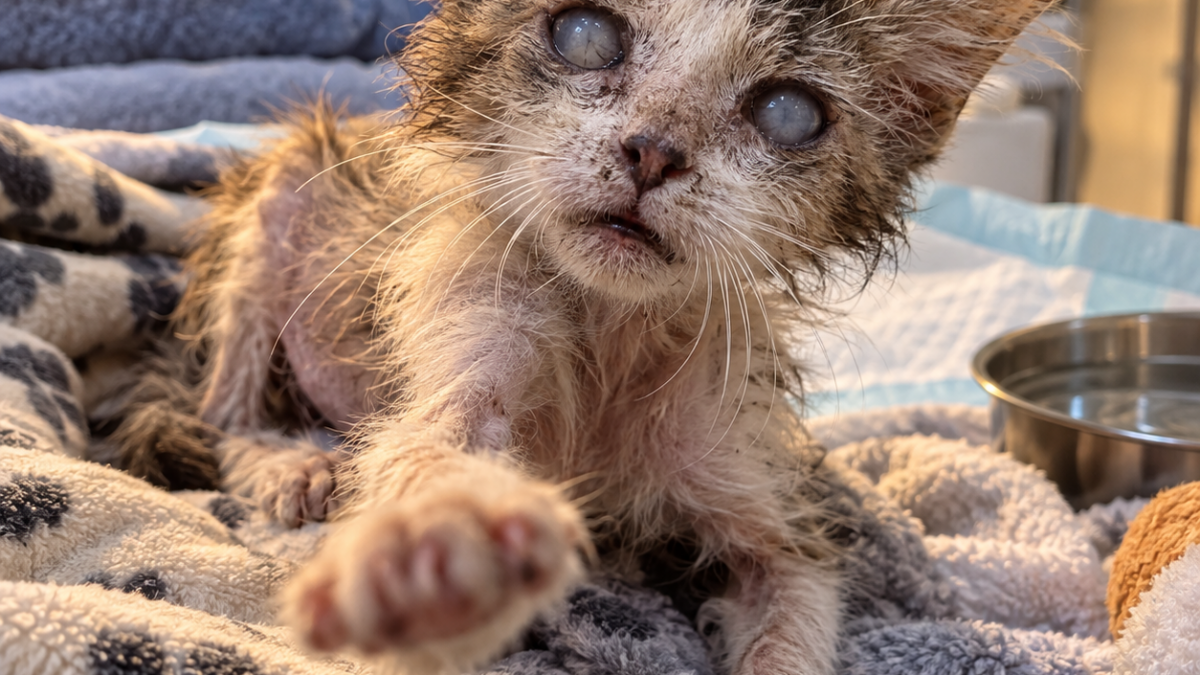
Blind, Toothless, Diabetic, and Abandoned—Bruiser Was Barely Alive When Rescuers Found Him on the Streets. Then the Broken Little Cat Reached Out One Tiny Paw, Begging for Something That Broke Everyone’s Heart.
PART3:
Cars passed on the street beyond the parking lot.
Someone pushed a shopping cart toward the corral.
Normal life continued twenty yards away.
Rachel looked at the cat and wondered how long normal life had been continuing around him.
A day?
A week?
Longer?
She could smell infection when she got closer.
His nose crusted.
Fur beneath his chin damp.
His ears dirty.
His body far too thin.
There was no collar.
No identification.
No sign that anybody had touched him recently with kindness.
Rachel put the towel on the pavement.
Extended one hand.
“Can I help you?”
The cat sniffed.
His head moved uncertainly toward her fingers.
Then something happened Rachel would remember for the rest of his life.
He lifted one paw.
Slowly.
It shook in the air.
For a second she thought he was trying to balance.
Then his paw touched her wrist.
His claws barely emerged.
He rested it there.
Not striking.
Not pushing away.
Holding.
Rachel stopped breathing.
The cat leaned forward.
Paw still on her.
As if making sure she would not disappear.
“Oh.”
Her voice broke.
“Okay.”
She moved closer.
“I’ve got you.”
He let her wrap him in the towel.
No fight.
No panic.
His body felt almost weightless.
He pressed his face into the fold near her chest.
Rachel stood.
The little paw remained hooked against her sleeve.
She would later tell people that was the moment the decision had been made.
Not the next morning at the clinic.
Not after bloodwork.
Not after the diagnosis.
There, in a wet grocery-store parking lot.
Bruiser chose to trust a stranger before that stranger had done anything to deserve it.
Rachel carried him to the car.
Set him inside a plastic carrier she kept collapsed in the trunk for emergencies.
The cat cried when her hands left him.
Weak.
Raspy.
Rachel immediately reached back inside.
“I’m here.”
The crying stopped.
She drove home with one hand touching the carrier through the metal door whenever traffic allowed.
At every red light she spoke.
“You’re okay.”
“I know.”
“Almost there.”
“Don’t worry.”
She knew those statements were promises she could not guarantee.
She made them anyway.
Sometimes frightened creatures need a voice more than accuracy.
Rachel lived fifteen minutes away in a small house with two rescued cats of her own.
Milo, a black cat missing part of one ear.
And Poppy, a fat calico whose greatest hardship in life was being asked to wait until five thirty for breakfast.
Rachel carried the new cat into the laundry room.
Closed the door.
Isolation first.
Always.
She filled a shallow bowl with water.
Opened a can of soft food.
The cat found the water by smell.
Drank.
And drank.
And drank.
Rachel’s concern deepened.
He lifted his head.
Then drank again.
The food came next.
He tried to eat.
That was when she realized he had no teeth.
Not a few missing.
No functional teeth at all.
His gums were inflamed.
He pushed soft food around with his tongue.
Swallowed tiny amounts.
Then returned to the water.
Rachel sat on the floor watching him.
“Where did you come from?”
The cat faced her voice.
No answer.
“What happened to you?”
He took two uncertain steps.
Bumped gently into her knee.
Then simply leaned against it.
Rachel put her hand over her mouth.
He began purring.
Quiet at first.
Then louder.
A broken little engine inside a body that looked as if it had used every remaining resource merely to reach that room.
She stroked his head.
The purr intensified.
“You shouldn’t trust me yet.”
He pushed his forehead into her hand.
Rachel laughed through tears.
“Apparently nobody told you.”
She slept on the laundry-room floor that night.
Not intentionally.
She had placed a blanket beside the carrier and told herself she would sit for twenty minutes.
The cat settled against her thigh.
Every time she moved, he woke.
His paw searched until it found her.
So she stayed.
At two in the morning, she woke with her back against the washing machine and the cat curled between her knees.
He was still trembling.
She put another blanket over him.
“Tomorrow.”
His ear twitched.
“We’re going to figure this out tomorrow.”
The veterinary clinic opened at seven thirty.
Rachel was outside at seven eighteen.
Dr. Leah Morrison had known Rachel for years.
She had treated Milo.
Spayed Poppy.
Patched up kittens Rachel brought in from parking lots and construction sites.
When Rachel carried the orange cat through the door, Leah’s expression changed immediately.
“Where?”
“Behind Carter’s Market.”
“When?”
“Last night.”
Leah opened the carrier.
Bruiser reached toward Rachel.
Again.
That paw.
Leah noticed.
“He bonded fast.”
“I don’t think he’s letting me leave.”
“Smart cat.”
They weighed him.
Seven pounds, two ounces.
A cat his frame should have been closer to eleven.
Temperature.
Dehydrated.
Heart rate elevated.
Blood drawn.
Urine collected.
The exam continued.
Rachel stood near his head.
He pressed against her fingers whenever Leah touched something painful.
The missing eye had been gone a long time.
The remaining eye had advanced damage.
No visual response.
Completely blind.
Severe dental disease had likely cost him his teeth over years.
Skin infection.
Ear infection.
Poor muscle mass.
Possible neuropathy in the rear legs.
Leah listened to his heart.
Then looked at Rachel.
“This is not recent neglect.”
“What do you mean?”
“This didn’t happen over a week.”
“How long?”
“Months.”
Pause.
“Probably years for some of it.”
Rachel looked down.
Bruiser sniffed her thumb.
“You think somebody owned him?”
“I don’t know.”
“A cat doesn’t survive this long alone, does he?”
“Cats survive things we don’t understand.”
Leah removed the stethoscope.
“But somebody may have fed him.”
“Then why didn’t they help?”
Leah gave the answer veterinarians and rescuers learn to give carefully.
“We don’t know his story.”
Rachel nodded.
Judgment could wait.
Bruiser could not.
Bloodwork returned late that morning.
Leah called Rachel into an exam room.
That alone frightened her.
Usually technicians handed over routine results.
Leah closed the door.
Rachel held Bruiser against her chest.
“What?”
“His glucose is extremely high.”
Rachel stared.
“How high?”
Leah told her.
Rachel knew enough to understand the number was bad.
“Stress?”
“Too high to explain with stress alone.”
“Diabetes?”
“Yes.”
The word landed heavier than Rachel expected.
Cats could live with diabetes.
She knew that.
But this cat already had so much.
Blind.
No teeth.
Infections.
Underweight.
Weak.
Now diabetes.
Leah continued.
“We need additional testing, but I am confident we’re dealing with significant diabetes mellitus.”
Rachel looked at Bruiser.
He was asleep inside the towel.
One paw visible.
Leah said:
“He’ll need insulin.”
“How often?”
“Most likely every twelve hours.”
“For how long?”
Leah hesitated.
“Possibly life.”
Rachel absorbed that.
Twice a day.
Every day.
Morning.
Night.
Workdays.
Weekends.
Christmas.
Illness.
Vacation.
Every twelve hours.
“What happens if he doesn’t get it?”
“Poor regulation. Neuropathy. Dehydration. Ketoacidosis.”
“Death.”
“Yes.”
Rachel sat.
Leah continued gently.
“This is manageable.”
“But.”
“But he is medically complicated.”
Rachel laughed once without humor.
“That’s a polite phrase.”
“He’s blind.”
“I know.”
“He’ll need soft food.”
“Okay.”
“We need to treat infections.”
“Okay.”
“He needs weight carefully restored.”
“Okay.”
“Glucose curves.”
“Okay.”
“Insulin.”
“Okay.”
“Potential emergency visits.”
“Okay.”
Leah paused.
“Rachel.”
“What?”
“You’re saying okay very quickly.”
Rachel looked at her.
“What am I supposed to say?”
“You’re allowed to think.”
“About what?”
“About what you can realistically handle.”
The room went quiet.
Rachel knew exactly what Leah meant.
Veterinarians see love collide with money.
Time.
Sleep.
Work.
Caregiver fatigue.
Medical reality.
Saving an animal is not made kinder by pretending those things do not exist.
Leah said:
“No one would think you’re cruel if you decide hospice or humane euthanasia is the kindest option.”
Rachel flinched.
There.
The word she had been refusing to imagine.
Euthanasia.
Bruiser woke at the sound of Rachel shifting.
His head lifted.
He could not see her.
He reached forward.
Paw moving through empty air.
Searching.
Rachel immediately gave him her hand.
His paw landed on her fingers.
Then curled.
Leah stopped speaking.
Bruiser pulled Rachel’s hand toward his face.
Pressed his forehead against it.
Rachel started crying.
Not dramatic sobbing.
Tears simply began falling.
“This is unfair.”
Leah sat across from her.
“Yes.”
“He doesn’t even know me.”
“He knows your voice.”
“He doesn’t know if I can afford this.”
“No.”
“He doesn’t know I work.”
“No.”
“He doesn’t know insulin schedules.”
“No.”
Bruiser began purring.
Rachel wiped her face.
“He just knows I came back.”
Leah waited.
Rachel looked down.
“I can’t put him to sleep because his life will inconvenience mine.”
“That is not what I said.”
“I know.”
She looked at Leah.
“Can he have a good life?”
Important question.
Leah considered before answering.
“Yes.”
No hesitation.
“Not a normal life.”
“Define normal.”
“He’ll be blind.”
“He already is.”
“He’ll need treatment.”
“Okay.”
“He may have bad days.”
“Everybody does.”
Leah almost smiled.
“He may never be an easy cat.”
Rachel looked at the orange body curled against her.
“I don’t think anybody who calls himself Bruiser is supposed to be easy.”
Leah blinked.
“Bruiser?”
Rachel looked surprised too.
She had not named him.
The word had simply appeared.
Maybe because his torn ear and scarred face made him look like he’d survived a hundred alley fights.
Maybe because calling a seven-pound toothless blind cat Bruiser felt like giving the world back some of what it had taken.
“Bruiser.”
She tested it.
His ear moved.
Leah smiled.
“I think he approves.”
Rachel leaned down.
“Okay, Bruiser.”
The cat touched his nose to her chin.
“We’re going home.”
The first week was brutal.
That part gets left out of rescue stories.
People like transformation.
Before.
After.
Sad animal.
Happy animal.
They rarely show 2:00 a.m.
They rarely show the panic when a cat refuses food before an insulin dose.
They rarely show blood glucose meters that will not cooperate.
Or urine on towels.
Or phone alarms.
Or sitting on a bathroom floor crying because you are not sure whether loving something means you are qualified to keep it alive.
Bruiser’s first insulin injection took Rachel fifteen minutes.
Not because the injection itself was difficult.
Because her hands shook.
She drew the tiny dose.
Checked it.
Checked again.
Looked at the syringe.
Looked at Bruiser.
“You trusted the wrong person, buddy.”
Bruiser was eating mashed wet food.
He did not care.
Rachel pinched skin between his shoulders.
Needle in.
Plunger.
Out.
Bruiser kept eating.
She stared.
“That’s it?”
He licked the bowl.
“You couldn’t have reacted a little?”
Nothing.
“You nearly gave me a heart attack.”
He turned toward her voice.
Licked his nose.
Rachel laughed.
The second injection was easier.
By day four:
Routine.
Breakfast.
Insulin.
Medication.
Ear treatment.
Soft bedding.
Work.
Home.
Dinner.
Insulin.
Medication.
Sleep.
Repeat.
Except bodies do not respect schedules merely because schedules look organized.
Bruiser’s glucose fluctuated.
One morning he would eat everything.
Next morning half.
One night he vomited.
Rachel called the emergency clinic at 11:20.
Another night she woke because she thought his breathing sounded different.
Sat beside him for an hour.
Nothing was wrong.
Bruiser simply snored.
He was exceptionally good at snoring for a cat with no teeth.
Milo and Poppy knew another animal was in the laundry room.
Poppy objected.
Loudly.
She sat outside the door and growled.
Bruiser heard her.
Walked toward the sound.
Hit the door gently with his forehead.
Then sat.
Poppy hissed through the gap.
Bruiser purred.
Rachel whispered:
“This is not how territorial disputes normally work.”
Slow introductions began.
Scented blankets first.
Meals on opposite sides of door.
Short controlled exposure.
Milo met Bruiser before Poppy.
Milo approached carefully.
Sniffed.
Bruiser froze.
His remaining eye was open but useless.
He waited.
Milo sniffed his ear.
Bruiser sniffed back.
Then Milo walked away.
That was the entire introduction.
Rachel had expected drama.
Cats often refuse to perform for human narratives.
Poppy required more time.
Eventually she tolerated him.
Then stole his bed.
Bruiser found another.
Because blindness did not make him helpless.
This became the second thing Rachel had to learn.
At first, she carried him everywhere.
Food bowl.
Litter box.
Bed.
Couch.
She feared he would collide with furniture.
Fall.
Become confused.
Then one evening she set him down in the hallway.
Bruiser walked.
Slowly.
Whiskers forward.
Nose working.
Left wall.
Three steps.
Right.
Pause.
He mapped the space.
Within two days he could move from laundry room to kitchen.
Within a week:
Living room.
Two weeks:
Bedroom.
He learned where walls were.
Learned carpet changes.
Learned the sound of Rachel’s footsteps.
Learned the refrigerator.
Especially the refrigerator.
At 5:57 one morning, Rachel woke to something hitting her mattress.
Again.
She opened her eyes.
Bruiser had placed both front paws against the bed frame.
He could not jump onto the bed yet.
But he knew where she was.
“Bruiser?”
Meow.
“What?”
Meow.
She looked at the clock.
Breakfast was at six.
“You have got to be kidding.”
Bruiser meowed louder.
From the doorway Poppy appeared, apparently supportive of the protest.
Rachel got up.
Bruiser turned toward the kitchen.
Walked ahead of her.
She stared.
“You know exactly what you’re doing.”
His tail went up.
That was the first morning he demanded breakfast.
Rachel cried while preparing it.
She hated herself for crying over something so ridiculous.
But two weeks earlier this cat barely possessed enough strength to stand.
Now he was yelling because breakfast was three minutes late.
That was life returning.
Not a miracle.
Medication.
Food.
Hydration.
Veterinary care.
Routine.
And the stubbornness of a little orange animal who had apparently decided survival could become a habit.
His fur improved.
The mats came out slowly.
Some were shaved.
Others combed after his skin healed.
Orange brightened.
White became white again.
The first bath was an insult he never forgave.
Bruiser screamed.
Not because it hurt.
Because dignity had limits.
Rachel wrapped him in a towel afterward.
He glared blindly in her approximate direction.
“You smell terrible.”
He turned his head.
“Yes, I’m talking to you.”
He refused to purr for almost seven minutes.
Then gave up.
Neuropathy in his back legs improved as glucose control stabilized.
He stopped walking low on his hocks.
Muscle returned.
Seven pounds became eight.
Then nine.
At ten pounds, Leah held him up during an appointment.
“Look at you.”
Bruiser reached toward Rachel.
Always.
Even when healthier.
Even when confident.
That paw.
Sometimes touching Rachel’s wrist.
Sometimes sleeve.
Sometimes face.
A check.
You are still here.
Rachel always answered.
“Still here.”
At three months, Bruiser discovered sunbeams.
Blind cats still feel sunlight.
Rachel had placed a thick blanket beneath the living-room window.
Morning sun crossed it around nine.
Bruiser walked through the warmth.
Stopped.
Backed up.
Turned in a circle.
Collapsed dramatically onto his side.
Rachel took a photograph.
He looked enormous compared with the grocery-store cat.
Not physically enormous.
Spiritually.
He occupied space as if the mortgage had his name on it.
He learned the house’s warmest locations.
Laundry fresh from dryer.
Heating vent.
Rachel’s lap.
Benches beside the window.
A patch of carpet in the afternoon.
If Poppy occupied one, Bruiser walked directly into her until she moved.
The first time it happened, Rachel stared.
Poppy hissed.
Bruiser continued forward.
Blind confidence.
Poppy moved.
Rachel laughed.
“You bullied a sighted cat out of a bed.”
Bruiser climbed in.
Their tiny lion.
That was what Rachel called him.
“Where is the lion?”
Bruiser would appear from somewhere.
Often yelling.
The name Bruiser stopped being ironic.
Not because he became aggressive.
Because strength doesn’t always look like teeth and claws.
Sometimes strength looks like a cat whose body had nearly failed deciding every morning that breakfast remained worth getting up for.
There were setbacks.
Many.
At five months, Bruiser stopped eating.
Completely.
Rachel offered everything.
Soft food.
Warm food.
Chicken.
Tuna water.
Nothing.
His glucose behaved badly.
She called Leah.
They went in.
Pancreatitis.
Two nights hospitalized.
Rachel visited twice a day.
Bruiser heard her voice through the kennel door.
Immediately stood.
Reached.
Rachel sat on the clinic floor.
Hand through bars.
“I’m here.”
His paw gripped one finger.
That night she drove home without him for the first time since the rescue.
The house felt wrong.
Poppy seemed quieter.
Milo slept by the laundry-room door.
Rachel did not sleep.
At 3:00 a.m., she wondered whether this was the moment everyone had warned her about.
Chronic disease.
Fear.
No guarantees.
Had she been selfish?
Was she keeping Bruiser alive because she could not stand losing him?
The question terrified her.
The next morning she asked Leah directly.
“Is he suffering because I won’t let go?”
Leah did not answer quickly.
That was why Rachel trusted her.
“He is sick.”
“I know.”
“Sick and suffering are not always the same thing.”
“Is he still enjoying life?”
Leah looked toward Bruiser’s treatment kennel.
“He ate for a technician at five this morning.”
Rachel stared.
“What?”
“Two tablespoons.”
“He wouldn’t eat for me yesterday.”
“Apparently he likes Jessica better.”
Rachel almost cried from relief.
Leah smiled.
“He is still interacting.”
“Okay.”
“Still seeking affection.”
“Okay.”
“Still angry about temperature checks.”
That made Rachel laugh.
“He has opinions.”
“He has many.”
Leah became serious.
“When that changes, we’ll talk.”
Not when treatment becomes expensive.
Not when Rachel becomes tired.
When Bruiser stops being Bruiser.
That was the agreement.
He came home next day.
Lost some weight.
Regained it.
Life continued.
Every twelve hours.
Insulin.
The schedule became architecture.
Rachel rearranged work.
Friends learned that dinner invitations had insulin windows.
If she stayed somewhere late, she drove home.
Vacations required trained pet sitters.
She kept emergency glucose supplies.
Records.
Food logs.
Vet numbers.
Bruiser had more medical documentation than some humans.
People asked:
“Isn’t that exhausting?”
Yes.
Sometimes.
“Expensive?”
Yes.
“Would you do it again?”
Every time Rachel looked toward the floor, Bruiser was usually there.
Sleeping upside down.
Snoring.
Waiting for food.
Fighting Poppy for a blanket.
She knew the answer.
“Yes.”
But she stopped romanticizing it.
Love did not make caregiving effortless.
Love made the effort belong to someone.
There is a difference.
One evening, Rachel’s sister Melissa visited.
She had not seen Bruiser since the first week.
Bruiser walked confidently through the living room.
Melissa stared.
“That’s him?”
“That’s him.”
“He’s huge.”
“He is ten and a half pounds.”
“He looks huge.”
“Attitude.”
Bruiser walked toward Melissa’s voice.
Sniffed her shoe.
Then moved on.
Melissa shook her head.
“I thought you were crazy.”
“You said that.”
“I didn’t think he’d make it.”
“Neither did I.”
“Did the vet?”
“She hoped.”
Melissa watched Bruiser find his blanket.
“How old?”
“No idea.”
“Eight?”
“Maybe.”
“Ten?”
“Could be.”
“Older?”
“Possibly.”
Melissa became quiet.
“What happened to his eye?”
“No idea.”
“Teeth?”
“No idea.”
“Where did he live?”
“No idea.”
“Doesn’t that bother you?”
Rachel looked at Bruiser.
“All the time.”
She had searched missing-pet pages.
Posted photographs.
Contacted shelters.
Had Bruiser scanned repeatedly for microchip.
Nothing.
No one came.
Part of Rachel wanted someone to.
Not because she wanted to lose him.
Because she wanted proof that before the dumpster, somebody had once known him.
Maybe loved him.
Maybe searched.
Nothing.
Bruiser’s past remained a locked room.
Rachel eventually stopped trying to break the door.
He lived in the present more easily than she did.
Animals are sometimes generous that way.
They can carry scars without demanding explanations.
Humans want narrative.
Cause.
Blame.
Meaning.
Bruiser wanted breakfast.
One year after his rescue, Rachel bought him a little paper birthday hat.
He hated it.
There are photographs.
He sat beneath a banner that read:
HAPPY GOTCHA DAY, BRUISER.
Milo ignored the celebration.
Poppy stole chicken.
Bruiser received a plate of medically appropriate food with one tiny piece of plain chicken on top.
Rachel lit no candle.
Fire and blind cats did not need introduction.
She sat on the floor.
“Do you remember the dumpster?”
Bruiser licked his plate.
“Probably not.”
He finished.
Found her knee.
Climbed into her lap.
By then, he had perfected the maneuver.
Front paws.
Push.
Turn.
Collapse.
He settled against her.
Then pressed his forehead into her chest.
Rachel stroked him.
“I’m glad you stayed.”
Bruiser purred.
She laughed softly.
“I guess technically I stayed.”
He lifted his head.
Pressed it under her chin.
That moment became more important later.
Because time passed.
And chronic disease does not negotiate with love.
Bruiser lived well.
But his body remained complicated.
There were glucose changes.
Dose adjustments.
Kidney values watched carefully.
Blood pressure.
Weight.
Infections.
One frightening hypoglycemic episode at two in the morning.
Rachel woke because she heard something fall.
Found Bruiser disoriented.
Weak.
His body twitching.
Training took over.
Emergency glucose.
Call clinic.
Carrier.
Drive.
She talked the whole way.
“You stay with me.”
Bruiser made one small sound.
“Don’t you dare.”
Emergency veterinarian stabilized him.
Insulin reduced afterward.
Rachel sat in the parking lot at dawn, hands shaking around the steering wheel.
Bruiser slept inside the carrier.
She whispered:
“You can’t keep doing this to me.”
Bruiser snored.
That was the terrible bargain of loving something medically fragile.
Every ordinary day becomes precious.
Every bad day feels like the beginning of the end.
You learn not to trust stability completely.
But slowly Rachel learned something else.
Fear can steal good time before loss arrives.
She stopped mourning Bruiser while he was alive.
That sounds obvious.
It wasn’t.
She had spent months watching him sleep and thinking:
How long?
Then realized Bruiser had never once asked.
He woke.
Ate.
Found sun.
Demanded blankets.
Accepted injections.
Purred.
Life occurred one day at a time.
Rachel started doing the same.
One summer morning, she opened the back door onto a screened porch.
Bruiser stood at the threshold.
New space.
He sniffed.
Wind.
Birds.
Grass smells.
His paws touched warm boards.
He froze.
Rachel sat nearby.
“Take your time.”
He stepped forward.
Slow.
Whiskers moving.
One paw.
Another.
He reached the center.
Wind touched his face.
Bruiser lifted his head.
For nearly a minute, he simply smelled the world.
Rachel watched tears fill her eyes.
He had once lived outdoors.
But this was different.
No cars.
No dogs.
No hunger.
No searching for somewhere to sleep.
He could feel air and still know a house waited behind him.
Safety changes the meaning of everything.
Even wind.
Bruiser began asking for porch time.
He would sit by the door and yell.
Rachel opened it.
He walked out.
Lay in sun.
Sometimes she sat beside him.
No dramatic gratitude.
No rescue narrative.
Just an old blind cat enjoying heat through fur.
That may have been Rachel’s favorite version of him.
Not survivor.
Not medical miracle.
Cat.
Simply cat.
The labels mattered for treatment.
Blind.
Diabetic.
Toothless.
One-eyed.
Stray.
But none told her who Bruiser was.
Bruiser hated closed doors.
Loved warm towels.
Preferred food slightly warmed.
Could locate a dropped piece of chicken from impossible distances.
Snored.
Head-butted aggressively.
Purred when injections were given because injections predicted breakfast.
Walked into Poppy when she occupied his preferred blanket.
Learned Rachel’s alarm sound.
Sometimes woke before it and yelled anyway.
He liked one specific fleece throw more than every expensive bed Rachel bought.
He hated thunderstorms.
Not because he saw lightning.
The pressure and noise frightened him.
On those nights, he climbed into Rachel’s lap.
One particularly violent storm came through late in October.
Rain slammed the windows.
Thunder shook the house.
Power flickered.
Poppy disappeared under the bed.
Milo hid behind the couch.
Bruiser stood in the hallway.
Confused.
Rachel called:
“Bruiser.”
He turned instantly.
Walked toward her voice.
Bumped one chair.
Corrected.
Reached the couch.
Rachel lifted him.
He climbed into her lap.
Another thunderclap.
Bruiser tensed.
Rachel put both arms around him.
“It’s okay.”
He pressed his forehead against her chest.
Then something changed.
His body relaxed completely.
Not gradually.
One breath.
Tension.
Next breath.
Gone.
His head rested against her.
His remaining blind eye closed.
Paws loosened.
He slept.
Rachel looked down and began crying.
Quietly.
Bruiser did not wake.
A year earlier, this cat had slept as if danger might return at any moment.
Even inside her house, his first weeks had been restless.
He woke at footsteps.
Startled at doors.
Searched for her whenever she moved.
Now thunder shook the windows and Bruiser simply slept in her arms.
No fear.
No need to monitor escape routes.
No searching paw.
He knew.
That was the moment Rachel realized something had happened bigger than medical recovery.
Bruiser finally understood safety.
Not intellectually.
Animals don’t need language for that.
His body understood.
This person stays.
This lap is safe.
This house is mine.
Food returns.
Pain is treated.
Hands do not hurt.
I can sleep.
Rachel bent down.
Kissed the top of his head.
“I’ve got you.”
Bruiser purred without opening his eye.
Months later, Rachel was asked to tell Bruiser’s story at a small rescue fundraiser.
She almost refused.
She did not enjoy public speaking.
But the rescue needed help funding medical cases.
So she stood beside a projector screen showing a photograph from the night he was found.
Filthy.
Thin.
Cloudy eye.
One missing.
Rachel heard people gasp.
Then another photograph.
Bruiser now.
Clean.
Heavy.
Sitting in sunlight.
She explained diabetes.
Insulin.
Costs.
Monitoring.
Then somebody asked from the audience:
“How did you know he was worth all that?”
Rachel stopped.
She understood the question was not meant cruelly.
Rescues make impossible decisions.
Money given to one complicated case cannot be given to five simpler ones.
There are no easy answers.
Still, the wording bothered her.
Worth.
As if Bruiser needed to demonstrate return on investment.
She said:
“I didn’t.”
The room quieted.
“I didn’t know if he’d live a week.”
Pause.
“I didn’t know if he’d ever stabilize.”
She looked at his photograph.
“I knew he was alive.”
That was the answer.
“He was suffering.”
Another pause.
“And he wanted contact.”
She smiled.
“He kept reaching for me.”
Someone in the audience wiped their eyes.
Rachel continued.
“Sometimes rescue isn’t deciding an animal will become healthy.”
“Sometimes it’s deciding they shouldn’t suffer alone.”
That night the fundraiser covered several months of treatment for diabetic and senior cats.
Bruiser contributed by sleeping at home through the entire event.
Years passed.
Not many.
Enough.
Enough for routines to become family history.
Enough that Rachel forgot what the house had sounded like without his yelling.
Enough that his insulin alarms became part of morning and evening.
Enough that neighborhood children knew him.
“The lion cat.”
One little girl asked:
“Why doesn’t he have eyes?”
Rachel said:
“He has one. It just doesn’t work.”
“Why?”
“He got sick before he came here.”
The girl considered.
“Does he know he can’t see?”
Rachel smiled.
“Yes.”
“Is he sad?”
Bruiser was currently rubbing his face against the girl’s shoe.
“I don’t think so.”
The child crouched.
“Can he see with his nose?”
“Kind of.”
She accepted that.
Bruiser found her hand.
Head-butted it.
She laughed.
“He found me.”
“Yes.”
Bruiser was good at finding people.
Eventually he began slowing.
Not suddenly.
A missed jump he no longer attempted.
Longer naps.
Less interest in walking the entire house.
More time on the favorite fleece blanket.
Rachel noticed.
Of course she did.
Caregivers notice before everybody else.
Leah watched his lab values.
Adjusted treatment.
Nothing catastrophic.
Just age and chronic disease collecting interest.
Rachel hated it.
One evening she sat beside Bruiser on the porch.
Warm air.
Cicadas.
He slept against her thigh.
“I don’t know how to do this part.”
His ear twitched.
“You were supposed to be the sick cat I saved.”
She stroked his neck.
“Nobody explained what happens when the sick cat becomes the reason I get out of bed.”
Bruiser woke.
Turned toward her.
Paw searched.
Found her hand.
Rachel laughed and cried simultaneously.
“Still checking?”
He pulled her fingers toward his face.
“I’m still here.”
That sentence had changed.
At the beginning, it was what Bruiser needed.
Now Rachel needed it too.
Still here.
Months later, his appetite declined.
Then returned.
Declined again.
Kidney values worsened.
Leah was careful.
“We’re not there yet.”
Rachel knew what there meant.
“When?”
“You’ll know.”
“I hate when veterinarians say that.”
“I know.”
“What if I don’t?”
“You will.”
Rachel did.
One winter morning, Bruiser did not demand breakfast.
The silence woke her.
That sounds impossible.
It isn’t.
You become accustomed to an animal’s noises so completely that absence becomes sound.
Rachel opened her eyes.
6:11.
No yelling.
She sat up.
“Bruiser?”
Nothing.
Found him on his fleece blanket.
Awake.
Head lifted.
But tired.
He sniffed food.
Turned away.
Rachel’s heart sank.
She called Leah.
Bloodwork.
Exam.
Numbers.
More complicated than before.
Leah sat on the floor beside them.
Bruiser rested against Rachel.
“We can hospitalize.”
Rachel nodded.
“Will it fix this?”
“Maybe improve him temporarily.”
“Will he come home feeling like Bruiser?”
Leah hesitated.
That was the answer.
Rachel looked down.
Bruiser’s paw rested across her wrist.
Of course.
Always.
She cried.
“I promised I wouldn’t make him stay because I can’t let him go.”
Leah touched her shoulder.
“You also promised he wouldn’t be alone.”
Rachel bent over him.
Pressed forehead to his.
“You’ve got terrible timing.”
Bruiser purred.
Weakly.
Still Bruiser.
He had spent years needing insulin every twelve hours.
On his final day, there was no schedule.
Rachel took him home first.
Leah agreed.
A few hours.
Comfort medication.
No pain.
Bruiser lay on the screened porch in a patch of winter sun.
Poppy sat nearby.
Milo sniffed him.
Then curled a few feet away.
Rachel warmed his favorite blanket.
Placed it beneath him.
She offered chicken.
Bruiser ate one tiny piece.
Of course he did.
She laughed.
“Had to get one last one?”
He licked his nose.
Friends visited quietly.
Melissa cried.
The neighbor girl kissed his head.
Nobody made Bruiser perform goodbye.
He slept.
Late afternoon, Rachel carried him to the clinic.
Same clinic where years earlier she had sat with an impossibly thin orange stray reaching toward her.
Leah prepared the room.
Blanket.
Low lights.
No metal table.
Rachel sat on the floor.
Bruiser in her lap.
His head against her chest.
Leah explained every step.
Rachel knew it already.
Still listened.
“Ready?”
No.
There is no ready.
Rachel nodded.
Bruiser felt the first medication.
His body relaxed.
His paw slid against Rachel’s hand.
She held it.
“I’m here.”
Purr.
Very faint.
“Still here.”
His forehead rested beneath her chin.
“No more needles after today.”
She smiled through tears.
“No more glucose checks.”
Bruiser breathed slowly.
“No more medicine.”
Another breath.
“You did so good.”
Another.
“My tiny lion.”
Leah waited.
Rachel whispered:
“You can sleep.”
Bruiser did.
Peacefully.
The final injection came after he was already deeply sedated.
His heart stopped while Rachel held him.
No road.
No dumpster.
No cold pavement.
No searching for a human who might leave.
Just the person who had promised years earlier:
I’ve got you.
Rachel stayed long afterward.
There was no need to hurry.
At one point, she realized her hand was still beneath his paw.
Exactly where it had been the first night.
She remembered wet pavement.
Filthy fur.
The trembling leg.
That paw rising.
Touching her wrist.
Please don’t leave me.
She bent down.
Kissed him once.
“I didn’t.”
Bruiser came home one final time inside a small urn several weeks later.
Rachel placed it beside the photograph from his first gotcha day.
No dramatic memorial.
One red collar.
His tag.
A clipping of orange fur.
The glucose meter she could not yet throw away.
For months afterward, Rachel still woke at insulin time.
5:55.
Her body remembered.
She would open her eyes.
Wait for the yell.
Nothing.
At night, her phone alarm would sound before she remembered she had never deleted it.
Eventually she turned it off.
That was harder than she expected.
Poppy inherited Bruiser’s fleece blanket.
Milo began sleeping in the sunny spot.
Life does what it always does.
Continues.
But Bruiser remained inside it.
Not as tragedy.
Not even primarily as rescue.
As proof.
Proof that a life can be profoundly imperfect and still profoundly worth living.
Bruiser never regained sight.
Never grew new teeth.
Never stopped being diabetic.
There was no magical cure hidden at the end of his story.
He needed insulin until near the end.
He required special food.
Monitoring.
Veterinary care.
Money.
Time.
Patience.
There were emergencies.
Fear.
Exhaustion.
He was never made whole in the way people sometimes mean when they tell rescue stories.
He didn’t need to be.
Healing and repair are not always the same thing.
His body remained damaged.
His life became good.
That distinction mattered.
Bruiser got sunlight.
Warm blankets.
Breakfast arguments.
Friends.
Porch wind.
Christmas mornings.
Hands that knew where he liked to be scratched.
A veterinarian who knew his personality.
Two cats who accepted him.
A home he could navigate blind.
A lap he could sleep in during thunder.
He got years in which nobody abandoned him for becoming difficult.
That was the miracle.
Not that diabetes disappeared.
It didn’t.
Not that blindness reversed.
It didn’t.
Not that he became young.
He didn’t.
The miracle was ordinary consistency.
Morning.
Evening.
Medicine.
Food.
Voice.
Touch.
Again.
Again.
Again.
Care repeated until an animal who had apparently spent much of his life expecting the world to hurt him finally stopped being afraid of sleep.
People sometimes asked Rachel whether Bruiser knew he had been rescued.
She never liked the question.
Rescue is a human word.
Bruiser probably didn’t think:
I was homeless and now I have been adopted.
He understood simpler things.
Hungry.
Then fed.
Cold.
Then warm.
Pain.
Then relief.
Alone.
Then not.
Maybe that is enough.
Years after he died, Rachel still volunteered with senior and special-needs cats.
People would show her animals and apologize before describing them.
“He’s blind.”
“She needs medication.”
“He’s old.”
“She has kidney disease.”
“He may not have much time.”
Rachel listened.
She never answered:
Take them all.
That isn’t responsible either.
Every home has limits.
Money.
Space.
Skill.
Time.
But she always asked one question.
“Can they still have good days?”
Because Bruiser taught her to stop evaluating life by perfection.
He had arrived with almost nothing people traditionally call adoptable.
Not pretty in the conventional sense.
Not healthy.
Not young.
Not easy.
No teeth.
One eye missing.
The other blind.
Diabetes.
Infections.
Weakness.
No known history.
No certainty.
A shelter profile could have reduced him to a list of problems.
Bruiser refused to live like a list.
He was demanding.
Funny.
Affectionate.
Bossy.
Brave.
Annoying.
Warm.
Trusting.
Loved.
The last photograph Rachel ever printed of him was not the dramatic rescue image.
Not the filthy cat.
Not the before-and-after comparison.
It showed Bruiser asleep on his favorite blanket.
Nothing more.
Orange body curled.
One paw stretched forward.
Sun across his back.
If you did not know his story, you would see only an old cat sleeping.
Rachel loved that.
Because after everything Bruiser survived, he had earned the right to be ordinary.
Not inspiration.
Not tragedy.
Not miracle.
Just a cat asleep in his own home.
And perhaps that was the greatest transformation of all.
The world had once looked at him—if it looked at all—and seen a ruined animal.
Blind.
Toothless.
Sick.
Expensive.
Difficult.
Probably dying.
Rachel learned to see the question differently.
Not:
How damaged is he?
But:
Is he still reaching for life?
Bruiser had answered that question before she knew how to ask it.
With one paw.
Shaking.
Filthy.
Weak.
Extended toward a stranger in a parking lot.
He had no idea whether the hand in front of him would disappear like everything else apparently had.
Still, he reached.
And Rachel stayed.
Not for a night.
Not until the first veterinary bill.
Not until treatment became inconvenient.
Not until he stopped looking tragic enough to inspire sympathy.
She stayed when he woke her.
When he vomited.
When she missed dinners.
When insulin had to be given.
When glucose crashed.
When the vet bills came.
When fear returned.
When he became old.
And finally, when loving him required the one form of staying that felt most like leaving.
She held him until the end.
Bruiser did not need a perfect body to deserve that.
He never did.
He needed someone willing to look past the list of everything that was wrong and see the life underneath it.
A life still capable of purring.
Of asking for breakfast.
Of seeking sunlight.
Of stealing blankets.
Of trusting.
A life that had not finished wanting things.
Sometimes rescue begins with medicine.
Sometimes with food.
Sometimes with a carrier and a veterinary appointment.
Bruiser’s began with something smaller.
A paw against a wrist.
And one silent request from an animal who had every reason to stop trusting people.
Please don’t leave me.
The answer took the rest of his life.
I won’t.








