Black Belts Robbed a Diner and Kicked His German Shepherd — They Had No Idea He Was a Navy SEAL
PART3:
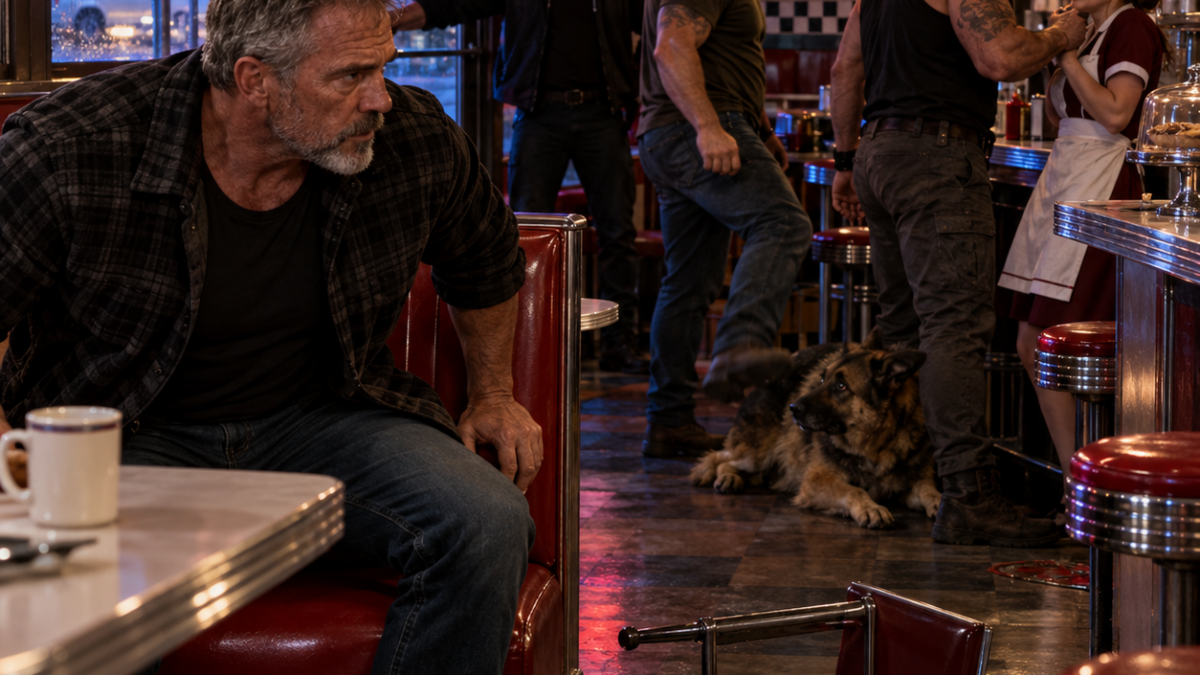
The door slammed against the wall with a wet gust of wind.
Three men walked in.
They did not enter the diner.
They invaded it.
That may sound dramatic, but men carry intention in their bodies long before they speak. These three were loud before their mouths opened. Shoulders wide. Chins lifted. Eyes moving over the room, not to understand it, but to claim it.
The leader came first.
Broad-shouldered. Tight black shirt despite the cold. Heavy tattooed arms. Cauliflower ear. Thick neck. He had that gym-built confidence young men get when they have been told too many times they hit hard.
The second was taller, leaner, wearing a track jacket with the logo of a local mixed martial arts gym on the back. Long arms, loose hips, bouncing lightly on the balls of his feet even while standing still.
A kicker.
The third was stockier. Younger-looking. Restless. He followed half a step behind the other two, laughing a little too quickly, watching the leader for permission before deciding what kind of man to be.
They were wet from the rain and smelled like sweat, beer, and ego.
The leader shook water from his hair onto the floor.
“Place is a dump.”
The tall one laughed.
“Smells like cheap grease and desperation.”
I looked down at my coffee.
Duke’s ear twitched.
The three men took the center booth, not because they wanted it, but because it made them visible. Men like that do not sit in corners. Corners are for people who understand angles. They sat where everyone had to notice them.
The leader slapped both palms on the table.
“Hey! Where’s the service in this graveyard?”
Maggie pushed through the kitchen doors, wiping her hands on a towel.
The second she saw them, something in her shoulders dropped.
Not much.
Enough.
She knew the type.
Every waitress working the night shift knows the type.
Men who confuse service with submission.
Men who think a woman being paid to be polite means she has no right to dignity.
Men who arrive hungry for more than food.
“Welcome,” Maggie said, voice even. “Coffee to start?”
The leader looked her up and down in a way that made my jaw tighten.
“I don’t want coffee, sweetheart. I want four burgers, extra bacon, fries, and whatever pie doesn’t taste like cardboard. We just spent three hours cutting weight, and I’m starving. So hop to it.”
“I’ll put the order in,” Maggie said. “Grill needs a little time. It’ll be about fifteen minutes.”
“Did I say fifteen?”
His voice stayed light, but the temperature in it changed.
“I said five.”
“The grill still needs to heat.”
The tall one leaned back, smirking.
“Maybe you should heat up faster, then.”
The third one laughed.
Too loud.
Too eager.
I took a slow sip of coffee.
My reflection stared back at me from the dark window.
Pale eyes.
Weathered face.
Still hands.
I had spent years learning the difference between noise and threat.
Not every loud man is dangerous.
Not every rude man deserves consequence.
The world is full of fools, and if you fight every fool, eventually you become one of them.
So I watched.
That is all.
I watched Maggie write down their order.
I watched the leader—Trent, the others called him—lean too close when she reached for the menus.
I watched the tall one, Logan, track her with lazy amusement.
I watched the stocky kid, Reese, look around the diner and realize there was no one there except a waitress, an old man, and a dog.
Duke shifted under the table.
He had always been better than most people at reading rooms.
For the next ten minutes, the men tested boundaries the way children test fences.
A sugar packet flicked across the booth.
Then another.
One bounced off Maggie’s shoulder as she brought water.
“Oops,” Logan said.
Maggie did not react.
Trent stuck his foot into the aisle every time she walked by, forcing her to step around him.
Reese laughed whenever the others laughed.
The grill hissed in the back.
Rain hammered the roof.
I kept my hands around the coffee mug.
I gave them every opportunity to just be idiots.
Eat.
Boast.
Insult the pie.
Leave.
Then Trent stood.
Not to stretch.
Not to use the bathroom.
He walked toward the register.
Maggie was behind the counter boxing up a slice of pie when he leaned both arms onto the laminate.
“Hey, sweetheart. Change of plans.”
Maggie froze.
“You need something?”
“We ain’t paying for this slop.”
“You haven’t even gotten your food yet.”
“Yeah, well, service is garbage. And I don’t feel like waiting anymore.”
He smiled.
“Actually, I think you owe us for wasting our time. Open the drawer.”
Maggie took a slow step back.
Her hand moved toward the phone under the counter.
“I don’t want any trouble. Just leave.”
Trent’s voice dropped.
“I said open the drawer.”
Logan and Reese stood from the booth.
They flanked him.
Reese went to the front door, flipped the deadbolt, and pulled down the shade.
The click of that lock echoed through the empty diner.
That was the moment the room changed completely.
Before, they had been bullies.
Now they were criminals.
Maggie’s face went pale.
“There’s a camera right there,” she said, nodding toward the corner. “You don’t want to do this.”
Logan laughed.
“Dummy camera. Blinking light’s fake. Seen a hundred of them.”
He vaulted the counter with athletic ease and landed next to Maggie.
She gasped and backed into the pie case.
“Open the register,” Logan said, grabbing her arm. “Or I break this arm in three places. I know how.”
Duke stood.
Slowly.
Stiffly.
But all the way.
The old dog stepped out from beneath my booth, claws clicking against the linoleum. His head lowered. Fur lifted along his spine. A low growl rolled out of him, deep and steady.
He placed himself in the aisle between my booth and the counter.
He was old.
He was hurting.
He knew it.
He stood there anyway.
Logan looked down at him and laughed.
“Look at this. Place comes with a guard dog.”
I set my coffee mug down.
“Hey.”
One word.
Not loud.
Not shouted.
It carried anyway.
Logan looked at me.
For the first time, all three men noticed me.
Not saw me.
They had seen me earlier.
Now they noticed me.
A gray-bearded man in flannel sitting in a corner booth.
Nothing more.
Logan grinned.
“Keep your mutt on a leash, old man, before I put it down for a nap.”
Duke barked once.
Sharp.
Protective.
He took one step forward.
Not attacking.
Holding the line.
Logan rolled his eyes.
Then he did the thing that changed everything.
He stepped away from the counter, cocked his leg back, and kicked Duke hard in the ribs.
The sound was terrible.
Not loud.
Terrible.
A dull, heavy thud followed by Duke’s sharp cry as his body folded and slammed against the base of a bar stool.
He hit the floor and did not get up.
For one second, there was no rain.
No neon.
No breathing.
No world.
Only Duke on the linoleum, gasping, trying to pull air into lungs that had just forgotten how.
Maggie covered her mouth, a broken sound caught behind her fingers.
Logan laughed.
“Told you. Put it down for a nap.”
Something inside me became very still.
People misunderstand anger.
They think real anger is loud.
Red-faced.
Spitting.
Shaking.
Sometimes it is.
But the kind of anger that scared me most in myself had no heat in it at all.
It was cold.
Clear.
Quiet.
It sharpened the edges of the room.
It slowed time.
It counted distance.
Logan: twelve feet.
Trent: fourteen.
Reese: near the door, nervous, weight on his back foot.
Maggie: behind the counter, left arm held close to her body.
Duke: down, breathing shallow.
Wet floor near entrance.
Coffee mug on table.
Napkin dispenser.
Bar stools bolted.
Glass pie case.
No firearms visible.
Three attackers.
One civilian.
One injured dog.
I stood.
The civilian version of me—the retired man trying to drink coffee in peace—stepped backward inside my mind.
The operator woke up.
Trent laughed.
“Oh, look. Grandpa’s mad.”
I stepped out of the booth.
Every movement smooth.
No hurry.
Hurry wastes energy.
“You want a piece of this, old man?” Trent said. “We train six days a week. Black belts. You’re going to break a hip just walking over here.”
I did not look at him.
I looked at Logan.
I took three measured steps down the aisle and stopped beside Duke.
I wanted to kneel.
I wanted to put my hands on my dog and tell him I was there.
But I knew what would happen if I looked away too soon.
So I kept my eyes on the man who had kicked him.
“You kicked my dog,” I said.
My voice did not sound like mine.
It was flat.
Dead.
A factual statement.
Logan bounced lightly, raising his hands.
“Yeah, I did. He was in my way.”
He smiled.
“What are you going to do about it? Throw hands?”
I looked at him.
I saw the stance.
The arrogance.
The false safety of a man who had only fought where someone could stop the fight.
“No,” I said.
His grin widened.
“No?”
“I’m not going to fight you.”
I took half a step closer.
“I’m going to stop you.”
He moved first.
Young.
Fast.
Confident.
He threw a quick combination meant to prove something.
I stepped inside it.
That is the thing sport fighters forget when ego gets louder than discipline. Distance is permission. Remove distance, and the beautiful strike they practiced in front of mirrors becomes crowded, jammed, useless.
I did not fight like a cage fighter.
I did not fight like a boxer.
I fought like a man who had spent years being taught that a threat remains a threat only until you remove its ability to continue.
I struck once.
Hard enough.
Precise enough.
Logan’s head snapped back, his balance gone.
Before he could recover, I took away his base.
He hit the floor badly and stayed there, clutching his leg, screaming.
I will not describe it more than that.
Some consequences are ugly enough without decoration.
Reese went white at the door.
Trent did not.
His shock turned to rage.
“You’re dead,” he roared. “You hear me? You’re dead.”
I stepped back to neutral.
Breathing steady.
Eyes on him.
“He shouldn’t have kicked my dog.”
That was all.
Trent charged.
He came like a bull, chin down, arms wide, all force and no thought. He was big. Strong. Maybe two hundred forty pounds. In a ring, under rules, with gloves and a referee and a crowd shouting his name, he might have been terrifying.
But a charging man gives you everything he owns.
Weight.
Momentum.
Balance.
Intent.
I waited until he was close enough to smell the cheap cologne under his sweat.
Then I moved.
Not backward.
Sideways.
His punch cut through empty air.
His boots slipped on the wet floor.
I used his momentum, took his balance, and put him down hard enough that the whole diner seemed to jump.
He tried to rise.
I did not let him.
A pinned man can still hurt people if you underestimate his panic. I controlled his arm, put pressure where pressure mattered, and lowered my voice beside his ear.
“Do not move.”
He made a sound somewhere between a curse and a groan.
“If you move, I make sure you cannot use this arm again. Do you understand?”
He nodded.
Fast.
Desperate.
“Good.”
The room held still around us.
Logan was on the floor, crying now, all swagger gone.
Trent lay pinned beneath me, breathing hard, his face pressed sideways against the linoleum.
Reese stood by the door with both hands shaking.
He looked from his friends to me.
Then to the lock he had turned himself.
That was when I saw understanding cross his face.
He had locked Maggie in with them.
But he had also locked himself in with me.
He fumbled blindly for the deadbolt, got it open, and shoved the door wide.
Cold rain blew into the diner.
I did not chase him.
I watched him run across the parking lot, slip once in a puddle, scramble up, and vanish into the storm.
Let him run.
Fear would keep him honest for the next ten minutes.
Police could handle the rest.
I released Trent’s arm and stood.
He did not move.
The room smelled of rain, sweat, old grease, and adrenaline.
The operator inside me began to recede.
The old man came back.
And the old man had a dog on the floor.
I dropped to my knees beside Duke.
“Hey, buddy.”
My voice changed.
All the ice disappeared.
“I’m right here. I’m right here.”
Duke lay on his side, breathing too fast and too shallow. His eyes were open but glassy. He tried to track me, tried to wag his tail, and could not.
That scared me worse than the three men had.
I ran my hands over his rib cage with the care of someone touching something sacred. I felt for breaks, swelling, the wrong movement under fur.
Duke whined softly and pushed his wet nose against my wrist.
“I know,” I whispered. “I know. Stay with me.”
Behind the counter, Maggie stood with both hands gripping the laminate.
“Is he…”
“He’s hurt,” I said.
I did not look up.
“Ribs. Maybe internal bleeding. He needs a vet now.”
Her face crumpled.
“Jack—”
“Call the police. Tell them there was an attempted robbery. Tell them to send an ambulance for those two.”
I slid one arm beneath Duke’s chest, carefully avoiding the side where the kick had landed. The other went beneath his hindquarters.
He weighed less than he used to.
Still, lifting him hurt.
My back screamed.
My shoulder flashed hot.
Old shrapnel scars pulled like wire.
I did not care.
Duke whimpered.
“I’ve got you,” I said through my teeth. “We’re going.”
Maggie rushed to the front door and held it open against the wind.
“The cops are coming,” she said. “You can’t just leave a crime scene.”
“Watch me.”
“Jack.”
“I have to get him to Dr. Miller.”
She stared at me for half a second.
Then nodded.
“I’ll handle the cops. Save him.”
I carried Duke into the rain.
My truck sat under a flickering light at the edge of the lot. I got the passenger door open with one hand and laid Duke across the worn bench seat. I pulled an old wool blanket from the floorboard and draped it over him.
As I rounded the hood, sirens rose over the rain.
Two cruisers crested the hill and swung into the lot, red and blue lights scattering across the wet asphalt.
Four officers got out fast.
Hands near weapons.
The lead officer was young, shaved head shining with rain.
“Hey!” he shouted. “Put your hands on the vehicle. Now.”
I opened the driver’s door.
He drew down to low ready.
I looked at him through the rain.
“My dog is dying.”
“Sir, step away from the truck.”
“The men you want are inside on the floor. The waitress is fine. I’m going to the emergency vet on County Line Road. Send somebody there if you want to arrest me. Otherwise, get out of my way.”
His mouth opened.
I did not wait for whatever came next.
I climbed in, started the truck, and pulled out.
Maybe he shouted.
Maybe he followed.
I could not hear him over the storm and Duke’s shallow breathing.
I kept one hand on the wheel and the other on Duke’s flank.
“Stay with me,” I said. “You hear me? You do not get to leave like this.”
His eyes were half closed.
I pressed the gas harder.
The road blurred with rain.
The wipers slapped back and forth.
I drove too fast.
Not stupid fast.
Controlled fast.
There is a difference, though a judge might disagree.
Duke was not just a dog.
People who say “just a dog” have never had one pull them back from the edge of themselves.
After my medical discharge, I came home to a house too quiet to survive.
No team.
No mission.
No radio.
No one checking whether I slept.
No one noticing whether I ate.
Civilian silence was not peaceful then.
It was a hole.
The memories came at night. Ramadi. The Korengal. Places that do not show up on tourist maps and should not show up in dreams. I started drinking because sleep would not come and daylight felt pointless.
Then came Duke.
He was a rescue from the county shelter. Defensive. Underweight. Missing patches of fur. Bit a volunteer badly enough that they had already marked him as difficult.
I saw him behind the chain-link fence, standing stiff in the back corner of the kennel, eyes hard, trusting nothing.
The shelter worker warned me not to get close.
I looked at Duke.
Duke looked at me.
Two broken things recognizing each other.
“I’ll take him,” I said.
The shelter worker thought I was crazy.
Maybe I was.
But Duke gave me a schedule.
Morning walks.
Food.
Vet visits.
Training.
A reason not to drink until noon.
A reason to get out of bed because something with fur and bad breath needed me.
He anchored me to the earth when the memories tried to drag me under it.
“You saved my life,” I whispered in the cab. “I’m not letting you die on a dirty diner floor. Hold the line, buddy. Just hold the line.”
The neon sign for County Line Emergency Veterinary Clinic appeared through the rain like a weak blue star.
I threw the truck into park before it fully stopped, left the engine running, and carried Duke inside.
The receptionist looked up from the computer.
Her eyes widened.
“I need help,” I said.
My voice filled the waiting room.
“He took blunt force trauma to the ribs. Breathing shallow. Gums pale. Going into shock.”
She did not ask for paperwork.
Good woman.
She slammed a buzzer beneath the desk.
Double doors flew open, and Dr. Miller rushed out wearing scrubs and the expression of a man who knew bad news before it was spoken.
“Bring him back. Now.”
I laid Duke on the stainless steel table with more care than I had ever given anything.
Dr. Miller moved quickly.
Stethoscope.
Hands.
Orders.
“Oxygen. IV. Fluids. X-ray ready. Ultrasound now.”
“What happened?” he asked.
“He was kicked. Full force. Behind the front shoulder. Twenty minutes ago.”
Miller’s jaw tightened.
He liked Duke.
Everybody liked Duke once Duke decided they were allowed to.
A tech slipped an oxygen mask over Duke’s muzzle. He did not fight it.
That terrified me.
“Sir,” the tech said gently, “we need space to work.”
I wanted to refuse.
Every instinct told me to stay on the X, guard my teammate, cover the door, control the room.
But I was not a vet.
Right then, I was only in the way.
I took one last look at Duke.
Then I stepped back through the swinging doors.
They closed in my face.
The waiting room was too bright.
Too quiet.
Too clean.
I stood dripping rainwater onto the tile, hands hanging at my sides.
Blood on my knuckles.
Not much.
Enough.
Slowly, the adrenaline drained out.
What remained was exhaustion so deep it felt like gravity had doubled.
I sat in a hard plastic chair and buried my face in my hands.
All I could see was Logan’s boot hitting Duke’s ribs.
All I could hear was the yelp.
The darkness inside me stirred.
It whispered with an old familiar voice.
Find the third one.
Find the gym.
Find every man who taught those boys violence without honor.
Make them afraid.
I inhaled slowly.
No.
You are not that man anymore.
You left him in the desert.
You left him where he belonged.
Forty-five minutes later, the clinic door opened.
I did not look up.
The footsteps were wrong for a pet owner.
Heavy.
Purposeful.
Cop.
“Jack?”
I lifted my head.
Detective Barnes stood a few feet away in a rumpled suit under a rain-dark trench coat. He was older, thick around the middle, with tired eyes and a face that said he had spent too much of his life asking questions people did not want to answer.
“Maggie gave me your name,” he said.
I stared at the opposite wall.
“She okay?”
“She’s shaken. Bruised arm. Alive.”
I nodded once.
Barnes pulled out a notebook but did not open it.
“She gave me a pretty wild story.”
“Is there a question, Detective?”
“Several.”
He sighed.
“I came from the diner. Paramedics were loading up two men. One is Trent Wallace. Amateur heavyweight fighter. Prior assault charges. The other is Logan Pierce. Same gym. Both badly hurt.”
I said nothing.
“Maggie says they tried to rob the register. Says one of them grabbed her. Says one of them kicked your dog. Then she says you stood up and put both of them on the floor in under ten seconds.”
He studied me.
“I look at you, and I see a guy pushing sixty. Flannel. Faded jeans. Not exactly a cage fighter.”
“No.”
“So how did a senior citizen dismantle two trained fighters without breaking a sweat?”
I turned my head and looked him directly in the eyes.
“They trained for points, Detective. They trained for tap-outs. They expected a contest.”
Barnes watched me carefully.
“And what did you expect?”
“To neutralize a threat.”
The room went quiet.
“I spent twenty-two years doing that for a living. Methodology doesn’t change because I got old.”
Barnes’s expression shifted.
Not fear.
Recognition.
“What unit?”
Before I could answer, the double doors opened.
Dr. Miller stepped out, pulling off his surgical cap.
His scrubs were stained.
I stood so fast the chair scraped backward.
“Doc.”
Miller looked tired enough to fall over.
“Tell me.”
“It was close,” he said.
My chest tightened.
“How close?”
“Too close. Two broken ribs. One splintered and nicked the outer lining of the lung. He was bleeding into his chest cavity.”
The room tilted slightly.
“But?”
Miller exhaled.
“But we stopped it. Drained the cavity, stabilized the ribs, pushed fluids and plasma. He’s heavily sedated. He’ll be in pain when he wakes up, and recovery is going to be slow.”
I waited.
Miller finally gave me the words.
“He’s going to make it.”
I closed my eyes.
The breath left me long and ragged.
It felt like something inside my chest had unclenched for the first time since the diner.
“Can I see him?”
“Yeah. Recovery. Back corner.”
I walked past him.
Duke lay in a bottom recovery run on heated blankets, IV taped to his shaved front leg, oxygen nearby. His chest rose and fell in a steady rhythm.
I knelt on the tile.
Reached through the bars.
Rested my hand against his snout.
He did not wake, but a deep sleeping sigh left him at my touch.
I sat there on the floor and watched him breathe.
Ten minutes later, Barnes entered the recovery room with a paper cup of bad coffee.
He looked at Duke.
Then at me.
“I made a few calls.”
I did not look away from my dog.
“And?”
“Ran your plates. Name came back flagged. Directed me to a federal database that told me I didn’t have clearance to view your full service record.”
“Should’ve stopped there.”
“I’m bad at stopping.”
“Most detectives are.”
He took a sip of coffee and grimaced.
“Had to wake up a buddy at the bureau. Got a summary.”
I waited.
“Naval Special Warfare. Twenty-two years. Silver Star. Two Bronze Stars with Valor. Medical discharge that reads like a building fell on you.”
I kept my hand on Duke.
“You aren’t just a veteran,” Barnes said softly. “You’re the kind of man they send when the situation is already past polite solutions.”
“I’m retired.”
“I know.”
He leaned against the counter.
“As far as the county is concerned, you are also a private citizen who intervened during a violent felony. Maggie gave a full statement. The men locked the door, threatened her, demanded money, and initiated the violence. Reese got picked up two miles down the highway, by the way. He’s talking fast.”
“Good.”
“Turns out they hit a gas station in the next county three hours before they walked into the diner.”
I finally looked up.
Barnes nodded.
“Trent and Logan are under police guard at the hospital. When they heal enough to understand handcuffs, they’ll be charged with robbery, assault, and felony animal cruelty.”
He paused.
“You are not facing charges.”
I said nothing.
“You saved Maggie’s life tonight.”
I looked back at Duke.
“I saved my dog.”
“You did both.”
Barnes pushed off the counter and placed a business card on the floor beside me.
“If anyone from that gym comes looking for revenge, you call me.”
“I can handle it.”
“I know. That’s what worries me.”
For the first time that night, I almost smiled.
Barnes pointed at the card.
“Call me anyway. Paperwork is easier when nobody ends up folded in half.”
“Understood.”
He left me alone with the machines, the dim lights, and the sound of Duke breathing.
The storm broke just before dawn.
Rain softened into mist.
A pale gray morning pressed against the clinic windows.
Duke stirred around six.
His amber eyes opened slowly, clouded by painkillers.
He lifted his head an inch, winced, then found me.
His tail thumped once against the blanket.
Weak.
Perfect.
I smiled.
A real one.
“There you are.”
He made a low sound in his throat.
Not a bark.
Not a whine.
A greeting.
I reached through the bars and scratched behind his ears.
“You scared me, old man.”
His eyes blinked slowly.
“I know,” I whispered. “I know I’m old too.”
Dr. Miller said Duke would stay two nights.
Maybe three.
No running for months.
Pain medication.
Follow-up visits.
Careful movement.
A harness instead of stairs.
I agreed to everything before he finished saying it.
Maggie came by later that morning.
She brought a clean shirt, my truck keys, and a thermos of diner coffee that tasted exactly as bad as always.
Her left arm was wrapped.
Her eyes were red.
She stood outside Duke’s recovery run for a long time.
“I’m sorry,” she said.
I looked up.
“For what?”
“If I had called police earlier. If I had refused service. If I—”
“No.”
She swallowed.
“They hurt him because he protected me.”
“Yes,” I said. “He did.”
Her face crumpled.
“I don’t know how to live with that.”
I looked at Duke.
Then back at her.
“You live by making sure what he protected was worth protecting.”
She wiped her cheeks.
“How?”
“You go home to your kids. You keep breathing. You testify. You let the men who did this face what they earned.”
She nodded.
Then she looked at me.
“And you?”
“I’ll sit here until he wakes up fully.”
“That’s not what I meant.”
I knew.
She glanced at my hands.
At the bruises.
At the stillness that never quite left me.
“Are you going to be okay?”
I almost gave the easy answer.
Sure.
Fine.
Always am.
Instead, I told her the truth.
“I don’t know.”
Maggie sat down beside me on the tile floor in her diner uniform, back against the cages.
For a while, neither of us spoke.
That was kind of her.
The trial came months later.
Trent Wallace showed up in a suit that did not hide the brace under his shirt. Logan walked with a cane and avoided looking at me entirely. Reese testified first and cried twice, once from guilt and once from fear of prison.
Maggie told the truth clearly.
The camera, it turned out, had not been fake.
Old, yes.
Grainy, yes.
But working.
The footage showed the door being locked.
Showed Maggie grabbed.
Showed Duke stepping between danger and a terrified woman.
Showed Logan kicking him.
Showed what happened after.
The prosecutor did not need me much.
When I did testify, the defense attorney tried to make me look like a violent man waiting for an excuse.
He was not entirely wrong.
That was what made the question dangerous.
“Mr. Callahan,” he said, pacing in front of the jury, “isn’t it true that you used excessive force against two younger men because you lost your temper?”
I looked at the jury.
Then at Trent.
Then at Logan.
Then back at the attorney.
“No.”
“No?”
“I did not lose my temper.”
The courtroom was still.
“That is what saved them.”
The attorney blinked.
“Saved them?”
“If I had lost my temper, they would not have been alive when police arrived.”
The judge warned me to answer only the questions asked.
The defense attorney stopped smiling.
In the end, Trent and Logan were convicted. Reese took a deal for testimony. All three were banned for life from the gym where they had trained. The owner came to the diner one week after the verdict and apologized to Maggie in person.
He apologized to me too.
I told him apology was a start.
Duke recovered slowly.
The first month was hard.
He hated the harness.
Hated the pills.
Hated that I would not let him jump into the truck.
He accepted hand-fed chicken with dignity, though.
A hero has standards.
The day he walked around the block again, Maggie closed the diner for ten minutes so she could come outside and watch.
Duke moved slowly.
Ribs healed.
Breathing steady.
Tail up.
He stopped at every tree like the neighborhood had been poorly managed in his absence.
When we reached the Starlight Diner, he paused by the front door.
For a second, I wondered if he remembered too much.
Then Maggie came out with a strip of bacon.
Duke forgot trauma immediately.
Dogs understand life better than we do.
They do not pretend pain did not happen.
They just refuse to give it the whole day.
The Starlight changed after that night.
Not much on the outside.
Same flickering sign.
Same bad coffee.
Same cracked booths.
But people heard the story.
Truckers came in asking to meet Duke.
Veterans left tips too large for a slice of pie.
A local carpenter fixed the broken door without charging Maggie.
Someone paid for a real security camera system.
Detective Barnes stopped by every Thursday morning and claimed he liked the coffee.
No one believed him.
As for me, I still sit in the corner booth facing the door.
Not every night.
But enough.
Duke still sleeps under the table, though now he has a padded mat Maggie bought online and pretends was “left by a customer.”
Sometimes men come in loud.
Young.
Cocky.
Full of themselves.
Most are harmless.
Some are not.
I do not go looking for trouble.
I spent twenty-two years finding enough of it.
But I have learned not to hate the part of me that can still stand up when trouble finds someone weaker.
For years, I thought the weapon inside me was the problem.
I was afraid of it.
Ashamed of it.
I tried to bury it so deep that I nearly buried myself with it.
That night taught me something I should have known earlier.
A weapon is not evil because it exists.
It becomes evil when it serves ego.
Cruelty.
Pride.
Power.
But when it stands between a frightened waitress and men who think strength gives them permission?
When it carries an injured dog through the rain?
When it refuses to chase the one who ran because saving a life matters more than feeding rage?
Then maybe it is not a curse.
Maybe it is a tool.
And maybe the measure of a man is not whether he can be dangerous.
It is whether he can decide when not to be.
A few weeks after Duke came home, Maggie asked me something while refilling my coffee.
“Jack?”
“Yeah?”
“Why didn’t you tell anyone?”
“Tell anyone what?”
She gave me a look.
“About the Navy. About the SEALs. About all of it.”
I scratched Duke behind the ears.
He groaned under the table.
“People get strange around old war stories.”
“I wouldn’t have.”
“Yes, you would.”
She thought about arguing.
Then did not.
“What do you want people to know, then?”
I looked around the diner.
At the register.
The door.
The window where rain had once blurred red and blue light.
At Duke, alive under the table.
At Maggie, still standing.
“Nothing,” I said.
“Nothing?”
“Just pour the coffee.”
She smiled.
“Coffee’s terrible.”
“I know.”
“You keep drinking it.”
I looked down at Duke.
“Some things don’t have to be perfect to be worth coming back for.”
Maggie’s smile softened.
“No,” she said. “I guess they don’t.”
Duke thumped his tail once beneath the booth.
Outside, Route 9 stretched wet and dark under the morning sky.
Inside, the Starlight hummed with the ordinary sounds of survival.
Coffee poured.
Rain fell.
An old dog slept.
And I faced the door, not because I wanted trouble to come through it, but because if it ever did, someone in that diner deserved to have a man watching.
Not a hero.
Not a monster.
Just a man who had learned the hard way that peace is precious.
And sometimes, protecting it means standing up before it is gone.








