At −23°F, a Homeless Man Gave His Last Coat to His German Shepherd—What Happened After We Opened the Shelter Door Changed All of Us
PART2:
Large upright ears that seemed too alert for a body shaking that violently.
Snow had frozen into the longer fur beneath his belly.
His paws were crusted white around the pads.
His ribs showed more than they should have beneath his thick double coat.
But his eyes were what I noticed first.
Dark.
Intelligent.
Completely fixed on the man holding the leash.
I opened the door wider.
“Come inside.”
The man shook his head.
Then pointed toward the Shepherd.
“I’m not asking for anything for me.”
His voice was rough.
“But could you keep him warm tonight?”
I stared at him.
“What about you?”
“I’ll manage.”
“In this weather?”
Tiny shrug.
Like twenty-three below zero was merely inconvenient.
“Please.”
He looked down at the German Shepherd.
“Just him.”
“What’s his name?”
PART3:
“Buddy.”
“And yours?”
He hesitated.
“Sam.”
“All right, Sam. Bring Buddy inside.”
But Sam didn’t move.
Instead, he crouched beside Buddy.
Buddy immediately leaned against him.
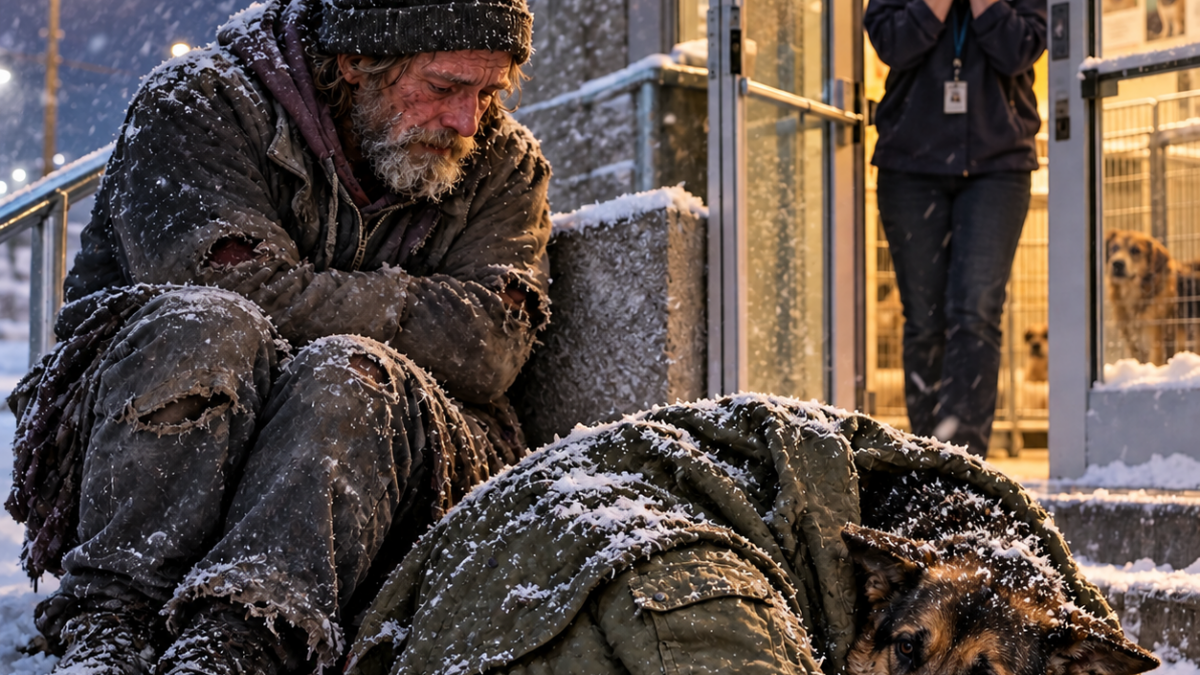
Sam started unzipping the green military coat.
At first, I thought he had finally decided to enter.
I was wrong.
He removed the warmest coat he owned.
Then wrapped it around the German Shepherd.
Buddy was so large that the coat barely covered his shoulders and back, but Sam pulled it around him carefully anyway.
Buddy pushed his long muzzle into Sam’s chest.
“Easy, buddy.”
Sam rubbed behind one upright ear.
“You’re okay.”
“You’re gonna be warm tonight.”
Something tightened in my throat.
“Sam.”
He looked up.
“You need that coat.”
“He needs it more.”
“You’re going to freeze.”
Sam looked directly at me.
No self-pity.
No performance.
No attempt to make me feel sorry for him.
Only concern for the dog.
“I’ve been cold before.”
Then he handed me the leash.
I had handled scared dogs for years.
I knew not to pull.
Still, the instant I took a step backward, Buddy planted all four paws against the tile.
A German Shepherd can make himself surprisingly immovable when he decides somewhere is exactly where he intends to stay.
“Come on, sweetheart.”
Buddy didn’t move.
He twisted his head.
Looked through the doorway.
Sam gave him a weak smile.
“Go on.”
Buddy whimpered.
Not the high nervous sound of a frightened puppy.
A low, broken sound from somewhere deep in his chest.
Sam stepped backward into the snow.
Buddy lunged toward him.
The leash tightened hard enough to pull my shoulder forward.
“Buddy.”
Sam’s voice changed.
Calm.
Firm.
“Stay.”
The response was immediate.
The Shepherd froze.
That told me something.
This was not a stray somebody had found yesterday.
Buddy knew commands.
He knew Sam’s commands.
Sam sat down on the shelter steps.
No warm coat.
No gloves.
No place to go.
He lowered his head into his hands as snow blew across his shoulders.
Buddy stared.
Then barked once.
Sharp.
Desperate.
Sam lifted one bare hand without looking up.
A small wave.
I’m here.
Buddy’s ears remained pointed toward him.
I stood there with the warm shelter behind me and deadly cold outside.
Between us stood a German Shepherd refusing to believe he was supposed to choose.
We were closed.
I reached toward the door.
Then stopped.
I couldn’t lock it.
Buddy wouldn’t stop watching Sam.
I brought him into the reception area and found the thickest blanket we had.
He allowed me to wrap it around him, but his head snapped toward the glass door every few seconds.
German Shepherds are famous for watching.
Doors.
Windows.
People.
Movement.
Buddy watched only one thing.
Sam.
“Come on, sweetheart.”
I sat beside him.
“You’re safe.”
Buddy looked at me.
Then barked once.
Not loudly.
Not aggressively.
Almost a question.
I knew anxiety.
Fear.
Defensive behavior.
Excitement.
This wasn’t any of those.
Buddy wasn’t worried about himself.
He was worried about Sam.
Through the glass I could see the dark shape of the man still sitting on our steps.
The wind was worsening.
I made coffee.
When I stepped outside, the cold struck my face so hard it physically hurt.
Sam hadn’t moved.
I held out the cup.
“Take it.”
“You don’t have to do that.”
“I know.”
He accepted it with both hands.
That was when I got a better look at his fingers.
“Sam.”
“What?”
“Your hands are turning blue.”
“They do that.”
“That isn’t normal.”
He took a sip.
“Nothing about January outside is normal.”
I looked at his boots.
Calling them boots was generous.
The soles were separating.
Snow had collected between cracked leather and rubber.
“What about your feet?”
He shrugged.
“They’ve frozen before.”
The casual way he said it made me angrier than complaining would have.
“You could lose toes.”
“Wouldn’t be the first thing I lost.”
I didn’t know what that meant.
Not yet.
Behind us, Buddy barked.
Sam turned immediately.
“I’m right here, buddy.”
Buddy pressed his nose against the glass.
Sam smiled.
First time I had seen him smile.
And suddenly I understood something.
Buddy wasn’t merely Sam’s dog.
Buddy was the reason Sam was still sitting upright.
I went inside.
Called my supervisor.
Karen answered on the fourth ring.
“Julie?”
“What happened?”
“I need permission to do something probably against at least three policies.”
Silence.
“That is not how I like phone calls to begin.”
I told her.
When I finished, she sighed.
“Julie.”
“I know.”
“We’re an animal shelter.”
“I know.”
“We are not equipped to house people.”
“I know.”
“Liability issues.”
“I know.”
“Then why are you calling?”
I looked through the glass.
Sam had set his coffee down.
His arms were wrapped around himself now.
Because Buddy was wearing his warmest coat.
“If I lock that door, Karen, I’m not sure he’ll be alive tomorrow morning.”
Silence.
“He gave the Shepherd his coat.”
“His warmest one.”
“Julie…”
“I know what policy says.”
Longer silence.
Then Karen exhaled.
“I am going to hang up now.”
“What does that mean?”
“It means I have heard absolutely nothing about anyone sleeping in our storage room.”
I smiled.
“Thank you.”
“I didn’t say anything.”
“Good night, Karen.”
“Julie?”
“Yeah?”
“Keep the space heater away from anything flammable.”
Click.
I went back outside.
“We have a room.”
Sam frowned.
“For Buddy?”
“For both of you.”
Immediately:
“No.”
“Why?”
“I don’t have money.”
“I didn’t ask for money.”
“I can’t pay you back.”
“You don’t have to.”
He stared suspiciously.
That was when I realized kindness had become unfamiliar enough that he no longer trusted it.
“No catch.”
“There’s always a catch.”
“Not tonight.”
He looked through the glass.
Buddy was still there.
Watching.
“Just one night?”
“Just tonight.”
Sam stood slowly.
His knees almost folded.
I caught his arm.
He pulled away immediately.
“I’m okay.”
“You’re not.”
“I said I’m okay.”
His voice sharpened.
And for the first time I saw fear in him.
Not fear of cold.
Fear of needing someone.
I stepped back.
“All right.”
“You walk inside yourself.”
He nodded.
And he did.
The moment Sam crossed the door, Buddy exploded.
Eighty pounds of German Shepherd scrambled across polished tile, paws slipping beneath him.
He slammed into Sam’s legs.
Sam dropped to his knees.
“Hey.”
“Hey, buddy.”
“I told you I was coming back.”
Buddy licked his entire face.
Pressed his chest into Sam.
Whined.
Snorted.
Tail hitting cabinets hard enough to rattle them.
Sam laughed.
A real laugh.
It changed his whole face.
For a few seconds, he wasn’t homeless.
Wasn’t frostbitten.
Wasn’t exhausted.
He was simply a man being welcomed home.
We put them in the storage room.
Calling it a room was generous.
Food bags.
Old carriers.
Cleaning supplies.
Donated blankets.
A radiator that rattled like loose change inside a dryer.
But it was warm.
Buddy entered first.
He inspected every corner.
German Shepherd.
Of course he did.
Door.
Window.
Radiator.
Blankets.
Then Sam.
Only when he had checked the space did he turn in one slow circle and lower himself beside the radiator.
Deep sigh.
Sam stopped in the doorway.
“You coming?”
He stared.
“Sam?”
“I haven’t slept indoors in a while.”
“How long?”
No answer.
I let it go.
Eventually he stepped inside.
I brought blankets.
Socks.
An old donated sweatshirt.
Soup from the staff refrigerator.
He accepted socks.
Sweatshirt.
When I handed him soup, he immediately set it beside Buddy.
“No.”
Sam looked up.
“That’s yours.”
“He hasn’t eaten since yesterday.”
“I fed him.”
Sam stared.
“You did?”
“Yes.”
“What?”
“Chicken and rice.”
“Small portion.”
“He’s underweight and freezing. I didn’t want him eating too much too quickly.”
Sam looked at Buddy.
“You hear that?”
“You ate better than me.”
Buddy’s ears lifted.
For some reason we both laughed.
Then Sam ate.
I left shortly afterward.
Before closing the door, I looked back.
Sam sat on the floor beside the radiator.
Buddy’s big head lay across his lap.
Sam’s fingers moved slowly through the fur behind those dark triangular ears.
“Good boy.”
I heard him whisper.
I went to my office.
And cried.
Not because I pitied him.
Something more complicated.
For years I’d heard compassion discussed as though it required money.
Donations.
Organizations.
Awards.
Speeches.
Yet one of the purest acts of love I’d ever witnessed belonged to a man who owned almost nothing.
Three jackets.
And when the cold became dangerous, he gave the warmest one to his dog.
I arrived just after six the next morning.
Storage-room door open.
Blankets folded.
Soup container washed.
Sam gone.
Buddy gone.
My stomach dropped.
Then I saw the paper on the radiator.
Shaky handwriting.
Julie,
Thank you.
Buddy says it was the warmest night of his life.
Don’t worry about me.
We’ll come back when we can.
Sam.
I ran outside.
“Sam!”
Nothing.
Fresh snow covered most of the sidewalk.
Except two sets of tracks.
One man.
One large dog.
They disappeared toward the river.
I stood there longer than made sense.
And somehow I knew that wasn’t the end.
Three days later, the bell rang.
Sam stood outside.
Buddy beside him.
I opened the door.
“You came back.”
“Told you I would.”
Sam looked thinner.
Buddy did too.
But something in Sam’s eyes had changed.
Determination.
“I need to ask something.”
“Okay.”
“I want a job.”
I blinked.
“A job?”
“Here.”
He gestured toward the kennels.
“I can clean.”
“Feed.”
“Walk dogs.”
“Fix things.”
“Whatever.”
“Sam…”
“I don’t need money.”
“That isn’t how employment works.”
“I just need somewhere Buddy and I can sleep.”
“We legally cannot pay you with a storage room.”
His jaw tightened.
“I’m not asking for charity.”
“I know.”
“No.”
“You don’t.”
His voice rose.
Buddy immediately stood.
Body suddenly alert.
Not aggressive.
Protective.
Sam looked down.
His entire tone changed.
“Easy, buddy.”
Buddy relaxed.
Sam looked back at me.
“Sorry.”
Then quieter:
“I need to work, Julie.”
The word need stopped me.
This wasn’t only about a bed.
It was dignity.
He needed to be useful.
I called Karen.
She arrived twenty minutes later.
Sam stood in her office.
Buddy sat pressed against his leg, ears following every voice.
“You have experience with animals?” Karen asked.
“One dog.”
She looked at Buddy.
“That isn’t much of a résumé.”
“No.”
“Employment history?”
Sam became quiet.
“Construction.”
“Maintenance.”
“Warehouse.”
“When?”
“A while.”
“How long?”
Sam looked at the floor.
“Five years.”
“Why the gap?”
His hand settled on Buddy’s head.
“My wife died.”
Silence.
First time we’d heard about her.
Karen softened.
Only slightly.
“I’m sorry.”
Sam nodded.
“After that, I stopped doing a lot of things I should’ve kept doing.”
He didn’t explain.
Didn’t need to.
Karen offered him a one-week trial through the volunteer program while we connected him with outreach services.
“One week.”
“I only need one chance.”
That week changed everything.
Sam arrived before me every morning.
We had no idea where he and Buddy slept during those first days.
He never said.
But 6:30 every morning, they were outside.
By 6:35, Sam was cleaning kennels.
Buddy waited in the office or followed during safe tasks.
By day two, Sam knew half our dogs.
By day four, all of them.
More surprising:
The difficult dogs liked him.
We had a shepherd mix named Rex.
Large.
Reactive.
Had already bitten two volunteers.
Sam sat outside his kennel for forty minutes.
No touching.
No eye contact.
“What are you doing?”
“Waiting.”
“For?”
“For him to decide I’m not dangerous.”
Eventually Rex came forward.
Sam extended one hand.
Rex sniffed.
Then rested his chin on Sam’s fingers.
I stared.
“How’d you do that?”
Sam shrugged.
“I know what it’s like when everybody decides the worst thing about you before you’ve done anything.”
I never forgot that.
One week became two.
Then a month.
Outreach helped replace Sam’s identification documents.
Karen found enough money to hire him part-time.
First paycheck.
I handed him the envelope.
He stared.
“This is mine?”
“You worked for it.”
His thumb moved across the printed name.
SAMUEL CARTER.
“Yes.”
“It’s yours.”
He looked away.
Not quickly enough.
I saw the tears.
That afternoon Sam disappeared for two hours.
Returned wearing new waterproof work boots.
Nothing fancy.
But new.
He also carried a red leather collar.
“For Buddy?”
He nodded.
Buddy sat proudly while Sam removed the frayed old one.
The new tag read:
BUDDY.
Sam’s new prepaid phone number beneath.
On the back:
I BELONG SOMEWHERE.
I swallowed.
“That’s nice.”
Sam looked at me.
“It isn’t for him.”
I frowned.
He smiled.
“It’s for me.”
Spring came slowly.
Minneapolis snow turns gray before it disappears.
By March, Sam worked almost full-time.
A local program found him and Buddy temporary housing.
Tiny studio apartment.
The day he received the key, he held it in his palm for nearly a minute.
“You okay?”
“I forgot what these feel like.”
“Keys?”
“Having somewhere they belong.”
Buddy sat beside him.
Sam crouched.
“Well, buddy.”
“We’ve got a front door.”
I helped them move.
There wasn’t much.
Two bags of clothes.
Dog food.
Three books.
Buddy’s blanket.
Green military coat.
The apartment had one room.
Small kitchen.
Window toward the river.
Sam inspected the locks.
Faucets.
Heater.
Of course.
Then stood in the middle.
Buddy ran from one end to the other.
For a large German Shepherd in a small studio, his excitement made the place look even smaller.
He jumped onto the mattress.
“Hey!”
Sam pointed.
“Who said you could get up there?”
Buddy turned in a circle.
Lay down.
Sam looked at me.
“I guess he did.”
We laughed.
Then Sam sat beside him.
I had wanted to ask something for months.
“How did you get Buddy?”
The smile disappeared.
Sam stared at the Shepherd.
“He got me.”
“When?”
“Three years ago.”
His hand moved over Buddy’s thick neck.
“I was sleeping under a bridge.”
He paused.
“It was colder than the night at your shelter.”
I sat down.
“I’d stopped caring whether I woke up.”
He said it like a fact from somebody else’s life.
“After Ellen died, things went bad.”
Ellen.
His wife.
They had been married twenty-one years.
Elementary-school teacher.
Sam worked construction.
Small house.
Nothing special, he said.
Absolutely perfect.
Then cancer.
Sam stopped working regularly to care for her.
Bills.
Savings gone.
Eighteen months after diagnosis, Ellen died.
Sam returned to work.
But not really.
Couldn’t sleep.
Missed shifts.
Lost job.
Then house.
Car.
Everything.
“I was angry.”
“At her for dying.”
“At me because I couldn’t save her.”
“At every person who had somewhere to go when the day was over.”
He looked ashamed.
“Mostly I was tired.”
One freezing night he crawled beneath a bridge near the river.
“I remember thinking I wouldn’t have to worry about tomorrow if I just stayed there.”
I said nothing.
“Sometime during the night, something touched my back.”
Buddy opened his eyes.
Apparently he knew this story too.
“I thought it was a rat.”
I smiled.
Sam did too.
“Then I heard breathing.”
It was a stray German Shepherd.
Buddy.
Young adult at the time.
Maybe four.
Maybe five.
Nobody ever knew exactly.
“He was filthy.”
“Skinny.”
“His coat was matted around his belly.”
“No collar.”
“One ear had an old notch.”
Sam scratched that ear.
“He crawled against my chest.”
A German Shepherd built to patrol property, search fields, and guard people had decided a frozen stranger beneath a bridge was where he belonged.
“He slept against me all night.”
Temperature dropped close to thirty below.
“When I woke up, he was still there.”
Sam’s voice cracked.
“And I realized I had to get up.”
“Why?”
“Because he was hungry.”
That was it.
Not revelation.
Not inspiration.
Not miracle.
A hungry dog.
Sam stood because Buddy needed food.
He found a gas station.
Spent almost his last money on two hot dogs.
“One for you?”
Sam shook his head.
“Both him.”
“Of course.”
He laughed.
“But he gave some back.”
“What?”
“I broke them into pieces.”
“He ate about half.”
“Then stopped.”
“He nudged the rest toward me.”
Sam looked at Buddy.
“This big idiot was starving and still tried to feed me.”
My eyes burned.
“So that’s when you kept him?”
“No.”
I stared.
“No?”
“Told him to leave.”
Buddy’s tail thumped.
“He followed me.”
“All day?”
“Three days.”
Sam walked.
Buddy followed.
Sam slept.
Buddy slept beside him.
Sam tried leaving him outside a church.
Buddy found him.
Sam tried telling him to go with another homeless man who had food.
Buddy sat beside Sam.
Finally Sam stopped arguing.
“He saved me under the bridge.”
“But that wasn’t the biggest thing.”
“What was?”
“He gave me somebody to be responsible for.”
Sam looked at me.
“When you lose everything, people tell you what you need.”
“Food.”
“Shelter.”
“Work.”
“Treatment.”
“Documents.”
“And they’re right.”
“You need all of it.”
Pause.
“But nobody talks about needing somebody who notices whether you wake up.”
I couldn’t answer.
Sam rested his hand on Buddy.
“He noticed.”
Months passed.
Sam became indispensable.
He had an unusual gift with frightened dogs.
Because he didn’t rush.
“Fear has its own clock,” he told a volunteer once.
“You don’t get to make it run faster because you’re impatient.”
Buddy changed too.
We started noticing how naturally he responded to distressed people.
German Shepherds can look intimidating to people who don’t know them.
Buddy didn’t.
Not once he approached.
He would move slowly.
Lower his head.
Sit.
Wait.
One afternoon a little girl named Madison arrived with her mother.
They had lost their apartment.
Couldn’t keep their elderly dog.
Madison sat on our floor crying.
Buddy got up from behind the desk.
No command.
No cue.
Walked over.
Lay beside her.
The little girl wrapped both arms around his neck.
Buddy became completely still.
Sam watched.
Later:
“Can dogs do that professionally?”
That question eventually led to therapy-dog training.
Buddy’s obedience made basic work easy.
The difficult part was teaching Sam that Buddy didn’t need to fix everybody.
“Sounds familiar,” I told him.
He ignored me.
Buddy passed certification.
Sam bought him a blue therapy vest.
Buddy hated it.
“He looks offended.”
“He thinks he’s management.”
Buddy stared at us with upright ears.
“I think he heard you.”
Sam laughed.
By then, I rarely thought of him as the man frozen outside our shelter.
His beard was trimmed.
Face fuller.
Hands warm.
New boots.
Keys.
Paycheck.
Apartment.
Friends.
Purpose.
A year after the January night, another snowstorm arrived.
I came to work early.
Sam was already there.
Of course.
Buddy slept beneath the front desk.
“Morning.”
“You know normal people wait until shifts begin.”
“Never claimed to be normal.”
Bell rang.
6:30 a.m.
We looked at each other.
I opened the door.
Young woman.
Maybe twenty-five.
Crying.
Small black puppy inside her sweatshirt.
“Please.”
“I don’t know what to do.”
Sam stepped forward.
“What happened?”
“My landlord found him.”
“I can’t keep him.”
She was shivering.
Sam looked at puppy.
Then woman.
“Come inside.”
She hesitated.
“I don’t have money.”
Sam and I looked at each other.
Same words.
Different winter.
Sam smiled.
“Good thing warmth is free today.”
I almost cried.
Sam made coffee.
Buddy sat beside her.
And I understood kindness rarely ends where you think it will.
It keeps moving.
Person to person.
Animal to animal.
Winter to winter.
Years passed.
Sam became our senior animal-care specialist.
Unofficially?
He was the man we called when a dog decided humanity had become unacceptable.
He never forced them.
He sat.
Waited.
Minutes.
Hours.
Eventually, most came forward.
Buddy aged.
Black fur around his face became silver.
Tan legs lighter.
His once-powerful rear stride slowed.
One ear occasionally sagged after naps before rising again.
Large German Shepherds don’t get to be old without their bodies sending invoices.
Hip stiffness.
Arthritis.
Longer recovery after walks.
But Buddy kept doing therapy visits.
Schools.
Hospitals.
Nursing homes.
Children read books while leaning against his side.
At nursing homes, Buddy rested his massive head on the knees of people who hadn’t received visitors in weeks.
Sometimes Sam caught my eye across the room.
We didn’t need words.
Buddy was still doing what he had done under that bridge.
Finding people who needed somebody to notice them.
Then came the day I always knew would come.
Buddy was somewhere around twelve or thirteen.
Exact age impossible.
One October morning, he refused breakfast.
For Buddy, that was enough to send alarms through everyone.
Sam brought him to our veterinarian.
I went.
Tests.
Long consultation.
The news wasn’t good.
Buddy was very sick.
There were treatments.
Maybe more time.
But limited.
Possibly uncomfortable.
Sam sat beside the exam table without moving.
Finally:
“Is he hurting?”
The veterinarian nodded.
Sam looked down.
Buddy lowered his silver muzzle onto Sam’s boot.
Long silence.
Then Sam crouched.
“Hey, buddy.”
Buddy lifted his eyes.
“You remember that bridge?”
My throat closed.
Sam smiled through tears.
“I was supposed to save you.”
Buddy licked his hand.
Sam broke.
Pressed his forehead to Buddy’s.
“No.”
“That isn’t true, is it?”
I looked away.
“You did all the saving.”
We brought Buddy home that afternoon.
Not to Sam’s apartment.
To the shelter.
Sam wanted him surrounded by the place that had become their second home.
We put blankets beside the old radiator.
Same storage room.
Same rattling radiator.
Karen had tried replacing it years earlier.
Sam refused.
“Works fine.”
That evening staff members arrived one at a time.
Photographs.
Treats Buddy couldn’t really eat.
A favorite toy.
One employee brought Buddy’s old red collar.
The first thing Sam had bought after receiving his first paycheck.
The tag was scratched.
Still readable.
I BELONG SOMEWHERE.
Sam held it a long time.
Around sunset, everyone left except us.
Buddy lay between Sam and me.
Snow began falling outside.
Not storming.
Soft flakes.
Sam ran his hand over Buddy’s white muzzle.
“You know what scares me?”
“What?”
“That when he’s gone, I’m going to become who I was before him.”
I moved closer.
“You can’t.”
“How do you know?”
“Because that man doesn’t exist anymore.”
Sam looked at me.
“You built a life.”
“With him.”
“Yes.”
“And he taught you how to keep building after him.”
Sam shook his head.
“You don’t understand.”
“I think I do.”
I pointed toward the kennel hallway.
“Remember Rex?”
Faint smile.
“The dog who wanted to eat everybody?”
“His family still sends Christmas cards.”
I pointed toward our bulletin board.
“Madison?”
The crying little girl was a teenager now.
Volunteered every summer.
“The nursing home?”
Dozens of people knew Sam.
“The schools?”
Hundreds of children had met Buddy.
I looked at him.
“You think Buddy saved one freezing man underneath a bridge.”
“No.”
“He saved everyone you helped afterward.”
Sam’s eyes filled.
Buddy shifted.
Sam bent immediately.
“I’m here.”
Those words.
Same promise from years earlier.
Outside our door.
Hand lifted through the snow.
I’m still here.
Buddy breathed slowly.
Sam held him through the night.
Shortly before sunrise, Buddy died with his head in Sam’s lap.
Warm.
Peaceful.
Home.
Sam didn’t speak for a long time.
Then:
“Good boy.”
Exact words I’d heard on their first night.
He looked at me.
“He hated the cold.”
I smiled through tears.
“No, he didn’t.”
Sam frowned.
“He found you in it.”
We buried Buddy’s ashes beneath a maple tree behind the shelter.
Small plaque.
Sam chose the words.
BUDDY
HE FOUND PEOPLE WHO NEEDED TO BE FOUND.
For weeks, Sam became quieter.
But he came to work.
Every day.
Unlocked kennels.
Filled bowls.
Changed blankets.
Sat with frightened dogs.
Kept moving.
Two months later, I found him sitting cross-legged outside a kennel.
Inside was a skinny puppy.
Not a German Shepherd.
Just a frightened yellow dog with oversized paws.
“What are you doing?”
“Waiting.”
I smiled.
“For?”
“For him to decide I’m not dangerous.”
I leaned against the wall.
“You adopting him?”
“No.”
Puppy moved closer.
Sam noticed.
I noticed Sam noticing.
“Definitely not.”
Twenty minutes later, the puppy was asleep in Sam’s lap.
Three days later, Sam took him home.
Named him January.
I laughed for five minutes.
“That is a terrible name.”
“I know.”
“Why January?”
Sam looked at the puppy.
“Because January took everything from me once.”
He scratched behind one small ear.
“Figured it was time January gave something back.”
Today, when people ask why I’ve stayed in animal shelter work so long, I could give dozens of answers.
Dogs.
Families.
Second chances.
Instead I usually tell them about one night.
January.
Twenty-three below zero.
A man arrived wearing three old jackets.
Owned almost nothing.
Never asked for food.
Never asked for money.
Never asked for a bed.
He only asked us to keep his German Shepherd warm.
And when he thought even that might not be enough, he took off the warmest coat he owned and wrapped it around his best friend.
At the time, I thought Sam was homeless.
Technically, he was.
I’m no longer sure that word told the whole truth.
Because Sam possessed something many people with houses spend a lifetime searching for.
Someone waiting for him.
Buddy had Sam.
Sam had Buddy.
On the coldest night of their lives, neither one was willing to save himself without saving the other.
I used to think home was a place.
Walls.
Key.
Heat.
Address on a form.
Sam and Buddy changed that.
Home can be a German Shepherd planting eighty pounds of himself on a shelter floor because the man he loves is still outside.
It can be a man giving away the last warm coat he owns.
It can be an old storage room beside bags of dog food and a radiator that won’t stop rattling.
It can be somebody lifting one hand through falling snow just so another living creature knows:
I’m still here.
The old green military coat still hangs in our shelter.
Sam donated it after Buddy died.
We keep it near the front desk.
Visitors sometimes stop.
There’s a card beneath it.
It doesn’t mention homelessness.
Doesn’t mention frostbite.
Doesn’t tell Buddy’s whole story.
Sam wrote it.
THIS COAT ONCE KEPT A GERMAN SHEPHERD WARM.
THE DOG KEPT A MAN ALIVE.
AND THE MAN LEARNED THAT BEING SAVED MEANS YOU GET ANOTHER CHANCE TO SAVE SOMEBODY ELSE.
Every January, when temperatures fall and Minneapolis disappears beneath snow again, I remember the bell ringing at exactly seven.
Sometimes I wonder what would’ve happened if I’d left thirty seconds earlier.
Turned off the lights.
Locked the door.
What if Sam had seen darkness and kept walking?
I don’t like those questions.
So I remember what did happen.
I opened the door.
Sam asked for warmth for Buddy.
Buddy refused to leave Sam.
And somehow, while trying to save one freezing German Shepherd for a single night, we opened a door none of us ever really closed.
That’s the thing nobody tells you about kindness.
You almost never know what it will become when you first offer it.
Sometimes it is coffee.
An unlocked door.
A blanket.
A rattling radiator.
Sometimes it is simply:
“Come inside.”
And years later, you realize the small kindness you almost didn’t give became the beginning of somebody else’s entire life.
Sam once told me Buddy saved him because Buddy gave him a reason to wake up.
I think Sam was wrong about one thing.
Buddy did not only give him a reason to wake up.
That German Shepherd reminded Sam that he was still worth waking up for.
And maybe that was the real miracle.
Not that a homeless man eventually got an apartment.
Not that he found work.
Not even that a once-homeless German Shepherd became a therapy dog who comforted hundreds of strangers.
The miracle was that on a night when Sam believed he had nothing left to offer the world, he still had enough love left to take off his warmest coat and wrap it around someone else.
That was the man standing outside my shelter.
I just didn’t know it yet.
I thought I was opening a door for Sam and Buddy.
In the end, a homeless man and one stubborn German Shepherd opened one for me.
And I have never looked at another frightened animal—or another human being standing outside in the cold—the same way again.








