An Orange Cat Waited Beside the Same Highway for 67 Days—When Rescuers Finally Picked Him Up, He Refused to Let Go of His Missing Brother’s Collar
PART3:
“Paper bag near the weeds yesterday.”
We both looked at each other.
Then Earl shrugged.
“Cats are weird.”
That was true.
We went back to complaining about diesel prices.
But the cat stayed in my head.
The third week, everybody seemed to know about him.
Not everybody in Missouri.
Just our little moving community of drivers using the same corridor.
Earl.
Me.
A livestock hauler named Carlos.
Woman named Denise who drove auto parts between Kansas City and Springfield.
Someone started leaving food.
Later I found out it was Carlos.
He could not safely stop his tractor-trailer at the shoulder, so one evening he came back in his pickup.
Left dry food in a brown paper sack.
Bowl of water too.
The next morning, food was gone.
Cat still there.
Carlos tried approaching.
The cat moved just far enough away to prevent being touched.
Then returned to the same spot after Carlos left.
“He’s waiting on something,” Carlos told me over the radio a few days later.
“For what?”
“If I knew, I’d tell you.”
The temperature climbed.
Missouri summer does not care about fur.
Humidity sat over everything.
Daytime highs reached the mid-nineties Fahrenheit.
The heat index pushed higher.
Road surfaces got hotter than that.
I began checking for him automatically.
Mile 212.
Then slow slightly.
There.
Every time.
Rain came one afternoon so hard traffic dropped to forty.
The cat crouched low.
Water ran through the gravel.
He stayed.
A truck passed close enough to throw brown spray over him.
I cursed out loud.
“Move, buddy.”
Of course he could not hear me.
Even if he could, he would not have understood.
But I kept talking anyway.
“Find a barn.”
“Go somewhere.”
“There’s nothing for you there.”
I was wrong about that last part.
There was something there.
We simply could not see it.
By the end of three weeks, the orange cat had become part of the road.
Drivers called him Mile Marker.
Somebody else called him 214.
Denise called him Highway.
I never gave him a name.
It felt disrespectful somehow.
Like he might already have one.
Drivers began timing reports.
“Cat’s there.”
“Still there.”
“Food’s low.”
“Water bowl tipped.”
A strange little relay formed among people who had never met outside gas stations.
Nobody organized it.
That is how some communities happen.
One person notices.
Another person cares just enough to say something.
Then suddenly six people are doing a job nobody assigned.
The problem was getting him off the roadside.
Several drivers contacted local animal control.
They were understaffed.
The location was difficult.
The cat was mobile enough to evade capture and did not appear immediately injured.
One volunteer group said they would try.
Nothing happened for several days.
Meanwhile, he waited.
Day after day.
Always on the same piece of gravel.
The strange thing was he did not wander toward the food until traffic quieted.
And after eating, he went right back.
That should have told us more.
He was not living there because the food was there.
The food came because he had chosen that place first.
Around day forty-one, a woman named Ruth Keller stopped.
I did not know Ruth then.
She lived on a small farm several miles away.
She had heard about the highway cat from her nephew, who worked at a feed store.
Unlike us, she drove a regular car and could pull well off onto a nearby maintenance access.
Ruth told me the story later.
She brought a carrier.
Towels.
Chicken.
Heavy gloves.
She thought it would take fifteen minutes.
Instead, she found the cat sitting over something.
At first she thought it was a strip of trash.
Blue.
Dirty.
Nearly gray from sun and dust.
She approached.
The cat lowered his body.
Not attacking.
Guarding.
Ruth put down chicken.
He ignored it.
She tried extending one hand.
The cat made a sound.
Not a full growl.
Not a hiss.
Something lower.
Desperate.
Ruth stopped.
“Okay.”
She sat several feet away.
Waited.
The cat never left the object beneath him.
Eventually Ruth stood.
Moved sideways.
Tried getting a better look.
That was when she saw it.
A collar.
Old nylon.
Blue originally.
Sun-bleached.
Buckle broken.
No tag.
The cat had shaped his entire body around it.
Chest over one section.
Paws tucked beside it.
Like if he got up completely, something might take it.
Ruth called animal control again.
Then a local rescue.
A volunteer named Marsha Bell arrived before sunset.
Marsha had been trapping cats for years.
She knew how to move slowly.
She also recognized immediately that the collar mattered.
They tried scanning the orange cat from a distance.
No chip reader would work without getting closer.
They tried a humane trap.
Food inside.
The cat walked around it.
Went back to the collar.
For hours.
At one point Marsha attempted to slide the collar toward herself using a long piece of cardboard.
The cat threw both front paws over it.
Not violent.
Possessive.
“No,” Ruth whispered.
The cat stared.
That was the first time anybody realized the answer might be inside the collar.
They waited until he moved a few feet for water.
Marsha reached quickly.
Picked up the collar.
The orange cat made a sound Ruth would later say she still heard in dreams.
A cry.
Not loud.
Raw.
He rushed forward but stopped short of biting.
Marsha almost dropped it.
“I’m not taking it.”
She held the collar low.
Turned it.
Inside the nylon, beneath dirt and wear, was writing.
Black permanent marker.
Most of it faded.
One word remained.
Duncan.
Marsha photographed it.
Then put the collar down.
The orange cat immediately took it between his teeth.
Carried it back to the depression in the gravel.
Lay over it.
That changed the search completely.
Duncan.
Not necessarily the orange cat’s name.
Maybe owner.
Maybe another pet.
Maybe meaningless.
But it was something.
Marsha began checking lost-animal reports.
Sixty-seven days before their eventual rescue date, there had been a crash.
Less than a quarter mile from that exact location.
Illinois family.
Vehicle left the roadway.
Went into a ditch.
No fatalities.
Several minor injuries.
During the confusion, one rear door opened.
Two cats escaped.
One was found later that same evening in a nearby field.
The other was not.
Gray domestic shorthair.
Four years old.
Name:
Duncan.
The found cat?
Orange tabby.
Same age.
Same litter.
Adopted together as kittens.
Never separated.
His name was Rusty.
I remember the moment Marsha told us.
We were at Miller’s Truck Stop.
Four of us happened to be there.
She had tracked down our little network because Carlos’s number was on one of the rescue calls.
She stood holding her phone.
“You guys named him all kinds of things.”
“What’s his real name?” I asked.
“Rusty.”
Earl nodded.
“Fits.”
Then she told us about Duncan.
Nobody said anything.
A trucker named Carlos stared down at his coffee.
Finally:
“You’re telling me that cat has been sitting there because the other one disappeared there?”
“We can’t know exactly why.”
Marsha was careful.
Good rescue people usually are.
“But the family confirmed the collar is Duncan’s.”
“How’d the collar get there?”
“Likely came off during or after the crash.”
“And Rusty found it.”
“Looks that way.”
Earl rubbed his face.
“So he didn’t run away.”
Marsha looked at him.
“No.”
“At least not for long.”
She showed us photographs from the family.
Two young cats asleep together.
Rusty’s orange body curved around Duncan’s gray one.
Another of them sharing a window perch.
Another when they were kittens.
The same size.
Same basket.
Same blanket.
I had spent weeks telling that orange cat to leave.
Find a barn.
Go somewhere safe.
Now I understood.
As far as Rusty knew, leaving might mean abandoning Duncan.
That evening I took my route.
Mile marker 214.
Rusty was there.
I slowed.
For the first time, I knew his name.
“Rusty.”
Stupid to say it through a closed truck window at highway speed.
I said it anyway.
I thought about loyalty.
Human beings like believing we invented it.
We did not.
The rescue organization arranged another capture attempt.
Not because Rusty suddenly trusted people.
Because his body was starting to fail.
Food was helping him survive.
It was not enough.
Weeks outside had taken a toll.
His coat lost shine.
He was thinner every time I passed.
Eyes irritated by dust.
He walked carefully.
Marsha estimated he had lost close to a third of his healthy body weight.
His paw pads were cracked from heat, gravel, and repeated movement across the shoulder.
They could not let him keep waiting.
Day sixty-seven arrived hot.
The rescue team went early.
Before heavy traffic.
Ruth came.
Marsha.
Animal control volunteer named Eddie.
Carlos parked his pickup farther down with hazard lights on to give drivers warning.
I changed my schedule.
That violated every rule I usually lived by.
Dispatch was not happy.
I told them I had a roadside issue.
Technically true.
I parked safely at a truck stop a mile away and walked part of the distance with Carlos.
Rusty was there.
Of course.
The collar beneath him.
Marsha had a plan.
Large humane trap with familiar food.
Towels creating visual cover.
No attempts to remove the collar.
They placed the collar itself just inside the entry while Rusty drank from a bowl several feet away.
He noticed immediately.
Walked toward it.
Stopped.
Looked at us.
Backed away.
Ten minutes.
Twenty.
Traffic roared.
Thirty.
Rusty circled.
Then entered halfway.
Backed out.
Marsha did not rush.
Forty-five minutes.
He entered again.
This time far enough.
Trap closed.
Rusty exploded.
Threw himself against the wire.
My stomach twisted.
Marsha immediately covered the trap.
Dark.
Her voice low.
“Easy.”
Rusty clawed.
Then stopped.
Inside the covered trap, something scraped.
Marsha lifted one corner of the towel.
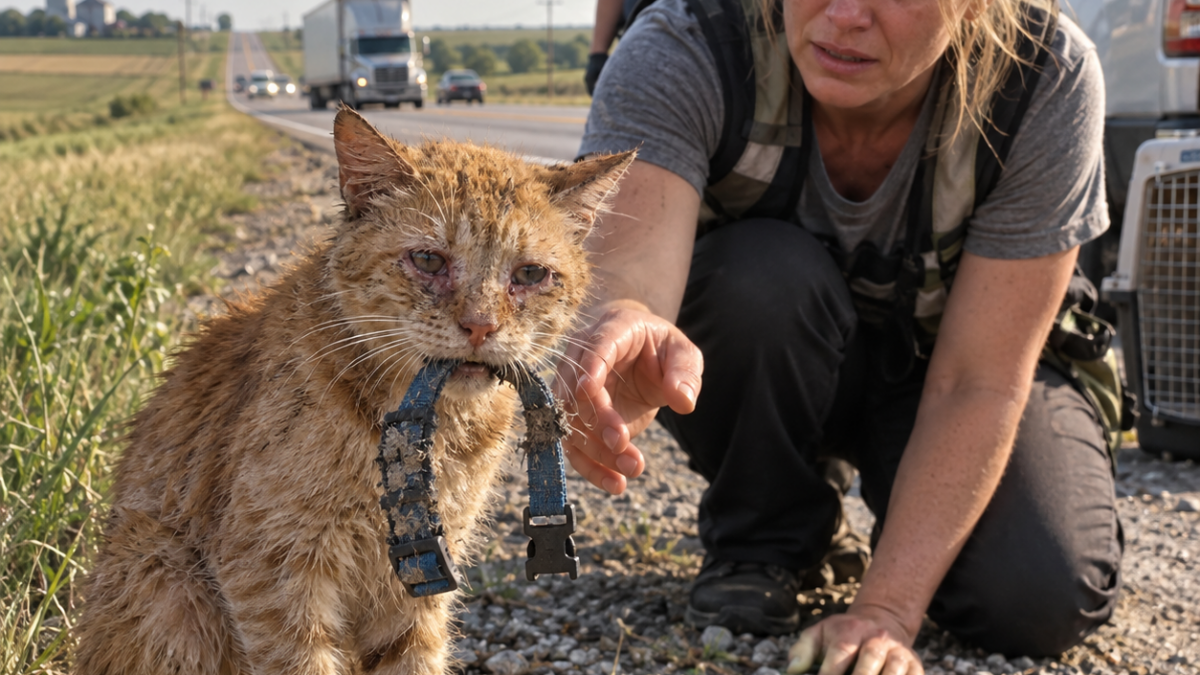
Rusty had the blue collar in his mouth.
He was holding it between his teeth.
Not chewing.
Carrying.
Marsha began crying.
“So that’s coming too.”
We loaded him.
Nobody celebrated.
He looked terrible up close.
From a semi at sixty miles an hour, you see a cat.
Up close you see dehydration.
Cracked pads.
Swollen eyelids.
Dirt embedded in fur.
His hip bones were visible.
One paw had a split pad with dried blood along the edge.
At the veterinary clinic, they tried transferring him.
Rusty kept the collar.
The technician reached gently.
He turned his head away.
Held tighter.
“Leave it.”
The veterinarian, Dr. Samuel Price, nodded.
“Unless it interferes with treatment, let him keep it.”
Fluids.
Bloodwork.
Eye flush.
Paw cleaning.
Parasite treatment.
Slow feeding.
Rusty endured all of it with Duncan’s collar beside his mouth.
When they had to remove it for an X-ray, he watched the technician place it on the table.
His eyes never left it.
The moment they finished, he dragged himself toward it.
Took it back.
Dr. Price said:
“I’ve never seen anything quite like that.”
Neither had we.
The family had already been contacted.
They lived in Illinois.
Seven hours away.
The woman who answered the phone was named Jennifer Hale.
When Marsha said:
“We think we found Rusty,”
there was silence.
Then:
“What?”
Marsha explained.
Orange tabby.
Crash location.
Blue collar with Duncan’s name.
The sound Jennifer made came through the speaker.
Half sob.
Half gasp.
“We thought he was dead.”
They had searched.
For days.
They had returned to Missouri twice.
Posted online.
Contacted shelters.
Placed food.
Checked roads.
But the crash had happened on a trip through unfamiliar country.
The first cat they recovered was actually Rusty?
Wait, careful: source says they found one of two cats, Duncan missing, orange cat returned to disappearance site. Let’s interpret the recovered cat wasn’t Rusty? Hmm source says “L’autre, un chat gris… Duncan, n’avait jamais été retrouvé. Le chat roux et Duncan…” That implies orange cat was the one found same night? But then he later returned to the spot. So yes family had Rusty briefly after accident? The narrative says “Le chat roux ne s’était pas enfui après l’accident. Il était retourné à l’endroit où Duncan avait disparu.” Means maybe orange cat was found or never actually left? Yet at day 67 he is there and family in Illinois. Let’s faithfully resolve: Rusty had initially been recovered but slipped out again during the family’s departure/search? But source doesn’t explicitly say. Better in expansion say they believed the recovered orange cat disappeared again during the continued search/transport, or that in confusion he returned. But avoid contradiction by phrasing family recovered one cat but later the orange one returned? Hmm.
Let’s continue: Jennifer says the first cat they found near field was Rusty. They put him in carrier at their motel, but the next morning he slipped out during continued search? This is invented. Better not. Could say records were confusing and volunteers eventually clarified Rusty had been seen by family after crash but was not secured? Yet not source-supported.
I need maintain core: family searched, Duncan never found, Rusty returned to location. I can say “They had seen Rusty near the crash that first night and thought he had disappeared into nearby fields again while they focused on Duncan” – invention. But acceptable expansion maybe.
Let’s phrase cautiously: “They had managed to account for Rusty briefly in the chaos, but by the time the family had to leave after the accident, he had returned to the roadside area and could not be secured.” This reconciles. Continue.
Jennifer and her husband had returned as long as work and money allowed.
Eventually, they had been forced home.
They believed both cats were gone.
They had never imagined one of them had stayed within a few hundred yards for more than two months.
Jennifer left Illinois the next morning.
Husband came too.
Seven hours.
They barely stopped.
At the clinic, Rusty was on IV fluids.
He had finally eaten a small meal.
The collar rested beneath his chin.
I was not supposed to be there.
But by then I had rearranged another delivery and stayed in town overnight.
Earl came too.
Carlos.
Ruth.
Marsha told us we were ridiculous.
She was right.
We waited in the hallway.
Jennifer entered.
Early forties.
Hair pulled back.
Face already wet with tears.
She saw the cage.
“Rusty?”
The cat’s head rose.
Slowly.
Yellow-green eyes.
He stared.
Jennifer crouched.
“Oh my God.”
Rusty stood.
Weak.
Took the blue collar in his mouth.
Walked toward the kennel door.
Dr. Price opened it.
Jennifer held out her hands.
Rusty stepped forward.
Then stopped.
He lowered his head.
Dropped Duncan’s collar at Jennifer’s feet.
Nobody in that room breathed.
Then Rusty pressed himself against her legs.
His body simply gave out.
Jennifer caught him.
She sat on the floor.
Held him.
Sobbed into his dirty orange fur.
“You waited.”
Rusty buried his face against her.
“I’m sorry.”
She picked up the collar.
“Baby, I’m so sorry.”
Her husband knelt beside them.
He touched Rusty’s back and started crying too.
I looked away.
Some moments belong to people even when strangers helped carry them there.
Later Jennifer told us what Duncan and Rusty had been like.
Same litter.
Born on a farm outside Peoria.
Adopted together at twelve weeks.
Duncan gray.
Rusty orange.
Duncan bolder with people.
Rusty more cautious.
Duncan slept on top of Rusty.
Rusty groomed Duncan’s ears every night.
They shared food bowls despite having separate ones.
If one disappeared into another room, the other followed.
Four years.
Never a night apart.
Then one car accident.
One open door.
One moment of chaos.
Everything changed.
“Duncan always wore blue.”
Jennifer held the faded collar.
“Rusty’s was green.”
“What happened to Rusty’s?” Ruth asked.
“Lost in the accident.”
Jennifer looked toward him.
“He must’ve found Duncan’s.”
The veterinarian suggested Rusty may have associated the collar’s smell with Duncan and used the crash location as an anchor.
Nobody needed a scientific explanation to understand the result.
He stayed.
Sixty-seven days.
Waiting.
Searching nearby, perhaps.
Returning.
Eating only when food appeared.
Sheltering who knows where during storms.
Then always back to that gravel.
It would be easy to say Rusty understood Duncan was missing exactly as a human would.
We cannot know that.
But we know what he did.
That is enough.
Jennifer took him home after three days of stabilization.
The first night at home, she sent Marsha a photograph.
Rusty in a soft bed.
Clean.
Eyes treated.
Bandages on both front paws.
Duncan’s blue collar tucked beneath one paw.
Caption:
He won’t sleep without it.
I stared at that photograph for a long time.
Five weeks later, another came.
Rusty had gained weight.
Coat orange again instead of road-dust brown.
Eyes clear.
Paws healed.
He sat at a window.
The collar beside him.
Jennifer wrote:
Every time a car pulls into the driveway, he goes to the door.
That hurt.
Because Duncan never came home.
Searches continued.
Local rescues checked old reports.
Farmers looked through barns.
The family returned to Missouri again.
Nothing.
No confirmed sightings.
No body.
No collar except the one Rusty had guarded.
Duncan simply remained missing.
That is the part people always want changed when they hear the story.
They expect a second miracle.
Rusty waits.
Family finds Rusty.
Then somebody calls:
“We found Duncan too.”
It did not happen.
Sometimes loyalty does not get rewarded with reunion.
Sometimes love waits longer than the world can answer.
Rusty recovered physically.
That part was good.
He regained nearly all his lost weight within five weeks.
His paw pads healed.
Eye inflammation resolved.
Kidney values normalized after dehydration.
He became affectionate at home again.
Slept in familiar rooms.
Ate beside the place where Duncan’s bowl had once sat.
But he changed.
Jennifer said before the accident, Rusty rarely waited by doors.
Afterward, he did.
Every evening around the time her husband came home, Rusty would sit facing the entrance.
If a vehicle slowed outside, his ears lifted.
Delivery truck?
Door.
Neighbor?
Door.
Family member?
Door.
Then the visitor entered.
Rusty looked past them.
As if expecting one more body.
One gray cat.
One brother.
At night, Duncan’s collar stayed in Rusty’s bed.
Jennifer tried washing it once.
Not completely.
Just wiping away road grime.
Rusty followed her through the kitchen crying until she put it down.
After that, nobody touched it unless necessary.
Years later the nylon remained faded almost white.
Buckle still broken.
Marker still barely visible:
Duncan.
I kept driving that route.
Of course.
For months, mile marker 214 looked wrong.
Empty.
The first time after Rusty’s rescue, I slowed automatically.
No orange cat.
Only gravel.
Grass.
The slight depression where he had been sitting.
I should have felt relieved.
I did.
Mostly.
But I had grown used to seeing him.
That sounds selfish.
A suffering animal had become part of my landscape.
I was glad he was gone.
Still, the empty shoulder felt like the aftermath of something.
Carlos noticed too.
“Road looks strange.”
“Yeah.”
Earl said:
“Better strange than seeing him still there.”
He was right.
We kept a photograph of Rusty at Miller’s Truck Stop.
The manager taped it near the coffee station.
Underneath:
RUSTY — HOME SAFE AFTER 67 DAYS AT MILE 214
Truckers added comments around it.
Tough little guy.
Still looking for Duncan.
Drive safe, buddy.
Someone drew a tiny truck.
For about a year, drivers continued reporting gray cats.
Every gray cat within fifty miles became Duncan.
Barn cat.
Stray.
Roadside sighting.
Shelter intake.
Every time, someone checked.
None matched.
I personally stopped once near a farmhouse because I saw a gray cat in a ditch.
Friendly female.
Wrong markings.
I felt foolish.
Then decided there are worse things than looking foolish while searching.
Jennifer and I stayed in touch.
Not close friends.
Christmas cards.
Occasional photos.
Rusty became older.
His face broadened.
Orange fur lightened around his muzzle.
Duncan’s collar remained.
On the anniversary of the crash, Jennifer sent one message:
He’s at the front door tonight.
I did not know what to say.
So I answered:
Maybe some part of him still expects Duncan.
Jennifer wrote back:
I think so.
Then:
Maybe I do too.
Grief behaves similarly across species in some ways.
The door remains important.
The phone.
The driveway.
The place somebody used to appear.
You know logically they may never walk through it.
Your eyes still check.
People talk about closure as though loss has a door you can lock.
Sometimes it does not.
Sometimes you simply learn to live in a house with an unlocked room.
Rusty taught me more about that than I expected.
My wife, Carol, died two years before I first saw him.
Cancer.
Fifty-nine.
Thirty-one years married.
I had handled her death the way I handled most difficult things.
Work.
More miles.
Longer routes.
I did not talk about her much.
Our daughter said I was avoiding home.
She was correct.
I kept Carol’s slippers under the bed for nearly a year.
Never moved them.
Her coffee mug remained in the cabinet.
I continued buying the brand of tea she liked despite not drinking tea.
I thought those habits were pathetic.
Then I watched an orange cat sit beside a highway guarding his brother’s collar.
Suddenly I judged myself less.
Memory needs objects sometimes.
A collar.
A mug.
A pair of slippers.
Not because the person or animal lives inside the object.
Because love has momentum.
It needs somewhere to go after the body disappears.
One afternoon I told Jennifer that.
We were talking by phone because she had sent another Rusty update.
“You think the collar is bad for him?” she asked.
“What do you mean?”
“Should we put it away?”
“Why?”
“My sister says maybe he’ll stop waiting if he can’t smell Duncan.”
I am not an animal behaviorist.
I told her.
“Ask your vet.”
“I did.”
“What’d they say?”
“If it comforts him and doesn’t interfere with eating or normal life, leave it.”
“Sounds reasonable.”
Jennifer sighed.
“Sometimes I wonder if we’re keeping him stuck.”
I looked at Carol’s old mug in my own kitchen.
“Or maybe you’re letting him remember.”
Silence.
“Does remembering make him miserable?”
“Not always.”
“Does he eat?”
“Yes.”
“Play?”
“Yes.”
“Sleep?”
“Yes.”
“Seek you out?”
“All the time.”
“Then maybe the collar is just part of home now.”
She cried.
I pretended not to hear.
Truck drivers develop selective deafness around feelings.
Rusty eventually became something of a local legend.
I disliked some versions.
People exaggerated.
Said he had not eaten for sixty-seven days.
False.
Drivers fed him.
Said he fought coyotes every night.
No evidence.
Said Duncan died in the crash and Rusty knew.
We did not know that.
Truth was already enough.
One cat.
One missing brother.
One collar.
Sixty-seven days.
That needed no improvement.
The most powerful detail to me was still his position.
Facing the road.
Every time.
Not hiding in the ditch.
Not curled beneath brush.
Sitting where vehicles passed.
Where someone might come back.
I once asked Marsha:
“Why do you think he sat facing traffic?”
She shrugged.
“Cats orient toward whatever matters to them.”
“You think he was watching for the family?”
“Maybe.”
“Duncan?”
“Maybe.”
“You rescue people always say maybe.”
“Because animals don’t give interviews.”
Fair.
Then she added:
“But he had hundreds of places nearby where a cat could hide.”
“Barns.”
“Trees.”
“Drainage culverts.”
“He kept returning to open gravel beside a road.”
“That choice means something.”
“What?”
“We don’t get to know everything.”
I hated that answer.
Then learned to respect it.
Three years after the rescue, I retired.
Forty-two years driving.
Millions of miles.
My final run used the Missouri route on purpose.
I did not tell dispatch why.
They thought it was nostalgia.
Maybe it was.
Mile marker 214 approached.
I slowed slightly.
Not dangerously.
There was more grass along the shoulder now.
Roadwork had changed the drainage.
The little hollow where Duncan’s collar once lay was gone.
Traffic continued.
Nobody else in the cars around me knew.
They saw road.
I saw an orange cat.
Rain.
Paper bag of food.
A woman kneeling.
A faded collar.
Sixty-seven days compressed into one place.
I pulled into Miller’s afterward.
Rusty’s photograph was no longer by the coffee station.
For a second I felt irrationally offended.
Then I saw it.
They had moved it.
Framed now.
On the wall with photos of retired drivers and local stories.
Rusty sitting beside Jennifer at home.
Healthy.
Caption underneath:
SOME WAITING IS LOVE REFUSING TO LEAVE.
I stood there longer than necessary.
Earl had retired before me.
Carlos changed routes.
Denise moved to Arizona.
The little trucker network dissolved the way temporary communities do.
But Rusty stayed on the wall.
I sent Jennifer a photo.
She replied five minutes later.
Then sent one of Rusty.
Older.
Sleeping.
Blue collar beneath his chin.
Still has it.
I smiled.
Still watches the door?
Three dots.
Then:
Every day.
Duncan would have been seven then.
If alive.
Maybe somewhere with another family.
Maybe feral.
Maybe gone long ago.
Nobody knew.
Jennifer never adopted another cat while Rusty was alive.
Not because she believed he could not tolerate one.
She simply was not ready.
She told me:
“It feels like Duncan’s place is still occupied somehow.”
I understood.
Again, objects and spaces.
Absence having shape.
Eventually, Rusty reached ten.
Then eleven.
His kidneys showed early age-related changes.
Nothing dramatic.
Managed.
He slept more.
Jumped less.
Still door.
Still collar.
One winter, Jennifer sent a video.
Snow outside.
Rusty lying in a heated bed near the front window.
A delivery van pulled up.
His head rose instantly.
He stood.
Walked to the door.
Waited.
Driver left a package.
Truck pulled away.
Rusty remained another thirty seconds.
Then returned to bed.
Watching that video hurt more than the original story.
Because sixty-seven days is dramatic.
Years are quieter.
Years mean the waiting did not disappear when his paws healed.
He simply learned to carry it somewhere safer.
Maybe that is what recovery is.
Not forgetting.
Not returning to whoever you were before.
Carrying the same love without bleeding onto hot pavement anymore.
Rusty had a bed now.
Food.
Veterinary care.
People.
He still listened at the door.
Both could be true.
When I think about his story, I do not picture the moment he collapsed against Jennifer first.
I picture before.
Day six.
When I saw him the second time.
At that moment, I had enough information to know something was unusual.
I still drove past.
That bothered me for years.
“What if we stopped sooner?”
I asked Marsha once.
“Maybe his paws wouldn’t have gotten that bad.”
“Maybe.”
“He wouldn’t have lost so much weight.”
“Maybe.”
“We waited too long.”
She looked at me.
“You were driving a semi on a highway shoulder.”
“I could’ve called.”
“You eventually did.”
“Somebody could’ve—”
“Tom.”
I stopped.
“You can turn every rescue into a trial against yourself if you want.”
She continued.
“Or learn.”
“Learn what?”
“When something keeps pulling your attention, pay attention.”
I remembered that.
Still do.
Because the first time, Rusty was scenery.
Second time, oddity.
Third time, story.
Eventually, emergency.
He had been the same cat the whole time.
We were the ones taking too long to understand.
That became personal too.
Carol had told me for months she was more tired than usual before her diagnosis.
I said we were getting older.
She lost weight.
I said stress.
Eventually the pain forced the appointment.
Cancer was already advanced.
Doctors never told me earlier diagnosis would definitely have saved her.
Probably not.
Still, guilt likes empty space.
Rusty’s story made that guilt surface.
Then soften.
You cannot live backward.
You can only become more attentive going forward.
I started calling my daughter more.
Not because Rusty taught me some magical secret.
Because grief stripped away my excuses.
If an animal could wait sixty-seven days beside a road because somebody he loved vanished there, surely I could drive twenty minutes to have dinner with my own child instead of pretending work mattered more.
So I did.
Small changes.
That is usually what stories leave behind when the dramatic part ends.
Not transformation.
Adjustments.
Rusty’s family made adjustments too.
They placed Duncan’s old food bowl near Rusty’s bed.
Not filled.
Just there.
A photograph of both cats sat beside it.
Some people thought that was excessive.
Those people were not invited to vote.
On the fifth anniversary of the accident, Jennifer drove back to Missouri.
Not with Rusty.
Too old for that trip by then.
She visited mile marker 214.
Brought no flowers.
No sign.
She carried a copy of Duncan’s photograph.
Stood for a few minutes.
Then went home.
She called me afterward.
“I thought it would feel different.”
“How?”
“Like goodbye.”
“Did it?”
“No.”
“What’d it feel like?”
She thought.
“Like a place.”
That was all.
A place.
Sometimes that is what trauma sites eventually become.
First they are the whole world.
Then, eventually, geography.
A road.
A ditch.
A mile marker.
Memory remains, but the land loses some power.
Rusty did not need to go back.
He had already spent enough time there for all of them.
There is one part of his behavior veterinarians could never explain confidently.
Whenever Jennifer played old videos where Duncan meowed, Rusty would come into the room.
Every time.
He would look behind the television.
Walk toward the hallway.
Search briefly.
Then sit.
They stopped playing them eventually.
Not because it was harmful necessarily.
Because Jennifer could not stand watching him search.
Photographs were easier.
Sound created possibility.
That detail stayed with me.
A voice is different from a picture.
Even for humans.
I still had one voicemail from Carol.
Nothing meaningful.
“Tom, pick up milk on your way home.”
That was it.
I could not delete it.
Could not listen often either.
When I did, for half a second, the world behaved incorrectly.
She existed again in time.
Then the message ended.
Maybe Duncan’s meow did something similar to Rusty.
Possibility.
Then silence.
I never played that voicemail after thinking about him searching the hallway.
I kept it.
Did not need to hear it.
Knowing it existed was enough.
Rusty eventually died at fourteen.
Jennifer called me herself.
I had not expected that.
We had never met in person after the clinic reunion.
Only texts.
Calls.
Christmas cards.
But when my phone rang and I saw Illinois, I knew before answering.
“Tom?”
“Yeah.”
“He’s gone.”
I sat at my kitchen table.
“How?”
“Kidneys.”
“Peaceful?”
“Yes.”
She started crying.
“He was in his bed.”
I already knew the next question before she spoke.
“The collar was with him.”
“Good.”
“We let him keep it.”
“Good.”
“Do you think that was stupid?”
“No.”
“No?”
“No.”
Long silence.
Then she said:
“He looked at the door yesterday.”
Of course he did.
I covered my eyes.
“He never stopped.”
“No.”
“Do you think he was waiting for Duncan all that time?”
I could have given the careful answer.
We cannot know.
Anthropomorphism.
Behavioral association.
Scent memory.
Instead I said:
“I think he remembered his brother.”
Jennifer cried harder.
I did too.
After Rusty’s death, they placed Duncan’s collar inside a small shadow box.
Not buried.
Not thrown away.
Hung beside photographs of both cats.
Rusty’s green kitten collar—found years earlier in an old moving box—went beside it.
Green and blue.
Two brothers.
One came home.
One did not.
The story could end there.
But I kept thinking about the number.
Sixty-seven.
People share numbers because numbers make suffering measurable.
Sixty-seven days.
One third body weight lost.
Paws bleeding.
Seven-hour drive.
Four years inseparable before the crash.
Numbers make the story feel real.
But love is not in the number.
The thing that gets me is not how long Rusty waited.
It is what he did while waiting.
Stayed near the last place Duncan had been.
Protected the collar.
Ate enough to survive.
Returned after every disturbance.
Refused to leave when people tried to move him.
Then finally carried the collar away himself when his body could no longer remain.
That last part matters.
Rusty did eventually leave mile marker 214.
He did not abandon Duncan by leaving.
He took what he had left.
The collar.
Maybe that is the piece humans need too.
Leaving a place is not always leaving a person.
Going home is not betrayal.
Healing is not forgetting.
Rusty could sleep on a warm bed and still keep Duncan’s collar under his chin.
Jennifer could laugh at Rusty’s recovery and still search shelter pages for gray cats.
I could retire, laugh with my daughter, enjoy mornings at home, and still keep Carol’s voicemail.
Love has room for movement and memory at the same time.
I wish I had known that sooner.
Maybe I would have spent fewer miles trying to outrun grief.
After Rusty died, Miller’s Truck Stop added another line beneath his framed photograph.
I saw it when I stopped there one afternoon with my grandson.
He was eight.
He pointed.
“Is that the cat you told me about?”
“Yeah.”
“The one who waited?”
“That’s him.”
He read the caption.
Then the smaller plaque added beneath.
RUSTY — 2017–2031
DUNCAN — STILL MISSED
My grandson asked:
“They never found the gray one?”
“No.”
“That’s sad.”
“Yeah.”
“Do you think Rusty thought he was coming back?”
I looked at the photograph.
“I think Rusty hoped.”
“What’s the difference?”
Eight-year-olds ask questions philosophers spend careers avoiding.
I said:
“Waiting is what your body does.”
“Hoping is why you stay.”
He considered that.
Then:
“Did Rusty waste all those days?”
That question hit hard.
“No.”
“He got hurt.”
“Yes.”
“He almost died.”
“Yes.”
“So why not?”
I crouched beside him.
“Because loving somebody isn’t a waste even when they don’t come back.”
He nodded as if that made complete sense.
Maybe it does when you are eight.
Adults complicate it.
Before leaving, I bought him a candy bar.
We walked to the parking lot.
A semi rolled in.
Air brakes hissed.
For one second I was back in 2021.
Mile marker 214.
Heat.
Orange cat.
I could see Rusty as clearly as if he were there.
Sitting straight.
Facing traffic.
Waiting.
Not knowing that four drivers had started watching for him.
Not knowing Ruth would stop.
Not knowing Marsha would find the collar.
Not knowing Jennifer would drive seven hours.
Not knowing a veterinarian would heal his feet.
Not knowing years of warm beds remained ahead.
He knew one thing.
Duncan was missing.
So he stayed.
That is the dangerous part of seeing only the middle of somebody’s story.
You think waiting is all there is.
You think the abandoned animal has nothing ahead except the shoulder.
You think the grieving man will always drive rather than go home.
You think the missing brother is the whole story.
Then life keeps moving.
Not always toward reunion.
Sometimes toward something quieter.
Rescue.
Rest.
Memory.
Home.
Rusty never got Duncan back.
I will not pretend otherwise.
That absence remained.
But he did get Jennifer back.
His family.
Food.
A bed.
Years.
Safety.
And when he finally left that highway on day sixty-seven, he did not leave empty-mouthed.
He carried Duncan’s collar with him.
I think about that whenever somebody tells me they cannot move on because moving on sounds like leaving someone behind.
Maybe we use the wrong phrase.
You do not always move on.
Sometimes you move forward carrying what matters.
A faded blue collar.
A photograph.
A voicemail.
A name.
Rusty showed me that.
A little orange cat beside a Missouri highway taught an old truck driver that home and grief are not opposite directions.
Sometimes you carry both.
And when I remember him now, I do not picture his bleeding paws.
I do not picture the dirt in his fur.
I picture the clinic.
Jennifer kneeling.
Rusty walking toward her with Duncan’s collar between his teeth.
He reached her.
Put it down.
Then collapsed against her legs.
For sixty-seven days, he had protected the last thing connecting him to his brother.
And only when somebody from home finally returned did he let it go.
Just for a moment.
Long enough to be held.
Then later, he picked it up again.
And for the rest of his life, Duncan’s collar stayed close.
Every night.
Every nap.
Every unfamiliar sound near the door.
Rusty went home.
But some part of him kept waiting.
Maybe that sounds unbearably sad.
I used to think so too.
Now I see something else in it.
Loyalty does not always mean refusing to leave the roadside forever.
Sometimes loyalty means surviving long enough to carry the memory home.








