An Exhausted Nurse Asked to Sit With a Navy SEAL—Then His K9 Barked Three Times and Refused to Take His Eyes Off Her.
PART3:
Do not make people rearrange themselves around your body.
Seven years earlier, people had rearranged entire helicopters around her.
Now she apologized if her prosthetic foot touched somebody’s chair leg.
Dee pointed with the coffee pot.
“One seat.”
Cass followed.
Back corner.
A man sat alone in a four-person booth.
Broad shoulders.
Dark work jacket.
Black baseball cap.
Trimmed beard streaked gray.
Late fifties, maybe early sixties.
One hand around a white coffee mug.
The other resting near the edge of the table.
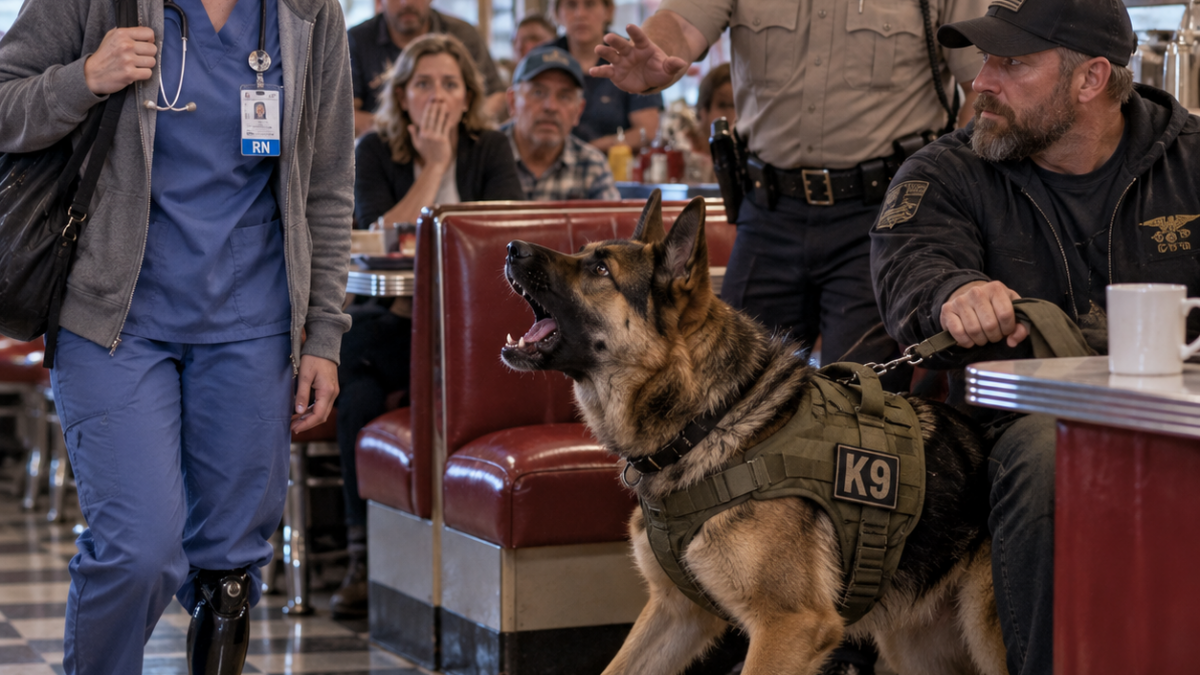
On the floor beside him lay a German shepherd.
The dog wore an olive tactical harness.
Not the decorative kind.
Working hardware.
Heavy handle across the back.
Old unit patches removed, leaving darker rectangles in the fabric.
His coat was black and tan, muzzle graying.
Big dog.
Eighty pounds at least.
He lay with his chin on his paws, calm enough that most diners had probably forgotten he was there.
Cass had not.
She noticed animals before people.
Always had.
She noticed the shepherd’s breathing.
Slow.
The slight stiffness in his right shoulder when he shifted.
One ear with a small notch.
A faded scar visible where the chest harness pulled fur aside.
Cass stopped breathing.
For half a second.
Then forced herself to move again.
There were thousands of German shepherds with scars.
Thousands.
The man noticed her looking.
He followed her eyes to the empty bench opposite him.
“Seat’s open.”
His voice was rough but not unfriendly.
Cass hesitated.
“I don’t want to bother you.”
“You won’t.”
She glanced at the dog.
“He okay?”
The man looked down.
“Better behaved than me.”
That got the smallest smile out of her.
She adjusted the strap of her bag.
“Can I sit with you?”
“Sure.”
Then:
“He’s friendly.”
A pause.
“Mostly.”
Cass took one step.
The dog’s eyes opened.
Second step.
His head came up.
Cass saw the nose working.
Scent.
Air.
Memory.
Her heart started pounding before anything happened.
The shepherd rose.
Fast.
Not lunging forward.
Up.
Ears locked toward her.
Body low.
He inhaled again.
Then barked.
Three times.
Hard.
Separated.
BARK.
BARK.
BARK.
The sound cracked through the diner.
Every conversation stopped.
Cass froze.
The dog’s owner straightened.
“Atlas.”
Cass’s stomach dropped.
Atlas.
Of course.
Of course that would be the name.
She had seen the patch.
ATLAS.
She told herself that was why the name felt familiar.
The dog barked again.
Three.
Exactly three.
His owner moved one hand down.
“Atlas, heel.”
Nothing.
“Easy.”
Three barks.
The dog did not show teeth.
Did not charge.
He crouched.
Tail low.
Sweeping.
Eyes locked on Cass.
She knew what those three barks meant.
Her body knew before she allowed her mind to know.
Medic.
Her fingers went cold.
Somebody behind her whispered:
“What the hell?”
A chair scraped.
A mother grabbed her little boy and pulled him onto the inside of the booth.
A man near the counter stood.
“Control the dog!”
Cass could feel thirty people deciding the story.
Dog reacts to woman.
Woman must be problem.
She knew that kind of room.
Not this exact one.
But rooms where people stared at the prosthesis.
Airports.
Locker rooms.
Hospital breakrooms with new staff.
A grocery store where a toddler once asked loudly:
“Why is that lady a robot?”
The mother had slapped his hand and apologized until Cass wanted to disappear.
She had gotten good at disappearing.
Small posture.
Quiet voice.
Move along.
The man in the booth rose halfway.
“Ma’am, back up a little.”
Cass looked at Atlas.
No.
Not aggressive.
The dog was almost trembling.
His tail brushed tile.
His ears were forward, but not rigid with attack.
Something else.
Recognition.
“No.”
Cass said.
The man frowned.
“What?”
“He’s not trying to bite me.”
Atlas barked three more times.
Cass’s eyes found the notch in his left ear.
Then the line of scar tissue high on his chest.
Eight inches.
Slight hook near the end.
A surgical repair where the tissue had torn badly.
Her vision narrowed.
No.
Impossible.
She had stitched in darkness.
Under red light.
Hands slippery.
Somewhere so far away she had trained herself not to name it before sunrise.
The man said:
“He’s never done this.”
Cass barely heard him.
“What?”
“In four years.”
His eyes moved from his dog to her.
“He has never barked at a stranger.”
That brought attention from the entire room.
A heavyset man stood from the counter.
Tan polo shirt.
Buzzed gray hair.
Thick neck.
Gold shield clipped to his belt.
Holstered pistol.
“Then maybe the stranger’s the problem.”
He stepped forward like a man who had spent decades being obeyed.
“Off-duty sheriff’s department.”
He announced it to everyone.
His name, she learned within seconds, was Wade Haskell.
Deputy Haskell.
Sixty-two.
Twenty-nine years in county law enforcement.
He walked toward Atlas.
Cass said:
“Don’t.”
Haskell looked at her.
“Excuse me?”
“Don’t approach him like that.”
He laughed.
“You the dog trainer?”
“No.”
Atlas barked again.
Three.
Then looked at Haskell.
One bark.
Back to Cass.
Three.
The man from the booth stood fully now.
He was taller than Cass expected.
Six-two.
Maybe more.
His calm had changed.
Not fear.
Readiness.
“Deputy.”
He said.
“Give him space.”
“Control him.”
“I am.”
Haskell pointed at Atlas.
“Your dog is barking at a customer.”
“Yes.”
“And?”
“He’s not advancing.”
Haskell’s eyes moved to Cass.
Then down.
Her scrub pants ended above the ankle.
She wore a carbon-fiber prosthetic on the left.
The diner light caught it.
Haskell’s mouth moved.
Not quite a smile.
“Well.”
He said.
“There you go.”
Cass knew before he finished.
“Dogs sense weakness.”
A few people shifted uncomfortably.
Haskell continued.
“She probably spooked him.”
Cass felt the old heat climb up her neck.
She could have left.
Should have left.
Coffee wasn’t worth this.
Food wasn’t worth this.
Nothing was.
“I didn’t do anything.”
She said.
Her voice was too quiet.
Haskell tilted his head.
“Did I ask you, sweetheart?”
That word.
Sweetheart.
Not kind.
Dismissive.
The dog whined.
Crawled half a step forward.
Cass saw the scar again.
Her pulse began beating against her prosthetic socket.
Pain.
Heat.
Dust.
A different world pushing through.
Haskell’s hand drifted toward his holster.
The booth man saw.
“Don’t.”
Haskell looked over.
“Don’t what?”
“Touch your gun.”
The entire diner seemed to inhale.
Haskell’s thumb touched retention strap.
Cass knew men like both of them.
Not personally.
Types.
Men who were used to command.
Men who knew exactly how dangerous the other one could become if pride took over.
A young uniformed deputy sitting near the counter stood halfway.
“Wade.”
Haskell ignored him.
“Wade, come on.”
“Sit down, Tommy.”
The young deputy’s name tag read ALVAREZ.
He looked twenty-four.
Maybe twenty-five.
His eyes were on Haskell’s gun hand.
“It’s a service dog.”
Alvarez said.
“Retired military working dog.”
The booth man corrected:
“Not service.”
“Retired MWD.”
Haskell snorted.
“Even better.”
He opened the retention strap.
Cass heard the click.
Something old woke up.
Not fear.
Training.
Her shoulders came back.
Her hands stopped shaking.
Atlas barked.
Three.
Medic.
Cass stepped forward.
The booth man said:
“Ma’am.”
She ignored him.
Haskell said:
“Stay back.”
Cass moved between the deputy and the dog.
Someone gasped.
She lowered her left hand.
Palm toward floor.
Two fingers raised.
A signal she had not used in seven years.
“Atlas.”
Her voice came from somewhere deeper than the exhausted nurse who had walked inside.
“Down.”
The dog dropped.
Instantly.
Chest to tile.
Front paws extended.
Head high.
Barking stopped mid-breath.
The room went silent.
Cass swallowed.
“Stay.”
Atlas stayed.
Tail moved.
Slow.
Thump.
Thump.
Thump.
The man from the booth stared.
His face had gone pale.
“What did you just do?”
Cass looked at him.
“I told him down.”
“No.”
He shook his head.
“That signal.”
Cass said nothing.
“That’s Danny’s signal.”
The name hit her harder than Haskell could have.
Danny.
Staff Sergeant Daniel Cole.
Twenty-eight.
K9 handler.
Married.
One daughter not yet two.
Terrible singer.
Carried hot sauce in his kit.
Had a habit of scratching Atlas under the vest strap right before patrol.
Danny.
Cass looked down.
Atlas had not taken his eyes off her.
The booth man whispered:
“He obeyed two people like that.”
His throat worked.
“Danny.”
Then:
“And me.”
Cass’s body wanted to run.
The doorway was twenty feet away.
She could leave.
Disappear.
Go home.
Remove prosthesis.
Turn shower on too hot.
Pretend the morning never happened.
Haskell laughed.
“Cute trick.”
The spell broke.
“A dog knows a hand signal.”
He looked at Cass.
“Congratulations.”
Then the prosthesis.
“Now sit down before you fall over.”
Cass felt something inside her close.
The booth man’s jaw tightened.
“That’s enough.”
Haskell turned.
“You got something to say?”
“Yes.”
“Say it.”
“You’re acting like an ass.”
Someone near the grill whispered:
“Oh boy.”
Haskell stepped forward.
The booth man did not.
Cass looked between them.
“Stop.”
Both men actually stopped.
Maybe because her voice sounded like command.
Maybe because Atlas’s eyes followed her.
Cass pointed to booth.
“You.”
The booth man raised brows.
“Sit.”
He almost smiled.
Then sat.
She looked at Haskell.
“You.”
He stared.
“You don’t outrank me.”
She said.
“But you’re done.”
A few people laughed quietly.
Haskell’s face darkened.
Cass immediately regretted it.
Attention.
Too much.
She hated attention.
She slid into the booth.
Her left leg nearly gave when she turned.
The socket had become unbearable.
She hid the wince.
Atlas crawled forward.
The booth man made a small motion.
“Atlas.”
The dog ignored him.
He came to Cass.
Slow.
No bark.
Placed his head across her prosthetic foot.
Then sighed.
Long.
Shaking.
Cass stopped breathing.
Her hand moved before permission.
Fingers into fur.
Under harness.
Scar.
Exactly where she remembered.
She pressed gently.
Atlas closed his eyes.
A sound escaped Cass.
Not quite sob.
The man across from her watched.
“Jack Hale.”
He said.
Cass nodded.
“Cass.”
“Cass what?”
She hesitated.
“Rowan.”
His eyes sharpened.
Atlas shifted closer.
Jack looked at the dog.
Then at her.
“He was military.”
“I figured.”
“Afghanistan.”
Cass stared at coffee Dee had silently placed in front of her.
Black.
Steam.
Her hands trembled again.
“His handler died.”
Jack said.
Cass whispered:
“I’m sorry.”
“Danny Cole.”
“I heard.”
“He was my teammate.”
Cass’s fingers stopped on Atlas’s neck.
Jack continued.
“I brought Atlas home after retirement.”
“How?”
“Danny’s wife couldn’t.”
“Too much.”
Cass understood that kind of too much.
Jack rotated mug.
“I was senior chief.”
“SEAL team.”
“Atlas wasn’t technically ours full time.”
“Attached.”
Cass knew.
Dogs crossed unit lines.
Handlers crossed lines.
Medics too.
“In four years he’s barked three times maybe twice.”
Jack said.
“Both times at medical emergencies.”
Cass looked up.
“What?”
“Once when my neighbor had seizure.”
“Once when I cut an artery in workshop.”
“He barked three times.”
Cass closed eyes.
Danny.
Of course.
Jack said:
“Danny trained three barks for medic.”
Cass answered without thinking.
“Medic now.”
Jack froze.
“What did you say?”
Cass regretted it instantly.
“Nothing.”
“No.”
He leaned forward.
“What did you say?”
Atlas raised head.
Cass drank coffee.
Too hot.
Burned tongue.
Good.
Something immediate to focus.
“Lucky guess.”
Jack stared.
He knew it was not.
Before he could ask again, Cass heard a breath.
Wet.
Wrong.
From the counter.
Habit took over.
Emergency nursing is partly learning to notice the human body betraying itself from across a room.
Haskell sat with his back half turned.
Five minutes earlier his face had been flushed red with anger.
Now gray.
Sweat running from temples.
Left hand rubbing shoulder.
Right hand pressed flat over sternum.
Jaw working.
Breathing fast.
Cass counted.
Twenty-six.
Shallow.
She hated him.
That truth arrived simultaneously.
She hated him.
He had humiliated her.
Mocked her leg.
Talked to her like she was stupid.
Reached for a firearm toward a dog who had done nothing dangerous.
A tiny ugly voice said:
Let him deal with it.
It lasted perhaps half a second.
Then she was moving.
“Deputy Haskell.”
He looked over.
“What now?”
“How long has your chest hurt?”
The room quieted again.
Haskell laughed.
“My what?”
“Chest.”
“It doesn’t.”
“You’re diaphoretic.”
He frowned.
“You’re sweating.”
“Left shoulder pain.”
“Rapid breathing.”
“Central pressure?”
Haskell looked around.
Embarrassed.
“Heartburn.”
“Sit still.”
“I am sitting.”
“Don’t stand.”
He sneered.
“Doctor now?”
“Nurse.”
“Right.”
“Emergency.”
That made him pause slightly.
Cass said:
“Do you take aspirin?”
“What?”
“Allergy?”
“No.”
“Blood thinner?”
“None of your business.”
Cass reached into her work bag.
She always carried baby aspirin.
Habit.
She poured four 81-milligram tablets.
“Chew these.”
Haskell stared.
“You’ve got to be kidding.”
“Chew them.”
“What did I just say?”
“I think you’re having an acute coronary event.”
Thin laughter moved across diner.
Not mocking Cass.
Nervous.
Haskell stood.
“I think you need to mind your—”
Cass saw the tremor.
“Sit down.”
“—own business.”
“Deputy—”
He slapped her hand.
Aspirin scattered.
Tiny white tablets across black tile.
“Get your freak dog and your plastic leg out of my face.”
Jack stood.
Fast.
“Watch your mouth.”
Cass raised hand.
“Jack.”
He stopped.
Haskell pointed.
“You think because you work in pajamas you can diagnose me?”
Cass looked at him.
“Yes.”
That almost got a laugh.
Then Haskell’s eyes rolled.
His knees buckled.
He hit the floor hard enough to shake a stool.
For one second, no one reacted.
Cass did.
Down.
Right knee.
Prosthetic left leg angled awkwardly behind.
She grabbed shoulder.
“Deputy Haskell!”
No response.
“Wade!”
Nothing.
She looked for breathing.
One agonal gasp.
Then none.
Pulse.
Carotid.
Ten seconds maximum.
Nothing.
The world narrowed.
Diner gone.
Uniform gone.
Insults gone.
One body.
One job.
“He’s in arrest.”
Her voice cut through panic.
“Dee.”
The waitress froze.
“Dee!”
“Yes.”
“911.”
“Say witnessed cardiac arrest.”
“CPR in progress.”
“Get AED.”
Dee ran.
Cass looked at Alvarez.
“Deputy.”
He was staring at Haskell.
“Radio.”
He fumbled.
“Now.”
He keyed mic.
“Dispatch, officer down—”
Cass snapped:
“Cardiac arrest.”
He corrected.
“Cardiac arrest.”
“Starlight Diner, Route One.”
Cass cut Haskell’s polo with trauma shears.
Jack dropped opposite.
“What do you need?”
Cass placed hands.
“Time.”
Then started compressions.
Hard.
Fast.
Two inches.
Full recoil.
One.
Two.
Three.
She counted.
The room joined around twelve.
Somebody cried.
A child asked what was happening.
Mother shushed.
Cass felt Haskell’s ribs flex.
Then crack.
No pause.
“You.”
She looked at Jack.
“When I say switch.”
“Same spot.”
“Same rhythm.”
Jack nodded.
“Yes, ma’am.”
Something about the answer struck her.
Military.
Automatic.
She ignored it.
Thirty.
Again.
Alvarez said:
“Ambulances tied up.”
Cass counted.
“Why?”
“Tanker rollover.”
“ETA seventeen.”
Jack looked up.
Cass did not.
“Then we keep him alive seventeen.”
Dee returned with AED.
White case.
Hands shaking.
Cass said:
“Open.”
She kept compressions.
“Pads.”
“Dry chest.”
Jack wiped Haskell’s sweat.
Pads.
Right collarbone.
Left lateral chest.
AED:
Analyzing.
“Hands off.”
Cass raised.
Everyone backed.
Shock advised.
Her mouth became dry.
Clear.
She checked.
“Clear.”
Press.
Haskell’s body jerked.
Resume CPR.
“Jack.”
He took over.
Perfect form.
Too perfect for ordinary civilian.
Cass counted.
“Harder.”
He adjusted.
“Good.”
Atlas lay ten feet away.
Down.
Stay.
Still obeying Cass’s command.
His eyes fixed on her.
Two minutes.
Switch.
Cass moved in.
Left leg burned.
Warm wetness inside socket.
Skin breaking.
Ignore.
Compressions.
Her mind flickered.
Another chest.
Not human.
Canine.
Blood.
Gunfire.
Three barks.
No.
Here.
Count.
Twenty-eight.
Twenty-nine.
Thirty.
AED analyzed again.
Shock advised.
Second shock.
Nothing.
CPR.
Jack again.
Alvarez on radio.
Dee praying.
Cass looked at Haskell’s face.
“Stay with me.”
Jack’s compression stuttered for half a beat.
Cass looked up.
“Jack.”
He stared.
“Keep going.”
He resumed.
Cass leaned closer to Haskell.
“Stay with me.”
Jack’s eyes filled.
She noticed.
No time.
Nine minutes.
AED chirped again.
Rhythm.
Shock.
Third.
Body arched.
CPR.
Then Cass felt neck.
Wait.
There.
Flutter.
Weak.
Again.
“Yes.”
She whispered.
Then louder:
“I’ve got pulse.”
Someone sobbed.
Alvarez laughed once in disbelief.
Cass said:
“No celebrating.”
“He can lose it.”
She checked breathing.
Poor but present.
Pulse oximeter from bag.
89%.
Heart rate 112.
Thready.
They rolled him lateral.
Airway.
Minutes passed.
Color returned slightly.
Then monitor AED alarmed.
Analyzing.
Cass’s stomach dropped.
“Back.”
They rolled flat.
Shock advised.
“Clear.”
Fourth shock.
This time Jack’s hands ready.
Compressions.
Cass stared at Haskell.
“You don’t get to die in front of me.”
She said.
Not compassionate.
Furious.
“You wanted to insult me?”
“Fine.”
“Live long enough to do it tomorrow.”
Jack almost smiled while pressing.
Siren.
Finally.
Paramedics entered.
Two.
Moreno and Chen.
Equipment.
Monitor.
“What’ve we got?”
Cass delivered handoff automatically.
“Sixty-two-year-old male.”
“Witnessed collapse after diaphoresis, chest pressure, left shoulder pain.”
“Pulseless VF arrest.”
“Immediate CPR.”
“Four shocks.”
“ROSC after second, rearrest around nine minutes, ROSC after fourth.”
“Current pulse approximately eighty-eight.”
“Spontaneous respirations.”
“O2 ninety-two.”
“Pressure?”
Paramedic checked.
“Eighty-six over fifty-two.”
Cass nodded.
“He’ll need cath.”
Moreno stared at her.
“You EMS?”
“Nurse.”
“Where?”
“St. Bridget’s.”
He looked at compressions marks.
AED.
Clock.
“Cleanest bystander code I’ve walked into in years.”
Cass said:
“Get him out.”
They did.
When stretcher crossed doorway, adrenaline left.
Cass tried to stand.
Left leg buckled.
She sat hard.
Jack grabbed her arm.
“You’re bleeding.”
Cass looked down.
Dark red spreading through left scrub leg.
“Skin.”
“Socket.”
“I’m fine.”
Jack’s expression changed.
“No.”
She looked up.
“Excuse me?”
“You don’t get to use his line.”
“What?”
“I’m fine.”
He nodded toward door.
“You just almost watched that man die because he said it.”
Cass almost laughed.
Instead she started crying.
It came without warning.
Atlas broke stay.
Technically.
He rose.
Crossed diner.
Climbed partly into her lap.
Eighty pounds.
Pressed head beneath her chin.
Trembled.
Cass wrapped both arms around him.
Then the memory arrived whole.
Seven years vanished.
Afghanistan.
Eastern valley.
Late afternoon.
Task force moving through narrow village corridor.
Cassidy Rowan had been Staff Sergeant Rowan then.
Army veterinary technician attached to special operations support.
Her primary job was working dogs.
Her secondary training was trauma medicine because teams in remote environments used whoever had useful hands.
She had hated being called dog nurse.
Until people needed one.
Danny Cole handled Atlas.
Young dog then.
Four.
Fast.
Fearless.
Too smart.
Danny called him Professor.
Jack Hale was senior chief.
Team leader.
Hard man.
Dry humor.
Cass had met him twice before that patrol.
He probably never remembered her face.
They were ambushed near dusk.
First rifle burst hit Danny.
Cass heard three barks.
Medic now.
Danny had trained Atlas to give it when handler or teammate went down.
Three barks.
Always spaced.
Atlas stood over Danny.
Gunfire.
Cass crawled.
Danny was already gone.
Chest.
No chance.
Atlas took a round seconds later.
High thorax.
Blood pumping beneath harness.
Cass clamped hand.
Jack went down from fragmentation.
Another man screaming.
Mortar whistle.
Cass opened Atlas’s kit.
Occlusive dressing gone.
Used plastic from sterile packaging.
Pressed.
Dog fighting breath.
Jack yelled something.
Cass moved.
Explosion.
Light.
Pressure.
Then no left foot.
She remembered looking.
Not pain initially.
Just absence.
Boot several feet away.
Blood.
Training.
Tourniquet.
High.
One-handed.
Atlas under other.
She kept saying:
“Stay with me.”
To dog.
To Jack.
Maybe herself.
“Stay with me.”
“Stay with me.”
Medevac crew arrived.
Pulled her.
She fought them.
“Dog first.”
They took Atlas.
She never knew.
Morphine.
Surgery.
Germany.
Walter Reed.
Then rehabilitation.
The Army sent updates.
Casualty lists.
She learned Danny died.
Jack survived, she assumed from later unit bulletin.
Atlas?
She never asked.
That shame had lived deepest.
Not because she didn’t care.
Because if Atlas had died after she fought to keep him alive, she was afraid something inside her would close permanently.
So she did not ask.
Cowardice, she called it.
Seven years.
Now the dog shook in her arms.
Alive.
Old.
Scarred.
Alive.
“I never asked.”
Cass whispered into fur.
Jack crouched beside.
“What?”
“I never asked if he made it.”
He went still.
Cass was crying openly.
“I couldn’t.”
“I couldn’t hear another name.”
Jack stared.
“Cassidy.”
She looked at him.
“How do you know?”
He had gone pale.
The diner had become silent again.
Jack stood slowly.
Looked around.
Then back to her.
“Seven years ago.”
He said.
His voice carried.
“A Navy special operations element was hit in eastern Afghanistan.”
Cass closed eyes.
“Jack.”
He continued.
“Our K9 handler, Staff Sergeant Danny Cole, died immediately.”
Atlas pressed closer.
“I took shrapnel.”
“Went down.”
“Atlas took a round through chest.”
Jack’s voice cracked.
“He should have died.”
Nobody moved.
“Then an Army veterinary specialist attached to our task force crawled through forty yards of fire.”
Cass whispered:
“Stop.”
Jack looked at her.
“No.”
Not cruel.
Certain.
“You’ve been hiding long enough.”
Cass almost hated him.
He continued.
“She sealed Atlas’s chest wound with her hands and a piece of plastic.”
“A mortar round took her left leg below knee.”
“She applied her own tourniquet.”
“Then kept pressure on the dog.”
“The medevac crew had to physically pull her hand away.”
Cass shook her head.
“I was doing my job.”
Jack looked at diner.
“I woke in helicopter.”
“She was beside me.”
“Bleeding.”
“Barely conscious.”
“She kept repeating three words.”
His eyes found hers.
“Stay with me.”
Cass looked down.
Jack’s voice softened.
“I have searched for her for seven years.”
“What?”
“The report was redacted.”
“Different command.”
“Privacy.”
“Whatever.”
“I knew Rowan.”
“No first name.”
“Atlas survived.”
“I wanted her to know.”
Cass could barely breathe.
Jack said:
“Staff Sergeant Cassidy Rowan.”
“United States Army.”
“Bronze Star with Valor.”
“Purple Heart.”
Cass looked up sharply.
“Don’t.”
Jack removed cap.
Stood straighter.
“Senior Chief Jack Hale, United States Navy, retired.”
He saluted.
Not dramatic movie salute.
Crisp.
Quiet.
Real.
“Thank you for saving my life.”
Then looked at Atlas.
“And his.”
Cass broke.
Dee cried behind counter.
Alvarez stood.
Hand over heart.
Mother with little boy stood too.
Then others.
Not applause.
Thank God.
Cass could not have borne applause.
Just standing.
Haskell’s empty stool on floor.
Aspirin scattered.
Atlas against her.
Cass whispered:
“I’m a nurse now.”
Jack lowered hand.
“You were a medic when we needed one.”
“I wasn’t a medic.”
“You were that day.”
Then:
“And today.”
The irony almost made her laugh.
Deputy Haskell.
The man who had called her weak.
Freak.
Plastic leg.
Alive because of her hands.
Cass looked toward door.
“I need to check on him.”
Jack nodded.
“Then we’re going.”
“We?”
Atlas stood.
Jack shrugged.
“He outranks me apparently.”
At St. Bridget’s, Cass entered through employee doors wearing same bloody scrubs.
Charge nurse saw.
“What happened?”
“Long story.”
Her prosthesis was removed.
Skin breakdown worse than she admitted.
Wound cleaned.
Dressed.
She refused stretcher.
Accepted wheelchair only because charge nurse threatened to sedate her.
Two hours later, cardiologist confirmed.
Haskell had 99% LAD occlusion.
Massive anterior MI.
Widowmaker.
Without immediate CPR and defibrillation:
almost certainly dead.
Cass sat outside cardiac ICU.
Jack beside her.
Atlas at his feet.
“You really searched?”
Cass asked.
Jack nodded.
“Why?”
“Because Danny’s wife wanted to thank you too.”
Cass looked away.
“How is she?”
“Alive.”
“Remarried.”
“Daughter fourteen now.”
“She knows Atlas lived.”
Cass closed eyes.
“Danny’s daughter.”
“Yeah.”
“Her name?”
“Emma.”
Cass nodded.
She remembered wallet photo on Danny’s kit.
Baby in yellow onesie.
Jack continued.
“I also needed to know.”
“What?”
“If you lived.”
Cass stared.
“I saw medevac.”
“You were bad.”
“I figured if you survived, maybe I owed you a life.”
Cass laughed tiredly.
“I don’t need one.”
“That’s good.”
“Because mine’s a mess.”
First genuine smile.
They sat.
Atlas placed chin on Cass’s prosthesis, now beside wheelchair.
“Why does he bark three times?”
Jack explained.
Danny had built signals.
One bark:
alert.
Two:
contact.
Three:
medical emergency.
After Danny died, Atlas retained it.
Rare.
But somehow he recognized Cass through scent, movement, voice—maybe the old antiseptic traces on scrubs layered over something deeper.
Dogs remember differently.
Cass said:
“He didn’t bark because he thought I needed a medic.”
Jack looked at Haskell’s room.
“Maybe not.”
“He called medic.”
Cass whispered.
“For himself.”
“For the room.”
“For me.”
Nobody could know.
That was okay.
Not every mystery needs proof.
Haskell woke that afternoon.
Asked for Cass the next morning.
She almost refused.
Then went.
He looked smaller in hospital gown.
No badge.
No weapon.
No authority clipped to belt.
Just a man with IVs.
He did not meet her eyes.
“They told me.”
Cass sat.
“What?”
“Everything.”
“The dog.”
“CPR.”
“Shocks.”
He swallowed.
“Things I said.”
Cass waited.
“I called you…”
He stopped.
“Yeah.”
“I threatened dog.”
“Yes.”
“My daughter is twelve.”
Cass said nothing.
“She would be planning my funeral.”
His eyes filled.
“I thought I knew what strength looked like.”
Cass looked at monitor.
“You thought it looked like you.”
He flinched.
Fair.
“I’m sorry.”
Cass studied him.
Apologies after survival can be cheap.
Fear makes people generous.
Time proves.
She said:
“Respect isn’t badge.”
He nodded.
“Or uniform.”
“Yes.”
“Or whether somebody walks on two legs.”
His face tightened with shame.
“No.”
Cass stood carefully.
“Then act like you learned it.”
That was all.
No hug.
No forgiveness speech.
Consequences came later.
Sheriff’s office reviewed diner footage.
Haskell had unsnapped holster while confronting a nonthreatening retired military dog and civilians.
Administrative leave.
Mandatory de-escalation retraining.
Off-duty weapons policy review.
Internal reprimand placed in file.
Some colleagues defended him.
Others didn’t.
Alvarez gave honest statement.
That mattered.
Haskell eventually returned to duty.
Different, people said.
Quieter.
Three months later he invited Cass to speak at department training.
She declined first.
Then agreed only if Atlas and Jack came.
Topic:
Medical emergencies, disability bias, working-dog behavior, and assumptions under stress.
Haskell sat front row.
No excuses.
That counted.
Cass’s life changed slower.
Jack wanted to start a training program.
He had been thinking about it since Atlas retired.
Veterans adopting working dogs often had little medical preparation.
Police handlers had canine trauma kits but uneven training.
Human first aid too.
Jack had contacts.
Cass had skills.
She said no.
Three times.
Then Atlas showed up at Starlight Diner every Thursday.
Jack claimed coincidence.
Cass knew manipulation.
Dee reserved booth.
Cass would finish shift.
Sit.
Atlas under table.
Coffee.
Pie.
Jack never asked questions about war unless Cass started.
That mattered.
They became friends before anything else.
Cass told him about rehabilitation.
About losing fiancé two months after injury—not because he was cruel, but because neither of them knew how to become different people together.
About finishing nursing school.
About choosing emergency medicine because chaos felt familiar.
About hiding prosthetic under scrub pants for years.
Not from shame exactly.
From exhaustion.
“I got tired of becoming a story.”
She said.
Jack understood.
“You walk into room.”
“People want the leg story.”
“Yes.”
“Or inspirational poster.”
“Exactly.”
“Or tragedy.”
“Yes.”
“Never just bad nurse who drinks too much coffee.”
Cass smiled.
“I’m an excellent nurse.”
“Debatable.”
She threw sugar packet at him.
Atlas watched.
Six months after diner, pilot training launched.
Small.
One Saturday a month.
County EMS garage.
Ten K9 handlers.
Four veterans with retired MWDs.
Two police officers.
Jack.
Cass.
Atlas.
Canine hemorrhage control.
Airway.
Heat injury.
Bloat recognition.
Human CPR.
AED.
Tourniquets.
How to recognize disability without assuming incapacity.
How not to mistake scars for weakness.
Cass hated that last phrase but taught anyway.
Haskell attended first class off duty.
He volunteered for CPR mannequin.
Cass corrected his hand placement.
He listened.
At lunch, he approached.
“My daughter wanted me to give you something.”
Envelope.
Inside:
handwritten card.
THANK YOU FOR MAKING MY DAD COME HOME.
Cass sat alone in supply room and cried.
Healing did not mean becoming soft toward what happened.
It meant letting new information exist beside injury.
Haskell had humiliated her.
He also had daughter who loved him.
Both true.
He had made bad choices.
Could make better ones.
Both true.
People hate complexity because justice feels cleaner without it.
Cass learned to live there.
A year after Starlight, Danny Cole’s widow came.
Megan.
She drove three hours.
Brought Emma.
Fifteen now.
Atlas recognized them too.
Not with three barks.
With whining.
Then complete collapse onto floor at Emma’s feet.
Emma cried into his fur.
Cass stood back.
Megan approached.
“You’re Cassidy.”
Cass nodded.
Megan hugged her.
No permission.
Cass stiffened.
Then hugged back.
“I’ve wanted to do that seven years.”
Megan whispered.
Cass said:
“I’m sorry.”
“For what?”
“Danny.”
Megan stepped back.
“No.”
“You don’t apologize for my husband.”
Cass looked down.
“I couldn’t save him.”
“I know.”
“He was gone before I got there.”
“I know.”
“I saved Atlas because I couldn’t—”
Megan touched her arm.
“Then you saved what he loved.”
That sentence stayed.
Emma asked Cass about her dad.
Not heroic stories first.
Normal.
Did he snore?
Yes.
Was he funny?
Sometimes.
Did he really carry hot sauce?
Everywhere.
Did he talk to Atlas like person?
Constantly.
Did he get scared?
Cass hesitated.
“Yes.”
Emma looked surprised.
“When?”
“Before dangerous things.”
“Then he did them anyway?”
“Yes.”
Emma smiled.
“Mom says that’s courage.”
Megan cried.
Atlas put head in her lap.
Jack stood at doorway.
Silent.
Later Cass asked:
“Why didn’t you tell me they were coming?”
Jack shrugged.
“You would’ve disappeared.”
Correct.
Two years passed.
Cass stopped wearing long scrub pants every day.
Sometimes cropped pants.
Prosthetic visible.
First week, patients stared.
Then stopped.
One child asked if she was robot.
Cass said:
“Part-time.”
Mother laughed.
No apology spiral.
Progress.
Hospital promoted Cass to trauma education coordinator while she kept clinical shifts.
She helped implement training program with county agencies.
Jack’s course expanded.
Regional police K9 units.
Search-and-rescue teams.
Veteran handlers.
Working dog first aid.
Human CPR.
Bias awareness.
No grand nonprofit miracle.
Paperwork.
Funding.
Insurance.
Scheduling.
Boring things that make change real.
Atlas aged.
Ten.
Then eleven.
Arthritis.
Retired retirement.
Jack joked.
He still came to diner.
Same booth.
Cass always asked:
“Can I sit with you?”
Even when seat obviously hers.
Jack always said:
“If dog allows.”
Atlas would put head on prosthetic.
At twelve, Atlas slowed.
Cancer.
Splenic mass.
Surgery bought months.
Cass knew prognosis.
Jack knew too.
Neither said enough.
One evening at Starlight, Atlas barked three times.
Cass froze.
Jack looked around.
Nobody collapsed.
Atlas looked at Cass.
Three barks.
Then lay down.
Cass’s eyes filled.
“What?”
Jack swallowed.
“Medic.”
She kneeled.
Atlas’s breathing shallow.
Gums pale.
They drove to emergency vet.
Internal bleed.
Cancer spread.
No good intervention.
Jack sat floor.
Atlas head in Cass’s lap.
Vet gave time.
Jack whispered:
“He picked you first day.”
Cass stroked gray muzzle.
“No.”
“He remembered.”
“That’s different.”
Jack shook head.
“He stayed.”
Cass looked at dog.
Seven years waiting.
Then years after finding.
She said:
“Stay with me.”
Old words.
Atlas opened eyes.
Tail moved once.
Cass corrected herself.
“No.”
Tears.
“You don’t have to.”
Jack broke then.
Full.
Cass held him with one arm, Atlas with other.
They let dog go peacefully.
No battlefield.
No gunfire.
No helicopter.
Warm blanket.
Two people.
Good death.
Afterward, Jack gave Cass Atlas’s old harness.
She refused.
Then took it.
At home she placed it beside Bronze Star she had kept hidden in drawer for decade.
Not on display exactly.
Visible.
That mattered.
Months later, Jack asked:
“Do you regret diner?”
Cass laughed.
“Coffee was terrible.”
“Answer.”
She thought.
“No.”
Even Haskell?
“No.”
Why?
“Because hiding was getting heavy.”
Jack nodded.
Then:
“I was going to ask if you wanted dinner.”
“We are at dinner.”
“A different dinner.”
Cass looked at him.
“Oh.”
He suddenly looked nervous.
Retired senior chief.
Ambush survivor.
Man who could command rooms.
Terrified.
Cass smiled.
“Can I sit with you?”
Jack understood.
“For as long as you want.”
Years later, Starlight Diner still told story.
Badly.
Every retelling added drama.
Dog attacked.
Deputy drew gun fully.
Nurse performed battlefield surgery with butter knife.
People are terrible archivists.
Dee corrected everyone.
“He barked.”
“She listened.”
“That’s the story.”
Cass liked that better.
He barked.
She listened.
Maybe Atlas did not recognize a hero.
Maybe he recognized scent.
Voice cadence.
Old hand signal.
Memory encoded somewhere humans cannot measure.
Maybe he called medic because Haskell was already in trouble.
Maybe he called Cass home.
Nobody knew.
Cass stopped needing certainty.
What mattered:
dog saw woman everyone else reduced.
Disabled.
Tired.
Threat.
Nurse.
Veteran.
Stranger.
Hero.
He saw one continuous person.
The same hands.
Same voice.
Same command.
Down.
Stay.
Stay with me.
For years Cass believed war split her in two.
Staff Sergeant Rowan died somewhere in Afghanistan.
Nurse Cassidy survived.
Prosthetic was








