An Elderly Widower Carried His Dying Cat Into My Clinic After Closing and Said, “Please Save My Girl”—Then He Told Me Why She Had Refused to Leave His Side for Years.
PART3:
She hated my stethoscope.
She hated thermometers.
She hated nail trims with a level of moral outrage usually reserved for betrayal.
She once swatted a pen clean out of my hand and looked pleased with herself for the rest of the appointment.
Dale adored her.
He never used baby talk.
Never fussed in a loud way.
But the tenderness was there in all the small things.
The towel he brought from home because clinic towels smelled wrong.
The way he remembered every medication dose without needing the label.
The way he listened when I explained kidney values, appetite changes, hydration, pain management, and the slow, unfair math of old age.
He called her “my girl.”
Not in a silly voice.
Not performatively.
Just softly, like he was naming something sacred.
“How’s my girl doing?” he would ask when I carried Midge back from bloodwork.
Or, “She’s been eating better this week, my girl has.”
Or, when she hissed at me, “Don’t be rude, girl. Doctor’s trying to help.”
Midge never listened.
That was one of the things Dale loved about her.
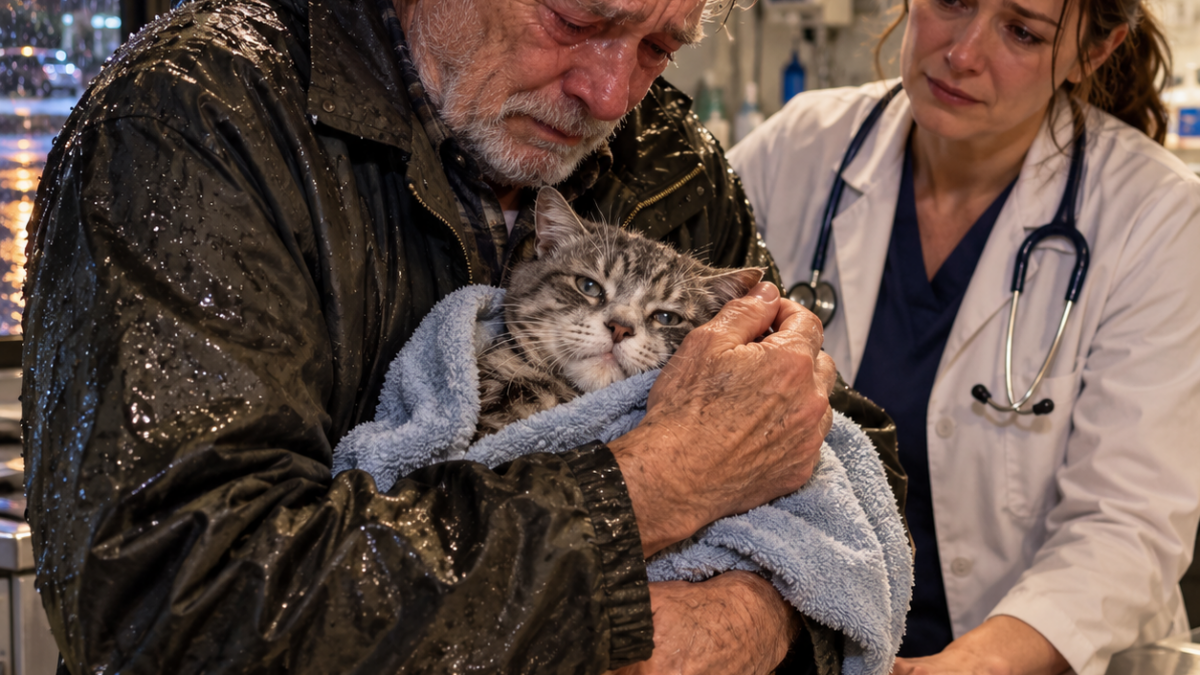
That night, when he laid the towel on the exam table and folded it back, Midge did not protest.
That frightened me more than any cry would have.
She was curled on her side inside the towel, her gray fur dull and uneven, her body so thin beneath it that she seemed almost weightless.
Her white chin rested against the edge of the towel.
Her cloudy eyes were half open.
Her breathing came in short, rough pulls.
Each breath tightened her whole body, as if even air had become work.
I set my keys on the counter.
Then I washed my hands, dried them, and approached her slowly.
“Hi, Midge,” I said.
Usually, she would have flicked an ear.
Maybe growled.
Maybe given me that offended little stare that seemed to say, You again.
That night, nothing.
Only breathing.
Dale stood across from the exam table, rainwater still dripping from his jacket onto the tile.
“She didn’t eat today,” he said.
His voice was careful.
Too careful.
“Wouldn’t drink much either. She tried, but then she just sat there. I thought maybe if I got her here fast enough…”
He stopped.
There are sentences people cannot finish because finishing them would make them real.
I nodded and began the exam.
Slowly.
Gently.
The way I always do when I already know the answer but wish I did not.
Midge had been sick for a while.
Dale knew it.
I knew it.
We had been buying time, not winning.
That is one of the hardest truths in veterinary medicine.
Sometimes treatment is not a bridge back to health.
Sometimes it is a small lamp held against the dark.
Medication had helped at first.
Soft food helped.
Warming her meals helped.
Fluids helped for a while.
Pain medicine helped.
Dale helping her to the litter box helped.
The heated bed he bought after our January appointment helped.
Love helped.
It helped more than people think.
But love does not stop kidneys from failing.
It does not reverse age.
It does not rebuild a body that has been slowly, quietly shutting its doors.
Midge’s gums were pale.
Her body temperature was low.
Her muscles had wasted.
Her abdomen felt empty and tight.
Her dehydration was severe.
Her pulse was weak beneath my fingers.
She made one small sound when I pressed along her spine.
Not a meow.
Not even pain exactly.
A tired little breath.
A sound that told me she had reached the end of what she could carry.
Dale watched my face the whole time.
People do that.
They look at your eyes before they are ready for your words.
They think veterinarians have a face we use when there is still hope and another face we use when there is not.
They are right.
No matter how long you practice, you never fully learn how to hide the second one.
“Tell me what to do,” Dale said.
That is the part people think is hardest in my job.
It is not.
The hardest part is when someone still has hope in their voice and you have to answer without crushing them more than necessary.
I placed my hand gently on Midge’s back.
Her fur felt cool beneath my palm.
She breathed once.
Twice.
The third breath caught slightly before it came.
“Dale,” I said softly, “this isn’t about whether you can take care of her. I know you can. You already have.”
He looked down at the floor.
His boots were muddy.
Water gathered around them in a small dark crescent.
I kept my voice low.
“The problem is that she’s hurting now. And there isn’t a treatment left that is going to give her comfort back.”
His throat moved.
He swallowed hard.
“So I’m supposed to just let her go?”
I have heard that question in many forms.
Angry.
Accusing.
Hopeless.
Whispered.
Shouted.
Bargained through tears.
But Dale’s voice was not angry.
It was broken.
There is a difference.
Anger pushes outward.
Brokenness folds in on itself.
I said, “I think she’s stayed this long because she loves you. I really do. But she looks tired now. Very tired.”
That did it.
Not dramatically.
Not all at once.
He sat down in the chair by the wall as if his legs had gone out from under him.
One hand came up over his mouth.
He nodded once, fast, like he was trying to keep himself together in front of me.
But I was not a stranger.
Not really.
Not after all those years of watching the two of them come through my clinic door.
Not after seeing him carry her in every winter wrapped against the cold.
Not after hearing him apologize to her when I had to draw blood.
Not after watching him leave with printed instructions folded carefully into his coat pocket like they were legal documents.
People think relationships are always announced by big moments.
Often, they are built quietly, appointment by appointment, ordinary act by ordinary act, until one night in the rain you realize you have been trusted with the ending of a love story.
Dale lowered his hand.
“My wife brought her home,” he said.
I stayed still.
Sometimes people need permission more than answers.
He looked toward Midge, but I could tell he was seeing years instead of the exam table.
“Church parking lot,” he said. “Shelter event. Little cages under a white tent. Kids running around. My wife, Ellen, said we were just going to look.”
He let out something almost like a laugh.
“She always said that when she knew exactly what she was going to do.”
I smiled faintly.
Dale rubbed one hand over his jaw.
“Midge was tiny then. Scraggly little thing. Big ears. Mean as a hornet. Every other kitten was pawing through the bars trying to get attention. Not her. She sat in the back of that cage and looked offended anybody had put her there.”
“That sounds like Midge,” I said.
“It was Midge from day one.”
His eyes moved to the towel.
“I told Ellen no cat was getting on my couch.”
He paused.
“She got on my couch the first night.”
This time, I did smile.
Dale saw it and almost did too.
“Ellen said, ‘Well, Dale, she heard the rule and made her position clear.’”
For a moment, the room held something warmer than grief.
Then it passed.
Dale leaned forward, elbows on his knees.
“When Ellen got sick, Midge knew before I wanted to know. She stopped sleeping in the living room and started curling up on Ellen’s side of the bed. Wouldn’t leave her. After the hospital bed came to the house, Midge slept underneath it. If the nurse came in, she’d sit up like she was supervising.”
His voice thinned.
“After Ellen passed, I thought Midge would look for her. I thought maybe she’d wander room to room and cry.”
“Did she?”
He shook his head.
“No. She stayed with me.”
He pressed his palms together.
“Slept by my feet. Followed me to the kitchen. Yelled at me every morning till I got up. Some days, Doctor, that cat was the only reason I stood up.”
There it was.
The truth under the emergency.
The thing heavier than illness.
Dale was not only losing a cat.
He was losing the last daily witness to the life he had shared with his wife.
Midge had known Ellen.
Midge had slept on their couch, ignored their rules, lived inside their routines, watched over sickness, survived the funeral, and remained when the house became a house for one.
To anyone else, she was an old gray tabby.
To Dale, she was memory with a heartbeat.
He looked at Midge and said the saddest thing I heard all year.
“I think she stayed for me longer than she should have.”
I did not answer right away.
Because there are some sentences you do not rush to soften.
They deserve to be heard first.
Finally, I said, “Maybe she did. But I think you stayed for her too.”
He closed his eyes.
The rain hammered the roof.
Midge breathed in shallow, uneven pulls.
A car hissed past outside on wet pavement.
Dale said, “What happens now?”
I explained the process carefully.
The same way I always do.
No euphemisms that confuse people.
No cold clinical phrasing that makes grief feel unwelcome.
First, a sedative to help her relax and drift into sleep.
She would not be afraid.
She would not struggle.
Then, when she was deeply asleep and no longer aware of pain, the final medication.
Peaceful.
Painless.
Quick.
Her breathing would stop.
Then her heart.
Dale listened to every word.
He nodded.
Then he asked, “Can I hold her?”
“Of course.”
I wrapped Midge more securely in the faded blue towel and lifted her.
She weighed so little.
That is another cruelty of these moments.
How light they become.
After years of filling a life, they can be placed into your arms like a bundle of feathers.
I set her against Dale’s chest.
His hands came around her immediately.
Rough hands.
Work-worn.
Knuckles swollen with age.
A small scar across one thumb.
Hands that had fixed engines, stacked lumber, repaired gutters, shoveled snow, carried groceries, buried a wife, and now held a cat with more tenderness than many people ever allow themselves to show.
Midge’s head rested beneath his chin.
He bent over her.
For a while, he said nothing.
I gave him time.
Veterinary medicine teaches you that silence is not empty.
Sometimes it is the only room grief has left.
Finally, Dale whispered, “You can rest, sweetheart.”
His voice broke on the last word.
“You don’t have to take care of me anymore.”
Midge opened her eyes a little.
Only a little.
Her cloudy gaze shifted upward.
Then she leaned her head into his hand.
I will not say animals understand every word we say.
I do not know that.
But I know they understand tone.
They understand touch.
They understand the person who has been theirs.
Midge knew Dale.
That was enough.
Then I heard it.
So faint I almost thought the rain had hidden it.
A purr.
Not the strong, irritated motor she had once produced in my exam room when pretending she hated being scratched under the chin while clearly enjoying it.
This was barely there.
A thread of sound.
A little broken vibration against Dale’s chest.
He heard it too.
His face changed completely.
For one second, joy and pain met in the same expression.
“She’s purring,” he whispered.
“I hear her.”
His tears fell onto the towel.
I prepared the first injection.
I moved slowly and told him what I was doing before I did it.
Dale kept talking to her.
Not loudly.
Not dramatically.
Just the steady murmur of a man walking someone he loved to the edge of a dark room and making sure she did not enter it alone.
“You were a good girl,” he whispered.
Midge breathed.
“You kept Ellen company when she needed you.”
Another breath.
“You kept me company after.”
Her purr faded in and out.
“You made the house less empty.”
I gave the sedative.
Midge barely reacted.
Her body was too tired to resist comfort.
Dale stroked the top of her head with one finger.
“Remember when you knocked over that plant?” he asked her softly. “Ellen blamed me for leaving it too close to the edge. You just sat there in the dirt like you owned the whole mess.”
His mouth trembled.
“And the Christmas turkey. Lord, you were proud of yourself.”
Her breathing eased.
The tightness in her body began to soften.
“You never did like Doctor Harris,” he added.
I looked at him.
He looked at me through tears.
“No offense.”
“None taken.”
“She respected you,” he said. “That was different.”
I laughed once, quietly.
Midge’s head grew heavier against his arm.
The sedative was working.
Her face relaxed in a way I had not seen all evening.
The strained pull of each breath smoothed.
Her paws loosened.
Dale looked at me.
“She’s asleep?”
“Yes,” I said. “Deeply asleep.”
“She can’t feel it?”
“No.”
He nodded.
I gave him a few more moments.
He pressed his lips to her forehead.
Then he whispered something I could barely hear.
“Find Ellen, sweet girl.”
I prepared the second injection.
No matter how many times I have done it, I never treat that moment casually.
It is medical.
It is merciful.
It is also enormous.
A life that has been loved is ending in your hands.
That should never feel routine.
I gave the injection slowly.
Dale held Midge against his chest.
The rain kept falling.
A few seconds passed.
Her breathing changed once.
Then stopped.
I placed my stethoscope against her chest.
Listened.
Waited.
Listened again.
There was no heartbeat.
I removed the stethoscope and looked at Dale.
“She’s gone.”
He folded over her.
Not carefully now.
Not controlled.
He bent around that little body and cried in a way that made the exam room feel too small for grief.
Not loud at first.
Deep.
Old.
Like it had been stored in him for years, packed away behind chores, habits, pride, and the daily responsibility of feeding one small gray cat who needed him to keep going.
I stood beside him and did not touch his shoulder.
Some people need touch.
Some need space.
Dale had spent his life holding himself together.
I let him come apart without asking him to make me comfortable.
After a while, he looked up.
His face was wet.
He seemed embarrassed, which made my heart ache.
“I’m sorry,” he said.
“Don’t be.”
“I didn’t think I’d—”
“I know.”
He looked back down at Midge.
“She was just a cat.”
People say that when they are trying to protect themselves from the size of their own love.
I said, “No. She was Midge.”
That broke him again.
But softer this time.
He held her for nearly twenty minutes.
He told me more stories.
How Midge used to sleep in Ellen’s laundry basket.
How she once disappeared for six hours and was found inside a kitchen cabinet.
How she hated every cat food except the one brand that got discontinued, forcing Dale to drive to three towns buying leftover cans like a man preparing for war.
How she sat in Ellen’s chair after the funeral and stared at anyone who tried to sit there.
How she developed the habit of yelling outside the bathroom door because privacy offended her.
How she stopped sleeping in Ellen’s chair only after Dale began talking to her at night.
“I’d tell her about my day,” he said, wiping his face. “Like she cared.”
“She probably did.”
He gave me a look.
“She cared about dinner.”
“Also possible.”
That almost made him smile.
When he was ready, I asked about aftercare.
Private cremation.
Communal cremation.
Home burial, if local rules allowed.
He had already thought about it.
People often have, even when they do not want to admit it.
“I want her ashes,” he said. “If that’s okay.”
“Of course.”
“I thought maybe…” He stopped, cleared his throat. “Ellen’s buried at Maple Ridge. I thought maybe I’d scatter a little there. Not all. Just some.”
“That sounds beautiful.”
He nodded.
“I think Ellen would like that.”
I wrapped Midge in a clean soft blanket for transport.
Dale watched every fold.
Before I took her, he kissed the top of her head one last time.
“Thank you, my girl,” he whispered.
Then he let me lift her from his arms.
That is another moment people do not see.
The letting go after the goodbye.
The arms that do not know what to do once empty.
Dale stood slowly.
He picked up the faded blue towel.
It was empty now.
Just cloth.
But he folded it carefully and held it against his chest.
At the door, he turned back.
“Thank you, Doctor.”
“You’re welcome.”
“I know you stayed late.”
“It’s all right.”
He nodded.
Then he walked out into the rain carrying the empty towel.
I watched through the glass as he crossed the parking lot.
His shoulders looked smaller than when he had come in.
His truck headlights came on.
For a moment, he did not drive.
He just sat there.
Then the truck pulled away, red taillights blurring through the storm.
I locked the door.
The clinic was silent again.
But not the same silence as before.
I went back to exam room two.
The towel fibers were still on the table.
There was rainwater on the floor from Dale’s jacket.
A few tissues in the trash.
Syringe wrappers on the counter.
The chair by the wall slightly crooked.
I cleaned because that is what we do.
We clean the room so the next patient does not walk into the last family’s grief.
I threw away the wrappers.
Wiped the table.
Mopped the rainwater.
Straightened the chair.
Checked Midge’s paperwork.
Labeled everything properly.
Professional tasks.
Necessary tasks.
Then I closed the exam room door, leaned against it, and cried.
Not every case makes me cry.
That surprises people, but it is true.
It cannot.
If I fell apart over every loss, I could not do this job.
But some cases find the soft place no amount of training protects.
Dale and Midge did.
Maybe because I had watched them age together.
Maybe because he loved her so quietly.
Maybe because he said she had stayed for him longer than she should have.
Maybe because I have seen that before.
Animals staying.
People staying.
Both afraid to leave the other alone.
Veterinary medicine is full of love stories that do not look like love stories from the outside.
An old man and a gray cat.
A teenager and a three-legged dog.
A widow and a parrot who still says her husband’s name.
A truck driver and a mutt who has ridden a million miles in the passenger seat.
A child and a rabbit with one blind eye.
A woman sleeping on the floor beside a sick Labrador because the dog panics if she leaves.
These are not small loves.
They are domestic.
Ordinary.
Unphotographed most of the time.
But not small.
People often say, “I know it’s just a pet.”
They say it in exam rooms while crying.
They say it with guilt, as if grief has a hierarchy and they are afraid they have taken too much.
I always tell them the same thing.
Grief is not measured by species.
It is measured by attachment.
By routine.
By presence.
By the space left behind.
Midge had filled Dale’s mornings.
She had forced him out of bed.
She had watched him survive the death of his wife.
She had given him someone to feed, someone to complain to, someone to come home to, someone who needed him when he no longer knew who else did.
That is not “just a pet.”
That is a life braided into another life.
The next morning, Sarah noticed my eyes were swollen.
“Late case?” she asked.
I nodded.
“Dale Boone?”
I looked up.
She knew.
Everyone at the clinic knew certain pairs.
Dale and Midge.
Mrs. Alvarez and Chico.
Mr. Grant and his ancient beagle, Walter.
Some names become linked in a clinic’s memory.
“Yeah,” I said.
Sarah’s face softened.
“Oh no.”
We stood behind the reception desk for a moment.
No dramatic conversation.
Just the shared ache of people who had cared for an animal long enough to feel the loss.
Later that week, Dale came in to pay the bill.
He could have done it over the phone.
He came in person.
He looked tired.
Shaved, but not well.
His jacket was dry this time.
His hands held an envelope.
“How are you?” I asked.
People ask that after loss because we have no better phrase.
He looked at the floor.
“House is quiet.”
I nodded.
He handed the envelope to Sarah, then turned to me.
“I keep waking up early.”
“Midge’s breakfast time?”
“Yes.”
He gave a faint, embarrassed smile.
“First morning, I got all the way to the kitchen before I remembered.”
I said nothing.
He continued.
“I opened the cabinet anyway.”
His voice thinned.
“Don’t know why.”
“You were loving her on schedule,” I said.
He looked at me.
Then nodded slowly.
“Yeah,” he said. “Maybe so.”
A week later, Midge’s ashes came back.
The box was small.
Too small, as they always are.
I called Dale myself.
He arrived that afternoon.
He did not open the box at the clinic.
He just held it with both hands.
Sarah gave him a clay paw print we had made before cremation.
Midge’s paw.
Tiny.
Pressed into soft gray clay.
Dale touched it with one finger.
His face shifted.
Not breaking.
Not exactly.
More like remembering the shape of what was gone.
“She hated having her paws touched,” he said.
“She did.”
“She let you do this?”
“She was already at peace.”
He nodded.
“Good.”
At the door, he paused.
“I scattered a bit of Ellen’s ashes under the maple at the cemetery,” he said. “Years ago.”
I listened.
“I think I’ll take Midge there.”
“I think she’d like that.”
He looked at the box.
“She’ll probably complain about the car ride.”
“Probably.”
That time, he did smile.
Small.
Brief.
Real.
Months passed.
I thought of Dale often.
That happens after goodbye appointments.
You wonder about the person left behind.
You wonder if they are eating.
Sleeping.
Speaking to anyone.
You wonder whether they still hear paws in the hallway.
One afternoon in early spring, Dale came into the clinic without an appointment.
For one terrible second, I forgot Midge was gone and thought he had brought her in.
Grief does that.
It leaves habits in other people too.
He stood near the reception desk holding his cap.
“Doctor,” he said.
“Dale. Is everything all right?”
“I don’t know.”
That was honest enough to make me step out from behind the desk.
He looked toward the adoption board in our lobby.
We kept photos there from the local shelter.
Cats, dogs, rabbits sometimes.
Animals needing homes.
“I told myself I wasn’t going to look,” he said.
I waited.
“But there’s a cat at the shelter.”
Sarah glanced at me, then pretended to organize files.
Dale cleared his throat.
“Older one. Black and white. Missing some teeth. They say she doesn’t like other cats. Doesn’t like dogs. Doesn’t like children much either.”
I smiled.
“Sounds charming.”
“They said she hides when people come.”
“Did she hide from you?”
He looked embarrassed.
“No.”
“What did she do?”
“Bit my shoelace.”
I tried not to laugh.
He saw and almost smiled.
“Her name’s Ruthie,” he said. “They think she’s about eleven.”
“That’s a good age.”
He looked down at his cap.
“I feel like I’d be replacing Midge.”
There it was.
The guilt.
The loyalty we attach to grief.
“No,” I said.
He looked up.
“You would not be replacing Midge. No one can replace her.”
His eyes shone.
“But Midge taught you how to make room for a cat who needs you. That love doesn’t disappear because you use it again.”
Dale stood very still.
Then he nodded.
“Ruthie has kidney trouble starting.”
“Then she’ll need someone careful.”
“They said she needs medicine.”
“You’re good with medicine.”
“They said she may take months to settle.”
“You’re patient.”
He swallowed.
“You think Midge would mind?”
I thought of that gray tabby glaring at me from Dale’s arms.
“I think Midge would have strong opinions about everything. But I also think she knew you were worth keeping alive.”
He looked away.
Sarah cried quietly behind the filing cabinet.
Two days later, Dale adopted Ruthie.
He brought her in for an exam the following week.
She was a black-and-white cat with a torn ear, missing teeth, and the suspicious expression of a retired judge.
She hissed at me.
Dale looked almost proud.
“She’s got spirit,” he said.
“She certainly does.”
Ruthie bit my pen.
Then she tried to climb into Dale’s coat.
He held her awkwardly at first, as if part of him was afraid affection itself might be disloyal.
But when Ruthie tucked her head beneath his chin, his hand came up automatically.
Gentle.
Practiced.
A hand that remembered.
No animal replaces another.
But love, if we let it, becomes less like a single candle and more like a fire passed carefully from one lamp to the next.
Midge had kept Dale standing.
Ruthie gave him somewhere to carry the standing.
Years later, I still think about that rainy night.
Not because it was unusual in my profession.
Sadly, it was not.
I have helped many animals leave this world.
Old ones.
Sick ones.
Broken ones.
Beloved ones.
Each goodbye is different.
But Dale’s words stayed with me.
“She stayed for me longer than she should have.”
That sentence changed how I talk to people about end-of-life care.
Because sometimes the question is not whether an animal is loved.
The question is whether love has become the reason they are still enduring pain.
That is a terrible question.
A necessary one.
There are people who hold on too long because they are selfish.
But far more often, they hold on because they are afraid.
Afraid of the empty bed.
The silent house.
The unused bowl.
The morning routine with no one waiting.
The grief that will walk in the moment their companion leaves.
They are not trying to make their animal suffer.
They are trying to survive the goodbye.
So I tell them what I told Dale, in one form or another.
This is not about whether you love them.
I know you do.
This is not about whether you cared enough.
You did.
This is about pain.
Comfort.
Dignity.
The last gift.
People think helping an animal die means giving up on them.
I do not believe that.
Not anymore.
Sometimes fighting is love.
The medications.
The special food.
The late-night emergencies.
The fluids.
The blankets warmed in the dryer.
The pills hidden in treats.
The alarms set for midnight doses.
All of that is love.
But sometimes stopping is love too.
Sometimes the last kind thing we can do is take the pain into our own hearts and not make them carry it one more day.
That night, Dale Boone came into my clinic begging me to save his cat.
And I wanted to.
God, I wanted to.
I wanted another medication.
Another treatment.
Another week where Midge could yell at him from the kitchen and sleep at his feet.
Another morning where the house was not silent yet.
But her body had reached the place where medicine becomes delay, and delay becomes suffering.
So we saved what could still be saved.
Not her body.
Her peace.
Dale held her.
He told her she was loved.
He told her she did not have to take care of him anymore.
And in the arms of the person who had been her whole world, Midge laid down the pain she had carried long enough.
The rain kept falling outside.
The room grew quiet.
An old man lost his girl.
A tired cat found rest.
And for the rest of my career, I never again used the word “only” before the word “pet.”








