An Elderly Couple Let a Soaked 19-Year-Old Stranger Into Their Home During a Storm—At 7 A.M., They Opened the Door to Hundreds of Silent Bikers Lining Their Street.
An Elderly Couple Let a Soaked 19-Year-Old Stranger Into Their Home During a Storm—At 7 A.M., They Opened the Door to Hundreds of Silent Bikers Lining Their Street.
At seven in the morning, my wife and I stepped onto our porch expecting wet pavement, quiet birds, and the same tired street we had lived on for forty-one years.
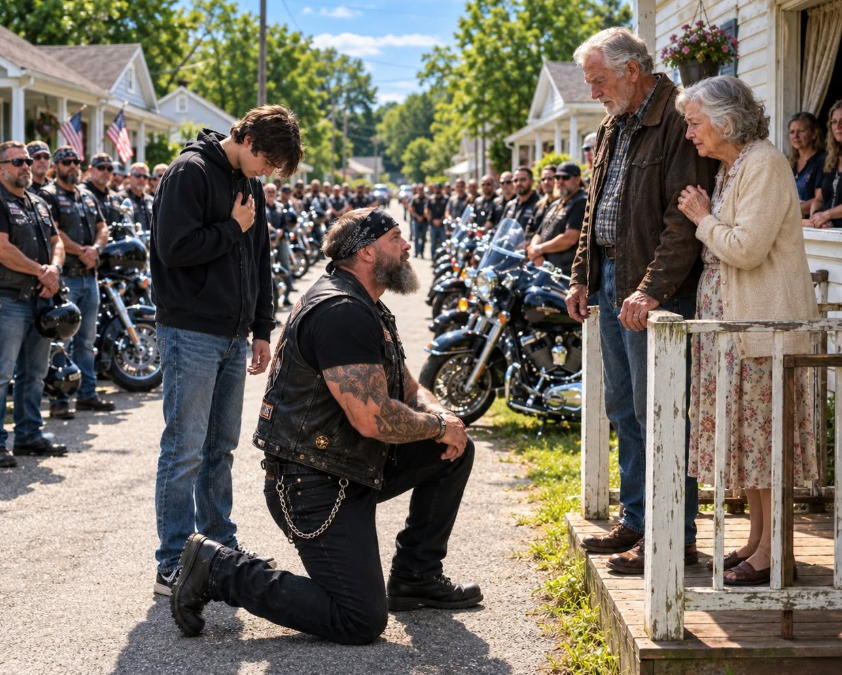
Instead, hundreds of motorcycles lined both sides of Birch Lane, and every neighbor who had shut his door the night before was watching through the curtains.
Then the biggest man in the crowd walked toward our porch, looked me in the eye, and dropped to his knees on the wet concrete.
My name is Arthur Bergmann.
Before that morning, I thought I understood what silence sounded like.
I was wrong.
Silence is not always the absence of noise.
Sometimes silence is a whole street holding its breath.
That morning, Martha and I heard the rumble before we saw anything. At first, I thought it was thunder. Not the sharp crack that follows lightning, but the deep kind that seems to rise from under the earth and crawl up through your bones.
Only the sky was clearing.
The storm from the night before had already moved east, leaving behind pale morning light, dripping gutters, wet maple branches, and the smell of rain-soaked asphalt lifting from the road.
I opened the front door because the whole porch seemed to tremble beneath my feet.
Then I looked down Birch Lane.
Motorcycles.
More motorcycles than I could count.
They lined both sides of the street from our little weathered house to the far intersection. They sat parked along curbs, in driveways, beside mailboxes, in front of houses whose owners had never once invited anything louder than a lawn mower into the neighborhood.
The engines were off.
Somehow, that made it worse.
If they had been roaring, if riders had been shouting, if someone had revved a throttle or played loud music, my mind might have made sense of it as a threat, a parade, or some mistake that had rolled into the wrong street.
But they stood still.
Hundreds of men and women in leather.
Helmets in their hands.
Patches across their backs.
Boots planted on wet pavement.
Faces turned toward our porch.
Waiting.
Behind curtains, our neighbors watched with the same nervous eyes they had probably used the night before when a drenched nineteen-year-old boy knocked on their doors and asked for help.
Across the street, Mrs. Halverson’s blinds trembled.
Two houses down, Mr. Crane stood behind his storm door, not opening it, not stepping outside, just peering through the glass.
Martha’s hand found mine before I reached for it.
She squeezed hard.
“Arthur,” she whispered.
I straightened my back.
That was an old habit.
My hips had gone bad, my hands had stiffened, and stairs had become negotiations, but my spine still remembered pride. A man stands straight when he does not want fear to become public.
From the center of the crowd, the largest man I had ever seen swung one leg off his motorcycle and started walking toward our house.
He was broad enough to make the leather vest across his shoulders look like it belonged to someone smaller. His beard was trimmed close. His dark hair had gray at the sides. His boots hit the wet pavement with slow, heavy certainty.
He did not look left.
He did not look right.
He looked only at us.
At me.
At Martha.
I heard three neighbors gasp when he reached the bottom of our walkway.
I do not blame them.
I nearly forgot to breathe myself.
The man stopped six feet from the porch steps.
He looked at me.
Then at my wife.
Then he sank to his knees.
Right there on the wet concrete.
A whole street froze.
No motorcycles.
No voices.
No doors opening.
Nothing but the last drops of rain falling from our porch roof and my wife’s breath catching beside me.
I did not know what to do with a man like that kneeling before me.
PART2:
I had spent my life working around machines, steel, oil, noise, and men who did not kneel unless something inside them had broken or something sacred stood in front of them.
This man did not look broken.
He looked grateful.
And that frightened me more.
Twenty-four hours earlier, I had never heard his name.
Twenty-four hours earlier, I had never seen his son.
Twenty-four hours earlier, Martha and I had been two old people in a small house at the end of Birch Lane, trying to stretch pension checks, hide medical bills from each other badly, and keep winter from finding every crack our house had developed over the years.
We were not heroes.
I need that understood.
People like to turn ordinary kindness into legend afterward because it makes the world feel better organized. They want villains behind locked doors and heroes opening them. They want great men arriving at sunrise with engines and gratitude.
But the truth is smaller.
The truth is, my wife saw a cold boy in the rain.
And we had towels.
Martha and I had lived in that house for forty-one years.
We raised our son there.
Daniel.
Even now, after all these years, his name still sits differently in my mouth.
Daniel died on a Tuesday in November, the kind of ordinary day that gives no warning before it splits your life in two. We woke up. Drank coffee. Argued about whether the mail had come early. Martha told me I had left a cabinet door open. I told her she had been born noticing cabinet doors.
Then the phone rang.
Before.
After.
That is how life divided itself.
Daniel was twenty-three.
PART3:
A car accident on a slick road outside town.
Gone before we reached the hospital.
People said no parent should have to bury a child.
They were right.
They were also useless.
After Daniel, our house did not stop being home, but it became quieter in ways we did not know how to repair. His bedroom became storage because neither of us could stand to keep it untouched and neither of us could stand to empty it completely.
His chair at the kitchen table disappeared first.
Then returned.
Then disappeared again.
Laughter still came sometimes, but thinner, like winter daylight getting shorter and shorter until you look up one afternoon and realize it is dark before five.
We got older.
Everyone does, if they are lucky and unlucky at the same time.
I worked thirty years in a machine shop before my hips started making decisions my pride disagreed with. Martha kept books for a medical practice until the place changed owners and the new man brought in his own staff with white smiles and young shoes.
We were not poor in the dramatic way people write about.
We managed.
But managing is its own kind of exhaustion when it lasts long enough.
The furnace needed replacing.
The gutters rusted at the corners.
The porch step sagged in the middle.
There were doctor bills I had not shown Martha because she already slept badly, and if she knew the full amount, she would start doing math at three in the morning with a pencil and trembling hands.
We came through things because that is what people of our generation were trained to do.
You get up.
You make coffee.
You patch what leaks.
You say it could be worse.
You do not ask for help unless the house is actively burning.
But one thing never became thin in our house.
The instinct to help.
Martha always said it like it was the most obvious law in the world.
“If someone needs what you have, you give it.”
Not charity.
Not heroism.
Just the correct order of things.
That is why, when she saw the boy outside in the storm, she did not ask whether helping him would become complicated.
She asked me for towels.
His name was Leon Brand.
I learned that later.
At the time, he was only a shape on the sidewalk.
Nineteen years old.
Soaked through.
Trying to stand upright in rain hard enough to beat leaves flat against the street.
Leon had made one of those decisions decent young men make before the world teaches them the cost of decency. A classmate named Kai had gotten his wallet stolen outside the library and needed to get across town. Leon gave him his last eight dollars and his bus pass without hesitation.
He figured he could walk the six miles home.
Uncomfortable, yes.
Dangerous, no.
That was what he thought.
The sky changed when he was halfway there.
Not gradually.
Suddenly.
The temperature dropped like someone had opened a door to winter. Wind stopped being weather and became force. Lightning struck so close that every tree along the street lit white for half a breath.
Then the rain came down in sheets.
Not drops.
Sheets.
The kind of rain that soaks a jacket in under a minute and turns shoes into buckets.
Leon checked his phone.
Eleven percent battery.
He thought of calling his father, then decided against it.
His father worked most evenings until ten, and Leon did not want to pull him from a shift over something he had gotten himself into.
That part stayed with me.
A child can love a parent so much that he tries not to need him.
Sometimes that is exactly how children get into danger.
Leon reached our neighborhood sometime after six.
By then, Birch Lane had turned silver and black under the storm. The houses glowed warmly from inside, every window a promise that safety existed somewhere, even if not for everyone.
He went to the first door.
A man looked through the glass.
Saw a drenched young man in dark clothes.
Pulled the blind down.
Leon went to the second house.
A woman opened the door only a crack.
He explained that he was trying to get home and only needed a dry place to stand until the worst of the storm passed.
She said, “We can’t let strangers in.”
Then the door clicked shut.
Not slammed.
That might have been easier to forgive.
Just clicked.
The small, final sound of a decision that had already decided it was reasonable.
I did not know any of that while it happened.
I only knew what Martha saw through the kitchen window.
She had been washing supper dishes when movement caught her eye. At first, she thought the storm had thrown a branch or a trash lid into the yard. Then she realized the movement was upright.
A person.
Standing on the sidewalk in front of our house.
Not walking.
Standing.
As if he had run out of places to go.
“Arthur,” she called.
I came from the living room, my left hip complaining the way it always did when rain was near.
“What?”
“Look.”
I leaned over the sink.
The boy outside was soaked to the skin. His arms were crossed over his chest, not defiantly, but the way people do when trying to hold warmth inside by force of will. His head was bowed. Water ran from his hair into his eyes.
He looked exhausted.
And terribly young.
I watched him for maybe three seconds.
Then I said, “Get the big towels from the hall closet.”
Martha was already moving before I finished the sentence.
I pulled on my coat and opened the front door.
The storm struck my face cold and hard. My bad hip did not appreciate the wet steps. I went down anyway.
“Son!” I called over the yard.
The young man turned.
He had the expression of someone trying very hard not to look as relieved as he felt.
I waved him toward the porch.
He hesitated.
Only for a second.
Long enough to decide whether pride still had a useful function.
Then he crossed the yard.
Up close, I could see his hands shaking.
“You need to come in,” I said.
“I don’t want to trouble you, sir.”
“Then don’t drip on my porch all night arguing.”
That got the smallest laugh from him.
Martha met us at the door with towels already open in both hands.
“Oh, you poor thing,” she said.
Leon flinched at the kindness.
Some people are unprepared for tenderness when they have been bracing for suspicion.
“You don’t know who I am,” he said.
Martha looked him straight in the face.
“I know you’re cold.”
That was the end of the interview.
We brought him inside.
Martha gave him Daniel’s old sweatpants and a sweatshirt from the storage box I had not opened in years. I saw the sweatshirt in her hands and felt something twist in my chest, but I said nothing.
She said nothing either.
Grief has its own language after forty-one years of marriage.
Leon changed in the bathroom and came out looking smaller than before, which is what dry clothes sometimes do to a young man who has been trying to seem fine. The sleeves hung a little short. Daniel had been broader through the chest.
Leon noticed the photograph in the hallway before he returned to the kitchen.
I saw him pause.
He did not ask.
That was respectful.
Martha set soup in front of him.
Vegetable beef, leftover from the night before.
Bread.
Butter.
Hot tea because Martha believed hot tea could correct almost any human difficulty if applied quickly enough.
Leon apologized four times in the first three minutes.
“I’m sorry for coming in like this.”
“I’m sorry about the floor.”
“I’m sorry to bother you.”
“I’m sorry, ma’am.”
Martha set the dish towel down and looked at him with the authority that had once made Daniel sit up straight at this very table.
“You do not apologize for needing a safe place.”
After that, Leon stopped apologizing and started eating.
The storm hurled itself against the windows. Rain hammered the gutters. Branches scraped the siding. Somewhere down the street, something metal rolled along the pavement with a hollow bang.
But inside the kitchen, the world became small and warm.
Soup steam.
Wet shoes by the door.
The little fireplace in the next room giving off its uneven heat.
Martha sitting across from the boy with both hands around her tea mug.
Me pretending not to watch him too closely because young men do not like being studied while they recover from almost being afraid.
We talked.
Really talked.
I asked about school.
Leon told me he was taking evening courses at the community college and studying engineering. His father had once told him that people who understood how things were built got a say in what came next.
I liked that.
I told him I had worked in machine shops most of my adult life and that there was something honest about a thing functioning the way it had been built to function.
Leon laughed.
A real laugh.
Not polite.
Real.
Martha noticed the way he spoke about his father.
Not with resentment.
Not with the complicated tightness some young men carry when talking about the men who raised them.
He spoke with simple admiration.
“My dad always says you pay your debts,” Leon said, tearing off a piece of bread. “Not just money. Anything. If somebody stands beside you when they didn’t have to, you remember.”
“What does your father do?” Martha asked.
Leon smiled slightly.
“A little of everything. Mechanic work. Security sometimes. Hauling. Helping people who need help and pretending it’s not helping.”
“That sounds familiar,” Martha said, looking at me.
I ignored her.
Leon added, almost casually, “He rides too. Motorcycles. He has a lot of brothers.”
I thought he meant friends.
I nodded and went back to my soup.
Leon did not mention a club.
He did not mention patches.
He did not mention that his father, Raymond Brand, was the president of a biker brotherhood spread across three counties and connected to enough people that a phone call could move faster than weather.
Maybe Leon did not think to say it.
Maybe it did not matter to him.
The son sees the father before the rest of the world sees the reputation.
Before Leon left, he stood once more in the hallway and looked at Daniel’s photographs.
Daniel at seventeen, holding a fish too small to brag about.
Daniel beside his first car, an old blue thing that never started on cold mornings unless threatened.
Daniel in his graduation shirt, hair too long, smile too open, before the world had taken anything serious from him.
Leon’s face changed in a way I did not expect.
Not pity.
Something gentler.
He understood, I think, that we had not invited him into an empty house.
We had invited him into a house with a missing place at the table.
When his father’s truck finally pulled up at the curb, the storm had softened but not ended.
Leon had called him from our kitchen once his phone had warmed enough to cooperate. I heard only Leon’s side of the conversation.
“I’m safe.”
“No, really.”
“An older couple let me in.”
“Yes, they fed me.”
“Yes, Dad.”
“Their names are Arthur and Martha.”
After that, Leon mostly listened.
When he left, he shook my hand with both of his.
“Thank you, sir.”
“You get home safe.”
He turned to Martha.
“Thank you, ma’am.”
Martha waved him off.
“You come by in better weather sometime, so I can see what you look like dry.”
He smiled.
Then, just before stepping off the porch, he looked back at her and said quietly, “My father never forgets a kindness.”
Martha smiled.
“You tell him we only did what anyone should have done.”
Leon nodded.
But something in his eyes told me he knew better.
Martha and I stood on the porch after the truck pulled away. The rain had become a fine mist, and the street was very still. Lights glowed behind curtains. The houses that had refused Leon looked peaceful again.
Martha folded her arms against the cold.
“He was a good boy,” she said.
“Yes.”
“Daniel would have liked him.”
I did not answer right away.
That sentence reached places in me I usually kept locked.
“Yes,” I said finally. “He would have.”
Across town, Raymond Brand was not a man who panicked.
I learned that later too.
He was disciplined, not calm by nature. There is a difference.
Calm means the storm does not reach you.
Discipline means the storm reaches you and finds everything tied down.
When the weather turned and Leon did not answer calls or texts, Raymond sat down and thought through what he knew. Within ten minutes, he reached Kai and learned about the stolen wallet, the bus money, the long walk home.
Then he drove the route.
In that storm.
Slowly.
Checking side streets.
Watching ditches.
Looking behind bus shelters, closed storefronts, gas stations, every place a nineteen-year-old might have tried to escape rain if pride had not carried him too far.
By the time Leon called, Raymond was six miles into the search and living in that terrible space between control and losing it.
He answered before the first ring ended.
Leon said he was safe.
Warm.
Inside.
An older couple had taken him in.
Raymond asked if we had fed him.
Leon said yes.
Raymond asked if we had warmed him.
Leon said yes.
There was a silence after that.
Leon later told me his father’s voice changed.
Got quieter.
Not softer exactly.
He asked for our names.
Leon said, “Arthur and Martha Bergmann.”
Raymond repeated both names slowly.
Arthur.
Martha.
The way a man repeats something he intends to preserve.
That night, Raymond told his closest men what happened.
Plainly.
No decoration.
His son had been caught in a dangerous storm. He had knocked on doors and been turned away by people with warm rooms behind them. Then two old people with very little opened everything they had because he was cold.
Raymond did not call for revenge.
He did not ask anyone to frighten the neighborhood.
He called it a debt.
And in his world, debts were not left unpaid.
By midnight, the story had spread.
By four in the morning, trucks were being loaded.
By six, motorcycles were forming along the highway.
That was the part none of us knew when we went to bed.
Martha and I slept badly because the storm kept rattling the gutters and because Daniel’s old sweatshirt was now draped over the chair near the door, damp at the cuffs from someone else’s son surviving the night.
At seven, thunder came up through the porch boards.
And there was Raymond Brand on his knees in front of our house.
I went down the steps slowly.
My hip protested.
I ignored it.
When I reached him, I said the first honest thing that came to mind.
“Get up. I’ve never been comfortable looking down at another man.”
A few riders shifted.
Raymond looked up at me.
His eyes were darker than I expected, tired and wet in a way that did not seem to embarrass him.
He stood.
He was taller than me by several inches and built like a man who had broken hard things for a living and sometimes regretted which things had broken.
“Arthur Bergmann?” he asked.
“Yes.”
“Martha?”
My wife came down one step and stopped beside me.
Raymond looked at her too.
Then he placed one hand over his chest.
“My name is Raymond Brand. Last night, you took my son into your home.”
Martha said, “He was cold.”
Raymond nodded once.
“That’s what he told me.”
“He was polite,” she added.
At that, Raymond’s face changed.
I did not understand why until later.
A good report about a man’s child can sometimes reach deeper than praise for the man himself.
“He said you fed him,” Raymond said.
“We had soup.”
“He said you gave him dry clothes.”
“My wife did.”
“He said you told him not to apologize for needing a safe place.”
Martha looked down.
Raymond’s voice became rough.
“You gave my son what the rest of the world would not give him when he needed it.”
He turned slightly and gestured toward the street.
The riders began moving.
Not toward us.
Toward trucks parked farther down the lane.
Doors opened.
Tailgates dropped.
Men and women in leather began unloading boxes.
Food.
Cleaning supplies.
Firewood.
Cases of bottled water.
Toolboxes.
A woman with a medic bag walked toward our porch and set it gently near the railing.
Two men in work clothes went straight to the rusted gutters and began studying the corners like surgeons examining a patient.
Someone knelt beside the porch step.
Someone else walked around the side of the house with a flashlight and peered into the basement window toward the furnace.
I stared.
Martha’s fingers found mine again.
“What is this?” I asked.
Raymond faced me.
“This is a debt being paid.”
“We didn’t lend you anything.”
“You opened a door.”
“That’s not something you repay.”
“Exactly,” Raymond said. “That is why it must be repaid properly.”
I shook my head.
“No. We can’t accept all this.”
Raymond looked at me as if he had expected that answer.
“You did what anyone should have done,” he said.
“Yes.”
“But not everyone did.”
Across the street, a curtain dropped shut.
Raymond noticed.
So did I.
The whole street had noticed.
He lowered his voice.
“My boy knocked on three doors before yours. Maybe more. People looked at him and saw danger. You looked at him and saw cold. That tells me what kind of people you are.”
Martha pressed her lips together.
“We’re ordinary people,” I said.
Raymond nodded.
“I’ve found ordinary people do most of the saving.”
Then he told us what they had done.
The remaining balance on our mortgage had been paid.
I did not understand the sentence at first.
It sounded like a different language.
“What?”
“Your mortgage,” Raymond said. “It’s done.”
My chest tightened.
“No.”
“Yes.”
“You can’t do that.”
“I already did.”
“How did you even—”
“I have brothers who know paperwork.”
“That sounds illegal.”
Raymond almost smiled.
“It wasn’t.”
Before I could argue, he continued.
“The medical bills you’ve been hiding from your wife are being handled.”
Martha turned toward me.
“Arthur.”
I looked away.
That was not a conversation I wanted to have in front of two hundred bikers and Mrs. Halverson’s trembling blinds.
Raymond spared me nothing.
“The furnace company will be here before noon. Your gutters are being replaced. The porch step is being fixed now. The roof will be inspected by ten. A nurse practitioner is here if either of you needs anything checked after last night’s cold.”
Martha began to cry quietly.
Not dramatic crying.
Martha has never cried dramatically in her life.
She pressed her fingers to her lips, and tears slipped down her face while she looked at the boxes, the people in our yard, the impossible morning that had arrived without warning.
I sat down on the porch step because my legs had become unreliable.
The step bent beneath me the way it always had.
One of the men repairing it paused respectfully, then went back to work around me.
“You don’t even know us,” I said.
Raymond looked down at me.
“You didn’t know Leon.”
That closed my mouth.
There are answers that do not feel like answers until they remove every excuse standing near them.
Leon stood beside his father’s motorcycle near the curb.
He tried not to show that his eyes were wet.
He failed.
I was glad he failed.
Young men should know tears do not undo them.
Two older riders lowered their heads and knelt beside Raymond’s bike.
Then others followed.
Not all.
Enough.
A whole line of men and women in leather kneeling in a quiet wet street because two old people had opened a door.
The neighbors watched from behind glass.
I thought about the man who had pulled down his blind.
I thought about the woman who said strangers could not come in.
I thought about all of us, really.
Because fear is easy to judge after danger has passed.
The truth is, I knew fear.
I had felt it when Raymond walked toward me.
I had felt it when the street filled with engines.
The difference was not that Martha and I were fearless.
The difference was that the boy at our door had been colder than we were afraid.
That was all.
Raymond reached inside his jacket and took out a patch.
He held it carefully, not like a trinket, but like a thing with weight.
“This is not about motorcycles,” he said. “Not the way people think. Not noise. Not leather. Not reputation. It means family. From today forward, everyone who rode to Birch Lane considers Arthur and Martha Bergmann their own. If you need anything, day or night, you call.”
I stared at the patch.
Black fabric.
Threaded emblem.
Worn at the edge as if it had passed through many hands before mine.
“No charity,” Raymond said. “Brotherhood.”
I held it carefully.
There are objects you know are important before you understand why.
Martha stood on the porch beside Leon then.
She had pulled him into a hug at some point. I had not seen it happen, but there he was, bent slightly so she could hold him properly.
She looked over his shoulder at Raymond and called, “You raised a good son.”
Raymond went very still.
I watched the words hit him harder than the mortgage, harder than the street full of witnesses, harder than all the gratitude he had brought to our door.
He looked at Martha for a long time.
Then he nodded once.
Slowly.
As if she had given him something he had needed for years and never asked for.
“Thank you,” he said.
That was the real repayment, I think.
Not the furnace.
Not the bills.
Not the groceries.
A good son returned safely and called good by a mother who had lost her own.
The rest of the morning moved like a dream built out of work boots and kindness.
Men climbed ladders.
Women organized food in our kitchen like they had always known which cabinet held the flour.
Someone fixed the porch step so quickly I suspected it had been personally offending him.
A mechanic looked at my old truck and said, “This thing still running out of loyalty or spite?”
“Both,” I said.
“Respect.”
Martha tried making coffee for everyone until a woman named Denise gently took over and produced three large urns from the back of a van.
“You came with coffee urns?” Martha asked.
“Honey,” Denise said, “we came with a plumber.”
She was not joking.
By noon, our little house had more people inside and around it than it had seen since Daniel’s funeral.
That thought should have hurt.
It did.
But not only.
Pain is strange that way.
Sometimes it opens the same door twice and lets different air in the second time.
Leon stayed near Martha most of the day.
Not because he was helpless.
Because she kept finding things for him to carry.
That is how Martha handles emotion.
She assigns it a task.
“Take this box to the pantry.”
“Hand Arthur those screws.”
“Tell that man on the ladder to come eat before he falls off from hunger.”
Leon obeyed every instruction like his life depended on it.
At one point, I found him in the hallway looking again at Daniel’s photographs.
This time, I stood beside him.
“That was our son,” I said.
“I figured.”
“Daniel.”
Leon nodded.
“He looks like he laughed a lot.”
“He did.”
I looked at the picture.
A young man frozen in sunlight.
“He died a long time ago.”
Leon did not rush to say he was sorry.
Most people do, because silence scares them around grief.
Instead, he said, “My dad says some losses don’t get smaller. You just build stronger walls around them.”
“That sounds like him.”
“He lost people too.”
“I imagine he has.”
Leon looked toward the kitchen where Martha was arguing with a biker about whether six loaves of bread was too much bread.
“She reminds me of my grandmother,” he said.
“That a compliment?”
“The highest one.”
I had to look away for a second.
Later, Raymond and I sat on the porch while the street slowly emptied of motorcycles.
Not all at once.
Riders came and went through the afternoon.
Some left tools.
Some left phone numbers.
Some left without saying anything because not everyone knows how to stand still inside gratitude.
Raymond handed me a cup of coffee.
I accepted it.
“My son said you asked about school,” he said.
“I did.”
“He likes when people ask him real questions.”
“Most people do.”
Raymond looked down the street.
“He gave away his bus money because someone else needed it.”
“He told us.”
“I taught him that.”
“You should be proud.”
“I am.”
He said it plainly.
No performance.
Then his face changed.
“I also taught him not to bother me unless it was serious.”
I heard the thing beneath the thing.
“Children misunderstand strength sometimes,” I said.
“So do fathers.”
We sat in silence for a while.
A repaired gutter gleamed above us. The porch step beneath my boots no longer bowed.
Raymond said, “I was still looking when he called.”
“I know.”
“I thought I had lost him.”
There it was.
The real sentence.
Not gratitude.
Not debt.
Fear.
A father’s fear, stripped of leather, engines, reputation, and men standing at attention behind him.
“I know something about that,” I said.
Raymond looked at me.
I did not explain.
I did not need to.
His eyes moved once toward Daniel’s photograph visible through the open door.
“I’m sorry,” he said.
“So am I.”
That was all.
It was enough.
Months passed.
The furnace ran clean for the first time in three winters.
The gutters held through the next hard rain.
The porch step no longer sagged.
Our truck stopped making the noise I had been pretending not to hear.
The medical bills disappeared from the drawer where I had hidden them badly, though Martha still gave me a look every time she opened that drawer, as if the paper itself had betrayed our marriage.
Leon started coming by on Sundays.
Usually with coffee and whatever pastry Martha had mentioned liking the week before. He claimed he happened to be in the area.
Nobody believed him.
He and I sat on the porch and talked about machines, school, work, and the future. He brought me problems from his engineering classes, and I pretended to complain while enjoying every second. Martha fed him as if he had been undernourished by the entire world.
Sometimes Raymond came too.
Not every week.
Often enough that the sound of one motorcycle turning onto Birch Lane stopped making neighbors reach for curtains.
The first time he came alone, he brought a small part for our furnace “just in case,” though I later learned it was expensive and not something any normal person carried casually.
The second time, he brought Martha a bag of apples from someone’s orchard.
By the fifth visit, he stopped knocking and started calling from the porch, “Anybody home?”
Martha would shout, “Only if you wiped your boots.”
It became normal.
That is the miracle people miss in stories like this.
Not the dramatic morning.
Not the street full of motorcycles.
The miracle is what becomes ordinary afterward.
A lawn mowed before we woke up.
A jar of soup left on the porch.
A rider checking the furnace before the first snow.
Leon at our kitchen table with textbooks spread beside a plate of Martha’s cookies.
Raymond and me drinking coffee in silence because men do not always need words to admit affection has entered the room.
Our house filled again.
Not the way it had before Daniel.
Nothing returns exactly.
But homes can hold more than one kind of love without betraying the first.
Daniel’s photograph stayed in the hall.
It still carried its full weight.
Love and loss do not dissolve just because new people step inside the house.
They do not get replaced.
They get company.
That is different.
Now there were other photographs too.
Leon at the kitchen table, laughing with a pencil behind one ear.
Raymond and me on the porch, both of us holding coffee like it had been issued by command.
Martha standing between two women in biker jackets, laughing so hard one hand blurred in the picture.
The first morning all those motorcycles came to Birch Lane, my neighbors were afraid.
I was afraid too.
But over time, the sound changed.
What once made the whole street grab curtain edges became something else.
Family arriving.
That is what it sounded like to me.
Family coming home.
One spring morning, nearly a year after the storm, I found Mr. Crane standing at the edge of my yard.
He was the man who had pulled down the blind on Leon.
He looked older than I remembered, though maybe guilt ages a person when it has nowhere to go.
“Arthur,” he said.
“Morning.”
He looked toward the porch, where Raymond had repaired the railing two weeks earlier.
“Quite a lot changed around here.”
“Yes.”
He swallowed.
“I didn’t know who the boy was.”
There it was.
I rested both hands on the rake handle.
“Neither did we.”
Mr. Crane looked down.
The sentence had done what it needed to do.
He nodded once and walked away.
I did not call after him.
Forgiveness is not always a conversation.
Sometimes it is letting a man carry the truth without helping him set it down too quickly.
Martha asked me later if he apologized.
“Not exactly.”
“Good,” she said.
I looked at her.
“Good?”
“An apology might have made him feel finished.”
That was Martha.
She could see clean through people when she wanted to.
I think about that night often.
Not because we saved Leon’s life in some grand way.
Maybe another door would have opened eventually.
Maybe his father would have found him ten minutes later.
Maybe the storm would have passed before real harm came.
Maybe.
But maybe is not a plan you leave a cold child standing in.
What I think about is the moment before action.
The second at the kitchen window when Martha saw him.
The three seconds I watched him from over the sink.
That is where most of life happens, I think.
Not in the big speeches afterward.
Not in the morning full of motorcycles.
Not in the patch Raymond placed in my hand.
In the small instant when you decide what another person’s need is allowed to mean to you.
Threat.
Inconvenience.
Risk.
Or simply need.
Martha and I did not know Leon was Raymond Brand’s son.
We did not know a whole brotherhood would remember our address.
We did not know our mortgage would vanish, our furnace would be repaired, our house would fill with people, or our Sundays would change.
We did not know any of that.
We knew only that we were warm and dry, and he was not.
That should have been enough for anyone.
It was enough for us.
Thirty years earlier, we lost a son.
On a stormy night, without knowing what would follow, we opened our door to someone else’s.
We did not ask who he belonged to.
We did not ask what he could repay.
We did not ask whether helping him was convenient.
We saw a young man shivering in the rain, and for once in a world that makes kindness feel complicated, the answer was simple.
Get the towels.
Open the door.
Put soup on the stove.
Years have passed now, and my hips are worse. Martha says my hearing is going, though I maintain she has simply started speaking from inconvenient rooms.
Leon finished school.
He became the kind of engineer who still gets grease under his nails because he believes machines should be understood by the people designing them.
Raymond still rides.
Not as far as he used to.
None of us goes as far as we used to.
But every so often, usually on a Sunday afternoon, I hear that low rumble begin at the end of Birch Lane. Martha looks up from whatever she is doing and tries not to smile too soon.
I step onto the porch.
The railing is solid now.
The step does not sag.
Daniel’s photograph watches from the hallway behind me.
And down the street comes family we never expected, born from one night of rain, one boy with no bus money, and one door opened before fear could win.
People say money can buy security.
Maybe.
Power can force respect.
Sometimes.
But kindness creates something neither money nor power can produce.
Loyalty.
Real loyalty.
The kind that arrives at seven in the morning with tools and groceries.
The kind that fixes a porch step before you can argue.
The kind that mows your lawn before you wake.
The kind that stays.
That morning, when Raymond knelt in front of our porch, I thought he had come to thank us.
I know better now.
He came to recognize us.
There is a difference.
A thank-you ends a debt.
Recognition begins a relationship.
And the truth is, we became part of that brotherhood long before Raymond gave me the patch.
We became part of it the moment Martha opened the hall closet for towels.
The moment I stepped into the rain.
The moment a shivering boy crossed our yard and learned that at least one house on Birch Lane still knew what a door was for.
So if you ask me what changed everything, I will not say the motorcycles.
I will not say the money.
I will not say the patch.
I will say this:
A storm came.
A boy knocked.
Some people saw a stranger.
We saw someone’s son.








